Machine Learning · arXiv:2609.00829 v1 · submitted 1 Sep 2026 · 15 references
HarnessEvolve: Learning from Reference Trajectories for Reliable Agent Self-Evolution
The paper says
“Self-evolving agents advance toward autonomy by optimizing their harness—prompts, skills, tools, and execution logic—based on environmental feedback.”
more of the abstract
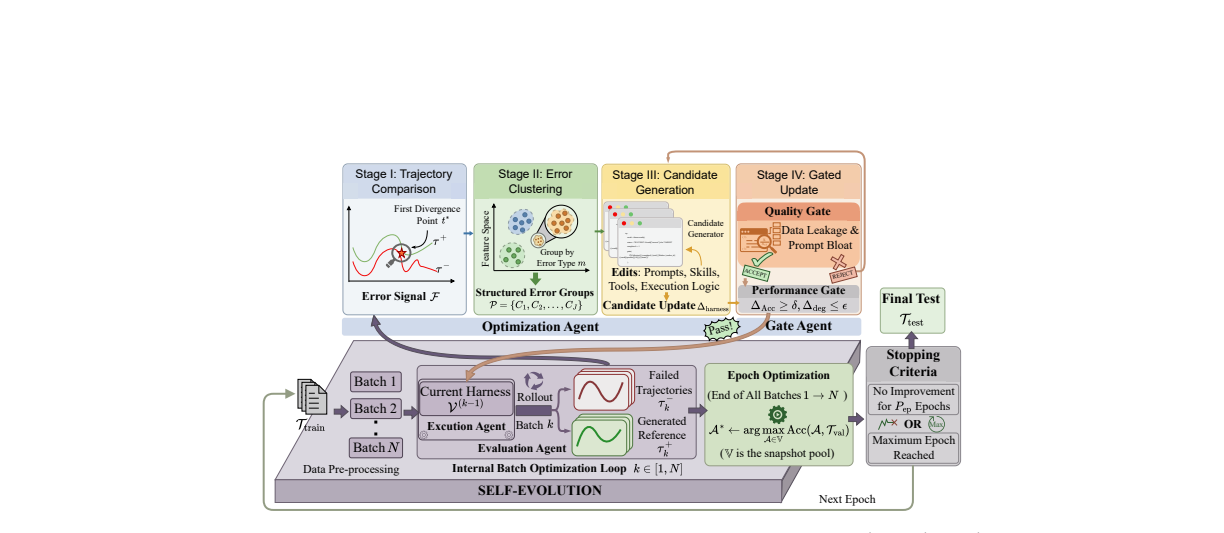
This paradigm, however, is hampered by three challenges: credit assignment failure, where terminal success/failure feedback makes it ambiguous which step caused the error; shortcut learning, where agents memorize task-specific patterns rather than acquire generalizable capabilities; and catastrophic forgetting, where unguarded updates degrade previously acquired competence. In this paper, we introduce HarnessEvolve, a self-evolving framework that learns from reference trajectories to achieve reliable agent self-evolution. HarnessEvolve decouples the execution agent from the evolutionary pipeline, assigning execution, evaluation, optimization, and gating to independent agent modules, enabling generalizable and stable harness improvements. Specifically, HarnessEvolve overcomes credit assignment failure by generating reference trajectories (execution paths produced when given the ground-truth answers) and aligning failed executions against them to extract error signals, which are clustered to reveal systematic failure patterns. To prevent shortcut learning and catastrophic forgetting, candidate harness updates must pass two gates: a quality gate that filters data leakage and prompt bloat, and a performance gate that accepts each update if it improves on the current batch without degrading recent batches, with epoch-end validation on a held-out set selecting the best-performing accepted agent snapshot. We conduct extensive experiments on several benchmarks spanning open-domain and enterprise scenarios, using different models and agent frameworks. Results demonstrate that HarnessEvolve consistently outperforms state-of-the-art baselines across all benchmarks and settings, confirming reliability across task domains.
from the abstract
Pith says
Machine review · deepseek-v4-flash · 9 Sep 2026 · what was read was not recorded · not checked by a person
It can be wrong. Challenge this review or reply to it.
Holds up, with conditions. Plausible architecture, informative ablation, but the headline SOTA claim rests on single-run numbers, missing baselines, and an unvalidated LLM judge for its most important component. This line is wrong
3 major objections · 6 minor
How often objections from reviews like this one are right: not yet measured
Not checked: figures, code, what the 15 references say.
The paper says, at §4.2, Tables 1–2
The review did not quote this passage.
Pith says: Objection 1 of 3 · major
All accuracy numbers are reported as single-point estimates with no error bars, confidence intervals, or significance tests. The paper claims 'consistently outperforms state-of-the-art baselines across all benchmarks' but provides no indication of variability across runs, seeds, or data splits. Given that the baselines (e.g., GEPA, ACE) themselves may be sensitive to initialization and randomness, these results are insufficient to support the claim of consistent superiority.
more of objection 1
The authors should report means and standard deviations over at least 5 runs with different random seeds, or otherwise justify why the observed margins are robust.
The paper says, at §3.2–3.3, §4.2 (ablation M1)
The review did not quote this passage.
Pith says: Objection 2 of 3 · major
The largest component gain (reference-guided diagnosis, M1 drop from 86.9% to 57.8%) rests on the assumption that reference trajectories (generated by providing the ground-truth answer) are genuine counterfactual execution paths rather than answer-leaked shortcuts. The verification in §3.3 is performed by Aeval, an uncalibrated LLM judge.
more of objection 2
No human evaluation, agreement rates, false-positive/negative statistics, or leakage statistics on the generated references are reported. If Aeval misses answer leakage, the first-divergence diagnosis and the entire error signal are systematically corrupted. The absence of any validation of the reference trajectory quality undermines the core claim. The authors should (a) provide human evaluation of a random sample of reference trajectories, (b) report the percentage of tasks for which references were generated and the per-task verification outcomes, and (c) conduct a sensitivity analysis varying the verification criterion.
The paper says, at §3.5, Eq. (1)
The review did not quote this passage.
Pith says: Objection 3 of 3 · major
The performance gate uses two thresholds (δ = 0.0, ε = 0.025) that are reported as fixed constants. The choice δ = 0.0 means any non-negative improvement is accepted, which may include noise-level fluctuations. The degradation tolerance ε = 0.025 is likewise arbitrary.
more of objection 3
No sensitivity analysis or justification for these values is provided. Since the gating mechanism directly controls which updates are retained, the impact of these thresholds should be explored (e.g., by varying them or measuring how often they reject updates).
6 minor objections
The paper says, at §1, Introduction
Pith says: minor objection 1 of 6
The three challenges (credit assignment failure, shortcut learning, catastrophic forgetting) are clearly motivated, but the paper does not cite any prior empirical work demonstrating that these challenges actually occur in current agent evolution systems beyond anecdote. Adding references to studies that document these failures would strengthen the motivation.
The paper says, at §3.2
Pith says: minor objection 2 of 6
The reference trajectory generation uses up to Tatt=5 attempts. It would be helpful to report the actual yield rate: what fraction of tasks have a verified reference trajectory? This number is important for understanding how often the fallback (single-trajectory analysis) is used.
show 4 more
The paper says, at §4.2, Figure 2
Pith says: minor objection 3 of 6
The x-axis label says 'Evolution Step' but it is unclear what a single step corresponds to (one batch? one epoch?). The caption should clarify. Also, the 'Peak Accuracy' curve appears to track the maximum accuracy in the snapshot pool, but it is not defined in the text.
The paper says, at Table 4
Pith says: minor objection 4 of 6
The ablation M3 (w/o quality gate) shows a drop from 86.9% to 80.1%. The paper should also report the accuracy of the agent when both quality gate and performance gate are removed, to isolate the effect of the performance gate.
The paper says, at Appendix, Algorithm 2
Pith says: minor objection 5 of 6
Line 23 uses ≥ δ and ≤ ε. With δ = 0.0, the condition ∆Acc ≥ 0 is always true if the update is neutral. The definition of 'improves' should be clarified: does a neutral update (same accuracy) get accepted? This could lead to acceptance of many vacuous updates.
The paper says, at References
Pith says: minor objection 6 of 6
Several arXiv preprints from 2025-2026 are cited as if already published (e.g., Agrawal et al., 2025; Yang et al., 2026). The paper should indicate the publication venue or state that they are preprints.
What would settle it
Run a reference-integrity ablation on CloudCoreNetwork-QA with Qwen3.6-27B: generate the usual answer-conditioned tau+, have two independent human annotators classify each as a genuine workflow vs answer-leaked, report Aeval agreement and leakage rate, and re-run the full evolution pipeline using only human-verified tau+ in cache C, with rejected references falling back to single-trajectory analysis. If Ttest accuracy stays near 86.9%, the M1 gain is genuine; if it falls toward the 57.8% M1 level, the reported gain is an artifact of answer-conditioned references passing an unvalidated LLM judge.
from the skeptic's reading
How the review went
4 readings by deepseek-v4-flash · 9 Sep 2026
- Reader holds up, with conditions
- Skeptic agrees
- Editor wrote the verdict above
- Referee major revision: 3 major objections, 6 minor
Not run on this paper: the simulated authors' defence.
Pith did not check this review's objections against the paper.
The review in full
The review in brief, machine-written
The paper is actually about a thing: a four-role decoupled pipeline for self-evolving LLM agents that uses reference trajectories (answer-conditioned rollouts) for root-cause diagnosis, clusters errors by cause, and gates updates for quality and stability. The architecture is coherent, the ablation study is genuinely informative (M1 losing 29 points shows the reference diagnosis is doing real work), and the cross-framework transfer experiment is a nice extra sanity check. This is a real system paper, not just another prompt trick.
The soft spots are significant and mostly about evidence quality. Every accuracy number is a single run with no variance or significance test. Three of five datasets are in-house and unpublished. The only baselines are single-component optimizers (GEPA, ACE, SkillOpt); the two closest full-harness methods cited in Section 2 (Self-Harness, AHE) are not evaluated. Most importantly, the stress-test concern is valid: reference trajectories are generated by feeding the ground-truth answer, and the only guard against answer leakage is Aeval, an LLM judge with zero reported calibration, human agreement, or leakage statistics. The 29-point M1 gain is therefore only as trustworthy as that unvalidated judge. The quality gate threshold (η_leak=0.8) is arbitrary and unmeasured. There is no ablation of the performance gate (only M1–M3 are tested). No code, prompts, or data are released.
None of this sinks the core idea—the architecture is plausible and the ablations are internally consistent—but the current evidence does not support the "consistently outperforms SOTA baselines" headline. The paper needs error bars, the missing full-harness baselines, a sensitivity analysis on gate thresholds, validation of the LLM judge against human labels, and open artifacts before that claim can be believed.
Who this is for: anyone building multi-agent self-evolution systems will find the architecture and ablation instructive, even if the numbers are preliminary. It deserves a serious referee (I'd accept peer review), but I would push hard for the missing evidence in revision.
The strongest objection
Section 3.2 generates each reference trajectory by running Aexec on the question together with the ground-truth answer, with up to Tatt=5 attempts. Section 3.3 then uses Aeval, an LLM judge, to reject "shortcuts" such as directly restating the answer. Section 3.4 treats the first action divergence t*_i between the failed trajectory and this answer-conditioned reference as the root cause, and the ablation M1 (86.9% vs 57.8%) attributes the largest single gain to this mechanism. The load-bearing assumption is therefore that tau+ is a genuine counterfactual execution path, not a path that succeeds only because the model already knows a*_i. This assumption is not established: Aeval is uncalibrated and no human labels, agreement rates, or leakage statistics are reported. An answer-leaked trajectory can invoke tools and "process intermediate observations" while still being unrepresentative, and in that case t*_i measures information asymmetry rather than a causal error. Moreover, tasks whose references fail verification fall back to weaker single-trajectory analysis (Section 3.4), so selective reference coverage could inflate the reported accuracy. The central SOTA claim depends on reference-guided diagnosis being sound, and the only evidence for that soundness is an unvalidated LLM judge.
The reader's weakest assumption identifies the same load-bearing point: reference genuineness. Reference-guided diagnosis is the component whose removal costs 29.1 points (86.9 vs 57.8), and the only check on reference genuineness is Aeval, an LLM judge with no calibration, thresholds, or human validation. Because tau+ is generated by feeding a*_i to Aexec (Section 3.2), the comparison in Section 3.4 is between an answer-informed execution and an uninformed failed execution, so first divergence need not be a causal error. No reference coverage statistics, attempt success rates, or judge agreement are reported, leaving open the possibility that the headline accuracy is produced by answer-conditioned paths or by discarding hard tasks without references. The architecture is coherent, the ablations are internally consistent, and no mathematical error is apparent, so the correct disposition remains CONDITIONAL pending the reference-integrity audit rather than a categorical rejection.
The referee's report
If the central claims hold, HarnessEvolve provides a practical recipe for reliable self-evolution of LLM agents that could reduce the need for manual prompt/skill engineering. The reference-guided diagnosis mechanism is a plausible approach to fine-grained credit assignment, and the two-gate design directly targets known failure modes (shortcut learning, catastrophic forgetting). The evaluation covers multiple benchmarks, models, and agent frameworks, lending some breadth. However, the significance is tempered by gaps in empirical rigor and unvalidated assumptions about the reference trajectories, which leave the headline claims incompletely supported.
Pith's reading of the paper (a machine's summary, not the authors')
Self-evolving agents struggle because binary success/failure feedback makes it hard to identify which step caused an error (credit assignment), agents may memorize task-specific patterns (shortcut learning), and updates can degrade prior skills (catastrophic forgetting). HarnessEvolve addresses all three by generating reference trajectories—correct execution paths produced when the agent is given the ground-truth answer—and comparing failed trajectories against them to pinpoint the first divergence point. Errors are clustered into systematic patterns, and candidate harness updates are filtered by a quality gate (checking for data leakage and prompt bloat) and a performance gate (accepting updates only if they improve the current batch without degrading recent batches). The result is a decoupled multi-agent pipeline that consistently outperforms existing prompt-level, context-level, and skill-level evolution methods on all five evaluated benchmarks, including a 21.6 percentage point gain over the strongest baseline on a complex enterprise QA task.
What carries the argument. The key machinery is the reference-guided error diagnosis with first-divergence-point analysis, combined with error clustering over cause categories and a dual-gating mechanism (quality gate for leakage and bloating, performance gate for regression). Reference trajectories provide a ground-truth execution path that enables fine-grained root-cause localization beyond what terminal success/failure signals alone can offer.
Core claim. The central claim of the paper is that credit assignment failure, shortcut learning, and catastrophic forgetting in self-evolving agents can be overcome simultaneously through a decoupled architecture that learns from reference trajectories. By providing the execution agent with the ground-truth answer during a separate generation phase, the framework obtains verified reference trajectories—execution paths that correctly reach the answer. When the agent subsequently fails on a task, its trajectory is compared step-by-step against the reference to find the first action that diverges, isolating the root cause. These root causes are clustered by error type to generate targeted harness modifications. Two gates then protect against overfitting: a quality gate uses an LLM judge to reject updates that leak answers or bloat prompts, and a performance gate accepts updates only if they improve the current batch without degrading recent batches. The paper demonstrates that this pipeline consistently beats state-of-the-art baselines (GEPA, ACE, SkillOpt) on five benchmarks across enterprise and open-domain settings.
The premise it rests on. The pipeline relies on the assumption that reference trajectories generated by feeding the ground-truth answer to the execution agent are genuine—that the LLM verification by the evaluation agent correctly rejects any shortcut where the agent directly uses the known answer without following the proper reasoning chain.
If the paper is right (Pith's inferences, not the authors')
If the method generalizes, self-evolving agents on any long-horizon task could be made more reliable by incorporating reference generation, capturing a verified success path for retroactive error analysis.
The dual-gating mechanism could become a standard component in self-evolution pipelines, reducing the risk of prompt bloat and catastrophic forgetting that currently limits iterative improvement.
The technique may reduce human effort in agent development: instead of hand-tuning prompts, skills, and tools, teams could let the agent evolve its own harness from a base configuration using the HarnessEvolve pipeline.
Cross-framework transfer results suggest that skills optimized on one agent framework retain their benefit on others, indicating that the method produces framework-agnostic improvements to agent behavior.
The method's reliance on an LLM judge for reference verification and leakage detection introduces a calibration risk: if the judge systematically fails to detect shortcuts, the reference trajectories and quality gate become unreliable, and performance could degrade silently.
Tasks where reference generation fails (e.g., no genuine trajectory found within the attempt limit) fall back to weaker single-trajectory diagnosis; on such tasks the advantage over baselines may shrink, and future work could improve coverage by generating multiple references or using weaker forms of verification.
The snapshot pool and epoch-end validation could be extended to select not only the best single agent but to compose an ensemble, potentially further improving performance at the cost of inference complexity.
Check this review
Pith stored no record of this review's passes and took no fingerprint of it. Reviews made by code from 13 Nov 2026 on carry both.
How often reviews like this one are right
Reviews like this one: written by deepseek-v4-flash, where what was read was not recorded.
How often objections from reviews like this one are right: not yet measured
Reviews by people
This review was written by a machine. No person has reviewed this paper on Pith yet. A scientist listed on Pith can review it for a fee, and their review is published here whatever it concludes.
The paper
Abstract
Self-evolving agents advance toward autonomy by optimizing their harness—prompts, skills, tools, and execution logic—based on environmental feedback. This paradigm, however, is hampered by three challenges: credit assignment failure, where terminal success/failure feedback makes it ambiguous which step caused the error; shortcut learning, where agents memorize task-specific patterns rather than acquire generalizable capabilities; and catastrophic forgetting, where unguarded updates degrade previously acquired competence. In this paper, we introduce HarnessEvolve, a self-evolving framework that learns from reference trajectories to achieve reliable agent self-evolution. HarnessEvolve decouples the execution agent from the evolutionary pipeline, assigning execution, evaluation, optimization, and gating to independent agent modules, enabling generalizable and stable harness improvements. Specifically, HarnessEvolve overcomes credit assignment failure by generating reference trajectories (execution paths produced when given the ground-truth answers) and aligning failed executions against them to extract error signals, which are clustered to reveal systematic failure patterns. To prevent shortcut learning and catastrophic forgetting, candidate harness updates must pass two gates: a quality gate that filters data leakage and prompt bloat, and a performance gate that accepts each update if it improves on the current batch without degrading recent batches, with epoch-end validation on a held-out set selecting the best-performing accepted agent snapshot. We conduct extensive experiments on several benchmarks spanning open-domain and enterprise scenarios, using different models and agent frameworks. Results demonstrate that HarnessEvolve consistently outperforms state-of-the-art baselines across all benchmarks and settings, confirming reliability across task domains.
The paper's own sentences, arranged, kept beside the review and separate from it. Each label is drawn from a closed vocabulary; the number beside it is the probability the classifier gave that label. No sentence in this record was written by a model.
abstract compiled · 2026-09-23
The authors' main claim, as the classifier picked it out 1.00
“Results demonstrate that HarnessEvolve consistently outperforms state-of-the-art baselines across all benchmarks and settings, confirming reliability across task domains.”
How the main claim is stated: asserted 1.00
What the abstract itself states, as probabilities: claims first 0.05 · states limitation 0.09 · human participants 0.03 · controlled comparison 0.90 · randomized assignment 0.02 · states quantitative result 0.05 · compares with prior results 0.97 · mentions code or data availability 0.03
The abstract, sentence by sentence
This table labels the abstract only (arXiv listing abstract v1). The number is the probability the classifier gave the label.
| Sentence | Role | The authors' own work | States the main conclusion | Strength |
|---|---|---|---|---|
| Self-evolving agents advance toward autonomy by optimizing their harness---prompts, skills, tools, and execution logic---based on environmental feedback. | background 1.00 | 0.06 | 0.03 | asserted 1.00 |
| This paradigm, however, is hampered by three challenges: \textit{credit assignment failure}, where terminal success/failure feedback makes it ambiguous which step caused the error; \textit{shortcut learning}, where agents memorize task-specific patterns rather than acquire generalizable capabilities; and \textit{catastrophic forgetting}, where unguarded updates degrade previously acquired competence. | background 0.68 | 0.07 | 0.02 | asserted 1.00 |
| In this paper, we introduce HarnessEvolve, a self-evolving framework that learns from reference trajectories to achieve reliable agent self-evolution. | contribution 1.00 | 0.81 | 0.10 | asserted 0.99 |
| HarnessEvolve decouples the execution agent from the evolutionary pipeline, assigning execution, evaluation, optimization, and gating to independent agent modules, enabling generalizable and stable harness improvements. | method 0.81 | 0.85 | 0.10 | asserted 1.00 |
| Specifically, HarnessEvolve overcomes credit assignment failure by generating reference trajectories (execution paths produced when given the ground-truth answers) and aligning failed executions against them to extract error signals, which are clustered to reveal systematic failure patterns. | method 0.98 | 0.89 | 0.04 | asserted 1.00 |
| To prevent shortcut learning and catastrophic forgetting, candidate harness updates must pass two gates: a quality gate that filters data leakage and prompt bloat, and a performance gate that accepts each update if it improves on the current batch without degrading recent batches, with epoch-end validation on a held-out set selecting the best-performing accepted agent snapshot. | method 0.99 | 0.81 | 0.05 | asserted 0.99 |
| We conduct extensive experiments on several benchmarks spanning open-domain and enterprise scenarios, using different models and agent frameworks. | method 0.95 | 0.95 | 0.02 | asserted 0.91 |
| Results demonstrate that HarnessEvolve consistently outperforms state-of-the-art baselines across all benchmarks and settings, confirming reliability across task domains. | result 0.81 | 0.96 | 0.86 | asserted 1.00 |
What kind of paper the classifier reports this is: method or tool 1.00 · evidence from observation or experiment 1.00
What was examined, and what was not
Sources read
- arXiv listing abstract v1
Not examined
- full text
- figures and tables
- references and citing sentences
- relations to other papers
Levels run
- P abstract
Not run
- S sections
- T body sentences
- C citations
- R cross-paper relations
How the labels were made
Compiled by classifier-1.13.0 via TypeSafe API, question bank abstract-p1-20260923, 2026-09-23: 1 request, 6,519 input tokens.
Every quoted sentence on this record is the authors'. Every label is from Pith's closed vocabulary, with the probability shown beside it. This record as JSON
Figures (3)

Figures are the authors', reproduced from the paper.
References (15)
- [1] Lakshya A. Agrawal, Shangyin Tan, Dilara Soylu, Noah Ziems, Rishi Khare, Krista Opsahl-Ong, Arnav Singhvi, Herumb Shandilya, Michael J. Ryan, Meng Jiang, Christopher Potts, Koushik Sen, Alexandros G. Dimakis, Ion Stoica, Daniel Klein, Matei Zaharia, and Omar Khattab. GEPA: ref... on PithPith's reviewarXiv
- [3] Yuan Liang, Ruobin Zhong, Haoming Xu, Chen Jiang, Yi Zhong, Runnan Fang, Jia-Chen Gu, Shumin Deng, Yunzhi Yao, Mengru Wang, Shuofei Qiao, Xin Xu, Tongtong Wu, Kun Wang, Yang Liu, Zhen Bi, Jungang Lou, Yuchen Eleanor Jiang, Hangcheng Zhu, Gang Yu, Haiwen Hong, Longtao Huang, Hu... on PithPith's reviewarXiv
- [5] Siwei Liu, Jinyuan Fang, Han Zhou, Yingxu Wang, and Zaiqiao Meng. SEW: self-evolving agentic workflows for automated code generation.CoRR, abs/2505.18646, on PithPith's reviewarXiv
- [6] Ziwei Liu, Zhongqi Miao, Xiaohang Zhan, Jiayun Wang, Boqing Gong, and Stella X. Yu. Large-scale long-tailed recognition in an open world.2019 IEEE/CVF Conference on Computer Vision and Pattern Recognition (CVPR), pages 2532–2541, on Pith
- [8] 10 Ofir Press, Muru Zhang, Sewon Min, Ludwig Schmidt, Noah A. Smith, and Mike Lewis. Measuring and narrowing the compositionality gap in language models. InEMNLP (Findings), volume EMNLP 2023 ofFindings of ACL, pages 5687–5711. Association for Computational Linguistics, on Pith
- [10] Guanzhi Wang, Yuqi Xie, Yunfan Jiang, Ajay Mandlekar, Chaowei Xiao, Yuke Zhu, Linxi Fan, and Anima Anandkumar. V oyager: An open-ended embodied agent with large language models.Trans. Mach. Learn. Res., 2024, on Pith
- [13] Yifan Yang, Ziyang Gong, Weiquan Huang, Qihao Yang, Ziwei Zhou, Zisu Huang, Yan Li, Xuemei Gao, Qi Dai, Bei Liu, Kai Qiu, Yuqing Yang, Dongdong Chen, Xue Yang, and Chong Luo. Skillopt: Executive strategy for self-evolving agent skills.CoRR, abs/2605.23904, on PithPith's reviewarXiv
- [14] Shunyu Yao, Dian Yu, Jeffrey Zhao, Izhak Shafran, Tom Griffiths, Yuan Cao, and Karthik Narasimhan. Tree of thoughts: Deliberate problem solving with large language models. InNeurIPS, 2023a. Shunyu Yao, Jeffrey Zhao, Dian Yu, Nan Du, Izhak Shafran, Karthik R. Narasimhan, and Yu... on PithPith's reviewarXiv
- [2006] Chengrun Yang, Xuezhi Wang, Yifeng Lu, Hanxiao Liu, Quoc V . Le, Denny Zhou, and Xinyun Chen. Large language models as optimizers.CoRR, abs/2309.03409, on PithPith's reviewarXiv
- [2019] Chang Ma, Junlei Zhang, Zhihao Zhu, Cheng Yang, Yujiu Yang, Yaohui Jin, Zhenzhong Lan, Lingpeng Kong, and Junxian He. Agentboard: An analytical evaluation board of multi-turn LLM agents. InNeurIPS, 2024a. Zeyao Ma, Bohan Zhang, Jing Zhang, Jifan Yu, Xiaokang Zhang, Xiaohan Zha... on PitharXiv
- [2022] Qingyun Wu, Gagan Bansal, Jieyu Zhang, Yiran Wu, Shaokun Zhang, Erkang Zhu, Beibin Li, Li Jiang, Xiaoyun Zhang, and Chi Wang. Autogen: Enabling next-gen LLM applications via multi-agent conversation framework.CoRR, abs/2308.08155, on PithPith's reviewarXiv
- [2023] Theodore R. Sumers, Shunyu Yao, Karthik Narasimhan, and Thomas L. Griffiths. Cognitive architec- tures for language agents.Trans. Mach. Learn. Res., 2024, on Pith
- [2024] Matthew Dunn, Levent Sagun, Mike Higgins, V . Ugur Güney, V olkan Cirik, and Kyunghyun Cho. Searchqa: A new q&a dataset augmented with context from a search engine.CoRR, abs/1704.05179, on PithPith's reviewarXiv
- [2025] Qizheng Zhang, Changran Hu, Shubhangi Upasani, Boyuan Ma, Fenglu Hong, Vamsidhar Kama- nuru, Jay Rainton, Chen Wu, Mengmeng Ji, Hanchen Li, et al. Agentic context engineering: Evolving contexts for self-improving language models. InInternational Conference on Learning Represen... on Pith
- [2026] Jiahang Lin, Shichun Liu, Chengjun Pan, Lizhi Lin, Shihan Dou, Zhiheng Xi, Xuanjing Huang, Hang Yan, Zhenhua Han, Tao Gui, and Yu-Gang Jiang. Agentic harness engineering: Observability- driven automatic evolution of coding-agent harnesses.arXiv preprint arXiv:2604.25850, on PithPith's reviewarXiv
Cited by 10 Pith papers
Reviewed papers on Pith that cite this one. The full citation record
- The View from Nowhere: Population-Centered Agent Evolution cs.AI · Oct 2026
- Bad Genius: Counterfactual-Guided Harness Evolution Beyond Task-Specific Shortcuts cs.AI · Sep 2026
- ParetoSaddler: Pareto-Guided Optimization of Agent Harnesses for Quality and Cost cs.AI · Nov 2026
- CoHARL: Co-Evolving Agent Policies and Executable Harnesses with Reinforcement Learning cs.LG · Oct 2026
- Object-Oriented Harness: Evolving Agent Harnesses through Object-Oriented Design cs.CL · Oct 2026
- Training the Whole Agent, Not Just the Model cs.SE · Oct 2026
- Harness Self-Evolution for Long-Horizon Terminal Agents cs.AI · Oct 2026
- Beyond Skill Evolution: Self-Evolving Context Management Policies for Long-Horizon Agent Harnesses cs.AI · Sep 2026
- Ecdysis: Efficient and Effective Training of Runtime Harnesses for LLM Agents cs.SE · Sep 2026
- VACE: Validation-Gated Alternating Co-Evolution of Agent Models and Harnesses cs.LG · Sep 2026
Challenges and discussion
Disagree with the review, or know something it missed? Leave a comment, or challenge this review formally: a challenge becomes a permanent entry in this paper's record, and its decision is published here.
Come back by email
A short list of the week's newly reviewed papers. Nothing is sent until you confirm from your inbox, and every email has a link that stops it. No account.
No comments yet.
Sign in to comment