Information Theory · arXiv:2609.01305 v1 · submitted 1 Sep 2026 · 20 references
Lifted-Product QLDPC Codes in the Polynomial Domain
The paper says
“This paper presents a finite-length polynomial-domain formulation of lifted-product quantum low-density parity-check (QLDPC) codes. We formulate the code construction over the quotient ring F 2[D]/(D L + 1), where polynomial base matrices are lifted entrywise to binary circulant blocks.”
more of the abstract
This representation gives a compact algebraic description of the lifted-product parity-check matrices and allows CSS orthogonality to be analyzed before binary expansion. We show that the standard circulant lifting map is compatible with polynomial conjugation, which implies that the resulting binary matrices satisfy the CSS commutation constraint. The construction is illustrated with a constraint length 7, rate 1/2 NASA convolutional code example, and numerical examples are provided from a 3 x 4 polynomial parity-check matrix. The finite-length performance of selected constructed codes is then evaluated over the depolarizing channel using various benchmark decoders. The resulting framework gives a structured method to construct finite-length lifted-product QLDPC codes from small polynomial base matrices.
from the abstract
Pith says
Machine review · deepseek-v4-flash · 8 Sep 2026 · what was read was not recorded · not checked by a person
It can be wrong. Challenge this review or reply to it.
Holds up. Solid algebraic framework for lifted-product QLDPC codes; the core orthogonality proof is correct and useful. This line is wrong
5 minor
How often objections from reviews like this one are right: not yet measured
Not checked: figures, code, what the 20 references say.
5 minor objections
The paper says, at Section V
Pith says: minor objection 1 of 5
The selection of the 3x4 base matrix H(D) is described only as the result of a computational search; to make the numerical demonstration reproducible, the manuscript should specify the candidate set, the search objective, and the tie-breaking or selection criterion, or provide access to the search scripts.
The paper says, at Table I
Pith says: minor objection 2 of 5
The distance entries for L=10 through L=17 are listed without a qualifier, while the entries for larger L are marked with a less-than-or-equal sign; the authors should state whether the smaller-L distances were certified exactly and by what method, or mark all search-derived values as upper bounds.
show 3 more
The paper says, at Section V / Fig. 1-3
Pith says: minor objection 3 of 5
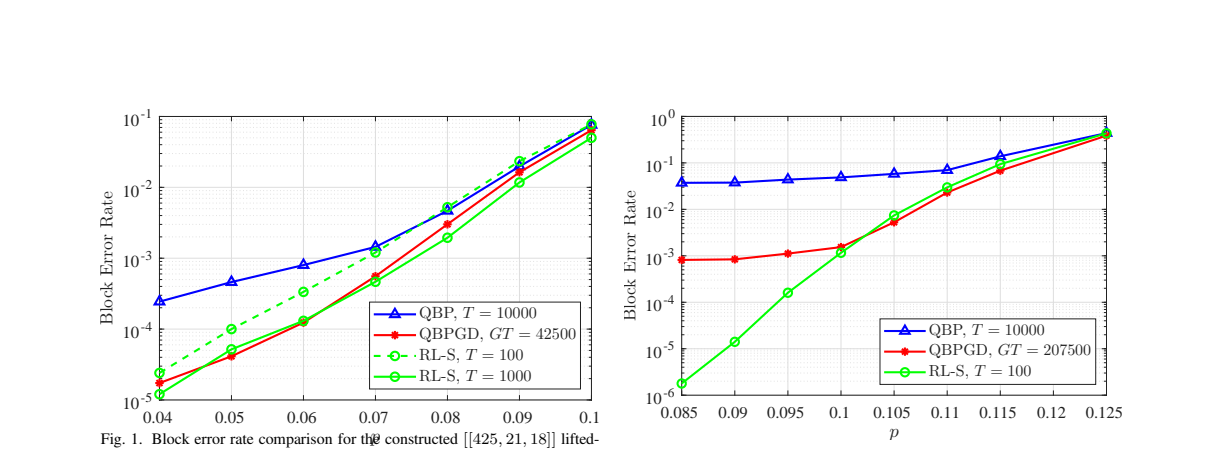
RL-S is used as a main benchmark decoder, but reference [17] is listed as unpublished and no training details, hyperparameters, or code availability are given; the authors should provide enough information for the RL-S results to be reproduced or independently verified.
The paper says, at Example 1
Pith says: minor objection 4 of 5
The displayed block structure of B_X and B_Z is correct, but the dimensions are not immediately transparent because B^* is a 2x1 matrix in the displayed concatenations; annotating the block dimensions or stating them explicitly would improve readability.
The paper says, at Section V
Pith says: minor objection 5 of 5
The decoder name QGBPD appears once in the introductory sentence of Section V; it should be QBPGD, consistent with the rest of the paper.
What would settle it
Implementationally verify Lemma 3 and Theorem 1 by randomly generating polynomial matrices B1, B2 over RL for small L (e.g., L=7,11) and checking in software: (1) for each entry p, LL(p*)=LL(p)^T; (2) for the construced BX,BZ, HX HZ^T=0. All tests should pass automatically.
from the skeptic's reading
How the review went
4 readings by deepseek-v4-flash · 8 Sep 2026
- Reader holds up
- Skeptic partly agrees
- Editor wrote the verdict above
- Referee minor revision: 5 minor
Not run on this paper: the simulated authors' defence.
Pith did not check this review's objections against the paper.
The review in full
The review in brief, machine-written
This paper gives a clean polynomial-domain formulation of lifted-product QLDPC codes and proves that the standard circulant lifting map over F2[D]/(DL+1) is conjugate-compatible, which implies CSS orthogonality at the polynomial level. The main theorem is correctly proved and the algebraic machinery is well laid out.
What is new: the explicit identification of conjugate-compatibility as a property of circulant lifting and the resulting polynomial-domain orthogonality check. This is a small but genuine gap in the literature—formally verifying it streamlines design. The connection to classical convolutional code base matrices is natural and well illustrated. The writing is clear and the proofs are self-contained.
Soft spots: the paper does not provide a systematic way to design the polynomial base matrix. The 3x4 example was found by computational search, and the selection procedure is not fully specified. That is a practical limitation, not a theoretical flaw. The numerical results cover only a few codes and depend on decoder parameters chosen ad hoc. No code or data are provided for reproducibility. These are common in theory papers, but they limit the immediate impact. The paper's own framing as a "description and verification framework" is honest and matches what is delivered.
Who this is for: researchers working on structured QLDPC code design, especially those interested in quasi-cyclic or convolutional connections. The algebra is accessible to anyone comfortable with polynomial rings and circulant matrices.
Recommendation: this paper deserves a serious referee. The main contribution is sound and fills a real gap. I would accept with minor suggestions: ask the authors to describe the base matrix search more transparently and to include at least one explicit polynomial example with all entries given. Additional numerics or code are not necessary for acceptance.
The strongest objection
The central mathematical claim—that conjugate-compatible circulant lifting (Lemma 3) implies polynomial-domain orthogonality (Theorem 1)—is correctly proven. The proof relies only on standard properties: the commutativity of RL = F2[D]/(D^L+1), the ring-homomorphism of the lifting map LL (Lemma 2), and the explicit verification that LL(p*)=LL(p)^T for monomials, which extends by linearity. The derivation of BX BZ^* = 0 in RL uses the mixed-product rule for Kronecker products over a commutative ring, and the final step HX HZ^T = 0 follows by applying LL and conjugate-compatibility. No hidden assumptions, algebraic gaps, or reliance on the specific base matrix are present. The reader's weakest assumption concerns the practical search for a good base matrix; this is a limitation of the demonstration, not a flaw in the algebraic framework. Hence, no load-bearing concern undermines the central claim.
The reader identified the search for a good base matrix as the weakest assumption. This is a reasonable observation about the paper's illustrative example but does not affect the correctness or load-bearing status of the central algebraic claim. The main contribution—a provably correct polynomial-domain formulation—holds regardless of how base matrices are chosen. The reader's verdict 'ACCEPT' is appropriate, and the stress-test finds no reason to adjust it. I set agreement to 'partial' because while the reader's observation is noted, it is not a load-bearing concern for the central argument; the paper can be accepted based on the mathematical proof alone.
The referee's report
The algebraic core is correct, self-contained, and cleanly presented. The main theorem gives a compact design-time certificate for CSS orthogonality that avoids forming and multiplying large binary matrices, and it applies to arbitrary polynomial base matrices over R_L once conjugate-compatible lifting is established. The paper explicitly disclaims asymptotic novelty and positions itself as a description and verification framework, which is an appropriate and honest framing. The numerical results are illustrative rather than a systematic comparison against existing QLDPC constructions, but they do demonstrate that the constructed codes are decodable by standard BP-based decoders. Overall, the contribution is incremental relative to the existing lifted-product literature, but the polynomial-domain formulation is a useful and clearly stated addition.
Pith's reading of the paper (a machine's summary, not the authors')
This paper establishes that the standard circulant lifting map from polynomials to binary matrices is conjugate-compatible, meaning the lift of a conjugate polynomial equals the transpose of the lifted matrix. It then shows that if the two base matrices in the lifted-product construction are lifted in this way, the resulting binary parity-check matrices automatically satisfy the CSS commutation condition $H_X H_Z^T = 0$. The proof works entirely in the quotient ring $\mathbb{F}_2[D]/(D^L+1)$, so orthogonality can be verified before expanding to large binary matrices. The construction is compact and connects to classical convolutional codes, enabling a small polynomial matrix to define a family of finite-length QLDPC codes. A sympathetic reader would care because this gives a principled, easy-to-check way to build quantum LDPC codes from small algebraic objects, without resorting to large-scale matrix checks.
What carries the argument. The key machinery is the conjugate-compatible circulant lifting map $L_L: R_L \to \mathbb{F}_2^{L\times L}$, where $R_L = \mathbb{F}_2[D]/(D^L+1)$. Conjugate-compatibility means $L_L(p(D^{-1})) = L_L(p(D))^T$. Together with the ring-homomorphism property of $L_L$, this allows the CSS orthogonality condition $H_X H_Z^T = 0$ to be reduced to a polynomial identity $B_X B_Z^* = 0$ in $R_L$ (Theorem 1), which holds automatically for any $B_1, B_2$ because of the structure of the lifted-product construction and the fact that $2=0$ in $R_L$.
Core claim. The central discovery is that the usual entrywise circulant lifting $L_L$ from the ring $R_L = \mathbb{F}_2[D]/(D^L+1)$ to $L\times L$ binary circulant matrices is conjugate-compatible: $L_L(p^*) = L_L(p)^T$ for all $p\in R_L$. Using this property, the paper proves that for any polynomial base matrices $B_1,B_2$ over $R_L$, the lifted-product parity-check matrices defined in equations (1)-(2) satisfy $H_X H_Z^T = 0$ (Theorem 1). This means the CSS orthogonality condition can be certified entirely in the polynomial domain, without forming the full binary matrices. The result connects quasi-cyclic and convolutional code techniques to lifted-product QLDPC design and provides a compact algebraic description useful for finite-length code search and optimization.
The premise it rests on. The central construction relies on the existence of a polynomial base matrix (like the 3×4 matrix $H(D)$ in Section V) that is found through computational search—the paper gives no theoretical guarantee that such a base matrix exists for arbitrary target parameters or that it can be chosen efficiently.
If the paper is right (Pith's inferences, not the authors')
If the claim is correct, any pair of polynomial base matrices over $\mathbb{F}_2[D]/(D^L+1)$ automatically produce valid CSS codes via the circled lifted product, eliminating a separate binary orthogonality check.
The polynomial-domain description enables algebraic search and optimization of finite-length QLDPC codes using small matrices, potentially reducing computational cost for code design.
Classical convolutional-code design heuristics (e.g., weight enumerators, free distance) become applicable to constructing quantum codes through the tail-biting interpretation of circulant liftng.
The framework directly connects to existing quasi-cyclic LDPC folklore, making it easy to repurpose classical circulant-ased LDPC code properties for quantum settings.
The conjugate-compatibility property is essentially a statement that the standard circulant representation is a $^*$-algebra homomorphism. This suggests that other $^*$-homomorphisms might yield valid liftings for non-circulant groups, potentially generalizing to abelian lifts beyond cylic groups.
Because the proof does not rely on the specific form of $D^L+1$ beyond $D^L=1$ and characteristic 2, similar constructions should work for any ring where $a^* = a^{-1}$ acts as an involution and the lifting map respects it. This opens the door to polynomial lifts over e.g., rings wit more than two variables.
The paper does not give a method to choose $B_1, B_2$ to achieve high minimum diStance or good decoding performance. A natural next step is to derive algebraic constraints on the base matrix entries (e.g., weight, girth) that provably lower-bound the quantum distance, which would elevate the construction from an existence guarantee to a design toolet.
Check this review
Pith stored no record of this review's passes and took no fingerprint of it. Reviews made by code from 13 Nov 2026 on carry both.
How often reviews like this one are right
Reviews like this one: written by deepseek-v4-flash, where what was read was not recorded.
How often objections from reviews like this one are right: not yet measured
Reviews by people
This review was written by a machine. No person has reviewed this paper on Pith yet. A scientist listed on Pith can review it for a fee, and their review is published here whatever it concludes.
The paper
Abstract
This paper presents a finite-length polynomial-domain formulation of lifted-product quantum low-density parity-check (QLDPC) codes. We formulate the code construction over the quotient ring F 2[D]/(D L + 1), where polynomial base matrices are lifted entrywise to binary circulant blocks. This representation gives a compact algebraic description of the lifted-product parity-check matrices and allows CSS orthogonality to be analyzed before binary expansion. We show that the standard circulant lifting map is compatible with polynomial conjugation, which implies that the resulting binary matrices satisfy the CSS commutation constraint. The construction is illustrated with a constraint length 7, rate 1/2 NASA convolutional code example, and numerical examples are provided from a 3 x 4 polynomial parity-check matrix. The finite-length performance of selected constructed codes is then evaluated over the depolarizing channel using various benchmark decoders. The resulting framework gives a structured method to construct finite-length lifted-product QLDPC codes from small polynomial base matrices.
The paper's own sentences, arranged, kept beside the review and separate from it. Each label is drawn from a closed vocabulary; the number beside it is the probability the classifier gave that label. No sentence in this record was written by a model.
abstract compiled · 2026-09-23
The authors' main claim, as the classifier picked it out 0.86
“The resulting framework gives a structured method to construct finite-length lifted-product QLDPC codes from small polynomial base matrices.”
How the main claim is stated: asserted 1.00
What the abstract itself states, as probabilities: claims first 0.04 · states limitation 0.09 · human participants 0.01 · controlled comparison 0.13 · randomized assignment 0.01 · states quantitative result 0.33 · compares with prior results 0.26 · mentions code or data availability 0.02
The abstract, sentence by sentence
This table labels the abstract only (arXiv listing abstract v1). The number is the probability the classifier gave the label.
| Sentence | Role | The authors' own work | States the main conclusion | Strength |
|---|---|---|---|---|
| This paper presents a finite-length polynomial-domain formulation of lifted-product quantum low-density parity-check (QLDPC) codes. | contribution 1.00 | 0.93 | 0.22 | asserted 1.00 |
| We formulate the code construction over the quotient ring F 2[D]/(D L + 1), where polynomial base matrices are lifted entrywise to binary circulant blocks. | method 0.96 | 0.93 | 0.07 | asserted 1.00 |
| This representation gives a compact algebraic description of the lifted-product parity-check matrices and allows CSS orthogonality to be analyzed before binary expansion. | interpretation 0.71 | 0.68 | 0.13 | asserted 1.00 |
| We show that the standard circulant lifting map is compatible with polynomial conjugation, which implies that the resulting binary matrices satisfy the CSS commutation constraint. | result 0.75 | 0.91 | 0.16 | asserted 1.00 |
| The construction is illustrated with a constraint length 7, rate 1/2 NASA convolutional code example, and numerical examples are provided from a 3 x 4 polynomial parity-check matrix. | method 0.65 | 0.88 | 0.06 | asserted 1.00 |
| The finite-length performance of selected constructed codes is then evaluated over the depolarizing channel using various benchmark decoders. | method 0.80 | 0.93 | 0.08 | asserted 1.00 |
| The resulting framework gives a structured method to construct finite-length lifted-product QLDPC codes from small polynomial base matrices. | contribution 0.72 | 0.82 | 0.55 | asserted 1.00 |
What kind of paper the classifier reports this is: method or tool 0.99 · evidence from proof or derivation 0.63
What was examined, and what was not
Sources read
- arXiv listing abstract v1
Not examined
- full text
- figures and tables
- references and citing sentences
- relations to other papers
Levels run
- P abstract
Not run
- S sections
- T body sentences
- C citations
- R cross-paper relations
How the labels were made
Compiled by classifier-1.13.0 via TypeSafe API, question bank abstract-p1-20260923, 2026-09-23: 1 request, 5,582 input tokens.
Every quoted sentence on this record is the authors'. Every label is from Pith's closed vocabulary, with the probability shown beside it. This record as JSON
Figures (3)
Showing 1 of the paper's 3 figures. Figures are the authors', reproduced from the paper.
References (20)
- [1] A. R. Calderbank and P . W. Shor, “Good quantum error-corr ecting codes exist,” Physical Review A , vol. 54, no. 2, pp. 1098–1105, 1996 on Pith
- [2] A. M. Steane, “Error correcting codes in quantum theory, ” Physical Review Letters, vol. 77, no. 5, pp. 793–797, 1996 on Pith
- [3] D. Gottesman, Stabilizer codes and quantum error correction . Cali- fornia Institute of Technology, 1997 on Pith
- [4] D. J. MacKay, G. Mitchison, and P . L. McFadden, “Sparse-g raph codes for quantum error correction,” IEEE Transactions on Information Theory, vol. 50, no. 10, pp. 2315–2330, 2004 on Pith
- [5] N. P . Breuckmann and J. N. Eberhardt, “Balanced product q uantum codes,” IEEE Transactions on Information Theory , vol. 67, no. 10, pp. 6653–6674, 2021 on Pith
- [6] J.-P . Tillich and G. Z´ emor, “Quantum LDPC codes with positive rate and minimum distance proportional to the square root of the bloc klength,” IEEE Transactions on Information Theory , vol. 60, no. 2, pp. 1193– 1202, 2013 on Pith
- [7] P . Panteleev and G. Kalachev, “Quantum LDPC codes with al most linear minimum distance,” IEEE Transactions on Information Theory , vol. 68, no. 1, pp. 213–229, 2022 on Pith
- [8] ——, “Asymptotically good quantum and locally testable c lassical LDPC codes,” in Proceedings of the 54th Annual ACM SIGACT Symposium on Theory of Computing , 2022, pp. 375–388 on Pith
- [9] R. M. Tanner, D. Sridhara, A. Sridharan, T. E. Fuja, and J. Costello, Daniel J., “LDPC block and convolutional codes based on circ ulant matrices,” IEEE Transactions on Information Theory , vol. 50, no. 12, pp. 2966–2984, 2004 on Pith
- [10] R. Smarandache and P . O. V ontobel, “Quasi-cyclic LDPC c odes: In- fluence of proto-and Tanner-graph structure on minimum Hamm ing distance upper bounds,” IEEE Transactions on Information Theory , vol. 58, no. 2, pp. 585–607, 2012 on Pith
- [11] A. A. Kovalev and L. P . Pryadko, “Quantum Kronecker sum- product low-density parity-check codes with finite rate,” Physical Review A—Atomic, Molecular , and Optical Physics , vol. 88, no. 1, p. 012311, 2013 on Pith
- [12] N. Raveendran, D. Declercq, and B. V asi´ c, “On the minim um distances of finite-length lifted product quantum LDPC codes,” arXiv preprint arXiv:2503.07567, 2025 on PithPith's reviewarXiv
- [13] P . Panteleev and G. Kalachev, “Degenerate quantum LDPC codes with good finite length performance,” Quantum, vol. 5, p. 585, 2021 on Pith
- [14] D. Poulin and Y . Chung, “On the iterative decoding of spa rse quantum codes,” Quantum Information & Computation , vol. 8, no. 10, pp. 987– 1000, 2008 on Pith
- [15] K.-Y . Kuo and C.-Y . Lai, “Refined belief propagation dec oding of sparse-graph quantum codes,” IEEE Journal on Selected Areas in Information Theory , vol. 1, no. 2, pp. 487–498, 2020 on Pith
- [16] H. Y ao, W. Abu Laban, C. H¨ ager, A. Graell i Amat, and H. D. Pfister, “Belief propagation decoding of quantum LDPC codes with gui ded decimation,” in Proceedings of the IEEE International Symposium on Information Theory (ISIT) , 2024, pp. 2478–2483 on Pith
- [17] M. Moradi, V . Nourozi, S. Habib, and D. G. M. Mitchell, “L earning to decode quantum LDPC codes via belief propagation,” 2026 on Pith
- [18] J. Hamkins, “A joint receiver-decoder for convolution ally coded binary phase-shift keying (BPSK),” TMO Progress Report , pp. 42–139, 1999 on Pith
- [19] Gurobi Optimization, LLC, “Gurobi Optimizer Referenc e Manual,” 2026, version 13.0. [Online]. Available: https://www.gur obi.com on Pith
- [20] M. Moradi, S. Habib, and D. G. M. Mitchell, “Enhancing be lief prop- agation decoding of polar codes: A reinforcement learning a pproach,” IEEE Communications Letters , vol. 29, no. 6, pp. 1285–1289, 2025 on Pith
Cited by 3 Pith papers
Reviewed papers on Pith that cite this one. The full citation record
- QEDist: Practical Exact Distance Certification for Stabilizer Codes quant-ph · Nov 2026
- Quantum LDPC Codes from Polynomial Minors quant-ph · Oct 2026
- High-Girth QLDPC Codes from Circulant and Affine Permutation Matrices cs.IT · Oct 2026
Challenges and discussion
Disagree with the review, or know something it missed? Leave a comment, or challenge this review formally: a challenge becomes a permanent entry in this paper's record, and its decision is published here.
Come back by email
A short list of the week's newly reviewed papers. Nothing is sent until you confirm from your inbox, and every email has a link that stops it. No account.
No comments yet.
Sign in to comment