Information Theory · arXiv:2610.19451 v1 · submitted 14 Oct 2026 · 21 references
High-Girth QLDPC Codes from Circulant and Affine Permutation Matrices
The paper says
“We study two explicit constructions of binary Calderbank–Shor–Steane quantum low-density parity-check (QLDPC) codes with check weight six. The first uses a fixed circulant shift pattern and yields parameters $\code{6N}{2N+2}{6}$ with Tanner graph girth twelve for N = 31 and every N ≥ 37.”
more of the abstract
A graph incidence interpretation gives the ranks and girths, and a uniform weight six logical operator establishes the exact distance. The second construction uses fixed matrix polynomials with circulant and affine permutation coefficients. Here, a polynomial commutation identity guarantees orthogonality for every cyclic lift. Four realizations give [[192,16,8]], [[288,16,12]], [[384,16,14]], and [[576,32,20]], with Tanner girth eight and computationally certified distances. We give reproducible construction data, distinguish classical cycle distance from quantum distance, and identify the limitations of both families.
from the abstract
Pith says
Machine review · deepseek-v4-flash · 15 Oct 2026 · what was read was not recorded · not checked by a person
It can be wrong. Challenge this review or reply to it.
Holds up. Clean analytic first family with honest limits; second family's distances rest on unverified enumeration. This line is wrong
1 major objection · 5 minor
How often objections from reviews like this one are right: not yet measured
Not checked: figures, code, what the 21 references say.
The paper says, at Section IV, Example 4
The review did not quote this passage.
Pith says: Objection 1 of 1 · major
The distances reported for Construction II rely on computational support enumerations that exclude smaller-weight logical operators. The description of the search algorithm (support enumeration, symmetry reduction, incomplete stage threshold) is too brief for a reader to assess the rigor of the exhaustiveness claim.
more of objection 1
The authors state that a stage that did not finish gives no lower bound, which is proper, but they do not detail the algorithm's complexity, the size of the search space, the exact symmetries used, or how the completeness of the finished stage was verified. Given that a missed weight-4 or weight-6 operator would invalidate the claimed parameters, a more thorough account is needed. I recommend that the authors expand this description or provide a reference to the archived code and data that would allow independent verification.
5 minor objections
The paper says, at Example 3, p. 6
Pith says: minor objection 1 of 5
The matrix representation of S2 appears garbled as "S2 = (0 11 0)". This should be corrected to a standard matrix form, e.g., S2 = [[0,1],[1,0]].
The paper says, at Section III, orthogonality proof after Eq. (10)
Pith says: minor objection 2 of 5
The text states that each of the four shift lists in (10) has even multiplicities, which is true. It would be clearer to explicitly state that each shift appears an even number of times in each list, e.g., for the third list (a−b): 0,6,8,8,0,6 contains two 0s, two 6s, and two 8s.
show 3 more
The paper says, at Section III, distance proof, Eq. (12)
Pith says: minor objection 3 of 5
The subscripts in the definitions of e1, e-11, e-5 should be explicitly stated as taken modulo N. While clear from context, a brief reminder would help readers not intimately familiar with circulant notation.
The paper says, at Section III, reusable conditions
Pith says: minor objection 4 of 5
The condition gcd(N, a1−a0, ..., a5−a0) = 1 is stated. For the specific a list, a1−a0=1, so this always holds. It might be worth noting that this single difference already ensures connectivity, simplifying the condition.
The paper says, at Section V, FER discussion
Pith says: minor objection 5 of 5
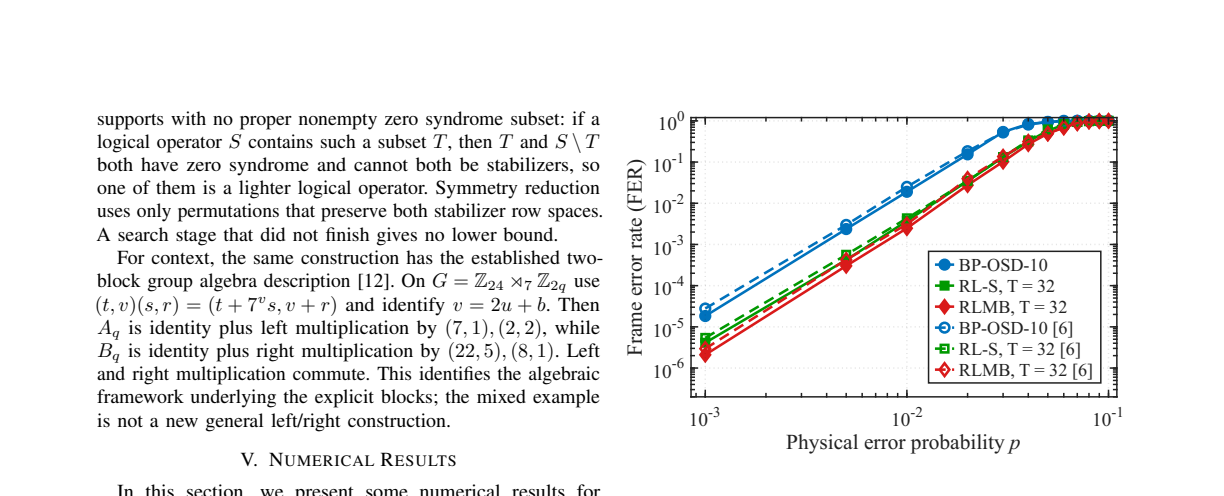
The paper attributes the observed FER improvement to the reduced number of weight-6 logical operators. The authors correctly note that this is a correlation and not a proven causal mechanism, but the phrasing could be sharpened to avoid overinterpretation.
What would settle it
Independently implement an exhaustive search (using the described symmetry reduction or a different method) for the [[192,16,8]] code: enumerate all supports up to weight 8, verify that no weight-4 or weight-6 vector lies in the kernel of both H_X and H_Z without being in the row space of the respective check matrix, and confirm the existence of a weight-8 logical operator. If a smaller logical operator is found, the claimed distance is incorrect.
from the skeptic's reading
How the review went
4 readings by deepseek-v4-flash · 15 Oct 2026
- Reader holds up
- Skeptic agrees
- Editor wrote the verdict above
- Referee minor revision: 1 major objection, 5 minor
Not run on this paper: the simulated authors' defence.
Pith did not check this review's objections against the paper.
The review in full
The review in brief, machine-written
The paper does what it says: two explicit weight-six QLDPC families with proven or computationally certified parameters. The first family (circulant-based) is the real meat. Theorem 1 gives a complete analytic proof of parameters [[6N, 2N+2, 6]] with girth twelve for N=31 and every N≥37, including rank, orthogonality, and exact distance. The proof is self-contained, the shift lists are fixed, and the limitations are stated plainly (distance is constant six, relative distance tends to zero). This is a solid, reproducible construction, useful for anyone who needs concrete codes with known finite-length parameters.
The second family (mixed circulant–affine) provides examples with larger distances (up to [[576,32,20]]) but here the distances come from computational support enumeration, not from an analytic lower bound. The authors are transparent about this: they say "a search stage that did not finish gives no lower bound" and call the distances "computationally certified." The stress-test note is correct that these results have not been independently replicated. That does not make them wrong, but it means the second family's claims rest on a computation that another group would need to verify. The paper also gives an algebraic orthogonality proof (Theorem 2) that holds for all outer lifts, so the construction is well-defined even if the distance claims later weaken.
Soft spots: the first family's distance is stuck at six, so asymptotic performance is poor. The second family lacks an analytic distance bound. The FER comparison with Komoto–Kasai is a single instance (N=128) and the improvement is attributed to fewer weight-six logical operators, which is a plausible but not proven explanation. The authors themselves caution against overinterpreting the 21% reduction.
Who is this for? Researchers working on explicit QLDPC constructions, especially those who want codes with guaranteed girth and simple check matrices. The first family is ready to use; the second family is a helpful set of examples but its distances need independent confirmation before being relied on.
Recommendation: send to peer review. The paper is honest, the main result is provably correct, and the limitations are clearly marked. The second family's computational claims should be checked by the referees, but that is exactly what peer review is for.
The strongest objection
For Construction II, the reported distances (e.g., [[192,16,8]]) rely on completed support enumerations that exclude smaller-weight logical operators (Section IV, Example 4). The paper states that "a search stage that did not finish gives no lower bound," making the distances contingent on the search being exhaustive up to the reported value. While the search is described as using symmetry reduction, there is no independent verification or analytic lower bound. If the enumeration missed a weight-4 or weight-6 logical operator, the claimed distances would be invalid. This does not affect the analytic first construction, but it is the weakest point for the second family.
The reader's weakest assumption correctly identified the reliance on computational enumeration for Construction II distances. This is the only part of the central claims that lacks an analytic proof. However, the paper is transparent about this limitation, and the first construction (Theorem 1) is fully rigorous. Therefore, the verdict remains ACCEPT. The proposed test would settle whether the computational results are reproducible, but the paper's overall contribution is not undermined by this open question.
The referee's report
If the claims hold, Construction I provides a rare example of a QLDPC family with a fully analytic parameter proof, including exact distance, at a fixed check weight. Construction II demonstrates moderately high distances at useful finite lengths with a deterministic algebraic base. Both constructions are explicit and reproducible, making them attractive for practical evaluation and as benchmarks. The paper also clarifies the relationship between classical cycle structure and quantum distance (Proposition 1), which is a helpful conceptual contribution.
Pith's reading of the paper (a machine's summary, not the authors')
The paper presents two explicit families of binary CSS QLDPC codes with check weight six. The first family uses a fixed pattern of circulant shifts and achieves exact parameters [[6N,2N+2,6]] for N=31 and every N≥37, with Tanner graph girth twelve. All parameters—orthogonality, rank, girth, and minimum distance—are proved analytically. The second family combines circulant and affine permutation matrices in a polynomial construction; orthogonality holds for every outer lift size via a commutation identity, but the reported distances (e.g., [[192,16,8]]) are finite computational results, not asymptotic. The paper also shows that the first family attains the largest possible girth under column weight two and check weight six, and provides a numerical comparison showing a 21% reduction in minimum-weight logical operators relative to a prior construction with the same nominal parameters.
What carries the argument. The first construction relies on an auxiliary incidence graph derived from the two-row block structure of each check matrix; the girth of the Tanner graph is twice the girth of this auxiliary graph. Conditions on the distinctness of ordered differences among the shift entries a_v ensure the auxiliary graph has no 4-cycles, and a uniform weight-six logical operator provides the exact distance. The second construction uses a pair of 2x2 matrix polynomials A(z), B(z) with coefficients that are 24x24 circulant and affine permutation matrices; the polynomial identity AB=BA guarantees CSS orthogonality for every outer lift size q, and the lifts produce check matrices with row weight six and column weight three.
Core claim. The paper discovers that a carefully chosen pattern of six circulant shifts, encoded in the integer lists a, b, c, yields a CSS QLDPC family whose X and Z parity-check matrices each have rank 2N−1, giving dimension 2N+2, and whose Tanner graph girth is exactly twelve for N=31 and every N≥37. A uniform weight-six logical operator is exhibited and proven to lie outside the stabilizer row space, establishing the exact distance d=6. A separate mixed construction uses the polynomial identity AB=BA, with A and B built from circulant and affine permutation coefficients, to guarantee orthogonality for every cyclic lift; at outer sizes q=2,3,4,6 this yields codes with computationally certified distances 8,12,14,20.
The premise it rests on. For the first construction, the proof of girth twelve depends on the thirty ordered differences of the shift list 'a' being distinct modulo N, which holds for N=31 and every N≥37; for the second construction, the reported distances rely on completed computational searches that exclude smaller-weight logical operators, and the paper states that an unfinished search stage gives no lower bound.
If the paper is right (Pith's inferences, not the authors')
The first family provides a concrete template for constructing QLDPC codes with analytically proven parameters and maximal girth under the given weight constraints, offering a benchmark for finite-length code design.
The mixed construction demonstrates that affine permutations can be incorporated into polynomial-based lift designs, potentially enabling larger distances than pure circulant patterns at selected lengths.
The factor of 21% reduction in minimum-weight logical operators compared to the Komoto-Kasai code, without changing length, rate, distance, or girth, suggests that logical operator multiplicity is a relevant design metric beyond classical cycle counts.
The explicit description of the binary matrices allows direct reproduction and further optimization, such as searching over shift patterns to improve suboptimal rates or distances.
The limitations of the first family (constant distance 6) and the second family (computationally certified distances without asymptotic guarantee) clarify the current frontier for weight-six QLDPC constructions.
The constant-distance six of the first family means that as block length grows, the relative distance vanishes; for practical fault-tolerance, codes with unbounded minimum distance are preferable, so this family is best suited for small or moderate lengths.
The computational nature of the second family's distances leaves open whether a formal proof for a distance growth law exists or whether the observed distances are optimal for the given polynomial pattern; an exhaustive search at larger sizes could either confirm a pattern or reveal the limit of the construction.
The observed decoding improvement from reducing minimum-weight logical operators suggests that in scenarios where such operators dominate the error floor, optimizing their multiplicity may yield practical gains without altering the code's nominal parameters.
The algebraic condition for orthogonality in the mixed construction (AB=BA) is independent of the outer lift size, which hints that the same polynomial pair might produce good codes at many more lift sizes than the four reported, possibly with larger distances.
Check this review
Pith stored no record of this review's passes and took no fingerprint of it. Reviews made by code from 13 Nov 2026 on carry both.
How often reviews like this one are right
Reviews like this one: written by deepseek-v4-flash, where what was read was not recorded.
How often objections from reviews like this one are right: not yet measured
Reviews by people
This review was written by a machine. No person has reviewed this paper on Pith yet. A scientist listed on Pith can review it for a fee, and their review is published here whatever it concludes.
The paper
Abstract
We study two explicit constructions of binary Calderbank–Shor–Steane quantum low-density parity-check (QLDPC) codes with check weight six. The first uses a fixed circulant shift pattern and yields parameters $\code{6N}{2N+2}{6}$ with Tanner graph girth twelve for N = 31 and every N ≥ 37. A graph incidence interpretation gives the ranks and girths, and a uniform weight six logical operator establishes the exact distance. The second construction uses fixed matrix polynomials with circulant and affine permutation coefficients. Here, a polynomial commutation identity guarantees orthogonality for every cyclic lift. Four realizations give [[192,16,8]], [[288,16,12]], [[384,16,14]], and [[576,32,20]], with Tanner girth eight and computationally certified distances. We give reproducible construction data, distinguish classical cycle distance from quantum distance, and identify the limitations of both families.
The paper's own sentences, arranged, kept beside the review and separate from it. Each label is drawn from a closed vocabulary; the number beside it is the probability the classifier gave that label. No sentence in this record was written by a model.
abstract compiled · 2026-10-15
The authors' main claim, as the classifier picked it out 0.70
“We give reproducible construction data, distinguish classical cycle distance from quantum distance, and identify the limitations of both families.”
How the main claim is stated: asserted 1.00
What the abstract itself states, as probabilities: claims first 0.04 · states limitation 0.94 · human participants 0.01 · controlled comparison 0.02 · randomized assignment 0.01 · states quantitative result 0.99 · compares with prior results 0.15 · mentions code or data availability 0.69
The abstract, sentence by sentence
This table labels the abstract only (arXiv listing abstract v1). The number is the probability the classifier gave the label.
| Sentence | Role | The authors' own work | States the main conclusion | Strength |
|---|---|---|---|---|
| We study two explicit constructions of binary Calderbank--Shor--Steane quantum low-density parity-check (QLDPC) codes with check weight six. | contribution 1.00 | 0.92 | 0.09 | asserted 0.97 |
| The first uses a fixed circulant shift pattern and yields parameters $\code{6N}{2N+2}{6}$ with Tanner graph girth twelve for $N=31$ and every $N\ge37$. | result 0.93 | 0.92 | 0.21 | asserted 1.00 |
| A graph incidence interpretation gives the ranks and girths, and a uniform weight six logical operator establishes the exact distance. | method 0.88 | 0.89 | 0.11 | asserted 1.00 |
| The second construction uses fixed matrix polynomials with circulant and affine permutation coefficients. | method 0.81 | 0.87 | 0.04 | asserted 0.99 |
| Here, a polynomial commutation identity guarantees orthogonality for every cyclic lift. | method 0.85 | 0.81 | 0.06 | asserted 1.00 |
| Four realizations give $[[192,16,8]]$, $[[288,16,12]]$, $[[384,16,14]]$, and $[[576,32,20]]$, with Tanner girth eight and computationally certified distances. | result 0.99 | 0.93 | 0.25 | asserted 1.00 |
| We give reproducible construction data, distinguish classical cycle distance from quantum distance, and identify the limitations of both families. | contribution 0.89 | 0.95 | 0.25 | asserted 1.00 |
What kind of paper the classifier reports this is: method or tool 0.64 · evidence from proof or derivation 0.99
What was examined, and what was not
Sources read
- arXiv listing abstract v1
Not examined
- full text
- figures and tables
- references and citing sentences
- relations to other papers
Levels run
- P abstract
Not run
- S sections
- T body sentences
- C citations
- R cross-paper relations
How the labels were made
Compiled by classifier-1.13.0 via TypeSafe API, question bank abstract-p1-20260923, 2026-10-15: 1 request, 5,653 input tokens.
Every quoted sentence on this record is the authors'. Every label is from Pith's closed vocabulary, with the probability shown beside it. This record as JSON
Figures (1)
Figures are the authors', reproduced from the paper.
References (21)
- [1] A. R. Calderbank and P. W. Shor, “Good quantum error-correcting codes exist,”Physical Review A, vol. 54, no. 2, p. 1098, 1996 on Pith
- [2] A. Steane, “Multiple-particle interference and quantum error correction,” Proceedings: Mathematical, Physical and Engineering Sciences, pp. 2551– 2577, 1996 on Pith
- [3] D. J. MacKay, G. Mitchison, and P. L. McFadden, “Sparse-graph codes for quantum error correction,”IEEE Transactions on Information Theory, vol. 50, no. 10, pp. 2315–2330, 2004 on Pith
- [4] N. P. Breuckmann and J. N. Eberhardt, “Quantum low-density parity- check codes,”PRX quantum, vol. 2, no. 4, p. 040101, 2021 on Pith
- [5] M. Hagiwara and H. Imai, “Quantum quasi-cyclic LDPC codes,” in 2007 IEEE international symposium on information theory. IEEE, 2007, pp. 806–810 on Pith
- [6] D. Komoto and K. Kasai, “Explicit construction of quantum quasi-cyclic low-density parity-check codes with column weight 2 and girth 12,”arXiv preprint arXiv:2501.13444, 2025 on PithPith's reviewarXiv
- [7] D. G. M. Mitchell, R. Smarandache, and D. J. Costello, “Quasi-cyclic LDPC codes based on pre-lifted protographs,”IEEE Transactions on Information Theory, vol. 60, no. 10, pp. 5856–5874, 2014 on Pith
- [8] R. Smarandache and D. G. M. Mitchell, “Necessary and sufficient girth conditions for Tanner graphs of quasi-cyclic LDPC codes,” in2021 IEEE International Symposium on Information Theory (ISIT). IEEE, 2021, pp. 380–385 on Pith
- [9] ——, “A unifying framework to construct QC-LDPC Tanner graphs of desired girth,”IEEE Transactions on Information Theory, vol. 68, no. 9, pp. 5802–5822, 2022 on Pith
- [10] P. Panteleev and G. Kalachev, “Degenerate quantum LDPC codes with good finite length performance,”Quantum, vol. 5, p. 585, 2021 on Pith
- [11] S. Bravyi, A. W. Cross, J. M. Gambetta, D. Maslov, P. Rall, and T. J. Yoder, “High-threshold and low-overhead fault-tolerant quantum memory,” Nature, vol. 627, no. 8005, pp. 778–782, 2024 on Pith
- [12] H.-K. Lin and L. P. Pryadko, “Quantum two-block group algebra codes,” Physical Review A, vol. 109, no. 2, p. 022407, 2024 on Pith
- [13] K. Kasai, “Quantum error correction with girth-16 non-binary LDPC codes via affine permutation construction,” in2025 13th International Symposium on Topics in Coding (ISTC). IEEE, 2025, pp. 1–5 on Pith
- [14] V . Nourozi, D. G. M. Mitchell, and T. Koike-Akino, “Base-Preserving APM/V oltage Lifts of Bivariate Bicycle Quantum LDPC Codes,” in IEEE International Conference on Quantum Computing and Engineering (QCE), Sep. 2026 on Pith
- [15] ——, “Net-V oltage Screening of Bivariate-Bicycle Tanner-Graph Cov- ers,” inIEEE International Conference on Quantum Computing and Engineering (QCE), Sep. 2026 on Pith
- [16] ——, “Q-Learning Base Search V oltage-Labeled Covers for Weight- Six Bivariate-Bicycle Quantum LDPC Codes,” inIEEE International Conference on Quantum Computing and Engineering (QCE), Sep. 2026 on Pith
- [17] V . Nourozi, M. Moradi, R. Smarandache, and D. G. M. Mitchell, “Lifted-product QLDPC codes in the polynomial domain,”arXiv preprint arXiv:2609.01305, 2026 on PithPith's reviewarXiv
- [18] R. Smarandache and P. O. V ontobel, “Quasi-cyclic LDPC codes: Influence of proto-and Tanner-graph structure on minimum hamming distance upper bounds,”IEEE Transactions on Information Theory, vol. 58, no. 2, pp. 585–607, 2012 on Pith
- [19] M. Moradi, S. Habib, V . Nourozi, and D. G. Mitchell, “Sequential BP- based decoding of qLDPC codes,” inICC 2026-IEEE International Conference on Communications. IEEE, 2026, pp. 1–6 on Pith
- [20] M. Moradi, V . Nourozi, S. Habib, and D. G. M. Mitchell, “Learning to decode quantum LDPC codes via belief propagation,”arXiv preprint arXiv:2603.10192, 2026 on PitharXiv
show 1 more
- [21] V . Nourozi, T. Koike-Akino, and D. G. M. Mitchell, “Reinforcement- Learning-Guided Multi-Branch Decoding of Quantum LDPC Codes,” in IEEE International Conference on Quantum Computing and Engineering (QCE), Sep. 2026 on Pith
Challenges and discussion
Disagree with the review, or know something it missed? Leave a comment, or challenge this review formally: a challenge becomes a permanent entry in this paper's record, and its decision is published here.
Come back by email
A short list of the week's newly reviewed papers. Nothing is sent until you confirm from your inbox, and every email has a link that stops it. No account.
No comments yet.
Sign in to comment