Machine Learning · arXiv:2609.04721 v1 · submitted 4 Sep 2026 · 59 references
Locating and Steering Refusal Beyond Attention
The paper says
“Where inside a language model does refusal live, and does that place change when the architecture does?”
more of the abstract
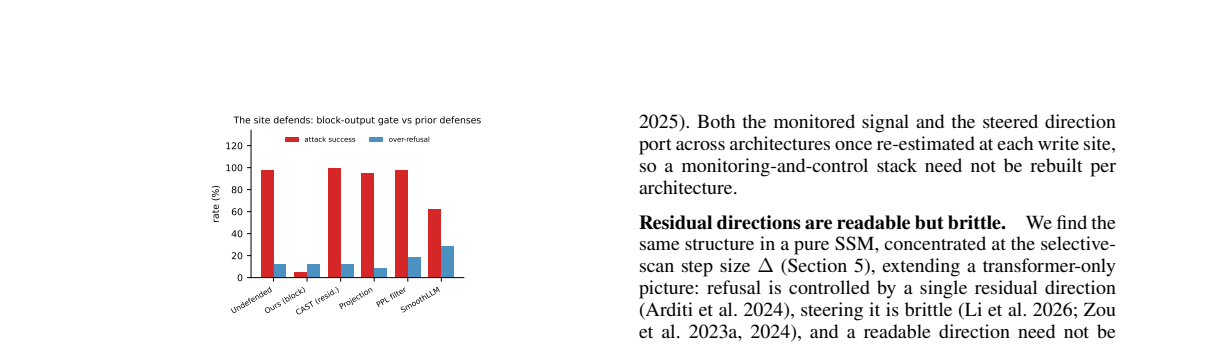
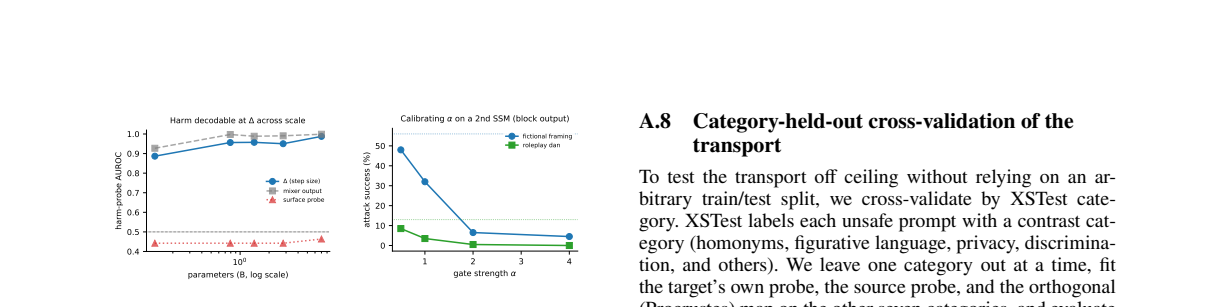
In a transformer, refusal is governed by a single direction in the residual stream, a finding that safety and interpretability tooling now depend on. State-space models (SSMs) route information through a recurrent update instead of attention, sharing no token-mixing mechanism with a transformer. Does the same safety representation survive this shift, or must it be rediscovered per architecture? It survives. A single rigid rotation, which can only reorient a space and not reshape it, aligns one model's representation space with another's, so the two genuinely share the representation. A harm probe trained on a transformer then flags an SSM's harmful inputs, and removing the aligned direction makes a model answer attacks it would otherwise refuse, while a random direction of the same size does far less. What is architecture-specific is not where the direction is steered but where it must be read. Each layer computes a fresh output that is then added into the residual stream, and harm is cleanly readable at this output, the write site, before the addition. A control that holds the intervention's strength fixed shows that what matters is where the direction is estimated, not where it is applied. Applied through a detector-triggered gate, this direction lowers jailbreak success in all four architecture families we test (SSM, transformer, recurrent, hybrid), and on the SSM it holds against an attacker that tunes its prompt against the defense. The gate only matches a trivial rule that returns a fixed refusal whenever the same detector fires, so what transfers across architectures is the direction itself, not defense strength. Safety tooling built on refusal therefore ports to a new architecture by re-estimating the direction at that architecture's write site, not by rebuilding it.
from the abstract
Pith says
Machine review · deepseek-v4-flash · 8 Sep 2026 · what was read was not recorded · not checked by a person
It can be wrong. Challenge this review or reply to it.
Holds up, with conditions. Thorough controls show refusal representation transfers across architectures, but the abstract overstates the geometry: the 'rigid rotation' claim is undercut by the paper's own Appendix A.9, where standardization (a non-rigid transform) is required. This line is wrong
4 major objections · 9 minor
How often objections from reviews like this one are right: not yet measured
Not checked: figures, code, what the 59 references say.
The paper says, at Abstract, §4.2, Appendix A.9
The review did not quote this passage.
Pith says: Objection 1 of 4 · major
The abstract and §4.2 state that 'a single rigid rotation, which can only reorient a space and not reshape it, aligns one model's representation space with another's.' Appendix A.9 reveals that without per-dimension standardization of both activation spaces, the orthogonal Procrustes rotation yields cosine 0.68 (Llama→Mamba) and fails to transport causally; with standardization, cosine reaches 0.998 and the transport succeeds.
more of objection 1
Standardization is an affine, space-reshaping operation per dimension, not a rigid reorientation. The paper therefore does not demonstrate that the two spaces are related by a pure rotation. The strong controls (shuffled-correspondence null, category-held-out CV, causal ablation) use the standardized rotation and remain valid evidence for representation sharing, but the 'rigid rotation' claim in the abstract and throughout the main text is overstated and contradicted by the paper's own data. The authors should (a) revise the abstract and main text to accurately describe the precondition, (b) explicitly state that the alignment requires per-dimension standardization, which is non-rigid, and (c) discuss whether the standardization degree of freedom could manufacture apparent alignment.
The paper says, at §4.2, Table 3, Appendix A.8
The review did not quote this passage.
Pith says: Objection 2 of 4 · major
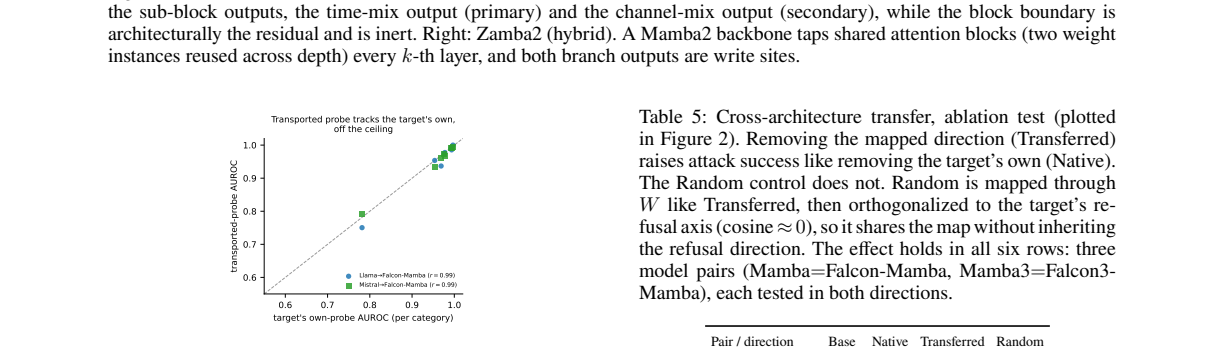
The category-held-out cross-validation is a strong control. However, the claim that the transported probe 'beats a shuffled-category control in all 16 of 16 folds tested' uses the standardized rotation. Given the standardization issue, this control validates that the correspondence between prompt pairs is meaningful, but it does not validate that the mapping is a pure rotation. The paper should clarify that the structural claim is about correspondence-driven alignment under standardization, not about rigid geometry.
The paper says, at §5.1, Table 9, Appendix A.12
The review did not quote this passage.
Pith says: Objection 3 of 4 · major
The paper honestly acknowledges that the gate matches a detect-then-refuse baseline, and that its contribution is the portability of the direction, not raw defense strength. This is a commendable framing. However, the abstract's phrase 'Applied through a detector-triggered gate, this direction lowers jailbreak success in all four architecture families' could be misinterpreted as a competitive defense.
more of objection 3
I recommend adding a one-sentence caveat in the abstract that the gate matches a trivial refusal policy and that the contribution is the portability, not the defense margin.
The paper says, at Appendix A.41, Table 25
The review did not quote this passage.
Pith says: Objection 4 of 4 · major
The claim that transport 'beats retraining when target labels are scarce' is supported by small AUROC gains (+0.032 to +0.046) that are statistically significant but practically modest. The paper's own analysis notes that the from-scratch curve is non-monotone and flat, so the gain may not be robust across settings.
more of objection 4
This does not invalidate the claim, but the main text (§4.2) presents it as 'transport beats retraining' without adequately discussing the small effect size and the non-monotonicity issue. I suggest adding a qualification about the modest absolute margin and the condition that the advantage appears only for cross-category generalization, not in-distribution.
9 minor objections
The paper says, at Abstract
Pith says: minor objection 1 of 9
The abstract uses 'rigid rotation' without noting the standardization precondition. This is a mismatch with the full paper. Consider revising to 'orthogonal rotation on standardized activations' or equivalent.
The paper says, at §2.3
Pith says: minor objection 2 of 9
Equation (1) defines the gate as g(y_t) = y_t + α û_ℓ. The direction û_ℓ is defined as the mean difference, not the detector's discriminative direction. This is important and should be emphasized earlier, not just in §2.7. Consider moving the clarification to §2.3.
show 7 more
The paper says, at §4.2
Pith says: minor objection 3 of 9
The sentence 'A single rigid rotation therefore both proves the representations are shared and controls behavior once transported' overstates the proof. The rotation alone does not 'prove' sharing; the combination of controls (shuffled null, category-held-out tracking, causal ablation) collectively supports the claim. Tone down 'proves' to 'provides evidence that'.
The paper says, at §5, Table 7
Pith says: minor objection 4 of 9
The matched-absolute-magnitude control is excellent. Consider reporting the exact absolute magnitude values used (as is done in Appendix A.35) in the main table caption for reproducibility.
The paper says, at Appendix A.6
Pith says: minor objection 5 of 9
The warning that 'geometric similarity is unreliable for cross-architecture transfer' is important and should be referenced in the main text §4.2. Consider adding a short note or citation.
The paper says, at Appendix A.13
Pith says: minor objection 6 of 9
The ∆ readout experiment (replacing ∆ with a global mean) is informative. The conclusion that 'harm is carried redundantly to the block output' is plausible but could be strengthened by verifying that the gate still controls refusal after ∆-freezing. The current test only checks decodability and refusal rate; a direct ablation of the gate under ∆-frozen conditions would confirm that ∆ is not causally necessary for steering.
The paper says, at Table 6
Pith says: minor objection 7 of 9
For the hybrid's attention site, the over-refusal is marked as † with a note about training on wrapped negatives. This is important; consider adding a brief explanation in the caption rather than only in Appendix A.37.
The paper says, at Appendix A.9
Pith says: minor objection 8 of 9
The sentence 'Through the standardized rigid rotation the causal ablation replicates into the SSM' uses 'standardized rigid rotation' which is a bit of an oxymoron. Consider rephrasing to 'Through the Procrustes rotation fitted on standardized activations...'
The paper says, at Section 7
Pith says: minor objection 9 of 9
The limitation 'The persona fix does not generalize' is clearly stated. However, the paper could add a short paragraph explaining what general property of the write site (e.g., direction orthogonality) enables the fix on Falcon-Mamba and why RWKV and Zamba2 fail. This would strengthen the principle.
What would settle it
Replace per-dimension standardization with a single global L2 normalization (scale each model's layer activation matrices to unit Frobenius norm) before fitting the orthogonal Procrustes rotation. Repeat the causal-ablation test (Table 5, Llama→Falcon-Mamba): if the transported direction still raises attack success from ~10% to >40% while the orthogonalized random control stays low, then the alignment is robust to the preprocessing choice. If it fails (e.g., cosine < 0.8 or attack success near the random control), then the paper's result depends on a specific standardization that is not part of the claimed rigid rotation.
from the skeptic's reading
How the review went
4 readings by deepseek-v4-flash · 8 Sep 2026
- Reader holds up, with conditions
- Skeptic partly agrees
- Editor wrote the verdict above
- Referee minor revision: 4 major objections, 9 minor
Not run on this paper: the simulated authors' defence.
Pith did not check this review's objections against the paper.
The review in full
The review in brief, machine-written
Here's my read on this paper—it's better than most work in this area methodologically, but the abstract oversells the geometric claim in a way that will get it dinged unless fixed.
What is actually new: cross-architecture refusal transport across the attention-to-pure-SSM gap, validated with a stronger set of internal controls than I typically see here: category-held-out cross-validation (the transported probe tracks the target's own probe with r=0.99), shuffled-correspondence nulls that collapse to chance, orthogonalized random direction ablation controls, and adaptive attacks. The paper also discloses its failures honestly—RWKV detector evaded, Zamba2 site not deployable, length-bound at 64 tokens, gate only ties a trivial baseline. That is unusually candid and earns real credit.
The soft spots are real but narrow. The abstract's central framing—"a single rigid rotation, which can only reorient a space and not reshape it"—is contradicted by Appendix A.9, where the raw Procrustes rotation (no standardization) fails to align or causally transfer, and per-dimension standardization (a space-reshaping operation) is needed. The paper's own best practice uses standardization; the abstract implies it doesn't. This does not invalidate the shared-representation claim (the controls are strong) but it does mean the geometric nature of the equivalence is weaker than advertised. Separately, no code or data accompanies the preprint, so every headline number depends on promised artifacts. And the write-site versus residual contrast, while well-controlled, is an operating-point statement: at low relative magnitudes the residual can defend coherently (Table 16), so the sharp claims about residual degeneracy are contingent on gain calibration.
Who this is for: anyone working on mechanistic interpretability of safety, especially cross-architecture transfer. The paper deserves a serious referee—the core result (refusal representation transfers across architectures that share no token-mixing mechanism) is well-supported by the controls, even if the geometric framing is overstated. I'd recommend the editor send it to review, with a note that the abstract needs adjustment.
The strongest objection
The central claim that refusal is shared up to a single rigid rotation (abstract, §4.2) relies on orthogonal Procrustes, but the actual alignment requires per-dimension standardization of both activation spaces before rotation (Appendix A.9). Without standardization, the rotated refusal direction achieves only cosine 0.68 (Llama→Mamba) and fails to causally transfer; with standardization it reaches 0.998 and transfers causally. Standardization is an affine, space-reshaping operation, not a rigid reorientation. The abstract's statement that 'a single rigid rotation, which can only reorient a space and not reshape it, aligns one model's representation space with another's' is therefore contradicted by the paper's own best practice. This weakens the representational-sharing claim because the apparent alignment may be partially manufactured by the choice of preprocessing, and the claim that the two spaces are related by a pure rotation is not demonstrated. The paper's controls (shuffled-correspondence null, category-held-out cross-validation, causal ablation) are strong but they rely on the standardized rotation; they do not validate the 'rigid' part of the claim. If the standardization step is necessary and sufficient, then the architecture-independent representation might still be genuine, but the paper overstates the geometric nature of the equivalence.
The reader identifies the standardization as the weakest assumption, which I agree is the most load-bearing concern. However, the paper mitigates this with strong internal controls: the shuffled-correspondence null (which fails even after standardization), the category-held-out cross-validation tracking the target's own probe at r=0.99, and the causal ablation that uses the standardized rotation yet still shows a large and specific effect. These controls suggest the alignment is genuine even if the rotational component is not pure. The abstract overstatement is a presentation flaw, not a fatal flaw in the evidence. The concrete test I propose directly tests whether the result is an artifact of the specific standardization choice, without requiring code release. If it passes, the concern is resolved; if it fails, the claim weakens substantially. For now, the reader's CONDITIONAL verdict is appropriate; I see no reason to change it (UNCHANGED).
The referee's report
If the central claim holds — that refusal is the same linear representation across architectures that share no token-mixing mechanism — it would substantially simplify cross-architecture safety tooling and directly challenge the assumption that interpretability findings are architecture-specific. The paper provides unusually thorough internal controls: shuffled-correspondence nulls, category-held-out tracking (Pearson r=0.99 between transported and native probes), norm-matched and matched-absolute-magnitude ablations, and adaptive attacks against both the detector and the steering mechanism. The write-site principle (harm is cleanly readable at the fresh sub-block contribution, not the accumulated residual) is empirically grounded across four architecture classes and has practical implications. However, as discussed in the major comments, the strength of the headline claim is weakened by a methodological nuance that the authors themselves expose in the appendix.
Pith's reading of the paper (a machine's summary, not the authors')
This paper tries to establish that the internal representation of refusal (the behavior of declining harmful requests) is not a property of a model's architecture but a shared function that all safety-tuned language models learn. The authors test this by taking the refusal direction from a transformer (Llama, Mistral), applying a single rigid rotation (Procrustes), and mapping it into a state-space model (Falcon-Mamba) that shares no token-mixing mechanism. They find that the rotated direction still flags harmful inputs and, when amplified, controls refusal in the target model. Removing this transported direction jailbreaks the target as much as removing its own native refusal direction, while a random direction through the same map does far less. The paper further localizes where this shared representation is cleanly readable: not in the accumulated residual stream, but at the fresh write site of each architecture (the attention output in a transformer, the selective-scan block output in an SSM). A matched-magnitude control shows that what matters is where the direction is estimated, not where it is applied. This means that safety tooling built on refusal representation can port to a new architecture by re-estimating the direction at that architecture's write site, without rebuilding the detection or steering mechanism.
What carries the argument. The key machinery is the combination of two ideas: (1) a single rigid rotation (orthogonal Procrustes map) that aligns the activation spaces of two different architectures on paired prompts, and (2) the write site, defined as the point where each architecture writes a fresh, single-layer contribution into the stream before the residual accumulates it (the selective-scan block output in an SSM, the attention output in a transformer). The rigid rotation proves that the representation is shared without being able to synthesize a new direction, and the write site localizes where the direction must be estimated to control refusal. Additionally, the paper uses mean-difference refusal directions (harmful minus benign) for steering, a linear probe for detection, and a closed-loop gate that amplifies the direction on a positive detection.
Core claim. The central claim is that the refusal representation is shared across architectures that route context in completely different ways: by attention (Llama, Mistral), by a selective scan (Falcon-Mamba), by token-shift recurrence (RWKV-6), or by a mix of attention and scan (Zamba2). The key evidence is that a rigid (Procrustes) rotation, which can only reorient a space and cannot reshape or synthesize new directions, aligns the representation spaces of a transformer and a state-space model. Under this rotation, a harm probe trained on the transformer flags the SSM's harmful inputs with AUROC 1.00, and it tracks the target's own probe category by category (Pearson r=0.99). Removing the rotated refusal direction in the SSM raises attack success from 10.5% to 44.0%, matching the effect of removing the SSM's own native direction (41.5%), while an orthogonalized random direction through the same map leaves it at 9.0%. The paper also discovers that what is architecture-specific is not the direction itself but where it must be read: at the fresh write site (the output each architecture writes into the residual stream before accumulation), not in the accumulated residual. A direction estimated at the write site controls refusal, while one estimated in the residual degenerates.
The premise it rests on. The orthogonal Procrustes rotation requires per-dimension standardization of both activation spaces before fitting; without this standardization, the raw rotation fails to align and transfer the refusal direction, so the claim of shared representation depends on this standardization being a legitimate precondition for comparison rather than a degree of freedom that manufactures the alignment.
If the paper is right (Pith's inferences, not the authors')
Safety tooling for refusal detection and steering can be ported to new architectures by re-estimating the same refusal direction at that architecture's write site, rather than rediscovering safety mechanisms from scratch.
The five-step recipe (find write site, select decodable layers, fit probe and direction, calibrate gain, deploy closed-loop) provides a concrete procedure for applying the defense to any new model.
In data-scarce scenarios, a transported direction from a well-studied model (like Llama) can detect harmful prompts more effectively than a direction fit locally on the same small budget, catching kinds of harm the target's own labels do not cover.
The finding that refusal is architecture-independent as a representation but architecture-specific as a readout site suggests that studying safety mechanisms across model families may reveal universal principles that transfer, rather than requiring per-architecture interpretability efforts.
The matched-magnitude control shows that the intervention location itself is irrelevant; the site effect is entirely about where the direction is estimated, which refines the understanding of why residual-steering approaches often fail.
If refusal is truly a shared representation, then an attacker with white-box access to one model might be able to estimate the refusal direction in their own model and then transport it into a different, target model using the same rigid rotation, potentially bypassing the target's own refusal direction with minimal adaptation cost.
The paper's write-site principle might extend beyond refusal to other behavioral dimensions that are represented linearly in the residual stream, such as truthfulness, helpfulness, or tone. If such dimensions also survive a rigid rotation, the same porting strategy could apply to steering other behaviors across architectures.
The Zamba2 hybrid model shows that even within a single model, different write sites can carry different causal weight. This suggests that future hybrid or modular architectures may need careful site selection per sub-component, not just per architecture family.
The paper's reliance on per-dimension standardization of activation spaces before rotation raises a subtle question: if different architectures use different activation scaling norms in their pre-norm or post-norm, does this standardization step implicitly engineer the alignment rather than discover a pre-existing shared geometry? The paper's shuffled-correspondence null (AUROC 0.33) partly addres
Check this review
Pith stored no record of this review's passes and took no fingerprint of it. Reviews made by code from 13 Nov 2026 on carry both.
How often reviews like this one are right
Reviews like this one: written by deepseek-v4-flash, where what was read was not recorded.
How often objections from reviews like this one are right: not yet measured
Reviews by people
This review was written by a machine. No person has reviewed this paper on Pith yet. A scientist listed on Pith can review it for a fee, and their review is published here whatever it concludes.
The paper
Abstract
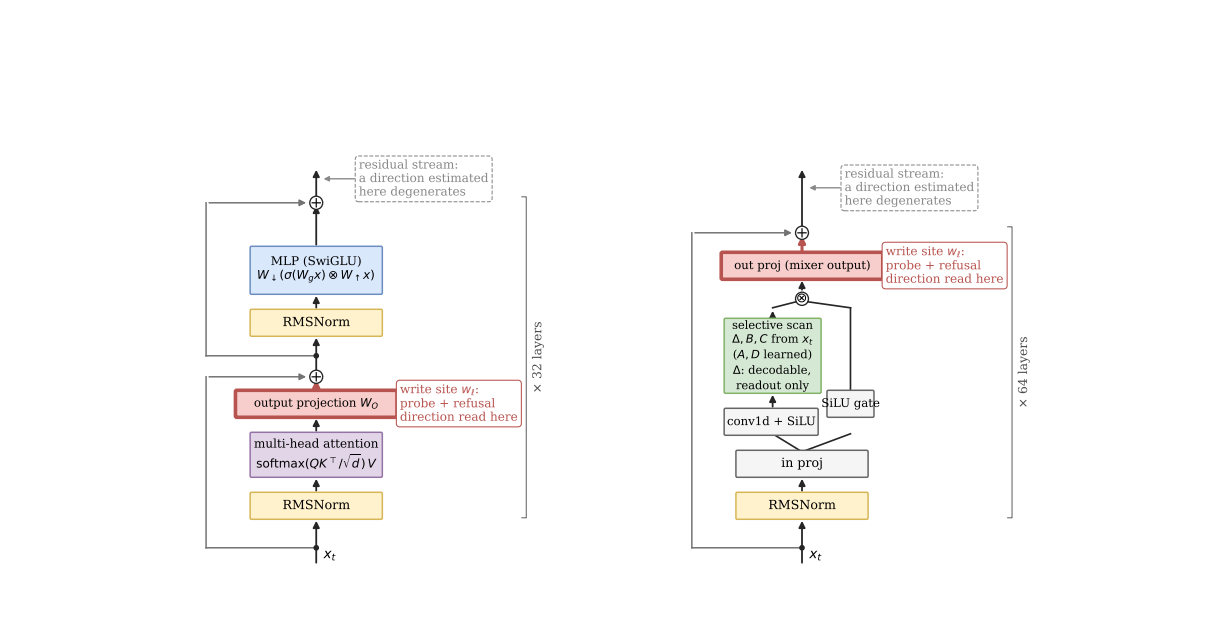
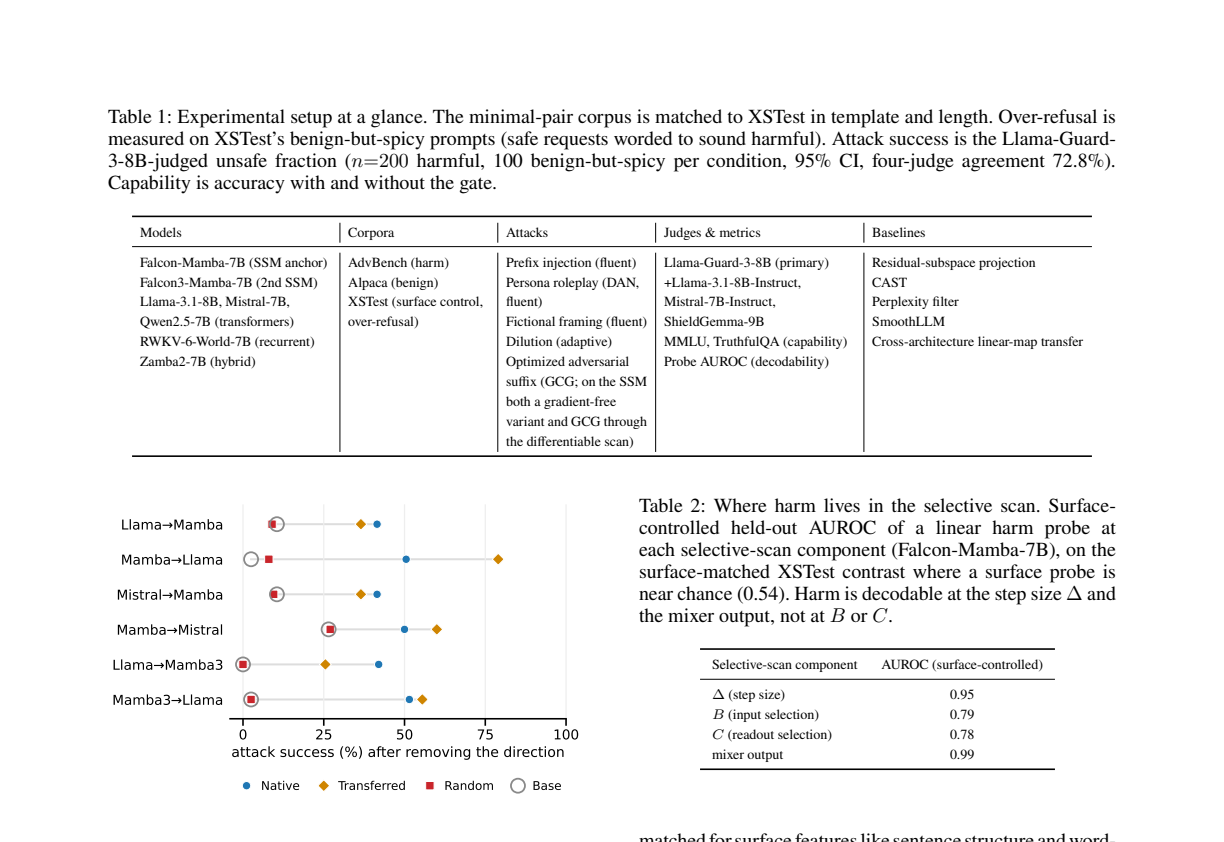
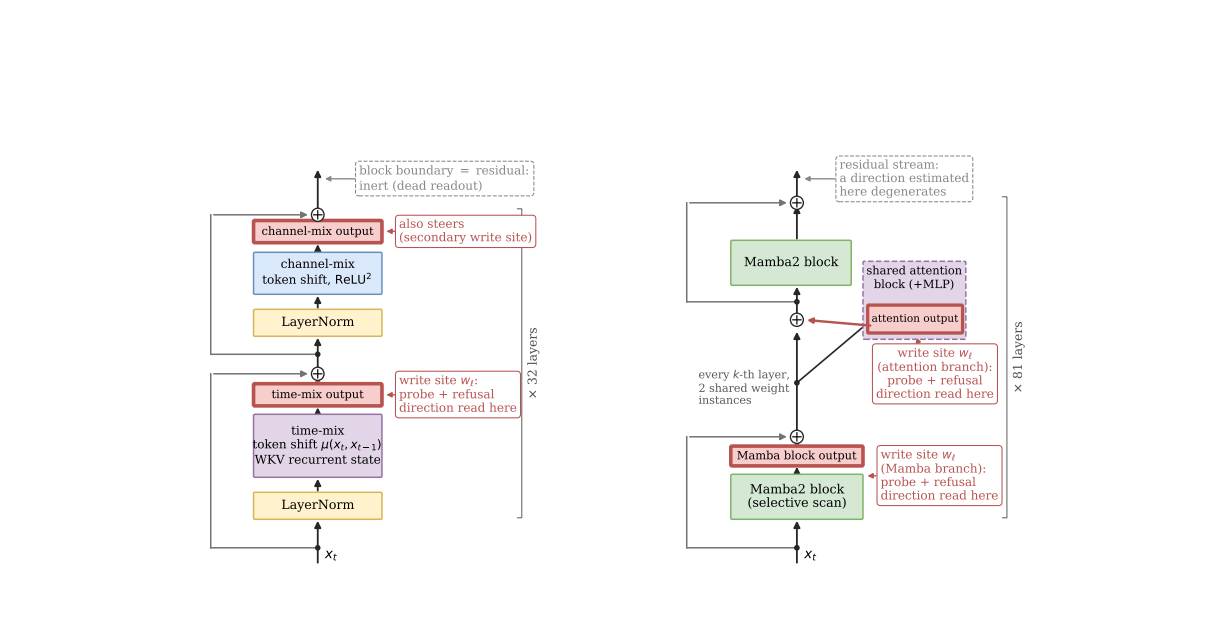
Where inside a language model does refusal live, and does that place change when the architecture does? In a transformer, refusal is governed by a single direction in the residual stream, a finding that safety and interpretability tooling now depend on. State-space models (SSMs) route information through a recurrent update instead of attention, sharing no token-mixing mechanism with a transformer. Does the same safety representation survive this shift, or must it be rediscovered per architecture? It survives. A single rigid rotation, which can only reorient a space and not reshape it, aligns one model's representation space with another's, so the two genuinely share the representation. A harm probe trained on a transformer then flags an SSM's harmful inputs, and removing the aligned direction makes a model answer attacks it would otherwise refuse, while a random direction of the same size does far less. What is architecture-specific is not where the direction is steered but where it must be read. Each layer computes a fresh output that is then added into the residual stream, and harm is cleanly readable at this output, the write site, before the addition. A control that holds the intervention's strength fixed shows that what matters is where the direction is estimated, not where it is applied. Applied through a detector-triggered gate, this direction lowers jailbreak success in all four architecture families we test (SSM, transformer, recurrent, hybrid), and on the SSM it holds against an attacker that tunes its prompt against the defense. The gate only matches a trivial rule that returns a fixed refusal whenever the same detector fires, so what transfers across architectures is the direction itself, not defense strength. Safety tooling built on refusal therefore ports to a new architecture by re-estimating the direction at that architecture's write site, not by rebuilding it.
The paper's own sentences, arranged, kept beside the review and separate from it. Each label is drawn from a closed vocabulary; the number beside it is the probability the classifier gave that label. No sentence in this record was written by a model.
abstract compiled · 2026-09-23
The authors' main claim, as the classifier picked it out 0.90
“Safety tooling built on refusal therefore ports to a new architecture by re-estimating the direction at that architecture's write site, not by rebuilding it.”
How the main claim is stated: asserted 1.00
What the abstract itself states, as probabilities: claims first 0.07 · states limitation 0.72 · human participants 0.03 · controlled comparison 0.94 · randomized assignment 0.02 · states quantitative result 0.11 · compares with prior results 0.79 · mentions code or data availability 0.03
The abstract, sentence by sentence
This table labels the abstract only (arXiv listing abstract v1). The number is the probability the classifier gave the label.
| Sentence | Role | The authors' own work | States the main conclusion | Strength |
|---|---|---|---|---|
| Where inside a language model does refusal live, and does that place change when the architecture does? | gap 0.77 | 0.06 | 0.02 | unclear 0.99 |
| In a transformer, refusal is governed by a single direction in the residual stream, a finding that safety and interpretability tooling now depend on. | background 0.62 | 0.40 | 0.13 | asserted 1.00 |
| State-space models (SSMs) route information through a recurrent update instead of attention, sharing no token-mixing mechanism with a transformer. | background 0.98 | 0.14 | 0.02 | asserted 1.00 |
| Does the same safety representation survive this shift, or must it be rediscovered per architecture? It survives. | result 0.92 | 0.82 | 0.37 | asserted 0.99 |
| A single rigid rotation, which can only reorient a space and not reshape it, aligns one model's representation space with another's, so the two genuinely share the representation. | interpretation 0.53 | 0.71 | 0.20 | asserted 1.00 |
| A harm probe trained on a transformer then flags an SSM's harmful inputs, and removing the aligned direction makes a model answer attacks it would otherwise refuse, while a random direction of the same size does far less. | result 1.00 | 0.87 | 0.16 | asserted 1.00 |
| What is architecture-specific is not where the direction is steered but where it must be read. | interpretation 0.61 | 0.78 | 0.34 | asserted 0.99 |
| Each layer computes a fresh output that is then added into the residual stream, and harm is cleanly readable at this output, the write site, before the addition. | result 0.76 | 0.77 | 0.10 | asserted 1.00 |
| A control that holds the intervention's strength fixed shows that what matters is where the direction is estimated, not where it is applied. | result 0.71 | 0.86 | 0.14 | asserted 1.00 |
| Applied through a detector-triggered gate, this direction lowers jailbreak success in all four architecture families we test (SSM, transformer, recurrent, hybrid), and on the SSM it holds against an attacker that tunes its prompt against the defense. | result 0.98 | 0.89 | 0.18 | asserted 1.00 |
| The gate only matches a trivial rule that returns a fixed refusal whenever the same detector fires, so what transfers across architectures is the direction itself, not defense strength. | interpretation 0.89 | 0.84 | 0.12 | asserted 1.00 |
| Safety tooling built on refusal therefore ports to a new architecture by re-estimating the direction at that architecture's write site, not by rebuilding it. | interpretation 0.97 | 0.78 | 0.82 | asserted 1.00 |
What kind of paper the classifier reports this is: empirical study 0.93 · evidence from observation or experiment 0.95
What was examined, and what was not
Sources read
- arXiv listing abstract v1
Not examined
- full text
- figures and tables
- references and citing sentences
- relations to other papers
Levels run
- P abstract
Not run
- S sections
- T body sentences
- C citations
- R cross-paper relations
How the labels were made
Compiled by classifier-1.13.0 via TypeSafe API, question bank abstract-p1-20260923, 2026-09-23: 1 request, 8,949 input tokens.
Every quoted sentence on this record is the authors'. Every label is from Pith's closed vocabulary, with the probability shown beside it. This record as JSON
Figures (6)
Figures are the authors', reproduced from the paper.
References (59)
- [1] Azaria, Amos and Mitchell, Tom , title =. Findings of the Association for Computational Linguistics: EMNLP , year = on Pith
- [2] Li, Kenneth and Patel, Oam and Vi. Inference-Time Intervention: Eliciting Truthful Answers from a Language Model , booktitle =. 2023 , note = on Pith
- [3] Goldowsky-Dill, Nicholas and Chughtai, Bilal and Heimersheim, Stefan and Hobbhahn, Marius , title =. International Conference on Machine Learning (ICML) , year = on Pith
- [4] MacDiarmid, Monte and Maxwell, Timothy and Schiefer, Nicholas and Mu, Jesse and Kaplan, Jared and Duvenaud, David and Bowman, Sam and Tamkin, Alex and Perez, Ethan and Sharma, Mrinank and Denison, Carson and Hubinger, Evan , title =. 2024 , howpublished = on Pith
- [5] Marks, Samuel and Tegmark, Max , title =. Conference on Language Modeling (COLM) , year = on Pith
- [6] Lee, Bruce W. and Padhi, Inkit and Ramamurthy, Karthikeyan Natesan and Miehling, Erik and Dognin, Pierre and Nagireddy, Manish and Dhurandhar, Amit , title =. International Conference on Learning Representations (ICLR) , year = on Pith
- [7] Han, Peixuan and Qian, Cheng and Chen, Xiusi and Zhang, Yuji and Ji, Heng and Zhang, Denghui , title =. Findings of the Association for Computational Linguistics: EMNLP , year = on Pith
- [8] Zhou, Zhenhong and Yu, Haiyang and Zhang, Xinghua and Xu, Rongwu and Huang, Fei and Wang, Kun and Liu, Yang and Fang, Junfeng and Li, Yongbin , title =. International Conference on Learning Representations (ICLR) , year = on Pith
- [9] Li, Yu and Jiang, Han and Wei, Zhihua , title =. Findings of the Association for Computational Linguistics: ACL , year = on Pith
- [10] Zhang, Qingru and Singh, Chandan and Liu, Liyuan and Liu, Xiaodong and Yu, Bin and Gao, Jianfeng and Zhao, Tuo , title =. International Conference on Learning Representations (ICLR) , year = on Pith
- [11] Li, Yuxiao and Fastowski, Alina and Zaradoukas, Efstratios and Prenkaj, Bardh and Kasneci, Gjergji , title =. 2026 , howpublished = on Pith
- [12] Oldfield, James and Torr, Philip and Patras, Ioannis and Bibi, Adel and Barez, Fazl , title =. International Conference on Learning Representations (ICLR) , year = on Pith
- [13] Engels, Joshua and Michaud, Eric J. and Liao, Isaac and Gurnee, Wes and Tegmark, Max , title =. International Conference on Learning Representations (ICLR) , year = on Pith
- [14] Wang, Junxuan and Ge, Xuyang and Shu, Wentao and Tang, Qiong and Zhou, Yunhua and He, Zhengfu and Qiu, Xipeng , title =. International Conference on Learning Representations (ICLR) , year = on Pith
- [15] Lindsey, Jack and Templeton, Adly and Marcus, Jonathan and Conerly, Thomas and Batson, Joshua and Olah, Christopher , title =. 2024 , howpublished = on Pith
- [16] Thasarathan, Harrish and Forsyth, Julian and Fel, Thomas and Kowal, Matthew and Derpanis, Konstantinos G. , title =. International Conference on Machine Learning (ICML) , year = on Pith
- [17] Jiralerspong, Thomas and Bricken, Trenton , title =. 2026 , howpublished = on Pith
- [18] Zou, Andy and Phan, Long and Chen, Sarah and Campbell, James and Guo, Phillip and Ren, Richard and Pan, Alexander and Yin, Xuwang and Mazeika, Mantas and Dombrowski, Ann-Kathrin and Goel, Shashwat and Li, Nathaniel and Byun, Michael J. and Wang, Zifan and Mallen, Alex and Basa... on Pith
- [19] Zou, Andy and Phan, Long and Wang, Justin and Duenas, Derek and Lin, Maxwell and Andriushchenko, Maksym and Wang, Rowan and Kolter, Zico and Fredrikson, Matt and Hendrycks, Dan , title =. Advances in Neural Information Processing Systems (NeurIPS) , year = on Pith
- [20] Mazeika, Mantas and Phan, Long and Yin, Xuwang and Zou, Andy and Wang, Zifan and Mu, Norman and Sakhaee, Elham and Li, Nathaniel and Basart, Steven and Li, Bo and Forsyth, David and Hendrycks, Dan , title =. International Conference on Machine Learning (ICML) , year = on Pith
show 39 more
- [21] Lin, Stephanie and Hilton, Jacob and Evans, Owain , title =. Proceedings of the Association for Computational Linguistics (ACL) , year = on Pith
- [22] Hendrycks, Dan and Burns, Collin and Basart, Steven and Zou, Andy and Mazeika, Mantas and Song, Dawn and Steinhardt, Jacob , title =. International Conference on Learning Representations (ICLR) , year = on Pith
- [23] Korznikov, Anton and Galichin, Andrey and Dontsov, Alexey and Rogov, Oleg Y. and Oseledets, Ivan and Tutubalina, Elena , title =. arXiv preprint arXiv:2509.22067 , year = on PitharXiv
- [24] Xiong, Chen and He, Zhiyuan and Chen, Pin-Yu and Ko, Ching-Yun and Ho, Tsung-Yi , title =. arXiv preprint arXiv:2602.04896 , year = on PitharXiv
- [25] Zuo, Jingwei and Velikanov, Maksim and Rhaiem, Dhia Eddine and Chahed, Ilyas and Belkada, Younes and Kunsch, Guillaume and Hacid, Hakim , title =. arXiv preprint arXiv:2410.05355 , year = on PithPith's reviewarXiv
- [26] Arditi, Andy and Obeso, Oscar and Syed, Aaquib and Paleka, Daniel and Panickssery, Nina and Gurnee, Wes and Nanda, Neel , title =. Advances in Neural Information Processing Systems (NeurIPS) , year = on Pith
- [27] Zou, Andy and Wang, Zifan and Carlini, Nicholas and Nasr, Milad and Kolter, J. Zico and Fredrikson, Matt , title =. 2023 , howpublished = on Pith
- [28] Andriushchenko, Maksym and Croce, Francesco and Flammarion, Nicolas , title =. International Conference on Learning Representations (ICLR) , year = on Pith
- [29] R. Proceedings of the 2024 Conference of the North American Chapter of the Association for Computational Linguistics (NAACL) , year = on Pith
- [30] Cui, Justin and Chiang, Wei-Lin and Stoica, Ion and Hsieh, Cho-Jui , title =. International Conference on Machine Learning (ICML) , year = on Pith
- [31] Mamba: Linear-Time Sequence Modeling with Selective State Spaces , author =. arXiv preprint arXiv:2312.00752 , year = on PithPith's reviewarXiv
- [32] Llama Guard: LLM-based Input-Output Safeguard for Human-AI Conversations , author =. arXiv preprint arXiv:2312.06674 , year = on PithPith's reviewarXiv
- [33] Robey, Alexander and Wong, Eric and Hassani, Hamed and Pappas, George J. , journal =. 2025 , url = on Pith
- [34] The Geometry of Refusal in Large Language Models: Concept Cones and Representational Independence , author =. Proceedings of the 42nd International Conference on Machine Learning (ICML) , year = on Pith
- [35] A generalized solution of the orthogonal Procrustes problem , author =. Psychometrika , volume = on Pith
- [36] Probable inference, the law of succession, and statistical inference , author =. Journal of the American Statistical Association , volume = on Pith
- [37] Universal Refusal Circuits Across LLMs: Cross-Model Transfer via Trajectory Replay and Concept-Basis Reconstruction , author =. 2026 , howpublished = on Pith
- [38] Interpreting and Steering State-Space Models via Activation Subspace Bottlenecks , author =. 2026 , howpublished = on Pith
- [39] Exploring the Multi-Dimensional Refusal Subspace in Reasoning Models , author =. 2025 , howpublished = on Pith
- [40] Piras, Giorgio and Mura, Raffaele and Brau, Fabio and Oneto, Luca and Roli, Fabio and Biggio, Battista , journal =. 2026 , doi = on Pith
- [41] Activation Space Interventions Can Be Transferred Between Large Language Models , author =. arXiv preprint arXiv:2503.04429 , year = on PitharXiv
- [42] Activation Steering for Masked Diffusion Language Models , author =. 2025 , eprint = on Pith
- [43] Paulo, Gon. Does Transformer Interpretability Transfer to. 2024 , eprint = on Pith
- [44] Peng, Bo and Goldstein, Daniel and Anthony, Quentin and Albalak, Alon and others , year =. Eagle and Finch:. 2404.05892 , archivePrefix = on PithPith's reviewarXiv
- [45] Belrose, Nora and Schneider-Joseph, David and Ravfogel, Shauli and Cotterell, Ryan and Raff, Edward and Biderman, Stella , title =. Advances in Neural Information Processing Systems (NeurIPS) , year = on Pith
- [46] Do Models Share Safety Representations? Cross-Model Steering for Safe Visual Generation , author =. 2026 , howpublished = on Pith
- [47] Building Production-Ready Probes for Gemini , author =. 2026 , howpublished = on Pith
- [48] Hidden State Poisoning Attacks against Mamba-based Language Models , author =. 2026 , howpublished = on Pith
- [49] Detection vs. Execution: Single-Bucket Probes Miss Half the Mamba-2 State Sink , author =. 2026 , howpublished = on Pith
- [50] Perfect Detection, Failed Control: The Geometry of Knowing vs. Steering in Language Models , author =. 2026 , howpublished = on Pith
- [51] Residual Paving: Diagnosing the Routing Bottleneck in Selective Refusal Editing , author =. 2026 , howpublished = on Pith
- [52] Young, Richard J. , year =. Comparative Analysis of on Pith
- [53] The Llama 3 Herd of Models , author=. 2024 , eprint= on Pith
- [54] Jiang, Albert Q. and Sablayrolles, Alexandre and Mensch, Arthur and others , year=. Mistral 7. 2310.06825 , archivePrefix= on PithPith's reviewarXiv
- [55] Taori, Rohan and Gulrajani, Ishaan and Zhang, Tianyi and Dubois, Yann and Li, Xuechen and Guestrin, Carlos and Liang, Percy and Hashimoto, Tatsunori B. , year=. Stanford on Pith
- [56] Ji, Jiaming and Liu, Mickel and Dai, Juntao and Pan, Xuehai and Zhang, Chi and Bian, Ce and Chen, Boyuan and Sun, Ruiyang and Wang, Yizhou and Yang, Yaodong , booktitle= on Pith
- [57] Position: The Platonic Representation Hypothesis , author=. International Conference on Machine Learning (ICML) , year= on Pith
- [58] Safety, Security, and Cognitive Risks in State-Space Models: A Systematic Threat Analysis with Spectral, Stateful, and Capacity Attacks , author =. 2026 , eprint = on Pith
- [59] The Zamba2 Suite: Technical Report , author =. 2024 , note = on Pith
Cited by 2 Pith papers
Reviewed papers on Pith that cite this one. The full citation record
- The Platonic Representation Hypothesis in Jacobian-Space: Language and Vision Models Agree Approximately Up to a Rotation cs.AI · Nov 2026
- Is Abliteration Getting Harder? Not Uniformly: Refusal Removal by Direction-Based Ablation and ARA in Heretic on the Qwen3.8, Gemma 4, Olmo 3.1 and Mistral Small 3.2 LLMs Versus Their Predecessors cs.AI · Nov 2026
Challenges and discussion
Disagree with the review, or know something it missed? Leave a comment, or challenge this review formally: a challenge becomes a permanent entry in this paper's record, and its decision is published here.
Come back by email
A short list of the week's newly reviewed papers. Nothing is sent until you confirm from your inbox, and every email has a link that stops it. No account.
No comments yet.
Sign in to comment