Artificial Intelligence · arXiv:2611.17846 v1 · submitted 13 Nov 2026 · 140 references
Is Abliteration Getting Harder? Not Uniformly: Refusal Removal by Direction-Based Ablation and ARA in Heretic on the Qwen3.8, Gemma 4, Olmo 3.1 and Mistral Small 3.2 LLMs Versus Their Predecessors
The paper says
“Abliteration, a fine-tuning-free weight edit, removes refusal from open-weight large language models (LLMs). The developer of Arbitrary-Rank Ablation (ARA), an optimisation-based variant, reports that direction-based abliteration, which ablates a refusal direction, increasingly fails on newer models.”
more of the abstract
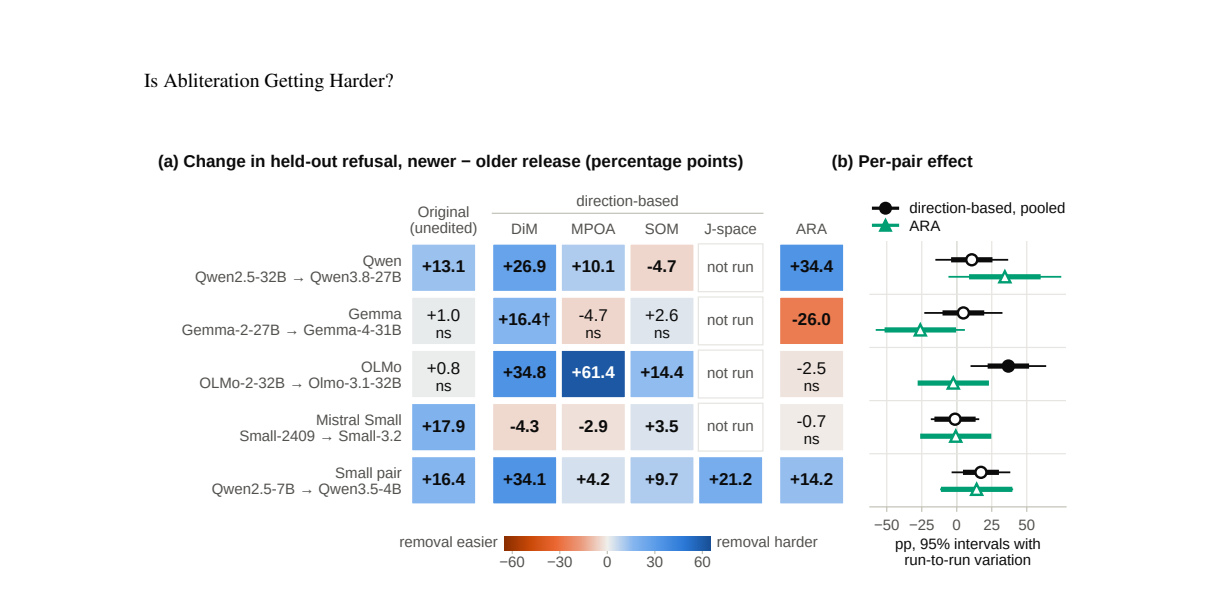
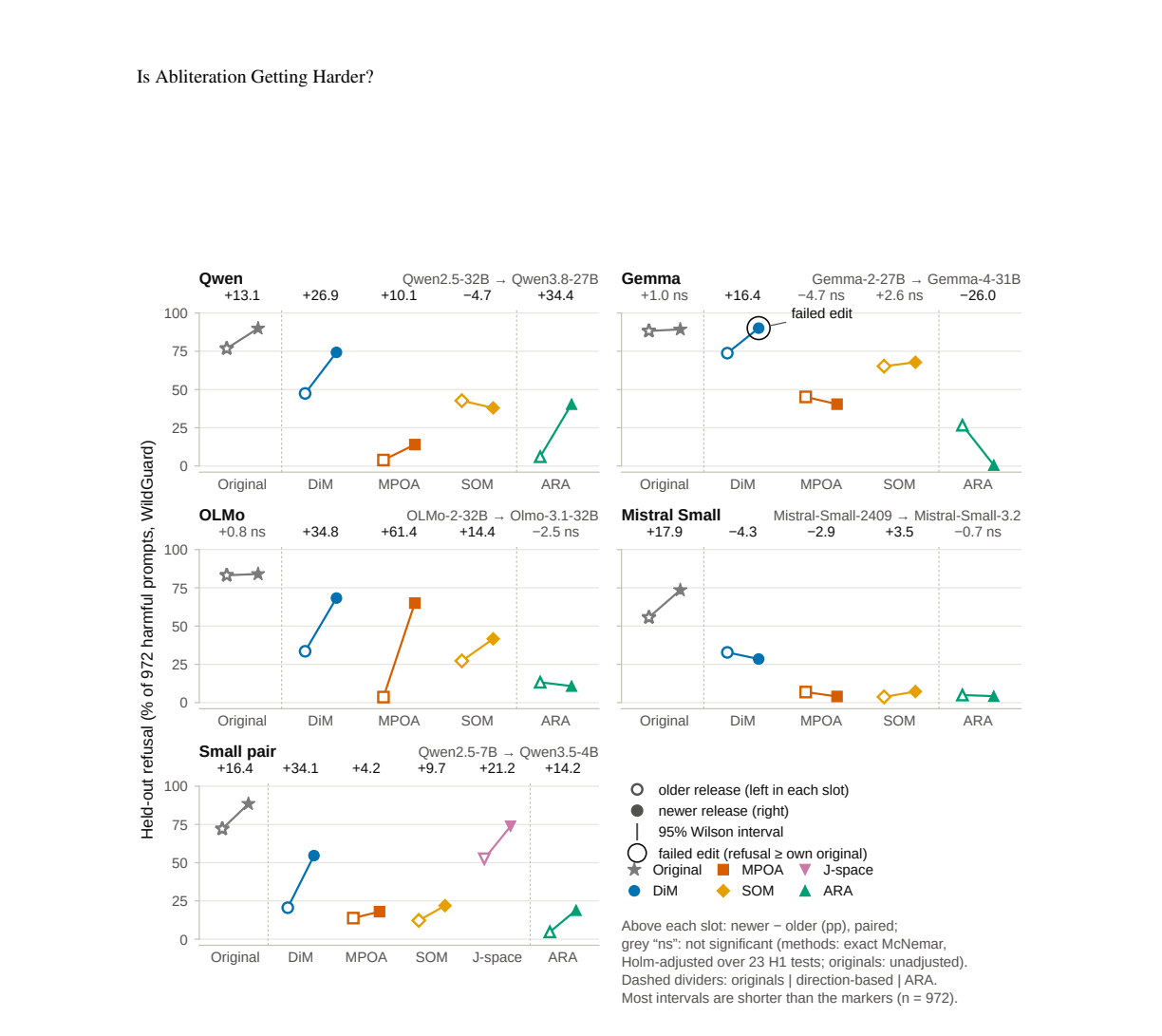
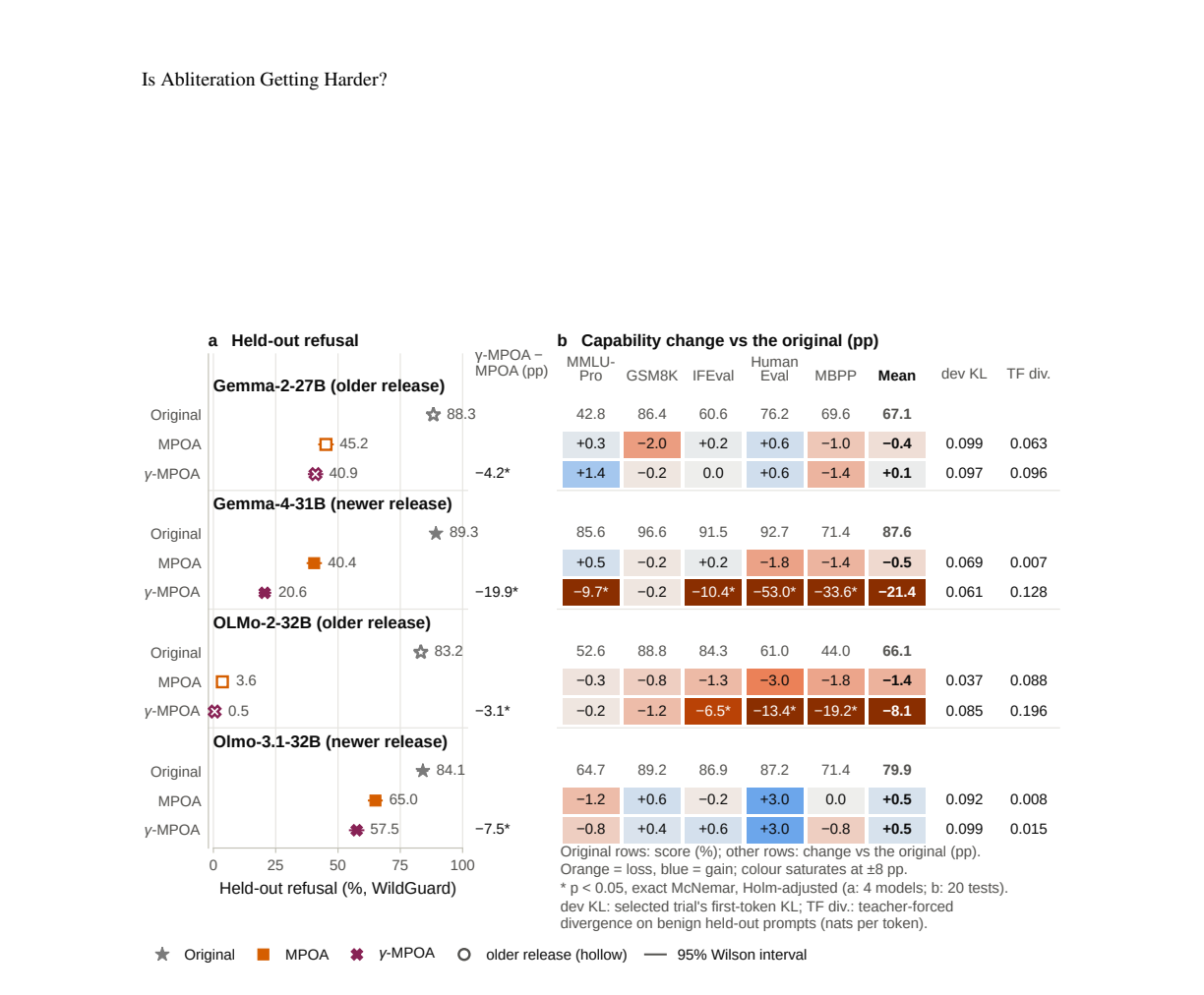
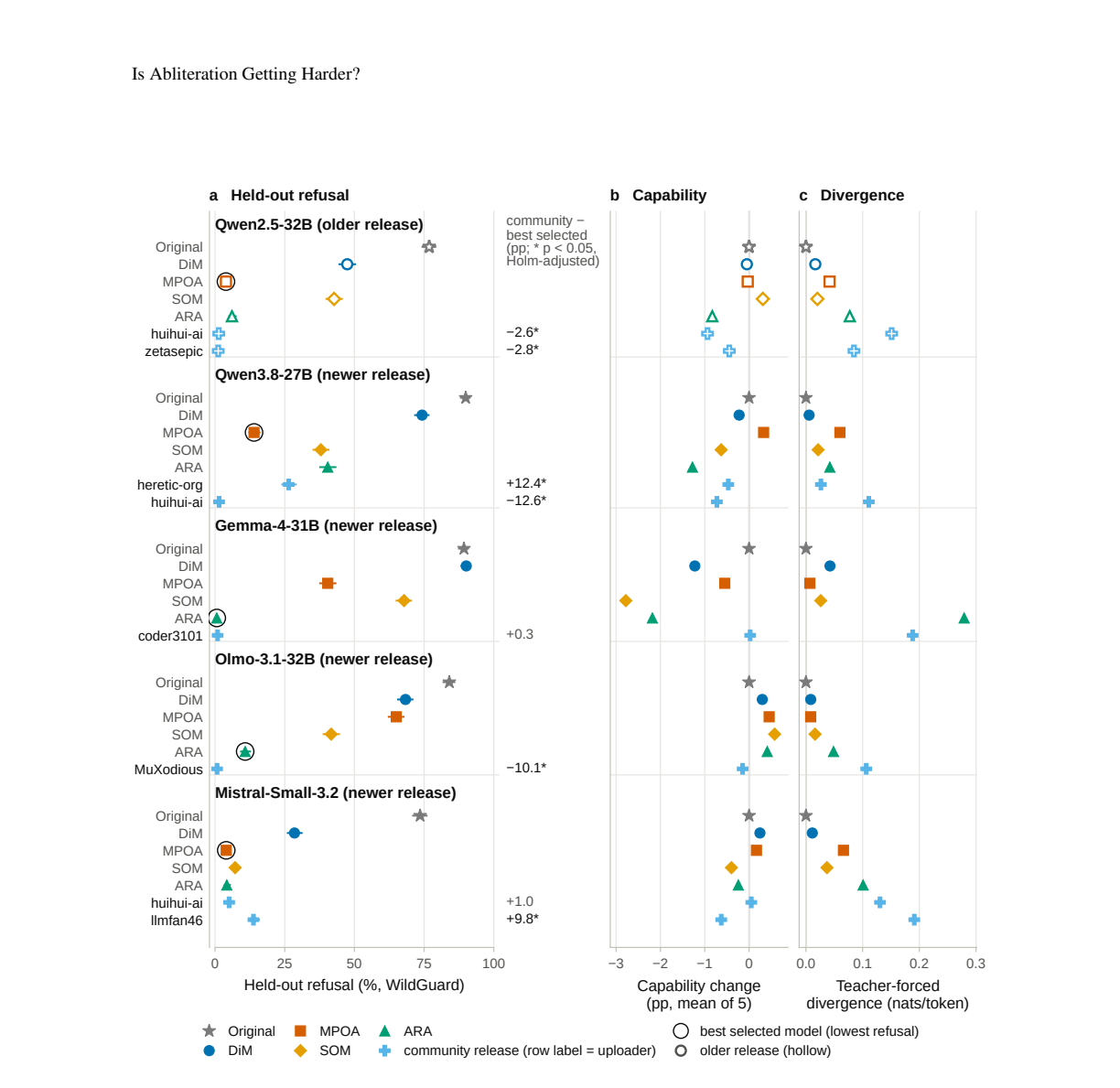
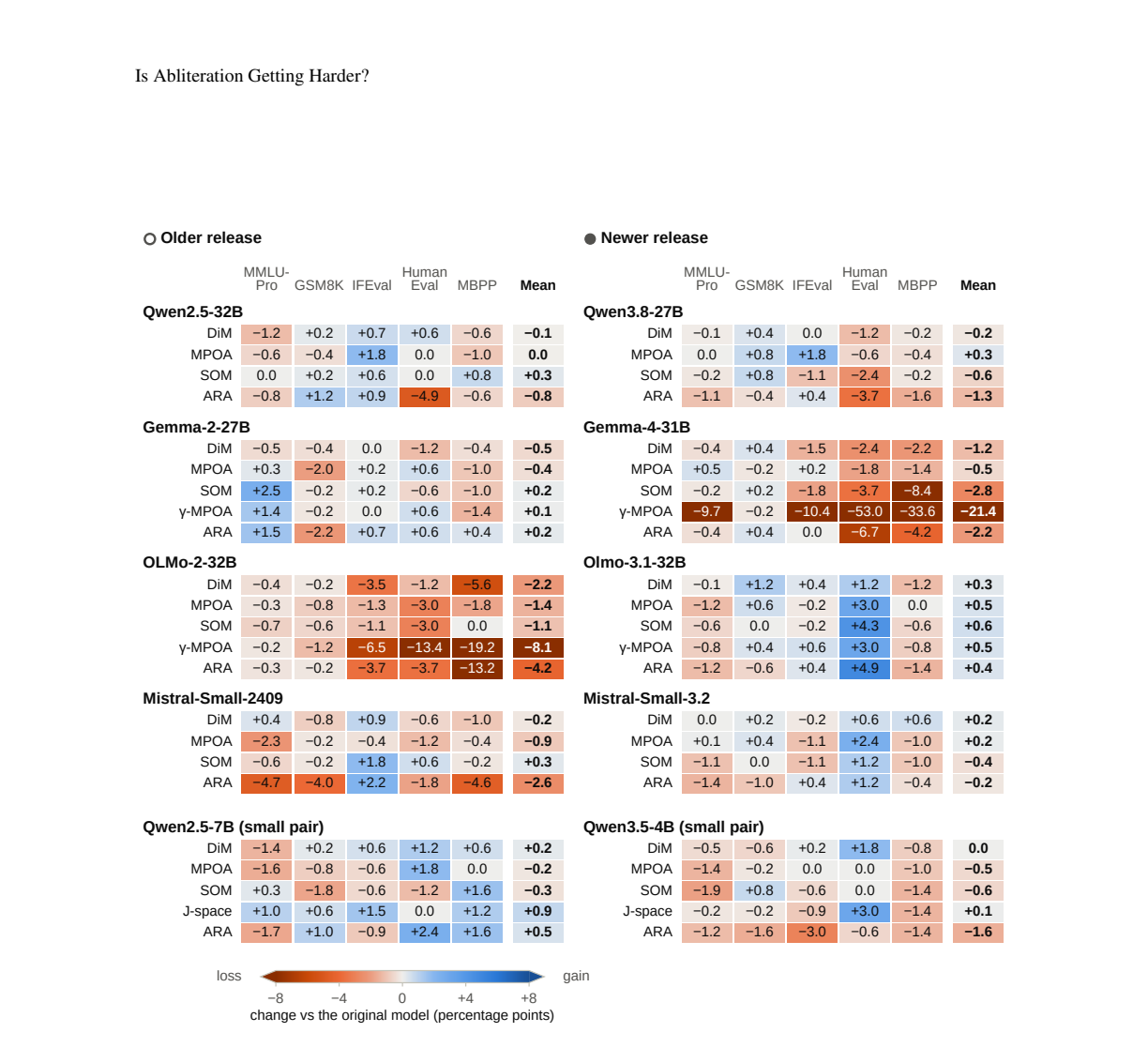
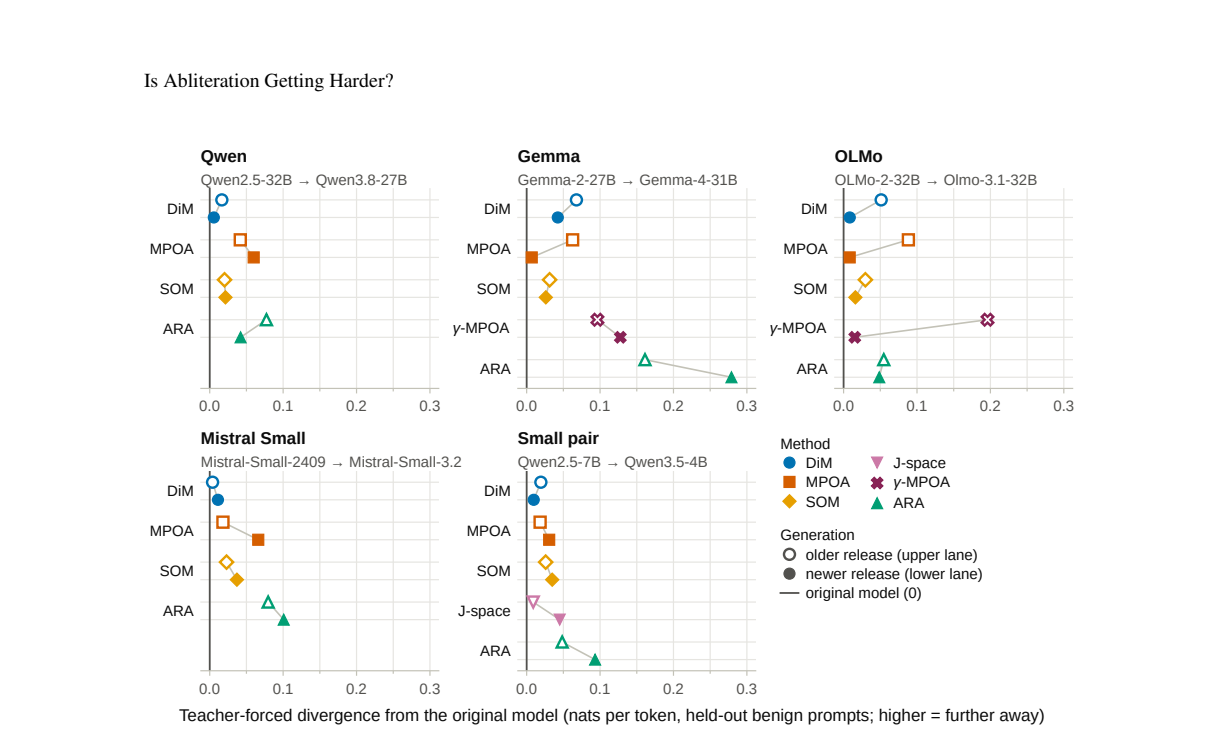
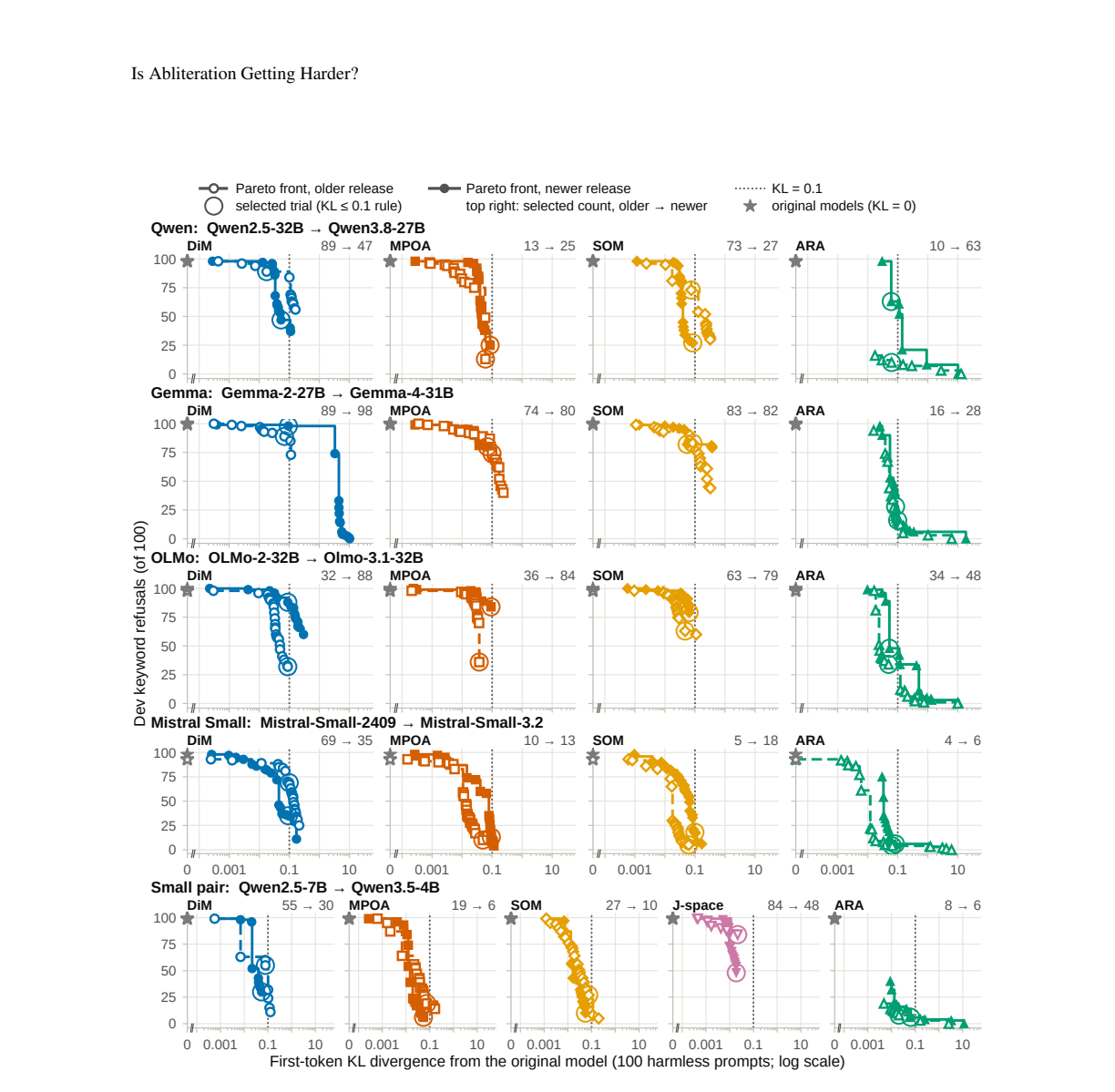
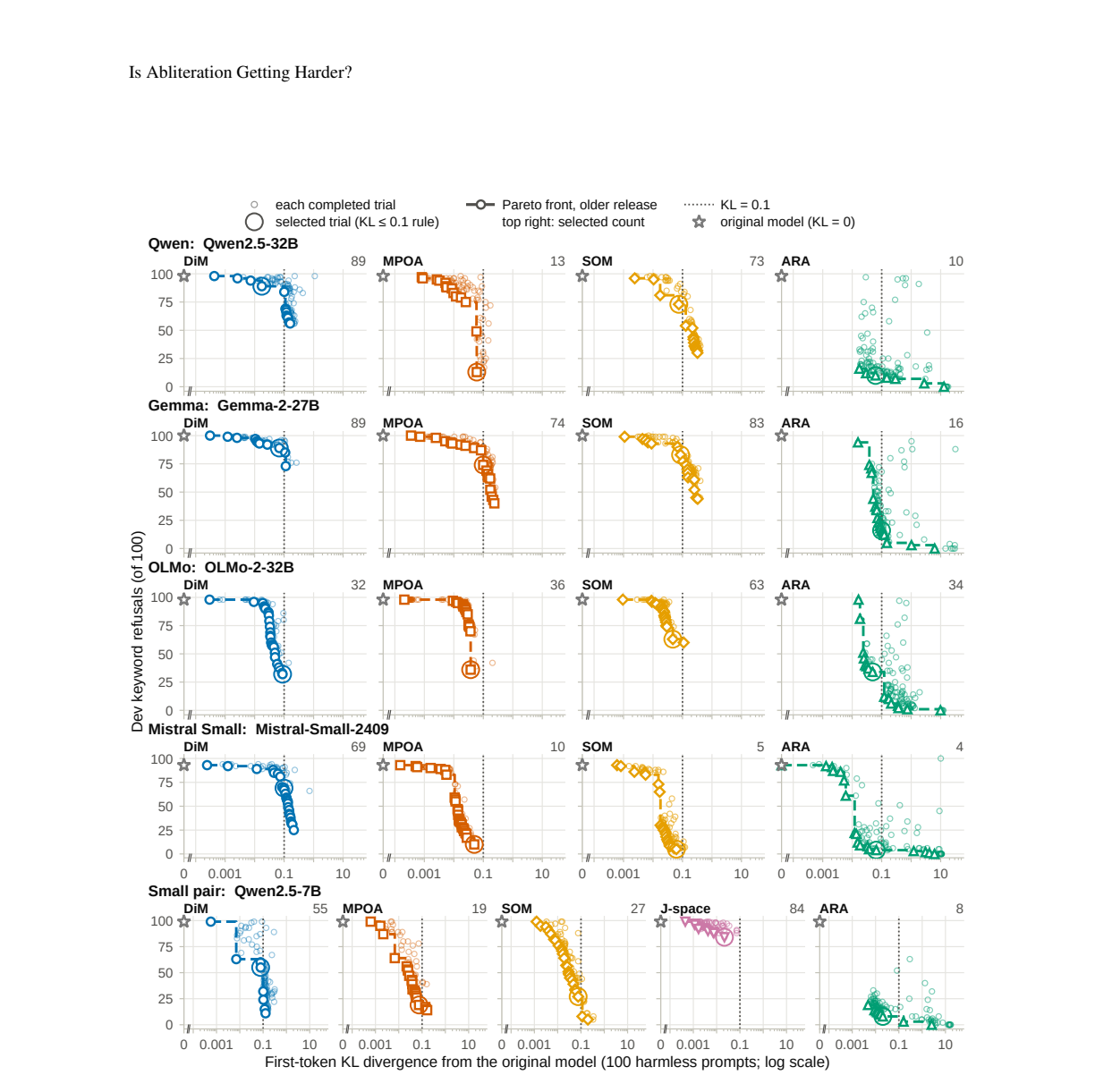
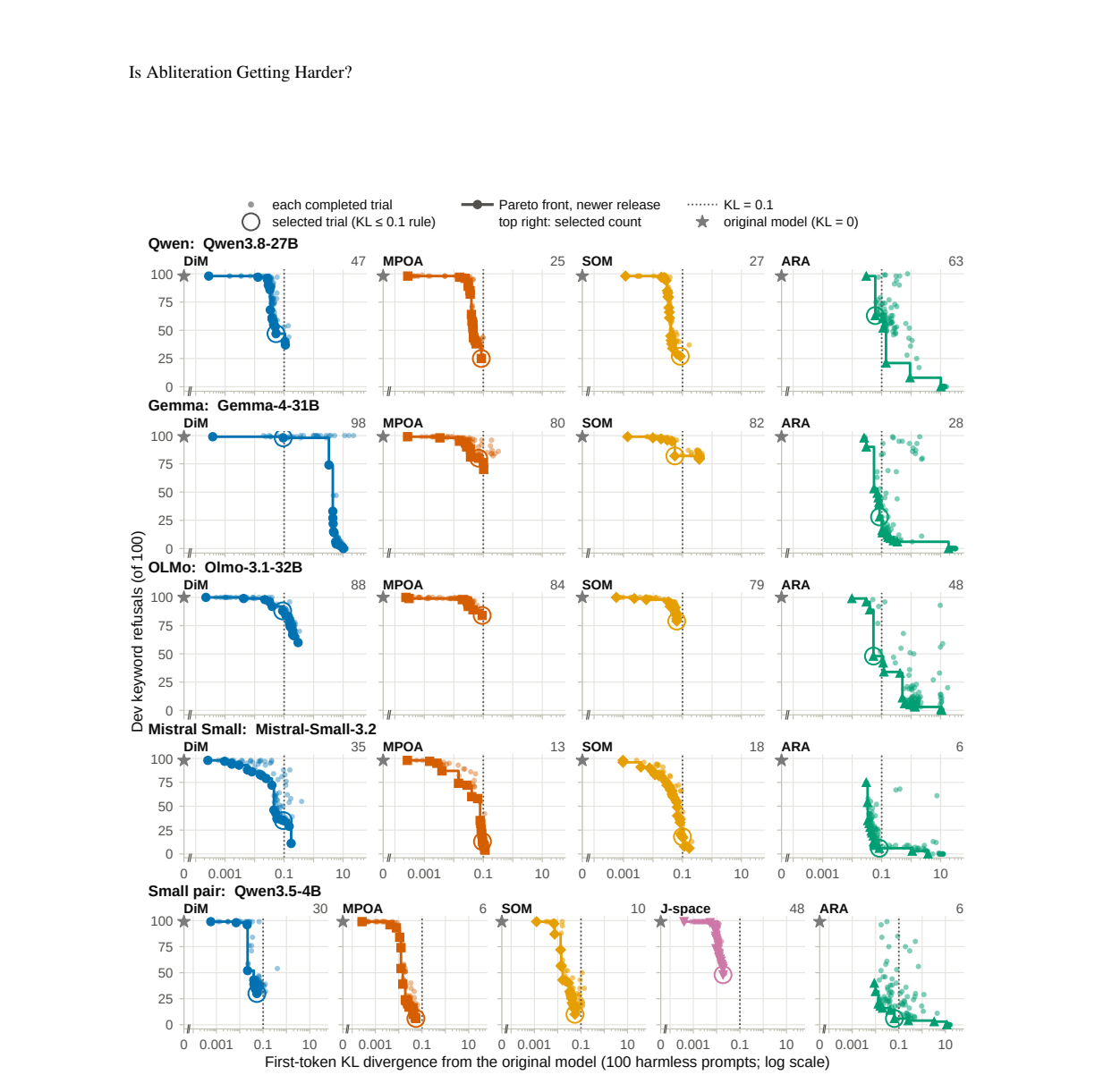
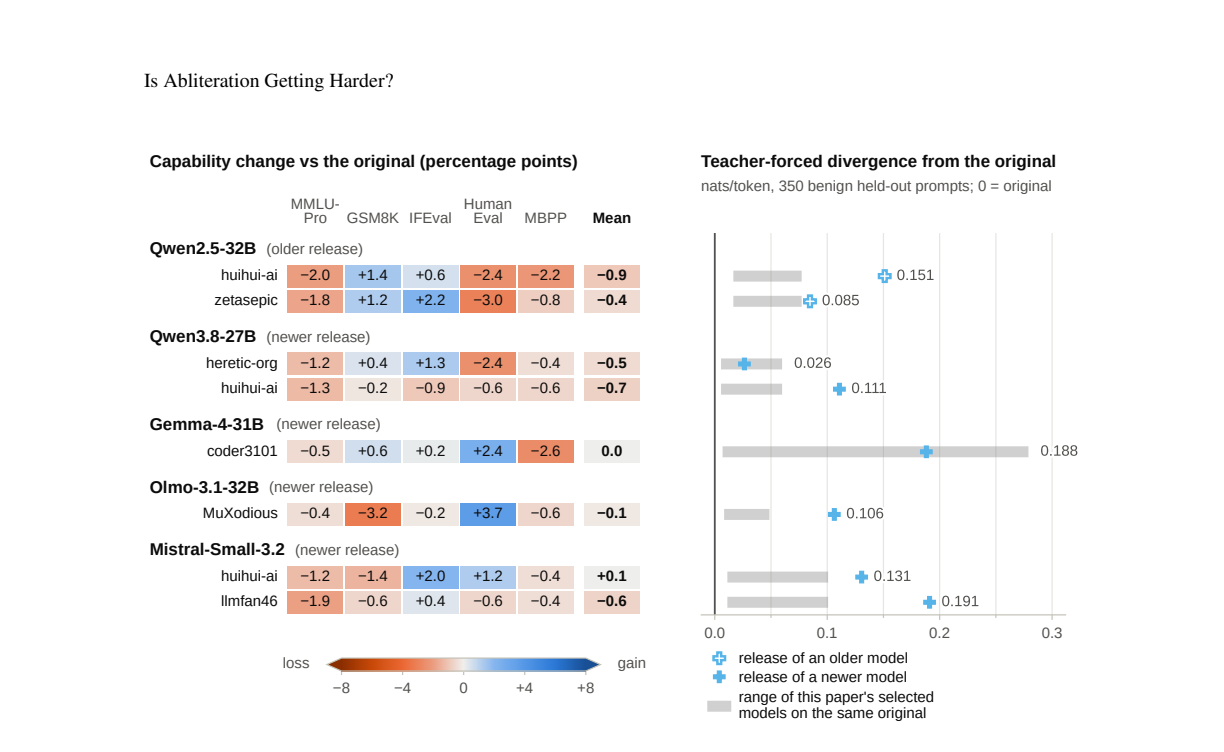
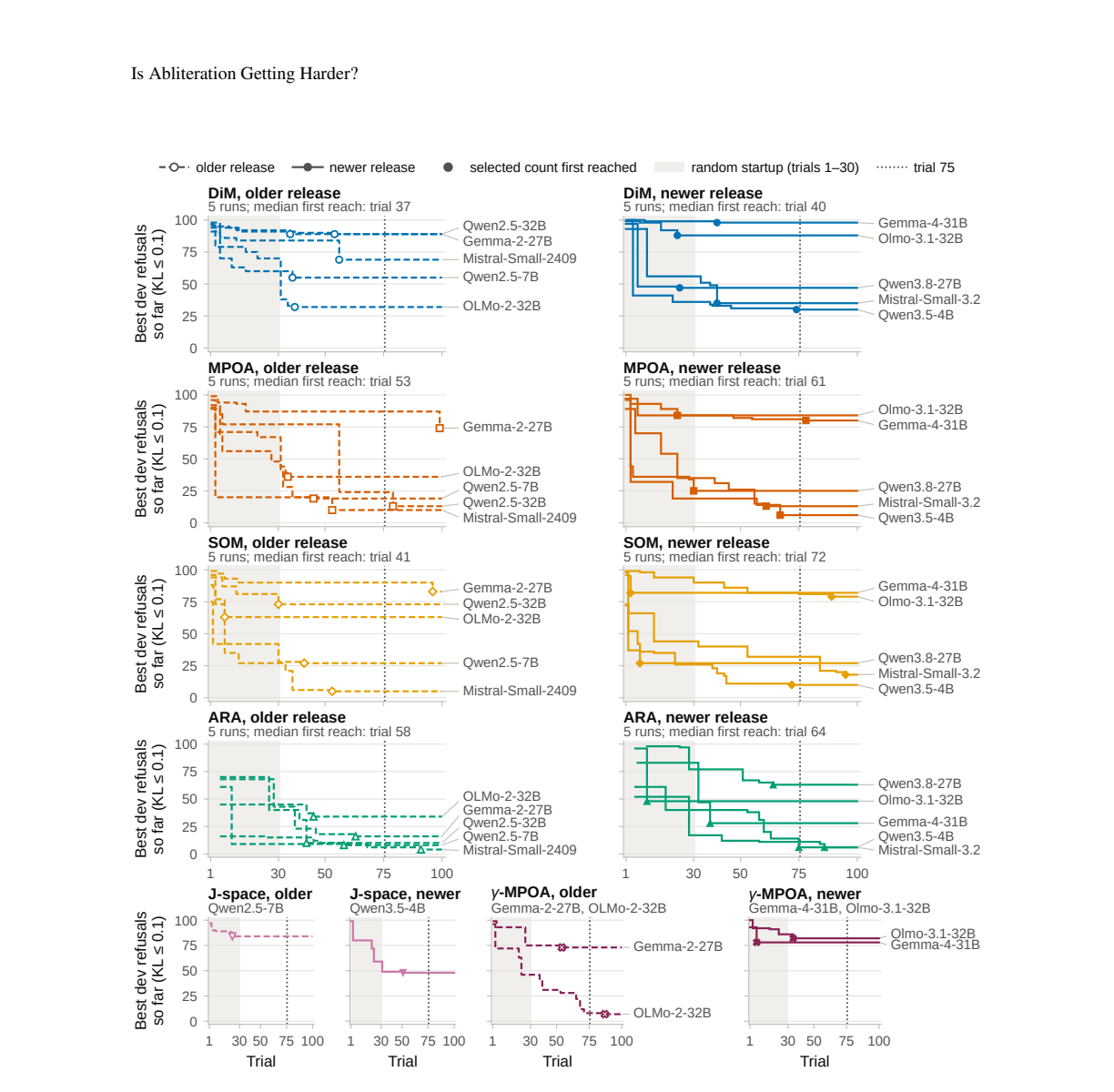
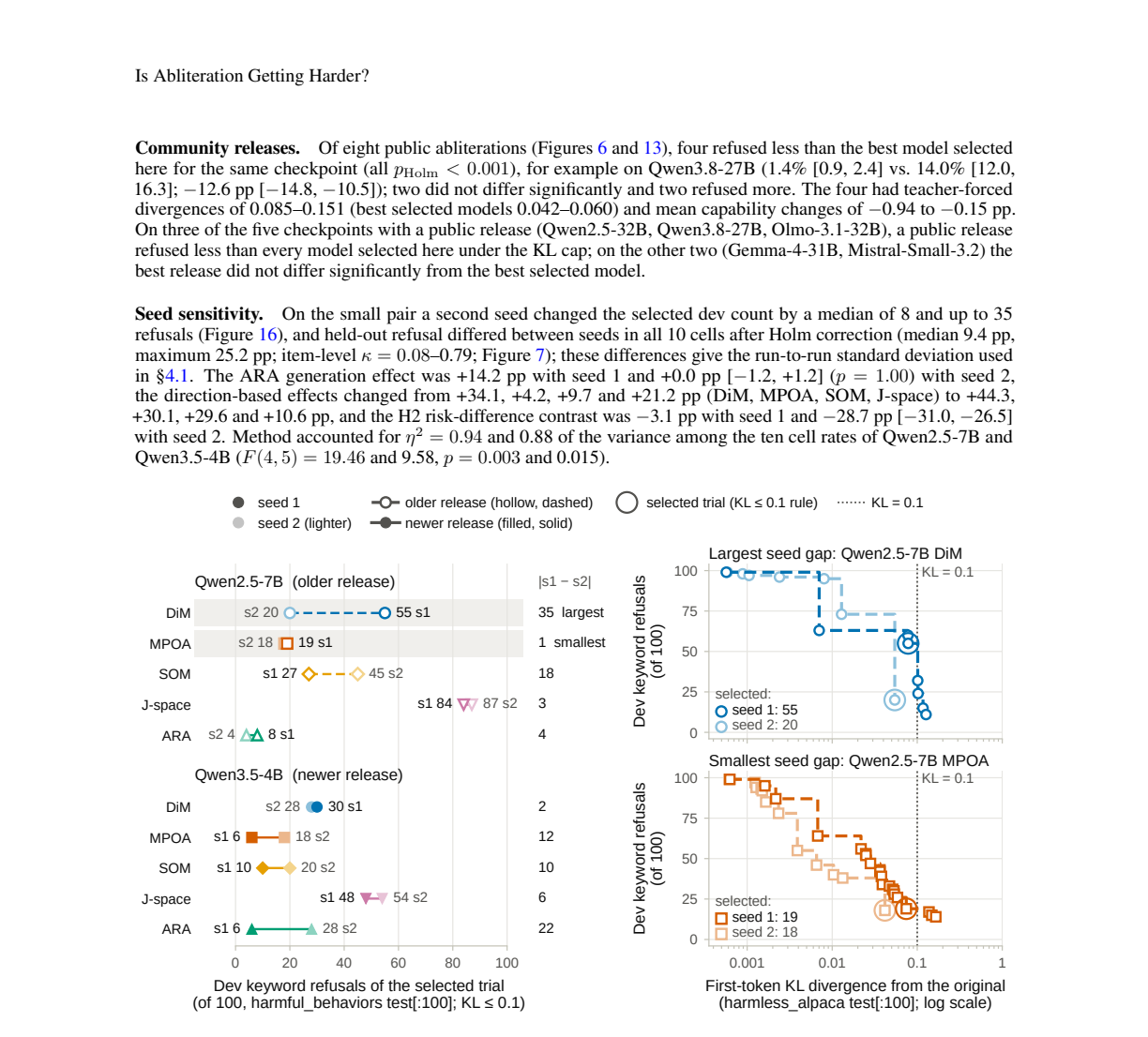
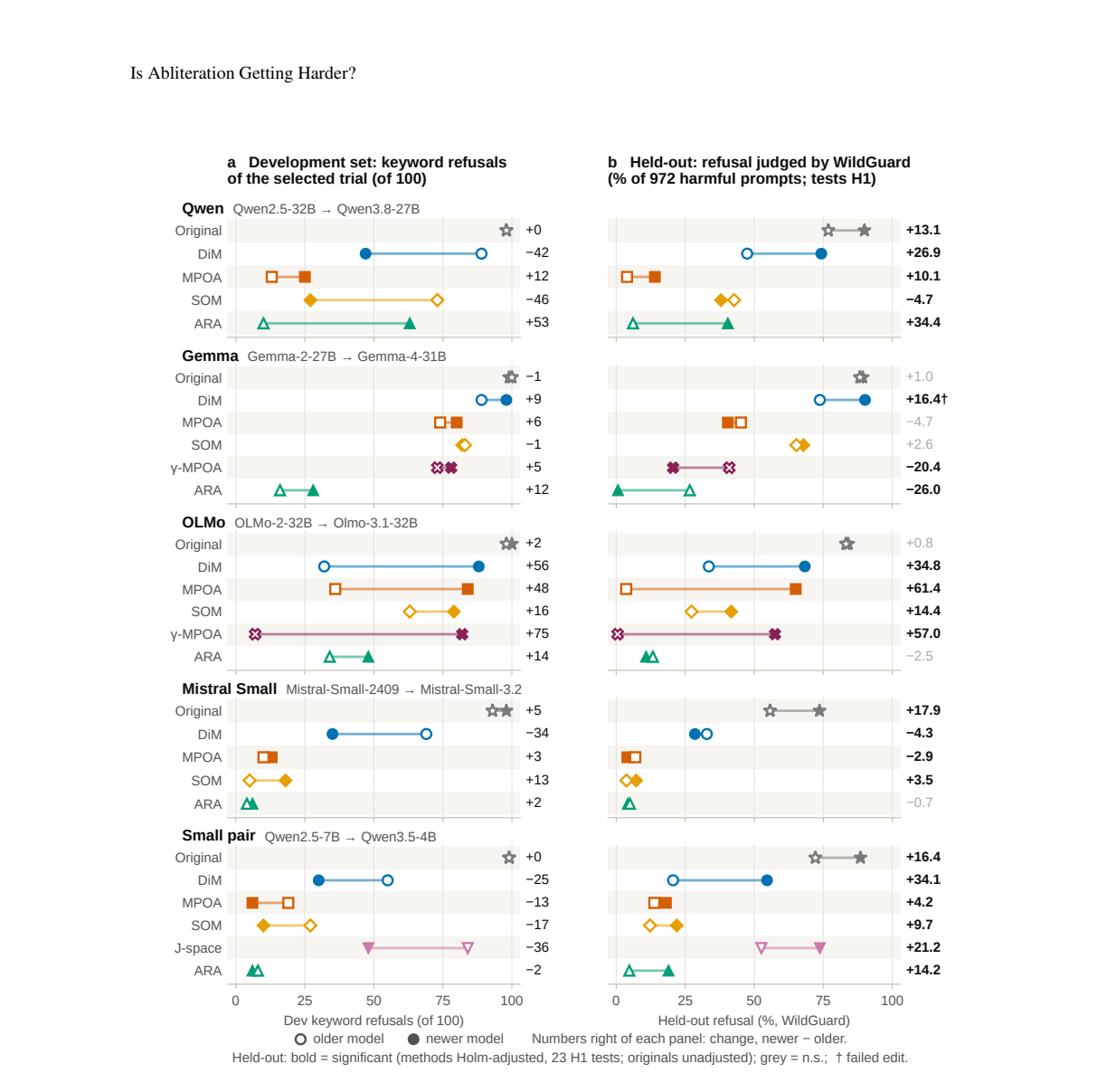
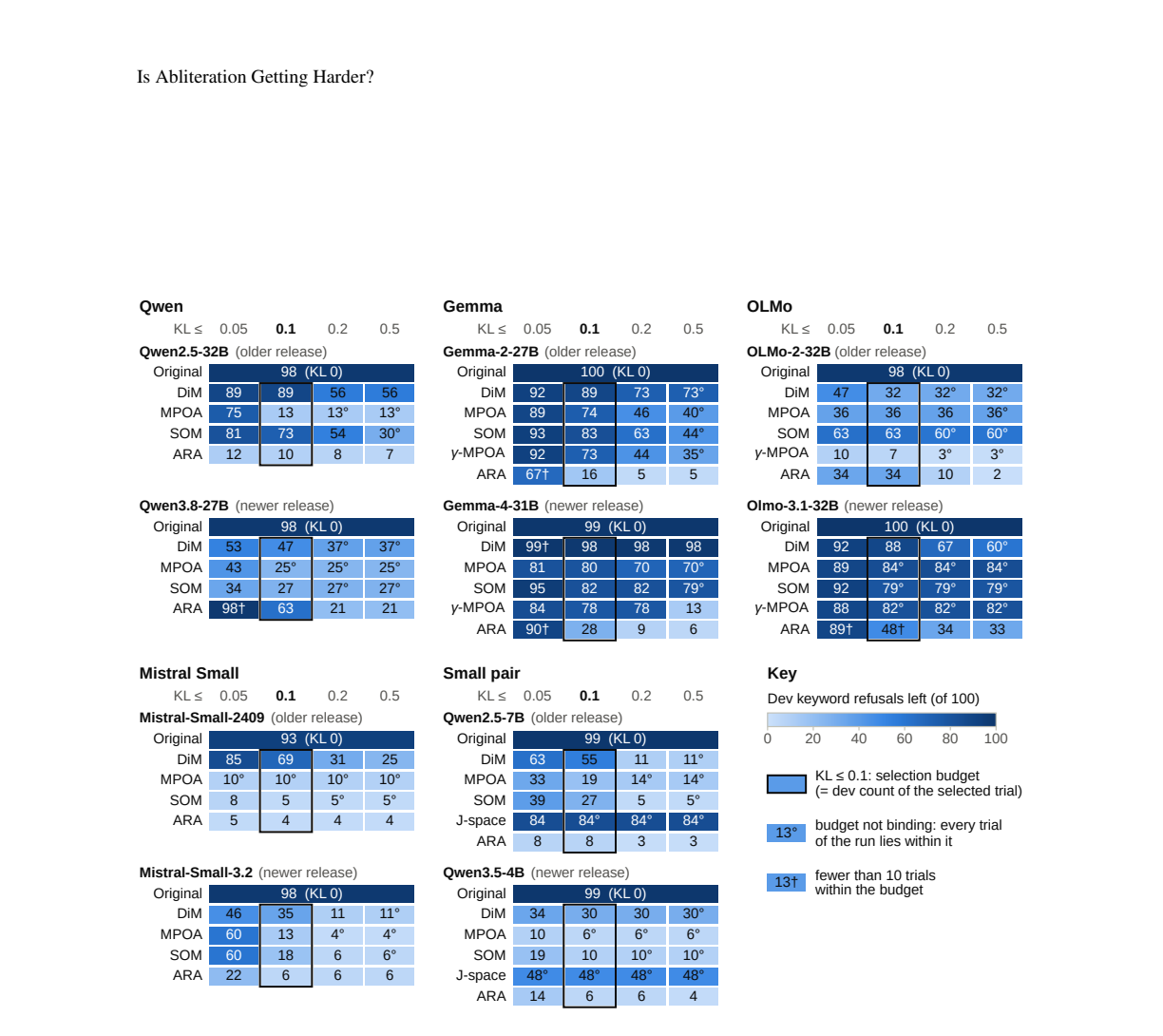
On five release pairs, refusal removal did not become uniformly harder. Qwen2.5-32B and Qwen3.8-27B, Gemma-2-27B and Gemma-4-31B, OLMo-2-32B and Olmo-3.1-32B, Mistral-Small-2409 and Mistral-Small-3.2, and Qwen2.5-7B and Qwen3.5-4B were edited in Heretic 2.0 by three or four direction-based methods (difference-in-means, MPOA, SOM and, on the small pair, J-space) and ARA under the same prompts, nominal search budget, first-token KL divergence cap and selection rule; removal counted as harder when the automatic WildGuard judge found more of 972 held-out harmful prompts (JailbreakBench, XSTest, StrongREJECT, HarmBench and an author-compiled malicious-code bank) still refused. After direction-based removal, newer releases retained -1 to +37 percentage points more refusal, and after ARA -26 to +34. With run-to-run variance included, between-pair heterogeneity of the direction-based effect ranged from high to low with the scale and variance model (I^2 20-80%). ARA lost less effectiveness than direction-based methods in Gemma and OLMo and more in Qwen; each verdict rests on one ARA run, and some changed with the divergence budget or variance model. In Gemma the direction-based increase came from the malicious-code bank and reversed on public sets. Contrary to prediction, keyword counts at the tool's window did not undercount judged refusal on average, but differed by a mean 7 points per model. Audits of a single pair, method or prompt source can reach opposite conclusions. Whether a newer model resisted removal depended on the release pair, method and budget, not on generation alone.
from the abstract
Pith says
Machine review · deepseek-v4-flash · 16 Nov 2026 · read the full text (363,525 characters) · not checked by a person
It can be wrong. Challenge this review or reply to it.
Holds up, with conditions. This paper tests whether newer LLMs resist refusal removal more than their predecessors, and finds that the answer depends on the pair, method, budget, and measure—not on generation alone. This line is wrong
6 minor
How often objections from reviews like this one are right: not yet measured
The paper, first character to last
The reviewer was given the whole text, 363,525 characters. Not checked: figures, code, what the 140 references say.
6 minor objections
The paper says, at §1, abstract
Pith says: minor objection 1 of 6
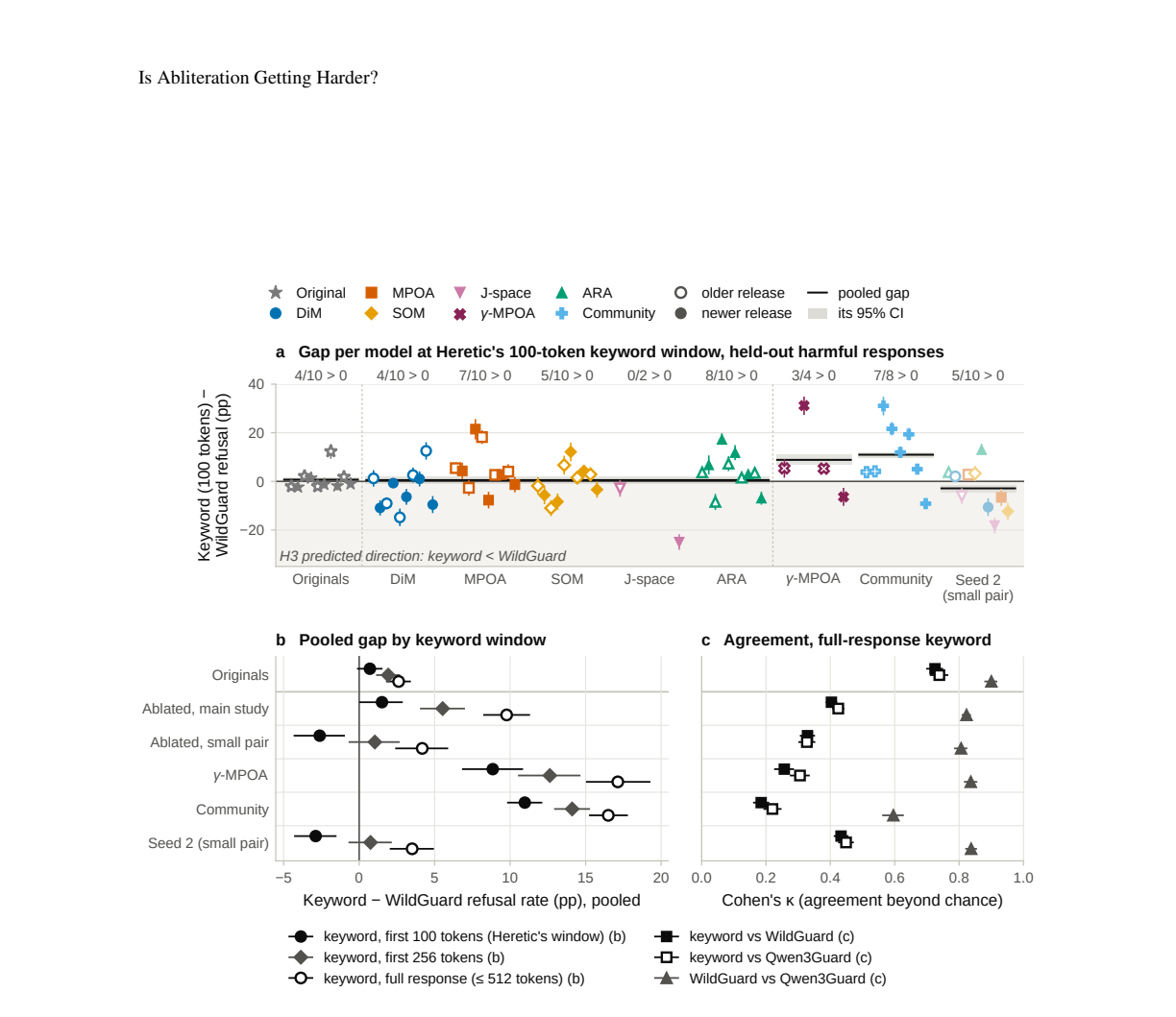
The abstract states 'Contrary to prediction, keyword counts at the tool's window did not undercount judged refusal on average, but differed by a mean 7 points per model.' The phrase 'on average' could be misinterpreted; consider clarifying that the mean gap is near zero but individual model gaps vary widely.
The paper says, at §3.2, Table 1
Pith says: minor objection 2 of 6
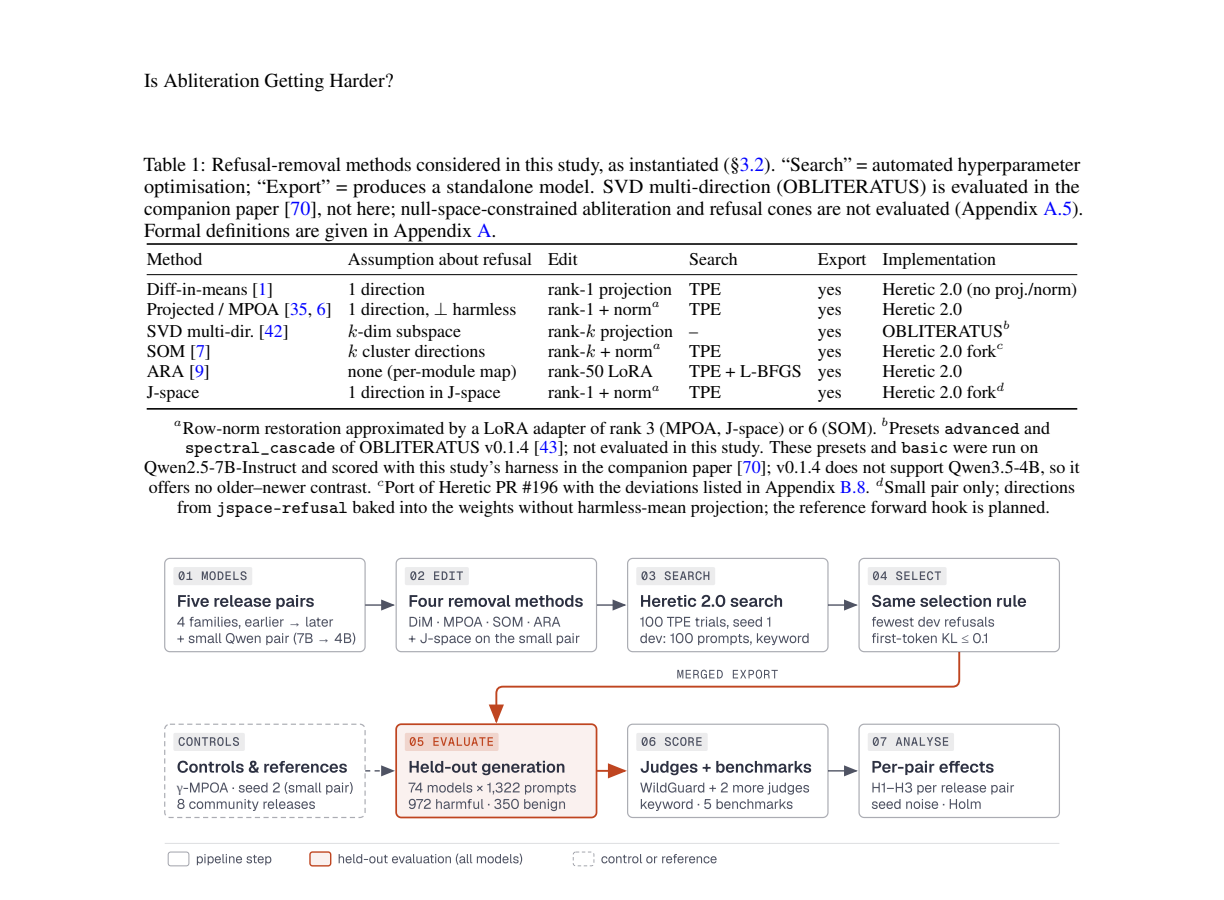
Table 1 lists 'SVD multi-dir.' as a method but notes it is not evaluated in this study. This is clear, but the table could be simplified to avoid confusion.
show 4 more
The paper says, at §4.1, Figure 1
Pith says: minor objection 3 of 6
Figure 1 (at-a-glance) is informative but the caption is dense. Consider adding a brief legend or note about the meaning of 'bold' and 'ns' in the figure itself.
The paper says, at §5.1, Table 4
Pith says: minor objection 4 of 6
Table 4 (pair effects) has many columns and small font. The note about 'Gemma direction includes the failed Gemma-4-31B DiM edit' is important; consider making it more prominent.
The paper says, at §6.2, Limitations
Pith says: minor objection 5 of 6
The limitations section is comprehensive but long. Consider moving some of the detailed threat discussions to the appendix, as the authors have done, but the main text could be more concise.
The paper says, at Appendix §A.5
Pith says: minor objection 6 of 6
The dev re-score analysis is important for understanding the reliability of the ARA results. Consider referencing it more prominently in the main text.
What would settle it
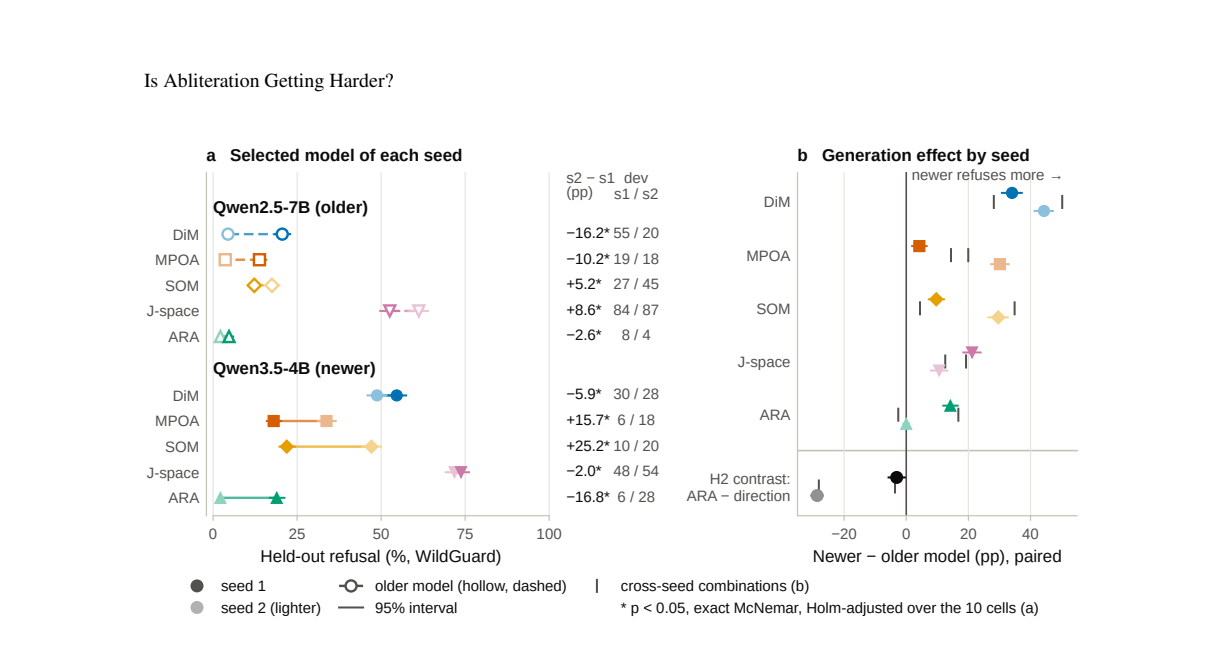
A direct test would be to repeat the 32 main-study optimisation runs with a second seed (seed 2) and measure whether the per-pair generation effects and H2 contrasts remain within the estimated run-to-run band. If the OLMo direction-based increase, the Qwen ARA increase, or the Gemma ARA decrease changed sign or fell within seed noise under a second seed, the paper's primary conclusions about which effects exceed run-to-run variation would be undermined.
from Pith's summary of the paper
How the review went
5 passes by deepseek-v4-flash · 16 Nov 2026
- Reader holds up, with conditions
- Skeptic concern withdrawn: Pith's reviewer misread the paper
- Referee 6 minor
- Check against the paper kept 0 of 4 objections
- Editor wrote the verdict above
Not run on this paper: the simulated authors' defence.
Pith's passes raised 4 objections. A check against the paper's text kept 0 and withdrew 4 (4 Pith's reviewer misread the paper).
The review in full
The review in brief, machine-written
This paper provides the first independent comparison of direction-based and optimisation-based refusal removal (ARA) across five release pairs of open-weight LLMs, under a shared framework and held-out evaluation. The central finding is that refusal removal did not become uniformly harder: the generation effect differed in sign and size between pairs, and the only per-pair effect that exceeded run-to-run variation under both variance models was the OLMo direction-based increase. The study is carefully designed, with within-family comparisons, multiple judges, explicit handling of run-to-run variance, and thorough sensitivity analyses. The paper is a solid contribution to the literature on LLM safety evaluation.
The main soft spots are that each main-study cell was optimised only once, so the run-to-run variance is transferred from the small-pair seed pairs to the larger models, and the per-pair estimates are provisional. The ARA results rest on single runs, and some verdicts changed with the variance model or KL budget. The code-as-weapon bank, compiled by the author, carried about half of the originals' generation difference, and some per-pair conclusions depended on it. The authors acknowledge these limitations clearly.
This paper is for researchers and practitioners working on LLM safety evaluation, refusal removal, and model editing. It deserves a serious referee. The study is thorough, the claims are appropriately conditional, and the limitations are stated. I recommend engaging with the work and treating the per-pair estimates as provisional pending replication with multiple seeds.
The stress test's concern
Withdrawn: Pith's reviewer misread the paper.
The paper says
“This flag is a screen that accompanies, not replaces, the McNemar tests, and it assumes that the seed variability of the 4B and 7B small-pair models transfers to the 22--32B main-study models.”
The referee's report
Not published. Pith's referee wrote this assessment before its objections were checked against the paper, and 3 of its 3 major objections did not survive that check.
Pith's reading of the paper (a machine's summary, not the authors')
This paper tests whether newer generations of open-weight LLMs are harder to edit to remove refusal behavior. The authors compare direction-based ablation methods (diff-in-means, MPOA, SOM) and an optimisation-based method (ARA) on five release pairs (Qwen, Gemma, OLMo, Mistral Small, and a small Qwen pair). They find that refusal removal did not become uniformly harder: the generation effect varied widely between pairs, from -1 to +37 percentage points for direction-based methods and -26 to +34 for ARA. Only the OLMo direction-based increase exceeded run-to-run variation under both variance models considered. The study also finds that keyword-based refusal counts, which tools optimise, do not systematically undercount judged refusal on average but disagree with it model by model. The authors conclude that whether a newer model resists removal depends on the release pair, method, budget, and measure, not on generation alone.
What carries the argument. The central object is the comparison of refusal-removal methods across model generations within a controlled framework. The key machinery is the Heretic 2.0 tool, which implements direction-based methods (difference-in-means, MPOA, SOM) and optimisation-based Arbitrary-Rank Ablation (ARA) under a common search budget (100 TPE trials), first-token KL divergence cap (≤0.1), and selection rule. The evaluation uses a held-out set of 972 harmful prompts scored by the WildGuard automatic judge, independent of the optimisation objectives. The study design crosses model generation (earlier vs later release) with method class, using five release pairs as the unit of analysis, with run-to-run variance estimated from seed replicates on a small pair.
Core claim. The paper's central claim is that refusal removal did not become uniformly harder across five model release pairs. The generation effect (newer minus older model residual refusal) differed in sign and size between pairs: after direction-based removal it ranged from -1.2 pp (Mistral Small) to +36.9 pp (OLMo), and after ARA from -26.0 pp (Gemma) to +34.4 pp (Qwen). With run-to-run variance added, only the OLMo direction-based increase, the Qwen ARA increase, and the Gemma ARA decrease had intervals excluding zero. Between-pair heterogeneity was high on the percentage-point scale (I² 80%) but low on the log-odds scale (20%). The study also finds that keyword-based refusal counts, which tools optimise, do not systematically undercount judged refusal on average but disagree with it model by model, and that first-token KL divergence does not bound capability loss.
The premise it rests on. The run-to-run variance estimated from ten seed pairs of 4B and 7B models is assumed to transfer to the 22–32B main-study models, each optimised once; this assumption cannot be tested with one seed per cell and is stated by the authors.
If the paper is right (Pith's inferences, not the authors')
If the paper's findings are correct, claims that a newer model resists refusal removal must be qualified by the release pair, method, budget, and measure used; no single pair or method supports a general statement about generation-level resistance.
The heterogeneity between pairs implies that safety auditors should test multiple model families and release pairs before concluding that safety training has improved against weight-editing attacks.
Keyword-based refusal counts, which tools optimise, are not a reliable proxy for judged refusal on edited models; evaluations should use held-out LLM judges and report per-model disagreement.
The finding that ARA lost less effectiveness than direction-based methods in two pairs (Gemma, OLMo) but more in one (Qwen) suggests that the relative performance of edit families is pair-specific and not a property of the method class alone.
The study's design—comparing five release pairs with multiple methods under a common budget—could serve as a template for future audits of open-weight safety robustness, but the authors' own limitations (single seed per main-study cell, no human audit, greedy decoding only) mean that any such template would need to add multiple seeds, human labels, and sampled decoding before it could be considere
The strong dependence of per-pair verdicts on the source of test prompts (public sets vs. the author-compiled code-as-weapon bank) suggests that prompt composition is a critical and underappreciated variable in refusal-removal evaluations; future work should stratify results by prompt category and validate prompt banks against real-world attack distributions.
The paper's finding that keyword counts and LLM judges disagree on edited models, combined with the authors' disclosure that no human audit was made, implies that the field lacks a validated gold standard for measuring refusal in edited models; until such a standard exists, every reported refusal rate is relative to a fallible automatic judge.
Check this review
What was read
The passes were given all 363,525 characters of the paper's LaTeX source.
Fingerprint of that text (SHA-256): 54883c73664c64990228cba61d8a5f35b1ea088428df8ffe9d6281978f3732b6
Pith does not keep that text. Rebuilt from the paper's source or PDF by the same code, it has this fingerprint if it is the same text. From a copy of Pith's code:
PYTHONPATH=. python scripts/review_input_check.py 2611.17846
The passes, in the order they ran
- Reader deepseek-v4-flash · medium effort · $0.012 · instructions of the Reader, fingerprint f9ead7300382…
- Skeptic deepseek-v4-flash · medium effort · $0.011 · instructions of the Skeptic, fingerprint 8f88c0f61488…
- Referee deepseek-v4-flash · medium effort · $0.019 · instructions of the Referee, fingerprint a852d99aea0d…
- Check against the paper deepseek-v4-flash · medium effort · $0.011 · instructions of the Check against the paper, fingerprint 6c7a6883d551…
- Editor deepseek-v4-flash · medium effort · $0.011 · instructions of the Editor, fingerprint e7211f6a3d27…
- Summary for the page deepseek-v4-flash · medium effort · temperature 0.2 · $0.011 · instructions of the Summary for the page, fingerprint e4f56bf568e7…
The passes cost $0.076 in model calls together.
Version stamped on this review: pith-pipeline@v1.4.1-daily-deepseek-or-medium+deepseek/deepseek-v4-flash+p.0ef1a750a3e3
Each link opens a pass's instructions as plain text, the exact bytes its fingerprint was taken over. Every stored set of instructions.
curl -s https://pith.science/methodology/prompts/f9ead730038216984cfb56d7cb34332bdf691828296a1de4245f3d6667d4bf56 | sha256sum
prints the fingerprint of the reader's instructions. The same works for every pass.
The receipt
The review's fingerprint was taken on 16 Nov 2026. The review you are reading still matches it.
Fingerprint of the review (SHA-256): a326f6ac5003fdb07f62d73495e3047d0f0a5545cd34f0dcf6c29917b5481369
curl -s 'https://pith.science/api/v1/verdicts/2611.17846?form=canonical' | sha256sum
prints the fingerprint of the review as it stands now. The rule, in four steps.
A matching fingerprint shows the review has not changed since that date. It does not show that the review is right.
How often reviews like this one are right
Reviews like this one: written by deepseek-v4-flash, from the paper's LaTeX source.
How often objections from reviews like this one are right: not yet measured
Reviews by people
This review was written by a machine. No person has reviewed this paper on Pith yet. A scientist listed on Pith can review it for a fee, and their review is published here whatever it concludes.
The paper
Abstract
Abliteration, a fine-tuning-free weight edit, removes refusal from open-weight large language models (LLMs). The developer of Arbitrary-Rank Ablation (ARA), an optimisation-based variant, reports that direction-based abliteration, which ablates a refusal direction, increasingly fails on newer models. On five release pairs, refusal removal did not become uniformly harder. Qwen2.5-32B and Qwen3.8-27B, Gemma-2-27B and Gemma-4-31B, OLMo-2-32B and Olmo-3.1-32B, Mistral-Small-2409 and Mistral-Small-3.2, and Qwen2.5-7B and Qwen3.5-4B were edited in Heretic 2.0 by three or four direction-based methods (difference-in-means, MPOA, SOM and, on the small pair, J-space) and ARA under the same prompts, nominal search budget, first-token KL divergence cap and selection rule; removal counted as harder when the automatic WildGuard judge found more of 972 held-out harmful prompts (JailbreakBench, XSTest, StrongREJECT, HarmBench and an author-compiled malicious-code bank) still refused. After direction-based removal, newer releases retained -1 to +37 percentage points more refusal, and after ARA -26 to +34. With run-to-run variance included, between-pair heterogeneity of the direction-based effect ranged from high to low with the scale and variance model (I^2 20-80%). ARA lost less effectiveness than direction-based methods in Gemma and OLMo and more in Qwen; each verdict rests on one ARA run, and some changed with the divergence budget or variance model. In Gemma the direction-based increase came from the malicious-code bank and reversed on public sets. Contrary to prediction, keyword counts at the tool's window did not undercount judged refusal on average, but differed by a mean 7 points per model. Audits of a single pair, method or prompt source can reach opposite conclusions. Whether a newer model resisted removal depended on the release pair, method and budget, not on generation alone.
The paper's own sentences, arranged, kept beside the review and separate from it. Each label is drawn from a closed vocabulary; the number beside it is the probability the classifier gave that label. No sentence in this record was written by a model.
abstract compiled · 2026-11-16
The authors' main claim, as the classifier picked it out 0.67
“On five release pairs, refusal removal did not become uniformly harder.”
How the main claim is stated: asserted 1.00
What the abstract itself states, as probabilities: claims first 0.04 · states limitation 0.96 · human participants 0.04 · controlled comparison 0.68 · randomized assignment 0.02 · states quantitative result 0.98 · compares with prior results 0.94 · mentions code or data availability 0.06
The abstract, sentence by sentence
This table labels the abstract only (arXiv listing abstract v1). The number is the probability the classifier gave the label.
| Sentence | Role | The authors' own work | States the main conclusion | Strength |
|---|---|---|---|---|
| Abliteration, a fine-tuning-free weight edit, removes refusal from open-weight large language models (LLMs). | background 1.00 | 0.08 | 0.03 | asserted 1.00 |
| The developer of Arbitrary-Rank Ablation (ARA), an optimisation-based variant, reports that direction-based abliteration, which ablates a refusal direction, increasingly fails on newer models. | background 0.91 | 0.09 | 0.10 | asserted 0.98 |
| On five release pairs, refusal removal did not become uniformly harder. | result 0.97 | 0.92 | 0.79 | asserted 1.00 |
| Qwen2.5-32B and Qwen3.8-27B, Gemma-2-27B and Gemma-4-31B, OLMo-2-32B and Olmo-3.1-32B, Mistral-Small-2409 and Mistral-Small-3.2, and Qwen2.5-7B and Qwen3.5-4B were edited in Heretic 2.0 by three or four direction-based methods (difference-in-means, MPOA, SOM and, on the small pair, J-space) and ARA under the same prompts, nominal search budget, first-token KL divergence cap and selection rule; removal counted as harder when the automatic WildGuard judge found more of 972 held-out harmful prompts (JailbreakBench, XSTest, StrongREJECT, HarmBench and an author-compiled malicious-code bank) still refused. | method 0.98 | 0.96 | 0.09 | asserted 0.97 |
| After direction-based removal, newer releases retained -1 to +37 percentage points more refusal, and after ARA -26 to +34. | result 1.00 | 0.92 | 0.20 | asserted 1.00 |
| With run-to-run variance included, between-pair heterogeneity of the direction-based effect ranged from high to low with the scale and variance model (I^2 20-80%). | result 1.00 | 0.93 | 0.07 | asserted 1.00 |
| ARA lost less effectiveness than direction-based methods in Gemma and OLMo and more in Qwen; each verdict rests on one ARA run, and some changed with the divergence budget or variance model. | result 0.87 | 0.90 | 0.11 | asserted 0.94 |
| In Gemma the direction-based increase came from the malicious-code bank and reversed on public sets. | result 0.99 | 0.92 | 0.05 | asserted 1.00 |
| Contrary to prediction, keyword counts at the tool's window did not undercount judged refusal on average, but differed by a mean 7 points per model. | result 0.98 | 0.90 | 0.03 | asserted 1.00 |
| Audits of a single pair, method or prompt source can reach opposite conclusions. | interpretation 0.68 | 0.61 | 0.16 | asserted 0.85 |
| Whether a newer model resisted removal depended on the release pair, method and budget, not on generation alone. | interpretation 0.90 | 0.87 | 0.79 | asserted 1.00 |
What kind of paper the classifier reports this is: empirical study 1.00 · evidence from observation or experiment 0.95
What was examined, and what was not
Sources read
- arXiv listing abstract v1
Not examined
- full text
- figures and tables
- references and citing sentences
- relations to other papers
Levels run
- P abstract
Not run
- S sections
- T body sentences
- C citations
- R cross-paper relations
How the labels were made
Compiled by classifier-1.13.0 via TypeSafe API, question bank abstract-p1-20260923, 2026-11-16: 1 request, 8,633 input tokens.
Every quoted sentence on this record is the authors'. Every label is from Pith's closed vocabulary, with the probability shown beside it. This record as JSON
Figures (19)
Showing 18 of the paper's 19 figures. Figures are the authors', reproduced from the paper.
References (140)
- [1] Andy Arditi, Oscar Obeso, Aaquib Syed, Daniel Paleka, Nina Panickssery, Wes Gurnee, and Neel Nanda. Refusal in language models is mediated by a single direction. InNeurIPS, volume 37, pages 136037–136083, 2024. arXiv:2406.11717 on PithPith's reviewarXiv
- [2] Maxime Labonne. Uncensor any LLM with abliteration. Hugging Face Blog, https://huggingface.co/ blog/mlabonne/abliteration, 2024 on Pith
- [3] Xiangyu Qi, Yi Zeng, Tinghao Xie, Pin-Yu Chen, Ruoxi Jia, Prateek Mittal, and Peter Henderson. Fine-tuning aligned language models compromises safety, even when users do not intend to! InICLR, pages 30988–31043, on Pith
- [4] Simon Lermen, Charlie Rogers-Smith, and Jeffrey Ladish. LoRA fine-tuning efficiently undoes safety training in Llama 2-Chat 70B, 2023. arXiv:2310.20624 on PithPith's reviewarXiv
- [5] Philipp Emanuel Weidmann. Heretic: Fully automatic censorship removal for language models. https: //github.com/p-e-w/heretic, 2025 on Pith
- [6] Jim Lai. Norm-preserving biprojected abliteration. https://huggingface.co/blog/grimjim/norm- preserving-biprojected-abliteration, 2025 on Pith
- [7] Giorgio Piras, Raffaele Mura, Fabio Brau, Luca Oneto, Fabio Roli, and Battista Biggio. SOM directions are better than one: Multi-directional refusal suppression in language models. InAAAI, volume 40, pages 32728–32736, on Pith
- [8] Tom Wollschläger, Jannes Elstner, Simon Geisler, Vincent Cohen-Addad, Stephan Günnemann, and Johannes Gasteiger. The geometry of refusal in large language models: Concept cones and representational independence. InICML, volume 267 ofPMLR, pages 66945–66970, 2025. arXiv:2502.17420 on PitharXiv
- [9] Philipp Emanuel Weidmann. Arbitrary-rank ablation (ARA). Heretic pull request #211, https://github.com/ p-e-w/heretic/pull/211, 2026. Unreviewed practitioner report, retrieved 2 November 2026. Not merged; ARA entered Heretic 2.0.0 through pull request #446,https://github.com/p... on Pith
- [10] Fabian Hildebrandt, Andreas Maier, Patrick Krauss, and Achim Schilling. Refusal behavior in large language models: A nonlinear perspective. InInternational Joint Conference on Neural Networks (IJCNN), pages 1–7, on Pith
- [11] Faaiz Joad, Majd Hawasly, Sabri Boughorbel, Nadir Durrani, and Husrev Taha Sencar. There is more to refusal in large language models than a single direction. InEMNLP, pages 59196–59232, 2026. arXiv:2602.02132 on PithPith's reviewarXiv
- [12] Han Wang, Erik Miehling, Dennis Wei, Karthikeyan Natesan Ramamurthy, and Huan Zhang. On the steering dimensionality of refusal in language models, 2026. InterpScience Workshop at NeurIPS 2026. arXiv:2610.04245 on PithPith's reviewarXiv
- [13] Wenbo Pan, Zhichao Liu, Qiguang Chen, Xiangyang Zhou, Haining Yu, and Xiaohua Jia. The hidden dimensions of LLM alignment: A multi-dimensional analysis of orthogonal safety directions. InICML, volume 267 of PMLR, pages 47697–47716, 2025. arXiv:2502.09674 on PithPith's reviewarXiv
- [14] Xiangyu Qi, Ashwinee Panda, Kaifeng Lyu, Xiao Ma, Subhrajit Roy, Ahmad Beirami, Prateek Mittal, and Peter Henderson. Safety alignment should be made more than just a few tokens deep. InICLR, pages 54911–54941, on Pith
- [15] Jiachen Zhao, Jing Huang, Zhengxuan Wu, David Bau, and Weiyan Shi. LLMs encode harmfulness and refusal separately. InNeurIPS, volume 38, pages 155649–155684, 2025. arXiv:2507.11878. 28 Is Abliteration Getting Harder? on PithPith's reviewarXiv
- [16] Lei Yu, Virginie Do, Karen Hambardzumyan, and Nicola Cancedda. Robust LLM safeguarding via refusal feature adversarial training. InICLR, pages 5254–5277, 2025. arXiv:2409.20089 on PithPith's reviewarXiv
- [17] Yuanbo Xie, Yingjie Zhang, Tianyun Liu, Duohe Ma, and Tingwen Liu. Beyond surface alignment: Rebuilding LLMs safety mechanism via probabilistically ablating refusal direction. InFindings of the Association for Com- putational Linguistics: EMNLP 2025, pages 17620–17632, Suzhou,... on PitharXiv
- [18] Wenhao Lan, Shan Li, Xinhua Lai, Meiqi Wu, Junbin Yang, Haihua Shen, and Yijun Yang. Dynamic adversarial fine-tuning reorganizes refusal geometry, 2026. arXiv:2604.27019 on PithPith's reviewarXiv
- [19] Thomas McGrath, Matthew Rahtz, Janos Kramar, Vladimir Mikulik, and Shane Legg. The hydra effect: Emergent self-repair in language model computations, 2023. arXiv:2307.15771 on PithPith's reviewarXiv
- [20] Shashank Agnihotri, Jonas Jakubassa, Priyam Dey, Sachin Goyal, Bernt Schiele, Venkatesh Babu Radhakrishnan, and Margret Keuper. A granular study of safety pretraining under model abliteration, 2025. NeurIPS 2025 Workshop Lock-LLM. arXiv:2510.02768 on PitharXiv
show 80 more
- [21] Richard J. Young. Comparative analysis of LLM abliteration methods: A cross-architecture evaluation, 2025. arXiv:2512.13655 on PitharXiv
- [22] Tinghao Xie, Xiangyu Qi, Yi Zeng, Yangsibo Huang, Udari Madhushani Sehwag, Kaixuan Huang, Luxi He, Boyi Wei, Dacheng Li, Ying Sheng, Ruoxi Jia, Bo Li, Kai Li, Danqi Chen, Peter Henderson, and Prateek Mittal. SORRY-Bench: Systematically evaluating large language model safety re... on Pith
- [23] Richard J. Young. Measuring faithfulness depends on how you measure: Classifier sensitivity in LLM chain-of- thought evaluation, 2026. arXiv:2603.20172 on PitharXiv
- [24] Vadym Hadetskyi, Dario Pasquini, and Artem Sorokin. Not all refusals are equal: How safety alignment fails cybersecurity at scale, 2026. arXiv:2607.02714 on PithPith's reviewarXiv
- [25] Richard J. Young and Gregory D. Moody. Refusal evaluation in coding LLMs and code agents: A systematic review of thirteen malicious-code prompt corpora (2023-2025), 2026. arXiv:2605.20351 on PithPith's reviewarXiv
- [26] Richard J. Young and Gregory D. Moody. A validated prompt bank for malicious code generation: Separating executable weapons from security knowledge in 1,554 consensus-labeled prompts, 2026. arXiv:2605.03179 on PithPith's reviewarXiv
- [27] Richard J. Young and Gregory D. Moody. Code as a weapon: A consensus-labeled prompt bank for measuring coding-model compliance with malicious-code requests, 2026. arXiv:2605.28734 on PithPith's reviewarXiv
- [28] Kristina Nikoli´c, Luze Sun, Jie Zhang, and Florian Tramèr. The jailbreak tax: How useful are your jailbreak outputs? InICML, volume 267 ofPMLR, pages 46412–46426, 2025. arXiv:2504.10694 on PithPith's reviewarXiv
- [29] Richard J. Young, Brandon Gillins, and Alice M. Matthews. When models can’t follow: Testing instruction adherence across 256 LLMs, 2025. arXiv:2510.18892 on PitharXiv
- [30] Andy Zou, Long Phan, Sarah Chen, James Campbell, Phillip Guo, Richard Ren, Alexander Pan, Xuwang Yin, Mantas Mazeika, Ann-Kathrin Dombrowski, Shashwat Goel, Nathaniel Li, Michael J. Byun, Zifan Wang, Alex Mallen, Steven Basart, Sanmi Koyejo, Dawn Song, Matt Fredrikson, J. Zico... on PithPith's reviewarXiv
- [31] Nina Panickssery, Nick Gabrieli, Julian Schulz, Meg Tong, Evan Hubinger, and Alexander Matt Turner. Steering Llama 2 via contrastive activation addition, 2023. arXiv:2312.06681 on PithPith's reviewarXiv
- [32] FailSpy. abliterator: Simple Python library/structure to ablate features in LLMs which are supported by TransformerLens.https://github.com/FailSpy/abliterator, 2024 on Pith
- [33] Kiho Park, Yo Joong Choe, and Victor Veitch. The linear representation hypothesis and the geometry of large language models. InICML, volume 235 ofPMLR, pages 39643–39666, 2024. arXiv:2311.03658 on PithPith's reviewarXiv
- [34] Thomas Marshall, Adam Scherlis, and Nora Belrose. Refusal in LLMs is an affine function, 2024. arXiv:2411.09003 on PithPith's reviewarXiv
- [35] Jim Lai. Projected abliteration. https://huggingface.co/blog/grimjim/projected-abliteration, 2025 on Pith
- [36] Takuya Akiba, Shotaro Sano, Toshihiko Yanase, Takeru Ohta, and Masanori Koyama. Optuna: A next-generation hyperparameter optimization framework. InKDD, pages 2623–2631, 2019. https://doi.org/10.1145/ 3292500.3330701 on Pith
- [37] jwest33. abliterator. https://github.com/jwest33/abliterator, 2025. GitHub repository (created 2025- 12-12). 29 Is Abliteration Getting Harder? on Pith
- [38] Junfeng Fang, Houcheng Jiang, Kun Wang, Yunshan Ma, Jie Shi, Xiang Wang, Xiangnan He, and Tat-Seng Chua. AlphaEdit: Null-space constrained knowledge editing for language models. InICLR, 2025. arXiv:2410.02355 on PithPith's reviewarXiv
- [39] Kevin Meng, David Bau, Alex Andonian, and Yonatan Belinkov. Locating and editing factual associations in GPT. InNeurIPS, volume 35, pages 17359–17372, 2022. arXiv:2202.05262 on PithPith's reviewarXiv
- [40] Tony Cristofano. Surgical refusal ablation: Disentangling safety from intelligence via concept-guided spectral cleaning, 2026. arXiv:2601.08489 on PitharXiv
- [41] Valentin Petrov. On the failure of topic-matched contrast baselines in multi-directional refusal abliteration, 2026. arXiv:2603.22061 on PitharXiv
- [42] Gökdeniz Gülmez. Gabliteration: Adaptive multi-directional neural weight modification for selective behavioral alteration in large language models, 2025. arXiv:2512.18901 on PitharXiv
- [43] elder-plinius. OBLITERATUS. https://github.com/elder-plinius/OBLITERATUS, 2026. GitHub repos- itory, release v0.1.4 on Pith
- [44] Thomas Winninger. Fast multi-dimensional refusal subspaces via RFM-AGOP, 2026. Mechanistic Interpretability Workshop at ICML 2026. arXiv:2607.02396 on PithPith's reviewarXiv
- [45] Grigoriy Evseev, Vladimir Solodkin, Dmitry Bylinkin, Daniil Medyakov, Vladimir Aletov, and Aleksandr Beznosikov. WRDO: Weighted refusal direction optimization in aligned language models. InFindings of the Association for Computational Linguistics: EMNLP 2026, pages 43929–43944... on PithPith's reviewarXiv
- [46] Boyi Wei, Kaixuan Huang, Yangsibo Huang, Tinghao Xie, Xiangyu Qi, Mengzhou Xia, Prateek Mittal, Mengdi Wang, and Peter Henderson. Assessing the brittleness of safety alignment via pruning and low-rank modifications. InICML, volume 235 ofPMLR, pages 52588–52610, 2024. arXiv:2402.05162 on PithPith's reviewarXiv
- [47] Geraldin Nanfack, Eugene Belilovsky, and Elvis Dohmatob. Efficient refusal ablation in LLM through optimal transport, 2026. arXiv:2603.04355 on PitharXiv
- [48] Sekinal. jspace-refusal: Refusal in the J-space workspace. https://github.com/Sekinal/jspace-refusal, on Pith
- [49] Wes Gurnee, Nicholas Sofroniew, Adam Pearce, Mateusz Piotrowski, Isaac Kauvar, Runjin Chen, Anna Soligo, Paul Bogdan, Euan Ong, Rowan Wang, Ben Thompson, David Abrahams, Subhash Kantamneni, Emmanuel Ameisen, Joshua Batson, and Jack Lindsey. Verbalizable representations form a ... on Pith
- [50] Neuronpedia. jacobian-lens: Pre-fitted Jacobian lenses. https://huggingface.co/neuronpedia/jacobian- lens, 2026. Hugging Face repository, revisionqwen-n1000 on Pith
- [51] Wei Jie Yeo, Nirmalendu Prakash, Clement Neo, Ranjan Satapathy, Roy Ka-Wei Lee, and Erik Cambria. Under- standing refusal in language models with sparse autoencoders. InFindings of the Association for Computational Linguistics: EMNLP 2025, pages 6377–6399, Suzhou, China, 2025.... on PithPith's reviewarXiv
- [52] Preethi Carmel Bosco and Gopalakrishnan Srinivasan. Locating and steering refusal beyond attention, 2026. arXiv:2609.04721 on PithPith's reviewarXiv
- [53] Andrew Lee, Xiaoyan Bai, Itamar Pres, Martin Wattenberg, Jonathan K. Kummerfeld, and Rada Mihalcea. A mechanistic understanding of alignment algorithms: A case study on DPO and toxicity, 2024. arXiv:2401.01967 on PithPith's reviewarXiv
- [54] Samyak Jain, Ekdeep Singh Lubana, Kemal Oksuz, Tom Joy, Philip H. S. Torr, Amartya Sanyal, and Puneet K. Dokania. What makes and breaks safety fine-tuning? A mechanistic study, 2024. arXiv:2407.10264 on PithPith's reviewarXiv
- [55] Harethah Abu Shairah, Hasan Abed Al Kader Hammoud, Bernard Ghanem, and George Turkiyyah. An embarrassingly simple defense against LLM abliteration attacks, 2025. arXiv:2505.19056 on PitharXiv
- [56] Nathan Truong. Abliteration mitigation via refusal aliases, 2026. arXiv:2608.18093 on PithPith's reviewarXiv
- [57] Aashiq Muhamed, Mona T. Diab, and Virginia Smith. Decoy direction optimization: A post-hoc defense against LLM abliteration, 2026. arXiv:2609.16204 on PithPith's reviewarXiv
- [58] Mark Russinovich. Fool’s gold: Defensive deception against safety-removal attacks on open-weight models, on Pith
- [59] Andy Zou, Long Phan, Justin Wang, Derek Duenas, Maxwell Lin, Maksym Andriushchenko, Rowan Wang, Zico Kolter, Matt Fredrikson, and Dan Hendrycks. Improving alignment and robustness with circuit breakers. In NeurIPS, volume 37, pages 83345–83373, 2024. arXiv:2406.04313. 30 Is Ab... on PithPith's reviewarXiv
- [60] Rishub Tamirisa, Bhrugu Bharathi, Long Phan, Andy Zhou, Alice Gatti, Tarun Suresh, Maxwell Lin, Justin Wang, Rowan Wang, Ron Arel, Andy Zou, Dawn Song, Bo Li, Dan Hendrycks, and Mantas Mazeika. Tamper-resistant safeguards for open-weight LLMs. InICLR, pages 101802–101829, 2025... on PithPith's reviewarXiv
- [61] Domenic Rosati, Jan Wehner, Kai Williams, Łukasz Bartoszcze, David Atanasov, Robie Gonzales, Subhabrata Majumdar, Carsten Maple, Hassan Sajjad, and Frank Rudzicz. Representation noising: A defence mechanism against harmful finetuning. InNeurIPS, volume 37, pages 12636–12676, 2... on PithPith's reviewarXiv
- [62] Kevin Kuo, Virginia Smith, and Chhavi Yadav. Open-weight LLM fine-tuning defenses are susceptible to simple attacks, 2026. arXiv:2605.26526 on PithPith's reviewarXiv
- [63] Justin Cui, Wei-Lin Chiang, Ion Stoica, and Cho-Jui Hsieh. OR-Bench: An over-refusal benchmark for large language models. InICML, volume 267 ofPMLR, pages 11515–11542, 2025. arXiv:2405.20947 on PithPith's reviewarXiv
- [64] Isaac David and Arthur Gervais. Ablating safety: Mechanisms for removing alignment in language models for security applications, 2026. arXiv:2605.17413 on PithPith's reviewarXiv
- [65] Cristina Carleo, Pietro Liguori, Naghmeh Ivaki, and Domenico Cotroneo. Willing but unable: Separating refusal from capability in code LLMs via abliteration, 2026. arXiv:2606.05396 on PithPith's reviewarXiv
- [66] Aleksander Fafuła. Abliteration is not a scalpel: Off-target effects of refusal removal on decision disposition across model families, 2026. arXiv:2607.17427 on PithPith's reviewarXiv
- [67] Ju-Chun Ko. Uncensored is not unbiased: Abliteration removes refusals but not script-dependent bias about Taiwan, 2026. arXiv:2610.29342 on PithPith's reviewarXiv
- [68] Richard J. Young. Evaluating the robustness of large language model safety guardrails against adversarial attacks, on Pith
- [69] Xiangyu Qi, Boyi Wei, Nicholas Carlini, Yangsibo Huang, Tinghao Xie, Luxi He, Matthew Jagielski, Milad Nasr, Prateek Mittal, and Peter Henderson. On evaluating the durability of safeguards for open-weight LLMs. In ICLR, pages 62651–62681, 2025. arXiv:2412.07097 on PithPith's reviewarXiv
- [70] Richard J. Young. The selection rule can reverse LLM abliteration tool comparisons: Heretic 1.x, Heretic 2.0, OBLITERATUS and community releases on Qwen2.5 and Qwen2.5-Coder, 2026. In preparation on Pith
- [71] Jesse Dodge, Suchin Gururangan, Dallas Card, Roy Schwartz, and Noah A. Smith. Show your work: Improved reporting of experimental results. InEMNLP-IJCNLP, pages 2185–2194, 2019. arXiv:1909.03004 on PithPith's reviewarXiv
- [72] Gemma Team, Morgane Riviere, Shreya Pathak, Pier Giuseppe Sessa, Cassidy Hardin, Surya Bhupatiraju, Léonard Hussenot, Thomas Mesnard, Bobak Shahriari, Alexandre Ramé, Johan Ferret, Peter Liu, et al. Gemma 2: Improving open language models at a practical size, 2024. arXiv:2408.00118 on PithPith's reviewarXiv
- [73] Evan Pete Walsh, Luca Soldaini, Dirk Groeneveld, Kyle Lo, Shane Arora, Akshita Bhagia, Yuling Gu, Shengyi Huang, Matt Jordan, Nathan Lambert, Dustin Schwenk, Oyvind Tafjord, Taira Anderson, David Atkinson, Faeze Brahman, Christopher Clark, Pradeep Dasigi, Nouha Dziri, Allyson ... on PithPith's reviewarXiv
- [74] Team Olmo, Allyson Ettinger, Amanda Bertsch, Bailey Kuehl, David Graham, David Heineman, Dirk Groeneveld, Faeze Brahman, Finbarr Timbers, Hamish Ivison, Jacob Morrison, Jake Poznanski, Kyle Lo, Luca Soldaini, Matt Jordan, Mayee Chen, Michael Noukhovitch, Nathan Lambert, Pete W... on PithPith's reviewarXiv
- [75] Biao Zhang and Rico Sennrich. Root mean square layer normalization. InNeurIPS, volume 32. Curran Associates, Inc., 2019. arXiv:1910.07467 on PithPith's reviewarXiv
- [76] Jeonghoon Kim, Byeongchan Lee, Cheonbok Park, Yeontaek Oh, Beomjun Kim, Taehwan Yoo, Seongjin Shin, Dongyoon Han, Jinwoo Shin, and Kang Min Yoo. Peri-LN: Revisiting normalization layer in the transformer architecture. InICML, volume 267 ofPMLR, pages 30400–30436, 2025. arXiv:2... on PithPith's reviewarXiv
- [77] Songlin Yang, Jan Kautz, and Ali Hatamizadeh. Gated delta networks: Improving Mamba2 with delta rule. In ICLR, pages 29687–29707, 2025. arXiv:2412.06464 on PithPith's reviewarXiv
- [78] Andy Zou, Zifan Wang, Nicholas Carlini, Milad Nasr, J. Zico Kolter, and Matt Fredrikson. Universal and transferable adversarial attacks on aligned language models, 2023. arXiv:2307.15043 on PithPith's reviewarXiv
- [79] Rohan Taori, Ishaan Gulrajani, Tianyi Zhang, Yann Dubois, Xuechen Li, Carlos Guestrin, Percy Liang, and Tatsunori B. Hashimoto. Stanford Alpaca: An instruction-following LLaMA model. https://github.com/ tatsu-lab/stanford_alpaca, 2023 on Pith
- [80] Patrick Chao, Edoardo Debenedetti, Alexander Robey, Maksym Andriushchenko, Francesco Croce, Vikash Sehwag, Edgar Dobriban, Nicolas Flammarion, George J. Pappas, Florian Tramèr, Hamed Hassani, and Eric Wong. JailbreakBench: An open robustness benchmark for jailbreaking large la... on PithPith's reviewarXiv
- [81] Paul Röttger, Hannah Kirk, Bertie Vidgen, Giuseppe Attanasio, Federico Bianchi, and Dirk Hovy. XSTest: A test suite for identifying exaggerated safety behaviours in large language models. InNAACL, pages 5377–5400, on Pith
- [82] Alexandra Souly, Qingyuan Lu, Dillon Bowen, Tu Trinh, Elvis Hsieh, Sana Pandey, Pieter Abbeel, Justin Svegliato, Scott Emmons, Olivia Watkins, and Sam Toyer. A StrongREJECT for empty jailbreaks. InNeurIPS, volume 37, pages 125416–125440, 2024. Datasets and Benchmarks Track; ar... on PithPith's reviewarXiv
- [83] Mantas Mazeika, Long Phan, Xuwang Yin, Andy Zou, Zifan Wang, Norman Mu, Elham Sakhaee, Nathaniel Li, Steven Basart, Bo Li, David Forsyth, and Dan Hendrycks. HarmBench: A standardized evaluation framework for automated red teaming and robust refusal. InICML, volume 235 ofPMLR, ... on PithPith's reviewarXiv
- [84] Edward J Hu, Yelong Shen, Phillip Wallis, Zeyuan Allen-Zhu, Yuanzhi Li, Shean Wang, Lu Wang, and Weizhu Chen. LoRA: Low-rank adaptation of large language models. InICLR, 2022. arXiv:2106.09685 on PithPith's reviewarXiv
- [85] Woosuk Kwon, Zhuohan Li, Siyuan Zhuang, Ying Sheng, Lianmin Zheng, Cody Hao Yu, Joseph E. Gonzalez, Hao Zhang, and Ion Stoica. Efficient memory management for large language model serving with PagedAttention. InSOSP, pages 611–626, 2023. arXiv:2309.06180 on PithPith's reviewarXiv
- [86] Yangsibo Huang, Samyak Gupta, Mengzhou Xia, Kai Li, and Danqi Chen. Catastrophic jailbreak of open-source LLMs via exploiting generation. InICLR, pages 13707–13727, 2024. arXiv:2310.06987 on PithPith's reviewarXiv
- [87] Seungju Han, Kavel Rao, Allyson Ettinger, Liwei Jiang, Bill Yuchen Lin, Nathan Lambert, Yejin Choi, and Nouha Dziri. WildGuard: Open one-stop moderation tools for safety risks, jailbreaks, and refusals of LLMs. In NeurIPS, volume 37, pages 8093–8131, 2024. Datasets and Benchma... on PithPith's reviewarXiv
- [88] Francisco Eiras, Eliott Zemour, Eric Lin, and Vaikkunth Mugunthan. Know thy judge: On the robustness meta-evaluation of LLM safety judges, 2025. ICBINB Workshop at ICLR 2025. arXiv:2503.04474 on PithPith's reviewarXiv
- [89] Haiquan Zhao, Chenhan Yuan, Fei Huang, Xiaomeng Hu, Yichang Zhang, An Yang, Bowen Yu, Dayiheng Liu, Jingren Zhou, Junyang Lin, Baosong Yang, Chen Cheng, Jialong Tang, Jiandong Jiang, Jianwei Zhang, Jijie Xu, Ming Yan, Minmin Sun, Pei Zhang, Pengjun Xie, Qiaoyu Tang, Qin Zhu, R... on PithPith's reviewarXiv
- [90] Leo Gao, Jonathan Tow, Baber Abbasi, Stella Biderman, Sid Black, Anthony DiPofi, Charles Foster, Laurence Golding, Jeffrey Hsu, Alain Le Noac’h, Haonan Li, Kyle McDonell, Niklas Muennighoff, Chris Ociepa, Jason Phang, Laria Reynolds, Hailey Schoelkopf, Aviya Skowron, Lintang S... on Pith
- [91] Yubo Wang, Xueguang Ma, Ge Zhang, Yuansheng Ni, Abhranil Chandra, Shiguang Guo, Weiming Ren, Aaran Arulraj, Xuan He, Ziyan Jiang, Tianle Li, Max Ku, Kai Wang, Alex Zhuang, Rongqi Fan, Xiang Yue, and Wenhu Chen. MMLU-Pro: A more robust and challenging multi-task language unders... on PithPith's reviewarXiv
- [92] Karl Cobbe, Vineet Kosaraju, Mohammad Bavarian, Mark Chen, Heewoo Jun, Lukasz Kaiser, Matthias Plappert, Jerry Tworek, Jacob Hilton, Reiichiro Nakano, Christopher Hesse, and John Schulman. Training verifiers to solve math word problems, 2021. arXiv:2110.14168 on PithPith's reviewarXiv
- [93] Jeffrey Zhou, Tianjian Lu, Swaroop Mishra, Siddhartha Brahma, Sujoy Basu, Yi Luan, Denny Zhou, and Le Hou. Instruction-following evaluation for large language models, 2023. arXiv:2311.07911. 32 Is Abliteration Getting Harder? on PithPith's reviewarXiv
- [94] Mark Chen, Jerry Tworek, Heewoo Jun, Qiming Yuan, Henrique Ponde de Oliveira Pinto, Jared Kaplan, Harri Edwards, Yuri Burda, Nicholas Joseph, Greg Brockman, Alex Ray, Raul Puri, Gretchen Krueger, Michael Petrov, Heidy Khlaaf, Girish Sastry, Pamela Mishkin, Brooke Chan, Scott G... on PithPith's reviewarXiv
- [95] Jacob Austin, Augustus Odena, Maxwell Nye, Maarten Bosma, Henryk Michalewski, David Dohan, Ellen Jiang, Carrie Cai, Michael Terry, Quoc Le, and Charles Sutton. Program synthesis with large language models, 2021. arXiv:2108.07732 on PithPith's reviewarXiv
- [96] James Bergstra, Rémi Bardenet, Yoshua Bengio, and Balázs Kégl. Algorithms for hyper-parameter optimiza- tion. InNeurIPS, volume 24, 2011. https://proceedings.neurips.cc/paper_files/paper/2011/hash/ 86e8f7ab32cfd12577bc2619bc635690-Abstract.html on Pith
- [97] Edwin B. Wilson. Probable inference, the law of succession, and statistical inference.Journal of the American Statistical Association, 22(158):209–212, 1927.https://doi.org/10.1080/01621459.1927.10502953 on Pithdoi:10.1080/01621459.1927.10502953
- [98] Lawrence D. Brown, T. Tony Cai, and Anirban DasGupta. Interval estimation for a binomial proportion. Statistical Science, 16(2):101–133, 2001.https://doi.org/10.1214/ss/1009213286 on Pithdoi:10.1214/ss/1009213286
- [99] Robert G. Newcombe. Improved confidence intervals for the difference between binomial proportions based on paired data.Statistics in Medicine, 17(22):2635–2650, 1998. https://doi.org/10.1002/(SICI)1097- 0258(19981130)17:22<2635::AID-SIM954>3.0.CO;2-C on Pithdoi:10.1002/(sici)1097-
- [100] Quinn McNemar. Note on the sampling error of the difference between correlated proportions or percentages. Psychometrika, 12(2):153–157, 1947.https://doi.org/10.1007/BF02295996 on Pithdoi:10.1007/bf02295996
The first 100 of 140 references are listed here. All of them are in this paper's citation record.
Challenges and discussion
Disagree with the review, or know something it missed? Leave a comment, or challenge this review formally: a challenge becomes a permanent entry in this paper's record, and its decision is published here.
Come back by email
A short list of the week's newly reviewed papers. Nothing is sent until you confirm from your inbox, and every email has a link that stops it. No account.
No comments yet.
Sign in to comment