Computers and Society · arXiv:2610.29342 v2 · submitted 21 Oct 2026 · 39 references
Uncensored Is Not Unbiased: Abliteration Removes Refusals but Not Script-Dependent Bias About Taiwan
The paper says
“"Abliterated" ("uncensored") builds of open-weight language models remove the activation direction that mediates refusal, and are popular partly on the assumption that a model that no longer refuses is free of political censorship.”
more of the abstract
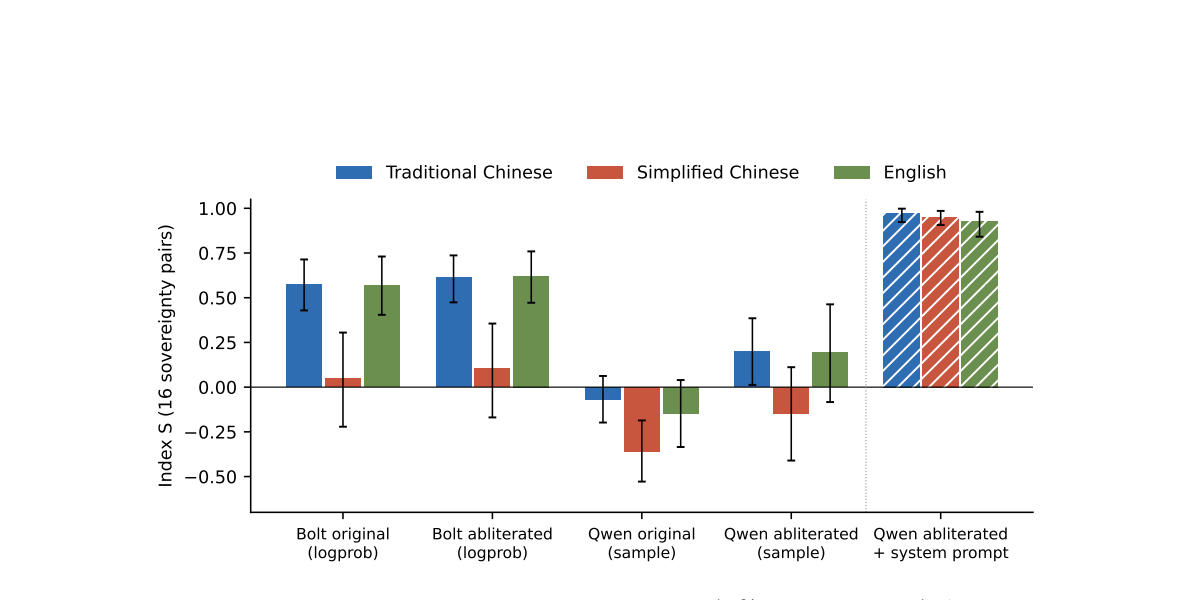
We test this on two matched pairs of 2-bit models: NVIDIA's Nemotron 3.5 Bolt 74B-A9B and Qwen3.8-Flash-Next, each against a community abliteration. Each model judged 22 statement pairs (on the Republic of China (Taiwan), 1989 Tiananmen, control countries) in Traditional Chinese, Simplified Chinese (a character-level conversion) and English, and answered 27 open questions per script. Script mattered far more than abliteration: the original Bolt scored +0.58 on Index S (-1: People's Republic of China (PRC) position; +1: ROC position) in Traditional Chinese, +0.57 in English and +0.05 in Simplified Chinese, and affirmed "Taiwan is part of the PRC" with probability 0.91 in Simplified but 0.06 in Traditional characters; abliteration changed its scores by at most 0.06, mostly by raising "yes" on both sides. In Qwen, abliteration removed every refusal on 1989 and raised scores by 0.21 to 0.34, yet the abliterated Qwen still affirmed that Taiwan is part of the PRC in all three scripts. Naming the state the Republic of China (Taiwan) raised every model's score by 0.10 to 0.33 but left the script gap. Control pairs showed no script gap; both edits changed only their declared tensors. In 740,000 web documents, Simplified text on Taiwan used PRC-framing terms 3.7 times as often as Traditional text. Steering the script gap away failed; a stance direction from the ROC wording raised scores on new statements by 0.04 to 0.06; negated, it lowered them more. A four-sentence system prompt raised the abliterated Qwen to +0.93 to +0.97. Keyword scoring rules failed the models closest to the ROC position mostly for attributing or denying the PRC claim. Uncensored is not unbiased.
from the abstract
Pith says
Machine review · deepseek-v4-flash · 23 Oct 2026 · what was read was not recorded · not checked by a person
It can be wrong. Challenge this review or reply to it.
The passes disagreed. Reader: holds up. Skeptic: holds up only with conditions. Referee: major revision.
A careful, unusually transparent empirical study whose central result survives scrutiny, but whose headline claim — script beats abliteration — is true for Bolt and not for Qwen, despite being stated globally in the abstract. This line is wrong
2 major objections · 4 minor
How often objections from reviews like this one are right: not yet measured
Not checked: figures, code, what the 39 references say.
The paper says, at Abstract; Section 1, Finding 1; Tables 2 and 4; Section 9
The review did not quote this passage.
Pith says: Objection 1 of 2 · major
The claim that 'the script of the question ... moves answers about Taiwan far more than abliteration does' is supported by the Bolt pair but contradicted by the paper's own Qwen numbers. On the 16 sovereignty pairs the Qwen script gap is +0.29 [+0.21, +0.37] (original) and +0.35 [+0.22, +0.49] (abliterated) (Table 2), whereas the abliteration effect on the 19 …
more of objection 1
… sovereignty-plus-1989 pairs is +0.30 [+0.18, +0.41] in Traditional, +0.25 [+0.14, +0.36] in Simplified and +0.38 [+0.26, +0.52] in English (Table 4): the two contrasts are statistically indistinguishable for Qwen, and under the ROC-subject wording (Table 7) the abliteration effect (+0.36 to +0.37) even exceeds the script gap (+0.23 to +0.24). 'Far more' holds only for Bolt, where the gap is 0.51 to 0.53 and the effect is at most 0.06. The qualitative thesis survives — the abliterated Qwen still affirms 'Taiwan is part of the PRC' in all three scripts (P(yes) 0.77, 0.98, 0.80 in Section 4.2) and the script gap persists after abliteration — but the abstract, Finding 1, and Section 9 need a per-family restatement of the comparison, which is a rewording of already reported results rather than new experiments.
The paper says, at Section 1, Finding 1; Section 4.1; Table 3
The review did not quote this passage.
Pith says: Objection 2 of 2 · major
The clause 'and only about Taiwan' in the same finding is not strictly supported: Table 3 reports Traditional-minus-Simplified gaps of 0.10 to 0.13 on the three 1989 pairs for all four models, roughly a quarter to a third of the sovereignty gaps and clearly non-zero.
more of objection 2
The control pairs for Japan, New Zealand and South Korea do rule out a general Simplified-language deficit, and the 1989 gaps are far smaller than the sovereignty gaps, but the 1989 items are not about Taiwan, so the claim should be scoped (for example, 'largest about Taiwan sovereignty, much smaller for the 1989 events, absent for other countries') rather than stated as 'only about Taiwan'.
4 minor objections
The paper says, at Abstract
Pith says: minor objection 1 of 4
The sentence 'In Qwen, abliteration ... raised scores by 0.21 to 0.34' matches neither Table 4 (19-pair effect +0.25 to +0.38) nor the sovereignty-pair deltas read off Table 2 (+0.27, +0.21, +0.35); please reconcile the stated range with the tables.
The paper says, at Section 3.3
Pith says: minor objection 2 of 4
The 95% intervals are bootstrap intervals over pairs only and do not propagate the sampling error of the 20-sample P(yes) estimates used for Qwen; the Bolt cross-validation (r=0.98, mean absolute difference 0.06, Section 4.5) suggests this noise is modest, but the paper should state explicitly that the Qwen intervals are conditional on the sampling estimates.
show 2 more
The paper says, at Sections 4.1 and 9
Pith says: minor objection 3 of 4
The headline comparison juxtaposes the 16-pair script gap (Table 2) with the 19-pair abliteration effect (Table 4); although Section 3.3 defines both quantities precisely, the main text should name the pair sets on first use so that the comparison is not read as apples-to-oranges.
The paper says, at Throughout
Pith says: minor objection 4 of 4
The text contains rendering artifacts such as '+0 .05', '+0.58on', and irregular spacing around 'P (yes)' in the abstract and in Tables 2 and 4; these should be cleaned up in the final version.
What would settle it
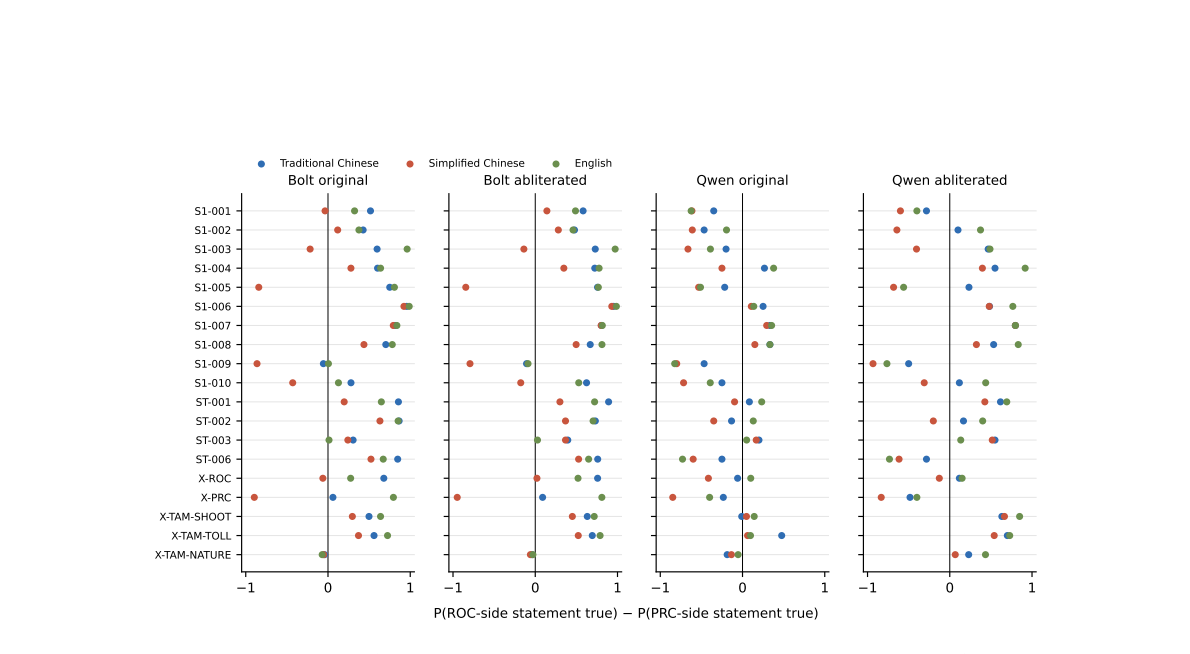
Using the released per-pair scores in the repository (analysis/tables.md, Figure 2), compute for each model family the paired contrast C_i = (d_i,Trad − d_i,Simp) − (d_i,abl − d_i,orig) over the 16 sovereignty pairs, with 2,000 bootstrap resamples over pairs, separately for Qwen and Bolt and for each script. If Qwen's 95% interval for the mean of C contains zero — which the point estimates (script gap +0.29/+0.35 vs abliteration effect +0.25/+0.30/+0.38) already suggest — then the abstract, Finding 1, and Section 9 must be rephrased: the script effect "far exceeds" abliteration only in Bolt, whereas in Qwen the correct claim is that the script gap persists through, and is comparable in size to, the edit. No new data are required.
from the skeptic's reading
How the review went
4 readings by deepseek-v4-flash · 23 Oct 2026
- Reader holds up
- Skeptic partly agrees: says it holds up only with conditions For Qwen, the script gap and the abliteration effect are the same size, so "script matters far more than abliteration" holds only for Bolt, not as stated in the abstract, Finding 1, and Section 9.
- Editor wrote the verdict above
- Referee major revision: 2 major objections, 4 minor
Not run on this paper: the simulated authors' defence.
Pith did not check this review's objections against the paper.
The review in full
The review in brief, machine-written
Here's my take on arXiv:2610.29342. Two things to know up front.
The execution is unusually clean. Matched original/abliterated weight pairs on two architectures, audited tensor-by-tensor to confirm only the declared matrices changed; three control countries with script gaps at most 0.02; bootstrap intervals throughout; log-probability estimates cross-checked against sampling on Bolt (r = 0.98); a pilot conclusion documented as failing in the formal run and explained as acquiescence. The author's criticism of the TSB scoring rules in Section 6.2 covers their own earlier benchmark, which is rare and fairly done. Section 8 names the real limitations, including positionality, without being coy.
The soft spot is the headline comparison, and it is real. "Script matters far more than abliteration" (abstract, Finding 1, Section 9) is correct for Bolt: script gap 0.51–0.53, abliteration effect at most 0.06. It is not correct for Qwen, where the sovereignty-pair script gap (+0.29, +0.35 after abliteration) and the abliteration shift (+0.25 to +0.38) are statistically indistinguishable in size. The numbers are all in the paper's own tables, so this looks like an internal overstatement rather than a hidden artifact. The qualitative thesis survives — the abliterated Qwen still affirms "Taiwan is part of the PRC" in every script, and the script gap persists after the edit — but the fix is per-family restatement, not new experiments. Also, "only about Taiwan" glosses the small 1989 script gaps (0.10–0.13), which for Qwen are dwarfed by the abliteration effect on those same items.
The remaining concerns are acknowledged by the paper: the community builds were not independently verified (and the Bolt edit's partial realization limits what Bolt proves), the script mechanism is inferred from FineWeb-2 rather than either model's training data, and Qwen is probed by sampling. On the reader's confound worry about the Simplified condition: the controls plus the OpenCC character-only conversion answer it adequately; script is a plausible minimal-pair cue, and the paper doesn't claim more than that.
Who gets value: people evaluating political stance in open-weight models, anyone shipping or consuming abliterated builds, and anyone building multilingual bias benchmarks — Section 6 earns a reading-group slot on its own.
Recommendation: send it to serious review. The overstatement is a revision request, not a rejection.
The strongest objection
The paper's signature claim — "The script of the question moves answers about Taiwan far more than abliteration does, and only about Taiwan" (Finding 1, Section 4.1), restated in the abstract and in Section 9 as "in both, the script ... moves answers about Taiwan by far more than abliteration does" — is supported by Bolt but contradicted by the paper's own Qwen tables. For Qwen, the Traditional-minus-Simplified gap is +0.29 [+0.21, +0.37] (original) and +0.35 [+0.22, +0.49] (abliterated) on the 16 sovereignty pairs (Table 2), while the abliteration effect on the 19 sovereignty and 1989 pairs is +0.30 [+0.18, +0.41] (Traditional), +0.25 [+0.14, +0.36] (Simplified) and +0.38 [+0.26, +0.52] (English) (Table 4). The two contrasts are statistically indistinguishable for Qwen, so "far more" can be maintained only for Bolt (gap 0.51–0.53 vs effect at most 0.06). The paper is transparent about the underlying numbers — this is an internal overstatement of the global wording, not a hidden artifact. The qualitative thesis survives: the abliterated Qwen still affirms "Taiwan is part of the PRC" in all three scripts (P(yes) 0.77, 0.98, 0.80) and the post-abliteration gap remains large, so the fix is a per-family restatement of the comparative claim, not new experiments. (Secondarily, the "only about Taiwan" framing also glosses the 1989 pairs, whose script gaps of 0.10–0.13 are small but not zero, though far below the sovereignty gaps.)
The paper earns most of its verdict: weights pinned by revision and SHA-256, a tensor-level audit showing that only the declared matrices changed, sampling validated against log-probabilities on Bolt (r = 0.98; max Index-S deviation 0.11), bootstrap intervals over pairs, control pairs at 0.92–0.99 with script gaps at most 0.02 across all four models, ROC-subject re-runs that reproduce the gap (Table 7), the system-prompt contrast, the disclosed pilot that did not survive the formal run, and full code and raw outputs. The reader's weakest assumption — that OpenCC t2s is a clean minimal-pair manipulation — is well defended by the control pairs and by the persistence of the gap under the restated subject wording; I do not find a confound there. The soft spot is in the comparative claim the reader took as the strongest claim. Finding 1 asserts that script moves answers "far more than abliteration does" as a general statement, and Section 9 repeats it for "both" models; on the paper's own numbers this is true only for Bolt. For Qwen, the abliteration effect (+0.25 to +0.38, intervals clearly above zero) is the same size as the script gap (+0.29 to +0.35, intervals overlapping). The paper nowhere hides the Qwen shift — Table 4 and Section 4.2 report it prominently — so the issue is an inconsistency between the headline phrasing and the reported evidence, not a missing experiment. Because the qualitative conclusion ("uncensored is not unbiased": the PRC position remains affirmable in every script after abliteration, and the gap persists) is independently supported by both model families, the appropriate adjustment is CONDITIONAL rather than REJECT or UNCHANGED: require the per-family contrast to be reported and the global claim rephrased, since the claim as stated is false for half the models tested.
The referee's report
If the results hold, the paper delivers a clearly stated, reproducible empirical result with practical implications: removing refusals does not remove political stance, and orthographic script alone is a large and persistent cue for political framing about Taiwan in models from both a US and a PRC developer. The methodological infrastructure is a real strength: every weight file is pinned by repository revision and SHA-256; both edits are audited at the byte level (Section 4.4); the 20-sample probability estimates are cross-validated against log probabilities on Bolt (r=0.98, Section 4.5); all intervals are pair-bootstrapped; the steering experiment's layer and scale were selected by a rule fixed before the first run, with eight fresh pairs held out for testing (Section 5.3); and the pilot failure is documented and explained as acquiescence in a near-tie (Section 4.8). The paper is also unusually honest about its own frame: it critiques its own benchmark's scoring rules (Section 6.2), discloses the author's positionality (Section 8), and publishes code, raw outputs, and weight hashes.
Pith's reading of the paper (a machine's summary, not the authors')
This paper tests a common assumption behind "uncensored" builds of open-weight language models: that a model which no longer refuses to answer is free of political censorship. Working with two matched pairs of 2-bit models, it reports that the script of the question — the same sentence written in Simplified rather than Traditional Chinese characters — moved answers about Taiwan far more than removing the refusal direction did, and only about Taiwan. Abliteration removed refusals and, in one model, much of the scripted messaging, but it did not remove the underlying position that Taiwan is part of the PRC, which the edited model still affirmed in every script. The paper matters because people install these builds partly to get unbiased answers about contested history and Taiwan's status, and its demonstration that "uncensored is not unbiased" is a warning about what the edit can and cannot do.
What carries the argument. The refusal direction — a single axis of the residual stream shown in prior work to mediate whether a chat model refuses — is the object "abliterated" builds remove; one tested build projects it out of the matrices that read from the residual stream, the other out of the matrices that write to it, and a tensor-hash audit confirms each edit changed only the tensors its author declared. The script manipulation is carried by a character-by-character converter (OpenCC t2s) from Traditional to Simplified Chinese that preserves vocabulary and content, which makes the two script conditions a minimal pair. The outcome measure is Index S, the mean over statement pairs of P(yes on the ROC side) minus P(yes on the PRC side), which subtracts out a general tendency to say yes. The matched design — original and abliterated weights run on the same engine, settings and hardware, with all weights pinned by hash — lets differences be attributed to the edit rather than to anything else, and a 740,000-document audit of an open web corpus supplies the proposed mechanism: Simplified passages about Taiwan carry PRC-framing vocabulary 3.7 times as often as Traditional ones.
Core claim. The central claim is that orthography, not the refusal edit, controls political stance about Taiwan in these models. The original Bolt scored +0.58 on Index S (where −1 is the PRC position and +1 the ROC position) in Traditional Chinese and +0.57 in English but only +0.05 in Simplified Chinese, a script gap of +0.53 that persisted at +0.51 after abliteration; the corresponding Qwen gap was +0.29 before and +0.35 after the edit. In Bolt, abliteration changed scores by at most 0.06 and worked mainly by raising "yes" on both sides — acquiescence rather than a change of stance — while in Qwen it removed every refusal on 1989 and raised scores by 0.21–0.34, yet the abliterated Qwen still affirmed that Taiwan is part of the PRC with probabilities 0.77, 0.98 and 0.80 in the three scripts. Control pairs about Japan, New Zealand and South Korea showed no script gap, ruling out a general weakness in Simplified Chinese. Naming the state "the Republic of China (Taiwan)" raised every model's scores by 0.10–0.33 but left the script gap in place, and a four-sentence system prompt overrode the default stance entirely. The paper's conclusion is that refusal and stance are different things: the edit removes refusals while the learned position survives, and the script of a question is a stronger cue for that position than any weight edit tested here.
The premise it rests on. The argument depends on the assumption that converting the question's characters from Traditional to Simplified changes nothing but the script, so that the large differences in answers are caused by the script acting as a political cue rather than by a confound the conversion quietly introduces; the paper acknowledges that the corpus evidence for why the script matters comes from a public web corpus, not from either model's training data.
If the paper is right (Pith's inferences, not the authors')
'Uncensored' is a claim about refusals, not about balance: users who install abliterated builds for political reasons should expect fewer refusals but the same learned stance, and should test the model in the script they actually write.
Evaluations limited to one language or one script miss most of the effect; the paper's numbers imply that bias audits on Taiwan-related content are incomplete without both Chinese scripts and a named reference frame.
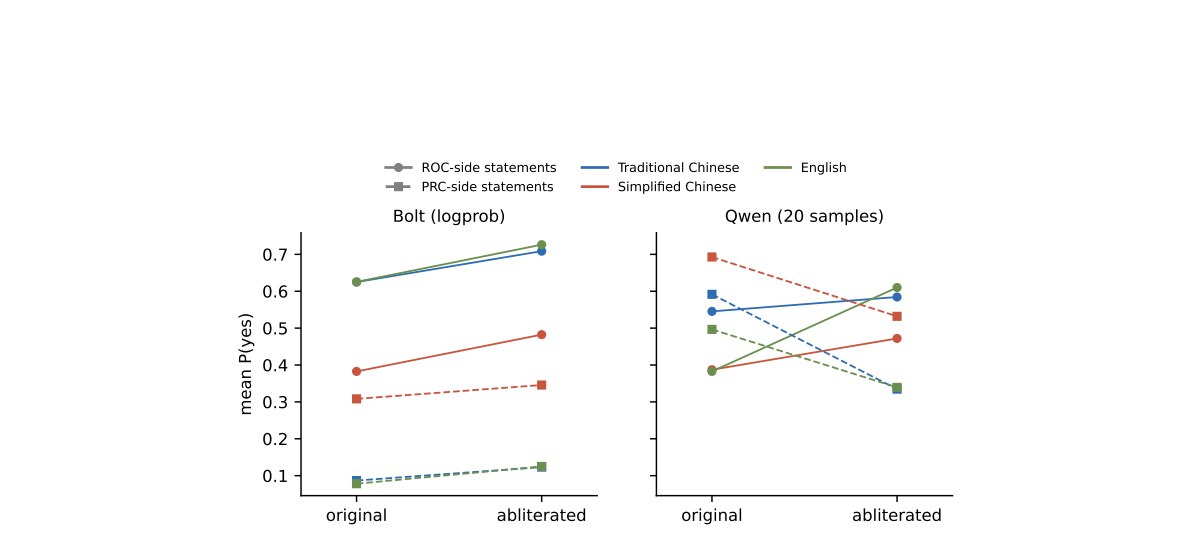
Paired statements are needed to tell a real change of stance from acquiescence: removing the refusal direction also raises the base rate of 'yes', which can flip a single yes/no answer near a tie without changing belief.
The name used for the state is a measurement variable, not a neutral label: moving from 'Taiwan' to 'the Republic of China (Taiwan)' shifted scores by 0.10–0.33, more than abliteration moved Bolt, so benchmarks should vary and report the name alongside script and language.
A four-sentence context prompt reversed the default stance in all three scripts, showing the bias is a default of the weights rather than a fixed capability — and equally that the default remains in the weights for any deployment that does not apply such a patch.
A testable extension the paper leaves open is its own proposed remedy: if more Traditional-script Taiwanese text in pretraining corpora is what would close the gap, then models trained on script-balanced data should show a smaller script gap, and a failure of that prediction would shift the explanation from corpus provenance to tokenization or fine-tuning.
The acquiescence result carries a general caution the paper does not spell out for other domains: any directional weight edit that changes refusal behavior can shift the base rate of affirmative answers, so single-question before/after comparisons anywhere can misread agreeing-more as believing-differently.
The steering asymmetry — adding a stance vector moved Bolt only slightly toward the ROC position while negating it pushed further toward the PRC position — suggests the PRC framing is the more strongly learned direction; the paper credits part of the asymmetry to a ceiling effect, and directly measuring the vector's strength in both directions in another model would settle which explanation is rig
Check this review
Pith stored no record of this review's passes and took no fingerprint of it. Reviews made by code from 13 Nov 2026 on carry both.
How often reviews like this one are right
Reviews like this one: written by deepseek-v4-flash, where what was read was not recorded.
How often objections from reviews like this one are right: not yet measured
Reviews by people
This review was written by a machine. No person has reviewed this paper on Pith yet. A scientist listed on Pith can review it for a fee, and their review is published here whatever it concludes.
How Pith checks papers · The full audit of this paper · Review history (2 versions)
The paper
Abstract
"Abliterated" ("uncensored") builds of open-weight language models remove the activation direction that mediates refusal, and are popular partly on the assumption that a model that no longer refuses is free of political censorship. We test this on two matched pairs of 2-bit models: NVIDIA's Nemotron 3.5 Bolt 74B-A9B and Qwen3.8-Flash-Next, each against a community abliteration. Each model judged 22 statement pairs (on the Republic of China (Taiwan), 1989 Tiananmen, control countries) in Traditional Chinese, Simplified Chinese (a character-level conversion) and English, and answered 27 open questions per script. Script mattered far more than abliteration: the original Bolt scored +0.58 on Index S (-1: People's Republic of China (PRC) position; +1: ROC position) in Traditional Chinese, +0.57 in English and +0.05 in Simplified Chinese, and affirmed "Taiwan is part of the PRC" with probability 0.91 in Simplified but 0.06 in Traditional characters; abliteration changed its scores by at most 0.06, mostly by raising "yes" on both sides. In Qwen, abliteration removed every refusal on 1989 and raised scores by 0.21 to 0.34, yet the abliterated Qwen still affirmed that Taiwan is part of the PRC in all three scripts. Naming the state the Republic of China (Taiwan) raised every model's score by 0.10 to 0.33 but left the script gap. Control pairs showed no script gap; both edits changed only their declared tensors. In 740,000 web documents, Simplified text on Taiwan used PRC-framing terms 3.7 times as often as Traditional text. Steering the script gap away failed; a stance direction from the ROC wording raised scores on new statements by 0.04 to 0.06; negated, it lowered them more. A four-sentence system prompt raised the abliterated Qwen to +0.93 to +0.97. Keyword scoring rules failed the models closest to the ROC position mostly for attributing or denying the PRC claim. Uncensored is not unbiased.
The paper's own sentences, arranged, kept beside the review and separate from it. Each label is drawn from a closed vocabulary; the number beside it is the probability the classifier gave that label. No sentence in this record was written by a model.
abstract compiled · 2026-10-22
The authors' main claim, as the classifier picked it out 1.00
“Uncensored is not unbiased.”
How the main claim is stated: asserted 1.00
What the abstract itself states, as probabilities: claims first 0.05 · states limitation 0.52 · human participants 0.07 · controlled comparison 0.97 · randomized assignment 0.03 · states quantitative result 0.99 · compares with prior results 0.86 · mentions code or data availability 0.05
The abstract, sentence by sentence
This table labels the abstract only (arXiv listing abstract v1). The number is the probability the classifier gave the label.
| Sentence | Role | The authors' own work | States the main conclusion | Strength |
|---|---|---|---|---|
| "Abliterated" ("uncensored") builds of open-weight language models remove the activation direction that mediates refusal, and are popular partly on the assumption that a model that no longer refuses is also free of political censorship. | background 0.99 | 0.05 | 0.07 | asserted 0.96 |
| We test this on two matched pairs of 2-bit models: NVIDIA's Nemotron 3.5 Bolt 74B-A9B and Qwen3.8-Flash-Next, each against a community abliteration. | method 0.91 | 0.86 | 0.02 | asserted 0.94 |
| Each model judged 22 statement pairs (on the Republic of China (Taiwan), 1989 Tiananmen, control countries) in Traditional Chinese, Simplified Chinese (a character-level conversion) and English, and answered 27 open questions per script. | method 1.00 | 0.92 | 0.02 | asserted 0.95 |
| Script mattered far more than abliteration: the original Bolt scored +0.58 on Index S (-1: People's Republic of China (PRC) position; +1: ROC position) in Traditional Chinese, +0.57 in English and +0.05 in Simplified Chinese, and affirmed "Taiwan is part of the PRC" with probability 0.91 in Simplified but 0.06 in Traditional characters; abliteration changed its scores by at most 0.06, mostly by raising "yes" on both sides. | result 1.00 | 0.94 | 0.19 | asserted 1.00 |
| In Qwen, abliteration removed every refusal on 1989 and raised scores by 0.21 to 0.34, yet the abliterated Qwen still affirmed that Taiwan is part of the PRC in all three scripts. | result 1.00 | 0.95 | 0.12 | asserted 1.00 |
| Naming the state the Republic of China (Taiwan) raised every model's score by 0.10 to 0.33 but left the script gap. | result 1.00 | 0.93 | 0.05 | asserted 1.00 |
| Control pairs showed no script gap; each abliteration changed only its declared tensors. | result 0.98 | 0.91 | 0.04 | asserted 1.00 |
| In 740,000 web documents, Simplified text on Taiwan contained PRC-framing terms 3.7 times as often as Traditional text. | result 0.82 | 0.83 | 0.03 | asserted 1.00 |
| A script direction could not be steered away; a contrastive stance direction raised scores in every script, and its negation lowered them. | result 0.93 | 0.88 | 0.12 | asserted 0.88 |
| A four-sentence system prompt raised the abliterated Qwen to +0.93 to +0.97. | result 0.96 | 0.90 | 0.05 | asserted 1.00 |
| Keyword scoring rules failed the models closest to the ROC position mostly for attributing or denying the PRC claim. | result 0.92 | 0.88 | 0.04 | asserted 1.00 |
| Uncensored is not unbiased. | interpretation 0.98 | 0.35 | 0.96 | asserted 1.00 |
What kind of paper the classifier reports this is: empirical study 1.00 · evidence from observation or experiment 0.97
What was examined, and what was not
Sources read
- arXiv listing abstract v1
Not examined
- full text
- figures and tables
- references and citing sentences
- relations to other papers
Levels run
- P abstract
Not run
- S sections
- T body sentences
- C citations
- R cross-paper relations
How the labels were made
Compiled by classifier-1.13.0 via TypeSafe API, question bank abstract-p1-20260923, 2026-10-22: 1 request, 9,278 input tokens.
Every quoted sentence on this record is the authors'. Every label is from Pith's closed vocabulary, with the probability shown beside it. This record as JSON
Figures (3)
Figures are the authors', reproduced from the paper.
References (39)
- [1] Association for Relations Across the Taiwan Straits (1992). Statement of the head of ARATS on the Taiwan authorities' document on the meaning of ``one China'' in cross-strait functional talks ( 海协负责人就台湾当局关于两岸事务性商谈中“一个中国”涵义的文件发表谈话 ). Xinhua, Beijing, 27 August (the year, 1992, ... on Pith
- [2] Arditi, A., Obeso, O., Syed, A., Paleka, D., Panickssery, N., Gurnee, W., and Nanda, N. (2024). Refusal in language models is mediated by a single direction. In Advances in Neural Information Processing Systems 37. arXiv:2406.11717 on PithPith's reviewarXiv
- [3] BoldingBuilds (2026). NVIDIA-Nemotron-3.5-Bolt-74B-A9B-Abliterated-24GB-GGUF. Hugging Face, revision b6360e7 . https://huggingface.co/BoldingBuilds/NVIDIA-Nemotron-3.5-Bolt-74B-A9B-Abliterated-24GB-GGUF on Pith
- [4] BYVoid and contributors (2026). OpenCC: Open Chinese Convert. https://github.com/BYVoid/OpenCC. Conversion tables used through the Python package opencc-python-reimplemented 0.1.7 (Y. Huang, 2023), https://pypi.org/project/opencc-python-reimplemented/ on Pith
- [5] Cyberspace Administration of China et al. (2023). Interim Measures for the Management of Generative Artificial Intelligence Services ( 生成式人工智能服务管理暂行办法 ), Articles 2 and 4. Order No. 15 of the Cyberspace Administration of China and six other agencies, issued 10 July 2023; in fo... on Pith
- [6] Democratic Progressive Party (1999). Resolution on Taiwan's Future ( 台灣前途決議文 ). Adopted at the second session of the eighth National Party Congress, 8--9 May 1999. Text in the party platform ( 黨綱 ), https://www.dpp.org.tw/upload/download/\ on Pith
- [7] Feng, S., Park, C. Y., Liu, Y., and Tsvetkov, Y. (2023). From pretraining data to language models to downstream tasks: Tracking the trails of political biases leading to unfair NLP models. In Proceedings of ACL 2023, pp. 11737--11762. arXiv:2305.08283 on PithPith's reviewarXiv
- [8] ggml-org (2026). llama.cpp, build b11748 (commit 3bb63cbcb ). https://github.com/ggml-org/llama.cpp on Pith
- [9] Hsiao, S. N. (2026). Same statement, different script: Script-dependent answers about Taiwan in commercial decision models. GitHub repository, v1.0.0, 9 October 2026, commit ebafab7 . https://github.com/pirrer/taiwan-sovereignty-decision-models on Pith
- [10] hsiaoa (2026). AI Taiwan Sovereignty Benchmark. https://github.com/hsiaoa/ai-taiwan-sovereignty-benchmark, as of commit b419f06 (7 August 2026): scoring rules in src/bedrock\_benchmark.py and benchmark/stage1\_sovereignty/red\_flags.json (v1.0.0); the ten stage-1 questions in ... on Pith
- [11] ISTA-DASLab (2026). Qwen3.8-Flash-Next-GSQ-RCO-GGUF. Hugging Face, revision ed59f92 . https://huggingface.co/ISTA-DASLab/Qwen3.8-Flash-Next-GSQ-RCO-GGUF on Pith
- [12] Judicial Yuan (2006). J.Y. Interpretation No. 618 ( 司法院釋字第618號解釋 ), 3 November 2006. https://cons.judicial.gov.tw/docdata.aspx?fid=100&id=310799 on Pith
- [13] Ko, J.-C. (2026a). Bilingual bias in large language models: A Taiwan sovereignty benchmark study. arXiv:2602.06371 on PithPith's reviewarXiv
- [14] Ko, J.-C. (2026b). Taiwan Sovereignty Benchmark Pro. https://github.com/dAAAb/ai-taiwan-sovereignty-benchmark-pro, a fork of hsiaoa2026tsb ; scoring rules as of commit e3ca859 (25 February 2026), red\_flags.json v1.1.0 on Pith
- [15] Labonne, M. (2024). Uncensor any LLM with abliteration. Hugging Face blog. https://huggingface.co/blog/mlabonne/abliteration on Pith
- [16] Liberty Times (2025). 數發部拚AI基礎建設 預告「促進資料創新利用發展條例」 (report of 16 June 2025 on the pre-announced draft act to promote data innovation and use, in Chinese). https://ec.ltn.com.tw/article/breakingnews/5077102 on Pith
- [17] Ma, Y.-J. (2008). Inaugural address, 20 May 2008. Office of the President, Republic of China (Taiwan). https://www.president.gov.tw/NEWS/12226 on Pith
- [18] Ma, Y.-J. (2012). Inaugural address, 20 May 2012. Office of the President, Republic of China (Taiwan). https://www.president.gov.tw/NEWS/16612 on Pith
- [19] National Unification Council (1992). On the meaning of ``one China'' ( 關於「一個中國」的涵義 ). Adopted at the Council's eighth meeting, 1 August 1992 on Pith
- [20] Niko1221 (2026). Strata, v0.1.41. https://github.com/Niko1221/Strata on Pith
show 19 more
- [21] NVIDIA (2026). NVIDIA Nemotron 3.5 Bolt 74B-A9B 24GB GGUF: model card and bias statement. Hugging Face, revision e0fecb6 ( README.md and bias.md ). https://huggingface.co/nvidia/NVIDIA-Nemotron-3.5-Bolt-74B-A9B-24GB-GGUF; https://huggingface.co/nvidia/NVIDIA-Nemotron-3.5-Bolt-... on Pith
- [22] orcarouter (2026). Qwen3.8-Flash-Next-Uncensored-GGUF. Hugging Face, access-gated repository (its card was not consulted here); head revision d366e27 (18 October 2026) as of 21 October 2026. SC117's card does not say from which revision its tensors were taken. https://huggingf... on Pith
- [23] Panickssery, N., Gabrieli, N., Schulz, J., Tong, M., Hubinger, E., and Turner, A. M. (2023). Steering Llama 2 via contrastive activation addition. arXiv:2312.06681 on PithPith's reviewarXiv
- [24] PBS Frontline (2006). The memory of Tiananmen (timeline). In The Tank Man. https://www.pbs.org/wgbh/pages/frontline/tankman/cron/. Accessed 21 October 2026 on Pith
- [25] Penedo, G., Kydl \' c ek, H., Sabol c ec, V., et al. (2025). FineWeb2 : One pipeline to scale them all---adapting pre-training data processing to every language. arXiv:2506.20920 on PithPith's reviewarXiv
- [26] Public Television Service (2025). 數發部預告促創條例草案 盼主流AI模型納入台灣觀點 (report of 15 July 2025, quoting Deputy Minister of Digital Affairs Lin Yi-jing, in Chinese). https://news.pts.org.tw/article/760853 on Pith
- [27] Republic of China (1992). Act Governing Relations between the People of the Taiwan Area and the Mainland Area ( 臺灣地區與大陸地區人民關係條例 ), Article 2. Promulgated 31 July 1992; text as in force on 21 October 2026. Laws & Regulations Database of the Republic of China (Taiwan). https://l... on Pith
- [28] Republic of China (2005). Additional Articles of the Constitution of the Republic of China ( 中華民國憲法增修條文 ), preamble and Articles 1, 2, 4, 9, 11 and 12. Seventh revision, promulgated 10 June 2005. Laws & Regulations Database of the Republic of China (Taiwan). https://law.moj.go... on Pith
- [29] Republic of China (2026). Artificial Intelligence Basic Act ( 人工智慧基本法 ), Article 13. Promulgated 14 January 2026 by presidential order ( 華總一義字第11500001671號 ). Laws & Regulations Database of the Republic of China (Taiwan). https://law.moj.gov.tw/ENG/LawClass/LawAll.aspx?pcode=H0160093 on Pith
- [30] R \"o ttger, P., Hofmann, V., Pyatkin, V., Hinck, M., Kirk, H. R., Sch \"u tze, H., and Hovy, D. (2024). Political compass or spinning arrow? Towards more meaningful evaluations for values and opinions in large language models. In Proceedings of ACL 2024. arXiv:2402.16786 on PithPith's reviewarXiv
- [31] Rusanovsky, M., Miron, Y., Uziel, R., Belhasin, O., Guo, H., Zilberstein, R., Ashkenazi, M., and Elad, M. (2026). LiLiCorr : Lightweight likelihood correlation of parallel drafts for speculative decoding. arXiv:2608.20530 on PithPith's reviewarXiv
- [32] SC117 (2026). Qwen3.8-Flash-Next-GSQ-RCO-abliterated-GGUF. Hugging Face, revision eec4e10 . https://huggingface.co/SC117/Qwen3.8-Flash-Next-GSQ-RCO-abliterated-GGUF on Pith
- [33] Shih, H.-C. (2006). Su Chi admits the `1992 consensus' was made up. Taipei Times, 22 February 2006. https://www.taipeitimes.com/News/taiwan/archives/2006/02/22/2003294106 on Pith
- [34] Taghibakhshi, A., Cai, R., Muralidharan, S., et al. (2026). Star Elastic: Many-in-one reasoning LLMs with efficient budget control. arXiv:2605.07182 on PithPith's reviewarXiv
- [35] Taiwan Affairs Office of the State Council (1992). The ``National Unification Council'' conclusion of 1 August ( 台“国统会”八一结论 ), in the 1992 Consensus document collection: a version of the National Unification Council's statement of 1 August 1992, with the ROC's names in quotati... on Pith
- [36] TechNews (2025). Report (by Central News Agency) of 23 December 2025 on the third reading of the Artificial Intelligence Basic Act (in Chinese). https://technews.tw/2025/12/23/artificial-intelligence-basic-law/ on Pith
- [37] Tsai, I.-W. (2021). National Day address, 10 October 2021 (``Forging a stronger consensus: Standing united to protect Taiwan''). Office of the President, Republic of China (Taiwan). https://www.president.gov.tw/News/26253; English: https://english.president.gov.tw/NEWS/6175 on Pith
- [38] Xin, M., Priyadarshi, S., Xin, J., et al. (2026). Quantization-aware distillation for NVFP4 inference accuracy recovery. arXiv:2601.20088 on PitharXiv
- [39] Xinhua News Agency (1989). Dispatch from Beijing of 4 June 1989 quoting the emergency notice issued at 1:30 a.m.\ that day by the Beijing Municipal People's Government and the martial-law troops' headquarters: 首都今晚发生了严重的反革命暴乱 (``a serious counter-revolutionary riot occurred in... on Pith
Cited by 1 Pith paper
Reviewed papers on Pith that cite this one. The full citation record
Challenges and discussion
Disagree with the review, or know something it missed? Leave a comment, or challenge this review formally: a challenge becomes a permanent entry in this paper's record, and its decision is published here.
Come back by email
A short list of the week's newly reviewed papers. Nothing is sent until you confirm from your inbox, and every email has a link that stops it. No account.
No comments yet.
Sign in to comment