Computation and Language · arXiv:2608.20530 v2 · submitted 20 Aug 2026
LiLiCorr: Lightweight Likelihood Correlation of Parallel Drafts for Speculative Decoding
The paper says
“Speculative decoding accelerates language-model inference by drafting future tokens the target model verifies in parallel. A diffusion-style drafter such as DFlash drafts an entire block in one forward pass.”
more of the abstract
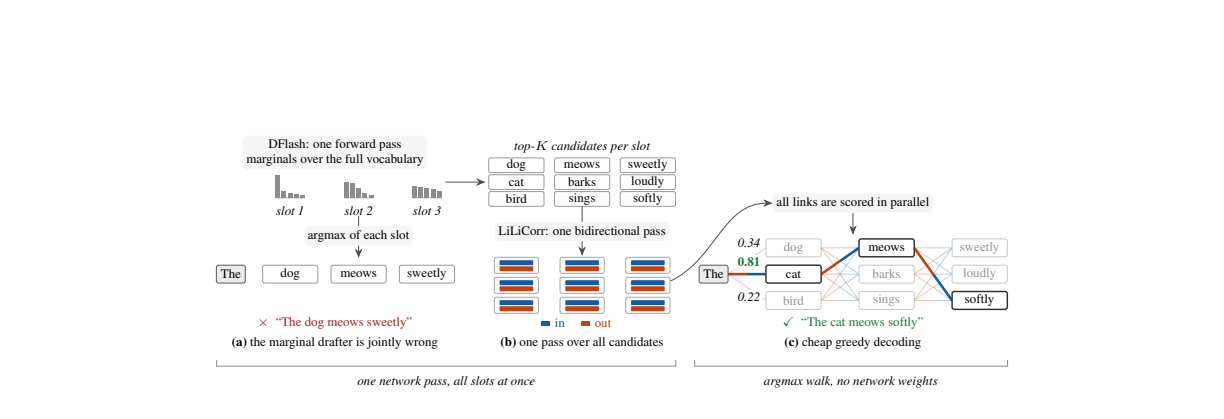
It is trained on the per-position marginals rather than on the joint distribution over the block, so the tokens it emits are individually plausible yet jointly incoherent. We introduce LiLiCorr, a Lightweight Likelihood-based model that Correlates the per-position marginals such a drafter produces. It keeps the top-K tokens at each position and processes them jointly, emitting an in and an out vector for each. Two candidates at consecutive positions match when the earlier out vector aligns, in cosine similarity, with the later in vector. Training scores the correct pairings highest and pushes competing ones down, so coherent blocks outscore incoherent ones. The joint distribution over the block, exponential in its length, is never materialized. One lightweight network pass produces all the vectors, the pairwise scores follow as batched matrix operations, leaving only a cheap greedy walk sequential. We co-train the DFlash drafter with LiLiCorr, so it proposes candidates that correlate into longer accepted sequences. Over the vanilla DFlash drafter it builds on, LiLiCorr accepts more and serves faster at all 72 settings we test: nine benchmarks at two target sizes under greedy and temperature-one decoding, plus a throughput sweep over six concurrencies, two input lengths and three output-entropy tiers. It raises acceptance length by 7 to 19%, while its single-pass scoring head costs only about 3% of the per-block latency. Against three concurrently developed methods that also restore coherence at draft time, all equally optimized on a common stack, LiLiCorr holds the highest throughput in 63 of those settings, ties within a measured noise floor in 6, and trails in only 3.
from the abstract
Pith says
Machine review · deepseek-v4-flash · 27 Aug 2026 · of version 1 of the paper; version 2 is newer · what was read was not recorded · not checked by a person
It can be wrong. Challenge this review or reply to it.
Holds up, with conditions. A genuinely new single-pass correlation head for draft-time coherence, with strong empirics; the missing oracle bound is the main thing to fix. This line is wrong
3 major objections · 4 minor
How often objections from reviews like this one are right: not yet measured
Not checked: figures, code, what the references say.
The paper says, at §4.1, Table 3
The review did not quote this passage.
Pith says: Objection 1 of 3 · major
The text states that the fully optimized LiLiCorr head costs 0.28 ms per block, is 2.4× cheaper than Domino's 0.67 ms, and accounts for about 2.8% of the per-block wall clock. As rendered, Table 3 reports the optimized LiLiCorr speculative-head cost as 1.97 ms with an optimized per-block wall of 11.88 ms, which gives a head share of about 16.6%, while 0.28 ms is the eager LiLiCorr value (0.28/10.15 = 2.76%).
more of objection 1
The same confusion affects the DFlash row, where the optimized head cost is reported as 0.66 ms versus 0.05 ms eager and the per-block wall increases from 9.87 to 10.53 ms. This internal contradiction directly undermines the paper's central efficiency claim and must be resolved before the results can be interpreted.
The paper says, at §3.3, §3.4, Conclusion
The review did not quote this passage.
Pith says: Objection 2 of 3 · major
The Conclusion explicitly acknowledges that LiLiCorr cannot recover tokens absent from the drafter's top-K pool and that acceptance length is bounded by the drafter's coverage, but the paper never quantifies that bound. No top-K coverage statistics are reported, and no oracle upper bound on the acceptance length achievable by any reranker over the same candidate pool is provided.
more of objection 2
The supervision in Eq. (3) masks all slots after the first coverage miss, so the reported 9-19% acceptance-length gains cannot be placed relative to this ceiling. Without an oracle-prefix bound, the central claim that the pairwise correlation 'recovers a coherent block' is under-supported: the gains could correspond to near-optimal reranking or to only a small fraction of the available headroom.
The paper says, at §2, §4.1
The review did not quote this passage.
Pith says: Objection 3 of 3 · major
Related Work cites D-PACE (Ref. [19]) as improving DFlash with an acceptance-aware training objective, which makes it a direct prior enhancement of the exact drafter backbone on which LiLiCorr builds, yet D-PACE never appears in the baseline tables or experimental comparisons.
more of objection 3
Since the paper claims the fastest draft-time system in 70 of 72 settings and states a state-of-the-art result, omitting a published method that improves the same backbone leaves that claim under-tested. The authors should either add D-PACE as a baseline or explain why it is not within the comparison scope.
4 minor objections
The paper says, at §4.3.1 / Abstract
Pith says: minor objection 1 of 4
The abstract's statement that extending LiLiCorr to inputs an order of magnitude longer than trained on 'preserves that lead' is only true for the hinge-regularized variant LiLiCorr + margin; Table 14 shows that LiLiCorr without the regularizer loses at some long-input operating points. This qualification should be made explicit in the abstract or in the main-text summary of Section 4.3.1.
The paper says, at Appendix G / Table 4
Pith says: minor objection 2 of 4
The margin regularizer in Eq. (13) introduces hyperparameters µ and ρ that are not listed in the main configuration table (Table 4); the values µ = 0.5 and ρ = 2.0 appear only in Appendix G. Please include them in Table 4 or clearly indicate that they are set in the appendix.
show 2 more
The paper says, at §4.1 / Appendix A
Pith says: minor objection 3 of 4
The term 'lightweight' is used for a head with 36.76M parameters; since the paper's central efficiency argument is about wall-clock cost rather than parameter count, I recommend phrasing that distinguishes the two claims to avoid conflating latency with model size.
The paper says, at Overall
Pith says: minor objection 4 of 4
No code or trained checkpoints are released. For a systems paper whose head-cost and throughput claims are load-bearing, releasing the serving kernels and the exact graph-capture recipe would substantially strengthen reproducibility.
What would settle it
Compute the oracle-prefix acceptance length for the co-trained drafter on each benchmark and decoding regime. Under greedy decoding, run the drafter, retain top-K at each slot, and at each slot pick the target's argmax token whenever it is present, stopping at the first absence; this is the maximum acceptance length any reranker over the same pool can achieve. Under temperature-1, use the candidate in the pool with the highest target conditional probability. Then report the ratio of LiLiCorr's measured acceptance length to this oracle bound, per benchmark and temperature. If the ratio is consistently above 0.9, the top-K ceiling is the binding constraint and the 9-19% claim is near-optimal; if it is below 0.7, the correlation head itself is the bottleneck and the central claim needs qualification.
from the skeptic's reading
How the review went
4 readings by deepseek-v4-flash · 27 Aug 2026
- Reader holds up, with conditions
- Skeptic agrees
- Editor wrote the verdict above
- Referee major revision: 3 major objections, 4 minor
Not run on this paper: the simulated authors' defence.
Pith did not check this review's objections against the paper.
The review in full
The review in brief, machine-written
LiLiCorr is a solid, well-tested entry in the speculative-decoding subfield. The core idea — scoring adjacent candidate tokens by cosine similarity between learned in/out vectors, computed in one parallel pass — is genuinely new and cleanly reduces the correlation problem to batched matrix products. The paper does a lot of things right: the local prefix-conditioned objective is well motivated, the target-weighted distractor penalty is a clever cost-aware shaping of cross-entropy, and the ablation that pits the greedy walk against a Viterbi path optimizer is exactly the kind of self-critical check that builds trust. The empirical coverage is extensive: two target sizes, two decoding regimes, a concurrency sweep, seed variability, long-context extrapolation, and a common serving stack for all baselines. I believe the headline claim — 9–19% acceptance-length gain over vanilla DFlash and highest throughput in most settings — is credible.
The main gap is the one the stress-test flags: no oracle-prefix bound. The paper discloses that the method can only rerank the top-K pool, but never reports how often the ground-truth token is in that pool, or how close LiLiCorr's greedy walk comes to the best any reranker could achieve over the same candidate lattice. Without that upper bound, the reader can't tell whether the correlation head is near-optimal or is capturing less than half of the available gain. This is a missing analysis, not a hidden flaw — the method is honestly described and the limitation is stated in the conclusion. But it should be addressed in revision, because it is the difference between 'this works' and 'this is the right ceiling.'
Two smaller issues. Table 3 as rendered is hard to parse and appears to contradict the prose about the LiLiCorr head cost; the numbers need a cleaner presentation. D-PACE is cited but not included as a baseline; if it's a natural comparison, a sentence explaining its omission would help. And no code or artifacts are released, which matters in a systems paper where kernel fusion and graph capture affect the throughput claims.
This deserves a serious referee. I'd send it to review, ask for the oracle-bound analysis, a cleaner Table 3, and ideally a code release. The central argument holds up; the missing pieces are about calibration and reproducibility, not about validity.
The strongest objection
The central claim depends on the drafter's top-K pool containing the correct token at the slots that decide prefix acceptance. The paper's conclusion explicitly states this ceiling, but it never quantifies it: no top-K coverage statistics, no oracle-prefix upper bound, and no analysis of how close the greedy walk comes to the best any reranker could do over the same pool. This matters because the training objective in Eq. (3) masks all slots after the first coverage miss, and the top-K selection in Section 3.4 is non-differentiable, so co-training cannot directly improve coverage; the only pressure on coverage comes from the DFlash loss in Eq. (6). The reported 9-19% gains are therefore meaningful only relative to the drafter's coverage ceiling. If the oracle bound is, say, 12% above vanilla DFlash, then LiLiCorr is near-optimal and the correlation head is doing its job. If the oracle bound is 40% above vanilla, LiLiCorr realizes less than half of the possible gain, and the claim that it 'recovers a coherent block' is overstated. Without the oracle bound, the reader cannot tell which regime holds, so the core empirical claim is under-supported.
The reader's weakest assumption identifies the same structural limit: LiLiCorr can only rerank candidates the drafter already proposes. The paper discloses this limitation in the conclusion but does not quantify it, and the non-differentiable top-K selection means co-training cannot directly push the correct token into the pool. This makes the drafter's coverage the true ceiling on the method's gains, and the absence of an oracle-prefix analysis leaves the significance of the 9-19% improvement ambiguous. The paper otherwise has strong support: detailed tables, seed variability, loss ablations, a greedy-versus-Viterbi decode-rule ablation, and consistent internal arithmetic. The missing D-PACE baseline also weakens the broad 'state-of-the-art' phrasing, though the abstract's 70-of-72 claim is explicitly scoped to DFlash and the two concurrent methods. These are completeness and support issues rather than internal contradictions, so the reader's CONDITIONAL verdict remains appropriate; the proposed oracle-bound check would settle whether the top-K ceiling is the dominant factor.
The referee's report
If the empirical results are substantiated, LiLiCorr is a meaningful advance: it is architecturally simple, reduces the correlation computation to parallel matrix operations, and is evaluated unusually broadly, including two target sizes, greedy and temperature-one decoding, three-seed variability, a six-point concurrency sweep, three output-entropy tiers, and separate ablations for the loss terms and the decode rule. The manuscript is also candid about its principal design limitation, the top-K coverage ceiling. However, the unresolved internal inconsistency in the head-cost table, the absence of an oracle-reranker bound, and the omission of a cited DFlash-improvement baseline prevent the central efficiency and state-of-the-art claims from being fully verified; no code or checkpoints are released.
Pith's reading of the paper (a machine's summary, not the authors')
The paper claims that the incoherence of parallel block drafters can be fixed at draft time without extra target passes or per-slot networks. LiLiCorr keeps the top-K tokens each draft slot proposes, runs one lightweight Transformer over the whole candidate lattice, and scores each adjacent pair by the cosine similarity of a learned out vector and in vector. A greedy left-to-right walk then commits the block using those precomputed scores, and the drafter is co-trained so its candidates chain into longer accepted prefixes. Across nine benchmarks, acceptance length rises 9–19 percent over the vanilla drafter, while the scoring head adds only about 2.8 percent of per-block latency. If true, this shows a structural limitation of diffusion-style drafters is fixable at nearly no extra cost.
What carries the argument. The central object is the candidate lattice with paired in/out vectors, scored by the matching term $\sigma \cos(o_{s,k}, i_{s+1,k'})$ between adjacent slots. A small bidirectional Transformer processes all $(B-1)\times K$ candidate nodes at once, so every vector sees the whole block before the pairwise cosine scores are computed as batched matrix operations. The cosine form is a deliberate stabilizer: it bounds every score in $[-\sigma,\sigma]$ and prevents runaway magnitudes from corrupting the shared drafter during joint training. A greedy left-to-right argmax walk, which touches no network weights, commits the final block.
Core claim. The central claim is that the joint coherence of a block of speculative tokens can be recovered from per-slot marginal distributions by a single neural pass over a candidate lattice, using pairwise cosine matching between learned direction vectors. Each candidate token is assigned an out vector and an in vector, and the match score between adjacent slots is the cosine similarity of the earlier candidate's out vector with the later candidate's in vector. Because every candidate attends to every other candidate in one bidirectional Transformer pass, the pairwise scores encode block-level context even though only adjacent slots are coupled. All scores are computed as batched matrix products, leaving only a cheap greedy argmax walk sequential. Trained jointly with the DFlash drafter, LiLiCorr raises acceptance length on every benchmark by 9 to 19 percent, and serves the fastest throughput in 70 of 72 measured settings against Domino, DSpark, and the vanilla drafter.
The premise it rests on. LiLiCorr can only rerank the top-K tokens the drafter already proposes; when the correct token is missing from a slot's candidate pool, no scoring can recover it, so the achievable acceptance length is bounded by the drafter's coverage.
If the paper is right (Pith's inferences, not the authors')
Parallel block drafters can be made coherent without iterative denoising or tree-based target verification, so the latency advantage of one-forward-pass drafting is preserved.
The 2.8 percent head overhead suggests draft-time correlation can be nearly free, changing the cost calculus for speculative decoding systems.
Co-training the drafter matters: the reported gains come from both the reranker and from adapting the drafter's candidate pools, not from reranking alone.
The method carries to inputs an order of magnitude beyond its training range when the positional encoding is extended at inference.
A greedy left-to-right decode beats a globally optimal path search under prefix acceptance, reinforcing that early-slot match fidelity is what speculative decoding rewards.
The same in/out matching mechanism could be reused on any parallel drafter that emits per-position scores and exposes hidden states, not just DFlash; the paper's setup is specific, but the mechanism is not.
Because the head sees all candidates in one pass, its capacity could be shifted to longer-range couplings; the paper leaves open whether couplings beyond adjacent pairs repay their cost under prefix acceptance.
The target-weighted distractor penalty suggests a general recipe: when a reranker is judged by a frozen verifier, training against the verifier's graded preferences can outperform training only on ground-truth labels.
The single-pass property may make LiLiCorr particularly valuable in compute-bound high-concurrency serving, where per-slot correction networks amortize less well.
Check this review
Pith stored no record of this review's passes and took no fingerprint of it. Reviews made by code from 13 Nov 2026 on carry both.
How often reviews like this one are right
Reviews like this one: written by deepseek-v4-flash, where what was read was not recorded.
How often objections from reviews like this one are right: not yet measured
Reviews by people
This review was written by a machine. No person has reviewed this paper on Pith yet. A scientist listed on Pith can review it for a fee, and their review is published here whatever it concludes.
The paper
Abstract
Speculative decoding accelerates language-model inference by drafting future tokens the target model verifies in parallel. A diffusion-style drafter such as DFlash drafts an entire block in one forward pass. It is trained on the per-position marginals rather than on the joint distribution over the block, so the tokens it emits are individually plausible yet jointly incoherent. We introduce LiLiCorr, a Lightweight Likelihood-based model that Correlates the per-position marginals such a drafter produces. It keeps the top-K tokens at each position and processes them jointly, emitting an in and an out vector for each. Two candidates at consecutive positions match when the earlier out vector aligns, in cosine similarity, with the later in vector. Training scores the correct pairings highest and pushes competing ones down, so coherent blocks outscore incoherent ones. The joint distribution over the block, exponential in its length, is never materialized. One lightweight network pass produces all the vectors, the pairwise scores follow as batched matrix operations, leaving only a cheap greedy walk sequential. We co-train the DFlash drafter with LiLiCorr, so it proposes candidates that correlate into longer accepted sequences. Over the vanilla DFlash drafter it builds on, LiLiCorr accepts more and serves faster at all 72 settings we test: nine benchmarks at two target sizes under greedy and temperature-one decoding, plus a throughput sweep over six concurrencies, two input lengths and three output-entropy tiers. It raises acceptance length by 7 to 19%, while its single-pass scoring head costs only about 3% of the per-block latency. Against three concurrently developed methods that also restore coherence at draft time, all equally optimized on a common stack, LiLiCorr holds the highest throughput in 63 of those settings, ties within a measured noise floor in 6, and trails in only 3.
The paper's own sentences, arranged, kept beside the review and separate from it. Each label is drawn from a closed vocabulary; the number beside it is the probability the classifier gave that label. No sentence in this record was written by a model.
abstract compiled · 2026-09-23
The authors' main claim, as the classifier picked it out 0.94
“Against DFlash and two concurrent methods that also restore coherence at draft time, LiLiCorr delivers the highest throughput in 70 of 72 settings: nine benchmarks at two target sizes under greedy and temperature-one decoding, and a throughput sweep over six concurrencies, two input lengths and three entropy tiers, with all systems equally optimized on a common serving stack.”
How the main claim is stated: asserted 1.00
What the abstract itself states, as probabilities: claims first 0.06 · states limitation 0.17 · human participants 0.03 · controlled comparison 0.96 · randomized assignment 0.02 · states quantitative result 0.99 · compares with prior results 0.98 · mentions code or data availability 0.03
The abstract, sentence by sentence
This table labels the abstract only (arXiv listing abstract v1). The number is the probability the classifier gave the label.
| Sentence | Role | The authors' own work | States the main conclusion | Strength |
|---|---|---|---|---|
| Speculative decoding accelerates language-model inference by drafting future tokens that the target model verifies in parallel. | background 1.00 | 0.05 | 0.03 | asserted 1.00 |
| A diffusion-style block head such as DFlash is an attractive drafter, predicting an entire block of future tokens in one forward pass. | background 1.00 | 0.07 | 0.02 | asserted 0.85 |
| However, it is trained on per-position marginals rather than the joint block distribution, so the tokens it emits are individually plausible yet jointly incoherent. | background 0.55 | 0.11 | 0.03 | asserted 1.00 |
| We introduce LiLiCorr, a Lightweight Likelihood-based model that Correlates the per-position marginal distributions a drafter already produces. | contribution 0.98 | 0.90 | 0.11 | asserted 0.99 |
| It keeps the top-k tokens at each position as candidates and processes them jointly, producing for each an in and an out vector. | method 0.99 | 0.82 | 0.03 | asserted 1.00 |
| A pair of adjacent candidates matches when the earlier one's out vector has high cosine similarity with the later one's in vector. | method 1.00 | 0.69 | 0.03 | asserted 0.99 |
| These matches capture the block's joint structure without ever materializing the full joint distribution. | method 0.52 | 0.69 | 0.08 | asserted 1.00 |
| One lightweight network pass produces all the vectors, and the pairwise scores are then computed in parallel as batched matrix operations, leaving only a cheap greedy walk sequential. | method 1.00 | 0.81 | 0.05 | asserted 1.00 |
| We further co-train the drafter with LiLiCorr, so it learns to propose candidates that correlate into longer accepted sequences. | method 0.82 | 0.94 | 0.07 | asserted 1.00 |
| Over the vanilla DFlash drafter, LiLiCorr raises acceptance length on every benchmark by 9 to 19%, while its scoring head accounts for about 2.8% of the per-block latency. | result 1.00 | 0.96 | 0.41 | asserted 1.00 |
| Against DFlash and two concurrent methods that also restore coherence at draft time, LiLiCorr delivers the highest throughput in 70 of 72 settings: nine benchmarks at two target sizes under greedy and temperature-one decoding, and a throughput sweep over six concurrencies, two input lengths and three entropy tiers, with all systems equally optimized on a common serving stack. | result 1.00 | 0.95 | 0.44 | asserted 1.00 |
| Extending LiLiCorr to inputs an order of magnitude longer than it was trained on preserves that lead. | result 1.00 | 0.92 | 0.11 | asserted 1.00 |
What kind of paper the classifier reports this is: method or tool 1.00 · evidence from observation or experiment 0.95
What was examined, and what was not
Sources read
- arXiv listing abstract v1
Not examined
- full text
- figures and tables
- references and citing sentences
- relations to other papers
Levels run
- P abstract
Not run
- S sections
- T body sentences
- C citations
- R cross-paper relations
How the labels were made
Compiled by classifier-1.13.0 via TypeSafe API, question bank abstract-p1-20260923, 2026-09-23: 1 request, 8,950 input tokens.
Every quoted sentence on this record is the authors'. Every label is from Pith's closed vocabulary, with the probability shown beside it. This record as JSON
Figures (1)
Figures are the authors', reproduced from the paper.
Cited by 5 Pith papers
Reviewed papers on Pith that cite this one. The full citation record
- Improving Tail-Augmented Speculative Drafting with Hidden State Mixing and Gradient Detach cs.LG · Nov 2026
- Uncensored Is Not Unbiased: Abliteration Removes Refusals but Not Script-Dependent Bias About Taiwan cs.CY · Oct 2026
- AdaSpark: Adaptive DSpark with Online Learning for Tree Verification and N-gram Fill cs.LG · Oct 2026
- DRelay: Global Draft Context for Prefix-Aware Parallel Speculative Decoding Repair cs.AI · Oct 2026
- Nemotron 3.5 Bolt E4B 4GB: An Open and Efficient Small Language Model for Fast Conversational Agents cs.CL · Nov 2026
How the literature uses it
What this paper does with the arXiv papers it cites
What it cites · 7 sentences without a confident label
Compares with 2 papers
-
We compare against two concurrent works to ours, Domino [ref] and DSpark [ref] , and against the drafter it builds on.
Domino: Decoupling Causal Modeling from Autoregressive Drafting in Speculative Decoding · Experimental setup · 1.00
-
We compare against two concurrent works to ours, Domino [ref] and DSpark [ref] , and against the drafter it builds on.
DSpark: Confidence-Scheduled Speculative Decoding with Semi-Autoregressive Generation · Experimental setup · 1.00
Cites as background 5 papers
-
A separate line of work drafts an entire block in one forward pass: parallel and diffusion-style block heads such as [ref] and diffusion-based self-speculation [ref] handle a long speculative window cheaply.
Nemotron-Labs-Diffusion: A Tri-Mode Language Model Unifying Autoregressive, Diffusion, and Self-Speculation Decoding · Related Work · 0.94
-
Speculative decoding accelerates inference by proposing draft tokens and verifying them with the target model under a rule that preserves its distribution [ref] .
Accelerating Large Language Model Decoding with Speculative Sampling · Related Work · 1.00
-
D-PACE [ref] improves with an acceptance-aware training objective.
D-PACE: Dynamic Position-Aware Cross-Entropy for Parallel Speculative Drafting · Related Work · 0.84
Challenges and discussion
Disagree with the review, or know something it missed? Leave a comment, or challenge this review formally: a challenge becomes a permanent entry in this paper's record, and its decision is published here.
Come back by email
A short list of the week's newly reviewed papers. Nothing is sent until you confirm from your inbox, and every email has a link that stops it. No account.
No comments yet.
Sign in to comment