Machine Learning · arXiv:2611.34092 v1 · submitted 25 Nov 2026 · 31 references
Improving Tail-Augmented Speculative Drafting with Hidden State Mixing and Gradient Detach
The paper says
“Multi-token prediction (MTP) modules and EAGLE-style drafters support efficient speculative decoding by reusing target-model hidden states.”
more of the abstract
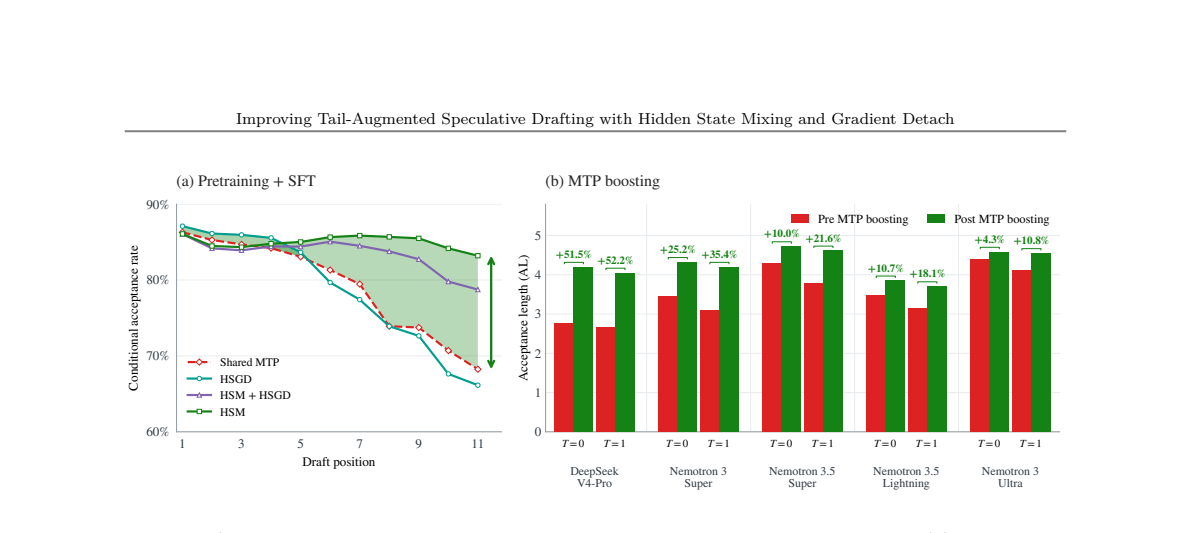
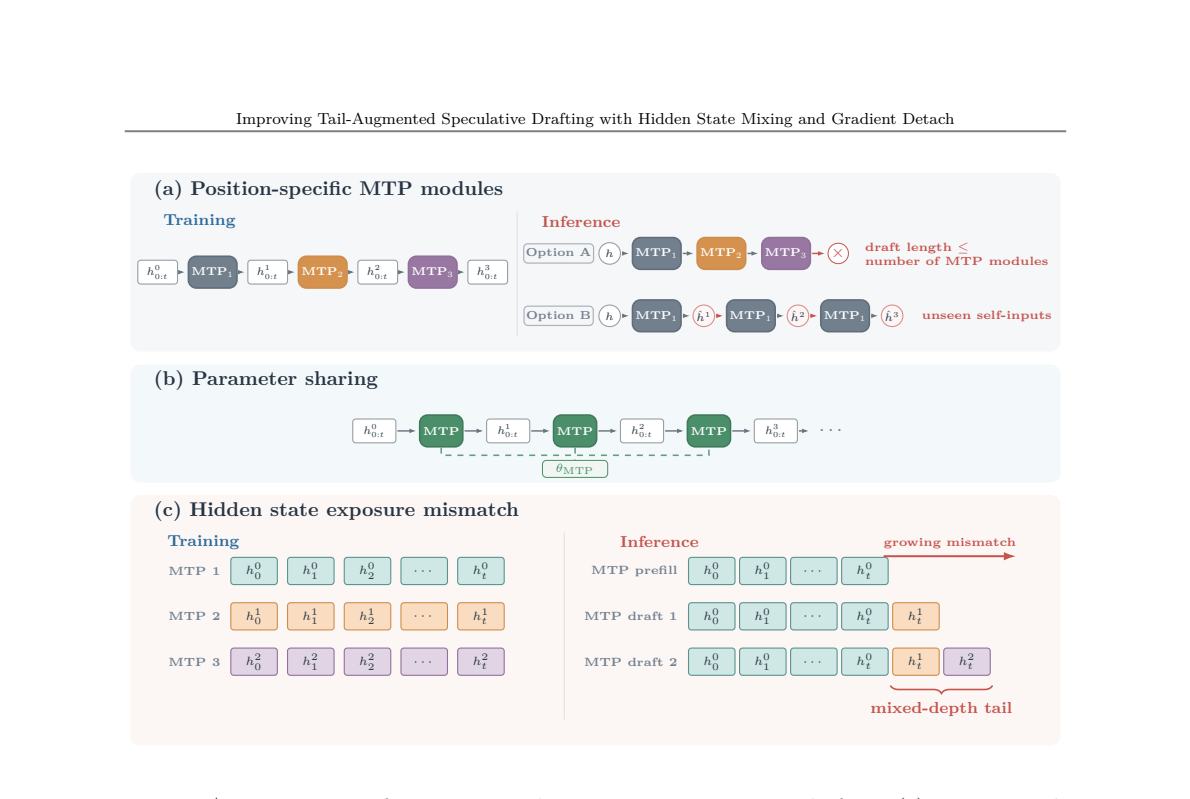
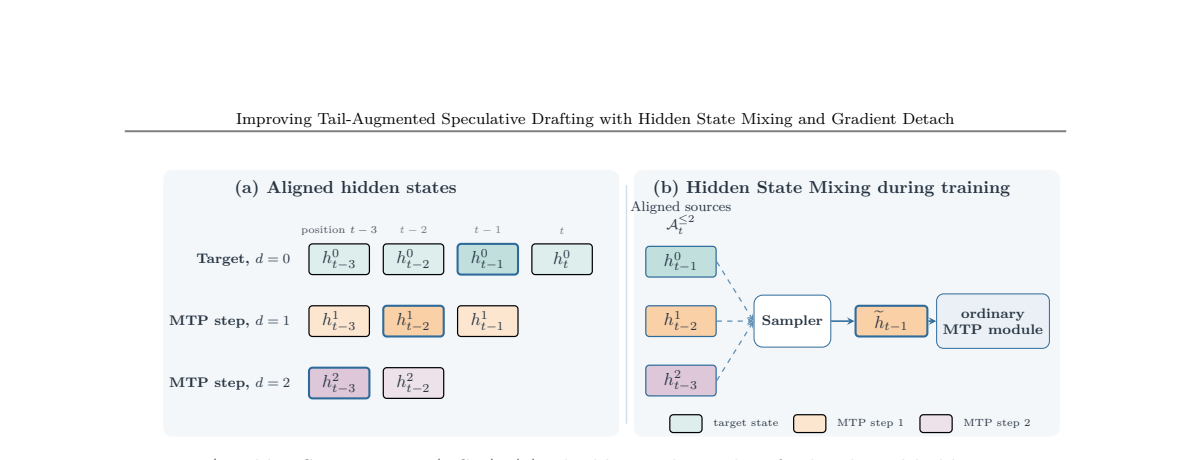
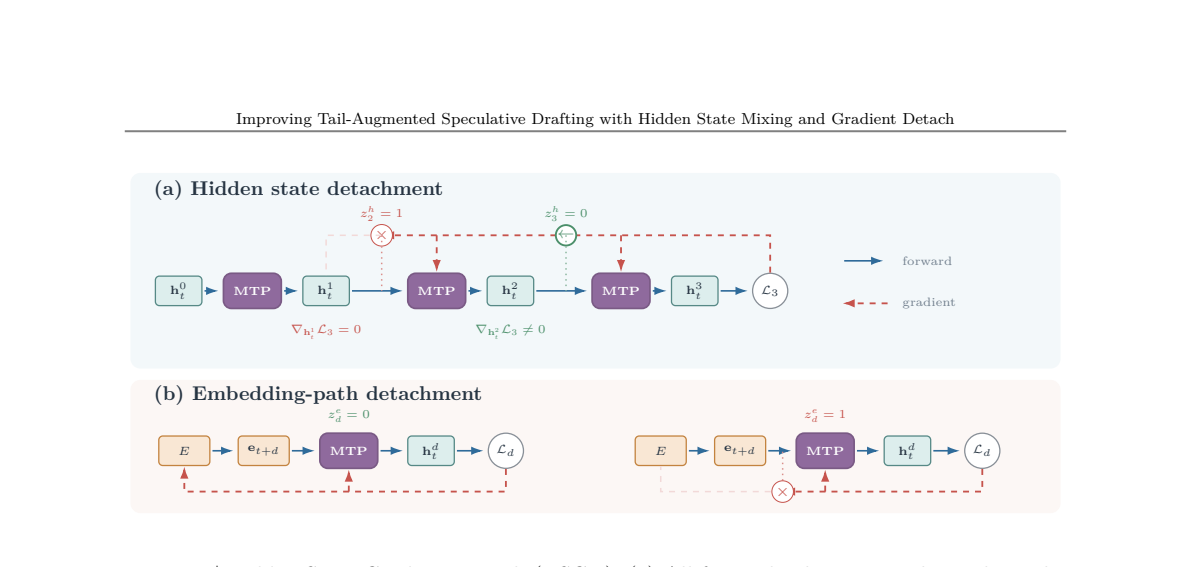
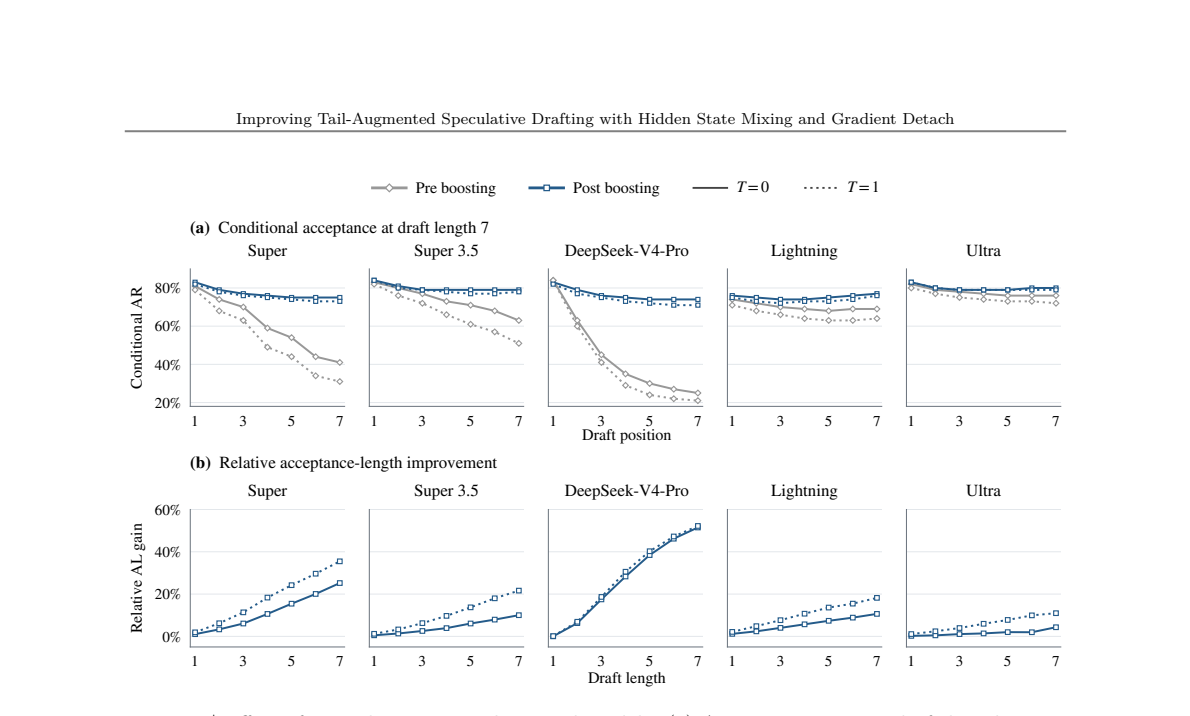
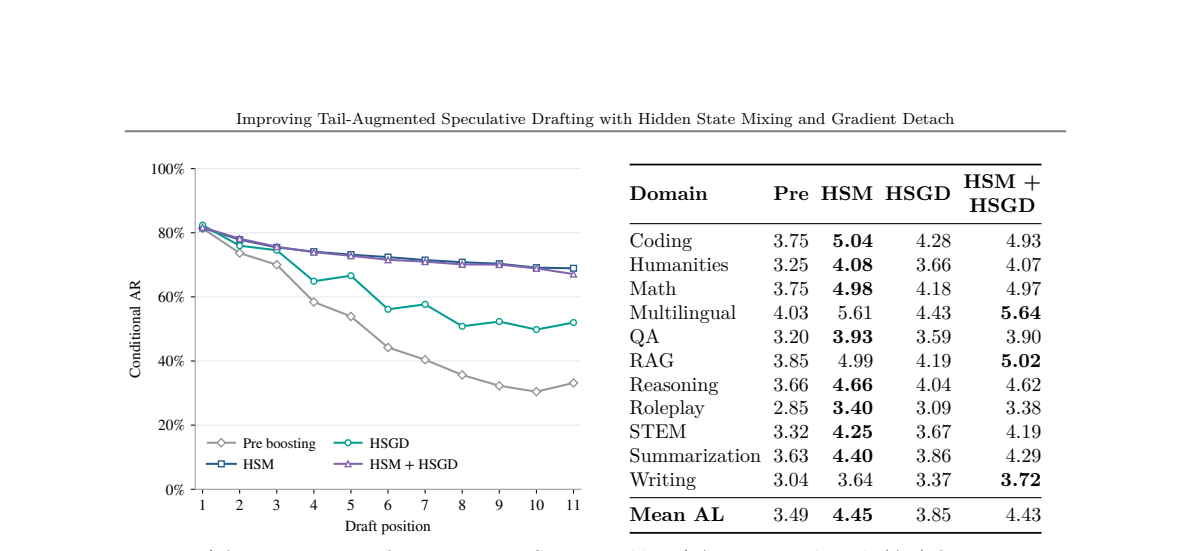
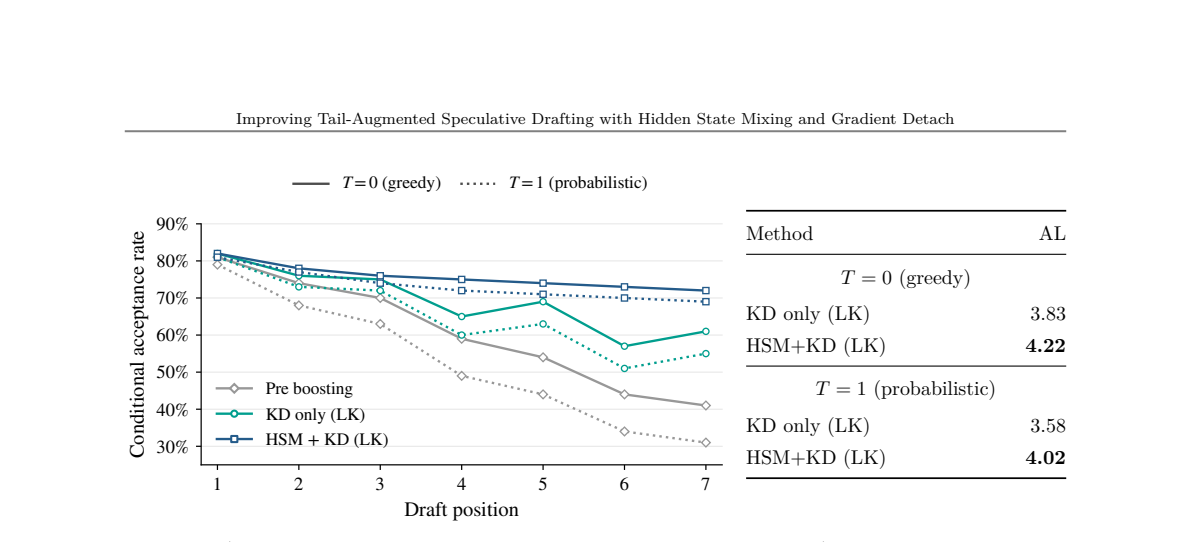
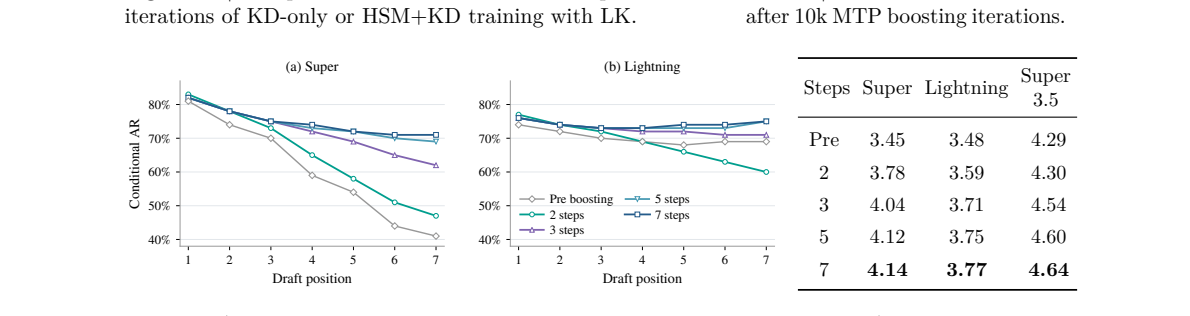
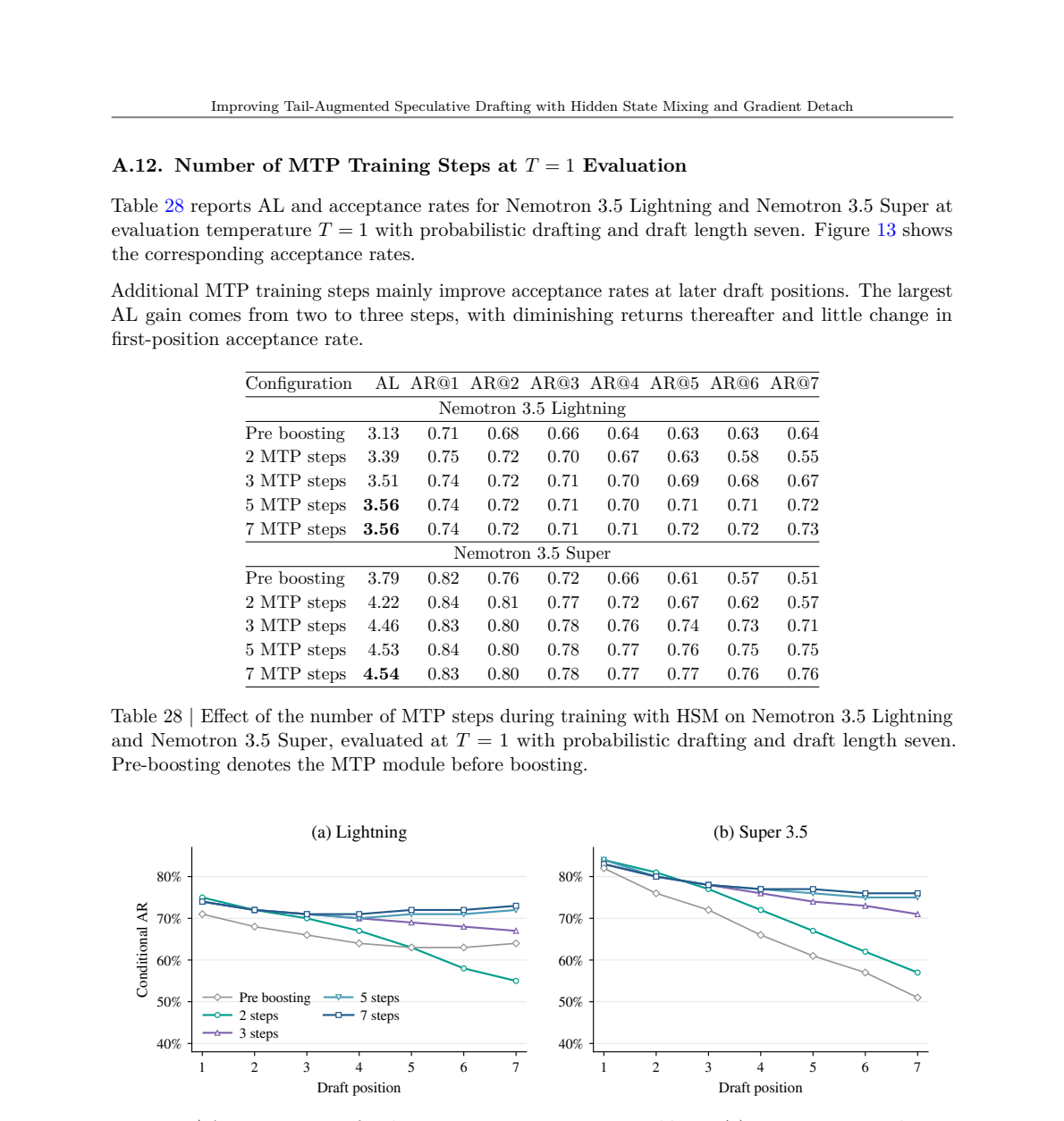
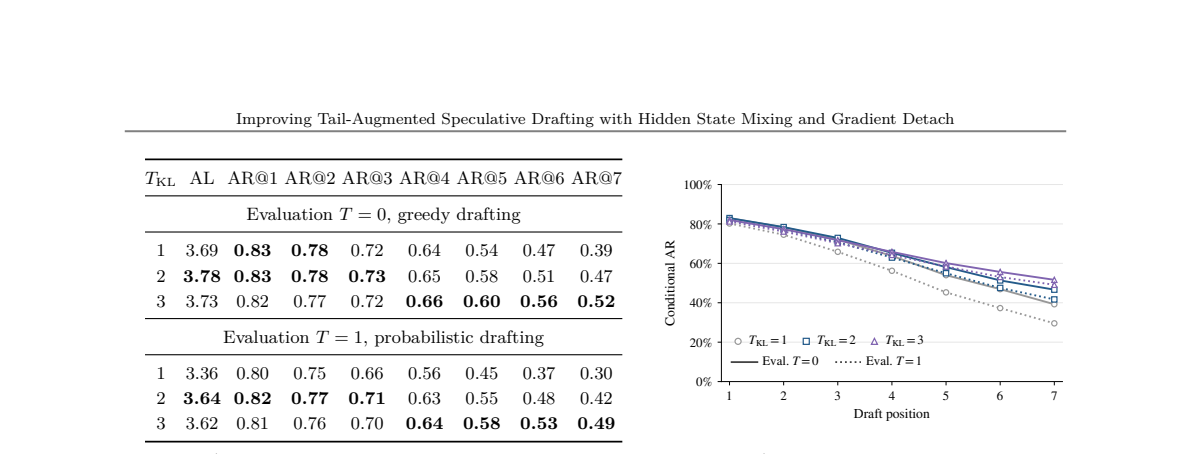
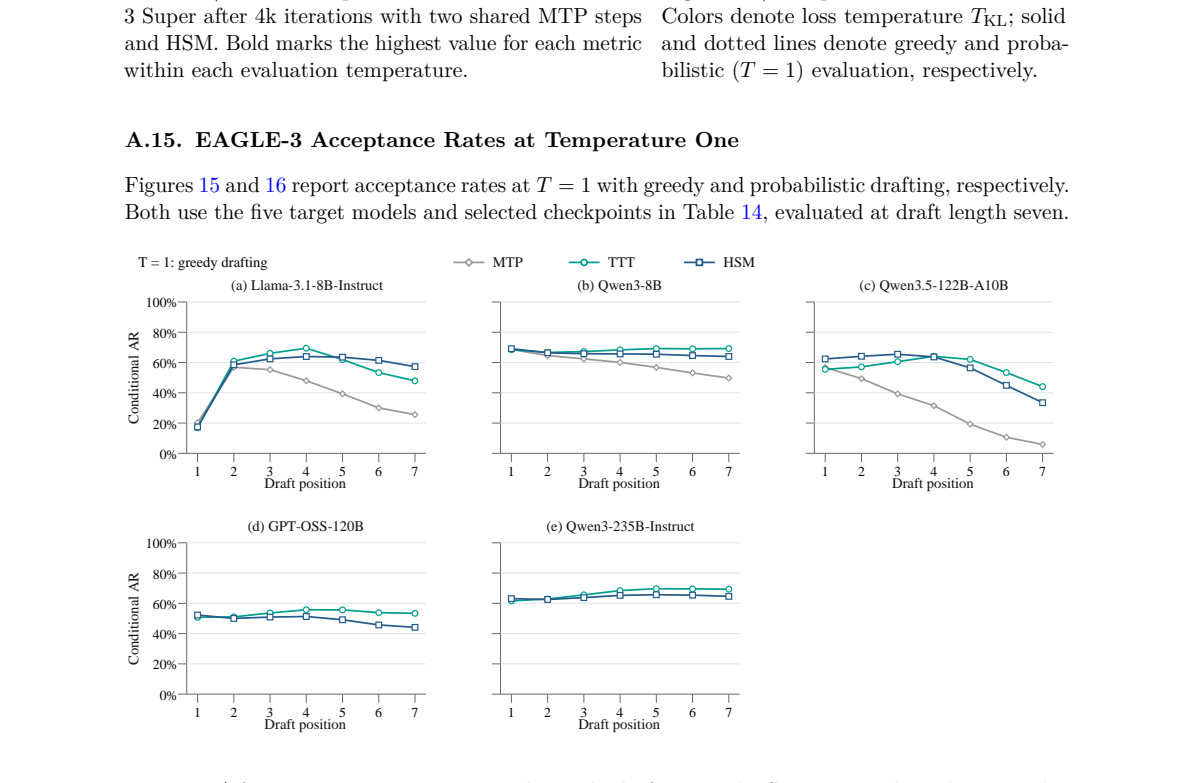
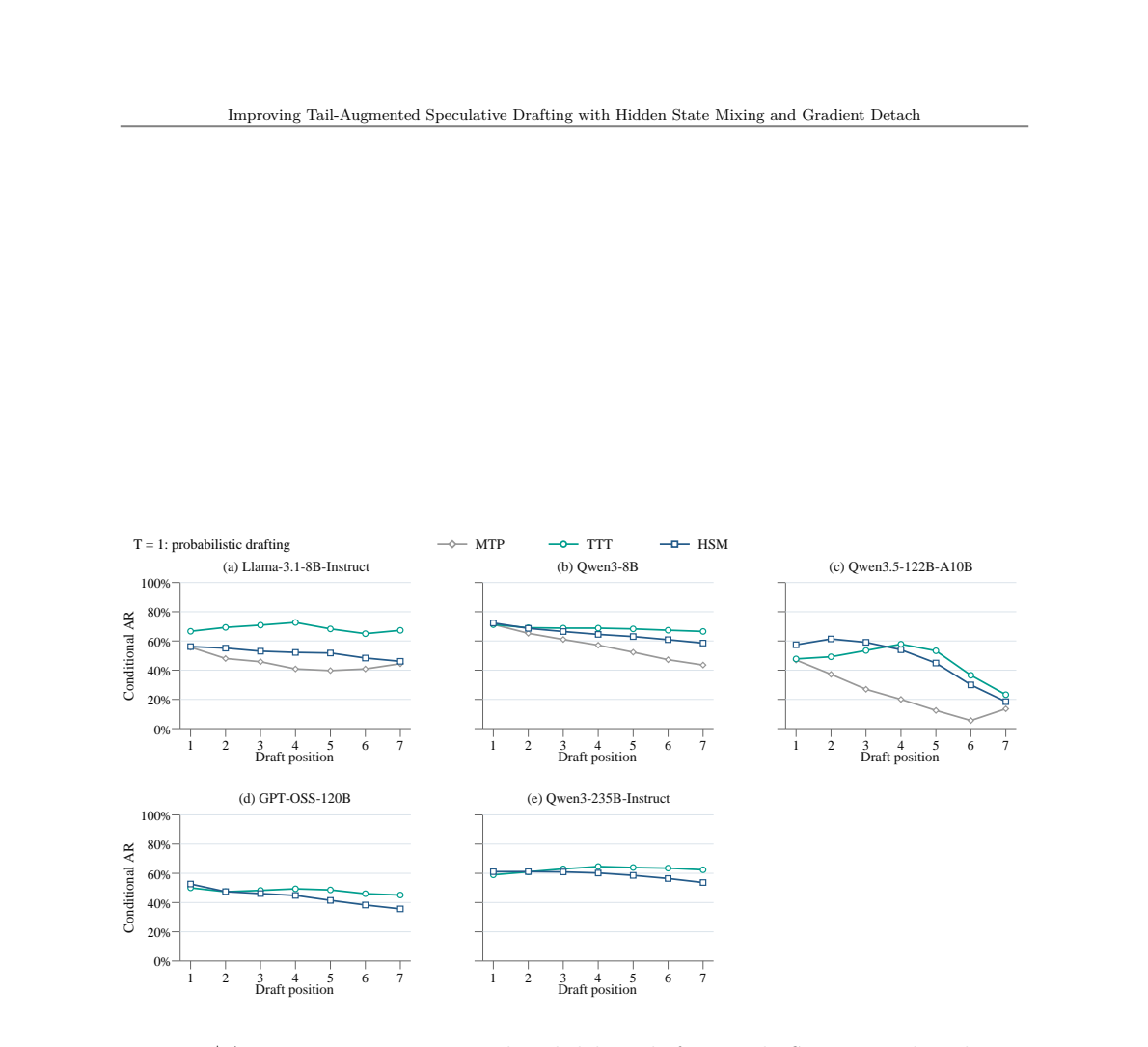
Their autoregressive use, however, introduces a training-inference mismatch: training supplies sequences of hidden states from the backbone or a single MTP step, whereas inference attends to a target-model prefix followed by a growing tail of recurrently generated MTP states. EAGLE-3's training-time test (TTT) explicitly simulates this behavior during training, at the cost of additional memory and specialized attention masks. We introduce two training-only methods for improving autoregressive drafting. Hidden State Mixing (HSM) samples among backbone and MTP hidden states aligned to the same prediction target, exposing the drafter to mixtures of states from different MTP steps without explicitly simulating inference. Hidden State Gradient Detach (HSGD) is a regularization method that stochastically blocks gradients through hidden state and embedding pathways while preserving the forward computation. Neither method adds inference cost. In joint pretraining followed by supervised fine-tuning, HSGD yields the highest acceptance rates at early draft positions, while HSM performs best later in the draft. These acceptance rate trends favor HSM for long-draft-length serving and HSGD for short-draft-length serving. Furthermore, across four Nemotron models and DeepSeek-V4-Pro, HSM-based MTP boosting with a frozen backbone improves mean acceptance length by up to 52.2% over the co-trained MTP. For EAGLE-3 drafters, HSM offers competitive acceptance with TTT, with 48% lower peak reserved training memory in a four-step Qwen3-8B comparison. HSM implementations are publicly available in Megatron-LM and NVIDIA Model Optimizer.
from the abstract
Pith says
Machine review · deepseek-v4-flash · 26 Nov 2026 · read the full text (151,003 characters) · not checked by a person
It can be wrong. Challenge this review or reply to it.
Holds up, with conditions. This paper introduces Hidden State Mixing and Hidden State Gradient Detach, two training-only methods that improve acceptance rates in autoregressive speculative decoding without adding inference cost. This line is wrong
4 minor · 1 open question
How often objections from reviews like this one are right: not yet measured
The paper, first character to last
The reviewer was given the whole text, 151,003 characters. Not checked: figures, code, what the 31 references say.
4 minor objections
The paper says, at 5.3
Pith says: minor objection 1 of 4
The paper uses the same evaluation benchmark (SPEED-Bench qualitative split) for both checkpoint selection and final reporting in the EAGLE-3 experiments. While this is flagged as a major concern, the authors should at least mention this limitation explicitly in the main text, not only in the appendix.
The paper says, at 4.2
Pith says: minor objection 2 of 4
Figure 1 caption refers to 'Nemotron 3 Super' but the paper also uses 'Nemotron 3.5 Super' and 'Nemotron 3.5 Lightning'. The naming convention is inconsistent: sometimes 'Super' alone, sometimes with version numbers. Please unify throughout.
show 2 more
The paper says, at 3.1
Pith says: minor objection 3 of 4
The paper defines 'acceptance length' (AL) as the expected number of tokens per verification step including the free bonus token. This definition should be stated earlier in the evaluation setup, not only in Section 3.1.
The paper says, at 5.3
Pith says: minor objection 4 of 4
Table 5 (EAGLE-3 comparison) is very wide and hard to read. Consider splitting by model or using a more compact layout.
Open questions (1)
Pith raised these and could not confirm them against the text of the paper it read. They are questions for the authors, not findings.
- 4.2 (Table 2) Can the authors provide confidence intervals or measures of variability for the reported acceptance length improvements to assess statistical reliability?
What would settle it
An independent evaluation on a held-out benchmark (e.g., a subset of SPEED-Bench not used for checkpoint selection, or a different benchmark such as MT-Bench) that fails to reproduce the reported acceptance length improvements would weaken the claim that HSM and HSGD generalize beyond the validation set used for both selection and reporting.
from Pith's summary of the paper
How the review went
5 passes by deepseek-v4-flash · 26 Nov 2026
- Reader holds up, with conditions
- Skeptic concern withdrawn: the paper already says this
- Referee 4 minor
- Check against the paper kept 0 of 4 objections
- Editor wrote the verdict above
Not run on this paper: the simulated authors' defence.
Pith's passes raised 4 objections. A check against the paper's text kept 0, withdrew 3 (3 the paper already says) and left 1 as a question.
The review in full
The review in brief, machine-written
The paper addresses a real problem: autoregressive MTP drafters see different hidden state contexts during training and inference, which hurts acceptance rates, especially at later draft positions. The authors propose two training-only fixes—Hidden State Mixing (HSM), which mixes aligned hidden states from different MTP steps during training, and Hidden State Gradient Detach (HSGD), which stochastically blocks gradient paths through the recurrent computation. Neither method adds inference cost, which is the right design constraint for production serving. The experiments are extensive: co-training from scratch, frozen-backbone boosting across four Nemotron models and DeepSeek-V4-Pro, and a comparison with EAGLE-3's TTT on five target models. The results are consistent and show meaningful gains—up to 52% improvement in mean acceptance length in the boosting setting. The paper also provides practical guidance on parameter sharing, number of MTP steps, and supervision timing during pretraining. The main soft spot is methodological: checkpoints are selected based on the highest mean acceptance length on the evaluation benchmark itself (SPEED-Bench qualitative split), which risks overestimating performance. No confidence intervals or statistical significance tests are reported, so the reader cannot assess variability. The code is available, but full reproducibility for the largest models requires proprietary data and compute. These concerns are real but not fatal; the central claim is supported with moderate confidence. This paper is for researchers working on speculative decoding and LLM inference acceleration. It deserves a serious referee; the methods are novel, the experiments are thorough, and the results are practically relevant. I would send it to review.
The stress test's concern
Withdrawn: the paper already says this.
The paper says
“Within each method, checkpoints are selected by the highest mean AL at $T=0$ on the evaluation benchmark itself.”
The referee's report
Not published. Pith's referee wrote this assessment before its objections were checked against the paper, and 3 of its 3 major objections did not survive that check.
Pith's reading of the paper (a machine's summary, not the authors')
The paper addresses a training-inference mismatch in autoregressive tail-augmented speculative drafters (MTP and EAGLE-style). During training, the drafter sees hidden states from a single depth; during inference, it must attend to a mixed-depth context combining target-model and recursively generated states. The authors introduce Hidden State Mixing (HSM), which mixes aligned hidden states from different MTP steps during training, and Hidden State Gradient Detach (HSGD), which stochastically blocks gradients through hidden state and embedding pathways. Both methods operate only during training and add no inference cost. Experiments show that HSGD improves early-position acceptance rates, while HSM improves the draft tail, leading to higher mean acceptance length. In frozen-backbone MTP boosting, HSM improves mean acceptance length by up to 52.2% across five models. For EAGLE-3 drafters, HSM achieves competitive acceptance with training-time test (TTT) while using 48% less peak training memory.
What carries the argument. Hidden State Mixing (HSM) samples among backbone and MTP hidden states aligned to the same prediction target, injecting structured noise by mixing states from different MTP steps during training. Hidden State Gradient Detach (HSGD) stochastically blocks gradients through hidden state and embedding pathways while preserving forward computation, acting as a backward-only regularizer. Both are training-only and add no inference cost.
Core claim. The paper introduces Hidden State Mixing (HSM) and Hidden State Gradient Detach (HSGD), two training-only methods that improve the acceptance rates of autoregressive tail-augmented drafters (MTP and EAGLE-style) without adding inference cost. HSM exposes the drafter to mixtures of aligned hidden states from different MTP steps during training, reducing the hidden-state exposure mismatch that arises when the drafter must attend to a mixed-depth context at inference. HSGD stochastically blocks gradients through hidden state and embedding pathways, regularizing cross-stage co-adaptation. The central discovery is that these methods improve different draft positions: HSGD yields highest acceptance rates at early positions, while HSM improves the draft tail, leading to higher mean acceptance length. In frozen-backbone MTP boosting, HSM improves mean acceptance length by up to 52.2% across five models, and for EAGLE-3 drafters HSM achieves competitive acceptance with training-time test (TTT) while using 48% less peak training memory.
The premise it rests on. The evaluation benchmark (SPEED-Bench qualitative split) is used both for checkpoint selection and final reporting, which can lead to overestimated performance; the paper does not validate on an independent held-out set or report cross-validation.
If the paper is right (Pith's inferences, not the authors')
HSM can be applied to boost existing MTP modules without retraining the backbone, improving acceptance rates across draft positions.
HSGD is most beneficial for short-draft serving regimes where early-position acceptance rates dominate end-to-end speedup.
HSM serves as a memory-efficient alternative to EAGLE-3's training-time test (TTT), enabling longer training unrolls with lower peak memory.
The methods can be combined with knowledge distillation and on-policy rollouts for further gains in frozen-backbone settings.
The choice between HSM and HSGD (or their combination) depends on the serving target: high-concurrency (short drafts) favors HSGD, low-concurrency (long drafts) favors HSM.
The reported gains may be overestimated because the SPEED-Bench qualitative split is used both for checkpoint selection and final reporting; an independent held-out evaluation would strengthen the claims.
The absence of confidence intervals or measures of variability for the acceptance length improvements makes it difficult to assess the statistical reliability of the reported gains.
HSM and HSGD could be applied to other autoregressive drafters beyond MTP and EAGLE, such as Medusa or parallel drafters with recurrent components, though this is not explored in the paper.
The complementary profiles of HSM and HSGD suggest a potential for adaptive draft length selection at inference time, where the serving system could switch between drafters trained with different methods based on current concurrency.
Check this review
What was read
The passes were given all 151,003 characters of the paper's LaTeX source.
Fingerprint of that text (SHA-256): a9537daf696c6e77b449d9ab46ce16e9996bd78c9f0f96860fa51e3c18fcf12e
Pith does not keep that text. Rebuilt from the paper's source or PDF by the same code, it has this fingerprint if it is the same text. From a copy of Pith's code:
PYTHONPATH=. python scripts/review_input_check.py 2611.34092
The passes, in the order they ran
- Reader deepseek-v4-flash · medium effort · $0.0047 · instructions of the Reader, fingerprint f9ead7300382…
- Skeptic deepseek-v4-flash · medium effort · $0.0043 · instructions of the Skeptic, fingerprint 8f88c0f61488…
- Referee deepseek-v4-flash · medium effort · $0.0043 · instructions of the Referee, fingerprint a852d99aea0d…
- Check against the paper deepseek-v4-flash · medium effort · $0.0048 · instructions of the Check against the paper, fingerprint 6c7a6883d551…
- Editor deepseek-v4-flash · medium effort · $0.0042 · instructions of the Editor, fingerprint e7211f6a3d27…
- Circularity check deepseek-v4-flash · medium effort · $0.0041 · instructions of the Circularity check, fingerprint e9946e39d67b…
- Summary for the page deepseek-v4-flash · medium effort · temperature 0.2 · $0.0045 · instructions of the Summary for the page, fingerprint e4f56bf568e7…
The passes cost $0.031 in model calls together.
Version stamped on this review: pith-pipeline@v1.4.1-daily-deepseek-or-medium+deepseek/deepseek-v4-flash+p.d60f54226f00
Each link opens a pass's instructions as plain text, the exact bytes its fingerprint was taken over. Every stored set of instructions.
curl -s https://pith.science/methodology/prompts/f9ead730038216984cfb56d7cb34332bdf691828296a1de4245f3d6667d4bf56 | sha256sum
prints the fingerprint of the reader's instructions. The same works for every pass.
The receipt
The review's fingerprint was taken on 26 Nov 2026. The review you are reading still matches it.
Fingerprint of the review (SHA-256): 9af2b90743ae5de6f122d13467cf4e17fc85b31ccc3f453c7d9f95478ff34d6f
curl -s 'https://pith.science/api/v1/verdicts/2611.34092?form=canonical' | sha256sum
prints the fingerprint of the review as it stands now. The rule, in four steps.
A matching fingerprint shows the review has not changed since that date. It does not show that the review is right.
How often reviews like this one are right
Reviews like this one: written by deepseek-v4-flash, from the paper's LaTeX source.
How often objections from reviews like this one are right: not yet measured
Reviews by people
This review was written by a machine. No person has reviewed this paper on Pith yet. A scientist listed on Pith can review it for a fee, and their review is published here whatever it concludes.
The paper
Abstract
Multi-token prediction (MTP) modules and EAGLE-style drafters support efficient speculative decoding by reusing target-model hidden states. Their autoregressive use, however, introduces a training-inference mismatch: training supplies sequences of hidden states from the backbone or a single MTP step, whereas inference attends to a target-model prefix followed by a growing tail of recurrently generated MTP states. EAGLE-3's training-time test (TTT) explicitly simulates this behavior during training, at the cost of additional memory and specialized attention masks. We introduce two training-only methods for improving autoregressive drafting. Hidden State Mixing (HSM) samples among backbone and MTP hidden states aligned to the same prediction target, exposing the drafter to mixtures of states from different MTP steps without explicitly simulating inference. Hidden State Gradient Detach (HSGD) is a regularization method that stochastically blocks gradients through hidden state and embedding pathways while preserving the forward computation. Neither method adds inference cost. In joint pretraining followed by supervised fine-tuning, HSGD yields the highest acceptance rates at early draft positions, while HSM performs best later in the draft. These acceptance rate trends favor HSM for long-draft-length serving and HSGD for short-draft-length serving. Furthermore, across four Nemotron models and DeepSeek-V4-Pro, HSM-based MTP boosting with a frozen backbone improves mean acceptance length by up to 52.2% over the co-trained MTP. For EAGLE-3 drafters, HSM offers competitive acceptance with TTT, with 48% lower peak reserved training memory in a four-step Qwen3-8B comparison. HSM implementations are publicly available in Megatron-LM and NVIDIA Model Optimizer.
The paper's own sentences, arranged, kept beside the review and separate from it. Each label is drawn from a closed vocabulary; the number beside it is the probability the classifier gave that label. No sentence in this record was written by a model.
abstract compiled · 2026-11-26
The authors' main claim, as the classifier picked it out 0.66
“Furthermore, across four Nemotron models and DeepSeek-V4-Pro, HSM-based MTP boosting with a frozen backbone improves mean acceptance length by up to 52.2% over the co-trained MTP.”
How the main claim is stated: asserted 1.00
What the abstract itself states, as probabilities: claims first 0.05 · states limitation 0.42 · human participants 0.02 · controlled comparison 0.94 · randomized assignment 0.02 · states quantitative result 0.99 · compares with prior results 0.98 · mentions code or data availability 0.91
The abstract, sentence by sentence
This table labels the abstract only (arXiv listing abstract v1). The number is the probability the classifier gave the label.
| Sentence | Role | The authors' own work | States the main conclusion | Strength |
|---|---|---|---|---|
| Multi-token prediction (MTP) modules and EAGLE-style drafters support efficient speculative decoding by reusing target-model hidden states. | background 1.00 | 0.05 | 0.03 | asserted 1.00 |
| Their autoregressive use, however, introduces a training-inference mismatch: training supplies sequences of hidden states from the backbone or a single MTP step, whereas inference attends to a target-model prefix followed by a growing tail of recurrently generated MTP states. | background 0.91 | 0.10 | 0.03 | asserted 1.00 |
| EAGLE-3's training-time test (TTT) explicitly simulates this behavior during training, at the cost of additional memory and specialized attention masks. | background 0.99 | 0.06 | 0.03 | asserted 1.00 |
| We introduce two training-only methods for improving autoregressive drafting. | contribution 1.00 | 0.85 | 0.05 | asserted 0.98 |
| Hidden State Mixing (HSM) samples among backbone and MTP hidden states aligned to the same prediction target, exposing the drafter to mixtures of states from different MTP steps without explicitly simulating inference. | method 0.85 | 0.90 | 0.08 | asserted 1.00 |
| Hidden State Gradient Detach (HSGD) is a regularization method that stochastically blocks gradients through hidden state and embedding pathways while preserving the forward computation. | method 0.90 | 0.82 | 0.03 | asserted 1.00 |
| Neither method adds inference cost. | contribution 0.57 | 0.77 | 0.08 | asserted 1.00 |
| In joint pretraining followed by supervised fine-tuning, HSGD yields the highest acceptance rates at early draft positions, while HSM performs best later in the draft. | result 1.00 | 0.93 | 0.22 | asserted 1.00 |
| These acceptance rate trends favor HSM for long-draft-length serving and HSGD for short-draft-length serving. | interpretation 0.99 | 0.89 | 0.25 | asserted 0.90 |
| Furthermore, across four Nemotron models and DeepSeek-V4-Pro, HSM-based MTP boosting with a frozen backbone improves mean acceptance length by up to 52.2% over the co-trained MTP. | result 1.00 | 0.93 | 0.28 | asserted 1.00 |
| For EAGLE-3 drafters, HSM offers competitive acceptance with TTT, with 48% lower peak reserved training memory in a four-step Qwen3-8B comparison. | result 1.00 | 0.92 | 0.12 | asserted 1.00 |
| HSM implementations are publicly available in Megatron-LM and NVIDIA Model Optimizer. | contribution 0.68 | 0.38 | 0.03 | asserted 1.00 |
What kind of paper the classifier reports this is: method or tool 1.00 · evidence from observation or experiment 0.95
What was examined, and what was not
Sources read
- arXiv listing abstract v1
Not examined
- full text
- figures and tables
- references and citing sentences
- relations to other papers
Levels run
- P abstract
Not run
- S sections
- T body sentences
- C citations
- R cross-paper relations
How the labels were made
Compiled by classifier-1.13.0 via TypeSafe API, question bank abstract-p1-20260923, 2026-11-26: 1 request, 8,977 input tokens.
Every quoted sentence on this record is the authors'. Every label is from Pith's closed vocabulary, with the probability shown beside it. This record as JSON
Figures (16)
Showing 15 of the paper's 16 figures. Figures are the authors', reproduced from the paper.
References (31)
- [1] Training sequences are capped at 8K tokens, and the loss is accumulated only over assistant-response tokens. 33 Improving Tail-Augmented Speculative Drafting with Hidden State Mixing and Gradient Detach For the released Nemotron 3 Super MTPv2 we used seed from only V2. Puzzle ... on Pith
- [4] URLhttps://arxiv.org/abs/2107.03374. Xin Cheng, Xingkai Yu, Chenze Shao, Jiashi Li, Yunfan Xiong, Yi Qian, Jiaqi Zhu, Shirong Ma, Xiaokang Zhang, Jiasheng Ye, et al. Dspark: Confidence-scheduled speculative decoding with semi-autoregressive generation.arXiv preprint arXiv:2607.05147, on PithPith's reviewarXiv
- [6] URLhttps://arxiv.org/abs/ 2110.14168. DeepSeek-AI. DeepSeek-V3 Technical Report, on PithPith's reviewarXiv
- [7] URLhttps://arxiv.org/abs/2412.19437. DeepSeek-AI. DeepSeek-V4: Towards Highly Efficient Million-Token Context Intelligence, on PithPith's reviewarXiv
- [8] URLhttps://arxiv.org/abs/2606.19348. Gemma Team. Gemma 4 technical report, on PitharXiv
- [9] URLhttps://arxiv.org/abs/2607.02770. GLM-5 Team. GLM-5: from vibe coding to agentic engineering, on PithPith's reviewarXiv
- [10] URLhttps://arxiv.org/ abs/2602.15763. Fabian Gloeckle, Badr Youbi Idrissi, Baptiste Roziere, David Lopez-Paz, and Gabriel Synnaeve. Better & Faster Large Language Models via Multi-token Prediction. InInternational Conference on Machine Learning, pp. 15706–15734. PMLR, on PithPith's reviewarXiv
- [11] Domain Shared MTP HSM HSGD HSM +HSGD Coding 5.50 5.63 5.305.69 Humanities 5.616.775.75 6.56 Math 5.776.315.46 6.15 Multilingual 5.735.835.28 5.58 QA 4.544.834.62 4.64 RAG 5.095.515.38 5.35 Reasoning 5.48 5.695.705.59 Roleplay 4.53 4.925.244.95 STEM 5.55 6.07 5.606.16 Summariza... on Pith
- [12] Dan Hendrycks, Collin Burns, Steven Basart, Andy Zou, Mantas Mazeika, Dawn Song, and Jacob Steinhardt. Measuring massive multitask language understanding. InInternational Conference on Learning Representations, 2021a. URLhttps://arxiv.org/abs/2009.03300. Dan Hendrycks, Collin ... on PithPith's reviewarXiv
- [16] 52202/085713-4562. URL https://proceedings.neurips.cc/paper_files/paper/2025/hash/ c7b5a35ea98b62512a869c19ea7b03cb-Abstract-Conference.html. Hunter Lightman, Vineet Kosaraju, Yura Burda, Harri Edwards, Bowen Baker, Teddy Lee, Jan Leike, John Schulman, Ilya Sutskever, and Karl... on Pith
- [17] URL https://arxiv.org/abs/2305.20050. Xupeng Miao, Gabriele Oliaro, Zhihao Zhang, Xinhao Cheng, Zeyu Wang, Zhengxin Zhang, Rae Ying Yee Wong, Alan Zhu, Lijie Yang, Xiaoxiang Shi, Chunan Shi, Zhuoming Chen, Daiyaan Arfeen, Reyna Abhyankar, and Zhihao Jia. Specinfer: Acceleratin... on PithPith's reviewarXiv
- [18] Association for Computing Machinery. ISBN 9798400703867. doi: 10.1145/3620666.3651335. URLhttps://doi.org/10.1145/3620666. 3651335. 29 Improving Tail-Augmented Speculative Drafting with Hidden State Mixing and Gradient Detach Dhruv Nathawani, Shuoyang Ding, Vitaly Lavrukhin, I... on Pithdoi:10.1145/3620666.3651335
- [19] URLhttps://arxiv.org/abs/2512.20848. NVIDIA. Nemotron 3.5 Super and Lightning: Open, Efficient Mixture-of-Experts Hy- brid Mamba-Transformer Models for Agentic AI. Technical report, NVIDIA, Octo- ber on PitharXiv
- [20] URLhttps://arxiv.org/abs/2604.12374. NVIDIA. Nemotron 3 Ultra: Open, efficient mixture-of-experts hybrid mamba-transformer model for agentic reasoning. Technical report, NVIDIA, on PithPith's reviewarXiv
- [21] URLhttps://arxiv.org/abs/2508.10925. Qwen Team. Qwen3-Next: Towards ultimate training & inference efficiency. Qwen blog, 2025a. URL https://qwen.ai/blog?id=qwen3-next. Qwen Team. Qwen3 Technical Report, 2025b. URLhttps://arxiv.org/abs/2505.09388. Qwen Team. Qwen3.5: Towards na... on PithPith's reviewarXiv
- [22] URLhttps://qwen.ai/ blog?id=qwen3.5. Matan Rusanovsky, Yoav Miron, Roy Uziel, Omer Belhasin, Hao Guo, Ran Zilberstein, Maor Ashkenazi, and Michael Elad. LiLiCorr: Lightweight likelihood correlation of parallel drafts for speculative decoding.arXiv preprint arXiv:2608.20530, on PithPith's reviewarXiv
- [25] URLhttps://arxiv.org/abs/2412.03304. Yubo Wang, Xueguang Ma, Ge Zhang, Yuansheng Ni, Abhranil Chandra, et al. MMLU-Pro: A more robust and challenging multi-task language understanding benchmark, on PithPith's reviewarXiv
- [26] URL https://arxiv.org/abs/2406.01574. 30 Improving Tail-Augmented Speculative Drafting with Hidden State Mixing and Gradient Detach A. Additional Results and Experimental Details A.1. Pretraining Model Architecture Table 15 outlines the Nano-style backbone used for the paramet... on PithPith's reviewarXiv
- [27] and HumanEval Chen et al. (2021), while mathematical reasoning is measured using MATH-500 (Hendrycks et al., 2021b; Lightman et al., on Pith
- [28] and GSM8K (Cobbe et al., 2021). We evaluate reading comprehension and commonsense reasoning using RACE (Lai et al., 2017), ARC-Challenge (Clark et al., 2018), and WinoGrande (Sakaguchi et al., 2020). Finally, multilingual performance is evaluated using MGSM (Shi et al., on Pith
show 11 more
- [90] Table 29 summarizes the iteration-time increase relative to a two MTP step configuration. Backbone MTP steps Iteration-time increase Frozen 2 0.0% 3 7.8% 5 22.6% 7 45.2% Table 29| Relative increase in mean training iteration time on Nemotron 3 Super, measured against a two MTP... on Pith
- [2015] Guokun Lai, Qizhe Xie, Hanxiao Liu, Yiming Yang, and Eduard Hovy. RACE: Large-scale ReAding comprehension dataset from examinations. InProceedings of the 2017 Conference on Empirical Methods in Natural Language Processing, on Pith
- [2017] URLhttps://arxiv.org/abs/1704.04683. Yaniv Leviathan, Matan Kalman, and Yossi Matias. Fast inference from transformers via speculative decoding. InInternational conference on machine learning, pp. 19274–19286. PMLR, on PithPith's reviewarXiv
- [2018] URLhttps://arxiv.org/abs/1803.05457. Karl Cobbe, Vineet Kosaraju, Mohammad Bavarian, Mark Chen, Heewoo Jun, Lukasz Kaiser, Matthias Plappert, Jerry Tworek, Jacob Hilton, Reiichiro Nakano, Christopher Hesse, and John Schulman. Training verifiers to solve math word problems, on PithPith's reviewarXiv
- [2020] URLhttps://arxiv.org/abs/1907.10641. Alexander Samarin, Sergei Krutikov, Anton Shevtsov, Sergei Skvortsov, Filipp Fisin, and Alexander Golubev. LK losses: Direct acceptance rate optimization for speculative decoding.arXiv preprint arXiv:2602.23881, on PithPith's reviewarXiv
- [2021] URLhttps://arxiv.org/abs/2108.07732. Akhiad Bercovich, Talor Abramovich, Daniel Afrimi, et al. Nemotron-Labs-3-Puzzle-75B-A9B: Compressing hybrid MoE LLMs, on PithPith's reviewarXiv
- [2022] URLhttps://arxiv.org/abs/2210.03057. Shivalika Singh, Angelika Romanou, Clémentine Fourrier, David I. Adelani, Jian Gang Ngui, et al. Global MMLU: Understanding and addressing cultural and linguistic biases in multilingual evaluation, on PithPith's reviewarXiv
- [2023] Yuhui Li, Fangyun Wei, Chao Zhang, and Hongyang Zhang. EAGLE: Speculative sampling requires rethinking feature uncertainty. In Ruslan Salakhutdinov, Zico Kolter, Katherine Heller, Adrian Weller, Nuria Oliver, Jonathan Scarlett, and Felix Berkenkamp (eds.),Proceedings of the 41... on Pith
- [2024] 28 Improving Tail-Augmented Speculative Drafting with Hidden State Mixing and Gradient Detach Aaron Grattafiori, Abhimanyu Dubey, Abhinav Jauhri, Abhinav Pandey, Abhishek Kadian, Ahmad Al-Dahle, Aiesha Letman, Akhil Mathur, Alan Schelten, Alex Vaughan, et al. The llama 3 herd ... on PithPith's reviewarXiv
- [2025] URLhttps://arxiv.org/abs/2509.18362. Jian Chen, Yesheng Liang, and Zhijian Liu. DFlash: Block diffusion for flash speculative decoding. arXiv preprint arXiv:2602.06036, on PitharXiv
- [2026] URLhttps://arxiv.org/abs/2607.04371. Tianle Cai, Yuhong Li, Zhengyang Geng, Hongwu Peng, Jason D. Lee, Deming Chen, and Tri Dao. Medusa: Simple LLM inference acceleration framework with multiple decoding heads. In Ruslan Salakhutdinov, Zico Kolter, Katherine Heller, Adrian Wel... on PithPith's reviewarXiv
Challenges and discussion
Disagree with the review, or know something it missed? Leave a comment, or challenge this review formally: a challenge becomes a permanent entry in this paper's record, and its decision is published here.
Come back by email
A short list of the week's newly reviewed papers. Nothing is sent until you confirm from your inbox, and every email has a link that stops it. No account.
No comments yet.
Sign in to comment