Computation and Language · arXiv:2611.20771 v1 · submitted 16 Nov 2026 · 37 references
Nemotron 3.5 Bolt E4B 4GB: An Open and Efficient Small Language Model for Fast Conversational Agents
The paper says
“We introduce Nemotron 3.5 Bolt E4B 4GB, an open and efficient small language model further post-trained from Gemma-4-E4B-it and optimized for speed and intelligence per GB of memory used for fast conversational agents.”
more of the abstract
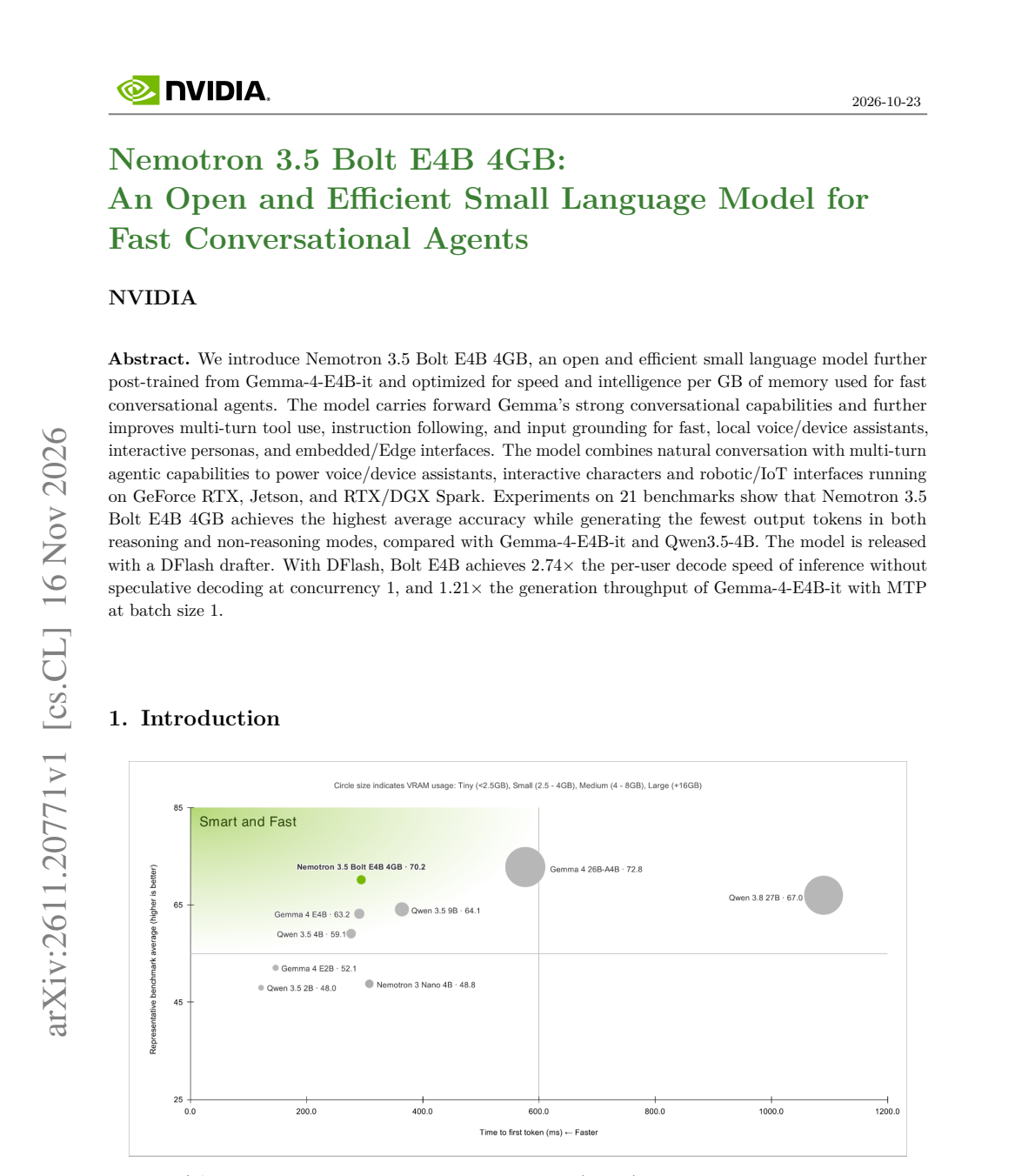
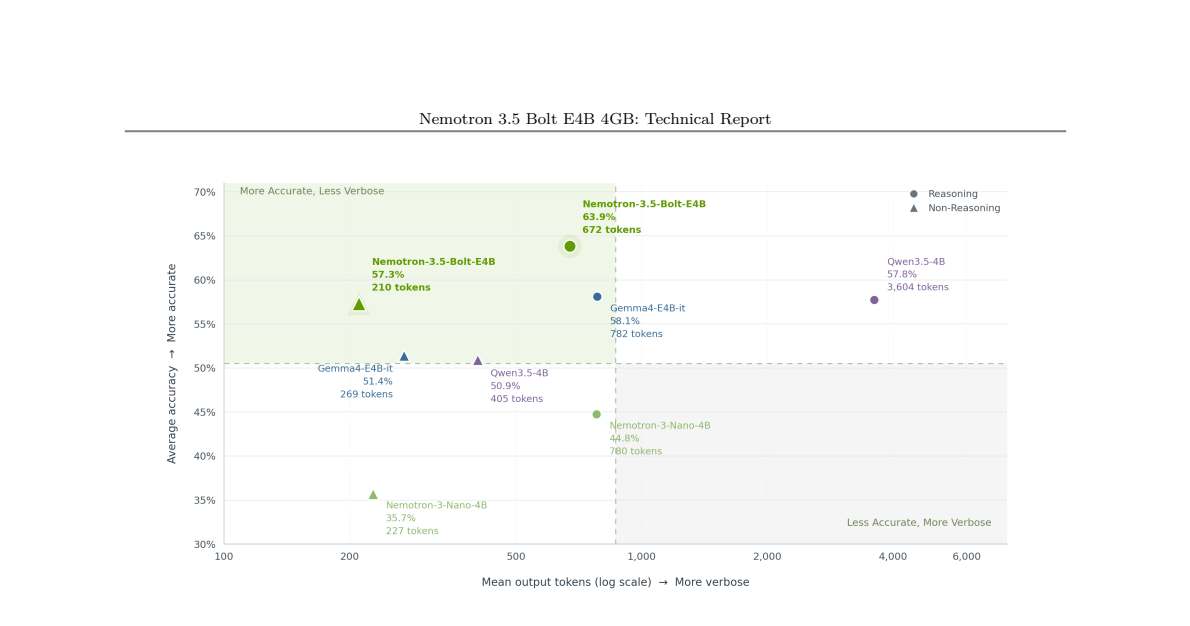
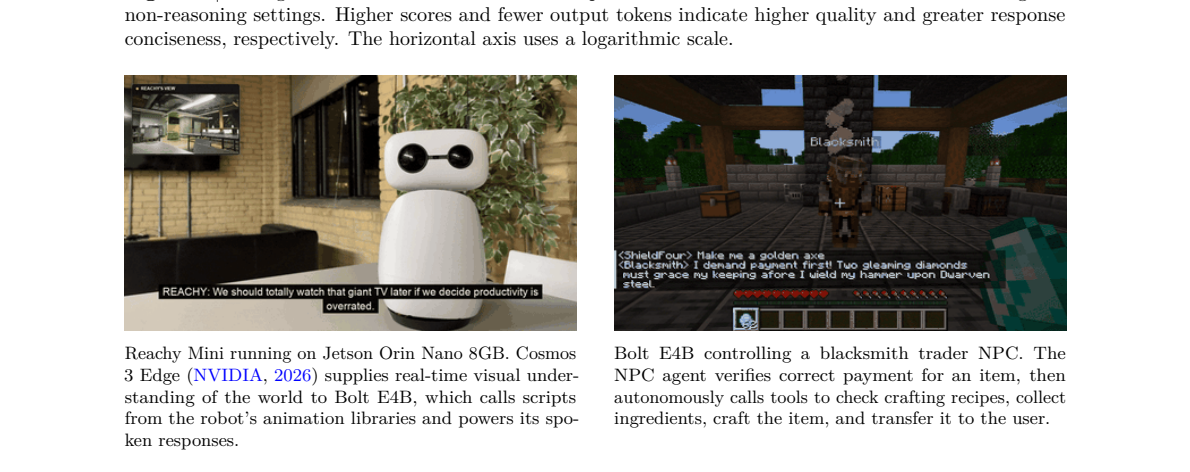
The model carries forward Gemma's strong conversational capabilities and further improves multi-turn tool use, instruction following, and input grounding for fast, local voice/device assistants, interactive personas, and embedded/Edge interfaces. The model combines natural conversation with multi-turn agentic capabilities to power voice/device assistants, interactive characters and robotic/IoT interfaces running on GeForce RTX, Jetson, and RTX/DGX Spark. Experiments on 21 benchmarks show that Nemotron 3.5 Bolt E4B 4GB achieves the highest average accuracy while generating the fewest output tokens in both reasoning and non-reasoning modes, compared with Gemma-4-E4B-it and Qwen3.5-4B. The model is released with a DFlash drafter. With DFlash, Bolt E4B achieves 2.74 × the per-user decode speed of inference without speculative decoding at concurrency 1, and 1.21 × the generation throughput of Gemma-4-E4B-it with MTP at batch size 1.
from the abstract
Pith says
Machine review · deepseek-v4-flash · 17 Nov 2026 · read the full text (75,976 characters) · not checked by a person
It can be wrong. Challenge this review or reply to it.
Holds up. A solid, well-documented small model release that delivers on its claims of improved accuracy and speed for conversational agents, though the gains are incremental and the evaluation relies heavily on LLM judges. This line is wrong
10 minor · 3 open questions
How often objections from reviews like this one are right: not yet measured
The paper, first character to last
The reviewer was given the whole text, 75,976 characters. Not checked: figures, code, what the 37 references say.
10 minor objections
The paper says, at §1 (Introduction), Figure 1
Pith says: minor objection 1 of 10
Figure 1 shows average benchmark score vs. TTFT, but the caption mentions it uses a subset of 6 benchmarks. The selection criteria for these 6 benchmarks is not explained. Clarify why these specific benchmarks were chosen for this figure.
The paper says, at §3 (Post-Training), Table 1
Pith says: minor objection 2 of 10
Table 1 lists environments and source datasets. The 'GenRM' environment is described as an 'Updated version of Nemotron-RLHF-GenRM-v1'. It would be helpful to specify what was updated compared to the original version.
show 8 more
The paper says, at §4.1 (Benchmarks and Evaluation Setup)
Pith says: minor objection 3 of 10
The description of the Brevity Benchmark states that it 'will be publicly released in the future.' Similarly for When2Call-MT. Consider adding a note about the expected release timeline or conditions.
The paper says, at §4.1 (Benchmarks and Evaluation Setup), Table 1
Pith says: minor objection 4 of 10
Table 1 uses 'Reasoning Mode' column with values 'On' or 'Off'. For RoleBench Custom, the reasoning mode is 'Off', but the model is evaluated in non-reasoning mode. However, the abstract claims the model achieves highest accuracy in both reasoning and non-reasoning modes. It would be clearer to also present results for RoleBench in reasoning mode if applicable.
The paper says, at §6 (Multilingual Evaluations), Table 5 and Table 6
Pith says: minor objection 5 of 10
The multilingual evaluation shows that the model retains translation quality but degrades on MMLU-ProX. The paper attributes this to English-only post-training. It would be informative to discuss whether this degradation is expected and whether any mitigation strategies were considered beyond noting it as a limitation.
The paper says, at §7 (Multimodal Evaluations), Table 7
Pith says: minor objection 6 of 10
The vision evaluation shows degradation on OmniDocBench, MMMU-Pro Vision, MathVision, and MedXpertQA Vision. The paper attributes this to misalignment from text-only training. However, the audio evaluation shows improvements. The asymmetry is interesting but not discussed. A brief explanation of why audio improves while vision degrades would be helpful.
The paper says, at §8 (Speculative Decoding), Table 8
Pith says: minor objection 7 of 10
Table 8 reports acceptance length (AL) for the drafter. The AL values (around 3-4) are relatively modest compared to some speculative decoding results in the literature. The paper could provide context on how these AL values compare to typical values for models of this size.
The paper says, at §9.1 (NVIDIA NIM), Table 9
Pith says: minor objection 8 of 10
Table 9 reports speedups from DFlash. The speedup at concurrency 1 is 2.74x on RTX PRO 6000, but drops to 2.71x at concurrency 8. On DGX Spark, the speedup drops from 3.56x to 2.85x. The paper could discuss why the speedup decreases with higher concurrency.
The paper says, at §9.2 (Quantized Local Inference), Table 10
Pith says: minor objection 9 of 10
Table 10 compares Bolt + DFlash vs. Gemma + MTP. The throughput advantage on RTX Spark N1X is only 1.05x, which is marginal. The paper should note that the advantage varies significantly across hardware.
The paper says, at §2 (Chat Template Design)
Pith says: minor objection 10 of 10
The description of conversational_mode is clear, but it would be helpful to provide an example of the system instruction that is added when the flag is true. This would help readers understand the exact nature of the conciseness prompt.
Open questions (3)
Pith raised these and could not confirm them against the text of the paper it read. They are questions for the authors, not findings.
- §4 (Post-Trained Model Evaluations), Table 1 and Table 2 Pith raised a concern here that it could not check against the text of the paper it was given, so it is not published as an objection.
- §4.2 (Results), Table 2 Pith raised a concern here that it could not check against the text of the paper it was given, so it is not published as an objection.
- §5 (Quantization), Table 4 Pith raised a concern here that it could not check against the text of the paper it was given, so it is not published as an objection.
What would settle it
An independent human evaluation on a representative set of conversational tasks (e.g., multi-turn tool use, instruction following, response conciseness) comparing Nemotron 3.5 Bolt E4B 4GB with Gemma-4-E4B-it and Qwen3.5-4B, using blind pairwise preference judgments, would test whether the LLM-as-a-judge scores reflect genuine improvements in quality and conciseness.
from Pith's summary of the paper
How the review went
5 passes by deepseek-v4-flash · 17 Nov 2026
- Reader holds up
- Skeptic concern withdrawn: Pith's reviewer misread the paper
- Referee 10 minor
- Check against the paper kept 0 of 6 objections
- Editor wrote the verdict above
Not run on this paper: the simulated authors' defence.
Pith's passes raised 6 objections. A check against the paper's text kept 0, withdrew 3 (1 the paper already says; 2 Pith's reviewer misread the paper) and left 3 as questions.
The review in full
The review in brief, machine-written
This paper introduces Nemotron 3.5 Bolt E4B 4GB, a post-trained version of Gemma-4-E4B-it optimized for local conversational AI. The model is released with weights, a DFlash speculative decoding drafter, and a NIM container. The core contribution is a training recipe that combines RLVR and RLHF with a deliberate 2:1 non-reasoning to reasoning sample ratio and cyclic verbosity control. The paper does a thorough job of evaluating the model across 21 benchmarks, covering conversational proficiency, tool use, instruction following, context robustness, and grounding. The results show that Bolt E4B outperforms its base model and Qwen3.5-4B on most benchmarks, particularly in instruction following and state/action grounding, while generating fewer output tokens. The speculative decoding speedups are clearly measured and meaningful for deployment.
The main soft spots are the heavy reliance on LLM-as-a-judge metrics (GPT-4o, GPT-5.1, etc.) for many benchmarks, and the use of two internal benchmarks (Brevity Benchmark, When2Call-MT) that are not yet public. The paper acknowledges these limitations, but they temper the strength of the claims. The model also shows slight degradation in vision capabilities and multilingual knowledge, which the authors note. The gains over Qwen3.5-4B are mixed: Qwen wins on several tool use and context robustness benchmarks.
This paper is for practitioners deploying small models on local hardware. It is a solid engineering report with reproducible artifacts. The evaluation is extensive and the methodology is clear. I would send this to peer review. The main thing to check in review is the reliability of the LLM judges and the internal benchmarks, but the paper's core claims are well-supported by the released model and data.
The stress test's concern
Withdrawn: Pith's reviewer misread the paper.
The paper says
“Experiments on 21 benchmarks show that \ourmodel achieves the highest average accuracy while generating the fewest output tokens in both reasoning and non-reasoning modes, compared with \parentmodel and Qwen3.5-4B.”
The referee's report
Not published. Pith's referee wrote this assessment before its objections were checked against the paper, and 5 of its 5 major objections did not survive that check.
Pith's reading of the paper (a machine's summary, not the authors')
The paper introduces Nemotron 3.5 Bolt E4B 4GB, a small language model designed for fast conversational agents that can run locally within about 4 GB of memory. The authors claim that by applying reinforcement learning (RLVR and RLHF) to the Gemma-4-E4B-it base model, they improved multi-turn tool use, instruction following, and output conciseness while preserving conversational quality. They report that the model achieves the highest average score across 21 benchmarks compared to Gemma-4-E4B-it and Qwen3.5-4B in both reasoning and non-reasoning modes, while also generating fewer output tokens. The model is released with a DFlash speculative decoding drafter that provides up to 2.74x decode speedup on RTX PRO 6000 and 1.21x generation throughput versus Gemma-4-E4B-it with MTP on RTX 5070. If these claims hold, the model offers a practical option for local voice assistants, interactive characters, and robotic interfaces that need fast, concise, and reliable responses within tight memory and latency constraints.
What carries the argument. The central mechanism is a post-training pipeline using RLVR and RLHF via NeMo-RL and NeMo-Gym, applied to the Gemma-4-E4B-it base model. Key design choices include: (1) training every sample in both reasoning and non-reasoning modes with a 2:1 non-reasoning to reasoning ratio to emphasize non-reasoning accuracy; (2) verbosity control through cyclic adjustment of length penalties and overlong filtering; (3) a DFlash parallel drafter (five-layer Transformer, 360M parameters) that proposes seven draft tokens per step, trained by distilling the target's next-token distribution. The model is quantized to Q4_K_M with importance-matrix calibration for deployment.
Core claim. The paper claims that Nemotron 3.5 Bolt E4B 4GB, further post-trained from Gemma-4-E4B-it using RLVR and RLHF with a deliberate 2:1 non-reasoning to reasoning sample ratio and verbosity control, achieves the highest average accuracy on 21 benchmarks spanning conversational proficiency, multi-turn tool use, instruction following, context robustness, and state/action grounding, while generating the fewest output tokens on average, compared to Gemma-4-E4B-it and Qwen3.5-4B in both reasoning and non-reasoning modes. The model also ships with a DFlash parallel drafter that yields 2.74x per-user decode speedup at concurrency 1 and 1.21x generation throughput versus Gemma-4-E4B-it with MTP on RTX 5070.
The premise it rests on. The evaluation relies heavily on LLM-as-a-judge metrics (e.g., GPT-4o, GPT-5.1, GPT-5.2) for many benchmarks, which may not perfectly align with human preferences and can introduce systematic bias; the paper does not include human evaluation to validate the judge scores.
If the paper is right (Pith's inferences, not the authors')
If the claims hold, Nemotron 3.5 Bolt E4B 4GB provides a strong open model for local voice assistants, interactive characters, and robotic interfaces that require fast, concise, and reliable multi-turn tool use within a ~4 GB memory footprint.
The DFlash drafter's 2.74x decode speedup at concurrency 1 suggests that speculative decoding can substantially improve the responsiveness of small models on consumer GPUs, making local deployment more practical.
The model's ability to achieve higher accuracy while generating fewer tokens indicates that RL-based post-training with verbosity control can produce more efficient conversational agents without sacrificing quality.
The release of the model in Q4_K_M GGUF format with an integrated DFlash drafter lowers the barrier for deploying capable conversational AI on edge devices like Jetson Orin and RTX GPUs.
The paper's emphasis on non-reasoning accuracy and conciseness suggests that for many conversational applications, explicit reasoning chains may be unnecessary or even detrimental to user experience; future work could explore whether this finding generalizes to larger models or other domains.
The reported 1.21x throughput advantage over Gemma-4-E4B-it with MTP on RTX 5070 is modest; the practical benefit of the DFlash drafter may be more significant in latency-sensitive applications (2.74x decode speedup) than in batch throughput scenarios.
The reliance on LLM-as-a-judge metrics (GPT-4o, GPT-5.1, etc.) for many benchmarks means that the reported accuracy improvements may partly reflect alignment with the judge models' preferences rather than with human judgments; independent human evaluation would strengthen the claims.
The slight degradation on multilingual knowledge benchmarks (MMLU-ProX) and vision tasks suggests that English-only RL post-training can narrow the model's capabilities; future work could explore multilingual or multimodal RL training to preserve breadth.
Check this review
What was read
The passes were given all 75,976 characters of the paper's LaTeX source.
Fingerprint of that text (SHA-256): 73ad1ad7aeb6d30bfcb13fa1e6d4b62b85b2d73ff29317a7785332bb89185f61
Pith does not keep that text. Rebuilt from the paper's source or PDF by the same code, it has this fingerprint if it is the same text. From a copy of Pith's code:
PYTHONPATH=. python scripts/review_input_check.py 2611.20771
The passes, in the order they ran
- Reader deepseek-v4-flash · medium effort · $0.0092 · instructions of the Reader, fingerprint f9ead7300382…
- Skeptic deepseek-v4-flash · medium effort · $0.0027 · instructions of the Skeptic, fingerprint 8f88c0f61488…
- Referee deepseek-v4-flash · medium effort · $0.0031 · instructions of the Referee, fingerprint a852d99aea0d…
- Check against the paper deepseek-v4-flash · medium effort · $0.0045 · instructions of the Check against the paper, fingerprint 6c7a6883d551…
- Editor deepseek-v4-flash · medium effort · $0.0027 · instructions of the Editor, fingerprint e7211f6a3d27…
- Circularity check deepseek-v4-flash · medium effort · $0.0032 · instructions of the Circularity check, fingerprint e9946e39d67b…
- Summary for the page deepseek-v4-flash · medium effort · temperature 0.2 · $0.0031 · instructions of the Summary for the page, fingerprint e4f56bf568e7…
The passes cost $0.029 in model calls together.
Version stamped on this review: pith-pipeline@v1.4.1-daily-deepseek-or-medium+deepseek/deepseek-v4-flash+p.d60f54226f00
Each link opens a pass's instructions as plain text, the exact bytes its fingerprint was taken over. Every stored set of instructions.
curl -s https://pith.science/methodology/prompts/f9ead730038216984cfb56d7cb34332bdf691828296a1de4245f3d6667d4bf56 | sha256sum
prints the fingerprint of the reader's instructions. The same works for every pass.
The receipt
The review's fingerprint was taken on 17 Nov 2026. The review you are reading still matches it.
Fingerprint of the review (SHA-256): 7e93ee4b1fb55d7a3e2afa1edbe101847b69dbaa77ece0678f6e8969b07c51eb
curl -s 'https://pith.science/api/v1/verdicts/2611.20771?form=canonical' | sha256sum
prints the fingerprint of the review as it stands now. The rule, in four steps.
A matching fingerprint shows the review has not changed since that date. It does not show that the review is right.
How often reviews like this one are right
Reviews like this one: written by deepseek-v4-flash, from the paper's LaTeX source.
How often objections from reviews like this one are right: not yet measured
Reviews by people
This review was written by a machine. No person has reviewed this paper on Pith yet. A scientist listed on Pith can review it for a fee, and their review is published here whatever it concludes.
The paper
Abstract
We introduce Nemotron 3.5 Bolt E4B 4GB, an open and efficient small language model further post-trained from Gemma-4-E4B-it and optimized for speed and intelligence per GB of memory used for fast conversational agents. The model carries forward Gemma's strong conversational capabilities and further improves multi-turn tool use, instruction following, and input grounding for fast, local voice/device assistants, interactive personas, and embedded/Edge interfaces. The model combines natural conversation with multi-turn agentic capabilities to power voice/device assistants, interactive characters and robotic/IoT interfaces running on GeForce RTX, Jetson, and RTX/DGX Spark. Experiments on 21 benchmarks show that Nemotron 3.5 Bolt E4B 4GB achieves the highest average accuracy while generating the fewest output tokens in both reasoning and non-reasoning modes, compared with Gemma-4-E4B-it and Qwen3.5-4B. The model is released with a DFlash drafter. With DFlash, Bolt E4B achieves 2.74 × the per-user decode speed of inference without speculative decoding at concurrency 1, and 1.21 × the generation throughput of Gemma-4-E4B-it with MTP at batch size 1.
The paper's own sentences, arranged, kept beside the review and separate from it. Each label is drawn from a closed vocabulary; the number beside it is the probability the classifier gave that label. No sentence in this record was written by a model.
abstract compiled · 2026-11-17
The authors' main claim, as the classifier picked it out 0.99
“Experiments on 21 benchmarks show that Nemotron 3.5 Bolt E4B 4GB achieves the highest average accuracy while generating the fewest output tokens in both reasoning and non-reasoning modes, compared with Gemma-4-E4B-it and Qwen3.5-4B.”
How the main claim is stated: asserted 1.00
What the abstract itself states, as probabilities: claims first 0.04 · states limitation 0.06 · human participants 0.04 · controlled comparison 0.87 · randomized assignment 0.01 · states quantitative result 0.98 · compares with prior results 0.98 · mentions code or data availability 0.70
The abstract, sentence by sentence
This table labels the abstract only (arXiv listing abstract v1). The number is the probability the classifier gave the label.
| Sentence | Role | The authors' own work | States the main conclusion | Strength |
|---|---|---|---|---|
| We introduce Nemotron 3.5 Bolt E4B 4GB, an open and efficient small language model further post-trained from Gemma-4-E4B-it and optimized for speed and intelligence per GB of memory used for fast conversational agents. | contribution 1.00 | 0.87 | 0.20 | asserted 0.99 |
| The model carries forward Gemma's strong conversational capabilities and further improves multi-turn tool use, instruction following, and input grounding for fast, local voice/device assistants, interactive personas, and embedded/Edge interfaces. | contribution 0.93 | 0.57 | 0.08 | asserted 1.00 |
| The model combines natural conversation with multi-turn agentic capabilities to power voice/device assistants, interactive characters and robotic/IoT interfaces running on GeForce RTX, Jetson, and RTX/DGX Spark. | contribution 0.86 | 0.27 | 0.07 | asserted 0.99 |
| Experiments on 21 benchmarks show that Nemotron 3.5 Bolt E4B 4GB achieves the highest average accuracy while generating the fewest output tokens in both reasoning and non-reasoning modes, compared with Gemma-4-E4B-it and Qwen3.5-4B. | result 1.00 | 0.95 | 0.66 | asserted 1.00 |
| The model is released with a DFlash drafter. | contribution 0.76 | 0.58 | 0.03 | asserted 1.00 |
| With DFlash, Bolt E4B achieves $2.74\times$ the per-user decode speed of inference without speculative decoding at concurrency~1, and $1.21\times$ the generation throughput of Gemma-4-E4B-it with MTP at batch size 1. | result 1.00 | 0.91 | 0.12 | asserted 1.00 |
What kind of paper the classifier reports this is: method or tool 1.00 · evidence from observation or experiment 0.99
What was examined, and what was not
Sources read
- arXiv listing abstract v1
Not examined
- full text
- figures and tables
- references and citing sentences
- relations to other papers
Levels run
- P abstract
Not run
- S sections
- T body sentences
- C citations
- R cross-paper relations
How the labels were made
Compiled by classifier-1.13.0 via TypeSafe API, question bank abstract-p1-20260923, 2026-11-17: 1 request, 5,237 input tokens.
Every quoted sentence on this record is the authors'. Every label is from Pith's closed vocabulary, with the probability shown beside it. This record as JSON
Figures (3)
Figures are the authors', reproduced from the paper.
References (37)
- [1] Talor Abramovich, Maor Ashkenazi, Izzy Putterman, Benjamin Chislett, Tiyasa Mitra, Bita Darvish Rouhani, Ran Zilberstein, and Yonatan Geifman. SPEED -bench: A unified and diverse benchmark for speculative decoding. In Forty-third International Conference on Machine Learning, 2... on Pith
- [2] Yushi Bai, Shangqing Tu, Jiajie Zhang, Hao Peng, Xiaozhi Wang, Xin Lv, Shulin Cao, Jiazheng Xu, Lei Hou, Yuxiao Dong, Jie Tang, and Juanzi Li. LongBench v2: Towards Deeper Understanding and Reasoning on Realistic Long-context Multitasks , 2025. URL https://arxiv.org/abs/2412.15204 on PithPith's reviewarXiv
- [3] Victor Barres, Honghua Dong, Soham Ray, Xujie Si, and Karthik Narasimhan. ^2 -Bench: Evaluating Conversational Agents in a Dual-Control Environment , 2025. URL https://arxiv.org/abs/2506.07982 on PithPith's reviewarXiv
- [4] Charlie Chen, Sebastian Borgeaud, Geoffrey Irving, Jean-Baptiste Lespiau, Laurent Sifre, and John Jumper. Accelerating large language model decoding with speculative sampling, 2023. URL https://arxiv.org/abs/2302.01318 on PithPith's reviewarXiv
- [5] Jian Chen, Yesheng Liang, and Zhijian Liu. DF lash: Block diffusion for flash speculative decoding. In Forty-third International Conference on Machine Learning, 2026. URL https://openreview.net/forum?id=Oz335dV48X on Pith
- [6] Yiming Chen, Xianghu Yue, Chen Zhang, Xiaoxue Gao, Robby T. Tan, and Haizhou Li. Voicebench: Benchmarking llm-based voice assistants, 2024. URL https://arxiv.org/abs/2410.17196 on PithPith's reviewarXiv
- [7] Elias Frantar, Saleh Ashkboos, Torsten Hoefler, and Dan Alistarh. GPTQ : Accurate post-training quantization for generative pre-trained transformers. In International Conference on Learning Representations, 2023 on Pith
- [8] Team Gemma. Gemma 4 technical report, 2026. URL https://arxiv.org/abs/2607.02770 on PithPith's reviewarXiv
- [9] Advait Gosai, Tyler Vuong, Utkarsh Tyagi, Steven Li, Wenjia You, Miheer Bavare, Arda U c ar, Zhongwang Fang, Brian Jang, Bing Liu, and Yunzhong He. Audio multichallenge: A multi-turn evaluation of spoken dialogue systems on natural human interaction, 2025. URL https://arxiv.or... on PitharXiv
- [10] Cheng-Ping Hsieh, Simeng Sun, Samuel Kriman, Shantanu Acharya, Dima Rekesh, Fei Jia, Yang Zhang, and Boris Ginsburg. RULER: What's the Real Context Size of Your Long-Context Language Models? , 2024. URL https://arxiv.org/abs/2404.06654 on PithPith's reviewarXiv
- [11] Woosuk Kwon, Zhuohan Li, Siyuan Zhuang, Ying Sheng, Lianmin Zheng, Cody Hao Yu, Joseph E. Gonzalez, Hao Zhang, and Ion Stoica. Efficient memory management for large language model serving with pagedattention. In Proceedings of the ACM SIGOPS 29th Symposium on Operating Systems... on Pith
- [12] Yaniv Leviathan, Matan Kalman, and Yossi Matias. Fast inference from transformers via speculative decoding. In Proceedings of the 40th International Conference on Machine Learning, 2023 on Pith
- [13] Jiarui Lu, Thomas Holleis, Yizhe Zhang, Bernhard Aumayer, Feng Nan, Felix Bai, Shuang Ma, Shen Ma, Mengyu Li, Guoli Yin, Zirui Wang, and Ruoming Pang. ToolSandbox: A Stateful, Conversational, Interactive Evaluation Benchmark for LLM Tool Use Capabilities , 2025 a . URL https:/... on PithPith's reviewarXiv
- [14] Junru Lu, Jiazheng Li, Guodong Shen, Lin Gui, Siyu An, Yulan He, Di Yin, and Xing Sun. RoleMRC: A Fine-Grained Composite Benchmark for Role-Playing and Instruction-Following , 2025 b . URL https://arxiv.org/abs/2502.11387 on PithPith's reviewarXiv
- [15] Huanzhi Mao, Fanjia Yan, Charlie Cheng-Jie Ji, Jason Huang, Vishnu Suresh, Yixin Huang, Xiaowen Yu, Joseph E. Gonzalez, and Shishir G. Patil. BFCL V3: Multi-Turn and Multi-Step Function Calling . https://gorilla.cs.berkeley.edu/blogs/13_bfcl_v3_multi_turn.html, 2024. Version-s... on Pith
- [16] Cheng Niu, Yuanhao Wu, Juno Zhu, Siliang Xu, Kashun Shum, Randy Zhong, Juntong Song, and Tong Zhang. RAGTruth: A Hallucination Corpus for Developing Trustworthy Retrieval-Augmented Language Models , 2024. URL https://arxiv.org/abs/2401.00396 on PithPith's reviewarXiv
- [17] NVIDIA. Nemo gym: An open source library for scaling reinforcement learning environments for llm. https://github.com/NVIDIA-NeMo/Gym, 2025 a . GitHub repository on Pith
- [18] NVIDIA. Nemo rl: A scalable and efficient post-training library. https://github.com/NVIDIA-NeMo/RL, 2025 b . GitHub repository on Pith
- [19] NVIDIA . Cosmos 3: Omnimodal World Models for Physical AI . arXiv preprint arXiv:2606.02800, 2026. URL https://research.nvidia.com/labs/cosmos-lab/cosmos3/technical-report.pdf on PithPith's reviewarXiv
- [20] NVIDIA Corporation . NVIDIA Model Optimizer . https://github.com/NVIDIA/Model-Optimizer, 2024--2026. GitHub repository on Pith
show 17 more
- [21] Samuel J. Paech. EQ-Bench: An Emotional Intelligence Benchmark for Large Language Models , 2024. URL https://arxiv.org/abs/2312.06281 on PithPith's reviewarXiv
- [22] Samuel J. Paech. EQ-Bench 3: Emotional Intelligence Benchmark . https://github.com/EQ-bench/eqbench3, 2025. Benchmark repository; rubric-scoring evaluation on Pith
- [23] Shishir G. Patil, Huanzhi Mao, Fanjia Yan, Charlie Cheng-Jie Ji, Vishnu Suresh, Ion Stoica, and Joseph E. Gonzalez. The Berkeley Function Calling Leaderboard (BFCL): From Tool Use to Agentic Evaluation of Large Language Models . In Proceedings of the 42nd International Confere... on Pith
- [24] Valentina Pyatkin, Saumya Malik, Victoria Graf, Hamish Ivison, Shengyi Huang, Pradeep Dasigi, Nathan Lambert, and Hannaneh Hajishirzi. Generalizing Verifiable Instruction Following , 2025. URL https://arxiv.org/abs/2507.02833 on PithPith's reviewarXiv
- [25] Yunjia Qi, Hao Peng, Xiaozhi Wang, Amy Xin, Youfeng Liu, Bin Xu, Lei Hou, and Juanzi Li. AGENTIF: Benchmarking Instruction Following of Large Language Models in Agentic Scenarios , 2025. URL https://arxiv.org/abs/2505.16944 on PithPith's reviewarXiv
- [26] Yanzhao Qin, Tao Zhang, Tao Zhang, Yanjun Shen, Wenjing Luo, Haoze Sun, Yan Zhang, Yujing Qiao, Weipeng Chen, Zenan Zhou, Wentao Zhang, and Bin Cui. SysBench: Can Large Language Models Follow System Messages? , 2024. URL https://arxiv.org/abs/2408.10943 on PitharXiv
- [27] Hayley Ross, Ameya Sunil Mahabaleshwarkar, and Yoshi Suhara. When2Call: When (not) to Call Tools , 2025. URL https://arxiv.org/abs/2504.18851 on PithPith's reviewarXiv
- [28] Matan Rusanovsky, Yoav Miron, Roy Uziel, Omer Belhasin, Hao Guo, Ran Zilberstein, Maor Ashkenazi, and Michael Elad. Lilicorr: Lightweight likelihood correlation of parallel drafts for speculative decoding, 2026. URL https://arxiv.org/abs/2608.20530 on PithPith's reviewarXiv
- [29] Ved Sirdeshmukh, Kaustubh Deshpande, Johannes Mols, Lifeng Jin, Ed-Yeremai Cardona, Dean Lee, Jeremy Kritz, Willow Primack, Summer Yue, and Chen Xing. MultiChallenge: A Realistic Multi-Turn Conversation Evaluation Benchmark Challenging to Frontier LLMs , 2025. URL https://arxi... on PithPith's reviewarXiv
- [30] Ionut-Teodor Sorodoc, Leonardo F. R. Ribeiro, Rexhina Blloshmi, Christopher Davis, and Adri \`a de Gispert. GaRAGe: A Benchmark with Grounding Annotations for RAG Evaluation , 2025. URL https://arxiv.org/abs/2506.07671 on PithPith's reviewarXiv
- [31] Zekun Moore Wang, Zhongyuan Peng, Haoran Que, Jiaheng Liu, Wangchunshu Zhou, Yuhan Wu, Hongcheng Guo, Ruitong Gan, Zehao Ni, Jian Yang, Man Zhang, Zhaoxiang Zhang, Wanli Ouyang, Ke Xu, Stephen W. Huang, Jie Fu, and Junran Peng. RoleLLM: Benchmarking, Eliciting, and Enhancing R... on PithPith's reviewarXiv
- [32] Di Wu, Hongwei Wang, Wenhao Yu, Yuwei Zhang, Kai-Wei Chang, and Dong Yu. LongMemEval: Benchmarking Chat Assistants on Long-Term Interactive Memory , 2025. URL https://arxiv.org/abs/2410.10813 on PithPith's reviewarXiv
- [33] Hongshen Xu, Zichen Zhu, Lei Pan, Zihan Wang, Su Zhu, Da Ma, Ruisheng Cao, Lu Chen, and Kai Yu. Reducing Tool Hallucination via Reliability Alignment , 2025. URL https://arxiv.org/abs/2412.04141 on PithPith's reviewarXiv
- [34] Jialin Yang, Dongfu Jiang, Lipeng He, Sherman Siu, Yuxuan Zhang, Disen Liao, Zhuofeng Li, Huaye Zeng, Yiming Jia, Haozhe Wang, Benjamin Schneider, Chi Ruan, Wentao Ma, Zhiheng Lyu, Yifei Wang, Yi Lu, Quy Duc Do, Ziyan Jiang, Ping Nie, and Wenhu Chen. StructEval: Benchmarking L... on PithPith's reviewarXiv
- [35] Qinyan Zhang, Xinping Lei, Ruijie Miao, Yu Fu, Haojie Fan, Le Chang, Jiafan Hou, Dingling Zhang, Zhongfei Hou, Ziqiang Yang, Changxin Pu, Fei Hu, Jingkai Liu, Mengyun Liu, Yang Liu, Xiang Gao, Jiaheng Liu, Tong Yang, Zaiyuan Wang, Ge Zhang, and Wenhao Huang. Inverse IFEval: Ca... on PithPith's reviewarXiv
- [36] Zhihan Zhang, Shiyang Li, Zixuan Zhang, Xin Liu, Haoming Jiang, Xianfeng Tang, Yifan Gao, Zheng Li, Haodong Wang, Zhaoxuan Tan, Yichuan Li, Qingyu Yin, Bing Yin, and Meng Jiang. IHEval: Evaluating Language Models on Following the Instruction Hierarchy , 2025 b . URL https://ar... on PithPith's reviewarXiv
- [37] Lianmin Zheng, Wei-Lin Chiang, Ying Sheng, Siyuan Zhuang, Zhanghao Wu, Yonghao Zhuang, Zi Lin, Zhuohan Li, Dacheng Li, Eric P. Xing, Hao Zhang, Joseph E. Gonzalez, and Ion Stoica. Judging LLM -as-a-judge with MT-Bench and Chatbot Arena . In Advances in Neural Information Proce... on Pith
Challenges and discussion
Disagree with the review, or know something it missed? Leave a comment, or challenge this review formally: a challenge becomes a permanent entry in this paper's record, and its decision is published here.
Come back by email
A short list of the week's newly reviewed papers. Nothing is sent until you confirm from your inbox, and every email has a link that stops it. No account.
No comments yet.
Sign in to comment