Artificial Intelligence · arXiv:2610.01439 v1 · submitted 1 Oct 2026 · 34 references
DRelay: Global Draft Context for Prefix-Aware Parallel Speculative Decoding Repair
The paper says
“Parallel drafting reduces the drafting overhead of speculative decoding for large language models (LLMs), but its gains remain limited by the accepted prefix length.”
more of the abstract
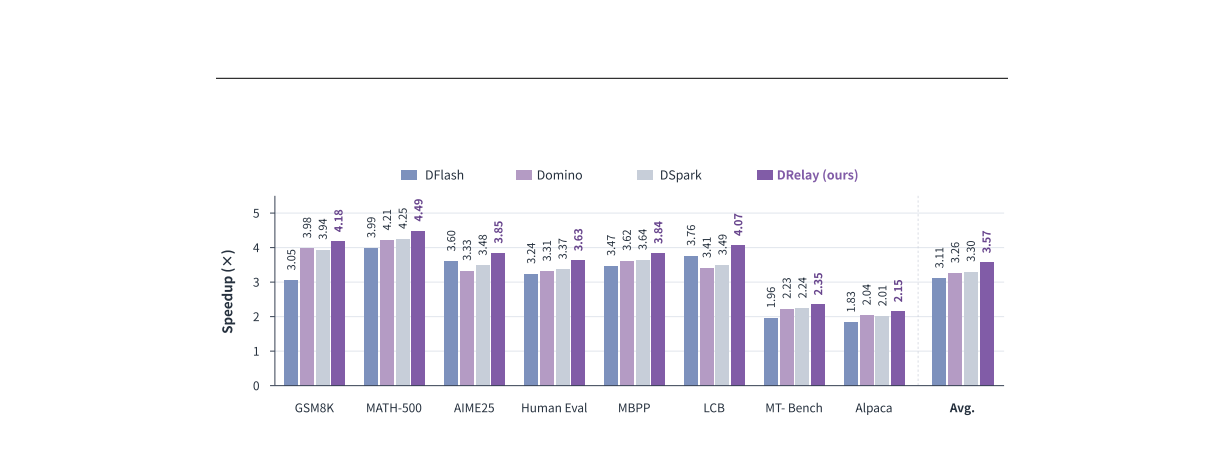
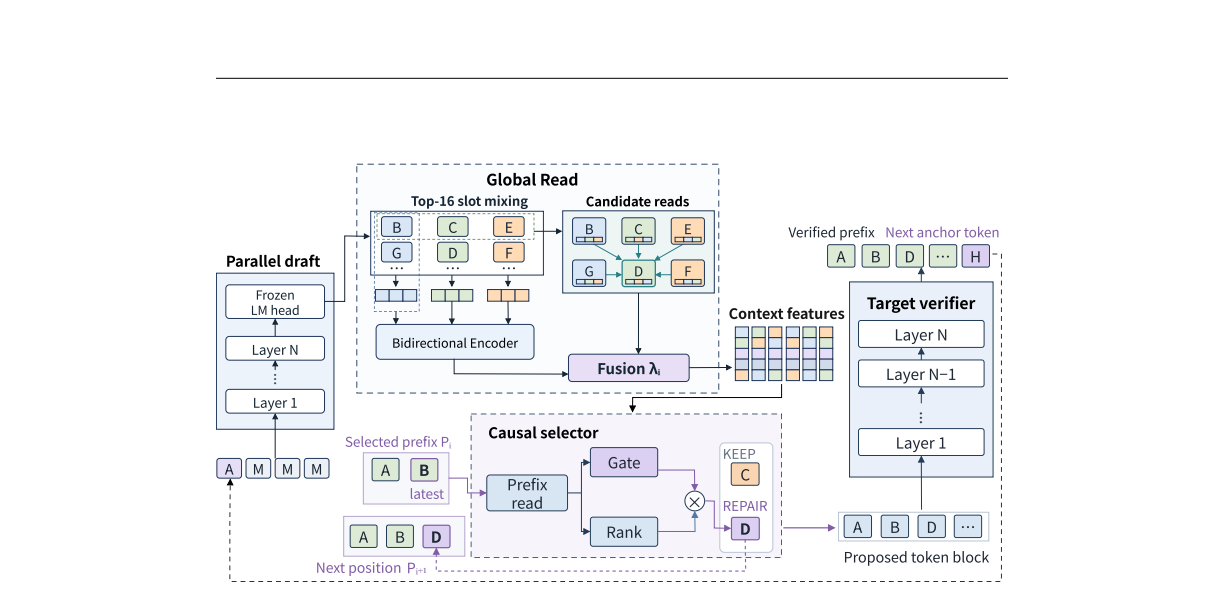
Even when the correct token is present in the candidate pool, a single early selection error prevents subsequent predictions from being used. We propose DRelay, which uses global information from the entire draft block to perform prefix-aware selective repair of candidate selections before target-model verification. DRelay bases its decisions on candidate correlations and the selected path: a global reader extracts predictive information across positions for each candidate. While a causal selector combines candidate-level information extracted by the global read with the tokens selected at preceding positions to determine whether the native choice at the current position is consistent with the global evidence and the selected prefix. It then decides whether to retain or replace the token, thereby repairing early errors and extending the accepted prefix. We further jointly train the draft backbone and the selector, combining candidate-support learning with a repair objective, while weighting the repair loss according to each block position's potential contribution to the consecutive accepted prefix. Across eight diverse benchmarks on an H800 GPU, DRelay consistently improves both average acceptance length and end-to-end decoding performance over DFlash, Domino, and DSpark. Under SGLang serving, DRelay improves average end-to-end speedup over DFlash, Domino, and DSpark by 14.7%-16.8%, 8.7%-9.3%, and 8.1%-9.3%, respectively.
from the abstract
Pith says
Machine review · deepseek-v4-flash · 2 Oct 2026 · what was read was not recorded · not checked by a person
It can be wrong. Challenge this review or reply to it.
Holds up, with conditions. DRelay is a serious parallel-drafting repair scheme with consistent wins across 32 cells, but the abstract overstates the range and the repair mechanism itself is never directly measured on DRelay's own drafts. This line is wrong
4 major objections · 4 minor
How often objections from reviews like this one are right: not yet measured
Not checked: figures, code, what the 34 references say.
The paper says, at §6.3, Tables 3–4
The review did not quote this passage.
Pith says: Objection 1 of 4 · major
The attribution of the gains to the repair mechanism rests on single-run ablation values. Removing the selector loss costs 0.36 τ, removing Global Read costs 0.42 τ, and uniform weights cost 0.39 τ, yet DRelay's margin over the DFlash baseline at Qwen3-4B/temp 0 is about 1.43 τ (7.58 vs 6.15 in Table 1).
more of objection 1
Since the ablations compare against Full and keep the jointly trained backbone, most of the margin over the baselines is not accounted for by the named components and could reflect joint backbone training rather than the repair stage. Without repeated seeds and variance estimates for Tables 1–4, the claim that repair, rather than improved drafting from joint training, causes the speedup is not supported. Please report multi-seed mean±std for the headline τ/S values and the ablations.
The paper says, at §3 vs §6; Fig. 2; Appendix A
The review did not quote this passage.
A classifier read this sentence of the paper as acknowledging the concern (probability 0.63):
“They do not provide supervision from unverified target states, do not evaluate a learned repair policy, and do not replace the end-to-end speed and acceptance results reported in Section 6.”
Pith says: Objection 2 of 4 · major
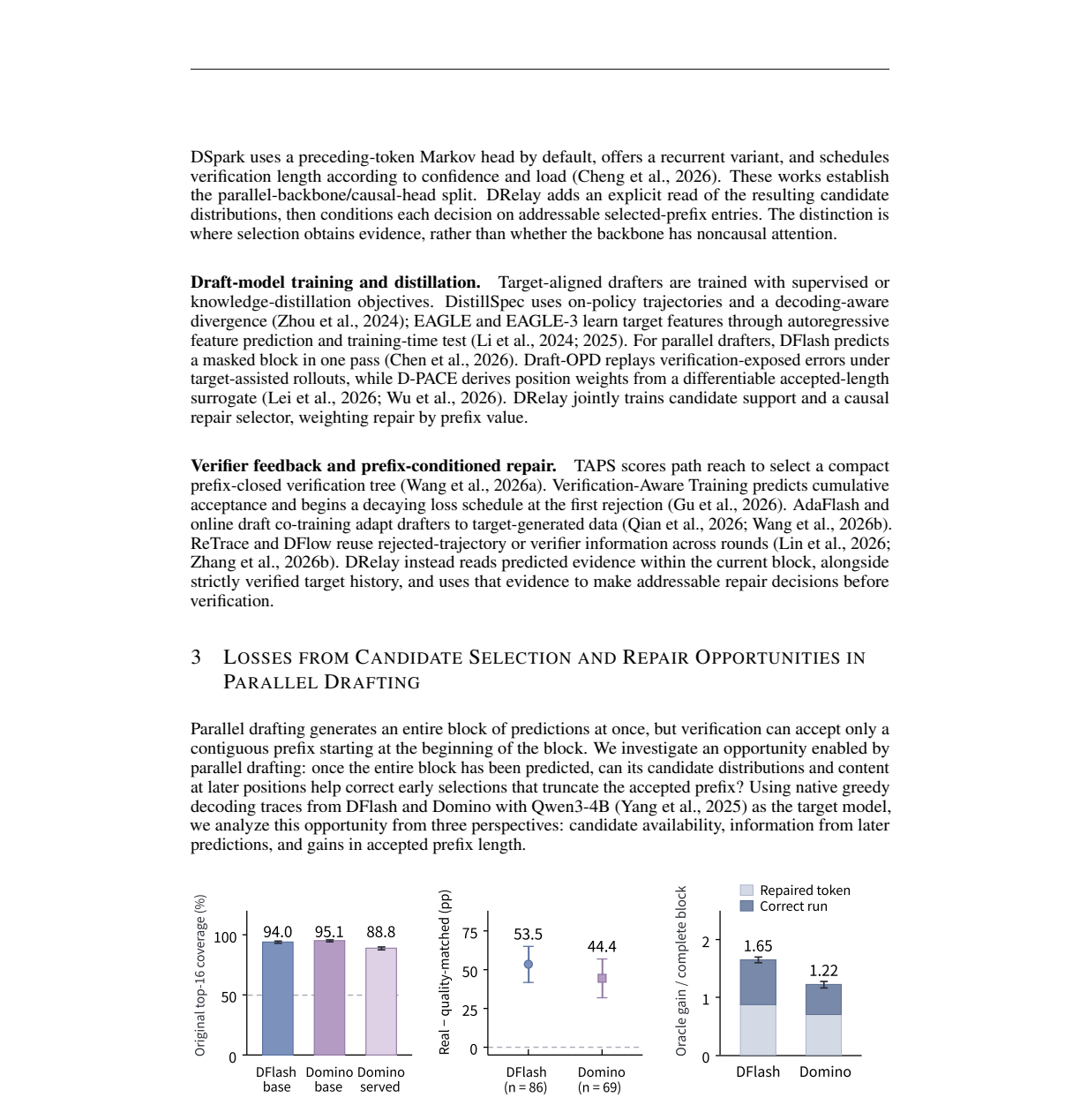
The repair-opportunity diagnostics are oracle-based — the continuation-evidence panel requires four correct subsequent predictions (b50), and the paper itself states the one-edit gain 'is not an estimate of DRelay's realized gain' (b273) and that the diagnostics 'do not evaluate a learned repair policy' (b275).
more of objection 2
That is honest, but the trained-system evaluation never re-measures the two quantities the mechanism requires: (i) DRelay's own first-error top-16 coverage under its deployed draft distribution, and (ii) the realized accepted-prefix gain from actual REPAIR decisions. Without these, the central causal claim — that repair of early errors extends the accepted prefix — is not directly verified in the system whose speedups are reported. Please add measurements of first-error pool coverage and gate REPAIR precision/recall for the trained DRelay.
The paper says, at §5, Eq. (3) and prefix memory; 'Learn at boundaries'
The review did not quote this passage.
Pith says: Objection 3 of 4 · major
There is a teacher-forcing gap between training and inference that is only partially addressed. Selector supervision (Eq. 3) and the prefix memory use target-greedy tokens under a strict j<i mask, so the gate learns calibration on correct prefixes, while at inference it conditions on its own selected prefix, which contains its own errors.
more of objection 3
The no-gradient boundary scout mixes some native states but does not relabel selector supervision, and no measurement of gate precision under self-selected prefixes is given. Please report gate KEEP/REPAIR accuracy on the deployed self-selected-prefix distribution, or explicitly bound how much of the 0.36 τ selector contribution could be a training-inference distribution-shift artifact.
The paper says, at Abstract and §6.2, Table 1
The review did not quote this passage.
Pith says: Objection 4 of 4 · major
The abstract's headline ranges (14.7%–16.8% over DFlash, 8.7%–9.3% over Domino, 8.1%–9.3% over DSpark) reproduce only the greedy (temperature 0) panels of Table 1. The temperature-1 sampling panels give smaller leads over DFlash (about 11.1%–12.9% by the same computation), and the contributions section separately quotes 7.8%–9.9% across temperatures. The abstract should either state that the quoted ranges are for greedy decoding or give the full temperature range, so the headline is not read as covering all reported settings.
4 minor objections
The paper says, at Eq. (5)
Pith says: minor objection 1 of 4
In the definition of the prefix-value credit, the right-hand side indexes the coverage and probability terms with i (̅pᵧ = cᵢ(1+stopgrad(pᵢ))/2) while the left-hand side is indexed by j; this appears to be a typo (the factors should be cⱼ and pⱼ), and it makes the continuation-product indices in Eq. (5) hard to follow. Please correct and add a one-line worked example of the credit for a small block.
The paper says, at Fig. 2, middle panel
Pith says: minor objection 2 of 4
The continuation-evidence analysis is based on small samples (n=86 and n=69), and the caption reports 97.5% intervals; with roughly 46/86 and 31/69 correct, a sentence noting the resulting interval width would help readers judge how robust the 53.5/44.4 pp contrasts are.
show 2 more
The paper says, at §6.1 and §6.3
Pith says: minor objection 3 of 4
Tables 1–4 and the concurrency table report no seeds, variance, or run count. Even a single sentence stating 'each entry is the mean over N runs with seeds s1…sN' would materially strengthen the 'consistently improves' wording in the abstract and would let readers assess whether the 7.8%–9.9% lead over the best baseline is within run-to-run noise.
The paper says, at §4, Fig. 3 and §4.3
Pith says: minor objection 4 of 4
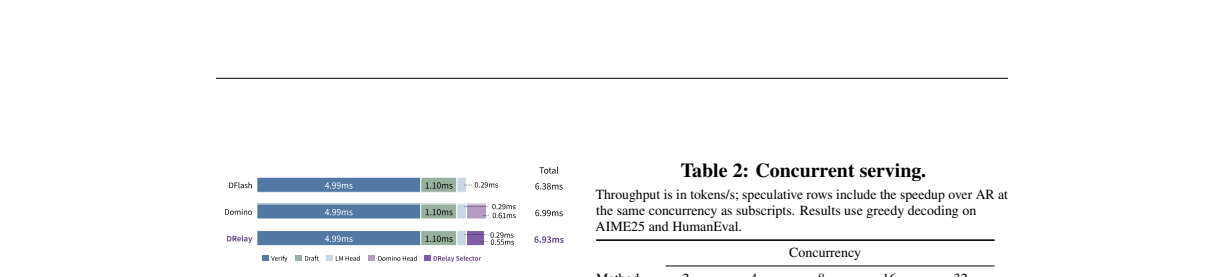
The 35.06M-parameter selector is stated without context; please state it relative to the draft backbone size (e.g., percentage of draft parameters) so the 0.55 ms overhead in Fig. 4 can be interpreted by readers who vary H and K.
What would settle it
On Qwen3-4B, run the trained DRelay end-to-end over the eight benchmarks and: (1) compute top-16 coverage at first-error positions of DRelay's own drafts, mirroring Figure 2's 94.0/95.1/88.8 figures; (2) measure gate REPAIR precision — among decisions flagged REPAIR at first-error positions, the fraction that output the target token — separately under teacher-forced prefixes and under deployed self-selected prefixes; and (3) re-run the No-Selector-Loss and No-Global-Read ablations across at least five seeds to test whether the 0.36–0.42 τ deltas are statistically distinct from zero. If on-policy coverage is far below ~90%, if gate precision collapses under self-selection, or if the ablation deltas vanish with seeds, the end-to-end gains do not come from the proposed repair mechanism.
from the skeptic's reading
How the review went
4 readings by deepseek-v4-flash · 2 Oct 2026
- Reader holds up, with conditions
- Skeptic agrees
- Editor wrote the verdict above
- Referee major revision: 4 major objections, 4 minor
Not run on this paper: the simulated authors' defence.
Pith did not check this review's objections against the paper.
The review in full
The review in brief, machine-written
DRelay's core idea is genuinely new in this line of work: a global reader plus causal selector that repairs early candidate selections before verification, with an addressable selected-prefix memory. The paper is honest about the oracle boundary — it explicitly states the diagnostics measure opportunity, not realized gain (b273, b275) — and that discipline shows in the design. The architecture is distinct from DFlash's noncausal block, Domino's GRU head, and DSpark's Markov/recurrent head, and the paper positions it cleanly against related verifier-feedback methods.
The evaluation is directionally solid: DRelay is the top method in all 32 Table 1 cells and all concurrency settings in Table 2, and the ablations (Tables 3–4) show each component contributes meaningfully (Global Read −0.42τ, selector loss −0.36τ, uniform weights −0.39τ). That internal consistency is more than most systems papers deliver.
The soft spots are real but not fatal. First, the abstract's improvement ranges (14.7–16.8% over DFlash) don't match the per-panel ratios in Table 1; the sampling-temperature panels are omitted and fall below the claimed lower bound. That's a concrete internal inconsistency. Second, no error bars, seeds, or significance tests accompany any headline or ablation number. Third, and most important for the causal claim: the repair mechanism is never directly measured on DRelay itself. We don't see DRelay's own top-16 coverage at first-error positions, nor gate KEEP/REPAIR precision under self-selected prefixes. The oracle diagnostics on DFlash/Domino base models (94%/95%/88.8% coverage) don't guarantee DRelay's own pool retains the correct token, and the teacher-forcing gap — selector trained on target-greedy prefixes but used on its own selected prefix at inference — is acknowledged but not evaluated. Fourth, no code or data artifact, and the training schedule is only partially specified.
None of these sink the paper. The direction is consistent, the authors are honest about the oracle boundary, and the ablations support the mechanism components even if single-run. What's missing is variance reporting and a direct measurement of the repair mechanism's selectivity on DRelay's own drafts. This deserves a serious referee. The authors should add seeds and error bars, reconcile the abstract numbers with Table 1, report DRelay's own pool coverage and gate precision under self-selected prefixes, and ideally release code. If those numbers hold, this is a solid systems contribution.
The strongest objection
The central claim is that DRelay's pre-verification repair extends accepted prefixes and converts this into end-to-end speedup. For that mechanism to be the cause of the gains, two things must hold: (i) DRelay's own drafts retain the correct token in the top-16 pool at first-error positions at rates comparable to the oracle's 94.0%/95.1%/88.8%, and (ii) the trained gate's KEEP/REPAIR decisions are correct under the deployed self-selected-prefix distribution. Neither is reported. The Section 3 diagnostics are explicitly oracle-based (b50, b273, b306, b307); the authors themselves state they do not evaluate a learned repair policy. The sharper problem is the teacher-forcing gap: in Section 5, selector supervision (Eq. 3) and the prefix memory use target-greedy tokens under a strict j<i mask, so the gate learns calibration on correct prefixes, while at inference it conditions on its own selected prefix, which contains its own errors. The no-gradient boundary scout mixes some native states but does not re-label selector supervision, and no measurement of gate precision under self-selected prefixes is given. The ablations (Tables 3–4) attribute only 0.36 τ (selector loss) and 0.42 τ (global read) — single runs without variance — while DRelay's advantage over DFlash at Qwen3-4B/temp0 is ~1.43 τ, so most of the gain is unexplained by the mechanism components and could reflect joint training improving the backbone rather than repair. Separately, the abstract's headline ranges (14.7–16.8% over DFlash) do not match Table 1's per-panel ratios (11.1–16.8%, mean 13.9%): both sampling-temperature panels fall below the claimed lower bound, a concrete internal inconsistency in the stated headline number.
The reader's weakest_assumption — that the oracle repair opportunity transfers to DRelay's own drafts — is the same load-bearing concern I identify, and I agree with it. I sharpen it in two ways. First, the teacher-forcing gap is concrete and specific: Eq. 3's selector labels and the prefix memory are built from target-greedy teacher tokens, so the gate is calibrated on correct prefixes but deployed on self-selected prefixes that contain its own errors; the boundary scout does not re-label selector supervision. Second, the mechanism's measured contribution is thin: the No-Selector-Loss (−0.36) and No-Global-Read (−0.42) ablations are single runs with no variance and account for only a fraction of DRelay's ~1.43 τ advantage over DFlash at Qwen3-4B/temp0 (7.58 vs 6.15), so most of the gain is unattributed and could stem from joint training or added capacity rather than the stated repair mechanism. I give credit where due: the paper cleanly separates oracle diagnostics from trained-system evaluation (Appendices A and C; b273, b306, b307 explicitly disclaim transfer to realized gain), Table 1 is internally consistent in showing DRelay highest in every cell, DRelay beats the best baseline by 7.8–9.9% as claimed in the contributions, and the latency breakdown (0.55 ms selector overhead on 6.38 ms shared work) is honest. The abstract-vs-Table-1 mismatch on the DFlash improvement range (claimed 14.7–16.8%; computed per-panel 11.2–16.8%, mean 13.9%) is a verifiable reporting defect that must be reconciled, but it does not overturn the direction of the result. Because the empirical direction is consistently supported while the mechanism attribution and headline magnitudes are not independently verifiable, the CONDITIONAL verdict stands: the authors should report on-policy pool coverage and gate precision, seeded ablations with variance, reconciled abstract numbers, and a code/artifact release.
The referee's report
If the results hold, DRelay is a clean, well-motivated architectural contribution: using the draft block itself as global evidence for candidate selection, with causal propagation of repaired tokens, is a sensible and non-obvious extension of DFlash/Domino/DSpark-style parallel drafting. The empirical direction is consistent — DRelay is best in all 32 dataset/model/temperature cells and all concurrency settings — which makes the headline claim internally coherent, and the latency decomposition honestly separates selector cost from verification cost. The paper is unusually careful in scoping its Section 3 diagnostics as oracle-only and non-evaluative of a trained policy (b273, b275, b307), and the joint-training objective with explicit credit-weighting is a genuine design contribution. The principal weaknesses are that the core causal mechanism (that repair drives the gains) is never directly measured in the trained system, and every headline number is a single run with no error bars or seeds.
Pith's reading of the paper (a machine's summary, not the authors')
DRelay attacks a structural ceiling in parallel speculative decoding: verification accepts only the contiguous correct prefix from the first draft position, so one early selection error discards every later correct prediction. The paper claims that the correct token usually survives in the candidate pool at that error position (94.0–95.1% coverage in its diagnostics), and that later draft positions carry context-specific evidence that can distinguish the right candidate. It therefore inserts a repair stage before target-model verification: a global reader summarizes the whole block per candidate, and a causal selector decides position by position whether to keep the native token or swap in an alternative, feeding each chosen token into later decisions. Trained jointly with the draft backbone under a prefix-value-weighted repair loss, DRelay reports average end-to-end speedups of 3.57x/3.89x over autoregressive decoding on Qwen3-4B/8B, beating DFlash, Domino, and DSpark on all eight benchmarks and improving serving speedup by 8.1–16.8%. If the mechanism holds, later predictions stop being wasted when an early pick is wrong.
What carries the argument. The load-bearing object is the Causal Selector, a gate/rank pair that decides per position whether to keep the native draft token or replace it with an alternative candidate. The gate (the paper calls it conservative) asks whether the best available repair justifies leaving the native choice; the rank branch scores alternatives from global, history, and prefix evidence, and a replacement fires only if gate tendency plus rank confidence is positive, with the gate initialized from native pool-mass log-odds so a zero correction reproduces the native distribution. Feeding it is the Global Read, a bidirectional-attention module with a candidate-specific read (Equation 1), a soft candidate-summary slot mixture, and a null read so uncertain contexts can decline to edit. Selection is causal: an addressable prefix memory exposes each chosen token only to later positions; a candidate-specific read of the last 64 verified target features supplies established context. Training uses a joint objective (Equations 3–4) combining dense candidate-support supervision with a selector loss, weighted by a prefix-value credit (Equation 5) that assigns each decision a value proportional to the reachable prefix and continuation it enables, processed through a bounded normalization that keeps uncertain long products from dominating. Together these turn the draft block from a fixed proposal into evidence for its own token choices.
Core claim. The paper's central claim is that a parallel draft block contains enough mutual information for later positions to repair a wrong early candidate selection before verification, and that this repair can be learned efficiently. Concretely, DRelay claims that reading global context across all positions per candidate, then making a causal KEEP/REPAIR decision at each position with the selected prefix fed forward, raises mean committed tokens per round from the best baseline's ~7.1 to 7.58–7.75 and lifts end-to-end speedup over autoregressive decoding to 3.57x–3.89x greedy on Qwen3-4B/8B, with margins of 14.7%–16.8%, 8.7%–9.3%, and 8.1%–9.3% over DFlash, Domino, and DSpark under SGLang serving. The paper also claims three supporting diagnostics: in 88.8–95.1% of first-error positions the target token remains in the top-16 candidate pool; later draft tokens carry context-aligned evidence that distinguishes the right candidate (46/86 and 31/69 correct repairs, 44.4–53.5 percentage points above matched controls); and a one-edit oracle correction of the first error recovers 1.22–1.65 accepted tokens per block including the subsequent run.
The premise it rests on. The load-bearing premise is that the repair opportunity measured with oracle diagnostics on DFlash/Domino drafts transfers to DRelay's own drafts and its teacher-prefix-trained selector; if DRelay's own pools do not keep the correct token at first-error positions as often as the 88.8–95.1% measured on the baseline drafters, or if KEEP/REPAIR decisions made under teacher prefixes do not generalize to the actual selected-prefix distribution at inference, the reported speedups would not come from the proposed repair mechanism.
If the paper is right (Pith's inferences, not the authors')
If DRelay's claims hold, the ceiling on parallel speculative decoding is no longer set by early selection errors: a repair stage raises mean committed tokens per round from roughly 7.1 to 7.58–7.75 without any full-vocabulary projection in the selector.
The repair pass is cheap relative to verification: Global Read runs once and the 35.06M-parameter selector adds about 0.55 ms per round (8.6% above DFlash's 6.38 ms total, below Domino's 6.99 ms), and the longer verified prefixes pay for it end-to-end.
The ablations attribute most of the gain to the mechanism the paper proposes: removing selector supervision costs 0.36 accepted tokens, replacing prefix-value weights with uniform weights costs 0.39, and removing Global Read costs 0.42.
The claimed gains persist under concurrent serving at concurrency 2–32, with DRelay fastest at every tested setting and throughput speedups over autoregressive decoding reaching up to 4.38x at matched concurrency.
Because Global Read consumes only draft-side hidden states and candidate distributions, the read-repair-select loop is in principle attachable to any parallel drafter that emits candidate pools, not just the three baselines tested.
A direct test of the causal story would measure DRelay's own served-path coverage: record the target token's presence in DRelay's top-16 pool at every first-error position under its own selected-prefix distribution; if coverage falls far below the 88.8–95.1% oracle range, the reported speedup cannot come from the proposed repair mechanism.
The paper leaves implicit that the same read-repair-select loop could attach to tree-based verifiers with prefix-closed acceptance, so the architecture may transfer beyond single-path parallel drafting to settings where several candidate branches are verified at once.
The temperature-1 results are the informative regime: DRelay's margins shrink (2.81x vs 2.60x best baseline at Qwen3-4B) where sampling makes pools noisier, suggesting the repair benefit is concentrated in higher-confidence drafts; probing temperature scaling of repair accuracy would delimit where the method pays off.
The prefix-value weight in Equation 5 is explicitly a weighted likelihood surrogate rather than an unbiased gradient of accepted length; a comparison against a learned value estimator or a reinforced objective would show whether the closed-form credit, rather than selector capacity, drives the accepted-length gains.
Check this review
Pith stored no record of this review's passes and took no fingerprint of it. Reviews made by code from 13 Nov 2026 on carry both.
How often reviews like this one are right
Reviews like this one: written by deepseek-v4-flash, where what was read was not recorded.
How often objections from reviews like this one are right: not yet measured
Reviews by people
This review was written by a machine. No person has reviewed this paper on Pith yet. A scientist listed on Pith can review it for a fee, and their review is published here whatever it concludes.
The paper
Abstract
Parallel drafting reduces the drafting overhead of speculative decoding for large language models (LLMs), but its gains remain limited by the accepted prefix length. Even when the correct token is present in the candidate pool, a single early selection error prevents subsequent predictions from being used. We propose DRelay, which uses global information from the entire draft block to perform prefix-aware selective repair of candidate selections before target-model verification. DRelay bases its decisions on candidate correlations and the selected path: a global reader extracts predictive information across positions for each candidate. While a causal selector combines candidate-level information extracted by the global read with the tokens selected at preceding positions to determine whether the native choice at the current position is consistent with the global evidence and the selected prefix. It then decides whether to retain or replace the token, thereby repairing early errors and extending the accepted prefix. We further jointly train the draft backbone and the selector, combining candidate-support learning with a repair objective, while weighting the repair loss according to each block position's potential contribution to the consecutive accepted prefix. Across eight diverse benchmarks on an H800 GPU, DRelay consistently improves both average acceptance length and end-to-end decoding performance over DFlash, Domino, and DSpark. Under SGLang serving, DRelay improves average end-to-end speedup over DFlash, Domino, and DSpark by 14.7%-16.8%, 8.7%-9.3%, and 8.1%-9.3%, respectively.
The paper's own sentences, arranged, kept beside the review and separate from it. Each label is drawn from a closed vocabulary; the number beside it is the probability the classifier gave that label. No sentence in this record was written by a model.
abstract compiled · 2026-10-02
The authors' main claim, as the classifier picked it out 1.00
“Across eight diverse benchmarks on an H800 GPU, DRelay consistently improves both average acceptance length and end-to-end decoding performance over DFlash, Domino, and DSpark.”
How the main claim is stated: asserted 1.00
What the abstract itself states, as probabilities: claims first 0.05 · states limitation 0.12 · human participants 0.02 · controlled comparison 0.92 · randomized assignment 0.01 · states quantitative result 0.99 · compares with prior results 0.98 · mentions code or data availability 0.03
The abstract, sentence by sentence
This table labels the abstract only (arXiv listing abstract v1). The number is the probability the classifier gave the label.
| Sentence | Role | The authors' own work | States the main conclusion | Strength |
|---|---|---|---|---|
| Parallel drafting reduces the drafting overhead of speculative decoding for large language models (LLMs), but its gains remain limited by the accepted prefix length. | background 0.95 | 0.09 | 0.04 | asserted 1.00 |
| Even when the correct token is present in the candidate pool, a single early selection error prevents subsequent predictions from being used. | background 0.87 | 0.10 | 0.03 | asserted 1.00 |
| We propose DRelay, which uses global information from the entire draft block to perform prefix-aware selective repair of candidate selections before target-model verification. | contribution 0.95 | 0.88 | 0.20 | asserted 0.99 |
| DRelay bases its decisions on candidate correlations and the selected path: a global reader extracts predictive information across positions for each candidate. | method 0.99 | 0.84 | 0.05 | asserted 1.00 |
| While a causal selector combines candidate-level information extracted by the global read with the tokens selected at preceding positions to determine whether the native choice at the current position is consistent with the global evidence and the selected prefix. | method 1.00 | 0.81 | 0.05 | asserted 0.95 |
| It then decides whether to retain or replace the token, thereby repairing early errors and extending the accepted prefix. | method 0.91 | 0.71 | 0.16 | asserted 1.00 |
| We further jointly train the draft backbone and the selector, combining candidate-support learning with a repair objective, while weighting the repair loss according to each block position's potential contribution to the consecutive accepted prefix. | method 0.95 | 0.94 | 0.06 | asserted 0.97 |
| Across eight diverse benchmarks on an H800 GPU, DRelay consistently improves both average acceptance length and end-to-end decoding performance over DFlash, Domino, and DSpark. | result 1.00 | 0.96 | 0.57 | asserted 1.00 |
| Under SGLang serving, DRelay improves average end-to-end speedup over DFlash, Domino, and DSpark by 14.7%-16.8%, 8.7%-9.3%, and 8.1%-9.3%, respectively. | result 1.00 | 0.95 | 0.25 | asserted 1.00 |
What kind of paper the classifier reports this is: method or tool 1.00 · evidence from observation or experiment 0.96
What was examined, and what was not
Sources read
- arXiv listing abstract v1
Not examined
- full text
- figures and tables
- references and citing sentences
- relations to other papers
Levels run
- P abstract
Not run
- S sections
- T body sentences
- C citations
- R cross-paper relations
How the labels were made
Compiled by classifier-1.13.0 via TypeSafe API, question bank abstract-p1-20260923, 2026-10-02: 1 request, 7,017 input tokens.
Every quoted sentence on this record is the authors'. Every label is from Pith's closed vocabulary, with the probability shown beside it. This record as JSON
Figures (4)
Figures are the authors', reproduced from the paper.
References (34)
- [1] Jianuo Huang and Yaojie Zhang and Qituan Zhang and Hao Lin and Hanlin Xu and Linfeng Zhang , year=. arXiv preprint arXiv:2605.29707 , url= on PithPith's reviewarXiv
- [2] Yu-Yang Qian and Hao-Cong Wu and Chen Chen and Jiacheng Sun and Zhenhua Dong and Peng Zhao and Zhi-Hua Zhou , year=. arXiv preprint arXiv:2607.19223 , url= on PithPith's reviewarXiv
- [3] Hong Liu and Rui Cen and Junhan Shi and Guangshuo Qin and Jiebin Zhang and Tianyu Liu and Runzhi Fan and Guoliang Zhao and Ruobing Xie and Kai Zhang and Song Liu and Guanghua Yu and Jianchen Zhu , year=. arXiv preprint arXiv:2607.25852 , url= on PithPith's reviewarXiv
- [4] Zheng Wang and Davis Wertheimer and Yu Chin Fabian Lim and Mudhakar Srivatsa and Raghu K. Ganti and Minjia Zhang and Naigang Wang , year=. arXiv preprint arXiv:2608.02438 , url= on PithPith's reviewarXiv
- [5] Matan Rusanovsky and Yoav Miron and Roy Uziel and Omer Belhasin and Ran Zilberstein and Maor Ashkenazi and Michael Elad , year=. arXiv preprint arXiv:2608.20530 , url= on PithPith's reviewarXiv
- [6] Xinwei Qiang and Xiang Fang and Chang Chen and Yue Guan and Yufei Ding , year=. arXiv preprint arXiv:2608.27339 , url= on PithPith's reviewarXiv
- [7] Luxi Lin and Zhanpeng Zeng and Shuang Peng and Songwei Liu and Rongrong Ji , year=. arXiv preprint arXiv:2608.29748 , url= on PithPith's reviewarXiv
- [8] Geonmo Gu and Byeongho Heo and HeeJae Jun and Yoohoon Kang and Sangmin Lee and Sangdoo Yun and Dongyoon Han , year=. arXiv preprint arXiv:2608.30135 , url= on PithPith's reviewarXiv
- [9] Yaojie Zhang and Linfeng Zhang and Bin Cui and Xupeng Miao , year=. arXiv preprint arXiv:2609.06498 , url= on PithPith's reviewarXiv
- [10] Zili Wang and Zhaopeng Qiu and Yuekai Zhang and Shuang Yu and Junjie Lai , year=. arXiv preprint arXiv:2609.07108 , url= on PithPith's reviewarXiv
- [11] Xin Cheng and Xingkai Yu and Chenze Shao and Jiashi Li and Yunfan Xiong and Yi Qian and Jiaqi Zhu and Shirong Ma and Xiaokang Zhang and Jiasheng Ye and Qinyu Chen and Chengqi Deng and Jiping Yu and Damai Dai and Zhengyan Zhang and Yixuan Wei and Yixuan Tan and Wenkai Yang and ... on PithPith's reviewarXiv
- [12] Zhuoyu Wang and Junnan Huang and Xinyu Chen , year=. arXiv preprint arXiv:2606.00487 , url= on PithPith's reviewarXiv
- [13] Jian Chen and Yesheng Liang and Zhijian Liu , booktitle=. 2026 , url= on Pith
- [14] Yaniv Leviathan and Matan Kalman and Yossi Matias , year=. Proceedings of the 40th International Conference on Machine Learning , volume= on Pith
- [15] Charlie Chen and Sebastian Borgeaud and Geoffrey Irving and Jean-Baptiste Lespiau and Laurent Sifre and John Jumper , year=. arXiv preprint arXiv:2302.01318 , url= on PithPith's reviewarXiv
- [16] Cobbe, Karl and Kosaraju, Vineet and Bavarian, Mohammad and Chen, Mark and Jun, Heewoo and Kaiser, Lukasz and Plappert, Matthias and Tworek, Jerry and Hilton, Jacob and Nakano, Reiichiro and Hesse, Christopher and Schulman, John , year=. arXiv preprint arXiv:2110.14168 , url= on PithPith's reviewarXiv
- [17] Chen, Mark and Tworek, Jerry and Jun, Heewoo and Yuan, Qiming and Pinto, Henrique Ponde de Oliveira and Kaplan, Jared and Edwards, Harri and Burda, Yuri and Joseph, Nicholas and Brockman, Greg and Ray, Alex and Puri, Raul and Krueger, Gretchen and Petrov, Michael and Khlaaf, H... on PithPith's reviewarXiv
- [18] Zheng, Lianmin and Chiang, Wei-Lin and Sheng, Ying and Zhuang, Siyuan and Wu, Zhanghao and Zhuang, Yonghao and Lin, Zi and Li, Zhuohan and Li, Dacheng and Xing, Eric P. and Zhang, Hao and Gonzalez, Joseph E. and Stoica, Ion , year=. Advances in Neural Information Processing Sy... on Pith
- [19] Yang, An and Li, Anfeng and Yang, Baosong and Zhang, Beichen and Hui, Binyuan and Zheng, Bo and Yu, Bowen and Gao, Chang and Huang, Chengen and Lv, Chenxu and Zheng, Chujie and Liu, Dayiheng and Zhou, Fan and Huang, Fei and Hu, Feng and Ge, Hao and Wei, Haoran and Lin, Huan an... on PithPith's reviewarXiv
- [20] Zhang, Jiebin and Yu, Zhenghan and Liu, Song and Yu, Eugene J. and Li, Zheng and Zhu, Dawei and Duo, Jiangshan and Xiong, Weimin and Song, Yifan and Yu, Guanghua and Zhu, Jianchen and Li, Sujian , year=. arXiv preprint arXiv:2606.02091 , url= on PithPith's reviewarXiv
show 14 more
- [21] Let's Verify Step by Step , author=. arXiv preprint arXiv:2305.20050 , year= on PithPith's reviewarXiv
- [22] Program Synthesis with Large Language Models , author=. arXiv preprint arXiv:2108.07732 , year= on PithPith's reviewarXiv
- [23] Taori, Rohan and Gulrajani, Ishaan and Zhang, Tianyi and Dubois, Yann and Li, Xuechen and Guestrin, Carlos and Liang, Percy and Hashimoto, Tatsunori B. , year=. Stanford Alpaca: An Instruction-following on Pith
- [24] Shenggui Li and Chao Wang and Yikai Zhu and Yubo Wang and Fan Yin and Shuai Shi and Yefei Chen and Xiaomin Dong and Qiaoling Chen and Jin Pan and Ji Li and Laixin Xie and Yineng Zhang and Lei Yu and Yonggang Wen and Ivor Tsang and Tianwei Zhang , year=. arXiv preprint arXiv:26... on PitharXiv
- [25] Naman Jain and King Han and Alex Gu and Wen-Ding Li and Fanjia Yan and Tianjun Zhang and Sida Wang and Armando Solar-Lezama and Koushik Sen and Ion Stoica , year=. The Thirteenth International Conference on Learning Representations , url= on Pith
- [26] 2025 , howpublished= on Pith
- [27] Goel, Raghavv and Gagrani, Mukul and Jeon, Wonseok and Park, Junyoung and Lee, Mingu and Lott, Christopher , year=. arXiv preprint arXiv:2403.00858 , url= on PithPith's reviewarXiv
- [28] Wu, Tianyu and Yao, Yu and Qi, Zhenting and Zheng, Han and Wang, Zhuohan and Ma, Haoran and Liao, Lawrence and Lakkaraju, Himabindu and Li, Ju and Du, Yilun , year=. arXiv preprint arXiv:2605.18810 , url= on PithPith's reviewarXiv
- [29] Lei, Haodi and Li, Yafu and Zhang, Haoran and Zhang, Shunkai and Cheng, Qianjia and Qu, Xiaoye and Cui, Ganqu and Zhou, Bowen and Ding, Ning and Luo, Yun and Cheng, Yu , year=. arXiv preprint arXiv:2605.29343 , url= on PithPith's reviewarXiv
- [30] Zhou, Yongchao and Lyu, Kaifeng and Rawat, Ankit Singh and Menon, Aditya Krishna and Rostamizadeh, Afshin and Kumar, Sanjiv and Kagy, Jean-Fran. International Conference on Learning Representations , pages=. 2024 , url= on Pith
- [31] Li, Yuhui and Wei, Fangyun and Zhang, Chao and Zhang, Hongyang , booktitle=. 2024 , publisher= on Pith
- [32] Li, Yuhui and Wei, Fangyun and Zhang, Chao and Zhang, Hongyang , booktitle=. 2025 , publisher= on Pith
- [33] The Perfect Blend: Redefining RLHF with Mixture of Judges , author=. arXiv preprint arXiv:2409.20370 , year= on PithPith's reviewarXiv
- [34] SGLang: Efficient Execution of Structured Language Model Programs , author=. Advances in Neural Information Processing Systems , volume= on Pith
Challenges and discussion
Disagree with the review, or know something it missed? Leave a comment, or challenge this review formally: a challenge becomes a permanent entry in this paper's record, and its decision is published here.
Come back by email
A short list of the week's newly reviewed papers. Nothing is sent until you confirm from your inbox, and every email has a link that stops it. No account.
No comments yet.
Sign in to comment