Machine Learning · arXiv:2609.07108 v3 · submitted 7 Sep 2026
Online Draft Co-Training for Speculative Decoding in Large-Scale, Long-Context RL Post-Training
The paper says
“Speculative decoding accelerates rollout generation, which dominates the cost of reinforcement learning (RL) post-training. Online co-training keeps the draft aligned with the evolving policy, further increasing acceptance length and speedup.”
more of the abstract
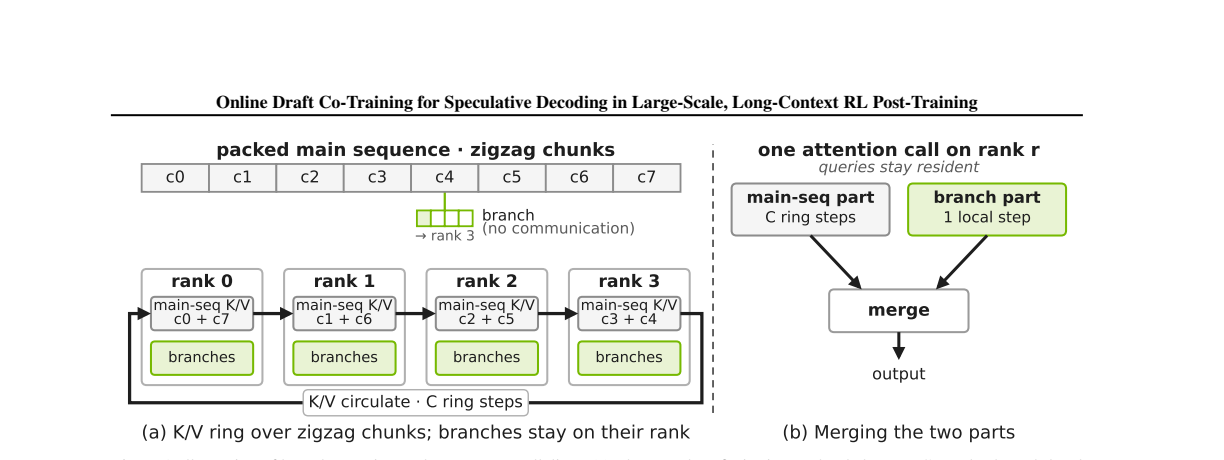
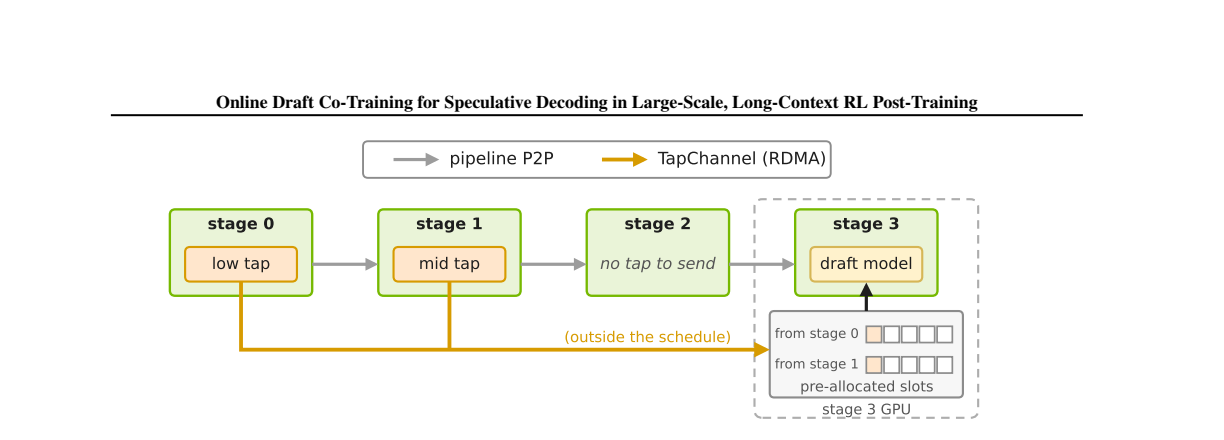
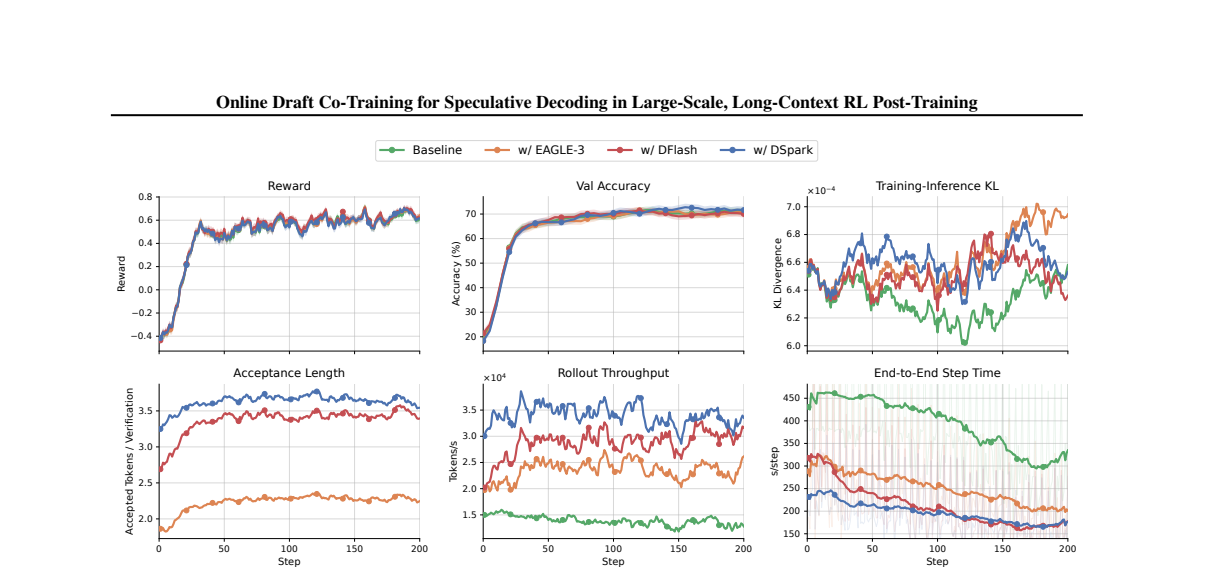
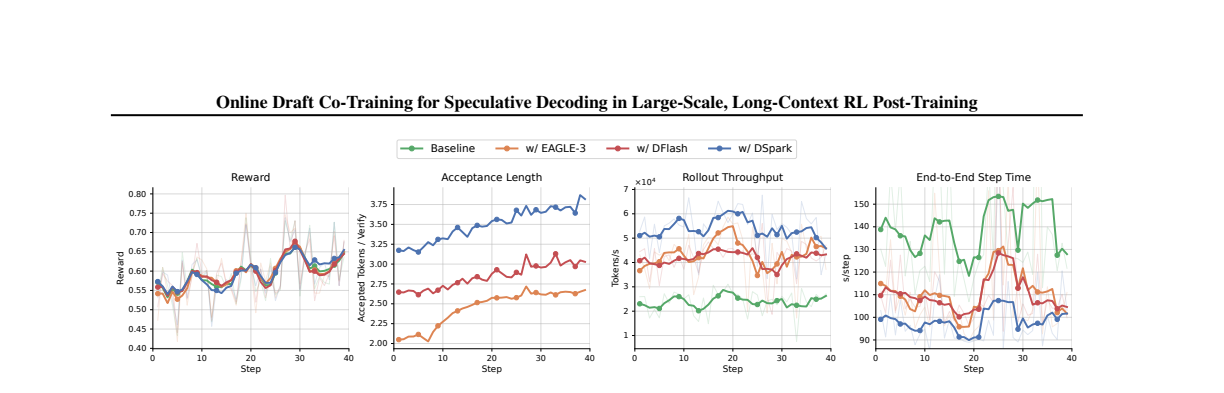
However, training large models on long contexts requires context parallelism (CP) and pipeline parallelism (PP), and co-training drafts under this layout poses two obstacles: (1) the draft's branch attention is unsupported by causal CP, and (2) the target features that the draft consumes are spread across PP stages. In this paper, we present the design and implementation of online draft co-training in NeMo-RL. For CP, we extend packed, load-balanced zigzag ring attention by merging rank-local branch attention with causal main-sequence attention. For PP, TapChannel transports intermediate target features across stages via a separate path, leaving the pipeline schedule unaffected. Experiments show that co-training keeps the policy's reward and accuracy close to the no-draft baseline while delivering 1.48–2.25 × rollout speedups and 1.19–1.88 × end-to-end training speedups across model scales up to 122B. Our CP design achieves strong scaling at 256K sequence length with significant memory savings over prior work, and our PP transport incurs modest overhead. Code can be found at https://github.com/NVIDIA-NeMo/RL/issues/3698.
from the abstract
Pith says
Machine review · deepseek-v4-flash · 10 Sep 2026 · of version 1 of the paper; version 3 is newer · what was read was not recorded · not checked by a person
It can be wrong. Challenge this review or reply to it.
Holds up, with conditions. Solid systems engineering with a genuine technical contribution, but the lack of auditable code leaves the central correctness claim supported by only one end-to-end KL curve on the smallest model. This line is wrong
2 major objections · 5 minor
How often objections from reviews like this one are right: not yet measured
Not checked: figures, code, what the references say.
The paper says, at Section 3.2, Equation (2)
The review did not quote this passage.
Pith says: Objection 1 of 2 · major
The merge identity in Eq. (2) is mathematically correct, but its faithful implementation is load-bearing for the central correctness claim. The paper provides only an end-to-end training–inference KL divergence for the 8B model (Figure 3) as evidence, not a direct microbenchmark that compares the merged output against the full union-attention reference for the branch attention kernel.
more of objection 1
Without such a test (ideally across multiple context lengths, random inputs, and all model scales in Table 1), there is no guarantee that the merge kernel is numerically identical and that draft-training gradients are correct. This gap is particularly concerning for the largest models (e.g., 122B) where the KL metric is not reported.
The paper says, at Abstract and Section 1
The review did not quote this passage.
Pith says: Objection 2 of 2 · major
The paper states 'Code can be found at https://github.com/NVIDIA-NeMo/RL/issues/3698', which is a GitHub issue tracker entry, not a repository containing the implementation. For a system paper whose contributions depend on implementation details, the code should be made publicly available in a usable form (or at least a detailed pseudocode of the merge kernel and TapChannel synchronization logic should be provided). The current link does not enable independent audit and is insufficient for reproducibility.
5 minor objections
The paper says, at Abstract
Pith says: minor objection 1 of 5
'Code can be found here.' should be replaced with a proper reference or link to a repository, not an issue tracker.
The paper says, at Figure 5 caption
Pith says: minor objection 2 of 5
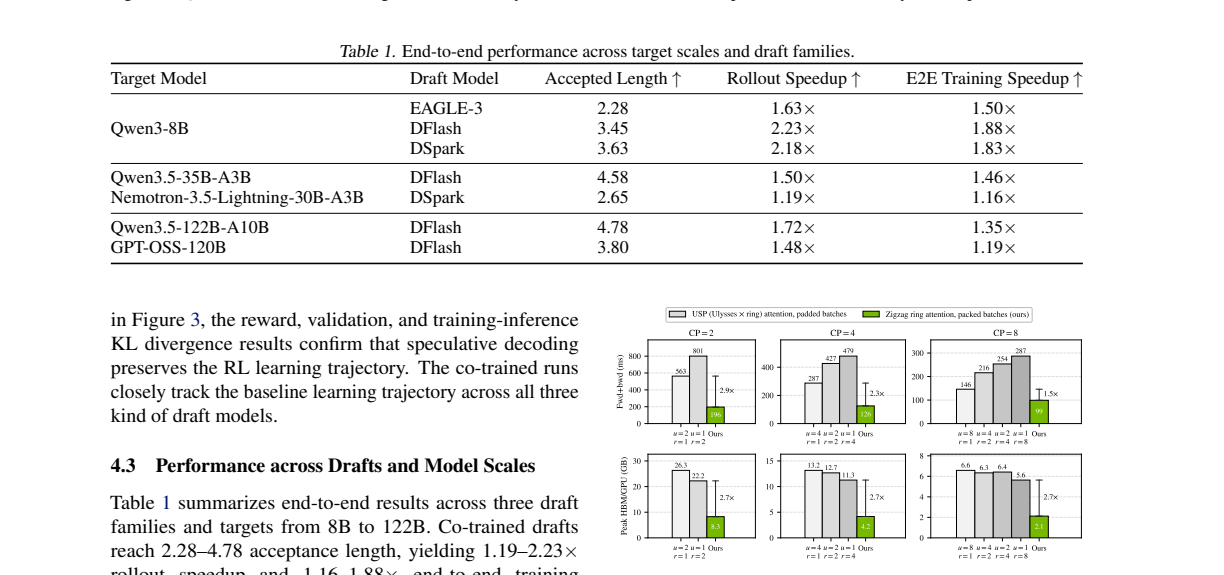
The variables 'u' (Ulysses degree) and 'r' (ring degree) are not defined in the caption; define them or refer to the original definition.
show 3 more
The paper says, at Table 2
Pith says: minor objection 3 of 5
The 'Tap wait' column is unclear; specify that this is the average waiting time for tap features per policy update step.
The paper says, at Section 3.1
Pith says: minor objection 4 of 5
The objective in Eq. (1) uses λ as a coefficient; list λ in Table 1 of free parameters as the paper does not fix its value or describe how it is chosen.
The paper says, at Section 4.4
Pith says: minor objection 5 of 5
The term 'USP' (Ulysses × ring) is used in Figure 5 but not defined in the caption; define the acronym.
What would settle it
Add and run an operator-level equivalence test, with released code and random packed inputs, that compares the merged CP branch-attention output and its backward gradient against a reference attention over the union of main-sequence and branch key sets, for CP=2,4,8 and sequence lengths 16K, 64K, and 256K in the actual BF16 kernel path; require max absolute output error below 1e-2 and relative gradient error below 5%. Then confirm the Qwen3-8B EAGLE-3 run reproduces Figure 3's KL curve when this merge kernel is used.
from the skeptic's reading
How the review went
4 readings by deepseek-v4-flash · 10 Sep 2026
- Reader holds up, with conditions
- Skeptic agrees
- Editor wrote the verdict above
- Referee major revision: 2 major objections, 5 minor
Not run on this paper: the simulated authors' defence.
Pith did not check this review's objections against the paper.
The review in full
The review in brief, machine-written
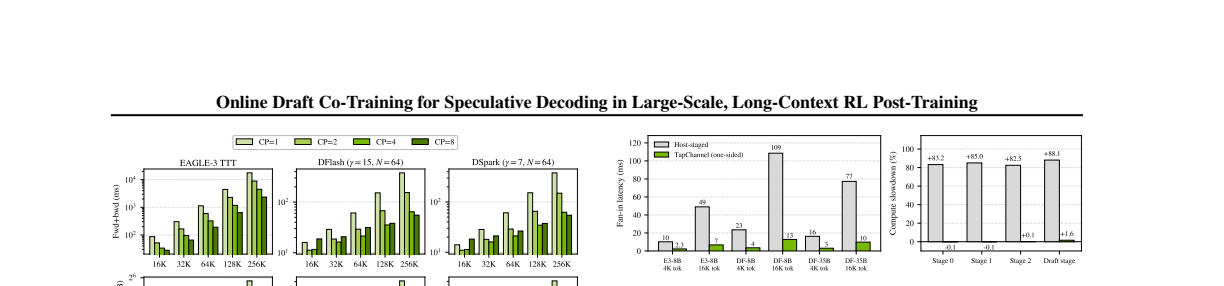
The paper solves two genuine problems that anyone trying to do online draft co-training at scale will hit: branch attention under context parallelism and cross-stage feature transport under pipeline parallelism. The packed zigzag-ring merge via online-softmax (Eq. 2) is a clean, mathematically sound decomposition for EAGLE-3, DFlash, and DSpark. TapChannel is straightforward but effective—out-of-schedule RDMA mailboxes that actually overlap with pipeline slack. The microbenchmarks (Figures 5, 6, 7) are well-designed and the scaling data is convincing.
What concerns me is the reproducibility gap. The code link is an issue tracker entry, not a repository with the merge kernel or TapChannel implementation. The stress-test note is right that the merge kernel is load-bearing and has only been validated end-to-end on Qwen3-8B via the KL curve. For the larger models in Table 1, there is no such check reported. If the merge kernel has numerical drift, the draft gradients shift and over RL steps the policy trajectory could diverge. The paper needs a standalone operator-level test that compares the merged output against a full union-attention reference on real hardware.
The comparison to SpecForge USP is useful but limited to operator-level latency and memory. The claim that this design is superior for end-to-end training would be stronger if there were a full training run comparison. I don't think that's a fatal omission—the paper's scope is systems mechanisms—but it limits the strength of the contribution narrative.
Overall, the engineering is serious, the math is correct, and the experimental setup is thorough except for the missing verification of the merge operator. This belongs in a peer-reviewed venue, but the decision should be conditional on releasing the code and providing a direct numerical verification of Eq. 2 against a reference implementation.
The strongest objection
The core identity is sound: for disjoint key sets, attention over the union is exactly the weighted average of the two component outputs with weights exp(ℓ_m−ℓ) and exp(ℓ_b−ℓ). The vulnerable step is the implemented merge kernel. The main-sequence term is produced by multi-step ring attention and the branch term by a local attention call; the kernel must recover the full logsumexp of each component, rescale it, and renormalize in the same numerical pass. Any drift or bug in that reduction changes draft-training gradients and, over RL steps, the policy trajectory. The paper does not test this operator directly against a full union-attention reference: the training-inference KL in Section 4.2 is an end-to-end check on Qwen3-8B only, not a check that the merged operator equals branch attention, and it is not reported for the larger targets in Table 1. Furthermore, the listed repository link (https://github.com/NVIDIA-NeMo/RL/issues/3698) is an issue tracker entry, not released source or configuration, so the merge kernel and TapChannel synchronization logic cannot be independently audited. This is load-bearing because both contributions are implementation-level system mechanisms; if the merge is not numerically faithful, the central claim that online draft co-training is correct at scale is unsupported.
The reader's weakest assumption is the same one I would stress: Eq. (2) is exact only if the two components' logsumexp statistics are faithfully recovered and merged. I checked the identity algebraically and it is correct for disjoint key sets, so the concern is not in the math but in the unverified fused kernel. The paper's KL metric is relevant and partially mitigates the risk for Qwen3-8B, but it is end-to-end and does not localize the merge. The missing code repository makes this concern concrete. I recommend keeping the CONDITIONAL verdict until source and configuration are released and the operator-level equivalence test passes.
The referee's report
If the claims hold, the paper provides a practical and scalable system for jointly training draft models during RL post-training, addressing two key system-level obstacles (branch attention under CP and cross-stage feature transport under PP) that previously prevented efficient online co-training. This is a significant contribution for the ML systems community working on speculative decoding and RL, with potential to reduce training time substantially.
Pith's reading of the paper (a machine's summary, not the authors')
Speculative decoding accelerates rollout generation, which dominates the wall-clock cost of reinforcement-learning post-training, but the small draft model must be continuously re-trained to stay aligned with the evolving policy. The paper claims that this online co-training can be scaled to large models with long contexts without changing the target policy's parallel training layout: branch-structured draft attention is decomposed into a causal main-sequence part computed by the existing ring-based context-parallel attention plus a rank-local branch part, merged by an online-softmax reduction, and a side channel called TapChannel ferries the target's intermediate features across pipeline stages outside the normal pipeline schedule. With these two mechanisms, co-trained drafts track the baseline policy's reward and accuracy while delivering 1.19–2.23× rollout speedups and 1.16–1.88× end-to-end training speedups across three draft families and target models from 8B to 122B. If the claim is right, the dominant cost of RL post-training can shrink while rollouts stay faithful to the training policy.
What carries the argument. Two mechanisms carry the argument. The first is a branch-attention decomposition with an online-softmax merge (the paper's Eq. 2): each branch query's attention is split into a main-sequence component, computed over the causal prefix by the same packed zigzag ring attention used for standard context parallelism, and a branch-local component, computed on the rank that owns the branch anchor; the two are combined by the log-sum-exp reduction $\ell = \log(e^{\ell_m} + e^{\ell_b})$, $O = e^{\ell_m - \ell}O_m + e^{\ell_b - \ell}O_b$, which is the same rule already used between ring-attention steps, so no new attention semantics are introduced. The second is TapChannel, an out-of-schedule transport for pipeline parallelism: every tap-producing stage writes its intermediate target features into a pre-allocated, sequence-stamped mailbox slot on the draft stage, and the draft stage reads that slot just before its own forward for the same microbatch, so features cross non-adjacent stages without entering or altering the pipeline schedule. The cost analysis carries the systems claim: the context-parallel communication volume is independent of the number or depth of branches, and the only visible TapChannel cost is the portion of each transfer that exceeds the natural pipeline slack window.
Core claim. Branch-structured drafts — EAGLE-3 (which simulates multi-step generation during training, creating a branch at every draft position), DFlash (which generates a whole block of tokens by block diffusion), and DSpark (which adds a lightweight Markov head to restore causal dependency within the block) — all share one requirement: every branch must attend both to the causal prefix of the main sequence and to a small set of branch-local keys. The paper's claim is that this requirement fits the existing parallel topology of large-model training: the main-sequence part is computed by packed zigzag ring attention (the standard long-context scheme in which shards of the sequence circulate rank-to-rank while queries stay resident), the branch part is computed locally on the rank that owns the branch's anchor, and an online-softmax merge of the two log-sum-exp values and outputs recovers the full branch-attention result. Under pipeline parallelism, where the draft sits on the last stage but needs intermediate target features produced on earlier stages, a side channel called TapChannel delivers those features through pre-allocated, sequence-stamped mailbox slots on the draft stage, leaving the pipeline schedule untouched. The experiments support the claim by showing that co-trained drafts closely track the baseline policy's reward, validation accuracy, and training-inference KL divergence while achieving the reported speedups on targets up to 122B parameters and sequence lengths up to 256K tokens.
The premise it rests on. The load-bearing premise is that merging the main-sequence and branch-local attention outputs with the online-softmax formula reproduces the full branch-attention result closely enough that the draft trains on correct targets; if the merge drifts numerically or a bug slips into the merge kernel, co-training would silently train the draft on wrong gradients and the learning-trajectory guarantee would break.
If the paper is right (Pith's inferences, not the authors')
If the central claim holds, RL post-training can keep its draft synchronized with a moving policy at production scale: co-trained drafts reach acceptance lengths of 2.28–4.78 tokens and end-to-end training speedups of 1.16–1.88× on targets from 8B to 122B, shrinking the dominant rollout cost without changing the parallelism configuration.
The same context-parallel attention path now serves both causal main-sequence attention and branch-structured draft attention, with per-GPU memory up to 2.7× lower than the padded sequence-parallel baseline it is compared against, so co-training rides the policy's existing layout nearly for free.
Long-context co-training scales: at fixed global lengths up to 256K tokens, the branch-attention forward-plus-backward pass parallelizes with 94% efficiency from CP=1 to CP=8, and block-style drafts stay cheap (under 55 ms) even at CP=8.
TapChannel adds only 13.6–14.6% update-time overhead for block drafts (34.3% for the multi-pass draft), and the draft stage waits only about 0.4–0.6 seconds per policy update for taps to arrive, confirming the side channel is largely hidden inside normal pipeline slack.
The learning-trajectory evidence — matching reward, matching validation accuracy, and near-zero training-inference KL divergence — supports keeping the RL algorithm's on-policy assumption intact while speculation is active.
pith_inferences: These are extensions beyond the paper's own claims.
The merge rule is generic: any future draft whose branches attend only to the main-sequence prefix plus branch-local keys could inherit the same decomposition, and the reduction chain could extend to more than two key sets by repeated online-softmax merges.
TapChannel's mailbox pattern is a general one-way feature-routing primitive for pipeline-parallel training: it could carry any schedule-tolerant side data — auxiliary-head activations, sampling statistics, verification results — to a consuming stage without reshaping the pipeline.
Check this review
Pith stored no record of this review's passes and took no fingerprint of it. Reviews made by code from 13 Nov 2026 on carry both.
How often reviews like this one are right
Reviews like this one: written by deepseek-v4-flash, where what was read was not recorded.
How often objections from reviews like this one are right: not yet measured
Reviews by people
This review was written by a machine. No person has reviewed this paper on Pith yet. A scientist listed on Pith can review it for a fee, and their review is published here whatever it concludes.
The paper
Abstract
Speculative decoding accelerates rollout generation, which dominates the cost of reinforcement learning (RL) post-training. Online co-training keeps the draft aligned with the evolving policy, further increasing acceptance length and speedup. However, training large models on long contexts requires context parallelism (CP) and pipeline parallelism (PP), and co-training drafts under this layout poses two obstacles: (1) the draft's branch attention is unsupported by causal CP, and (2) the target features that the draft consumes are spread across PP stages. In this paper, we present the design and implementation of online draft co-training in NeMo-RL. For CP, we extend packed, load-balanced zigzag ring attention by merging rank-local branch attention with causal main-sequence attention. For PP, TapChannel transports intermediate target features across stages via a separate path, leaving the pipeline schedule unaffected. Experiments show that co-training keeps the policy's reward and accuracy close to the no-draft baseline while delivering 1.48–2.25 × rollout speedups and 1.19–1.88 × end-to-end training speedups across model scales up to 122B. Our CP design achieves strong scaling at 256K sequence length with significant memory savings over prior work, and our PP transport incurs modest overhead. Code can be found at https://github.com/NVIDIA-NeMo/RL/issues/3698.
The paper's own sentences, arranged, kept beside the review and separate from it. Each label is drawn from a closed vocabulary; the number beside it is the probability the classifier gave that label. No sentence in this record was written by a model.
abstract compiled · 2026-09-23
The authors' main claim, as the classifier picked it out 1.00
“Experiments demonstrate that co-trained drafts closely track the policy baseline while delivering substantial rollout and end-to-end speedups across model scales up to 122B.”
How the main claim is stated: asserted 1.00
What the abstract itself states, as probabilities: claims first 0.07 · states limitation 0.77 · human participants 0.02 · controlled comparison 0.84 · randomized assignment 0.01 · states quantitative result 0.95 · compares with prior results 0.94 · mentions code or data availability 0.97
The abstract, sentence by sentence
This table labels the abstract only (arXiv listing abstract v1). The number is the probability the classifier gave the label.
| Sentence | Role | The authors' own work | States the main conclusion | Strength |
|---|---|---|---|---|
| Speculative decoding accelerates rollout generation, which dominates the cost of reinforcement learning (RL) post-training. | background 1.00 | 0.11 | 0.04 | asserted 1.00 |
| Online co-training can further increase the draft's accuracy, yielding greater speedups. | background 1.00 | 0.11 | 0.07 | asserted 0.53 |
| However, scaling this approach to co-training on large models with long contexts poses two obstacles: (1) branch attention is unsupported by standard causal context-parallel (CP) implementations, and (2) target features span across pipeline-parallel (PP) stages. | gap 0.85 | 0.16 | 0.03 | asserted 0.98 |
| We address both with an end-to-end system for large-scale online draft co-training. | contribution 1.00 | 0.89 | 0.19 | asserted 1.00 |
| For CP, we extend packed, load-balanced zigzag ring attention by merging rank-local branch attention with causal main-sequence attention. | method 0.97 | 0.92 | 0.04 | asserted 0.99 |
| For PP, TapChannel transports intermediate target features across stages via a separate path, leaving the pipeline schedule unaffected. | method 0.98 | 0.89 | 0.04 | asserted 1.00 |
| Experiments demonstrate that co-trained drafts closely track the policy baseline while delivering substantial rollout and end-to-end speedups across model scales up to 122B. | result 1.00 | 0.95 | 0.75 | asserted 1.00 |
| Our CP design achieves strong scaling at 256K tokens with significant memory savings over prior work, and our PP transport incurs modest overhead. | result 1.00 | 0.95 | 0.12 | asserted 1.00 |
| Code can be found at https://github.com/NVIDIA-NeMo/RL/issues/3698. | contribution 0.63 | 0.23 | 0.02 | asserted 0.85 |
What kind of paper the classifier reports this is: method or tool 1.00 · evidence from observation or experiment 0.99
What was examined, and what was not
Sources read
- arXiv listing abstract v1
Not examined
- full text
- figures and tables
- references and citing sentences
- relations to other papers
Levels run
- P abstract
Not run
- S sections
- T body sentences
- C citations
- R cross-paper relations
How the labels were made
Compiled by classifier-1.13.0 via TypeSafe API, question bank abstract-p1-20260923, 2026-09-23: 1 request, 6,863 input tokens.
Every quoted sentence on this record is the authors'. Every label is from Pith's closed vocabulary, with the probability shown beside it. This record as JSON
Figures (7)
Showing 6 of the paper's 7 figures. Figures are the authors', reproduced from the paper.
Cited by 2 Pith papers
Reviewed papers on Pith that cite this one. The full citation record
Challenges and discussion
Disagree with the review, or know something it missed? Leave a comment, or challenge this review formally: a challenge becomes a permanent entry in this paper's record, and its decision is published here.
Come back by email
A short list of the week's newly reviewed papers. Nothing is sent until you confirm from your inbox, and every email has a link that stops it. No account.
No comments yet.
Sign in to comment