Computation and Language · arXiv:2609.06498 v1 · submitted 6 Sep 2026 · 22 references
DFlow: Enabling Verifier Information Flow in Block Diffusion Speculative Decoding
The paper says
“Block diffusion speculative decoding improves LLM inference efficiency by proposing a block of future tokens in parallel and verifying them with a single forward pass through the target model.”
more of the abstract
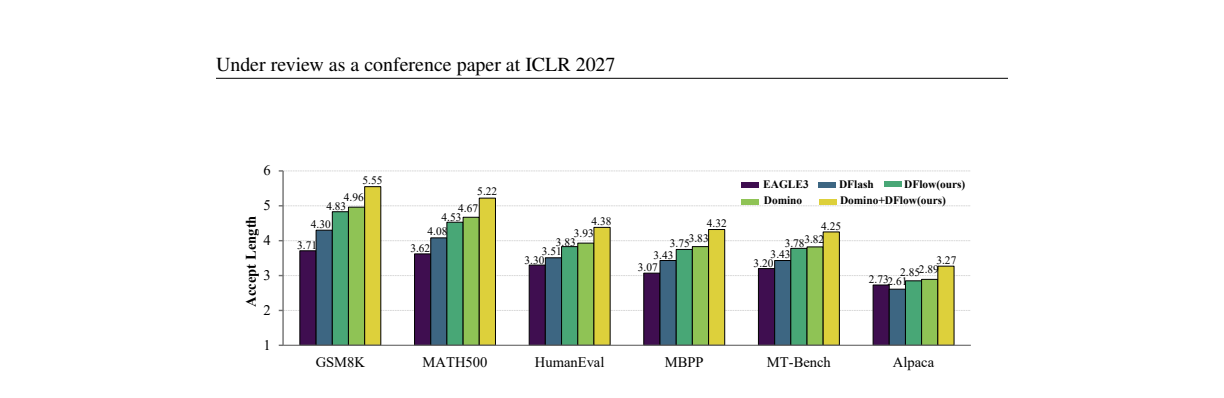
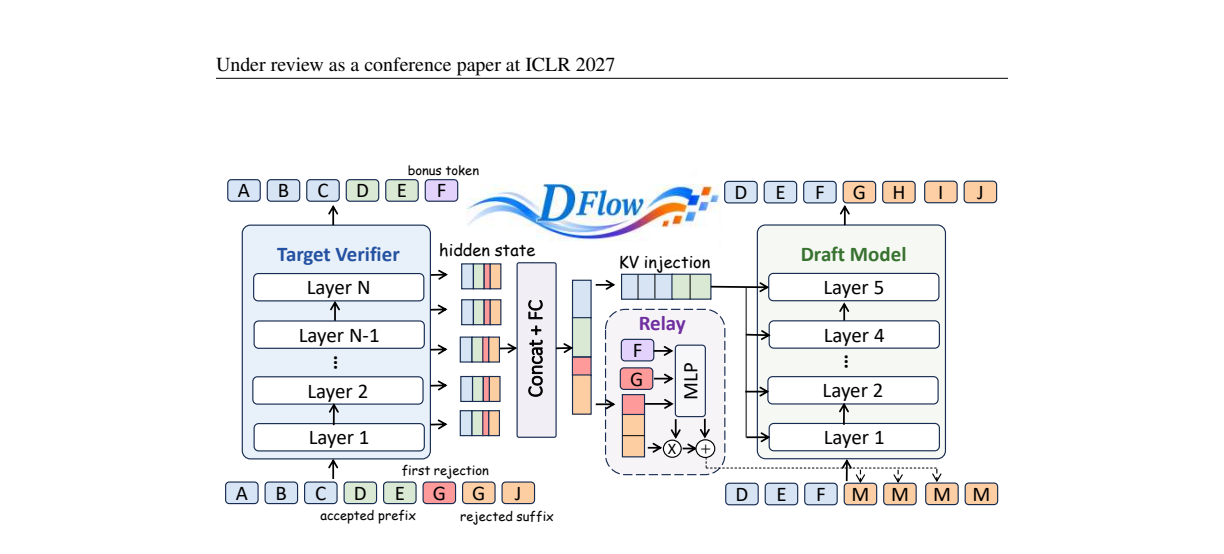
However, existing methods retain only the accepted prefix and discard the rejected suffix, preventing the computation spent on these positions from benefiting subsequent drafting rounds and forcing the drafter to repeatedly reconstruct representations for future tokens from scratch. We observe that rejection only determines whether a proposed token can be committed, while the verifier representations at rejected positions can still provide useful information for subsequent predictions. Based on this observation, we propose DFlow, a simple yet effective framework that enables verifier information to flow across drafting rounds. DFlow reuses the hidden states produced by the target verifier for the rejected suffix to guide subsequent drafting without additional target computation. To effectively learn this information flow across drafting rounds, we introduce a self-condition train strategy that feeds verifier representations from earlier predictions back into subsequent predictions. Experiments on Qwen3 models across diverse benchmarks demonstrate that DFlow consistently improves draft quality and acceptance length over DFlash.
from the abstract
Pith says
Machine review · deepseek-v4-flash · 10 Sep 2026 · what was read was not recorded · not checked by a person
It can be wrong. Challenge this review or reply to it.
Holds up, with conditions. Solid engineering win with a real attribution gap: the relay ablation toggles the verifier hidden states and the boundary-token signal together, so the paper's central claim about verifier representations is not yet isolated. This line is wrong
3 major objections · 6 minor
How often objections from reviews like this one are right: not yet measured
Not checked: figures, code, what the 22 references say.
The paper says, at Section 5.2, Table 1; Section 5.3, Table 3
The review did not quote this passage.
Pith says: Objection 1 of 3 · major
The central claim is that verifier hidden states at rejected positions improve subsequent drafting, but the only relay ablation removes the entire residual pathway. In Eq. (4)-(5), the next-round input is built from E(b^(r)), E(y-hat^(r)_{a_r+1}), and h_i, so the hidden-state channel, the boundary-token channel, and the MLP are removed simultaneously.
more of objection 1
The observed gain from 3.66 to 3.93 is therefore also consistent with an alternative explanation: the drafter benefits only from being told the boundary pair (the first rejected draft token and the target correction) and learns to set beta_i near zero. To support the Main Hypothesis in Section 4.1, please add ablations that hold the boundary-conditioned modulation fixed while suppressing or corrupting the hidden-state channel, e.g., boundary-only conditioning with h_i removed, or a version with random or zeroed h_i.
The paper says, at Section 3 and Eq. (1); Section 5.1; Appendix A.1
The review did not quote this passage.
Pith says: Objection 2 of 3 · major
No variance, standard deviation, or number of training or evaluation runs is reported for any acceptance-length value. The headline improvements are modest in absolute terms (for example, 3.56 to 3.93 on Qwen3-1.7B, and 3.66 to 3.93 in the relay ablation), and without multiple seeds it cannot be ruled out that part of the gain reflects random initialization of the drafter.
more of objection 2
Please report at least three independent training runs with means and standard deviations, or otherwise justify why the reported single-run numbers are not sensitive to training variance, and provide error bars or significance tests for the key ablation.
The paper says, at Section 4.2; Figure 3
The review did not quote this passage.
Pith says: Objection 3 of 3 · major
The target layer set L and the relay MLP are free parameters that determine DFlow's representational capacity, but the paper never states which target layers are used, how L was selected, or the MLP depth, width, and placement. Because both the fused target context and the relayed hidden states depend on L, the comparison with DFlash is not fully reproducible and the sensitivity of the reported gains to this choice is untested.
more of objection 3
Please specify these architectural details and include a sensitivity check over L and the relay capacity.
6 minor objections
The paper says, at Figure 3
Pith says: minor objection 1 of 6
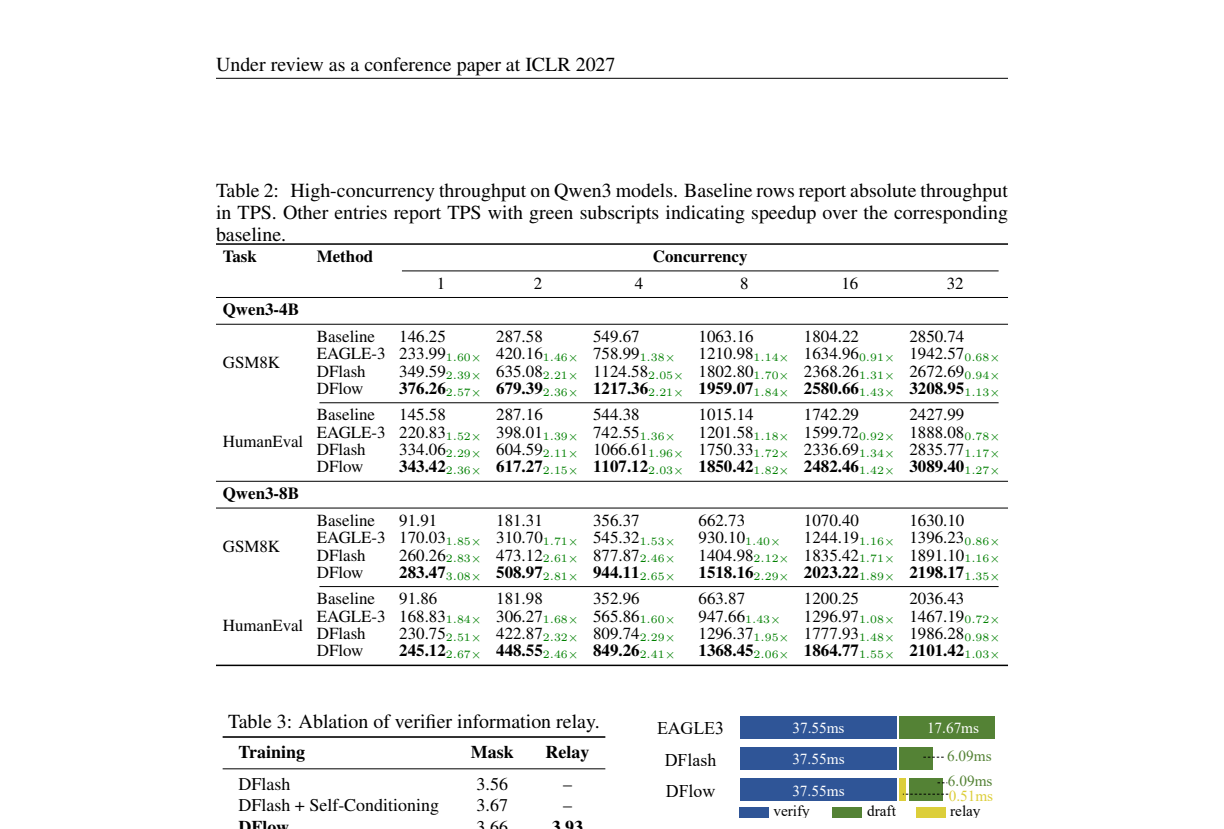
The DFlow row in Table 3 is visually ambiguous: the two numeric entries under the columns 'Training Mask Relay' could be read as two separate models. Please rename the columns to make explicit that 3.66 is the same DFlow-trained model evaluated with mask-only initialization and 3.93 is that model evaluated with verifier relay enabled.
The paper says, at Section 4.2
Pith says: minor objection 2 of 6
The runtime decomposition figure is difficult to parse: the repeated 37.55 ms values and the unlabeled stacked segments make it unclear what is included in 'verify,' 'draft,' and 'relay.' Please provide a clear legend and state explicitly how the 1.2% overhead figure is computed relative to DFlash.
show 4 more
The paper says, at Section 4.3
Pith says: minor objection 3 of 6
The one-position shift that aligns verifier representations with drafter mask-token predictions is described only in prose. Please give the indexing explicitly (for example, which verifier hidden state is used for which draft position in Eq. (5)), since this is essential for reproducing the relay construction.
The paper says, at Table 2
Pith says: minor objection 4 of 6
The exponential decay applied to the cross-entropy loss is mentioned but not defined. Please specify the decay schedule and how it is applied across positions within a block and across the unfolded rounds.
The paper says, at Section 2
Pith says: minor objection 5 of 6
The high-concurrency table is typeset densely, with speedup symbols run together with throughput numbers, and the baseline row is not explicitly labeled. Please separate the values and symbols and name the baseline model in the table.
The paper says, at Place not named
Pith says: minor objection 6 of 6
The discussion of DFlare is brief, and since DFlare also reuses target-model representations, a sentence explicitly contrasting DFlare's within-round target-layer feature mixing with DFlow's cross-round relay of rejected-suffix hidden states would help position the contribution.
What would settle it
Retrain or evaluate DFlow with h_i in Eq. 4 replaced by a learned position-independent constant vector (or zeros), while keeping E(b), E(y_hat_first_rejected), and MLP_phi intact, under identical training and evaluation settings; then measure average acceptance length on the Table 1 greedy benchmarks. If acceptance length stays near 3.93, the verifier hidden-state content itself is not load-bearing and the central claim must be weakened. If it falls back toward the 3.66 relay-disabled value, the verifier representations are confirmed as the active ingredient. A cheaper diagnostic on a released checkpoint is to zero out h_i at inference only, though retraining with the constant h_i is the cleaner test.
from the skeptic's reading
How the review went
4 readings by deepseek-v4-flash · 10 Sep 2026
- Reader holds up, with conditions
- Skeptic partly agrees
- Editor wrote the verdict above
- Referee major revision: 3 major objections, 6 minor
Not run on this paper: the simulated authors' defence.
Pith did not check this review's objections against the paper.
The review in full
The review in brief, machine-written
Read DFlow. The useful result: relaying information across drafting rounds in block diffusion speculative decoding gives consistent 10-13% acceptance-length gains over DFlash on Qwen3-1.7B/4B/8B, and the gains hold under sampling and translate into throughput at low concurrency, though they shrink as concurrency grows. The multi-round self-conditioned training is a sensible way to close the train/inference gap, and the Domino compatibility section—especially the online-rollout fix for the teacher-forcing mismatch—shows the authors understand their own failure modes. This is a real, if incremental, step for a narrow subfield.
The soft spot is real and the stress-test note lands. The relay input (Eq. 4-5) concatenates the verifier hidden state hi with the boundary pair (bonus token, first rejected draft token), and the relay ablation in Table 3 removes the entire pathway at once. So the 3.66 -> 3.93 gain could come from the boundary tokens alone—the drafter learning "this token was rejected, here is the correction"—while beta_i goes to zero. The paper's Main Hypothesis names the verifier representations specifically, and the experiments do not isolate that quantity. This is not fatal to the method, which still works, but it is fatal to the stated interpretation. A one-afternoon control—relay with boundary embeddings but no hi, and relay with hi but no boundary embeddings—would settle it.
Other softness is more ordinary: no error bars or standard deviations on the headline acceptance lengths, no code release, one model family, and DFlash 2/DFlare get a mention rather than a comparison. The runtime overhead figure is clean and reassuring. Citation pattern is fine; the authors cite the work they build on, including their own Domino, and the comparison is fair.
Net: this deserves a serious referee. Not a desk reject. But I would condition acceptance on the boundary-only ablation and some variance reporting. If the gain turns out to be mostly the boundary signal, the paper still has a usable engineering result, just a different and less general story.
The strongest objection
The paper's central claim is that target verifier hidden states at rejected positions, not merely the rejection event itself, improve subsequent drafting. But in the proposed relay (Eq. 4-5), the next-round input is x_i = E_mask + beta_i * LN(h_i) + gamma_i, where both beta_i and gamma_i are produced by MLP_phi([E(b); E(y_hat_first_rejected); h_i]). The input therefore always contains two correlated information channels: the verifier hidden state h_i and the boundary pair (target correction token, first rejected draft token). The only relay ablation in Table 3 toggles the entire relay pathway against mask-only initialization; it removes h_i, the MLP, and the boundary embeddings simultaneously. Consequently, the reported gain from 3.66 to 3.93 cannot distinguish 'verifier hidden states carry useful information' from 'the drafter benefits from being told which token was rejected and what the target printed instead.' A trained model could set beta_i close to zero and rely on gamma_i computed from the boundary embeddings alone, and Table 3 would look exactly the same. Section 4.1's Main Hypothesis is specifically about the hidden states, so the current experiments do not isolate the quantity that the claim depends on.
The reader identified the utility of verifier hidden states as the weakest assumption, and my concern sits inside that assumption: the experiments do not yet prove the hidden states themselves are the source of the gain, because the relay pathway also injects the rejection-boundary tokens. The boundary confound is load-bearing because the paper's Main Hypothesis is about the hidden states, not about the rejection decision. However, this is a missing control rather than a demonstrated failure: the ablations are consistent with the paper's interpretation, and the self-conditioning ablation (3.56 to 3.67) plus the relay on/off comparison (3.66 to 3.93) provide real correlational support. The existing CONDITIONAL verdict already covers this situation, so I do not move the verdict category; the acceptance conditions should now include an explicit isolation test of h_i alongside error bars and code release. I marked agreement as partial because the reader did not flag the boundary-signal confound explicitly, though our concerns overlap substantially.
The referee's report
If the central claim holds, DFlow is a meaningful, low-cost improvement to block diffusion speculative decoding: it reuses computation already performed by the target verifier, adds only about 0.5 ms per round according to the paper, and composes with a stronger drafter such as Domino. The experimental design is otherwise sound in important respects: comparison against strong baselines (EAGLE-3, DFlash), ablations that separate multi-round self-conditioned training from the relay mechanism, a throughput study, and an explicit handling of the train-inference mismatch with Domino. The main weaknesses are that the decisive relay ablation does not isolate the verifier hidden states from the boundary-token signal, and that no variance or error information is provided for any acceptance-length number. Both issues should be addressed before the mechanism claim can be regarded as established.
Pith's reading of the paper (a machine's summary, not the authors')
This paper tries to establish that the hidden states a target LLM computes for draft tokens that are rejected --- normally thrown away after verification --- still carry useful predictive information, and that feeding them into the next drafting round makes the drafter propose better tokens. The claim matters because that computation has already been paid for by the verifier, so recycling it adds almost no latency (about 1.2% in the authors' measurements) while raising the average number of tokens accepted per round. Against the current block-diffusion baseline, DFlow reports acceptance-length gains of 10.4%, 13.2%, and 13.4% on 1.7B, 4B, and 8B Qwen3 models under greedy decoding, with consistent gains under sampling and under concurrent serving throughput. The paper's central move is to treat the rejection boundary as a token-commitment decision only, not as evidence that the rejected positions are uninformative.
What carries the argument. The carrying object is the relay module: a lightweight MLP that takes the target-correction embedding, the first-rejected-proposal embedding, and the aligned verifier hidden state at each reusable position, and outputs channel-wise scaling $\beta^{(r)}_i$ and additive correction $\gamma^{(r)}_i$ (Eq. 4); the next round's input at that position becomes the mask embedding plus $\beta^{(r)}_i \odot \mathrm{LN}(h^{(r)}_i) + \gamma^{(r)}_i$ (Eq. 5). Two alignments make the relay usable: a one-position shift, because the causal verifier's state at position $i$ predicts token $i+1$ while the drafter's masked position $i$ predicts token $i$, and a shared feature projection ($W_c$ plus RMSNorm) inherited from DFlash so the relayed states live in the drafter's conditioning space. The companion mechanism is Multi-Round Self-Conditioned Training, which unfolds consecutive draft-verify rounds, uses the target trajectory to locate the bonus token that starts each next round, and sums the per-round losses so the drafter learns to consume its own previous verification artifacts rather than only clean mask embeddings.
Core claim. DFlow claims that verifier representations at rejected positions can provide useful guidance for subsequent drafting. During exact-match verification the target model has already computed causal hidden states for every proposed position, including those past the first mismatch; rejection decides only whether a token may be committed, not whether its representation is informative. DFlow therefore relays the rejected suffix's hidden states into the overlapping positions of the next drafting round, projecting them into the drafter's hidden space with the shared DFlash feature projection, shifting them by one position so the verifier state and the drafter predict the same token, and modulating them with an MLP conditioned on the pair (target correction, first rejected proposal) to produce per-channel scaling and additive correction. Because the states come from the verification pass that already happened, no additional target forward pass is required. To teach the drafter to consume these states, training uses multi-round self-conditioned rollout: one round predicts from mask embeddings, the frozen target verifies, and the rejected-suffix states feed up to $k = 2$ further reject-conditioned rounds whose losses are summed. The experimental claim is that this reuse raises average acceptance length over DFlash from 3.56 to 3.93 on Qwen3-1.7B, 3.71 to 4.20 on Qwen3-4B, and 3.66 to 4.15 on Qwen3-8B under greedy decoding, and that the gains survive combination with a stronger causal-dependency drafter (Domino, 4.02 to 4.50) provided training uses an online rollout of the actual draft trajectory.
The premise it rests on. The load-bearing premise is that hidden states the target model computes at rejected token positions really do contain usable information about the future text, and that the drafter can learn to exploit that information because the training-time verification conditions match inference-time ones; the paper's own Domino experiment, in which acceptance length collapses to 2.22 without online rollout, shows just how much the method depends on that match.
If the paper is right (Pith's inferences, not the authors')
Acceptance length rises consistently across all three model scales: 10.4% on Qwen3-1.7B, 13.2% on Qwen3-4B, and 13.4% on Qwen3-8B under greedy decoding, with smaller gains (about 9-12%) under sampling at temperature 1.0.
The gain comes from the relay, not from extra training rounds: multi-round mask-only training improves DFlash's 3.56 to 3.67, whereas enabling the relay under the same trained model improves it from 3.66 to 3.93.
The relay adds roughly 0.51 ms per speculative round (about 1.2% overhead), so most of the draft-quality gain converts into end-to-end throughput improvements that persist up to concurrency 32 in the reported serving tests.
DFlow composes with stronger drafters: combined with Domino it raises acceptance length from 4.02 to 4.50, but only when training uses an online rollout of actual draft predictions; with teacher-forced transitions the same combination collapses to 2.22.
All gains are obtained without extra target-model forward passes, because the relayed states are byproducts of the verification that already runs.
By the same logic, other verifier byproducts already computed during verification -- attention maps, KV states, routing decisions -- are candidates for the same cross-round relay; nothing in the paper's mechanism strictly limits reuse to dense hidden states.
The relay's value should scale with the length of the rejected suffix: a testable implication is that DFlow's gain grows when drafts are rejected early (more positions relayed) and shrinks when drafts are almost always accepted.
The Domino result suggests a general design constraint for self-conditioned decoding: any training signal derived from draft predictions must come from the actual inference-time trajectory, since optimistic (teacher-forced) drafts produce relay states that actively hurt rather than help.
One could test whether the boundary-conditioned MLP is genuinely reading information from the rejected-suffix states, or mostly acting as a learned bias, by comparing against a variant that relays only the acceptance-boundary tokens' states.
Check this review
Pith stored no record of this review's passes and took no fingerprint of it. Reviews made by code from 13 Nov 2026 on carry both.
How often reviews like this one are right
Reviews like this one: written by deepseek-v4-flash, where what was read was not recorded.
How often objections from reviews like this one are right: not yet measured
Reviews by people
This review was written by a machine. No person has reviewed this paper on Pith yet. A scientist listed on Pith can review it for a fee, and their review is published here whatever it concludes.
The paper
Abstract
Block diffusion speculative decoding improves LLM inference efficiency by proposing a block of future tokens in parallel and verifying them with a single forward pass through the target model. However, existing methods retain only the accepted prefix and discard the rejected suffix, preventing the computation spent on these positions from benefiting subsequent drafting rounds and forcing the drafter to repeatedly reconstruct representations for future tokens from scratch. We observe that rejection only determines whether a proposed token can be committed, while the verifier representations at rejected positions can still provide useful information for subsequent predictions. Based on this observation, we propose DFlow, a simple yet effective framework that enables verifier information to flow across drafting rounds. DFlow reuses the hidden states produced by the target verifier for the rejected suffix to guide subsequent drafting without additional target computation. To effectively learn this information flow across drafting rounds, we introduce a self-condition train strategy that feeds verifier representations from earlier predictions back into subsequent predictions. Experiments on Qwen3 models across diverse benchmarks demonstrate that DFlow consistently improves draft quality and acceptance length over DFlash.
The paper's own sentences, arranged, kept beside the review and separate from it. Each label is drawn from a closed vocabulary; the number beside it is the probability the classifier gave that label. No sentence in this record was written by a model.
abstract compiled · 2026-09-23
The authors' main claim, as the classifier picked it out 0.97
“Experiments on Qwen3 models across diverse benchmarks demonstrate that DFlow consistently improves draft quality and acceptance length over DFlash.”
How the main claim is stated: asserted 1.00
What the abstract itself states, as probabilities: claims first 0.06 · states limitation 0.08 · human participants 0.02 · controlled comparison 0.91 · randomized assignment 0.02 · states quantitative result 0.05 · compares with prior results 0.97 · mentions code or data availability 0.02
The abstract, sentence by sentence
This table labels the abstract only (arXiv listing abstract v1). The number is the probability the classifier gave the label.
| Sentence | Role | The authors' own work | States the main conclusion | Strength |
|---|---|---|---|---|
| Block diffusion speculative decoding improves LLM inference efficiency by proposing a block of future tokens in parallel and verifying them with a single forward pass through the target model. | background 1.00 | 0.07 | 0.03 | asserted 1.00 |
| However, existing methods retain only the accepted prefix and discard the rejected suffix, preventing the computation spent on these positions from benefiting subsequent drafting rounds and forcing the drafter to repeatedly reconstruct representations for future tokens from scratch. | gap 0.56 | 0.06 | 0.03 | asserted 1.00 |
| We observe that rejection only determines whether a proposed token can be committed, while the verifier representations at rejected positions can still provide useful information for subsequent predictions. | interpretation 0.39 | 0.79 | 0.12 | asserted 0.95 |
| Based on this observation, we propose DFlow, a simple yet effective framework that enables verifier information to flow across drafting rounds. | contribution 0.99 | 0.87 | 0.23 | asserted 0.99 |
| DFlow reuses the hidden states produced by the target verifier for the rejected suffix to guide subsequent drafting without additional target computation. | method 0.93 | 0.88 | 0.16 | asserted 1.00 |
| To effectively learn this information flow across drafting rounds, we introduce a self-condition train strategy that feeds verifier representations from earlier predictions back into subsequent predictions. | method 0.92 | 0.90 | 0.06 | asserted 0.98 |
| Experiments on Qwen3 models across diverse benchmarks demonstrate that DFlow consistently improves draft quality and acceptance length over DFlash. | result 1.00 | 0.95 | 0.57 | asserted 1.00 |
What kind of paper the classifier reports this is: method or tool 1.00 · evidence from observation or experiment 0.99
What was examined, and what was not
Sources read
- arXiv listing abstract v1
Not examined
- full text
- figures and tables
- references and citing sentences
- relations to other papers
Levels run
- P abstract
Not run
- S sections
- T body sentences
- C citations
- R cross-paper relations
How the labels were made
Compiled by classifier-1.13.0 via TypeSafe API, question bank abstract-p1-20260923, 2026-09-23: 1 request, 5,583 input tokens.
Every quoted sentence on this record is the authors'. Every label is from Pith's closed vocabulary, with the probability shown beside it. This record as JSON
Figures (3)
Figures are the authors', reproduced from the paper.
References (22)
- [1] Jacob Austin, Augustus Odena, Maxwell Nye, Maarten Bosma, Henryk Michalewski, David Dohan, Ellen Jiang, Carrie Cai, Michael Terry, Quoc Le, and Charles Sutton. Program synthesis with large language models.arXiv preprint arXiv:2108.07732, on PithPith's reviewarXiv
- [2] DFlash and DFlow are both trained on ShareGPT for 6 epochs with a learning rate of6×10 −4. Unless otherwise specified, DFlash and DFlow use identical training data and optimization settings for a fair comparison. For evaluation, we set the maximum number of newly generated tok... on Pith
- [5] Yuetao Chen, Xuliang Wang, Xinzhou Zheng, Ming Li, Peng Wang, and Hong Xu. Make every draft count: Hidden state based speculative decoding.arXiv preprint arXiv:2602.21224, 2026b. Xin Cheng, Xingkai Yu, Chenze Shao, Jiashi Li, Yunfan Xiong, Yi Qian, Jiaqi Zhu, Shirong Ma, Xiaok... on PitharXiv
- [7] DeepSeek-AI. Deepseek-v4: Towards highly efficient million-token context intelligence.CoRR, abs/2606.19348, on PitharXiv
- [8] doi: 10.48550/ARXIV .2606.19348. URLhttps://doi.org/10. 48550/arXiv.2606.19348. Dan Hendrycks, Collin Burns, Saurav Kadavath, Akul Arora, Steven Basart, Eric Tang, Dawn Song, and Jacob Steinhardt. Measuring mathematical problem solving with the math dataset.arXiv preprint arXi... on Pithdoi:10.48550/arxiv.2606.19348
- [9] Jianuo Huang, Yaojie Zhang, Qituan Zhang, Hao Lin, Hanlin Xu, and Linfeng Zhang. Domino: Decoupling causal modeling from autoregressive drafting in speculative decoding.arXiv preprint arXiv:2605.29707, on PithPith's reviewarXiv
- [10] URLhttps://inco.ai/blog/ dflash2/. Kimi Team. Kimi K3: open frontier intelligence.CoRR, abs/2607.24653, on PitharXiv
- [11] doi: 10.48550/ ARXIV .2607.24653. URLhttps://doi.org/10.48550/arXiv.2607.24653. Yaniv Leviathan, Matan Kalman, and Yossi Matias. Fast inference from transformers via speculative decoding. InProceedings of the 40th International Conference on Machine Learning, volume 202 ofProc... on Pithdoi:10.48550/arxiv.2607.24653
- [12] 10 Under review as a conference paper at ICLR 2027 Yan Li, Pengfei Zheng, Shuang Chen, Zewei Xu, Yuanhao Lai, Yunfei Du, and Zhengang Wang. Speculative moe: Communication efficient parallel moe inference with speculative token and expert pre-scheduling.arXiv preprint arXiv:250... on PitharXiv
- [13] doi: 10.1145/3767295.3769315. URLhttps://doi.org/10.1145/3767295. 3769315. Zuning Liang, Zhiyi Yao, Qi Chen, Yuedong Xu, Hao Dai, Zhiqiang Ding, Tongkai Yang, Jinlong Hou, and Yuan Cheng. Dualdecoder: Accelerate long context llm inference by predictive prefetch. arXiv preprint... on PitharXiv
- [14] Fuliang Liu, Xue Li, Ketai Zhao, Yinxi Gao, Ziyan Zhou, Zhonghui Zhang, Zhibin Wang, Wanchun Dou, Sheng Zhong, and Chen Tian. Dart: Diffusion-inspired speculative decoding for fast llm inference.arXiv preprint arXiv:2601.19278, 2026a. Hong Liu, Rui Cen, Junhan Shi, Guangshuo Q... on PitharXiv
- [15] Shen Nie, Fengqi Zhu, Zebin You, Xiaolu Zhang, Jingyang Ou, Jun Hu, Jun Zhou, Yankai Lin, Ji-Rong Wen, and Chongxuan Li. Large language diffusion models.arXiv preprint arXiv:2502.09992, on PithPith's reviewarXiv
- [16] Jameson Sandler, Jacob K Christopher, Thomas Hartvigsen, and Ferdinando Fioretto. Specdiff- 2: Scaling diffusion drafter alignment for faster speculative decoding.arXiv preprint arXiv:2511.00606, on PitharXiv
- [17] Aaditya Singh, Adam Fry, Adam Perelman, Adam Tart, Adi Ganesh, Ahmed El-Kishky, Aidan McLaughlin, Aiden Low, AJ Ostrow, Akhila Ananthram, et al. Openai gpt-5 system card.arXiv preprint arXiv:2601.03267, on PithPith's reviewarXiv
- [18] https://crfm.stanford.edu/2023/03/13/alpaca.html. 11 Under review as a conference paper at ICLR 2027 Tianyu Wu, Yu Yao, Zhenting Qi, Han Zheng, Zhuohan Wang, Haoran Ma, Lawrence Liao, Himabindu Lakkaraju, Ju Li, and Yilun Du. D-pace: Dynamic position-aware cross-entropy for pa... on PithPith's reviewarXiv
- [19] Tianjian Yang and Meng Li. Spec-auf: Accept-until-fail training under train-inference misalignment for masked block drafters.arXiv preprint arXiv:2607.01893, on PithPith's reviewarXiv
- [20] Jiebin Zhang, Zhenghan Yu, Song Liu, Eugene J Yu, Zheng Li, Dawei Zhu, Jiangshan Duo, Weimin Xiong, Yifan Song, Guanghua Yu, et al. Dflare: Scaling up draft capacity for block diffusion speculative decoding.arXiv preprint arXiv:2606.02091, 2026a. Yaojie Zhang, Jianuo Huang, Ju... on PithPith's reviewarXiv
- [21] 12 Under review as a conference paper at ICLR 2027 A APPENDIX A.1 IMPLEMENTATIONDETAILS For EAGLE-3, we directly use the released model checkpoint provided by AngelSlim on Pith
- [2021] Charlie Chen, Sebastian Borgeaud, Geoffrey Irving, Jean-Baptiste Lespiau, Laurent Sifre, and John Jumper. Accelerating large language model decoding with speculative sampling.arXiv preprint arXiv:2302.01318, on PithPith's reviewarXiv
- [2023] Jian Chen, Yesheng Liang, and Zhijian Liu. Dflash: Block diffusion for flash speculative decoding. arXiv preprint arXiv:2602.06036, 2026a. Liangkun Chen, Zijian Wen, Tian Wu, Xiaoxi Zhang, and Chuan Wu. Sp-moe: Speculative decoding and prefetching for accelerating moe-based mo... on PithPith's reviewarXiv
show 2 more
- [2025] Mark Chen, Jerry Tworek, Heewoo Jun, Qiming Yuan, Henrique Ponde de Oliveira Pinto, Jared Kaplan, Harri Edwards, Yuri Burda, Nicholas Joseph, Greg Brockman, Alex Ray, Raul Puri, Gretchen Krueger, Michael Petrov, Heidy Khlaaf, Girish Sastry, Pamela Mishkin, Brooke Chan, Scott G... on PithPith's reviewarXiv
- [2026] Karl Cobbe, Vineet Kosaraju, Mohammad Bavarian, Mark Chen, Heewoo Jun, Lukasz Kaiser, Matthias Plappert, Jerry Tworek, Jacob Hilton, Reiichiro Nakano, Christopher Hesse, and John Schulman. Training verifiers to solve math word problems.arXiv preprint arXiv:2110.14168, on PithPith's reviewarXiv
Cited by 4 Pith papers
Reviewed papers on Pith that cite this one. The full citation record
- DLite: History-free Speculative Decoding for Agentic AI cs.CL · Oct 2026
- DNeo: Your Parallel Draft Model Needs Better Target Feature Encoding cs.AI · Nov 2026
- DForkTree: Accelerating Speculative Decoding with Fork-Aware Block Diffusion Draft Trees cs.AI · Nov 2026
- DRelay: Global Draft Context for Prefix-Aware Parallel Speculative Decoding Repair cs.AI · Oct 2026
Challenges and discussion
Disagree with the review, or know something it missed? Leave a comment, or challenge this review formally: a challenge becomes a permanent entry in this paper's record, and its decision is published here.
Come back by email
A short list of the week's newly reviewed papers. Nothing is sent until you confirm from your inbox, and every email has a link that stops it. No account.
No comments yet.
Sign in to comment