Computation and Language · arXiv:2610.23787 v1 · submitted 16 Oct 2026 · 15 references
DLite: History-free Speculative Decoding for Agentic AI
The paper says
“Speculative decoding has become a mainstream technique for accelerating large language model (LLM) inference by using a lightweight draft model to generate candidate tokens that are subsequently verified by the target model.”
more of the abstract
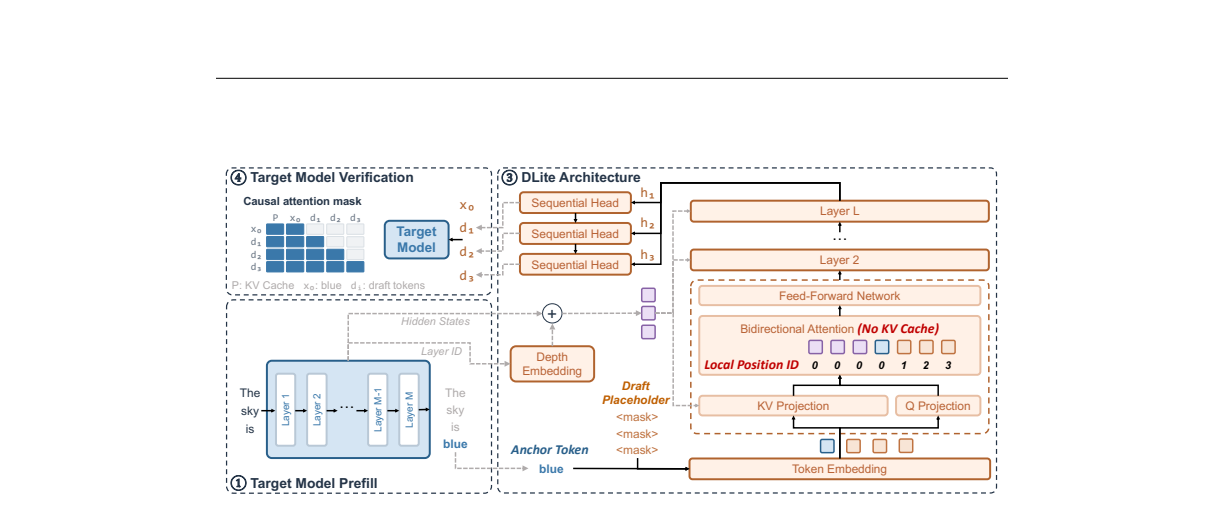
However, agentic workloads introduce long and continuously evolving contexts and frequent multi-turn interactions. Under such workloads, we observe that existing draft models suffer from up to an 80% degradation in acceptance length, while maintaining their historical KV cache introduces substantial system overhead. In this paper, we identify the growing historical context as a common source of both problems and introduce DLite, a history-free speculative decoding framework for agentic AI. DLite directly reuses contextual hidden states from the target model and performs local speculative prediction without explicitly maintaining the historical context, transforming an increasingly complex modeling problem into local simple prediction problem. A lightweight sequential head further restores intra-block causal dependencies with low overhead. To effectively train this heterogeneous history-free architecture, we introduce a tailored two-stage training strategy. Experiments on general-purpose, long-context and agentic workloads show that DLite achieves 2-6 acceptance length and outperforms the state-of-the-art speculative decoding method, DSpark, up to 70%.
from the abstract
Pith says
Machine review · deepseek-v4-flash · 19 Oct 2026 · what was read was not recorded · not checked by a person
It can be wrong. Challenge this review or reply to it.
The passes disagreed. Reader: holds up. Skeptic: holds up only with conditions. Referee: major revision.
A clever history-free drafter that reuses target hidden states; agentic benchmarks need variance reporting. This line is wrong
3 major objections · 5 minor
How often objections from reviews like this one are right: not yet measured
Not checked: figures, code, what the 15 references say.
The paper says, at Section 5.2, Table 3, and Appendix A.2 (last paragraph)
The review did not quote this passage.
Pith says: Objection 1 of 3 · major
The agentic evaluation uses very small sample sizes: 50 prompts for SWE-Bench and AgentLongBench, and 41 sessions for BFCL. No variance or confidence intervals are reported for acceptance length or speedup. Given that the headline claim of up to 70% improvement over DSpark is based on these workloads, the statistical reliability is unconvincing.
more of objection 1
The authors should (a) provide bootstrap confidence intervals or error bars, (b) justify the sample size with a power analysis, or (c) explicitly acknowledge this limitation in the main text and temper the strength of the claim. Without such quantification, it is impossible to assess whether the observed differences reflect true advantage or sampling noise.
The paper says, at Abstract, Section 1, Section 6
The review did not quote this passage.
Pith says: Objection 2 of 3 · major
The paper repeatedly states that DLite 'outperforms DSpark by up to 70%'. From Table 3, the largest relative improvement appears to be on SWE-Bench (Qwen3-4B: speedup 2.68× vs 1.64×, relative ~63%; acceptance length 3.15 vs 1.89, relative ~67%). Neither reaches exactly 70%. Please clarify how the 70% figure is computed, report exact relative improvements for all agentic benchmarks, and ensure the claim is precisely supported by the data.
The paper says, at Section 4.1.2 and Figure 4(a)
The review did not quote this passage.
Pith says: Objection 3 of 3 · major
The lightweight sequential head is described as a 'low-rank RNN-style' module with recurrent state s_T = g_phi(s_{T-1}, E(x_{t+T-1})), but the specific parameterization of g_phi (e.g., GRU, LSTM, simple linear recurrence) and the dimension of the recurrent state are omitted. This insufficient detail hinders reproducibility. Please provide the exact formulation, the hidden dimension of the recurrent step, and any nonlinearities used.
5 minor objections
The paper says, at Figure 1(b)
Pith says: minor objection 1 of 5
The bars for EAGLE, DFlash, and DSpark are hard to distinguish. Consider using different colors or patterns, or a larger figure, to improve readability.
The paper says, at Abstract
Pith says: minor objection 2 of 5
Typo: 'into local simple prediction problem' should be 'into a simple local prediction problem'.
show 3 more
The paper says, at Appendix A.2 (last paragraph)
Pith says: minor objection 3 of 5
The reference for AgentLongBench appears in the text but the citation formatting in the appendix may be incomplete (e.g., 'Xuanjing Huang' listed as a separate author). Please verify that all author names are correct.
The paper says, at Section 5.3 and Table 5
Pith says: minor objection 4 of 5
The terms 'sequence-wise concatenation' and 'feature-wise concatenation' are defined in the text but a small diagram illustrating how hidden states are composed would aid understanding. Additionally, consider adding a brief definition of 'sequence-wise' as treating each hidden state as a separate input token.
The paper says, at Section 4.1.1, Eq. (2)
Pith says: minor objection 5 of 5
The depth embedding e^{(l)}_{depth} is introduced but its initialization method is not stated. Please specify how these embeddings are initialized (e.g., random normal, zero).
What would settle it
Compute bootstrapped 95% confidence intervals for acceptance length on the SWE-Bench 50-prompt subset for both DLite and DSpark. If the intervals overlap, the improvement is not statistically significant and the 'up to 70%' claim should be downgraded. If they do not overlap, report the intervals to quantify uncertainty.
from the skeptic's reading
How the review went
4 readings by deepseek-v4-flash · 19 Oct 2026
- Reader holds up
- Skeptic partly agrees: says it holds up only with conditions Agentic evaluation results rely on only 50 prompts per benchmark without error bars; the claimed 'up to 70%' improvement may not be statistically significant.
- Editor wrote the verdict above
- Referee major revision: 3 major objections, 5 minor
Not run on this paper: the simulated authors' defence.
Pith did not check this review's objections against the paper.
The review in full
The review in brief, machine-written
The core idea is simple and effective: instead of making the draft model reconstruct the full history, DLite draws on the target model's hidden states and does only local prediction. That's genuinely new among speculative decoding papers I've seen, and it sidesteps the 80% acceptance-length degradation that existing drafters suffer on long contexts. The architecture – parallel backbone plus a lightweight sequential head operating in hidden space – is well motivated, and the two-stage training (isomorphic teacher then direct distillation) addresses the structural mismatch cleanly.
The experimental work is thorough for a systems paper: two model sizes (4B, 8B), seven general benchmarks, four long-context subsets, four agentic tasks, and high-concurrency throughput. They release code and models, they ablate the key design choices (number of hidden states, composition, head rank), and they show that the history-free drafter eventually matches a version with a 512-token sliding cache. That is solid engineering evidence.
The soft spot is statistical. The agentic results – where the largest gains are claimed – come from small samples: 50 prompts for SWE-Bench and AgentLongBench, 41 sessions for BFCL. The paper reports no confidence intervals. The authors do disclose these counts in the appendix, which is honest, but they do not discuss whether the observed differences could be noise. The stress-test note is right to flag this. I don't think it invalidates the paper – the gains are large and consistent across tasks – but it means the 'up to 70%' number carries unquantified uncertainty. A minor revision should add error bars (boostrap or repeated runs with different seeds) for those benchmarks.
Overall: This is a solid contribution to an active area. The idea is clean, the ablation is convincing, and the system-level gains (no draft KV-cache overhead) are real even when acceptance lengths are similar. I'd send it to a serious referee; the agentic statistics are a fixable weakness, not a fatal one.
Who is it for? Researchers working on efficient LLM inference, especially for agentic or long-context workloads. Would I cite it? Yes, for the design pattern.
Recommendation: Accept with minor revision, requesting variance estimates on the agentic benchmarks.
The strongest objection
The central claim of up to 70% improvement over DSpark on agentic workloads is quantified in Table 3. The appendix (last paragraph) reveals that for SWE-Bench and AgentLongBench only 50 prompts are used (40K–64K input tokens). For BFCL, 41 sessions are used. The paper reports zero variance or confidence intervals. Without such statistical characterization, it is impossible to know whether the observed differences reflect true advantage or sampling noise. Given that these are precisely the workloads where the improvement is largest, the headline claim rests on an unquantified uncertainty. This does not invalidate the paper, but it weakens the evidential support for the strongest claim.
The reader acknowledged the small sample sizes and lack of variance reporting as weaknesses but still accepted the paper with high confidence. I view this as the single most load-bearing concern because the headline improvement on agentic tasks is the most novel and practically significant claim. If the improvement is not statistically robust, the core performance advantage weakens. However, the paper's architecture and training strategy remain well-motivated and supported by ablation studies and larger benchmarks. Therefore, a conditional acceptance—requiring the authors to provide confidence intervals or replicate on larger samples for the agentic benchmarks—strikes the right balance between recognizing the contribution and demanding proper statistical rigor.
The referee's report
If the results are robust, DLite addresses a genuine bottleneck in speculative decoding for agentic inference, where context grows rapidly and multi-turn interactions cause existing drafters to degrade. The idea of decoupling historical-context modeling from speculation by reusing target hidden states is well-motivated and the architecture is carefully ablated. The open release of code and models strengthens reproducibility and practical impact. However, the strongest performance claims rest on agentic evaluations with small sample sizes, which limits the confidence one can place in the exact improvement percentages.
Pith's reading of the paper (a machine's summary, not the authors')
Speculative decoding accelerates LLM inference by having a lightweight draft model generate candidate tokens verified by the target model. However, in agentic workloads with long, continuously growing contexts, existing draft models suffer up to 80% degradation in acceptance length and incur substantial KV-cache overhead. DLite addresses both problems by directly reusing the target model's hidden states as contextual features, transforming speculative prediction from growing-history modeling into a local problem. A lightweight sequential head restores intra-block causal dependencies, and a two-stage training strategy bridges the structural mismatch between the history-free drafter and the target model. Experiments show DLite achieves 2-6 acceptance length and outperforms DSpark by up to 70% while eliminating draft KV-cache maintenance.
What carries the argument. The central mechanism is a history-free parallel backbone that takes target hidden states (from selected layers) plus local position information to produce draft token representations for all speculative positions in one pass. A lightweight low-rank RNN-style sequential head then restores intra-block causal dependencies directly in the hidden space, avoiding expensive full-vocabulary projections. The architecture is trained with a two-stage strategy: first using an isomorphic history-aware teacher as an intermediate distillation target, then directly aligning with the target model via cross-entropy and total-variation losses.
Core claim. DLite demonstrates that removing the draft model's need to independently encode and maintain historical context—by instead consuming the target model's already-computed hidden states—can simultaneously improve speculative decoding quality and system efficiency. The key discovery is that the draft model's limited capacity is better spent on local prediction around the current decoding position rather than on reconstructing the full history, especially under long-context agentic workloads. This principle yields up to 70% improvement over the state-of-the-art semi-autoregressive drafter DSpark and completely eliminates historical draft KV-cache maintenance.
The premise it rests on. Target model hidden states carry enough information for a lightweight draft model to accurately predict tokens locally, without explicitly processing the historical context.
If the paper is right (Pith's inferences, not the authors')
Agentic AI systems (coding agents, web search agents, etc.) can achieve higher inference throughput with identical target model quality, since DLite adds no draft KV-cache maintenance latency.
The history-free design simplifies serving infrastructure by eliminating the need to store and update a separate draft KV cache across multi-turn interactions.
DLite's acceptance length advantage grows with context length, making it particularly attractive for long-context agentic workloads where conventional drafters degrade.
The two-stage training strategy may serve as a general recipe for distilling heterogeneous architectures where direct distribution matching is difficult.
The reuse of target hidden states may extend beyond speculative decoding to other forms of lightweight generation, such as early-exit or layer-skipping decoding, where a small module predicts from intermediate representations.
The approach suggests a broader design principle: rather than replicating computation in a lightweight model, one can expose intermediate representations of a larger model to auxiliary tasks, shifting the bottleneck from model capacity to representation transfer.
If target hidden states are found to carry sufficient information for local prediction across diverse tasks, speculative decoding systems could be further simplified by eliminating the draft model's own transformer backbone entirely, relying solely on a learned head over target states.
Check this review
Pith stored no record of this review's passes and took no fingerprint of it. Reviews made by code from 13 Nov 2026 on carry both.
How often reviews like this one are right
Reviews like this one: written by deepseek-v4-flash, where what was read was not recorded.
How often objections from reviews like this one are right: not yet measured
Reviews by people
This review was written by a machine. No person has reviewed this paper on Pith yet. A scientist listed on Pith can review it for a fee, and their review is published here whatever it concludes.
The paper
Abstract
Speculative decoding has become a mainstream technique for accelerating large language model (LLM) inference by using a lightweight draft model to generate candidate tokens that are subsequently verified by the target model. However, agentic workloads introduce long and continuously evolving contexts and frequent multi-turn interactions. Under such workloads, we observe that existing draft models suffer from up to an 80% degradation in acceptance length, while maintaining their historical KV cache introduces substantial system overhead. In this paper, we identify the growing historical context as a common source of both problems and introduce DLite, a history-free speculative decoding framework for agentic AI. DLite directly reuses contextual hidden states from the target model and performs local speculative prediction without explicitly maintaining the historical context, transforming an increasingly complex modeling problem into local simple prediction problem. A lightweight sequential head further restores intra-block causal dependencies with low overhead. To effectively train this heterogeneous history-free architecture, we introduce a tailored two-stage training strategy. Experiments on general-purpose, long-context and agentic workloads show that DLite achieves 2-6 acceptance length and outperforms the state-of-the-art speculative decoding method, DSpark, up to 70%.
The paper's own sentences, arranged, kept beside the review and separate from it. Each label is drawn from a closed vocabulary; the number beside it is the probability the classifier gave that label. No sentence in this record was written by a model.
abstract compiled · 2026-10-20
The authors' main claim, as the classifier picked it out 0.99
“Experiments on general-purpose, long-context and agentic workloads show that DLite achieves 2-6 acceptance length and outperforms the state-of-the-art speculative decoding method, DSpark, up to 70%.”
How the main claim is stated: asserted 1.00
What the abstract itself states, as probabilities: claims first 0.09 · states limitation 0.09 · human participants 0.03 · controlled comparison 0.82 · randomized assignment 0.01 · states quantitative result 0.99 · compares with prior results 0.98 · mentions code or data availability 0.03
The abstract, sentence by sentence
This table labels the abstract only (arXiv listing abstract v1). The number is the probability the classifier gave the label.
| Sentence | Role | The authors' own work | States the main conclusion | Strength |
|---|---|---|---|---|
| Speculative decoding has become a mainstream technique for accelerating large language model (LLM) inference by using a lightweight draft model to generate candidate tokens that are subsequently verified by the target model. | background 1.00 | 0.04 | 0.02 | asserted 1.00 |
| However, agentic workloads introduce long and continuously evolving contexts and frequent multi-turn interactions. | background 0.98 | 0.10 | 0.02 | asserted 0.99 |
| Under such workloads, we observe that existing draft models suffer from up to an 80% degradation in acceptance length, while maintaining their historical KV cache introduces substantial system overhead. | result 0.57 | 0.84 | 0.05 | asserted 1.00 |
| In this paper, we identify the growing historical context as a common source of both problems and introduce DLite, a history-free speculative decoding framework for agentic AI. | contribution 0.99 | 0.88 | 0.31 | asserted 1.00 |
| DLite directly reuses contextual hidden states from the target model and performs local speculative prediction without explicitly maintaining the historical context, transforming an increasingly complex modeling problem into local simple prediction problem. | method 0.93 | 0.87 | 0.20 | asserted 1.00 |
| A lightweight sequential head further restores intra-block causal dependencies with low overhead. | method 0.98 | 0.75 | 0.03 | asserted 1.00 |
| To effectively train this heterogeneous history-free architecture, we introduce a tailored two-stage training strategy. | method 0.86 | 0.92 | 0.04 | asserted 0.98 |
| Experiments on general-purpose, long-context and agentic workloads show that DLite achieves 2-6 acceptance length and outperforms the state-of-the-art speculative decoding method, DSpark, up to 70%. | result 1.00 | 0.95 | 0.75 | asserted 1.00 |
What kind of paper the classifier reports this is: method or tool 1.00 · evidence from observation or experiment 1.00
What was examined, and what was not
Sources read
- arXiv listing abstract v1
Not examined
- full text
- figures and tables
- references and citing sentences
- relations to other papers
Levels run
- P abstract
Not run
- S sections
- T body sentences
- C citations
- R cross-paper relations
How the labels were made
Compiled by classifier-1.13.0 via TypeSafe API, question bank abstract-p1-20260923, 2026-10-20: 1 request, 6,251 input tokens.
Every quoted sentence on this record is the authors'. Every label is from Pith's closed vocabulary, with the probability shown beside it. This record as JSON
Figures (5)




Figures are the authors', reproduced from the paper.
References (15)
- [4] URLhttps://arxiv.org/abs/ 2601.20730. Ke Hong, Guohao Dai, Jiaming Xu, Qiuli Mao, Xiuhong Li, Jun Liu, Kangdi Chen, Yuhan Dong, and Yu Wang. Flashdecoding++: Faster large language model inference with asynchronization, flat gemm optimization, and heuristics.Proceedings of Mach... on PitharXiv
- [5] 10 Jianuo Huang, Yaojie Zhang, Qituan Zhang, Hao Lin, Hanlin Xu, and Linfeng Zhang. Domino: Decoupling causal modeling from autoregressive drafting in speculative decoding.arXiv preprint arXiv:2605.29707, on PithPith's reviewarXiv
- [6] inco.ai. Dflash 2: Keep drafting parallel. [Online], 2026.https://inco.ai/blog/ dflash2/. Naman Jain, Alex Gu, Wen-Ding Li, Fanjia Yan, Tianjun Zhang, Sida Wang, Armando Solar- Lezama, Koushik Sen, and Ion Stoica. Livecodebench: Holistic and contamination free evalua- tion of ... on Pith
- [8] Hunter Lightman, Vineet Kosaraju, Yura Burda, Harri Edwards, Bowen Baker, Teddy Lee, Jan Leike, John Schulman, Ilya Sutskever, and Karl Cobbe. Let’s verify step by step.arXiv preprint arXiv:2305.20050, on PithPith's reviewarXiv
- [9] Xiao Liu, Hao Yu, Hanchen Zhang, Yifan Xu, Xuanyu Lei, Hanyu Lai, Yu Gu, Hangliang Ding, Kaiwen Men, Kejuan Yang, et al. Agentbench: Evaluating llms as agents. InInternational Conference on Learning Representations, volume 2024, pp. 52989–53046, on Pith
- [11] 11 Anyi Xu, Bangcai Lin, Bing Xue, Bingxuan Wang, Bingzheng Xu, Bochao Wu, Bowei Zhang, Chaofan Lin, Chen Dong, Chenchen Ling, et al. Deepseek-v4: Towards highly efficient million- token context intelligence.arXiv preprint arXiv:2606.19348, on PitharXiv
- [12] Tengyu Xu, Eryk Helenowski, Karthik Abinav Sankararaman, Di Jin, Kaiyan Peng, Eric Han, Shao- liang Nie, Chen Zhu, Hejia Zhang, Wenxuan Zhou, et al. The perfect blend: Redefining rlhf with mixture of judges.arXiv preprint arXiv:2409.20370, on PithPith's reviewarXiv
- [13] Yaojie Zhang, Linfeng Zhang, Bin Cui, and Xupeng Miao. Dflow: Enabling verifier information flow in block diffusion speculative decoding.arXiv preprint arXiv:2609.06498, on PithPith's reviewarXiv
- [14] Zixuan Zhou, Xuefei Ning, Ke Hong, Tianyu Fu, Jiaming Xu, Shiyao Li, Yuming Lou, Luning Wang, Zhihang Yuan, Xiuhong Li, et al. A survey on efficient inference for large language models.arXiv preprint arXiv:2404.14294, on PithPith's reviewarXiv
- [512] Bold indicates the configuration adopted in the final model. Dimension Configuration Alpaca GSM8K MBPP Multi-Doc QA Avg.τ Target Hidden States 7 2.34 4.36 3.63 2.22 3.14 9 2.42 4.40 3.75 2.24 3.20 14 2.63 4.53 3.76 2.28 3.30 20 2.62 4.55 3.74 2.26 3.29 36 2.58 4.51 3.71 2.26 3... on Pith
- [2021] Xin Cheng, Xingkai Yu, Chenze Shao, Jiashi Li, Yunfan Xiong, Yi Qian, Jiaqi Zhu, Shirong Ma, Xiaokang Zhang, Jiasheng Ye, et al. Dspark: Confidence-scheduled speculative decoding with semi-autoregressive generation.arXiv preprint arXiv:2607.05147, on PithPith's reviewarXiv
- [2023] Jinhao Li, Jiaming Xu, Shan Huang, Yonghua Chen, Wen Li, Jun Liu, Yaoxiu Lian, Jiayi Pan, Li Ding, Hao Zhou, et al. Large language model inference acceleration: A comprehensive hard- ware perspective.arXiv preprint arXiv:2410.04466, on PithPith's reviewarXiv
- [2024] Association for Computational Linguistics. doi: 10.18653/v1/ 2024.acl-long.172. URLhttps://aclanthology.org/2024.acl-long.172. Jian Chen, Yesheng Liang, and Zhijian Liu. Dflash: Block diffusion for flash speculative decoding. arXiv preprint arXiv:2602.06036, on PithPith's reviewarXiv
- [2025] URLhttps://huggingface.co/datasets/nvidia/ Nemotron-Post-Training-Dataset-v2. NVIDIA. Co-designing ai models using speculative decoding for faster llm in- ference. [Online], 2026.https://developer.nvidia.com/blog/ co-designing-ai-models-using-speculative-decoding-for-faster-ll... on Pith
- [2026] Karl Cobbe, Vineet Kosaraju, Mohammad Bavarian, Mark Chen, Heewoo Jun, Lukasz Kaiser, Matthias Plappert, Jerry Tworek, Jacob Hilton, Reiichiro Nakano, et al. Training verifiers to solve math word problems.arXiv preprint arXiv:2110.14168, on PithPith's reviewarXiv
Cited by 3 Pith papers
Reviewed papers on Pith that cite this one. The full citation record
- DFly2: Turbocharging Long-Context Speculative Decoding by Sharing the Target's Sparsity cs.CL · Nov 2026
- TraceSpec: Understanding and Improving Speculative Decoding for LLM Agents cs.CL · Oct 2026
- LEGOSpec: A Composable and Efficient Framework for Speculative Draft Design and Training cs.LG · Nov 2026
Challenges and discussion
Disagree with the review, or know something it missed? Leave a comment, or challenge this review formally: a challenge becomes a permanent entry in this paper's record, and its decision is published here.
Come back by email
A short list of the week's newly reviewed papers. Nothing is sent until you confirm from your inbox, and every email has a link that stops it. No account.
No comments yet.
Sign in to comment