Computation and Language · arXiv:2611.34776 v1 · submitted 25 Nov 2026 · 29 references
DFly2: Turbocharging Long-Context Speculative Decoding by Sharing the Target's Sparsity
The paper says
“To avoid the quadratic cost of dense attention over long contexts, models such as DeepSeek-V4 and Hy4 have turned natively sparse, and speculative decoding, which matters most where decoding is slowest, increasingly runs on them.”
more of the abstract
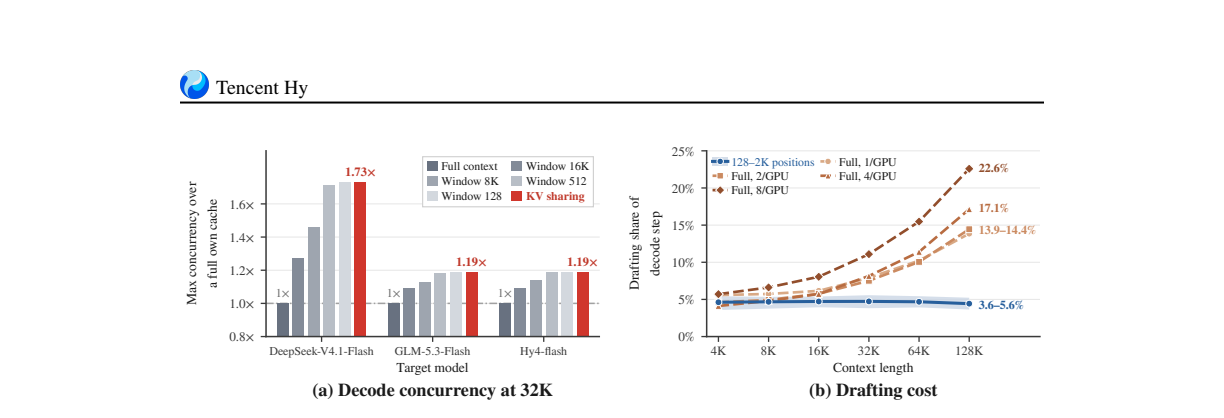
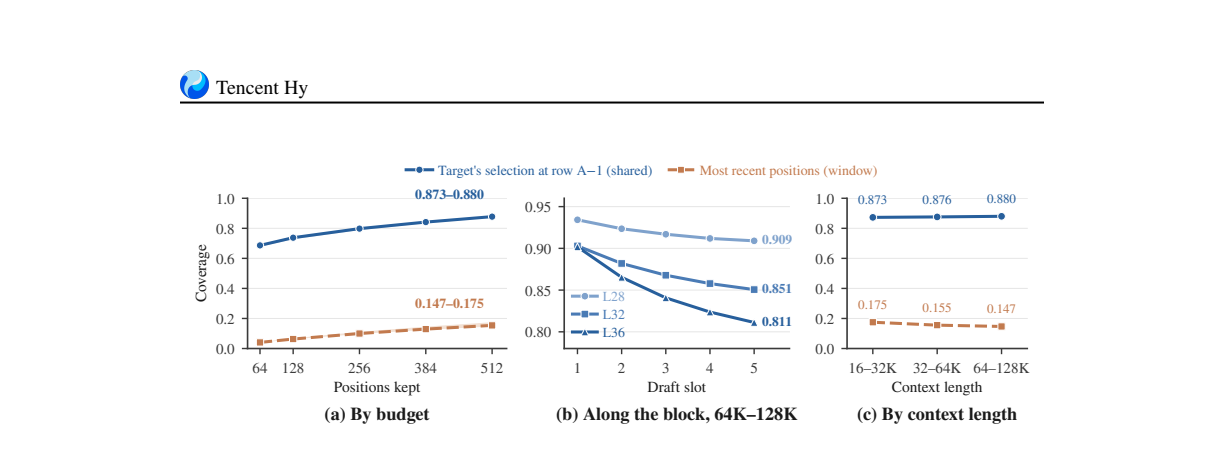
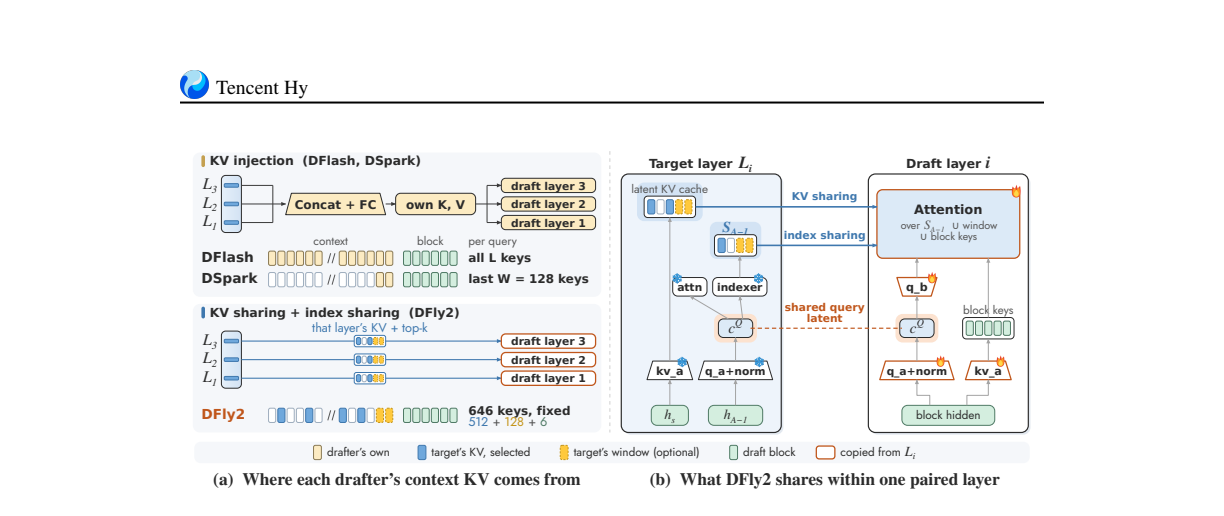
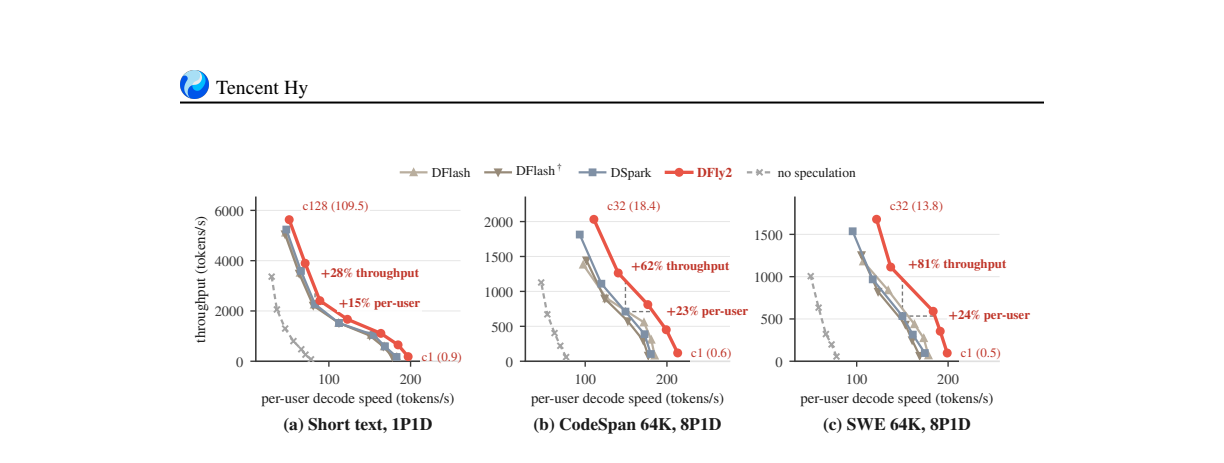
Their drafters, however, still keep a context cache of their own, over the whole prompt or a sliding window. Beyond memory, such a cache costs prefill time, prefix-cache hits and decode concurrency. Drafters that read the target's cache avoid one of their own, but settle only which cache, not which positions, and still read everything or a recent window. Neither rule is made for the query at hand, and computing a selection per query in the drafter would cost more as the context grows. Yet a natively sparse target already picks positions for each query, over a cache it keeps anyway. Both of the drafter's choices are therefore already made, and paid for, by the target: its cache and its selection. We measure how far one selection carries: made a step early, it still covers close to nine tenths of what each later token selects on DS-V4.1-Flash. We present DFly2, a block-parallel drafter that shares the target's sparsity. Each draft layer reads the KV its paired target layer cached (KV sharing), at the positions that layer's indexer selected, a fixed number anywhere in the context (Index sharing). DFly2 thus runs no scoring pass and keeps no cache of its own. On DS-V4.1-Flash, GLM-5.3-Flash and Hy4 flash, whose sparse attention and architecture differ, it accepts more tokens per step than DFlash and DSpark trained on the same recipe, over general, long-context and agentic benchmarks. Its margin over the stronger baseline widens from 3.9%-10.5% on general workloads to 10.0%-31.5% on long-context and agentic ones. At high concurrency on DS-V4.1-Flash, at matched per-user decode speed, its throughput is 62% and 81% higher on two 64K sets.
from the abstract
Pith says
Machine review · deepseek-v4-flash · 26 Nov 2026 · read the full text (103,081 characters) · not checked by a person
It can be wrong. Challenge this review or reply to it.
Holds up, with conditions. DFly2 reuses the target's own sparse attention selection to guide its drafter, achieving consistent gains in accepted token length across three natively sparse models. This line is wrong
6 minor · 2 open questions
How often objections from reviews like this one are right: not yet measured
The paper, first character to last
The reviewer was given the whole text, 103,081 characters. Not checked: figures, code, what the 29 references say.
6 minor objections
The paper says, at 1
Pith says: minor objection 1 of 6
Section 1, paragraph 2: The phrase 'settle only which cache, not which positions' is unclear; consider rephrasing to clarify that the drafter decides which cache to read but not which positions within it.
The paper says, at 3.3
Pith says: minor objection 2 of 6
Section 3.3: The explanation that 'the energy of an index query sits almost entirely in its low-frequency RoPE components' is not supported by any experiment or citation. Consider adding a reference or removing the claim.
show 4 more
The paper says, at 5.4
Pith says: minor objection 3 of 6
Table 5: The row labelled 'w/o sharing (own cache)' is not an ablation of DFly2 but a comparison to a different method (a drafter with its own cache). Consider renaming it to 'Own cache (like DFlash)' for clarity.
The paper says, at 1
Pith says: minor objection 4 of 6
The paper uses 'Hy4~flash' with a tilde; ensure consistent formatting throughout the manuscript.
The paper says, at 4
Pith says: minor objection 5 of 6
Equation 7 in Section 4: The notation $C^{L_i}_{R_i}$ is used but not defined until later in the same paragraph. Consider defining it immediately after the equation for clarity.
The paper says, at 4
Pith says: minor objection 6 of 6
Section 4, paragraph on intra-block correction: The phrase 'returns to the context' is ambiguous. Clarify that the correction reads the context again.
Open questions (2)
Pith raised these and could not confirm them against the text of the paper it read. They are questions for the authors, not findings.
- 3.3 Can the authors provide coverage measurements (Eq. 3) for GLM-5.3-Flash and Hy4 flash to validate the assumption that the target's selection holds across the block on those architectures?
- 5.1 Can the authors commit to releasing the code and data, or provide a detailed recipe for the DFly-SFT mixture and preprocessing to enable independent replication?
What would settle it
If coverage (Eq. 3) on GLM-5.3-Flash or Hy4 flash were significantly lower than on DS-V4.1-Flash, the assumption that the target's selection holds across the block would fail and DFly2's advantage over window-based drafters would diminish. The paper does not provide such measurements.
from Pith's summary of the paper
How the review went
5 passes by deepseek-v4-flash · 26 Nov 2026
- Reader holds up, with conditions
- Skeptic concern not confirmed: listed as an open question
- Referee 6 minor
- Check against the paper kept 0 of 3 objections
- Editor wrote the verdict above
Not run on this paper: the simulated authors' defence.
Pith's passes raised 3 objections. A check against the paper's text kept 0 and left 3 as questions.
The review in full
The review in brief, machine-written
The paper's core idea is simple and effective: a natively sparse target already selects which positions to attend to; DFly2's drafter reads the target's KV cache at those same positions, avoiding its own cache and scoring pass. This is novel and well-motivated. The experiments are thorough: three different sparse architectures, multiple benchmarks, ablations. The gains are real: 3.9–10.5% on general workloads, 10–31.5% on long-context and agentic ones. The analysis of why the selection carries across a block is convincing. The paper also shows that the gains translate to throughput improvements at high concurrency. The ablation studies isolate the contributions of KV sharing, index sharing, initialization, and intra-block correction. The method works across targets with different sparse attention variants, which strengthens the claim that the design is general. The soft spots are moderate. The coverage measurement (Fig 3) is only on DS-V4.1-Flash; the paper assumes it holds for other targets. The training data (DFly-SFT) is not publicly available, and the code is not released. These limit reproducibility. However, the paper acknowledges the assumption, and the results are consistent across targets, so the concern is not fatal. The paper deserves a serious referee. The idea is clean, the evaluation is solid, and the gains are practically meaningful. The main recommendation is to release code and data to strengthen the contribution and enable independent verification.
The stress test's concern
Not confirmed. Pith could not check this concern against the text of the paper it was given; it is listed as an open question, not a finding.
The referee's report
Not published. Pith's referee wrote this assessment before its objections were checked against the paper, and 2 of its 2 major objections did not survive that check.
Pith's reading of the paper (a machine's summary, not the authors')
Speculative decoding speeds up language model inference by having a small drafter propose tokens that a target model verifies. Existing block-parallel drafters keep their own KV cache and read positions chosen by fixed rules, which adds memory cost and limits reach on long contexts. The paper's insight is that natively sparse target models already compute a query-aware selection of positions and maintain a compact KV cache. DFly2 shares both: each draft layer reads the target's cached KV at the positions the target's indexer selected. This eliminates the drafter's own cache and scoring pass, and the selection largely holds across a block. On three sparse targets, DFly2 accepts more tokens per step than DFlash and DSpark trained on the same recipe, with margins of 3.9%-10.5% on general workloads and 10.0%-31.5% on long-context and agentic workloads. At high concurrency, it delivers 62% and 81% more throughput on 64K sets.
What carries the argument. The central mechanism is sharing the target's sparsity: each draft layer reads the KV cache of a paired target layer (KV sharing) at the positions that layer's indexer selected (Index sharing). The selection is a fixed-size top-k from anywhere in the context, made by the target's sparse attention. The drafter runs no scoring pass and keeps no cache of its own. Two additions are a last-layer hidden state injection and an intra-block correction that rereads the shared context.
Core claim. The central claim is that a block-parallel drafter for natively sparse language models can reuse the target model's own sparse attention selection and KV cache, avoiding the need for a separate drafter-side cache and selection mechanism. The paper argues that the target's top-k selection, made one step before the block, covers close to nine tenths of what later tokens in the block would select, and that this holds across three different sparse architectures. DFly2 implements this by pairing each draft layer with a target layer, reading its cached KV at the positions its indexer selected, and initializing weights from that layer. The result is higher accepted token length than DFlash and DSpark, especially on long contexts where the drafter's own cache would be costly or limited.
The premise it rests on. The assumption that the target's sparse attention selection, made one step before the block, still covers most of what later tokens in the block would select. The paper measures this on DS-V4.1-Flash (coverage close to nine tenths) but assumes it holds for other targets without direct measurement.
If the paper is right (Pith's inferences, not the authors')
If DFly2's approach is correct, speculative decoding on natively sparse models can be made more efficient by eliminating the drafter's own KV cache, reducing prefill time and memory overhead.
The method's length generalization suggests that drafters can handle contexts far longer than their training length by relying on the target's selection, which is bounded and query-aware.
The design applies to any natively sparse model with a trained indexer, as demonstrated on three different architectures (DS-V4.1-Flash, GLM-5.3-Flash, Hy4 flash).
At high concurrency, the throughput gains from sharing the target's cache compound because the drafter does not consume additional memory per request, allowing more concurrent requests.
The paper's coverage measurement (Eq. 3) is only reported for DS-V4.1-Flash. An independent replication on GLM-5.3-Flash and Hy4 flash would test whether the assumption that the target's selection holds across the block generalizes to those architectures.
The method assumes the target's indexer selection is available at the start of the block. In a disaggregated serving setup, this requires the verify pass to communicate the selection to the drafter, which the paper does not discuss in detail.
The training data DFly-SFT is a mixture of public datasets; the paper does not release it. Reproducing the results would require access to a similar mixture or the authors' release.
Check this review
What was read
The passes were given all 103,081 characters of the paper's LaTeX source.
Fingerprint of that text (SHA-256): cd06be9ed5bf7f0bca2bf342561823e4f515c7416ac4c879e5a6d90149710984
Pith does not keep that text. Rebuilt from the paper's source or PDF by the same code, it has this fingerprint if it is the same text. From a copy of Pith's code:
PYTHONPATH=. python scripts/review_input_check.py 2611.34776
The passes, in the order they ran
- Reader deepseek-v4-flash · medium effort · $0.0037 · instructions of the Reader, fingerprint f9ead7300382…
- Skeptic deepseek-v4-flash · medium effort · $0.0031 · instructions of the Skeptic, fingerprint 8f88c0f61488…
- Referee deepseek-v4-flash · medium effort · $0.0035 · instructions of the Referee, fingerprint a852d99aea0d…
- Check against the paper deepseek-v4-flash · medium effort · $0.0037 · instructions of the Check against the paper, fingerprint 6c7a6883d551…
- Editor deepseek-v4-flash · medium effort · $0.0031 · instructions of the Editor, fingerprint e7211f6a3d27…
- Circularity check deepseek-v4-flash · medium effort · $0.0029 · instructions of the Circularity check, fingerprint e9946e39d67b…
- Summary for the page deepseek-v4-flash · medium effort · temperature 0.2 · $0.0035 · instructions of the Summary for the page, fingerprint e4f56bf568e7…
The passes cost $0.023 in model calls together.
Version stamped on this review: pith-pipeline@v1.4.1-daily-deepseek-or-medium+deepseek/deepseek-v4-flash+p.d60f54226f00
Each link opens a pass's instructions as plain text, the exact bytes its fingerprint was taken over. Every stored set of instructions.
curl -s https://pith.science/methodology/prompts/f9ead730038216984cfb56d7cb34332bdf691828296a1de4245f3d6667d4bf56 | sha256sum
prints the fingerprint of the reader's instructions. The same works for every pass.
The receipt
The review's fingerprint was taken on 26 Nov 2026. The review you are reading still matches it.
Fingerprint of the review (SHA-256): fb44cead61abfca9c26b3e5d48660c15dc8daa9528650ea5811a4074292af198
curl -s 'https://pith.science/api/v1/verdicts/2611.34776?form=canonical' | sha256sum
prints the fingerprint of the review as it stands now. The rule, in four steps.
A matching fingerprint shows the review has not changed since that date. It does not show that the review is right.
How often reviews like this one are right
Reviews like this one: written by deepseek-v4-flash, from the paper's LaTeX source.
How often objections from reviews like this one are right: not yet measured
Reviews by people
This review was written by a machine. No person has reviewed this paper on Pith yet. A scientist listed on Pith can review it for a fee, and their review is published here whatever it concludes.
The paper
Abstract
To avoid the quadratic cost of dense attention over long contexts, models such as DeepSeek-V4 and Hy4 have turned natively sparse, and speculative decoding, which matters most where decoding is slowest, increasingly runs on them. Their drafters, however, still keep a context cache of their own, over the whole prompt or a sliding window. Beyond memory, such a cache costs prefill time, prefix-cache hits and decode concurrency. Drafters that read the target's cache avoid one of their own, but settle only which cache, not which positions, and still read everything or a recent window. Neither rule is made for the query at hand, and computing a selection per query in the drafter would cost more as the context grows. Yet a natively sparse target already picks positions for each query, over a cache it keeps anyway. Both of the drafter's choices are therefore already made, and paid for, by the target: its cache and its selection. We measure how far one selection carries: made a step early, it still covers close to nine tenths of what each later token selects on DS-V4.1-Flash. We present DFly2, a block-parallel drafter that shares the target's sparsity. Each draft layer reads the KV its paired target layer cached (KV sharing), at the positions that layer's indexer selected, a fixed number anywhere in the context (Index sharing). DFly2 thus runs no scoring pass and keeps no cache of its own. On DS-V4.1-Flash, GLM-5.3-Flash and Hy4 flash, whose sparse attention and architecture differ, it accepts more tokens per step than DFlash and DSpark trained on the same recipe, over general, long-context and agentic benchmarks. Its margin over the stronger baseline widens from 3.9%-10.5% on general workloads to 10.0%-31.5% on long-context and agentic ones. At high concurrency on DS-V4.1-Flash, at matched per-user decode speed, its throughput is 62% and 81% higher on two 64K sets.
The paper's own sentences, arranged, kept beside the review and separate from it. Each label is drawn from a closed vocabulary; the number beside it is the probability the classifier gave that label. No sentence in this record was written by a model.
abstract compiled · 2026-11-26
The authors' main claim, as the classifier picked it out 0.90
“On DS-V4.1-Flash, GLM-5.3-Flash and Hy4~flash, whose sparse attention and architecture differ, it accepts more tokens per step than DFlash and DSpark trained on the same recipe, over general, long-context and agentic benchmarks.”
How the main claim is stated: asserted 1.00
What the abstract itself states, as probabilities: claims first 0.08 · states limitation 0.14 · human participants 0.03 · controlled comparison 0.96 · randomized assignment 0.02 · states quantitative result 0.99 · compares with prior results 0.98 · mentions code or data availability 0.03
The abstract, sentence by sentence
This table labels the abstract only (arXiv listing abstract v1). The number is the probability the classifier gave the label.
| Sentence | Role | The authors' own work | States the main conclusion | Strength |
|---|---|---|---|---|
| To avoid the quadratic cost of dense attention over long contexts, models such as DeepSeek-V4 and Hy4 have turned natively sparse, and speculative decoding, which matters most where decoding is slowest, increasingly runs on them. | background 1.00 | 0.04 | 0.04 | asserted 1.00 |
| Their drafters, however, still keep a context cache of their own, over the whole prompt or a sliding window. | background 0.82 | 0.06 | 0.02 | asserted 1.00 |
| Beyond memory, such a cache costs prefill time, prefix-cache hits and decode concurrency. | background 0.93 | 0.13 | 0.02 | asserted 1.00 |
| Drafters that read the target's cache avoid one of their own, but settle only which cache, not which positions, and still read everything or a recent window. | background 0.58 | 0.08 | 0.04 | asserted 1.00 |
| Neither rule is made for the query at hand, and computing a selection per query in the drafter would cost more as the context grows. | gap 0.70 | 0.11 | 0.03 | asserted 0.98 |
| Yet a natively sparse target already picks positions for each query, over a cache it keeps anyway. | background 0.67 | 0.08 | 0.10 | asserted 0.99 |
| Both of the drafter's choices are therefore already made, and paid for, by the target: its cache and its selection. | interpretation 0.55 | 0.21 | 0.26 | asserted 1.00 |
| We measure how far one selection carries: made a step early, it still covers close to nine tenths of what each later token selects on DS-V4.1-Flash. | result 0.98 | 0.95 | 0.09 | asserted 1.00 |
| We present DFly2, a block-parallel drafter that shares the target's sparsity. | contribution 0.98 | 0.85 | 0.26 | asserted 0.99 |
| Each draft layer reads the KV its paired target layer cached (KV sharing), at the positions that layer's indexer selected, a fixed number anywhere in the context (Index sharing). | method 0.97 | 0.77 | 0.17 | asserted 1.00 |
| DFly2 thus runs no scoring pass and keeps no cache of its own. | method 0.88 | 0.75 | 0.11 | asserted 1.00 |
| On DS-V4.1-Flash, GLM-5.3-Flash and Hy4~flash, whose sparse attention and architecture differ, it accepts more tokens per step than DFlash and DSpark trained on the same recipe, over general, long-context and agentic benchmarks. | result 1.00 | 0.92 | 0.45 | asserted 1.00 |
| Its margin over the stronger baseline widens from 3.9%-10.5% on general workloads to 10.0%-31.5% on long-context and agentic ones. | result 1.00 | 0.93 | 0.17 | asserted 1.00 |
| At high concurrency on DS-V4.1-Flash, at matched per-user decode speed, its throughput is 62% and 81% higher on two 64K sets. | result 1.00 | 0.93 | 0.15 | asserted 1.00 |
What kind of paper the classifier reports this is: method or tool 1.00 · evidence from observation or experiment 0.99
What was examined, and what was not
Sources read
- arXiv listing abstract v1
Not examined
- full text
- figures and tables
- references and citing sentences
- relations to other papers
Levels run
- P abstract
Not run
- S sections
- T body sentences
- C citations
- R cross-paper relations
How the labels were made
Compiled by classifier-1.13.0 via TypeSafe API, question bank abstract-p1-20260923, 2026-11-26: 1 request, 10,364 input tokens.
Every quoted sentence on this record is the authors'. Every label is from Pith's closed vocabulary, with the probability shown beside it. This record as JSON
Figures (8)




Figures are the authors', reproduced from the paper.
References (29)
- [1] Jacob Austin, Augustus Odena, Maxwell Nye, Maarten Bosma, Henryk Michalewski, David Dohan, Ellen Jiang, Carrie Cai, Michael Terry, Quoc Le, et al. Program synthesis with large language models.arXiv preprint arXiv:2108.07732, on PithPith's reviewarXiv
- [6] Mark Chen, Jerry Tworek, Heewoo Jun, Qiming Yuan, Henrique Ponde de Oliveira Pinto, Jared Kaplan, Harri Edwards, Yuri Burda, Nicholas Joseph, Greg Brockman, et al. Evaluating large language models trained on code.arXiv preprint arXiv:2107.03374, on PithPith's reviewarXiv
- [7] Xin Cheng, Xingkai Yu, Chenze Shao, Jiashi Li, Yunfan Xiong, et al. DSpark: Confidence-scheduled speculative decoding with semi-autoregressive generation.arXiv preprint arXiv:2607.05147, on PithPith's reviewarXiv
- [8] Karl Cobbe, Vineet Kosaraju, Mohammad Bavarian, Mark Chen, Heewoo Jun, Lukasz Kaiser, Matthias Plappert, Jerry Tworek, Jacob Hilton, Reiichiro Nakano, Christopher Hesse, and John Schulman. Training verifiers to solve math word problems.arXiv preprint arXiv:2110.14168, on PithPith's reviewarXiv
- [9] DeepSeek-AI. DeepSeek-V3.2: Pushing the frontier of open large language models.arXiv preprint arXiv:2512.02556, on PithPith's reviewarXiv
- [10] DeepSeek-AI. DeepSeek-V4: Towards highly efficient million-token context intelligence.arXiv preprint arXiv:2606.19348, on PitharXiv
- [12] Yao Fu, Jiahan Chang, Yueying Li, Ritchie Zhao, Bryce Long, Mohammad Mahdi Kamani, Samkit Jain, Rahul Raman, Tara Safavi, et al. Spin: Shadow predictive indexer for sparse attention.arXiv preprint arXiv:2610.09025, on PithPith's reviewarXiv
- [13] GLM-5 Team. GLM-5: From vibe coding to agentic engineering.arXiv preprint arXiv:2602.15763, on PithPith's reviewarXiv
- [14] Hao-Yuan He, Peng-Fei Liu, Chen Chen, Si Shen, Quan He, Runzhou Liu, et al. Efficient speculative decoding with a fixed-cost parallel drafter.arXiv preprint arXiv:2609.37029, on PithPith's reviewarXiv
- [15] arXiv:2507.05257. Jianuo Huang, Yaojie Zhang, Qituan Zhang, Hao Lin, Hanlin Xu, et al. Domino: Decoupling causal modeling from autoregressive drafting in speculative decoding.arXiv preprint arXiv:2605.29707, on PithPith's reviewarXiv
- [16] Weifan Jiang, Krishna Teja Chitty-Venkata, Megan Flynn, Reed Meyerson, Zhenting Qi, Tianyu Wu, Eldar Kurtic, Minlan Yu, and Alexandre Marques. H-Spec: Parallel speculative decoding without a drafter-side KV cache.arXiv preprint arXiv:2609.24197, on PithPith's reviewarXiv
- [17] Yuhui Li, Fangyun Wei, Chao Zhang, and Hongyang Zhang. EAGLE-3: Scaling up inference acceleration of large language models via training-time test.arXiv preprint arXiv:2503.01840, on PithPith's reviewarXiv
- [18] Luxi Lin, Shuang Peng, Rui Ma, Junhao Hua, Shuwei Fan, Zhengda Qin, et al. HyperDFlash: Hyper-connection-aligned block speculative decoding with gated residual reduction.arXiv preprint arXiv:2606.26744, on PithPith's reviewarXiv
- [19] Changxu Liu and Zhaogeng Li. Adapting tree-structured speculative decoding to DeepSeek-V4 for efficient inference.arXiv preprint arXiv:2609.24698, on PithPith's reviewarXiv
- [20] Hong Liu, Rui Cen, Junhan Shi, Guangshuo Qin, Jiebin Zhang, Tianyu Liu, et al. AngelSpec: Towards real-world high performance inference with speculative decoding.arXiv preprint arXiv:2607.25852, 2026a. Tianyu Liu, Yuhao Shen, Xinyi Hu, Baolin Zhang, Hengxin Zhang, Jun Dai, et ... on PithPith's reviewarXiv
- [21] Chien Van Nguyen, Chaitra Hegde, et al. Orthrus: Memory-efficient parallel token generation via dual-view diffusion.arXiv preprint arXiv:2605.12825, on PithPith's reviewarXiv
- [22] Peer Rheinboldt, Frédéric Berdoz, and Roger Wattenhofer. TreeFlash: Parallel AR-approximation for faster speculative decoding.arXiv preprint arXiv:2606.03819, on PithPith's reviewarXiv
- [23] Alexander Samarin, Sergei Krutikov, Anton Shevtsov, Sergei Skvortsov, Filipp Fisin, and Alexander Golubev. LK losses: Direct acceptance rate optimization for speculative decoding.arXiv preprint arXiv:2602.23881, on PithPith's reviewarXiv
- [24] – 19 – Tencent Hy Hanshi Sun, Zhuoming Chen, Xinyu Yang, Yuandong Tian, and Beidi Chen. TriForce: Lossless acceleration of long sequence generation with hierarchical speculative decoding. InConference on Language Modeling (COLM), 2024a. Yutao Sun, Li Dong, Yi Zhu, Shaohan Huan... on PithPith's reviewarXiv
- [25] Version 1 appeared as SpecSA. Tianyu Wu, Yu Yao, Zhenting Qi, Han Zheng, Zhuohan Wang, Haoran Ma, Lawrence Liao, Himabindu Lakkaraju, Ju Li, and Yilun Du. D-PACE: Dynamic position-aware cross-entropy for parallel speculative drafting.arXiv preprint arXiv:2605.18810, on PithPith's reviewarXiv
show 9 more
- [26] Jiaming Xu, Hanzhen Wang, Tianlang Zhao, Jiewen Xiao, Chengze Yuan, et al. DLite: History-free speculative decoding for agentic AI.arXiv preprint arXiv:2610.23787, on PithPith's reviewarXiv
- [27] Penghui Yang, Cunxiao Du, Fengzhuo Zhang, Haonan Wang, Tianyu Pang, Chao Du, and Bo An. LongSpec: Long-context lossless speculative decoding with efficient drafting and verification.arXiv preprint arXiv:2502.17421, on PithPith's reviewarXiv
- [28] Jingyang Yuan, Huazuo Gao, Damai Dai, Junyu Luo, Liang Zhao, Zhengyan Zhang, Zhenda Xie, Y . X. Wei, Lean Wang, et al. Native sparse attention: Hardware-aligned and natively trainable sparse attention.arXiv preprint arXiv:2502.11089, on PithPith's reviewarXiv
- [29] arXiv:2602.07223; version 1 appeared as SpecAttn. Jiebin Zhang, Zhenghan Yu, Song Liu, Eugene J. Yu, Zheng Li, et al. DFlare: Scaling up draft capacity for block diffusion speculative decoding.arXiv preprint arXiv:2606.02091, on PithPith's reviewarXiv
- [2021] Yushi Bai, Qian Dong, Ting Jiang, Xin Lv, Zhengxiao Du, Aohan Zeng, Jie Tang, and Juanzi Li. IndexCache: Accelerating sparse attention via cross-layer index reuse.arXiv preprint arXiv:2603.12201, on PitharXiv
- [2023] Jian Chen, Yesheng Liang, and Zhijian Liu. DFlash: Block diffusion for flash speculative decoding.arXiv preprint arXiv:2602.06036, on PithPith's reviewarXiv
- [2024] Shicheng Fang, Yuxin Wang, XiaoRan Liu, Jiahao Lu, Chuanyuan Tan, Xinchi Chen, Yining Zheng, Xuanjing Huang, and Xipeng Qiu. AgentLongBench: A controllable long benchmark for long-contexts agents via environment rollouts.arXiv preprint arXiv:2601.20730, on PitharXiv
- [2025] Charlie Chen, Sebastian Borgeaud, Geoffrey Irving, Jean-Baptiste Lespiau, Laurent Sifre, and John Jumper. Accelerating large language model decoding with speculative sampling.arXiv preprint arXiv:2302.01318, on PithPith's reviewarXiv
- [2026] Jungyoub Cha, Hyunjong Kim, and Sungzoon Cho. SpecExtend: A drop-in enhancement for speculative decoding of long sequences.arXiv preprint arXiv:2505.20776, on PitharXiv
Challenges and discussion
Disagree with the review, or know something it missed? Leave a comment, or challenge this review formally: a challenge becomes a permanent entry in this paper's record, and its decision is published here.
Come back by email
A short list of the week's newly reviewed papers. Nothing is sent until you confirm from your inbox, and every email has a link that stops it. No account.
No comments yet.
Sign in to comment