Machine Learning · arXiv:2609.37029 v2 · submitted 29 Sep 2026
LongSpark: Efficient speculative decoding with a fixed-cost parallel drafter
The paper says
“Speculative decoding accelerates autoregressive inference by verifying multiple draft tokens in a single target forward pass. However, as the context grows, existing state-of-the-art drafters become increasingly expensive, eroding the very efficiency advantage they are designed to provide.”
more of the abstract
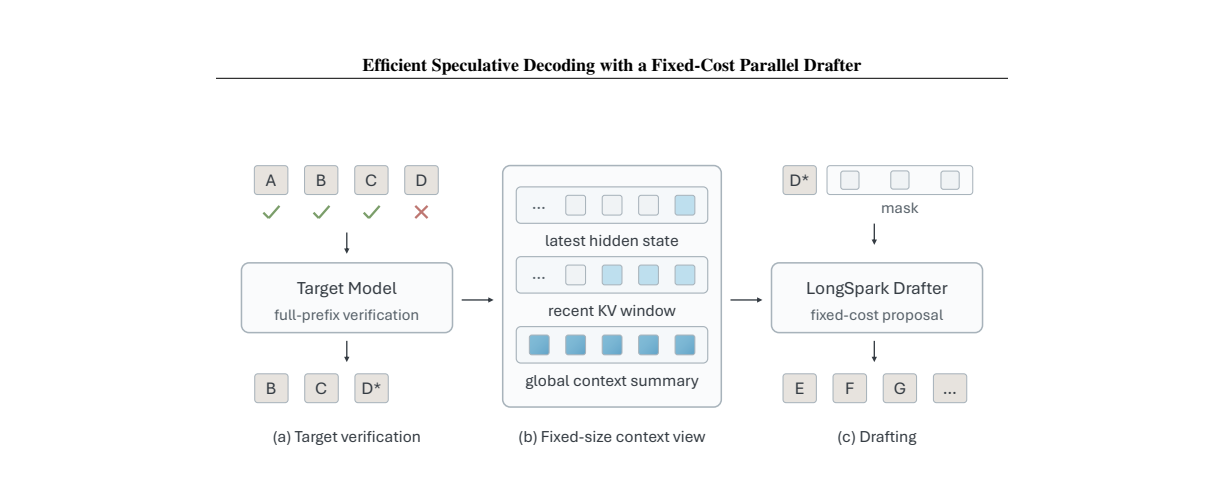
We argue that this scaling is unnecessary. A standalone language model must grow with its prefix because it is solely responsible for every token it produces. A drafter, by contrast, only proposes candidates; the target catches and corrects every error before any token is committed. The drafter's decoding cost can therefore be made entirely independent of the prefix length. We introduce LongSpark, a block-diffusion drafter that achieves this by extracting fixed-size, multiscale views from the target's verification pass, thereby eliminating the need for a growing persistent state. Extensive evaluations demonstrate that LongSpark achieves state-of-the-art end-to-end efficiency across multiple model scales and realistic serving conditions. Notably, it delivers the lowest time-per-output-token on long-context tasks while reducing the drafter's context state by several orders of magnitude.
from the abstract
Pith says
Machine review · deepseek-v4-flash · 30 Sep 2026 · of version 1 of the paper; version 2 is newer · what was read was not recorded · not checked by a person
It can be wrong. Challenge this review or reply to it.
Holds up, with conditions. The fixed-cost drafting idea is genuinely new and the O(1) argument is sound, but the SOTA throughput claims need error bars, released artifacts, and a matched full-prefix baseline before they carry their weight. This line is wrong
2 major objections · 4 minor
How often objections from reviews like this one are right: not yet measured
Not checked: figures, code, what the references say.
The paper says, at §2.2, §3.3, App. B.2, Table 5a
The review did not quote this passage.
Pith says: Objection 1 of 2 · major
The headline claim that a fixed-size lossy view of the prefix keeps draft quality competitive at 128K contexts (sentence b158) rests on the global context summary being the only mechanism that conveys information from beyond the recent window (W=256). That summary is built from R=16 learned queries per selected layer and head that are trained exclusively on sequences capped at 4096 tokens (App.
more of objection 1
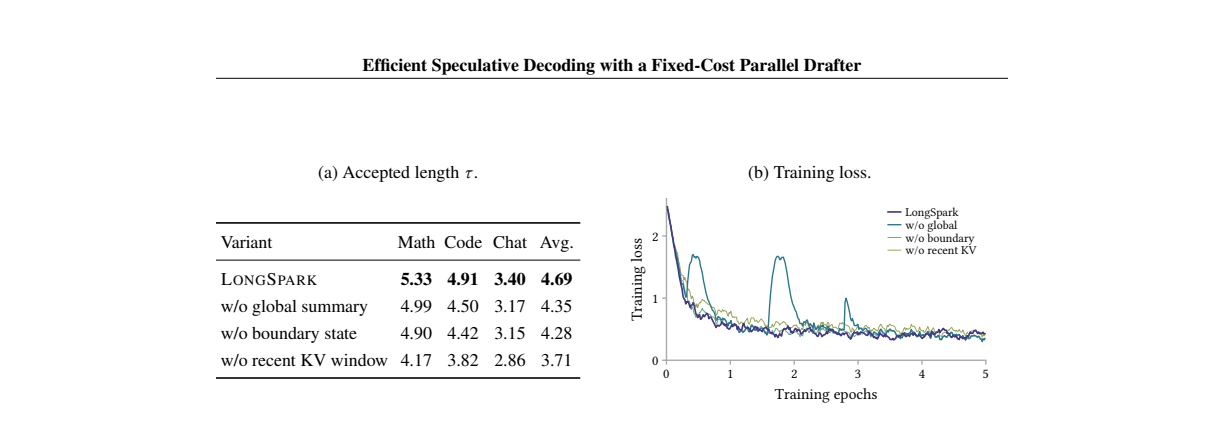
B.2: 'we limit the total sequence length to 4096 tokens'), while at inference the same queries must compress prefixes up to 128K (Table 2, LSWE). The attention weights exp(g^T k_j/sqrt(d)) these queries assign to key positions beyond the training horizon were never optimized, and the NTK scaling (alpha=4) applied at inference further shifts far-position RoPE-encoded keys off the training distribution. The paper never tests whether the summary actually reaches the far prefix: the ablation in Table 5a removes the summary wholesale, and no matched-budget comparison against a drafter that reads the full prefix is reported. The marginal contribution of the summary is modest and grows only slightly from 32K to 128K (2.88 vs 2.70 at 32K; 2.53 vs 2.25 at 128K), consistent with the summary re-covering local content rather than adding genuine global conditioning. I request either (a) a measurement of the summary queries' attention mass on key positions beyond 4096 at 128K contexts, or (b) a matched-budget comparison with a full-prefix-conditioning drafter, before the 128K fixed-cost claim (b158) can be considered supported.
The paper says, at §3.4, Table 5b
The review did not quote this passage.
Pith says: Objection 2 of 2 · major
The long-context ablation claims rest on differences that are presented without significance assessment. In Table 5b the observed effect of the global summary on serving throughput is within about one standard deviation of the noise (1597.3±77.0 vs 1514.4±77.8 TPS at LongSpec 32K; 208.4±45.3 vs 183.5±10.6 at LSWE 128K, ten seeds), so the serving-performance differences do not by themselves establish the summary's contribution.
more of objection 2
The accepted-length differences in Table 5a are the more informative evidence; I recommend basing the summary-contribution claim on τ with per-seed paired differences or confidence intervals, and reporting the serving numbers with their variance relations.
4 minor objections
The paper says, at §3.3, Fig. 1
Pith says: minor objection 1 of 4
The flat drafting-cost-versus-context curve is measured only with Qwen3-8B on a single code prefix; either extend it to another scale or explicitly scope the empirical confirmation to the 8B case, since it is the only direct measurement of the O(1) claim.
The paper says, at §3.3, App. B.2
Pith says: minor objection 2 of 4
State whether NTK scaling (alpha=4) was applied during drafter training; since the summary queries are the only network component that contacts unbounded far positions, the interaction between training-time and inference-time RoPE scaling should be documented.
show 2 more
The paper says, at Table 7
Pith says: minor objection 3 of 4
The fixed-request completion times are averaged over three seeds without spread; given the text's own note that output-length variation dominates, per-seed values or standard deviations would let readers judge the differences (56.14 vs 63.66 s at 32K).
The paper says, at Conclusion, §3.2
Pith says: minor objection 4 of 4
A one-line quantification of the accepted-length gap would sharpen the argument: at every scale in Table 1 LongSpark's average τ trails DSpark's (e.g., 4.78 vs 5.00 at 8B) while winning on speedup, making the 'competitive accepted lengths' wording in the conclusion precise.
What would settle it
Instrument the trained drafter at 64K/128K inference: for each summary query and head, compute the attention mass assigned to key positions beyond the 4096-token training horizon (sum of exp(s_j) for j > 4096, normalized). If that mass is near zero or statistically flat relative to near-prefix positions, the summary is not genuinely compressing the far prefix and the fixed-cost view duplicates local coverage. Stronger, matched-budget check: retrain the same architecture with training sequences that include 32K–128K contexts and compare accepted length at 64K/128K (same protocol as Table 5).
from the skeptic's reading
How the review went
4 readings by deepseek-v4-flash · 30 Sep 2026
- Reader holds up, with conditions
- Skeptic partly agrees
- Editor wrote the verdict above
- Referee major revision: 2 major objections, 4 minor
Not run on this paper: the simulated authors' defence.
Pith did not check this review's objections against the paper.
The review in full
The review in brief, machine-written
The one thing to know: the central idea is real. LongSpark's claim is that a drafter, unlike a standalone LM, does not need to represent the full prefix, because the target verifies every proposal, so the drafter's per-round cost can be O(1) in prefix length. That argument holds. The O(1) complexity is architectural, derived from the interface definition (fixed boundary state, W=256 recent window, R=16 summary queries) rather than fitted, and the incremental summary update in Appendix A.2 is exact log-sum-exp attention merging under fixed queries, cleanly derived. No circularity: the throughput numbers are serving measurements, not predictions matched to constants.
What is new: DFlash, DSpark, Domino all have block-diffusion backbones that attend over the full prefix; Medusa is prefix-independent but single-position and does not attend at all. LongSpark is the first to pair fixed-size multiscale context views with the block-diffusion backbone, and the framing, accepted tokens per unit of proposal overhead, is the right lens for this line of work. The ablation is sensible: the recent window matters most, the summary and boundary state are secondary but real.
Soft spots, in proportion. Three things, none load-bearing, all worth fixing before the SOTA wording stays. First, headline tables 1 and 2 carry no error bars, and Table 5's own standard deviations at LSWE 128K are large (208.4 ± 45.3 TPS, TPOT 75.4 ± 14.0 ms), so the LSWE margins over DSpark could plausibly sit inside noise. Second, the title-page banner promises code and models; none are released. For a systems paper whose entire value is a new architecture, that is a genuine gap. Third, the stress-test concern: the R=16 summary queries are trained only on windows up to 4096 tokens yet must compress 128K prefixes at inference, and their far-prefix reach is validated only internally. That is a legitimate open question, and the paper never benchmarks the compressed view against a full-prefix-conditioning baseline at matched budget. One wrinkle against the stress-test's own reading: the summary's marginal contribution to accepted length actually grows from 32K to 128K (0.18 to 0.28), which mildly contradicts the 'it just re-covers the recent window' hypothesis. Inconclusive, but the extrapolation concern stands as unexamined rather than demonstrated wrong.
This is a conditional accept, not a rejection. The paper is honest, openly reporting shorter accepted lengths than DSpark, which is exactly what makes the fixed-cost point interesting. Send it to serious review; make error bars, artifacts, and a full-prefix upper-bound comparison part of the revision ask.
The strongest objection
The central claim (b158) is that a fixed-size, lossy view of the prefix suffices to keep draft quality competitive at contexts up to 128K. The mechanism that is supposed to compress the whole prefix is the global summary: R=16 learned queries per selected layer/head attend over all cached target keys (Eq. 5). But those queries are trained exclusively on sequences capped at 4096 tokens — 'During training, we limit the total sequence length to 4096 tokens' (Appendix B.2) — while at inference they must compress a 128K prefix (Table 2, LSWE). The attention weights exp(s_j) = exp(g^T k_j / sqrt(d)) that these queries assign to key positions beyond the training horizon were never optimized; the query bank is 'initialized from N(0,d^{-1}I) and jointly optimized with the drafter' on short windows only. The summary's far-prefix content is therefore carried by uncalibrated weights, and its effective reach at 128K is unknown. The paper's own ablations (Table 5) remove components wholesale but never test whether the summary actually reaches the far prefix: the marginal contribution of the summary grows only modestly from 32K to 128K (0.18 to 0.28 accepted length), consistent with the summary mostly re-covering the recent window's local content rather than adding genuine global conditioning. If the summary's attention mass on positions >4096 is negligible or near-uniform, then the 'global' view at 128K is asserted, not demonstrated, and the strongest claim (b158) that fixed context processing suffices rests on out-of-distribution behavior the paper neither analyzes nor controls. The incremental-update math (Appendix A.2) is correct streaming-attention merging, but it preserves whatever the uncalibrated weights produce; it does not fix the extrapolation. This is a correctness risk to the empirical support of the headline claim, not an internal inconsistency.
The reader's weakest assumption was that the R=16 lossy compression is only validated internally, never against a full-prefix-conditioning upper bound at matched budget. My pass agrees with the territory but sharpens it into a concrete mechanism: the summary queries are trained on ≤4096-token sequences (Appendix B.2) yet must compress 128K prefixes at inference, so the attention weights over far positions are extrapolations, not trained values. This is more specific than 'sufficiency asserted from internal comparisons' — it identifies that the very weights that define the far-prefix reach were never exposed to long contexts during optimization. It is also directly testable: measure the attention mass the trained summaries place on positions beyond the training horizon, or retrain with long training sequences and compare accepted length. If the summary effectively only covers the recent few thousand tokens, then the fixed-cost drafter is realizing its O(1) cost by ignoring the far prefix rather than compressing it, which would undermine the claim (b158) that competitive draft quality is maintained at 128K. I did not find a load-bearing problem in the fixed-cost complexity analysis itself: the per-round cost is genuinely independent of t (block attention over ≤B+W+R entries, summary update over ≤B+1 rows), the incremental summary merging (Eq. 11) is standard and correct streaming attention, and verification being the only full-prefix pass is structurally sound. The empirical narrative is extensive and internally consistent, though Table 2 omits accepted-length columns for baselines, leaving 'competitive accepted lengths' at 128K asserted rather than shown. Because the reader already flagged the sufficiency of the lossy view and recommended CONDITIONAL, and my concern refines rather than overturns it, the verdict stands: CONDITIONAL, unchanged. If either concrete test shows the summary reaches the far prefix and contributes to long-context accepted length, the central claim would be substantially strengthened.
The referee's report
The paper makes two clean contributions if its empirical claims hold. First, the fixed-cost drafting principle — that a drafter need not grow with the prefix because the target verifies and corrects every proposal — is a sound and useful reframing of the speculative-decoding design objective. Second, the specific realization, LongSpark, obtains the O(1) claim by construction rather than by fitting: each draft layer attends to at most B+W+R entries (§2.3, Eq. 6), and the incremental global summary update (App. A.2, Eqs. 10-11) is an exact log-sum-exp merge of fixed-query attention, derived rigorously and independently checkable. Training setup, architecture, and measurement protocol (TD-disaggregated serving, TP4 long-context, ten-seed averages, fixed-request completions) are specified in unusual detail, and the throughput numbers are serving measurements rather than quantities fitted to the complexity model, so the efficiency argument is not circular. The reported 406x state reduction at 128K and the lowest mean TPOT across three long-context workloads (Tables 2, 4) are concrete and falsifiable.
Pith's reading of the paper (a machine's summary, not the authors')
Speculative decoding speeds up inference by having a cheap drafter propose tokens that a large target model verifies in one pass, but existing drafters grow costlier as the context lengthens, eroding the speedup. This paper argues that scaling is unnecessary: because the target verifies and corrects every proposal before committing a token, the drafter only needs a compressed, lossy view of the prefix rather than a faithful one. The paper builds LongSpark, a block-diffusion drafter that extracts three fixed-size views from the target's verification state, so all proposal computation and drafter state stay bounded while only target verification touches the full prefix. Empirically, LongSpark reports the lowest mean time-per-output-token on long contexts up to 128K across three model scales, holding drafter state at 6.3 MiB where a leading prefix-scaling baseline grows to over 2.5 GiB.
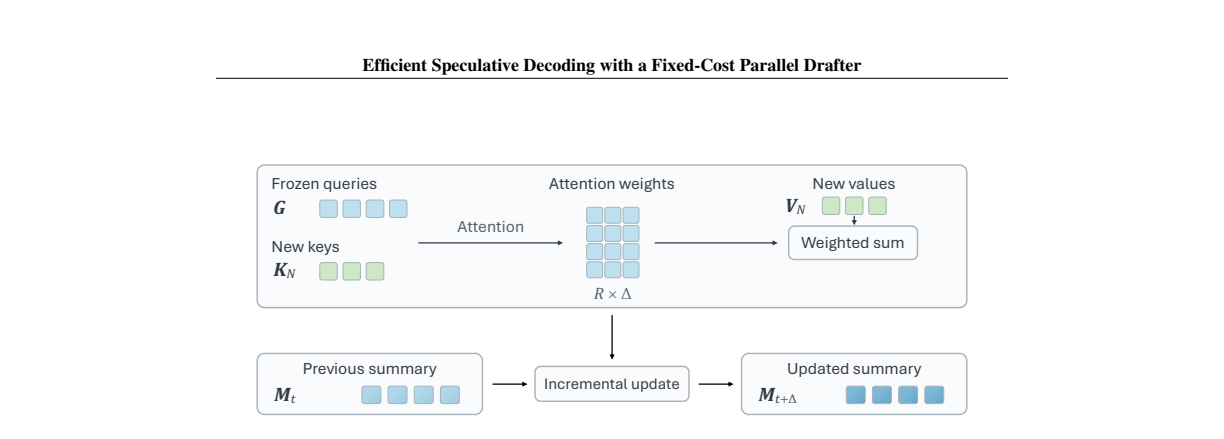
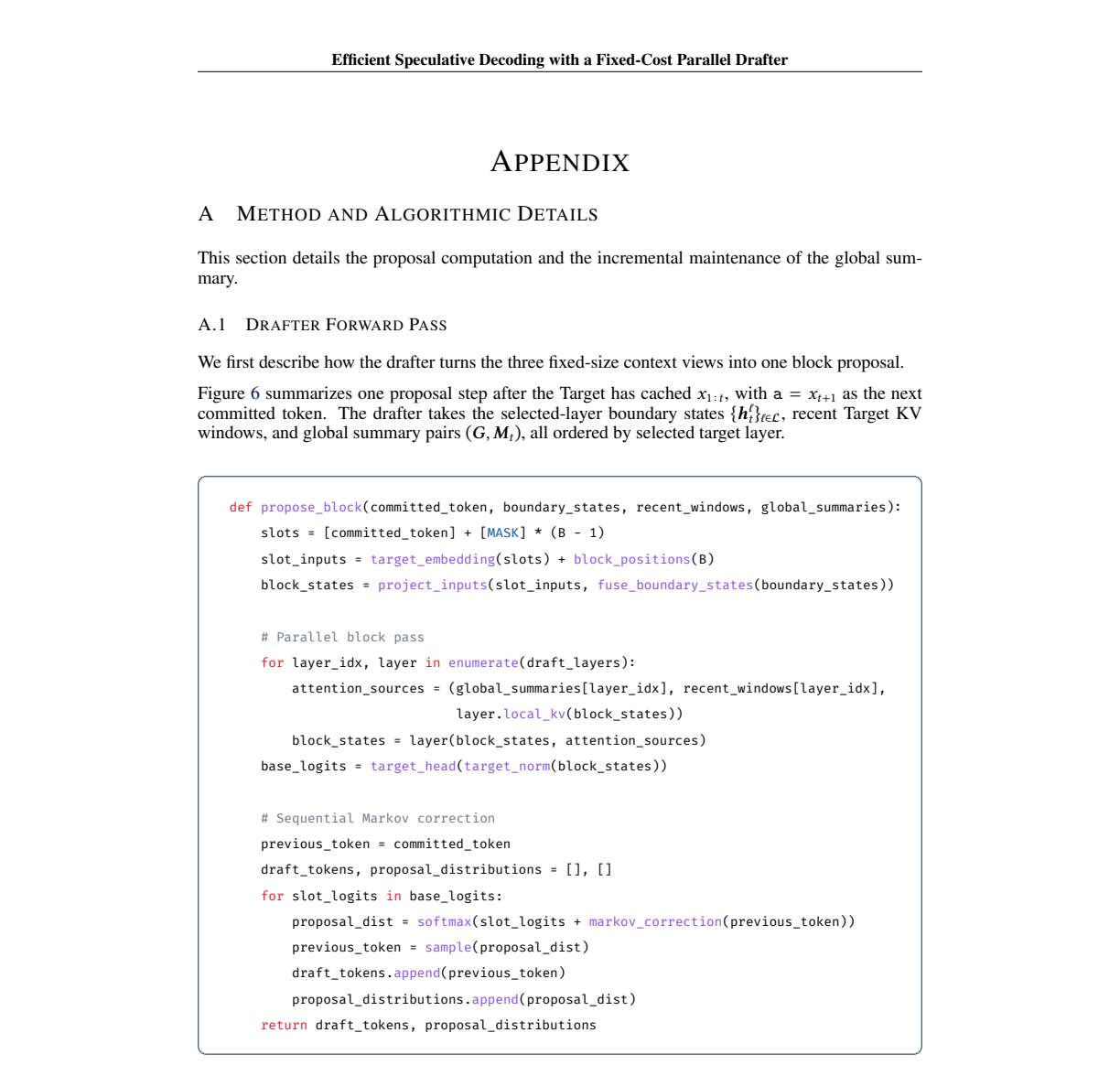
What carries the argument. The load-bearing object is the fixed-cost context interface: three bounded views of the target's cached state (a boundary state, a recent key-value window, and a global context summary), driven by an incrementally updated summary construction. Each selected layer and attention head keeps a bank of R=16 learned summary queries that stay fixed during inference, so after verification only the B+1 newly retained key-value rows are folded into the summary through a log-sum-exp merge. Draft layers attend only to a context of at most B+W+R entries per head, making proposal computation and persistent state O(1) with respect to prefix length while full-prefix work is confined to target verification.
Core claim. The paper's central claim is that drafting and verification obey different scaling contracts: a standalone model must represent the full prefix because it owns every token it produces, whereas a drafter only proposes candidates and the target's lossless verification catches and corrects every error. Drafting cost can therefore be made entirely independent of the prefix length while keeping competitive accepted lengths. LongSpark realizes this by conditioning its parallel block proposal on a boundary state at the decoding point, a recent window of W=256 tokens, and a global summary that compresses the whole prefix into R=16 learned queries per selected target layer and head, drawn from just five target layers. The paper reports the lowest mean time per output token on LongSpec 32K, CodeSpan 64K, and LongSWE-Bench 128K across 4B, 8B, and 14B targets, and a constant 6.3 MiB drafter state that is 406 times smaller than the leading prefix-scaling drafter's at 128K.
The premise it rests on. The whole design assumes that a heavily compressed view of the prefix (16 learned queries per selected layer-head, a 256-token window, and a boundary state, drawn from five target layers) is enough to keep draft quality competitive as context grows, an assumption validated only against other drafters and never against a full-prefix-conditioning upper bound at matched budget.
If the paper is right (Pith's inferences, not the authors')
Drafting design should optimize accepted tokens per unit of proposal overhead rather than accepted length alone; the paper shows LongSpark wins end-to-end even where rivals reach longer accepted lengths.
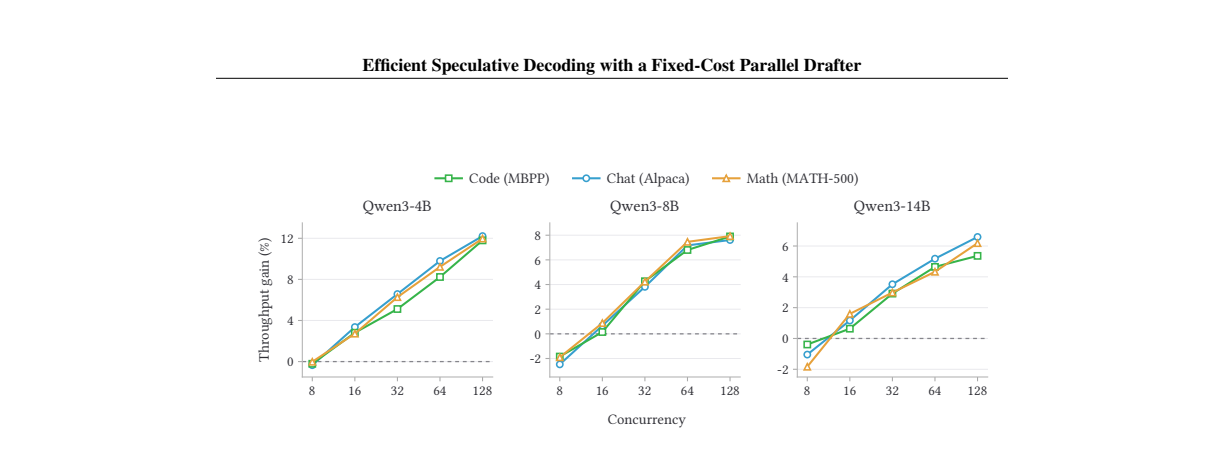
Fixed-cost drafting compounds under load and context growth: its advantage over prefix-scaling drafters widens as concurrency rises and as contexts extend toward 128K.
Drafter memory stops being a serving constraint, since the persistent drafter state stays at 6.3 MiB regardless of prefix length, easing high-concurrency serving.
Greedy decoding shows the same ranking as sampling, indicating the advantage is structural rather than an artefact of the sampling strategy.
If the lossy view is as sufficient beyond 128K as the 32K-128K evidence suggests, the same design could be pushed further at matched budget: fewer layers, smaller summaries, or even a thinner window, with acceptance measured against a full-prefix-conditioned upper bound.
The asymmetry argument generalizes beyond a single drafter: any proposal stage whose errors are caught by a verifier can trade faithfulness for cost, which could extend to multi-drafter and tree-verification schemes that keep proposal cost flat.
A test the paper does not run is training LongSpark only on short contexts and evaluating acceptance at much longer contexts than it saw in training, which would reveal whether the global summary supplies the promised orientation or degrades as the prefix outgrows the compressed view.
Check this review
Pith stored no record of this review's passes and took no fingerprint of it. Reviews made by code from 13 Nov 2026 on carry both.
How often reviews like this one are right
Reviews like this one: written by deepseek-v4-flash, where what was read was not recorded.
How often objections from reviews like this one are right: not yet measured
Reviews by people
This review was written by a machine. No person has reviewed this paper on Pith yet. A scientist listed on Pith can review it for a fee, and their review is published here whatever it concludes.
The paper
Abstract
Speculative decoding accelerates autoregressive inference by verifying multiple draft tokens in a single target forward pass. However, as the context grows, existing state-of-the-art drafters become increasingly expensive, eroding the very efficiency advantage they are designed to provide. We argue that this scaling is unnecessary. A standalone language model must grow with its prefix because it is solely responsible for every token it produces. A drafter, by contrast, only proposes candidates; the target catches and corrects every error before any token is committed. The drafter's decoding cost can therefore be made entirely independent of the prefix length. We introduce LongSpark, a block-diffusion drafter that achieves this by extracting fixed-size, multiscale views from the target's verification pass, thereby eliminating the need for a growing persistent state. Extensive evaluations demonstrate that LongSpark achieves state-of-the-art end-to-end efficiency across multiple model scales and realistic serving conditions. Notably, it delivers the lowest time-per-output-token on long-context tasks while reducing the drafter's context state by several orders of magnitude.
The paper's own sentences, arranged, kept beside the review and separate from it. Each label is drawn from a closed vocabulary; the number beside it is the probability the classifier gave that label. No sentence in this record was written by a model.
abstract compiled · 2026-09-30
The authors' main claim, as the classifier picked it out 0.77
“Extensive evaluations demonstrate that LongSpark achieves state-of-the-art end-to-end efficiency across multiple model scales and realistic serving conditions.”
How the main claim is stated: asserted 1.00
What the abstract itself states, as probabilities: claims first 0.09 · states limitation 0.08 · human participants 0.02 · controlled comparison 0.35 · randomized assignment 0.01 · states quantitative result 0.20 · compares with prior results 0.88 · mentions code or data availability 0.03
The abstract, sentence by sentence
This table labels the abstract only (arXiv listing abstract v1). The number is the probability the classifier gave the label.
| Sentence | Role | The authors' own work | States the main conclusion | Strength |
|---|---|---|---|---|
| Speculative decoding accelerates autoregressive inference by verifying multiple draft tokens in a single target forward pass. | background 1.00 | 0.06 | 0.04 | asserted 1.00 |
| However, as the context grows, existing state-of-the-art drafters become increasingly expensive, eroding the very efficiency advantage they are designed to provide. | background 0.78 | 0.08 | 0.04 | asserted 1.00 |
| We argue that this scaling is unnecessary. | gap 0.40 | 0.14 | 0.27 | asserted 0.97 |
| A standalone language model must grow with its prefix because it is solely responsible for every token it produces. | background 0.87 | 0.10 | 0.09 | asserted 1.00 |
| A drafter, by contrast, only proposes candidates; the target catches and corrects every error before any token is committed. | background 0.56 | 0.10 | 0.10 | asserted 1.00 |
| The drafter's decoding cost can therefore be made entirely independent of the prefix length. | interpretation 0.67 | 0.24 | 0.47 | asserted 0.69 |
| We introduce LongSpark, a block-diffusion drafter that achieves this by extracting fixed-size, multiscale views from the target's verification pass, thereby eliminating the need for a growing persistent state. | contribution 0.57 | 0.93 | 0.30 | asserted 1.00 |
| Extensive evaluations demonstrate that LongSpark achieves state-of-the-art end-to-end efficiency across multiple model scales and realistic serving conditions. | result 0.99 | 0.95 | 0.49 | asserted 1.00 |
| Notably, it delivers the lowest time-per-output-token on long-context tasks while reducing the drafter's context state by several orders of magnitude. | result 1.00 | 0.94 | 0.30 | asserted 1.00 |
What kind of paper the classifier reports this is: method or tool 1.00 · evidence from observation or experiment 0.96
What was examined, and what was not
Sources read
- arXiv listing abstract v1
Not examined
- full text
- figures and tables
- references and citing sentences
- relations to other papers
Levels run
- P abstract
Not run
- S sections
- T body sentences
- C citations
- R cross-paper relations
How the labels were made
Compiled by classifier-1.13.0 via TypeSafe API, question bank abstract-p1-20260923, 2026-09-30: 1 request, 6,767 input tokens.
Every quoted sentence on this record is the authors'. Every label is from Pith's closed vocabulary, with the probability shown beside it. This record as JSON
Figures (6)

Figures are the authors', reproduced from the paper.
Cited by 2 Pith papers
Reviewed papers on Pith that cite this one. The full citation record
Challenges and discussion
Disagree with the review, or know something it missed? Leave a comment, or challenge this review formally: a challenge becomes a permanent entry in this paper's record, and its decision is published here.
Come back by email
A short list of the week's newly reviewed papers. Nothing is sent until you confirm from your inbox, and every email has a link that stops it. No account.
No comments yet.
Sign in to comment