Machine Learning · arXiv:2610.05774 v1 · submitted 5 Oct 2026 · 71 references
AdaSpark: Adaptive DSpark with Online Learning for Tree Verification and N-gram Fill
The paper says
“Block drafters such as DSpark propose ranked candidates for several positions in one forward pass, and a tree verifier checks them in one pass of the target.”
more of the abstract
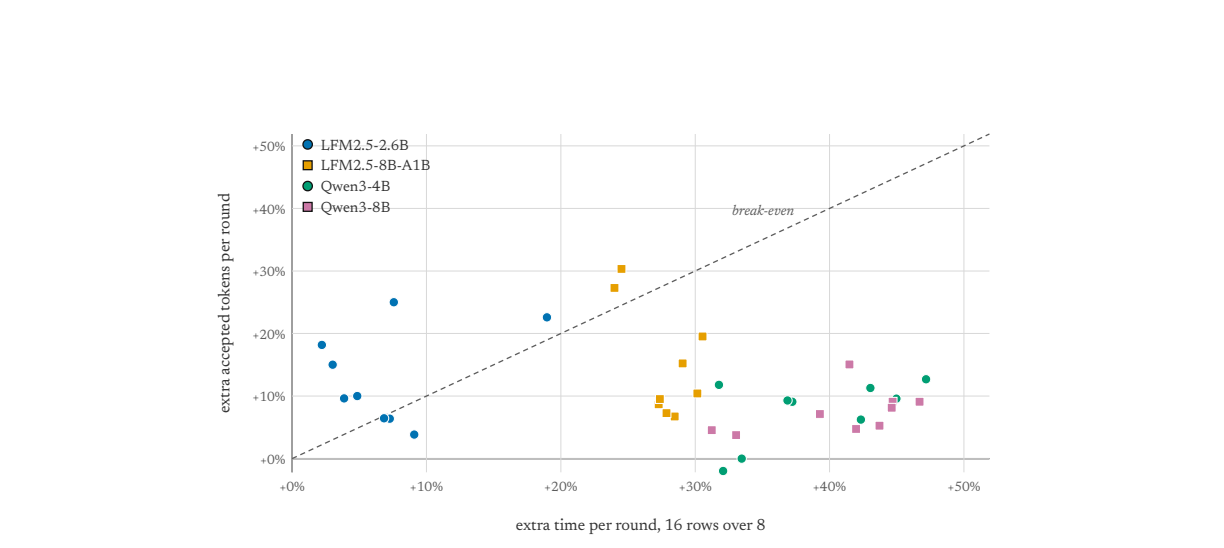
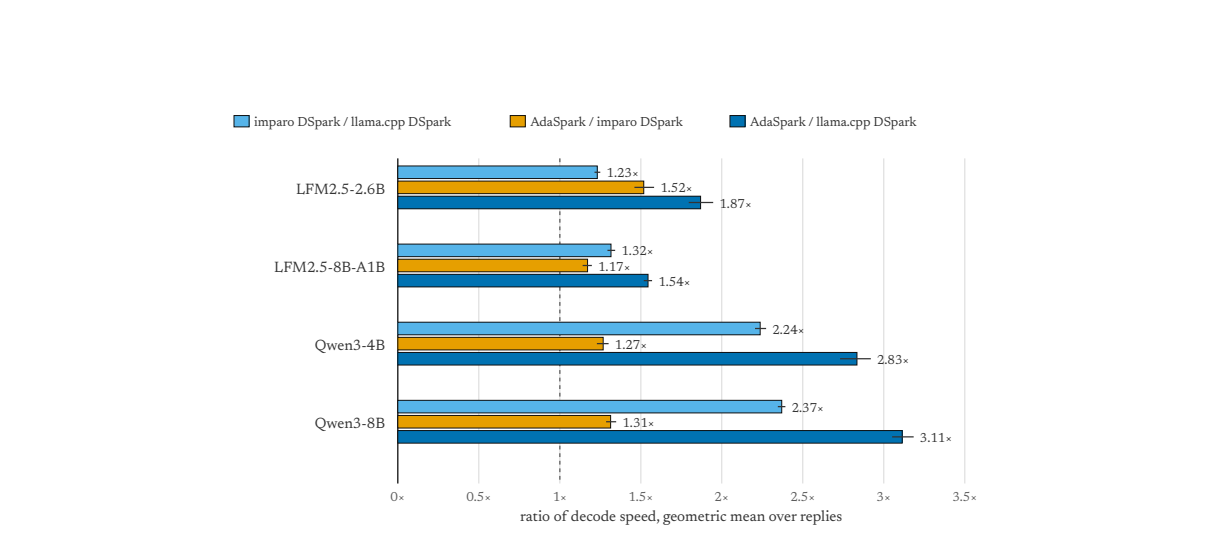
The number of rows to verify trades the tokens a wider tree is expected to accept against the time a wider verify takes. Most schedulers that choose this number take the verify time from a table or model measured before serving, corrected online by at most one scale factor, and take acceptance from the drafter's confidence estimates or from a map fitted offline. AdaSpark learns both quantities while it serves, with no profile, calibration or sweep in advance. It learns which verify widths are worth offering and fits each one's verify time as a function of context. It fits each candidate's acceptance probability to the target's verify outcomes, with the drafter's confidence head as one input, and orders and sizes the tree by that fit instead of by the head. The same model prices n-gram continuations of the request's own text, so drafted and text-derived candidates compete for rows in one best-first order. The width is chosen by pricing time at the long-run decode rate. On single- and multi-turn conversations from six public datasets, on three dense targets and one mixture-of-experts target, AdaSpark decodes 1.5-3.1x faster than llama.cpp's DSpark with the same drafters. Our imparo engine with AdaSpark is 1.17-1.52x faster than imparo running with a three-token chain (the default llama.cpp setting); this gain comes from the scheduler alone. Without a width sweep, AdaSpark is never more than 0.3% slower than the best pinned tree width on any dense target or context band. On the mixture-of-experts target it ties the best pinned width, and the other pinned widths from 4 to 16 rows are 5-14% slower.
from the abstract
Pith says
Machine review · deepseek-v4-flash · 6 Oct 2026 · what was read was not recorded · not checked by a person
It can be wrong. Challenge this review or reply to it.
The passes disagreed. Reader: holds up. Skeptic: agrees with the reader. Referee: major revision.
A careful, unusually honest systems paper whose central claim — an online-learning scheduler reaches the best pinned width without a sweep — holds up, with the text-invariance caveat on Proposition 5 real but disclosed and proportionate. This line is wrong
3 major objections · 3 minor
How often objections from reviews like this one are right: not yet measured
Not checked: figures, code, what the 71 references say.
The paper says, at §4.5, Table 3
The review did not quote this passage.
Pith says: Objection 1 of 3 · major
The no-sweep claim (never more than 0.3% slower than the best pinned width) compares AdaSpark against pinned-width arms on texts that are not always byte-identical between arms: Table 10 reports 14, 22, 17 and 10 of 95 replies differing from the three-pick chain baseline, and a divergence in a first turn makes the whole conversation diverge.
more of objection 1
Since the reported margins are 0.1–0.5%, a text-composition effect of comparable size could change the verdict. Please re-run the Table 3 comparison restricted to replies byte-identical between the AdaSpark run and each pinned arm, or bound the size of the composition effect, before the 'no sweep needed' claim is accepted at face value.
The paper says, at §3.4, Proposition 5; §3.5
The review did not quote this passage.
A classifier read this sentence of the paper as acknowledging the concern (probability 0.74):
“The text assumption holds because decoding is greedy and, within the widths one ac- cumulation order serves, a verify’s rows do not depend on its width (§3.5); the other rounds (wider verifies, up to 4% of rounds, and the routed target’s 2-row verifies, 13.4%) can change the text only at a near tie (Table 10 counts how often the text differs).”
Pith says: Objection 2 of 3 · major
Proposition 5's premise (b191) that the reply text does not depend on the width rule holds only within one accumulation order (widths 3–16 on the 4-bit targets, 3–24 on the 8-bit one, §3.5). The wider verifies that teach the gains above n0, and the routed target's 2-row verifies (13.4% of rounds), are outside that range and can change the text at near ties; the paper acknowledges this (b201, b232).
more of objection 2
The consequence for the optimality claim is not drawn: the expected-decode-time objective is defined relative to a workload the width choice itself changes, so Proposition 5's guarantee holds precisely where it is least informative. Please state plainly that optimality is conditional on text invariance, and that performance in the divergent regime rests on the empirical evaluation rather than on the proposition.
The paper says, at §4.5, Table 3
The review did not quote this passage.
Pith says: Objection 3 of 3 · major
The point estimate 'never more than 0.3% slower in every context band' is supported, but several bootstrap intervals extend below 0.997 (LFM2.5-2.6B band 2,048+ is [0.991, 1.025]; LFM2.5-8B-A1B 2,048+ is [0.950, 1.042]), and the 'again' run-to-run ratios reach 0.964 in that band.
more of objection 3
The text should report the worst-case lower confidence bound rather than the point estimate when stating a 0.3% guarantee, and the routed-target 'ties the best pinned width' should be reported with its interval ([0.989, 1.019]) explicitly noted as consistent with a small loss as well as with a tie.
3 minor objections
The paper says, at §3.2, Table 1
Pith says: minor objection 1 of 3
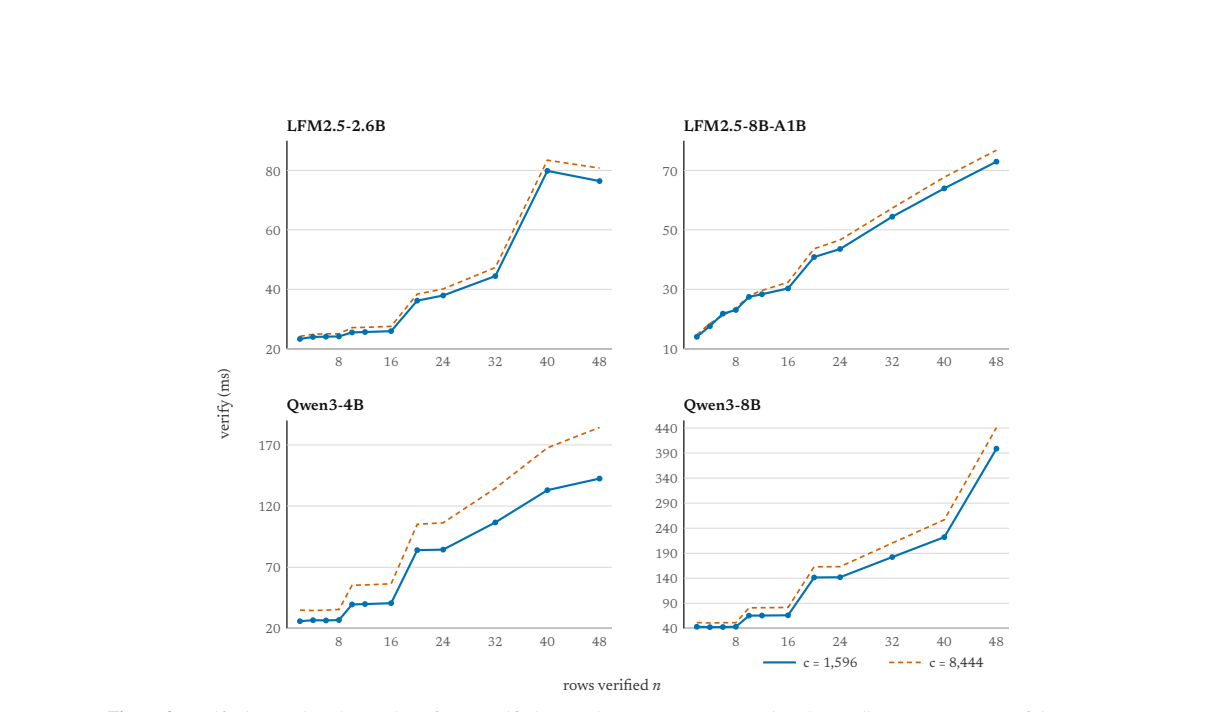
In Table 1 the LFM2.5-8B-A1B 8-row row reports β = −0.01 with T falling from 24.2 ms at 443 tokens to 23.0 ms at 1,596 tokens; the text's claim that 'the fitted time never falls as context grows' refers to the constrained basis coefficients, not to the reported linear slope. Please add one sentence clarifying which quantity carries the non-negativity constraint.
The paper says, at Figure 4
Pith says: minor objection 2 of 3
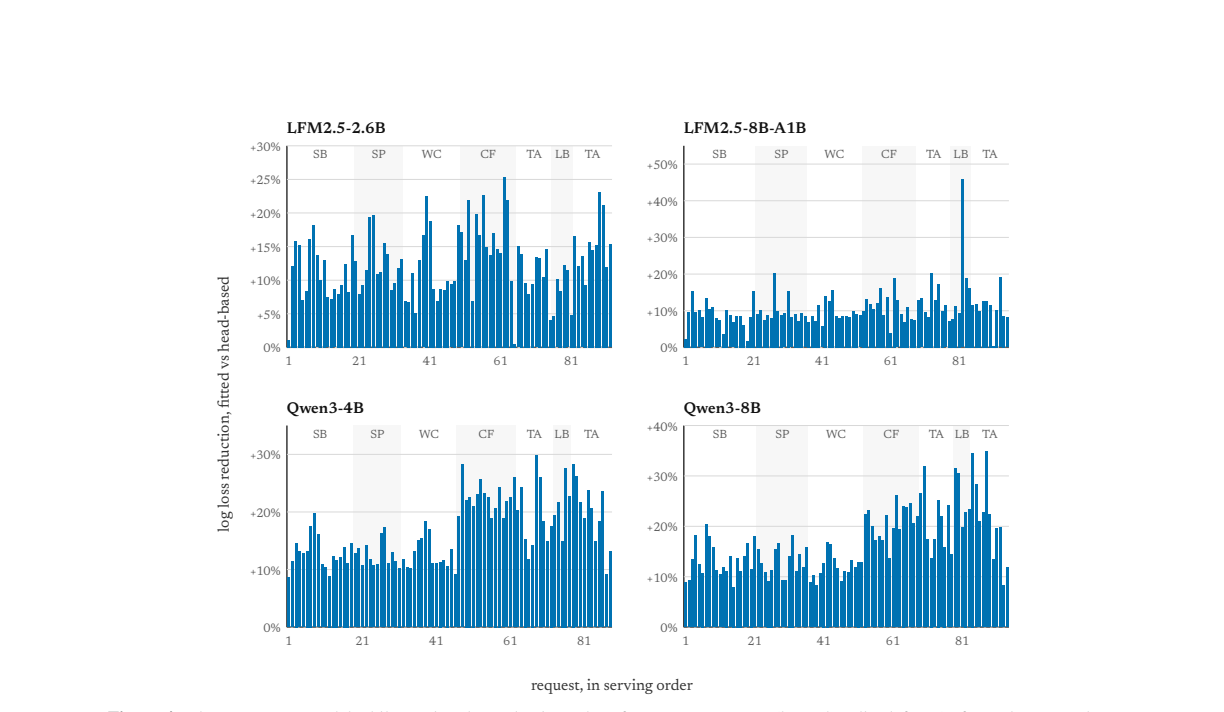
Figure 4 is visually dense: four panels with many bars and per-panel scales make per-request trends hard to read. Consider larger panels, fewer sources per panel, or marking source boundaries more prominently.
show 1 more
The paper says, at §4.5
Pith says: minor objection 3 of 3
The routed-target tie is stated without reference to the 'again' column; given run-to-run ratios of 0.995–1.002 on the other targets and wider noise on the routed bands, the tie claim should cite the repeat-run variability alongside the bootstrap interval.
What would settle it
Recompute Table 3's global and per-band 'AdaSpark / best pinned width' ratios restricted to the evaluation-subset replies whose text is byte-identical between the AdaSpark run and the pinned-width arm; the first-turn identities of Table 10 provide the cleanest subset, since first turns share history and isolate the verify. If the dense-target margins stay within 0.3% and the routed target stays within its interval on that clean subset, text non-invariance is not driving the headline. If the margin widens materially, or the routed point estimate drops below 0.99, the 'without a sweep' claim is partly a comparison of different decode tasks and should be restated with the text-identical subset's numbers.
from the skeptic's reading
How the review went
4 readings by deepseek-v4-flash · 6 Oct 2026
- Reader holds up
- Skeptic agrees
- Editor wrote the verdict above
- Referee major revision: 3 major objections, 3 minor
Not run on this paper: the simulated authors' defence.
Pith did not check this review's objections against the paper.
The review in full
The review in brief, machine-written
The one thing to know: this is a genuine systems contribution and the central claim mostly holds. Fitting verify cost online per learned width as a function of context, fitting acceptance online per node with a multinomial that takes the drafter's head as one input, and pricing time at the long-run decode rate — that combination is new relative to CAST, EVICT, Bastion, TreeSpark and the vLLM/SGLang schedulers, which take cost from offline tables, profiles, or at most one online scale factor. The claims rest on bootstrap intervals over conversations, a staged ablation, a held-out set within 4% of the evaluation subset, and every looped-reply exclusion counted. That is more honest than most papers in this area ship.
What is actually new: it learns which widths to offer rather than taking a partition from the backend, splitting a class only where a width inside could change the choice; a low-quantile cost law with per-class context slopes, with Proposition 3 giving a real reason for the low quantile; an acceptance model fitted from the target's own verify outcomes with separate n-gram and agreement terms; and pricing time at the band's achieved rate rather than the per-round ratio. The ablation is properly staged, and the engine-versus-scheduler split in Figure 6 is fair and useful. This reads like someone who actually served these workloads, not a scaffolded benchmark.
The soft spot the stress-test flags is real but proportionate. Proposition 5's optimality requires the reply's text not depend on the width rule (b191), and that premise fails exactly on the rounds that matter: wider verifies and the routed target's 2-row verifies accumulate in another kernel order and can flip a near tie. Table 10 shows 10–22 of 95 replies differ from the chain baseline. The authors disclose this (b201, b232, b298) and it does not overturn the paper — the density of invariant rounds is high on dense targets, two-run averaging checks drift, and the held-out set confirms engine-level gains. But the clean subset is untested, and the 'never more than 0.3% slower / ties' margin rests on partly divergent texts. If one number could break, that is the one.
Minor: all numbers come from one engine on one machine, no commit hash is stated, and constants were set once on one target. None of that is disqualifying for a systems paper of this type.
Who this is for: anyone working on speculative decoding serving, block drafters, or online cost adaptation in inference engines. It deserves a serious referee; the natural referee push is to re-check the width comparison on byte-identical replies only. Send it out.
The strongest objection
The headline empirical claim, that without a sweep the width chooser reaches the best pinned width (within 0.3% on dense targets, ties on the routed MoE), rests on Table 3's comparison being a valid width comparison. Section 3.5 establishes bit-identical rows only within one accumulation order (widths 3–16 / 3–24 on the four targets); wider verifies, 2-row verifies and cold-start rounds accumulate in another order and can flip a near-tie argmax. The authors acknowledge this (b201, b232, b298), and Table 10 shows the consequence: on the evaluation subset, 14, 22, 17 and 10 of 95 replies differ from the three-pick chain baseline on the four targets (first turns 3, 8, 5, 4 of 42), and once a reply diverges, the rest of its conversation diverges. Two things follow. First, Proposition 5's premise (b191) that the reply's text is independent of the width rule fails on exactly the rounds that matter most (wider verifies up to 4% of dense rounds, 13.4% two-row verifies on the routed target), so the chooser's objective of minimising band decode time is defined relative to a workload its own width choice changes; the optimality guarantee is void where it is needed. Second, and more load-bearing, the Table 3 ratio 'AdaSpark / best pinned' compares speeds on texts that are not always the same between arms, so the 0.3% margin could absorb a text-composition effect rather than reflect width quality. The routed-target tie is the least precise sub-claim (interval [0.989, 1.019]; 'again' 0.964 on 2,048+ replies) and is the target with the highest share of non-invariant rounds. The concern does not overturn the paper: divergence is disclosed, the density of invariant rounds is high on dense targets (85.6–99.9%), two-run averaging checks drift, and the held-out set confirms the engine-level gains. But this is the spot where the central claim could break, and the clean subset is untested.
The reader identified Proposition 5's premise (b191) as the weakest assumption, and I agree: the independence and text-invariance assumptions are the least secure conditions on which the theoretical justification rests. I sharpened the concern in one respect: the text divergence measured in Table 10 (10–22 of 95 replies) does not merely void the optimality argument, it contaminates the fair comparison that supports the headline empirical claim. When AdaSpark and a pinned arm decode different texts on the same conversation, the per-reply speed ratio compares different tasks, so the 'never more than 0.3% slower' margin could in principle reflect workload composition rather than width quality. The routed-target tie is the weakest empirical sub-claim precisely because that target has the most non-invariant rounds (13.4% two-row verifies) and the least precise interval ([0.989, 1.019], with a 0.964 second-run on long replies). I considered other candidates — the cost model's failed Proposition 3 premise on the routed target (§4.6), the gain floor on Qwen3-4B's long context (§3.4), run-to-run drift versus the 0.3% margin, and llama.cpp's weak baseline — but each is disclosed by the authors, is bounded, or does not bear on the scheduler-only claim; none is as load-bearing as the text-invariance failure, which touches both the theory and the headline measurement. I still recommend keeping the reader's ACCEPT: the paper is unusually transparent (looped replies counted, both runs reported, clamped gains and broken premises stated), the dense-target claim relies on 85.6–99.9% width-invariant rounds, and the two-run averaging plus the held-out set check the obvious confounds. The byte-identical-reply restriction is a single, cheap check that would settle whether the concern actually lands; I expect the margin to survive, but it is untested and is precisely where an honest reviewer would look first. Because the concern is real but bounded and disclosed, the verdict does not need to move.
The referee's report
If the headline claims hold, AdaSpark removes the need for per-deployment verify-cost profiles and width sweeps, replacing them with a single online learner whose constants are fixed once. The paper's strengths are real: the propositions are simple and correct (Prop. 1 restates the known prefix-selection rule; Prop. 3 is a valid quantile argument; Prop. 5 is a clean renewal-reward/Dinkelbach statement); the evaluation counts exclusions, holds out data, reports bootstrap intervals over conversations, and ships setup notes for reproduction; and the paper explicitly acknowledges its own weakest points (b201, b232, b298 on text invariance, §4.6 on the routed target's cost premise). The central unresolved issue is whether the headline no-sweep width claim survives when the AdaSpark and pinned-width arms are restricted to byte-identical replies, since the reported margins are comparable to run-to-run noise and to plausible text-composition effects.
Pith's reading of the paper (a machine's summary, not the authors')
Speculative decoding speeds up language-model serving by drafting cheap candidates and checking them in one forward pass of the target model; a block drafter like DSpark can emit a whole tree of candidates, so the server must decide how many rows of the tree to verify. That decision normally needs two numbers measured in advance: how long a verify of a given width takes, and how likely each candidate is to be accepted. AdaSpark claims both can be learned online from the rounds the engine serves, with no profile, calibration, or width sweep. Starting from an empty store it reaches the width a sweep would find best on each dense target (never more than 0.3% slower) and ties the best pinned width on a routed mixture-of-experts target, while decoding 1.5 to 3.1 times faster than llama.cpp's DSpark with the same drafters. If the claim holds, offline verify-cost profiling and per-target width tuning become unnecessary for this class of servers.
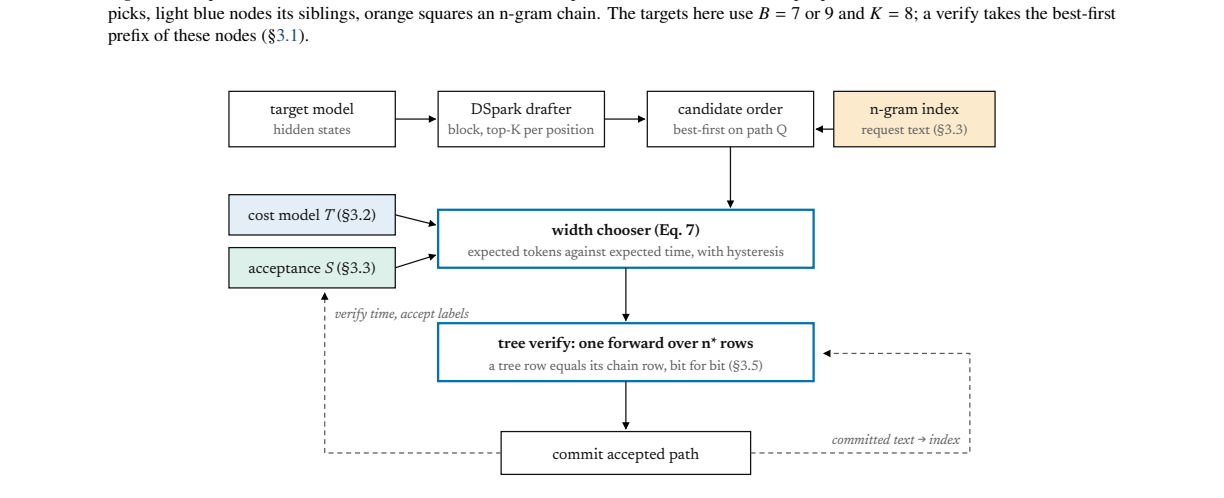
What carries the argument. Three results carry the argument. Proposition 1 states that ordering candidates by the path product $Q$ of acceptance probabilities makes every prefix of the order a tree that is optimal under the model, so the width decision reduces to picking a prefix length and one pass over the order gives $S(n)$ for every $n$ at once. The cost model of section 3.2 fits each learned width class's verify time as a low-quantile law in context, $T_k(c) = \alpha_k + \beta_k c$, priced as the product of a slow kernel law, a fast level that follows the machine within eight rounds, and a staleness clock; Proposition 2 shows some maximiser of the value is always the top width of a class, and Proposition 3 shows a low quantile recovers the machine's true time whenever more than a small fraction of rounds run free of interference. Proposition 5, via the renewal-reward theorem and Dinkelbach's fractional-programming theorem, justifies pricing time at the long-run decode rate $\rho_m$ rather than each round's own ratio: a width rule minimises a band's expected decode time if and only if it maximises $E[A - \rho^*_m C]$ per state. The width-invariance property of section 3.5 — that within one accumulation order a verify's rows are bit-identical among widths — is what lets measurement rounds teach every narrower prefix and lets the acceptance model transfer cleanly.
Core claim. The central discovery is that the two quantities a tree-verification scheduler needs — the verify's time as a function of width and context, and each candidate's acceptance probability — can be fitted online from the rounds the engine serves, and that pricing the width choice at the long-run decode rate (Eq. 7) reaches the width a sweep finds best. The cost model learns which widths to offer from a starting ladder of six, fits each class's verify time as a low-quantile law in context so that bursts of interference do not inflate the price, and corrects for machine drift with a fast level and a staleness clock. The acceptance model fits a multinomial over each parent's children from the target's own verify outcomes, taking the drafter's confidence head as one input and replacing it for ordering and sizing the tree; on all four targets it beats the head-based estimate by 10.5 to 15.0% per-node log loss. N-gram continuations of the request's own text are priced by the same model, so drafted and text-derived candidates compete for rows in one best-first order rather than by a fixed split. With the engine held fixed, the scheduler alone gives 1.17 to 1.52 times decode speedup over a three-token chain, and the wide trees it picks on a routed expert target move between widths round to round, tying the best pinned width that no single fixed width can match.
The premise it rests on. Proposition 5's optimality rests on the assumption that within a context band the round states are independent draws from a distribution that does not depend on the width rule, and that the reply's text is unchanged by the rule; if wider or narrower verifies change enough text — Table 10 shows 10 to 22 of 95 evaluation replies differ from the chain baseline — then maximising expected decode time per token under the model could target the wrong objective.
If the paper is right (Pith's inferences, not the authors')
Offline verify-cost profiles and per-target width sweeps become unnecessary: from an empty store the chooser reaches the width a sweep finds best on each dense target and ties the best pinned width on the routed MoE target, never more than 0.3% slower.
A target-fitted acceptance model can replace the drafter's confidence head as the arbiter of tree order and size, since the fitted multinomial beats the head-based estimate on every one of the 355 evaluation requests after the first.
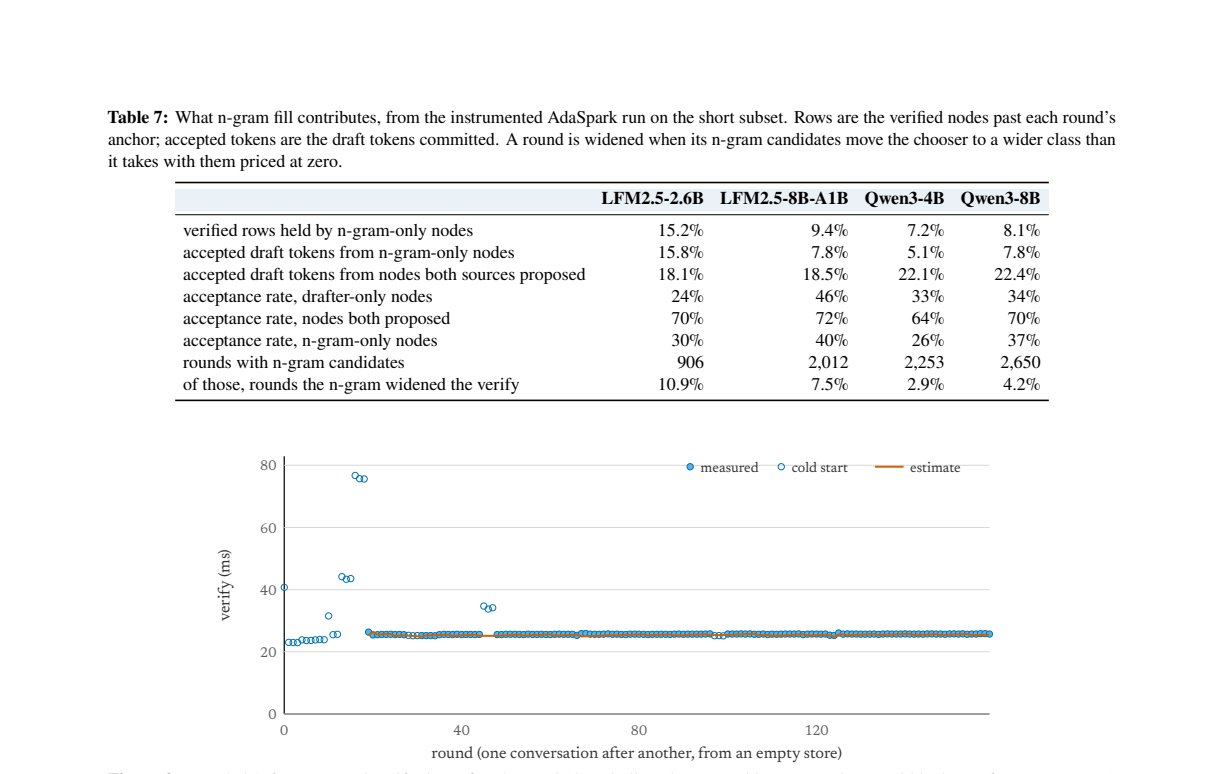
N-gram candidates of the request's own text can join drafted candidates in one priced best-first order without the fixed source-split failure that retrieved candidates cause in a fixed-budget tree, because Corollary 4 guarantees a verify of a given width is never worse under the model.
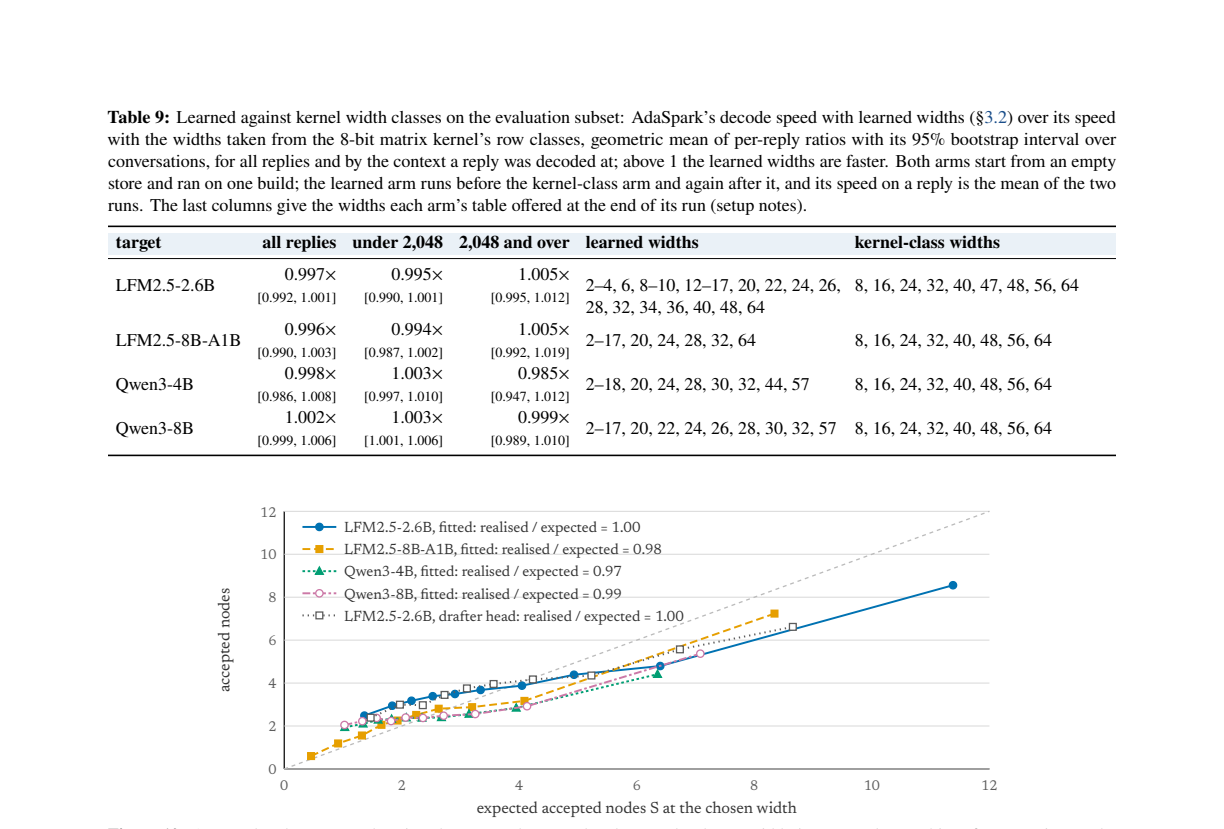
The learned widths match an explicit declaration of the 8-bit matrix kernel's row classes within 0.4% on every target, so the widths need not be declared by the backend — the learner follows whatever kernels each target runs.
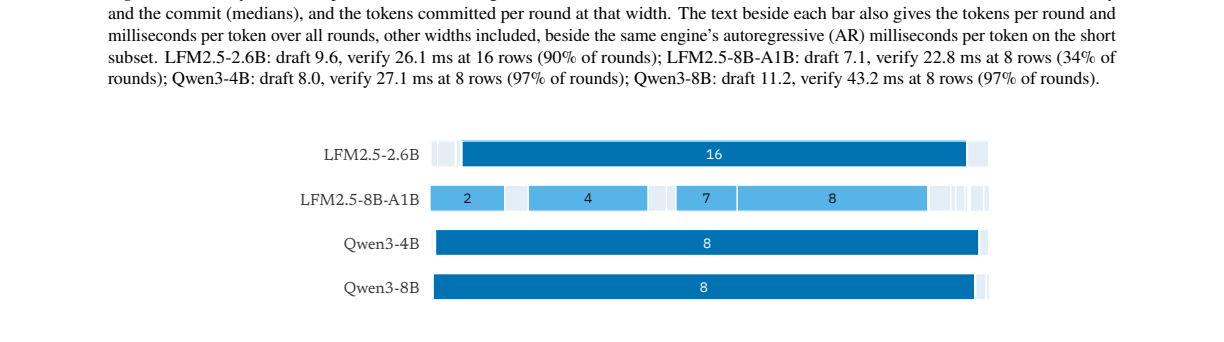
On a routed MoE target, where time rises with every row, a width that moves between 2 and 8 rows from round to round ties the best pinned width anyway, committing 2.8% more tokens per round in about the same time as a pinned 6-row tree.
The width-invariance premise bounds how far the claim extends: wider verifies and the routed target's 2-row verifies accumulate in another kernel order and can change the text at near ties, so on workloads where most rounds fall outside the bit-identical range the long-run-rate rule rests on an approximation the paper defends but does not prove.
The gains are demonstrated for greedy decoding only; under sampling, the acceptance model's labels and the near-tie argument would both need reworking, and the reported speedups may not carry over.
A testable extension is to run AdaSpark on a second device with a different kernel step structure: the constants were set on one target and are claimed to transfer unchanged, so a device with different row classes would probe whether the low-quantile law and the learned-width split rule generalise.
Check this review
Pith stored no record of this review's passes and took no fingerprint of it. Reviews made by code from 13 Nov 2026 on carry both.
How often reviews like this one are right
Reviews like this one: written by deepseek-v4-flash, where what was read was not recorded.
How often objections from reviews like this one are right: not yet measured
Reviews by people
This review was written by a machine. No person has reviewed this paper on Pith yet. A scientist listed on Pith can review it for a fee, and their review is published here whatever it concludes.
The paper
Abstract
Block drafters such as DSpark propose ranked candidates for several positions in one forward pass, and a tree verifier checks them in one pass of the target. The number of rows to verify trades the tokens a wider tree is expected to accept against the time a wider verify takes. Most schedulers that choose this number take the verify time from a table or model measured before serving, corrected online by at most one scale factor, and take acceptance from the drafter's confidence estimates or from a map fitted offline. AdaSpark learns both quantities while it serves, with no profile, calibration or sweep in advance. It learns which verify widths are worth offering and fits each one's verify time as a function of context. It fits each candidate's acceptance probability to the target's verify outcomes, with the drafter's confidence head as one input, and orders and sizes the tree by that fit instead of by the head. The same model prices n-gram continuations of the request's own text, so drafted and text-derived candidates compete for rows in one best-first order. The width is chosen by pricing time at the long-run decode rate. On single- and multi-turn conversations from six public datasets, on three dense targets and one mixture-of-experts target, AdaSpark decodes 1.5-3.1x faster than llama.cpp's DSpark with the same drafters. Our imparo engine with AdaSpark is 1.17-1.52x faster than imparo running with a three-token chain (the default llama.cpp setting); this gain comes from the scheduler alone. Without a width sweep, AdaSpark is never more than 0.3% slower than the best pinned tree width on any dense target or context band. On the mixture-of-experts target it ties the best pinned width, and the other pinned widths from 4 to 16 rows are 5-14% slower.
The paper's own sentences, arranged, kept beside the review and separate from it. Each label is drawn from a closed vocabulary; the number beside it is the probability the classifier gave that label. No sentence in this record was written by a model.
abstract compiled · 2026-10-06
The authors' main claim, as the classifier picked it out 1.00
“On single- and multi-turn conversations from six public datasets, on three dense targets and one mixture-of-experts target, AdaSpark decodes 1.5-3.1x faster than llama.cpp's DSpark with the same drafters.”
How the main claim is stated: asserted 1.00
What the abstract itself states, as probabilities: claims first 0.08 · states limitation 0.41 · human participants 0.03 · controlled comparison 0.96 · randomized assignment 0.02 · states quantitative result 0.99 · compares with prior results 0.98 · mentions code or data availability 0.05
The abstract, sentence by sentence
This table labels the abstract only (arXiv listing abstract v1). The number is the probability the classifier gave the label.
| Sentence | Role | The authors' own work | States the main conclusion | Strength |
|---|---|---|---|---|
| Block drafters such as DSpark propose ranked candidates for several positions in one forward pass, and a tree verifier checks them in one pass of the target. | background 0.99 | 0.08 | 0.03 | asserted 1.00 |
| The number of rows to verify trades the tokens a wider tree is expected to accept against the time a wider verify takes. | background 0.99 | 0.15 | 0.04 | asserted 0.99 |
| Most schedulers that choose this number take the verify time from a table or model measured before serving, corrected online by at most one scale factor, and take acceptance from the drafter's confidence estimates or from a map fitted offline. | background 0.86 | 0.07 | 0.03 | asserted 1.00 |
| AdaSpark learns both quantities while it serves, with no profile, calibration or sweep in advance. | contribution 0.82 | 0.91 | 0.13 | asserted 1.00 |
| It learns which verify widths are worth offering and fits each one's verify time as a function of context. | method 0.88 | 0.91 | 0.08 | asserted 1.00 |
| It fits each candidate's acceptance probability to the target's verify outcomes, with the drafter's confidence head as one input, and orders and sizes the tree by that fit instead of by the head. | method 0.97 | 0.92 | 0.07 | asserted 1.00 |
| The same model prices n-gram continuations of the request's own text, so drafted and text-derived candidates compete for rows in one best-first order. | method 0.93 | 0.86 | 0.05 | asserted 1.00 |
| The width is chosen by pricing time at the long-run decode rate. | method 0.99 | 0.78 | 0.06 | asserted 1.00 |
| On single- and multi-turn conversations from six public datasets, on three dense targets and one mixture-of-experts target, AdaSpark decodes 1.5-3.1x faster than llama.cpp's DSpark with the same drafters. | result 1.00 | 0.94 | 0.55 | asserted 1.00 |
| Our imparo engine with AdaSpark is 1.17-1.52x faster than imparo running with a three-token chain (the default llama.cpp setting); this gain comes from the scheduler alone. | result 0.99 | 0.94 | 0.18 | asserted 1.00 |
| Without a width sweep, AdaSpark is never more than 0.3% slower than the best pinned tree width on any dense target or context band. | result 1.00 | 0.94 | 0.13 | asserted 1.00 |
| On the mixture-of-experts target it ties the best pinned width, and the other pinned widths from 4 to 16 rows are 5-14% slower. | result 1.00 | 0.94 | 0.12 | asserted 1.00 |
What kind of paper the classifier reports this is: method or tool 1.00 · evidence from observation or experiment 0.95
What was examined, and what was not
Sources read
- arXiv listing abstract v1
Not examined
- full text
- figures and tables
- references and citing sentences
- relations to other papers
Levels run
- P abstract
Not run
- S sections
- T body sentences
- C citations
- R cross-paper relations
How the labels were made
Compiled by classifier-1.13.0 via TypeSafe API, question bank abstract-p1-20260923, 2026-10-06: 1 request, 9,016 input tokens.
Every quoted sentence on this record is the authors'. Every label is from Pith's closed vocabulary, with the probability shown beside it. This record as JSON
Figures (10)
Figures are the authors', reproduced from the paper.
References (71)
- [1] Y. Leviathan, M. Kalman, and Y. Matias. Fast Inference from Transformers via Speculative Decoding. ICML 2023 on Pith
- [2] C. Chen et al. Accelerating Large Language Model DecodingwithSpeculativeSampling. arXiv:2302.01318, 2023 on PithPith's reviewarXiv
- [3] T.Caietal.Medusa: SimpleLLMInferenceAcceleration Framework with Multiple Decoding Heads. ICML 2024 on Pith
- [4] Y. Li et al. EAGLE: Speculative Sampling Requires Rethinking Feature Uncertainty. ICML 2024 on Pith
- [5] X. Miao et al. SpecInfer: Accelerating Large Language Model Serving with Tree-based Speculative Inference and Verification. ASPLOS 2024. arXiv:2305.09781. 19 Table 12:DSpark schedulers in vLLM (read from vLLM commit 41c4a3ed4e) and SGLang (read from SGLang commit 8b2ca8ecc2), ... on PithPith's reviewarXiv
- [6] Y.Li,F.Wei,C.Zhang,andH.Zhang. EAGLE-2: Faster InferenceofLanguageModelswithDynamicDraftTrees. EMNLP 2024. arXiv:2406.16858 on PithPith's reviewarXiv
- [7] J. Wang et al. OPT-Tree: Speculative Decoding with Adaptive Draft Tree Structure. TACL 13, 2025. arXiv:2406.17276 on PithPith's reviewarXiv
- [8] X. Cheng et al. DSpark: Confidence-Scheduled Specu- lative Decoding with Semi-Autoregressive Generation. arXiv:2607.05147, 2026 on PithPith's reviewarXiv
- [9] H. Zhou, H. Wang, and X. Wang. TreeSpark: Calibrated, Load-AdaptiveDraftTreesforSemi-AutoregressiveSpec- ulative Decoding. arXiv:2609.22098, 2026 on PithPith's reviewarXiv
- [10] Z. Li, T. Li, C. Xie, et al. From Chains to Trees: Parent- Conditioned Drafting for Semi-Autoregressive Specula- tive Decoding (PCTree). arXiv:2608.02123, 2026 on PithPith's reviewarXiv
- [11] Y. Shen, T. Liu, X. Hu, et al. Draft Less, Retrieve More: Hybrid Tree Construction for Speculative Decod- ing (Graft). arXiv:2605.20104, 2026 on PithPith's reviewarXiv
- [12] T. Liu, Q. Lv, Y. Shen, et al. TALON: Confidence- Aware Speculative Decoding with Adaptive Token Trees. arXiv:2601.07353, 2026 on PitharXiv
- [13] S. Saremi. AdaptiveSD: A Stability-Aware, Runtime- Adaptive Speculative Decoding Framework with Multi- Policy Orchestration for CPU-Constrained LLM Infer- ence. arXiv:2607.03876, 2026 on PithPith's reviewarXiv
- [14] Y.Houetal.BanditSpec: AdaptiveSpeculativeDecoding via Bandit Algorithms. ICML 2025. arXiv:2505.15141 on PitharXiv
- [15] K.Sun,J.Li,X.Chen,etal. Delay-AdaptiveSpeculation Control for Low-Latency Edge-Cloud LLM Inference. arXiv:2606.20591, 2026 on PithPith's reviewarXiv
- [16] A. Saxena, P.-A. Tsai, H. Taneja, et al. Utility-Driven Speculative Decoding for Mixture-of-Experts (Cascade). arXiv:2506.20675, 2025 on PithPith's reviewarXiv
- [17] W. Kwon et al. Efficient Memory Management for Large Language Model Serving with PagedAttention (vLLM). SOSP 2023. arXiv:2309.06180 on PithPith's reviewarXiv
- [18] L. Pan, Z. Tao, X. Wang, et al. Making Every Verified TokenCount: AdaptiveVerificationforMoESpeculative Decoding (EVICT). arXiv:2605.00342, 2026 on PithPith's reviewarXiv
- [19] L. Zheng et al. SGLang: Efficient Execution of Structured Language Model Programs. NeurIPS 2024. arXiv:2312.07104 on PithPith's reviewarXiv
- [20] S. Oh, N. Cao, Y. Kim, et al. Bastion: Budget-Aware Speculative Decoding with Tree-structured Block Diffu- sion Drafting. arXiv:2605.29727, 2026 on PithPith's reviewarXiv
show 51 more
- [21] K. Huang, X. Guo, and M. Wang. SpecDec++: Boosting Speculative Decoding via Adaptive Candidate Lengths. COLM 2025. arXiv:2405.19715 on PithPith's reviewarXiv
- [22] Z. Wang, J. Huang, and X. Chen. TAPS: Target-Aware Prefix Tree Selection for Diffusion-Drafted Speculative Decoding. arXiv:2606.00487, 2026 on PithPith's reviewarXiv
- [23] P. Chordiya. Lossless but Not Free: An Empirical Anatomy of Speculative Decoding on Consumer Hard- ware. arXiv:2607.17283, 2026 on PithPith's reviewarXiv
- [24] Z. Huang, L. Zhu, Z. Zhan, et al. MoESD: Unveil SpeculativeDecoding’sPotentialforAcceleratingSparse MoE. NeurIPS 2025. arXiv:2505.19645 on PitharXiv
- [25] G. Quan, W. Feng, C. Hao, et al. RASD: Retrieval- Augmented Speculative Decoding. Findings of ACL on Pith
- [26] B. McDanel, S. Li, S. Surineni, et al. MoE-Spec: Expert Budgeting for Efficient Speculative Decoding. arXiv:2602.16052, 2026 on PitharXiv
- [27] R.KoenkerandG.Bassett. RegressionQuantiles. Econo- metrica 46(1), 1978. 20 on Pith
- [28] H. Zou and T. Hastie. Regularization and Variable Selection via the Elastic Net. Journal of the Royal Statistical Society B 67(2), 2005 on Pith
- [29] H. B. McMahan et al. Ad Click Prediction: a View from the Trenches. KDD 2013 on Pith
- [30] J. Duchi, E. Hazan, and Y. Singer. Adaptive Subgradient Methods for Online Learning and Stochastic Optimiza- tion. Journal of Machine Learning Research 12, 2011 on Pith
- [31] Y. Hong, Z. Tan, and K. Hu. Inference-Cost-Aware Dynamic Tree Construction for Efficient Inference in Large Language Models (CAST). ICLR 2026. arXiv:2510.26577 on PitharXiv
- [32] X. Liu, J. Park, L. Hu, et al. TurboSpec: Closed-loop SpeculationControlSystemforOptimizingLLMServing Goodput. arXiv:2406.14066, 2024 on PithPith's reviewarXiv
- [33] W. Dinkelbach. On Nonlinear Fractional Programming. Management Science 13(7), 1967 on Pith
- [34] Liquid AI. LFM2.5-2.6B and LFM2.5-8B-A1B. Model cards and DSpark drafters, Hugging Face, 2026 on Pith
- [35] A. Yang et al. (Qwen Team). Qwen3 Technical Report. arXiv:2505.09388, 2025 on PithPith's reviewarXiv
- [36] DeepSeek-AI. dspark_qwen3_4b_block7 and dspark_qwen3_8b_block7. DSpark drafters for Qwen3-4B and Qwen3-8B, Hugging Face, 2026 on Pith
- [37] Y. Oda, R. Mathieu, R. Knyazhitskiy, et al. Trees from Marginals: Autoregressive Drafting with Factorized Pri- ors. arXiv:2607.06763, 2026 on PithPith's reviewarXiv
- [38] G. Gerganov et al. llama.cpp. Software, github. com/ggml-org/llama.cpp; build 11201, commit 2145525a4 on Pith
- [39] Z. Chen et al. Sequoia: Scalable and Robust Speculative Decoding. NeurIPS 2024. arXiv:2402.12374 on PithPith's reviewarXiv
- [40] S. Zhang, H. Qiu, H. He, and Y. Dai. Cost-Aware Diffu- sion Draft Trees for Speculative Decoding (CaDDTree). arXiv:2606.01813, 2026 on PithPith's reviewarXiv
- [41] L. Ringel and Y. Romano. Accelerating Speculative Decoding with Block Diffusion Draft Trees (DDTree). arXiv:2604.12989, 2026 on PithPith's reviewarXiv
- [42] A. Ziashahabi, H. Entezari Zarch, L. Gao, et al. AS- PIRE: Asynchronous Batched Self-Speculative Decod- ing for Long-Context LLM Inference. COLM 2026. arXiv:2609.17943 on PithPith's reviewarXiv
- [43] T. Liu, Y. Shen, R. Cen, et al. D-cut: Adaptive Verifica- tion Depth Pruning for Batched Speculative Decoding. arXiv:2607.14647, 2026 on PithPith's reviewarXiv
- [44] X. Hu, Y. Shen, B. Zhang, et al. ECHO: Elastic Specula- tive Decoding with Sparse Gating for High-Concurrency Scenarios. arXiv:2604.09603, 2026 on PithPith's reviewarXiv
- [45] F. Huo, J. Tan, K. Zhang, et al. C2T: A Classifier- Based Tree Construction Method in Speculative Decod- ing. arXiv:2502.13652, 2025 on PithPith's reviewarXiv
- [46] M. Rusanovsky, Y. Miron, R. Uziel, et al. LiLiCorr: LightweightLikelihoodCorrelationofParallelDraftsfor Speculative Decoding. arXiv:2608.20530, 2026 on PithPith's reviewarXiv
- [47] T. Wu et al. D-PACE: Dynamic Position-Aware Cross-Entropy for Parallel Speculative Drafting. arXiv:2605.18810, 2026 on PithPith's reviewarXiv
- [48] A. Saxena. Prompt Lookup Decoding. Software, 2023 on Pith
- [49] Z.Heetal. REST:Retrieval-BasedSpeculativeDecoding. NAACL 2024. arXiv:2311.08252 on PithPith's reviewarXiv
- [50] J. Ou, Y. Chen, and W. Tian. Lossless Accelera- tion of Large Language Model via Adaptive N-gram Parallel Decoding. NAACL 2024 (Industry Track). arXiv:2404.08698 on PithPith's reviewarXiv
- [51] L. Stewart, M. Trager, S. K. Gonugondla, and S. Soatto. The N-Grammys: Accelerating Autoregressive Inference with Learning-Free Batched Speculation. ENLSP Work- shop at NeurIPS 2024. arXiv:2411.03786 on PithPith's reviewarXiv
- [52] S. Somasundaram, A. Phukan, and A. Saxena. PLD+: Accelerating LLM Inference by Leveraging Lan- guage Model Artifacts. Findings of NAACL 2025. arXiv:2412.01447 on PithPith's reviewarXiv
- [53] T. Liu et al. LogitSpec: Accelerating Retrieval-based Speculative Decoding via Next Next Token Speculation. Findings of ACL 2026. arXiv:2507.01449 on PithPith's reviewarXiv
- [54] G. Oliaro, Z. Jia, D. Campos, and A. Qiao. SuffixDe- coding: Extreme Speculative Decoding for Emerging AI Applications. NeurIPS 2025. arXiv:2411.04975 on PitharXiv
- [55] Y. Hu, K. Wang, X. Zhang, et al. SAM Decoding: Speculative Decoding via Suffix Automaton. ACL 2025. arXiv:2411.10666 on PithPith's reviewarXiv
- [56] Snowflake. Arctic Inference. Software,github.com/ snowflakedb/ArcticInference on Pith
- [57] NVIDIA. TensorRT-LLM. Software, github.com/ NVIDIA/TensorRT-LLM on Pith
- [58] R. Eisenstadt, I. Cohen, E. Cohen-Karlik, et al. To Copy or Not to Copy: Controlling Speculative Decoding via Intrinsic Model Signals. arXiv:2609.20186, 2026 on PithPith's reviewarXiv
- [59] F. Liu, X. Li, K. Zhao, et al. DART: Diffusion- Inspired Speculative Decoding for Fast LLM Inference. arXiv:2601.19278, 2026 on PitharXiv
- [60] A. Amankulov and D. Mamatin. The Limits of Specu- lation: Bounding Speculative Decoding in Mixture-of- Experts. arXiv:2609.22156, 2026. 21 on PithPith's reviewarXiv
- [61] H.-K. Zheng and P. Li. DeLS-Spec: Decoupled Long-Short Contexts for Parallel Speculative Drafting. arXiv:2607.07409, 2026 on PithPith's reviewarXiv
- [62] X. Qiang, X. Fang, C. Chen, et al. Beyond Parallel Blindness: Information Floors and Model Gaps in Block Drafting. arXiv:2608.27339, 2026 on PithPith's reviewarXiv
- [63] J. Koo, S. Woo, J. Kil, et al. Carryover Drafting: Recycling Rejected States for Speculative Decoding. arXiv:2609.14717, 2026 on PithPith's reviewarXiv
- [64] F.Liu,X.Li,K.Qian,etal. WhenParallelDrafterMeets Parallel Speculative Decoding. arXiv:2609.27396, 2026 on PithPith's reviewarXiv
- [65] H. Xia et al. Unlocking Efficiency in Large Language Model Inference: A Comprehensive Survey of Specula- tiveDecoding. FindingsofACL2024.arXiv:2401.07851. (Spec-Bench.) on PithPith's reviewarXiv
- [66] T. Abramovich et al. SPEED-Bench: A Unified and Di- verse Benchmark for Speculative Decoding. ICML 2026. arXiv:2604.09557. Datasetnvidia/SPEED-Bench on PithPith's reviewarXiv
- [67] W. Zhao et al. WildChat: 1M ChatGPT Interaction Logs in the Wild. ICLR 2024 on Pith
- [68] Z. Chen et al. ConvFinQA: Exploring the Chain of Nu- merical Reasoning in Conversational Finance Question Answering. EMNLP 2022 on Pith
- [69] Q.Xieetal.PIXIU:ALargeLanguageModel,Instruction Data and Evaluation Benchmark for Finance. NeurIPS 2023 Datasets and Benchmarks. (FLARE.) on Pith
- [70] W. Liu et al. ToolACE: Winning the Points of LLM Function Calling. ICLR 2025. arXiv:2409.00920 on PithPith's reviewarXiv
- [71] Y. Bai et al. LongBench: A Bilingual, Multitask Bench- mark for Long Context Understanding. ACL 2024. A Test set Every prompt in the end-to-end evaluation comes from a published dataset; we wrote no prompt text. The protocol is ours: multi-turn conversations over each engine’s... on Pith
Challenges and discussion
Disagree with the review, or know something it missed? Leave a comment, or challenge this review formally: a challenge becomes a permanent entry in this paper's record, and its decision is published here.
Come back by email
A short list of the week's newly reviewed papers. Nothing is sent until you confirm from your inbox, and every email has a link that stops it. No account.
No comments yet.
Sign in to comment