Machine Learning · arXiv:2609.14717 v1 · submitted 13 Sep 2026 · 35 references
Carryover Drafting: Recycling Rejected States for Speculative Decoding
The paper says
“Speculative decoding accelerates LLM inference by verifying multiple drafted tokens in parallel, allowing a single target forward pass to accept several tokens. By construction, verification computes representations for both accepted and rejected tokens.”
more of the abstract
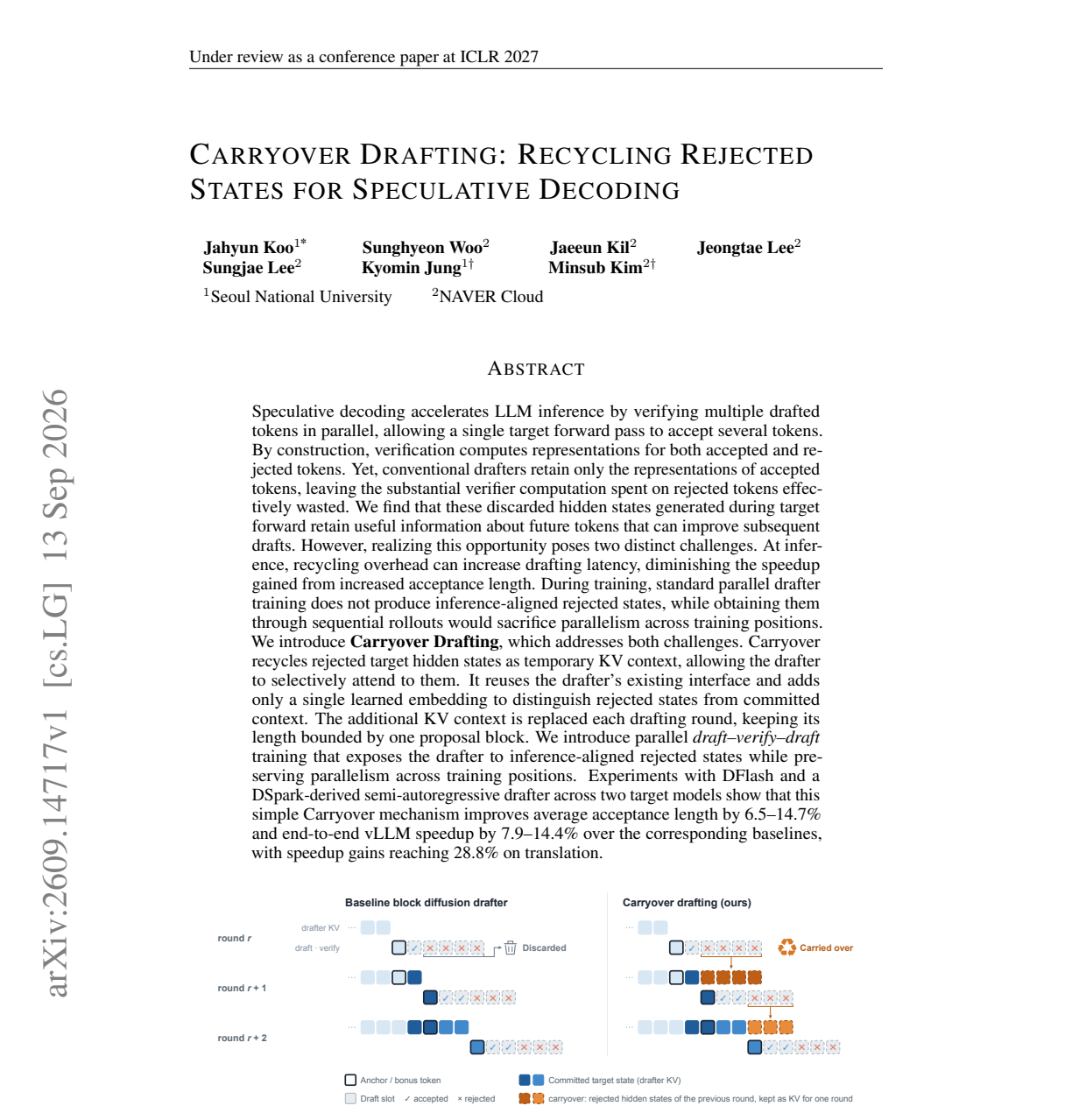
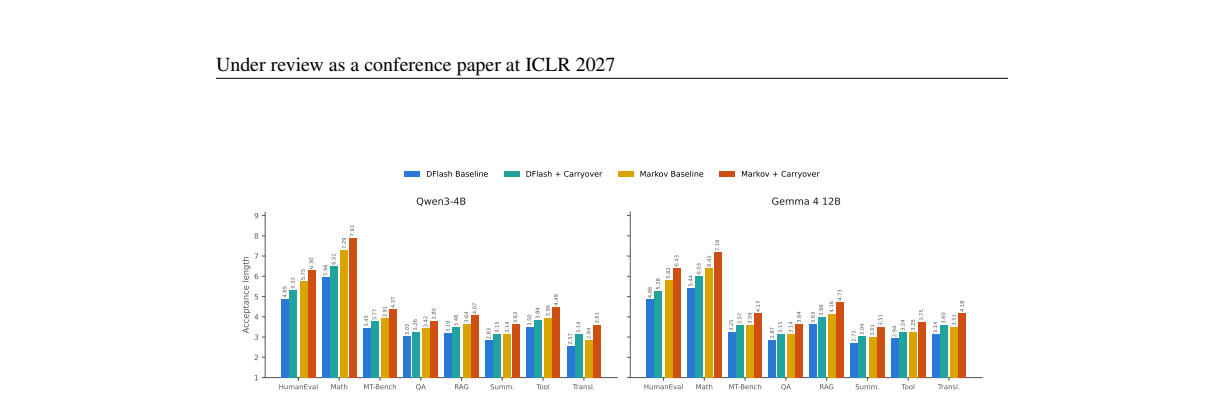
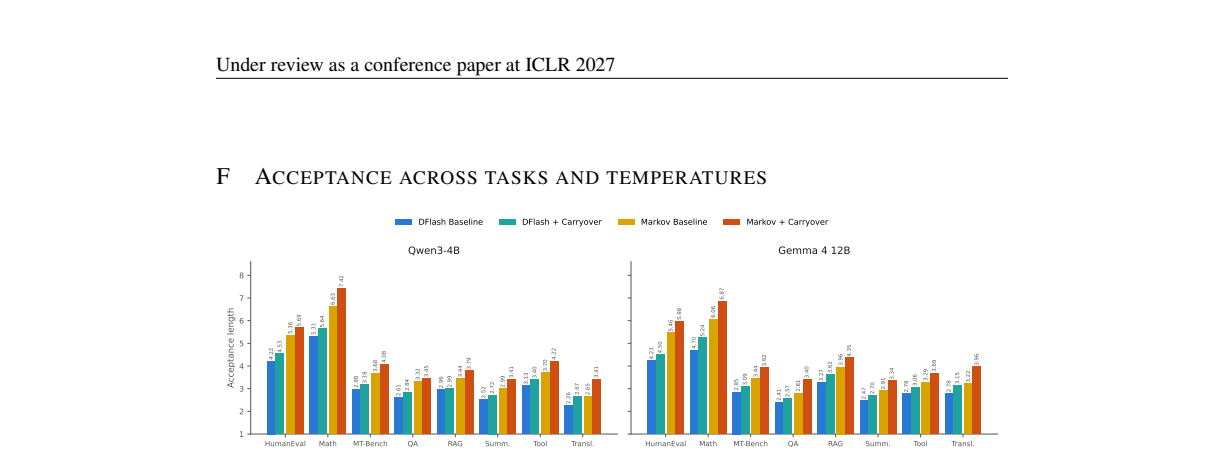
Yet, conventional drafters retain only the representations of accepted tokens, leaving the substantial verifier computation spent on rejected tokens effectively wasted. We find that these discarded hidden states generated during target forward retain useful information about future tokens that can improve subsequent drafts. However, realizing this opportunity poses two distinct challenges. At inference, recycling overhead can increase drafting latency, diminishing the speedup gained from increased acceptance length. During training, standard parallel drafter training does not produce inference-aligned rejected states, while obtaining them through sequential rollouts would sacrifice parallelism across training positions. We introduce Carryover Drafting, which addresses both challenges. Carryover recycles rejected target hidden states as temporary KV context, allowing the drafter to selectively attend to them. It reuses the drafter's existing interface and adds only a single learned embedding to distinguish rejected states from committed context. The additional KV context is replaced each drafting round, keeping its length bounded by one proposal block. We introduce parallel draft–verify–draft training that exposes the drafter to inference-aligned rejected states while preserving parallelism across training positions. Experiments with DFlash and a DSpark-derived semi-autoregressive drafter across two target models show that this simple Carryover mechanism improves average acceptance length by 6.5–14.7% and end-to-end vLLM speedup by 7.9–14.4% over the corresponding baselines, with speedup gains reaching 28.8% on translation.
from the abstract
Pith says
Machine review · deepseek-v4-flash · 15 Sep 2026 · what was read was not recorded · not checked by a person
It can be wrong. Challenge this review or reply to it.
The passes disagreed. Reader: holds up. Skeptic: holds up only with conditions. Referee: major revision.
Genuinely new and cleanly executed idea in speculative decoding — recycle rejected target hidden states through the drafter's KV interface — with thorough experiments, but the headline numbers compare 10-epoch baselines against 13-epoch carryover and the missing +3-epoch baseline control deserves a fix. This line is wrong
2 major objections · 5 minor
How often objections from reviews like this one are right: not yet measured
Not checked: figures, code, what the 35 references say.
The paper says, at Section 3, Table 1
The review did not quote this passage.
Pith says: Objection 1 of 2 · major
The comparison between Baseline and Carryover is confounded by unequal training durations: all baselines are trained for 10 epochs, while Carryover is trained for an additional 3 epochs from that checkpoint (13 total). The paper does not include a control experiment that continues baseline training for the same 3 additional epochs (with the same optimizer restart) to measure whether the observed acceptance and speedup gains are attributable to the carryover mechanism or simply to extended training.
more of objection 1
The ablation in Section 4.3 uses a 6-epoch probe, not the full 10+3 setup, and therefore does not address this confound. Without this control, the central claim that carryover causes the improvements is underdetermined. The authors should either provide data showing that additional baseline training (3 more epochs) yields negligible improvement, or re-run the comparison with matched total training epochs.
The paper says, at Section 5.2, Figure 5
The review did not quote this passage.
Pith says: Objection 2 of 2 · major
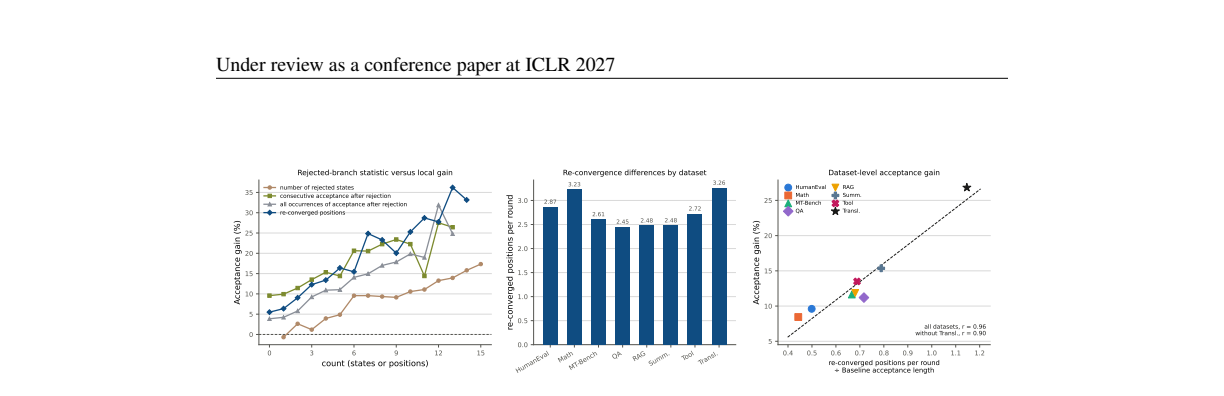
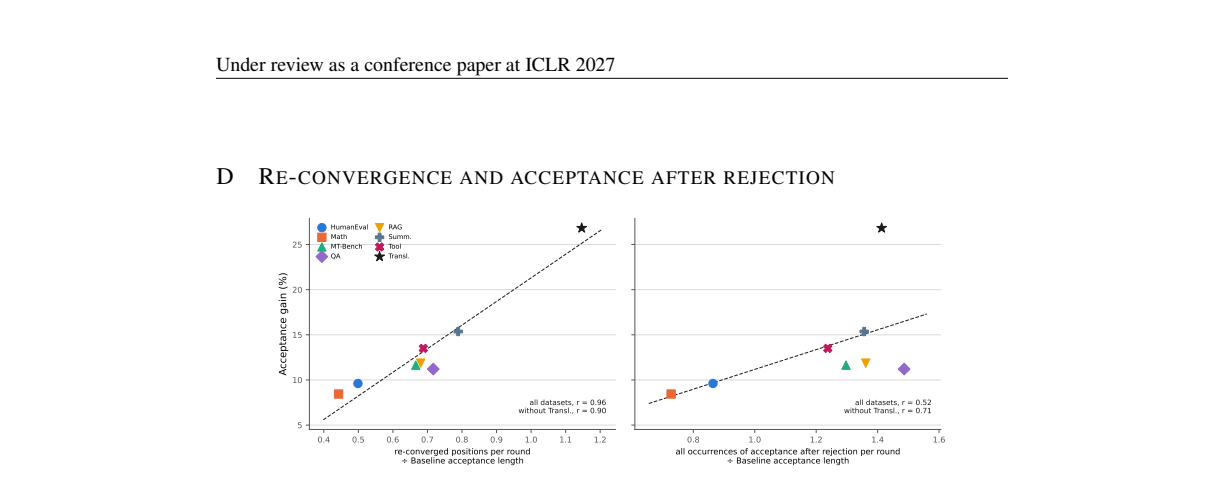
The correlation analysis between re-convergence and gain is instructive, but the paper does not report confidence intervals or significance tests for the reported correlations (r=0.96, 0.90 without Translation). Given that these correlations are based on only 8 data points (datasets), the reliability of these values should be quantified, e.g., with bootstrap intervals or p-values.
5 minor objections
The paper says, at Section 3, Paragraph 3
Pith says: minor objection 1 of 5
The justification for training baselines for 10 epochs cites the 'convergence rationale reported in DSpark.' This is an indirect argument; the paper should provide evidence (e.g., validation loss curves, acceptance-length evolution) that the specific targets and drafters used here have indeed converged at 10 epochs.
The paper says, at Table 1
Pith says: minor objection 2 of 5
The reported percentages are rounded after aggregation, which can cause small discrepancies when recomputing from raw numbers (as the paper itself notes). However, the paper does not report any measure of variability (e.g., standard deviation, confidence intervals) for acceptance length or speedup. Reporting error bars would strengthen the empirical claims, especially for datasets with small prompt counts (e.g., 80 prompts for some datasets).
show 3 more
The paper says, at Figure 5, left panel
Pith says: minor objection 3 of 5
The definitions of 'consecutive acceptance after rejection' and 'all occurrences of acceptance after rejection' are explained in Section 5.2, but the axis labels and legend in the figure do not match the text precisely. Clarifying these in the caption would improve readability.
The paper says, at Section 6, 'On-policy training with rollouts'
Pith says: minor objection 4 of 5
The paper mentions that Draft-OPD could naturally produce carryover opportunities without additional verification. However, the current training only covers single-round carryover. The implications of multi-round carryover are discussed qualitatively, but a brief estimate or small-scale experiment would help readers gauge the potential benefit or risk of distribution shift.
The paper says, at Bibliography
Pith says: minor objection 5 of 5
Several references (e.g., Amazon Web Services 2026, Red Hat AI 2026) are to Hugging Face model cards or datasets. These URLs should be checked for stability and, if possible, archived (e.g., on arXiv or institutional repositories) to ensure long-term accessibility for peer review and reproducibility.
What would settle it
Train the baseline for 3 additional epochs from its 10-epoch checkpoint, using the same data, learning rate restart, and optimizer settings as the Carryover fine-tuning, but without any carryover states or shifted anchors. Compare acceptance length and speedup on the full evaluation suite (Table 1). If the 13-epoch baseline achieves acceptance gains greater than half of those reported for Carryover, the causal role of carryover is not established and the central claim weakens.
from the skeptic's reading
How the review went
4 readings by deepseek-v4-flash · 15 Sep 2026
- Reader holds up
- Skeptic disagrees: says it holds up only with conditions Carryover's gains may be partially due to additional training epochs rather than the carryover mechanism; the paper lacks a control for extended baseline training.
- Editor wrote the verdict above
- Referee major revision: 2 major objections, 5 minor
Not run on this paper: the simulated authors' defence.
Pith did not check this review's objections against the paper.
The review in full
The review in brief, machine-written
Two things to know about arXiv:2609.14717. First, the central idea is genuinely new: rather than discarding the hidden states of rejected draft tokens after verification, Carryover feeds them into the next drafting round through the drafter's existing KV interface, distinguished from committed context by a single learned embedding, with the extra context bounded to one proposal block. That departs cleanly from the existing recycling lines — tokens (Token Recycling, Lookahead, Ouroboros), drafter states (Lyanna), steering vectors (SD2) — and it demonstrably works. Second, the headline comparison in Table 1 is 10-epoch baselines against 10+3-epoch Carryover, and the paper never runs the control of giving the baseline the same three extra epochs.
What the paper does well: the parallel draft-verify-draft training is a real methodological contribution — it produces inference-aligned rejected states without sequential rollouts, keeping training parallel across anchors. The experiments are thorough by this subfield's standards: two targets, two drafting regimes, eight datasets, T=0 and T=1, a concurrency sweep to 32, ablations, matched-anchor recall, and an attention diagnostic. The re-convergence analysis is honest post-hoc explanation, explicitly never used to select states or supervise training. The authors also state limitations plainly in Section 6: no confidence scheduling, no tree decoding, and training covers only one carryover round.
On the training-time confound: it is real and should be fixed, but I don't think it sinks the paper. The stress-test note overreaches when it says the Table 3 ablation fails to control for training — the probe gives baseline and variants the same 6 epochs, and carryover still gains 9.6-14.8% over the probe baseline, roughly matching the full-scale effect sizes. That is genuine evidence that the mechanism, not the extra epochs, drives the gains. What is missing is the clean full-scale control: extend the DFlash and Markov baselines for 3 more epochs with a fresh optimizer and report the delta. The authors assert the 10-epoch baselines are converged per DSpark's recipe, which would make the confound small — but that assertion is doing work the paper never measures.
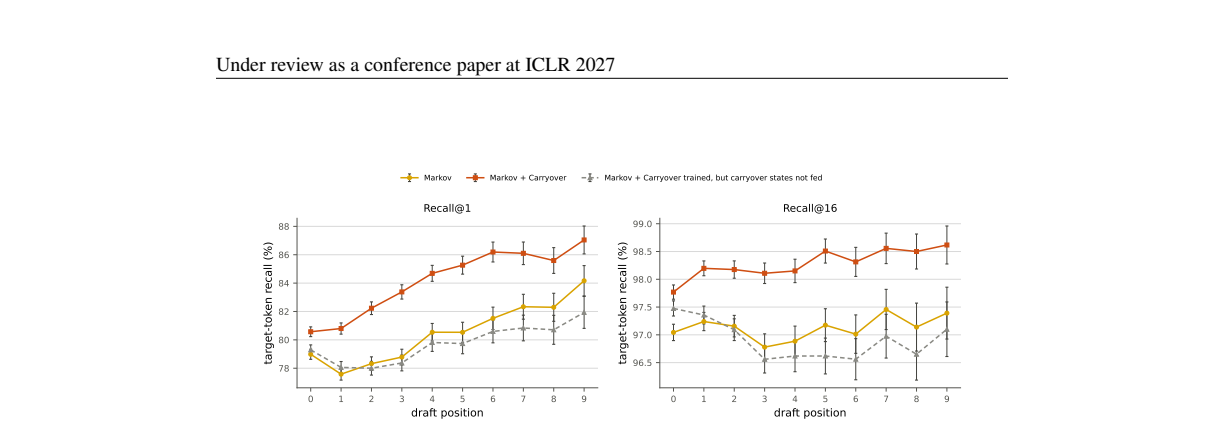
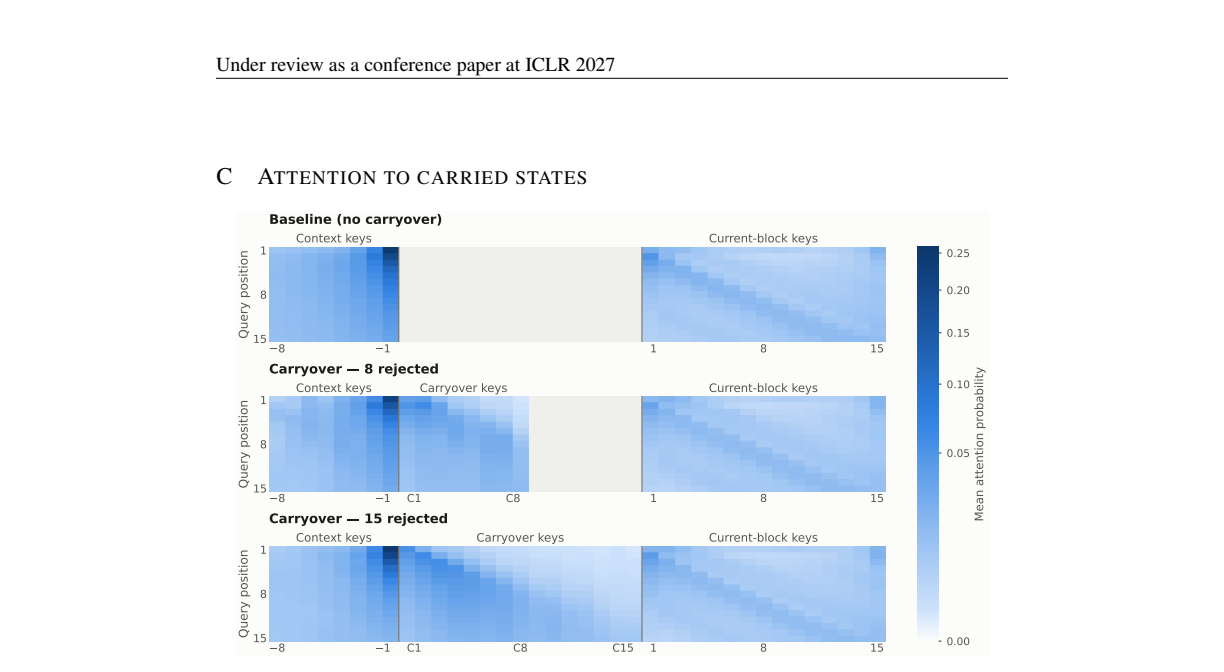
Minor soft spots: the Table 3(a) comparison changes both what is carried and how it enters the drafter, which the authors flag; the OFF replay in Figure 4 withholds context from a model trained on it, so it is a diagnostic rather than a deployment counterfactual; and evaluation is single-GPU with fixed verification length.
This is for anyone working on speculative decoding or LLM serving, and it deserves a serious referee. For review I'd accept and ask for the baseline-plus-3-epochs control in revision. If the extended baselines don't move, the claims are clean as stated.
The strongest objection
The central empirical claim of Carryover Drafting is that recycling rejected hidden states improves acceptance length and speedup. However, the experimental setup introduces a confound: the baseline is trained for 10 epochs, while Carryover is trained for an additional 3 epochs from that checkpoint (13 total). The paper does not test whether continuing baseline training for the same 3 epochs (with the same data and optimizer restart) yields comparable improvements. Without this control, the observed gains could reflect extended training rather than the carryover mechanism. The ablation study in Table 3 uses a small-scale probe with 6 epochs, not the full 10+3 setup, and does not control for extra training either. This underdetermines the attribution of the improvement to carryover, which is the paper's core innovation.
The reader's weakest assumption was about training-time vs. inference-time distribution alignment, which the paper addresses via parallel draft–verify–draft training. However, a more immediate load-bearing concern is the lack of a control for extended training in the main experiment. The baseline is trained for 10 epochs; Carryover is additionally trained for 3 epochs. The paper does not show that a baseline trained for 13 epochs would not achieve similar improvements. This is a standard confound in fine-tuning studies, and without it the causal attribution to carryover is uncertain. The ablation uses only 6 epochs and does not address this. Therefore, the claim should be accepted conditional on passing this control. The concrete test proposed would resolve the uncertainty: if the 13-epoch baseline approaches the gains, carryover is not the driver; if it does not, the claim is strengthened. This concern is not about distribution mismatch but about experimental design, hence disagreement with the reader's focus.
The referee's report
The paper addresses a practical and well-motivated problem: the wasted computation on rejected tokens during speculative decoding. The proposed mechanism is lightweight (one embedding, no additional projection modules) and integrates naturally with existing block-diffusion drafters. The experimental evaluation is thorough—two targets, two drafter architectures, eight datasets, concurrency sweeps, and ablation studies—and the gains are consistent across settings. The diagnostic analysis linking gains to re-convergence of rejected states provides insight into when the method works best. If the results are robust, Carryover Drafting could become a standard component of speculative decoding systems, offering a simple and effective way to recycle otherwise discarded computation.
Pith's reading of the paper (a machine's summary, not the authors')
Speculative decoding accelerates LLM inference by verifying multiple drafted tokens in parallel, but conventional drafters discard the hidden states of rejected tokens computed during verification. The paper argues that these rejected states retain useful information about future tokens and can be recycled to improve the next draft. To do this without adding latency overhead, Carryover Drafting feeds the rejected hidden states into the drafter's existing key-value attention interface, distinguished by a single learned embedding, and replaces them every round to keep context bounded. A parallel draft-verify-draft training procedure exposes the drafter to inference-aligned rejected states without requiring sequential rollouts. Experiments across two target models and eight datasets show consistent improvements in acceptance length and end-to-end speedup, with the largest gains on translation tasks (up to 28.8% speedup relative to baseline).
What carries the argument. Carryover mechanism: after verification, the drafter collects the rejected target hidden states (obtained from the verifier's top-layer features), adds a single learned embedding $E_{\text{carry}}$ to distinguish them from accepted context, projects them through the existing fusion layer $F$ and per-layer key/value projections $\(K^\ell, V^\ell\)$, and appends them as read-only KV context for the next drafting round. The carried-over context is replaced each round, keeping its length bounded by one proposal block.
Core claim. Rejected target hidden states produced during speculative decoding verification are not wasted computation: they can be carried over to the next drafting round via the drafter's existing KV projection interface, using one additional learned embedding to mark them as rejected. This simple mechanism improves average acceptance length by 6.5–14.7% and end-to-end vLLM speedup by 7.9–14.4% over corresponding baselines, with translation tasks benefiting most (up to 28.8% speedup).
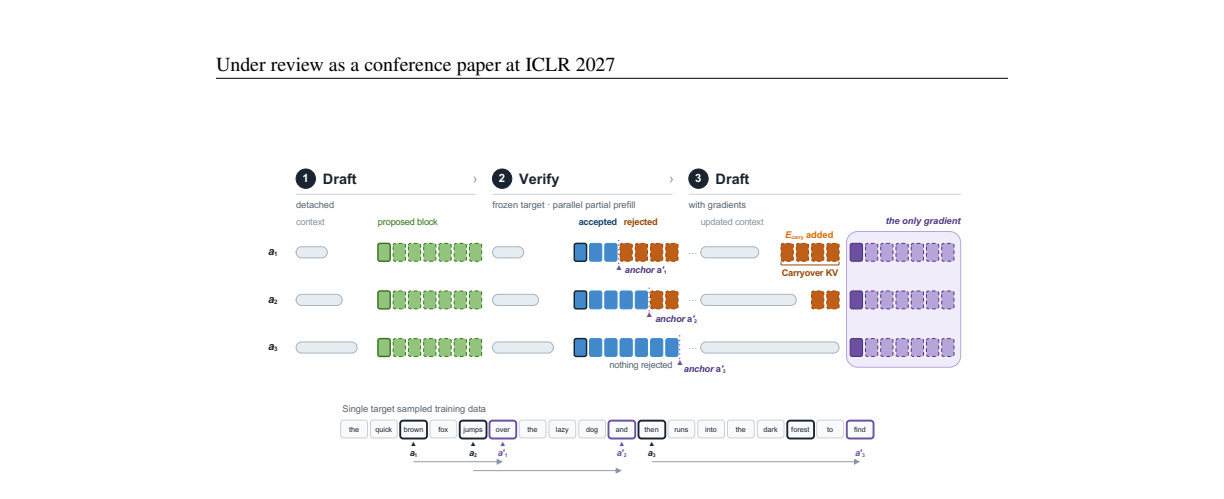
The premise it rests on. The parallel draft-verify-draft training procedure (Algorithm 2) assumes that the rejected states obtained from a frozen target verifying detached proposals during training are representative of the rejected states that will arise during actual inference-time speculative decoding with the same drafter.
If the paper is right (Pith's inferences, not the authors')
If Carryover Drafting is correct, any target-conditioned drafter (e.g., DFlash, EAGLE variants) can be retrofitted with the carryover embedding and training procedure to obtain immediate acceptance and speedup gains without changing the target model or verification algorithm.
The parallel draft-verify-draft training procedure (Algorithm 2) provides a template for exposing drafters to inference-like rejected states while preserving parallelism across training positions, which may generalize to other speculative decoding methods that reuse intermediate states.
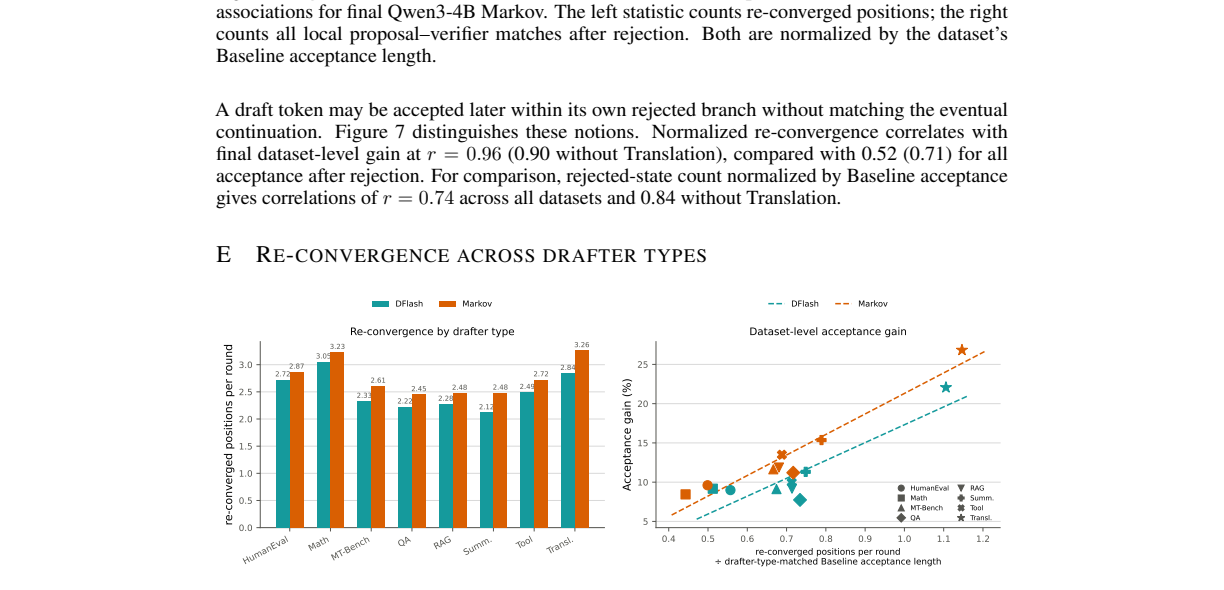
The finding that re-convergence (agreement between rejected-branch predictions and the eventual committed continuation) correlates strongly with Carryover gain (r=0.96) suggests that the mechanism is most effective when the drafter's rejected predictions are close to the target's final path – a property that stronger drafters already tend to satisfy.
Larger gains on translation (up to 28.8% speedup) indicate that tasks with higher lexical variation or longer-range dependencies may benefit disproportionately from the additional context provided by rejected states.
The separation between committed KV cache and read-only carried-over context preserves correctness of the target distribution, because the drafter defines a proposal distribution conditioned on (accepted history + carried states) and the usual acceptance rule with residual correction still samples from the target.
The correlation between re-convergence and gain suggests a natural extension: selectively carrying over only rejected states whose future predictions are likely to re-converge (e.g., based on attention confidence or verifier logits) could reduce the size of carried context without sacrificing benefit, potentially lowering overhead further.
The parallel draft-verify-draft training relies on a frozen target to verify detached proposals; if the target itself is a larger model with high inference cost, this verification step adds training overhead proportional to the number of anchors per response (512). Reducing the number of anchors or verifying in mini-batches could trade off training cost for statistical coverage.
Carryover's design assumes that one round of carryover is sufficient; extending to multi-round carryover might help in long generation scenarios where rejected states remain predictive across several drafting steps, but would require the training procedure to maintain a longer sequence of state transitions.
The paper evaluates only fixed verification lengths; combining Carryover with confidence-based adaptive scheduling (as in DSpark) would require retraining under that scheduling policy and recalibrating acceptance probabilities, because Carryover changes the proposal distribution.
Check this review
Pith stored no record of this review's passes and took no fingerprint of it. Reviews made by code from 13 Nov 2026 on carry both.
How often reviews like this one are right
Reviews like this one: written by deepseek-v4-flash, where what was read was not recorded.
How often objections from reviews like this one are right: not yet measured
Reviews by people
This review was written by a machine. No person has reviewed this paper on Pith yet. A scientist listed on Pith can review it for a fee, and their review is published here whatever it concludes.
The paper
Abstract
Speculative decoding accelerates LLM inference by verifying multiple drafted tokens in parallel, allowing a single target forward pass to accept several tokens. By construction, verification computes representations for both accepted and rejected tokens. Yet, conventional drafters retain only the representations of accepted tokens, leaving the substantial verifier computation spent on rejected tokens effectively wasted. We find that these discarded hidden states generated during target forward retain useful information about future tokens that can improve subsequent drafts. However, realizing this opportunity poses two distinct challenges. At inference, recycling overhead can increase drafting latency, diminishing the speedup gained from increased acceptance length. During training, standard parallel drafter training does not produce inference-aligned rejected states, while obtaining them through sequential rollouts would sacrifice parallelism across training positions. We introduce Carryover Drafting, which addresses both challenges. Carryover recycles rejected target hidden states as temporary KV context, allowing the drafter to selectively attend to them. It reuses the drafter's existing interface and adds only a single learned embedding to distinguish rejected states from committed context. The additional KV context is replaced each drafting round, keeping its length bounded by one proposal block. We introduce parallel draft–verify–draft training that exposes the drafter to inference-aligned rejected states while preserving parallelism across training positions. Experiments with DFlash and a DSpark-derived semi-autoregressive drafter across two target models show that this simple Carryover mechanism improves average acceptance length by 6.5–14.7% and end-to-end vLLM speedup by 7.9–14.4% over the corresponding baselines, with speedup gains reaching 28.8% on translation.
The paper's own sentences, arranged, kept beside the review and separate from it. Each label is drawn from a closed vocabulary; the number beside it is the probability the classifier gave that label. No sentence in this record was written by a model.
abstract compiled · 2026-09-23
The authors' main claim, as the classifier picked it out 1.00
“Experiments with DFlash and a DSpark-derived semi-autoregressive drafter across two target models show that this simple Carryover mechanism improves average acceptance length by 6.5--14.7% and end-to-end vLLM speedup by 7.9--14.4% over the corresponding baselines, with speedup gains reaching 28.8% on translation.”
How the main claim is stated: asserted 1.00
What the abstract itself states, as probabilities: claims first 0.07 · states limitation 0.37 · human participants 0.02 · controlled comparison 0.95 · randomized assignment 0.02 · states quantitative result 0.99 · compares with prior results 0.97 · mentions code or data availability 0.03
The abstract, sentence by sentence
This table labels the abstract only (arXiv listing abstract v1). The number is the probability the classifier gave the label.
| Sentence | Role | The authors' own work | States the main conclusion | Strength |
|---|---|---|---|---|
| Speculative decoding accelerates LLM inference by verifying multiple drafted tokens in parallel, allowing a single target forward pass to accept several tokens. | background 1.00 | 0.06 | 0.03 | asserted 1.00 |
| By construction, verification computes representations for both accepted and rejected tokens. | background 1.00 | 0.14 | 0.02 | asserted 1.00 |
| Yet, conventional drafters retain only the representations of accepted tokens, leaving the substantial verifier computation spent on rejected tokens effectively wasted. | gap 0.61 | 0.12 | 0.04 | asserted 1.00 |
| We find that these discarded hidden states generated during target forward retain useful information about future tokens that can improve subsequent drafts. | result 0.87 | 0.93 | 0.25 | asserted 0.99 |
| However, realizing this opportunity poses two distinct challenges. | gap 0.75 | 0.30 | 0.02 | asserted 0.93 |
| At inference, recycling overhead can increase drafting latency, diminishing the speedup gained from increased acceptance length. | background 0.47 | 0.22 | 0.02 | asserted 0.60 |
| During training, standard parallel drafter training does not produce inference-aligned rejected states, while obtaining them through sequential rollouts would sacrifice parallelism across training positions. | gap 0.71 | 0.25 | 0.02 | asserted 1.00 |
| We introduce Carryover Drafting, which addresses both challenges. | contribution 1.00 | 0.87 | 0.11 | asserted 0.99 |
| Carryover recycles rejected target hidden states as temporary KV context, allowing the drafter to selectively attend to them. | method 0.94 | 0.86 | 0.12 | asserted 1.00 |
| It reuses the drafter's existing interface and adds only a single learned embedding to distinguish rejected states from committed context. | method 0.98 | 0.88 | 0.05 | asserted 1.00 |
| The additional KV context is replaced each drafting round, keeping its length bounded by one proposal block. | method 0.99 | 0.77 | 0.03 | asserted 1.00 |
| We introduce parallel draft--verify--draft training that exposes the drafter to inference-aligned rejected states while preserving parallelism across training positions. | method 0.82 | 0.94 | 0.08 | asserted 0.99 |
| Experiments with DFlash and a DSpark-derived semi-autoregressive drafter across two target models show that this simple Carryover mechanism improves average acceptance length by 6.5--14.7% and end-to-end vLLM speedup by 7.9--14.4% over the corresponding baselines, with speedup gains reaching 28.8% on translation. | result 1.00 | 0.97 | 0.82 | asserted 1.00 |
What kind of paper the classifier reports this is: method or tool 1.00 · evidence from observation or experiment 0.99
What was examined, and what was not
Sources read
- arXiv listing abstract v1
Not examined
- full text
- figures and tables
- references and citing sentences
- relations to other papers
Levels run
- P abstract
Not run
- S sections
- T body sentences
- C citations
- R cross-paper relations
How the labels were made
Compiled by classifier-1.13.0 via TypeSafe API, question bank abstract-p1-20260923, 2026-09-23: 1 request, 9,470 input tokens.
Every quoted sentence on this record is the authors'. Every label is from Pith's closed vocabulary, with the probability shown beside it. This record as JSON
Figures (9)
Figures are the authors', reproduced from the paper.
References (35)
- [1] Fast Inference from Transformers via Speculative Decoding , author=. International Conference on Machine Learning , year= on Pith
- [2] Accelerating Large Language Model Decoding with Speculative Sampling , author=. arXiv preprint arXiv:2302.01318 , year= on PithPith's reviewarXiv
- [3] Cai, Tianle and Li, Yuhong and Geng, Zhengyang and Peng, Hongwu and Lee, Jason D. and Chen, Deming and Dao, Tri , booktitle=. Medusa: Simple on Pith
- [4] Li, Yuhui and Wei, Fangyun and Zhang, Chao and Zhang, Hongyang , booktitle= on Pith
- [5] Chen, Jian and Liang, Yesheng and Liu, Zhijian , booktitle= on Pith
- [6] Cheng, Xin and Yu, Xingkai and Shao, Chenze and Li, Jiashi and Xiong, Yunfan and Qian, Yi and Zhu, Jiaqi and Ma, Shirong and Zhang, Xiaokang and Ye, Jiasheng and others , journal= on Pith
- [7] Huang, Jianuo and Zhang, Yaojie and Zhang, Qituan and Lin, Hao and Xu, Hanlin and Zhang, Linfeng , journal= on Pith
- [8] Wang, Zheng and Wertheimer, Davis and Lim, Yu Chin Fabian and Srivatsa, Mudhakar and Ganti, Raghu K. and Zhang, Minjia and Wang, Naigang , journal= on Pith
- [9] Wu, Tianyu and Yao, Yu and Qi, Zhenting and Zheng, Han and Wang, Zhuohan and Ma, Haoran and Liao, Lawrence and Lakkaraju, Himabindu and Li, Ju and Du, Yilun , journal= on Pith
- [10] Ouroboros: Generating Longer Drafts Phrase by Phrase for Faster Speculative Decoding , author=. Empirical Methods in Natural Language Processing , pages=. 2024 , doi= on Pith
- [11] Turning Trash into Treasure: Accelerating Inference of Large Language Models with Token Recycling , author=. Annual Meeting of the Association for Computational Linguistics , pages=. 2025 , doi= on Pith
- [12] Fu, Yichao and Bailis, Peter and Stoica, Ion and Zhang, Hao , booktitle=. Break the Sequential Dependency of on Pith
- [13] Steering Pretrained Drafters During Speculative Decoding , author=. AAAI Conference on Artificial Intelligence , pages=. 2026 , doi= on Pith
- [14] Judge Decoding: Faster Speculative Sampling Requires Going Beyond Model Alignment , author=. International Conference on Learning Representations , year= on Pith
- [15] Block Verification Accelerates Speculative Decoding , author=. International Conference on Learning Representations , year= on Pith
- [16] Speculator Benchmarks , author=. 2026 , howpublished= on Pith
- [17] Qwen3 Technical Report , author=. arXiv preprint arXiv:2505.09388 , year= on PithPith's reviewarXiv
- [18] Kwon, Woosuk and Li, Zhuohan and Zhuang, Siyuan and Sheng, Ying and Zheng, Lianmin and Yu, Cody Hao and Gonzalez, Joseph E. and Zhang, Hao and Stoica, Ion , booktitle=. Efficient Memory Management for Large Language Model Serving with on Pith
- [19] Zheng, Lianmin and Yin, Liangsheng and Xie, Zhiqiang and Sun, Chuyue and Huang, Jeff and Yu, Cody Hao and Cao, Shiyi and Kozyrakis, Christos and Stoica, Ion and Gonzalez, Joseph E. and Barrett, Clark and Sheng, Ying , booktitle= on Pith
- [20] Miao, Xupeng and Oliaro, Gabriele and Zhang, Zhihao and Cheng, Xinhao and Wang, Zeyu and Zhang, Zhengxin and Wong, Rae Ying Yee and Zhu, Alan and Yang, Lijie and Shi, Xiaoxiang and others , booktitle= on Pith
show 15 more
- [21] Lei, Haodi and Li, Yafu and Zhang, Haoran and Zhang, Shunkai and Cheng, Qianjia and Qu, Xiaoye and Cui, Ganqu and Zhou, Bowen and Ding, Ning and Luo, Yun and Cheng, Yu , journal= on Pith
- [22] Gemma 4 Technical Report , author=. arXiv preprint arXiv:2607.02770 , year= on PithPith's reviewarXiv
- [23] Make Every Draft Count: Hidden State based Speculative Decoding , author=. arXiv preprint arXiv:2602.21224 , year= on PitharXiv
- [24] Accelerating Speculative Decoding with Block Diffusion Draft Trees , author=. arXiv preprint arXiv:2604.12989 , year= on PithPith's reviewarXiv
- [25] Oh, Soowon and Cao, Nam and Kim, Yujin and Jung, Hojung and Ahmad, Huzama and Bae, Sangmin and Yun, Se-Young , journal= on Pith
- [26] Li, Tianyi and Luo, Yaxin and Shang, Xinyi and Shen, Zhiqiang , journal= on Pith
- [27] DFlash 2: Keep Drafting Parallel , year = on Pith
- [28] Enhancing Chat Language Models by Scaling High-Quality Instructional Conversations , author=. Conference on Empirical Methods in Natural Language Processing , pages=. 2023 , doi= on Pith
- [29] Xu, Zhangchen and Jiang, Fengqing and Niu, Luyao and Deng, Yuntian and Poovendran, Radha and Choi, Yejin and Lin, Bill Yuchen , booktitle=. Magpie: Alignment Data Synthesis from Scratch by Prompting Aligned. 2025 , url= on Pith
- [30] 2023 , howpublished= on Pith
- [31] 2024 , howpublished= on Pith
- [32] 2026 , howpublished= on Pith
- [33] Smarter Data Generation for Faster Speculator Training , author=. 2026 , month= on Pith
- [34] Hui, Mude and Huang, Xin and Salas, Jaime Campos and Sun, Yue and Pemberton, Nathan and Song, Xiang and Khetan, Ashish and Karypis, George , journal=. 2026 , url= on Pith
- [35] Li, Yuhui and Wei, Fangyun and Zhang, Chao and Zhang, Hongyang , journal= on Pith
Cited by 2 Pith papers
Reviewed papers on Pith that cite this one. The full citation record
Challenges and discussion
Disagree with the review, or know something it missed? Leave a comment, or challenge this review formally: a challenge becomes a permanent entry in this paper's record, and its decision is published here.
Come back by email
A short list of the week's newly reviewed papers. Nothing is sent until you confirm from your inbox, and every email has a link that stops it. No account.
No comments yet.
Sign in to comment