Computation and Language · arXiv:2608.02123 v1 · submitted 3 Aug 2026 · 27 references
From Chains to Trees: Parent-Conditioned Drafting for Semi-Autoregressive Speculative Decoding
The paper says
“Speculative decoding accelerates LLM inference only when drafted continuations survive target-model verification. Semi-autoregressive drafters such as DSpark predict an entire token block with one backbone forward and refine it with a lightweight Markov head.”
more of the abstract
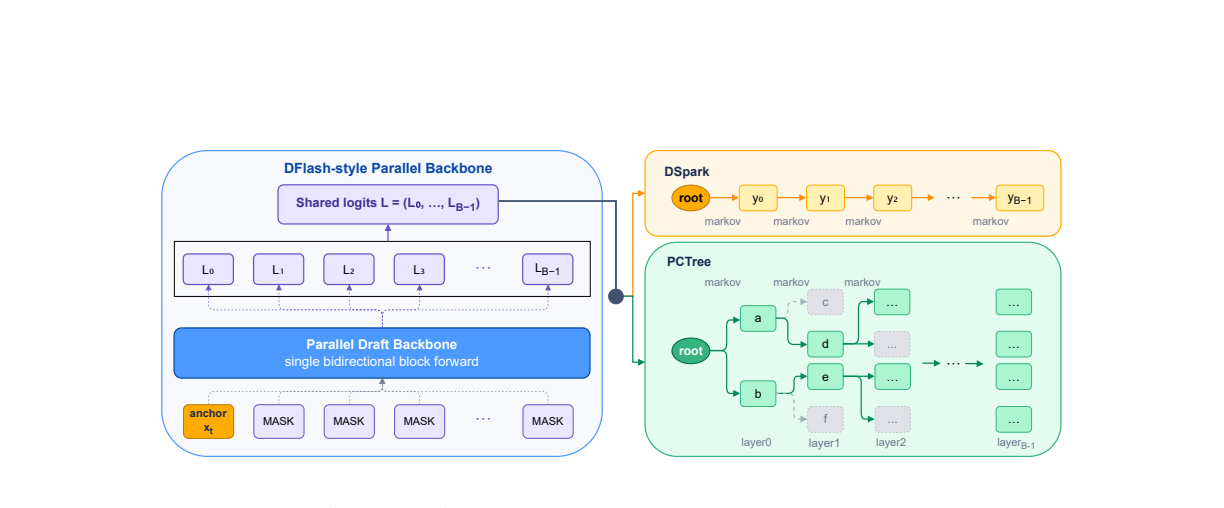
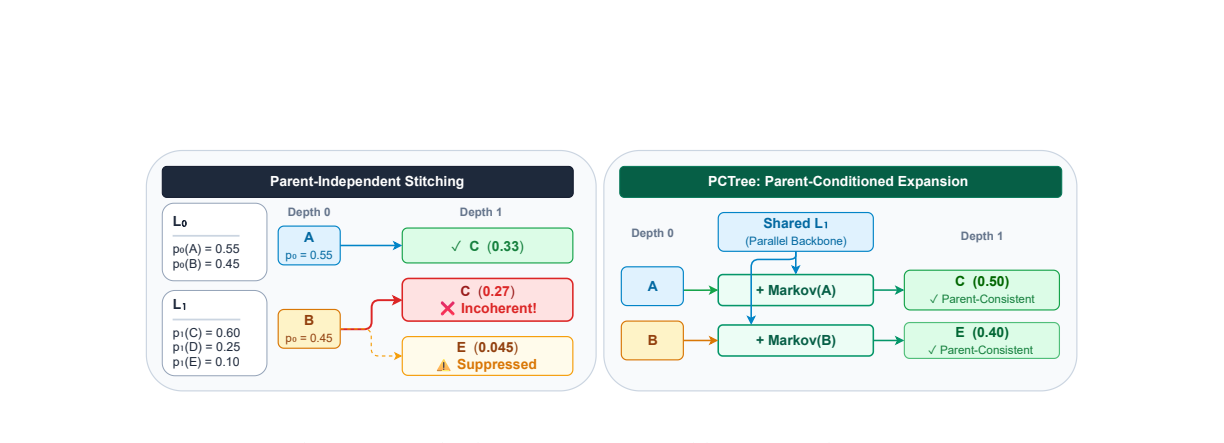
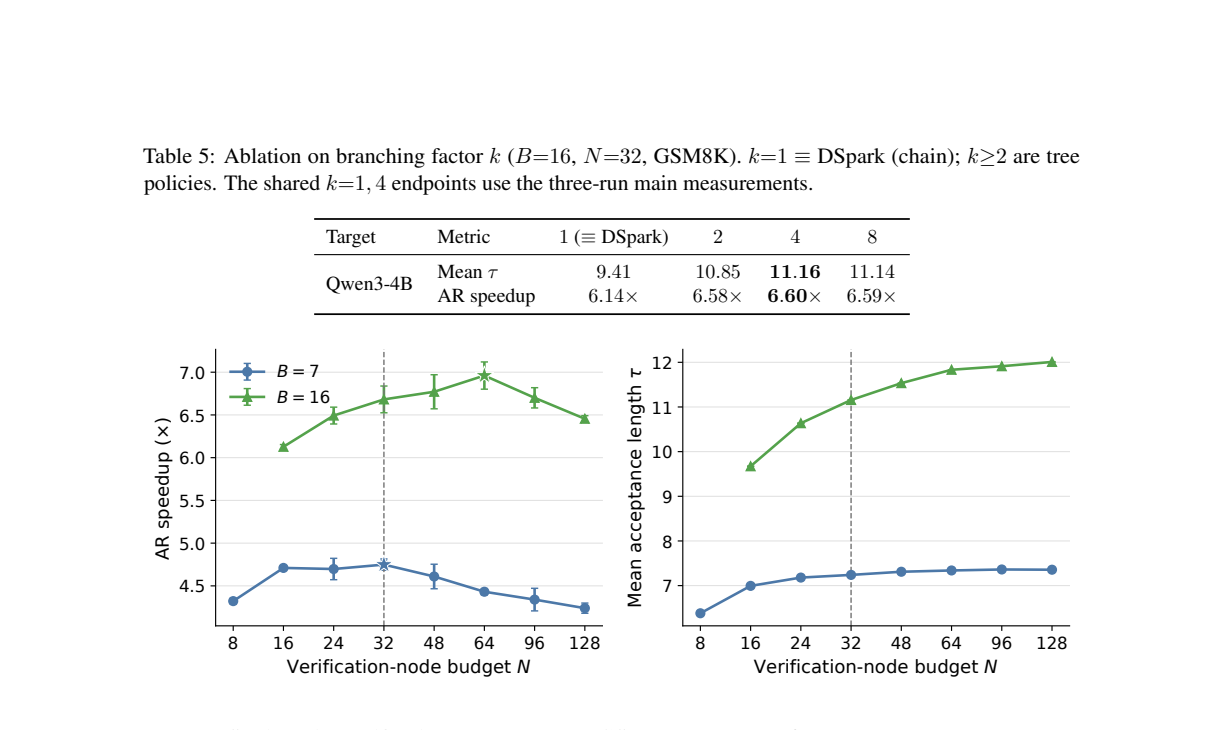
However, DSpark decodes this block as a single chain, so an early mismatch invalidates the remaining suffix and limits the benefit of large draft blocks. We show that the conditional structure already learned by DSpark can support multiple parent-consistent continuations without retraining or additional backbone passes. We introduce Parent-Conditioned Drafting Tree (PCTree), which uses the pretrained Markov head to score alternative children separately for each concrete parent and allocates a fixed verification budget to the most probable paths. This converts DSpark's linear draft into a tree while preserving its one-pass parallel backbone. Across Qwen3-4B,8B,14B and nine benchmarks, at B=7, measured speedup gains over autoregressive (AR) decoding, relative to matched DSpark, range from 3.1% to 29.5%. On Qwen3-4B GSM8K at B=16, PCTree increases mean acceptance length from 9.41 to 11.16 and three-run mean AR speedup from 6.14× to 6.60×. These show that parent-conditioned branching can turn conditional capacity already present in a semi-autoregressive drafter into end-to-end inference gains through an inference-only change.
from the abstract
Pith says
Machine review · deepseek-v4-flash · 4 Aug 2026 · what was read was not recorded · not checked by a person
It can be wrong. Challenge this review or reply to it.
Holds up, with conditions. A real, training-free idea: parent-conditioned tree scoring on DSpark's Markov head, with a clean mechanism control — but the headline speedups rest on single runs and unreleased checkpoints. This line is wrong
2 major objections · 4 minor
How often objections from reviews like this one are right: not yet measured
Not checked: figures, code, what the 27 references say.
The paper says, at §5.1, Appendix A, Table 8
The review did not quote this passage.
Pith says: Objection 1 of 2 · major
The paper's headline claim—improvement in every model–task pair and the 3.1%–29.5% speedup range—rests largely on single full runs. The protocol states that all main-table configurations except Qwen3-4B B=16 (all tasks) and Qwen3-4B GSM8K B=7 have one run, with no prompt-level warmup, and the first prompt is inside the timed loop.
more of objection 1
Table 8 contains several small deltas (MATH-500 4B B=7: 4.21→4.34; LCB 4B B=7: 3.49→3.74; Arena-Hard 4B B=16: 2.86→3.16) that are within plausible run-to-run and warmup variation. As written, 'every model–task pair' is not statistically established; the abstract's range should be qualified or all claimed entries need repeated runs/error bars.
The paper says, at §5.1, Appendix A, Tables 3 and 8
The review did not quote this passage.
Pith says: Objection 2 of 2 · major
All B=16 comparisons use internally trained DSpark checkpoints that are not released. The abstract's B=16 highlights (9.41→11.16; 6.14→6.60) come from these checkpoints. If the internal baselines are weaker than the official DSpark recipe, the reported relative gains may partly reflect baseline quality rather than the PCTree mechanism. The authors should release the B=16 checkpoints (or otherwise verify against public large-block checkpoints) and report sufficient training details to allow replication. This is load-bearing for the end-to-end B=16 claim.
4 minor objections
The paper says, at Abstract
Pith says: minor objection 1 of 4
There is a typo in the abstract: 'introduceParent-Conditioned' should read 'introduce Parent-Conditioned'.
The paper says, at §5.2
Pith says: minor objection 2 of 4
The sentence 'the GSM8K mean gain over three matched runs is +6.1%; the HumanEval and MT-Bench gains are +14.3% and +29.3%' is ambiguous: only GSM8K is a three-run mean. Please make explicit that the HumanEval and MT-Bench B=7 numbers are single-run.
show 2 more
The paper says, at Table 6 caption / Appendix A
Pith says: minor objection 3 of 4
The phase latencies in Table 6 are described as 'representative matched measurements' but only AR speedups are stated as three-run means. This asymmetry should be stated in the main text so readers do not infer the same precision for the phase-level numbers.
The paper says, at Eq. (4) / Algorithm 1
Pith says: minor objection 4 of 4
The term 'path(c)' is used before it is formally defined; a one-line definition (the root-to-node token sequence) would improve readability. Also, 'retrieve indices' in Algorithm 1 should be named consistently with the verification description.
What would settle it
Re-run every DSpark/PCTree pair in Table 8 at least three full times under the exact Appendix A protocol (same checkpoints, alternating order, no prompt warmup), reporting per-run AR speedups, mean deltas, and 95% confidence intervals. Release the internally trained B=16 DSpark checkpoints (or retrain them from the official recipe with two seeds) and repeat the B=16 comparisons. If every positive delta in Table 8 remains positive with the smaller repeated deltas' confidence intervals excluding zero, the claim holds. If any of the nine B=7 tasks flips sign or the B=16 GSM8K delta (6.14→6.60) becomes consistent with zero, the abstract's universal claim should be narrowed to the repeated configurations.
from the skeptic's reading
How the review went
4 readings by deepseek-v4-flash · 4 Aug 2026
- Reader holds up, with conditions
- Skeptic partly agrees
- Editor wrote the verdict above
- Referee major revision: 2 major objections, 4 minor
Not run on this paper: the simulated authors' defence.
Pith did not check this review's objections against the paper.
The review in full
The review in brief, machine-written
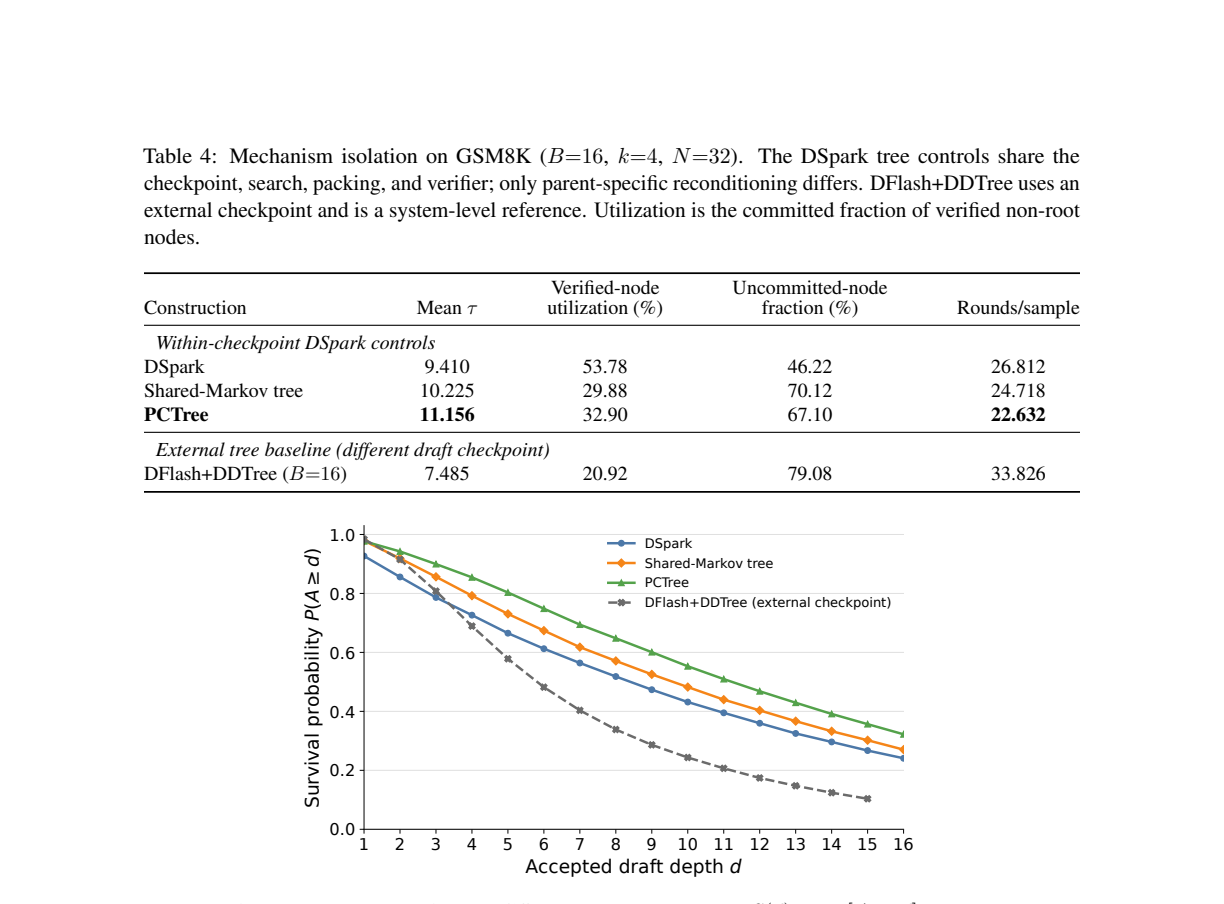
Short take: the core of this paper is sound and the mechanism experiment is the most convincing part. PCTree takes DSpark's existing Markov head and uses it to score multiple children per parent against shared backbone logits, building a fixed-budget draft tree. That's a genuine new trick, not just a light retread of DDTree or EAGLE-2 — the parent-conditioned re-scoring is the difference, and the paper proves it with a controlled Shared-Markov tree that shares everything except the parent-specific conditioning. That control is done well: it isolates the mechanism and shows conditioning, not branching, drives most of the acceptance gain.
The algorithm is coherent. The prefix-closedness argument is correct, eq. (3) is a valid batched Markov computation, and the complexity story (B sequential stages, batch ≤ k) is honest. The ablations on k and N are informative and the paper explicitly avoids retroactive tuning. I also give credit for openly disclosing that most main-table numbers are single runs with no error bars.
The soft spots are empirical, not algorithmic. The headline 3.1%–29.5% range and 'every model-task pair' are built on one full run per configuration, with no prompt-level warmup and the first prompt inside the timed loop. The appendix says not to read decimals as statistical confidence, yet the abstract presents them as established. Separately, the B=16 DSpark checkpoints are internally trained and not released; if they are weaker than the official recipe, PCTree's relative gains overstate the real-world lift. And there is no code, so exact replication means re-implementing Algorithm 1.
None of this breaks the central claim. The mechanism result at B=16 on GSM8K (PCTree 11.16 vs Shared-Markov 10.225 on the same checkpoint) is a three-run mean and survives the controls. What's needed is multi-run timing for the remaining configurations, released checkpoints/code, and a toned-down abstract.
Who is this for? Anyone working on speculative decoding or serving. It's a practical, training-free throughput win, not a model-quality result. Should an editor send it to reviewers? Yes — the idea is novel enough and the controlled evidence is strong enough to deserve referee time. It will probably come back with a request for the missing empirical support, but the paper is worth engaging with.
The strongest objection
The controlled Shared-Markov comparison (Table 4) provides real evidence that parent-specific reconditioning, not branching alone, drives acceptance gains; that part of the argument is credible. The load-bearing weakness is the empirical basis of the headline numbers. Section 5.1 and Appendix A state that all main-table configurations except Qwen3-4B B=16 (all tasks) and Qwen3-4B GSM8K B=7 have one full run, with no error bars; there is also no prompt-level warmup, so the first prompt is inside the timed loop. Table 8 contains small deltas (e.g., LCB 4B B=7: 3.49→3.74; MATH-500 4B B=7: 4.21→4.34; Arena-Hard 4B B=16: 2.86→3.16) that can move with CUDA warmup, clock throttling, or kernel-cache effects. The paper explicitly cautions against interpreting those decimals as statistical confidence, yet the abstract reports a 3.1%–29.5% range and 'every model-task pair' as established. All B=16 comparisons use internally trained DSpark checkpoints that are not released; if those baselines are weaker than the official recipe, PCTree's relative gains may partly reflect repairing a suboptimal baseline. The abstract's highlighted B=16 numbers (9.41→11.16; 6.14→6.60) come from these checkpoints. The central claim is therefore conditional on measurement stability and checkpoint representativeness, not on the algorithmic derivation, which is coherent.
The central claim is empirical and comparative: PCTree improves acceptance length and end-to-end AR speedup over matched DSpark across models and benchmarks. For that claim to hold, the measurements need to be stable and the matched baselines representative. The paper does several things right: fixed hyperparameters k=4/N=32, matched checkpoints within each DSpark/PCTree pair, disabled confidence scheduling, and a Shared-Markov control that isolates parent conditioning. The mechanism story is coherent and the controlled comparison gives real support. My concern is not the algorithm's internal logic; it is the strength of the headline numerical evidence. Most Table 8 entries are single full runs with no error bars, and all B=16 DSpark baselines are internally trained and not released. Small speedup differences are within what GPU warmup/no-warmup can produce, especially for short benchmarks like AIME25 (30 prompts). The paper's own measurement-protocol section cautions against reading the single-run decimals as statistical confidence, yet the abstract and Table 8 present them as a definitive range across every model-task pair. The reader's weakest_assumption (Markov-head calibration) is a real theoretical risk, but the Shared-Markov control already provides partial empirical evidence that parent-conditioned scoring helps; the more pressing question is whether the measured gains are reproducible and the B=16 baselines are representative. A multi-run replication with released B=16 checkpoints would settle this. If the deltas survive, the claim is strong; if not, it needs to be narrowed. Therefore the verdict remains conditional, unchanged from the reader.
The referee's report
The contribution is well motivated and the algorithmic core is sound: Eq. (4) is monotone, so the global top-N selection is prefix-closed; Eq. (3) correctly batches frontier parents; complexity remains bounded by B Markov calls with batch size at most k. The controlled Shared-Markov comparison in Table 4 is a genuine mechanism isolation and provides credible evidence that parent-conditioned re-scoring, not branching alone, drives the acceptance gains. If the empirical results are confirmed, PCTree would be a valuable training-free improvement to semi-autoregressive drafting. The main weakness is not algorithmic but evidentiary: most headline numbers come from single runs on internally trained, unreleased B=16 baselines.
Pith's reading of the paper (a machine's summary, not the authors')
This paper claims that the conditional structure already learned by DSpark, a semi-autoregressive drafter, can support multiple parent-consistent continuations without retraining or additional backbone passes. The method, PCTree, uses DSpark's pretrained Markov head to score alternative children separately for each concrete parent and allocates a fixed verification budget to the most probable paths, converting DSpark's linear draft into a tree while preserving its one-pass parallel backbone. If correct, this is an inference-only change that turns a drafter's existing conditional capacity into end-to-end gains: across Qwen3-{4B,8B,14B} and nine benchmarks, PCTree raises mean acceptance length and end-to-end AR speedup over DSpark by 3.1%-29.5%. A controlled Shared-Markov tree shows most of the benefit comes from parent-specific reconditioning, not branching alone.
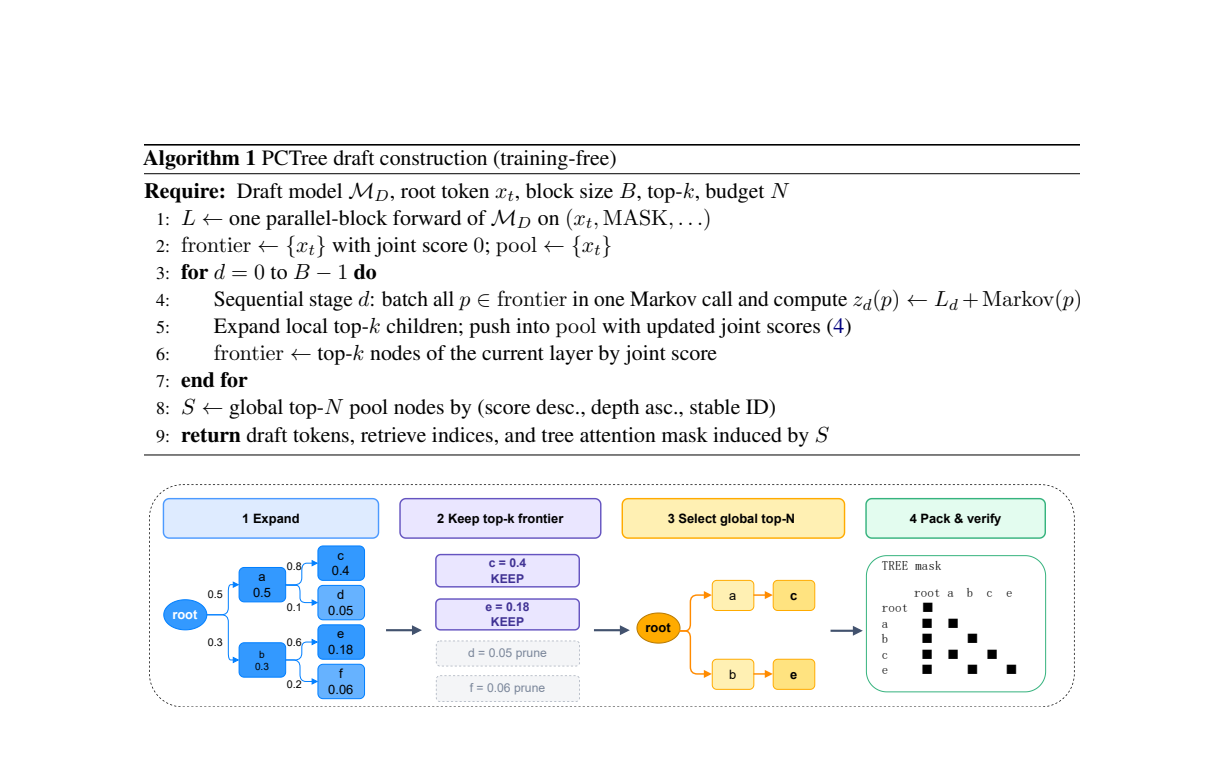
What carries the argument. Parent-conditioned Markov expansion over shared backbone logits. The parallel backbone computes base logits L_d for each draft position in one forward; the pretrained Markov head adds a parent-specific bias, giving log pi_d(.|p) = softmax(L_d + Markov(p)) for each frontier parent p. The tree is grown by expanding the local top-k children per parent under the joint path score s(c)=sum log pi(v|u), pruning the frontier to the top-k nodes, and finally selecting the global top-N nodes (prefix-closed) for a single target verification pass. This keeps the B sequential Markov stages and one backbone forward, raising only the Markov batch size to the branching factor k.
Core claim. PCTree shows that DSpark's parent-dependent Markov factorization, originally used for single-chain decoding, can be repurposed to grow a budgeted tree of draft tokens without any retraining or additional backbone forwards. At each depth d, for every frontier parent p, the method reconditions the shared parallel-backbone logits L_d by adding the Markov bias Markov(p), producing a distinct child distribution per parent. It then keeps the local top-k children under a joint path score, prunes the frontier layer-wise, and selects the global top-N prefix-closed nodes for one target verification forward. Across Qwen3-4B/8B/14B and nine math, code, and chat benchmarks, PCTree improves acceptance len
The premise it rests on. The pretrained Markov head's per-parent scores faithfully rank which continuations the target model will accept; if those scores are miscalibrated for alternative parents, the tree search would prune the very paths the target would accept and PCTree's gains would disappear.
If the paper is right (Pith's inferences, not the authors')
Existing DSpark checkpoints can be accelerated with an inference-only change, so the technique is immediately applicable where DSpark is already deployed.
Longer accepted prefixes reduce the number of verification rounds; the extra Markov and tree-construction cost is offset by fewer rounds, as the paper's phase-cost breakdown shows.
The fixed (k,N) budget yields a controllable operating point between draft cost and acceptance length; the non-monotonic speedup-vs-budget curve implies a practical optimum per workload and hardware.
The benefit is largest where early rejection makes long linear chains inefficient, so PCTree should be most valuable for tasks with high token diversity or long generation spans.
A Markov head trained only for chain decoding already encodes enough conditional structure for search; this suggests a drafter's sequential head is a latent scoring function that could be exploited more aggressively, e.g., with learned tree-aware selection, though the paper does not train it.
The joint path score in eq. (4) is a product of per-edge probabilities that ignores any global coherence; combining it with a target-aware re-ranker could push acceptance further without architectural changes.
Because the paper's benchmark suite is fixed at math, code, and chat, the size of the gain as a function of task entropy and sequence length remains to be mapped; one could test PCTree on long-form open-ended generation to see if acceptance gains grow with chain fragility.
Check this review
Pith stored no record of this review's passes and took no fingerprint of it. Reviews made by code from 13 Nov 2026 on carry both.
How often reviews like this one are right
Reviews like this one: written by deepseek-v4-flash, where what was read was not recorded.
How often objections from reviews like this one are right: not yet measured
Reviews by people
This review was written by a machine. No person has reviewed this paper on Pith yet. A scientist listed on Pith can review it for a fee, and their review is published here whatever it concludes.
The paper
Abstract
Speculative decoding accelerates LLM inference only when drafted continuations survive target-model verification. Semi-autoregressive drafters such as DSpark predict an entire token block with one backbone forward and refine it with a lightweight Markov head. However, DSpark decodes this block as a single chain, so an early mismatch invalidates the remaining suffix and limits the benefit of large draft blocks. We show that the conditional structure already learned by DSpark can support multiple parent-consistent continuations without retraining or additional backbone passes. We introduce Parent-Conditioned Drafting Tree (PCTree), which uses the pretrained Markov head to score alternative children separately for each concrete parent and allocates a fixed verification budget to the most probable paths. This converts DSpark's linear draft into a tree while preserving its one-pass parallel backbone. Across Qwen3-4B,8B,14B and nine benchmarks, at B=7, measured speedup gains over autoregressive (AR) decoding, relative to matched DSpark, range from 3.1% to 29.5%. On Qwen3-4B GSM8K at B=16, PCTree increases mean acceptance length from 9.41 to 11.16 and three-run mean AR speedup from 6.14× to 6.60×. These show that parent-conditioned branching can turn conditional capacity already present in a semi-autoregressive drafter into end-to-end inference gains through an inference-only change.
The paper's own sentences, arranged, kept beside the review and separate from it. Each label is drawn from a closed vocabulary; the number beside it is the probability the classifier gave that label. No sentence in this record was written by a model.
abstract compiled · 2026-09-23
The authors' main claim, as the classifier picked it out 1.00
“These show that parent-conditioned branching can turn conditional capacity already present in a semi-autoregressive drafter into end-to-end inference gains through an inference-only change.”
How the main claim is stated: asserted 1.00
What the abstract itself states, as probabilities: claims first 0.06 · states limitation 0.21 · human participants 0.02 · controlled comparison 0.96 · randomized assignment 0.02 · states quantitative result 0.99 · compares with prior results 0.97 · mentions code or data availability 0.02
The abstract, sentence by sentence
This table labels the abstract only (arXiv listing abstract v1). The number is the probability the classifier gave the label.
| Sentence | Role | The authors' own work | States the main conclusion | Strength |
|---|---|---|---|---|
| Speculative decoding accelerates LLM inference only when drafted continuations survive target-model verification. | background 1.00 | 0.07 | 0.05 | asserted 1.00 |
| Semi-autoregressive drafters such as DSpark predict an entire token block with one backbone forward and refine it with a lightweight Markov head. | background 0.98 | 0.08 | 0.03 | asserted 1.00 |
| However, DSpark decodes this block as a single chain, so an early mismatch invalidates the remaining suffix and limits the benefit of large draft blocks. | background 0.46 | 0.09 | 0.03 | asserted 1.00 |
| We show that the conditional structure already learned by DSpark can support multiple parent-consistent continuations without retraining or additional backbone passes. | contribution 0.53 | 0.86 | 0.31 | asserted 0.99 |
| We introduce Parent-Conditioned Drafting Tree (PCTree), which uses the pretrained Markov head to score alternative children separately for each concrete parent and allocates a fixed verification budget to the most probable paths. | method 0.77 | 0.90 | 0.15 | asserted 0.99 |
| This converts DSpark's linear draft into a tree while preserving its one-pass parallel backbone. | method 0.78 | 0.77 | 0.12 | asserted 1.00 |
| Across Qwen3-{4B,8B,14B} and nine benchmarks, at $B{=}7$, measured speedup gains over autoregressive (AR) decoding, relative to matched DSpark, range from $3.1\%$ to $29.5\%$. | result 1.00 | 0.95 | 0.14 | asserted 1.00 |
| On Qwen3-4B GSM8K at $B{=}16$, PCTree increases mean acceptance length from $9.41$ to $11.16$ and three-run mean AR speedup from $6.14{\times}$ to $6.60{\times}$. | result 1.00 | 0.94 | 0.08 | asserted 1.00 |
| These show that parent-conditioned branching can turn conditional capacity already present in a semi-autoregressive drafter into end-to-end inference gains through an inference-only change. | interpretation 1.00 | 0.90 | 0.88 | asserted 1.00 |
What kind of paper the classifier reports this is: method or tool 1.00 · evidence from observation or experiment 0.94
What was examined, and what was not
Sources read
- arXiv listing abstract v1
Not examined
- full text
- figures and tables
- references and citing sentences
- relations to other papers
Levels run
- P abstract
Not run
- S sections
- T body sentences
- C citations
- R cross-paper relations
How the labels were made
Compiled by classifier-1.13.0 via TypeSafe API, question bank abstract-p1-20260923, 2026-09-23: 1 request, 7,134 input tokens.
Every quoted sentence on this record is the authors'. Every label is from Pith's closed vocabulary, with the probability shown beside it. This record as JSON
Figures (5)
Figures are the authors', reproduced from the paper.
References (27)
- [1] Fast inference from transformers via speculative decoding , author=. Proceedings of the 40th International Conference on Machine Learning , series=. 2023 , publisher= on Pith
- [2] Accelerating Large Language Model Decoding with Speculative Sampling , author=. arXiv preprint arXiv:2302.01318 , year= on PithPith's reviewarXiv
- [3] Speculative decoding: Exploiting speculative execution for accelerating seq2seq generation , author=. Findings of the Association for Computational Linguistics: EMNLP 2023 , pages=. 2023 , doi= on Pith
- [4] Miao, Xupeng and Oliaro, Gabriele and Zhang, Zhihao and Cheng, Xinhao and Wang, Zeyu and Zhang, Zhengxin and Wong, Rae Ying Yee and Zhu, Alan and Yang, Lijie and Shi, Xiaoxiang and Shi, Chunan and Chen, Zhuoming and Arfeen, Daiyaan and Abhyankar, Reyna and Jia, Zhihao , bookti... on Pith
- [5] Cai, Tianle and Li, Yuhong and Geng, Zhengyang and Peng, Hongwu and Lee, Jason D. and Chen, Deming and Dao, Tri , booktitle=. Medusa: Simple. 2024 , organization= on Pith
- [6] Li, Yuhui and Wei, Fangyun and Zhang, Chao and Zhang, Hongyang , booktitle=. 2024 , url= on Pith
- [7] Li, Yuhui and Wei, Fangyun and Zhang, Chao and Zhang, Hongyang , booktitle=. 2024 , doi= on Pith
- [8] Li, Yuhui and Wei, Fangyun and Zhang, Chao and Zhang, Hongyang , journal=. 2025 , url= on Pith
- [9] Wang, Jikai and Su, Yi and Li, Juntao and Xia, Qingrong and Ye, Zi and Duan, Xinyu and Wang, Zhefeng and Zhang, Min , journal=. 2025 , doi= on Pith
- [10] Blockwise Parallel Decoding for Deep Autoregressive Models , author=. Advances in Neural Information Processing Systems , volume=. 2018 , url= on Pith
- [11] Chen, Jian and Liang, Yesheng and Liu, Zhijian , journal=. 2026 , note= on Pith
- [12] Accelerating Speculative Decoding with Block Diffusion Draft Trees , author=. arXiv preprint arXiv:2604.12989 , year= on PithPith's reviewarXiv
- [13] Cheng, Xin and Yu, Xingkai and Shao, Chenze and Li, Jiashi and Xiong, Yunfan and Qian, Yi and Zhu, Jiaqi and Ma, Shirong and Zhang, Xiaokang and Ye, Jiasheng and Chen, Qinyu and Deng, Chengqi and Yu, Jiping and Dai, Damai and Zhang, Zhengyan and Wei, Yixuan and Tan, Yixuan and... on Pith
- [14] Training verifiers to solve math word problems , author=. arXiv preprint arXiv:2110.14168 , year= on PithPith's reviewarXiv
- [15] Evaluating large language models trained on code , author=. arXiv preprint arXiv:2107.03374 , year= on PithPith's reviewarXiv
- [16] Zheng, Lianmin and Chiang, Wei-Lin and Sheng, Ying and Zhuang, Siyuan and Wu, Zhanghao and Zhuang, Yonghao and Lin, Zi and Li, Zhuohan and Li, Dacheng and Xing, Eric P. and Zhang, Hao and Gonzalez, Joseph E. and Stoica, Ion , journal=. Judging. 2023 , doi= on Pith
- [17] Non-Autoregressive Neural Machine Translation , author=. International Conference on Learning Representations , year= on Pith
- [18] Semi-Autoregressive Neural Machine Translation , author=. Proceedings of the 2018 Conference on Empirical Methods in Natural Language Processing , pages=. 2018 , doi= on Pith
- [19] Better & Faster Large Language Models via Multi-token Prediction , author=. Proceedings of the 41st International Conference on Machine Learning , series=. 2024 , url= on Pith
- [20] Wang, Zhuoyu and Huang, Junnan and Chen, Xinyu , journal=. 2026 , url= on Pith
show 7 more
- [21] Yang, An and Li, Anfeng and Yang, Baosong and Zhang, Beichen and Hui, Binyuan and Zheng, Bo and Yu, Bowen and Gao, Chang and Huang, Chengen and Lv, Chenxu and others , journal=. 2025 , url= on Pith
- [22] Let's Verify Step by Step , author=. International Conference on Learning Representations , year= on Pith
- [23] Balunovi. Advances in Neural Information Processing Systems , volume=. 2025 , url= on Pith
- [24] Program Synthesis with Large Language Models , author=. arXiv preprint arXiv:2108.07732 , year= on PithPith's reviewarXiv
- [25] Jain, Naman and Han, King and Gu, Alex and Li, Wen-Ding and Yan, Fanjia and Zhang, Tianjun and Wang, Sida I. and Solar-Lezama, Armando and Sen, Koushik and Stoica, Ion , booktitle=. 2025 , url= on Pith
- [26] Taori, Rohan and Gulrajani, Ishaan and Zhang, Tianyi and Dubois, Yann and Li, Xuechen and Guestrin, Carlos and Liang, Percy and Hashimoto, Tatsunori B. , year=. Stanford Alpaca: An Instruction-Following on Pith
- [27] Li, Tianle and Chiang, Wei-Lin and Frick, Evan and Dunlap, Lisa and Wu, Tianhao and Zhu, Banghua and Gonzalez, Joseph E. and Stoica, Ion , booktitle=. From Crowdsourced Data to High-quality Benchmarks:. 2025 , url= on Pith
Cited by 3 Pith papers
Reviewed papers on Pith that cite this one. The full citation record
- Pando: Noise-Coupled Parallel Draft Trees for Efficient Edge Speculative Decoding cs.LG · Nov 2026
- SpecPilot: Autonomous Algorithm Discovery and Systems Optimization for Speculative Decoding cs.LG · Nov 2026
- AdaSpark: Adaptive DSpark with Online Learning for Tree Verification and N-gram Fill cs.LG · Oct 2026
How the literature uses it
1 arXiv paper cite this in 1 sentence
What it cites · 11 sentences without a confident label
Compares with 2 papers
-
EAGLE-3 [ref] and DFlash [ref] are published references reproduced from [ref] , not strict same-environment speed comparisons.
EAGLE-3: Scaling up Inference Acceleration of Large Language Models via Training-Time Test · Setup · 0.84
-
EAGLE-3 [ref] and DFlash [ref] are published references reproduced from [ref] , not strict same-environment speed comparisons.
DFlash: Block Diffusion for Flash Speculative Decoding · Setup · 0.84
Cites as background 4 papers
-
Speculative decoding [ref] instead drafts several future tokens and verifies them together, but its benefit depends on how much of each draft survives verification.
Accelerating Large Language Model Decoding with Speculative Sampling · Introduction · 0.96
-
Follow-up work improved the drafter that feeds such trees: multi-head proposals [ref] , feature-level drafting with target hidden states [ref] , dynamic tree shapes guided by draft confidence [ref] , and multi-layer feature fusion [ref] .
EAGLE-3: Scaling up Inference Acceleration of Large Language Models via Training-Time Test · Related Work · 0.80
-
[ref] introduced DFlash, a lightweight block diffusion drafter that emits an entire draft block in one forward while conditioning on target-side context features.
DFlash: Block Diffusion for Flash Speculative Decoding · Related Work · 0.94
Challenges and discussion
Disagree with the review, or know something it missed? Leave a comment, or challenge this review formally: a challenge becomes a permanent entry in this paper's record, and its decision is published here.
Come back by email
A short list of the week's newly reviewed papers. Nothing is sent until you confirm from your inbox, and every email has a link that stops it. No account.
No comments yet.
Sign in to comment