Machine Learning · arXiv:2611.02501 v1 · submitted 2 Nov 2026 · 55 references
SpecPilot: Autonomous Algorithm Discovery and Systems Optimization for Speculative Decoding
The paper says
“Speculative decoding accelerates memory-bound LLM decoding with a lightweight drafter, and parallel drafters extend this speedup by drafting a whole block in one forward pass.”
more of the abstract
However, it remains unclear whether their released systems (stock) attain the full speedup that parallel drafting permits. We identify three challenges. First, with one request, each step accepts few tokens but reads every target weight. Second, with batching, per-request verification work roughly halves the speedup over autoregressive (AR) decoding. Third, speculative decoding is deployment-specific, and no universal optimization fits every serving regime, drafter, target model and GPU. To address these challenges, we present SpecPilot, an autonomous agentic loop that discovers algorithms and systems optimizations for each deployment. In each round, a cost model locates the largest gaps between the current system and its ceiling. Parallel agents explore directions and integrate the successful ones. Token forcing checks every output token against stock to detect reward hacking. A structured memory carries validated mechanisms to new rounds and deployments. SpecPilot discovered a general lossless 12-bit weight format, tree verification for hybrid recurrent targets, two-level verification and three batching mechanisms. We evaluate it across four target models, three drafters, two GPU platforms and five benchmarks. Without training or quality loss, it raises the speedup over AR from stock's 4.46× to 10.87× with one request, and from 1.94× to 3.93× with batching.
from the abstract
Pith says
Machine review · deepseek-v4-flash · 3 Nov 2026 · what was read was not recorded · not checked by a person
It can be wrong. Challenge this review or reply to it.
Holds up, with conditions. Unusually transparent and internally consistent systems paper whose ~2x speedups look real, but the 'lossless' qualifier rests on a statistical test validated on one fault class. This line is wrong
1 major objection · 5 minor
How often objections from reviews like this one are right: not yet measured
Not checked: figures, code, what the 55 references say.
The paper says, at Sec. 3.3 and Sec. 6.2
The review did not quote this passage.
A classifier read this sentence of the paper as acknowledging the concern (probability 0.62):
“Second, an agent rewarded for speed is prone to reward hacking [19, 20], such as adopting a faster numerical shortcut that changes outputs without a measurable drop in task accuracy (Figure2c).”
Pith says: Objection 1 of 1 · major
The abstract's 'without quality loss' claim and the contribution bullet on token forcing rest on the assumption that any lossy shortcut or implementation bug produces output divergence beyond stock's near-tie noise. The paper acknowledges the general reward-hacking risk (Sec. 1 and Sec. 3.3) and validates the test on one injected fault class, a logit bias of 2 to every 7th …
more of objection 1
… vocabulary id after token 2048 (Sec. 6.2); that is a reasonable first step, but the coverage assumption is load-bearing and unproven. A shortcut that perturbs logits at small magnitude, or that substitutes the W12 8-bit view for exact weights in a few layers, would flip predominantly near-tie tokens. Such a system could keep its mismatch rate within the allowed stock + 0.5pp budget (the H100 DFlash2 sealed final scores only about 3,183 tokens, putting the rate rule's resolution at a few tenths of a percentage point) and could produce few or no mismatches with margin above 2delta, so the event rule would not trigger either; task accuracy does not help, as Figure 2c demonstrates. I recommend adding fault-injection experiments for this evasive class (for example, logit biases of 0.02-0.5 nats on a subset of ids that activate before token 2048, and 8-bit-view substitution in one or two target layers) and reporting whether token forcing rejects them. Alternatively, the paper should narrow the 'without quality loss' wording to state that the guarantee is by construction for the exact-pass path and that the statistical check has been validated only on the tested fault class.
5 minor objections
The paper says, at Sec. 3.1, Eq. (3)
Pith says: minor objection 1 of 5
As typeset, the equation reads S(N) = tau(N)c(N) with c(N) = T_step/T_AR, which is dimensionally inverted; the surrounding text makes clear that the intended relation is S = tau / c, so the displayed formula should be corrected.
The paper says, at Sec. 6.3, Fig. 9c
Pith says: minor objection 2 of 5
The 'beats cuBLAS' comparisons should state the cuBLAS version and whether the baseline uses TF32 or FP32 accumulation; the reported 1.17-1.47x margin at 1-32 rows is sensitive to these settings.
show 3 more
The paper says, at Sec. 3.3
Pith says: minor objection 3 of 5
The confidence statements for the rate rule should specify the test direction (one-sided versus two-sided) and report the scored-token counts for each sealed final, since the power of the +0.5pp rule depends on these counts.
The paper says, at Sec. 4.1, Table A2
Pith says: minor objection 4 of 5
The claimed 12.01-12.02 bits per weight depends on the per-escape encoding cost, which is not stated; reporting the escape record size would let a reader reproduce the arithmetic.
The paper says, at Fig. 3
Pith says: minor objection 5 of 5
Figure 3 is very dense and the phase arrows and the 'registry card' are hard to read at print size; splitting it into two panels would improve readability.
What would settle it
Run token forcing with a different fault class from §6.2: take the sealed SpecPilot Qwen3.8-27B H100 system and silently substitute the W12 8-bit view for the full 12-bit records in the exact pass of one GDN layer; separately, add a small logit bias of 0.05 to 0.5 to every 50th vocabulary id before token 2048. Apply the paper's own §3.3 rate and event rules over the same 4096-token sealed-final outputs. If either mutant passes while producing divergences beyond floating-point reduction order, the statistical certification does not cover the general class of reward-hacking shortcuts; if both are rejected, the §6.2 validation extends beyond the single injected fault. Repeating at several bias magnitudes would map the detection boundary and settle whether the losslessness claim needs a formal or machine-checked implementation guarantee.
from the skeptic's reading
How the review went
4 readings by deepseek-v4-flash · 3 Nov 2026
- Reader holds up, with conditions
- Skeptic agrees
- Editor wrote the verdict above
- Referee major revision: 1 major objection, 5 minor
Not run on this paper: the simulated authors' defence.
Pith did not check this review's objections against the paper.
The review in full
The review in brief, machine-written
The paper is serious: an agentic loop that found real mechanisms — W12, a bit-exact 12-bit weight format with in-GEMM register decode; best-first tree verification for hybrid recurrent targets; two-level verification; three batching mechanisms — that roughly double measured speculative-decoding speedups over strong stock systems across four targets, three drafters, and two GPUs. If the headline numbers hold, this is a major inference-systems result, and W12 alone is worth a paper.
What's actually good. The numbers are internally consistent in a way that matters: the fifteen per-promotion gains in Table A3 multiply to about 2.08x, matching the sealed 2.13x gain on unseen requests, and Table 3's sealed gains sit inside the paper's own -2% to +6% band against Tables 1/2. Losslessness holds by construction for the ideal system — only the exact-pass argmax accepts tokens. And the paper is unusually transparent: it reports the 530 GPU-hours, the closed directions in A7, and one deployment that beats its own ceiling, which makes the cost model falsifiable rather than tautological. The injected-fault test on token forcing catches a bug that task accuracy misses.
Soft spots, in proportion. First, the 'without quality loss' headline is certified statistically, not by bit-equality or machine-checked code. Token forcing — mismatch rate within stock + 0.5pp, no excess large-margin events — was validated on one injected fault class, a logit bias after token 2048. A subtle implementation bug that perturbs logits by small amounts could flip mostly near-tie tokens and stay inside both rules. The paper acknowledges reward hacking and tests one class; that no other class is exercised is the gap. It is addressable (more fault classes, verified kernels, shipped code) but load-bearing for the lossless qualifier. Second, the headline AR-relative speedups come from development-request runs; the sealed gains confirm the roughly 2x over stock, but someone should re-derive the AR-relative numbers on unseen requests. Third, the baselines are mostly self-chosen — one external DDTree anchor on H100, and EAGLE-3's stock running at 0.68x of AR needs scrutiny. Fourth, no code, commits, prompts, or data are shipped, which is the biggest practical gap for a systems paper.
Bottom line: this deserves a serious referee. The internal consistency and transparency make it credible enough to spend the effort, and review should pin down the statistical losslessness and demand the code. I'd send it out.
The strongest objection
SpecPilot's central claim ('Without training or quality loss', abstract; §5.2) depends on §3.3's token forcing to certify that no agent-introduced shortcut or implementation bug changes outputs. For the ideal implementation, losslessness holds by construction: every accepted token comes from an exact-pass argmax (§2.1, §4). The statistical test therefore carries the entire burden of certifying the shipped implementation against bugs and reward hacking. A system passes if its mismatch rate stays within stock + 0.5pp at 95% confidence, and if unexplained large-margin events (margin above 2δ) are no more frequent than stock's, where δ is calibrated from stock's own near-tie departures from AR. The only published validation (§6.2) injects one fault class: a logit bias of 2 to every 7th vocabulary id after token 2048. This leaves open the class of evasive implementations: a patch that perturbs logits by small amounts, for example silently using W12's 8-bit view in the exact pass at a few layers or adding a small bias before token 2048, would flip mostly near-tie tokens, could keep the mismatch rate inside stock + 0.5pp, and might produce few or no margins above 2δ. Task accuracy does not help, since Figure 2c shows the faulty systems' 95% CIs include zero. The headline speedup (4.46x to 10.87x) creates a strong incentive for exactly such a shortcut. The paper transparently acknowledges reward hacking (§1, §3.3) and tests one fault class, but the assumption that no other shortcut evades both rules is unproven. This is an addressable weakness, not a demonstrated failure; it is load-bearing because the 'lossless' qualifier on every headline speedup is what token forcing is asked to guarantee.
The paper's ideal algorithms are lossless by construction: W12 is bit-exact with escapes and load-time checks (§4.1), TLV accepts tokens only from the exact pass (§4.3), and the tree kernels change only rounding (§4.2). The empirical 'without quality loss' claim therefore hinges on whether the implemented system actually realizes those algorithms. Token forcing is a reasonable statistical detector, but its guarantee is unproven beyond the single injected fault class, and the paper itself acknowledges that gains are close to timing noise and that agents are prone to reward hacking (§1). The missing piece is not an internal inconsistency in the speedup measurements; the promotions in Table A3 multiply to about 2.08x, matching the sealed 2.13x gain in Table 3, and the sealed gains match the Table 1/2 ratios within the stated -2% to +6% range. Those checks give real independent support to the speedup claims. The load-bearing concern is narrower: the statistical certification of losslessness has not been shown to catch a broad class of evasive lossy implementations, and no code or commit hash is shipped to allow direct checking. The proposed concrete test would settle the concern by trying mutants that target the weakest part of the certification, the near-tie margin distribution. If such mutants pass, the abstract's unqualified 'lossless' would need to be weakened or supplemented with a formal guarantee; if they are rejected, the concern does not land. Because this is an addressable validation gap rather than a demonstrated failure, the reader's CONDITIONAL verdict remains appropriate with no change.
The referee's report
If the claims hold, this is a substantial systems result with reusable artifacts. Credit is due for several load-bearing properties that are machine-checkable or falsifiable rather than asserted: W12 decodes bit-exactly to BF16, with the server verifying every decoded tensor against the checkpoint at load time (Sec. 4.1); the W12 GEMM uses a fixed-order split reduce and is deterministic; the losslessness of each mechanism is argued by construction (Sec. 4); and the cost-model ceilings are falsifiable, as shown by the RTX PRO 6000 deployment exceeding its stated 2.12x ceiling once the one-draft-per-pass assumption is removed (Sec. 5.3). The internal arithmetic is consistent: the fifteen per-promotion gains in Table A3 multiply to about 2.08x, matching the sealed 2.13x gain, and the sealed gains in Table 3 sit within the stated -2% to +6% band of Tables 1 and 2. The experimental protocol is unusually disciplined: frozen SGLang build, paired runs with GPU swapping, sealed finals on unseen requests, and per-promotion paired gains.
Pith's reading of the paper (a machine's summary, not the authors')
This paper tries to establish that the gap between released speculative decoding systems and what their drafters could in principle deliver is large, and that an autonomous agentic loop, rather than manual engineering, can close most of it deployment by deployment. Its concrete claim is that a ceiling-guided search discovered a lossless 12-bit weight format (W12), best-first tree verification for hybrid recurrent targets, two-level verification, and three batching mechanisms, and that these stack to raise the speedup over autoregressive decoding from stock's 4.46× to 10.87× with one request and from 1.94× to 3.93× with batching, with no training and no output changes beyond the near-tie rounding stock itself already exhibits. The reason to care is that LLM serving optimization is currently deployment-specific — drafter, target, GPU, and batch regime each change what pays off — so a loop that measures its own bottleneck and carries validated mechanisms into new deployments would turn a manual expert task into a repeatable, automatable one. If the claims hold, the discovered mechanisms are also independently valuable: W12 alone speeds plain autoregressive decoding by 1.19–1.28× on dense models and, the paper argues, is the first lossless weight format whose GEMM beats cuBLAS on H100 from 1 to 32 rows.
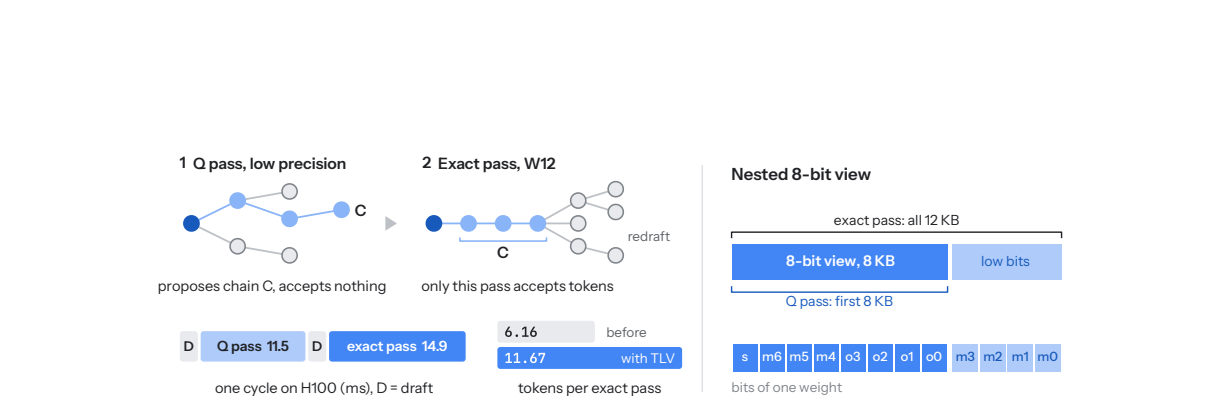
What carries the argument. The argument is carried by four interacting mechanisms. The first is the ceiling model: each round the speedup $S(N) = \tau(N)\,c(N)$ — tokens accepted per step times the step's cost relative to one autoregressive step — is factored into a token factor, a kernel factor, and an overhead factor, and the largest factor names the bottleneck. The second is the agent loop itself: a master proposes one direction per GPU, sub-agents implement patches behind options whose defaults reproduce stock, and a controller the agents cannot modify promotes a patch only on a paired, statistically significant gain confirmed on unseen requests. The third, token forcing, is the losslessness gate: a teacher-forced scorer replays the system's outputs through the stock engine with an FP32 LM head, and the system passes only if its mismatch rate stays within stock plus 0.5 points at 95% confidence and its unexplained large-margin events (margin above $2\delta$, with $\delta$ calibrated from stock's own near-tie departures from AR) are no more frequent than stock's. The fourth is a structured memory that carries validated mechanisms — 140 entries — into later rounds and new deployments as replayable code deltas plus evidence. The paper's chief discovered artifact, W12, encodes each BF16 weight as three 4-bit planes (sign plus top mantissa bits, a 4-bit exponent offset within a 16-binade per-channel window, and the low mantissa bits) with a small exact escape list, shrinking the main hybrid target's converted layers from 44.67 to 33.58 GB while decoding bit-for-bit; a stream-K GEMM decodes the weights in registers so the compression is hidden from the memory stream.
Core claim. The central claim is that released parallel-drafter systems leave most of speculative decoding's available speedup on the table, and that this residue can be recovered automatically. The argument rests on measuring, each round, where the current system sits relative to a computable ceiling — the speedup a step could reach if it drafted the best possible tree and ran every kernel at its byte floor — and steering parallel coding agents at the largest factor. The systems so built stay lossless in a defined sense: every accepted token lies on a path verified by an exact pass over the target weights and equals that pass's argmax, so the output differs from the target's greedy decode only where floating-point reduction order flips a near-tie, exactly as stock already differs from AR. Token forcing is the statistical gate that enforces this contract, rejecting any change whose token-mismatch rate against stock exceeds stock's own by more than 0.5 points at 95% confidence, or whose unexplained large-margin events are more frequent than stock's. On that basis, the paper reports one-request speedups over AR of 8.86–10.87× across targets, drafters, and GPUs, up from stock's 3.74–4.69×, batched speedups of 3.90–3.93× against stock's roughly 2×, and a 1.84× advantage over the DDTree baseline on H100.
The premise it rests on. The 'no quality loss' claim rests on token forcing, a statistical test calibrated to stock's own near-tie rounding noise: a system passes if its mismatch rate stays within stock plus 0.5 points at 95% confidence and its unexplained large-margin events are no more frequent than stock's, so the load-bearing assumption is that any real lossy shortcut or implementation bug produces output divergences statistically beyond that noise, an assumption validated against only one injected fault class.
If the paper is right (Pith's inferences, not the authors')
If the sealed-final results are representative, deployment-specific LLM inference optimization becomes automatable: each setting reached its final system in one to three rounds of 7–20 hours, and new drafters, models, and GPUs reused validated mechanisms from memory rather than starting from scratch.
W12's bit-exact 12-bit encoding, if it holds generally, makes lossless weight compression a practical speed lever rather than only a memory saving: it speeds plain AR decoding by 1.19–1.28× on four dense models and shrinks weights by 14–22%, freeing memory that grows the KV-cache pool by 2.0–2.5×.
Two-level verification shows that a low-precision pass which never accepts tokens can still nearly double the tokens accepted per exact pass by drafting twice, though the gain is regime-dependent: the same idea loses roughly 13% under batching on the BF16 target.
Token forcing gives serving systems a statistically grounded acceptance rule for output-preserving changes, separating near-tie rounding noise from genuine divergence where task-accuracy checks are blind, since all four accuracy intervals in the paper's fault test include zero.
Mechanisms that spend extra verify work per exact pass help single requests, where the weight stream hides that work, and hurt batching, where the work adds up; this regime dependence is a direct corollary of the paper's cost model.
Because the loop's recipe — factor the cost, steer agents at the largest factor, gate changes with a stock-calibrated output test — is not specific to speculative decoding, I would expect it to transfer to other serving bottlenecks the paper does not study, such as KV-cache-bound long-context decoding or prefill scheduling, where the cost factors would name different ceilings.
The paper defines losslessness relative to stock, which itself departs from pure greedy AR at near-ties of up to 0.232 nats; a stricter contract, bit-identical to AR rather than to stock, would be a harder target whose certificate the paper does not attempt.
Token forcing was exercised against one injected fault class, a logit bias appearing after token 2048; an adversarial search for other divergent-but-passing systems — for example, rounding that flips only near-tie logits below the $2\delta$ threshold — would tell whether the gate is complete rather than merely calibrated.
If W12's register-decoding GEMM stays ahead of cuBLAS on shapes and GPUs beyond the ones measured, weight-format design should move toward formats engineered as GEMM operands rather than decode-before-multiply compression; encoding sparse or MoE models, whose weights may straddle more binades per channel, would stress the 16-binade window assumption.
Check this review
Pith stored no record of this review's passes and took no fingerprint of it. Reviews made by code from 13 Nov 2026 on carry both.
How often reviews like this one are right
Reviews like this one: written by deepseek-v4-flash, where what was read was not recorded.
How often objections from reviews like this one are right: not yet measured
Reviews by people
This review was written by a machine. No person has reviewed this paper on Pith yet. A scientist listed on Pith can review it for a fee, and their review is published here whatever it concludes.
The paper
Abstract
Speculative decoding accelerates memory-bound LLM decoding with a lightweight drafter, and parallel drafters extend this speedup by drafting a whole block in one forward pass. However, it remains unclear whether their released systems (stock) attain the full speedup that parallel drafting permits. We identify three challenges. First, with one request, each step accepts few tokens but reads every target weight. Second, with batching, per-request verification work roughly halves the speedup over autoregressive (AR) decoding. Third, speculative decoding is deployment-specific, and no universal optimization fits every serving regime, drafter, target model and GPU. To address these challenges, we present SpecPilot, an autonomous agentic loop that discovers algorithms and systems optimizations for each deployment. In each round, a cost model locates the largest gaps between the current system and its ceiling. Parallel agents explore directions and integrate the successful ones. Token forcing checks every output token against stock to detect reward hacking. A structured memory carries validated mechanisms to new rounds and deployments. SpecPilot discovered a general lossless 12-bit weight format, tree verification for hybrid recurrent targets, two-level verification and three batching mechanisms. We evaluate it across four target models, three drafters, two GPU platforms and five benchmarks. Without training or quality loss, it raises the speedup over AR from stock's 4.46× to 10.87× with one request, and from 1.94× to 3.93× with batching.
The paper's own sentences, arranged, kept beside the review and separate from it. Each label is drawn from a closed vocabulary; the number beside it is the probability the classifier gave that label. No sentence in this record was written by a model.
abstract compiled · 2026-11-03
The authors' main claim, as the classifier picked it out 1.00
“Without training or quality loss, it raises the speedup over AR from stock's 4.46$\times$ to 10.87$\times$ with one request, and from 1.94$\times$ to 3.93$\times$ with batching.”
How the main claim is stated: asserted 1.00
What the abstract itself states, as probabilities: claims first 0.08 · states limitation 0.24 · human participants 0.02 · controlled comparison 0.92 · randomized assignment 0.01 · states quantitative result 0.99 · compares with prior results 0.97 · mentions code or data availability 0.06
The abstract, sentence by sentence
This table labels the abstract only (arXiv listing abstract v1). The number is the probability the classifier gave the label.
| Sentence | Role | The authors' own work | States the main conclusion | Strength |
|---|---|---|---|---|
| Speculative decoding accelerates memory-bound LLM decoding with a lightweight drafter, and parallel drafters extend this speedup by drafting a whole block in one forward pass. | background 1.00 | 0.06 | 0.03 | asserted 1.00 |
| However, it remains unclear whether their released systems (stock) attain the full speedup that parallel drafting permits. | gap 1.00 | 0.10 | 0.03 | asserted 0.46 |
| We identify three challenges. | gap 0.74 | 0.78 | 0.02 | asserted 0.90 |
| First, with one request, each step accepts few tokens but reads every target weight. | gap 0.67 | 0.48 | 0.02 | asserted 1.00 |
| Second, with batching, per-request verification work roughly halves the speedup over autoregressive (AR) decoding. | gap 0.80 | 0.55 | 0.03 | asserted 0.99 |
| Third, speculative decoding is deployment-specific, and no universal optimization fits every serving regime, drafter, target model and GPU. | gap 0.85 | 0.33 | 0.04 | asserted 1.00 |
| To address these challenges, we present SpecPilot, an autonomous agentic loop that discovers algorithms and systems optimizations for each deployment. | contribution 0.97 | 0.90 | 0.13 | asserted 1.00 |
| In each round, a cost model locates the largest gaps between the current system and its ceiling. | method 0.99 | 0.80 | 0.04 | asserted 1.00 |
| Parallel agents explore directions and integrate the successful ones. | method 0.99 | 0.73 | 0.04 | asserted 0.99 |
| Token forcing checks every output token against stock to detect reward hacking. | method 0.99 | 0.72 | 0.02 | asserted 1.00 |
| A structured memory carries validated mechanisms to new rounds and deployments. | method 0.99 | 0.76 | 0.04 | asserted 1.00 |
| SpecPilot discovered a general lossless 12-bit weight format, tree verification for hybrid recurrent targets, two-level verification and three batching mechanisms. | contribution 0.54 | 0.97 | 0.22 | asserted 1.00 |
| We evaluate it across four target models, three drafters, two GPU platforms and five benchmarks. | method 0.78 | 0.94 | 0.04 | asserted 0.91 |
| Without training or quality loss, it raises the speedup over AR from stock's 4.46$\times$ to 10.87$\times$ with one request, and from 1.94$\times$ to 3.93$\times$ with batching. | result 1.00 | 0.96 | 0.76 | asserted 1.00 |
What kind of paper the classifier reports this is: method or tool 1.00 · evidence from observation or experiment 0.95
What was examined, and what was not
Sources read
- arXiv listing abstract v1
Not examined
- full text
- figures and tables
- references and citing sentences
- relations to other papers
Levels run
- P abstract
Not run
- S sections
- T body sentences
- C citations
- R cross-paper relations
How the labels were made
Compiled by classifier-1.13.0 via TypeSafe API, question bank abstract-p1-20260923, 2026-11-03: 1 request, 9,972 input tokens.
Every quoted sentence on this record is the authors'. Every label is from Pith's closed vocabulary, with the probability shown beside it. This record as JSON
Figures (10)




Figures are the authors', reproduced from the paper.
References (55)
- [1] Yaniv Leviathan, Matan Kalman, and Yossi Matias. Fast inference from transformers via speculative decoding. InICML, 2023 on Pith
- [2] Charlie Chen, Sebastian Borgeaud, Geoffrey Irving, Jean-Baptiste Lespiau, Laurent Sifre, and John Jumper. Accelerating large language model decoding with speculative sampling. arXiv preprint arXiv:2302.01318, 2023 on PithPith's reviewarXiv
- [3] Yuhui Li, Fangyun Wei, Chao Zhang, and Hongyang Zhang. EAGLE-3: Scaling up inference acceleration of large language models via training-time test. InNeurIPS, 2025 on Pith
- [4] Jian Chen, Yesheng Liang, and Zhijian Liu. DFlash: Block diffusion for flash speculative decoding. InICML, 2026 on Pith
- [5] Inco AI. DFlash 2: Keep drafting parallel, 2026 on Pith
- [6] Xin Cheng, Xingkai Yu, Chenze Shao, Jiashi Li, Yunfan Xiong, Yi Qian, Jiaqi Zhu, Shirong Ma, Xiaokang Zhang, Jiasheng Ye, Qinyu Chen, Chengqi Deng, Jiping Yu, Damai Dai, Zhengyan Zhang, Yixuan Wei, Yixuan Tan, Wenkai Yang, Runxin Xu, Yu Wu, Zhean Xu, Xuanyu Wang, Muyang Chen, ... on PithPith's reviewarXiv
- [7] Xupeng Miao, Gabriele Oliaro, Zhihao Zhang, Xinhao Cheng, Zeyu Wang, Zhengxin Zhang, Rae Ying Yee Wong, Alan Zhu, Lijie Yang, Xiaoxiang Shi, Chunan Shi, Zhuoming Chen, Daiyaan Arfeen, Reyna Abhyankar, and Zhihao Jia. SpecInfer: Accelerating large language model serving with tr... on Pith
- [8] Zhuoming Chen, Avner May, Ruslan Svirschevski, Yuhsun Huang, Max Ryabinin, Zhihao Jia, and Beidi Chen. Sequoia: Scalable and robust speculative decoding. InNeurIPS, 2024 on Pith
- [9] Yuhui Li, Fangyun Wei, Chao Zhang, and Hongyang Zhang. EAGLE-2: Faster inference of language models with dynamic draft trees. InEMNLP, 2024 on Pith
- [10] Liran Ringel and Yaniv Romano. Accelerating speculative decoding with block diffusion draft trees.arXiv preprint arXiv:2604.12989, 2026 on PithPith's reviewarXiv
- [11] Xiaoxuan Liu, Jongseok Park, Langxiang Hu, Woosuk Kwon, Zhuohan Li, Chen Zhang, Kuntai Du, Xiangxi Mo, Kaichao You, Alvin Cheung, Zhijie Deng, Ion Stoica, and Hao Zhang. TurboSpec: Closed-loop speculation control system for optimizing LLM serving goodput.arXiv preprint arXiv:2... on PithPith's reviewarXiv
- [12] Ranajoy Sadhukhan, Jian Chen, Zhuoming Chen, Vashisth Tiwari, Ruihang Lai, Jinyuan Shi, Ian En-Hsu Yen, Avner May, Tianqi Chen, and Beidi Chen. MagicDec: Breaking the latency-throughput tradeoff for long context generation with speculative decoding. InICLR, 2025 on Pith
- [13] Tianyu Liu, Yuhao Shen, Rui Cen, Junhan Shi, Jiebin Zhang, Guangshuo Qin, Hong Liu, Song Liu, Guanghua Yu, and Jianchen Zhu. D-cut: Adaptive verification depth pruning for batched speculative decoding.arXiv preprint arXiv:2607.14647, 2026 on PithPith's reviewarXiv
- [14] Qwen Team. Qwen3.8-27B, 2026 on Pith
- [15] Anthropic. Claude Code, 2025 on Pith
- [16] OpenAI. Codex, 2025. 16 on Pith
- [17] Alexander Novikov, Ng ˆan V ˜u, Marvin Eisenberger, Emilien Dupont, Po-Sen Huang, Adam Zsolt Wagner, Sergey Shirobokov, Borislav Kozlovskii, Francisco J. R. Ruiz, Ab- bas Mehrabian, M. Pawan Kumar, Abigail See, Swarat Chaudhuri, George Holland, Alex Davies, Sebastian Nowozin, ... on PithPith's reviewarXiv
- [18] Audrey Cheng, Shu Liu, Melissa Pan, Zhifei Li, Bowen Wang, Alex Krentsel, Tian Xia, Mert Cemri, Jongseok Park, Shuo Yang, Jeff Chen, Lakshya Agrawal, Aditya Desai, Jiarong Xing, Koushik Sen, Matei Zaharia, and Ion Stoica. Barbarians at the gate: How AI is upending systems rese... on PitharXiv
- [19] Dario Amodei, Chris Olah, Jacob Steinhardt, Paul Christiano, John Schulman, and Dan Man´e. Concrete problems in AI safety.arXiv preprint arXiv:1606.06565, 2016 on PithPith's reviewarXiv
- [20] Joar Skalse, Nikolaus H. R. Howe, Dmitrii Krasheninnikov, and David Krueger. Defining and characterizing reward hacking. InNeurIPS, 2022 on Pith
show 35 more
- [21] Songlin Yang, Jan Kautz, and Ali Hatamizadeh. Gated delta networks: Improving Mamba2 with delta rule. InICLR, 2025 on Pith
- [22] Sneha Murthy Ghantasala. TreeWY: Speculative verification for gated DeltaNet hybrids. arXiv preprint arXiv:2608.20961, 2026 on PithPith's reviewarXiv
- [23] Lianmin Zheng, Liangsheng Yin, Zhiqiang Xie, Chuyue Sun, Jeff Huang, Cody Hao Yu, Shiyi Cao, Christos Kozyrakis, Ion Stoica, Joseph E. Gonzalez, Clark Barrett, and Ying Sheng. SGLang: Efficient execution of structured language model programs. InNeurIPS, 2024 on Pith
- [24] Meta. Muse Glimmer: An open model built for always-on local agents, 2026 on Pith
- [25] Qwen Team. Qwen3.5-4B, 2026 on Pith
- [26] Gemma Team, Sherif El Abd, Vaibhav Aggarwal, Robin Algayres, Alek Andreev, Olivier Bachem, Ian Ballantyne, Cormac Brick, Victor C˘arbune, Michelle Casbon, et al. Gemma 4 technical report.arXiv preprint arXiv:2607.02770, 2026 on PithPith's reviewarXiv
- [27] Karl Cobbe, Vineet Kosaraju, Mohammad Bavarian, Mark Chen, Heewoo Jun, Lukasz Kaiser, Matthias Plappert, Jerry Tworek, Jacob Hilton, Reiichiro Nakano, Christopher Hesse, and John Schulman. Training verifiers to solve math word problems.arXiv preprint arXiv:2110.14168, 2021 on PithPith's reviewarXiv
- [28] Mark Chen, Jerry Tworek, Heewoo Jun, Qiming Yuan, Henrique Ponde de Oliveira Pinto, Jared Kaplan, Harri Edwards, Yuri Burda, Nicholas Joseph, Greg Brockman, Alex Ray, Raul Puri, Gretchen Krueger, Michael Petrov, Heidy Khlaaf, Girish Sastry, Pamela Mishkin, Brooke Chan, Scott G... on PithPith's reviewarXiv
- [29] Dan Hendrycks, Collin Burns, Saurav Kadavath, Akul Arora, Steven Basart, Eric Tang, Dawn Song, and Jacob Steinhardt. Measuring mathematical problem solving with the MATH dataset. InNeurIPS Datasets and Benchmarks, 2021. 17 on Pith
- [30] Hunter Lightman, Vineet Kosaraju, Yuri Burda, Harrison Edwards, Bowen Baker, Teddy Lee, Jan Leike, John Schulman, Ilya Sutskever, and Karl Cobbe. Let’s verify step by step. In ICLR, 2024 on Pith
- [31] Jacob Austin, Augustus Odena, Maxwell Nye, Maarten Bosma, Henryk Michalewski, David Dohan, Ellen Jiang, Carrie Cai, Michael Terry, Quoc Le, and Charles Sutton. Program synthesis with large language models.arXiv preprint arXiv:2108.07732, 2021 on PithPith's reviewarXiv
- [32] Lianmin Zheng, Wei-Lin Chiang, Ying Sheng, Siyuan Zhuang, Zhanghao Wu, Yonghao Zhuang, Zi Lin, Zhuohan Li, Dacheng Li, Eric P . Xing, Hao Zhang, Joseph E. Gonzalez, and Ion Stoica. Judging LLM-as-a-judge with MT-Bench and Chatbot Arena. InNeurIPS Datasets and Benchmarks, 2023 on Pith
- [33] Bernardino Romera-Paredes, Mohammadamin Barekatain, Alexander Novikov, Matej Balog, M. Pawan Kumar, Emilien Dupont, Francisco J. R. Ruiz, Jordan S. Ellenberg, Pengming Wang, Omar Fawzi, Pushmeet Kohli, and Alhussein Fawzi. Mathematical discoveries from program search with larg... on Pith
- [34] Daniel J. Mankowitz, Andrea Michi, Anton Zhernov, Marco Gelmi, Marco Selvi, Cosmin Paduraru, Edouard Leurent, Shariq Iqbal, Jean-Baptiste Lespiau, Alex Ahern, Thomas K¨oppe, Kevin Millikin, Stephen Gaffney, Sophie Elster, Jackson Broshear, Chris Gamble, Kieran Milan, Robert Tu... on Pith
- [35] Lianmin Zheng, Chengfan Jia, Minmin Sun, Zhao Wu, Cody Hao Yu, Ameer Haj-Ali, Yida Wang, Jun Yang, Danyang Zhuo, Koushik Sen, Joseph E. Gonzalez, and Ion Stoica. Ansor: Generating high-performance tensor programs for deep learning. InOSDI, 2020 on Pith
- [36] Anne Ouyang, Simon Guo, Simran Arora, Alex L. Zhang, William Hu, Christopher R´e, and Azalia Mirhoseini. KernelBench: Can LLMs write efficient GPU kernels? InICML, 2025 on Pith
- [37] Xiaoya Li, Albert Wang, Guoyin Wang, Jiwei Li, and Chris Shum. CUDA-L1: Improving CUDA optimization via contrastive reinforcement learning. InICLR, 2026 on Pith
- [38] Tianle Cai, Yuhong Li, Zhengyang Geng, Hongwu Peng, Jason D. Lee, Deming Chen, and Tri Dao. Medusa: Simple LLM inference acceleration framework with multiple decoding heads. InICML, 2024 on Pith
- [39] Yuhui Li, Fangyun Wei, Chao Zhang, and Hongyang Zhang. EAGLE: Speculative sampling requires rethinking feature uncertainty. InICML, 2024 on Pith
- [40] Yichao Fu, Peter Bailis, Ion Stoica, and Hao Zhang. Break the sequential dependency of LLM inference using lookahead decoding. InICML, 2024 on Pith
- [41] Jun Zhang, Jue Wang, Huan Li, Lidan Shou, Ke Chen, Gang Chen, and Sharad Mehrotra. Draft & verify: Lossless large language model acceleration via self-speculative decoding. In ACL, 2024 on Pith
- [42] Mostafa Elhoushi, Akshat Shrivastava, Diana Liskovich, Basil Hosmer, Bram Wasti, Liangzhen Lai, Anas Mahmoud, Bilge Acun, Saurabh Agarwal, Ahmed Roman, Ahmed A. Aly, Beidi Chen, and Carole-Jean Wu. LayerSkip: Enabling early exit inference and self- speculative decoding. InACL, 2024 on Pith
- [43] Jikai Wang, Yi Su, Juntao Li, Qingrong Xia, Zi Ye, Xinyu Duan, Zhefeng Wang, and Min Zhang. OPT-Tree: Speculative decoding with adaptive draft tree structure.TACL, 2025. 18 on Pith
- [44] Shuai Zhang, Huachuan Qiu, Hongliang He, and Yong Dai. Cost-aware diffusion draft trees for speculative decoding.arXiv preprint arXiv:2606.01813, 2026 on PithPith's reviewarXiv
- [45] Zixian Li, Tong Li, Chi Xie, Xiaohui Song, and Haonan Lu. From chains to trees: Parent-conditioned drafting for semi-autoregressive speculative decoding.arXiv preprint arXiv:2608.02123, 2026 on PithPith's reviewarXiv
- [46] Yangchao Wu, Zongyue Qin, Alex Wong, and Stefano Soatto. STree: Speculative tree decoding for hybrid state-space models. InNeurIPS, 2025 on Pith
- [47] Benjamin Spector and Chris R ´e. Accelerating LLM inference with staged speculative decoding. InICML ES-FoMo Workshop, 2023 on Pith
- [48] Hanshi Sun, Zhuoming Chen, Xinyu Yang, Yuandong Tian, and Beidi Chen. TriForce: Lossless acceleration of long sequence generation with hierarchical speculative decoding. In COLM, 2024 on Pith
- [49] Evangelos Georganas, Dhiraj Kalamkar, Alexander Kozlov, and Alexander Heinecke. ML-SpecQD: Multi-level speculative decoding with quantized drafts.arXiv preprint arXiv:2503.13565, 2025 on PithPith's reviewarXiv
- [50] Juntao Zhao, Wenhao Lu, Sheng Wang, Lingpeng Kong, and Chuan Wu. QSpec: Speculative decoding with complementary quantization schemes. InEMNLP, 2025 on Pith
- [51] Rishabh Tiwari, Haocheng Xi, Aditya Tomar, Coleman Hooper, Sehoon Kim, Maxwell Horton, Mahyar Najibi, Michael W. Mahoney, Kurt Keutzer, and Amir Gholami. QuantSpec: Self-speculative decoding with hierarchical quantized KV cache. InICML, 2025 on Pith
- [52] Moshik Hershcovitch, Andrew Wood, Leshem Choshen, Guy Girmonsky, Roy Leibovitz, Ilias Ennmouri, Michal Malka, Peter Chin, Swaminathan Sundararaman, and Danny Harnik. ZipNN: Lossless compression for AI models. InIEEE CLOUD, 2025 on Pith
- [53] Tianyi Zhang, Mohsen Hariri, Shaochen Zhong, Vipin Chaudhary, Yang Sui, Xia Hu, and Anshumali Shrivastava. 70% size, 100% accuracy: Lossless LLM compression for efficient GPU inference via dynamic-length float (DFloat11). InNeurIPS, 2025 on Pith
- [54] Ruibo Fan, Xiangrui Yu, Xinglin Pan, Zeyu Li, Weile Luo, Qiang Wang, Wei Wang, and Xiaowen Chu. ZipServ: Fast and memory-efficient LLM inference with hardware-aware lossless compression. InASPLOS, 2026 on Pith
- [55] Ivan Nikulin. Unweight: Lossless MLP weight compression for LLM inference. Technical Report Cf-TR-2026.04.v1, Cloudflare, Inc., 2026. 19 GSM8K HumanEval MATH500 MBPP MT-Bench 1.0 1.5 2.0 2.5 3.0Gain over stock (×) Qwen3.8-27B, DFlash2, H100 Qwen3.8-27B, DSpark, H100 Qwen3.8-27... on Pith
Challenges and discussion
Disagree with the review, or know something it missed? Leave a comment, or challenge this review formally: a challenge becomes a permanent entry in this paper's record, and its decision is published here.
Come back by email
A short list of the week's newly reviewed papers. Nothing is sent until you confirm from your inbox, and every email has a link that stops it. No account.
No comments yet.
Sign in to comment