Computation and Language · arXiv:2609.20186 v1 · submitted 17 Sep 2026 · 45 references
To Copy or Not to Copy: Controlling Speculative Decoding via Intrinsic Model Signals
The paper says
“Speculative Decoding (SD) has significantly accelerated Large Language Model (LLM) inference, yet existing approaches face a fundamental tradeoff between two drafting strategies: neural drafting and context-based copying.”
more of the abstract
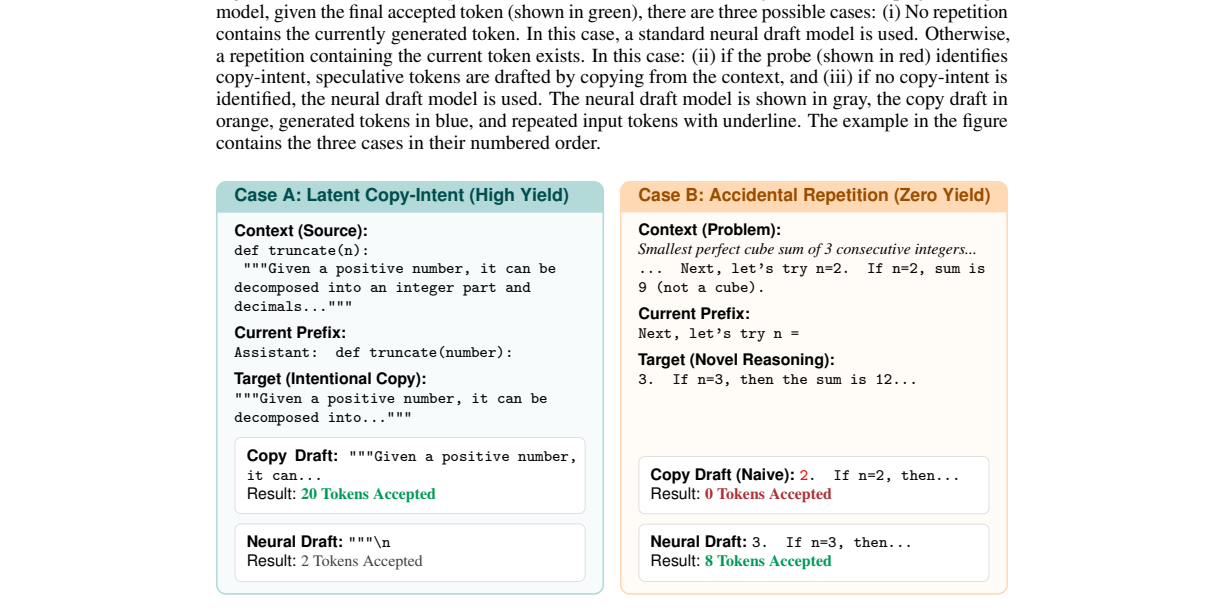
Neural drafts (e.g., EAGLE3) provide robust performance across diverse text settings, while copy-based methods achieve higher speedups in copy-intensive regimes by generating candidates faster and exploiting long repetition spans for near-perfect speculation. We analyze existing copy-based methods and find that they are prone to accidental repetitions where surface-level n-gram overlap does not reflect a structural intent to copy, leading to false-positive triggers that ultimately degrade throughput. We introduce SwitchSD, an adaptive framework that treats copying as a latent control signal of the LLM. By training lightweight probes on the target model's internal representations, SwitchSD identifies genuine copy-intent with high precision (AUC > 0.99). This allows the system to dynamically switch between neural drafting (e.g., EAGLE) and context-based copying. Our results across Llama and Qwen families demonstrate throughput gains of up to 15% over state-of-the-art baselines like EAGLE3, effectively turning copying from a noisy heuristic into a principled, model-aware decoding regime.
from the abstract
Pith says
Machine review · deepseek-v4-flash · 20 Sep 2026 · what was read was not recorded · not checked by a person
It can be wrong. Challenge this review or reply to it.
Holds up. Well-executed paper with a novel probe-based switch for speculative decoding; the weak supervision assumption is load-bearing but the experiments are thorough enough to justify peer review. This line is wrong
1 major objection · 6 minor
How often objections from reviews like this one are right: not yet measured
Not checked: figures, code, what the 45 references say.
The paper says, at §4.1, Appendix E
The review did not quote this passage.
Pith says: Objection 1 of 1 · major
The weak-supervision concern (whether the probe learns surface-level repetition rather than latent copy-intent) is discussed in Appendix E, but the paper does not test generalization to domains where repetitions arise from different mechanisms (e.g., multi-turn dialogue, adversarial inputs, non-English text). While the three benchmarks are diverse, an explicit robustness test or a more detailed error analysis of probe failures would strengthen the claim of generalizability.
6 minor objections
The paper says, at Abstract
Pith says: minor objection 1 of 6
The abstract states 'AUC > 0.99' but does not specify which model or layer this corresponds to; please report the range across models.
The paper says, at §3.2
Pith says: minor objection 2 of 6
The sentence 'We define a token position as a copy-mode instance (Y=1) if it belongs to a verbatim sequence of at least n_train = 5 tokens that appears earlier in the context.' should clarify whether the repeated tokens can overlap partially or must be exactly contiguous in the context.
show 4 more
The paper says, at Table 1
Pith says: minor objection 3 of 6
The column headers for 'Copy' and 'EAGLE3' iterations could be labeled more clearly (e.g., '% iter. (copy)' and 'mean accept. len. (copy)'). The current formatting of '% mean' is ambiguous.
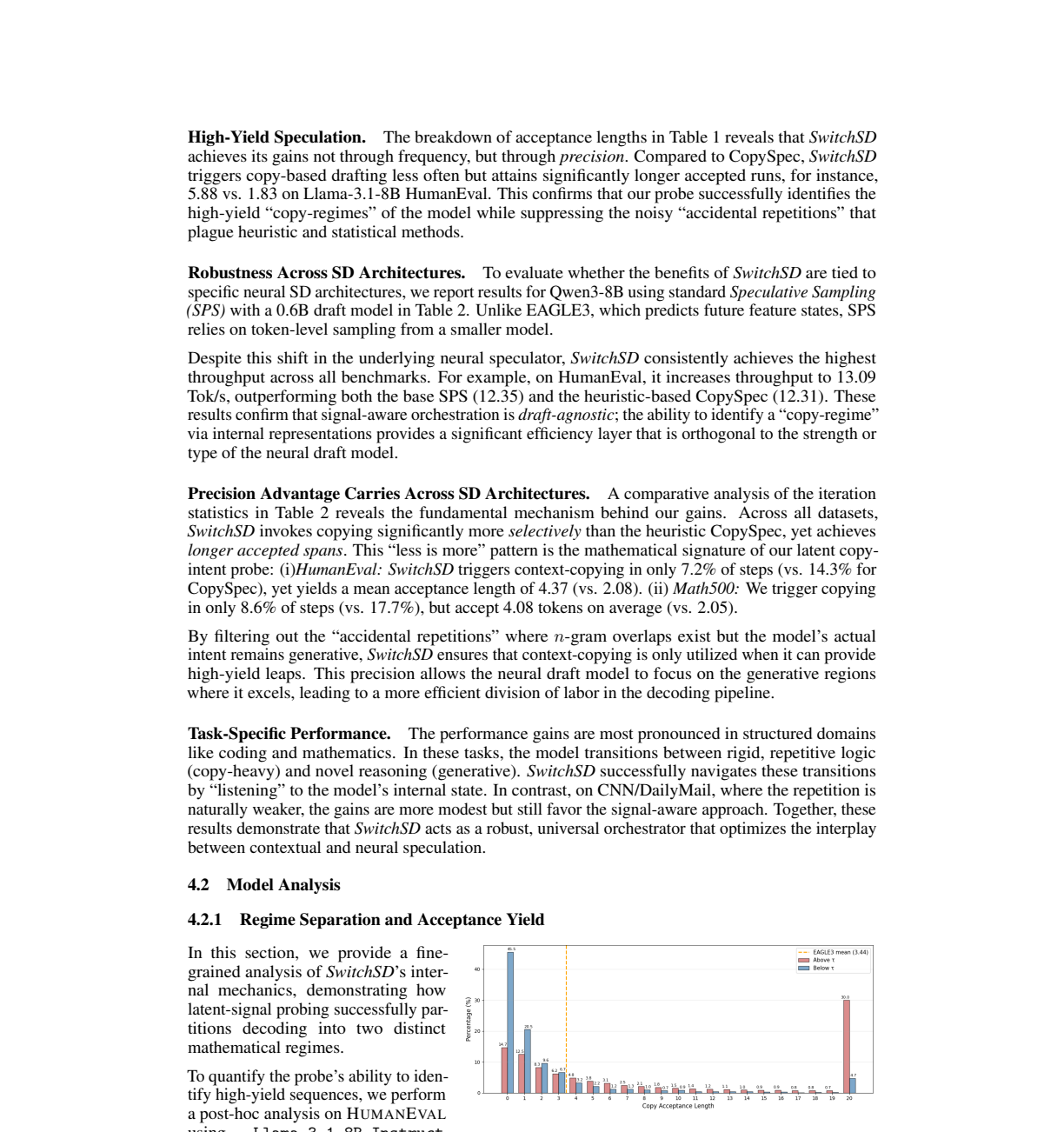
The paper says, at §4.2.1 (Figure 3)
Pith says: minor objection 4 of 6
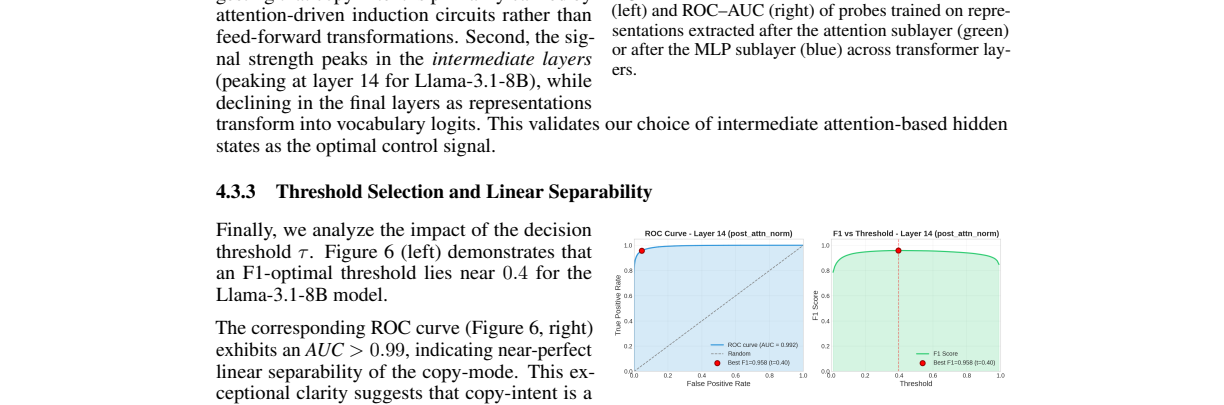
The y-axis label in Figure 3 is missing a '%' or 'probability' indication. Please add units.
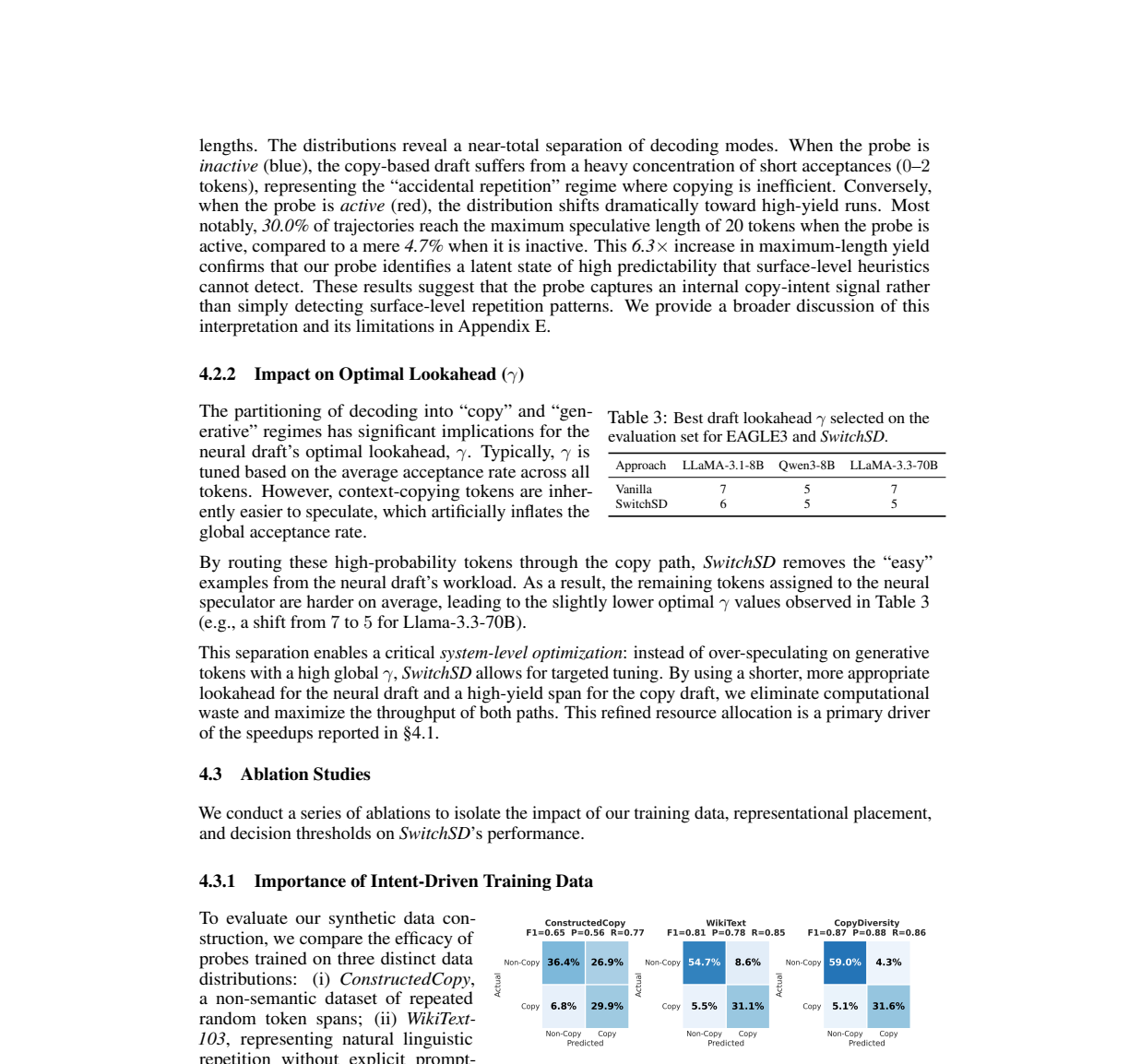
The paper says, at §4.3.1 (Figure 4)
Pith says: minor objection 5 of 6
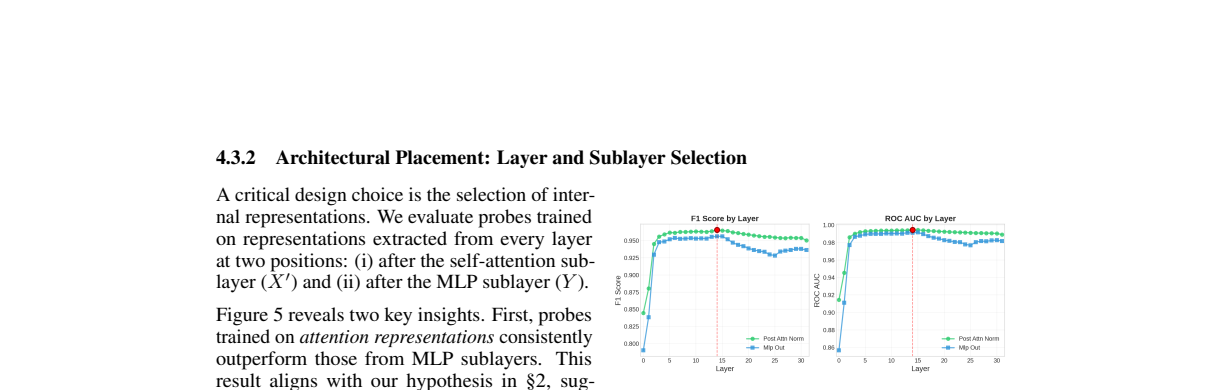
The confusion matrices in Figure 4 are informative, but the paper should state whether the percentages are normalized by total tokens or by row.
The paper says, at General
Pith says: minor objection 6 of 6
Several citations use 'et al.' inconsistently (e.g., 'Grattafiori et al.' vs 'Grattafiori et al., 2024'). Please ensure consistent formatting.
What would settle it
Construct a challenge set of 200 prompts where (a) the prefix contains an exact n-gram repetition of length ≥5 tokens with a prior occurrence in context, but (b) the prompt includes an explicit instruction to ignore the repetition and generate a novel continuation (e.g., 'Do NOT repeat the previous text; write something completely different.'). Run the target model on these prompts, collect the probe's predictions, and compute the false positive rate (probe predicts copy-intent when the model's actual response is novel). Additionally, measure the mean acceptance length if copy speculation were triggered based on the probe alone (ignoring the instruction). If the probe's false positive rate exceeds 20% or the mean copy acceptance length drops below 2 tokens, then the probe is not capturing true copy-intent but merely a surface-level correlate, and the generalization claims weaken.
from the skeptic's reading
How the review went
4 readings by deepseek-v4-flash · 20 Sep 2026
- Reader holds up
- Skeptic agrees
- Editor wrote the verdict above
- Referee minor revision: 1 major objection, 6 minor
Not run on this paper: the simulated authors' defence.
Pith did not check this review's objections against the paper.
The review in full
The review in brief, machine-written
The paper’s core idea—training a lightweight linear probe on the target model’s hidden states to detect copy-intent and then dynamically switching between copy-based and neural speculative decoding—is genuinely new. Prior work used heuristics or bandit-based exploration; using internal model signals is a cleaner approach. The experimental evaluation is serious: three model families (8B–70B), three benchmarks, multiple baselines including EAGLE3, and ablation studies on probe placement and training data. The probe achieves AUC > 0.99, and the throughput gains (up to 15% over EAGLE3) hold across settings. The paper also shows that copy-based drafting is triggered less often but with much longer accepted spans, which confirms the probe is doing something useful.
The soft spot is the weak supervision. The probe is trained using long n-gram repetitions (≥5 identical tokens) as a proxy for “copy-intent.” The paper argues that the representational bottleneck (one token’s hidden state) prevents the probe from simply memorizing string-match patterns, but this is more speculation than evidence. A linear probe could still learn a correlated surface property (e.g., low-entropy states) if that property is linearly encoded. The high AUC might reflect such a correlation rather than a true latent “copy mode.” The paper tests on coding, math, and summarization—domains that may share structure with the training set (CopyDiversity). Whether the probe generalizes to adversarial repetitions, multi-turn dialogue, or non-English text is unknown. This is a genuine limitation, though the authors acknowledge it in Appendix E.
Who is this for? Researchers working on efficient LLM inference, especially those building on speculative decoding. The method is practical and the code will likely be useful. The paper is a solid contribution to the subfield, not a paradigm shift.
Recommendation: Deserves a serious referee. The central experiment is credible and the gain is reproducible. The weak-supervision concern is real but not disqualifying—it is discussed and partly mitigated by the empirical regime analysis. I would accept peer review.
The strongest objection
The central claim that SwitchSD improves throughput via a model-aware copy-intent probe depends on the probe actually learning a generalizable internal copy-intent signal, not just a correlation with surface-level repetition. The training labels are derived from exact n-gram matches of length ≥5 tokens in the model's own completions of a diverse prompt set (CopyDiversity). The paper acknowledges this in Appendix E and argues that the representational bottleneck (a linear probe on a single token's hidden state) prevents learning surface-level string matching. This argument is not evidence; it is speculation. In fact, a linear probe on a single hidden state could still learn to detect a proxy like 'this token position is likely to be followed by a repeated continuation' if the hidden state encodes that statistical property. The high AUC (>0.99) might reflect a relatively simple correlation within the training distribution (e.g., low entropy, high confidence in the next token) that is not causally linked to copy-intent. The paper tests on three benchmarks (coding, math, summarization) which share structural similarities with the training data. Unknown is whether the probe would maintain its precision on domains where exact repetitions arise from different mechanisms (e.g., adversarial repetitions, multi-turn dialogue, non-English text) or where repetitions exist but the model genuinely intends to diverge. If the probe fails in such settings, the claimed 15% throughput gain may not generalize, reducing the method's practical value. Thus, this assumption is load-bearing and warrants direct empirical scrutiny.
I agree with the reader that the proxy label for copy-intent (long n-gram repetitions) is the weakest assumption in the paper. My stress-test analysis refines this: the representational bottleneck argument in Appendix E is insufficient to guarantee that the probe learns a generalizable latent signal rather than a dataset-specific correlate. The paper provides strong empirical evidence on three benchmarks, but the claim of up to 15% throughput gains depends on the probe working in diverse deployment scenarios. The concrete test I propose directly probes whether the probe can distinguish between intentional copying and coincidental repetition when the model is instructed to diverge. If the probe passes this test, it supports the authors' interpretation; if it fails, the method's practical value is reduced. However, since the paper already acknowledges this limitation and the presented results are solid on the tested tasks, the current verdict of ACCEPT remains appropriate. No change is needed; the stress test merely identifies a direction for future robustness checks.
The referee's report
If the results hold, this work is significant for two reasons. First, it demonstrates that internal LLM representations encode a reliable signal for the model's latent 'copy-regime', which can be leveraged to dynamically select between drafting strategies. Second, it provides a practical throughput improvement of up to 15% over state-of-the-art neural speculators like EAGLE3, with negligible overhead and no loss in output quality. The paper is thorough in its experimental evaluation and addresses the key concern of probe supervision in Appendix E.
Pith's reading of the paper (a machine's summary, not the authors')
Speculative decoding (SD) accelerates LLM inference by using a draft model, but existing methods either use a static neural draft or blindly copy from context based on n-gram overlap. The paper shows that context copying triggered by surface-level overlap often leads to false positives that waste computation. It proposes SwitchSD, which trains a lightweight linear probe on the target model's hidden states to detect genuine copy-intent with high precision (AUC > 0.99). At each decoding step, the probe decides whether to use context copying or fall back to a neural draft (e.g., EAGLE3). Across Llama-3 and Qwen-3 families, SwitchSD achieves up to 15% higher throughput than the state-of-the-art EAGLE3 alone, turning copy from a noisy heuristic into a model-aware, high-yield strategy.
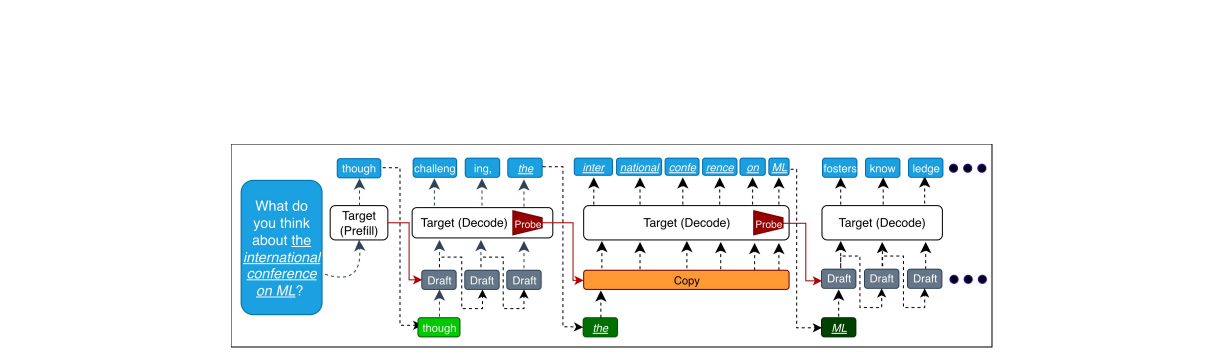
What carries the argument. A linear probe (single-layer, no bias) trained on hidden representations extracted from an intermediate attention sublayer of the target model. The probe is trained with binary cross-entropy using long n-gram repeats (κ≥5) as positive labels for copy-intent. At inference, when the probe score exceeds a threshold and a κ-gram match is found in the context, SwitchSD enables context-based speculation using up to 10 candidate continuations verified in parallel with block-triangular attention; otherwise, it falls back to a neural draft model. This probe acts as a gate that filters out accidental repetitions and triggers copying only when the model is internally in a copy regime.
Core claim. The paper discovers that copy-intent is linearly separable in the intermediate attention-layer representations of large language models. By training a lightweight binary classifier on those representations—using long verbatim repetitions (≥5 tokens) as weak supervision—the resulting probe can predict when the model is about to produce a long copy sequence versus an accidental repetition. This allows SwitchSD to selectively activate context-based speculation only in high-yield copy regimes, avoiding the speculation tax of false-positive copies while preserving the benefits of neural drafting in generative regions. The probe achieves AUC > 0.99 and leads to substantially longer accepted copy spans (e.g., mean 5.88 tokens on HumanEval) compared to heuristic baselines.
The premise it rests on. The probe is trained using long verbatim n-gram repetitions (≥5 tokens) as a proxy for copy-intent; if this proxy does not capture true copy-intent (e.g., if the probe learns surface-level text overlap rather than the model's latent intention to reproduce context), then the performance gains may not generalise to new domains or to types of repetition not seen in training.
If the paper is right (Pith's inferences, not the authors')
SwitchSD can be combined with any existing neural draft model (EAGLE3, SPS) to improve its throughput, showing that the probe's benefit is orthogonal to the quality of the neural drafter.
By removing easy copy tokens from the neural drafter's workload, SwitchSD allows tuning shorter lookahead values for the neural draft, reducing computational waste in generative regions.
The near-perfect linear separability of copy-intent (AUC > 0.99) suggests that the residual stream encodes this latent state as a first-order feature, which could be exploited for other adaptive inference strategies.
The probe's selective activation leads to a clean division of labor: copying dominates in structured, repetitive text (code, math derivations) while neural drafting handles novel reasoning, yielding the largest speedups in coding and mathematics tasks.
The framework preserves exact generation quality because the target model still verifies all speculations, ensuring no change to the output distribution.
If the weak supervision proxy (long verbatim repeats) fails to capture copy-intent for certain patterns—such as paraphrased repetition or semi-structured outputs—the probe may miss high-value copy opportunities or trigger on unintended forms of repetition.
Because the probe only sees a single token's hidden state at a time, it cannot leverage broader syntactic or semantic context that might signal a longer copy trajectory; incorporating sequential or multi-token features could further improve precision.
The reliance on target model internal representations means SwitchSD is not directly applicable to black-box API models where hidden states are unavailable; a student-trained proxy might be needed in such settings.
The current design requires a fixed threshold τ tuned on a held-out set; dynamic threshold adjustment based on recent acceptance statistics could make the system more robust to distribution shift.
Check this review
Pith stored no record of this review's passes and took no fingerprint of it. Reviews made by code from 13 Nov 2026 on carry both.
How often reviews like this one are right
Reviews like this one: written by deepseek-v4-flash, where what was read was not recorded.
How often objections from reviews like this one are right: not yet measured
Reviews by people
This review was written by a machine. No person has reviewed this paper on Pith yet. A scientist listed on Pith can review it for a fee, and their review is published here whatever it concludes.
The paper
Abstract
Speculative Decoding (SD) has significantly accelerated Large Language Model (LLM) inference, yet existing approaches face a fundamental tradeoff between two drafting strategies: neural drafting and context-based copying. Neural drafts (e.g., EAGLE3) provide robust performance across diverse text settings, while copy-based methods achieve higher speedups in copy-intensive regimes by generating candidates faster and exploiting long repetition spans for near-perfect speculation. We analyze existing copy-based methods and find that they are prone to accidental repetitions where surface-level n-gram overlap does not reflect a structural intent to copy, leading to false-positive triggers that ultimately degrade throughput. We introduce SwitchSD, an adaptive framework that treats copying as a latent control signal of the LLM. By training lightweight probes on the target model's internal representations, SwitchSD identifies genuine copy-intent with high precision (AUC > 0.99). This allows the system to dynamically switch between neural drafting (e.g., EAGLE) and context-based copying. Our results across Llama and Qwen families demonstrate throughput gains of up to 15% over state-of-the-art baselines like EAGLE3, effectively turning copying from a noisy heuristic into a principled, model-aware decoding regime.
The paper's own sentences, arranged, kept beside the review and separate from it. Each label is drawn from a closed vocabulary; the number beside it is the probability the classifier gave that label. No sentence in this record was written by a model.
abstract compiled · 2026-09-23
The authors' main claim, as the classifier picked it out 1.00
“Our results across Llama and Qwen families demonstrate throughput gains of up to 15% over state-of-the-art baselines like EAGLE3, effectively turning copying from a noisy heuristic into a principled, model-aware decoding regime.”
How the main claim is stated: asserted 1.00
What the abstract itself states, as probabilities: claims first 0.07 · states limitation 0.10 · human participants 0.02 · controlled comparison 0.89 · randomized assignment 0.01 · states quantitative result 0.99 · compares with prior results 0.98 · mentions code or data availability 0.02
The abstract, sentence by sentence
This table labels the abstract only (arXiv listing abstract v1). The number is the probability the classifier gave the label.
| Sentence | Role | The authors' own work | States the main conclusion | Strength |
|---|---|---|---|---|
| Speculative Decoding (SD) has significantly accelerated Large Language Model (LLM) inference, yet existing approaches face a fundamental tradeoff between two drafting strategies: neural drafting and context-based copying. | background 0.97 | 0.06 | 0.03 | asserted 1.00 |
| Neural drafts (e.g., EAGLE3) provide robust performance across diverse text settings, while copy-based methods achieve higher speedups in copy-intensive regimes by generating candidates faster and exploiting long repetition spans for near-perfect speculation. | background 1.00 | 0.07 | 0.04 | asserted 1.00 |
| We analyze existing copy-based methods and find that they are prone to accidental repetitions where surface-level n-gram overlap does not reflect a structural intent to copy, leading to false-positive triggers that ultimately degrade throughput. | gap 0.46 | 0.91 | 0.04 | asserted 1.00 |
| We introduce SwitchSD, an adaptive framework that treats copying as a latent control signal of the LLM. | contribution 0.92 | 0.81 | 0.08 | asserted 0.99 |
| By training lightweight probes on the target model's internal representations, SwitchSD identifies genuine copy-intent with high precision (AUC > 0.99). | result 0.52 | 0.95 | 0.10 | asserted 1.00 |
| This allows the system to dynamically switch between neural drafting (e.g., EAGLE) and context-based copying. | method 0.96 | 0.59 | 0.08 | asserted 0.96 |
| Our results across Llama and Qwen families demonstrate throughput gains of up to 15% over state-of-the-art baselines like EAGLE3, effectively turning copying from a noisy heuristic into a principled, model-aware decoding regime. | result 0.98 | 0.96 | 0.81 | asserted 1.00 |
What kind of paper the classifier reports this is: method or tool 1.00 · evidence from observation or experiment 0.96
What was examined, and what was not
Sources read
- arXiv listing abstract v1
Not examined
- full text
- figures and tables
- references and citing sentences
- relations to other papers
Levels run
- P abstract
Not run
- S sections
- T body sentences
- C citations
- R cross-paper relations
How the labels were made
Compiled by classifier-1.13.0 via TypeSafe API, question bank abstract-p1-20260923, 2026-09-23: 1 request, 5,733 input tokens.
Every quoted sentence on this record is the authors'. Every label is from Pith's closed vocabulary, with the probability shown beside it. This record as JSON
Figures (6)
Figures are the authors', reproduced from the paper.
References (45)
- [1] P. Langley , title =. Proceedings of the 17th International Conference on Machine Learning (ICML 2000) , address =. 2000 , pages = on Pith
- [2] T. M. Mitchell. The Need for Biases in Learning Generalizations. 1980 on Pith
- [3] M. J. Kearns , title = on Pith
- [4] Machine Learning: An Artificial Intelligence Approach, Vol. I. 1983 on Pith
- [5] R. O. Duda and P. E. Hart and D. G. Stork. Pattern Classification. 2000 on Pith
- [6] Suppressed for Anonymity , author= on Pith
- [7] A. Newell and P. S. Rosenbloom. Mechanisms of Skill Acquisition and the Law of Practice. Cognitive Skills and Their Acquisition. 1981 on Pith
- [8] A. L. Samuel. Some Studies in Machine Learning Using the Game of Checkers. IBM Journal of Research and Development. 1959 on Pith
- [9] Prompt Lookup Decoding , author =. 2023 , month = on Pith
- [10] Pld+: Accelerating llm inference by leveraging language model artifacts , author=. Findings of the Association for Computational Linguistics: NAACL 2025 , pages= on Pith
- [11] CopySpec: Accelerating LLMs with Speculative Copy-and-Paste Without Compromising Quality , author=. arXiv preprint arXiv:2502.08923 , year= on PithPith's reviewarXiv
- [12] Break the sequential dependency of llm inference using lookahead decoding , author=. arXiv preprint arXiv:2402.02057 , year= on PithPith's reviewarXiv
- [13] Fast inference from transformers via speculative decoding , author=. International Conference on Machine Learning , pages=. 2023 , organization= on Pith
- [14] Eagle: Speculative sampling requires rethinking feature uncertainty , author=. arXiv preprint arXiv:2401.15077 , year= on PithPith's reviewarXiv
- [15] Evaluating Large Language Models Trained on Code , author=. 2021 , eprint= on Pith
- [16] Measuring mathematical problem solving with the math dataset , author=. arXiv preprint arXiv:2103.03874 , year= on PithPith's reviewarXiv
- [17] Qwen3 technical report , author=. arXiv preprint arXiv:2505.09388 , year= on PithPith's reviewarXiv
- [18] The llama 3 herd of models , author=. arXiv preprint arXiv:2407.21783 , year= on PithPith's reviewarXiv
- [19] Eagle-3: Scaling up inference acceleration of large language models via training-time test , author=. arXiv preprint arXiv:2503.01840 , year= on PithPith's reviewarXiv
- [20] OpenAI , title =. 2023 , howpublished = on Pith
show 25 more
- [21] Large language models are zero-shot reasoners , author=. Advances in neural information processing systems , volume= on Pith
- [22] Scaling llm test-time compute optimally can be more effective than scaling model parameters , author=. arXiv preprint arXiv:2408.03314 , year= on PithPith's reviewarXiv
- [23] From decoding to meta-generation: Inference-time algorithms for large language models , author=. arXiv preprint arXiv:2406.16838 , year= on PithPith's reviewarXiv
- [24] Introducing Claude Sonnet 4.5 , author =. 2025 , howpublished = on Pith
- [25] Accelerating large language model decoding with speculative sampling , author=. arXiv preprint arXiv:2302.01318 , year= on PithPith's reviewarXiv
- [26] In-context learning and induction heads , author=. arXiv preprint arXiv:2209.11895 , year= on PithPith's reviewarXiv
- [27] Extracting training data from large language models , author=. 30th USENIX security symposium (USENIX Security 21) , pages= on Pith
- [28] Quantifying memorization across neural language models , author=. The Eleventh International Conference on Learning Representations , year= on Pith
- [29] A mathematical framework for transformer circuits , author=. Transformer Circuits Thread , volume= on Pith
- [30] In-Context Learning Creates Task Vectors , author=. Conference on Empirical Methods in Natural Language Processing , year = on Pith
- [31] Overclocking LLM Reasoning: Monitoring and Controlling Thinking Path Lengths in LLMs , author=. arXiv preprint arXiv:2506.07240 , year= on PithPith's reviewarXiv
- [32] Training Domain Draft Models for Speculative Decoding: Best Practices and Insights , author=. arXiv preprint arXiv:2503.07807 , year= on PithPith's reviewarXiv
- [33] The Linear Representation Hypothesis and the Geometry of Large Language Models , author=. International Conference on Machine Learning , pages=. 2024 , organization= on Pith
- [34] Toy models of superposition , author=. arXiv preprint arXiv:2209.10652 , year= on PithPith's reviewarXiv
- [35] Attention is all you need , author=. Advances in neural information processing systems , volume= on Pith
- [36] Li, Yuhui and Wei, Fangyun and Zhang, Chao and Zhang, Hongyang. EAGLE -2: Faster Inference of Language Models with Dynamic Draft Trees. Proceedings of the 2024 Conference on Empirical Methods in Natural Language Processing. 2024. doi:10.18653/v1/2024.emnlp-main.422 on Pithdoi:10.18653/v1/2024.emnlp-main.422
- [37] DistillSpec: Improving Speculative Decoding via Knowledge Distillation , author=. 2024 , eprint= on Pith
- [38] Quan, Guofeng and Feng, Wenfeng and Hao, Chuzhan and Jiang, Guochao and Zhang, Yuewei and Wang, Hao Henry. RASD : Retrieval-Augmented Speculative Decoding. Findings of the Association for Computational Linguistics: ACL 2025. 2025. doi:10.18653/v1/2025.findings-acl.320 on Pithdoi:10.18653/v1/2025.findings-acl.320
- [39] Specdec++: Boosting speculative decoding via adaptive candidate lengths , author=. arXiv preprint arXiv:2405.19715 , year= on PithPith's reviewarXiv
- [40] Training Domain Draft Models for Speculative Decoding: Best Practices and Insights , author=. 2025 , eprint= on Pith
- [41] Sam decoding: Speculative decoding via suffix automaton , author=. Proceedings of the 63rd Annual Meeting of the Association for Computational Linguistics (Volume 1: Long Papers) , pages= on Pith
- [42] Lookahead: An inference acceleration framework for large language model with lossless generation accuracy , author=. Proceedings of the 30th ACM SIGKDD Conference on Knowledge Discovery and Data Mining , pages= on Pith
- [43] BanditSpec: Adaptive Speculative Decoding via Bandit Algorithms , author=. ArXiv , year= on Pith
- [44] Get To The Point: Summarization with Pointer-Generator Networks , author=. Annual Meeting of the Association for Computational Linguistics , year= on Pith
- [45] Teaching Machines to Read and Comprehend , author=. ArXiv , year= on Pith
Cited by 1 Pith paper
Reviewed papers on Pith that cite this one. The full citation record
Challenges and discussion
Disagree with the review, or know something it missed? Leave a comment, or challenge this review formally: a challenge becomes a permanent entry in this paper's record, and its decision is published here.
Come back by email
A short list of the week's newly reviewed papers. Nothing is sent until you confirm from your inbox, and every email has a link that stops it. No account.
No comments yet.
Sign in to comment