Optics · arXiv:2609.04996 v1 · submitted 4 Sep 2026 · 100 references
Fisher-information retention under local driving in non-Hermitian feed-forward chains
The paper says
“When local drive hardware is installed before a sensing task is revealed, directional non-Hermitian buildup creates a tradeoff between targeted preparation and spatial coverage. We quantify this tradeoff for stable linear scatterers with proper complex Gaussian output statistics.”
more of the abstract
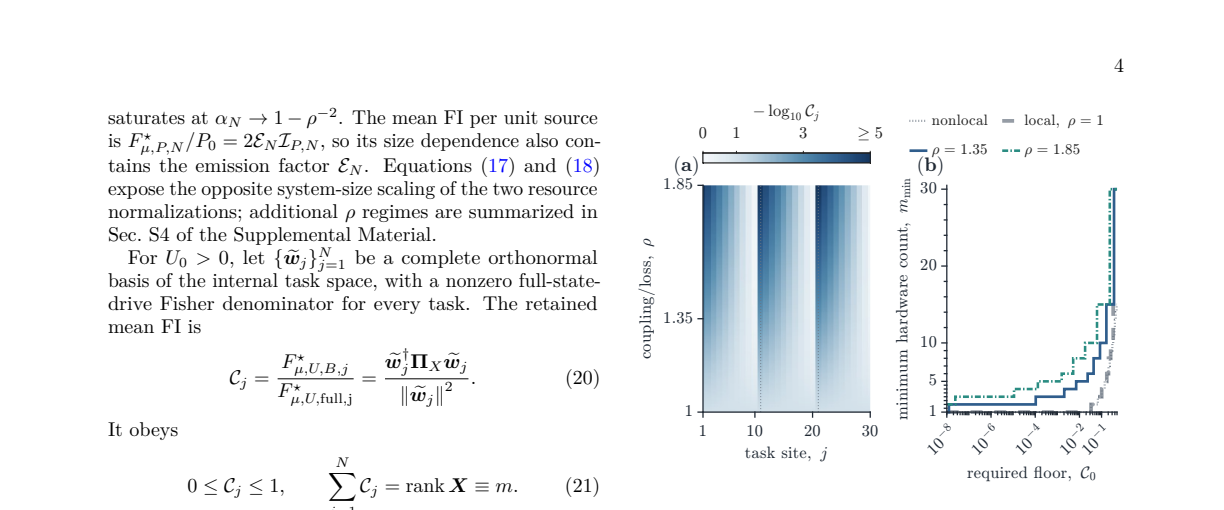
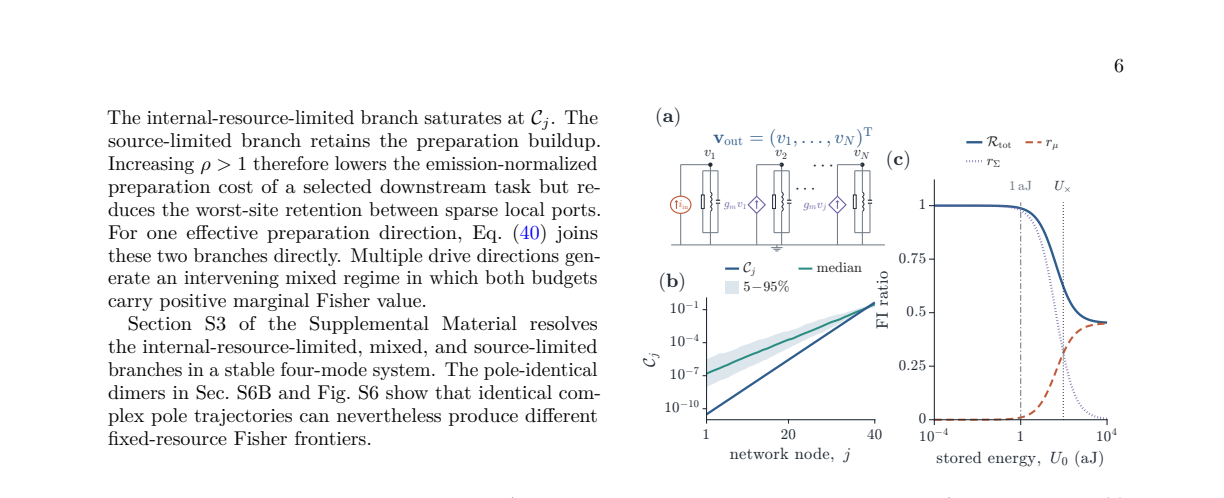
For parameters encoded in the internal generator, and at fixed coherent internal resource, the drive hardware enters the optimized mean-response Fisher information only through the projector onto the internally reachable subspace, while the preparation Gramian sets the source cost. In an on-resonance feed-forward chain, nested Green-function columns decompose into disjoint port intervals, and the site-local retention factors in each interval sum exactly to unity. Directionality concentrates this unit downstream, so the worst-site retention decays exponentially when one port serves many sites; for m equal intervals, a single probe shared by all tasks has a worst-site retention lower by a further factor m than task-specific reoptimization. Joint source-power and internal-resource constraints connect this fixed-resource law to source-limited preparation. A noisy RLC/VCCS model illustrates the retention law with stored electromagnetic energy, covariance Fisher information, and component disorder. The resulting bounds turn directional buildup into a port-layout criterion: source savings for a selected task are accompanied by a spatial coverage cost for tasks unknown at the hardware-design stage.
from the abstract
Pith says
Machine review · deepseek-v4-flash · 8 Sep 2026 · what was read was not recorded · not checked by a person
It can be wrong. Challenge this review or reply to it.
Holds up. The interval conservation law is a genuine, exactly verified new result; the only real weakness is the narrowness of the regime it applies to, and the authors flag that themselves. This line is wrong
3 minor
How often objections from reviews like this one are right: not yet measured
Not checked: figures, code, what the 100 references say.
3 minor objections
The paper says, at Abstract, last sentence
Pith says: minor objection 1 of 3
The phrase 'form equal intervals' appears to be a typo; it should read 'for m equal intervals'.
The paper says, at Section IV.B, Eq. (24)
Pith says: minor objection 2 of 3
The notation could be slightly clearer: at ρ=0, the expression is replaced by a limit; it would be helpful to explicitly state that Eq. (24) holds for ρ>0 and give the ρ=0 case directly (as is done later in the text).
show 1 more
The paper says, at Section VII, Discussion
Pith says: minor objection 3 of 3
The paragraph on 'The RLC/VCCS model carries this distinction...' could benefit from a brief mention of the quantitative agreement with the analytic retention law (achieved to 5.27×10^{-16}) to emphasize the connection.
What would settle it
Independently re-derive Eq. (24) by direct projection: compute Π_X from the analytic Green columns (Eq. 22) for a feed-forward chain with arbitrary port positions (e.g., N=50, ports at {1,7,20,35}) and verify that the diagonal entries satisfy the segment sum rule ∑_{j∈I_ℓ} C_j = 1 for each interval. The discrepancy should be ≤ 10⁻¹⁴ in double precision.
from the skeptic's reading
How the review went
4 readings by deepseek-v4-flash · 8 Sep 2026
- Reader holds up
- Skeptic partly agrees
- Editor wrote the verdict above
- Referee accept: 3 minor
Not run on this paper: the simulated authors' defence.
Pith did not check this review's objections against the paper.
The review in full
The review in brief, machine-written
The one thing to know: the interval conservation law is a real, exactly verified new result, and the paper around it is careful and honest. The reader's high-confidence accept is not misplaced.
What is actually new: for an on-resonance feed-forward chain with uniform forward coupling and uniform loss, the nested Green-function columns split into disjoint port intervals, and the site-local Fisher retention factors inside each interval sum exactly to one (Eq. 24). That conservation law directly produces the exponential worst-site decay when one port serves many sites, the port-density criterion for holding a retention floor (Eq. 26), and the exact 1/m common-probe penalty for equal intervals (Eq. 28). The derivation is elementary in the best sense—orthogonalize the nested columns, read off the projector diagonal—and the numerics in Table S1 agree to 10−15 because they are checking the algebra, not fitting anything. The more general projector law (Eq. 21) is, in linear-algebra terms, the standard fact that the diagonal of a projector sums to its rank; the contribution is the operational reading of that fact as a Fisher-retention budget for drive hardware installed before the task location is known, and I do not know an earlier paper that states it that way. The joint source-internal-resource duality in Sec. V is handled correctly, with the right support conditions, and the RLC/VCCS illustration is clearly labeled as reduced-order with a phenomenological active-noise bath.
Soft spots, in proportion. The exact interval law lives in a genuinely narrow regime: strictly feed-forward, uniform coupling, uniform loss, on resonance, Q = I, onsite rank-one tasks, fixed downstream measurement. The authors say exactly this before deriving it, and they test what happens when the assumptions break—reverse hopping, disorder, the Hatano-Nelson detuning case—so this is an acknowledged limitation, not a hidden one. Still, the headline result is a benchmark for idealized chains, and the part that carries over to real devices is the broader projector law, not Eq. 24 itself. Second, code and data are not public during review; the seeds and tolerances are described in enough detail that the numerics are probably reproducible, but a repository would have made it certain. Third, the pole-identical dimer comparison is a cautionary example rather than a load-bearing result; it is fine, just not central.
Who it is for: anyone working on non-Hermitian or wave-based sensing who cares about the difference between preparing one target well and covering many possible targets. It gives a clean design rule and an honest statement of its own limits. I would send this to a serious referee without hesitation; it deserves referee time and should come back with minor requests—most usefully, the code deposit.
The strongest objection
The paper's central claim—the exact interval conservation law for an on-resonance feed-forward chain (Section IV.B, Eq. 24)—is a direct algebraic consequence of the nested geometric Green function columns under the assumptions of uniform nearest-neighbor forward coupling, uniform loss, Q=I, and local rank-one tasks. The derivation from Eqs. (22)–(24) is elementary and the numerical agreement (discrepancy 1.34×10⁻¹⁵) confirms the algebra. The paper also explicitly discusses the limitations of these assumptions (reverse hopping, disorder, non-uniformity) and shows how the general projector law (Eq. 21) provides a broader framework. No hidden assumptions, internal contradictions, or unverified steps were identified. The reliance on specific conditions is openly acknowledged and does not affect the correctness of the mathematical result under those conditions.
The reader's weakest assumption correctly notes that the exact interval law depends on a specific set of conditions. This is a valid observation about scope, but it does not undermine the correctness or internal consistency of the law under those assumptions. The paper is transparent about these conditions and provides complementary results (e.g., reverse-hopping analysis, general projector theorem) that extend beyond the strict chain. As a stress-tester, I find no load-bearing concern regarding the proof, derivation, or numerical verification of the central claim. The analytic core stands on its own. Therefore, the reader's verdict of ACCEPT remains appropriate, and no adjustment is needed.
The referee's report
The paper provides a clean, exact result (the interval conservation law) for a model problem in non-Hermitian sensing that captures the essential tradeoff between directional buildup and spatial coverage. The more general projector-based framework (Eq. 21) has broader applicability. The derivations are rigorous and self-contained, and the analytical results are verified numerically to machine precision. The paper explicitly discusses its assumptions and limitations, and includes extensions (reverse hopping, Hatano–Nelson, SSH, circuit model) that demonstrate the robustness and scope of the ideas. If the results hold (and they appear to be mathematically exact under the stated assumptions), this work offers a useful design criterion for spatially distributed sensor arrays with fixed drive ports.
Pith's reading of the paper (a machine's summary, not the authors')
This paper establishes a tradeoff between targeted preparation and spatial coverage when drive hardware is installed before a sensing task is selected. The central result is an exact interval conservation law for a strictly feed-forward chain: nested Green-function columns decompose into disjoint port intervals, and the site-local retention factors in each interval sum exactly to unity. Directionality concentrates this unit downstream, so the worst-site retention decays exponentially when one port serves many sites. These bounds turn directional buildup into a port-layout criterion for maintaining a desired information floor, and they extend to general linear scatterers via a reachable-subspace projector.
What carries the argument. The reachable-subspace projector Π_X = X X^+, where X = $Q^{{1/2}}$ G B, carries the argument: the drive hardware enters the optimized mean-response Fisher information only through this projector. In the feed-forward chain, the nested Green-function columns yield an orthogonal decomposition of Π_X into disjoint interval basis vectors, enabling the exact retention law.
Core claim. The paper discovers that in an on-resonance feed-forward chain with uniform nearest-neighbor forward coupling, uniform loss, onsite rank-one tasks, and fixed downstream measurement maps, the Fisher-information retention under fixed internal resource decomposes into disjoint port intervals, each summing to unity. This decomposition yields an exact exponential decay $ρ^{{2(j-p_ℓ)}}$ / Σ_{r=0}^{L_ℓ-1} $ρ^{{2r}}$ for the retention at site j in interval ℓ. The result is derived from an orthogonal decomposition of the nested Green-function columns, which directly gives the reachable-subspace projector. This exact profile contrasts with the neutral-buildup case and with nonlocal subspace designs, and it quantifies the exponential penalty for sparse local ports.
The premise it rests on. The exact interval conservation law relies on a strictly feed-forward chain with uniform nearest-neighbor forward coupling, uniform loss, on-resonance operation, Q=I, onsite rank-one tasks, and fixed downstream measurement maps — a very specific set of conditions that may not be met in realistic devices.
If the paper is right (Pith's inferences, not the authors')
The minimum number m of local ports needed to guarantee a retention floor C0 for all tasks scales linearly with chain length N and logarithmically with 1/C0, independent of systems size for fixed C0.
A common probe shared across all task locations incurs an additional factor of 1/m in worst-site retention relative to task-specific reoptimization when all segments are balanced.
Under joint source-power and internal-resource constraints, the preparation Gramian returns through a one-parameter envelope, connecting the fixed-resource law to source-limited preparation.
The projector law extends beyond the feed-forward chain to any linear scatterer with a fixed internal metric, establishing that only the reachable subspace determines the fixed-resource Fisher region.
The exact interval conservation provides analytically closed benchmarks for nonreciprocal photonic, microwave, acoustic, and mechanical sensor arrays with finite local access.
The interval conservation law could be tested directly in an electronic circuit with unidirectional voltage-follower coupling (VCCS chain) by measuring the Fisher retention of a local capacitance task under fixed stored electromagnetic energy, as outlined in the paper's reduced-order model.
The projector approach suggests a design principle for distributed sensor networks: the locations of local drive ports should be chosen to equalize the lengths of the reachable-subspace intervals, thereby maximizing the worst-task retention floor.
Beyond the feed-forward limit, adding reverse hopping (as in Fig. 3b) may recover some spatial coverage lost at large forward-to-loss ratio; this opens a design space for non-Hermitian sensor arrays with controllable back-action.
Check this review
Pith stored no record of this review's passes and took no fingerprint of it. Reviews made by code from 13 Nov 2026 on carry both.
How often reviews like this one are right
Reviews like this one: written by deepseek-v4-flash, where what was read was not recorded.
How often objections from reviews like this one are right: not yet measured
Reviews by people
This review was written by a machine. No person has reviewed this paper on Pith yet. A scientist listed on Pith can review it for a fee, and their review is published here whatever it concludes.
The paper
Abstract
When local drive hardware is installed before a sensing task is revealed, directional non-Hermitian buildup creates a tradeoff between targeted preparation and spatial coverage. We quantify this tradeoff for stable linear scatterers with proper complex Gaussian output statistics. For parameters encoded in the internal generator, and at fixed coherent internal resource, the drive hardware enters the optimized mean-response Fisher information only through the projector onto the internally reachable subspace, while the preparation Gramian sets the source cost. In an on-resonance feed-forward chain, nested Green-function columns decompose into disjoint port intervals, and the site-local retention factors in each interval sum exactly to unity. Directionality concentrates this unit downstream, so the worst-site retention decays exponentially when one port serves many sites; for m equal intervals, a single probe shared by all tasks has a worst-site retention lower by a further factor m than task-specific reoptimization. Joint source-power and internal-resource constraints connect this fixed-resource law to source-limited preparation. A noisy RLC/VCCS model illustrates the retention law with stored electromagnetic energy, covariance Fisher information, and component disorder. The resulting bounds turn directional buildup into a port-layout criterion: source savings for a selected task are accompanied by a spatial coverage cost for tasks unknown at the hardware-design stage.
The paper's own sentences, arranged, kept beside the review and separate from it. Each label is drawn from a closed vocabulary; the number beside it is the probability the classifier gave that label. No sentence in this record was written by a model.
abstract compiled · 2026-09-23
The authors' main claim, as the classifier picked it out 0.97
“The resulting bounds turn directional buildup into a port-layout criterion: source savings for a selected task are accompanied by a spatial coverage cost for tasks unknown at the hardware-design stage.”
How the main claim is stated: asserted 1.00
What the abstract itself states, as probabilities: claims first 0.03 · states limitation 0.74 · human participants 0.01 · controlled comparison 0.20 · randomized assignment 0.01 · states quantitative result 0.88 · compares with prior results 0.62 · mentions code or data availability 0.02
The abstract, sentence by sentence
This table labels the abstract only (arXiv listing abstract v1). The number is the probability the classifier gave the label.
| Sentence | Role | The authors' own work | States the main conclusion | Strength |
|---|---|---|---|---|
| When local drive hardware is installed before a sensing task is revealed, directional non-Hermitian buildup creates a tradeoff between targeted preparation and spatial coverage. | background 0.95 | 0.16 | 0.26 | asserted 1.00 |
| We quantify this tradeoff for stable linear scatterers with proper complex Gaussian output statistics. | contribution 0.78 | 0.92 | 0.04 | asserted 1.00 |
| For parameters encoded in the internal generator, and at fixed coherent internal resource, the drive hardware enters the optimized mean-response Fisher information only through the projector onto the internally reachable subspace, while the preparation Gramian sets the source cost. | result 0.98 | 0.83 | 0.22 | asserted 1.00 |
| In an on-resonance feed-forward chain, nested Green-function columns decompose into disjoint port intervals, and the site-local retention factors in each interval sum exactly to unity. | result 0.98 | 0.85 | 0.12 | asserted 1.00 |
| Directionality concentrates this unit downstream, so the worst-site retention decays exponentially when one port serves many sites; for $m$ equal intervals, a single probe shared by all tasks has a worst-site retention lower by a further factor $m$ than task-specific reoptimization. | result 0.99 | 0.86 | 0.26 | asserted 1.00 |
| Joint source-power and internal-resource constraints connect this fixed-resource law to source-limited preparation. | interpretation 0.43 | 0.74 | 0.08 | asserted 1.00 |
| A noisy RLC/VCCS model illustrates the retention law with stored electromagnetic energy, covariance Fisher information, and component disorder. | method 0.97 | 0.83 | 0.04 | asserted 1.00 |
| The resulting bounds turn directional buildup into a port-layout criterion: source savings for a selected task are accompanied by a spatial coverage cost for tasks unknown at the hardware-design stage. | interpretation 0.99 | 0.83 | 0.78 | asserted 1.00 |
What kind of paper the classifier reports this is: theoretical result 1.00 · evidence from proof or derivation 1.00
What was examined, and what was not
Sources read
- arXiv listing abstract v1
Not examined
- full text
- figures and tables
- references and citing sentences
- relations to other papers
Levels run
- P abstract
Not run
- S sections
- T body sentences
- C citations
- R cross-paper relations
How the labels were made
Compiled by classifier-1.13.0 via TypeSafe API, question bank abstract-p1-20260923, 2026-09-23: 1 request, 6,333 input tokens.
Every quoted sentence on this record is the authors'. Every label is from Pith's closed vocabulary, with the probability shown beside it. This record as JSON
Figures (4)
Showing 2 of the paper's 4 figures. Figures are the authors', reproduced from the paper.
References (100)
- [1] R. El-Ganainy, K. G. Makris, M. Khajavikhan, Z. H. Musslimani, S. Rotter, and D. N. Christodoulides, Non- Hermitian physics and PT symmetry, Nature Physics14, 11 (2018) on Pith
- [2] M.-A. Miri and A. Alù, Exceptional points in optics and photonics, Science363, eaar7709 (2019) on Pith
- [3] Y. Ashida, Z. Gong, and M. Ueda, Non-Hermitian physics, Advances in Physics69, 249 (2020) on Pith
- [4] E. J. Bergholtz, J. C. Budich, and F. K. Kunst, Excep- tional topology of Non-Hermitian systems, Reviews of Modern Physics93, 015005 (2021) on Pith
- [5] W. Langbein, No exceptional precision of exceptional- point sensors, Physical Review A98, 023805 (2018) on Pith
- [6] H.-K. Lau and A. A. Clerk, Fundamental limits and non- reciprocal approaches in Non-Hermitian quantum sensing, Nature Communications9, 4320 (2018) on Pith
- [7] A. McDonald and A. A. Clerk, Exponentially-enhanced quantum sensing with Non-Hermitian lattice dynamics, Nature Communications11, 5382 (2020) on Pith
- [10] P.-É. Blanchard, A. McDonald, and P. St-Jean, Expo- nentially enhanced sensing through nonreciprocal light propagation (2025), arXiv:2511.16895 [physics.optics] on PithPith's reviewarXiv
- [11] J. Wiersig and S. Rotter, Fundamental limits of Non- Hermitian sensing from quantum Fisher information, Reports on Progress in Physics89, 067501 (2026), arXiv:2603.10614 on PithPith's reviewarXiv
- [12] D. Bouchet, S. Rotter, and A. P. Mosk, Maximum in- formation states for coherent scattering measurements, Nature Physics17, 564 (2021) on Pith
- [15] J. Hüpfl, F. Russo, L. M. Rachbauer, D. Bouchet, J. Lu, U. Kuhl, and S. Rotter, Continuity equation for the flow of Fisher information in wave scattering, Nature Physics 20, 1294 (2024) on Pith
- [16] M. Weimar, H. Zhou, L. Neubacher, T. A. Grant, J. Hüpfl, K. F. MacDonald, S. Rotter, and N. I. Zheludev, Control- ling the flow of information in optical metrology (2025), arXiv:2508.13640 [physics.optics] on PithPith's reviewarXiv
- [17] Y. Zhang, Y. Ge, B. Clerckx, and T. Y. Al-Naffouri, How many RF chains does a microwave linear analog computer 8 (MiLAC) need to match the fully-digital Cramér–Rao bound? (2026), preprint, arXiv:2606.23986 [cs.IT] on PithPith's reviewarXiv
- [18] I. Klickstein and F. Sorrentino, The controllability gramian of lattice graphs, Automatica114, 108833 (2020), arXiv:1808.05554 on PithPith's reviewarXiv
- [19] P. J. Schreier and L. L. Scharf,Statistical Signal Process- ing of Complex-Valued Data(Cambridge University Press, Cambridge, 2010) on Pith
- [26] C. Mahaux and H. A. Weidenmüller,Shell-Model Ap- proach to Nuclear Reactions(North-Holland, Amsterdam, 1969) on Pith
- [27] I. Schur, Über eine Klasse von Mittelbildungen mit Anwen- dungen auf die Determinantentheorie, Sitzungsberichte der Berliner Mathematischen Gesellschaft22, 9 (1923) on Pith
- [30] Y.-Z. Chen, L.-Z. Wang, W.-X. Wang, and Y.-C. Lai, Energy scaling and reduction in controlling complex net- works, Royal Society Open Science3, 160064 (2016) on Pith
- [31] L.-Z. Wang, Y.-Z. Chen, W.-X. Wang, and Y.-C. Lai, Physical controllability of complex networks, Scientific Reports7, 40198 (2017) on Pith
- [32] S. Zhao and F. Pasqualetti, Controllability degree of directed line networks: Nodal energy and asymptotic bounds, in2018 European Control Conference (ECC) (2018) pp. 1857–1862 on Pith
show 80 more
- [33] S. Alizadeh, M. Pósfai, and A. Ghasemi, Input node place- ment restricting the longest control chain in controllability of complex networks, Scientific Reports13, 3752 (2023) on Pith
- [34] A. Nazerian, M. Asllani, M. Tyloo, W. L. Ku, and F. Sorrentino, The frequency response of networks as open systems, Nature Communications17, 2088 (2026), arXiv:2507.04180 on PitharXiv
- [35] C. Duan, T. Nishikawa, and A. E. Motter, Prevalence and scalable control of localized networks, Proceedings of the National Academy of Sciences119, e2122566119 (2022) on Pith
- [38] W. Deng, W. Zhu, T. Chen, H. Sun, and X. Zhang, Ul- trasensitive integrated circuit sensors based on high-order Non-Hermitian topological physics, Science Advances10, eadp6905 (2024) on Pith
- [40] J. B. Johnson, Thermal agitation of electricity in conduc- tors, Physical Review32, 97 (1928) on Pith
- [41] H. Nyquist, Thermal agitation of electric charge in con- ductors, Physical Review32, 110 (1928) on Pith
- [43] Å. Björck and G. H. Golub, Numerical methods for com- puting angles between linear subspaces, Mathematics of Computation27, 579 (1973) on Pith
- [47] A. A. Clerk, M. H. Devoret, S. M. Girvin, F. Marquardt, and R. J. Schoelkopf, Introduction to quantum noise, mea- surement, and amplification, Reviews of Modern Physics 82, 1155 (2010) on Pith
- [48] W. Ding, X. Wang, and S. Chen, Fundamental sensitiv- ity limits for Non-Hermitian quantum sensors, Physical Review Letters131, 160801 (2023) on Pith
- [54] M. W. Mahoney, Randomized algorithms for matrices and data, Foundations and Trends in Machine Learning 3, 123 (2011) on Pith
- [55] N. Okuma, K. Kawabata, K. Shiozaki, and M. Sato, Topo- logical origin of Non-Hermitian skin effects, Physical Re- view Letters124, 086801 (2020) on Pith
- [58] C. Wang, W. R. Sweeney, A. D. Stone, and L. Yang, Co- herent perfect absorption at an exceptional point, Science 373, 1261 (2021). 9 on Pith
- [59] Z.-Q. Wang, Y.-M. Sun, Y.-D. Hu, Y.-P. Wang, R.-C. Shen, W.-J. Wu, and J. Q. You, Enhancement of signal- to-noise ratio at a high-order exceptional point of coher- ent perfect absorption, Nature Communications17, 3343 (2026) on Pith
- [60] P.-Å. Wedin, Perturbation bounds in connection with sin- gular value decomposition, BIT Numerical Mathematics 12, 99 (1972) on Pith
- [61] J. Wiersig, Prospects and fundamental limits in excep- tional point-based sensing, Nature Communications11, 2454 (2020) on Pith
- [62] Z. Xiao, H. Li, T. Kottos, and A. Alù, Enhanced sens- ing and nondegraded thermal noise performance based onPT -symmetric electronic circuits with a sixth-order exceptional point, Physical Review Letters123, 213901 (2019) on Pith
- [63] S. Yao and Z. Wang, Edge states and topological invari- ants of Non-Hermitian systems, Physical Review Letters 121, 086803 (2018) on Pith
- [66] M. Zhang, W. Sweeney, C. W. Hsu, L. Yang, A. D. Stone, and L. Jiang, Quantum noise theory of exceptional point amplifying sensors, Physical Review Letters123, 180501 (2019). Supplemental Material for “Fisher-information retention under local driving in non-Hermitian feed-forwa... on Pith
- [67] Efficient-score geometry For each real parameter define the whitened mean and covariance tangents uα =Σ−1/2 c ∂αµ,Z α =Σ−1/2 c (∂αΣc)Σ−1/2 c .(S10) The covariance tangent is Hermitian. On the real Hilbert-space direct sum of complex vectors and Hermitian matrices, introduce ⟨(... on Pith
- [68] Resource filtering of the mean-FI kernel For the physical factorizationH =X†X andK =X†A†AX, setλP =q and λU =qτ, withq >0and τ≥ 0. For fixedτ, the smallest admissible scale is φ(τ) =λ max [ AX(R+τH) +X†A†] ,(S65) 10 providedker(R+τH)⊆kerK. The joint optimum is F⋆ µ,P,U 2 = min... on Pith
- [69] Resource regimes and marginal values Let t =U0/P0. If a fixed-source maximizer satisfies the internal constraint,λ⋆ U = 0; if a fixed-U maximizer satisfies the source constraint,λ⋆ P = 0; otherwise both constraints are active. For finite positive one-resource optima, let EP ={... on Pith
- [70] Four-mode joint frontier The frontier in Fig. S1 uses a stable four-mode feed-forward generator and two local drive ports, withT+ =∑3 j=1|j+ 1⟩⟨j|, Heff =−iI+ 1.35T +,B= (|1⟩,|3⟩),R=Q=I.(S75) 11 10!3 10!1 101 103 U0=P0 10!4 10!2 100 102 F ? P;U =F ? P (a) joint internal only s... on Pith
- [71] Network equations and energy metric The reduced nodal-admittance model is motivated by non-Hermitian topolectrical and integrated-circuit sensors [30, 31] and by unidirectional circuit coupling based on a voltage follower [32]. For peak-amplitude phasors, Y(Ω) = iΩC+G c + (iΩL... on Pith
- [72] Noise covariance The input-referred current-noise covariance is the sum of passive Johnson noise and a phenomenological effective active-source contribution [33, 34], Spass I = 4kBTR−1I,(S133) Sact I = 4kBTact diag(0,g 1,...,g N−1).(S134) The output voltage covariance is Σc =Z... on Pith
- [73] Stability of the reduced network The time-domain nodal equation is C ¨v+G c ˙v+L −1v= ˙iin.(S142) BecauseC andL are diagonal andGc is lower triangular, the quadratic matrix polynomial is triangular. Its poles equal the isolated parallel-RLC roots sj,± =−R−1± √ R−2−4Cj/Lj 2Cj ,... on Pith
- [74] Disorder and frequency selection For each Monte Carlo sample, independent Gaussian perturbations of standard deviation 5% are applied to every Cj, Lj, andgj. The aggregate mean-component resonance estimatefmc = [2π √ CL]−1, with bars denoting sample means, is used for all task... on Pith
- [75] Generators and matched pole splitting In dimensionless frequency units, the three internal generators are hPT(ϵ) = ( 1−ϵ−iγ+ ig g+ϵ g+ϵ1−ϵ−iγ−ig ) ,(S146) hUC(ϵ) = ( 1−ϵ−iγ ϵ κ+ϵ1−ϵ−iγ ) ,(S147) hDP(ϵ) = ( 1−ϵ−iγ ϵ ϵ1−ϵ−iγ ) .(S148) The parameter tangent used in all three case... on Pith
- [76] Power-wave covariance and fluctuation–dissipation closure All covariance matrices are expressed in one power-wave normalization [41, 42]. The passive and added bath terms are Γp,PT =γI+gdiag(0,1),Γ add,PT =gν PT diag(1,0), Γp,UC =γI,Γ add,UC =κν UC diag(0,1), Γp,DP =γI,Γ add,D... on Pith
- [77] Results under source and internal constraints At the common reference point, the preparation Gramian enters the target-only mean-FI operator through the spectral filter of Eq. (S67). Define the normalized coefficients ϕP = F⋆ µ,P 2P0 =λ max(AW0A†), ϕ U = F⋆ µ,U 2U0 =λ max(AΠXA... on Pith
- [78] Covariance Fisher contribution For the Gaussian model of Sec. S1B, Ftot =F µ +F Σ, F Σ = Tr[(Σ−1 c ∂ϵΣc)2].(S158) The projector theorem constrainsFµ. Covariance FI is a per-record score that adds to each drive configuration, as illustrated by the RLC example. 22 DP reference 1... on Pith
- [79] Nuisance-parameter elimination Letϑ= (ϵ,ν)contain the target and nuisance parameters [43, 44]. Partition F= ( Fϵϵ Fϵν Fνϵ Fνν ) .(S159) With a Gaussian calibration prior of precisionΛν ⪰ 0, the effective information forϵ is the generalized Schur complement [1, 2] Fϵ|ν =F ϵϵ−Fϵ... on Pith
- [80] Common-probe budget For the orthonormal task basis of Sec. S2C, letz∈ranX be an internal state with unit internal resource. Its common-probe overlaps are ccommon j =| ~w† jz|2, ∑ j ccommon j = 1.(S162) For a rank-one task with whitened-emission factorEj, the corresponding mean... on Pith
- [81] S. M. Kay,Fundamentals of Statistical Signal Processing, Volume I: Estimation Theory(Prentice Hall, 1993) on Pith
- [82] H. L. Van Trees,Detection, Estimation, and Modulation Theory, Part I, 2nd ed. (Wiley, 2001) on Pith
- [83] P. J. Schreier and L. L. Scharf,Statistical Signal Processing of Complex-Valued Data(Cambridge University Press, Cambridge, 2010) on Pith
- [84] D. Blackwell, Equivalent comparisons of experiments, The Annals of Mathematical Statistics24, 265 (1953) on Pith
- [85] R. Zamir, A proof of the Fisher information inequality via a data processing argument, IEEE Transactions on Information Theory44, 1246 (1998) on Pith
- [86] D. Bouchet, S. Rotter, and A. P. Mosk, Maximum information states for coherent scattering measurements, Nature Physics17, 564 (2021) on Pith
- [87] M. W. Mahoney, Randomized algorithms for matrices and data, Foundations and Trends in Machine Learning3, 123 (2011) on Pith
- [88] P. Drineas, M. Magdon-Ismail, M. W. Mahoney, and D. P. Woodruff, Fast approximation of matrix coherence and statistical leverage, Journal of Machine Learning Research13, 3475 (2012), arXiv:1109.3843 on PithPith's reviewarXiv
- [89] E. P. Wigner, Lower limit for the energy derivative of the scattering phase shift, Physical Review98, 145 (1955) on Pith
- [90] F. T. Smith, Lifetime matrix in collision theory, Physical Review118, 349 (1960) on Pith
- [91] C. Mahaux and H. A. Weidenmüller,Shell-Model Approach to Nuclear Reactions(North-Holland, Amsterdam, 1969) on Pith
- [92] I. Schur, Über eine Klasse von Mittelbildungen mit Anwendungen auf die Determinantentheorie, Sitzungsberichte der Berliner Mathematischen Gesellschaft22, 9 (1923) on Pith
- [93] A. Horn, Doubly stochastic matrices and the diagonal of a rotation matrix, American Journal of Mathematics76, 620 (1954) on Pith
- [94] R. A. Horn and C. R. Johnson,Matrix Analysis, 2nd ed. (Cambridge University Press, Cambridge, 2012) on Pith
- [95] Å. Björck and G. H. Golub, Numerical methods for computing angles between linear subspaces, Mathematics of Computation27, 579 (1973). 25 on Pith
- [96] P.-Å. Wedin, Perturbation bounds in connection with singular value decomposition, BIT Numerical Mathematics12, 99 (1972) on Pith
- [97] A. Beck and Y. C. Eldar, Strong duality in nonconvex quadratic optimization with two quadratic constraints, SIAM Journal on Optimization17, 844 (2006) on Pith
- [98] N. Hatano and D. R. Nelson, Localization transitions in Non-Hermitian quantum mechanics, Physical Review Letters77, 570 (1996) on Pith
- [99] S. Yao and Z. Wang, Edge states and topological invariants of Non-Hermitian systems, Physical Review Letters121, 086803 (2018) on Pith
- [100] K. Yokomizo and S. Murakami, Non-Bloch band theory of Non-Hermitian systems, Physical Review Letters123, 066404 (2019) on Pith
- [101] N. Okuma, K. Kawabata, K. Shiozaki, and M. Sato, Topological origin of Non-Hermitian skin effects, Physical Review Letters124, 086801 (2020) on Pith
- [102] A. McDonald and A. A. Clerk, Exponentially-enhanced quantum sensing with Non-Hermitian lattice dynamics, Nature Communications 11, 5382 (2020) on Pith
- [103] L. Bao, B. Qi, and D. Dong, Exponentially enhanced quantum Non-Hermitian sensing via optimized coherent drive, Physical Review Applied17, 014034 (2022) on Pith
- [104] F. K. Kunst, E. Edvardsson, J. C. Budich, and E. J. Bergholtz, Biorthogonal bulk–boundary correspondence in Non-Hermitian systems, Physical Review Letters121, 026808 (2018) on Pith
- [105] F. Koch and J. C. Budich, Quantum Non-Hermitian topological sensors, Physical Review Research4, 013113 (2022) on Pith
- [106] S. Sarkar, F. Ciccarello, A. Carollo, and A. Bayat, Critical Non-Hermitian topology induced quantum sensing, New Journal of Physics 26, 073010 (2024), arXiv:2311.12756 [quant-ph] on PithPith's reviewarXiv
- [107] I. Kiorpelidis and K. G. Makris, Scaling of pseudospectra in exponentially sensitive lattices, Physical Review Research7, L032043 (2025), arXiv:2409.12036 [physics.optics] on PithPith's reviewarXiv
- [108] W.-P. Su, J. R. Schrieffer, and A. J. Heeger, Solitons in polyacetylene, Physical Review Letters42, 1698 (1979) on Pith
- [109] O. Arandes and E. J. Bergholtz, Quantum sensing with driven-dissipative Su–Schrieffer–Heeger lattices, Physical Review Research7, 013309 (2025), arXiv:2412.13249 [quant-ph] on PithPith's reviewarXiv
- [110] H. Yuan, W. Zhang, Z. Zhou, W. Wang, N. Pan, Y. Feng, H. Sun, and X. Zhang, Non-Hermitian topolectrical circuit sensor with high sensitivity, Advanced Science10, 2301128 (2023), arXiv:2304.13870 [physics.app-ph] on PithPith's reviewarXiv
- [111] W. Deng, W. Zhu, T. Chen, H. Sun, and X. Zhang, Ultrasensitive integrated circuit sensors based on high-order Non-Hermitian topological physics, Science Advances10, eadp6905 (2024) on Pith
- [112] W. Zhao, Y. Zhang, Z. Gao, D. Peng, J.-l. Kou, Y.-q. Lu, R. El-Ganainy, Ş. K. Özdemir, and Q. Zhong, Exceptional points induced by unidirectional coupling in electronic circuits, Nature Communications15, 9907 (2024) on Pith
- [113] J. B. Johnson, Thermal agitation of electricity in conductors, Physical Review32, 97 (1928) on Pith
- [114] H. Nyquist, Thermal agitation of electric charge in conductors, Physical Review32, 110 (1928) on Pith
- [115] M. Zhang, W. Sweeney, C. W. Hsu, L. Yang, A. D. Stone, and L. Jiang, Quantum noise theory of exceptional point amplifying sensors, Physical Review Letters123, 180501 (2019) on Pith
- [116] Z. Xiao, H. Li, T. Kottos, and A. Alù, Enhanced sensing and nondegraded thermal noise performance based onPT -symmetric electronic circuits with a sixth-order exceptional point, Physical Review Letters123, 213901 (2019) on Pith
- [117] J. Wiersig, Prospects and fundamental limits in exceptional point-based sensing, Nature Communications11, 2454 (2020) on Pith
- [118] H. A. Loughlin and V. Sudhir, Exceptional-point sensors offer no fundamental signal-to-noise ratio enhancement, Physical Review Letters132, 243601 (2024) on Pith
- [119] C. Wang, W. R. Sweeney, A. D. Stone, and L. Yang, Coherent perfect absorption at an exceptional point, Science373, 1261 (2021) on Pith
- [120] Z.-Q. Wang, Y.-M. Sun, Y.-D. Hu, Y.-P. Wang, R.-C. Shen, W.-J. Wu, and J. Q. You, Enhancement of signal-to-noise ratio at a high-order exceptional point of coherent perfect absorption, Nature Communications17, 3343 (2026) on Pith
- [121] C. M. Caves, Quantum limits on noise in linear amplifiers, Physical Review D26, 1817 (1982) on Pith
- [122] A. A. Clerk, M. H. Devoret, S. M. Girvin, F. Marquardt, and R. J. Schoelkopf, Introduction to quantum noise, measurement, and amplification, Reviews of Modern Physics82, 1155 (2010) on Pith
- [123] J. Naikoo, R. W. Chhajlany, and J. Kołodyński, Multiparameter estimation perspective on Non-Hermitian singularity-enhanced sensing, Physical Review Letters131, 220801 (2023), arXiv:2303.05532 [quant-ph] on PithPith's reviewarXiv
- [124] B. Verreussel, J. Seifert, and A. P. Mosk, Multiparameter maximum information states for coherent diffraction measurements (2026), arXiv:2606.01445 [physics.optics] on PithPith's reviewarXiv
- [125] K. Chaloner and I. Verdinelli, Bayesian experimental design: A review, Statistical Science10, 273 (1995) on Pith
- [126] S. L. Braunstein and C. M. Caves, Statistical distance and the geometry of quantum states, Physical Review Letters72, 3439 (1994) on Pith
- [127] W. Ding, X. Wang, and S. Chen, Fundamental sensitivity limits for Non-Hermitian quantum sensors, Physical Review Letters131, 160801 (2023) on Pith
- [128] K. Yokomizo, A. A. Clerk, and Y. Ashida, Fundamental limits of continuous Gaussian quantum metrology (2026), arXiv:2601.13554 [quant-ph] on PithPith's reviewarXiv
Cited by 1 Pith paper
Reviewed papers on Pith that cite this one. The full citation record
Challenges and discussion
Disagree with the review, or know something it missed? Leave a comment, or challenge this review formally: a challenge becomes a permanent entry in this paper's record, and its decision is published here.
Come back by email
A short list of the week's newly reviewed papers. Nothing is sent until you confirm from your inbox, and every email has a link that stops it. No account.
No comments yet.
Sign in to comment