Machine Learning · arXiv:2609.39800 v1 · submitted 30 Sep 2026 · 49 references
Finite-Horizon Fisher Memory in Two-Sided Power-Bounded Recurrent Systems
The paper says
“We analyse allocation, admission and post-write retention in finite-horizon linear-Gaussian noisy recurrent memories. At every horizon, the directional Fisher memory Mn satisfies trMn = N: non-normality redistributes information but cannot raise its spherical average, while normal carriers satisfy Mn = I.”
more of the abstract
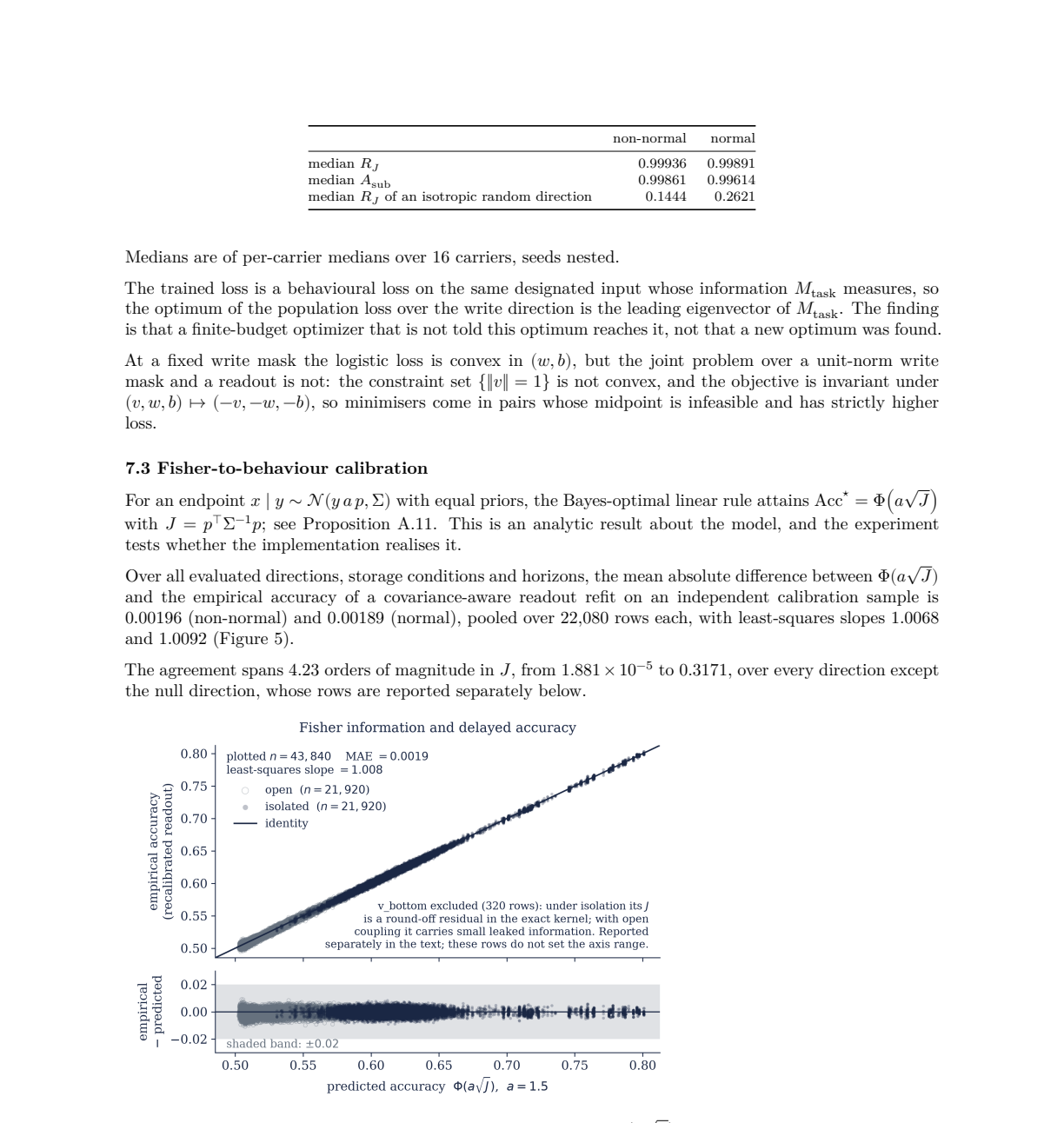
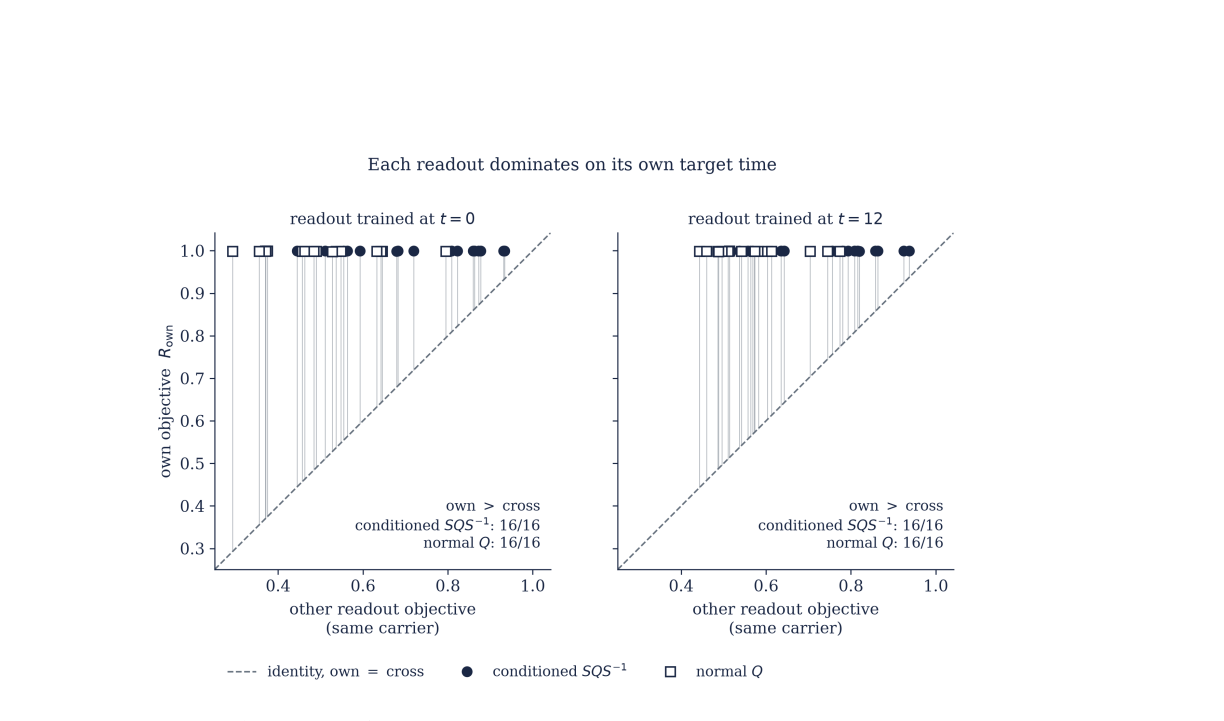
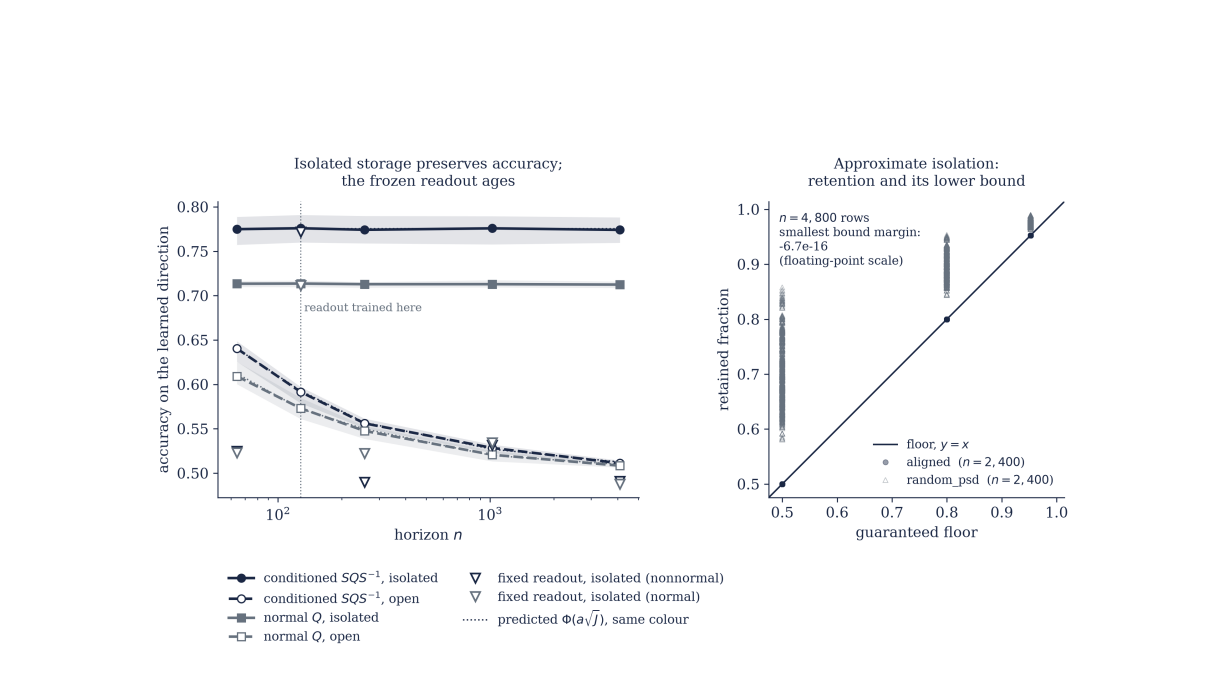
For bi-power-bounded carriers, we derive uniform 1/n lag bounds, identify the limit of Mn with the inverse of the classical Cesàro asymptotic limit of $W^\top$, and give finite-horizon error bounds. A time-varying coupling defines an end-to-end store operator. The writer-optimal direction need not be store-optimal. After writing ends, an invertible hold preserves the full stored Fisher matrix. Additive contamination bounded by α times the closure covariance retains at least 1/(1 + α) of that matrix; a covariance-aware decoder attains the corresponding accuracy. With recurrent carriers held fixed, training input masks and linear readouts approached the task-specific optimum in 160 runs, with median normalized Rayleigh efficiency above 0.998. Binary accuracy matched the Gaussian prediction to mean absolute error below 0.002 over more than four orders of magnitude in J. In a separate pre-specified study of 320 runs, trained masks followed the designated input-time objective in both carrier types, in 16 of 16 draws. These studies used development-seen carriers and are pre-specified validations, not blind holdouts. The same fixed design reproduced the objective-specific result in 16 of 16 draws on carriers unused before run commitment. Exact isolation preserved information, while a decoder fixed at its training horizon fell to chance; inverse-adjoint transport restored its sampled decisions to numerical precision.
from the abstract
Pith says
Machine review · deepseek-v4-flash · 1 Oct 2026 · what was read was not recorded · not checked by a person
It can be wrong. Challenge this review or reply to it.
Holds up. Clean, honestly scoped finite-horizon Fisher-memory math: the trace budget and normal isotropy hold everywhere, the 1/n asymptotic claims are correctly confined to the similar-to-unitary class, and the paper earns a serious referee. This line is wrong
5 minor
How often objections from reviews like this one are right: not yet measured
Not checked: figures, code, what the 49 references say.
5 minor objections
The paper says, at Section 1 and Section 9
Pith says: minor objection 1 of 5
The bi-power-bounded restriction that underwrites Theorems 3.3a/b is correctly stated in the Definition (Section 2), in the abstract, and in the two theorems, so the mathematics is properly scoped. I recommend adding one explicit sentence in the introduction (and a line in the Section 9 limitations list) stating that the uniform 1/n lag structure and the M_inf identification do not …
more of objection 1
… extend to the contracting (rho(W) < 1) or nilpotent carriers that motivate [1], [5], and [21]: for a contraction with fixed lag k, J_n(k) converges to the positive stationary FMC value, so the 1/n picture is a genuine property of the marginal similar-to-unitary class rather than of finite-horizon linear-Gaussian memory in general. This would prevent a reader of the opening narrative from overgeneralizing the abstract's 1/n claim.
The paper says, at Abstract and Classical ingredients (before Section 3.3)
Pith says: minor objection 2 of 5
The abstract's phrase 'the inverse of the classical Cesàro asymptotic limit of W^T' is precise only after the definition of A_C(T) = lim n^{-1} sum_j (T^T)^j T^j in the Classical ingredients subsection; since A_C is applied to the operator W^T, the object in question is the Cesàro limit of the sequence W^j W^{jT} (the limiting covariance C_n/n). A parenthetical in the abstract ('in the sense of the limiting covariance C_n/n') would remove a possible point of confusion.
show 3 more
The paper says, at Section 4.1 and Appendix B
Pith says: minor objection 3 of 5
The 4x4 Hamiltonian value 1.91 of 4 is flagged as an unreplicated single-instance run inside Section 4.1, but it does not appear in the Appendix B tables. For consistency with the rest of the census, either exclude this value from the main text or include it in Appendix B under the same 'not replicated' label.
The paper says, at Section 7.3
Pith says: minor objection 4 of 5
The text states that the Fisher-to-behaviour rows span 'every direction except the null direction' and then reports that the 320 v_bottom rows are excluded from the plotted population and axis range; the two exclusions (the zero-information null rows and the bottom-eigenvector rows) should be reconciled in a single sentence so that the reader does not count the excluded rows twice.
The paper says, at Section 7.5
Pith says: minor objection 5 of 5
The sentence giving the ratios 118.3/119.3 (along the horizon) and 520.4/486.9 (fixed-horizon contrast) immediately follows the statement that these are per-carrier seed-median ratios, and the parenthetical then quotes the different pooled-median estimands; the switch between the two estimands is easy to misread, and a small two-line table would make the distinction clearer.
What would settle it
Take a contracting non-normal carrier W = 0.9·SQS^{-1} with cond(S)=10, N=32, and compute n·J_n(n-1) at the eigmax(M_n) direction for n up to 4096. If n·J_n(n-1) → 0 while J_n(n-1) saturates toward a positive stationary-FMC-type value, the uniform 1/n lag-share claim is confined to the bi-power-bounded class exactly as scoped, confirming the boundary. Then, inside the class, push a bi-power-bounded carrier toward the boundary (cond(S) ≈ 10^6, eigen-angles clustered so the §3.4 Δ is small) and check whether, at n = 2048, n·J_n(n-1) still tracks v^T M_inf v within the 2% tolerance used in §4.1, or whether the certificate's rejection rule fires; this quantifies how rapidly the asymptotic regime is entered in the worst in-class cases.
from the skeptic's reading
How the review went
4 readings by deepseek-v4-flash · 1 Oct 2026
- Reader holds up
- Skeptic agrees
- Editor wrote the verdict above
- Referee minor revision: 5 minor
Not run on this paper: the simulated authors' defence.
Pith did not check this review's objections against the paper.
The review in full
The review in brief, machine-written
What you should know: the core math is right, and the scoping is unusually honest. tr Mn = N is a one-line cyclic-trace identity that holds for every W. Mn = I for normal carriers at every finite horizon needs no stability assumption and is clean. The Cesaro-commutant identification M_inf = AC(WT)−1 is a genuine specialization of Gehér's theorem, credited properly rather than laundered, and the finite-horizon certification bound with the spectral-gap separation is the most novel piece — it is checked directly against M_2048, and the near-degenerate control shows why the asymptotic formula alone is not a certificate. That is good work.
The soft spot is the one the stress test flags, and it is real. Every asymptotic claim — the uniform 1/n lag bounds, the identification of M_inf — requires bi-power-boundedness, i.e. W similar to orthogonal with bounded conditioning. That excludes exactly the regimes the paper motivates itself with: stable contractions (Ganguli–Huh–Sompolinsky, Kang et al.) and nilpotent feedforward chains. In a contraction, fixed-lag Fisher information converges to a positive stationary value; there is no 1/n decay. The paper states this restriction in the Definition and scopes the abstract accordingly, and the stress test is right that the trace budget and finite-horizon results stand for every W. My only complaint is presentational: the opening narrative, "non-normality redistributes information," invites a reader to carry the 1/n picture into the full regime. The text almost corrects for it; I would like it corrected at the top.
The training studies are where I had to look twice, and they hold up. The first block was development-seen, and the paper says so plainly. The genuinely fresh second block is the right test, but note that its freshness check failed once because it was written to trigger only on draws 0–15, so it could not fail on draws 16–31 — a real preregistration stumble, disclosed in full, with the rerun passing. I read that as honest reporting of an honest mistake, not a red flag. The §7.7 evidence taxonomy, separating analytic identities from derived theorems from implementation tests from optimization results, and noting the Holm-adjusted p-values sit at the 10,000-resample floor, is the best disclosure practice I have seen in a while. The exploratory log fit is labeled exploratory and predicted its held-out conditioning; that is fine.
Bottom line: the mathematical claims are checkable, the limits are stated rather than hidden, and the empirical endpoints are appropriately hedged. Send it to review. A good referee will spend an afternoon verifying §3 and the appendices, and the paper will survive it — the main revision is linguistic, not mathematical, around the scope of the 1/n claims.
The strongest objection
The paper's novel asymptotic content (Theorem 3.3a/b: M_n → M_inf = A_C(W^T)^{-1} and the uniform Θ(1/n) lag bound) rests entirely on bi-power-boundedness: W invertible with both {W^j} and {W^{-j}} uniformly bounded, equivalently W = SQS^{-1} with Q orthogonal. The algebra needs this in two visible places: the second fixed-point relation W^T G^{-1}W = G^{-1} (Classical ingredients, before §3.3) requires invertibility, and the λ_min bound of Appendix A.3 needs K_- finite. The restriction is real and is acknowledged in the Definition (Section 2) and in the abstract's scoping ('for bi-power-bounded carriers'). What makes it load-bearing rather than cosmetic is that the excluded regimes are exactly the standard non-normal memory cases the paper motivates itself with: stable contractions (ρ<1; the Ganguli–Huh–Sompolinsky [1] and Kang–Shirasaka–Suzuki [21] settings) and nilpotent feedforward chains with extensive capacity. In a contraction, J_n(k) for fixed k converges to the positive stationary FMC value J(k), so lag memory does not decay as 1/n; the uniform 1/n share is a genuine property of the marginal similar-to-unitary class, not of the linear-Gaussian setting. A reader of the abstract's opening narrative ('non-normality redistributes information') could overgeneralize the 1/n structure to the full regime. Nevertheless the trace budget tr M_n = N and the normal-isotropy M_n = I hold for every W including 0.9Q, and the asymptotic claims are correctly attributed to the bi-power-bounded subclass, so this narrows but does not falsify the central claims. No internal inconsistency was found in §§3–6; the derivations check out, including Proposition 3.2b, the §3.5 corollary, the store budget, and the Sherman–Morrison equality case of §6.2.
I read the paper in good faith as a finite-horizon, explicitly scoped analysis: the trace budget and normal-isotropy results are fully general, and the asymptotic machinery is correctly restricted to bi-power-bounded carriers. I re-derived the key identities (tr M_n = N; M_2 = I iff W normal; M_inf = S^{-T}Ā^{-1}S^{-1}; the contractive-regime failure of the 1/n tail) and found no internal inconsistency. The derivation of the second fixed-point relation and the λ_min tail bound both genuinely require invertibility and K_- < ∞, so the reader's weakest-assumption identification is exactly right and I agree with it. The paper acknowledges the restriction in the Definition and scopes the abstract and theorems accordingly, and it separately flags the related risks: near-degenerate eigenvalue groups delaying the Cesàro projection (b42), the certificate being sufficient but conservative (b293), and the existence-only status of the horizon-two concentration claim (b76). The one sharpening I can add is emphasizing that the uniform-1/n picture is characteristic of the marginal class and fails qualitatively (saturation, not 1/n decay) in the contracting regime that motivates most of the prior literature; since the paper both acknowledges the class restriction and never claims otherwise, this does not undermine the stated claims. The empirical endpoints (training reaching the analytic optimum, calibration to Φ(a√J), decoder aging) are consistent with the theory and properly labeled as pre-specified validations rather than blind holdouts; the disclosed seed-check failure in §7.4.1 and its rerun are handled transparently. Because the load-bearing restriction is real and correctly handled, and no unacknowledged defect surfaced, the ACCEPT verdict stands without adjustment.
The referee's report
Within the bi-power-bounded class the analytic core is sound: I checked the trace identity, the block-diagonal eigenvalue argument behind normal isotropy, the push-through horizon-two identity, the C_n spectral bounds underlying Theorem 3.3a, the fixed-point relations W G W^T = G and W^T G^{-1} W = G^{-1} (the latter needs invertibility), and the Cesàro-commutant rate estimate; all follow from the stated definitions and the cited published results of Gehér and Aloisio et al. The finite-horizon trace budget and normal isotropy hold for every W, including contractions and nilpotent chains, so the core message that non-normality redistributes rather than enlarges the spherical average is general. The uniform 1/n structure is correctly scoped to the similar-to-unitary class and the restriction is stated in the Definition (Section 2), in the abstract, and in the theorem statements; the residual risk is narrative overgeneralization, which one explicit sentence in Section 1 and Section 9 would remove (see minor comments).
Pith's reading of the paper (a machine's summary, not the authors')
At every finite horizon, the directional Fisher memory \(M_n\) of a noisy linear recurrent carrier has trace exactly \(N\): the information carried about past inputs is a fixed budget that non-normal dynamics can concentrate in chosen write directions but cannot enlarge on average. For a normal carrier the budget is perfectly isotropic, \(M_n=I\), so no direction beats the average. For carriers whose powers and inverse powers are both uniformly bounded, the paper identifies the long-horizon limit \(M_\infty\) with the inverse of the Cesàro asymptotic limit of \(W^\top\), and shows that every lag eventually receives about \(1/n\) of the directional total. The same geometry is carried through a downstream store and post-write channel: an invertible hold preserves the stored Fisher matrix exactly, bounded additive contamination retains at least \(1/(1+\$\alpha$)\) of it, and a decoder pinned to its training coordinates can lose access even though the information is unchanged. Why this matters is that design can be split by stage: allocate by the writer's fixed budget, admit by the store operator's leading direction, and preserve by controlling the post-write channel.
What carries the argument. The load-bearing object is the finite-horizon directional Fisher memory matrix \(M_n=\sum_{k<n}(W^\top)^k $C_n^{{-1}}$W^k\), whose Rayleigh quotient \(v^\top M_n v\) is the total Fisher memory of a unit write direction \(v\); the trace identity \(\operatorname{tr}M_n=N\) follows because \(C_n=\sum_{j<n}W^j(W^j)^\top\) is a Gram matrix and \(H^\top $C_n^{{-1}}$H\) is an orthogonal projector whose diagonal blocks sum to \(M_n\). The asymptotic machinery is the bi-power-bounded similarity \(W=$SQS^{{-1}}$\) with \(Q\) orthogonal: Cesàro averaging of the conjugation \(A\mapsto Q^j A $Q^{{-j}}$\) converges to the commutant projection \(\bar A=\Pi_{\mathrm{Comm}(Q)}A\), and that projection controls both the limiting operator \(M_\infty=$S^{{-\top}}$\bar $A^{{-1}}$$S^{{-1}}$\) and the finite-horizon error through the spectral-group gap. The store and retention chain is carried by the operator \(M_{\rm store}=\sum_t L_t^\top C_{ss}^{-1}L_t\) and by the congruence \(P_h^\top\$Sigma_h^{{-1}}$P_h=P_0^\top\$Sigma_0^{{-1}}$P_0\) under an invertible hold.
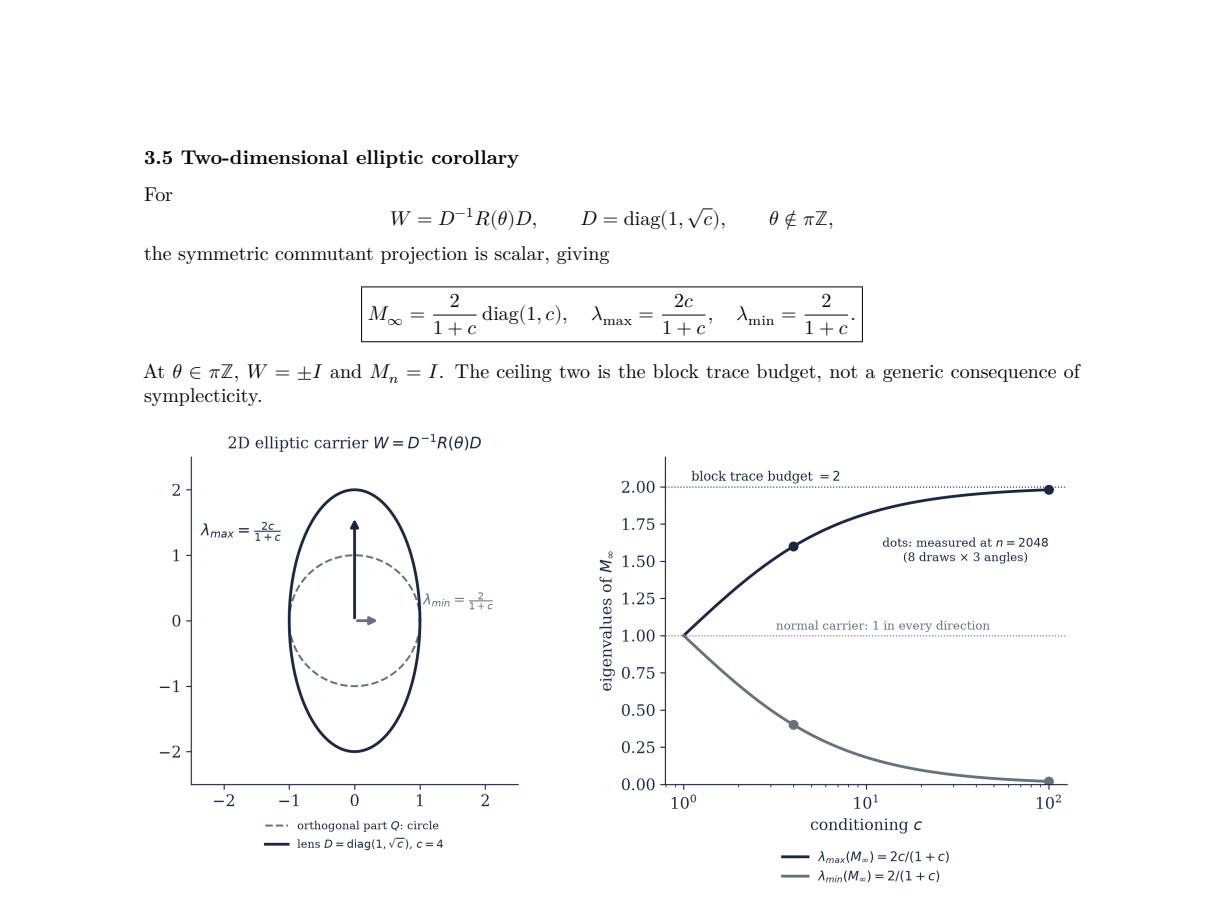
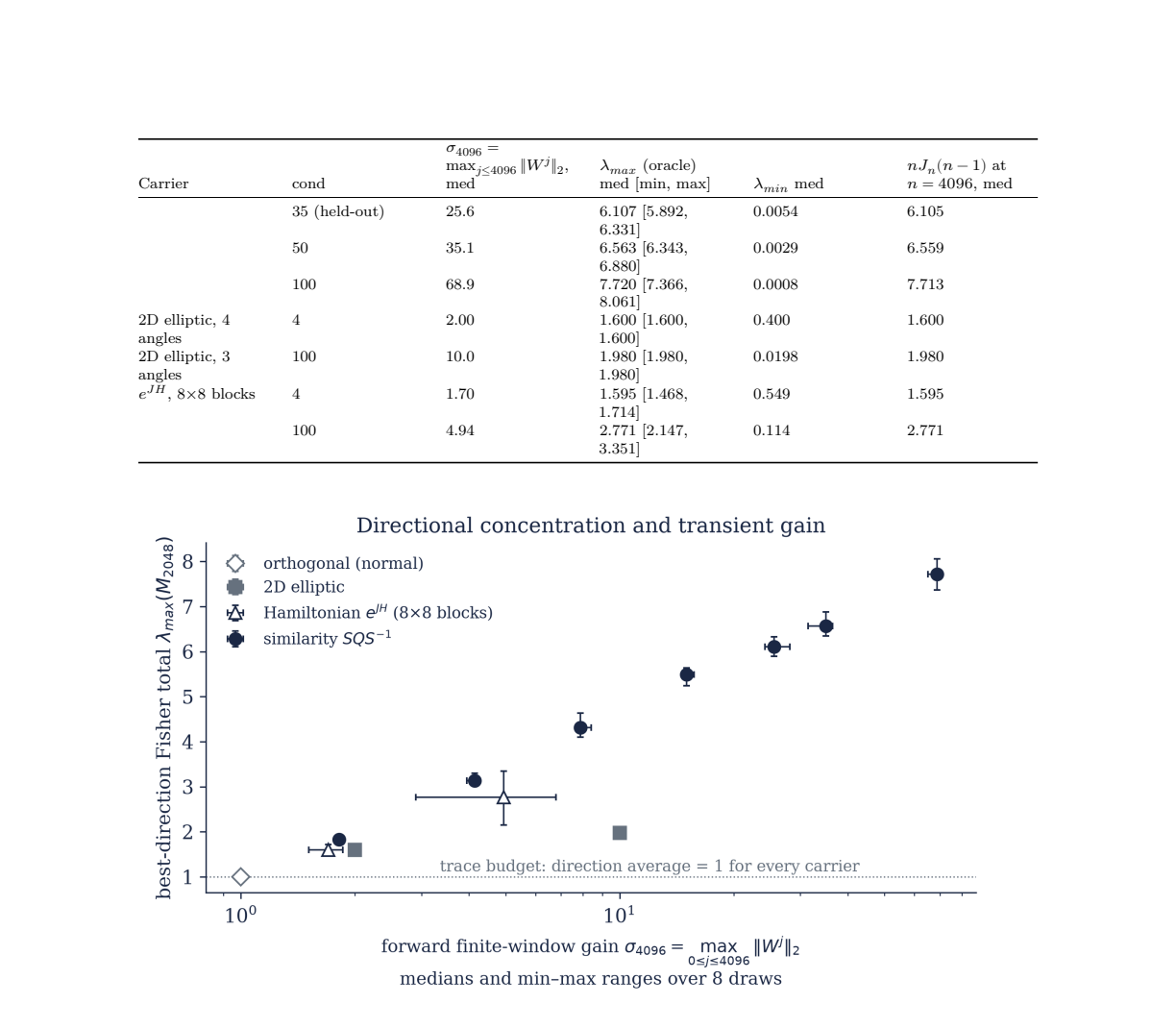
Core claim. The central claim is that finite-horizon Fisher memory in linear-Gaussian recurrent systems obeys a fixed trace budget, and that all the interesting non-normal structure is redistribution, not creation. Defining \(C_n=\sum_{j<n}W^j(W^j)^\top\) and \(M_n=\sum_{k<n}(W^\top)^k $C_n^{{-1}}$W^k\), the paper proves \(\operatorname{tr}M_n=N\) for every horizon and every carrier, and \(M_n=I\) whenever \(W\) is normal, with no stability assumption needed. For bi-power-bounded \(W=$SQS^{{-1}}$\), \(Q\) orthogonal, it proves uniform \(1/n\) lag bounds and \(M_n\to M_\infty = \mathcal{A}_C(W^\top)^{-1}=$S^{{-\top}}$\bar $A^{{-1}}$$S^{{-1}}$\), where \(\bar A\) is the commutant projection of the Cesàro limit; consequently \(nJ_n(k;v)\to v^\top M_\infty v\) uniformly over lags and directions. Downstream, the end-to-end store operator \(M_{\rm store}=\sum_t L_t^\top C_{ss}^{-1}L_t\) has trace at most \(d\), and its leading eigenvector, not the writer's, is the right selection target for a finite store. After writing ends, an invertible hold leaves the stored Fisher matrix \(P^\top\$Sigma^{{-1}}$P\) invariant, and additive contamination bounded by \(\$\alpha$\) times the closure covariance guarantees retention at least \(1/(1+\$\alpha$)\); behavioural training of masks and readouts approached the analytic leading direction, and a decoder carried by the inverse-adjoint map recovered its training-horizon decisions to numerical precision.
The premise it rests on. The load-bearing premise is that the carrier \(W\) is bi-power-bounded, meaning invertible with both its forward powers and inverse powers uniformly bounded and hence similar to an orthogonal matrix, because the identification of \(M_\infty\) and the uniform \(1/n\) tail bounds hold only inside that class.
If the paper is right (Pith's inferences, not the authors')
In any finite-horizon linear-Gaussian carrier the total directional Fisher memory is \(N\), so non-normal dynamics can concentrate the budget but cannot increase its spherical average.
A normal carrier has exactly isotropic Fisher memory, \(M_n=I\), while every non-normal carrier has at least one direction above the average and one below it already at horizon two.
For bi-power-bounded carriers each lag carries about \(1/n\) of the directional total at long horizons, so oldest-lag information decays like \(1/n\) with a direction-dependent coefficient \(v^\top M_\infty v\).
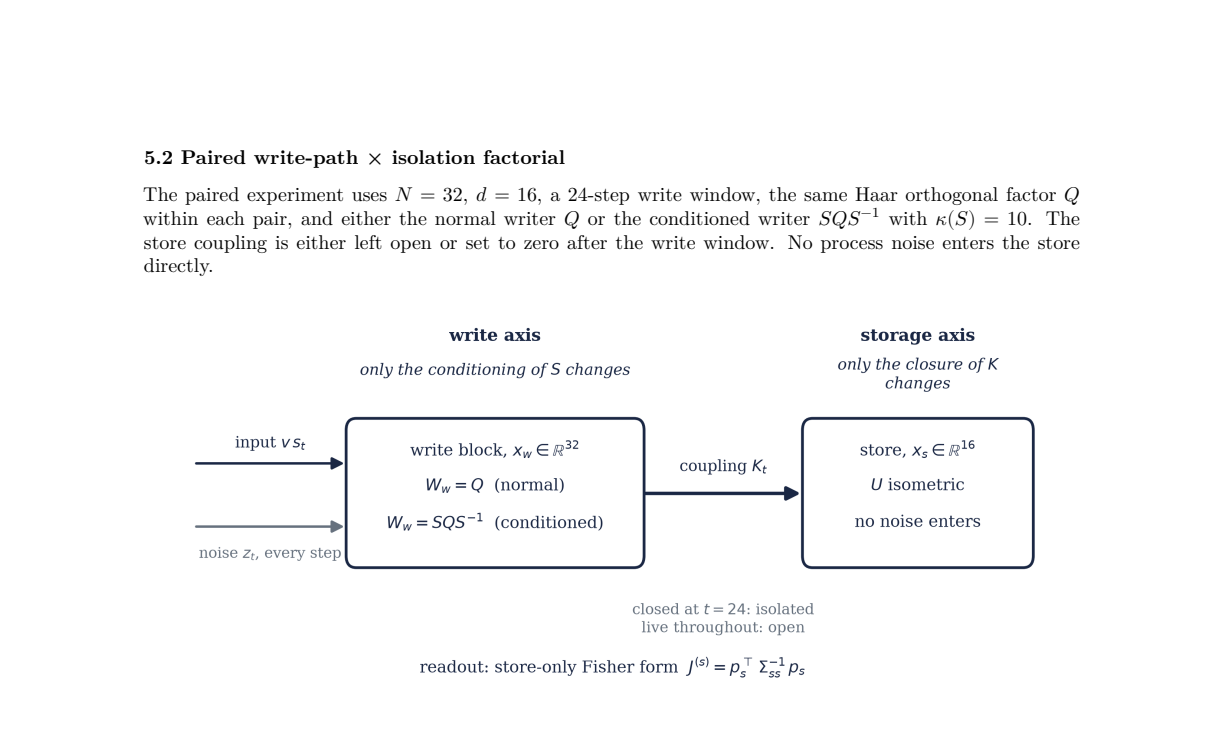
The end-to-end store operator has trace at most the store dimension, and its leading direction can differ from the writer's; write directions should be chosen against the store objective.
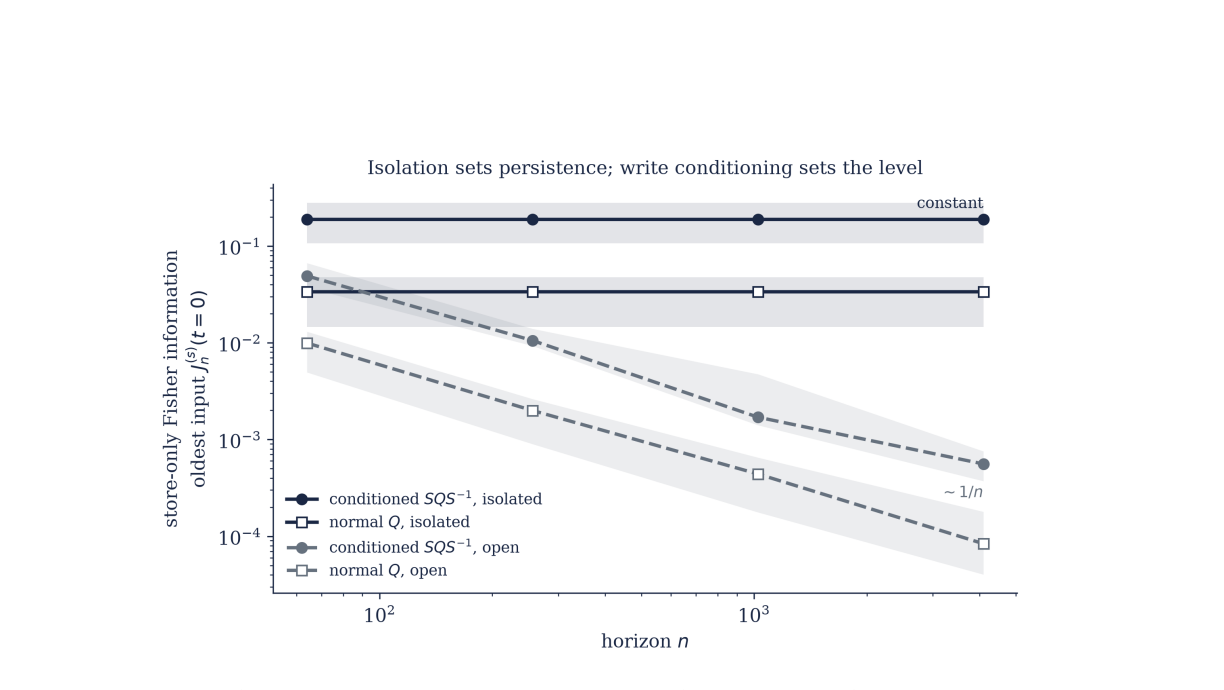
After writing ends, an invertible hold preserves the full stored Fisher matrix, contamination bounded by \(\alpha\) times the closure covariance keeps at least \(1/(1+\alpha)\), and a decoder that ignores the coordinate change can fail despite unchanged information.
The paper leaves open how the fixed-trace theorem interacts with the known extensive-capacity constructions for stable contractions and nilpotent feedforward chains, since those carriers fall outside bi-power-boundedness; a direct finite-horizon treatment of that interaction is a natural next step.
If the \(M_\infty\) certificate is accepted, the spectral-group gap times horizon \(n\Delta\) could be used as a pre-training acceptability check before committing to an operating horizon, turning the paper's sufficient bound into a cheap design rule.
The inverse-adjoint decoder transport is exact only when the post-write map is known; a testable extension is to estimate the map from paired endpoints and transport a learned decoder, or to train a decoder that is equivariant under the hold.
Check this review
Pith stored no record of this review's passes and took no fingerprint of it. Reviews made by code from 13 Nov 2026 on carry both.
How often reviews like this one are right
Reviews like this one: written by deepseek-v4-flash, where what was read was not recorded.
How often objections from reviews like this one are right: not yet measured
Reviews by people
This review was written by a machine. No person has reviewed this paper on Pith yet. A scientist listed on Pith can review it for a fee, and their review is published here whatever it concludes.
The paper
Abstract
We analyse allocation, admission and post-write retention in finite-horizon linear-Gaussian noisy recurrent memories. At every horizon, the directional Fisher memory Mn satisfies trMn = N: non-normality redistributes information but cannot raise its spherical average, while normal carriers satisfy Mn = I. For bi-power-bounded carriers, we derive uniform 1/n lag bounds, identify the limit of Mn with the inverse of the classical Cesàro asymptotic limit of $W^\top$, and give finite-horizon error bounds. A time-varying coupling defines an end-to-end store operator. The writer-optimal direction need not be store-optimal. After writing ends, an invertible hold preserves the full stored Fisher matrix. Additive contamination bounded by α times the closure covariance retains at least 1/(1 + α) of that matrix; a covariance-aware decoder attains the corresponding accuracy. With recurrent carriers held fixed, training input masks and linear readouts approached the task-specific optimum in 160 runs, with median normalized Rayleigh efficiency above 0.998. Binary accuracy matched the Gaussian prediction to mean absolute error below 0.002 over more than four orders of magnitude in J. In a separate pre-specified study of 320 runs, trained masks followed the designated input-time objective in both carrier types, in 16 of 16 draws. These studies used development-seen carriers and are pre-specified validations, not blind holdouts. The same fixed design reproduced the objective-specific result in 16 of 16 draws on carriers unused before run commitment. Exact isolation preserved information, while a decoder fixed at its training horizon fell to chance; inverse-adjoint transport restored its sampled decisions to numerical precision.
The paper's own sentences, arranged, kept beside the review and separate from it. Each label is drawn from a closed vocabulary; the number beside it is the probability the classifier gave that label. No sentence in this record was written by a model.
abstract compiled · 2026-10-01
The authors' main claim, as the classifier picked it out 0.59
“At every horizon, the directional Fisher memory $M_n$ satisfies $\operatorname{tr}M_n=N$: non-normality redistributes information but cannot raise its spherical average, while normal carriers satisfy $M_n=I$.”
How the main claim is stated: asserted 1.00
What the abstract itself states, as probabilities: claims first 0.03 · states limitation 0.92 · human participants 0.02 · controlled comparison 0.69 · randomized assignment 0.05 · states quantitative result 0.98 · compares with prior results 0.46 · mentions code or data availability 0.02
The abstract, sentence by sentence
This table labels the abstract only (arXiv listing abstract v1). The number is the probability the classifier gave the label.
| Sentence | Role | The authors' own work | States the main conclusion | Strength |
|---|---|---|---|---|
| We analyse allocation, admission and post-write retention in finite-horizon linear-Gaussian noisy recurrent memories. | contribution 0.96 | 0.90 | 0.06 | asserted 0.84 |
| At every horizon, the directional Fisher memory $M_n$ satisfies $\operatorname{tr}M_n=N$: non-normality redistributes information but cannot raise its spherical average, while normal carriers satisfy $M_n=I$. | result 0.99 | 0.83 | 0.38 | asserted 1.00 |
| For bi-power-bounded carriers, we derive uniform $1/n$ lag bounds, identify the limit of $M_n$ with the inverse of the classical Ces\`aro asymptotic limit of $W^\top$, and give finite-horizon error bounds. | result 0.68 | 0.93 | 0.23 | asserted 1.00 |
| A time-varying coupling defines an end-to-end store operator. | method 0.80 | 0.71 | 0.04 | asserted 0.99 |
| The writer-optimal direction need not be store-optimal. | result 0.91 | 0.75 | 0.14 | asserted 0.78 |
| After writing ends, an invertible hold preserves the full stored Fisher matrix. | result 0.84 | 0.79 | 0.09 | asserted 1.00 |
| Additive contamination bounded by $\alpha$ times the closure covariance retains at least $1/(1+\alpha)$ of that matrix; a covariance-aware decoder attains the corresponding accuracy. | result 0.98 | 0.82 | 0.11 | asserted 1.00 |
| With recurrent carriers held fixed, training input masks and linear readouts approached the task-specific optimum in 160 runs, with median normalized Rayleigh efficiency above $0.998$. | result 0.98 | 0.93 | 0.10 | asserted 1.00 |
| Binary accuracy matched the Gaussian prediction to mean absolute error below $0.002$ over more than four orders of magnitude in $J$. | result 1.00 | 0.90 | 0.08 | asserted 1.00 |
| In a separate pre-specified study of 320 runs, trained masks followed the designated input-time objective in both carrier types, in 16 of 16 draws. | result 0.91 | 0.92 | 0.08 | asserted 1.00 |
| These studies used development-seen carriers and are pre-specified validations, not blind holdouts. | limitation 0.99 | 0.82 | 0.04 | asserted 1.00 |
| The same fixed design reproduced the objective-specific result in 16 of 16 draws on carriers unused before run commitment. | result 0.98 | 0.92 | 0.11 | asserted 1.00 |
| Exact isolation preserved information, while a decoder fixed at its training horizon fell to chance; inverse-adjoint transport restored its sampled decisions to numerical precision. | result 0.99 | 0.89 | 0.15 | asserted 1.00 |
What kind of paper the classifier reports this is: theoretical result 1.00 · evidence from proof or derivation 0.84
What was examined, and what was not
Sources read
- arXiv listing abstract v1
Not examined
- full text
- figures and tables
- references and citing sentences
- relations to other papers
Levels run
- P abstract
Not run
- S sections
- T body sentences
- C citations
- R cross-paper relations
How the labels were made
Compiled by classifier-1.13.0 via TypeSafe API, question bank abstract-p1-20260923, 2026-10-01: 1 request, 9,573 input tokens.
Every quoted sentence on this record is the authors'. Every label is from Pith's closed vocabulary, with the probability shown beside it. This record as JSON
Figures (7)
Figures are the authors', reproduced from the paper.
References (49)
- [1] S. Ganguli, D. Huh, H. Sompolinsky. Memory traces in dynamical systems. Proc. Natl. Acad. Sci. USA 105(48):18970–18975 (2008). doi:10.1073/pnas.0804451105 on Pithdoi:10.1073/pnas.0804451105
- [2] G. Hennequin, T. P. Vogels, W. Gerstner. Non-normal amplification in random balanced neuronal networks. Phys. Rev. E 86:011909 (2012). arXiv:1204.2945 on PithPith's reviewarXiv
- [3] A. E. Orhan, X. Pitkow. Improved memory in recurrent neural networks with sequential non-normal dynamics. ICLR 2020 . arXiv:1905.13715 on PithPith's reviewarXiv
- [4] M. Asllani, R. Lambiotte, T. Carletti. Structure and dynamical behavior of non-normal networks. Sci. Adv. 4(12):eaau9403 (2018) on Pith
- [5] G. Kerg, K. Goyette, M. Puelma Touzel, G. Gidel, E. Vorontsov, Y. Bengio, G. Lajoie. Non-normal recurrent neural network (nnRNN): learning long time dependencies while improving expressivity with transient dynamics. NeurIPS 32 (2019). arXiv:1905.12080. 24 on PithPith's reviewarXiv
- [6] M. S. Goldman. Memory without feedback in a neural network. Neuron 61(4):621–634 (2009) on Pith
- [7] M. MacKay, P. Vicol, J. Ba, R. Grosse. Reversible recurrent neural networks. NeurIPS 31 (2018). arXiv:1810.10999 on PithPith's reviewarXiv
- [8] Z. Li, J. Han, W. E, Q. Li. On the curse of memory in recurrent neural networks: approximation and optimization analysis. ICLR 2021 . arXiv:2009.07799 on PithPith's reviewarXiv
- [9] T. K. Rusch, S. Mishra. UnICORNN: a recurrent model for learning very long time dependencies. ICML 2021 . arXiv:2103.05487 on PithPith's reviewarXiv
- [10] T. Haruna, K. Nakajima. Memory uncertainty relation and harmonic memory in random recurrent networks. arXiv:2605.24628 (2026) on PithPith's reviewarXiv
- [11] Supplementary Material S1. Finite-horizon Fisher-memory scripts, result tables, run records and the public reproduction entry point released with this paper: https://github.com/jeonghoon-ad/finite- horizon-fisher-memory (release v1.0) on Pith
- [12] P. Tiňo. Fisher memory of linear Wigner echo state networks. ESANN 2017 , pp. 87–92, i6doc.com, ISBN 978-287587039-1 on Pith
- [13] O. L. White, D. D. Lee, H. Sompolinsky. Short-term memory in orthogonal neural networks. Phys. Rev. Lett. 92(14):148102 (2004). arXiv:cond-mat/0402452 on PithPith's reviewarXiv
- [14] T. Toyoizumi, L. F. Abbott. Beyond the edge of chaos: amplification and temporal integration by recurrent networks in the chaotic regime. Phys. Rev. E 84:051908 (2011) on Pith
- [15] H. Jaeger. Short term memory in echo state networks. GMD Report 152, GMD – Forschungszentrum Informationstechnik, Sankt Augustin (2002) on Pith
- [16] M. Hermans, B. Schrauwen. Memory in linear recurrent neural networks in continuous time. Neural Networks 23(3):341–355 (2010). doi:10.1016/j.neunet.2009.08.008 on Pithdoi:10.1016/j.neunet.2009.08.008
- [17] H. Jaeger. The “echo state” approach to analysing and training recurrent neural networks, with an erratum note. GMD Report 148, German National Research Center for Information Technology (2001; corrected 2010) on Pith
- [18] J. Guan, T. Kubota, Y. Kuniyoshi, K. Nakajima. How noise affects memory in linear recurrent networks. Phys. Rev. Research 7:023049 (2025). arXiv:2409.03187 on PitharXiv
- [19] J. Dambre, D. Verstraeten, B. Schrauwen, S. Massar. Information processing capacity of dynamical systems. Sci. Rep. 2:514 (2012). doi:10.1038/srep00514 on Pithdoi:10.1038/srep00514
- [20] F. Wang, P. Benner, J. Heiland. Partial observation of linear systems with the Mori-Zwanzig formalism. arXiv:2606.23341 (2026) on PithPith's reviewarXiv
show 29 more
- [21] Z. Kang, S. Shirasaka, H. Suzuki. Optimizing input mask for maximum memory performance of time-delay reservoir subjected to state noise. Nonlinear Theory and Its Applications, IEICE 12(4):662 ff. (2021). doi:10.1587/nolta.12.662 on Pithdoi:10.1587/nolta.12.662
- [22] J. Ba, G. Hinton, V. Mnih, J. Z. Leibo, C. Ionescu. Using fast weights to attend to the recent past. NeurIPS 29 (2016). arXiv:1610.06258 on PithPith's reviewarXiv
- [23] M. Beck, K. Pöppel, M. Spanring, A. Auer, O. Prudnikova, M. Kopp, G. Klambauer, J. Brandstetter, S. Hochreiter. xLSTM: Extended long short-term memory. NeurIPS 37 (2024). arXiv:2405.04517 on PithPith's reviewarXiv
- [24] M. Dowling, H. Jeon, C. Savin, I. M. Park. Memory by design: probabilistic sequence layers. arXiv:2605.31163 (2026) on PithPith's reviewarXiv
- [25] P. Becker, H. Pandya, G. Gebhardt, C. Zhao, J. Taylor, G. Neumann. Recurrent Kalman networks: factorized inference in high-dimensional deep feature spaces. ICML 2019 . arXiv:1905.07357 on PithPith's reviewarXiv
- [26] J. Beuria, A. Shukla. Lindblad-inspired multi-timescale reservoir computing with separable rotation and dissipation. arXiv:2608.04028 (2026). 25 on PithPith's reviewarXiv
- [27] A. Behrouz, P. Zhong, V. Mirrokni. Titans: learning to memorize at test time. arXiv:2501.00663 (2025) on PithPith's reviewarXiv
- [28] Y. Shi, C. R. Rojas. Universal estimation of the Fisher information for processes with memory. arXiv:2609.14582 (2026) on PithPith's reviewarXiv
- [29] B. Boyacıoğlu, F. van Breugel. Fisher information and stochastic observability for state estimation in linear systems. arXiv:2410.19975 (2024) on PithPith's reviewarXiv
- [30] G. P. Gehér. Characterisation of Cesàro and L-asymptotic limits of matrices. Linear and Multilinear Algebra 63(4):788–805 (2015). arXiv:1407.1275. doi:10.1080/03081087.2014.899359 on PithPith's reviewarXiv
- [31] G. P. Gehér. Asymptotic behaviour of Hilbert space operators with applications. Dissertation, arXiv:1505.07205 (2015). Chapter 3 restates the results of [30] on PithPith's reviewarXiv
- [32] G. Baggio, V. Rutten, G. Hennequin and S. Zampieri. Efficient communication over complex dynamical networks: The role of matrix non-normality. Science Advances 6:eaba2282 (2020). doi:10.1126/sciadv.aba2282 on Pithdoi:10.1126/sciadv.aba2282
- [33] D. C. Hoaglin and R. E. Welsch. The hat matrix in regression and ANOV A. The American Statisti- cian 32(1):17–22 (1978). doi:10.1080/00031305.1978.10479237. Author working-paper version (1977): https://hdl.handle.net/1721.1/1920 on PithPith's reviewdoi:10.1080/00031305.1978.10479237
- [34] A. G. Kachurovskii. The rate of convergence in ergodic theorems. Russian Mathematical Surveys 51(4):653–703 (1996) on Pith
- [35] M. Aloisio, S. L. de Carvalho, C. R. de Oliveira and E. Souza. On spectral measures and convergence rates in von Neumann’s Ergodic Theorem. arXiv:2209.05290 (2022; version 2, 2023) on PithPith's reviewarXiv
- [36] A. J. Short and T. C. Farrelly. Quantum equilibration in finite time. New Journal of Physics 14:013063 (2012). doi:10.1088/1367-2630/14/1/013063 on Pithdoi:10.1088/1367-2630/14/1/013063
- [37] J. P. Stroud, K. Watanabe, T. Suzuki, M. G. Stokes and M. Lengyel. Optimal information loading into working memory explains dynamic coding in the prefrontal cortex. PNAS 120(48):e2307991120 (2023). doi:10.1073/pnas.2307991120 on Pithdoi:10.1073/pnas.2307991120
- [38] J. Zylberberg, A. Pouget, P. E. Latham and E. Shea-Brown. Robust information prop- agation through noisy neural circuits. PLOS Computational Biology 13(4):e1005497 (2017). doi:10.1371/journal.pcbi.1005497 on Pithdoi:10.1371/journal.pcbi.1005497
- [39] X. Luo and I. Hoteit. Covariance inflation in the ensemble Kalman filter: a residual nudging perspective and some implications. arXiv:1305.4496 (2013) on PithPith's reviewarXiv
- [40] R. Moreno-Bote, J. Beck, I. Kanitscheider, X. Pitkow, P. Latham and A. Pouget. Information-limiting correlations. Nature Neuroscience 17:1410–1417 (2014). doi:10.1038/nn.3807 on Pithdoi:10.1038/nn.3807
- [41] Y. Burak and I. R. Fiete. Fundamental limits on persistent activity in networks of noisy neurons. PNAS 109(43):17645–17650 (2012). doi:10.1073/pnas.1117386109 on Pithdoi:10.1073/pnas.1117386109
- [42] L. Cui, K. Nakajima and K. Aihara. Optimal Memory Encoding Through Fluctuation–Response Structure. arXiv:2603.21666 (2026) on PitharXiv
- [43] J.-R. King and S. Dehaene. Characterizing the dynamics of mental representations: the temporal gen- eralization method. Trends in Cognitive Sciences 18(4):203–210 (2014). doi:10.1016/j.tics.2014.01.002 on Pithdoi:10.1016/j.tics.2014.01.002
- [44] J. D. Murray et al. Stable population coding for working memory coexists with heterogeneous neural dynamics in prefrontal cortex. PNAS 114(2):394–399 (2017). doi:10.1073/pnas.1619449114 on Pithdoi:10.1073/pnas.1619449114
- [45] K. Aitken, M. Garrett, S. Olsen and S. Mihalas. The geometry of representational drift in natural and artificial neural networks. PLOS Computational Biology 18(11):e1010716 (2022). doi:10.1371/journal.pcbi.1010716. 26 on Pithdoi:10.1371/journal.pcbi.1010716
- [46] A. D. Degenhart et al. Stabilization of a brain-computer interface via the alignment of low-dimensional spaces of neural activity. Nature Biomedical Engineering 4:672–685 (2020). doi:10.1038/s41551-020- 0542-9 on Pithdoi:10.1038/s41551-020-
- [47] V. Joshi et al. Accurate deep neural network inference using computational phase-change memory. Nature Communications 11:2473 (2020). doi:10.1038/s41467-020-16108-9 on Pithdoi:10.1038/s41467-020-16108-9
- [48] Q. Bai, Z. Li and J. Kou. Fisher-information retention under local driving in non-Hermitian feed- forward chains. arXiv:2609.04996 (2026) on PithPith's reviewarXiv
- [49] C. Wang and X. Qiu. Fisher-Orthogonal Memory in Quantum Reservoir Computing. arXiv:2607.29219 (2026; version 2). Appendix A. Proofs A.1 T race budget Because 𝐶𝑛 = ∑ 𝑗<𝑛 𝑊 𝑗(𝑊 𝑗)⊤ ⪰ 𝐼 , tr 𝑀𝑛 = ∑ 𝑘<𝑛 tr(𝐶 −1 𝑛 𝑊 𝑘(𝑊 𝑘)⊤) = tr(𝐶 −1 𝑛 𝐶𝑛) = 𝑁 . A.2 Normal isotropy For normal 𝑊 = ... on PithPith's reviewarXiv
Challenges and discussion
Disagree with the review, or know something it missed? Leave a comment, or challenge this review formally: a challenge becomes a permanent entry in this paper's record, and its decision is published here.
Come back by email
A short list of the week's newly reviewed papers. Nothing is sent until you confirm from your inbox, and every email has a link that stops it. No account.
No comments yet.
Sign in to comment