Information Theory · arXiv:2609.14582 v1 · submitted 13 Sep 2026 · 45 references
Universal Estimation of the Fisher Information for Processes with Memory
The paper says
“The Fisher information matrix (FIM) determines the accuracy attainable in an estimation problem.”
more of the abstract
For a parametric process with memory, it has a closed form only for narrow classes of models, and it cannot be computed when the model is available only as a simulator. This paper estimates the Fisher information rate of such a process, the per-observation limit of its FIM, from simulator output alone and without knowledge of the memory length. The construction uses the identity between the FIM and the local curvature of the Kullback–Leibler (KL) divergence. Directional divergence rates are estimated by context-tree weighting (CTW), and the matrix is recovered from them by least squares. We establish strong consistency in an iterated limit and a finite-sample bound, uniform over every working depth at least as large as the true memory length, which gives a mean error of order n−1/3. The analysis also delivers a finite-sample rate for CTW-based estimation of the KL divergence rate. Experiments confirm the predicted exponents, show that the accuracy does not degrade as the working depth grows, and use the estimate to plan a sampling budget that attains a prescribed precision. The estimator stays accurate on a hidden-state source that has no finite memory length.
from the abstract
Pith says
Machine review · deepseek-v4-flash · 15 Sep 2026 · what was read was not recorded · not checked by a person
It can be wrong. Challenge this review or reply to it.
Holds up. Solid paper that delivers a genuine new estimator with rigorous guarantees; the rate result is honest and the experiments back it up. This line is wrong
6 minor
How often objections from reviews like this one are right: not yet measured
Not checked: figures, code, what the 45 references say.
6 minor objections
The paper says, at Abstract and Section V.C
Pith says: minor objection 1 of 6
The phrase 'uniform over every working depth' could be misinterpreted as meaning the error bound's constants are independent of L. The analysis in Appendix E shows that constants can depend on L (and on |A|, δ, etc.). The claim 'uniform over every working depth at least as large as the true memory length' is correct in the sense that for each fixed L ≥ L⋆ the rate holds, but the bound may degrade with L.
more of objection 1
The authors should clarify this in the abstract and the main text, e.g., by saying 'for every fixed working depth L ≥ L⋆' or 'uniformly in L in the sense that the error does not deteriorate as L grows beyond L⋆, although constants may depend on L.'
The paper says, at Section III-A, Lemma III.1
Pith says: minor objection 2 of 6
The constant C_3 is said to depend only on the local model family. In the proof (Appendix C), it equals M_T/6, where M_T depends on the neighborhood. It would be helpful to remark that this constant can be made explicit via the bounds in Assumption II.3.
show 4 more
The paper says, at Section IV-B, before Theorem IV.4
Pith says: minor objection 3 of 6
The authors state 'the finite-sample bound, uniform over every working depth at least as large as the true memory length'. Again, the constants in the bound involve L, so the uniformity is not in the sense of L-independent constants. Please rephrase.
The paper says, at Appendix D, proof of Lemma IV.1
Pith says: minor objection 4 of 6
The reference to [24, Thm. 2] should note that the theorem requires the source to have transition probabilities strictly less than 1, which is ensured by Assumption II.3(i). The authors might want to make that connection explicit.
The paper says, at Notation and typos
Pith says: minor objection 5 of 6
In the abstract, 'ordern −1/3' should be 'order n^{-1/3}'. Similarly in the text around Theorem IV.4. Also, in Notation (page 2), 'a n≍b n' should be 'a_n ≍ b_n'. These are minor formatting issues.
The paper says, at Figure 1 caption
Pith says: minor objection 6 of 6
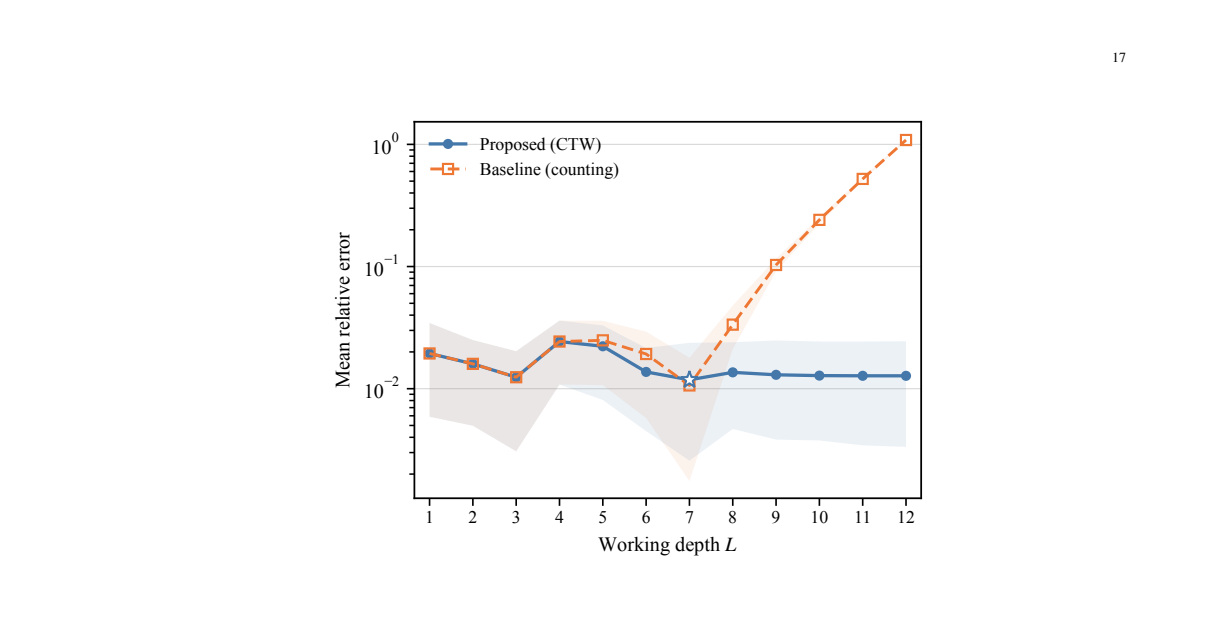
The shaded bands are 'one sample standard deviation'. Clarify that it is across repetitions, not across the parameter.
What would settle it
Extract from Lemmas E.1, E.3, E.4, E.6 and Theorem IV.4 the full dependence of all constants on the working depth L. If any constant demonstrably grows with L, such as through the δ^L mixing coefficient or |A|^L context sums, then the 'uniform over L' phrasing in the abstract and Section V.C is not supported by the proof and should be edited to 'for each fixed L ≥ L⋆', while Theorem IV.4(b) remains valid.
from the skeptic's reading
How the review went
4 readings by deepseek-v4-flash · 15 Sep 2026
- Reader holds up
- Skeptic partly agrees
- Editor wrote the verdict above
- Referee minor revision: 6 minor
Not run on this paper: the simulated authors' defence.
Pith did not check this review's objections against the paper.
The review in full
The review in brief, machine-written
This is a well-executed paper that deserves a serious referee. It builds a Fisher information estimator for processes with memory that works from simulator output alone — no likelihood, no score. The construction (CTW for directional KL divergences, least-squares recovery) is not a trivial combination of existing pieces. The analysis is the main contribution: strong consistency in an iterated limit, plus a finite-sample bound that gives a mean Frobenius error O(n−1/3) when the step size is set right. The experiments verify the predicted exponents and show that accuracy does not degrade when the working depth is chosen generously. The authors state their assumptions clearly and honestly delineate the scope (finite alphabet, finite memory). The stress-test note is correct: the universal-rate claim in the abstract should be read as 'for every fixed L >= L⋆', not as L-independent constants, but that is a wording issue, not a flaw in the math. The main soft spot is that the finite-sample rate requires the structural Assumptions IV.1–IV.3 (fixed tree topology, uniform occupancy, positive separation gap). These are strong and not verifiable from simulator access alone, but they are explicitly stated and the consistency theorem does not need them. The O(n−1/3) rate is honest — modest, but what the analysis delivers, and the empirical optima match the predicted exponent. For a reader in simulation-based inference or system identification, this is a practical tool with real guarantees. I would accept peer review. The paper needs a clarifying sentence about the 'uniform over L' bound, and perhaps a discussion of how to check or relax the structural assumptions in practice. Otherwise it is ready for review.
The strongest objection
No load-bearing flaw found in Theorem IV.4(b). The claimed rate follows from the stated machinery: Proposition IV.3 gives a KL estimation error O(ε/√n + log n/n), the central-difference measurement divides by ε², and Lemma C.1 supplies O(ε²) bias, so balancing the two dominant terms at ε ≍ n^{-1/6} yields O(n^{-1/3}). The oracle, self-redundancy, and frozen cross-predictor terms are separated cleanly in (83), and the crucial ε-factor in the cross term is obtained from the normalization identity (82), so the error genuinely shrinks with the perturbation. The structural assumptions IV.1–IV.3 are strong and not verifiable from simulator access alone, but they are explicitly stated and are not needed for the consistency theorem. The one caveat I would flag is wording rather than mathematics: Appendix E states that constants may depend on L, so the abstract and Section V.C claim that the finite-sample bound is 'uniform over every working depth' should be read as 'for every fixed L ≥ L⋆', not as a bound with L-independent constants. This does not change Theorem IV.4(b) for a fixed L.
I focused on the reader's strongest claim, Theorem IV.4(b). The proof's anatomy is sound: the KL error is decomposed into an oracle term whose fluctuation scales like ε/√n, a CTW redundancy term of order log n/n, and a frozen cross-predictor term whose first-order contribution cancels by normalization, leaving O(ε/√n + log n/n). After division by ε², the three terms in Theorem IV.4 balance exactly at ε ≍ n^{-1/6}, giving O(n^{-1/3}). The assumptions IV.1–IV.3 are restrictive, especially the fixed local topology assumption, but the paper is explicit that they are needed only for the finite-sample rate, not for consistency. I did not find an internal inconsistency or a missing step that would invalidate the central rate. The main qualification is that Appendix E's constants depend on L, so the 'uniform over working depth' language overstates what the theorem proves unless read pointwise; this is a presentation issue, not a mathematical flaw. The reader's weakest-assumption identification is broadly aligned, but my caveat concerns uniformity in L rather than the structural assumptions themselves, hence partial agreement.
The referee's report
The paper fills a practical gap: estimating Fisher information for complex models with memory when only simulated trajectories are available. The theoretical guarantees (consistency and convergence rates) are technically demanding and appear correct. The use of CTW for divergence estimation in this context is novel, and the finite-sample rate for CTW-based KL divergence estimation is a contribution in itself. The estimator's uniformity over working depths (in the sense that accuracy does not degrade for L≥L⋆) is practically important. The paper is likely to have impact in simulation-based inference, system identification, and experimental design.
Pith's reading of the paper (a machine's summary, not the authors')
This paper considers the problem of estimating the Fisher information rate of a stationary process with memory using only simulator output, without access to the likelihood or knowledge of the memory length. The method exploits the fact that the Fisher information equals the local curvature of the Kullback-Leibler divergence: it estimates directional KL divergence rates via context-tree weighting (CTW) and then recovers the full Fisher information matrix by least squares. The authors prove strong consistency of the estimator in an iterated limit and, crucially, establish a finite-sample convergence rate. With a central-difference scheme and a step size that shrinks as $n^{{-1/6}}$, the mean Frobenius error decays as O($n^{{-1/3}}$). Numerical experiments confirm the predicted exponents and show that the estimator remains accurate when the working depth is chosen generously larger than the true memory length, and even on a hidden-state source with no finite memory.
What carries the argument. Two components carry the argument. First, the identity \(\bar{D}(P_{\theta_0}\|P_{\theta_0+\$\Delta$}) = \frac12 \$\Delta$^\top I(\theta_0)\$\Delta$ + O(\|\$\Delta$\|^3)\) connects the KL divergence rate to the Fisher information rate, allowing the matrix to be recovered from multiple directional divergence estimates. Second, the context-tree weighting (CTW) algorithm serves as a universal sequential predictor that estimates the entropy rate and the cross-entropy rate from simulated trajectories, without knowing the memory length. The estimator constructs one CTW scorer on the reference path (for the entropy) and frozen CTW scorers on independent auxiliary paths at perturbed parameter values (for the cross-entropy); the difference gives the KL divergence rate. Directional measurements are then fed into a least-squares solver to obtain the Fisher information rate, followed by a projection onto the positive semidefinite cone.
Core claim. The paper presents the first estimator of the Fisher information rate for stationary, finite-alphabet processes with finite memory that (a) requires only black-box simulator access, (b) does not need to know the memory length, and (c) comes with a proven finite-sample convergence rate. The central result, Theorem IV.4(b), shows that when the step size is set proportional to $n^{{-1/6}}$, the central-difference version of the estimator achieves a mean Frobenius error of order $n^{{-1/3}}$. The proof combines a local expansion relating the KL divergence rate to the Fisher information rate, the CTW-based universal divergence estimator of Cai et al. (2006), and a detailed finite-sample analysis of the CTW prediction error under structural regularity conditions. The implied rate for CTW-based KL divergence estimation is also new.
The premise it rests on. The finite-sample rate in Theorem IV.4 requires that the minimal context tree is locally constant (fixed topology), that every full-depth context is visited with probability uniformly bounded away from zero, and that the conditional mutual information at each internal node of the minimal tree is uniformly bounded away from zero; without these non-degeneracy conditions the claimed O($n^{{-1/3}}$) rate is not guaranteed.
If the paper is right (Pith's inferences, not the authors')
The estimator allows practitioners to compute Cramér–Rao lower bounds for models that exist only as simulators, enabling performance benchmarking and experimental design without likelihood derivations.
Sample-size determination—the planning of how many observations are needed to achieve a prescribed estimation precision—can be carried out directly from simulator output, as demonstrated in the paper.
For machine learning, the method provides a way to estimate the Fisher information matrix (used in natural gradient and second-order optimization) for sequential or dynamical models whose analytical score is unavailable.
The proven convergence rate provides a guarantee that the estimator becomes reliable at a predictable polynomial rate, which is essential for applications in system identification and simulation-based inference.
If the CTW machinery can be extended to continuous-valued observations (e.g., through quantization or the real-valued CTW variants cited in the paper), the same framework could cover a much broader class of black-box simulators beyond finite alphabets.
The finite-sample bound relies on three structural assumptions (fixed context tree, positive occupancy, positive separation margin); the experiments on a hidden Markov model (which violates the finite-memory assumption) suggest the method may work more broadly, but a theoretical extension to infinite-memory processes would be a natural next step.
The least-squares recovery step treats each directional measurement independently; incorporating adaptive direction selection or heteroscedastic weighting (as discussed in Section III-D) could reduce the variance in practice, though the theoretical analysis would need to be extended.
Check this review
Pith stored no record of this review's passes and took no fingerprint of it. Reviews made by code from 13 Nov 2026 on carry both.
How often reviews like this one are right
Reviews like this one: written by deepseek-v4-flash, where what was read was not recorded.
How often objections from reviews like this one are right: not yet measured
Reviews by people
This review was written by a machine. No person has reviewed this paper on Pith yet. A scientist listed on Pith can review it for a fee, and their review is published here whatever it concludes.
The paper
Abstract
The Fisher information matrix (FIM) determines the accuracy attainable in an estimation problem. For a parametric process with memory, it has a closed form only for narrow classes of models, and it cannot be computed when the model is available only as a simulator. This paper estimates the Fisher information rate of such a process, the per-observation limit of its FIM, from simulator output alone and without knowledge of the memory length. The construction uses the identity between the FIM and the local curvature of the Kullback–Leibler (KL) divergence. Directional divergence rates are estimated by context-tree weighting (CTW), and the matrix is recovered from them by least squares. We establish strong consistency in an iterated limit and a finite-sample bound, uniform over every working depth at least as large as the true memory length, which gives a mean error of order n−1/3. The analysis also delivers a finite-sample rate for CTW-based estimation of the KL divergence rate. Experiments confirm the predicted exponents, show that the accuracy does not degrade as the working depth grows, and use the estimate to plan a sampling budget that attains a prescribed precision. The estimator stays accurate on a hidden-state source that has no finite memory length.
The paper's own sentences, arranged, kept beside the review and separate from it. Each label is drawn from a closed vocabulary; the number beside it is the probability the classifier gave that label. No sentence in this record was written by a model.
abstract compiled · 2026-09-23
The authors' main claim, as the classifier picked it out 0.57
“This paper estimates the Fisher information rate of such a process, the per-observation limit of its FIM, from simulator output alone and without knowledge of the memory length.”
How the main claim is stated: asserted 1.00
What the abstract itself states, as probabilities: claims first 0.06 · states limitation 0.43 · human participants 0.02 · controlled comparison 0.03 · randomized assignment 0.01 · states quantitative result 0.97 · compares with prior results 0.14 · mentions code or data availability 0.02
The abstract, sentence by sentence
This table labels the abstract only (arXiv listing abstract v1). The number is the probability the classifier gave the label.
| Sentence | Role | The authors' own work | States the main conclusion | Strength |
|---|---|---|---|---|
| The Fisher information matrix (FIM) determines the accuracy attainable in an estimation problem. | background 1.00 | 0.05 | 0.02 | asserted 1.00 |
| For a parametric process with memory, it has a closed form only for narrow classes of models, and it cannot be computed when the model is available only as a simulator. | gap 0.80 | 0.06 | 0.03 | asserted 1.00 |
| This paper estimates the Fisher information rate of such a process, the per-observation limit of its FIM, from simulator output alone and without knowledge of the memory length. | contribution 1.00 | 0.95 | 0.57 | asserted 1.00 |
| The construction uses the identity between the FIM and the local curvature of the Kullback--Leibler (KL) divergence. | method 0.98 | 0.40 | 0.04 | asserted 1.00 |
| Directional divergence rates are estimated by context-tree weighting (CTW), and the matrix is recovered from them by least squares. | method 1.00 | 0.84 | 0.05 | asserted 1.00 |
| We establish strong consistency in an iterated limit and a finite-sample bound, uniform over every working depth at least as large as the true memory length, which gives a mean error of order $n^{-1/3}$. | result 0.92 | 0.95 | 0.39 | asserted 1.00 |
| The analysis also delivers a finite-sample rate for CTW-based estimation of the KL divergence rate. | result 0.61 | 0.93 | 0.06 | asserted 1.00 |
| Experiments confirm the predicted exponents, show that the accuracy does not degrade as the working depth grows, and use the estimate to plan a sampling budget that attains a prescribed precision. | result 0.99 | 0.95 | 0.16 | asserted 1.00 |
| The estimator stays accurate on a hidden-state source that has no finite memory length. | result 1.00 | 0.92 | 0.11 | asserted 1.00 |
What kind of paper the classifier reports this is: method or tool 0.96 · evidence from proof or derivation 0.86
What was examined, and what was not
Sources read
- arXiv listing abstract v1
Not examined
- full text
- figures and tables
- references and citing sentences
- relations to other papers
Levels run
- P abstract
Not run
- S sections
- T body sentences
- C citations
- R cross-paper relations
How the labels were made
Compiled by classifier-1.13.0 via TypeSafe API, question bank abstract-p1-20260923, 2026-09-23: 1 request, 6,891 input tokens.
Every quoted sentence on this record is the authors'. Every label is from Pith's closed vocabulary, with the probability shown beside it. This record as JSON
Figures (7)
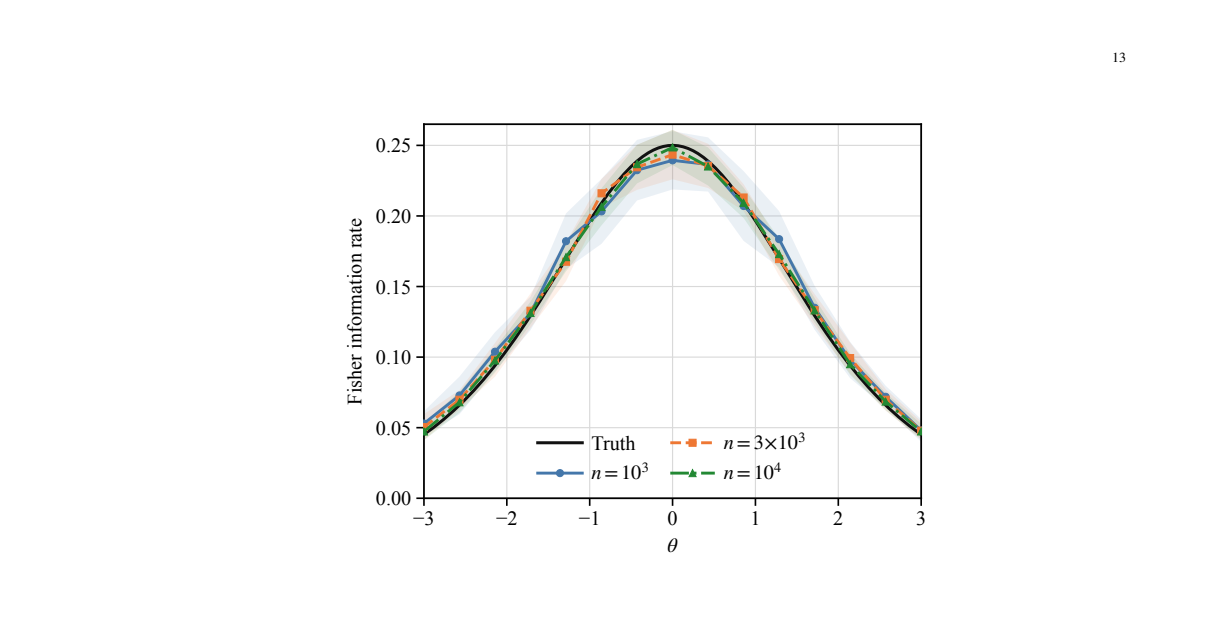
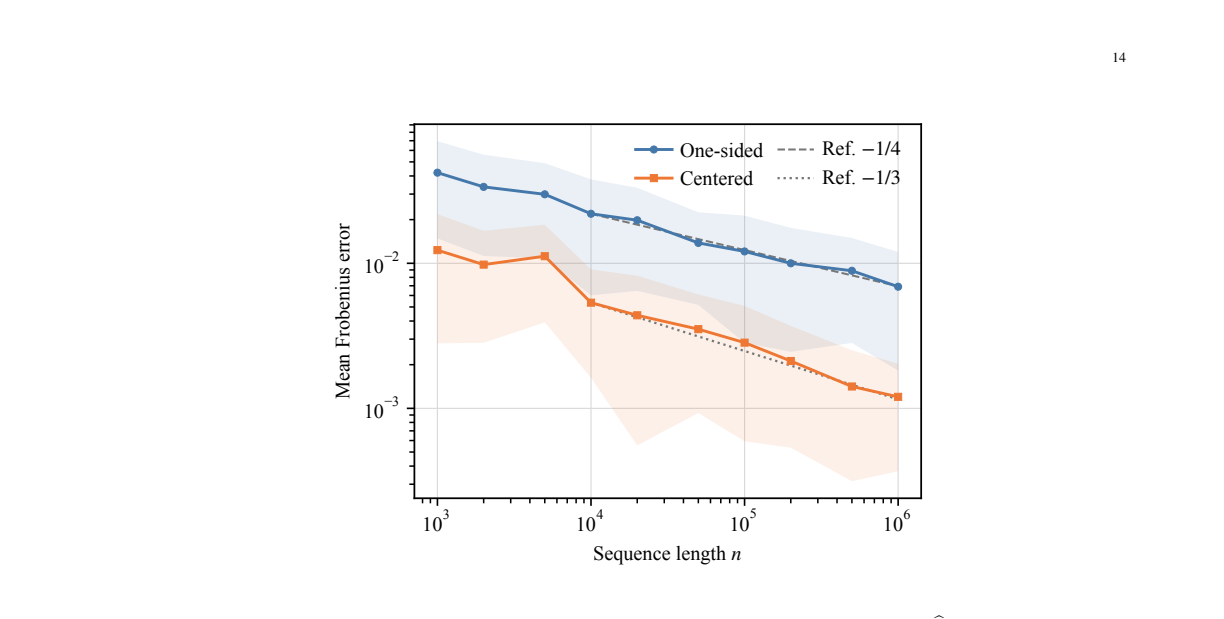
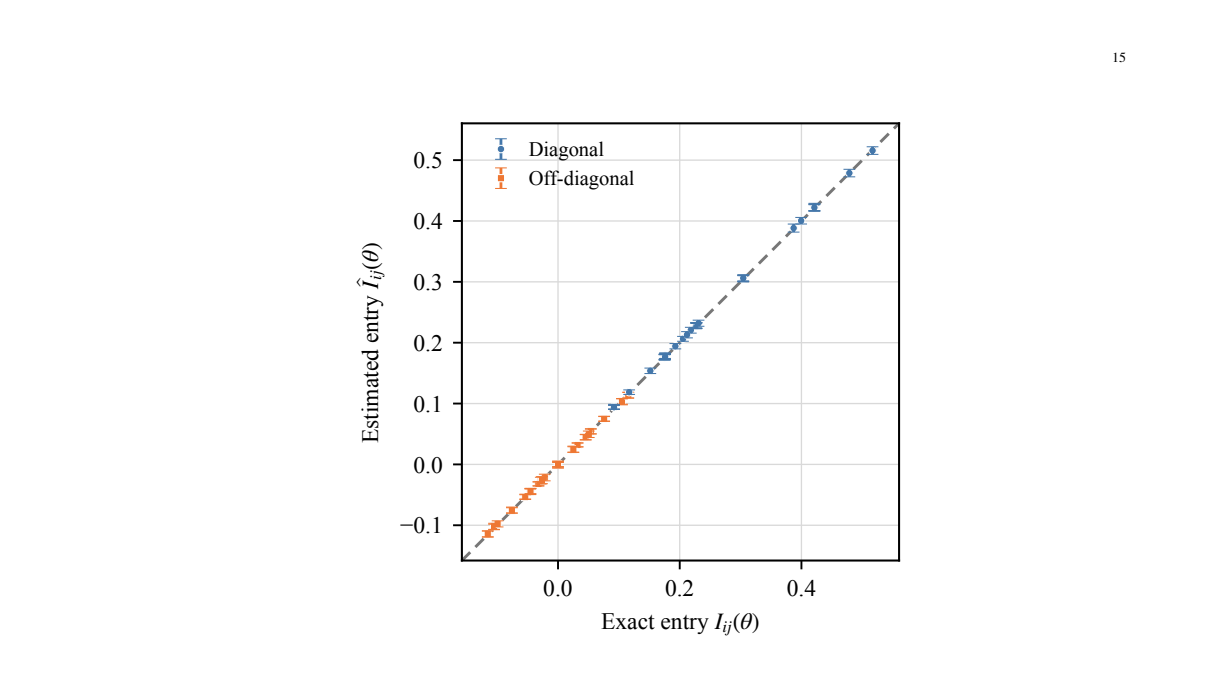
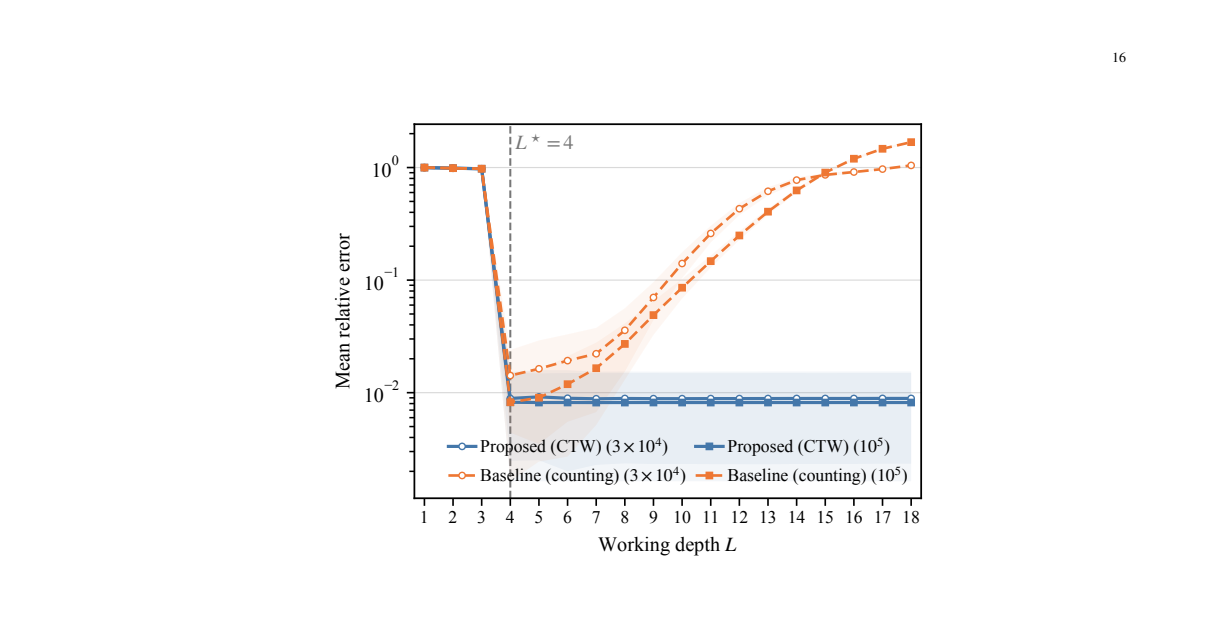
Figures are the authors', reproduced from the paper.
References (45)
- [1] E. L. Lehmann and G. Casella,Theory of Point Estimation. Springer, 2nd ed., 1998 on Pith
- [2] C. J. Adcock, “Sample size determination: a review,”Journal of the Royal Statistical Society: Series D (The Statistician), vol. 46, no. 2, pp. 261–283, 1997 on Pith
- [3] S. M. Kay,Fundamentals of Statistical Signal Processing: Estimation Theory. Prentice Hall, 1993 on Pith
- [4] S.-I. Amari, “Natural gradient works efficiently in learning,”Neural Computation, vol. 10, no. 2, pp. 251–276, 1998 on Pith
- [5] J. Martens and R. Grosse, “Optimizing neural networks with Kronecker-factored approximate curvature,” inInternational Conference on Machine Learning, pp. 2408–2417, PMLR, 2015 on Pith
- [6] J. Kirkpatrick, R. Pascanu, N. Rabinowitz, J. Veness, G. Desjardins, A. A. Rusu, K. Milan, J. Quan, T. Ramalho, A. Grabska-Barwinska, D. Hassabis, C. Clopath, D. Kumaran, and R. Hadsell, “Overcoming catastrophic forgetting in neural networks,”Proceedings of the National Academ... on Pith
- [7] H. Jeffreys, “An invariant form for the prior probability in estimation problems,”Proceedings of the Royal Society of London. Series A. Mathematical and Physical Sciences, vol. 186, no. 1007, pp. 453–461, 1946 on Pith
- [8] B. S. Clarke and A. R. Barron, “Jeffreys’ prior is asymptotically least favorable under entropy risk,”Journal of Statistical planning and Inference, vol. 41, no. 1, pp. 37–60, 1994 on Pith
- [9] K. Cranmer, J. Brehmer, and G. Louppe, “The frontier of simulation-based inference,”Proceedings of the National Academy of Sciences, vol. 117, no. 48, pp. 30055–30062, 2020 on Pith
- [10] S. A. Sisson, Y . Fan, and M. A. Beaumont, eds.,Handbook of Approximate Bayesian Computation. Chapman & Hall/CRC Handbooks of Modern Statistical Methods, Boca Raton, FL: Chapman & Hall/CRC, 2018 on Pith
- [11] S. N. Wood, “Statistical inference for noisy nonlinear ecological dynamical systems,”Nature, vol. 466, no. 7310, pp. 1102–1104, 2010 on Pith
- [12] L. Ljung,System Identification: Theory for the User. Prentice Hall, 2nd ed., 1999 on Pith
- [13] T. S ¨oderstr¨om and P. Stoica,System Identification. Prentice Hall, 1989. 33 on Pith
- [14] P. E. Valenzuela, J. Dahlin, C. R. Rojas, and T. B. Sch ¨on, “On robust input design for nonlinear dynamical models,”Automatica, vol. 77, pp. 268–278, 2017 on Pith
- [15] G. Poyiadjis, A. Doucet, and S. S. Singh, “Particle approximations of the score and observed information matrix in state space models with application to parameter estimation,”Biometrika, vol. 98, no. 1, pp. 65–80, 2011 on Pith
- [16] N. Kantas, A. Doucet, S. S. Singh, J. Maciejowski, and N. Chopin, “On particle methods for parameter estimation in state-space models,”Statistical Science, vol. 30, no. 3, pp. 328–351, 2015 on Pith
- [17] B. Efron and D. V . Hinkley, “Assessing the accuracy of the maximum likelihood estimator: Observed versus expected Fisher information,”Biometrika, vol. 65, no. 3, pp. 457–483, 1978 on Pith
- [18] J. C. Spall, “Monte Carlo computation of the Fisher information matrix in nonstandard settings,”Journal of Computational and Graphical Statistics, vol. 14, no. 4, pp. 889–909, 2005 on Pith
- [19] S. Das, J. C. Spall, and R. Ghanem, “An efficient calculation of Fisher information matrix: Monte Carlo approach using prior information,” inIEEE Conference on Decision and Control (CDC), pp. 963–968, IEEE, 2007 on Pith
- [20] T. M. Cover and J. A. Thomas,Elements of Information Theory. Wiley-Interscience, 2nd ed., 2006 on Pith
show 25 more
- [21] Q. Wang, S. R. Kulkarni, and S. Verd ´u, “Divergence estimation for multidimensional densities viak-nearest-neighbor distances,”IEEE Transactions on Information Theory, vol. 55, no. 5, pp. 2392–2405, 2009 on Pith
- [22] X. Nguyen, M. J. Wainwright, and M. I. Jordan, “Estimating divergence functionals and the likelihood ratio by convex risk minimization,”IEEE Transactions on Information Theory, vol. 56, no. 11, pp. 5847–5861, 2010 on Pith
- [23] J. Ziv and N. Merhav, “A measure of relative entropy between individual sequences with application to universal classification,”IEEE Transactions on Information Theory, vol. 39, no. 4, pp. 1270–1279, 1993 on Pith
- [24] H. Cai, S. R. Kulkarni, and S. Verd ´u, “Universal divergence estimation for finite-alphabet sources,”IEEE Transactions on Information Theory, vol. 52, no. 8, pp. 3456–3475, 2006 on Pith
- [25] V . Berisha and A. O. Hero, “Empirical non-parametric estimation of the Fisher information,”IEEE Signal Processing Letters, vol. 22, no. 7, pp. 988–992, 2015 on Pith
- [26] Y . Gao, I. Kontoyiannis, and E. Bienenstock, “Estimating the entropy of binary time series: Methodology, some theory and a simulation study,”Entropy, vol. 10, no. 2, pp. 71–99, 2008 on Pith
- [27] M. I. Belghazi, A. Baratin, S. Rajeshwar, S. Ozair, Y . Bengio, A. Courville, and D. Hjelm, “Mutual information neural estimation,” inInternational Conference on Machine Learning, pp. 531–540, PMLR, 2018 on Pith
- [28] F. M. J. Willems, Y . M. Shtarkov, and T. J. Tjalkens, “The context-tree weighting method: Basic properties,”IEEE Transactions on Information Theory, vol. 41, no. 3, pp. 653–664, 1995 on Pith
- [29] I. Kontoyiannis, “Context-tree weighting and Bayesian context trees: Asymptotic and non-asymptotic justifications,”IEEE Transactions on Information Theory, vol. 70, no. 2, pp. 1204–1219, 2024 on Pith
- [30] I. Papageorgiou and I. Kontoyiannis, “Context-tree weighting for real-valued time series: Bayesian inference with hierarchical mixture models,” inIEEE International Symposium on Information Theory (ISIT), pp. 2464–2469, 2023 on Pith
- [31] I. Papageorgiou and I. Kontoyiannis, “The Bayesian context trees state space model for time series modelling and forecasting,”International Journal of Forecasting, 2025 on Pith
- [32] R. Krichevsky and V . Trofimov, “The performance of universal encoding,”IEEE Transactions on Information Theory, vol. 27, no. 2, pp. 199–207, 1981 on Pith
- [33] T. J. Tjalkens, Y . M. Shtarkov, and F. M. J. Willems, “Sequential weighting algorithms for multi-alphabet sources,” in6th Joint Swedish–Russian International Workshop on Information Theory, pp. 230–234, 1993 on Pith
- [34] F. M. J. Willems, “The context-tree weighting method: Extensions,”IEEE Transactions on Information Theory, vol. 44, no. 2, pp. 792–798, 1998 on Pith
- [35] N. J. Higham, “Computing a nearest symmetric positive semidefinite matrix,”Linear Algebra and its Applications, vol. 103, pp. 103–118, 1988 on Pith
- [36] J. Stoer and R. Bulirsch,Introduction to Numerical Analysis. Springer, 3rd ed., 2002 on Pith
- [37] A. N. Tikhonov and V . Y . Arsenin,Solutions of Ill-Posed Problems. V . H. Winston & Sons, 1977 on Pith
- [38] S. Boyd and L. Vandenberghe,Convex Optimization. Cambridge University Press, 2004 on Pith
- [39] L. Vandenberghe and S. Boyd, “Semidefinite programming,”SIAM Review, vol. 38, no. 1, pp. 49–95, 1996 on Pith
- [40] A. W. van der Vaart,Asymptotic Statistics. Cambridge Univ. Press, 2000 on Pith
- [41] J. M. Bernardo and A. F. M. Smith,Bayesian Theory. John Wiley & Sons, 2009 on Pith
- [42] R. A. Horn and C. R. Johnson,Matrix Analysis. Cambridge University Press, 2012 on Pith
- [43] H. H. Bauschke and P. L. Combettes,Convex Analysis and Monotone Operator Theory in Hilbert Spaces. Springer, 2017 on Pith
- [44] S. Meyn and R. L. Tweedie,Markov Chains and Stochastic Stability. Cambridge, U.K.: Cambridge Univ. Press, 2 ed., 2009 on Pith
- [45] D. Paulin, “Concentration inequalities for Markov chains by Marton couplings and spectral methods,”Electronic Journal of Probability, vol. 20, pp. 1–32, 2015 on Pith
Cited by 1 Pith paper
Reviewed papers on Pith that cite this one. The full citation record
Challenges and discussion
Disagree with the review, or know something it missed? Leave a comment, or challenge this review formally: a challenge becomes a permanent entry in this paper's record, and its decision is published here.
Come back by email
A short list of the week's newly reviewed papers. Nothing is sent until you confirm from your inbox, and every email has a link that stops it. No account.
No comments yet.
Sign in to comment