Artificial Intelligence · arXiv:2609.05327 v2 · submitted 4 Sep 2026
LLM-Driven Algorithm Design for Quantum Circuit Synthesis based on Binary Decision Diagrams
The paper says
“Quantum circuits are central to implementing quantum algorithms on quantum devices, where quantum gates must be reversible. Many quantum algorithms rely on Boolean functions, which must therefore be implemented reversibly within quantum circuits.”
more of the abstract
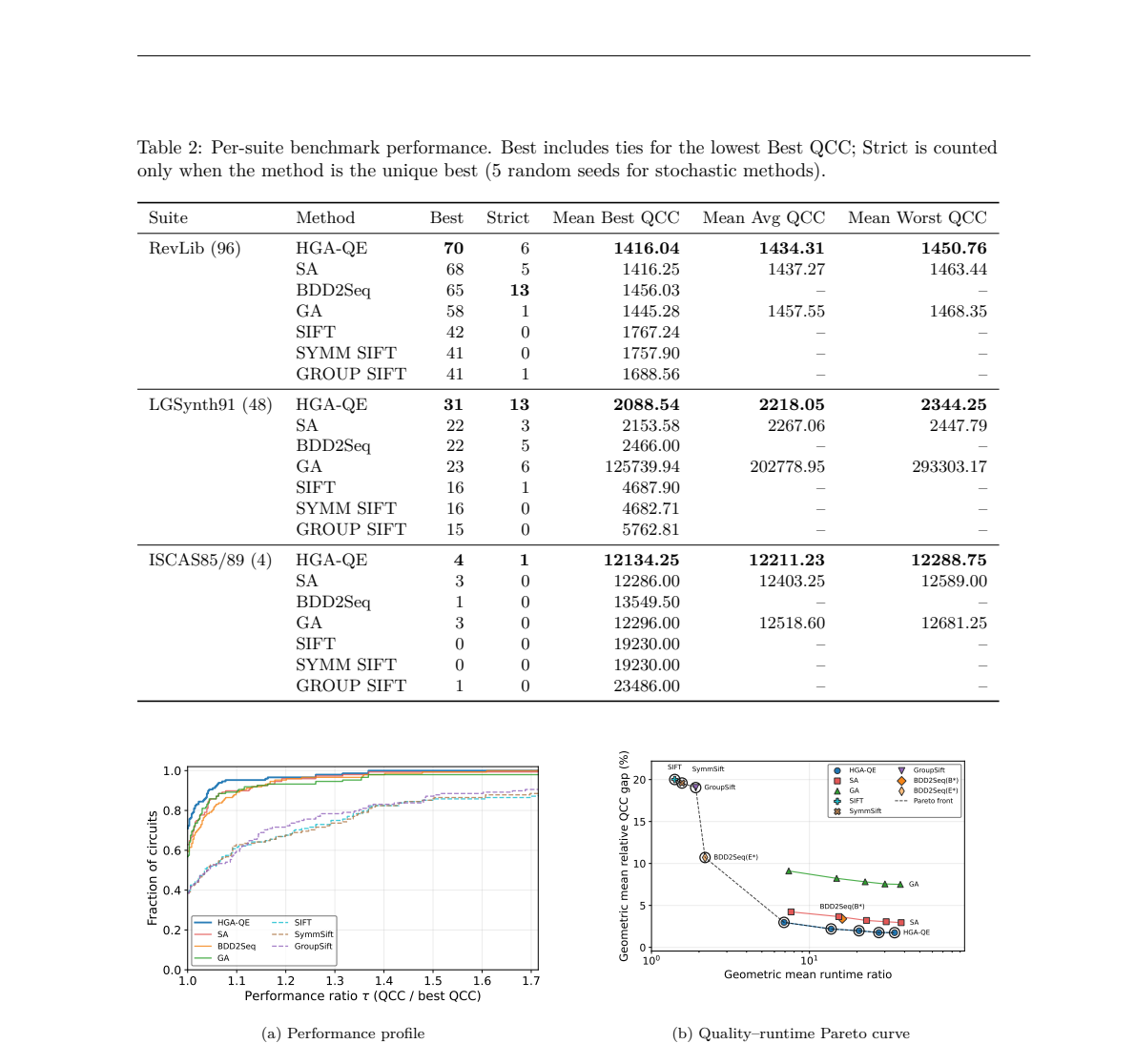
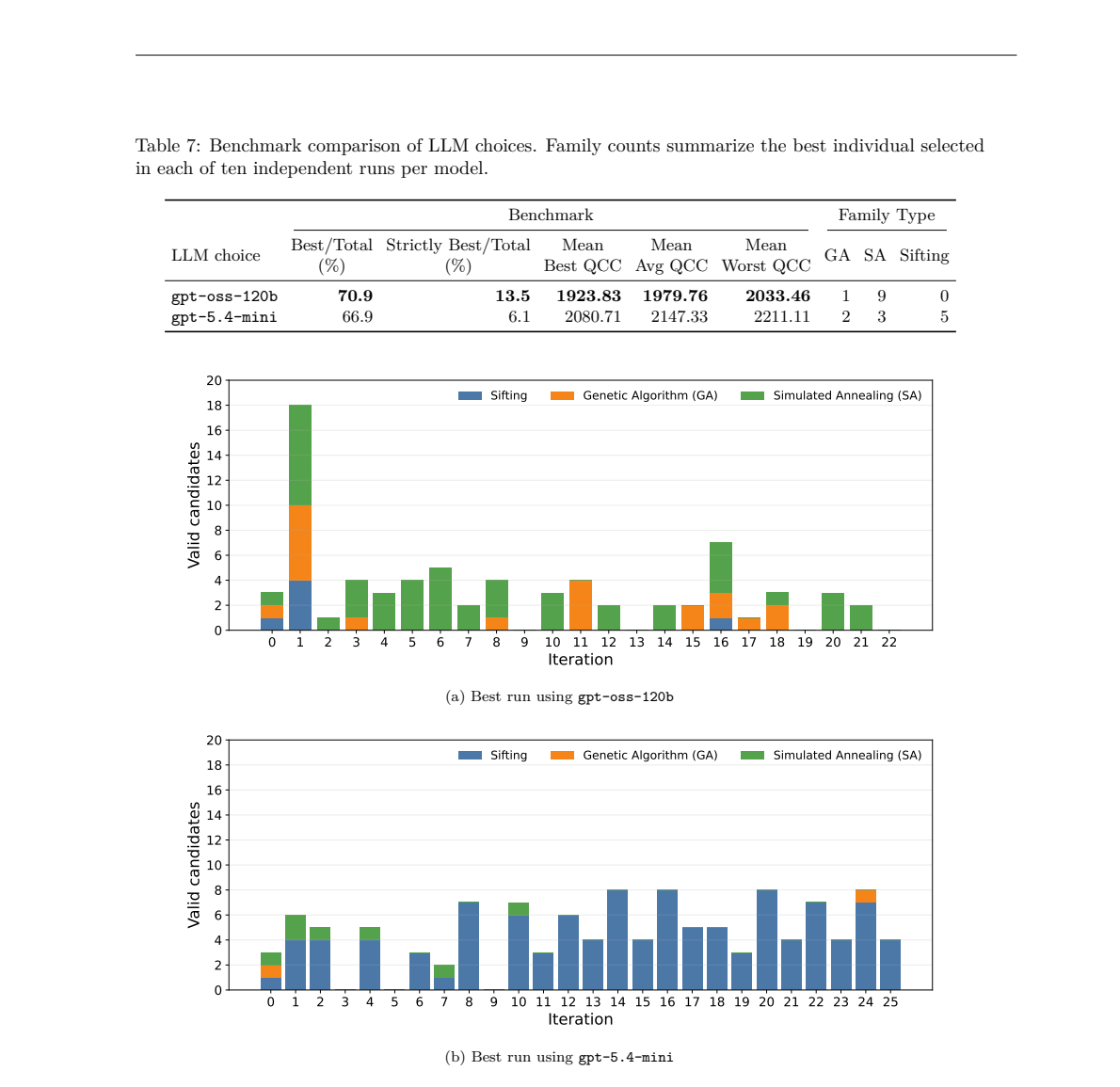
Reversible circuit synthesis provides a way to translate such Boolean functions into reversible circuits. Binary decision diagrams (BDDs) offer a scalable approach to this task, but the resulting BDDs and circuits depend heavily on variable ordering. Existing ordering heuristics commonly minimize BDD size because it is closely tied to the circuit size. However, BDD size is an imperfect proxy for the quantum cost of the synthesized circuit (QCC). We propose \textttQuantumEvo, an evolutionary framework that uses an LLM as a heuristic generator for QCC-aware BDD variable ordering. Instead of predicting orderings directly, \textttQuantumEvo searches over ordering heuristics initialized from multiple heuristic families. Candidate heuristics directly manipulate variable orderings using standard BDD operations and are selected by downstream QCC. The discovered heuristic, HGA-QE, modifies the sifting step inside a genetic algorithm so that the procedure is better aligned with QCC. Across the benchmark set, HGA-QE achieves a 70.9% tie-or-win rate against the per-function best baseline and is strictly best on 13.5% of the functions. The results demonstrate broadly competitive QCC performance, with HGA-QE showing a clearer relative advantage in strict wins on the two benchmark suites drawn from sources different from the data used for heuristic discovery.
from the abstract
Pith says
Machine review · deepseek-v4-flash · 8 Sep 2026 · of version 1 of the paper; version 2 is newer · what was read was not recorded · not checked by a person
It can be wrong. Challenge this review or reply to it.
Holds up. Solid empirical study with a modest improvement; the cross-corpus transfer claim is overstated. This line is wrong
3 major objections · 6 minor
How often objections from reviews like this one are right: not yet measured
Not checked: figures, code, what the references say.
The paper says, at Table 3 and Section 4.2.2
The review did not quote this passage.
Pith says: Objection 1 of 3 · major
The strict-win examples in Table 3, particularly c432I and rot_origL, show runtime per seed of 245 s and 845 s, respectively, which are two to three orders of magnitude higher than the competing baselines. While the paper notes that 'synthesis runtime remains practically manageable', this level of overhead makes HGA-QE impractical for many use cases.
more of objection 1
The claim of a 'clearer relative advantage' on non-RevLib suites should be accompanied by an explicit discussion of whether those wins are practically meaningful given the runtime cost.
The paper says, at Section 4.2.3, Figure 6, and Table 4
The review did not quote this passage.
Pith says: Objection 2 of 3 · major
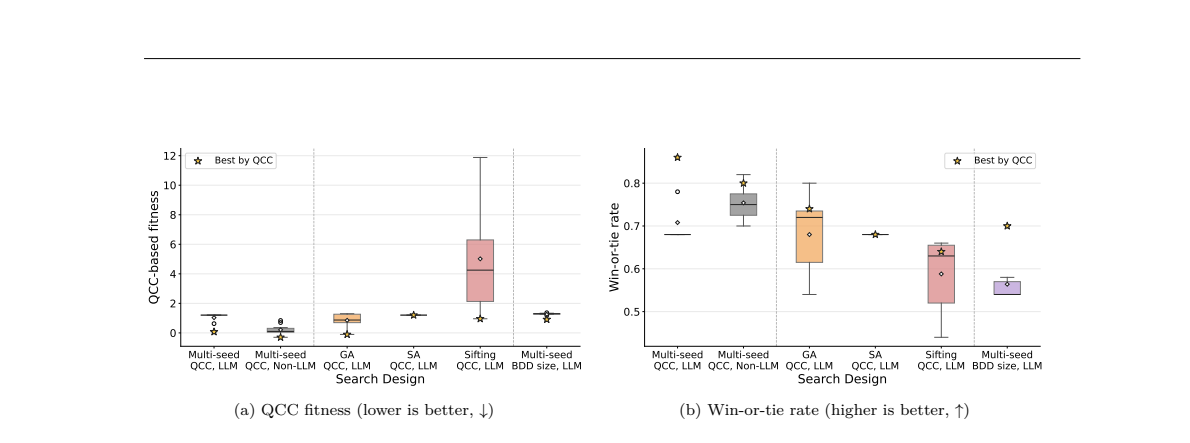
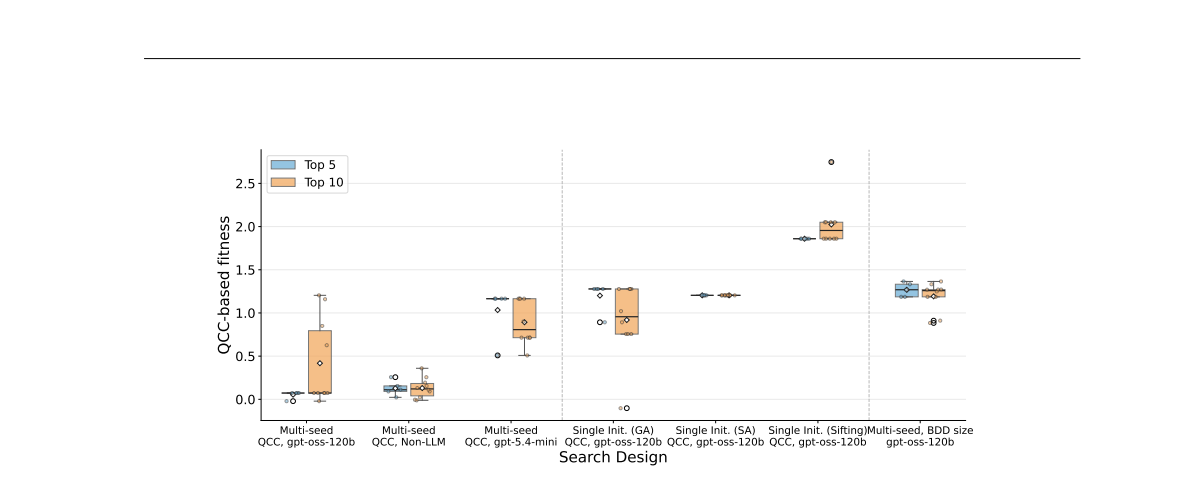
The non-LLM control (multi-seed QCC, Non-LLM) achieves very similar validation fitness to the full LLM-driven search, and its selected heuristic obtains 66.9% best/total and 5.4% strictly best on the benchmark, compared to 70.9% and 13.5% for the LLM version. The paper states that LLM guidance 'can yield heuristics that transfer more effectively', but the advantage is small and only appears on a few non-RevLib circuits.
more of objection 2
The claim that LLM guidance is beneficial should be toned down, or the authors should provide a clearer decomposition of where the LLM specifically adds value beyond the non-LLM search space.
The paper says, at Section B.3 and Discussion
The review did not quote this passage.
Pith says: Objection 3 of 3 · major
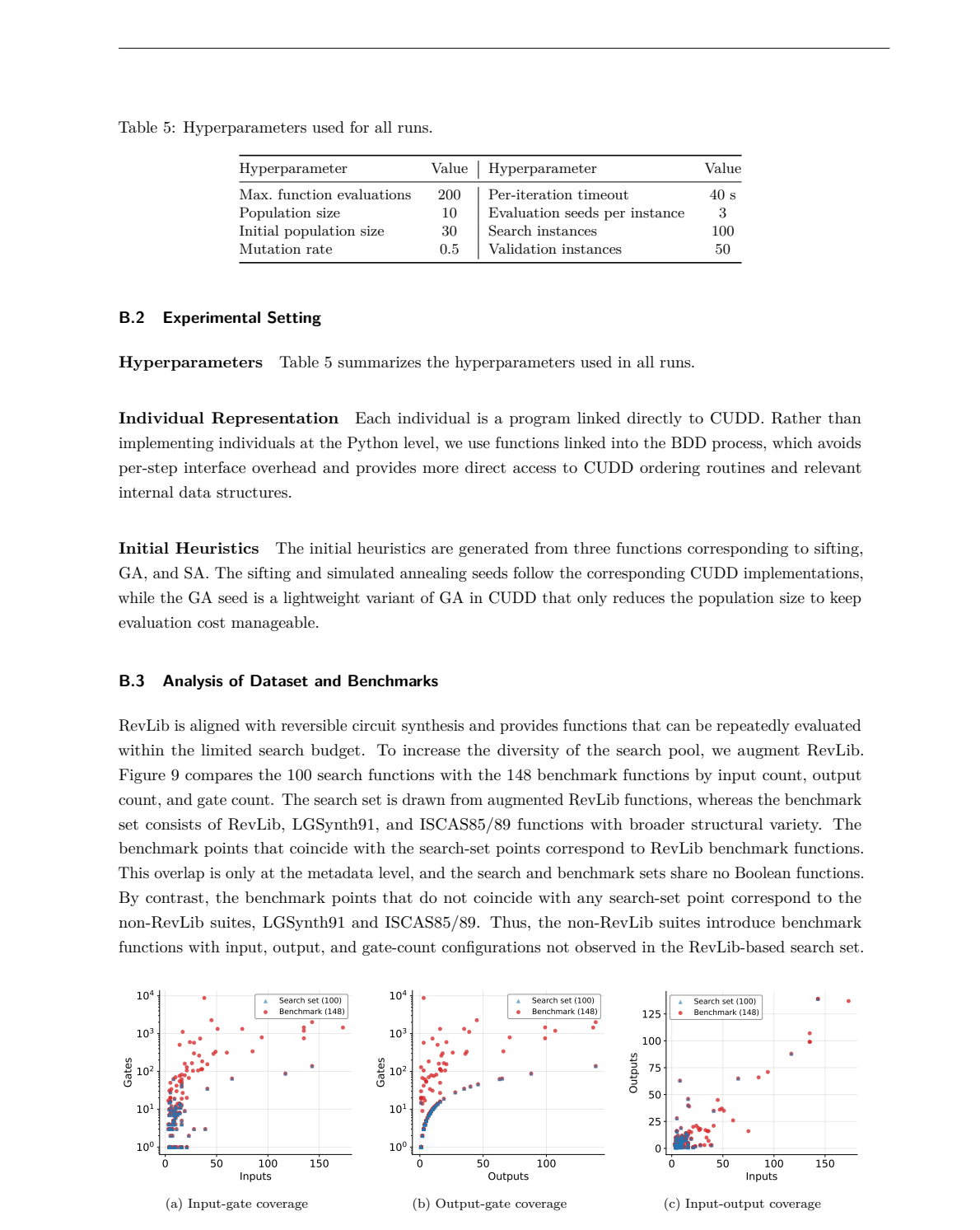
The search set is derived from augmented RevLib functions, and the benchmark set contains 96 RevLib functions that share metadata but no specific Boolean functions. This still means that 96 of the 148 benchmark functions come from the same underlying corpus as the search set.
more of objection 3
The genuine out-of-distribution evidence is limited to the 48 LGSynth91 and 4 ISCAS85/89 circuits, where HGA-QE achieves 14 strict wins (13 LGSynth, 1 ISCAS). The aggregate 70.9% tie-or-win rate is dominated by RevLib cases. The paper should explicitly quantify how much of the advantage comes from RevLib vs. non-RevLib and discuss whether this materially supports a claim of cross-corpus transfer.
6 minor objections
The paper says, at Table 4
Pith says: minor objection 1 of 6
The 'Bold' annotation in the table header is not defined in the caption or text. If it indicates the best result per row, please state this explicitly.
The paper says, at Section 2.2, paragraph 2
Pith says: minor objection 2 of 6
Typo: 'minimizing the BDD size is a common objective' should be 'minimizing'.
show 4 more
The paper says, at Algorithm 1 and 2
Pith says: minor objection 3 of 6
The notation in PartialSift (Algorithm 2) uses both sigma and pi for the current order, which can be confusing. Consider renaming to make clear that pi records the original order before imposing sigma.
The paper says, at Table 10
Pith says: minor objection 4 of 6
The table caption says 'Correspondence between pseudocode functions and CUDD source', but the column 'Type' uses 'W', 'A', 'N' which are not explained in the caption. Add a legend.
The paper says, at Appendix G
Pith says: minor objection 5 of 6
The hardware normalization for BDD2Seq uses a PassMark single-thread ratio derived from the dual Xeon 8375C. Please justify that the synthesis calls are single-threaded and that the normalization factor of 0.714 is appropriate for your Ryzen 9 5900X.
The paper says, at Figure 1 caption
Pith says: minor objection 6 of 6
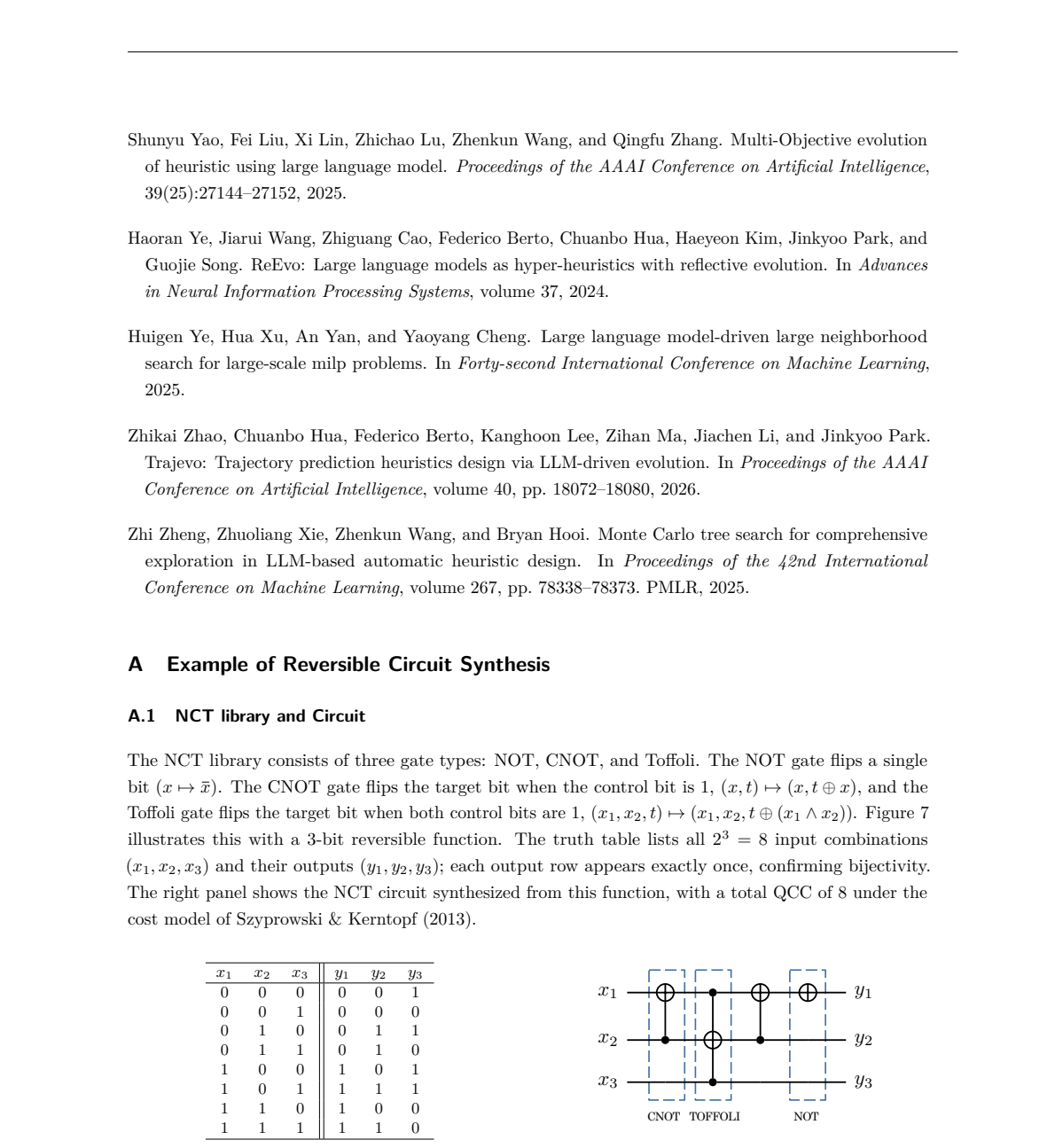
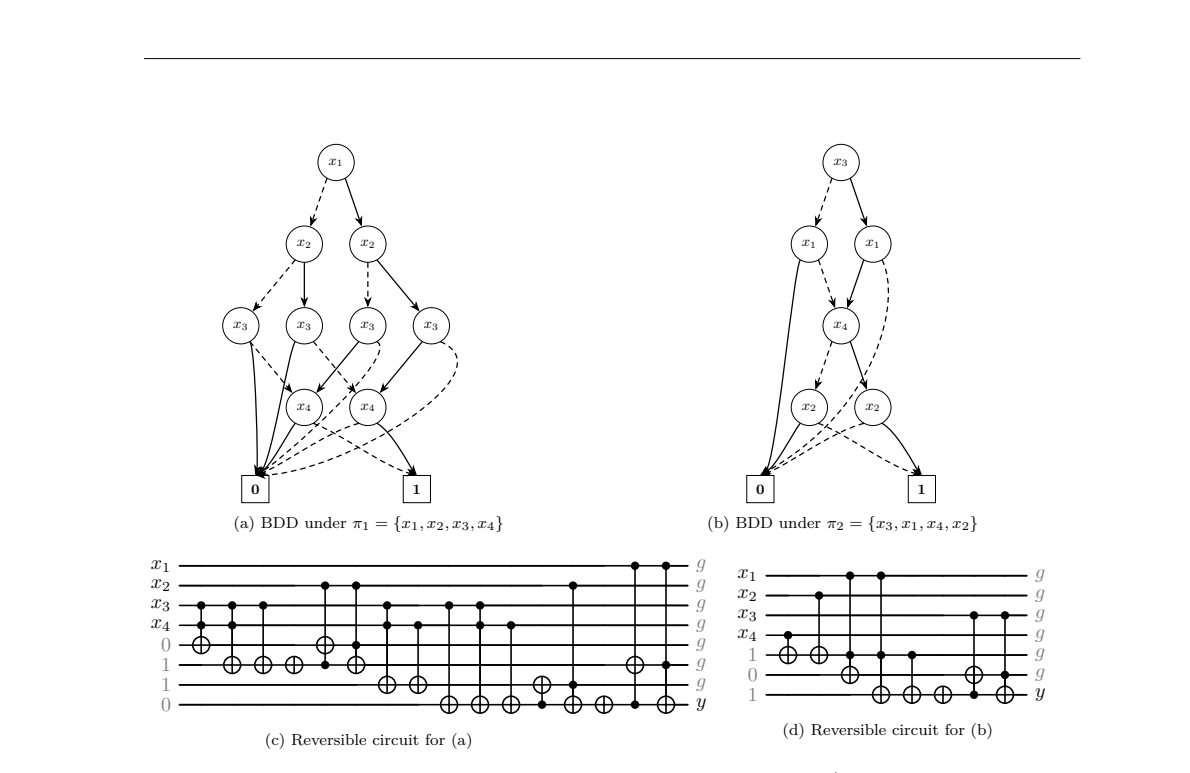
The figure caption mentions 'g function' but the function is $f_{232}$. Also, the expression for $y$ in the caption is truncated and should be checked for correct LaTeX.
This objection may describe the copy Pith gave the reviewer, not the paper.
What would settle it
Evaluate HGA-QE against SA and GA on a third suite not represented in search, validation, or benchmark construction, for example randomly generated 14-to-30-input Boolean functions or EPFL combinational benchmarks mapped to reversible form, using a per-function runtime cap equal to the fastest baseline's per-seed time. Recompute tie-or-win and strict-best rates; if HGA-QE does not reproduce the non-RevLib strict-win rate under a matched budget, the transfer claim in the abstract should be softened.
from the skeptic's reading
How the review went
4 readings by deepseek-v4-flash · 8 Sep 2026
- Reader holds up
- Skeptic partly agrees
- Editor wrote the verdict above
- Referee minor revision: 3 major objections, 6 minor
Not run on this paper: the simulated authors' defence.
Pith did not check this review's objections against the paper.
The review in full
The review in brief, machine-written
This paper is fine but not a slam dunk. What’s actually new: an LLM-driven evolutionary search for BDD variable ordering heuristics that directly optimize quantum circuit cost (QCC) rather than BDD size. The discovered heuristic, HGA-QE, patches the sifting step in a genetic algorithm and shows a 13.5% strict-win rate over six baselines on 148 benchmarks. The experimental setup is thorough — code released, statistical tests, ablation of LLM guidance, multi-family initialization, and QCC fitness. The authors honestly discuss the competitive non-LLM search and the runtime cost on some instances.
Soft spots. The main claim is that HGA-QE "transfers" to structurally different functions, but the evidence is weaker than the headline suggests. The search set (100 augmented RevLib functions) shares the same source corpus as 96 of the 148 benchmark functions. The genuinely out-of-distribution suites — LGSynth91 (48 circuits) and ISCAS85/89 (4 circuits) — show a few strict wins, but those wins often come at 10–100× the runtime of baselines (c432I costs 245 s per seed vs 1–6 s; rot_origL costs 845 s vs 26 s). Table 12 shows no significant benefit on the four ISCAS circuits. So the "clearer relative advantage" on non-RevLib suites may be driven by high-budget runs on a handful of functions rather than systematic transfer.
Second, the LLM guidance is not clearly superior: the non-LLM control (predefined component search) achieves competitive or better validation fitness and converges to GA-family heuristics every time. The paper argues that LLM guidance yields better transfer, but the cross-suite advantage is small and expensive. This is consistent with many LLM-for-heuristic papers: the LLM adds variety but the core improvement comes from search and a tailored fitness function.
Overall, this is a solid empirical paper for the reversible-circuits community and for people applying LLMs to heuristic search. The modest improvement is honestly reported. I would send it to peer review, but I would push the authors to either strengthen the transfer evidence (e.g., hold out entire RevLib families, test on more non-RevLib functions, or provide cost-adjusted win rates) or tone down the generalization claims. The paper is worth reading and discussing, but I wouldn't bet my own work on the transfer claim without more data.
The strongest objection
The reusable-heuristic claim is that QCC-aware LLM search discovers a heuristic that transfers: HGA-QE is "broadly competitive" and has a "clearer relative advantage" on suites drawn outside the discovery data. Section B.3 shows the 100 search/validation functions are augmented RevLib functions, while the benchmark's 96 RevLib circuits share metadata but no exact Boolean functions with them. That leaves the two non-RevLib suites, 48 LGSynth91 and 4 ISCAS85/89 circuits, as the only genuinely out-of-distribution evidence. Table 2 shows HGA-QE's strict wins are 6/96 on RevLib, 13/48 on LGSynth91, and 1/4 on ISCAS85/89. In Table 3, the headline non-RevLib strict wins include c432I, where HGA-QE's best QCC is 10494 versus 11101 for the best baseline but costs 245.19 s per seed versus 1.46-6.20 s, and rot_origL, where HGA-QE wins 23926 versus 24124 but costs 845.19 s per seed versus 25.99 s. Table 12 also shows no significant benefit on the four ISCAS circuits. Because the search set is derived from the same source corpus as 96 of the 148 benchmark functions, the aggregate 70.9% tie-or-win rate is weak evidence that HGA-QE would maintain an advantage on structurally different functions; the "clearer" non-RevLib advantage may be driven by a few high-budget runs rather than systematic transfer. This is a limitation rather than a demonstrated error, and the paper's sensitivity analyses address selection, but not this source-corpus overlap combined with runtime concentration.
The reader's weakest assumption is representativeness of the 100-function augmented RevLib search set, and I agree that this is the right general area of concern. I sharpen it: the benchmark itself is dominated by the same source corpus, so the only independent transfer evidence is the 52 non-RevLib functions, and HGA-QE's strict wins there are concentrated in a small number of high-runtime instances. Importantly, this concern does not invalidate the results as reported on the fixed benchmark. The paper provides code, detailed per-function tables, paired statistical tests, ablations, and sensitivity analyses; the aggregate 70.9% tie-or-win rate and 13.5% strict-best rate are supported as stated. The proposed cross-suite, runtime-matched evaluation would settle whether the non-RevLib advantage reflects robust transfer or an artifact of a few expensive runs. Because the paper is appropriately hedged about the modest improvement and the competitive non-LLM baseline, I would not change the reader's accept verdict; this is a generalization caveat, not a correctness failure.
The referee's report
If the claimed performance holds, this work introduces a principled way to incorporate domain-specific downstream metrics into heuristic design for BDD-based synthesis, an application area where BDD size has traditionally been the objective. The framework is general and could be adapted to other optimization decisions within computational workflows. However, the practical advantage is modest and concentrated on a small number of expensive instances, and the LLM component is not cleanly necessary for the best discovered heuristic.
Pith's reading of the paper (a machine's summary, not the authors')
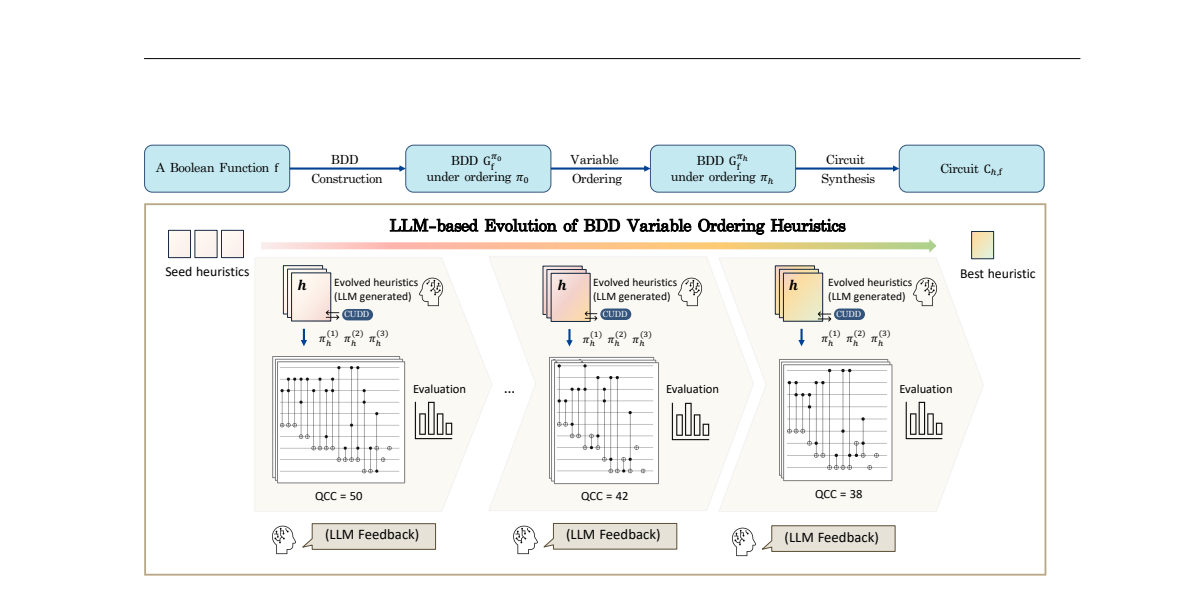
The paper argues that minimizing the size of a binary decision diagram (BDD) is an imperfect proxy for the quantum cost of the reversible circuit synthesized from it, and proposes to search instead for BDD variable-ordering heuristics that optimize that downstream cost directly. It introduces QuantumEvo, an evolutionary search in which a large language model generates and revises executable ordering heuristics, seeded with sifting, genetic algorithm, and simulated annealing orderers, and scored by the average quantum-cost gap over a training set of 100 Boolean functions. The discovered heuristic, HGA-QE, is a hybrid genetic algorithm whose only change is to replace full sifting with a targeted re-sifting of just the BDD levels a candidate ordering actually altered, which increases population diversity while keeping BDD size roughly constant. On 148 benchmark circuits HGA-QE matches or beats the best per-function baseline on 70.9% of functions and is uniquely best on 13.5%, with its clearest relative gains on the two benchmark suites whose structures do not appear in the search data.
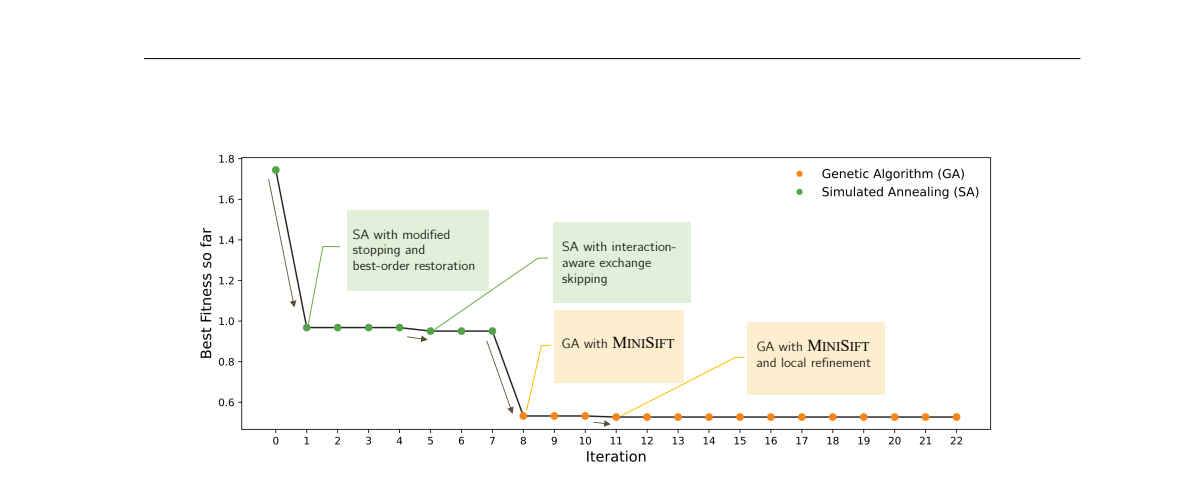
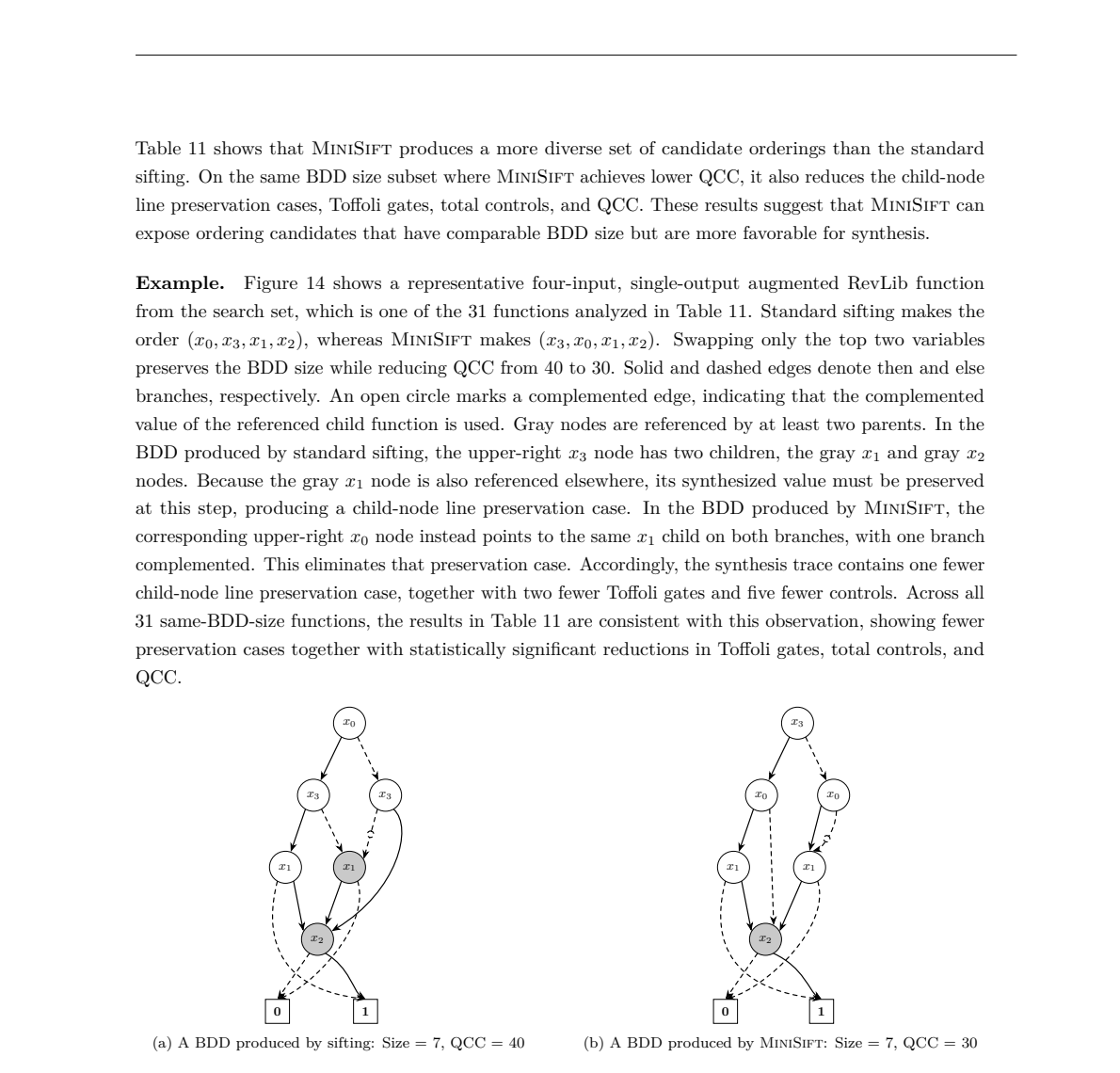
What carries the argument. The carrying mechanism is QuantumEvo, an evolutionary loop that treats a heuristic as an executable C function linked to the CUDD BDD library, seeded from three heuristic families (sifting, GA, and SA), mutated and recombined by an LLM under reflective feedback, and evaluated by the average relative QCC gap to the per-instance best classical baseline over a 100-function search set. The fitness metric is the quantum cost of the synthesized NCT circuit, where a gate with $k$ control bits contributes $2k^2 - 2k + 1$. The discovered object, HGA-QE, modifies the genetic-algorithm loop so that after producing a candidate order, it calls PartialSift, which imposes the candidate permutation and then MiniSift, which locally sifts only the variable levels that the candidate actually moved. MiniSift's effect is to raise the diversity of candidate orderings (unique fraction +11.2%, normalized Hamming distance +5.9%) while leaving BDD size essentially unchanged, which the diagnostic analysis connects to fewer child-node line preservation cases and fewer Toffoli gates and controls during circuit synthesis. This mechanism is what enables the search to improve QCC without first improving the BDD-size proxy.
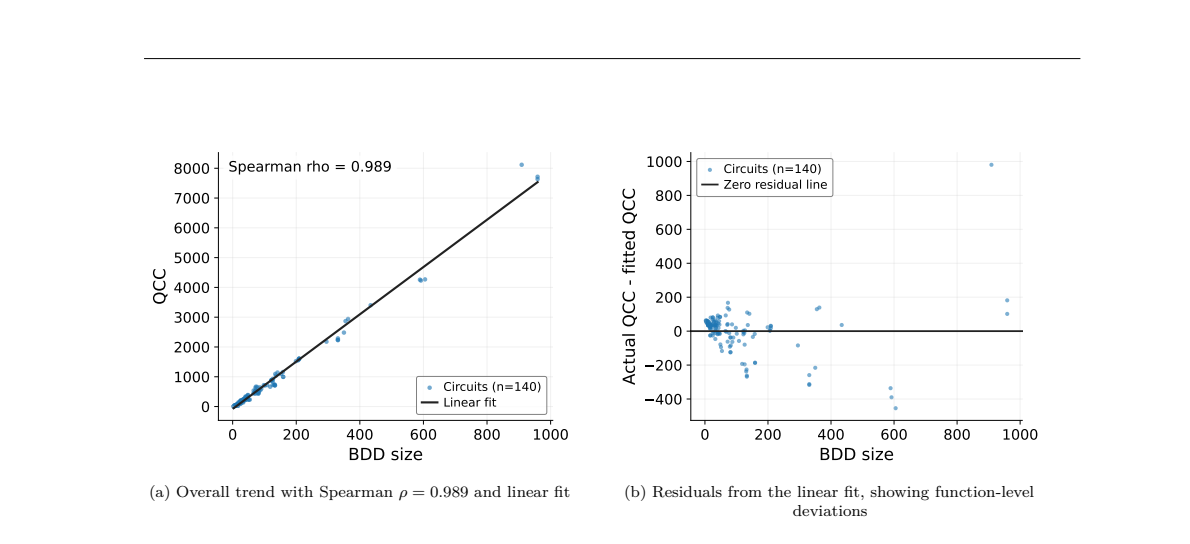
Core claim. QuantumEvo discovers that a BDD variable-ordering heuristic can meaningfully reduce quantum cost by replacing a BDD-size-oriented reordering step with a cost-blind but diversity-inducing targeted sifting step, while keeping the outer genetic algorithm's size-based selection unchanged. The central empirical pair of observations is: BDD size and QCC are strongly correlated (Spearman $\rho = 0.989$) yet imperfectly aligned, with a mean absolute residual of 79.3 and 35% of the functions admitting an ordering where a smaller BDD yields a higher QCC; and the found heuristic HGA-QE, by re-sifting only the levels changed by a candidate permutation (MiniSift), produces more diverse orderings that synthesize to fewer Toffoli gates and controls without shrinking the BDD. Across 148 benchmark functions, HGA-QE achieves a 70.9% tie-or-win rate against the per-function best baseline, is strictly best on 13.5% of functions, and after Holm correction significantly outperforms every baseline in per-circuit QCC. The paper interprets these results as evidence that optimizing the downstream objective, rather than the BDD-size proxy, transfers to unseen functions, while explicitly noting that on the RevLib subset the advantage over simulated annealing and the genetic algorithm is not statistically significant.
The premise it rests on. The load-bearing premise is that the 100 augmented RevLib functions used to evaluate heuristics during evolution accurately represent the structural variety of the Boolean functions the discovered heuristic will later be applied to, so that optimizing average QCC on those 100 transfers to unseen circuits.
If the paper is right (Pith's inferences, not the authors')
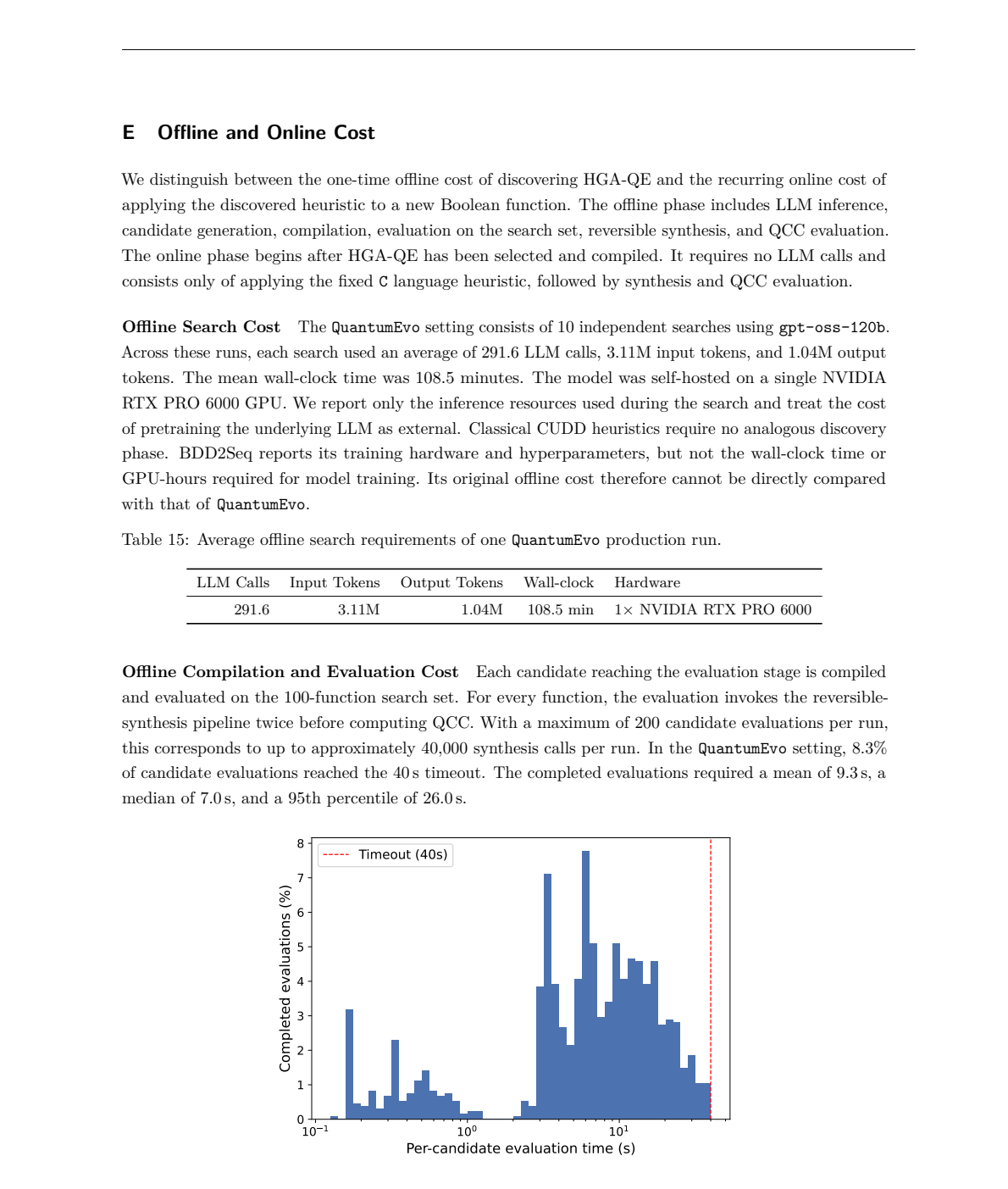
HGA-QE can be deployed as a fixed compiled CUDD ordering routine requiring no LLM calls at runtime, so the discovery cost is one-time and the online cost is only BDD reordering plus synthesis.
The evidence that 35% of the searched functions admit an ordering with a smaller BDD but higher QCC implies that proxy-based ordering search leaves recoverable quantum cost on the table, and that QCC-aware fitness is a more direct target.
Because the advantage is clearest on LGSynth91 and ISCAS85/89, the result suggests that LLM-driven heuristic search can generalize beyond the distribution of the training circuits, at least when the search set is diverse.
The paper's quality-runtime Pareto analysis indicates that HGA-QE reaches a trade-off comparable to the learning-based BDD2Seq baseline after two seeds, and then improves further with more seeds at the cost of cumulative runtime.
The positive result on the QCC objective does not transfer automatically to other downstream objectives, as the paper's own FPGA-mapping experiment shows HGA-QE losing to SA and GA on four-input LUT counts despite winning on multiplexer-network size.
A testable extension would run the same QuantumEvo pipeline with a search set drawn from LGSynth91 and ISCAS85/89 and check whether the discovered heuristic improves the strict-win rate on RevLib; a symmetric improvement would strengthen the transfer story.
MiniSift's mechanism, re-sifting only the levels a variation operator changed, is a general diversity-preserving refinement that could be ported to any population-based BDD reorderer without LLM involvement; the paper does not test that standalone transfer.
The FPGA experiment suggests that the correct objective matters beyond quantum cost: the same ordering heuristic can lead for one downstream metric and lose for another, so the QuantumEvo framework should be re-run with each target metric as fitness.
Given that the non-LLM search matches the LLM-guided search in validation fitness but transfers worse, a hybrid that invokes the LLM only when predefined operators stagnate could reduce offline cost without sacrificing the generalization benefit.
Check this review
Pith stored no record of this review's passes and took no fingerprint of it. Reviews made by code from 13 Nov 2026 on carry both.
How often reviews like this one are right
Reviews like this one: written by deepseek-v4-flash, where what was read was not recorded.
How often objections from reviews like this one are right: not yet measured
Reviews by people
This review was written by a machine. No person has reviewed this paper on Pith yet. A scientist listed on Pith can review it for a fee, and their review is published here whatever it concludes.
The paper
Abstract
Quantum circuits are central to implementing quantum algorithms on quantum devices, where quantum gates must be reversible. Many quantum algorithms rely on Boolean functions, which must therefore be implemented reversibly within quantum circuits. Reversible circuit synthesis provides a way to translate such Boolean functions into reversible circuits. Binary decision diagrams (BDDs) offer a scalable approach to this task, but the resulting BDDs and circuits depend heavily on variable ordering. Existing ordering heuristics commonly minimize BDD size because it is closely tied to the circuit size. However, BDD size is an imperfect proxy for the quantum cost of the synthesized circuit (QCC). We propose \textttQuantumEvo, an evolutionary framework that uses an LLM as a heuristic generator for QCC-aware BDD variable ordering. Instead of predicting orderings directly, \textttQuantumEvo searches over ordering heuristics initialized from multiple heuristic families. Candidate heuristics directly manipulate variable orderings using standard BDD operations and are selected by downstream QCC. The discovered heuristic, HGA-QE, modifies the sifting step inside a genetic algorithm so that the procedure is better aligned with QCC. Across the benchmark set, HGA-QE achieves a 70.9% tie-or-win rate against the per-function best baseline and is strictly best on 13.5% of the functions. The results demonstrate broadly competitive QCC performance, with HGA-QE showing a clearer relative advantage in strict wins on the two benchmark suites drawn from sources different from the data used for heuristic discovery.
The paper's own sentences, arranged, kept beside the review and separate from it. Each label is drawn from a closed vocabulary; the number beside it is the probability the classifier gave that label. No sentence in this record was written by a model.
abstract compiled · 2026-09-23
The authors' main claim, as the classifier picked it out 0.84
“The results demonstrate broadly competitive QCC performance, with HGA-QE showing a clearer relative advantage in strict wins on the two benchmark suites drawn from sources different from the data used for heuristic discovery.”
How the main claim is stated: asserted 1.00
What the abstract itself states, as probabilities: claims first 0.05 · states limitation 0.44 · human participants 0.02 · controlled comparison 0.94 · randomized assignment 0.02 · states quantitative result 0.99 · compares with prior results 0.98 · mentions code or data availability 0.03
The abstract, sentence by sentence
This table labels the abstract only (arXiv listing abstract v1). The number is the probability the classifier gave the label.
| Sentence | Role | The authors' own work | States the main conclusion | Strength |
|---|---|---|---|---|
| Quantum circuits are central to implementing quantum algorithms on quantum devices, where quantum gates must be reversible. | background 1.00 | 0.04 | 0.02 | asserted 1.00 |
| Many quantum algorithms rely on Boolean functions, which must therefore be implemented reversibly within quantum circuits. | background 1.00 | 0.04 | 0.02 | asserted 0.99 |
| Reversible circuit synthesis provides a way to translate such Boolean functions into reversible circuits. | background 1.00 | 0.04 | 0.02 | asserted 0.99 |
| Binary decision diagrams (BDDs) offer a scalable approach to this task, but the resulting BDDs and circuits depend heavily on variable ordering. | background 0.94 | 0.08 | 0.03 | asserted 1.00 |
| Existing ordering heuristics commonly minimize BDD size because it is closely tied to the circuit size. | background 1.00 | 0.04 | 0.02 | asserted 1.00 |
| However, BDD size is an imperfect proxy for the quantum cost of the synthesized circuit (QCC). | gap 0.79 | 0.19 | 0.05 | asserted 1.00 |
| We propose \texttt{QuantumEvo}, an evolutionary framework that uses an LLM as a heuristic generator for QCC-aware BDD variable ordering. | contribution 0.93 | 0.90 | 0.10 | asserted 1.00 |
| Instead of predicting orderings directly, \texttt{QuantumEvo} searches over ordering heuristics initialized from multiple heuristic families. | method 0.98 | 0.86 | 0.04 | asserted 1.00 |
| Candidate heuristics directly manipulate variable orderings using standard BDD operations and are selected by downstream QCC. | method 0.99 | 0.75 | 0.03 | asserted 1.00 |
| The discovered heuristic, HGA-QE, modifies the sifting step inside a genetic algorithm so that the procedure is better aligned with QCC. | method 0.91 | 0.91 | 0.09 | asserted 1.00 |
| Across the benchmark set, HGA-QE achieves a 70.9\% tie-or-win rate against the per-function best baseline and is strictly best on 13.5\% of the functions. | result 1.00 | 0.96 | 0.48 | asserted 1.00 |
| The results demonstrate broadly competitive QCC performance, with HGA-QE showing a clearer relative advantage in strict wins on the two benchmark suites drawn from sources different from the data used for heuristic discovery. | interpretation 0.88 | 0.95 | 0.63 | asserted 1.00 |
What kind of paper the classifier reports this is: method or tool 1.00 · evidence from simulation or computation 0.85
What was examined, and what was not
Sources read
- arXiv listing abstract v1
Not examined
- full text
- figures and tables
- references and citing sentences
- relations to other papers
Levels run
- P abstract
Not run
- S sections
- T body sentences
- C citations
- R cross-paper relations
How the labels were made
Compiled by classifier-1.13.0 via TypeSafe API, question bank abstract-p1-20260923, 2026-09-23: 1 request, 8,819 input tokens.
Every quoted sentence on this record is the authors'. Every label is from Pith's closed vocabulary, with the probability shown beside it. This record as JSON
Figures (15)
Showing 14 of the paper's 15 figures. Figures are the authors', reproduced from the paper.
Cited by 1 Pith paper
Reviewed papers on Pith that cite this one. The full citation record
Challenges and discussion
Disagree with the review, or know something it missed? Leave a comment, or challenge this review formally: a challenge becomes a permanent entry in this paper's record, and its decision is published here.
Come back by email
A short list of the week's newly reviewed papers. Nothing is sent until you confirm from your inbox, and every email has a link that stops it. No account.
No comments yet.
Sign in to comment