Quantum Physics · arXiv:2611.04431 v1 · submitted 3 Nov 2026 · 26 references
Reducing the arithmetic cost of quantum derivative pricing with language-model circuit design
The paper says
“Quantum amplitude estimation can estimate expected discounted payoffs with quadratically fewer oracle calls than Monte Carlo, but each call requires coherent computation.”
more of the abstract
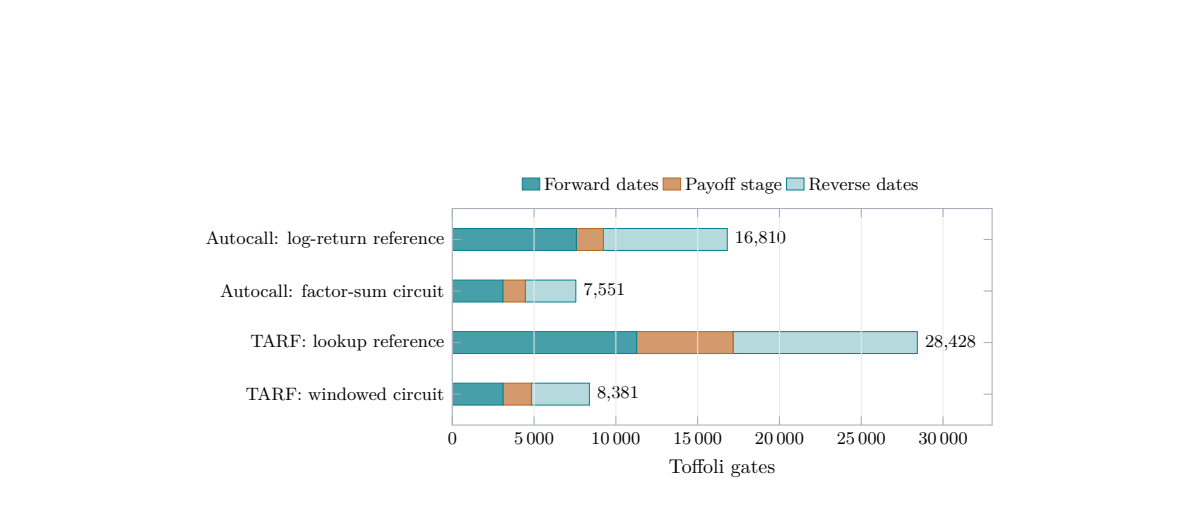
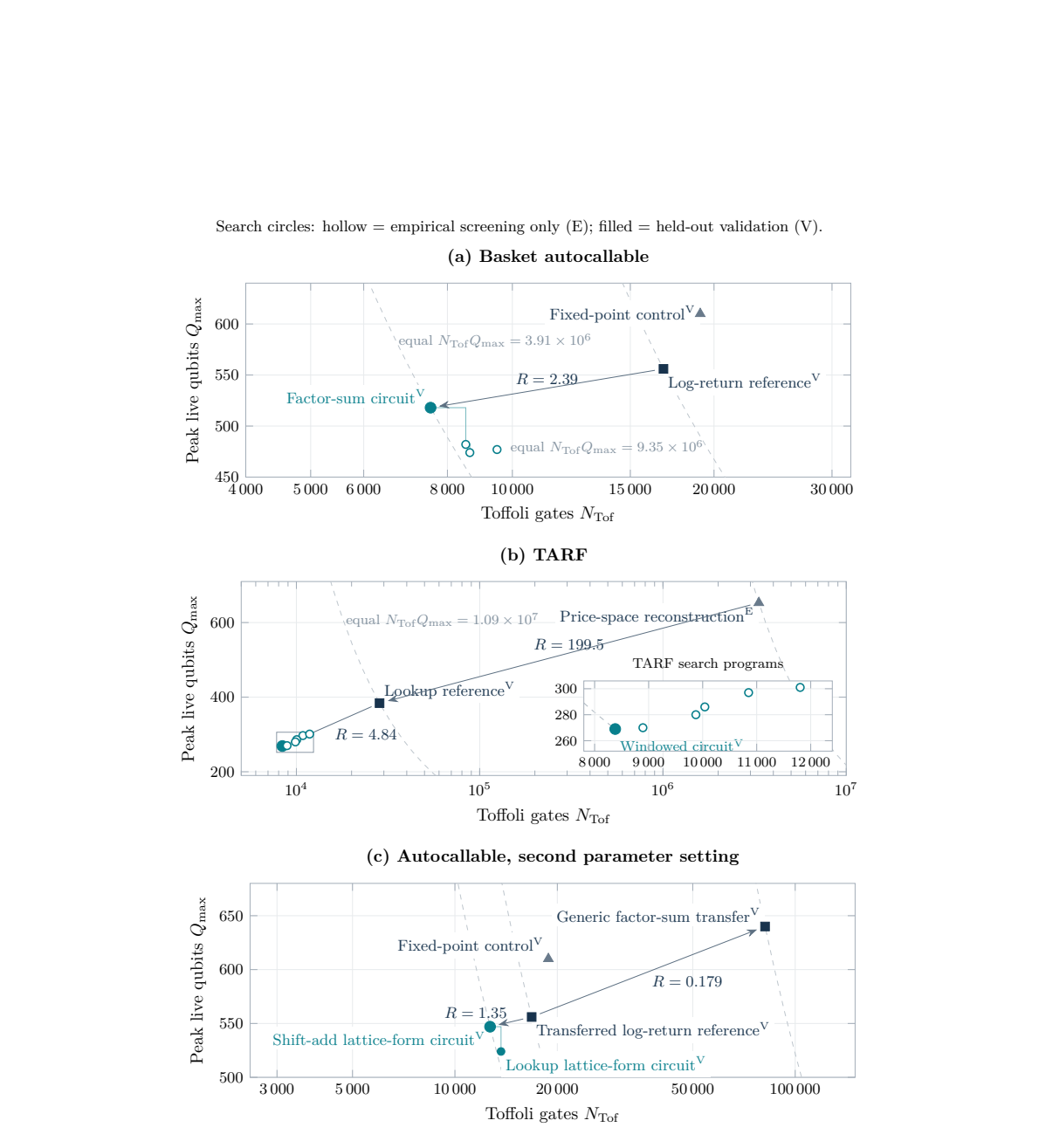
We use language-model-assisted circuit design to reduce reversible payoff arithmetic for a three-asset worst-of autocallable and a target accrual redemption forward (TARF). The constructions retain compact integer representations of market paths alongside contract history, reconstructing quantities temporarily for contract decisions and payoff-angle evaluation. Relative to matched internal references, the factor-sum autocallable and windowed TARF circuits reduce the product of Toffoli count and peak logical qubits (NTofQmax) by factors of 2.39 and 4.84, respectively. At a second autocallable setting, fresh search recovers a 1.35-fold saving after the tested fixed adaptation loses its advantage. For the factor-sum circuit, we prove exact coherent execution of its integer specification for every input, incoming accumulator and measurement record, with clean workspace and phase cancellation. A separate lattice calculation gives a numerical angle-tolerance-violation probability of 6.248e-8 and evaluates pricing bias under the declared loading law, with bounded omission but no certified numerical enclosure. The results connect compact representations to lower-cost payoff arithmetic and separately assessed logical and financial correctness. Their resource scope excludes loading, payoff rotation and estimation.
from the abstract
Pith says
Machine review · deepseek-v4-flash · 4 Nov 2026 · what was read was not recorded · not checked by a person
It can be wrong. Challenge this review or reply to it.
Holds up, with conditions. The headline savings check out against the paper's own tables and the retained-state constructions are genuinely new for this domain; the real caveat is that Theorem 1's "for every input" is a computational certificate resting on the authors' asserted tape segmentation and on internally built references. This line is wrong
2 major objections · 3 minor
How often objections from reviews like this one are right: not yet measured
Not checked: figures, code, what the 26 references say.
The paper says, at Section 5.1, Theorem 1 (Eq. 21); Appendix B.3
The review did not quote this passage.
Pith says: Objection 1 of 2 · major
The 'for every input' conclusion of Theorem 1 is conditioned on a tape segmentation that is asserted rather than mechanically verified. The proof composes 92 local lemmas (Table 10) across cuts 'between dates, where only three ten-bit index sums, the knock-in counter and call counters persist,' and the trusted-infrastructure list explicitly includes 'tape segmentation asserted against the secure tape.'
more of objection 1
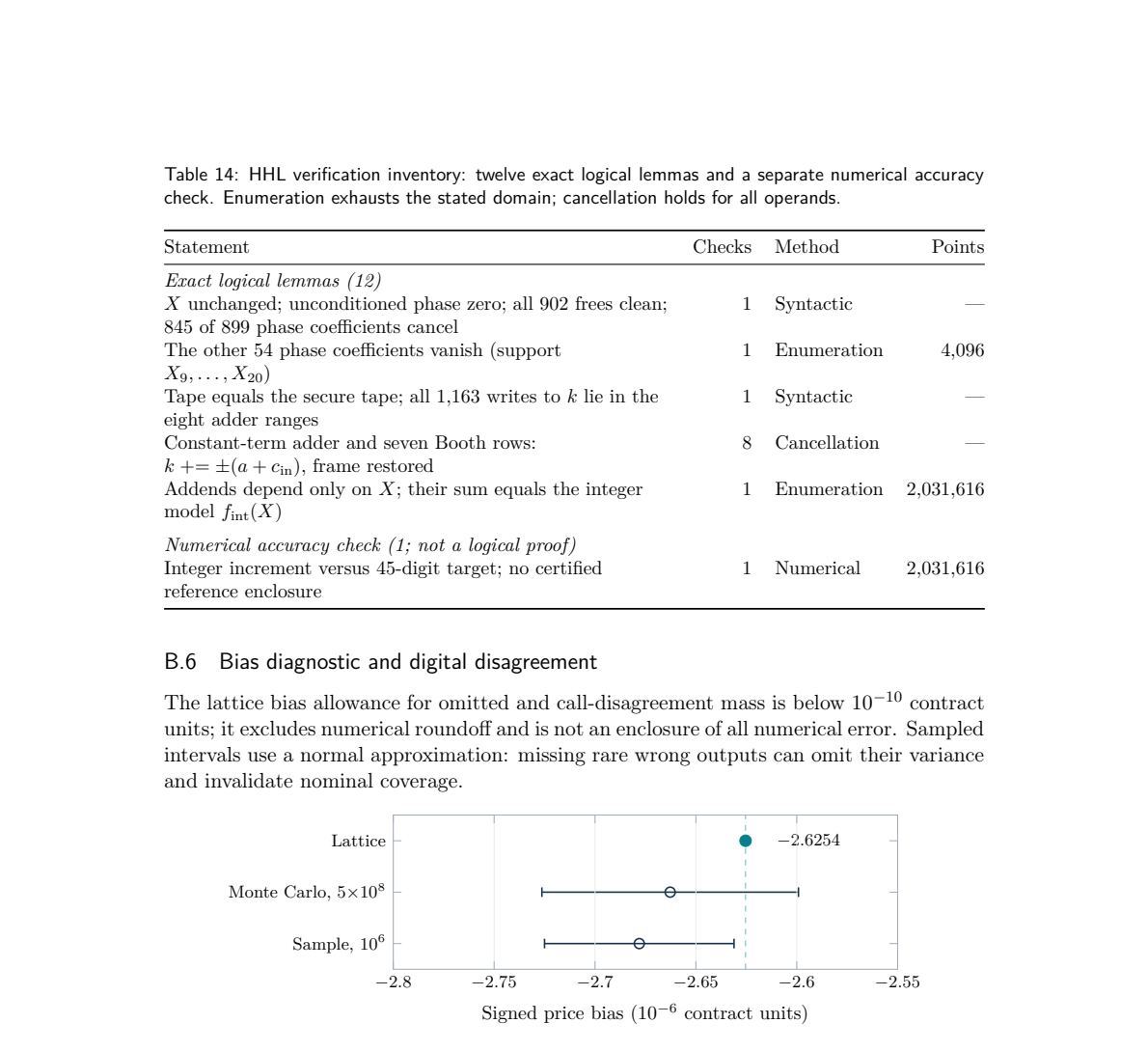
Composition is valid only if the cuts tile the 259,386-operation tape with no gaps, overlaps, or misattributed operations, and the described support checks catch a mis-segmented block only when its outputs depend on undeclared qubits; a gap whose operations' outputs are overwritten before the next cut would pass unnoticed, in which case Theorem 1 and the lattice evaluation in Eq. (23) would describe a map different from the actual circuit. Because this is the load-bearing step for the paper's strongest claim, I ask that the revision add a mechanical audit: parse T_F3, verify that the 92 cut points partition the tape exactly once, verify per-segment quantum support against the declared cut-point registers, and re-run the support checks on the audited partition. I am not asking for a proof-assistant formalization, which would be disproportionate; I am asking for a check of the one assertion that currently has no external anchor. If such an audit is not feasible, the abstract and Theorem 1 must state the conditioning explicitly rather than asserting 'for every input.'
The paper says, at Sections 5.1 and D (artifact manifest)
The review did not quote this passage.
Pith says: Objection 2 of 2 · major
The artifact manifest is the authority for the frozen 292-quadruple coefficient dataset, the asserted segmentation, the certificate inventory, the numerical records, and the audit metadata, but the manuscript provides no public link, repository URL, or commit hash. Because the paper states that the literal thresholds and frozen coefficients are authoritative and not to be regenerated from the generation formulas, an …
more of objection 2
… external reader cannot currently reconstruct or audit the object that Theorem 1 is about, and the mechanical segmentation audit requested above cannot be performed. Please deposit the versioned artifact (gate tape, segmentation, certificate inventory, lattice records, audit metadata) in a permanent public archive and cite its DOI or commit hash in the final version.
3 minor objections
The paper says, at Table 2 and Section 4.2
Pith says: minor objection 1 of 3
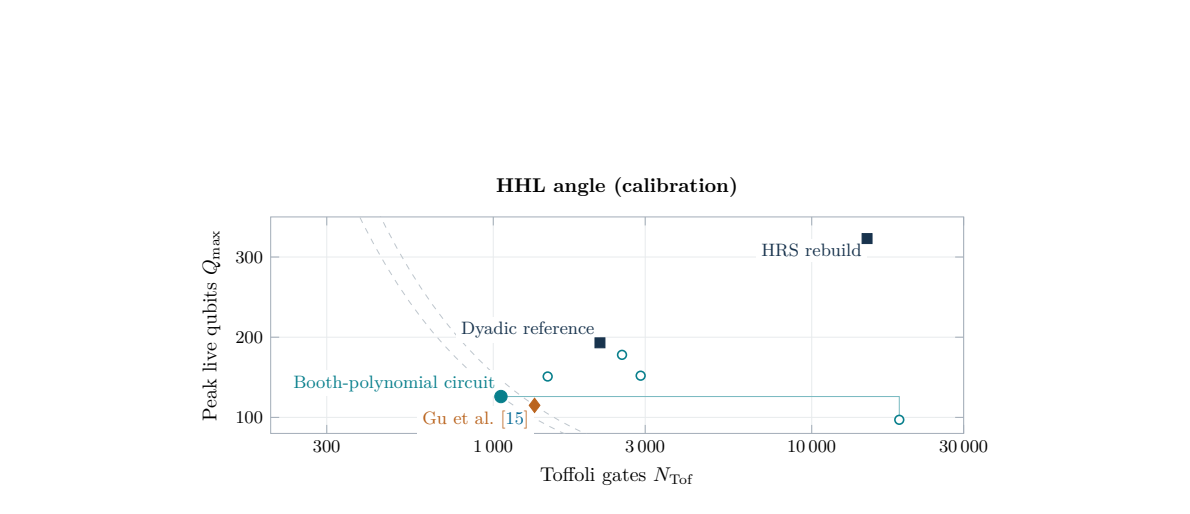
Since the 2.39x and 4.84x ratios are the headline quantitative claims, a short supplementary table placing the matched internal references alongside published component estimates (e.g., Chakrabarti et al. [4]) with the stated boundary adjustments would help readers gauge how representative the baselines are; the current text confines this to the remark that published boundaries are unmatched.
The paper says, at Figure 6(a) and Section 5.2
Pith says: minor objection 2 of 3
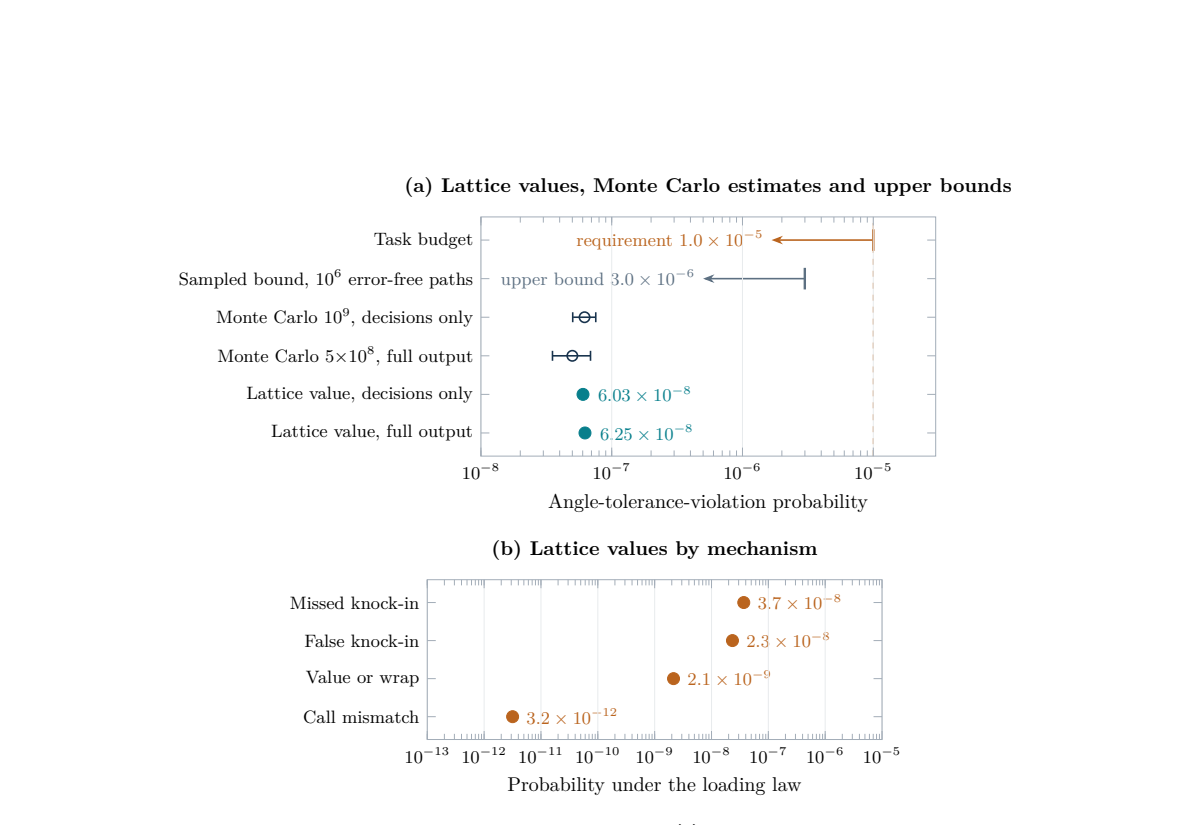
The Monte Carlo point estimates behind the hollow symbols (5x10^8 full-output and 10^9 decisions-only studies) are not stated numerically in the text; reporting the point estimates and their 95% intervals explicitly would let readers verify the claimed agreement with the lattice values.
show 1 more
The paper says, at Appendix B.4.3
Pith says: minor objection 3 of 3
The statement that the a priori relative-roundoff estimate is 'far below 10^-8' would be more useful as a quantitative expression (operation count, unit roundoff, and a bound on the sum), and the reported minimum decision margin of 4.3e-8 and gap-to-tolerance of 2e-3 are asserted without a derivation of how they support the numerical classification.
What would settle it
On the released artifact (frozen tape F3-001-ccd3 and manifest), independently reconstruct the asserted cuts — 20 date blocks, terminal S1/S2, eight accumulator adders — and verify: (i) the segments concatenate to exactly all 259,386 operations, in order, with no gaps or overlaps; (ii) each boundary's live-qubit set equals exactly the declared retained state (three 10-bit sums, 5-bit knock-in counter, five 2-bit call counters), with reconstructed words cleared; (iii) each segment's I/O signature matches its declared cut-point registers; performed by a script independent of the authors' segmentation code. If tiling fails, Theorem 1's 'for every input' does not cover the real tape and the 6.248e-8 lattice value must be recomputed for the true action. If it passes, the segmentation concern closes, leaving the semantics base, which the DRAT checker and kickmix replay already anchor.
from the skeptic's reading
How the review went
4 readings by deepseek-v4-flash · 4 Nov 2026
- Reader holds up, with conditions
- Skeptic agrees
- Editor wrote the verdict above
- Referee major revision: 2 major objections, 3 minor
Not run on this paper: the simulated authors' defence.
Pith did not check this review's objections against the paper.
The review in full
The review in brief, machine-written
Read this one before the coffee gets cold — it's worth a real referee, and the conditional verdict is the right shape. The 2.39x and 4.84x reductions in N_Tof·Q_max re-derive cleanly from the reported stage and count tables, and the second-setting story is a genuine result: the fixed transfer fails, they notice, and fresh bounded search recovers 1.35x. The retained-state principle — keep exact integer index sums plus contract history, reconstruct weighted forms only at decision dates — is the genuinely new idea for this domain, and the windowed TARF accrual identity is a neat piece of arithmetic narrowing.
Strongest element: Theorem 1, an all-input coherent-action certificate for a 259,386-operation, 7,437-measurement circuit, composed from 92 local lemmas, with clean workspace and phase cancellation. That is well beyond what most LLM-designed-circuit papers deliver, which usually stop at empirical screening. The paper also does something rare: it separates exact implementation of the declared integer model from financial agreement with the real contract, and reports both. The lattice pfail of 6.248e-8 and the −2.6e-6 contract-unit bias come with bounded omission, no certified enclosure, and an honest statement that the million-path sample interval misses the lattice value.
Soft spots, in proportion. The sharpest: Theorem 1's "for every input" rests on tape segmentation the authors assert, with no independent audit. The stress-test concern is real — a gap whose outputs are overwritten before the next cut would pass unnoticed — but it is disclosed in Section 5.1, and there are partial external anchors: the Qualtran kickmix conversion reproduces counts and bit-for-bit outputs, independent-simulator replays agree on 106 inputs, and the SAT refutations go through an independent DRAT checker. I read this as a justified trust boundary, not a hidden flaw; still, the abstract's unconditional "prove exact coherent execution" outruns the certificate. Second: the headline savings are ratios against internally built references, not published baselines — acknowledged, with the HHL comparison against the published best point as a partial external check. Third: windowed TARF correctness is statistical plus conditional mechanism bounds, with the cap-tie containment explicitly unproved. Minor: the artifact manifest has no public link or commit hash.
Citations look fine; the provenance section is unusually candid about shared TARF lineage and protocol deviations. Who this is for: anyone building derivative-pricing oracles, and anyone thinking about what verification evidence for LLM-designed circuits should look like. Send it to referees; the conditional verdict is the right call — plausible, internally consistent, and checkable once the artifact and an external baseline land.
The strongest objection
The central claim's strongest element is Theorem 1: the frozen tape T_F3 (259,386 operations, 7,437 measurements) realizes U_Δ|z⟩|θ⟩|0⟩ = |z⟩|θ+Δ(z) mod 2^22⟩|0⟩ for every z and θ, with clean workspace and phase cancellation. The proof composes 92 local lemmas (Table 10) cut 'between dates, where only three ten-bit index sums, the knock-in counter and call counters persist.' Section 5.1 lists 'tape segmentation asserted against the secure tape' among the trusted infrastructure. That assertion is the least-audited load-bearing input: composition is valid only if the asserted segments tile the entire tape with no gaps, overlaps, or misattributed operations, and each boundary's live registers match the declared retained state. Support checks catch a mis-segmented block only when its outputs depend on undeclared qubits; a gap whose operations' outputs are overwritten before the next cut would pass unnoticed. If the segmentation diverges, 'for every input' covers the wrong map, and the headline pfail ≈ 6.248e-8 — computed for the model Δ (Section 5.2, Eq. (23)) — becomes the financial error of a different circuit. The rest of the trusted base has partial external anchors (independent DRAT checker; Qualtran kickmix conversion reproducing counts and bit-for-bit outputs; independent-simulator replays on 10^6 inputs); the segmentation has none, and the artifact manifest is cited without a public link or commit hash. The paper discloses this ('computational certificate, not a proof-assistant formalization'), but the abstract's unconditional 'prove exact coherent execution of its integer specification for every input' makes the certificate load-bearing.
The paper's central claim has three nested parts: (1) component-level resource reductions of 2.39x and 4.84x against matched internal references; (2) Theorem 1, an all-input exact coherent-action certificate for the factor-sum tape; (3) a numerical lattice probability pfail ≈ 6.248e-8 that the proved map misses the angle tolerance. I re-derived the ratios from Table 2 and the stage sums in Table 7; they are internally consistent, and the paper scopes them honestly ('matched internal references', complete-pricing comparison excluded). Part (3) is corroborated by a 5x10^8-path Monte Carlo and a zero-in-10^6 95% bound (~3e-6, below the 1e-5 budget), and its exact value is far below budget, so even a materially wrong pfail would not flip the financial conclusion. The load-bearing link is part (2): the abstract states 'we prove exact coherent execution of its integer specification for every input, incoming accumulator and measurement record,' and part (3) presupposes that the tape implements the model Δ. The certificate's local checks (92 lemmas; enumeration and cancellation; DRAT-verified refutations) are substantial and partly externally anchored, but the one element with no such anchor is the tape segmentation, which Section 5.1 explicitly lists as 'asserted against the secure tape'; composition over segments requires exact tiling with correct boundary signatures. A gap whose operations' outputs are overwritten before the next cut would pass the support checks while removing those operations from the proof's coverage. This is a real but checkable risk, not a demonstrated failure, and the paper discloses the certificate's nature. A second candidate — the windowed TARF's unproved cap-tie containment (Appendix C.3) and lack of an all-input proof — is also real but backstopped by the direct million-path holdout (95% upper bound 2.99573e-6), so its failure would weaken the TARF narrative without overturning the 4.84x resource claim, which rests on counts rather than on the containment. The reader's weakest_assumption identifies the same certificate concern; my read sharpens it to the tiling property and adds the public-artifact-access condition. Net: the CONDITIONAL verdict stands. The concern does not move the verdict because it is concrete, checkable, disclosed, and the surrounding trusted base carries several independent checks; but 'for every input' should not be treated as settled without the segmentation tiling check against the released tape.
The referee's report
If the claims hold, this is a useful and unusually carefully verified contribution to arithmetic-based quantum derivative pricing. The headline ratios are internally consistent with the reported stage counts, and the factor-sum construction demonstrates that compact integer-state representations can be both resource-competitive and exactly verifiable at the circuit-semantics level, with a separate numerical evaluation of the financial approximation error. Concrete strengths to credit: the DRAT-checked symbolic and structural certificates, the Qualtran kickmix conversion that reproduces counts and bit-for-bit outputs, independent-simulator replays on 10^6 inputs, and independent 60/90-digit reference holdouts. The paper also reports negative results honestly (the fixed-point control loses in the original setting; the generic factor-sum transfer loses at the second setting), and the TARF identity of Eq. (18) is a clean, parameter-free algebraic reduction.
Pith's reading of the paper (a machine's summary, not the authors')
In quantum amplitude estimation, every oracle call must be executed coherently, so the reversible arithmetic that maps market paths to payoff angles is the expensive part of a pricing circuit. This paper claims that what a circuit retains between monitoring dates matters more than how it implements any single date: an autocallable circuit that keeps only exact ten-bit cumulative index sums, rebuilding the weighted forms needed for barrier and call decisions temporarily, costs 2.39 times less in the product of Toffoli gates times peak qubits than a matched fixed-point log-return reference, and a windowed TARF circuit that narrows its lookups to one seven-bit index window costs 4.84 times less than its lookup reference. The paper further proves, on its declared gate and measurement semantics, that the factor-sum circuit computes exactly its specified integer angle increment for every encoded path, incoming accumulator and measurement record, with clean workspace and cancelled phases. It is explicit that the exact integer action is not financial accuracy: a separate recombining lattice calculation puts the probability of exceeding the $10^{-5}$ rad angle tolerance at about $6.25\times 10^{-8}$ under the declared loading law. The reported savings are ratios against internally constructed references, deliberately excluding loading, payoff rotation and estimation.
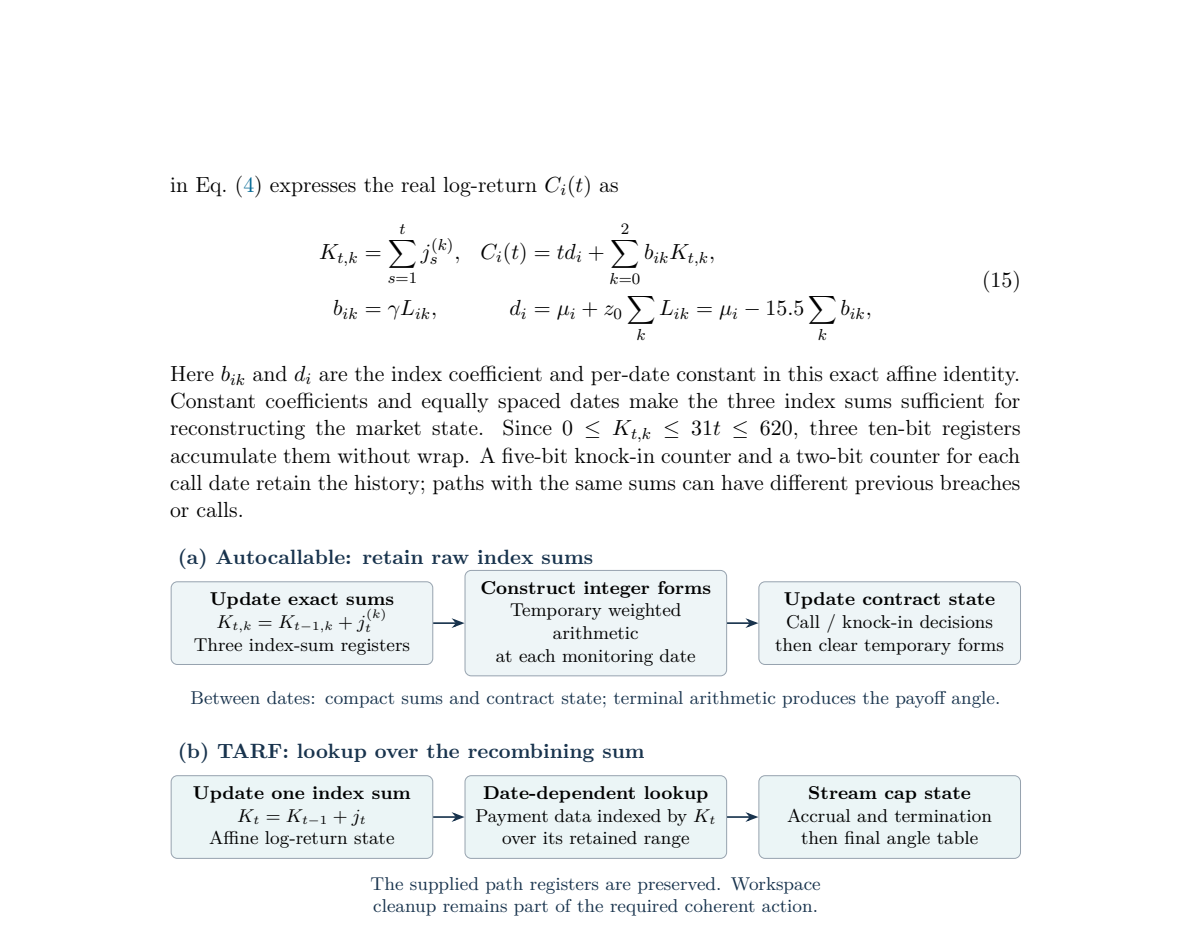
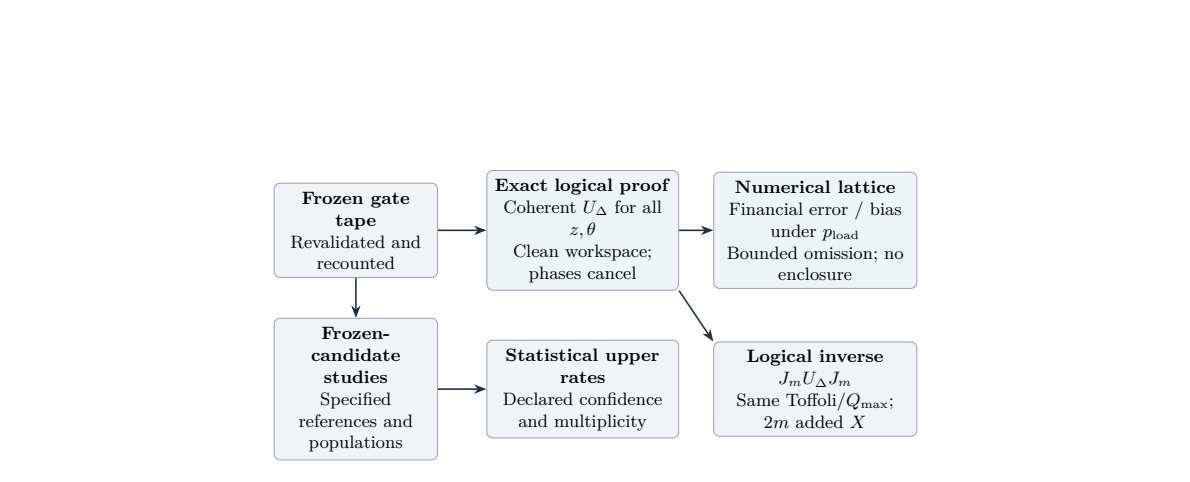
What carries the argument. The carrying object is the pair of exact identities that make the retained state recombine. For the autocallable, the affine index-sum identity $C_i(t) = t d_i + \sum_k b_{ik} K_{t,k}$ turns three ten-bit cumulative counters into a full description of the market state, and the circuit tests barriers and calls by comparing temporary integer forms $F_i = q K_{t,0} + p K_{t,1} + r_f K_{t,2}$ (and variants) against precomputed integer thresholds $\tau_i(t,\ell)$; the amplitudes of the coefficients approximate the asset correlations while accumulation stays exact. Those weighted sums are evaluated by column reduction, in which shifted copies of existing qubits feed parity bits and only nonlinear carries allocate new qubits, forming a 'virtual register' that can be cleaned by measurement, with the induced phases cancelled by Clifford corrections. For the TARF the load-bearing identity is $f_{\mathrm{disc}} = P_{\mathrm{full}} + Y - d_\tau E$ with $\lvert Y\rvert < 11$, which replaces a wide discounted-payment accumulator with shifted accrual plus a narrow discount correction and restricts the lookup address to a date-dependent seven-bit window. The third ingredient is compositional verification: the tape is cut between dates where only the index sums, the knock-in counter and the call counters persist, which is what lets local exhaustive checks compose into the 'for every input' theorem.
Core claim. The paper's central claim is that compact, exactly updated market state plus temporary reconstruction of decision quantities gives reversible payoff arithmetic that is both cheaper and easier to verify than carrying wide fixed-point path registers. Because the benchmark models use constant coefficients, uniform time steps and an equally spaced index grid, each asset's log return is an exact affine function $C_i(t) = t d_i + \sum_k b_{ik} K_{t,k}$ of the raw cumulative index sums $K_{t,k} = \sum_{s\le t} j_s^{(k)}$; the factor-sum autocallable therefore keeps three ten-bit counters plus contract history and materializes integer forms $F_i$ only at the moments they are needed for barrier or call comparisons, then clears them. Theorem 1 states that the frozen gate tape realizes $U_\Delta \lvert z\rangle \lvert\theta\rangle \lvert 0\rangle = \lvert z\rangle \lvert \theta + \Delta(z) \bmod 2^{22}\rangle \lvert 0\rangle$ for every encoded path, every incoming 22-bit accumulator and every measurement record, an all-input statement obtained by composing 92 enumerated or symbolically cancelled lemmas. For the TARF, an exact real-arithmetic identity rewrites the discounted payoff as a full payment sum plus a bounded discount correction minus one cap-date excess, so the circuit retains shifted accrual and a narrow correction instead of a wide discounted total, and its lookup address narrows to seven bits. The authors also report that at a second autocallable setting the tested fixed adaptation loses its advantage, while fresh search recovers a 1.35-fold saving, which they present as evidence of parameter dependence and of recovery, not of a generally transferable construction.
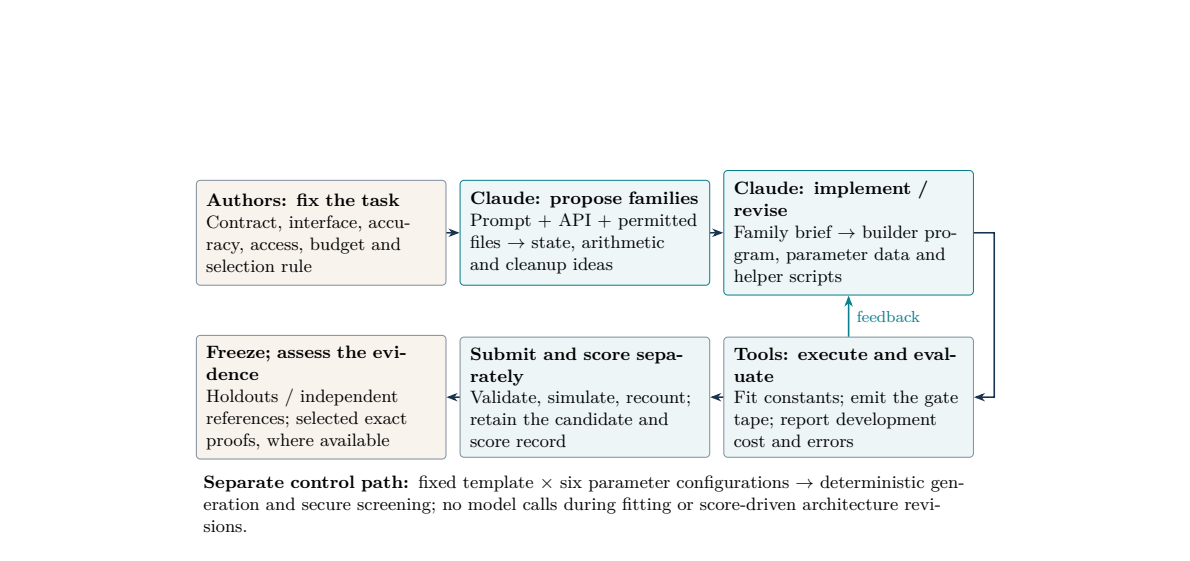
The premise it rests on. The all-input proof of Theorem 1 is a computational certificate built on the authors' own trusted base: mirrored gate semantics, an asserted tape segmentation, their symbolic and bitsliced evaluators, Python/NumPy, and a Tseitin encoding checked by an independent DRAT checker, so if the asserted segmentation or semantics does not match the actual frozen tape, the 'for every input' conclusion would not cover the real circuit; separately, the headline 2.39-fold and 4.84-fold savings are ratios against the authors' own internally constructed references rather than published external baselines.
If the paper is right (Pith's inferences, not the authors')
Inside an amplitude-estimation pricing pipeline, the arithmetic that must run per oracle call, before loading, rotation and estimation are added, is 2.39 times cheaper for the worst-of autocallable and 4.84 times cheaper for the windowed TARF in the gate-count times peak-qubit metric, easing the dominant coherent-arithmetic burden.
Because the factor-sum circuit provably implements its declared integer model, the remaining pricing error is a quantified numerical phenomenon rather than an implementation ambiguity: the lattice puts the angle-tolerance-violation probability near $6.25\times 10^{-8}$ and the signed bias near $-2.6\times 10^{-6}$ contract units.
Accumulator complementation gives a logical inverse for the proved additive action with unchanged Toffoli count and peak qubits, supplying the backward step that controlled amplitude-estimation oracles need.
The parameter-transfer result implies the savings are not a universal template: a generic transfer of the factor-sum construction was 5.58 times worse at the second setting, and fresh bounded search was needed to recover a 1.35-fold product saving.
As an editorial extension, the general recipe, retain the minimal exact state on which the payoff recombines and reconstruct everything else temporarily, should transfer to any contract whose payoff is an affine or low-degree function of a few additive path quantities; a natural test is whether similar savings survive finer grids, more factors, or non-uniform time steps that break exact affinity.
The TARF result suggests that shrinking lookup address width via a recombining sum is at least as powerful as local gate optimization, since the four-fold-plus gap came from a seven-bit window; this invites analogous date-dependent windows with bounded alias events for other path-dependent contracts.
Formalizing the 92-lemma certificate inside an interactive proof assistant would upgrade the 'for every input' claim from a computational certificate to a machine-checked theorem; the hard steps would be auditing the mirrored gate semantics and the asserted tape segmentation, exactly the two components the paper names as trusted rather than proved.
If the lattice probability near $6\times 10^{-8}$ is reliable, the digital-angle interface is not the dominant error channel for these benchmarks; a complete-pricing experiment should budget discretization, loading, rotation and estimation error first, since those blocks are explicitly outside the paper's resource claims.
Check this review
Pith stored no record of this review's passes and took no fingerprint of it. Reviews made by code from 13 Nov 2026 on carry both.
How often reviews like this one are right
Reviews like this one: written by deepseek-v4-flash, where what was read was not recorded.
How often objections from reviews like this one are right: not yet measured
Reviews by people
This review was written by a machine. No person has reviewed this paper on Pith yet. A scientist listed on Pith can review it for a fee, and their review is published here whatever it concludes.
The paper
Abstract
Quantum amplitude estimation can estimate expected discounted payoffs with quadratically fewer oracle calls than Monte Carlo, but each call requires coherent computation. We use language-model-assisted circuit design to reduce reversible payoff arithmetic for a three-asset worst-of autocallable and a target accrual redemption forward (TARF). The constructions retain compact integer representations of market paths alongside contract history, reconstructing quantities temporarily for contract decisions and payoff-angle evaluation. Relative to matched internal references, the factor-sum autocallable and windowed TARF circuits reduce the product of Toffoli count and peak logical qubits (NTofQmax) by factors of 2.39 and 4.84, respectively. At a second autocallable setting, fresh search recovers a 1.35-fold saving after the tested fixed adaptation loses its advantage. For the factor-sum circuit, we prove exact coherent execution of its integer specification for every input, incoming accumulator and measurement record, with clean workspace and phase cancellation. A separate lattice calculation gives a numerical angle-tolerance-violation probability of 6.248e-8 and evaluates pricing bias under the declared loading law, with bounded omission but no certified numerical enclosure. The results connect compact representations to lower-cost payoff arithmetic and separately assessed logical and financial correctness. Their resource scope excludes loading, payoff rotation and estimation.
The paper's own sentences, arranged, kept beside the review and separate from it. Each label is drawn from a closed vocabulary; the number beside it is the probability the classifier gave that label. No sentence in this record was written by a model.
abstract compiled · 2026-11-04
The authors' main claim, as the classifier picked it out 0.60
“Relative to matched internal references, the factor-sum autocallable and windowed TARF circuits reduce the product of Toffoli count and peak logical qubits $(N_{Tof} Q_{max})$ by factors of 2.39 and 4.84, respectively.”
How the main claim is stated: asserted 1.00
What the abstract itself states, as probabilities: claims first 0.04 · states limitation 0.96 · human participants 0.02 · controlled comparison 0.55 · randomized assignment 0.01 · states quantitative result 0.99 · compares with prior results 0.89 · mentions code or data availability 0.03
The abstract, sentence by sentence
This table labels the abstract only (arXiv listing abstract v1). The number is the probability the classifier gave the label.
| Sentence | Role | The authors' own work | States the main conclusion | Strength |
|---|---|---|---|---|
| Quantum amplitude estimation can estimate expected discounted payoffs with quadratically fewer oracle calls than Monte Carlo, but each call requires coherent computation. | background 1.00 | 0.06 | 0.04 | asserted 1.00 |
| We use language-model-assisted circuit design to reduce reversible payoff arithmetic for a three-asset worst-of autocallable and a target accrual redemption forward (TARF). | contribution 0.59 | 0.95 | 0.12 | asserted 1.00 |
| The constructions retain compact integer representations of market paths alongside contract history, reconstructing quantities temporarily for contract decisions and payoff-angle evaluation. | method 0.99 | 0.88 | 0.07 | asserted 1.00 |
| Relative to matched internal references, the factor-sum autocallable and windowed TARF circuits reduce the product of Toffoli count and peak logical qubits $(N_{Tof} Q_{max})$ by factors of 2.39 and 4.84, respectively. | result 1.00 | 0.94 | 0.53 | asserted 1.00 |
| At a second autocallable setting, fresh search recovers a 1.35-fold saving after the tested fixed adaptation loses its advantage. | result 0.99 | 0.93 | 0.06 | asserted 1.00 |
| For the factor-sum circuit, we prove exact coherent execution of its integer specification for every input, incoming accumulator and measurement record, with clean workspace and phase cancellation. | result 0.78 | 0.95 | 0.11 | asserted 1.00 |
| A separate lattice calculation gives a numerical angle-tolerance-violation probability of 6.248e-8 and evaluates pricing bias under the declared loading law, with bounded omission but no certified numerical enclosure. | result 0.58 | 0.91 | 0.06 | asserted 1.00 |
| The results connect compact representations to lower-cost payoff arithmetic and separately assessed logical and financial correctness. | interpretation 0.98 | 0.83 | 0.51 | asserted 1.00 |
| Their resource scope excludes loading, payoff rotation and estimation. | limitation 1.00 | 0.51 | 0.06 | asserted 1.00 |
What kind of paper the classifier reports this is: method or tool 1.00 · evidence from simulation or computation 0.73
What was examined, and what was not
Sources read
- arXiv listing abstract v1
Not examined
- full text
- figures and tables
- references and citing sentences
- relations to other papers
Levels run
- P abstract
Not run
- S sections
- T body sentences
- C citations
- R cross-paper relations
How the labels were made
Compiled by classifier-1.13.0 via TypeSafe API, question bank abstract-p1-20260923, 2026-11-04: 1 request, 6,962 input tokens.
Every quoted sentence on this record is the authors'. Every label is from Pith's closed vocabulary, with the probability shown beside it. This record as JSON
Figures (8)
Figures are the authors', reproduced from the paper.
References (26)
- [1] A. Montanaro. Quantum speedup of Monte Carlo methods.Proc. R. Soc. A, 471: 20150301, 2015. DOI: 10.1098/rspa.2015.0301 on Pithdoi:10.1098/rspa.2015.0301
- [2] P. Rebentrost, B. Gupt, and T. R. Bromley. Quantum computational finance: Monte Carlo pricing of financial derivatives.Phys. Rev. A, 98:022321, 2018. DOI: 10.1103/PhysRevA.98.022321 on Pithdoi:10.1103/physreva.98.022321
- [3] N. Stamatopoulos, D. J. Egger, Y. Sun, C. Zoufal, R. Iten, N. Shen, and S. Woerner. Option pricing using quantum computers.Quantum, 4:291, 2020. DOI: 10.22331/q- 2020-07-06-291 on Pithdoi:10.22331/q-
- [4] S. Chakrabarti, R. Krishnakumar, G. Mazzola, N. Stamatopoulos, S. Woerner, and W. J. Zeng. A Threshold for Quantum Advantage in Derivative Pricing.Quantum, 5:463, 2021. DOI: 10.22331/q-2021-06-01-463 on Pithdoi:10.22331/q-2021-06-01-463
- [5] G. Wang and A. Kan. Option pricing under stochastic volatility on a quantum com- puter.Quantum, 8:1504, 2024. DOI: 10.22331/q-2024-10-23-1504 on Pithdoi:10.22331/q-2024-10-23-1504
- [6] N. Stamatopoulos and W. J. Zeng. Derivative Pricing using Quantum Signal Process- ing.Quantum, 8:1322, 2024. DOI: 10.22331/q-2024-04-30-1322 on Pithdoi:10.22331/q-2024-04-30-1322
- [7] F. Cibrario et al. Autocallable Options Pricing with Integration-Based Exponen- tial Amplitude Loading. In2025 IEEE International Conference on Quantum Com- puting and Engineering (QCE), volume 1, pages 2459–2469. IEEE, 2025. DOI: 10.1109/QCE65121.2025.00267 on Pithdoi:10.1109/qce65121.2025.00267
- [8] S. Herbert. Quantum Monte Carlo integration: the full advantage in minimal circuit depth.Quantum, 6:823, 2022. DOI: 10.22331/q-2022-09-29-823 on Pithdoi:10.22331/q-2022-09-29-823
- [9] S. McArdle, A. Gilyén, and M. Berta. Quantum state preparation without coherent arithmetic.Phys. Rev. Lett., 136:240603, 2026. DOI: 10.1103/ntvs-c48s on Pithdoi:10.1103/ntvs-c48s
- [10] C. Gidney. Halving the cost of quantum addition.Quantum, 2:74, 2018. DOI: 10.22331/q-2018-06-18-74 on Pithdoi:10.22331/q-2018-06-18-74
- [11] R. Babbush, C. Gidney, D. W. Berry, N. Wiebe, J. McClean, A. Paler, A. Fowler, and H. Neven. Encoding electronic spectra in quantum circuits with linear T complexity. Phys. Rev. X, 8:041015, 2018. DOI: 10.1103/PhysRevX.8.041015 on Pithdoi:10.1103/physrevx.8.041015
- [12] D. W. Berry, C. Gidney, M. Motta, J. R. McClean, and R. Babbush. Qubitization of arbitrary basis quantum chemistry leveraging sparsity and low rank factorization. Quantum, 3:208, 2019. DOI: 10.22331/q-2019-12-02-208 on Pithdoi:10.22331/q-2019-12-02-208
- [13] T. Häner, M. Roetteler, and K. M. Svore. Optimizing Quantum Circuits for Arith- metic. arXiv:1805.12445, 2018 on PithPith's reviewarXiv
- [14] W.J.ZengandR.Krishnakumar. UsingQ#toestimateresourcesneededforquantum advantage in derivative pricing. Microsoft Azure Quantum Blog, September 2022. 15 September 2022 on Pith
- [15] A. Gu, A. H. Kemeny, S. F. Yelin, and M. D. Lukin. Discovering state-of-the-art quantum circuits with large language models. arXiv:2610.22367, 2026. 22 on PithPith's reviewarXiv
- [16] A. Novikov, N. V u, M. Eisenberger, et al. AlphaEvolve: A coding agent for scientific and algorithmic discovery. arXiv:2506.13131, 2025 on PithPith's reviewarXiv
- [17] Ryan Babbush, Adam Zalcman, Craig Gidney, Michael Broughton, Tanuj Khattar, Hartmut Neven, Thiago Bergamaschi, Justin Drake, and Dan Boneh. Securing ellip- tic curve cryptocurrencies against quantum vulnerabilities: Resource estimates and mitigations.PRX Quantum, 7(3):031001, ... on Pithdoi:10.1103/j3xf-bw18
- [18] T. Khattar, N. C. Rubin, C. Gidney, M. Broughton, G. H. Low, and R. Babbush. Leveraging verifiable structure in quantum circuits to find more efficient compilations with agentic AI. arXiv:2610.23832, 2026 on PithPith's reviewarXiv
- [19] F. J. R. Ruiz, T. Laakkonen, J. Bausch, et al. Quantum circuit optimization with AlphaTensor.Nat. Mach. Intell., 7:374–385, 2025. DOI: 10.1038/s42256-025-01001-1 on Pithdoi:10.1038/s42256-025-01001-1
- [20] D. Lizzio Bosco, L. Cincio, G. Serra, and M. Cerezo. Quantum Circuit Pre-Synthesis: Learning Local Edits to ReduceT-count. arXiv:2601.19738, 2026 on PitharXiv
show 6 more
- [21] Y. Sim, F. Berto, C. Hua, J. Park, and C. Kwon. LLM-Driven Algorithm Design for Quantum Circuit Synthesis based on Binary Decision Diagrams. arXiv:2609.05327, 2026 on PithPith's reviewarXiv
- [22] K. Jang, H. Kim, H. Seo, and A. Chattopadhyay. Quantum Circuit Optimization with LLMs under a Structured Guideline. IACR Cryptology ePrint Archive, Paper 2026/1446, 2026. URLhttps://eprint.iacr.org/2026/1446 on Pith
- [23] C. S. Wallace. A suggestion for a fast multiplier.IEEE Trans. Electron. Comput., EC-13:14–17, 1964. DOI: 10.1109/PGEC.1964.263830 on Pithdoi:10.1109/pgec.1964.263830
- [24] A. D. Booth. A signed binary multiplication technique.Q. J. Mech. Appl. Math., 4: 236–240, 1951. DOI: 10.1093/qjmam/4.2.236 on Pithdoi:10.1093/qjmam/4.2.236
- [25] O. L. MacSorley. High-speed arithmetic in binary computers.Proc. IRE, 49:67–91, on Pith
- [1961] DOI: 10.1109/JRPROC.1961.287779. A Integer models and arithmetic details A.1 Factor-sum integer model The rules below specify the arithmetic and table interpretation for∆in Theorem 1; the frozen factor-sum coefficient dataset identified by the artifact supplies its 292 indexed... on Pithdoi:10.1109/jrproc.1961.287779
Challenges and discussion
Disagree with the review, or know something it missed? Leave a comment, or challenge this review formally: a challenge becomes a permanent entry in this paper's record, and its decision is published here.
Come back by email
A short list of the week's newly reviewed papers. Nothing is sent until you confirm from your inbox, and every email has a link that stops it. No account.
No comments yet.
Sign in to comment