Differential Geometry · arXiv:2609.06533 v1 · submitted 6 Sep 2026 · 23 references
A Counterexample to Yau's Conjectured Asymptotic Scalar-Curvature Integral Bound
The paper says
“A complete one-ended three-manifold with strictly positive Ricci curvature is constructed such that $$ \limsup_{R\to\infty}\frac1R\int_{B(p,R)} Scal\,dV=+\infty. $$ The construction combines an explicit toric lens carrying a large scalar-curvature integral with a three-dimensional angular pair of pants and an adaptive sequence …”
more of the abstract
… of hybrid blocks.
from the abstract
Pith says
Machine review · deepseek-v4-flash · 10 Sep 2026 · what was read was not recorded · not checked by a person
It can be wrong. Challenge this review or reply to it.
The passes disagreed. Reader: holds up. Skeptic: holds up only with conditions. Referee: reject.
Lemma 2.2 has a concrete numerical error: the printed cap constants don't give the claimed C1 match, and the whole smoothing in Section 2 rests on that match. This line is wrong
1 major objection · 4 minor
How often objections from reviews like this one are right: not yet measured
Not checked: figures, code, what the 23 references say.
The paper says, at Lemma 2.2, (2.9)–(2.10)
The review did not quote this passage.
Pith says: Objection 1 of 1 · major
The piecewise cap–core metric is claimed to be C1 at the transition radius, but the cap formulas (2.9) give f(r_tr)=2+ε^3/2 - 5ε^3/2 + O(ε^6) = 2 - 2ε^3 + …, and f'(r_tr) = -6ε^3/r_tr + … . The core data (2.10) require f(r_tr)=1 and f'(r_tr) = -ε^3/r_tr.
more of objection 1
These do not match; the claimed match to first order is false. This error propagates directly into the smoothing construction of Lemma 2.6, which assumes the common zero and first jet (2.10) and uses the one-sided second jets (2.22) derived from those incorrect data. The cap–core join is therefore not C1, and the smoothing collar cannot be constructed on the printed formulas. All subsequent claims that depend on the high-action lens (Proposition 2.1, Corollary 2.15, the seam comparisons in Section 3, and the block iteration in Section 4) are unsupported.
4 minor objections
The paper says, at Throughout, especially §2
Pith says: minor objection 1 of 4
The notation O_U(·) and ≍_U is used without explicit definition of what constants depend on U; this makes some estimates ambiguous.
The paper says, at Page 5, line before (2.4)
Pith says: minor objection 2 of 4
‘collapsed orbit’ is used before it is defined; consider clarifying earlier.
show 2 more
The paper says, at Appendix A, Proposition A.2
Pith says: minor objection 3 of 4
The proof is a standard Perelman interpolation, but the claim that the Hermite interpolation yields a C1,2 metric is not verified in the presence of tensor-valued data; the formula for h_δ should be checked for the tensor component, not just scalar multiplication.
The paper says, at References
Pith says: minor objection 4 of 4
Reference [19] is listed as arXiv:2608.15505v1; this may not be the final published version. Consider updating if a peer-reviewed version exists.
What would settle it
Recompute the cap jets at r = r_tr using only the printed equations (2.9): compute f(R) and f'(R) with β_cap R^2 = 3ε^3/2 and f_pole = 2 + ε^3/2, and compare them with the values asserted in (2.10). If they are not exactly (1, −ε^3/R), the cap–core join is not C1 and Lemma 2.2 fails as stated. To test whether the proof is repairable, repeat the calculation with f_pole = 1 + ε^3/2 and β_cap R^2 = ε^3/(2 + ε^3); then verify that (2.10), the cap second jets used in Lemma 2.6 Step 1, and the O(ε^3 r_tr) collar action estimate still hold.
from the skeptic's reading
How the review went
4 readings by deepseek-v4-flash · 10 Sep 2026
- Reader holds up
- Skeptic partly agrees: says it holds up only with conditions As printed, Lemma 2.2's cap–core join is not C1: the cap constants in (2.9) give f(r_tr) ≈ 2 − 5ε^3/2 and f'(r_tr) ≈ −6ε^3/r_tr, not the values asserted in (2.10). The smoothing lemma and all downstream blocks rest on this false matching.
- Editor wrote the verdict above
- Referee reject: 1 major objection, 4 minor
Not run on this paper: the simulated authors' defence.
Pith did not check this review's objections against the paper.
The review in full
The review in brief, machine-written
The paper aims to construct a counterexample to Yau's scalar-curvature integral bound, and the general architecture — angular pair of pants, toric lens, companion neck, iterative blocks — is sensible and uses standard gluing technology. If the construction works, it would be a genuinely important result.
But there is a problem in the load-bearing step. Lemma 2.2 claims that the cap and core of the toric lens agree to first order at the transition radius. The printed formulas (2.9) give f_pole = 2 + ε3/2, and (2.10) asserts f = 1 and f' = −ε3/r_tr at the join. Plugging the actual numbers: at r = r_tr, f equals (2 + ε3/2) · (1 − ε3/(2+ε3)), which is about 2, not 1; its derivative is roughly −2ε3/r_tr, not −ε3/r_tr. Remark 2.3 itself says f_pole = 1 + ε3/2, contradicting the displayed value. So the piecewise metric is not C1, and the common first jet (2.10) that Lemma 2.6 starts from does not exist for the given formulas.
This is not a minor typo: the whole smoothing construction and every downstream estimate in Section 2 assumes that first-jet matching. Unless the constants are corrected (the stress-test note shows how), the lens cannot be built as described. The error propagates to Proposition 2.1, Corollary 2.15, and the later attachments. The AI disclosure is irrelevant to the math, but it might explain why the algebra slipped.
For the record: the problem the paper tackles is real, and the iterative idea is imaginative. But a central calculation is simply wrong as printed. I cannot recommend citation or acceptance of this version. However, the approach is plausible enough that a careful revision (fixing the constants and rechecking the algebra) could salvage the result. I would send it to a referee, because the question matters and the architecture is non-trivial; the referee will catch the error and the authors can fix it.
The strongest objection
Let R = r_tr^ε and e = ε^3. The core at x = 1 has (a, f, a', f') = (R, 1, 1, −e/R), as stated in (2.10). But the displayed cap formulas (2.9) give β_cap R^2 = 3e/2 and f_pole = 2 + e/2. At r = R this yields f(R) = (2 + e/2)(1 − 3e/2) = 2 − 5e/2 − 3e^2/4, not f(R) = 1, and f'(R) = −2β_cap f_pole R = −(3e/R)(2 + e/2) = −6e/R − 3e^2/(2R), not f'(R) = −e/R. Thus the assertion in Lemma 2.2 that 'the cap and core agree to first order' is false as written, and the piecewise cap–core metric is not C1. Lemma 2.6 begins from the common first jet (2.10) and the one-sided second jets (2.22), so the smoothing collar cannot be constructed on the printed data. This propagates to Proposition 2.1, Corollary 2.15, the seam comparisons in Section 3, and the block iteration in Section 4. The internal inconsistency is confirmed by Remark 2.3, which requires f_pole = 1 + ε^3/2, contradicting the displayed 2 + ε^3/2 in (2.9). The matching constants that would make (2.10) exact are f_pole = 1 + e/2 and β_cap R^2 = e/(2 + e).
The main theorem is a chain of constructions: Lemma 2.2 supplies the C1 cap–core lens, Lemma 2.6 smooths that join, Lemmas 2.7–2.14 build the high-action packet, Section 3 attaches it via the angular pair of pants and companion neck, and Section 4 iterates blocks. The most load-bearing point is the very first join: if the cap and core do not agree to first order, the smoothing lemma has no valid starting data. The displayed constants in (2.9) and (2.10) are numerically contradictory, and Remark 2.3's pole-flux value f_pole = 1 + ε^3/2 contradicts the f_pole = 2 + ε^3/2 shown in (2.9). This is not a disagreement with the overall strategy; it is an internal check of the printed formulas. Since the required correction appears localized and plausible, I would not reject the paper outright, but it should not be accepted as-is: the cap parameters need to be corrected and the affected estimates in Lemmas 2.2, 2.6, and their downstream corollaries re-verified. The reader's weakest assumption identified the smoothing in Lemma 2.6, which is related but downstream; the failure I find is in the C1 matching that the smoothing is meant to regularize, so my agreement is partial.
The referee's report
A valid counterexample to Yau's long-standing problem would be a major advance in the understanding of scalar-curvature growth under nonnegative Ricci curvature. The result would also resolve the unrestricted one-ended conjecture of Munteanu and Wang. The paper connects to several recent works on volume growth, Collins–Vossen type inequalities, and Naber's local noncollapsing conjecture.
Pith's reading of the paper (a machine's summary, not the authors')
The paper proves that Yau's conjectured asymptotic bound for the scalar-curvature integral fails even under strict positive Ricci curvature. It constructs a complete three-manifold diffeomorphic to ℝ³ where the average scalar curvature over large balls is unbounded. This also disproves a conjecture of Munteanu and Wang. The construction combines explicit toric lenses with high scalar action, an angular pair of pants, and an iterative gluing procedure.
What carries the argument. The central object is a toric lens (C_{ε,U}, g_{ε,U}) constructed from a doubly warped metric. Its boundary is normalized to a prescribed rotational sphere, and it contains a compact set E carrying scalar action proportional to 1/w_{ε,U}, where w_{ε,U} is the waist radius. This lens is inserted into one inner boundary of an angular pair of pants; the other inner boundary receives a companion neck that makes the block an annulus. The whole construction is iterated with increasing packet parameters Q_j.
Core claim. Theorem 1.1 states that there exists a complete one-ended three-manifold (M³,g) with Ric_g > 0 such that for every p∈M, limsup_{R→∞} (1/R)∫_{B(p,R)} Scal_g dV_g = +∞. This contradicts the bound conjectured by Yau and the one-ended case of a conjecture by Munteanu and Wang.
The premise it rests on. The construction relies on Lemma 2.6, which smooths the C¹ join between the lens cap and core while preserving Ricci positivity and a strict lens inequality; the existence of such a smoothing for arbitrarily small packet size ε is load-bearing.
If the paper is right (Pith's inferences, not the authors')
Yau's conjectured integral bound (1.2) fails in dimension three.
In every dimension n≥4, the same failure occurs for manifolds with nonnegative Ricci curvature via product with Euclidean space.
The scalar-curvature integral can grow arbitrarily fast relative to radius on a Ricci-positive manifold.
The construction has asymptotic volume ratio zero, so it does not contradict a conjecture of Naber.
The existence of such manifolds shows that Cohn-Vossen type inequalities do not extend to dimension three without additional assumptions.
The iterative method may be adapted to construct examples with prescribed blow-up rate for the scalar-curvature integral.
The toric lens construction might serve as a building block for other curvature pathologies under positive Ricci curvature.
The dependence on very small parameters suggests that the counterexample is highly delicate and may not survive small perturbations or additional integral bounds.
Check this review
Pith stored no record of this review's passes and took no fingerprint of it. Reviews made by code from 13 Nov 2026 on carry both.
How often reviews like this one are right
Reviews like this one: written by deepseek-v4-flash, where what was read was not recorded.
How often objections from reviews like this one are right: not yet measured
Reviews by people
This review was written by a machine. No person has reviewed this paper on Pith yet. A scientist listed on Pith can review it for a fee, and their review is published here whatever it concludes.
The paper
Abstract
A complete one-ended three-manifold with strictly positive Ricci curvature is constructed such that $$ \limsup_{R\to\infty}\frac1R\int_{B(p,R)} Scal\,dV=+\infty. $$ The construction combines an explicit toric lens carrying a large scalar-curvature integral with a three-dimensional angular pair of pants and an adaptive sequence of hybrid blocks.
The paper's own sentences, arranged, kept beside the review and separate from it. Each label is drawn from a closed vocabulary; the number beside it is the probability the classifier gave that label. No sentence in this record was written by a model.
abstract compiled · 2026-09-23
The authors' main claim, as the classifier picked it out 1.00
“A complete one-ended three-manifold with strictly positive Ricci curvature is constructed such that $$ \limsup_{R\to\infty}\frac1R\int_{B(p,R)} Scal\,dV=+\infty.”
How the main claim is stated: asserted 1.00
What the abstract itself states, as probabilities: claims first 0.07 · states limitation 0.09 · human participants 0.01 · controlled comparison 0.02 · randomized assignment 0.01 · states quantitative result 0.80 · compares with prior results 0.24 · mentions code or data availability 0.02
The abstract, sentence by sentence
This table labels the abstract only (arXiv listing abstract v1). The number is the probability the classifier gave the label.
| Sentence | Role | The authors' own work | States the main conclusion | Strength |
|---|---|---|---|---|
| A complete one-ended three-manifold with strictly positive Ricci curvature is constructed such that $$ \limsup_{R\to\infty}\frac1R\int_{B(p,R)} Scal\,dV=+\infty. | result 0.84 | 0.93 | 0.93 | asserted 1.00 |
| $$ The construction combines an explicit toric lens carrying a large scalar-curvature integral with a three-dimensional angular pair of pants and an adaptive sequence of hybrid blocks. | method 0.99 | 0.89 | 0.06 | asserted 1.00 |
What kind of paper the classifier reports this is: theoretical result 1.00 · evidence from proof or derivation 1.00
What was examined, and what was not
Sources read
- arXiv listing abstract v1
Not examined
- full text
- figures and tables
- references and citing sentences
- relations to other papers
Levels run
- P abstract
Not run
- S sections
- T body sentences
- C citations
- R cross-paper relations
How the labels were made
Compiled by classifier-1.13.0 via TypeSafe API, question bank abstract-p1-20260923, 2026-09-23: 1 request, 2,349 input tokens.
Every quoted sentence on this record is the authors'. Every label is from Pith's closed vocabulary, with the probability shown beside it. This record as JSON
Figures (1)
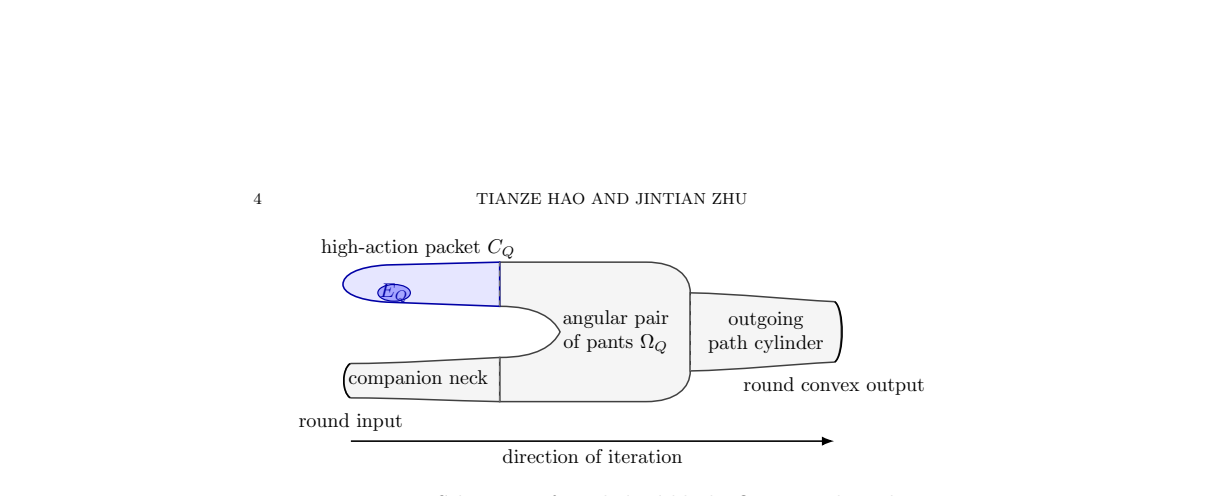
Figures are the authors', reproduced from the paper.
References (23)
- [1] G. Antonelli,Universal volume growth bounds from positive intermediate curvature, arXiv:2608.14507v2, 2026 on PithPith's reviewarXiv
- [2] Z. Chen, G. Xu and S. Zhang,Integrals and rigidity on manifolds with nonnegative Ricci curvature, arXiv:2602.10393v1, 2026 on PitharXiv
- [3] S. Cohn-Vossen,K¨ urzeste Wege und Totalkr¨ ummung auf Fl¨ achen, Compositio Math. 2(1935), 69–133 on Pith
- [4] A. Cucinotta and A. Mondino,On manifolds with almost non-negative Ricci curvature and integrally-positivekth-scalar curvature, Math. Ann.394(2026), Article 49. COUNTEREXAMPLE TO YAU’S SCALAR-CURVATURE CONJECTURE 69 on Pith
- [5] J. Deng,Cohn–Vossen-type inequalities for three-manifolds and locally conformally flat manifolds, arXiv:2606.01368v1, 2026 on PithPith's reviewarXiv
- [6] J. Ge,Heat kernel geometry and Gromov’s volume growth conjecture, arXiv:2608.13553v1, 2026 on PithPith's reviewarXiv
- [7] R. S. Hamilton,The Ricci flow on surfaces, in Mathematics and General Relativity, Contemporary Mathematics71(1988), 237–262 on Pith
- [8] B. Kong and X. Zhu,Positive scalar curvature and volume growth, arXiv:2608.14438v2, 2026 on PithPith's reviewarXiv
- [9] G. Liu,Cohn–Vossen inequality on certain noncompact K¨ ahler manifolds, Math. Z. 302(2022), 1025–1034 on Pith
- [10] S. Ma,Cohn–Vossen theory for locally conformally flat manifolds, arXiv:2606.13979v2, 2026 on PithPith's reviewarXiv
- [11] O. Munteanu and J. Wang,Sharp integral bound of scalar curvature on3-manifolds, arXiv:2505.10520v1, 2025 on PithPith's reviewarXiv
- [12] O. Munteanu and J. Wang,Comparison theorems for3D manifolds with scalar curvature bound, Int. Math. Res. Not. IMRN (2023), no. 3, 2215–2242 on Pith
- [13] A. Naber,Conjectures and open questions on the structure and regularity of spaces with lower Ricci curvature bounds, SIGMA16(2020), Paper No. 104 on Pith
- [14] G. Perelman,Construction of manifolds of positive Ricci curvature with big volume and large Betti numbers, in Comparison Geometry, MSRI Publications30, Cambridge University Press, 1997, 157–163 on Pith
- [15] A. Petrunin,An upper bound for the curvature integral, St. Petersburg Math. J.20 (2009), 255–265 on Pith
- [16] W.-X. Shi and S.-T. Yau,A note on the total curvature of a K¨ ahler manifold, Math. Res. Lett.3(1996), 123–132 on Pith
- [17] G. Xu,Integral of scalar curvature on non-parabolic manifolds, J. Geom. Anal.30 (2020), 901–909 on Pith
- [18] G. Xu,Integral of scalar curvature on manifolds with a pole, Proc. Amer. Math. Soc. 152(2024), 4865–4872 on Pith
- [19] N. Wu and Z. Yan,Pr¨ ufer2-group and Milnor’s conjecture on fundamental groups, arXiv:2608.15505v1, 2026 on PithPith's reviewarXiv
- [20] B. Yang,On a problem of Yau regarding a higher dimensional generalization of the Cohn–Vossen inequality, Math. Ann.355(2013), 765–781 on Pith
show 3 more
- [21] S.-T. Yau,Open problems in geometry, in Chern—A Great Geometer of the Twentieth Century, International Press, 1992, 275–319 on Pith
- [22] B. Zhu,Geometry of positive scalar curvature on complete manifold, J. Reine Angew. Math.791(2022), 225–246 on Pith
- [23] B. Zhu,Comparison theorem and integral of scalar curvature on three manifolds, J. Geom. Anal.32(2022), Paper No. 197. Beijing International Center for Mathematical Research, Peking University Email address:haotz@pku.edu.cn Institute for Theoretical Sciences, Westlake Universit... on Pith
Cited by 6 Pith papers
Reviewed papers on Pith that cite this one. The full citation record
- An $L^1$ bound for Ricci curvature on K\"ahler manifolds math.DG · Oct 2026
- Unbounded normalized scalar curvature integrals in dimension four math.DG · Sep 2026
- Integral of Scalar Curvature under Volume Collapse math.DG · Sep 2026
- Scalar curvature integrals on geodesic balls math.DG · Oct 2026
- Scalar curvature growth on nonnegatively curved three-manifolds math.DG · Sep 2026
- Integral of Scalar Curvature: Sharp Asymptotic Bounds and Rigidity math.DG · Sep 2026
Challenges and discussion
Disagree with the review, or know something it missed? Leave a comment, or challenge this review formally: a challenge becomes a permanent entry in this paper's record, and its decision is published here.
Come back by email
A short list of the week's newly reviewed papers. Nothing is sent until you confirm from your inbox, and every email has a link that stops it. No account.
No comments yet.
Sign in to comment