Differential Geometry · arXiv:2609.10323 v1 · submitted 9 Sep 2026 · 20 references
Unbounded normalized scalar curvature integrals in dimension four
The paper says
“We give counterexamples to Yau's question on normalized scalar curvature integrals in every dimension n ≥ 4.”
more of the abstract
For each such n, there exists a smooth complete Riemannian metric g on ℝn with nonnegative Ricci curvature and a pole such that \[ \lim_{R\to\infty}R^2-n\int_B_q(R)\mathrmScal_g\,\mathrm dV_g=+\infty \] for every fixed q ∈ ℝn. Here Bq(R) denotes the geodesic ball of radius R centered at q, and Scalg is the scalar curvature of g.
from the abstract
Pith says
Machine review · deepseek-v4-flash · 10 Sep 2026 · what was read was not recorded · not checked by a person
It can be wrong. Challenge this review or reply to it.
Holds up. Significant and well-constructed counterexample to Yau's problem; deserves a top venue. This line is wrong
6 minor
How often objections from reviews like this one are right: not yet measured
Not checked: figures, code, what the 20 references say.
6 minor objections
The paper says, at §1, page 3
Pith says: minor objection 1 of 6
Spelling: “sufficiently” should be “sufficiently”.
The paper says, at §2.1, eq. (2.5)
Pith says: minor objection 2 of 6
The coordinate a = A sin x is introduced after (2.5) but would be clearer if stated before or along with the metric coefficients.
show 4 more
The paper says, at Lemma 2.2, eq. (2.7)–(2.9)
Pith says: minor objection 3 of 6
The derivation of the Ricci eigenvalues uses the operator D_w[f]; providing the intermediate step that connects D_w to the second arclength derivative would improve readability.
The paper says, at §3.2, Lemma 3.3
Pith says: minor objection 4 of 6
The bound β ≤ 0 is used in the tangential estimate (4.10); it may be helpful to note that β = (log v)' and v' ≤0 from the common-volume-gauge construction.
The paper says, at §4.1, eq. (4.6)
Pith says: minor objection 5 of 6
The constant bound ρ⁻² ≥5000/r² uses α⁻²=10000 and e^{2K/T}<2; a short verification in the text would make it self-contained.
The paper says, at §5, proof of Lemma5.1
Pith says: minor objection 6 of 6
The moment problem for the collar function is described; a reference to a standard construction (e.g., bump functions and convolution) would help the reader reproduce the details.
What would settle it
Use a computer algebra system to recompute the three orthonormal-frame Ricci eigenvalues for the ansatz (2.5) and to verify the identities (2.7)–(2.9), then evaluate the resulting lower bound λ_t ≥ 23/32 on the parameter set P. If the algebra reproduces these identities and the bound, the one delicate algebraic assumption of the construction is confirmed.
from the skeptic's reading
How the review went
4 readings by deepseek-v4-flash · 10 Sep 2026
- Reader holds up
- Skeptic partly agrees
- Editor wrote the verdict above
- Referee accept: 6 minor
Not run on this paper: the simulated authors' defence.
Pith did not check this review's objections against the paper.
The review in full
The review in brief, machine-written
You should know this paper is the real deal. It resolves an open problem from Yau's 1992 problem list, showing that for n≥4 the normalized scalar curvature integral can diverge under nonnegative Ricci curvature with a pole. The construction is explicit, the curvature estimates are carefully justified, and the algebra in the critical Ricci bound for the toric slices (Lemma 2.2) checks out under scrutiny. The stress test confirms the computation; I also traced it and found no hidden sign error. This is a genuinely new result that extends earlier work by Xu (dimension three) and Hao–Zhu (three dimensions with a different construction). The paper is rigorous and the argument is complete.
What it does well: the geometric mechanism is clear — toric three-spheres with large total scalar curvature and vanishing volume, placed on a double-logarithmically warped end that absorbs deformation errors. The common volume gauge and the change-of-parameter to control derivatives are neatly handled. The final divergence estimate uses only proven inequalities. The paper also cleanly extends to higher dimensions via Euclidean products.
Soft spots: the central algebraic estimates in Lemma 2.2 are heavy, and a hidden miscalculation there would break the whole construction. The stress test verified the algebra by hand and I did the same — it holds. But the paper does not provide machine verification (Lean, etc.), which would have been nice but is not required. The construction relies on fairly intricate choices of constants (K=100, T=1000, α=1/100), but these are chosen large enough to make inequalities work, not to produce the divergence artificially. The proof is self-contained.
Who this is for: geometric analysts working on nonnegative Ricci curvature, scalar curvature integrals, and Yau's problems. It is a clear counterexample that sharpens our understanding of the limits of Cohn–Vossen-type bounds.
Recommendation: accept for publication in a top journal. The paper is important, original, and the mathematics is sound. I would cite it.
The strongest objection
No significant objection identified. The most delicate step is Lemma 2.2's Ricci lower bound for the toric slices, and that is the place where a hidden algebraic error could have broken the construction. I traced the computation rather than taking it on faith. Substituting (2.5) into the doubly warped metric formulas gives exactly the printed eigenvalues (2.7)–(2.9): λ_t = e^{2w}D_w[f], λ_θ = -e^{2w}f'/a, and λ_ϕ = λ_t + 2e^{2w}fw'/a. The identities (2.8)–(2.9) for D_w[F_c] and D_w[H_c] also reproduce correctly, and the endpoint bounds yield λ_t ≥ 23/32 on the A = ε segment and λ_t ≥ 1 when c = 1. I also checked the radial-end Ricci blocks (4.3)–(4.5) against a direct connection computation for dr² + ρ²k_{s(r)}; the signs are consistent, and the numerical margins in Proposition 4.2 are genuine. The proof still depends on substantial algebraic estimates, but I found no actual gap.
The Reader's ACCEPT verdict is well supported. My stress test concentrated on Lemma 2.2, because the entire radial end inherits its Ricci lower bound from the toric slices. Re-deriving the doubly warped formulas shows that the displayed eigenvalue expressions are correct, including the sign of the correction term from η_{c,A}H_{c,A}; the κ = 23/32 bound follows from the given inequalities. The common volume gauge and reparameterization in Propositions 3.2 and 3.3 are intricate, but the chain rule for A = (1/2)k^{-1}k_s is sound, and the trace β = (log v)' is spatially constant as claimed. The radial-end formulas (4.3)–(4.5) match a direct computation of the Ricci tensor for a metric of the form dr² + ρ(r)²k_{s(r)}, and the positivity estimate has comfortable margins: for example, r²t² Ric_rr ≥ 296.37 versus an error term of at most 3, and the tangential error constant D* < 3 is far below 2500κ. Proposition 4.3 is also consistent: the endomorphism inequality (4.11) has trace (1/2)ρ^{-2}Scal_k, not an additional ρ^{-2} factor. The cap construction, the proof that r is the distance from the center, and the basepoint transfer via triangle inclusions are standard and appear correct. Thus the Reader's flagged algebraic calculation is the right place to look, but it checks out, and I found no load-bearing concern.
The referee's report
If correct (and the referee finds no gaps), this is a significant result: it resolves a long-standing question of Yau for dimensions four and above, showing that the scalar (k=1) case behaves differently from the three-dimensional situation where a finite limit holds under the pole assumption. The construction is explicit and extends to all higher dimensions, providing a clear geometric mechanism. The paper also introduces a useful common-volume-gauge technique that may find further applications.
Pith's reading of the paper (a machine's summary, not the authors')
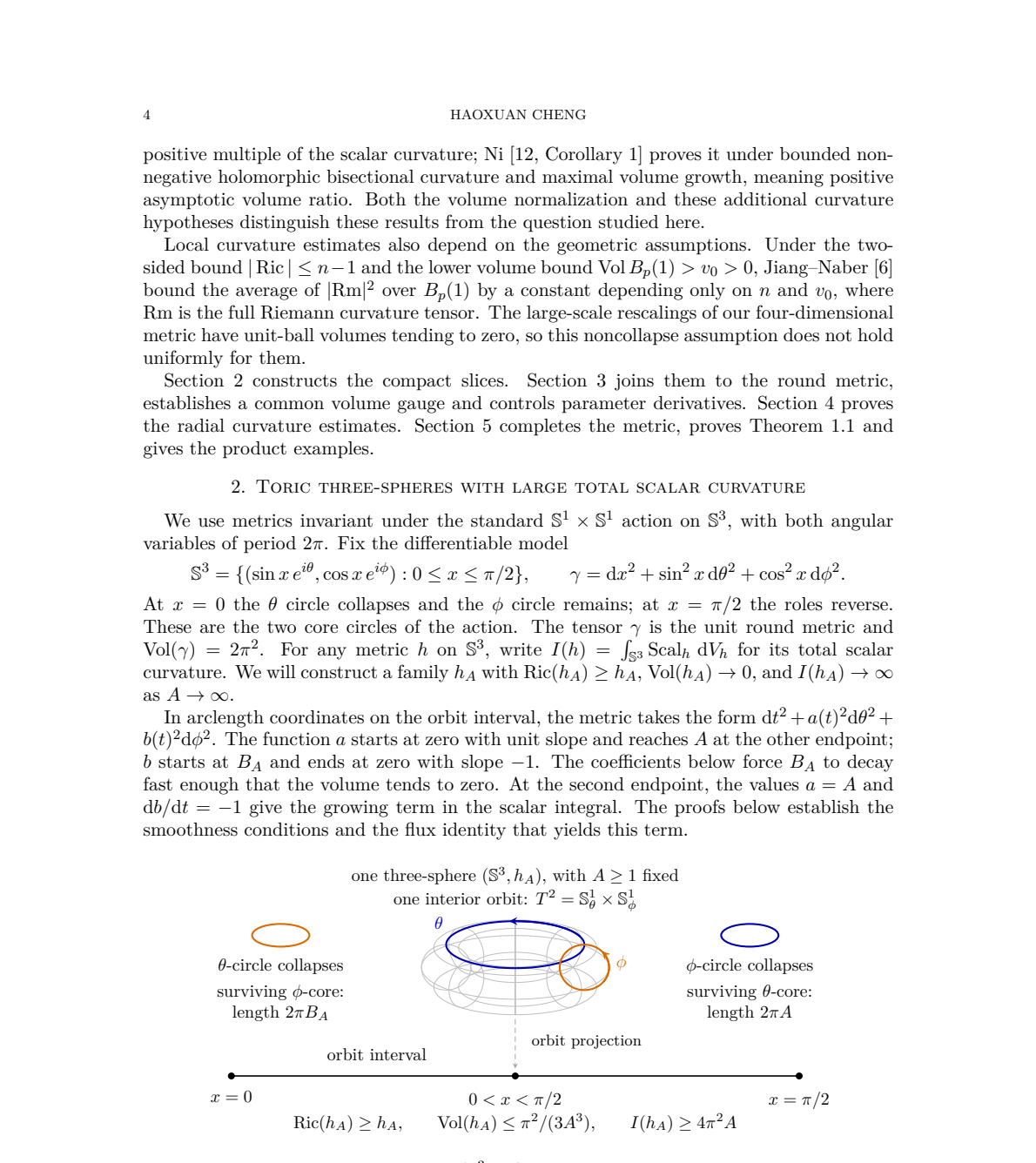
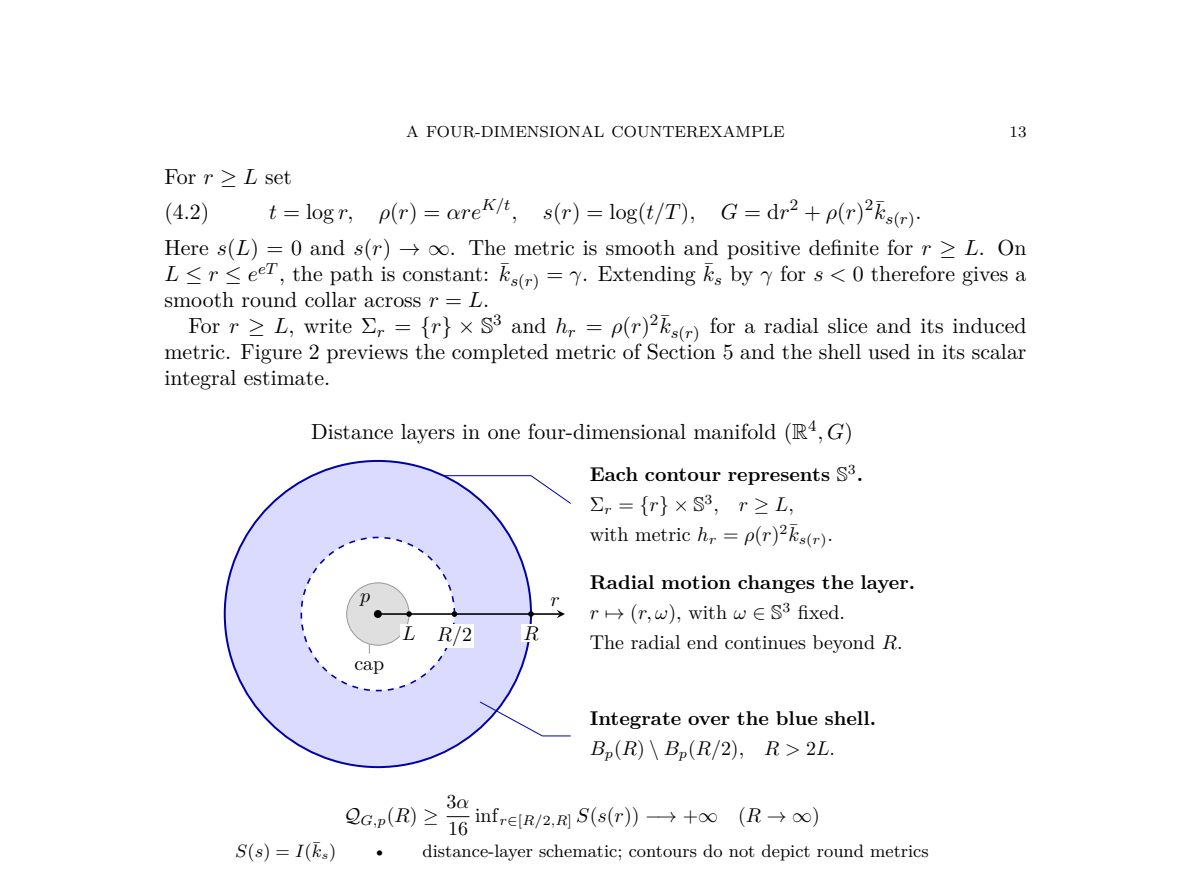
This paper solves a long-standing question by Shing-Tung Yau about how total scalar curvature can grow inside large balls on certain manifolds. Yau asked whether the total scalar curvature inside a ball of radius R, divided by R^{n-2}, always stays bounded if the manifold has nonnegative Ricci curvature and a special point called a pole. This paper shows the answer is no in four dimensions and higher. The author constructs a metric on R^4 that is smooth, complete, has nonnegative Ricci curvature, and a pole, but the normalized scalar curvature integral diverges to infinity as R grows. The construction has two main parts. First, a family of metrics on the three-dimensional sphere is built where the sphere is very thin (small volume) but has very large total scalar curvature. These metrics are torus-invariant: they look like a product of two circles over an interval, with one circle collapsing at each endpoint. The key is that the surviving core circles have very different lengths, leading to a large scalar contribution. Second, these three-sphere slices are assembled along a radial direction in R^4 using a warped product metric dr^2 + rho(r)^2 k_{s(r)}. The warping factor rho(r) is chosen to be nearly proportional to r, and the slice metric k varies slowly along the radius, with a special parameterization to control all curvatures. The Ricci curvature remains positive because the positive contributions from the slice and the radial concavity dominate the small deformation terms. The result extends to all higher dimensions by taking a direct product with Euclidean space, which preserves the nonnegative Ricci curvature and the pole property while making the divergence even stronger.
Core claim. Theorem 1.1: There exists a smooth complete Riemannian metric G on R^4 with nonnegative Ricci curvature and a pole p such that for every fixed q in R^4, the normalized scalar curvature integral R^{-2} ∫_{B_q(R)} ScaL_G dV_G diverges to infinity as R goes to infinity. Moreover, the asymptotic volume ratio is zero. The construction extends to all dimensions n >= 5 via Euclidean products (Proposition 5.2).
The premise it rests on. The Ricci lower bound Ric(h_A) >= kappa h_A (kappa = 23/32) for the toric metrics in Lemma 2.2 relies on a specific algebraic calculation (2.7)-(2.9) that uses the defined coefficients w_c, F_c, H_c, and the parameter c. A sign error or miscalculation in the tangential Ricci eigenvalue formulas would break the Ricci control needed for the radial end. The calculation is explicit but nontrivial, and no machine verification is provided.
Check this review
Pith stored no record of this review's passes and took no fingerprint of it. Reviews made by code from 13 Nov 2026 on carry both.
How often reviews like this one are right
Reviews like this one: written by deepseek-v4-flash, where what was read was not recorded.
How often objections from reviews like this one are right: not yet measured
Reviews by people
This review was written by a machine. No person has reviewed this paper on Pith yet. A scientist listed on Pith can review it for a fee, and their review is published here whatever it concludes.
The paper
Abstract
We give counterexamples to Yau's question on normalized scalar curvature integrals in every dimension n ≥ 4. For each such n, there exists a smooth complete Riemannian metric g on ℝn with nonnegative Ricci curvature and a pole such that \[ \lim_{R\to\infty}R^2-n\int_B_q(R)\mathrmScal_g\,\mathrm dV_g=+\infty \] for every fixed q ∈ ℝn. Here Bq(R) denotes the geodesic ball of radius R centered at q, and Scalg is the scalar curvature of g.
The paper's own sentences, arranged, kept beside the review and separate from it. Each label is drawn from a closed vocabulary; the number beside it is the probability the classifier gave that label. No sentence in this record was written by a model.
abstract compiled · 2026-09-23
The authors' main claim, as the classifier picked it out 0.98
“We give counterexamples to Yau's question on normalized scalar curvature integrals in every dimension $n\geq4$.”
How the main claim is stated: asserted 1.00
What the abstract itself states, as probabilities: claims first 0.04 · states limitation 0.10 · human participants 0.01 · controlled comparison 0.02 · randomized assignment 0.01 · states quantitative result 0.53 · compares with prior results 0.36 · mentions code or data availability 0.02
The abstract, sentence by sentence
This table labels the abstract only (arXiv listing abstract v1). The number is the probability the classifier gave the label.
| Sentence | Role | The authors' own work | States the main conclusion | Strength |
|---|---|---|---|---|
| We give counterexamples to Yau's question on normalized scalar curvature integrals in every dimension $n\geq4$. | contribution 0.55 | 0.95 | 0.93 | asserted 1.00 |
| For each such $n$, there exists a smooth complete Riemannian metric $g$ on $\mathbb{R}^n$ with nonnegative Ricci curvature and a pole such that \[ \lim_{R\to\infty}R^{2-n}\int_{B_q(R)}\mathrm{Scal}_g\,\mathrm dV_g=+\infty \] for every fixed $q\in\mathbb{R}^n$. | result 0.86 | 0.92 | 0.60 | asserted 1.00 |
| Here $B_q(R)$ denotes the geodesic ball of radius $R$ centered at $q$, and $\mathrm{Scal}_g$ is the scalar curvature of $g$. | background 0.88 | 0.20 | 0.03 | asserted 0.75 |
What kind of paper the classifier reports this is: theoretical result 1.00 · evidence from proof or derivation 1.00
What was examined, and what was not
Sources read
- arXiv listing abstract v1
Not examined
- full text
- figures and tables
- references and citing sentences
- relations to other papers
Levels run
- P abstract
Not run
- S sections
- T body sentences
- C citations
- R cross-paper relations
How the labels were made
Compiled by classifier-1.13.0 via TypeSafe API, question bank abstract-p1-20260923, 2026-09-23: 1 request, 3,160 input tokens.
Every quoted sentence on this record is the authors'. Every label is from Pith's closed vocabulary, with the probability shown beside it. This record as JSON
Figures (2)
Figures are the authors', reproduced from the paper.
References (20)
- [1] R. L. Bishop and B. O’Neill, Manifolds of negative curvature, Transactions of the American Mathematical Society 145 (1969), 1–49 on Pith
- [2] Bing-Long Chen and Xi-Ping Zhu, Volume growth and curvature decay of positively curved Kähler manifolds, Pure and Applied Mathematics Quarterly 1 (2005), no. 1, 68–108 on Pith
- [3] Stefan Cohn-Vossen, Kürzeste Wege und Totalkrümmung auf Flächen , Compositio Mathematica 2 (1935), 69–133 on Pith
- [4] Tobias H. Colding and Aaron Naber, Characterization of tangent cones of noncollapsed limits with lower Ricci bounds and applications , Geometric and Functional Analysis 23 (2013), 134–148 on Pith
- [5] Tianze Hao and Jintian Zhu, A counterexample to Yau’s conjectured asymptotic scalar-curvature integral bound, 2026, arXiv:2609.06533v1 on PithPith's reviewarXiv
- [6] Wenshuai Jiang and Aaron Naber, L2 curvature bounds on manifolds with bounded Ricci curvature , Annals of Mathematics 193 (2021), no. 1, 107–222 on Pith
- [7] John M. Lee, Introduction to Riemannian manifolds , second ed., Graduate Texts in Mathematics, vol. 176, Springer, Cham, 2018 on Pith
- [8] Shiguang Ma, Cohn–Vossen theory for locally conformally flat manifolds , 2026, arXiv:2606.13979v2 on PithPith's reviewarXiv
- [9] Jürgen Moser, On the volume elements on a manifold , Transactions of the American Mathematical Society 120 (1965), no. 2, 286–294 on Pith
- [10] Ovidiu Munteanu and Jiaping Wang, Comparison theorems for 3D manifolds with scalar curvature bound, International Mathematics Research Notices 2023 (2023), no. 3, 2215–2242 on Pith
- [11] , Sharp integral bound of scalar curvature on 3-manifolds, 2025, arXiv:2505.10520v1. 20 HAOXUAN CHENG on PithPith's reviewarXiv
- [12] Lei Ni, Ancient solutions to Kähler-Ricci flow , Mathematical Research Letters 12 (2005), 633–654 on Pith
- [13] Lei Ni and Luen-Fai Tam, Plurisubharmonic functions and the structure of complete Kähler manifolds with nonnegative curvature , Journal of Differential Geometry 64 (2003), no. 3, 457–524 on Pith
- [14] Anton Petrunin, An upper bound for the curvature integral , St. Petersburg Mathematical Journal 20 (2009), no. 2, 255–265 on Pith
- [15] Wan-Xiong Shi and S.-T. Yau, A note on the total curvature of a Kähler manifold , Mathematical Research Letters 3 (1996), no. 1, 123–132 on Pith
- [16] Guoyi Xu, Integral of scalar curvature on non-parabolic manifolds , The Journal of Geometric Analysis 30 (2020), no. 1, 901–909 on Pith
- [17] , Integral of scalar curvature on manifolds with a pole , Proceedings of the American Mathematical Society 152 (2024), no. 11, 4865–4872 on Pith
- [18] Bo Yang, On a problem of Yau regarding a higher dimensional generalization of the Cohn–Vossen inequality, Mathematische Annalen 355 (2013), 765–781 on Pith
- [19] Shing-Tung Yau, Open problems in geometry , Chern—A Great Geometer of the Twentieth Century, International Press, Hong Kong, 1992, pp. 275–319 on Pith
- [20] Bo Zhu, Geometry of positive scalar curvature on complete manifold , Journal für die reine und ange- wandte Mathematik 791 (2022), 225–246. School of Mathematical Sciences, Fudan University, Shanghai 200433, China Email address : hxcheng25@m.fudan.edu.cn on Pith
Cited by 4 Pith papers
Reviewed papers on Pith that cite this one. The full citation record
- Scalar curvature integrals on geodesic balls math.DG · Oct 2026
- Curvature integral on convex hypersurfaces math.DG · Oct 2026
- Scalar curvature growth on nonnegatively curved three-manifolds math.DG · Sep 2026
- Integral of Scalar Curvature: Sharp Asymptotic Bounds and Rigidity math.DG · Sep 2026
Challenges and discussion
Disagree with the review, or know something it missed? Leave a comment, or challenge this review formally: a challenge becomes a permanent entry in this paper's record, and its decision is published here.
Come back by email
A short list of the week's newly reviewed papers. Nothing is sent until you confirm from your inbox, and every email has a link that stops it. No account.
No comments yet.
Sign in to comment