Cryptography and Security · arXiv:2609.08040 v1 · submitted 7 Sep 2026 · 21 references
VEX-Bench: Benchmarking LLM Agents for Assessing Exploitability of Software Supply Chain Vulnerabilities
The paper says
“The software supply chain has become an increasingly exposed attack surface because of its reliance on intricate yet fragile dependencies.”
more of the abstract
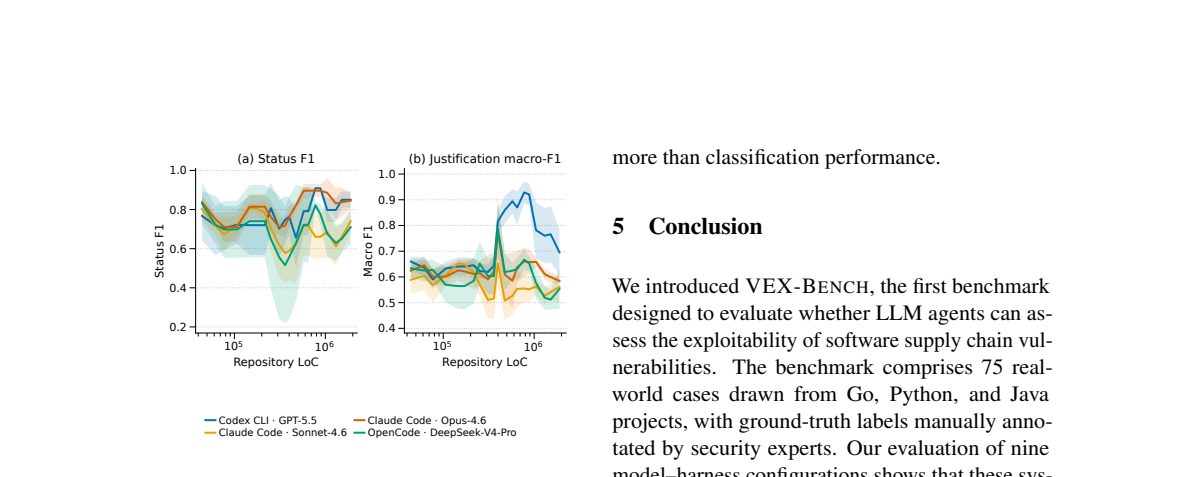
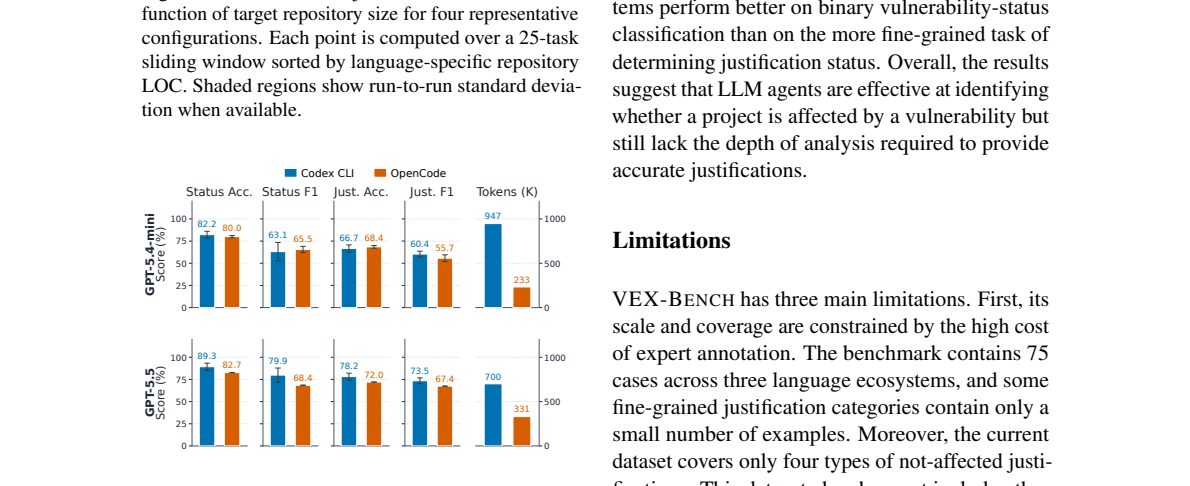
Existing defenses such as GitHub Dependabot often raise many false alerts because their coarse-grained matching cannot determine whether a vulnerable dependency is actually exploitable. Security analysts typically spend substantial time assessing vulnerability exploitability case by case. Recent LLM agents have emerged as promising candidates for this task given their advanced capabilities in coding and cybersecurity, yet no existing benchmark evaluates them on it. Prior benchmarks target zero-day settings, where agents detect and exploit previously unknown vulnerabilities. In contrast, software supply chain security focuses on how known vulnerabilities in upstream dependencies affect downstream projects. This requires agents to reason across repositories and determine whether an upstream vulnerability is exploitable in the downstream project. To address this gap, we introduce VEX-Bench, the first benchmark for evaluating LLM agents' ability to assess the exploitability of software supply chain vulnerabilities. It contains 75 real-world cases mined from GitHub and labeled by security experts, covering Python, Java, and Go. We evaluate nine models across three agent harnesses. While GPT-5.5 and Claude Opus 4.6 reach approximately 80% F1 on binary vulnerability-status classification, only GPT-5.5 surpasses 70% macro-F1 on fine-grained justification classification. This gap highlights the challenge of moving beyond binary exploitability assessment to identifying fine-grained exploitability reasons. Code and data: https://github.com/steven1518/vex-bench
from the abstract
Pith says
Machine review · deepseek-v4-flash · 9 Sep 2026 · what was read was not recorded · not checked by a person
It can be wrong. Challenge this review or reply to it.
The passes disagreed. Reader: holds up. Skeptic: holds up only with conditions. Referee: major revision.
A well-constructed, genuinely useful supply-chain triage benchmark whose fine-grained headline gap is partly a grading-rule artifact — worth refereeing, not desk-rejecting. This line is wrong
3 major objections · 5 minor
How often objections from reviews like this one are right: not yet measured
Not checked: figures, code, what the 21 references say.
The paper says, at Section 4.4.3 and Limitations
The review did not quote this passage.
Pith says: Objection 1 of 3 · major
The fine-grained justification metrics in Table 2 rest on a single-label gold standard, and the paper's own error analysis shows that these labels are not unique. GPT-5.5's largest error cluster is code_not_reachable cases predicted as requires_configuration; manual review of the five such cases found four admit both explanations, and the Limitations explicitly state that the single-label formulation may omit valid secondary reasons.
more of objection 1
Since code_not_reachable is the largest class (38/75) and its boundary with requires_configuration (7/75) is the most judgment-dependent one, the reported per-class F1 values conflate factual correctness with adherence to a precedence rule. I request a robustness analysis: release secondary-label annotations for at least the ambiguous CNR/ReqCfg cases, re-score with an any-match or multi-label criterion, and report how the macro-F1 numbers and the claim that only GPT-5.5 exceeds 70% macro-F1 change. If the gap persists after this check, it is a real result; if it shrinks, the abstract and Section 4.2 need to be revised accordingly.
The paper says, at Section 4.1 and Appendix B.1
The review did not quote this passage.
Pith says: Objection 2 of 3 · major
The prompt instructs agents to classify into 12 VEX-aligned categories with a strict precedence rule, but the evaluation treats only five annotated classes as valid and marks all other predictions as FAILED. A model that follows the prompt and outputs, for example, requires_dependency or runtime_protected as the first applicable category is penalized even though the gold label space does not contain that category.
more of objection 2
This confounds factual error with prompt/evaluation mismatch. The authors should either restrict the prompt to the five benchmark classes, provide gold labels for the full 12-class space, or analyze how often each non-annotated category is predicted and how the FAILED mapping affects each model's metrics.
The paper says, at Section 4.2, Table 2
The review did not quote this passage.
Pith says: Objection 3 of 3 · major
The claim that performance consistently drops from vulnerability-status prediction to justification prediction is based on raw accuracy across tasks with different label-space sizes. Accuracy is not calibrated across a binary task and a five-class task (majority-class baselines are 70.7% and 50.7%, respectively), so a large part of the drop may be mechanical. The comparison should be re-expressed relative to majority-class or chance baselines, or supported by calibrated metrics, before it is used as evidence of a specific fine-grained reasoning gap.
5 minor objections
The paper says, at Introduction
Pith says: minor objection 1 of 5
The phrase 'OW ASP Top 10' should read 'OWASP Top 10'.
The paper says, at Figure 4
Pith says: minor objection 2 of 5
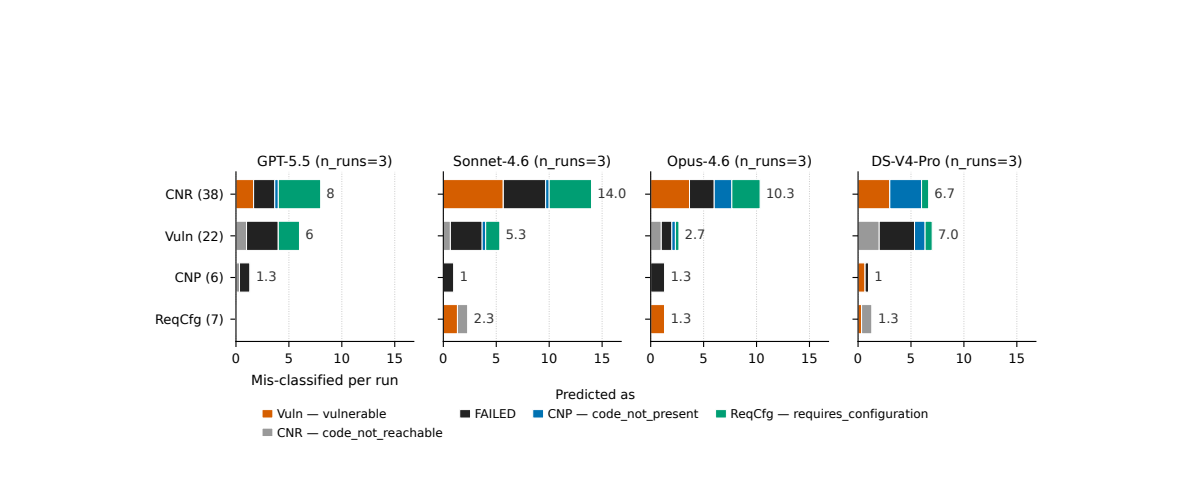
The stacked bars are difficult to map to the numeric counts shown above them, and the FAILED category is hard to distinguish; a table of per-configuration error counts would be clearer.
show 3 more
The paper says, at Section 3.3
Pith says: minor objection 3 of 5
The statement that the 'median case spans roughly 273K lines of code across more than 2,600 files' combines separate medians for LOC and file count; a single case will not generally have both median values.
The paper says, at Appendix B.1
Pith says: minor objection 4 of 5
The phrase '12 fixed categories' is confusing given that the benchmark evaluates only five; consider wording such as '12 candidate categories in the prompt.'
The paper says, at Table 2
Pith says: minor objection 5 of 5
With only three runs per configuration, reporting bootstrap confidence intervals or a significance test for the headline macro-F1 differences would strengthen the comparisons.
What would settle it
Run a second independent annotation of all 75 cases in which annotators mark every defensible not-affected justification rather than the precedence winner, and report the multi-label rate. Then re-score the existing model outputs under a tolerant rule: a prediction is correct if it matches any defensible label, with FAILED reserved for outputs matching none or failing to parse. Report strict and tolerant justification macro-F1 side by side for all nine configurations. A cheaper first pass: take the five cases identified in Section 4.4.3 as admitting both code_not_reachable and requires_configuration, re-score them with the alternative label accepted, and check whether 'only GPT-5.5 surpasses 70% macro-F1' and the reported gap sizes survive.
from the skeptic's reading
How the review went
4 readings by deepseek-v4-flash · 9 Sep 2026
- Reader holds up
- Skeptic partly agrees: says it holds up only with conditions Fine-grained justification labels are not unique: Section 4.4.3's own review finds GPT-5.5 'errors' that are factually valid under an alternative label, so the headline binary-vs-fine-grained gap and the 'only GPT-5.5 > 70% macro-F1' claim may be partly a rubric artifact.
- Editor wrote the verdict above
- Referee major revision: 3 major objections, 5 minor
Not run on this paper: the simulated authors' defence.
Pith did not check this review's objections against the paper.
The review in full
The review in brief, machine-written
You should know two things before reading VEX-Bench. First, it is a genuinely useful resource: the first benchmark I've seen that targets the actual triage problem in supply-chain security — a known CVE in a third-party dependency, and the question is whether the downstream project is really affected. That is the Dependabot false-alert problem, and it is distinct from the zero-day detection/exploitation tasks in CyBench, CVE-Bench, and BountyBench. The authors built it carefully: mined PRs that touch manifests, filtered, annotated by five experts with a calibration phase, Fleiss' Kappa 0.667 reported, disagreements reconciled. The leakage controls are real work too — isolated Docker, no Git history, no executable tests, and a guided-completion probe for PR memorization. The SCA baselines (OSV, Trivy, govulncheck) give the LLM results a useful floor to compare against. Code and data are public. This is reproducible, externally checkable work.
Second, the headline empirical claim — the large, uniform status-to-justification drop, with only GPT-5.5 above 70% macro-F1 — is softer than it looks. The stress-test note is right. The four not-affected categories are ordered by strict precedence, and only the first applicable label counts. Section 4.4.3 admits that GPT-5.5's biggest error cluster, code_not_reachable predicted as requires_configuration, includes four of five manually-reviewed cases that 'admit both explanations' and 'may still be factually valid.' The Limitations section concedes the single-label rule may omit valid secondary reasons. Since code_not_reachable (38 cases) borders requires_configuration (7 cases) — the most judgment-dependent boundary — the fine-grained metrics partially measure rubric adherence, not factual correctness. With only 7 and 2 cases in the two smallest classes, macro-F1 moves several points if even a handful of gold labels admit defensible alternatives. The gap narrative survives, but it is a statement about the benchmark's grading rule as much as about agent reasoning. I would want tolerant scoring (any applicable label counts) or a label-uniqueness analysis before trusting the 11-15 point gap as a capability measurement.
The binary status results look solid and the benchmark is usable as-is. The right fix is in the evaluation layer, not the dataset.
Who this is for: anyone building or evaluating LLM agents for vulnerability triage, and anyone designing agent benchmarks generally — the rubric-design discussion is instructive. It deserves a serious referee: the weaknesses are disclosed, local, and fixable. I'd send it out.
The strongest objection
The benchmark's headline empirical claim is that moving from binary status to fine-grained justification causes a large, uniform performance drop, with only GPT-5.5 exceeding 70% macro-F1 (abstract; Table 2). That claim rests on a single-label gold standard in which the four not-affected categories are ordered by a strict precedence rule and only the first applicable category counts as correct (Appendix A; prompt in B.1). The paper itself shows these gold labels are not unique. Section 4.4.3 reports that GPT-5.5's largest error cluster is code_not_reachable cases predicted as requires_configuration; manual review of the five such cases found four admit both explanations, and the predictions 'may still be factually valid.' The Limitations section concedes that the single-label formulation 'may omit valid secondary reasons.' Consequently, the justification metrics in Table 2 conflate factual correctness with rubric adherence: an agent that provides a complete, evidence-backed explanation whose first applicable category differs from the annotators' precedence choice is scored as a full error. Since code_not_reachable is the largest class (38/75) and borders requires_configuration (7/75), the boundary between 'reachable but gated by configuration' and 'not reachable' is exactly the most judgment-dependent one, so the ambiguity plausibly extends beyond the five cases examined. If even 6-10 gold labels admit defensible alternatives, per-class F1 moves by several points, shifting the macro-F1 ranking and the reported 11-15 point status-to-justification gaps. The abstract's 'gap highlights the challenge' narrative is therefore not secure as a measurement of reasoning capability until label uniqueness is quantified and tolerant scoring is reported.
This paper's contribution is genuinely useful: it is a first-of-kind benchmark for dependency-level exploitability assessment, built from real cases with careful Docker sealing, an explicit leakage audit (Appendix C), SCA baselines (Table 3), three-run reporting with standard deviations, and unusually candid limitation and error analyses. Those strengths survive my concern unchanged. I looked hardest at three candidate weak points and found two of them adequately managed. First, web-search leakage through the source PRs: every case is mined from a public CVE-referencing PR, so an agent could in principle search for the repo plus CVE and find the exact PR the case came from; however, the existence of such a PR carries no signal across cases, and the paper's audit found only three PRs that discuss exploitability, so this avenue appears bounded. Second, representativeness of the 75 cases: this is a real but disclosed limitation typical of any first benchmark, and the 70.7% not-affected distribution actually matches the paper's stated false-alert motivation. The third concern is the load-bearing one. The abstract's central quantitative finding — that fine-grained justification is much harder than binary status, with only GPT-5.5 above 70% macro-F1 — depends entirely on the single-label justification schema with its strict precedence rule. The paper's own Section 4.4.3 provides direct evidence that this gold standard is not unique: in GPT-5.5's largest error cluster, four of five reviewed 'errors' are factually valid requires_configuration answers that merely violate precedence, and the Limitations section concedes the single-label formulation can omit valid secondary reasons. Scored against a rubric that accepts only the precedence winner, factually correct analyses count as full errors, so the measured gap between status and justification metrics is partly an artifact of label non-uniqueness rather than a pure measure of reasoning failure. The magnitude is plausibly nontrivial: macro-F1 averages five class F1 scores, the requires_configuration class has only seven cases, and the code_not_reachable class (38 cases) borders it on precisely the most judgment-dependent boundary, so a modest number of multi-label cases can shift macro-F1 by several points and alter the reported ranking and gap sizes. The fix is cheap and decisive: a multi-label annotation pass and tolerant re-scoring of the outputs the authors already have, or at minimum re-scoring the 4.4.3 dual-valid cases. I therefore recommend CONDITIONAL rather than UNCHANGED: the benchmark itself should be accepted, but the 'gap highlights the challenge' headline should not be taken at face value until the strict-vs-tolerant scoring comparison confirms the effect, or the claim is reworded to acknowledge the rubric-mismatch contribution.
The referee's report
The benchmark fills a real gap: prior agent benchmarks focus on first-party zero-day tasks, whereas supply-chain triage requires cross-repository reasoning about known CVEs. Strengths include transparent dataset construction, expert annotation with inter-annotator agreement reporting, sealed Docker environments, a model-side leakage analysis, and a useful comparison with traditional SCA tools. The code and data are promised publicly, and results are reported with standard deviations over three runs. My main reservation is that the headline fine-grained result depends on a single-label gold standard whose non-uniqueness is documented in the paper itself; the status-level results are more robust, and the fine-grained claims need a sensitivity analysis before they can be taken at face value.
Pith's reading of the paper (a machine's summary, not the authors')
VEX-Bench is the first benchmark that measures whether LLM agents can do what security analysts do every day: take a known vulnerability in a third-party dependency and decide whether the downstream project that depends on it is actually exploitable. The paper builds 75 real cases mined from GitHub (35 projects across Go, Python, and Java), labeled by five security experts with both a binary affected/not-affected status and a fine-grained justification drawn from the VEX standard. Nine model–harness combinations were run against these cases, and the headline result is a split: Claude Opus 4.6 and GPT-5.5 reach roughly 80% F1 on the binary status, but only GPT-5.5 exceeds 70% macro-F1 on the fine-grained justification, and every configuration loses accuracy between the two. The authors read this as evidence that LLM triage is good enough to filter false dependency alerts at scale, but that explaining the reason behind a not-affected verdict — the part that tells a maintainer what, if anything, to do — remains unsolved. If the benchmark holds up, it gives the field a standard yardstick for a task that otherwise consumes substantial expert attention per alert; the paper's own annotators spent roughly 30 minutes per case.
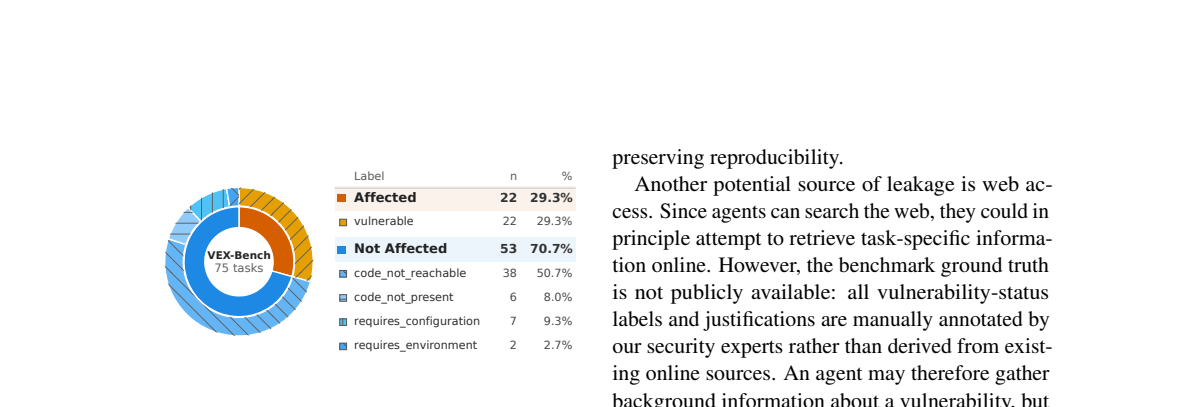
What carries the argument. The load-bearing object is the VEX justification schema turned into a precedence-ordered classification routine: four fine-grained not-affected reasons adapted from the CISA VEX status-justification vocabulary, enforced by a 12-category prompt that instructs the agent to walk the categories in strict logical precedence and select the first that applies. The schema does two jobs at once. It converts a yes/no exploitability call into a multi-class test with an imbalanced, long-tail label distribution (50.7% code_not_reachable, 29.3% vulnerable, the rest split across configuration, environment, and missing-code reasons), which prevents a majority-class predictor from inflating the fine-grained score. And it is what connects agent output to the information a maintainer actually needs, since each not-affected reason implies a different follow-up action. The evaluation protocol — isolated Docker environments, Git history removed, no executable test harness, and a guided-completion probe for model-side memorization of the source pull requests — is the supporting mechanism that lets the authors attribute the scores to in-task reasoning rather than leaked answers.
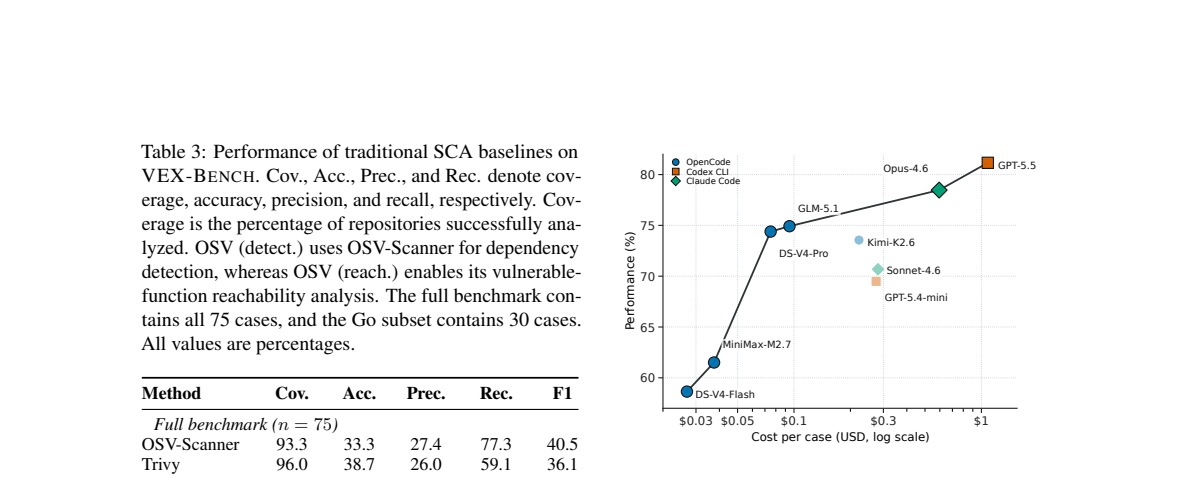
Core claim. On VEX-Bench, the task is cross-repository exploitability assessment: an agent is dropped into a full real-world codebase with only a CVE identifier, receives no curated advisory text, no preselected vulnerable files, and no call-graph slice, and must retrieve upstream vulnerability information and inspect downstream call sites to produce a three-field answer — a binary vulnerability status, a justification label from four not-affected categories (code_not_present, code_not_reachable, requires_configuration, requires_environment), and a free-form reasoning trace. The central empirical claim is that today's best agents perform well on the binary status — GPT-5.5 at 89.3% accuracy and 79.9% F1, Claude Opus 4.6 at 88.4% accuracy and 81.6% F1 — but that fine-grained justification lags for all nine configurations, with only GPT-5.5 surpassing 70% justification macro-F1 (73.5%). The paper attributes the difficulty to the structure of the task: 70.7% of real scanner-reported cases in the benchmark are not affected, and over half are not affected because the vulnerable code is unreachable, so the interesting reasoning is precisely the discrimination among reachability, configuration, environment, and dependency-absence explanations — a discrimination the paper shows traditional software composition analysis tools cannot make (OSV-Scanner 40.5% F1, Trivy 36.1% F1).
The premise it rests on. The whole evaluation stands on five human annotators' verdicts, agreed by discussion under a rule forcing each of the 75 cases into exactly one justification category — if those verdicts are wrong, or the forced single label misrepresents cases that genuinely admit several reasons, the reported scores and the central gap between binary and fine-grained performance could be artifacts of labeling rather than measures of triage ability.
If the paper is right (Pith's inferences, not the authors')
LLM agents become a viable first-pass filter for dependency-alert triage: the top models identify the affected/not-affected status of real projects correctly roughly 80–89% of the time, which would cut the false-alert load that overwhelms analysts using scanners alone.
Any deployment that acts on the binary verdict alone is overstating agent competence, since every one of the nine evaluated configurations loses accuracy when moving from status to justification (up to 15.5 percentage points for GPT-5.4 mini); verdicts need human or second-stage review until fine-grained reasoning matures.
Traditional SCA and reachability tooling is the wrong yardstick for exploitability: OSV-Scanner and Trivy reach at most roughly 40% F1 on the full benchmark, and reachability analysis still mislabels about 70% of its false positives as code_not_reachable, because call-graph presence does not imply a feasible triggering path.
The four fine-grained not-affected categories, with their strict precedence rule, define the reasoning abilities a useful triage agent must exhibit: distinguishing reachability failure from configuration, environment, and missing-code causes.
Benchmark integrity can be maintained even when the raw material is public: sealed Docker execution plus a memorization probe found no meaningful model-side leakage, so future agents that score high on VEX-Bench can be credited with genuine exploitability reasoning.
The boundary cases the error analysis exposes — four code_not_reachable cases where requires_configuration is also factually valid — suggest the true not-affected space is graded rather than categorical; a multi-label or confidence-weighted variant of VEX-Bench would test whether the forced single label deflates agent scores and whether the status-versus-justification gap survives when partial cre
The cost analysis implies a likely production shape for triage agents: DeepSeek-V4-Pro and GLM-5.1 reach roughly 74–75% balanced performance at about one tenth to one fifteenth of GPT-5.5's per-case dollar cost, so a deployed pipeline would plausibly use a cheap model to screen and reserve an expensive model for borderline cases — if the cheap model's fine-grained weakness does not degrade the fir
The paper's stated limitation that npm/JavaScript is missing is a testable prediction in disguise: extending the benchmark to npm's sprawling transitive dependency graphs would likely raise the share of code_not_present and requires_dependency cases, and it is an open question whether the four-category schema and the observed model ranking would survive that shift.
The unannotated VEX-aligned categories in the 12-class prompt (compiler_protected, runtime_protected, perimeter_protected, mitigating_control_protected) mark a natural difficulty ladder: scoring the full precedence chain would tell defenders which safeguard class LLM agents can verify reliably, and it would raise the fine-grained ceiling above the current 73.5% macro-F1.
Check this review
Pith stored no record of this review's passes and took no fingerprint of it. Reviews made by code from 13 Nov 2026 on carry both.
How often reviews like this one are right
Reviews like this one: written by deepseek-v4-flash, where what was read was not recorded.
How often objections from reviews like this one are right: not yet measured
Reviews by people
This review was written by a machine. No person has reviewed this paper on Pith yet. A scientist listed on Pith can review it for a fee, and their review is published here whatever it concludes.
The paper
Abstract
The software supply chain has become an increasingly exposed attack surface because of its reliance on intricate yet fragile dependencies. Existing defenses such as GitHub Dependabot often raise many false alerts because their coarse-grained matching cannot determine whether a vulnerable dependency is actually exploitable. Security analysts typically spend substantial time assessing vulnerability exploitability case by case. Recent LLM agents have emerged as promising candidates for this task given their advanced capabilities in coding and cybersecurity, yet no existing benchmark evaluates them on it. Prior benchmarks target zero-day settings, where agents detect and exploit previously unknown vulnerabilities. In contrast, software supply chain security focuses on how known vulnerabilities in upstream dependencies affect downstream projects. This requires agents to reason across repositories and determine whether an upstream vulnerability is exploitable in the downstream project. To address this gap, we introduce VEX-Bench, the first benchmark for evaluating LLM agents' ability to assess the exploitability of software supply chain vulnerabilities. It contains 75 real-world cases mined from GitHub and labeled by security experts, covering Python, Java, and Go. We evaluate nine models across three agent harnesses. While GPT-5.5 and Claude Opus 4.6 reach approximately 80% F1 on binary vulnerability-status classification, only GPT-5.5 surpasses 70% macro-F1 on fine-grained justification classification. This gap highlights the challenge of moving beyond binary exploitability assessment to identifying fine-grained exploitability reasons. Code and data: https://github.com/steven1518/vex-bench
The paper's own sentences, arranged, kept beside the review and separate from it. Each label is drawn from a closed vocabulary; the number beside it is the probability the classifier gave that label. No sentence in this record was written by a model.
abstract compiled · 2026-09-23
The authors' main claim, as the classifier picked it out 0.82
“This gap highlights the challenge of moving beyond binary exploitability assessment to identifying fine-grained exploitability reasons.”
How the main claim is stated: asserted 0.96
What the abstract itself states, as probabilities: claims first 0.97 · states limitation 0.71 · human participants 0.35 · controlled comparison 0.19 · randomized assignment 0.01 · states quantitative result 0.99 · compares with prior results 0.67 · mentions code or data availability 0.99
The abstract, sentence by sentence
This table labels the abstract only (arXiv listing abstract v1). The number is the probability the classifier gave the label.
| Sentence | Role | The authors' own work | States the main conclusion | Strength |
|---|---|---|---|---|
| The software supply chain has become an increasingly exposed attack surface because of its reliance on intricate yet fragile dependencies. | background 1.00 | 0.05 | 0.02 | asserted 1.00 |
| Existing defenses such as GitHub Dependabot often raise many false alerts because their coarse-grained matching cannot determine whether a vulnerable dependency is actually exploitable. | background 0.96 | 0.06 | 0.02 | asserted 0.99 |
| Security analysts typically spend substantial time assessing vulnerability exploitability case by case. | background 0.99 | 0.06 | 0.02 | asserted 1.00 |
| Recent LLM agents have emerged as promising candidates for this task given their advanced capabilities in coding and cybersecurity, yet no existing benchmark evaluates them on it. | gap 0.89 | 0.08 | 0.04 | asserted 0.66 |
| Prior benchmarks target zero-day settings, where agents detect and exploit previously unknown vulnerabilities. | background 0.87 | 0.04 | 0.02 | asserted 1.00 |
| In contrast, software supply chain security focuses on how known vulnerabilities in upstream dependencies affect downstream projects. | background 0.95 | 0.06 | 0.03 | asserted 1.00 |
| This requires agents to reason across repositories and determine whether an upstream vulnerability is exploitable in the downstream project. | background 0.97 | 0.08 | 0.03 | asserted 1.00 |
| To address this gap, we introduce VEX-Bench, the first benchmark for evaluating LLM agents' ability to assess the exploitability of software supply chain vulnerabilities. | contribution 1.00 | 0.95 | 0.21 | asserted 1.00 |
| It contains 75 real-world cases mined from GitHub and labeled by security experts, covering Python, Java, and Go. | method 0.81 | 0.94 | 0.04 | asserted 1.00 |
| We evaluate nine models across three agent harnesses. | method 0.95 | 0.95 | 0.04 | asserted 0.99 |
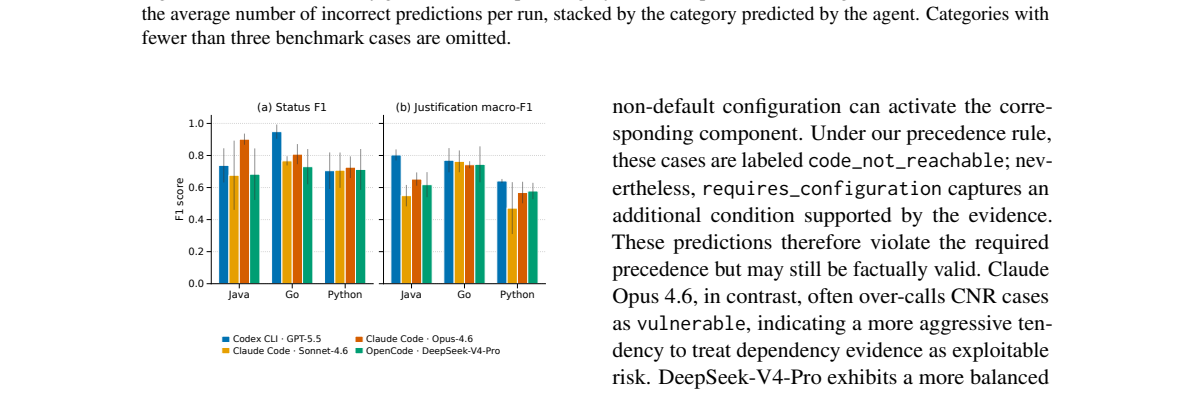
| While GPT-5.5 and Claude Opus 4.6 reach approximately 80% F1 on binary vulnerability-status classification, only GPT-5.5 surpasses 70% macro-F1 on fine-grained justification classification. | result 1.00 | 0.95 | 0.36 | asserted 1.00 |
| This gap highlights the challenge of moving beyond binary exploitability assessment to identifying fine-grained exploitability reasons. | interpretation 1.00 | 0.82 | 0.31 | asserted 0.96 |
| Code and data: https://github.com/steven1518/vex-bench | contribution 0.64 | 0.39 | 0.03 | unclear 0.86 |
What kind of paper the classifier reports this is: dataset or benchmark 1.00 · evidence from observation or experiment 0.97
What was examined, and what was not
Sources read
- arXiv listing abstract v1
Not examined
- full text
- figures and tables
- references and citing sentences
- relations to other papers
Levels run
- P abstract
Not run
- S sections
- T body sentences
- C citations
- R cross-paper relations
How the labels were made
Compiled by classifier-1.13.0 via TypeSafe API, question bank abstract-p1-20260923, 2026-09-23: 1 request, 9,394 input tokens.
Every quoted sentence on this record is the authors'. Every label is from Pith's closed vocabulary, with the probability shown beside it. This record as JSON
Figures (7)
Showing 6 of the paper's 7 figures. Figures are the authors', reproduced from the paper.
References (21)
- [1] "false_positive" - The CVE-to-package mapping is wrong (named package is not what the CVE applies to, or the CVE is withdrawn/malformed). Use only with concrete evidence of mismatch on Pith
- [2] "code_not_present" - The vulnerable package/module is absent from the repository: not declared in any manifest, not in any lockfile, no vendored copy on Pith
- [3] "code_not_reachable" - The vulnerable code is present (manifest, lockfile, or vendored copy) in the codebase but is never executed at runtime, e.g., never imported, referenced, or called from first-party source. - Only applicable when code IS present AND call-chain/reachabilit... on Pith
- [4] "requires_configuration" - Exploitation requires a specific configuration option, feature flag, or setting that is currently disabled by default in this repository on Pith
- [5] Software composition analysis for vulnerabil- ity detection: An empirical study on java projects. In Proceedings of the 31st ACM Joint European Soft- ware Engineering Conference and Symposium on the Foundations of Software Engineering, ESEC/FSE 2023, page 960–972, New York, NY... on Pith
- [6] A reality check on sbom-based vulnerability management: An empirical study and a path forward. InProceedings of the Sixteenth ACM Conference on Data and Application Security and Privacy, CO- DASPY ’26, page 255–268, New York, NY , USA. Association for Computing Machinery. Yuxu... on Pith
- [7] "compiler_protected" - Compile-time hardening configured in this repository's build (stack canaries, PIE/ASLR-required builds, sanitizer instrumentation, etc.) prevents the exploit primitive on Pith
- [8] "runtime_protected" - Runtime mechanisms set up by this repository's own code (sandboxing, in-process isolation, seccomp filters) prevent exploitation on Pith
- [9] "perimeter_protected" - Network, authentication, or perimeter controls shipped in this repository (auth middleware, allowlists, network policies in deployment manifests) block the attack surface on Pith
- [10] "mitigating_control_protected" - Other in-repo mitigations not covered by 7-9 (input validation, output encoding, custom guards) reduce risk to negligible on Pith
- [11] "requires_dependency" - Exploitation requires an additional dependency (library, plugin, module) that this repository does 13 not declare on Pith
- [12] "requires_environment" - Exploitation requires a specific runtime environment (OS, architecture, kernel version, hardware feature) that this repository does not establish or rely on on Pith
- [17] "uncertain" - Investigation cannot establish presence, reachability, or mitigation status with the available evidence. Use as a true fallback, not a hedge on Pith
- [18] "vulnerable" - All of: - an affected version of the vulnerable package is present, - the vulnerable surface is imported and called from first-party (non-test) source, - no mitigation from categories 4-10 applies. </CLASSIFICATION_CATEGORIES> <DECISION_RULES> on Pith
- [19] A CVE is classified as "vulnerable" if and only if ALL of the following hold: - The vulnerable code is PRESENT in the container/codebase. - The vulnerable code is USED or CALLED by the application. - The vulnerable code is REACHABLE from an attack surface (user input, network ... on Pith
- [20] If ANY of the above conditions fails, select the SINGLE most appropriate non-vulnerable category by walking the precedence list from top (1) to bottom (11) and choosing the first matching category. For example: - If the vulnerable code is not present→ "code_not_present" (do NO... on Pith
- [21] Use "uncertain" only when the investigation genuinely lacks the evidence needed to reach any conclusion. </DECISION_RULES> <OUTPUT_FORMAT> Output a single JSON object on stdout — no surrounding prose, no markdown fences, no comments. Schema: { "category": "<one of the 12 categ... on Pith
- [2020] Detection, assessment and mitigation of vul- nerabilities in open source dependencies.Empirical Software Engineering, 25(5):3175–3215. Yingyuan Pu, Lingyun Ying, and Yacong Gu. 2026. From noise to signal: Precisely identify affected pack- ages of known vulnerabilities in npm e... on Pith
- [2023] Automating dependency updates in practice: An exploratory study on github dependabot.IEEE Trans. Softw. Eng., 49(8):4004–4022. Nasif Imtiaz, Seaver Thorn, and Laurie Williams. 2021. A comparative study of vulnerability reporting by software composition analysis tools. InProcee... on Pith
- [2025] Understanding vulnerabilities in software supply chains.Empirical Software Engineering, 30(1):20. Sonatype. 2024. 2024 state of the software supply chain report: A 10-year look back. Industry report, Sonatype. Accessed: 2026-05-13. Kunvar Thaman. 2026. Reward hacking benchmark... on PithPith's reviewarXiv
show 1 more
- [2026] Bountybench: Dollar impact of AI agent at- tackers and defenders on real-world cybersecurity systems. InThe Thirty-ninth Annual Conference on Neural Information Processing Systems Datasets and Benchmarks Track. Andy K Zhang, Neil Perry, Riya Dulepet, Joey Ji, Ce- leste Menders... on Pith
Cited by 1 Pith paper
Reviewed papers on Pith that cite this one. The full citation record
Challenges and discussion
Disagree with the review, or know something it missed? Leave a comment, or challenge this review formally: a challenge becomes a permanent entry in this paper's record, and its decision is published here.
Come back by email
A short list of the week's newly reviewed papers. Nothing is sent until you confirm from your inbox, and every email has a link that stops it. No account.
No comments yet.
Sign in to comment