Cryptography and Security · arXiv:2611.26131 v1 · submitted 19 Nov 2026 · 51 references
SCARVA: Interpretable Agentic Reasoning in Software Supply-Chain Analysis
The paper says
“Complex applications may inherit security vulnerabilities from their dependencies, though a vulnerable dependency does not necessarily endanger the application.”
more of the abstract
Existing tools flag dependencies associated with public vulnerabilities, and more advanced ones analyze the call graph to assess whether the vulnerable code is reachable. However, these approaches are limited to specific programming languages and ecosystems. LLM agents are promising candidates for this task, yet they hallucinate, take shortcuts, and reward hack. As these behaviors are opaque, the agents' conclusions may not be trusted. We present SCARVA a framework designed to produce interpretable reports. SCARVA combines advanced agent reasoning with an evidence-collection methodology that assesses the agent's analysis and improves its trustworthiness. Specifically, the ANALYST performs a software security assessment while SCARVA records every tool call, file access, and web request. Then, one or more independent JUDGE agents inspect the ANALYST's result and produce an evidence-backed report. We evaluate SCARVA on 54 manually curated cases, balanced across exploitable, non-exploitable, and vulnerability-free projects, using both open-weight and frontier models. The best ANALYST model, Qwen 3.8, reaches 82% balanced accuracy and surpasses the evaluated proprietary models. Human annotation validates the JUDGE findings: Claude Opus 5.5 performs best, agreeing with annotators in 94% of claim checks. Finally, we discuss the most common failure modes of agents on supply-chain vulnerability assessment.
from the abstract
Pith says
Machine review · deepseek-v4-flash · 20 Nov 2026 · read the full text (245,046 characters) · not checked by a person
It can be wrong. Challenge this review or reply to it.
Holds up, with conditions. SCARVA introduces an independent Judge agent that checks an LLM Analyst's vulnerability claims against a recorded tool-call trace, improving balanced accuracy from 66.7% to 81.9% on a 54-case C/C++ dataset, but the evaluation is limited by small dataset size, lack of significance testing, and confounded comparisons. This line is wrong
10 minor · 1 open question
How often objections from reviews like this one are right: not yet measured
The paper, first character to last
The reviewer was given the whole text, 245,046 characters. Not checked: figures, code, what the 51 references say.
10 minor objections
The paper says, at §1, Introduction
Pith says: minor objection 1 of 10
The abstract on arXiv states 'Qwen 3.8 reaches 82% balanced accuracy' while the manuscript text says '81.9%'. These should be consistent.
The paper says, at §5.1, Table 2
Pith says: minor objection 2 of 10
The table caption says 'Bold marks the best value per column' but the bold values in the 'Balanced accuracy' column are 0.819 for Qwen+Panel and 0.754 for Claude Sonnet+Self. The latter is not the best in its column; the best is 0.819. The bold formatting appears inconsistent.
show 8 more
The paper says, at §5.2, Table 4
Pith says: minor objection 3 of 10
The table reports 'Reviewed' claims and 'Correct' counts with percentages. The 95% Wilson confidence intervals are given, which is good. However, the table does not report the total number of claims per Judge model (only the reviewed subset). Adding the total would help assess the sampling fraction.
The paper says, at §5.4, Agents' Behavior
Pith says: minor objection 4 of 10
The paper states 'In 21 assessments, the Analyst produces an incomplete analysis and reports missing evidence or open questions.' It would be helpful to know whether these incomplete analyses are distributed evenly across models or concentrated in particular models.
The paper says, at §6, Discussion
Pith says: minor objection 5 of 10
The 'Context Boundaries' paragraph notes that in nine affected assessments the Analyst drifted to a fixed revision. The paper says 'stricter boundaries would likely remove the shortcut.' This is a reasonable suggestion, but the paper does not test it. Consider adding a brief experiment or at least noting that this is a hypothesis.
The paper says, at §4.2, Assessment
Pith says: minor objection 6 of 10
The paper states 'The monitor data and session are considered trusted as they are collected independently.' However, the monitor data are collected by the same infrastructure that runs the Analyst. The paper should clarify what guarantees the independence (e.g., the monitor is a separate process, the logs are append-only, etc.).
The paper says, at §5.3, VEX-Bench comparison
Pith says: minor objection 7 of 10
The token comparison (Table 6) shows SCARVA uses 10-80x more tokens than VEX-Bench. The paper notes this is 'a lower bound' because Judge tokens were not recorded. It would be useful to also report the total cost including the Judge, even if estimated, to give a complete picture of the trade-off.
The paper says, at §5.4, Tool Usage
Pith says: minor objection 8 of 10
Table 8 reports 'Claims / 10 calls' but this metric is not discussed. The ratio varies widely (1.07 to 6.19). The paper could briefly comment on whether a higher ratio indicates efficiency or superficiality.
The paper says, at Appendix C, Cost
Pith says: minor objection 9 of 10
The cost table (Table 10) reports median tokens and cost. The confidence intervals are given in brackets but the notation is ambiguous (e.g., '1.70 [1.46, 1.98]'). Clarify that these are 95% confidence intervals for the median (e.g., bootstrap intervals).
The paper says, at General
Pith says: minor objection 10 of 10
The paper uses many custom macros (\gemma, \qwen, \opus, etc.) which are defined in the preamble. While this is fine for LaTeX, the resulting text in the PDF may be hard to read for someone not familiar with the naming. Consider adding a table of model names and their shorthand at the start of the evaluation section.
Open questions (1)
Pith raised these and could not confirm them against the text of the paper it read. They are questions for the authors, not findings.
- §4.4, Judge Report What are the inter-dimension correlations among the ten Judge dimensions, and do you have any analysis of redundancy or internal consistency?
What would settle it
Re-run the Qwen 3.8 Analyst with the four-judge panel on a held-out set of 20 new C/C++ cases (balanced across affected, not affected, and no-known-vulnerability) to verify that the 81.9% balanced accuracy generalizes beyond the original 54-case dataset.
from the skeptic's reading
How the review went
5 passes by deepseek-v4-flash · 20 Nov 2026
- Reader holds up, with conditions
- Skeptic agrees
- Referee 10 minor
- Check against the paper kept 0 of 5 objections
- Editor wrote the verdict above
Not run on this paper: the simulated authors' defence.
Pith's passes raised 5 objections. A check against the paper's text kept 0, withdrew 4 (4 the paper already says) and left 1 as a question.
The review in full
The review in brief, machine-written
This paper tackles a real problem: when an LLM agent decides whether a known library vulnerability is exploitable through a specific host application, how do you trust its verdict? The authors propose SCARVA, which separates the analysis into an Analyst agent that performs the investigation and an independent Judge agent that checks every claim against a recorded trace of tool calls, file accesses, and web requests. The Judge also scores the analysis along ten dimensions and provides feedback for a second iteration.
The core idea is sound and the implementation is thorough. The evaluation covers 54 manually curated C/C++ cases (balanced across exploitable, non-exploitable, and no-known-vulnerability groups), eight models from five vendors, multiple Judge configurations, and three runs per configuration. The best result—Qwen 3.8 with a four-Judge panel reaching 81.9% balanced accuracy, up from 66.7% without a Judge—shows that the approach can work. The manual review of 22.2% of claims (2,757 claims) is a strength, and the analysis of agent failure modes is informative.
However, several limitations temper the conclusions. The dataset is small (54 cases, all C/C++) and the authors state that differences are not tested for significance at the case level. Some CVEs predate model training cutoffs, so the Analyst may recall answers rather than derive them from code. Frontier models are judged only by themselves, confounding the Judge comparison. The Anthropic account runs under a more lenient Cyber Verification Program while the OpenAI account does not, limiting provider comparison. The repository setup does not enforce version constraints, leading to version drift in nine affected cases. The comparison to VEX-Bench is on SCARVA's dataset, not VEX-Bench's own.
These issues are acknowledged in the paper's limitations section, which is good practice. The paper is for researchers and practitioners working on LLM-based vulnerability triage and agent trustworthiness. It deserves a serious referee: the framework is novel, the evaluation is careful within its scope, and the limitations are clearly stated. A reviewer should push for a larger, more diverse dataset, significance testing, and a more controlled comparison with prior work.
Recommendation: send to peer review.
The strongest objection
The paper's central claim is that SCARVA, by pairing an Analyst agent with an independent Judge agent that cross-validates claims against a recorded tool-call trace, achieves 81.9% balanced accuracy on a 54-case C/C++ software supply-chain vulnerability dataset, improving over the Analyst alone (66.7%) and over all evaluated proprietary models without a Judge. The Judge's claim checks are correct in 85.0% of reviewed claims (93.9% for Claude Opus 5.5). The paper is thorough, well-structured, and the claims are appropriately scoped. The authors explicitly acknowledge the key limitations: small dataset (54 cases), no significance testing, potential memorization of old CVEs, frontier models judged only by themselves, and unequal guardrail conditions between providers. These are genuine limitations but they are stated openly and do not undermine the central argument that the framework is useful and that the Judge improves performance. The evaluation is detailed, with multiple runs, standard deviations, and per-group breakdowns. The comparison to VEX-Bench is fair and acknowledges structural differences. The behavioral analysis is informative. I cannot identify a load-bearing concern that the authors have not already acknowledged and scoped appropriately. The central claim holds as stated: the framework works as described, with the reported numbers, under the stated limitations.
The reader's verdict is CONDITIONAL with HIGH confidence, and the weakest_assumption correctly identifies the key limitations: small dataset, no significance testing, potential memorization, frontier models judged only by themselves, and unequal guardrails. The reader's rationale is thorough and balanced. My stress-test pass did not uncover any additional load-bearing concern that the authors have not already acknowledged in their limitations section. The paper is well-executed within its stated scope. The central claim is supported by the data presented, and the limitations are transparently discussed. Therefore, I agree with the reader's assessment and recommend no change to the verdict.
The referee's report
Not published. Pith's referee wrote this assessment before its objections were checked against the paper, and 5 of its 5 major objections did not survive that check.
Pith's reading of the paper (a machine's summary, not the authors')
The paper presents SCARVA, a framework for auditable software supply-chain vulnerability analysis using LLM agents. It separates the analysis into an Analyst agent that performs the security assessment and an independent Judge agent that cross-validates the Analyst's claims against a recorded tool-call trace. The authors argue that current LLM agents alone are insufficient for reliable supply-chain analysis (balanced accuracy 55.6-66.7%), but pairing an Analyst with a Judge panel can boost performance to 81.9%. The key insight is that trustworthiness requires independent verification of claims, not just a verdict. The paper includes a manually curated dataset of 54 C/C++ cases with a control group (no known vulnerability) that exposes agents' tendency to fabricate findings.
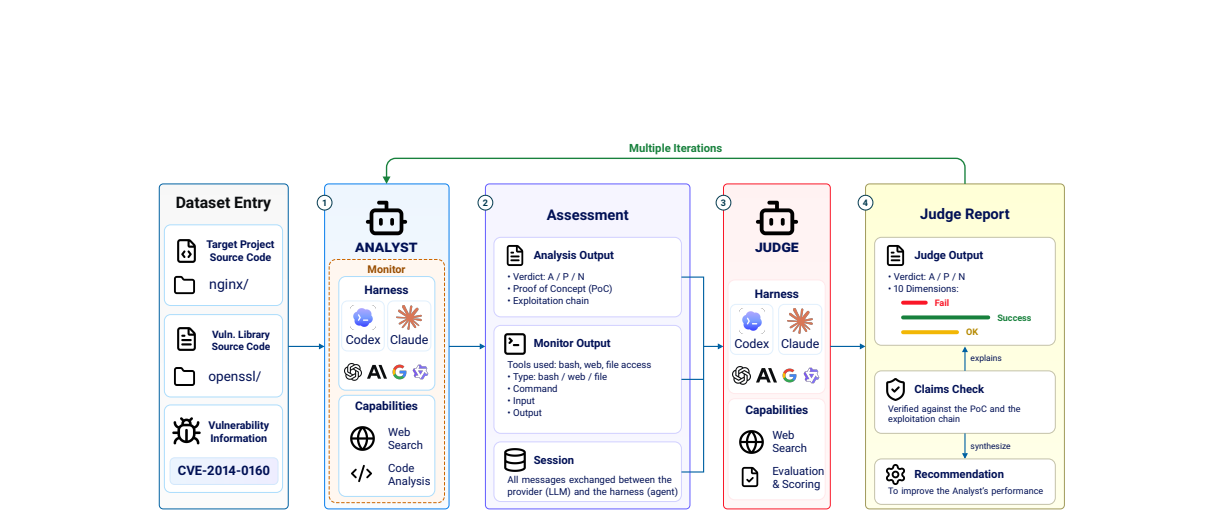
What carries the argument. The central mechanism is the separation of the Analyst agent (which performs the security assessment with full tool access) from one or more independent Judge agents (which cross-validate the Analyst's claims against a recorded tool-call trace without access to the source code). The Judge evaluates ten dimensions (scope, dependency, vulnerability, integration, reachability, evidence, tool use, classification, PoC, artifacts) and produces claim checks that tie each claim to recorded evidence. The recorded tool-call trace (monitor data) is treated as trusted, while the Analyst's output is treated as untrusted.
Core claim. SCARVA demonstrates that separating the roles of analysis and verification in LLM-based software supply-chain vulnerability assessment improves both accuracy and auditability. The best configuration (Qwen 3.8 Analyst with a four-model Judge panel) achieves 81.9% balanced accuracy, surpassing all evaluated proprietary models without a Judge. The Judge's claim checks are correct in 85.0% of reviewed claims (93.9% for Claude Opus 5.5). The paper also documents systematic agent failures: drifting to fixed revisions, citing unretrieved advisories, producing mock proofs of concept, and failing to recognize libraries without known vulnerabilities (recall as low as 9.3%).
The premise it rests on. The dataset contains only 54 C/C++ cases (18 per group), the reported differences are not tested for significance at the case level, and some CVEs may predate model training cutoffs, so the Analyst may recall the answer rather than derive it from the supplied code.
If the paper is right (Pith's inferences, not the authors')
LLM agents for security analysis should not be trusted on their verdict alone; independent verification of claims against a recorded trace is necessary for auditability.
The inclusion of a control group (libraries without known vulnerabilities) is essential for evaluating agentic security tools, as agents optimized for bug finding tend to fabricate findings when no vulnerability exists.
A panel of diverse Judge models provides more consistent improvements than any single Judge model, suggesting that ensemble verification may be more robust than relying on a single verifier.
The ten-dimensional scoring system (reachability, classification, vulnerability, etc.) provides a moderate signal (AUROC up to 0.80) for distinguishing correct from incorrect assessments, enabling human analysts to prioritize which assessments to audit.
Current frontier models (Claude Opus 5.5, GPT-5.6 families) do not outperform open-weight models (Qwen 3.8) on this task when both are used as Analysts without a Judge, challenging assumptions about model capability ordering for security analysis.
The SCARVA framework could be extended to other domains where LLM agents produce claims that need independent verification, such as medical diagnosis, legal analysis, or scientific literature review, wherever a recorded action trace is available.
The finding that a panel of weaker models outperforms a single strong model as Judge suggests that verification may benefit from diversity of perspective rather than raw capability, which has implications for how to design trustworthy AI systems.
The documented failure mode of agents drifting to fixed revisions (9 of 32 affected cases) suggests that current agent prompts and repository setups do not adequately enforce version constraints, a design issue that could be addressed with stricter tool-use boundaries.
The low recall on control group cases (libraries without known vulnerabilities) across most models indicates a systematic bias in LLM fine-tuning toward finding problems rather than correctly identifying their absence, which may require different training objectives or prompting strategies for security triage tasks.
Check this review
What was read
The passes were given all 245,046 characters of the paper's LaTeX source.
Fingerprint of that text (SHA-256): c3260f18d739f4076fc4802d7b8770f1f56b36613202769c6b738167d24d0a3c
Pith does not keep that text. Rebuilt from the paper's source or PDF by the same code, it has this fingerprint if it is the same text. From a copy of Pith's code:
PYTHONPATH=. python scripts/review_input_check.py 2611.26131
The passes, in the order they ran
- Reader deepseek-v4-flash · medium effort · $0.018 · instructions of the Reader, fingerprint f9ead7300382…
- Skeptic deepseek-v4-flash · medium effort · $0.0092 · instructions of the Skeptic, fingerprint 8f88c0f61488…
- Referee deepseek-v4-flash · medium effort · $0.0096 · instructions of the Referee, fingerprint a852d99aea0d…
- Check against the paper deepseek-v4-flash · medium effort · $0.0096 · instructions of the Check against the paper, fingerprint 6c7a6883d551…
- Editor deepseek-v4-flash · medium effort · $0.0093 · instructions of the Editor, fingerprint e7211f6a3d27…
- Summary for the page deepseek-v4-flash · medium effort · temperature 0.2 · $0.012 · instructions of the Summary for the page, fingerprint e4f56bf568e7…
The passes cost $0.067 in model calls together.
Version stamped on this review: pith-pipeline@v1.4.1-daily-deepseek-or-medium+deepseek/deepseek-v4-flash+p.0ef1a750a3e3
Each link opens a pass's instructions as plain text, the exact bytes its fingerprint was taken over. Every stored set of instructions.
curl -s https://pith.science/methodology/prompts/f9ead730038216984cfb56d7cb34332bdf691828296a1de4245f3d6667d4bf56 | sha256sum
prints the fingerprint of the reader's instructions. The same works for every pass.
The receipt
The review's fingerprint was taken on 20 Nov 2026. The review you are reading still matches it.
Fingerprint of the review (SHA-256): 94db83b7da34abbaf503e76088684f4c60dc207a82ea927fdf9abb2ca0667924
curl -s 'https://pith.science/api/v1/verdicts/2611.26131?form=canonical' | sha256sum
prints the fingerprint of the review as it stands now. The rule, in four steps.
A matching fingerprint shows the review has not changed since that date. It does not show that the review is right.
How often reviews like this one are right
Reviews like this one: written by deepseek-v4-flash, from the paper's LaTeX source.
How often objections from reviews like this one are right: not yet measured
Reviews by people
This review was written by a machine. No person has reviewed this paper on Pith yet. A scientist listed on Pith can review it for a fee, and their review is published here whatever it concludes.
The paper
Abstract
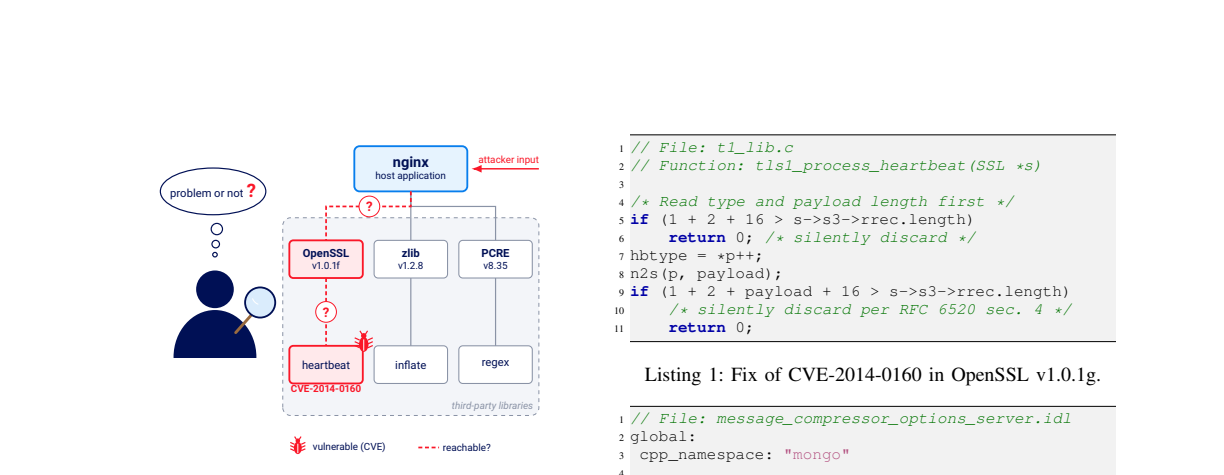
Complex applications may inherit security vulnerabilities from their dependencies, though a vulnerable dependency does not necessarily endanger the application. Existing tools flag dependencies associated with public vulnerabilities, and more advanced ones analyze the call graph to assess whether the vulnerable code is reachable. However, these approaches are limited to specific programming languages and ecosystems. LLM agents are promising candidates for this task, yet they hallucinate, take shortcuts, and reward hack. As these behaviors are opaque, the agents' conclusions may not be trusted. We present SCARVA a framework designed to produce interpretable reports. SCARVA combines advanced agent reasoning with an evidence-collection methodology that assesses the agent's analysis and improves its trustworthiness. Specifically, the ANALYST performs a software security assessment while SCARVA records every tool call, file access, and web request. Then, one or more independent JUDGE agents inspect the ANALYST's result and produce an evidence-backed report. We evaluate SCARVA on 54 manually curated cases, balanced across exploitable, non-exploitable, and vulnerability-free projects, using both open-weight and frontier models. The best ANALYST model, Qwen 3.8, reaches 82% balanced accuracy and surpasses the evaluated proprietary models. Human annotation validates the JUDGE findings: Claude Opus 5.5 performs best, agreeing with annotators in 94% of claim checks. Finally, we discuss the most common failure modes of agents on supply-chain vulnerability assessment.
The paper's own sentences, arranged, kept beside the review and separate from it. Each label is drawn from a closed vocabulary; the number beside it is the probability the classifier gave that label. No sentence in this record was written by a model.
abstract compiled · 2026-11-20
The authors' main claim, as the classifier picked it out 0.77
“The best ANALYST model, Qwen 3.8, reaches 82% balanced accuracy and surpasses the evaluated proprietary models.”
How the main claim is stated: asserted 1.00
What the abstract itself states, as probabilities: claims first 0.06 · states limitation 0.55 · human participants 0.35 · controlled comparison 0.44 · randomized assignment 0.02 · states quantitative result 0.99 · compares with prior results 0.84 · mentions code or data availability 0.04
The abstract, sentence by sentence
This table labels the abstract only (arXiv listing abstract v1). The number is the probability the classifier gave the label.
| Sentence | Role | The authors' own work | States the main conclusion | Strength |
|---|---|---|---|---|
| Complex applications may inherit security vulnerabilities from their dependencies, though a vulnerable dependency does not necessarily endanger the application. | background 1.00 | 0.05 | 0.02 | hedged possibility 0.99 |
| Existing tools flag dependencies associated with public vulnerabilities, and more advanced ones analyze the call graph to assess whether the vulnerable code is reachable. | background 1.00 | 0.03 | 0.02 | asserted 1.00 |
| However, these approaches are limited to specific programming languages and ecosystems. | gap 0.84 | 0.05 | 0.02 | asserted 1.00 |
| LLM agents are promising candidates for this task, yet they hallucinate, take shortcuts, and reward hack. | background 0.73 | 0.07 | 0.03 | asserted 0.84 |
| As these behaviors are opaque, the agents' conclusions may not be trusted. | background 0.71 | 0.06 | 0.03 | hedged possibility 0.97 |
| We present SCARVA a framework designed to produce interpretable reports. | contribution 1.00 | 0.86 | 0.16 | asserted 1.00 |
| SCARVA combines advanced agent reasoning with an evidence-collection methodology that assesses the agent's analysis and improves its trustworthiness. | contribution 0.57 | 0.73 | 0.20 | asserted 1.00 |
| Specifically, the ANALYST performs a software security assessment while SCARVA records every tool call, file access, and web request. | method 0.99 | 0.70 | 0.04 | asserted 1.00 |
| Then, one or more independent JUDGE agents inspect the ANALYST's result and produce an evidence-backed report. | method 0.99 | 0.64 | 0.06 | asserted 1.00 |
| We evaluate SCARVA on 54 manually curated cases, balanced across exploitable, non-exploitable, and vulnerability-free projects, using both open-weight and frontier models. | method 0.96 | 0.97 | 0.06 | asserted 0.99 |
| The best ANALYST model, Qwen 3.8, reaches 82% balanced accuracy and surpasses the evaluated proprietary models. | result 1.00 | 0.96 | 0.26 | asserted 1.00 |
| Human annotation validates the JUDGE findings: Claude Opus 5.5 performs best, agreeing with annotators in 94% of claim checks. | result 1.00 | 0.93 | 0.12 | asserted 1.00 |
| Finally, we discuss the most common failure modes of agents on supply-chain vulnerability assessment. | contribution 0.33 | 0.73 | 0.04 | unclear 0.65 |
What kind of paper the classifier reports this is: method or tool 1.00 · evidence from observation or experiment 0.99
What was examined, and what was not
Sources read
- arXiv listing abstract v1
Not examined
- full text
- figures and tables
- references and citing sentences
- relations to other papers
Levels run
- P abstract
Not run
- S sections
- T body sentences
- C citations
- R cross-paper relations
How the labels were made
Compiled by classifier-1.13.0 via TypeSafe API, question bank abstract-p1-20260923, 2026-11-20: 1 request, 9,358 input tokens.
Every quoted sentence on this record is the authors'. Every label is from Pith's closed vocabulary, with the probability shown beside it. This record as JSON
Figures (10)
Showing 4 of the paper's 10 figures. Figures are the authors', reproduced from the paper.
References (51)
- [1] Y . Shen, X. Gao, H. Sun, and Y . Guo, “Understanding vulnerabilities in software supply chains,”Empirical Softw. Engg., vol. 30, no. 1, Nov. 2024. [Online]. Available: https://doi.org/10.1007/ s10664-024-10581-2 on Pith
- [2] Anchore, “Syft: SBOM generator for container images and filesystems,” 2026, GitHub repository; accessed 2026-10-27. [Online]. Available: https://github.com/anchore/syft on Pith
- [3] Aqua Security, “Trivy: a comprehensive security scanner,” 2026, GitHub repository; accessed 2026-10-27. [Online]. Available: https://github.com/aquasecurity/trivy on Pith
- [4] OW ASP, “Dependency-Track: continuous SBOM analysis platform,” 2026, accessed 2026-10-27. [Online]. Available: https://dependencytrack.org/ on Pith
- [5] Anchore, “Grype: vulnerability scanner for container images and filesystems,” 2026, GitHub repository; accessed 2026-10-27. [Online]. Available: https://github.com/anchore/grype on Pith
- [6] Google, “OSV-Scanner: vulnerability scanner based on the OSV database,” 2026, GitHub repository; accessed 2026-10-27. [Online]. Available: https://github.com/google/osv-scanner on Pith
- [7] I. Pashchenko, H. Plate, S. E. Ponta, A. Sabetta, and F. Massacci, “Vuln4real: A methodology for counting actually vulnerable depen- dencies,”IEEE Transactions on Software Engineering, vol. 48, no. 5, pp. 1592–1609, 2022 on Pith
- [8] Y . Pu, L. Ying, and Y . Gu, “From noise to signal: Precisely identify affected packages of known vulnerabilities in npm ecosystem,” inProceedings of the Network and Distributed System Security (NDSS) Symposium. Internet Society, 2026. [Online]. Available: https://doi.org/10.1... on Pithdoi:10.14722/ndss.2026.241902
- [9] C. Fang, N. Miao, S. Srivastav, J. Liu, R. Zhang, R. Fang, Asmita, R. Tsang, N. Nazari, H. Wang, and H. Homayoun, “Large language models for code analysis: Do LLMs really do their job?” in33rd USENIX Security Symposium (USENIX Security 24). Philadelphia, PA: USENIX Association... on Pith
- [10] W. Ma, Z. Lin, S. Liu, Q. Hu, Y . Liu, W. Wang, C. Zhang, L. Nie, L. Li, Y . Liu, and L. Jiang, “Exploring code analysis: Zero-shot insights on syntax and semantics with llms,”ACM Trans. Softw. Eng. Methodol., May 2026, just Accepted. [Online]. Available: https://doi.org/10.11... on Pithdoi:10.1145/3818607
- [11] J. Shi, E. Tsien, Y . Di, H. Zhang, Y . Tang, R. Dey, I. Shishov, G. Netanel, Z. Grinberg, V . Belousov, B.-Z. Rotman, I. Pinto, and T. Zhang, “VEX-Bench: Benchmarking LLM agents for assessing exploitability of software supply chain vulnerabilities,” inProceedings of the 2026 ... on PithPith's reviewarXiv
- [12] CVE Project, “CVE Record Format,” GitHub repository; accessed 2026-10-23. [Online]. Available: https://github.com/CVEProject/ cve-schema on Pith
- [13] National Telecommunications and Information Administration, “The minimum elements for a software bill of materials (SBOM),” 2021, accessed 2026-10-23. [Online]. Available: https://www.ntia. gov/report/2021/minimum-elements-software-bill-materials-sbom on Pith
- [14] L. Zhou, M. Dacier, and C. Konstantinou, “A reality check on SBOM- based vulnerability management: An empirical study and a path forward,” 2026. [Online]. Available: https://arxiv.org/abs/2511.20313 on PithPith's reviewarXiv
- [15] A. Vaswani, N. Shazeer, N. Parmar, J. Uszkoreit, L. Jones, A. N. Gomez, Ł. Kaiser, and I. Polosukhin, “Attention is all you need,” inAdvances in Neural Information Processing Systems (NeurIPS), vol. 30, 2017 on Pith
- [16] A. Radford, K. Narasimhan, T. Salimans, and I. Sutskever, “Improving language understanding by generative pre- training,” OpenAI, Tech. Rep., 2018. [Online]. Avail- able: https://cdn.openai.com/research-covers/language-unsupervised/ language_understanding_paper.pdf on Pith
- [17] T. Brown, B. Mann, N. Ryder, M. Subbiah, J. D. Kaplan, P. Dhariwal, A. Neelakantan, P. Shyam, G. Sastry, A. Askellet al., “Language models are few-shot learners,”Advances in neural information pro- cessing systems, vol. 33, pp. 1877–1901, 2020 on Pith
- [18] D. Guo, D. Yang, H. Zhang, J. Song, P. Wang, Q. Zhu, R. Xu, R. Zhang, S. Ma, X. Biet al., “Deepseek-r1 incentivizes reasoning in llms through reinforcement learning,”Nature, vol. 645, no. 8081, pp. 633–638, 2025 on Pith
- [19] E. Zelikman, Y . Wu, J. Mu, and N. Goodman, “Star: Bootstrapping reasoning with reasoning,”Advances in Neural Information Process- ing Systems, vol. 35, pp. 15 476–15 488, 2022 on Pith
- [20] T. Schick, J. Dwivedi-Yu, R. Dessì, R. Raileanu, M. Lomeli, E. Ham- bro, L. Zettlemoyer, N. Cancedda, and T. Scialom, “Toolformer: Language models can teach themselves to use tools,”Advances in neural information processing systems, vol. 36, pp. 68 539–68 551, 2023 on Pith
show 31 more
- [21] S. Yao, J. Zhao, D. Yu, N. Du, I. Shafran, K. Narasimhan, and Y . Cao, “React: Synergizing reasoning and acting in language models,” 2023. [Online]. Available: https://arxiv.org/abs/2210.03629 on PithPith's reviewarXiv
- [22] Anthropic, “Claude Code,” 2026, GitHub repository; accessed 2026- 10-22. [Online]. Available: https://github.com/anthropics/claude-code on Pith
- [23] OpenAI, “Codex,” 2026, GitHub repository; accessed 2026-10-22. [Online]. Available: https://github.com/openai/codex on Pith
- [24] J. Yang, C. Jimenez, A. Wettig, K. Lieret, S. Yao, K. Narasimhan, and O. Press, “Swe-agent: Agent-computer interfaces enable automated software engineering,”Advances in Neural Information Processing Systems, vol. 37, pp. 50 528–50 652, 2024 on Pith
- [25] Z. W ANG, T. Shi, J. He, M. Cai, J. Zhang, and D. Song, “Cybergym: Evaluating ai agents'real-world cybersecurity capabilities at scale,” inInternational Conference on Learning Representations, C. V ondrick, B. Hariharan, C. Raffel, L. Pinto, D. Yang, and A. Faust, Eds., vol. 2... on Pith
- [26] H. Larcher, A. Carreira, R. G., and C. Rannou, “Anatomy of a frontier lab agent intrusion: A technical timeline of the July 2026 incident,” Hugging Face Blog, Jul. 2026. [Online]. Available: https://huggingface.co/blog/agent-intrusion-technical-timeline on Pith
- [27] A. K. Zhang, N. Perry, R. Dulepet, J. Ji, C. Menders, J. W. Lin, E. Jones, G. Hussein, S. Liu, D. Jasper, P. Peetathawatchai, A. Glenn, V . Sivashankar, D. Zamoshchin, L. Glikbarg, D. Askaryar, M. Yang, T. Zhang, R. Alluri, N. Tran, R. Sangpisit, P. Yiorkadjis, K. Osele, G. Ra... on PithPith's reviewarXiv
- [28] Z. Wang, N. Schiller, H. Li, S. S. Narayana, M. Nasr, N. Carlini, X. Qi, E. Wallace, E. Bursztein, L. Invernizzi, K. Thomas, Y . Shoshitaishvili, W. Guo, J. He, T. Holz, and D. Song, “Exploitgym: Can ai agents turn security vulnerabilities into real attacks?” 2026. [Online]. A... on PithPith's reviewarXiv
- [29] T. Shi, R. Rheem, D. Jiang, M. Wang, F. D. L. Riega, Z. Wang, J. Jiang, A. Cheung, S. Tai, J. Cha, J. Tu, G. Han, C. Wang, J. He, W. Guo, and D. Song, “CyberGym-E2E: Scalable real-world benchmark for AI agents’ end-to-end cybersecurity capabilities,” on Pith
- [30] S. Ullah, P. Balasubramanian, W. Guo, A. Burnett, H. Pearce, C. Kruegel, G. Vigna, and G. Stringhini, “From cve entries to verifiable exploits: An automated multi-agent framework for reproducing cves,” 2026. [Online]. Available: https://arxiv.org/abs/ 2509.01835 on PitharXiv
- [31] CVE Program, “CVE-2014-0160,” 2014, CVE Record; accessed 2026-10-22. [Online]. Available: https://www.cve.org/CVERecord? id=CVE-2014-0160 on Pith
- [32] Heartbleed.com, “The Heartbleed Bug,” 2014, updated 2025-03-07; accessed 2026-10-22. [Online]. Available: https://www.heartbleed. com/ on Pith
- [33] N. Lee, J. Hong, and J. Thorne, “Evaluating the consistency of LLM evaluators,” inProceedings of the 31st International Conference on Computational Linguistics (COLING). Association for Computa- tional Linguistics, 2025, pp. 10 650–10 659 on Pith
- [34] Docker, “Docker,” 2026, accessed: 2026-10-22. [Online]. Available: https://www.docker.com/ on Pith
- [35] GitHub user: "neurostream", “MCP tool invocation regressed for custom/local providers (Ollama Responses API) in v0.117.0+,” 2026, GitHub Issue; opened 2026-04-27; accessed 2026-10-27. [Online]. Available: https://github.com/openai/codex/issues/19871 on Pith
- [36] Firecrawl, “Firecrawl MCP Server,” 2026, GitHub repository; accessed 2026-10-22. [Online]. Available: https://github.com/ firecrawl/firecrawl-mcp-server on Pith
- [37] Microsoft, “Playwright MCP,” 2026, GitHub repository; accessed 2026-10-22. [Online]. Available: https://github.com/microsoft/ playwright-mcp on Pith
- [38] Model Context Protocol, “Model Context Protocol,” 2026, GitHub repository; accessed 2026-10-22. [Online]. Available: https://github. com/modelcontextprotocol/modelcontextprotocol on Pith
- [39] OpenTelemetry, “OpenTelemetry,” 2026, GitHub organization; accessed 2026-10-22. [Online]. Available: https://github.com/ open-telemetry on Pith
- [40] Grafana Labs, “Loki,” 2026, GitHub repository; accessed 2026-10-22. [Online]. Available: https://github.com/grafana/loki on Pith
- [41] ——, “Grafana,” 2026, GitHub repository; accessed 2026-10-22. [Online]. Available: https://github.com/grafana/grafana on Pith
- [42] G. Team, “Gemma 4 technical report,” 2026. [Online]. Available: https://arxiv.org/abs/2607.02770 on PithPith's reviewarXiv
- [43] Qwen Team, “Qwen3.8-Max: A new bar for coding and cowork,” August 2026. [Online]. Available: https://qwen.ai/blog?id=qwen3.8 on Pith
- [44] BenchGecko, “Knowledge Horizon · Where Does the Model’s World End?” 2026, accessed: 2026-10-22. [Online]. Available: https://benchgecko.ai/gecko-tests/knowledge-horizon on Pith
- [45] M. G. team, “Muse glimmer 30b: An on-device agentic model,” on Pith
- [46] OpenAI, “GPT-5.6 system card,” OpenAI, Tech. Rep., Jul. 2026, covers GPT-5.6 Sol, Terra and Luna. Accessed: 2026-10-22. [Online]. Available: https://deploymentsafety.openai.com/gpt-5-6 on Pith
- [47] [Online]. Available: https://arxiv.org/abs/2610.24628 on PithPith's reviewarXiv
- [48] ——, “System card: Claude Sonnet 5.5,” Anthropic, Tech. Rep., Sep. 2026, accessed: 2026-10-22. [Online]. Available: https://www.anthropic.com/document/claude-sonnet-5-5-system-card on Pith
- [49] Anthropic, “System card: Claude Opus 5.5,” Anthropic, Tech. Rep., Sep. 2026, accessed: 2026-10-22. [Online]. Available: https://www.anthropic.com/claude-opus-5-5-system-card on Pith
- [51] CVE Program, “CVE-2020-36846,” 2025, CVE Record; published 2025-05-30; accessed 2026-10-22. [Online]. Available: https://www. cve.org/CVERecord?id=CVE-2020-36846 Appendix A. Agent Prompts SCARV A uses three prompts, whose role is described in §5.2. Their exact text is availabl... on Pith
- [2026] [Online]. Available: https://arxiv.org/abs/2606.04460 on PithPith's reviewarXiv
Challenges and discussion
Disagree with the review, or know something it missed? Leave a comment, or challenge this review formally: a challenge becomes a permanent entry in this paper's record, and its decision is published here.
Come back by email
A short list of the week's newly reviewed papers. Nothing is sent until you confirm from your inbox, and every email has a link that stops it. No account.
No comments yet.
Sign in to comment