Machine Learning · arXiv:2609.09662 v1 · submitted 9 Sep 2026 · 48 references
PELM: Power Efficient On-Device LLM Inference with Speculative Decoding and Dynamic Voltage Frequency Scaling
The paper says
“Deploying Large Language Models (LLMs) directly on mobile platforms at the edge is gaining traction due to a myriad of benefits, such as increased privacy, personalization, and reduced latency.”
more of the abstract
However, LLMs have heavy computational requirements, which are difficult for resource-constrained mobile and edge platforms to fulfill. In addition to limited compute resources, mobile and edge systems often have a compact form factor and lack physical mechanisms to dissipate heat generated from high processor usage rates (e.g., fans) to prevent throttling and reduced processing power, which LLMs can easily cause. To mitigate these effects, prior works have proposed various power governing strategies, such as dynamic voltage and frequency scaling (DVFS), for reducing power and heat generation for heavy computational tasks on mobile platforms. Recently, DVFS methods tailored for mobile LLMs have also been proposed. However, these methods mostly focus on optimizing hardware parameters and processor frequencies, and they fall short under some thermally constrained scenarios. Drawing from recent advances in machine learning, we identify and take advantage of the key insight that not all tokens require full-depth inference to maintain high-quality generation. Motivated by this, we present PELM, a solution that augments traditional DVFS processor frequency tuning with two additional workload-specific knobs: 1) speculative decoding and 2) variable verification depth to expand the optimization space to multiple dimensions for more power efficient on-device LLM inference. In extensive evaluations across hardware platforms and datasets, PELM demonstrates superior performance compared to state-of-the-art power governing methods, with up to 23.1% speedup and 52.4% reduction in energy consumption, while maintaining comparable task performance. The source code is available at https://github.com/imec-nu/PELM.
from the abstract
Pith says
Machine review · deepseek-v4-flash · 10 Sep 2026 · what was read was not recorded · not checked by a person
It can be wrong. Challenge this review or reply to it.
The passes disagreed. Reader: holds up. Skeptic: agrees with the reader. Referee: major revision.
Genuine co-design of DVFS, speculative decoding, and variable depth with unusually thorough measurements, but the DQN's contribution is never isolated and task quality on 13B is weaker than the abstract claims. This line is wrong
2 major objections · 2 minor
How often objections from reviews like this one are right: not yet measured
Not checked: figures, code, what the 48 references say.
The paper says, at §5.3, Table 5
The review did not quote this passage.
Pith says: Objection 1 of 2 · major
The ablation study removes individual control knobs (frequency, variable depth, speculative decoding) but never removes the DQN itself to isolate the contribution of reinforcement learning over the knowledge-guided behavior policy described in §3.2.2. The behavior policy already implements domain-specific heuristics (AIMD frequency adjustment, speculation‑feedback loops).
more of objection 1
Without a control experiment that compares the full PELM against a variant that uses only the behavior policy (i.e., no Q‑network updates, acting solely on heuristics) it is impossible to determine whether the DQN provides a meaningful advantage or merely adds complexity. This is a load‑bearing issue because the paper's central claim is that it presents a 'Deep Reinforcement Learning‑based power governor' and §3.2 states the DQN is needed to 'navigate this large optimization space'. The authors should run this missing ablation and report the results; if the DQN contributes negligible improvement, the novelty of the RL component would be substantially diminished.
The paper says, at §3.2.3, Eq. (4)–(8) and Table 1
The review did not quote this passage.
Pith says: Objection 2 of 2 · major
The reward function depends on five scalar hyper‑parameters (α_S, α_vd+, α_vd−, α_p, T_vd) plus the warning temperature T_warning. The paper gives no indication of how these were chosen (manual tuning? grid search?), provides no sensitivity analysis, and does not list the final values used in the experiments.
more of objection 2
Reward shaping can strongly influence the learned policy; without reporting these parameters and some justification for their selection, the reproducibility of the results is compromised. The authors should provide the chosen values, describe the selection process, and ideally include a sensitivity study (e.g., varying one parameter while holding others fixed) to show that the main conclusions are robust to reasonable perturbations.
2 minor objections
The paper says, at Algorithm 1, line 6
Pith says: minor objection 1 of 2
The action updating step writes `f_c0, f_c1, f_c2, f_g` for CPU/GPU frequencies. However, the Orin Nano (Table 2) has only two CPU clusters, not three. The pseudocode should either note that the number of CPU clusters is platform‑dependent or genericize the notation (e.g., `f_c[1..N]`).
The paper says, at Fig. 1, Fig. 2
Pith says: minor objection 2 of 2
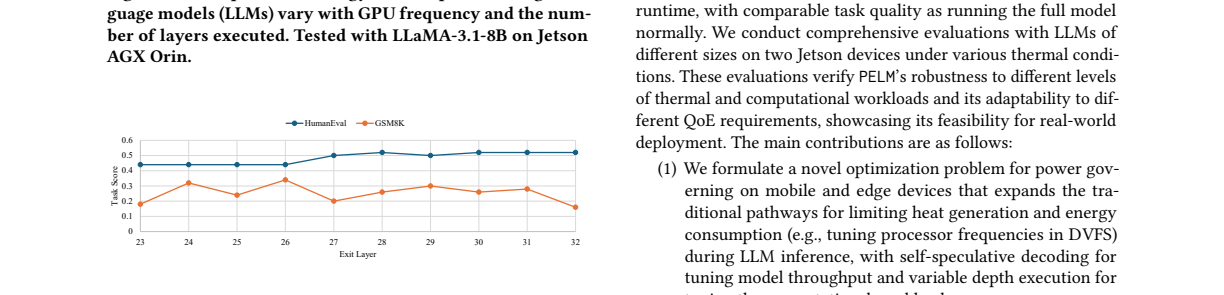
In Fig. 1 the y‑axis 'Layer Used' is labeled from 8 (top) to 32 (bottom), but thermal maps conventionally place the smallest value at the bottom. Consider reversing the axis order for readability. Also, in Fig. 2 the drop in HumanEval score from layer 24 (≈0.45) to layer 32 (≈0.25) is notable; the text (end of §2.3) describes the performance …
more of objection 2
… as 'within a comparable range', but a 44% drop may need further discussion, especially since it is used to motivate the feasibility of early‑exit execution.
What would settle it
Implement a PELM variant (PELM-H) that replaces the DQN action selection with the knowledge-guided behavior policy described in Section 3.2.2: always select actions according to the thermal headroom, speed ratio, and speculation feedback heuristics, without any Q-network or training. Run PELM-H on the 8B model on Jetson AGX Orin under Moderate cooling (Table 5). Compare energy consumption, decoding speed, completion rate, and task score (TSA) against full PELM. If all metrics are within 5% of the full system, then the DQN provides negligible benefit.
from the skeptic's reading
How the review went
4 readings by deepseek-v4-flash · 10 Sep 2026
- Reader holds up
- Skeptic partly agrees
- Editor wrote the verdict above
- Referee major revision: 2 major objections, 2 minor
Not run on this paper: the simulated authors' defence.
Pith did not check this review's objections against the paper.
The review in full
The review in brief, machine-written
Worth a look. PELM is the first system I know of that treats processor frequency, self-speculative decoding, and verification depth as one joint control space for on-device LLM inference, and the evaluation is genuinely careful: two Jetson platforms, three model sizes, five datasets, four cooling regimes, completion rates, frequency statistics, and measured control overhead. The overhead accounting is thorough—the DQN is 5,687 parameters, roughly 22 KB, with training updates of 9-18 ms inside a 100 ms control window. HQCache, which restores hidden states when verification depth deepens, fixes a real KV-cache problem. Code is released. For the 8B and 1B regimes the energy and speed claims hold up, and the pattern of an energy advantage that grows with workload and thermal stress is supported by the data.
Three soft spots, in proportion. First, the stress-test concern is valid: the RL contribution is never isolated. The exploration/behavior policy is a hand-designed AIMD-style heuristic with speculative feedback, and the ablations remove variable depth, speculation, and frequency control—but never the DQN itself. So the paper's claim that learning is needed to navigate this space is unproven; the heuristics may be doing most of the work. This is fixable with one variant running the behavior policy alone with no Q-network updates, and it should be added.
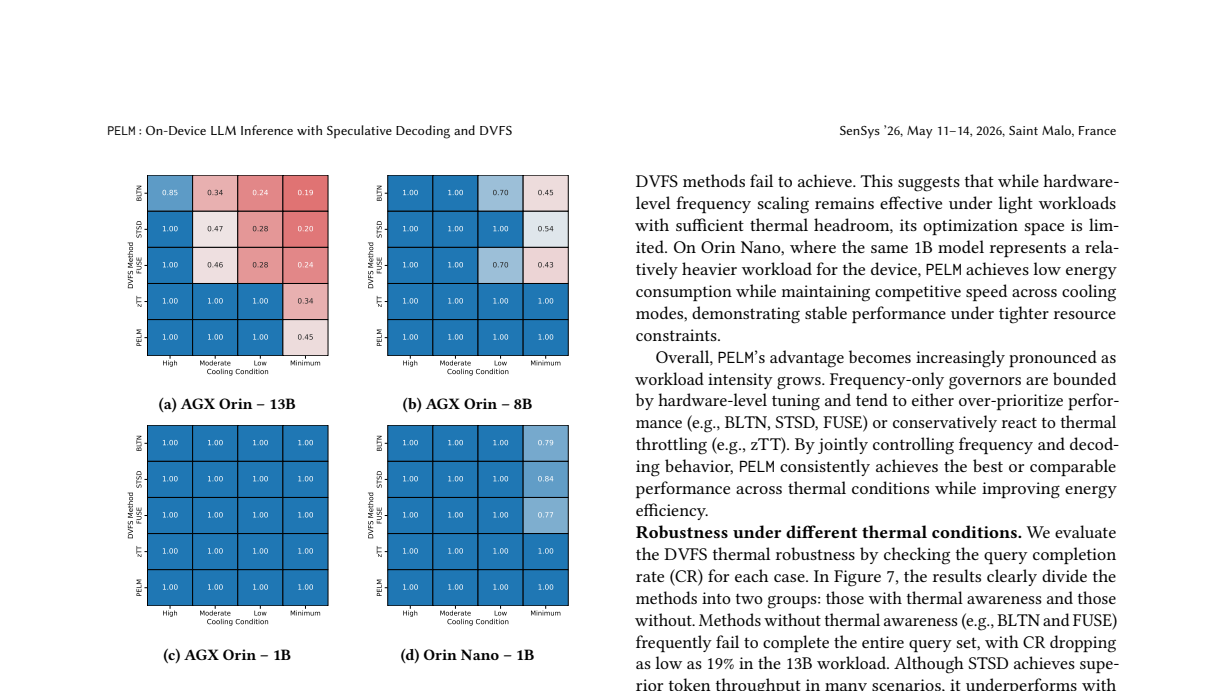
Second, and more serious for the headline numbers: task quality on 13B is not comparable. TSA drops about a third against the vanilla baselines; NQ-open is roughly halved (15 vs 30) and translation falls to about a third (7.5 vs 22). The largest energy savings, up to 52.4%, come from exactly this regime. The abstract says comparable task performance while the results section quietly downgrades to retains meaningful quality. Those are different claims, and the paper should own that.
Minor: the epsilon-greedy description reads backwards (DQN action with probability epsilon, exploration with 1-epsilon), there is no sensitivity analysis for the six hand-tuned reward weights, and the variable-depth ablation is inconsistent—the no-VD variant beats full PELM on PPJ in several 13B and 8B cells, contradicting the universal degradation wording.
Bottom line: send it to review. The co-design and the measurements are real, and the main gaps are closable with one additional ablation and honest reframing of the 13B trade-off. Not a desk reject.
The strongest objection
The paper claims that PELM is a Deep Reinforcement Learning-based power governor that jointly optimizes hardware frequencies and decoding knobs via a DQN. However, the RL agent acts on top of a knowledge-guided behavior policy (Section 3.2.2) that uses hand-designed heuristics (AIMD-style frequency adjustments, speculative feedback rules). The ablation study (Section 5.3) removes components (frequency, variable depth, speculation) but never removes the DQN itself to isolate the contribution of learning over the behavior policy. The behavior policy alone already implements sensible domain logic (e.g., reduce frequency on overspeed, adjust speculation length based on acceptance rates). Without a direct comparison between the full PELM and a variant that uses only the behavior policy (always acting according to heuristics, no Q-network updates), it is impossible to determine whether the RL provides a meaningful advantage or merely adds complexity. If the heuristics account for most of the energy savings, the DQN claim is overclaimed and the paper's novelty is diminished. This is load-bearing because the central claim that PELM is an RL-based controller that 'navigates this large optimization space' hinges on the DQN being an essential component.
The paper presents a well-engineered system with thorough evaluation, but the claim that the DQN-based RL is a key innovation is not fully supported. The reader's weakest_assumption focused on early-exit quality and reward parameter tuning; my concern is adjacent but more fundamental: the contribution of the learning component itself is not isolated. Nevertheless, the overall system PELM (joint optimization of DVFS and speculative decoding) demonstrates clear energy savings and robustness, independent of whether the DQN or the heuristic policy drives decisions. The central claim about energy reduction and speedup is empirically validated; the uncertainty about the RL's marginal importance does not invalidate those results. Therefore, the reader's ACCEPT verdict stands, though the confidence might be slightly tempered. The concrete test would settle whether the DQN is necessary, potentially shifting the novelty assessment but not the empirical contribution.
The referee's report
If the claimed results hold, PELM demonstrates a promising cross-layer approach that bridges hardware DVFS control with algorithm-level early-exit and speculative decoding, a combination that has not been systematically studied for on-device LLM energy management. The empirical evaluation is broad: multiple model sizes, thermal regimes, and datasets. The idea of co-optimizing frequency and decoding depth is well motivated by the many-to-one mapping shown in the pilot study (Fig. 1). The work has the potential to influence how future mobile LLM stacks manage the power-performance trade-off in thermally constrained environments.
Pith's reading of the paper (a machine's summary, not the authors')
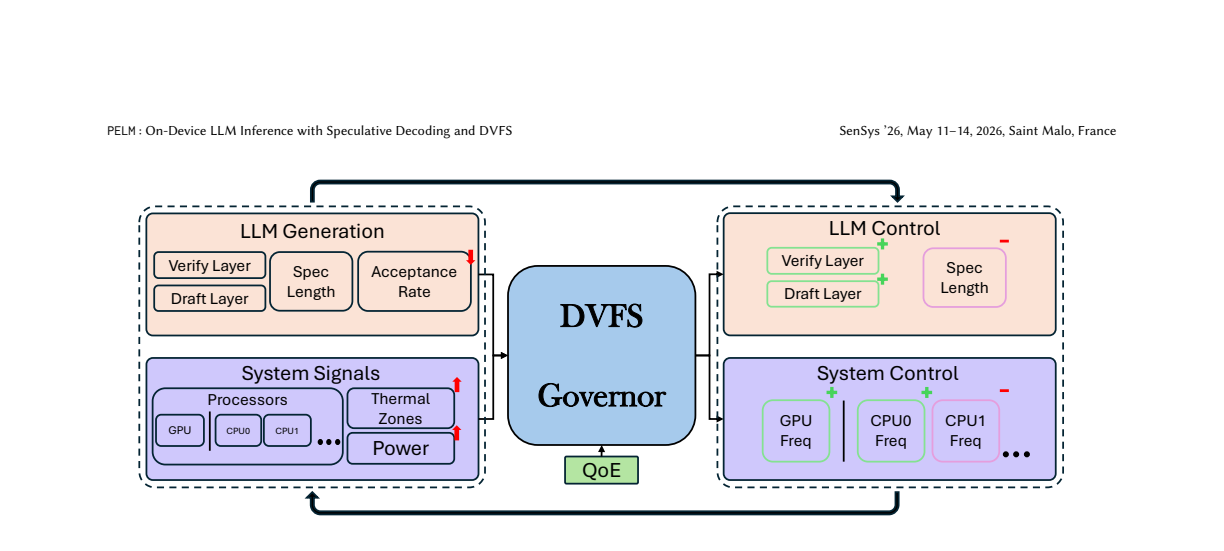
The paper tries to establish that the usual way to manage power on phones and edge devices — scaling processor voltage and frequency — is too narrow for large language models, and that adding decoding-level controls can do much better. Its system, PELM, keeps generation speed at a target tokens-per-second while a reinforcement-learning governor chooses CPU/GPU frequency, draft exit layer, speculation count, and verification depth together. Because many tokens are produced with fewer than the full number of layers, the same perceived speed costs less energy and produces less heat. On three model sizes, five datasets, two embedded platforms, and four cooling conditions, PELM reports up to 52.4% lower energy per query and up to 23.1% faster decoding than existing power governors, with task-performance averages near full-depth inference. A reader should care because thermal throttling, not just battery life, is a first-order limit on running LLMs locally.
What carries the argument. The load-bearing object is a closed-loop DVFS governor built as a branch deep Q-network (DQN) that acts every 100 ms on a state of CPU/GPU power, utilization, temperature and its rate of change, current frequencies, token speed, and speculation ratio. Its action is the tuple of CPU frequency, GPU frequency, draft exit layer $e_x$, speculation count $n_s$, and verification depth $v_d$; the reward sums separate terms for meeting the speed target, preserving output fidelity (proxied by $v_d$), avoiding thermal limits, matching utilization to frequency, and limiting power. The speedup model $R = (n_{ac} v_d)/(n_s e_x + v_d)$ ties the three knobs together, and a hidden-state cache avoids recomputing earlier layers when verification depth grows. What makes the argument carry is the demonstrated many-to-one mapping from (depth, frequency) pairs to the same token speed at different energy costs.
Core claim. The central claim is that not every token needs a full forward pass through every layer, and a power governor can profit from that fact. PELM's pilot measurements show many combinations of layer count and GPU frequency deliver the same token speed at very different energy; for instance, running 20 of 32 layers at 0.6 GHz matches the speed of the full model at 1.3 GHz while using roughly half the energy. The paper therefore reformulates power management as a joint optimization of hardware frequency plus two workload knobs — self-speculative decoding and variable verification depth — and solves it online with a deep Q-network whose reward penalizes missing the speed target, overheating, frequency/workload mismatch, and excessive power, while rewarding accepted speculative tokens. Across model sizes from 1B to 13B, five datasets, two embedded platforms, and four cooling levels, PELM meets or beats the target decoding speed with up to 52.4% energy reduction and up to 23.1% speedup relative to existing DVFS governors, while keeping task-quality averages within a few points of full-depth baselines.
The premise it rests on. The load-bearing premise is that verifying draft tokens with a truncated part of the model keeps generation quality close enough to full-depth output for every kind of token; the paper demonstrates this on a limited set of tasks and only for models that expose intermediate-layer outputs.
If the paper is right (Pith's inferences, not the authors')
On phones and edge modules that already have early-exit LLMs, a governor like PELM can extend battery life and reduce heat without asking users to accept slower answers.
Frequency-only governors leave a measurable fraction of energy savings on the table even when they hit the same speed target, because the same quality of experience can be delivered at lower depth and lower frequency.
Under thermal stress, PELM's thermal-aware reward lets more queries finish before hitting temperature limits; in the paper's hardest case it completed more of the query set than the closest baseline.
Energy per query and performance per joule become natural headline metrics for comparing on-device LLM serving systems, alongside raw throughput.
If the central premise generalizes, early-exit training should optimize intermediate layers for verification agreement rather than only final-task accuracy, since PELM's savings depend on how often a shallow pass agrees with the full model.
A consequence the authors leave implicit is that the same three-knob formulation could transfer to phone SoCs or NPUs with different DVFS interfaces, but the reward weights would likely need per-platform re-tuning.
Token-level difficulty signals such as output entropy could let a future governor decide per token whether to verify deeper; the paper names this direction but does not implement it.
A testable extension is to measure how often the policy chooses maximum verification depth on long-context or multi-step reasoning prompts; if that fraction rises sharply, the energy savings would shrink exactly where output quality is most at risk.
Check this review
Pith stored no record of this review's passes and took no fingerprint of it. Reviews made by code from 13 Nov 2026 on carry both.
How often reviews like this one are right
Reviews like this one: written by deepseek-v4-flash, where what was read was not recorded.
How often objections from reviews like this one are right: not yet measured
Reviews by people
This review was written by a machine. No person has reviewed this paper on Pith yet. A scientist listed on Pith can review it for a fee, and their review is published here whatever it concludes.
The paper
Abstract
Deploying Large Language Models (LLMs) directly on mobile platforms at the edge is gaining traction due to a myriad of benefits, such as increased privacy, personalization, and reduced latency. However, LLMs have heavy computational requirements, which are difficult for resource-constrained mobile and edge platforms to fulfill. In addition to limited compute resources, mobile and edge systems often have a compact form factor and lack physical mechanisms to dissipate heat generated from high processor usage rates (e.g., fans) to prevent throttling and reduced processing power, which LLMs can easily cause. To mitigate these effects, prior works have proposed various power governing strategies, such as dynamic voltage and frequency scaling (DVFS), for reducing power and heat generation for heavy computational tasks on mobile platforms. Recently, DVFS methods tailored for mobile LLMs have also been proposed. However, these methods mostly focus on optimizing hardware parameters and processor frequencies, and they fall short under some thermally constrained scenarios. Drawing from recent advances in machine learning, we identify and take advantage of the key insight that not all tokens require full-depth inference to maintain high-quality generation. Motivated by this, we present PELM, a solution that augments traditional DVFS processor frequency tuning with two additional workload-specific knobs: 1) speculative decoding and 2) variable verification depth to expand the optimization space to multiple dimensions for more power efficient on-device LLM inference. In extensive evaluations across hardware platforms and datasets, PELM demonstrates superior performance compared to state-of-the-art power governing methods, with up to 23.1% speedup and 52.4% reduction in energy consumption, while maintaining comparable task performance. The source code is available at https://github.com/imec-nu/PELM.
The paper's own sentences, arranged, kept beside the review and separate from it. Each label is drawn from a closed vocabulary; the number beside it is the probability the classifier gave that label. No sentence in this record was written by a model.
abstract compiled · 2026-09-23
The authors' main claim, as the classifier picked it out 1.00
“In extensive evaluations across hardware platforms and datasets, PELM demonstrates superior performance compared to state-of-the-art power governing methods, with up to 23.1% speedup and 52.4% reduction in energy consumption, while maintaining comparable task performance.”
How the main claim is stated: asserted 1.00
What the abstract itself states, as probabilities: claims first 0.06 · states limitation 0.10 · human participants 0.03 · controlled comparison 0.79 · randomized assignment 0.01 · states quantitative result 0.99 · compares with prior results 0.96 · mentions code or data availability 0.98
The abstract, sentence by sentence
This table labels the abstract only (arXiv listing abstract v1). The number is the probability the classifier gave the label.
| Sentence | Role | The authors' own work | States the main conclusion | Strength |
|---|---|---|---|---|
| Deploying Large Language Models (LLMs) directly on mobile platforms at the edge is gaining traction due to a myriad of benefits, such as increased privacy, personalization, and reduced latency. | background 1.00 | 0.05 | 0.02 | asserted 0.99 |
| However, LLMs have heavy computational requirements, which are difficult for resource-constrained mobile and edge platforms to fulfill. | background 0.98 | 0.06 | 0.02 | asserted 1.00 |
| In addition to limited compute resources, mobile and edge systems often have a compact form factor and lack physical mechanisms to dissipate heat generated from high processor usage rates (e.g., fans) to prevent throttling and reduced processing power, which LLMs can easily cause. | background 1.00 | 0.07 | 0.01 | asserted 0.91 |
| To mitigate these effects, prior works have proposed various power governing strategies, such as dynamic voltage and frequency scaling (DVFS), for reducing power and heat generation for heavy computational tasks on mobile platforms. | background 1.00 | 0.03 | 0.02 | asserted 0.99 |
| Recently, DVFS methods tailored for mobile LLMs have also been proposed. | background 1.00 | 0.04 | 0.02 | asserted 1.00 |
| However, these methods mostly focus on optimizing hardware parameters and processor frequencies, and they fall short under some thermally constrained scenarios. | gap 0.93 | 0.09 | 0.02 | asserted 0.97 |
| Drawing from recent advances in machine learning, we identify and take advantage of the key insight that not all tokens require full-depth inference to maintain high-quality generation. | contribution 0.51 | 0.71 | 0.06 | asserted 1.00 |
| Motivated by this, we present PELM, a solution that augments traditional DVFS processor frequency tuning with two additional workload-specific knobs: 1) speculative decoding and 2) variable verification depth to expand the optimization space to multiple dimensions for more power efficient on-device LLM inference. | contribution 0.86 | 0.90 | 0.12 | asserted 0.99 |
| In extensive evaluations across hardware platforms and datasets, PELM demonstrates superior performance compared to state-of-the-art power governing methods, with up to 23.1% speedup and 52.4% reduction in energy consumption, while maintaining comparable task performance. | result 1.00 | 0.97 | 0.88 | asserted 1.00 |
| The source code is available at https://github.com/imec-nu/PELM. | contribution 0.73 | 0.43 | 0.03 | asserted 0.98 |
What kind of paper the classifier reports this is: method or tool 1.00 · evidence from observation or experiment 0.99
What was examined, and what was not
Sources read
- arXiv listing abstract v1
Not examined
- full text
- figures and tables
- references and citing sentences
- relations to other papers
Levels run
- P abstract
Not run
- S sections
- T body sentences
- C citations
- R cross-paper relations
How the labels were made
Compiled by classifier-1.13.0 via TypeSafe API, question bank abstract-p1-20260923, 2026-09-23: 1 request, 7,773 input tokens.
Every quoted sentence on this record is the authors'. Every label is from Pith's closed vocabulary, with the probability shown beside it. This record as JSON
Figures (7)



Showing 6 of the paper's 7 figures. Figures are the authors', reproduced from the paper.
References (48)
- [1] Marah Abdin, Jyoti Aneja, Harkirat Behl, Sébastien Bubeck, Ronen Eldan, Suriya Gunasekar, Michael Harrison, Russell J Hewett, Mojan Javaheripi, Piero Kauff- mann, et al. 2024. Phi-4 technical report.arXiv preprint arXiv:2412.08905(2024) on PithPith's reviewarXiv
- [2] Ondřej Bojar, Christian Buck, Christian Federmann, Barry Haddow, Philipp Koehn, Johannes Leveling, Christof Monz, Pavel Pecina, Matt Post, Herve Saint- Amand, et al. 2014. Findings of the 2014 workshop on statistical machine trans- lation. InProceedings of the ninth workshop o... on Pith
- [3] Tianle Cai, Yuhong Li, Zhengyang Geng, Hongwu Peng, Jason D Lee, Deming Chen, and Tri Dao. 2024. Medusa: Simple llm inference acceleration framework with multiple decoding heads.arXiv preprint arXiv:2401.10774(2024) on PithPith's reviewarXiv
- [4] Mark Chen, Jerry Tworek, Heewoo Jun, Qiming Yuan, Henrique Ponde De Oliveira Pinto, Jared Kaplan, Harri Edwards, Yuri Burda, Nicholas Joseph, Greg Brockman, et al. 2021. Evaluating large language models trained on code. arXiv preprint arXiv:2107.03374(2021) on PithPith's reviewarXiv
- [5] Karl Cobbe, Vineet Kosaraju, Mohammad Bavarian, Mark Chen, Heewoo Jun, Lukasz Kaiser, Matthias Plappert, Jerry Tworek, Jacob Hilton, Reiichiro Nakano, et al. 2021. Training verifiers to solve math word problems.arXiv preprint arXiv:2110.14168(2021) on PithPith's reviewarXiv
- [6] Vincent Dumas, Fabrice Guillemin, and Philippe Robert. 2002. A Markovian analysis of additive-increase multiplicative-decrease algorithms.Advances in Applied Probability34, 1 (2002), 85–111 on Pith
- [7] Mostafa Elhoushi, Akshat Shrivastava, Diana Liskovich, Basil Hosmer, Bram Wasti, Liangzhen Lai, Anas Mahmoud, Bilge Acun, Saurabh Agarwal, Ahmed Roman, Ahmed Aly, Beidi Chen, and Carole-Jean Wu. 2024. LayerSkip: Enabling Early Exit Inference and Self-Speculative Decoding. InPr... on Pith
- [8] Ophir Frieder, Ida Mele, Cristina Ioana Muntean, Franco Maria Nardini, Raf- faele Perego, and Nicola Tonellotto. 2024. Caching Historical Embeddings in Conversational Search.ACM Trans. Web18, 4, Article 42 (Oct. 2024), 19 pages. doi:10.1145/3578519 on Pithdoi:10.1145/3578519
- [9] Yichao Fu, Peter Bailis, Ion Stoica, and Hao Zhang. 2024. Break the sequen- tial dependency of llm inference using lookahead decoding.arXiv preprint arXiv:2402.02057(2024) on PithPith's reviewarXiv
- [10] Jiawei Geng, Zongwei Zhu, Weihong Liu, Xuehai Zhou, and Boyu Li. 2024. Pow- erLens: an adaptive DVFS framework for optimizing energy efficiency in deep neural networks. InProceedings of the 61st ACM/IEEE design automation confer- ence. 1–6 on Pith
- [11] Karl Moritz Hermann, Tomas Kocisky, Edward Grefenstette, Lasse Espeholt, Will Kay, Mustafa Suleyman, and Phil Blunsom. 2015. Teaching machines to read and comprehend.Advances in neural information processing systems28 (2015) on Pith
- [12] Andreas Kosmas Kakolyris, Dimosthenis Masouros, Petros Vavaroutsos, Sotirios Xydis, and Dimitrios Soudris. 2025. throttLL’eM: Predictive GPU Throttling for Energy Efficient LLM Inference Serving. In2025 IEEE International Symposium on High Performance Computer Architecture (HP... on Pith
- [13] Andreas Kosmas Kakolyris, Dimosthenis Masouros, Sotirios Xydis, and Dimitrios Soudris. 2024. Slo-aware gpu dvfs for energy-efficient llm inference serving.IEEE Computer Architecture Letters23, 2 (2024), 150–153 on Pith
- [14] Seyeon Kim, Kyungmin Bin, Sangtae Ha, Kyunghan Lee, and Song Chong. 2022. zTT: Learning-based DVFS with zero thermal throttling for mobile devices. GetMobile: Mobile Computing and Communications25, 4 (2022), 30–34 on Pith
- [15] Tom Kwiatkowski, Jennimaria Palomaki, Olivia Redfield, Michael Collins, Ankur Parikh, Chris Alberti, Danielle Epstein, Illia Polosukhin, Jacob Devlin, Kenton Lee, et al. 2019. Natural questions: a benchmark for question answering research. Transactions of the Association for C... on Pith
- [16] Stefanos Laskaridis, Kleomenis Katevas, Lorenzo Minto, and Hamed Haddadi. [n. d.]. Mobile and edge evaluation of large language models. InWorkshop on Efficient Systems for Foundation Models II@ ICML2024 on Pith
- [17] Stefanos Laskaridis, Kleomenis Katevas, Lorenzo Minto, and Hamed Haddadi on Pith
- [18] Kenton Lee, Ming-Wei Chang, and Kristina Toutanova. 2019. Latent Retrieval for Weakly Supervised Open Domain Question Answering. InProceedings of the 57th Annual Meeting of the Association for Computational Linguistics, Anna Korhonen, David Traum, and Lluís Màrquez (Eds.). Ass... on Pithdoi:10.18653/v1/p19-1612
- [19] Yaniv Leviathan, Matan Kalman, and Yossi Matias. 2023. Fast inference from transformers via speculative decoding. InInternational Conference on Machine Learning. PMLR, 19274–19286 on Pith
- [20] Xiang Li, Zhenyan Lu, Dongqi Cai, Xiao Ma, and Mengwei Xu. 2024. Large language models on mobile devices: Measurements, analysis, and insights. In Proceedings of the Workshop on Edge and Mobile Foundation Models. 1–6 on Pith
show 28 more
- [21] Yuhui Li, Fangyun Wei, Chao Zhang, and Hongyang Zhang. 2024. EAGLE-2: Faster Inference of Language Models with Dynamic Draft Trees. InProceedings of the 2024 Conference on Empirical Methods in Natural Language Processing, Yaser Al-Onaizan, Mohit Bansal, and Yun-Nung Chen (Eds.... on Pithdoi:10.18653/v1/
- [22] Yuhui Li, Fangyun Wei, Chao Zhang, and Hongyang Zhang. 2024. Eagle: Speculative sampling requires rethinking feature uncertainty.arXiv preprint arXiv:2401.15077(2024) on PithPith's reviewarXiv
- [23] Yuhui Li, Fangyun Wei, Chao Zhang, and Hongyang Zhang. 2025. EAGLE-3: Scaling up Inference Acceleration of Large Language Models via Training-Time Test. InThe Thirty-ninth Annual Conference on Neural Information Processing Systems. https://openreview.net/forum?id=4exx1hUffq on Pith
- [24] Chengdong Lin, Kun Wang, Zhenjiang Li, and Yu Pu. 2023. A workload-aware DVFS robust to concurrent tasks for mobile devices. InProceedings of the 29th Annual International Conference on Mobile Computing and Networking. 1–16 on Pith
- [25] Daria Lioubashevski, Tomer M. Schlank, Gabriel Stanovsky, and Ariel Goldstein on Pith
- [26] Kaiyuan Liu, Xiaobo Zhou, and Li Li. 2025. m 2 LLM: A Multi-Dimensional Optimization Framework for LLM Inference on Mobile Devices.IEEE Transactions on Parallel and Distributed Systems(2025) on Pith
- [27] Qunyou Liu, Darong Huang, Marina Zapater, and David Atienza. 2025. GreenLLM: SLO-Aware Dynamic Frequency Scaling for Energy-Efficient LLM Serving.arXiv preprint arXiv:2508.16449(2025) on PithPith's reviewarXiv
- [28] Patrick Mochel. 2005. The sysfs filesystem. InLinux Symposium, Vol. 1. The Linux Foundation San Francisco, CA, USA, 313–326 on Pith
- [29] Haoran Qiu, Weichao Mao, Archit Patke, Shengkun Cui, Saurabh Jha, Chen Wang, Hubertus Franke, Zbigniew Kalbarczyk, Tamer Başar, and Ravishankar K Iyer on Pith
- [30] Tal Schuster, Adam Fisch, Jai Gupta, Mostafa Dehghani, Dara Bahri, Vinh Tran, Yi Tay, and Donald Metzler. 2022. Confident adaptive language modeling.Advances in Neural Information Processing Systems35 (2022), 17456–17472 on Pith
- [31] Dongjoo Seo, Juhee Sung, Jaekoo Lee, and Nikil Dutt. 2025. GOLD: Green Optimization of Language Models Serving on Devices. In2025 IEEE International Conference on Consumer Electronics (ICCE). IEEE, 1–2 on Pith
- [32] Power-aware deep learning model serving with{𝜇 -Serve}. In2024 USENIX Annual Technical Conference (USENIX ATC 24). 75–93 on Pith
- [33] Jovan Stojkovic, Chaojie Zhang, Íñigo Goiri, Esha Choukse, Haoran Qiu, Rodrigo Fonseca, Josep Torrellas, and Ricardo Bianchini. 2025. Tapas: Thermal-and power- aware scheduling for LLM inference in cloud platforms. InProceedings of the 30th ACM International Conference on Arch... on Pith
- [34] D Suleiman, Muhammed Ibrahim, and Ibrahim Hamarash. 2005. Dynamic voltage frequency scaling (DVFS) for microprocessors power and energy reduction. In 4th International Conference on Electrical and Electronics Engineering, Vol. 12. 4 on Pith
- [35] Oscar Skean, Md Rifat Arefin, Dan Zhao, Niket Nikul Patel, Jalal Naghiyev, Yann LeCun, and Ravid Shwartz-Ziv. 2025. Layer by Layer: Uncovering Hidden Representations in Language Models. InForty-second International Conference on Machine Learning. https://openreview.net/forum?i... on Pith
- [36] Thomas Wolf, Lysandre Debut, Victor Sanh, Julien Chaumond, Clement Delangue, Anthony Moi, Pierric Cistac, Tim Rault, Remi Louf, Morgan Funtowicz, Joe Davison, Sam Shleifer, Patrick von Platen, Clara Ma, Yacine Jernite, Julien Plu, Canwen Xu, Teven Le Scao, Sylvain Gugger, Mari... on Pith
- [37] Heming Xia, Yongqi Li, Jun Zhang, Cunxiao Du, and Wenjie Li. 2024. Swift: On- the-fly self-speculative decoding for llm inference acceleration.arXiv preprint arXiv:2410.06916(2024) on PithPith's reviewarXiv
- [38] Zhepei Wei, Wei-Lin Chen, Xinyu Zhu, and Yu Meng. 2025. AdaDecode: Accelerat- ing LLM Decoding with Adaptive Layer Parallelism. InForty-second International Conference on Machine Learning. https://openreview.net/forum?id=VnO2GEpmlb on Pith
- [39] An Yang, Anfeng Li, Baosong Yang, Beichen Zhang, Binyuan Hui, Bo Zheng, Bowen Yu, Chang Gao, Chengen Huang, Chenxu Lv, et al. 2025. Qwen3 technical report.arXiv preprint arXiv:2505.09388(2025) on PithPith's reviewarXiv
- [40] Zicong Ye, Kunming Zhang, and Guoming Tang. 2025. AGFT: An Adaptive GPU Frequency Tuner for Real-Time LLM Inference Optimization.arXiv preprint arXiv:2508.01744(2025) on PithPith's reviewarXiv
- [41] Mengwei Xu, Dongqi Cai, Wangsong Yin, Shangguang Wang, Xin Jin, and Xu- anzhe Liu. 2025. Resource-efficient algorithms and systems of foundation models: A survey.Comput. Surveys57, 5 (2025), 1–39 on Pith
- [42] Jun Zhang, Jue Wang, Huan Li, Lidan Shou, Ke Chen, Gang Chen, and Sharad Mehrotra. 2023. Draft & verify: Lossless large language model acceleration via self-speculative decoding.arXiv preprint arXiv:2309.08168(2023) on PithPith's reviewarXiv
- [43] Zongpu Zhang, Pranab Dash, Y Charlie Hu, Qiang Xu, Jian Li, and Haibing Guan. 2025. Dissecting the Impact of Mobile DVFS Governors on LLM Inference Performance and Energy Efficiency.arXiv preprint arXiv:2507.02135(2025) on PithPith's reviewarXiv
- [44] Amir Yeganeh-Khaksar, Mohsen Ansari, Sepideh Safari, Sina Yari-Karin, and Alireza Ejlali. 2020. Ring-DVFS: Reliability-aware reinforcement learning-based DVFS for real-time embedded systems.IEEE Embedded Systems Letters13, 3 SenSys ’26, May 11–14, 2026, Saint Malo, France Weis... on Pith
- [45] Ziyang Zhang, Yang Zhao, Huan Li, Changyao Lin, and Jie Liu. 2024. DVFO: Learning-based DVFS for energy-efficient edge-cloud collaborative inference. IEEE Transactions on Mobile Computing23, 10 (2024), 9042–9059 on Pith
- [47] Ziyang Zhang, Yang Zhao, Ming-Ching Chang, Changyao Lin, and Jie Liu. 2025. E4: Energy-Efficient DNN Inference for Edge Video Analytics Via Early Exiting and DVFS. InProceedings of the AAAI Conference on Artificial Intelligence, Vol. 39. 1165–1173 on Pith
- [2024] Melting point: Mobile evaluation of language transformers. InProceedings of the 30th Annual International Conference on Mobile Computing and Networking. 890–907 on Pith
- [2025] Looking Beyond the Top-1: Transformers Determine Top Tokens in Order. InForty-second International Conference on Machine Learning. https://openreview. net/forum?id=2B11W1Z6ID on Pith
Cited by 2 Pith papers
Reviewed papers on Pith that cite this one. The full citation record
Challenges and discussion
Disagree with the review, or know something it missed? Leave a comment, or challenge this review formally: a challenge becomes a permanent entry in this paper's record, and its decision is published here.
Come back by email
A short list of the week's newly reviewed papers. Nothing is sent until you confirm from your inbox, and every email has a link that stops it. No account.
No comments yet.
Sign in to comment