Distributed, Parallel, and Cluster Computing · arXiv:2610.06325 v1 · submitted 5 Oct 2026 · 84 references
Fine-Tuning a 3B-Parameter LLM on a Smartphone: Characterizing Sustained Training
The paper says
“Multi-billion-parameter LLMs now run on phones for inference, and training them on the device would personalize them without user data leaving the phone.”
more of the abstract
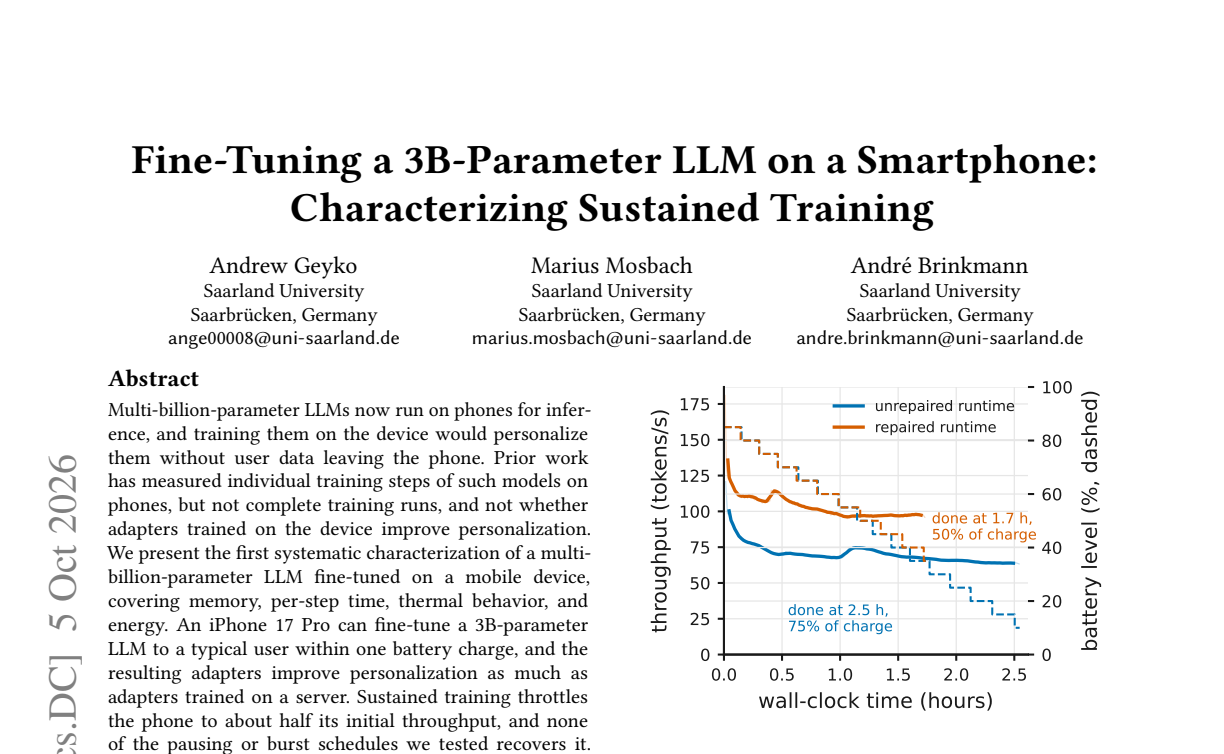
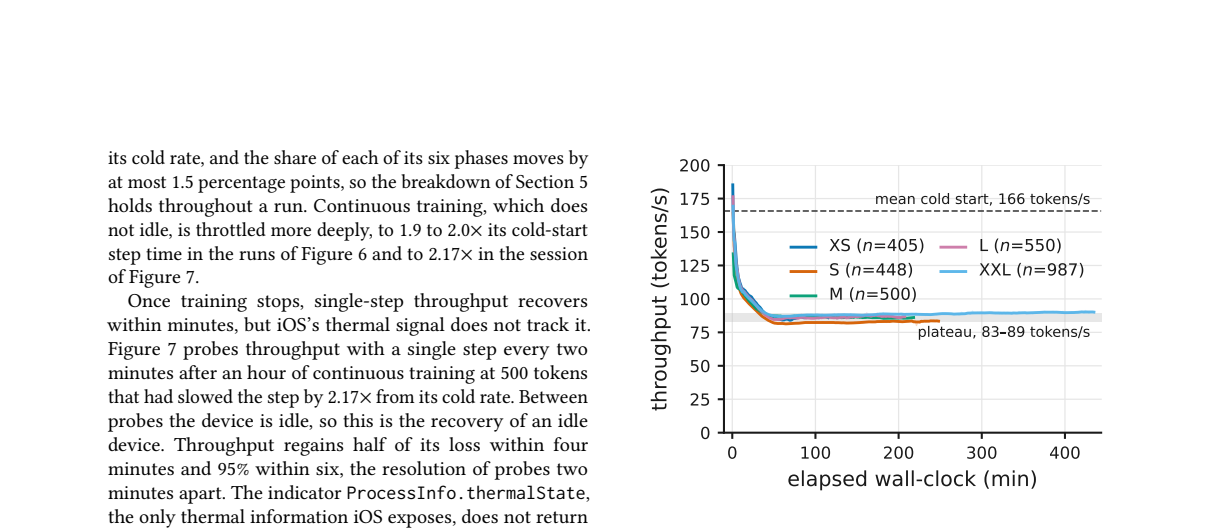
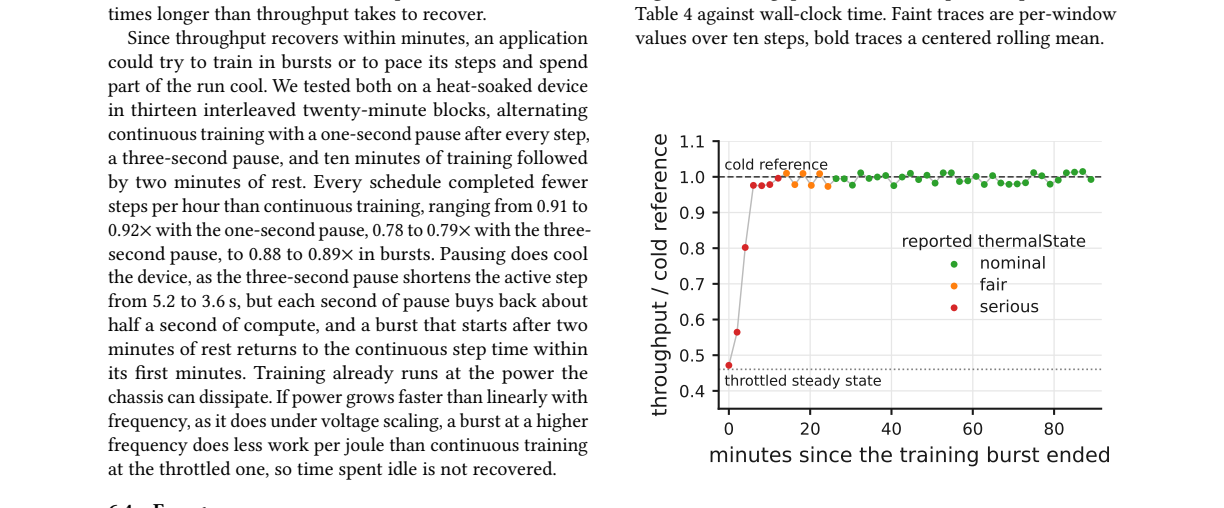
Prior work has measured individual training steps of such models on phones, but not complete training runs, and not whether adapters trained on the device improve personalization. We present the first systematic characterization of a multi-billion-parameter LLM fine-tuned on a mobile device, covering memory, per-step time, thermal behavior, and energy. An iPhone 17 Pro can fine-tune a 3B-parameter LLM to a typical user within one battery charge, and the resulting adapters improve personalization as much as adapters trained on a server. Sustained training throttles the phone to about half its initial throughput, and none of the pausing or burst schedules we tested recovers it. Nearly all of each training step is spent in the frozen base model, most of it in the backward pass, which nine of the ten other runtimes we audited do not accelerate. Apple's MLX had a kernel for it that was never dispatched and was incorrect, and our repair, now merged upstream, trains an adapter 1.47x faster on a third less energy. On-device fine-tuning is feasible on current phones, and making it efficient requires runtimes and operating systems to treat training as a first-class workload.
from the abstract
Pith says
Machine review · deepseek-v4-flash · 6 Oct 2026 · what was read was not recorded · not checked by a person
It can be wrong. Challenge this review or reply to it.
Holds up, with conditions. A genuine first measurement of complete multi-billion-parameter training runs on a phone, anchored by a real, verified MLX kernel fix — but the energy headline is stated with more precision than the 5%-granularity battery gauge can support. This line is wrong
2 major objections · 3 minor
How often objections from reviews like this one are right: not yet measured
Not checked: figures, code, what the 84 references say.
The paper says, at Section 6.4 / Table 6 / Abstract
The review did not quote this passage.
Pith says: Objection 1 of 2 · major
The headline quantitative energy claims ('trains an adapter 1.47x faster on a third less energy', '0.04 J/token', 'about half a battery charge') are stated without error bars even though the only energy signal (Section 2.3, Section 3) is a battery gauge reporting charge in 5% steps, i.e., 2.78 kJ on the rated 55.6 kJ battery.
more of objection 1
Each net-energy value is a difference of two quantized readings minus an idle baseline, so each of the 26.2 kJ and 39.3 kJ figures carries roughly ±2.8 kJ of quantization error; the ratio 26.2/39.3 = 0.667 then spans roughly 0.56–0.79, so the 'a third less' figure is not pinned, and the per-token 0.04 J/token carries an absolute uncertainty of about ±0.004 J/token (≈10%). The saving direction itself is robust — it inherits the well-measured per-step speedup at nearly equal net power (4.18 vs 4.28 W) — but the exact quantitative framing is not supported at the stated precision. I request propagated error bars on Table 6, the per-token constants, and the abstract/energy-ratio statements, or, if that is not feasible at this gauge resolution, softened and ranged language ('approximately a third', '47 ± 5% of a charge').
The paper says, at Section 5.3
The review did not quote this passage.
Pith says: Objection 2 of 2 · major
The end-to-end kernel comparison (2.55 h / 39.3 kJ generic vs 1.74 h / 26.2 kJ repaired, giving the headline 1.47x factor and the 'third less energy' figure) rests on a single generic-kernel run, while Section 6.1 reports a 4.9% run-to-run spread on the repaired arm alone.
more of objection 2
Because the 1.47x and its energy counterpart are advertised in the abstract and introduction, I recommend at least three replicate runs per arm, or an explicit statement that the interleaved per-step ratios of Section 5.3 (1.45–1.68x), which control for thermal state, are the primary evidence for the speedup, with the single full-run comparison presented as illustrative.
3 minor objections
The paper says, at Abstract / Section 7.4
Pith says: minor objection 1 of 3
The claim that on-device adapters 'improve personalization as much as adapters trained on a server' is validated on-device for a single task (movie tagging, Table 8); the other six tasks in the per-user evaluation were run on a server. The paper is transparent about this in Section 7.4, but the abstract and introduction should carry the same scope qualifier.
The paper says, at Section 6.4
Pith says: minor objection 2 of 3
The derived statement that 'a full charge trains about 1.3 million training tokens' (52 kJ / 0.04 J per token) inherits the same ±~10% gauge uncertainty; it would be more precise to state a range (approximately 1.1–1.5 million tokens).
show 1 more
The paper says, at Section 6.1
Pith says: minor objection 3 of 3
The observation that the same 405-record history trains 5–10% faster unplugged than plugged rests on a single unplugged run; given the 4.9% run-to-run spread reported for the plugged runs, a replicate or two would make the plugged-vs-battery comparison more informative.
What would settle it
Run each kernel arm (repaired, generic) as three complete unplugged 405-record adapter runs from full charge, separated by at least one hour of idle recovery, and treat each arm as one continuous battery window: record batteryLevel once at the arm's start and once at its end, subtract the idle-baseline draw of the recovery gaps, and divide by three for per-run net energy. This cuts the 5%-step quantization error from ±2.8 kJ to under ±1 kJ per run and averages out the 4.9% run-to-run spread the paper reports (Section 6.1). Decision rule: if the refined ratio remains 0.667 within about 0.05, conditional acceptance stands with error bars added to Table 6; if it lands near 0.55 or 0.80, 'a third less energy' and '0.04 J/token' must be weakened to interval statements.
from the skeptic's reading
How the review went
4 readings by deepseek-v4-flash · 6 Oct 2026
- Reader holds up, with conditions
- Skeptic agrees
- Editor wrote the verdict above
- Referee major revision: 2 major objections, 3 minor
Not run on this paper: the simulated authors' defence.
Pith did not check this review's objections against the paper.
The review in full
The review in brief, machine-written
Know three things before you read this one. First, it is the first paper to measure complete multi-billion-parameter fine-tuning runs on a phone — hours-long, through sustained throttling — not just single steps like the prior work. Second, the most valuable artifact in it is a real bug fix: an accelerated quantized backward kernel in MLX that was compiled into every binary but never dispatched, and was incorrect when it did run. They repaired it, verified it against a dense reference (bit-for-bit on matrix-unit shapes, 1e-3 elsewhere), and it is merged upstream. The 1.47x wall-clock speedup at nearly equal net power is well measured, so the energy saving direction is robust. Third, the "a third less energy" headline is imprecise: all energy comes from UIDevice.batteryLevel reported in 5% steps (2.78 kJ on a 55.6 kJ battery), and the 26.2-vs-39.3 kJ comparison pins the ratio to roughly 0.56-0.79, a saving between about 20% and 44%, not exactly 33%. The authors acknowledge the gauge granularity but never propagate it into error bars, and the generic arm is a single run atop a reported 4.9% spread.
What it does well beyond the fix: the sustained-throttling characterization is clean — throughput halves within minutes, stays flat for hours, and no pause or burst schedule recovers it, which is a finding about the thermal envelope, not about scheduling. The phases-of-a-step decomposition is internally consistent (sums to 1.02-1.08x), the per-token time fits are tight (r = 0.998 on tokens vs 0.931 on record count), and the runtime audit of eleven frameworks — nine of which lack the backward contraction over quantized weights — is a useful gap map. The on-device adapter matches the server-trained one within one accuracy point on movie tagging, which is the claim that matters, though validation on that task only is a minor gap; the other six LaMP tasks are server-only. Code and data are public.
Proportionately: the energy imprecision is a fixable precision problem, not a refutation — the saving direction inherits the well-measured time speedup. The single-task personalization validation and single-run generic arm are minor. The memory model free parameters are honestly presented fits, not circular claims. This is a careful, serious paper whose central feasibility claim (a 3B adapter within one charge, matching server quality) survives the worst case.
For the systems/mobile-ML community, a careful referee is worth it; the main revision ask is error bars or an external power measurement for the energy claims, plus one more on-device task. I'd bring it to a reading group and would cite the kernel repair and runtime audit in my own work.
The strongest objection
The abstract's 'a third less energy' and Section 6.4's per-token cost model (0.04 J/token, about half a battery charge) are derived from UIDevice.batteryLevel, which the paper states reported charge in 5% steps on a rated 55.6 kJ battery (Section 2.3, Section 3). One step is 2.78 kJ. A run's net energy is the difference of two quantized readings, start and end, minus the idle baseline, so the combined quantization error is about one gauge step, roughly ±2.8 kJ. For the kernel comparison of Section 5.3, the reported net energies are 26.2 kJ (repaired) and 39.3 kJ (generic); with ±2.8 kJ on each, the reported ratio 26.2/39.3 = 0.667 ('a third less') falls anywhere in approximately 23.4/42.1 = 0.56 to 29.0/36.5 = 0.79 — a saving between about 20% and 44%, not pinned to 33%. The per-token figure 0.04 J/token carries the same ±10% absolute uncertainty, the 405-record cost is 47 ± 5% of a charge, and the generic arm is a single run on top of the 4.9% run-to-run spread the paper reports for the repaired arm (Section 6.1). The authors acknowledge the gauge resolution but never propagate it: Table 6, the energy ratio, and the per-token values carry no error bars. This is a precision concern, not a refutation — the saving direction is robust because it inherits the well-measured 1.47x wall-clock speedup at nearly equal net power (4.18 vs 4.28 W, Section 6.4), and the 405-record feasibility margin survives the worst case. But 'a third less energy' is stated as an exact quantitative headline, and the reported data cannot support that precision.
The paper's central claims are (i) feasibility of a complete per-user fine-tuning run of a 3B-parameter LLM on a phone within one battery charge, (ii) parity of phone-trained adapters with server-trained adapters on personalization, and (iii) a kernel repair that trains 1.47x faster on a third less energy. What must hold for these to be true is that the energy accounting is accurate enough to support the quantitative cost statements, and that phone-trained adapters have server quality on tasks where personalization gains exist. The least-secure condition is the energy accounting. The 5%-resolution battery gauge (Section 2.3) is the only energy signal iOS exposes, and the paper converts its readings into kilojoules and per-token figures (Section 6.4, Table 6) without propagating the quantization error: the headline comparison 26.2 vs 39.3 kJ is uncertain to about ±2.8 kJ per run, which turns 'a third less' into anywhere from 'a fifth less' to 'under a half less.' The qualitative direction is nevertheless robust, since the saving is the 1.47x wall-clock speedup at nearly equal net power, and the central feasibility claim survives even worst-case error (47 ± 5% of a charge is still within one charge). Because the authors acknowledge the gauge resolution but do not supply error bars in Table 6 or the abstract, the reader's weakest-assumption identification is accurate and my read does not change the reader's verdict. The remaining candidate concerns are weaker: on-device personalization parity rests on a single task (movie tagging, Section 7.4), but Table 8 already discloses that per-user gains are task-dependent and the paper scopes its validation honestly; the runtime audit is a snapshot of cited, publicly inspectable sources; and the memory-model curve fit is a secondary claim. Credit is due where the paper is well supported: the 1.47x speedup is corroborated by interleaved per-step alternation (1.55x average) and a bit-for-bit check against a dense reference, the repair is merged upstream as cited PR #4051, and the code and data are released. These supports leave the energy-precision issue as the one load-bearing soft spot, and the proposed interleaved-triplicate measurement would settle it, so the CONDITIONAL verdict should stand.
The referee's report
If the results hold, this is a substantial systems contribution. The complete-run characterization — memory budget, sustained-throttle plateau, token-linear time and energy models, and the feasibility claim that a 3B model can be fine-tuned within one battery charge — is genuinely new for billion-parameter training on phones. The MLX kernel diagnosis with a merged upstream fix is a concrete, verifiable artifact, and the quality evaluation showing on-device adapters matching server-trained ones on a personalization task addresses a question prior step-level studies could not answer. Strengths include public code and data, strong internal-consistency checks (the six step phases sum to 1.02–1.08x of the fused step; per-kernel GPU captures; loss trajectories of the two kernels correlated at 0.9999; the repaired kernel agreeing bit-for-bit with a dense reference on supported shapes), and no circularity: the per-token time and energy constants are observed fits, not derived from the claims they support. The principal weakness is the precision of the energy claims, which rest on a battery gauge with 5% granularity that the paper acknowledges but never propagates into error bars.
Pith's reading of the paper (a machine's summary, not the authors')
The paper tries to establish that on-device fine-tuning of a multi-billion-parameter language model is not just possible but practical today: an iPhone 17 Pro can fine-tune a 3B-parameter SmolLM3-3B at 4-bit precision on a typical user's history within one battery charge, and the adapters it produces match server-trained adapters on the LaMP personalization benchmark. It is the first measurement of complete sustained training runs (not single steps) on a phone, and it shows training time and energy are linear in training tokens at about 0.01 seconds and 0.04 joules per token. The core discovery is that nearly all of each step is spent in the frozen base model, most of it in a backward pass over quantized weights that the runtime never accelerated: MLX's matrix-unit kernel for this contraction had never been dispatched and was incorrect, and repairing it makes an adapter train 1.47x faster on about a third less energy. The paper also finds that sustained training throttles the phone to about half its initial throughput and that no pause-and-resume schedule recovers it.
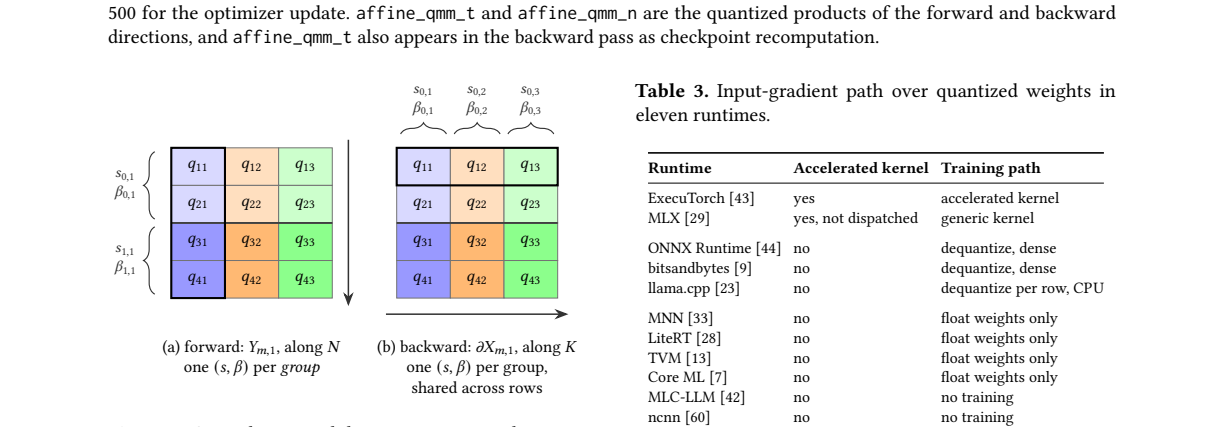
What carries the argument. The load-bearing mechanism is the grouped-quantized weight layout and the two contraction directions it forces. With 4-bit weights and group size 64, the forward pass $Y = XW$ reads weights down a column so one scale applies per group of 64 products; the backward pass computes $\partial X = \partial Y W^\top$, reading weights along rows where scales differ per column but are shared across a group's rows—so the scale factors once per group but the contraction needs a separate tiled kernel over the packed codes. MLX only ever dispatched the forward-direction kernel to the matrix units; the backward direction ran generic Metal kernels. The repair corrects the transposed-layout offsets and leading dimension, bounds tile loads, and dispatches the backward kernel, showing the whole excess over the arithmetic-predicted factor-of-two backward cost was this missing dispatch.
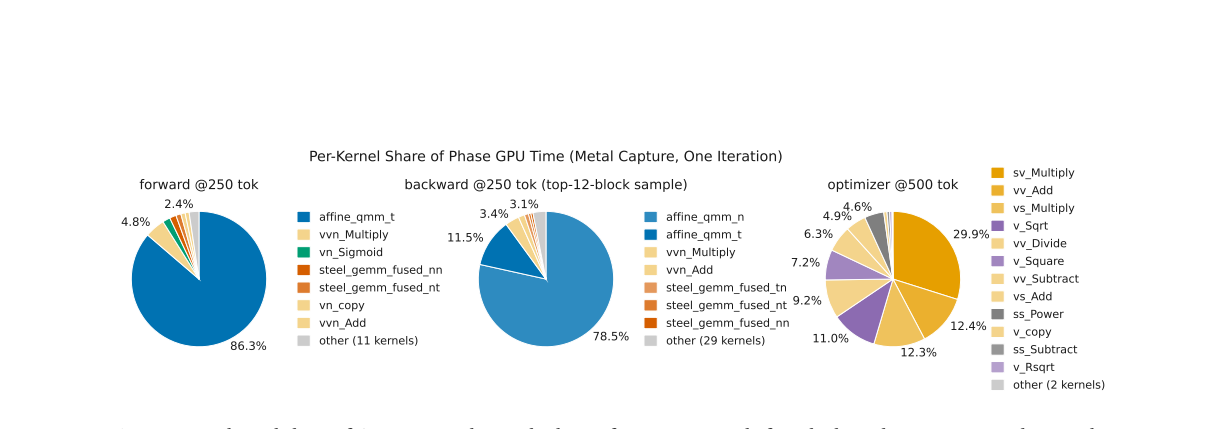
Core claim. On-device fine-tuning of a 3B-parameter LLM at 4-bit precision is feasible on a current flagship phone and matches server quality: a 405-record user history trains as a per-user LoRA adapter in about a third of a full charge's energy (26.2 kJ net), while a 987-record history exhausts a full charge before completing. Training time and energy are linear in training tokens—roughly 0.01 seconds and 0.04 joules per token—so a run's cost can be predicted before it starts. The paper's central diagnosis is that the backward pass over the frozen quantized base model dominates every step (78% of an un-repaired step; the frozen model takes ~96% of step time), and this pass needs a second, tiled kernel over the packed 4-bit weights that inference-oriented runtimes do not provide. In MLX such a kernel existed but was never dispatched and was incorrect; the authors fixed the offsets, bounded the tile loads, and wired the dispatch, making the backward pass 1.65–2.13x faster and a complete adapter run 1.47x faster on 26.2 kJ instead of 39.3 kJ, with unchanged loss and identical adapter quality. An audit shows nine of the ten other runtimes lack this accelerated kernel entirely, with only ExecuTorch adding one concurrently.
The premise it rests on. The claims that an adapter costs about half a battery charge and that the repaired kernel uses a third less energy rest on energy values derived from a battery gauge that reports charge in 5% steps with no stated error bars, so the precision the headlines imply is not actually measured.
If the paper is right (Pith's inferences, not the authors')
On-device fine-tuning of a 3B-parameter model is feasible on current phones: a 405-record user history trains within one battery charge, and a 987-record history exhausts a full charge before the run completes.
Phone-trained adapters are equivalent in personalization quality to server-trained adapters: on movie tagging they gain +12.0 points over the task adapter versus +12.7 on a server, with the on-device gain growing with history length.
Training cost can be predicted before a run starts because time and energy are linear in training tokens at about 0.01 seconds and 0.04 joules per token, independent of record count.
The backward pass over quantized weights requires its own tiled kernel, and since nine of ten audited runtimes lack one, most on-device runtimes either pay a 1.45–1.68x per-step penalty or dequantize the weights at additional memory and time cost.
Sustained training settles at a throttled plateau of roughly half a cold start's throughput, and no pause-and-resume schedule recovers it, so any practical deployment must be planned around that plateau.
The never-dispatched-kernel defect is likely not confined to MLX: any runtime storing grouped-quantized weights in the inference layout needs the second contraction kernel, and the audit's pattern suggests the 1.47x speedup is a lower bound on what a correct backward path would save in other runtimes that currently dequantize or run generic kernels.
If operating systems permitted training to run while charging and off-screen, as the paper recommends, the battery cost that anchors the 'within one charge' framing would largely vanish, at a measured 5–10% runtime penalty for plugged-in runs.
The quantitative energy claims ('half a battery charge', 'a third less energy') are only as precise as the 5%-step battery gauge they derive from; remeasuring the same runs with an external power meter would confirm or revise those numbers.
Adapter depth is the cheapest quality-versus-cost knob: adapting the last 24 of 36 blocks raises phone throughput by 34–45% at a cost of 1.1 accuracy points, suggesting a plausible automatic tuning lever for deployments that accept a small quality penalty.
Check this review
Pith stored no record of this review's passes and took no fingerprint of it. Reviews made by code from 13 Nov 2026 on carry both.
How often reviews like this one are right
Reviews like this one: written by deepseek-v4-flash, where what was read was not recorded.
How often objections from reviews like this one are right: not yet measured
Reviews by people
This review was written by a machine. No person has reviewed this paper on Pith yet. A scientist listed on Pith can review it for a fee, and their review is published here whatever it concludes.
The paper
Abstract
Multi-billion-parameter LLMs now run on phones for inference, and training them on the device would personalize them without user data leaving the phone. Prior work has measured individual training steps of such models on phones, but not complete training runs, and not whether adapters trained on the device improve personalization. We present the first systematic characterization of a multi-billion-parameter LLM fine-tuned on a mobile device, covering memory, per-step time, thermal behavior, and energy. An iPhone 17 Pro can fine-tune a 3B-parameter LLM to a typical user within one battery charge, and the resulting adapters improve personalization as much as adapters trained on a server. Sustained training throttles the phone to about half its initial throughput, and none of the pausing or burst schedules we tested recovers it. Nearly all of each training step is spent in the frozen base model, most of it in the backward pass, which nine of the ten other runtimes we audited do not accelerate. Apple's MLX had a kernel for it that was never dispatched and was incorrect, and our repair, now merged upstream, trains an adapter 1.47x faster on a third less energy. On-device fine-tuning is feasible on current phones, and making it efficient requires runtimes and operating systems to treat training as a first-class workload.
The paper's own sentences, arranged, kept beside the review and separate from it. Each label is drawn from a closed vocabulary; the number beside it is the probability the classifier gave that label. No sentence in this record was written by a model.
abstract compiled · 2026-10-06
The authors' main claim, as the classifier picked it out 0.93
“On-device fine-tuning is feasible on current phones, and making it efficient requires runtimes and operating systems to treat training as a first-class workload.”
How the main claim is stated: asserted 0.99
What the abstract itself states, as probabilities: claims first 0.93 · states limitation 0.80 · human participants 0.19 · controlled comparison 0.83 · randomized assignment 0.02 · states quantitative result 0.98 · compares with prior results 0.95 · mentions code or data availability 0.14
The abstract, sentence by sentence
This table labels the abstract only (arXiv listing abstract v1). The number is the probability the classifier gave the label.
| Sentence | Role | The authors' own work | States the main conclusion | Strength |
|---|---|---|---|---|
| Multi-billion-parameter LLMs now run on phones for inference, and training them on the device would personalize them without user data leaving the phone. | background 1.00 | 0.06 | 0.04 | asserted 0.91 |
| Prior work has measured individual training steps of such models on phones, but not complete training runs, and not whether adapters trained on the device improve personalization. | gap 1.00 | 0.05 | 0.02 | asserted 1.00 |
| We present the first systematic characterization of a multi-billion-parameter LLM fine-tuned on a mobile device, covering memory, per-step time, thermal behavior, and energy. | contribution 1.00 | 0.94 | 0.12 | asserted 1.00 |
| An iPhone 17 Pro can fine-tune a 3B-parameter LLM to a typical user within one battery charge, and the resulting adapters improve personalization as much as adapters trained on a server. | result 1.00 | 0.94 | 0.59 | asserted 1.00 |
| Sustained training throttles the phone to about half its initial throughput, and none of the pausing or burst schedules we tested recovers it. | result 0.99 | 0.95 | 0.10 | asserted 1.00 |
| Nearly all of each training step is spent in the frozen base model, most of it in the backward pass, which nine of the ten other runtimes we audited do not accelerate. | result 0.99 | 0.90 | 0.07 | asserted 1.00 |
| Apple's MLX had a kernel for it that was never dispatched and was incorrect, and our repair, now merged upstream, trains an adapter 1.47x faster on a third less energy. | result 0.70 | 0.94 | 0.09 | asserted 1.00 |
| On-device fine-tuning is feasible on current phones, and making it efficient requires runtimes and operating systems to treat training as a first-class workload. | interpretation 0.86 | 0.53 | 0.78 | asserted 0.99 |
What kind of paper the classifier reports this is: empirical study 1.00 · evidence from observation or experiment 1.00
What was examined, and what was not
Sources read
- arXiv listing abstract v1
Not examined
- full text
- figures and tables
- references and citing sentences
- relations to other papers
Levels run
- P abstract
Not run
- S sections
- T body sentences
- C citations
- R cross-paper relations
How the labels were made
Compiled by classifier-1.13.0 via TypeSafe API, question bank abstract-p1-20260923, 2026-10-06: 1 request, 6,395 input tokens.
Every quoted sentence on this record is the authors'. Every label is from Pith's closed vocabulary, with the probability shown beside it. This record as JSON
Figures (7)

Figures are the authors', reproduced from the paper.
References (84)
- [1] Apple Distribution International Limited. 2025. Product In- formation Sheet, model A3523 (EPREL registration 2402615). https://eprel.ec.europa.eu/fiches/smartphonestablets20231669/ Fiche_2402615_EN.pdf. European Product Registry for Energy Labelling, pursuant to Commission Del... on Pith
- [2] Apple Inc. 2025. Apple unveils iPhone 17 Pro and iPhone 17 Pro Max.https://www.apple.com/newsroom/2025/09/apple-unveils- iphone-17-pro-and-iphone-17-pro-max/. Apple Newsroom press release, 9 September 2025 on Pith
- [3] Apple Inc. 2026. BGContinuedProcessingTaskRequest.Resources.gpu. https://developer.apple.com/documentation/backgroundtasks/ bgcontinuedprocessingtaskrequest/resources/gpu. Apple Developer Documentation. Accessed 2026-09-11 on Pith
- [4] Apple Inc. 2026. BGProcessingTask.https://developer.apple.com/ documentation/backgroundtasks/bgprocessingtask. Apple Developer Documentation. Accessed 2026-09-11 on Pith
- [5] Apple Inc. 2026. com.apple.developer.kernel.increased-memory- limit.https://developer.apple.com/documentation/bundleresources/ entitlements/com.apple.developer.kernel.increased-memory-limit. Apple Developer Documentation. Accessed 2026-09-11 on Pith
- [6] Apple Inc. 2026. com.apple.developer.sustained-execution. https://developer.apple.com/documentation/bundleresources/ entitlements/com.apple.developer.sustained-execution. Apple Developer Documentation. Accessed 2026-09-24 on Pith
- [7] Apple Inc. 2026. Core ML.https://developer.apple.com/ documentation/coreml. Accessed 2026-09-11 on Pith
- [8] Elie Bakouch, Loubna Ben Allal, Anton Lozhkov, Nouamane Tazi, Lewis Tunstall, Carlos Miguel Patiño, Edward Beeching, Aymeric Roucher, Aksel Joonas Reedi, Quentin Gallouédec, Kashif Rasul, Nathan Habib, Clémentine Fourrier, Hynek Kydlicek, Guilherme Penedo, Hugo Larcher, Mathie... on Pith
- [9] bitsandbytes Foundation. 2026. bitsandbytes.https://github.com/ bitsandbytes-foundation/bitsandbytes. Accessed 2026-09-11 on Pith
- [10] Fahao Chen, Jie Wan, Peng Li, Zhou Su, and Dongxiao Yu. 2026. Fed- erated Fine-Tuning of Sparsely-Activated Large Language Models on Resource-Constrained Devices. InProceedings of the 21st European Conference on Computer Systems (EuroSys ’26). ACM. System named FLUX; arXiv:2508.19078 on PitharXiv
- [11] Guanduo Chen, Yutong He, Yipeng Hu, Kun Yuan, and Binhang Yuan on Pith
- [12] Le Chen, Dahu Feng, Erhu Feng, Yingrui Wang, Rong Zhao, Yubin Xia, Pinjie Xu, and Haibo Chen. 2025. Characterizing Mobile SoC for Accelerating Heterogeneous LLM Inference. InProceedings of the ACM SIGOPS 31st Symposium on Operating Systems Principles (SOSP ’25). ACM, 359–374. ... on Pithdoi:10.1145/3731569.3764808
- [13] Tianqi Chen, Thierry Moreau, Ziheng Jiang, Lianmin Zheng, Ed- die Yan, Haichen Shen, Meghan Cowan, Leyuan Wang, Yuwei Hu, Luis Ceze, Carlos Guestrin, and Arvind Krishnamurthy. 2018. TVM: An Automated End-to-End Optimizing Compiler for Deep Learn- ing. In13th USENIX Symposium o... on Pith
- [14] Tianqi Chen, Bing Xu, Chiyuan Zhang, and Carlos Guestrin. 2016. Training Deep Nets with Sublinear Memory Cost.CoRRabs/1604.06174 (2016). arXiv:1604.06174http://arxiv.org/abs/1604.06174 on PithPith's reviewarXiv
- [15] Yuhao Chen, Yuxuan Yan, Shuowei Ge, Yuyang Qin, Yue Zheng, Qian- qian Yang, Shibo He, Zhiguo Shi, Jiming Chen, and Yuanchao Shu. 2025. Confidant: Customizing Transformer-based LLMs via Collaborative Training on Mobile Devices. InProceedings of the 31st Annual Interna- tional C... on Pithdoi:10.1145/3680207.3723487
- [16] Tim Dettmers, Artidoro Pagnoni, Ari Holtzman, and Luke Zettlemoyer on Pith
- [17] Elias Frantar, Saleh Ashkboos, Torsten Hoefler, and Dan Alistarh on Pith
- [18] Lei Gao, Amir Ziashahabi, Yue Niu, Salman Avestimehr, and Murali Annavaram. 2025. MobiZO: Enabling Efficient LLM Fine-Tuning at the Edge via Inference Engines. InProceedings of the 2025 Conference on Empirical Methods in Natural Language Processing. 20217–20234. doi:10.18653/v... on Pithdoi:10.18653/v1/2025.emnlp-main.1022
- [19] Gemini Team. 2023. Gemini: A Family of Highly Capable Multimodal Models. arXiv:2312.11805 [cs.CL]https://arxiv.org/abs/2312.11805 on PithPith's reviewarXiv
- [20] Jiaxiang Geng, Yiyi Lu, Lunyu Zhao, Yan Gao, Nicholas D. Lane, and Bing Luo. 2026. EdgeFlowerTune: Evaluating Feder- ated LLM Fine-Tuning Under Realistic Edge System Constraints. arXiv:2605.08636 [cs.LG]https://arxiv.org/abs/2605.08636 on PithPith's reviewarXiv
show 64 more
- [21] Jiaxiang Geng, Lunyu Zhao, Yiyi Lu, and Bing Luo. 2025. MobileFine- Tuner: A Mobile-Native Framework for On-Device LLM Fine-Tuning in Real-World Embedded AI Applications.arXiv preprint arXiv:2512.08211 (2025) on PithPith's reviewarXiv
- [22] Georgi Gerganov et al. 2022. ggml: Tensor library for machine learning. https://github.com/ggml-org/ggml on Pith
- [23] Georgi Gerganov et al . 2023. llama.cpp.https://github.com/ggml- org/llama.cpp on Pith
- [24] In Gim and JeongGil Ko. 2022. Memory-efficient DNN training on mobile devices. InProceedings of the 20th Annual International Confer- ence on Mobile Systems, Applications and Services (MobiSys ’22). ACM, 464–476. doi:10.1145/3498361.3539765System named Sage on Pithdoi:10.1145/3498361.3539765system
- [25] Google. 2026. Foreground services overview. Android Developers documentation.https://developer.android.com/develop/background- work/services/fgsAccessed September 2026 on Pith
- [26] Google. 2026. Performance Hint API. Android Developers doc- umentation.https://developer.android.com/games/optimize/adpf/ performance-hint-apiAccessed September 2026 on Pith
- [27] Google. 2026. PowerManager.getThermalHeadroom. Android De- velopers documentation.https://developer.android.com/reference/ android/os/PowerManagerAccessed September 2026 on Pith
- [28] Google AI Edge. 2024. LiteRT: Google’s On-Device Runtime for High-Performance ML and GenAI.https://github.com/google-ai- edge/LiteRT on Pith
- [29] Awni Hannun, Jagrit Digani, Angelos Katharopoulos, and Ronan Col- lobert. 2023. MLX: Efficient and flexible machine learning on Apple silicon.https://github.com/ml-explore on Pith
- [30] Zixu Hao, Jianyu Wei, Tuowei Wang, Minxing Huang, Huiqiang Jiang, Shiqi Jiang, Ting Cao, and Ju Ren. 2026. Scaling LLM Test-Time Com- pute with Mobile NPU on Smartphones. InProceedings of the 21st European Conference on Computer Systems, EuroSys 2026, McEwan Hal- l/The Univers... on Pithdoi:10.1145/3767295.3769382
- [31] Zecheng He, Tianwei Zhang, and Ruby B. Lee. 2019. Model inversion attacks against collaborative inference. InProceedings of the 35th An- nual Computer Security Applications Conference(San Juan, Puerto Rico, USA)(ACSAC ’19). Association for Computing Machinery, New York, NY, US... on Pithdoi:10.1145/3359789.3359824
- [32] Edward J. Hu, Yelong Shen, Phillip Wallis, Zeyuan Allen-Zhu, Yuanzhi Li, Shean Wang, Lu Wang, and Weizhu Chen. 2021. LoRA: Low- Rank Adaptation of Large Language Models. arXiv:2106.09685 [cs.CL] https://arxiv.org/abs/2106.09685 on PithPith's reviewarXiv
- [33] Xiaotang Jiang, Huan Wang, Yiliu Chen, Ziqi Wu, Lichuan Wang, Bin Zou, Yafeng Yang, Zongyang Cui, Yu Cai, Tianhang Yu, Chengfei Lv, and Zhihua Wu. 2020. MNN: A Universal and Efficient Inference Engine. InMLSys on Pith
- [34] Stefanos Laskaridis, Kleomenis Katevas, Lorenzo Minto, and Hamed Haddadi. 2024. MELTing Point: Mobile Evaluation of Language Trans- formers. InProceedings of the 30th Annual International Conference on Mobile Computing and Networking, ACM MobiCom 2024, Washington D.C., DC, USA... on Pithdoi:10.1145/3636534
- [35] Ethan Li, Anders Boesen Lindbo Larsen, Chen Zhang, et al . 2025. Apple Intelligence Foundation Language Models: Tech Report 2025. arXiv:2507.13575 [cs.LG]https://arxiv.org/abs/2507.13575 on PithPith's reviewarXiv
- [36] Liang Li, Xingke Yang, Wen Wu, Hao Wang, Tomoaki Ohtsuki, Xin Fu, Miao Pan, and Xuemin Shen. 2025. MobiLLM: Enabling LLM Fine- Tuning on the Mobile Device via Server Assisted Side Tuning.arXiv preprint arXiv:2502.20421(2025) on PithPith's reviewarXiv
- [37] Chin-Yew Lin. 2004. ROUGE: A Package for Automatic Evalua- tion of Summaries. InText Summarization Branches Out. Associa- tion for Computational Linguistics, Barcelona, Spain, 74–81.https: //aclanthology.org/W04-1013 on Pith
- [38] Ji Lin, Jiaming Tang, Haotian Tang, Shang Yang, Wei-Ming Chen, Wei-Chen Wang, Guangxuan Xiao, Xingyu Dang, Chuang Gan, and Song Han. 2024. AWQ: Activation-aware Weight Quantization for On-Device LLM Compression and Acceleration. InProceedings of Ma- chine Learning and Systems ... on PithPith's reviewarXiv
- [39] Ilya Loshchilov and Frank Hutter. 2019. Decoupled Weight Decay Regularization. InInternational Conference on Learning Representations (ICLR).https://openreview.net/forum?id=Bkg6RiCqY7 on Pith
- [40] Sadhika Malladi, Tianyu Gao, Eshaan Nichani, Alex Damian, Jason D Lee, Danqi Chen, and Sanjeev Arora. 2023. Fine-Tuning Language Models with Just Forward Passes. InAdvances in Neural Informa- tion Processing Systems, A. Oh, T. Naumann, A. Globerson, K. Saenko, M. Hardt, and S.... on Pithdoi:10.52202/075280-2308
- [41] Brendan McMahan, Eider Moore, Daniel Ramage, Seth Hampson, and Blaise Agüera y Arcas. 2017. Communication-Efficient Learning of Deep Networks from Decentralized Data. InProceedings of the 20th International Conference on Artificial Intelligence and Statistics, AISTATS 2017, 20... on Pith
- [42] MLC team. 2023–2025.MLC-LLM.https://github.com/mlc-ai/mlc-llm on Pith
- [43] Mergen Nachin, Digant Desai, Sicheng Stephen Jia, Chen Lai, Mengwei Liu, Jacob Szwejbka, Raziel Alvarez, RJ Ascani, Dave Bort, Manuel Candales, et al. 2026. ExecuTorch - A Unified PyTorch Solution to Run AI Models On-Device.arXiv preprint arXiv:2605.08195(2026). https://github... on PithPith's reviewarXiv
- [44] ONNX Runtime developers. 2021. ONNX Runtime.https:// onnxruntime.ai/. Version: 1.x on Pith
- [45] JuneYoung Park, Yuri Hong, Seongwan Kim, and Jaeho Lee. 2026. Memory-Efficient Structured Backpropagation for On-Device LLM Fine-Tuning. InProceedings of the 64th Annual Meeting of the Associa- tion for Computational Linguistics (Volume 6: Industry Track). 906–916. doi:10.1865... on Pithdoi:10.18653/v1/2026.acl-industry.62
- [46] Jurn-Gyu Park, Sanzhar Zholdybayev, Aidar Amangeldi, and Ademi Zhanuzakova. 2026. Energy-Efficient GPU DVFS for Fine-Tuning of SLMs on Resource-constrained Embedded Devices. arXiv:2607.05933 [cs.LG]https://arxiv.org/abs/2607.05933 on PithPith's reviewarXiv
- [47] Dario Pasquini, Giuseppe Ateniese, and Massimo Bernaschi. 2021. Unleashing the Tiger: Inference Attacks on Split Learning. InProceed- ings of the 2021 ACM SIGSAC Conference on Computer and Commu- nications Security(Virtual Event, Republic of Korea)(CCS ’21). Asso- ciation for ... on Pithdoi:10.1145/3460120.3485259
- [48] Dan Peng, Zhihui Fu, and Jun Wang. 2024. PocketLLM: Enabling On-Device Fine-Tuning for Personalized LLMs. InProceedings of the Fifth Workshop on Privacy in Natural Language Processing (PrivateNLP). Association for Computational Linguistics, Bangkok, Thailand, 91–96. https://ac... on Pith
- [49] PyTorch Contributors. 2026. ExecuTorch pull requests 20943 and 20931.https://github.com/pytorch/executorch/pull/20943. Add the linear_q4gsw_backward kernel to the Vulkan backend (20943) and the q4gsw training kernels to the WebGPU backend (20931). Both merged 21 July 2026 on Pith
- [50] Qwen Team. 2025. Qwen3 Technical Report. arXiv:2505.09388 [cs.CL] https://arxiv.org/abs/2505.09388 on PithPith's reviewarXiv
- [51] Stephen Robertson and Hugo Zaragoza. 2009. The Probabilistic Rel- evance Framework: BM25 and Beyond.Foundations and Trends in Information Retrieval3, 4 (2009), 333–389. doi:10.1561/1500000019 on Pithdoi:10.1561/1500000019
- [52] Andreas Rücklé, Gregor Geigle, Max Glockner, Tilman Beck, Jonas Pfeiffer, Nils Reimers, and Iryna Gurevych. 2021. AdapterDrop: On the Efficiency of Adapters in Transformers. InProceedings of the 2021 Conference on Empirical Methods in Natural Language Processing. 7930– on Pith
- [53] Alireza Salemi, Surya Kallumadi, and Hamed Zamani. 2024. Opti- mization Methods for Personalizing Large Language Models through Retrieval Augmentation. InProceedings of the 47th International ACM SIGIR Conference on Research and Development in Information Retrieval (Washington... on Pithdoi:10.1145/3626772.3657783
- [54] Alireza Salemi, Sheshera Mysore, Michael Bendersky, and Hamed Zamani. 2024. Lamp: When large language models meet personaliza- tion. InProceedings of the 62nd Annual Meeting of the Association for Computational Linguistics (Volume 1: Long Papers). 7370–7392 on Pith
- [55] Alireza Salemi and Hamed Zamani. 2025. Comparing Retrieval- Augmentation and Parameter-Efficient Fine-Tuning for Privacy- Preserving Personalization of Large Language Models. InProceedings of the 2025 International ACM SIGIR Conference on Innovative Concepts and Theories in In... on Pithdoi:10.1145/3731120.3744595
- [56] Congzheng Song and Xinyu Tang. 2025. Memory-Efficient Backpropa- gation for Fine-Tuning LLMs on Resource-Constrained Mobile Devices. InProceedings of the 2025 Conference on Empirical Methods in Natural Language Processing, EMNLP 2025 - Industry Track, Suzhou, China, November 4... on Pithdoi:10.18653/v1/2025.emnlp-industry.52
- [57] Yi-Lin Sung, Jaemin Cho, and Mohit Bansal. 2022. LST: Ladder Side-Tuning for Parameter and Memory Efficient 14 Transfer Learning. InAdvances in Neural Information Pro- cessing Systems 35 (NeurIPS 2022). arXiv:2206.06522 [cs.LG] https://proceedings.neurips.cc/paper_files/paper/... on PithPith's reviewarXiv
- [58] Kahou Tam, Wei Niu, Yu Bao, Xiaomin Ouyang, ChengZhong Xu, and Li Li. 2026. FBLayout: Optimizing Memory Layout for Efficient LLM Finetuning on Mobile GPUs. InProceedings of the 24th Annual International Conference on Mobile Systems, Applications and Services, MobiSys 2026, Uni... on Pith
- [59] Zhaoxuan Tan, Qingkai Zeng, Yijun Tian, Zheyuan Liu, Bing Yin, and Meng Jiang. 2024. Democratizing Large Language Models via Personalized Parameter-Efficient Fine-tuning. InProceedings of the 2024 Conference on Empirical Methods in Natural Language Processing, Yaser Al-Onaizan... on Pith
- [60] Tencent. 2017. ncnn: A High-Performance Neural Network Inference Framework Optimized for the Mobile Platform.https://github.com/ Tencent/ncnn on Pith
- [61] Irene Tenison, Stella Ahn, Miriam Kim, Ebtisam Alshehri, and Lalana Kagal. 2026. Parameter Efficiency Is Not Memory Effi- ciency: Rethinking Fine-Tuning for On-Device LLM Adaptation. arXiv:2604.22783 [cs.LG]https://arxiv.org/abs/2604.22783 on PithPith's reviewarXiv
- [62] Pranay Tummalapalli, Sahil Arayakandy, Ritam Pal, and Kautuk Kundan. 2026. LLM Inference at the Edge: Mobile, NPU, and GPU Performance Efficiency Trade-offs Under Sustained Load. arXiv:2603.23640 [cs.DC]https://arxiv.org/abs/2603.23640 on PithPith's reviewarXiv
- [63] Praneeth Vepakomma, Otkrist Gupta, Tristan Swedish, and Ramesh Raskar. 2018. Split learning for health: Distributed deep learn- ing without sharing raw patient data.CoRRabs/1812.00564 (2018). arXiv:1812.00564http://arxiv.org/abs/1812.00564 on PithPith's reviewarXiv
- [64] Haoming Wang, Boyuan Yang, Xiangyu Yin, and Wei Gao. 2025. Never Start from Scratch: Expediting On-Device LLM Personalization via Explainable Model Selection. InProceedings of the 23rd Annual Interna- tional Conference on Mobile Systems, Applications and Services (MobiSys ’25)... on Pithdoi:10.1145/3711875.3729132
- [65] Qipeng Wang, Mengwei Xu, Chao Jin, Xinran Dong, Jinliang Yuan, Xin Jin, Gang Huang, Yunxin Liu, and Xuanzhe Liu. 2022. Melon: breaking the memory wall for resource-efficient on-device machine learning. InProceedings of the 20th Annual International Conference on Mobile Systems... on Pithdoi:10.1145/3498361.3538928
- [66] Xunjie Wang, Jiacheng Shi, Zihan Zhao, Yang Yu, Zhichao Hua, and Jinyu Gu. 2026. TZ-LLM: Protecting On-Device Large Lan- guage Models with Arm TrustZone. InProceedings of the 21st Eu- ropean Conference on Computer Systems (EuroSys ’26). ACM, 657–674. doi:10.1145/3767295.3769334 on Pithdoi:10.1145/3767295.3769334
- [67] Yiding Wang, Decang Sun, Kai Chen, Fan Lai, and Mosharaf Chowd- hury. 2023. Egeria: Efficient DNN Training with Knowledge-Guided Layer Freezing. InProceedings of the Eighteenth European Conference on Computer Systems (EuroSys ’23). ACM, 851–866. doi:10.1145/3552326. 3587451 on Pithdoi:10.1145/3552326
- [68] Zhenyu Wang, Rana Muhammad Shahroz Khan, Tianlong Chen, and Shahriar Nirjon. 2026. EdgeTune: Efficient On-Device LLM Personal- ization at the Edge. InProceedings of the 2026 ACM/IEEE International Conference on Embedded Artificial Intelligence and Sensing Systems (SenSys ’26).... on Pithdoi:10.1145/3774906.3802769
- [69] Daliang Xu, Mengwei Xu, Qipeng Wang, Shangguang Wang, Yun Ma, Kang Huang, Gang Huang, Xin Jin, and Xuanzhe Liu. 2022. Mand- heling: Mixed-Precision On-Device DNN Training with DSP Offload- ing. InProceedings of the 28th Annual International Conference on Mobile Computing and N... on Pithdoi:10.1145/3495243.3560545
- [70] Weisi Yang and Stephen Xia. 2026. PELM: Power Efficient On-Device LLM Inference with Speculative Decoding and Dynamic Voltage Fre- quency Scaling. InProceedings of the 2026 ACM/IEEE International Conference on Embedded Artificial Intelligence and Sensing Systems (SenSys ’26). ... on PithPith's reviewarXiv
- [71] Xingke Yang, Liang Li, Zhiyi Wan, Sicong Li, Xiaoqi Qi, Jiang Liu, Tomoaki Ohtsuki, Xin Fu, and Miao Pan. 2025. PAE MobiLLM: Privacy- Aware and Efficient LLM Fine-Tuning on the Mobile Device via Addi- tive Side-Tuning. arXiv:2507.01216 [cs.LG]https://arxiv.org/abs/2507. 01216 on PithPith's reviewarXiv
- [72] Zongpu Zhang, Pranab Dash, Y. Charlie Hu, Qiang Xu, Jian Li, and Haibing Guan. 2025. Dissecting the Impact of Mobile DVFS Governors on LLM Inference Performance and Energy Efficiency. arXiv:2507.02135 [cs.OS]https://arxiv.org/abs/2507.02135 on PithPith's reviewarXiv
- [73] Zhehao Zhang, Ryan A. Rossi, Branislav Kveton, Yijia Shao, Diyi Yang, Hamed Zamani, Franck Dernoncourt, Joe Barrow, Tong Yu, Sungchul Kim, Ruiyi Zhang, Jiuxiang Gu, Tyler Derr, Hongjie Chen, Junda Wu, Xiang Chen, Zichao Wang, Subrata Mitra, Nedim Lipka, Nesreen Ahmed, and Yu W... on PithPith's reviewarXiv
- [74] Zhaofeng Zhong, Wei Yuan, Liang Qu, Tong Chen, Hao Wang, Xiangyu Zhao, and Hongzhi Yin. 2025. Towards On-Device Personalization: Cloud-device Collaborative Data Augmentation for Efficient On-device Language Model.arXiv preprint arXiv:2508.21313(2025) on PitharXiv
- [75] Ligeng Zhu, Lanxiang Hu, Ji Lin, Wei-Ming Chen, Wei-Chen Wang, Chuang Gan, and Song Han. 2023. PockEngine: Sparse and Efficient Fine-tuning in a Pocket. InProceedings of the 56th Annual IEEE/ACM International Symposium on Microarchitecture (MICRO ’23). ACM, 1381– on Pith
- [76] Ligeng Zhu, Zhijian Liu, and Song Han. 2019. Deep leakage from gradients.Advances in neural information processing systems32 (2019) on Pith
- [77] Zhanda Zhu, Qidong Su, Yaoyao Ding, Kevin Song, Shang Wang, and Gennady Pekhimenko. 2026. LoRAFusion: Efficient LoRA Fine-Tuning for LLMs. InProceedings of the 21st European Conference on Computer Systems (EuroSys ’26). ACM, 586–604. doi:10.1145/3767295.3769331 on Pithdoi:10.1145/3767295.3769331
- [78] Bohua Zou, Nian Liu, Binqi Sun, Matteo Mascherin, Debayan Roy, Yutao Liu, Yu Peng, Ning Jia, and Haibo Chen. 2026. EnerInfer: Energy- Aware On-Device LLM Inference. arXiv:2606.23001 [cs.SE]https: //arxiv.org/abs/2606.23001 15 on PithPith's reviewarXiv
- [447] doi:10.1145/3745756.3809214 on Pithdoi:10.1145/3745756.3809214
- [1394] doi:10.1145/3613424.3614307 on Pithdoi:10.1145/3613424.3614307
- [2022] GPTQ: Accurate Post-Training Quantization for Generative Pre-trained Transformers. arXiv:2210.17323 [cs.LG]https://arxiv.org/ abs/2210.17323 on PithPith's reviewarXiv
- [2023] QLoRA: Efficient Finetuning of Quantized LLMs. InAdvances in Neural Information Processing Systems 36 (NeurIPS 2023). doi:10.52202/ 075280-0441arXiv:2305.14314 [cs.LG] on PithPith's reviewarXiv
- [2025] CE-LoRA: Computation-Efficient LoRA Fine-Tuning for Lan- guage Models. arXiv:2502.01378 [cs.LG]https://arxiv.org/abs/2502. 01378 on PithPith's reviewarXiv
- [7946] doi:10.18653/v1/2021.emnlp-main.626 on Pithdoi:10.18653/v1/2021.emnlp-main.626
Challenges and discussion
Disagree with the review, or know something it missed? Leave a comment, or challenge this review formally: a challenge becomes a permanent entry in this paper's record, and its decision is published here.
Come back by email
A short list of the week's newly reviewed papers. Nothing is sent until you confirm from your inbox, and every email has a link that stops it. No account.
No comments yet.
Sign in to comment