Quantum Physics · arXiv:2609.11327 v1 · submitted 10 Sep 2026 · 91 references
Virtual quantum neural networks
The paper says
“Quantum neural networks are a prominent model of quantum machine learning.”
more of the abstract
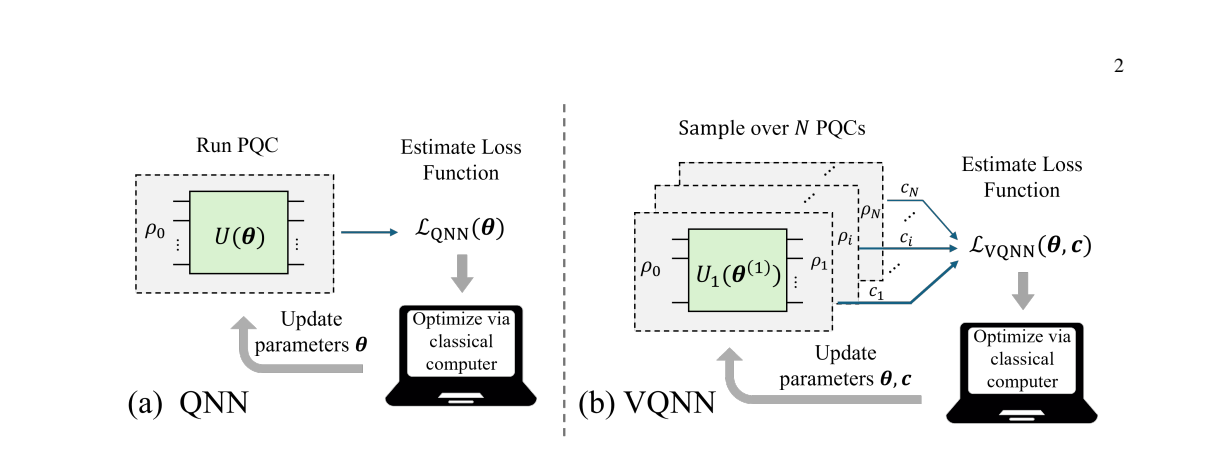
Their training consists in the minimization of a given loss function over a parametrized family of quantum circuits, mathematically described by unitary operators, or, more generally, completely positive linear maps. In this work, we extend the notion of quantum neural network, using random sampling and classical data processing to enlarge the optimization space in a way that includes linear combinations of completely positive maps. Our extended model, called virtual quantum neural networks, leverages its enlarged optimization space to achieve increased expressivity and improved noise robustness. These benefits are illustrated in three representative tasks: quantum error mitigation, binary classification, and estimation of ground-state energies. Overall, virtual quantum neural networks offer a flexible learning paradigm that expands the space of achievable computations and strengthens the applications of near-term quantum hardware.
from the abstract
Pith says
Machine review · deepseek-v4-flash · 11 Sep 2026 · what was read was not recorded · not checked by a person
It can be wrong. Challenge this review or reply to it.
Holds up, with conditions. A genuinely variational extension of QNNs to Hermitian-preserving maps; the framework is sound and the small numerics are honest, but the noise-robustness claim rests on a loss function whose multi-qubit behavior is not established. This line is wrong
5 major objections · 6 minor
How often objections from reviews like this one are right: not yet measured
Not checked: figures, code, what the 91 references say.
The paper says, at III A 2, Eq. (18)
The review did not quote this passage.
Pith says: Objection 1 of 5 · major
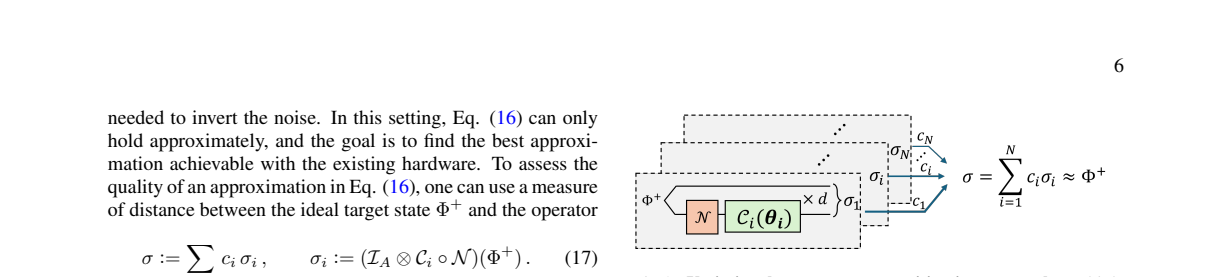
The VQEM algorithm minimizes the Hilbert-Schmidt distance between the virtual state σ and the Bell state Φ+. The paper then interprets closeness in this HS distance as effective error mitigation. However, the goal of error mitigation is to accurately estimate Tr[Oρ] for any observable O and input state ρ, and this quality is controlled by the diamond norm, not the Frobenius norm.
more of objection 1
Closeness in Frobenius norm does not imply closeness in diamond norm, and the gap can grow with system dimension. The paper provides no theoretical bound relating these norms and tests only single-qubit noise (where the norms are likely well-correlated). This is load-bearing: if the HS-distance loss does not guarantee good mitigation quality, then the VQEM demonstration—a key pillar of the claimed noise robustness—is unsupported. The authors should either provide a theoretical link (e.g., bounds between HS distance and diamond distance under the specific Choi-state construction) or discuss this limitation explicitly and provide multi-qubit numerical evidence that the HS-based optimization actually reduces diamond-norm errors.
The paper says, at III A 3, Table I
The review did not quote this passage.
Pith says: Objection 2 of 5 · major
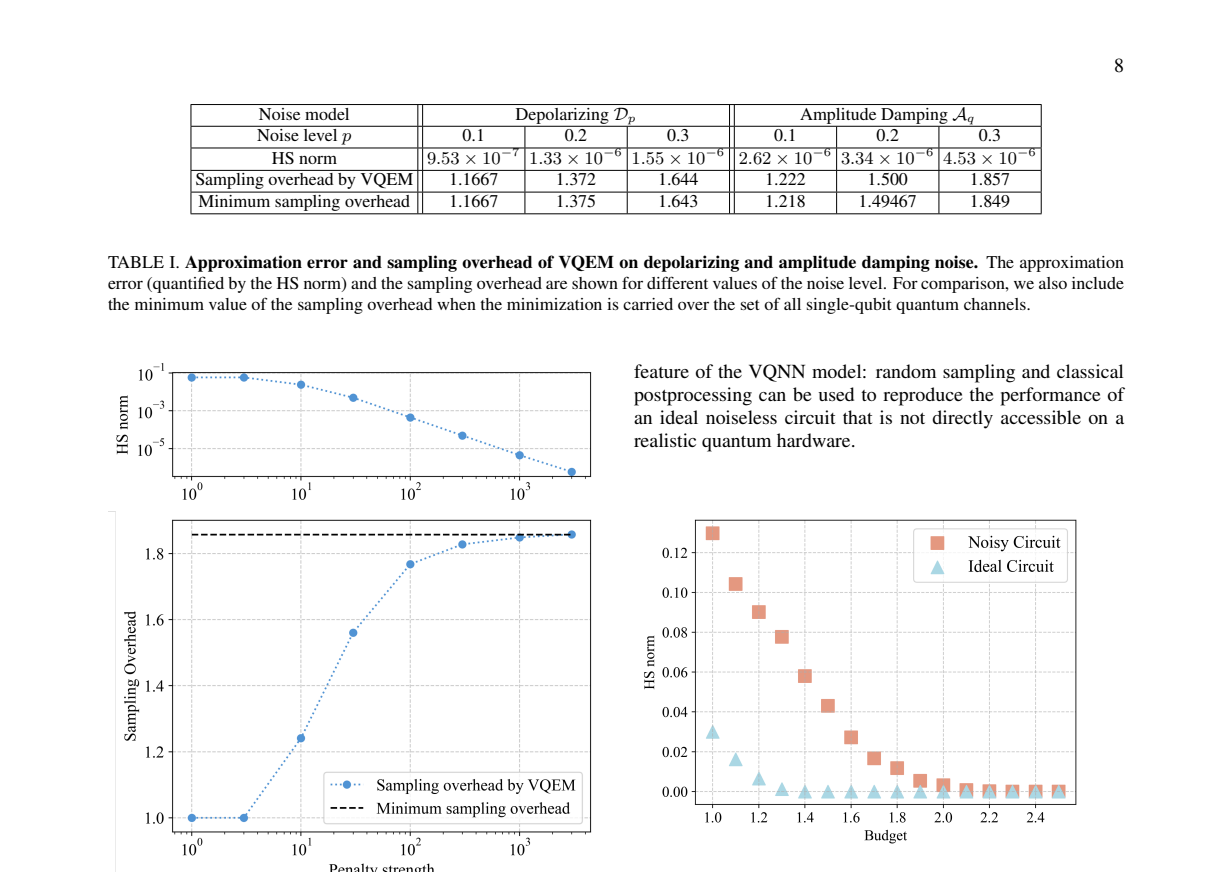
Table I reports the HS norm and sampling overhead for VQEM on single-qubit depolarizing and amplitude damping noise. No error bars or confidence intervals are given. Given the stochastic nature of the training (random initialization, sampling in the loss estimate), it is essential to report the variance over multiple runs (e.g., standard deviation or confidence intervals) to assess the reliability of the reported values. The same issue applies to Fig. 4 and Fig. 5.
The paper says, at III B, Fig. 6 (d)
The review did not quote this passage.
Pith says: Objection 3 of 5 · major
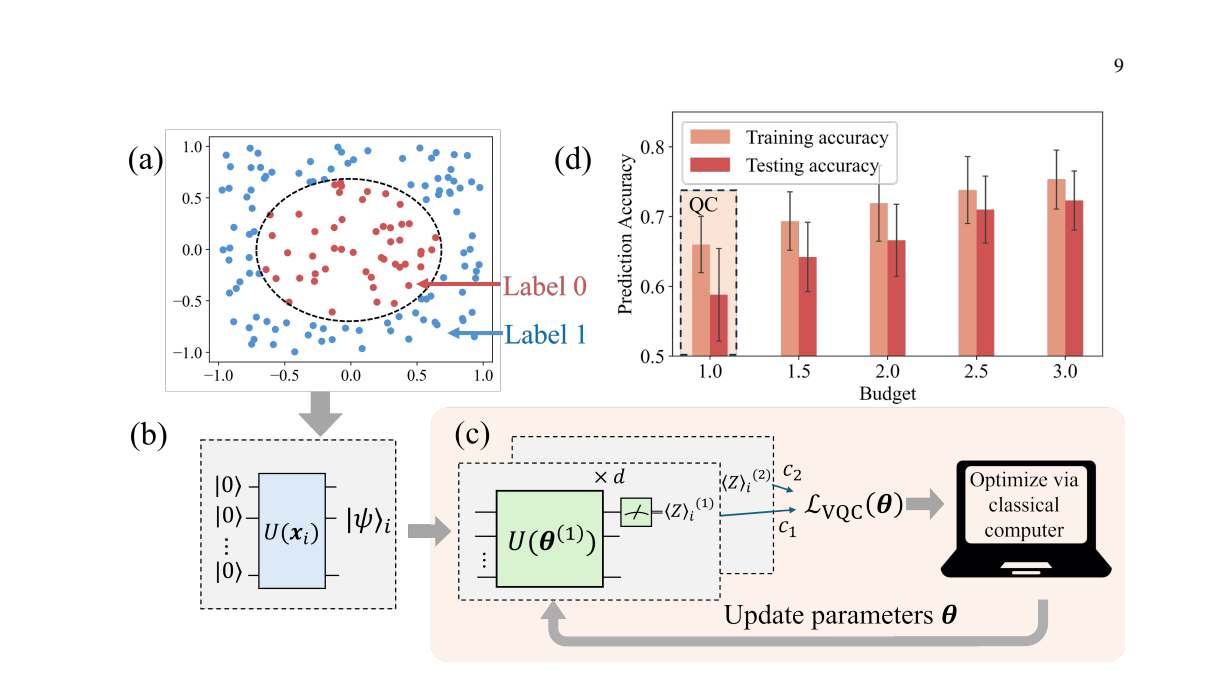
Fig. 6(d) shows prediction accuracy for the VQC as a function of sampling overhead budget. While error bars are shown (from 10 repetitions), the manuscript does not describe the statistical procedure used to generate these error bars (e.g., bootstrapping or standard deviation). Moreover, the figure lacks error bars for the conventional QNN baseline (budget=1). The claim that VQC 'consistently achieves higher prediction accuracy' would be strengthened by reporting the full distribution of accuracies and performing a statistical significance test.
The paper says, at III C 1, Eq. (26) and Appendix G
The review did not quote this passage.
Pith says: Objection 4 of 5 · major
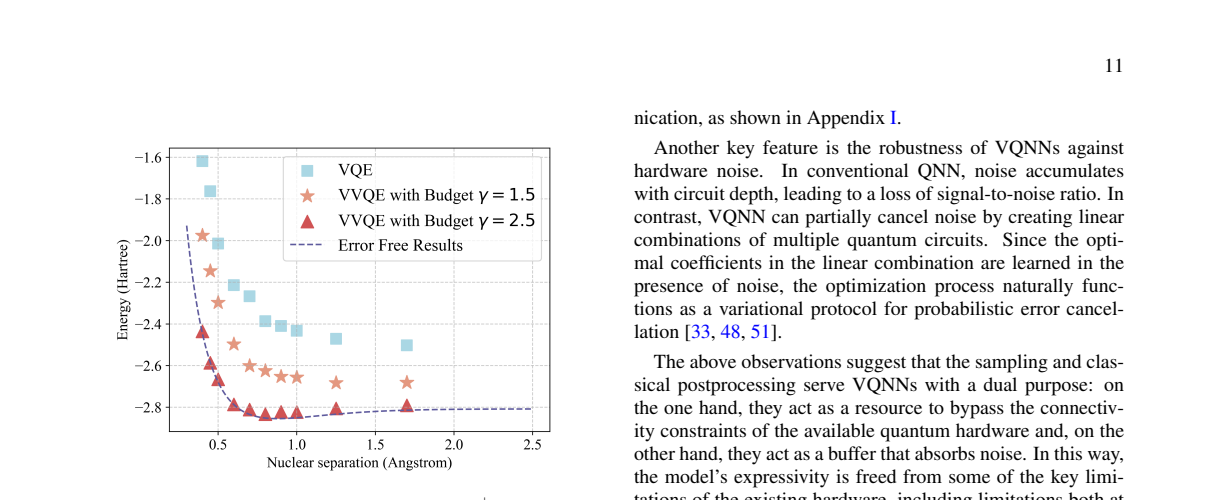
The VVQE loss function approximates the trace of the negativity f(σ̃) using a K-truncated Chebyshev expansion. While the error bound Eq. (G11) is given, it depends on the rank r of σ̃, which itself can be large. The paper does not analyze how the truncation error propagates through the optimization or whether the gradient direction is preserved.
more of objection 4
In practice, for the HeH+ molecule demonstration (K=100), the rank of σ̃ is not reported, and the sensitivity to K is not studied. The authors should provide an ablation study on K and discuss the conditions under which the approximate negativity leads to a valid positive-semidefinite state after optimization.
This objection may describe the copy Pith gave the reviewer, not the paper.
The paper says, at II B, Eq. (7)
The review did not quote this passage.
Pith says: Objection 5 of 5 · major
The sampling complexity bound in Eq. (7) depends on ||c||_1^2 ||O||_∞^2 / ε^2. The paper later claims that even if each branch has a barren plateau, the VQNN does not aggravate the problem (Appendix A). However, the practical bottleneck may be the sampling overhead required to achieve a given precision.
more of objection 5
If ||c||_1 grows exponentially with system size (which may be necessary to achieve a good approximation to the desired map), then the sampling complexity becomes prohibitive. The paper does not analyze this tradeoff for any of the three applications beyond single-qubit examples. A discussion of how the overhead might scale with system size for each task would improve the manuscript.
6 minor objections
The paper says, at Abstract and I
Pith says: minor objection 1 of 6
The claim that VQNNs 'achieve increased expressivity and improved noise robustness' is presented as a general statement, but the numerical support is limited to very small systems. The authors should qualify these claims in the abstract and introduction (e.g., 'for small-scale systems' or 'as demonstrated on up to two qubits').
The paper says, at II E, Eq. (11)-(13)
Pith says: minor objection 2 of 6
The extension to quantum instruments (Eq. 11) uses indices i and j, but the notation is slightly inconsistent: in Eq. (12) the map is defined as sum over i and j, yet the text mentions 'j-th outcome' but the CP maps C_ij. Clarify the index roles.
show 4 more
The paper says, at III A 3, Fig. 4 caption
Pith says: minor objection 3 of 6
Fig. 4 shows the relation between penalty strength α and both approximation error and sampling overhead. The caption describes the top and bottom panels, but the figure itself appears to be a single combined plot. Ensure the figure is clearly labelled and the caption matches the panel layout.
The paper says, at III A 4, Fig. 5
Pith says: minor objection 4 of 6
Fig. 5 labels the axes and includes a legend, but the x-axis is labelled 'Sampling overhead budget' while the circles represent discrete budgets. The plot would benefit from a corresponding table of numerical values (e.g., for the two curves) to allow quantitative comparison.
The paper says, at Appendix G, Eq. (G2)
Pith says: minor objection 5 of 6
The Chebyshev expansion for |σ̃| is given as an infinite series. It would be helpful to cite a standard reference for this expansion (e.g., a textbook on spectral methods) to aid reproducibility.
The paper says, at General
Pith says: minor objection 6 of 6
The code repository is referenced [75] but the paper does not state the software environment or version (e.g., QuAIRKit version). Including a software citations section with version numbers would improve reproducibility.
What would settle it
Implement VQEM for a 2-qubit depolarizing channel (noise level p=0.1) using a scaled ansatz (2 data qubits + ancilla, depth 5, N=2). First compute the true minimal achievable mitigation error (e.g., variance of the estimator for a fixed observable like ⟨Z⊗Z⟩ on the Bell state) via the SDP in Appendix D. Then run the VQEM algorithm to minimize HS distance, and measure the actual mitigation error on the same test observable. If the HS distance is small (< 10⁻⁴) but the mitigation error is significantly larger than the SDP optimum (e.g., by a factor >2) for several random instances, the loss function is not a reliable proxy. Repeat for 10 random noise realizations to assess consistency.
from the skeptic's reading
How the review went
4 readings by deepseek-v4-flash · 11 Sep 2026
- Reader holds up, with conditions
- Skeptic partly agrees
- Editor wrote the verdict above
- Referee major revision: 5 major objections, 6 minor
Not run on this paper: the simulated authors' defence.
Pith did not check this review's objections against the paper.
The review in full
The review in brief, machine-written
The thing to know: this paper's real contribution is making the coefficients in a linear combination of CPTP maps trainable parameters, alongside the circuit parameters. Existing error mitigation uses fixed linear combinations from known decompositions; here the combination is learned variationally, which lets the model adapt to unknown noise and to the actual ansatz. That is a solid, if incremental, step, and the paper does it cleanly. The math is correct: linear combinations of CPTP maps are Hermitian-preserving maps, the sampling estimator with the Hoeffding bound works, and the barren-plateau appendix says the honest thing — a VQNN does not escape a plateau in its branches, it only avoids making it worse when the sampling overhead is bounded. The numerics are reproducible (code and data are public) and the small benchmarks are appropriate for a first demonstration: VQEM reaches near-optimal sampling overhead against the SDP optimum, the classifier shows a clear accuracy-budget tradeoff, and VVQE recovers the HeH+ ground-state energy with moderately increased budget. These are real, positive results. The soft spots are also real. First, everything is small: single-qubit noise for VQEM, a two-branch classifier on a toy dataset, a two-qubit molecule. There are no multi-qubit scaling studies, and error bars appear only in the classification figure, not in the energy or overhead tables. Second, the stress-test note about Hilbert-Schmidt distance is on point. The VQEM loss makes the virtual state close to the Bell state in Frobenius norm of Choi operators, but the actual goal is accurate expectation values for arbitrary observables, which is controlled by diamond distance. For single-qubit noise these norms are roughly comparable; in higher dimension the gap can grow, and the paper provides neither a bound nor multi-qubit evidence. This is a genuine gap in the noise-robustness claim, though I would call it a missing analysis rather than a fatal flaw — the paper is framed as a demonstration, not a theorem. Third, the Chebyshev positivity penalty in VVQE has only a loose error bound, O(r/K), and the authors justify the looseness by argument rather than evidence. That is weaker than the rest of the paper but not load-bearing for the central idea. The central idea holds. I would send this to a serious referee and ask for multi-qubit evidence or an HS-to-diamond bound, error bars everywhere, and a baseline comparison to standard PEC with known noise. The paper is squarely aimed at the variational-quantum-algorithms community; anyone working on error mitigation or trainable virtual maps should read it.
The strongest objection
The central claim of improved noise robustness is heavily supported by the VQEM application, which uses the Hilbert-Schmidt (HS) distance between the virtual state σ and the Bell state Φ+ as the loss function (Eq. 18–20). Minimizing this distance makes the virtual map M(θ,c) close to the noise inverse in Frobenius norm of the Choi matrices. However, the goal of error mitigation is accurate estimation of Tr[Oρ] for any observable O and input state ρ. Closeness in Frobenius norm does not guarantee closeness in diamond norm, which controls worst-case estimation error. The gap can grow with system dimension. The paper tests only single-qubit noise, where these norms are likely well-correlated, but provides no theoretical bound or multi-qubit numerical evidence that minimizing HS distance leads to effective mitigation. Without this link, the VQEM algorithm's success on larger systems is uncertain, and the claim that VQNNs 'achieve improved noise robustness' lacks rigorous support beyond trivial sizes. This is load-bearing because if the loss function fails to capture the true mitigation quality, the entire VQEM demonstration—and thus a key pillar of the noise robustness claim—becomes unsupported.
The reader identified scalability and the potential growth of sampling overhead as the weakest assumption, which is correct. However, a more fundamental concern lies in the choice of loss function for the VQEM algorithm. The central claim of improved noise robustness depends critically on VQEM working for non-trivial noise. But the HS distance, while easy to estimate, may not correlate with actual mitigation performance in multi-qubit systems. The paper neither proves nor numerically checks this correlation beyond the single-qubit case. This is a load-bearing gap because if the loss function is unreliable, the VQEM results do not support the noise robustness claim. The reader did not flag this, so agreement is partial. The verdict remains CONDITIONAL because the paper still has theoretical merit and small-scale evidence, but our concern adds a specific additional condition: the authors should justify or validate that minimizing HS distance yields good mitigation for larger systems.
The referee's report
If the central claims hold, the VQNN framework would provide a principled way to enhance the expressivity and noise resilience of near-term quantum circuits by trading off additional classical sampling and postprocessing. The mathematical formalism linking linear combinations of CPTP maps to Hermitian-preserving maps is sound, and the sampling procedure with Hoeffding bounds is correctly stated. However, the significance is partly undercut by the limited numerical evidence (all demonstrations are on very small systems: single-qubit noise, 2-branch classifiers, and the HeH+ molecule with at most a handful of qubits) and by a load-bearing theoretical gap concerning the VQEM loss function.
Pith's reading of the paper (a machine's summary, not the authors')
The paper introduces virtual quantum neural networks (VQNNs), which enlarge the optimization space of standard quantum neural networks from completely positive trace-preserving (CPTP) maps to Hermitian-preserving (HP) maps by sampling multiple parametrized circuits and classically combining their measurement outcomes. This expansion provides a strictly larger set of achievable computations without requiring deeper or less noisy circuits. The framework is demonstrated on three tasks: quantum error mitigation under unknown noise, binary classification with noisy encodings, and ground-state energy estimation for a small molecule. In each case, VQNNs outperform standard QNNs, with the improvement controlled by a tunable sampling overhead that trades quantum resources for classical postprocessing.
What carries the argument. The central object is the linear combination M(θ,c) = ∑ᵢ cᵢ Cᵢ(θᵢ) of parametrized completely positive maps Cᵢ(θᵢ), which defines a Hermitian-preserving map accessible via random sampling and classical postprocessing. The workhorse is the ability to compute the expectation value of any observable under M(θ,c) by sampling the channels Cᵢ with probability proportional to |cᵢ|/‖c‖₁ and then scaling the averaged measurement outcomes by ‖c‖₁. The sampling overhead γ = ‖c‖₁ quantifies the additional quantum resources required, and the loss functions are chosen to be estimable from such sampling — e.g., Hilbert–Schmidt distances in error mitigation and truncated Chebyshev expansions in ground-state estimation.
Core claim. The paper discovers that training over linear combinations of parametrized quantum channels, each implemented as a conventional QNN, yields a virtual operation described by a Hermitian-preserving map, which can be realized via Monte Carlo sampling and classical postprocessing. This virtual operation enlarges the optimization manifold beyond CPTP maps, allowing the loss function to reach values that no single CPTP map could achieve given the same circuit depth and noise levels. The authors prove this increased expressivity is achievable with bounded sampling overhead, and show numerically that the resulting VQNNs outperform standard QNNs on error mitigation (with near-optimal sampling overhead), binary classification (accuracy increasing with budget), and ground-state energy estimation (approaching exact values).
The premise it rests on. The practical advantage of VQNNs relies on the assumption that the optimal coefficients cᵢ remain bounded (giving a moderate sampling overhead γ) even for large system sizes and realistic noise levels, but the paper does not prove this scaling — if the optimal γ grows exponentially with n, the framework becomes impossible.
If the paper is right (Pith's inferences, not the authors')
VQNNs offer a principled way to upgrade any near-term variational algorithm (VQE, quantum autoencoder, quantum classifier) by adding virtual branches, sacrificing sampling overhead for improved accuracy and noise resilience.
The framework unifies probabilistic error cancellation and variational circuits into a single learning paradigm, making it possible to mitigate unknown, uncharacterized noise without a prior noise model.
Because the linear combination can realize operations outside CPTP (e.g., the inverse of a noisy channel), VQNNs can effectively simulate gates or entangling operations that are not directly available on the hardware, such as long-range entanglement from shallow circuits.
The training does not aggravate barren plateaus (variance of gradients scales as cᵢ² Var[∂Lᵢ]), so the expressivity gain does not worsen trainability under the standard random-circuit assumption — but it also does not escape them unless coefficients grow exponentially.
The VQNN framework is a variational version of circuit knitting (quasiprobability simulation of non-local gates), but learned from data rather than derived analytically. This suggests that VQNNs could automatically discover optimal decompositions for tasks beyond gate simulation, such as noise-aware compilation.
The dependence of sampling overhead on the number of qubits and circuit depth is not analyzed beyond the one-qubit error mitigation example. A careful scaling analysis would reveal whether the benefits persist for larger systems or whether the overhead becomes prohibitive — the paper does not rule out an exponential blow-up in γ for practical tasks.
The Chebyshev-based positivity constraint in VVQE (ground-state estimation) relies on high-order moment estimation, which itself requires error mitigation on noise-corrupted measurements, creating a potential circular overhead that the paper leaves for future analysis.
VQNNs could be combined with classical neural network postprocessing (instead of simple linear weighting) to learn genuinely nonlinear functions of the sampled outcomes, further expanding the expressivity without increasing quantum depth.
Check this review
Pith stored no record of this review's passes and took no fingerprint of it. Reviews made by code from 13 Nov 2026 on carry both.
How often reviews like this one are right
Reviews like this one: written by deepseek-v4-flash, where what was read was not recorded.
How often objections from reviews like this one are right: not yet measured
Reviews by people
This review was written by a machine. No person has reviewed this paper on Pith yet. A scientist listed on Pith can review it for a fee, and their review is published here whatever it concludes.
The paper
Abstract
Quantum neural networks are a prominent model of quantum machine learning. Their training consists in the minimization of a given loss function over a parametrized family of quantum circuits, mathematically described by unitary operators, or, more generally, completely positive linear maps. In this work, we extend the notion of quantum neural network, using random sampling and classical data processing to enlarge the optimization space in a way that includes linear combinations of completely positive maps. Our extended model, called virtual quantum neural networks, leverages its enlarged optimization space to achieve increased expressivity and improved noise robustness. These benefits are illustrated in three representative tasks: quantum error mitigation, binary classification, and estimation of ground-state energies. Overall, virtual quantum neural networks offer a flexible learning paradigm that expands the space of achievable computations and strengthens the applications of near-term quantum hardware.
The paper's own sentences, arranged, kept beside the review and separate from it. Each label is drawn from a closed vocabulary; the number beside it is the probability the classifier gave that label. No sentence in this record was written by a model.
abstract compiled · 2026-09-23
The authors' main claim, as the classifier picked it out 0.96
“Overall, virtual quantum neural networks offer a flexible learning paradigm that expands the space of achievable computations and strengthens the applications of near-term quantum hardware.”
How the main claim is stated: asserted 1.00
What the abstract itself states, as probabilities: claims first 0.05 · states limitation 0.06 · human participants 0.02 · controlled comparison 0.09 · randomized assignment 0.02 · states quantitative result 0.04 · compares with prior results 0.17 · mentions code or data availability 0.02
The abstract, sentence by sentence
This table labels the abstract only (arXiv listing abstract v1). The number is the probability the classifier gave the label.
| Sentence | Role | The authors' own work | States the main conclusion | Strength |
|---|---|---|---|---|
| Quantum neural networks are a prominent model of quantum machine learning. | background 1.00 | 0.04 | 0.02 | asserted 1.00 |
| Their training consists in the minimization of a given loss function over a parametrized family of quantum circuits, mathematically described by unitary operators, or, more generally, completely positive linear maps. | background 0.99 | 0.05 | 0.03 | asserted 1.00 |
| In this work, we extend the notion of quantum neural network, using random sampling and classical data processing to enlarge the optimization space in a way that includes linear combinations of completely positive maps. | contribution 0.73 | 0.92 | 0.10 | asserted 1.00 |
| Our extended model, called virtual quantum neural networks, leverages its enlarged optimization space to achieve increased expressivity and improved noise robustness. | result 0.51 | 0.80 | 0.44 | asserted 1.00 |
| These benefits are illustrated in three representative tasks: quantum error mitigation, binary classification, and estimation of ground-state energies. | result 0.78 | 0.86 | 0.10 | asserted 1.00 |
| Overall, virtual quantum neural networks offer a flexible learning paradigm that expands the space of achievable computations and strengthens the applications of near-term quantum hardware. | interpretation 0.99 | 0.45 | 0.84 | asserted 1.00 |
What kind of paper the classifier reports this is: method or tool 1.00 · evidence from simulation or computation 0.92
What was examined, and what was not
Sources read
- arXiv listing abstract v1
Not examined
- full text
- figures and tables
- references and citing sentences
- relations to other papers
Levels run
- P abstract
Not run
- S sections
- T body sentences
- C citations
- R cross-paper relations
How the labels were made
Compiled by classifier-1.13.0 via TypeSafe API, question bank abstract-p1-20260923, 2026-09-23: 1 request, 4,891 input tokens.
Every quoted sentence on this record is the authors'. Every label is from Pith's closed vocabulary, with the probability shown beside it. This record as JSON
Figures (7)
Showing 6 of the paper's 7 figures. Figures are the authors', reproduced from the paper.
References (91)
- [1] Compared with conventional QNNs, VQNNs framework offers two key advantages: enhanced expressivity and im- proved robustness against quantum noise. We demonstrate these features in three representative quantum machine learn- ing tasks, including both supervised and unsupervised... on PithPith's reviewarXiv
- [2] Standard quantum error mitigation Estimating the expectation values of quantum observables is a key step in several quantum algorithms [24, 55, 56]. In the ideal scenario, the expectation valueTr[Oρ]of a given observableOon a given quantum stateρis estimated by di- rectly perf... on Pith
- [3] Variational quantum error mitigation We now use the VQNN framework to develop variational algorithms for mitigation of an initially unknown noise pro- cess. The first step to construct such a protocol is to rephrase the optimization problem in Eq. (15) in a way that facili- ta... on Pith
- [4] Here, we let the channels(Ci)N i=1 depend on variational pa- rameters(θ i)N i=1, respectively, and train our VQNN to min- imize the approximation error. We propose two algorithms, corresponding to two different ways to include the sampling overhead into the optimization. The f... on Pith
- [5] VQEM with bounded-size unitary circuits Here we consider the problem of mitigating an initially un- known single-qubit noisy channelN. To this purpose, here we will use our first VQEM algorithm, designed to minimize the loss function (19) with a given penalty strengthα. To tes... on Pith
- [6] VQEM with bounded-size noisy circuits We now extend our numerical experiments to the scenario in which the parametrized quantum circuits are also subject to noise. As the task, we consider the mitigation of single-qubit depolarizing noise. For the variational optimization, we ... on Pith
- [7] Loss function We consider the scenario where two branches of PQCs are utilized, and the sampling overhead budgetγb =|c 1|+|c 2|is given, wherec 1 = (1 +γ b)/2andc 2 = (1−γ b)/2are real numbers. The output average state isσ=c 1ρ1 +c 2ρ2, and ρi =U i(θ(i))|0⟩⟨0|U† i (θ(i)),i∈{1,... on Pith
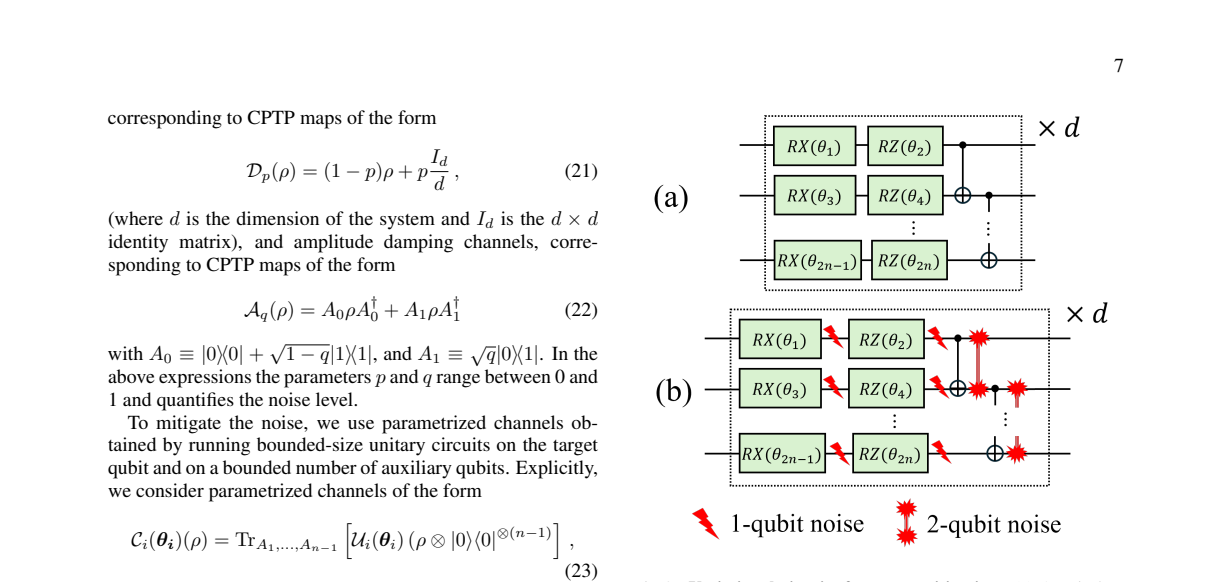
- [8] Estimating the ground-state energy ofHeH + Here we conduct the numerical experiment to estimate the ground-state energy ofHeH + on a noisy quantum device with the VVQE algorithm. Conduct Algorithm 4 by setting the noisy PQCs as shown in Fig. 3 (b) with depthd= 5. The truncatio... on Pith
- [9] J. Preskill, Quantum computing in the nisq era and beyond, Quantum2, 79 (2018) on Pith
- [10] E. Farhi, J. Goldstone, and S. Gutmann, A quantum approx- imate optimization algorithm, arXiv preprint arXiv:1411.4028 (2014) on PithPith's reviewarXiv
- [11] M. P. Harrigan, K. J. Sung, M. Neeley, K. J. Satzinger, F. Arute, K. Arya, J. Atalaya, J. C. Bardin, R. Barends, S. Boixo,et al., Quantum approximate optimization of non-planar graph prob- lems on a planar superconducting processor, Nature Physics17, 332 (2021) on Pith
- [12] S. McArdle, S. Endo, A. Aspuru-Guzik, S. C. Benjamin, and X. Yuan, Quantum computational chemistry, Reviews of Mod- ern Physics92, 015003 (2020) on Pith
- [13] Google AI Quantum and Collaborators, F. Arute, K. Arya, R. Babbush, D. Bacon, J. C. Bardin, R. Barends, S. Boixo, M. Broughton, B. B. Buckley,et al., Hartree-fock on a super- conducting qubit quantum computer, Science369, 1084 (2020) on Pith
- [14] K. M. Nakanishi, K. Mitarai, and K. Fujii, Subspace-search variational quantum eigensolver for excited states, Physical Re- view Research1, 033062 (2019) on Pith
- [15] C. H. Bennett and G. Brassard, Quantum cryptography: Public key distribution and coin tossing, Theoretical computer science 560, 7 (2014) on Pith
- [16] A. K. Ekert, Quantum cryptography based on Bell’s theorem, Physical Review Letters67, 661 (1991) on Pith
- [17] K. Fujii, K. Mizuta, H. Ueda, K. Mitarai, W. Mizukami, and Y . O. Nakagawa, Deep variational quantum eigensolver: a divide-and-conquer method for solving a larger problem with 12 smaller size quantum computers, PRX Quantum3, 010346 (2022) on Pith
- [18] X. Yuan, S. Endo, Q. Zhao, Y . Li, and S. C. Benjamin, Theory of variational quantum simulation, Quantum3, 191 (2019) on Pith
- [19] B. Zhao and K. Fujii, Variational quantum hamiltonian engi- neering, Physical Review Research7, 023123 (2025) on Pith
- [20] S. Endo, J. Sun, Y . Li, S. C. Benjamin, and X. Yuan, Variational quantum simulation of general processes, Physical Review Let- ters125, 010501 (2020) on Pith
show 71 more
- [21] X. Zhao, B. Zhao, Z. Wang, Z. Song, and X. Wang, Practical distributed quantum information processing with loccnet, npj Quantum Information7, 159 (2021) on Pith
- [22] R. Chen, B. Zhao, and X. Wang, Near-term efficient quantum algorithms for entanglement analysis, Physical Review Applied 20, 024071 (2023) on Pith
- [23] R. Chen, Z. Song, X. Zhao, and X. Wang, Variational quantum algorithms for trace distance and fidelity estimation, Quantum Science and Technology7, 015019 (2021) on Pith
- [24] K. H. Wan, O. Dahlsten, H. Kristjánsson, R. Gardner, and M. Kim, Quantum generalisation of feedforward neural net- works, npj Quantum information3, 36 (2017) on Pith
- [25] E. Farhi and H. Neven, Classification with quantum neu- ral networks on near term processors, arXiv preprint arXiv:1802.06002 (2018) on PithPith's reviewarXiv
- [26] K. Mitarai, M. Negoro, M. Kitagawa, and K. Fujii, Quantum circuit learning, Physical Review A98, 032309 (2018) on Pith
- [27] M. Schuld, A. Bocharov, K. M. Svore, and N. Wiebe, Circuit- centric quantum classifiers, Physical Review A101, 032308 (2020) on Pith
- [28] I. Cong, S. Choi, and M. D. Lukin, Quantum convolutional neu- ral networks, Nature Physics15, 1273 (2019) on Pith
- [29] Y . Du, X. Wang, N. Guo, Z. Yu, Y . Qian, K. Zhang, M.-H. Hsieh, P. Rebentrost, and D. Tao, Quantum machine learning: A hands-on tutorial for machine learning practitioners and re- searchers, arXiv preprint arXiv:2502.01146 (2025) on PithPith's reviewarXiv
- [30] J. Biamonte, P. Wittek, N. Pancotti, P. Rebentrost, N. Wiebe, and S. Lloyd, Quantum machine learning, Nature549, 195 (2017) on Pith
- [31] P. Rebentrost, M. Mohseni, and S. Lloyd, Quantum support vec- tor machine for big data classification, Phys. Rev. Lett.113, 130503 (2014) on Pith
- [32] M. Cerezo, A. Arrasmith, R. Babbush, S. C. Benjamin, S. Endo, K. Fujii, J. R. McClean, K. Mitarai, X. Yuan, L. Cincio,et al., Variational quantum algorithms, Nature Reviews Physics3, 625 (2021) on Pith
- [33] W. Li and D.-L. Deng, Recent advances for quantum classifiers, Science China Physics, Mechanics & Astronomy65, 220301 (2022) on Pith
- [34] E. Grant, M. Benedetti, S. Cao, A. Hallam, J. Lockhart, V . Sto- jevic, A. G. Green, and S. Severini, Hierarchical quantum clas- sifiers, npj Quantum Information4, 65 (2018) on Pith
- [35] J. Romero, J. P. Olson, and A. Aspuru-Guzik, Quantum autoen- coders for efficient compression of quantum data, Quantum Sci- ence and Technology2, 045001 (2017) on Pith
- [36] C. Cao and X. Wang, Noise-assisted quantum autoencoder, Physical Review Applied15, 054012 (2021) on Pith
- [37] D. Bondarenko and P. Feldmann, Quantum autoencoders to denoise quantum data, Physical Review Letters124, 130502 (2020) on Pith
- [38] X. Gao, Z.-Y . Zhang, and L.-M. Duan, A quantum machine learning algorithm based on generative models, Science ad- vances4, eaat9004 (2018) on Pith
- [39] P.-L. Dallaire-Demers and N. Killoran, Quantum generative ad- versarial networks, arXiv preprint arXiv:1804.08641 (2018) on PithPith's reviewarXiv
- [40] W. Hoeffding, Probability inequalities for sums of bounded ran- dom variables, Journal of the American statistical association 58, 13 (1963) on Pith
- [41] J. Jiang, K. Wang, and X. Wang, Physical implementability of linear maps and its application in error mitigation, Quantum5, 600 (2021) on Pith
- [42] B. Regula, R. Takagi, and M. Gu, Operational applications of the diamond norm and related measures in quantifying the non- physicality of quantum maps, Quantum5, 522 (2021) on Pith
- [43] X. Zhao, L. Zhang, B. Zhao, and X. Wang, Power of quantum measurement in simulating unphysical operations, Physical Re- view Research7, 013334 (2025) on Pith
- [44] J. Stokes, J. Izaac, N. Killoran, and G. Carleo, Quantum natural gradient, Quantum4, 269 (2020) on Pith
- [45] R. M. Parrish, J. T. Iosue, A. Ozaeta, and P. L. McMahon, A jacobi diagonalization and anderson acceleration algorithm for variational quantum algorithm parameter optimization, arXiv preprint arXiv:1904.03206 (2019) on PithPith's reviewarXiv
- [46] K. M. Nakanishi, K. Fujii, and S. Todo, Sequential minimal optimization for quantum-classical hybrid algorithms, Physical Review Research2, 043158 (2020) on Pith
- [47] M. Ostaszewski, E. Grant, and M. Benedetti, Structure opti- mization for parameterized quantum circuits, Quantum5, 391 (2021) on Pith
- [48] D. P. Kingma and J. Ba, Adam: A method for stochastic opti- mization, arXiv preprint arXiv:1412.6980 (2014) on PithPith's reviewarXiv
- [49] M. Larocca, S. Thanasilp, S. Wang, K. Sharma, J. Bia- monte, P. J. Coles, L. Cincio, J. R. McClean, Z. Holmes, and M. Cerezo, Barren plateaus in variational quantum computing, Nature Reviews Physics , 1 (2025) on Pith
- [50] A. Peres, Separability criterion for density matrices, Physical Review Letters77, 1413 (1996) on Pith
- [51] M. Horodecki, P. Horodecki, and R. Horodecki, Separability of n-particle mixed states: necessary and sufficient conditions in terms of linear maps, Physics Letters A283, 1 (2001) on Pith
- [52] O. Gühne and G. Tóth, Entanglement detection, Physics Re- ports474, 1 (2009) on Pith
- [53] P. Pechukas, Reduced dynamics need not be completely posi- tive, Physical Review Letters73, 1060 (1994) on Pith
- [54] K. Modi, Operational approach to open dynamics and quantify- ing initial correlations, Scientific reports2, 581 (2012) on Pith
- [55] D. Schmid, K. Ried, and R. W. Spekkens, Why initial system- environment correlations do not imply the failure of com- plete positivity: A causal perspective, Physical Review A100, 022112 (2019) on Pith
- [56] K. Temme, S. Bravyi, and J. M. Gambetta, Error mitigation for short-depth quantum circuits, Physical Review Letters119, 180509 (2017) on Pith
- [57] R. Takagi, Optimal resource cost for error mitigation, Physical Review Research3, 033178 (2021) on Pith
- [58] R. Takagi, S. Endo, S. Minagawa, and M. Gu, Fundamental limits of quantum error mitigation, npj Quantum Information8, 114 (2022) on Pith
- [59] X. Zhao, B. Zhao, Z. Xia, and X. Wang, Information recover- ability of noisy quantum states, Quantum7, 978 (2023) on Pith
- [60] B. Zhao, M. Jing, L. Zhang, X. Zhao, Y .-A. Chen, K. Wang, and X. Wang, Retrieving nonlinear features from noisy quan- tum states, PRX Quantum5, 020357 (2024) on Pith
- [61] G. Bai and G. Chiribella, Test one to test many: a unified ap- proach to quantum benchmarks, Physical Review Letters120, 150502 (2018) on Pith
- [62] QuAIR Team, QuAIRKit,https://github.com/ QuAIR/QuAIRKit(2023) on Pith
- [63] M. A. Nielsen and I. L. Chuang,Quantum computation and 13 quantum information(Cambridge university press, 2010) on Pith
- [64] A. Peruzzo, J. McClean, P. Shadbolt, M.-H. Yung, X.-Q. Zhou, P. J. Love, A. Aspuru-Guzik, and J. L. O’brien, A variational eigenvalue solver on a photonic quantum processor, Nature Communications5, 4213 (2014) on Pith
- [65] A. J. Scott, Optimizing quantum process tomography with uni- tary 2-designs, Journal of Physics A: Mathematical and Theo- retical41, 055308 (2008) on Pith
- [66] A. Bisio, G. Chiribella, G. D’Ariano, S. Facchini, and P. Perinotti, Optimal quantum tomography of states, mea- surements, and transformations, Physical Review Letters102, 010404 (2009) on Pith
- [67] A. Bisio, G. Chiribella, G. M. D’Ariano, S. Facchini, and P. Perinotti, Optimal quantum tomography, IEEE Journal of Se- lected Topics in Quantum Electronics15, 1646 (2009) on Pith
- [68] A. Barenco, A. Berthiaume, D. Deutsch, A. Ekert, R. Jozsa, and C. Macchiavello, Stabilization of quantum computations by symmetrization, SIAM Journal on Computing26, 1541 (1997) on Pith
- [69] H. Buhrman, R. Cleve, J. Watrous, and R. De Wolf, Quantum fingerprinting, Physical Review Letters87, 167902 (2001) on Pith
- [70] A. Anshu, Z. Landau, and Y . Liu, Distributed quantum inner product estimation, inProceedings of the 54th Annual ACM SIGACT Symposium on Theory of Computing(2022) pp. 44– 51 on Pith
- [71] Y . Wang, G. Li, and X. Wang, Variational quantum gibbs state preparation with a truncated taylor series, Phys. Rev. Appl.16, 054035 (2021) on Pith
- [72] G. Li, X. Zhao, and X. Wang, Quantum self-attention neural networks for text classification, Science China Information Sci- ences67, 142501 (2024) on Pith
- [73] T. Scheiber, P. Haubenwallner, and M. Heller, Reducing pec overhead by pauli error propagation, arXiv preprint arXiv:2412.01311 (2024) on PithPith's reviewarXiv
- [74] M. Liao, Y . Zhu, G. Chiribella, and Y . Yang, Noise-agnostic quantum error mitigation with data augmented neural models, npj Quantum Information11, 8 (2025) on Pith
- [75] P. W. Anderson, An approximate quantum theory of the antifer- romagnetic ground state, Physical Review86, 694 (1952) on Pith
- [76] M. Reiher, N. Wiebe, K. M. Svore, D. Wecker, and M. Troyer, Elucidating reaction mechanisms on quantum computers, Pro- ceedings of the national academy of sciences114, 7555 (2017) on Pith
- [77] P. A. Lee, N. Nagaosa, and X.-G. Wen, Doping a mott insula- tor: Physics of high-temperature superconductivity, Reviews of modern physics78, 17 (2006) on Pith
- [78] X.-G. Wen, Topological order: From long-range entangled quantum matter to a unified origin of light and electrons, In- ternational Scholarly Research Notices2013, 198710 (2013) on Pith
- [79] X. Chen, Z.-C. Gu, and X.-G. Wen, Local unitary trans- formation, long-range quantum entanglement, wave func- tion renormalization, and topological order, Physical Re- view B—Condensed Matter and Materials Physics82, 155138 (2010) on Pith
- [80] K. Mitarai and K. Fujii, Constructing a virtual two-qubit gate by sampling single-qubit operations, New Journal of Physics 23, 023021 (2021) on Pith
- [81] K. Mitarai and K. Fujii, Overhead for simulating a non-local channel with local channels by quasiprobability sampling, Quantum5, 388 (2021) on Pith
- [82] C. Piveteau and D. Sutter, Circuit knitting with classical com- munication, IEEE Transactions on Information Theory70, 2734 (2023) on Pith
- [83] B. Zhao, Codes for Virtual Quantum Neural Net- work,https://github.com/benchizhao/ Virtual-Quantum-Neural-Network(2026) on Pith
- [84] M.-D. Choi, Completely positive linear maps on complex ma- trices, Linear algebra and its applications10, 285 (1975) on Pith
- [85] V . Havlíˇcek, A. D. Córcoles, K. Temme, A. W. Harrow, A. Kan- dala, J. M. Chow, and J. M. Gambetta, Supervised learning with quantum-enhanced feature spaces, Nature567, 209 (2019) on Pith
- [86] H.-P. Breuer and F. Petruccione,The theory of open quantum systems(OUP Oxford, 2002) on Pith
- [87] R. LaRose and B. Coyle, Robust data encodings for quantum classifiers, arXiv preprint arXiv:2003.01695 (2020) on PithPith's reviewarXiv
- [88] H.-Y . Huang, M. Broughton, M. Mohseni, R. Babbush, S. Boixo, H. Neven, and J. R. McClean, Power of data in quantum machine learning, Nature Communications12, 2631 (2021) on Pith
- [89] K. Chen, Q. Wang, Z. Yu, and Z. Zhang, Simultaneous estima- tion of nonlinear functionals of a quantum state, arXiv preprint arXiv:2505.16715 (2025) on PithPith's reviewarXiv
- [90] X. Shi, J. Jiang, X. Wu, J. Xie, H. Yao, and X. Wang, Near- optimal simultaneous estimation of quantum state moments, arXiv preprint arXiv:2509.24842 (2025) on PitharXiv
- [91] B. Kraus and J. I. Cirac, Optimal creation of entanglement using a two-qubit gate, Physical Review A63, 062309 (2001). Appendix for Virtual Quantum Neural Networks Appendix A: Analysis of Barren Plateaus The problem of barren plateaus (BPs) [41] arises when the gradients of th... on Pith
Cited by 1 Pith paper
Reviewed papers on Pith that cite this one. The full citation record
- Augmenting Quantum Neural Networks with Contractive Layers quant-ph · Nov 2026
Challenges and discussion
Disagree with the review, or know something it missed? Leave a comment, or challenge this review formally: a challenge becomes a permanent entry in this paper's record, and its decision is published here.
Come back by email
A short list of the week's newly reviewed papers. Nothing is sent until you confirm from your inbox, and every email has a link that stops it. No account.
No comments yet.
Sign in to comment