Artificial Intelligence · arXiv:2609.14864 v1 · submitted 14 Sep 2026 · 20 references
GGUF-Metadata Prediction of Single-Sequence llama.cpp Throughput Across Three Systems
The paper says
“We predict single-sequence model throughput from GGUF metadata using roofline-shaped predictors with quantization-specific scale factors fitted on reference models.”
more of the abstract
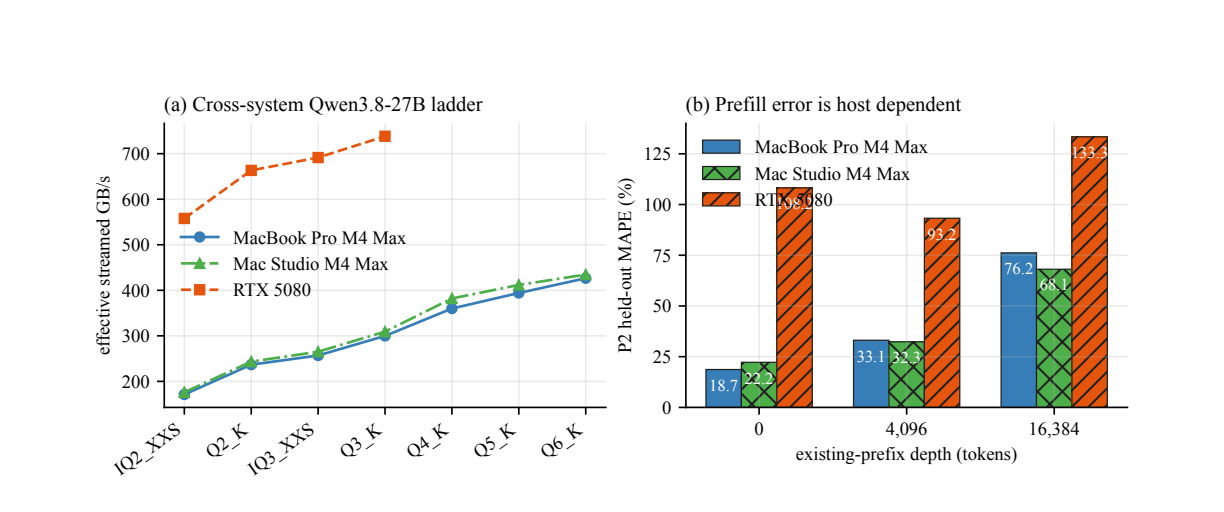
The scored cohort comprises 318 phase-depth measurements from 53 host-file configurations on two Apple M4 Max systems and an NVIDIA RTX 5080. On host-specific held-out sets of four, five, and two configurations, an active-parameter decode model obtains 13.1%, 14.4%, and 36.1% mean absolute percentage error (MAPE), versus 49.4%, 55.3%, and 51.9% when charging total parameters. Leave-one-host-out coefficients fitted on the other two systems yield 11.6%, 16.8%, and 36.0% test MAPE. A low-bit model ladder changes ordering across runtime stacks. The P2 prefill baseline gives 18.7%, 22.2%, and 108.2% test MAPE. GGUF structure helps on all three systems, but fitted efficiencies are not universal.
from the abstract
Pith says
Machine review · deepseek-v4-flash · 15 Sep 2026 · what was read was not recorded · not checked by a person
It can be wrong. Challenge this review or reply to it.
Holds up, with conditions. Careful study with transparent limitations, but tiny held-out sets (especially RTX's 2 configs) turn the headline generalizability claim into a fragile one. This line is wrong
3 major objections · 7 minor
How often objections from reviews like this one are right: not yet measured
Not checked: figures, code, what the 20 references say.
The paper says, at §3, Table 1
The review did not quote this passage.
Pith says: Objection 1 of 3 · major
The held-out set sizes (4, 5, 2 configurations) are very small. The 49.9% APE on Ling-mini-2.0 demonstrates that the per-format efficiency factor η_h,q does not transfer well to architectures outside the dominant training family (Qwen). The paper acknowledges this limitation in §5, but the headline MAPE figures (13.1%, 14.4%, 36.1%) give an overly optimistic impression of generalizability. The authors should add bootstrap confidence intervals or at least discuss how the small test size affects the reliability of the reported errors.
The paper says, at §3, RTX 5080 experiments
The review did not quote this passage.
Pith says: Objection 2 of 3 · major
The RTX 5080 results are the weakest: only 2 held-out configurations, no device-memory telemetry, and the largest working set exceeds reported VRAM (acknowledged in §5). This makes the 36.1% MAPE figure essentially unreliable for cross-model generalization. The paper should either (a) remove RTX from the headline claims and treat it as a pilot test, or (b) add explicit caveat that the RTX results are preliminary due to unresolved residency questions.
The paper says, at §4.3, prefill model
The review did not quote this passage.
Pith says: Objection 3 of 3 · major
The prefill model (P2) is correctly labeled as unsupported, but the inclusion of a 108.2% test MAPE in the abstract (alongside the decode numbers) may confuse readers. The abstract already states 'The P2 prefill baseline gives 18.7%, 22.2%, and 108.2% test MAPE', which is clear. However, the reasons for failure on RTX (high prefill CV, poor fit) could be elaborated: the per-format coefficients are weakly identified (only one training configuration per format) and the model omits prefix-dependent computation.
7 minor objections
The paper says, at §2, Eq. (1)
Pith says: minor objection 1 of 7
The notation D(c) is defined as 'bytes per generated token', but the equation divides file size and KV cache, which is actually total bytes transferred per token (file size per active token plus KV). Clarify the units.
The paper says, at §2, paragraph after Eq. (3)
Pith says: minor objection 2 of 7
The phrase 'back-solve r = T_p (2P_a)/F_h' is unclear: what is r, and why is 2P_a used? Ensure the text explains the factor of 2 (likely due to FLOP counting).
show 5 more
The paper says, at §3, last paragraph
Pith says: minor objection 3 of 7
The description of the 'atomic selector' for data reduction is vague. It prefers 'lower decode coefficient of variation (CV) and pre-run load'. How much lower? Provide a threshold or clarify that it is a heuristic.
The paper says, at Figure 1
Pith says: minor objection 4 of 7
The scatter plot is dense and the ±25% lines are helpful. However, the orange markers (held-out) are hard to distinguish from the blue train markers when overplotted. Consider using different shape or larger markers for test points.
The paper says, at §4.2, '14 three-way matched configurations'
Pith says: minor objection 5 of 7
The phrase '14 three-way matched configurations' appears without explanation. Define what 'three-way matched' means (presumably the same model–quantization–depth combination on all three hosts) and state how many such points exist.
The paper says, at Appendix, Table 6
Pith says: minor objection 6 of 7
The appendix includes SHA-256 hashes and full provenance, which is excellent for reproducibility. However, the body of the paper could reference this more clearly (e.g., 'see Appendix Table 6 for complete provenance').
The paper says, at General
Pith says: minor objection 7 of 7
Some acronyms are used without expansion on first use (e.g., 'GGUF' is defined in the abstract but not in the introduction; 'MoE' is introduced in the introduction but not expanded). Ensure all acronyms are spelled out where first used in each section.
What would settle it
Perform leave-one-family-out cross-validation on each host. For MacBook (15 training configs from 5 families: gemma4, gpt-oss, qwen35, qwen35moe, smollm3), refit B2 on 4 families and evaluate on the left-out family's configurations (including all its quantizations and depths). Repeat for each family. Report the per-family MAPE and the standard deviation across folds. If any family (e.g., the dense non-Qwen gpt-oss or smollm3) exceeds 30% MAPE, the single per-format efficiency factor does not generalize uniformly, and the claim should be qualified accordingly.
from the skeptic's reading
How the review went
4 readings by deepseek-v4-flash · 15 Sep 2026
- Reader holds up, with conditions
- Skeptic partly agrees
- Editor wrote the verdict above
- Referee minor revision: 3 major objections, 7 minor
Not run on this paper: the simulated authors' defence.
Pith did not check this review's objections against the paper.
The review in full
The review in brief, machine-written
This paper tackles a practical problem: can you predict how fast a model will run on your machine without downloading it first, using only the GGUF file header? That's useful for local LLM deployment. The authors propose a roofline-shaped model with active-parameter and per-layer KV corrections, fitted with a single per-host, per-quantization scale factor. The ablation is clean—active parameters clearly beat total parameters, and per-layer KV beats uniform-global. The cross-system transfer experiment is a nice diagnostic. And they are unusually honest about failure: the prefill model is labeled unsupported, the RTX result is preliminary, and the limitations section is twice as long as most.
The soft spots are real and load-bearing. The held-out sets are tiny: 4–5 configurations on Apple, 2 on RTX. The training data is dominated by one model family (Qwen3.8), so the per-format scale factors are effectively per-family. The Ling-mini outlier (49.9% error on MacBook) shows exactly this fragility. The RTX result (36% MAPE with only two test files) cannot support any strong claim. The stress-test concern is right: the headline MAPE gives an optimistic picture of generalizability, and the paper's own data prove that most quantization groups have only one training family.
That said, the paper is not claiming universality. The conclusions are measured. The code and data are (mostly) reproducible. For a workshop or a systems venue, this is a reasonable method paper that clearly defines a baseline and states its failure modes.
Who gets value from this? Practitioners who want a cheap pre-download filter, and researchers working on performance modeling who want a clear baseline to beat. It is not a breakthrough, but it is honest engineering science.
Recommendation: Send to peer review. A good referee will push for a larger held-out set (at least 10 per host) and a clearer statement that the per-format factor is essentially per-family. With those additions, the paper would be solid. Without them, it remains a poster or workshop paper. But desk rejection is too harsh for work this transparent.
The strongest objection
The central claim that a per-host per-quantization scale factor η_{h,q} captures all kernel and implementation differences is tested on only 4–5 held-out configurations on Apple systems and 2 on RTX. The training set is dominated by Qwen3.8-27B files (7 of 15 training configs on each Apple host, representing one architecture family with multiple quantizations). Per-format η values for formats like Q4_K_M are therefore fitted primarily on Qwen data. When applied to the held-out Ling-mini-2.0 (a small MoE with many KV heads), the predictor achieves 49.9% APE at depth 0 on MacBook (the worst of all test observations). This single outlier substantially influences the aggregate MAPE: the remaining three test configs all stay well under 15%. The small held-out set does not allow systematic assessment of how η generalizes across families with different kernel tuning, tensor shapes, or memory patterns. The paper explicitly notes that most quantization groups have only one training family, so the per-format coefficient is effectively a per-model-family coefficient. Without a broader evaluation across multiple families per format, the claim of substantial improvement over total-parameter models rests on a fragile empirical base. Limitations section acknowledges this in passing, but the headline MAPE figures may give an overly optimistic impression of generalizability.
The reader's weakest_assumption correctly identifies the per-host per-quantization scale factor as load-bearing. This stress-test agrees but sharpens the concern: the assumption is not just partly failing on RTX and low-bit formats, but also fails for specific architectures (Ling-mini) on Apple systems, yet is masked by the small held-out set. The concrete test (leave-one-family-out CV) is a systematic way to quantify this cross-family variation. The reader's condition (expand held-out sets or add caveat) is appropriate; this test directly addresses that condition. The verdict remains CONDITIONAL because the paper's transparent limitations already cover this possibility, but the proposed test would strengthen the empirical foundation. No ad hominem or theatrical language used.
The referee's report
The work addresses a practical problem: predicting LLM throughput on a given machine without running the model, using only metadata available from the GGUF file header. The proposed active-parameter and per-layer KV corrections are conceptually clear and shown to improve prediction on all three tested systems. The paper is notable for its explicit documentation of failure cases (e.g., the Ling-mini outlier, poor RTX results, negative prefill result) and its deliberate avoidance of inflated claims. If the approach generalizes beyond the small held-out sets, it would be a useful tool for model selection. The reproducible protocol and open data (hashes, append-only archives) are strengths.
Pith's reading of the paper (a machine's summary, not the authors')
The paper proposes a simple roofline-style predictor for single-sequence llama.cpp decode throughput that uses only metadata stored in a model's GGUF file: file size, active parameter count (adjusting for mixture-of-experts), and per-layer key-value cache size. On three host systems — two Apple M4 Max machines and an NVIDIA RTX 5080 — the model achieves held-out mean absolute percentage errors of 13.1%, 14.4%, and 36.1%, respectively, a large improvement over a baseline using total parameter count (49–55%). The central insight is that replacing total parameters with active parameters and using per-layer rather than uniform-global KV accounting corrects systematic misestimates, especially for MoE and hybrid-attention models. However, the predictor requires host- and quantization-specific efficiency factors that do not transfer universally across hardware, and it fails to model prefill throughput on the RTX 5080.
What carries the argument. The decode predictor is built from two equations. First, bytes per generated token $D(c) = S \cdot P_a / P + K(c)$, where $S$ is file size, $P_a$ and $P$ are active and total parameters, and $K(c)$ is the per-layer KV cache size computed from head counts, head dimensions, and attention windows (with sliding-window and recurrent layers treated specially). Second, predicted throughput $\hat{T}_d(c) = \eta_{h,q} \cdot B_h / D(c)$, where $B_h$ is the calibrated copy bandwidth of host $h$ and $\eta_{h,q}$ is an empirical scale factor for that host-quantization pair, fitted as the median ratio of measured throughput times $D(c)$ over bandwidth. The active parameter count $P_a$ is computed from GGUF expert-routing metadata: for MoE with $E$ experts, $k$ selected, and expert-bank weights $P_e$, $P_a = P - P_e + (k/E) P_e$; for dense models $P_a = P$.
Core claim. The paper establishes that a roofline-based decoder throughput predictor for llama.cpp, using only fields parseable from a GGUF header (file size, active parameter count via expert-routing fields, and per-layer KV metadata), can estimate single-sequence generation speed with moderate accuracy on unseen model families. The key quantities are the active parameter fraction, which corrects for mixture-of-experts waste, and the per-layer KV byte formula, which prevents the 10–14x overestimates that a uniform-global attention assumption would produce. The improvement over a total-parameter baseline is substantial across all three test systems, though the RTX 5080 shows larger errors and the prefill model is not supported. The efficiency factors are not hardware-universal; leave-one-host-out tests show that coefficients fitted on the other two systems give similar test-set MAPE, but low-bit quantization ordering varies by runtime stack, and the RTX held-out accuracy is notably worse.
The premise it rests on. The load-bearing assumption is that a single per-host per-quantization scale factor $\eta_{h,q}$ can capture all kernel and implementation differences for that host-format pair, independent of model architecture and size; the paper exposes that this assumption partly fails for RTX and for low-bit quantizations.
If the paper is right (Pith's inferences, not the authors')
A user evaluating a new GGUF model on a known host can obtain a reasonable decode throughput estimate from the file's metadata alone, without running a benchmark, after a one-time calibration of efficiency factors on a few reference models.
Active-parameter accounting should become standard for performance prediction of sparse mixture-of-experts models, as the paper shows it reduces held-out error by a factor of 3–4 compared to using total parameters.
Per-layer KV metadata (head counts, windows) is essential for hybrid architectures; a uniform-global assumption can overstate cache traffic by an order of magnitude, leading to large prediction errors.
The prefill throughput predictor fails under this protocol, especially on the RTX 5080, indicating that prefill requires a different modeling approach (likely involving compute-bound prefilling and dependency on prefix depth).
Cross-system transfer is possible only when the target host's quantization efficiency factors are re-fitted; a single universal coefficient set does not suffice, particularly for low-bit quantizations.
If the approach were embedded in a local LLM client (e.g., a downloader or model selector), it could rank candidate GGUF models by expected decode speed without requiring the user to download and run each one, reducing trial-and-error bandwidth.
The failure on prefill suggests that a combined predictor would likely need separate models for prompt processing and generation, with prefill predicted from a compute-roofline (FLOP-bound) rather than memory-roofline (bandwidth-bound) framework.
The observed variation in low-bit quantization ordering across systems implies that quantization recommendations should be hardware-aware; a format optimal on Apple Silicon may not be optimal on NVIDIA CUDA.
A practical extension would be a learning curve study to determine how many reference models (and which quantization–architecture combinations) are needed to stabilize efficiency factors for a new host.
Check this review
Pith stored no record of this review's passes and took no fingerprint of it. Reviews made by code from 13 Nov 2026 on carry both.
How often reviews like this one are right
Reviews like this one: written by deepseek-v4-flash, where what was read was not recorded.
How often objections from reviews like this one are right: not yet measured
Reviews by people
This review was written by a machine. No person has reviewed this paper on Pith yet. A scientist listed on Pith can review it for a fee, and their review is published here whatever it concludes.
The paper
Abstract
We predict single-sequence model throughput from GGUF metadata using roofline-shaped predictors with quantization-specific scale factors fitted on reference models. The scored cohort comprises 318 phase-depth measurements from 53 host-file configurations on two Apple M4 Max systems and an NVIDIA RTX 5080. On host-specific held-out sets of four, five, and two configurations, an active-parameter decode model obtains 13.1%, 14.4%, and 36.1% mean absolute percentage error (MAPE), versus 49.4%, 55.3%, and 51.9% when charging total parameters. Leave-one-host-out coefficients fitted on the other two systems yield 11.6%, 16.8%, and 36.0% test MAPE. A low-bit model ladder changes ordering across runtime stacks. The P2 prefill baseline gives 18.7%, 22.2%, and 108.2% test MAPE. GGUF structure helps on all three systems, but fitted efficiencies are not universal.
The paper's own sentences, arranged, kept beside the review and separate from it. Each label is drawn from a closed vocabulary; the number beside it is the probability the classifier gave that label. No sentence in this record was written by a model.
abstract compiled · 2026-09-23
The authors' main claim, as the classifier picked it out 0.95
“GGUF structure helps on all three systems, but fitted efficiencies are not universal.”
How the main claim is stated: asserted 1.00
What the abstract itself states, as probabilities: claims first 0.04 · states limitation 0.94 · human participants 0.02 · controlled comparison 0.93 · randomized assignment 0.02 · states quantitative result 0.99 · compares with prior results 0.96 · mentions code or data availability 0.03
The abstract, sentence by sentence
This table labels the abstract only (arXiv listing abstract v1). The number is the probability the classifier gave the label.
| Sentence | Role | The authors' own work | States the main conclusion | Strength |
|---|---|---|---|---|
| We predict single-sequence model throughput from GGUF metadata using roofline-shaped predictors with quantization-specific scale factors fitted on reference models. | method 0.59 | 0.91 | 0.25 | asserted 1.00 |
| The scored cohort comprises 318 phase-depth measurements from 53 host-file configurations on two Apple M4 Max systems and an NVIDIA RTX 5080. | method 0.98 | 0.90 | 0.03 | asserted 0.99 |
| On host-specific held-out sets of four, five, and two configurations, an active-parameter decode model obtains 13.1%, 14.4%, and 36.1% mean absolute percentage error (MAPE), versus 49.4%, 55.3%, and 51.9% when charging total parameters. | result 1.00 | 0.94 | 0.27 | asserted 1.00 |
| Leave-one-host-out coefficients fitted on the other two systems yield 11.6%, 16.8%, and 36.0% test MAPE. | result 1.00 | 0.94 | 0.10 | asserted 1.00 |
| A low-bit model ladder changes ordering across runtime stacks. | result 0.98 | 0.78 | 0.05 | asserted 1.00 |
| The P2 prefill baseline gives 18.7%, 22.2%, and 108.2% test MAPE. | result 1.00 | 0.85 | 0.06 | asserted 1.00 |
| GGUF structure helps on all three systems, but fitted efficiencies are not universal. | interpretation 0.60 | 0.88 | 0.52 | asserted 1.00 |
What kind of paper the classifier reports this is: method or tool 0.53 · evidence from observation or experiment 0.96
What was examined, and what was not
Sources read
- arXiv listing abstract v1
Not examined
- full text
- figures and tables
- references and citing sentences
- relations to other papers
Levels run
- P abstract
Not run
- S sections
- T body sentences
- C citations
- R cross-paper relations
How the labels were made
Compiled by classifier-1.13.0 via TypeSafe API, question bank abstract-p1-20260923, 2026-09-23: 1 request, 5,654 input tokens.
Every quoted sentence on this record is the authors'. Every label is from Pith's closed vocabulary, with the probability shown beside it. This record as JSON
Figures (1)
Figures are the authors', reproduced from the paper.
References (20)
- [1] INTRODUCTION Choosing a local language model often requires benchmarking sev- eral multi-gigabyte GGUFs. A predictor based on stored metadata would reduce candidate executions relative to a lookup table; remote header-only acquisition is outside our scope. Three effects compli... on Pith
- [2] PREDICTOR Let measured 𝑇𝑑 (𝑐) and𝑇𝑝 (𝑐) denote decode and prefill through- put. Let 𝑆 be GGUF file size, 𝑃 and𝑃𝑎 total and activated parame- ter counts, 𝐵ℎ measured bandwidth on host ℎ, and 𝑐 existing-prefix depth. We model bytes per generated token and decode tokens per secon... on PithPith's reviewarXiv
- [3] EXPERIMENTAL METHOD The hosts are a 64-GB MacBook Pro M4 Max and a 128-GB Mac Studio M4 Max, each using 12 performance-core threads, plus an RTX 5080 with 16,302 MiB reported VRAM, CUDA, and 16 threads. Their device-copy/FP16 matrix calibrations are 380.1 GB/s and 13.95 TFLOP/... on Pith
- [4] RESULTS 4.1. Host-adapted decode Figure 1 and Table 1 show the primary result. B2 train/test MAPE is 10.4/13.1% on MacBook, 12.4/14.4% on Studio, and 10.1/36.1% on RTX. RTX test median/maximum error is 25.8/69.0%. On the exact two-file intersection shared by all hosts, MAPE is... on Pith
- [5] LIMITATIONS AND CONCLUSION The RTX held-out set has only two Q4_K_M files and no independent between-run repeatability campaign; acquisition spans two sessions. Quantization formats often have one training family, IQ2’s Qwen file has 1.55% fewer parameters than the rest of tha... on Pith
- [6] Samuel Williams, Andrew Waterman, and David Patterson, “Roofline: An insightful visual performance model for multi- core architectures,” Communications of the ACM , vol. 52, no. 4, pp. 65–76, Apr. 2009 on Pith
- [7] Hengrui Zhang, August Ning, Rohan Baskar Prabhakar, and David Wentzlaff, “LLMCompass: Enabling efficient hardware design for large language model inference,” in2024 ACM/IEEE 51st Annual International Symposium on Computer Architec- ture (ISCA), 2024, pp. 1080–1096 on Pith
- [8] Amey Agrawal, Nitin Kedia, Jayashree Mohan, Ashish Panwar, Nipun Kwatra, Bhargav Gulavani, Ramachandran Ramjee, and Alexey Tumanov, “Vidur: A large-scale simulation framework for LLM inference,” in Proceedings of Machine Learning and Systems, 2024, vol. 6, pp. 351–366 on Pith
- [9] Zhen Bi, Xueshu Chen, Luoyang Sun, Yuhang Y ao, Qing Shen, Jungang Lou, and Cheng Deng, “RooflineBench: A bench- marking framework for on-device LLMs via roofline analysis,” arXiv preprint arXiv:2602.11506, 2026 on PithPith's reviewarXiv
- [10] Michael Davies, Neal Crago, Karthikeyan Sankaralingam, and Christos Kozyrakis, “LIMINAL: Exploring the frontiers of LLM decode performance,” arXiv preprint arXiv:2507.14397, 2025 on PitharXiv
- [11] Yinsicheng Jiang, Y ao Fu, Y eqi Huang, Ping Nie, Zhan Lu, Leyang Xue, Congjie He, Man-Kit Sit, Jilong Xue, Li Dong, Ziming Miao, DaY ou Du, Tairan Xu, Kai Zou, Edoardo Maria Ponti, and Luo Mai, “MoE-CAP: Benchmarking cost, accu- racy and performance of sparse mixture-of-exper... on Pith
- [12] Afsara Benazir and Felix Xiaozhu Lin, “Benchmarking and characterization of large language model inference on Apple Silicon,” Proceedings of the ACM on Measurement and Anal- ysis of Computing Systems, vol. 9, no. 3, pp. 1–26, Dec. 2025 on Pith
- [13] Georgi Gerganov et al., “llama.cpp: LLM inference in C/C++,” GitHub repository, https://github.com/ggml-org/llama.cpp , 2023 on Pith
- [14] ggml-org contributors, “GGUF file format specification,” GitHub documentation, https://github.com/ggml-org/ggml/ blob/master/docs/gguf.md, 2026, Accessed September 2026 on Pith
- [15] Unsloth AI, “Model cards for the evaluated Muse-Glimmer, Nemotron, Qwen, and Gemma GGUF repositories,” Hugging Face, https://huggingface.co/unsloth , 2026, Exact repository URLs and revisions are listed in the companion appendix; ac- cessed September 2026 on Pith
- [16] LM Studio Community, “NVIDIA-Nemotron-3-Nano-4B- GGUF model card,” Hugging Face, https://huggingface.co/ lmstudio-community, 2026, Exact repository URL and revi- sion are listed in the companion appendix; accessed September 2026 on Pith
- [17] ggml-org contributors, “Model cards for the evaluated SmolLM3 and gpt-oss GGUF repositories,” Hugging Face, https://huggingface.co/ggml-org, 2026, Exact repository URLs and revisions are listed in the companion appendix; accessed September 2026 on Pith
- [18] Google, “gemma-4-12B-it-qat-q4_0-gguf model card,” Hug- ging Face, https://huggingface.co/google , 2026, Exact repos- itory URL and revision are listed in the companion appendix; accessed September 2026 on Pith
- [19] Bartowski, “inclusionAI/Ling-mini-2.0-GGUF model card,” Hugging Face, https://huggingface.co/bartowski , 2026, Ex- act repository URL and revision are listed in the companion appendix; accessed September 2026. Companion Results Appendix: GGUF Throughput Prediction Protocol-com... on Pith
- [20] The row CV column is reported rather than used as an inclusion filter. Table 5: Protocol-complete prefill measurements and predictions. The retry deci- sion was decode-gated, not prefill-gated; depth-0 rows are the primary evaluation and larger depths are scope diagnostics. Ho... on Pith
Challenges and discussion
Disagree with the review, or know something it missed? Leave a comment, or challenge this review formally: a challenge becomes a permanent entry in this paper's record, and its decision is published here.
Come back by email
A short list of the week's newly reviewed papers. Nothing is sent until you confirm from your inbox, and every email has a link that stops it. No account.
No comments yet.
Sign in to comment