Artificial Intelligence · arXiv:2609.15160 v3 · submitted 14 Sep 2026
T-LoopFormer: Token-Level Elastic-Depth Looped Transformers with Dynamic Routing
The paper says
“Looped Transformers have recently demonstrated strong performance in both reasoning and language tasks by reusing a shared set of parameters across multiple iterations, achieving parameter efficiency without sacrificing representational power.”
more of the abstract
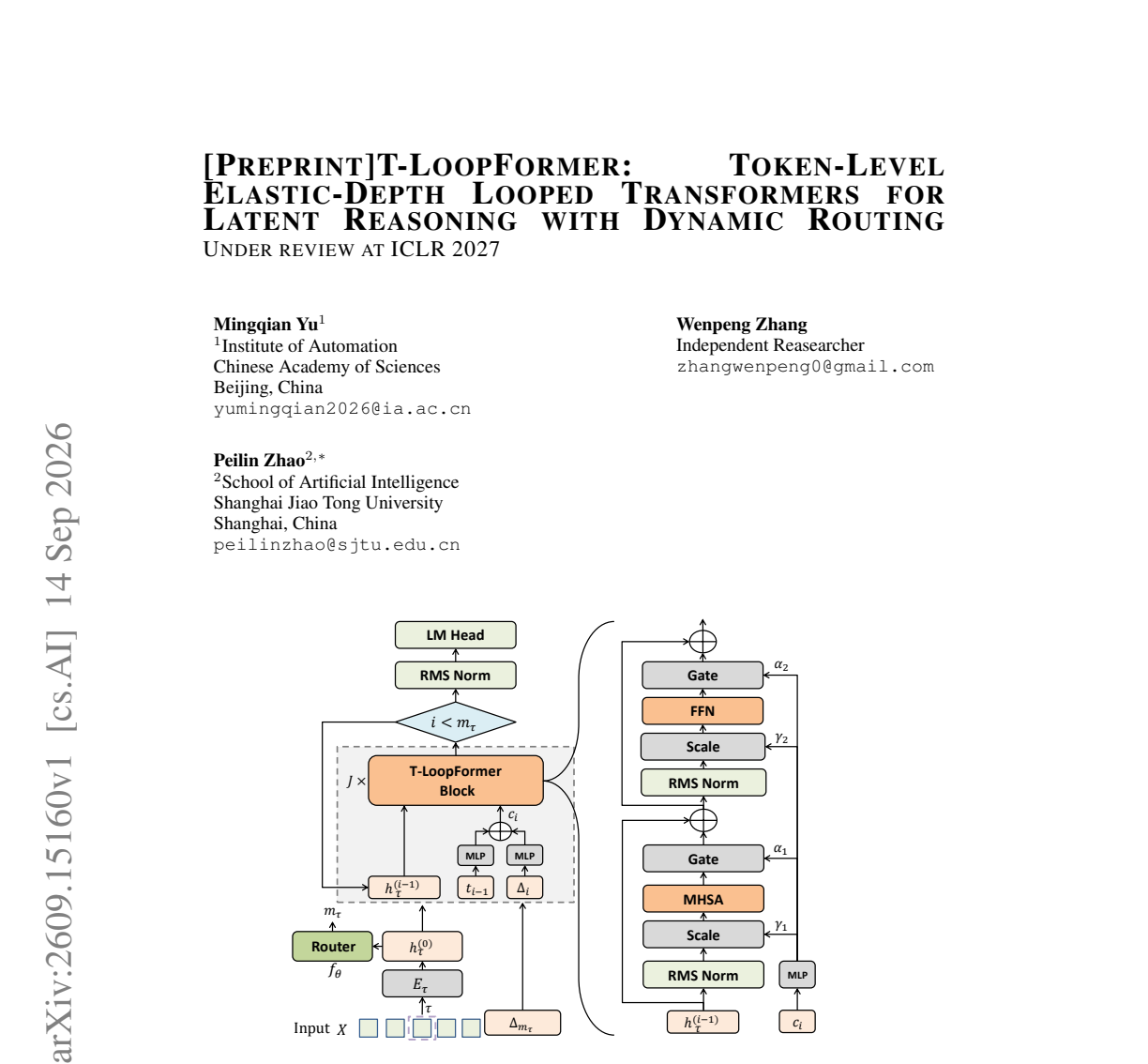
Besides, looped Transformers perform inference directly in the latent space (latent reasoning) to reduce the number of tokens consumed during inference, thereby achieving improved sample efficiency. However, these models typically apply a fixed recursion depth uniformly to every token, leading to suboptimal compute allocation and leaving significant efficiency gains on the table. In this work, we propose \textbftoken-level elastic-depth \textbflooped transformers: T-LoopFormer. T-LoopFormer uses \textbfdynamic token-choice routing, which enables each token to adaptively determine its own number of loop iterations based on its hidden state, which could improve the token generation accuracy. Moreover, we further introduce recursion-wise KV cache, which maintains an independent key-value cache for each recursion loop of active tokens; this design ensures that tokens at different depths only attend to their corresponding cached states, effectively enabling faster autoregressive decoding. Extensive experiments show that T-LoopFormer achieves robust performance on a wide range of language modeling and zero-shot reasoning tasks, and our model could reach the lowest decoding latency, which validates the effectiveness of token-choice router and recursion-wise KV cache. Code is available at https://github.com/YuMingQian1234/T-LoopFormer
from the abstract
Pith says
Machine review · deepseek-v4-flash · 15 Sep 2026 · of version 1 of the paper; version 3 is newer · what was read was not recorded · not checked by a person
It can be wrong. Challenge this review or reply to it.
The passes disagreed. Reader: holds up, with conditions. Skeptic: agrees with the reader. Referee: reject.
Interesting architecture but the router that drives the central claim has no specified training objective, making the results uninterpretable. This line is wrong
3 major objections · 4 minor
How often objections from reviews like this one are right: not yet measured
Not checked: figures, code, what the references say.
The paper says, at Section 3.2, Eq. (1)–(4)
The review did not quote this passage.
Pith says: Objection 1 of 3 · major
The dynamic token-choice router f_θ is the key novel component, yet the manuscript never states how it is trained. The only loss function is Eq. (1), which includes next-token prediction losses and an alignment loss but no router-specific loss. The routing decisions are hard indicators based on Eq.
more of objection 1
(4), which are non-differentiable, and no straight-through estimator, Gumbel-Softmax, REINFORCE, or any other gradient approximation is mentioned. As written, there is no differentiable path from any loss to f_θ; the router could be frozen or randomly initialized, and the claimed effectiveness of dynamic token-choice routing would remain unsupported. This is a load-bearing omission that invalidates the central empirical claim.
The paper says, at Section 3.2, Eq. (2) and surrounding text
The review did not quote this passage.
Pith says: Objection 2 of 3 · major
Output dimension of f_θ is set to M, where M equals the sampled shortcut length S during training (which varies per batch) or the full length L. A fixed MLP cannot change its output dimension on a per-batch basis without an unspecified truncation or renormalization rule. The paper does not explain how f_θ handles a variable M, making the definition of the router inconsistent with a standard MLP implementation.
The paper says, at Table 1 and Section 4.1
The review did not quote this passage.
Pith says: Objection 3 of 3 · major
The reported improvements over the strongest baseline (LoopFormer) are marginal: at 24× FLOPs, perplexity improves from 21.96 to 20.13 (vs. the base model's 20.17) and average zero-shot accuracy from 43.48 to 44.20. No standard deviations or statistical significance tests are reported for any metric, so it is unclear whether these differences are meaningful. Given the missing router training specification, the results cannot be reliably attributed to the proposed components.
4 minor objections
The paper says, at Table 1
Pith says: minor objection 1 of 4
The table lists 'Params' as 24x, 12x, 6x, but the parameter counts for looped models are explicitly 3x (same number of unique parameters). Labeling by FLOPs multiples in the same column is confusing; consider using separate rows for parameter count.
The paper says, at Section 3.2, Eq. (5)
Pith says: minor objection 2 of 4
The maximum in Eq. (5) defines m_τ as the largest i such that τ ∈ A_i, but the set A_i is defined via p^{(i)}_τ > 0.5. Since p^{(i)}_τ is non-increasing, this yields a well-defined depth. However, the notation in Eq. (5) implicitly assumes A_M is non-empty, which may not hold if all tokens exit early; this corner case should be clarified.
show 2 more
The paper says, at Figure 3
Pith says: minor objection 3 of 4
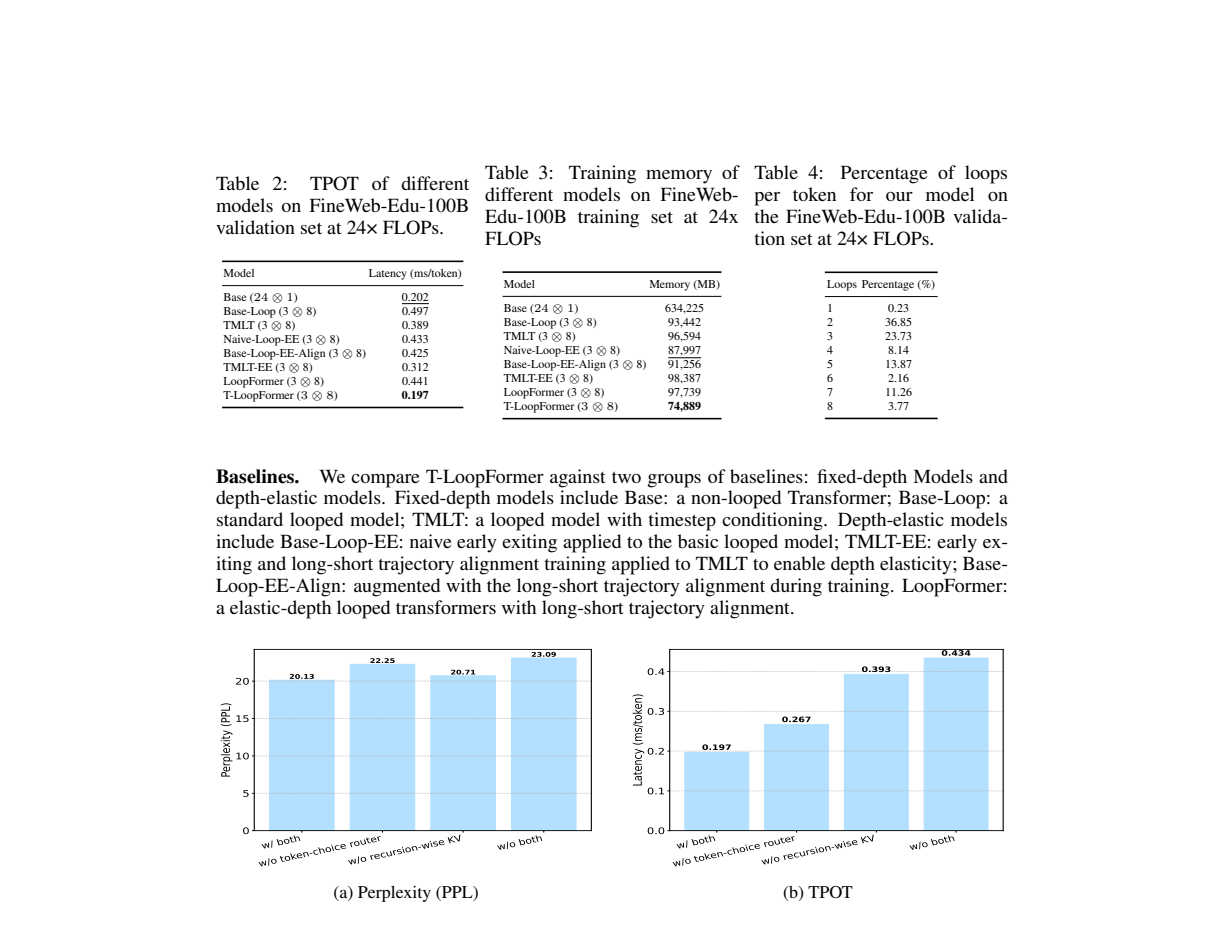
The ablation study shows that removing the router increases perplexity from 20.13 to 22.25 and latency from 0.197 to 0.267 ms/token. However, without a description of how the 'without router' variant is trained (since the router is itself the source of depth decisions), it is unclear whether a fixed-depth looped model is used instead. This comparison should be explicitly described.
The paper says, at Appendix B
Pith says: minor objection 4 of 4
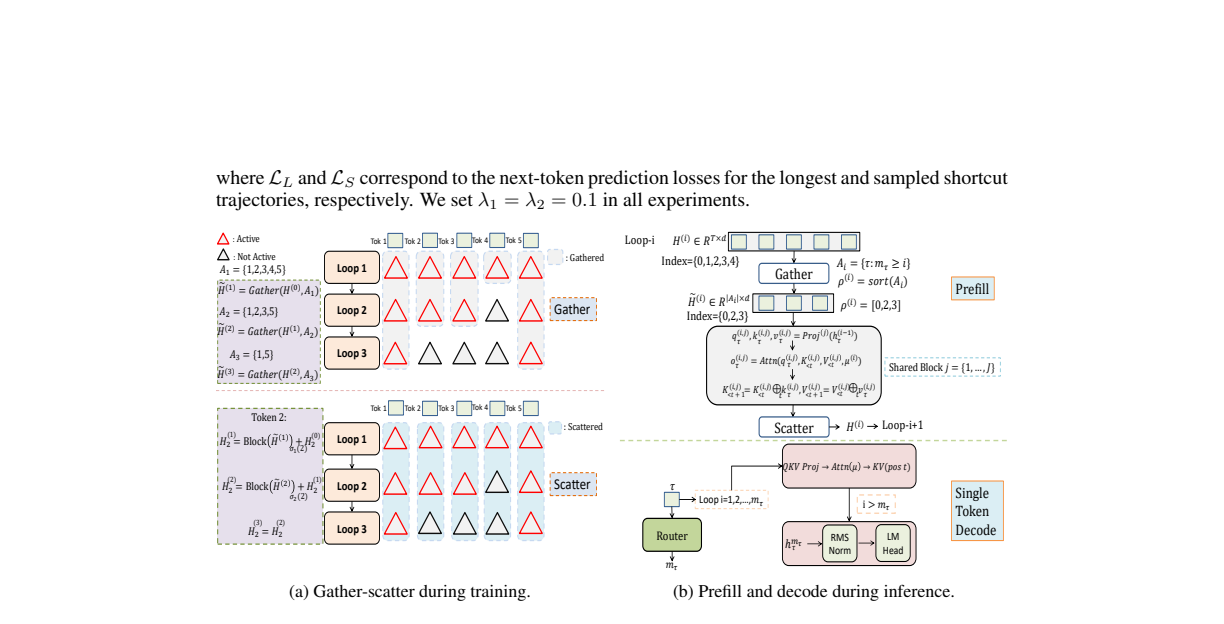
The appendix contains a useful discussion of gather-scatter differences between training and inference, but the training-time gradient flow through the gather-scatter operation is not explained. The text states that gradients flow back through the indexed assignment; it would be helpful to clarify whether the gather-scatter is implemented as an indexed slice assignment that preserves gradients (e.g., through scatter_add or equivalent).
What would settle it
Open the provided repository and trace one training step for T-LoopFormer: record whether f_theta's parameters receive nonzero gradients or an explicit optimizer update, and identify the estimator (straight-through, Gumbel-softmax, REINFORCE, or auxiliary loss) used for the hard decision in Eq. 4; also check how the softmax dimension is handled when the sampled shortcut length S differs from L. Then run the 24x FLOPs configuration from Table 1 with the router frozen versus trained; if the two runs give the same perplexity and accuracy, the paper's attribution of gains to the router is unsupported.
from the skeptic's reading
How the review went
4 readings by deepseek-v4-flash · 15 Sep 2026
- Reader holds up, with conditions
- Skeptic partly agrees
- Editor wrote the verdict above
- Referee reject: 3 major objections, 4 minor
Not run on this paper: the simulated authors' defence.
Pith did not check this review's objections against the paper.
The review in full
The review in brief, machine-written
The paper introduces token-level dynamic depth for looped transformers, which is new, and couples it with a recursion-wise KV cache for efficiency. The engineering is solid: the gather-scatter mechanism, the alignment loss from LoopFormer, and the extensive experiments against multiple baselines show the authors know what they are doing. Code is provided. These are genuine strengths.
That said, the paper has a load-bearing flaw that the stress-test note correctly identifies: the dynamic token-choice router f_theta is never shown to be trainable. The loss in Eq. 1 contains no router-relevant term; Eq. 4 is a hard threshold with no gradient path; and Eq. 2's output dimension M varies between training and inference, which a fixed MLP cannot accommodate. As written, the router could be frozen or random and the claimed 'effectiveness of token-choice routing' would still be unverifiable. This is not a minor omission — it undermines the paper's central empirical claim.
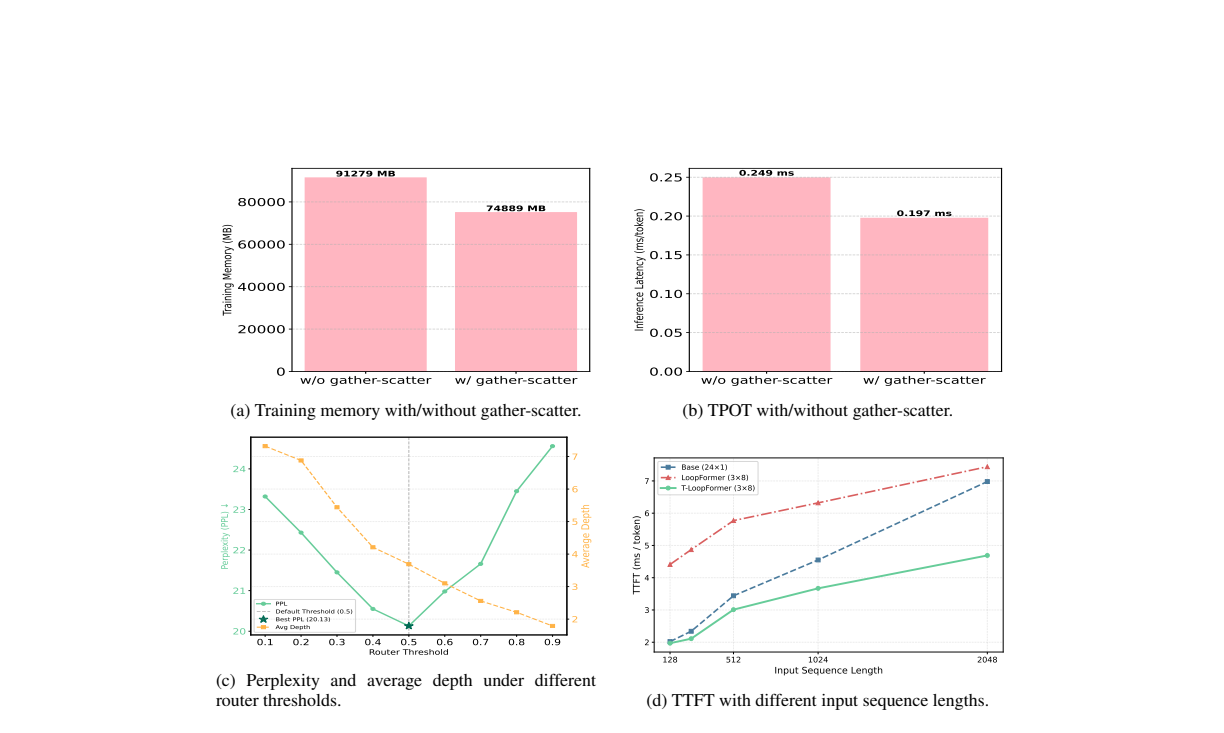
Other issues are smaller but real: the perplexity improvements over the base model are tiny (20.13 vs 20.17) with no error bars or statistical tests; the router threshold of 0.5 is chosen without sensitivity analysis (Figure 4c only shows one run); and the latency gains, while plausible, depend on the gather-scatter implementation details.
On balance, the paper deserves a serious referee because the core idea — per-token adaptive depth in looped transformers — is interesting and the architecture is otherwise well-designed. But the reviewer should focus on the router training: the authors must either specify how f_theta is trained (e.g., straight-through estimator, REINFORCE, or a separate loss) or acknowledge that the routing is rule-based rather than learned.
My bottom line: accept with major revision. If the router training can be clarified or corrected, this becomes a solid contribution to the efficient inference literature. If not, the paper cannot support its conclusions.
The strongest objection
T-LoopFormer's central novelty is the dynamic token-choice router f_theta (Section 3.2), and the headline result is attributed to it (Section 5, Figure 3). But the manuscript never states how f_theta is trained. The only training objective is Eq. 1: L = L_L + lambda_1 L_S + lambda_2 L_align; there is no router loss, no straight-through/Gumbel/REINFORCE estimator, and no mention of training the router separately. Routing enters the graph through the hard indicator Eq. 4 and the gather/scatter update Eq. 7, so as written there is no differentiable path from any loss to f_theta; the router could be frozen or randomly initialized and the claim that the token-choice router is effective would still be unverifiable. There is also a definitional inconsistency: Section 3.2 sets M equal to the sampled shortcut length S or the full trajectory length L, while Eq. 2 makes f_theta's output dimension M; a fixed MLP cannot change output dimension without an unspecified truncation or renormalization rule. Thus the mechanism that supposedly allocates computation is underspecified at the level needed to support the central claim. The threshold-at-0.5 and missing error bars noted by the reader matter only after this more basic question is resolved.
I read the paper as a well-engineered attempt to add token-level elastic depth to looped transformers, and the gather-scatter and recursion-wise KV-cache ideas are plausible engineering contributions. The strongest claim, however, rests on the token-choice router being the cause of the reported gains. The manuscript does not specify any training signal for the router: the objective in Eq. 1 contains no router term, and the hard threshold in Eq. 4 together with the mask in Eq. 7 blocks gradients unless some unstated estimator is used. This is not merely a missing hyperparameter; it is a missing mechanism for the paper's central component. A second, closely related inconsistency is that the router output dimension is defined as M, but M is said to equal either S or L during training, which a fixed MLP cannot satisfy without an additional explanation. Both issues can be resolved by inspecting the released code, which is why I do not move to REJECT; the appropriate outcome is a conditional acceptance contingent on demonstrating that the router is actually trained and that the reported results are not attributable to an untrained or constant router. The reader's identified weakest assumption about the 0.5 threshold is real but secondary: threshold sensitivity and statistical significance matter only once the router's training mechanism is established. My agreement is therefore partial: we both locate the risk in the router's role, but I see the more load-bearing gap as the absence of any described training objective for it.
The referee's report
If the router mechanism were correctly trained and the performance gains were robust, the idea of token-level elastic depth in looped Transformers could be a useful contribution to efficient latent reasoning. However, the current manuscript suffers from a missing training specification for the router and an internal inconsistency in the router's output dimension, which make the central claim unverifiable. The reported gains over the base model are marginal and lack statistical tests. The significance of the work is therefore substantially diminished until these foundational issues are resolved.
Pith's reading of the paper (a machine's summary, not the authors')
Looped transformers reuse one shared block many times and do their reasoning in hidden states instead of emitted text. Standard versions unroll the block the same number of times for every token, which wastes compute on easy tokens and slows decoding. T-LoopFormer replaces that uniform schedule with a token-choice router: each token's initial hidden state fixes its recursion depth, so simple tokens leave early and hard tokens get more loops. To keep early exits cheap, the model keeps a separate key-value cache for each recursion loop and only lets active tokens write to and attend from it. The paper argues that, at matched parameter count and FLOPs, this beats uniform-depth looped baselines on perplexity and ten zero-shot reasoning benchmarks, and at 24x FLOPs it edges past a non-looped 24-layer model while decoding faster than all compared models.
What carries the argument. The load-bearing mechanism is the dynamic token-choice router coupled with recursion-wise KV caching. The router maps the initial hidden state $h^{(0)}_{\tau}$ to a softmax vector $\pi_{\tau}$ over $M$ recursion depths and keeps token $\tau$ active at loop $i$ exactly when the tail probability $p^{(i)}_{\tau} = \sum_{\ell=i}^{M} \pi_{\tau,\ell}$ exceeds 0.5. This rule makes the active sets nested, gives each token a single depth $m_{\tau} = \max\{i : \tau \in A_i\}$, and is what turns uniform loop depth into elastic per-token depth. The recursion-wise KV cache then makes that elasticity cheap: each loop $i$ has its own key-value array, only tokens with $m_{\tau} \ge i$ write to it, and attention at loop $i$ reads only that array with a validity mask, so exited tokens cost nothing at decode time. Combined with the gather-scatter scheme, which runs the shared block only on gathered active rows and scatters results back, the machinery makes training memory and inference latency scale with surviving tokens rather than sequence length.
Core claim. Looped transformers usually unroll a shared block a fixed number of times for every token. T-LoopFormer replaces that uniform schedule with a per-token schedule: a lightweight two-layer MLP reads the token's initial embedding and outputs a distribution over recursion depths; the tail probability of needing at least $i$ loops is thresholded at 0.5 to decide whether the token stays active at loop $i$. Because the tail probabilities are non-increasing, tokens only leave and never return, so each token has a well-defined depth. During inference the model keeps a separate key-value cache for each recursion loop, writes only active tokens into their loop's cache at original positions, and masks the empty slots of exited tokens, so attention never touches dead entries. The paper reports that, among models with the same parameter count, this design reaches the best perplexity and average zero-shot accuracy at 6x, 12x, and 24x FLOPs, edges past the non-looped 24-layer baseline at 24x FLOPs, and attains the lowest decoding latency of all compared models.
The premise it rests on. The load-bearing premise is that the router's fixed 0.5 cutoff is the right exit rule for every token and every task, and that a token dropped from the recursion should never be allowed to re-enter.
If the paper is right (Pith's inferences, not the authors')
At equal parameter count and equal FLOPs, token-level elastic depth improves quality over uniform-depth looped models; T-LoopFormer reports the best perplexity and best average zero-shot accuracy among same-parameter baselines at 6x, 12x, and 24x FLOPs.
At 24x FLOPs the model slightly beats the non-looped 24-layer base on perplexity and average accuracy, so adaptive per-token loops can dominate a fixed-depth model with far more parameters.
Separating the KV cache by recursion loop, so that exited tokens are never attended to, keeps decoding fast; the paper reports the lowest per-token latency among all compared models and 2.24x faster decoding than LoopFormer.
The gather-scatter scheme makes the savings real: training memory and inference latency both drop by roughly a quarter relative to running the shared block on the full sequence.
The measured long-tail distribution of loop counts, with most tokens using four or fewer loops, is direct evidence that token difficulty varies, so a uniform depth either over-computes easy tokens or under-computes hard ones.
The paper does not state this, but because the router sees only each token's initial embedding plus its position, routing cannot react to how the hidden state changes after context mixing; a router that re-reads hidden states at later loops would test whether later-loop information improves depth choices.
This is an inference, not a paper claim: the recursion-wise KV cache is a general pattern, and any decoder that lets tokens finish at different depths could keep one cache per depth and mask dead slots, so the caching design may transfer beyond looped transformers.
This is an inference, not a paper claim: the fixed 0.5 threshold and the monotone no-re-entry policy are design choices, and the paper's own U-shaped perplexity curve suggests the optimal threshold is not a universal constant across tasks.
This is an inference, not a paper claim: a matched-compute uniform-depth baseline, unrolled as many times as T-LoopFormer's average active depth, would separate the benefit of adaptivity from the benefit of simply doing less work.
Check this review
Pith stored no record of this review's passes and took no fingerprint of it. Reviews made by code from 13 Nov 2026 on carry both.
How often reviews like this one are right
Reviews like this one: written by deepseek-v4-flash, where what was read was not recorded.
How often objections from reviews like this one are right: not yet measured
Reviews by people
This review was written by a machine. No person has reviewed this paper on Pith yet. A scientist listed on Pith can review it for a fee, and their review is published here whatever it concludes.
The paper
Abstract
Looped Transformers have recently demonstrated strong performance in both reasoning and language tasks by reusing a shared set of parameters across multiple iterations, achieving parameter efficiency without sacrificing representational power. Besides, looped Transformers perform inference directly in the latent space (latent reasoning) to reduce the number of tokens consumed during inference, thereby achieving improved sample efficiency. However, these models typically apply a fixed recursion depth uniformly to every token, leading to suboptimal compute allocation and leaving significant efficiency gains on the table. In this work, we propose \textbftoken-level elastic-depth \textbflooped transformers: T-LoopFormer. T-LoopFormer uses \textbfdynamic token-choice routing, which enables each token to adaptively determine its own number of loop iterations based on its hidden state, which could improve the token generation accuracy. Moreover, we further introduce recursion-wise KV cache, which maintains an independent key-value cache for each recursion loop of active tokens; this design ensures that tokens at different depths only attend to their corresponding cached states, effectively enabling faster autoregressive decoding. Extensive experiments show that T-LoopFormer achieves robust performance on a wide range of language modeling and zero-shot reasoning tasks, and our model could reach the lowest decoding latency, which validates the effectiveness of token-choice router and recursion-wise KV cache. Code is available at https://github.com/YuMingQian1234/T-LoopFormer
The paper's own sentences, arranged, kept beside the review and separate from it. Each label is drawn from a closed vocabulary; the number beside it is the probability the classifier gave that label. No sentence in this record was written by a model.
abstract compiled · 2026-09-23
The authors' main claim, as the classifier picked it out 1.00
“Extensive experiments show that T-LoopFormer reaches the sota performance under the same parameters on PPL and 10 zero-shot reasoning tasks, even surpassing the base model at 24x FLOPs and our model could reach the lowest inference latency, which validate the effectiveness of token-choice router and recursion-wise KV cache.”
How the main claim is stated: asserted 0.99
What the abstract itself states, as probabilities: claims first 0.07 · states limitation 0.10 · human participants 0.02 · controlled comparison 0.85 · randomized assignment 0.02 · states quantitative result 0.96 · compares with prior results 0.94 · mentions code or data availability 0.98
The abstract, sentence by sentence
This table labels the abstract only (arXiv listing abstract v1). The number is the probability the classifier gave the label.
| Sentence | Role | The authors' own work | States the main conclusion | Strength |
|---|---|---|---|---|
| Looped Transformers have recently demonstrated strong performance in both reasoning and language tasks by reusing a shared set of parameters across multiple iterations, achieving parameter efficiency without sacrificing representational power. | background 1.00 | 0.05 | 0.04 | asserted 1.00 |
| Besides, looped Transformers perform inference directly in the latent space (latent reasoning) to reduce the number of tokens consumed during inference, thereby achieving improved sample efficiency. | background 1.00 | 0.09 | 0.04 | asserted 1.00 |
| However, these models typically apply a fixed recursion depth uniformly to every token, leading to suboptimal compute allocation and leaving significant efficiency gains on the table. | gap 0.77 | 0.06 | 0.03 | asserted 0.99 |
| In this work, we propose \textbf{dynamic token-choice routing} for looped transformers, enabling each token to adaptively determine its own number of loop iterations based on its hidden state. | contribution 0.92 | 0.88 | 0.14 | asserted 0.99 |
| We use a dynamic router to decide whether a token should continue recursing or exit early, allowing simple tokens to bypass unnecessary computation while hard tokens receive deeper processing. | method 0.94 | 0.86 | 0.07 | asserted 1.00 |
| To ensure that this adaptive mechanism does not compromise decoding efficiency, we further introduce recursion-wise KV caching, which maintains an independent key-value cache for each recursion loop. | method 0.86 | 0.89 | 0.04 | asserted 0.99 |
| This design ensures that tokens at different depths only attend to their corresponding cached states, effectively eliminating redundant computations for exited tokens and enabling fast autoregressive decoding. | method 0.94 | 0.76 | 0.07 | asserted 1.00 |
| Extensive experiments show that T-LoopFormer reaches the sota performance under the same parameters on PPL and 10 zero-shot reasoning tasks, even surpassing the base model at 24x FLOPs and our model could reach the lowest inference latency, which validate the effectiveness of token-choice router and recursion-wise KV cache. | result 1.00 | 0.96 | 0.84 | asserted 0.99 |
| Code: https://github.com/YuMingQian1234/T-LoopFormer. | contribution 0.44 | 0.42 | 0.02 | unclear 0.96 |
What kind of paper the classifier reports this is: method or tool 1.00 · evidence from observation or experiment 0.99
What was examined, and what was not
Sources read
- arXiv listing abstract v1
Not examined
- full text
- figures and tables
- references and citing sentences
- relations to other papers
Levels run
- P abstract
Not run
- S sections
- T body sentences
- C citations
- R cross-paper relations
How the labels were made
Compiled by classifier-1.13.0 via TypeSafe API, question bank abstract-p1-20260923, 2026-09-23: 1 request, 7,087 input tokens.
Every quoted sentence on this record is the authors'. Every label is from Pith's closed vocabulary, with the probability shown beside it. This record as JSON
Figures (4)
Figures are the authors', reproduced from the paper.
Cited by 4 Pith papers
Reviewed papers on Pith that cite this one. The full citation record
- Dual-Slot: From Serial Loops to Parallel Slots in Language Models cs.CL · Oct 2026
- Mixture of Latent Recursions for Low-Rank Adaptation cs.LG · Nov 2026
- CUA-Master: Scaling Computer-use Agents through Open-World Recursive Improvements cs.AI · Nov 2026
- Accordion: Elastic-Depth Inference via Fixed-Prefix Layer Looping cs.LG · Oct 2026
Challenges and discussion
Disagree with the review, or know something it missed? Leave a comment, or challenge this review formally: a challenge becomes a permanent entry in this paper's record, and its decision is published here.
Come back by email
A short list of the week's newly reviewed papers. Nothing is sent until you confirm from your inbox, and every email has a link that stops it. No account.
No comments yet.
Sign in to comment