Artificial Intelligence · arXiv:2611.03126 v1 · submitted 2 Nov 2026 · 75 references
CUA-Master: Scaling Computer-use Agents through Open-World Recursive Improvements
The paper says
“Despite recent advances in CUAs, their development remains constrained by the limited diversity, controllability, and reliability of interaction data.”
more of the abstract
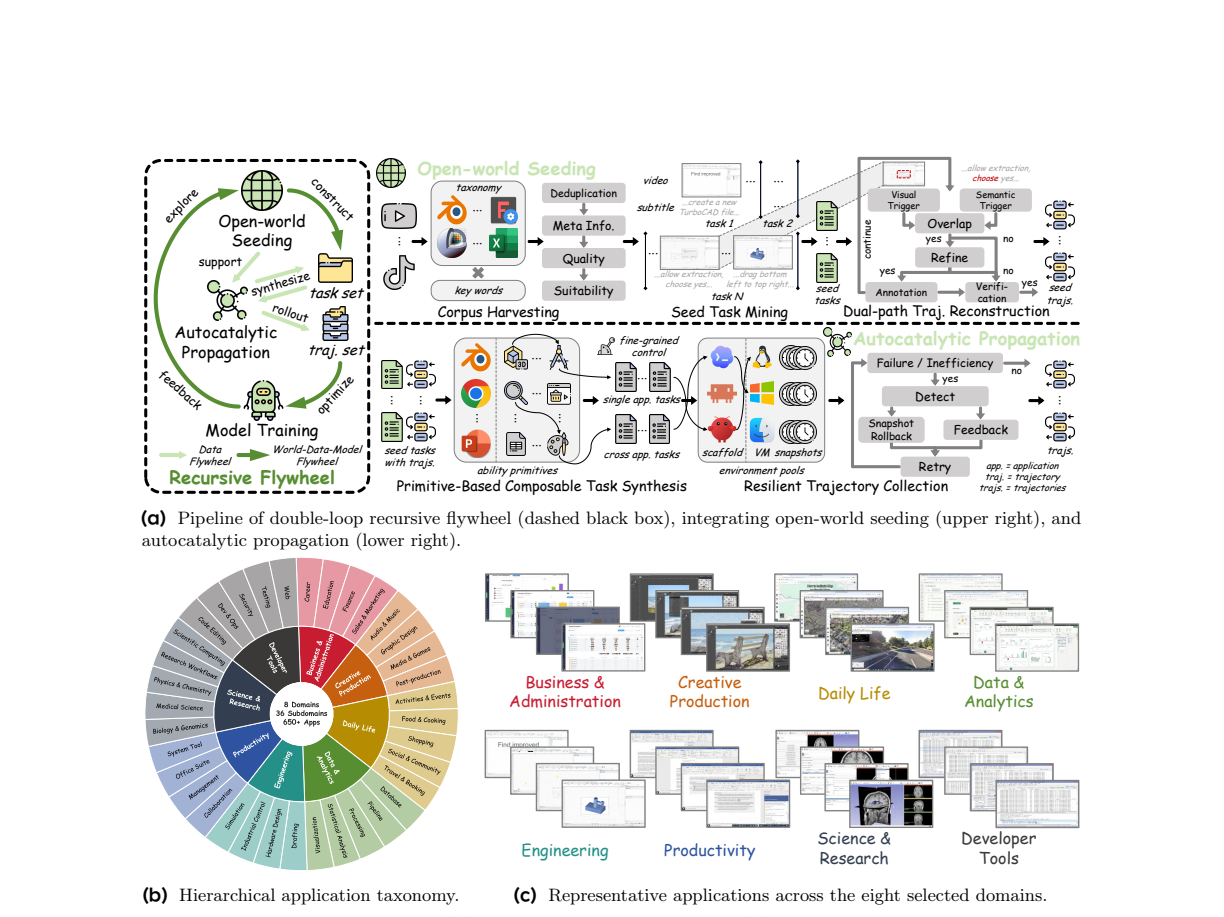
Moreover, conventional optimization pipelines lack iterative feedback, while existing recursive improvement approaches often rely on self-generated experiences, limiting ability expansion and yielding diminishing returns. To address these challenges, we introduce CUA-Master, a nested double-loop recursive improvement framework. At the system level, an outer world-data-model flywheel continuously incorporates open-world corpus and leverages evolving model weaknesses to guide subsequent data construction and optimization iterations. At the data level, an inner flywheel couples open-world seeding and autocatalytic propagation. The former mines authentic workflows as seed tasks from instructional videos, and employs visual-semantic dual-path trajectory reconstruction; The latter transforms these seeds into reusable primitives for controllable synthesis of diverse, complex, and verifiable tasks. To enable efficient and reliable trajectory collection, we further introduce a feedback-guided snapshot-rollback retry mechanism in various real environments. Extensive experiments demonstrate that CUA-Master-27B achieves competitive performance across GUI-only and GUI-CLI hybrid benchmarks, scoring 80.2 on OSWorld Verified, 36.9 on OSWorld 2.0, 43.9 on WeaveBench, and 25.0 on Agents' Last Exam. Our framework also substantially improves the quality and efficiency of data synthesis, and exhibits continuous gains across recursive iterations.
from the abstract
Pith says
Machine review · deepseek-v4-flash · 3 Nov 2026 · what was read was not recorded · not checked by a person
It can be wrong. Challenge this review or reply to it.
Holds up, with conditions. A detailed systems report with a genuinely new data-flywheel recipe and plausible-sounding 27B numbers; the unquantified seed-trajectory quality and thin statistics keep the headline claims conditional rather than established. This line is wrong
5 major objections · 6 minor
How often objections from reviews like this one are right: not yet measured
Not checked: figures, code, what the 75 references say.
The paper says, at §3.2, Table 1
The review did not quote this passage.
Pith says: Objection 1 of 5 · major
All benchmark scores in Table 1 are single point estimates with no error bars, variance, or significance tests, yet the text makes fine-grained comparative claims such as 'slightly surpasses Qwen-3.8-27B (36.9 vs. 36.5)' (§3.2.2) and 'consistently improves performance by 2.6, 12.9, 25.6, and 11.8' over UI-Mate (§3.2.1).
more of objection 1
A 0.4-point gap on a 108-task benchmark is within typical evaluation noise for CUA agents; please report the number of repeated runs, per-task variance or bootstrap intervals, and which head-to-head differences are actually distinguishable.
The paper says, at §3.2.1, Table 1
The review did not quote this passage.
Pith says: Objection 2 of 5 · major
The claim that on Agents' Last Exam CUA-Master 'surpasses all other counterparts (when full-pass rate is equal, compare the average score)' is not verifiable from the manuscript: Table 1 reports only the full-pass rate for ALE, and the average scores that break the three-way tie at 25.0 (CUA-Master, Qwen-3.8-Max, Kimi-K3) are never reported anywhere in the paper.
more of objection 2
Please add the ALE average-score column to Table 1 or report the tie-break averages explicitly, since the global 'surpasses all' claim rests on them.
The paper says, at §2.5.2, §2.4.1, §2.3.3
The review did not quote this passage.
A classifier read this sentence of the paper as acknowledging the concern (probability 0.75):
“Moreover, although annotation-verified, trajectories reconstructed from instructional videos may contain annotation noise and do not necessarily correspond to real executions in the target environments.”
Pith says: Objection 3 of 5 · major
The framework's stated foundation, open-world seeding (called 'the necessary foundation' in §2.2.1), supplies seed trajectories that are reconstructed from tutorial videos by annotator A and are never executed in the target environments, yet §2.5.2 trains SFT on the union X_seed ∪ X_synt without any execution filter on seeds, and §2.4.1 extracts primitives and verifier specifications from the same seeds.
more of objection 3
The paper itself concedes the risk (b93: trajectories 'may contain annotation noise and do not necessarily correspond to real executions in the target environments'), and the synthesis loop cannot detect ground-truth errors inherited from seeds because its verifiers are derived from the same seed material. The magnitude of this risk is unquantified: please report the seed/synthetic data mix per iteration, an execution replay pass rate for seed trajectories in the catalog VM images, and an independent audit of a sample of seeds.
The paper says, at §2.1.3 vs §2.3.3
The review did not quote this passage.
Pith says: Objection 4 of 5 · major
There is a potential spatial mismatch between annotation and execution: action coordinates are annotated from video frames in a normalized 0-1000 space (§2.3.3), but rollouts run in programmatic variants of base images with 'reorganizing desktop layouts' and randomly removed applications (§2.1.3).
more of objection 4
The dual-path reconstruction validates visual-semantic consistency of action boundaries, not executability in the specific VM, so even faithful annotations may be non-executable in the variant environments. No measurement of this mismatch is provided; a coordinate hit-rate or seed-trajectory replay success rate on the catalog images would establish whether the concern is material.
The paper says, at §3.3.2, Table 3
The review did not quote this passage.
Pith says: Objection 5 of 5 · major
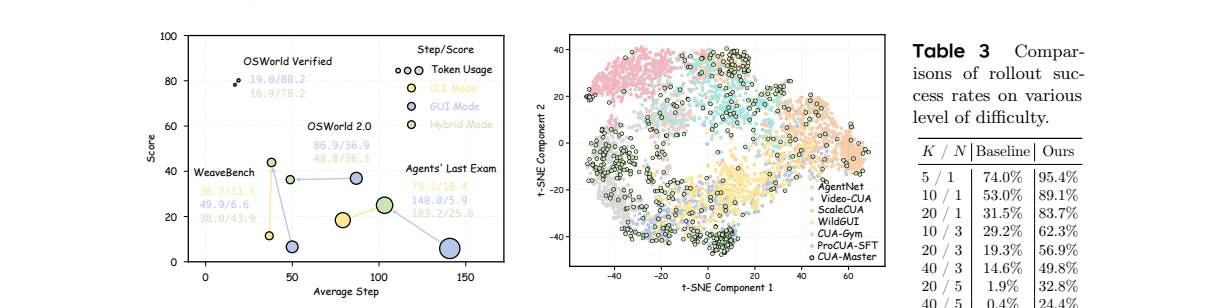
The rollout success-rate comparison in Table 3 conflates the snapshot-rollback retry mechanism with synthesis controllability: the baseline 'utilizes naive environments to rollout with the same retry budget but re-rollout from the start,' so the large gaps (e.g., 31.5% to 83.7% at K/N=20/1) may largely be attributable to the retry mechanism and environment infrastructure rather than to primitive-based controllable synthesis.
more of objection 5
In addition, these internal success rates are measured with the pipeline's own LLM-written verifiers, a self-referential metric; an independent audit of a sample of 'successful' rollouts, or a version of Table 3 that ablates the retry mechanism, would make the controllability claim load-bearing.
6 minor objections
The paper says, at Table 2
Pith says: minor objection 1 of 6
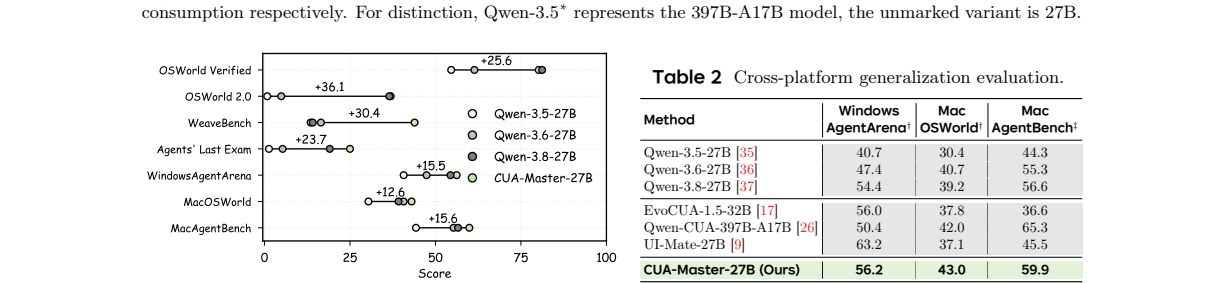
Table 2's column headers appear garbled ('Windows Mac MacAgentArena† OSWorld† AgentBench‡') and each row shows only three scores, so the alignment with WindowsAgentArena, MacOSWorld, and MacAgentBench is unclear; please fix the header row, the benchmark-name annotations, and the caption.
The paper says, at Figure 1
Pith says: minor objection 2 of 6
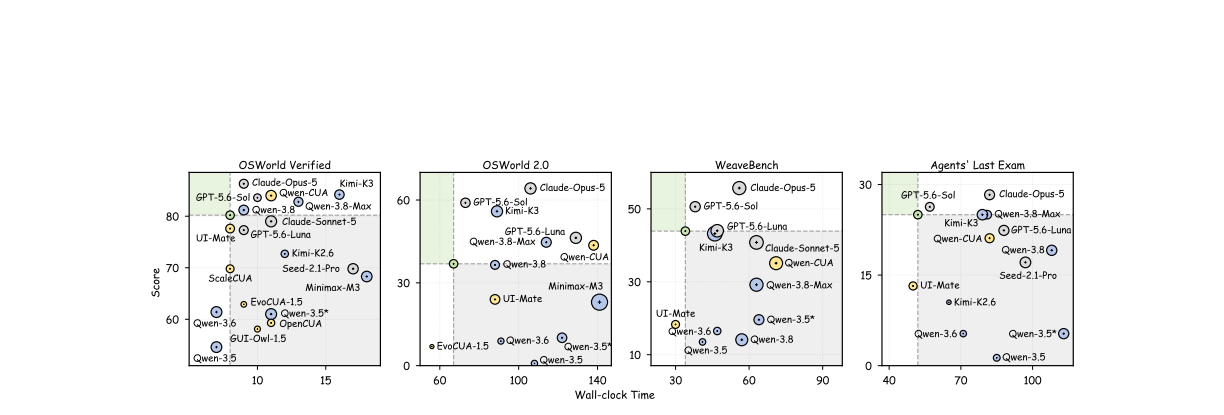
Figure 1 renders with overlapping labels (e.g., '80.281.2' and unlabeled axis fragments such as '90 45 0'), making the comparison chart hard to read; a clean vector figure with a proper legend and axis labels is needed.
show 4 more
The paper says, at §2.5.2
Pith says: minor objection 3 of 6
The sentence 'we fine-tune the policy on verified trajectories' conflicts with the concession in §2.4 (b93) that seed trajectories are only annotation-verified and may not correspond to real executions; please use distinct terms (e.g., 'execution-verified' versus 'annotation-verified') throughout the paper.
The paper says, at §2.3.1, Table 8
Pith says: minor objection 4 of 6
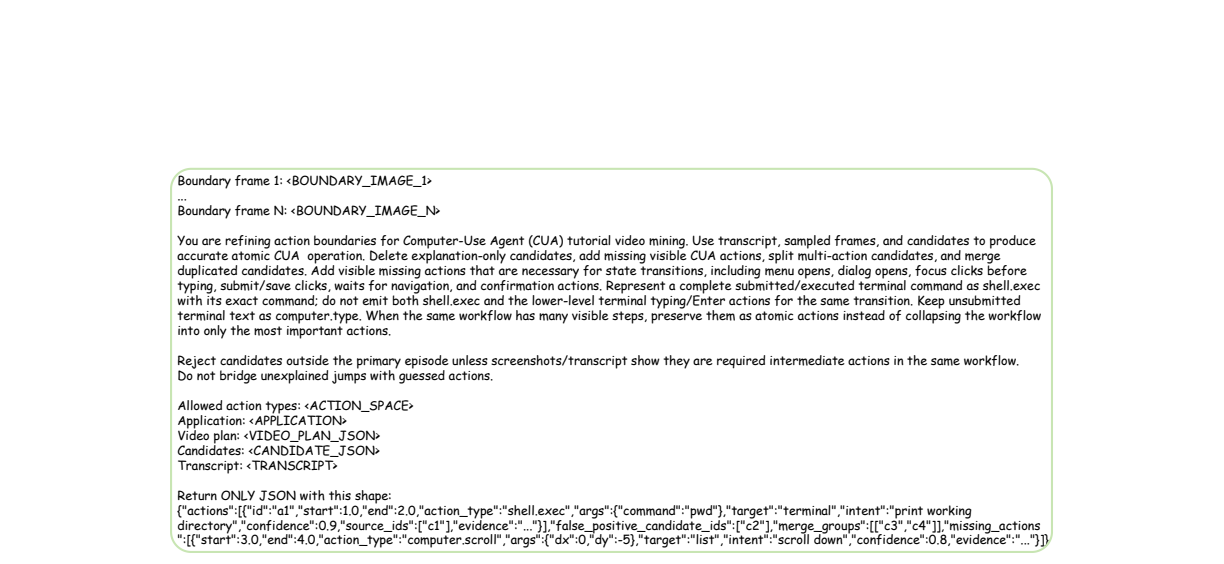
The identity of annotator A is never disclosed ('normally a more powerful model', §2.3.1), despite Figure 9 showing that performance depends strongly on the annotator choice and Table 8 listing only 'allowed models'; naming the actual annotator used for the main runs is necessary for reproducibility of the data pipeline.
The paper says, at Appendix B, Fig. 10b
Pith says: minor objection 5 of 6
Please clarify whether the per-iteration distributions in Figure 10b sum to 100% within each iteration or across the whole dataset, and state the per-iteration seed/synthetic task counts in addition to the cumulative totals.
The paper says, at §2.3.3, Eq. (5)
Pith says: minor objection 6 of 6
The temporal overlap window T, the frame-level appearance-change threshold, and the retry budget are each described as 'predefined' but no values are given anywhere in the paper; please report the actual settings, since these are free parameters of the reconstruction and rollout pipeline.
What would settle it
Replay N=200 randomly sampled seed trajectories in the paper's own VM infrastructure (matching the environment spec and video-derived starting state recorded at mining time), without retry or rollback assistance, and measure (a) the fraction reaching the annotated goal state within the original step budget, and (b) action-sequence agreement (e.g., Levenshtein distance over normalized action types and coordinates) between replayed and annotated trajectories, stratified by annotator confidence. Also report the seed/synthetic composition of the 115K SFT set. If the replay pass rate is at least 80%, the concern is mitigated; if below 50%, the seed portion of SFT is materially noisy, and the paper should retrain without seeds (or with execution-filtered seeds) and re-report the four benchmark scores to establish whether the headline numbers are carried by the executed synthetic loop alone.
from the skeptic's reading
How the review went
4 readings by deepseek-v4-flash · 3 Nov 2026
- Reader holds up, with conditions
- Skeptic agrees
- Editor wrote the verdict above
- Referee major revision: 5 major objections, 6 minor
Not run on this paper: the simulated authors' defence.
Pith did not check this review's objections against the paper.
The review in full
The review in brief, machine-written
The one thing to know: this is about the most complete open-weights CUA data-flywheel write-up I've seen recently, with a genuinely new system recipe and strong-sounding numbers for a 27B model — but the evidence base is thinner than the prose, and I'd treat the headline scores as conditional until replication or at least error bars.
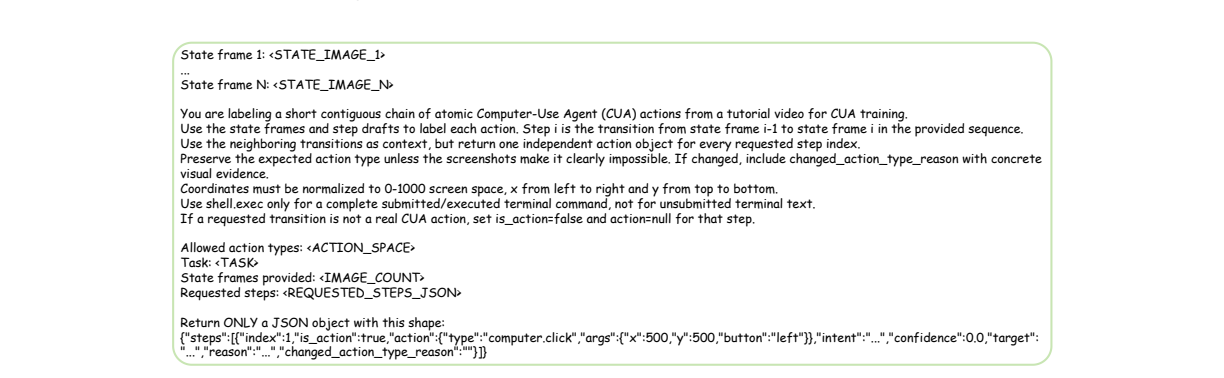
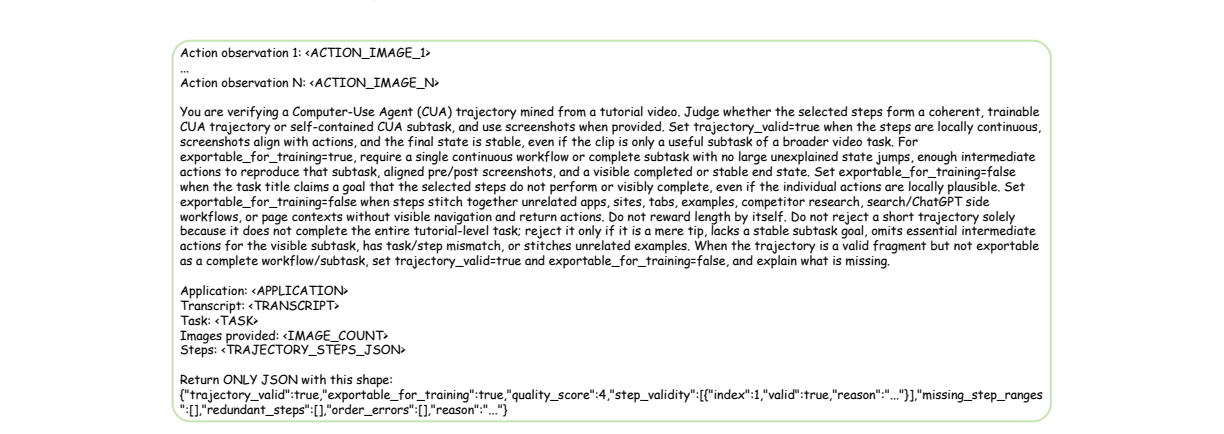
What's actually new is the nested double loop: open-world seeding from instructional videos (taxonomy over 650 apps), dual-path visual-semantic trajectory reconstruction, primitive-based composable task synthesis, feedback-guided snapshot-rollback retries, and iterative SFT-to-RL. None of the components is brand new — ScaleCUA, OpenCUA, and EvoCUA cover much of the neighborhood — but the combination, plus the trained 27B model and its numbers, is not in the cited literature. The paper also ships unusually complete appendices: all eight annotator prompts in full, the action space, the domain taxonomy, and domain-level benchmark breakdowns. A reader can reconstruct the pipeline from the text, which is real value. Baselines are also re-evaluated under a consistent protocol, which is more care than most papers in this area take.
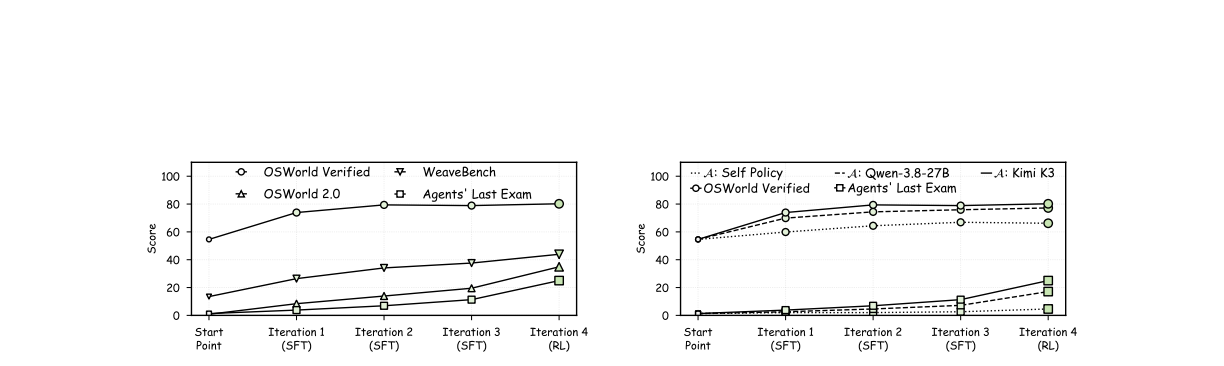
Credit where due: the ablations are internally consistent. The iteration curves (Fig 8), the annotator-strength comparison (Fig 9), and the rollout success-rate table (Table 3) all support the flywheel story, and the hybrid GUI+CLI analysis (Fig 6) is a clean demonstration that the hybrid action space is doing heavy lifting. The main benchmark claims run on external published benchmarks, so the central result does not reduce to a fitted constant.
Soft spots, in order of size. First, the seed trajectories — the stated foundation of the whole loop — are reconstructed by an LLM annotator from tutorial videos and never executed in the target VMs before feeding SFT (Sec 2.5.2 trains on X_seed union X_synt with no execution filter on seeds). The paper acknowledges this at b93, but never quantifies it: no seed/synthetic split of the 115K tasks, no replay or pass rate for seeds, and the seed verification is done by the same annotator class that generated them. The synthetic loop can fix its own errors but cannot correct ground-truth error inherited from seeds. This is the load-bearing weakness, and it is unquantified rather than fatal. Second, there are no error bars or significance tests anywhere, and several headline comparisons rest on 2-3 point gaps. Third, the "surpasses all other counterparts" claim on Agents' Last Exam is decided by average scores that are never reported — the table only shows the tied full-pass rate. Fourth, no contamination analysis, which matters when the training corpus is YouTube/TikTok/Bilibili and the benchmarks are public.
Who this is for: anyone building CUA data pipelines or working on recursive training. The prompt appendix alone is worth the read.
Recommendation: send it to review, and require the authors to report the seed/synthetic mix, a seed replay rate, and the unreported Agents' Last Exam averages, plus at least a contamination discussion. With those, the claims become checkable.
The strongest objection
The central claim is that a 27B model reaches the reported scores through a nested double-loop whose stated foundation is open-world seeding: Section 2.2.1 calls it 'the necessary foundation', and Section 2.3 supplies seed tasks whose trajectories are reconstructed from tutorial videos by LLM annotator A, never executed in the target environments. The load-bearing premise is that these unexecuted trajectories are usable supervision. The paper itself concedes the risk (b93: 'may contain annotation noise and do not necessarily correspond to real executions'), yet Section 2.5.2 trains SFT on the union X_seed ∪ X_synt without any execution filter on seeds, and Section 2.4.1 extracts primitives from (T_seed, X_seed), so any systematic annotation bias propagates into synthetic tasks, their LLM-written verifiers, and the RL rewards derived from them. The synthesis loop can check internal consistency against its own verifiers, but cannot detect ground-truth errors inherited from seeds.
Two mechanisms make the concern concrete. First, coordinates are annotated from video frames in normalized 0-1000 space, but rollout VMs are programmatic variants of base images with 'reorganizing desktop layouts' (Section 2.1.3); the dual-path reconstruction (Section 2.3.3) validates visual-semantic consistency of action boundaries, not executability in the specific VM, so even faithful annotations can be non-executable. Second, the magnitude is unquantified: the paper never reports the seed/synthetic split of the 115K SFT tasks, any execution pass rate for seeds, or domain-level acceptance. If a substantial fraction of seeds are non-executable, a large share of SFT targets contain state/action sequences inconsistent with real environment dynamics, noise the synthetic loop cannot correct. The benchmark headline might survive (synthetic rollouts are executed and verified), but the paper's actual contribution, open-world recursive improvement, would rest on unvalidated supervision.
I read the paper as a systems report whose central claim has two parts: (a) CUA-Master-27B attains the reported benchmark numbers, and (b) the numbers are attributable to the double-loop flywheel, with open-world seeding as the stated foundation (Section 2.2.1). Part (b) is the novel contribution, and it rests on the quality of video-derived seed trajectories. The reader's weakest assumption identifies exactly this, and I agree: the paper's own sentence b93 concedes seeds 'may contain annotation noise and do not necessarily correspond to real executions', yet Section 2.5.2 trains on the union X_seed ∪ X_synt without an execution check, and Section 2.4.1 propagates seeds into primitives, verifiers, and RL rewards. My added value is mechanistic specificity: coordinate transfer from video frames into perturbed VM layouts (Section 2.1.3) makes non-executability structurally likely rather than merely possible, and the missing seed/synthetic split plus missing replay pass rate make the damage unquantifiable from the text alone.
I considered and set aside three alternatives. (i) Benchmark contamination: genuine, but untestable without released data and not specific to the contribution. (ii) LLM-generated verifier reliability in the RL stage: downstream of the seeds (verifiers derive from seed-derived primitives) and bounded mostly to the 12K RL tasks. (iii) Attribution of iteration gains to data volume rather than feedback: a weakness of the 'recursive' sub-claim, but secondary to the headline numbers.
Credit where due: the paper is unusually transparent for this genre, with full annotation prompts (Figures 11-18), environment taxonomies (Table 9), domain-level benchmark tables (Tables 4-6), and an honest limitation statement (Section E, b93). The efficiency metrics and cross-platform results are internally consistent. None of this substitutes for execution-verified seeds, which the paper's own infrastructure (Section 2.1.3) could have produced at modest cost; its absence is the single largest gap.
Verdict: the concern does not refute the paper, since the synthetic loop is executed and verifier-checked and the headline could survive even if seeds are noisy. But it conditions the central contribution on an unmeasured premise. The reader's CONDITIONAL verdict stands; nothing in the text moves me to REJECT or ACCEPT.
The referee's report
If the reported results hold, this is a substantial empirical contribution: a 27B open-weights model approaching frontier closed-source performance across four diverse CUA benchmarks, with the framework's mechanics unusually well documented. Strengths that should be credited include the appendix's complete role-specific prompts for all eight annotator functions (Figs. 11-18), the detailed application taxonomy (Table 9), explicit training-data accounting (115K SFT / 12K RL, Appendix B), and domain-level benchmark breakdowns (Tables 4-6). The central benchmark claims are evaluated on external, published benchmarks, so the main result does not reduce to a fitted constant or a self-generated test set, and the head-to-head comparisons are falsifiable.
Pith's reading of the paper (a machine's summary, not the authors')
This paper claims that computer-use agents escape the diminishing returns of self-generated training data by anchoring recursive improvement in the open world. Its framework, CUA-Master, couples two loops: an outer world-data-model flywheel that mines instructional videos for real workflows and lets each model's failure analysis steer the next round of exploration, and an inner data flywheel that recombines mined workflows into new, verifiable tasks. Trained this way, a 27-billion-parameter model scores 80.2 on OSWorld Verified, 36.9 on OSWorld 2.0, 43.9 on WeaveBench, and 25.0 on Agents' Last Exam, approaching or beating far larger and closed-source systems. If correct, the bottleneck for capable computer-use agents shifts from expensive hand-annotated trajectories to the much cheaper and broader resource of public tutorial video.
What carries the argument. The load-bearing object is the nested double-loop flywheel. The outer world-data-model loop couples exploration, data construction, and training: the evolving model's failure analysis decides which applications and workflows the next round of video mining and task synthesis should emphasize, so data volume is steered rather than merely increased. The inner loop couples open-world seeding (the source of diversity) with autocatalytic propagation (the source of scale and controllability). The central unit is the ability primitive, a five-tuple $(u_i, a_i, P_i, E_i, V_i)$ of application, reusable ability, preconditions, environment requirements, and verifier, whose explicit preconditions and verifier specifications are what make composed synthetic tasks verifiable rather than decorative. Two supporting mechanisms carry feasibility: the trigger-overlap rule, which pairs transcript-derived semantic triggers with frame-change visual triggers to turn diffuse video into actions, and feedback-guided snapshot-rollback retry, which restores the last valid state and resumes with diagnostic feedback, keeping high-complexity rollouts cheap enough to scale.
Core claim. The central claim is that recursively improving a computer-use agent does not require feeding it its own outputs, which the paper argues concentrates on existing strengths and plateaus; instead, each iteration should pull fresh operational knowledge from the open world and convert it into executable supervision. The paper's machinery treats instructional video as the seed: a taxonomy of over 650 applications drives retrieval, an LLM annotator segments each video into independently trainable episodes, and a visual-semantic dual-path detector recovers step-level actions by pairing narrator cues such as ‘click’ or ‘scroll’ with frame-change events. Seeds are then decomposed into reusable ability primitives, each carrying preconditions, environment requirements, and a verifier, and recomposed into synthetic tasks of explicitly controlled complexity ($K$ primitives across $N$ applications). Trajectories are collected in real virtual machines using a snapshot-rollback retry that preserves valid prefixes instead of restarting, and a final online RL stage trains on high-quality verifiable tasks. The paper reports that this pipeline lets a 27B model match or approach models that are orders of magnitude larger, with the largest gains on long-horizon hybrid GUI+CLI benchmarks.
The premise it rests on. The SFT stage trains on trajectories that an LLM reconstructs from tutorial videos without executing them in the target environments, and the paper itself concedes these “may contain annotation noise and do not necessarily correspond to real executions in the target environments”; if a large fraction of reconstructions mislabel states or actions, that noise is baked into the base of the pipeline, where the verifiable synthesis loop cannot repair it.
If the paper is right (Pith's inferences, not the authors')
A 27B open-weight model can reach parity with much larger or closed-source systems on both GUI-only and hybrid GUI+CLI benchmarks, so model scale is not the only lever for computer-use ability.
Hybrid GUI+CLI execution is worth far more on long-horizon tasks: the paper measures WeaveBench jumping from 6.6 (GUI-only) and 11.5 (CLI-only) to 43.9 in hybrid mode, and Agents' Last Exam from 5.9 to 25.0.
Snapshot-rollback retries make extreme difficulty tractable: rollout success at $K/N=40/3$ reaches 49.8% versus 14.6% for restart-from-scratch, and at $K/N=50/8$ it reaches 18.7% versus 0.0%.
Recursive iterations with weakness-guided data reallocation keep improving scores, with the final RL stage adding roughly 15 points on the harder benchmarks after SFT saturates.
If the video-seeded, verifier-checked loop keeps improving agents without hand annotation, public tutorial video becomes a durable scaling resource, and the binding constraint shifts to environment coverage: applications with few or no tutorial videos would remain capability gaps.
The paper's own finding that stronger external annotators beat the self-policy as data generators leaves a ratchet question open: as the trained model improves, will the self-annotation gap narrow, or will the system remain permanently dependent on an external stronger model?
A testable extension of the outer loop's logic: per-iteration gains should track the fraction of newly added tasks drawn from under-represented taxonomy branches, since weakness-guided reallocation, not raw data volume, is what the flywheel claims drives improvement.
The verifier-centric design suggests the curated RL task set could eventually be replaced by on-the-fly verifier rewards on newly mined applications, letting the agent extend its frontier without a separate curation stage.
Check this review
Pith stored no record of this review's passes and took no fingerprint of it. Reviews made by code from 13 Nov 2026 on carry both.
How often reviews like this one are right
Reviews like this one: written by deepseek-v4-flash, where what was read was not recorded.
How often objections from reviews like this one are right: not yet measured
Reviews by people
This review was written by a machine. No person has reviewed this paper on Pith yet. A scientist listed on Pith can review it for a fee, and their review is published here whatever it concludes.
The paper
Abstract
Despite recent advances in CUAs, their development remains constrained by the limited diversity, controllability, and reliability of interaction data. Moreover, conventional optimization pipelines lack iterative feedback, while existing recursive improvement approaches often rely on self-generated experiences, limiting ability expansion and yielding diminishing returns. To address these challenges, we introduce CUA-Master, a nested double-loop recursive improvement framework. At the system level, an outer world-data-model flywheel continuously incorporates open-world corpus and leverages evolving model weaknesses to guide subsequent data construction and optimization iterations. At the data level, an inner flywheel couples open-world seeding and autocatalytic propagation. The former mines authentic workflows as seed tasks from instructional videos, and employs visual-semantic dual-path trajectory reconstruction; The latter transforms these seeds into reusable primitives for controllable synthesis of diverse, complex, and verifiable tasks. To enable efficient and reliable trajectory collection, we further introduce a feedback-guided snapshot-rollback retry mechanism in various real environments. Extensive experiments demonstrate that CUA-Master-27B achieves competitive performance across GUI-only and GUI-CLI hybrid benchmarks, scoring 80.2 on OSWorld Verified, 36.9 on OSWorld 2.0, 43.9 on WeaveBench, and 25.0 on Agents' Last Exam. Our framework also substantially improves the quality and efficiency of data synthesis, and exhibits continuous gains across recursive iterations.
The paper's own sentences, arranged, kept beside the review and separate from it. Each label is drawn from a closed vocabulary; the number beside it is the probability the classifier gave that label. No sentence in this record was written by a model.
abstract compiled · 2026-11-04
The authors' main claim, as the classifier picked it out 0.82
“Extensive experiments demonstrate that CUA-Master-27B achieves competitive performance across GUI-only and GUI-CLI hybrid benchmarks, scoring 80.2 on OSWorld Verified, 36.9 on OSWorld 2.0, 43.9 on WeaveBench, and 25.0 on Agents' Last Exam.”
How the main claim is stated: asserted 1.00
What the abstract itself states, as probabilities: claims first 0.07 · states limitation 0.15 · human participants 0.08 · controlled comparison 0.11 · randomized assignment 0.01 · states quantitative result 0.99 · compares with prior results 0.34 · mentions code or data availability 0.06
The abstract, sentence by sentence
This table labels the abstract only (arXiv listing abstract v1). The number is the probability the classifier gave the label.
| Sentence | Role | The authors' own work | States the main conclusion | Strength |
|---|---|---|---|---|
| Despite recent advances in CUAs, their development remains constrained by the limited diversity, controllability, and reliability of interaction data. | background 0.67 | 0.06 | 0.02 | asserted 1.00 |
| Moreover, conventional optimization pipelines lack iterative feedback, while existing recursive improvement approaches often rely on self-generated experiences, limiting ability expansion and yielding diminishing returns. | gap 0.64 | 0.06 | 0.02 | asserted 1.00 |
| To address these challenges, we introduce CUA-Master, a nested double-loop recursive improvement framework. | contribution 0.98 | 0.80 | 0.06 | asserted 0.99 |
| At the system level, an outer world-data-model flywheel continuously incorporates open-world corpus and leverages evolving model weaknesses to guide subsequent data construction and optimization iterations. | method 0.95 | 0.81 | 0.06 | asserted 1.00 |
| At the data level, an inner flywheel couples open-world seeding and autocatalytic propagation. | method 0.95 | 0.79 | 0.03 | asserted 0.99 |
| The former mines authentic workflows as seed tasks from instructional videos, and employs visual-semantic dual-path trajectory reconstruction; The latter transforms these seeds into reusable primitives for controllable synthesis of diverse, complex, and verifiable tasks. | method 0.99 | 0.88 | 0.03 | asserted 0.99 |
| To enable efficient and reliable trajectory collection, we further introduce a feedback-guided snapshot-rollback retry mechanism in various real environments. | method 0.92 | 0.93 | 0.03 | asserted 0.98 |
| Extensive experiments demonstrate that CUA-Master-27B achieves competitive performance across GUI-only and GUI-CLI hybrid benchmarks, scoring 80.2 on OSWorld Verified, 36.9 on OSWorld 2.0, 43.9 on WeaveBench, and 25.0 on Agents' Last Exam. | result 1.00 | 0.97 | 0.41 | asserted 1.00 |
| Our framework also substantially improves the quality and efficiency of data synthesis, and exhibits continuous gains across recursive iterations. | result 0.94 | 0.95 | 0.39 | asserted 1.00 |
What kind of paper the classifier reports this is: method or tool 1.00 · evidence from observation or experiment 1.00
What was examined, and what was not
Sources read
- arXiv listing abstract v1
Not examined
- full text
- figures and tables
- references and citing sentences
- relations to other papers
Levels run
- P abstract
Not run
- S sections
- T body sentences
- C citations
- R cross-paper relations
How the labels were made
Compiled by classifier-1.13.0 via TypeSafe API, question bank abstract-p1-20260923, 2026-11-04: 1 request, 7,008 input tokens.
Every quoted sentence on this record is the authors'. Every label is from Pith's closed vocabulary, with the probability shown beside it. This record as JSON
Figures (18)






Showing 16 of the paper's 18 figures. Figures are the authors', reproduced from the paper.
References (75)
- [1] Saaket Agashe, Jiuzhou Han, Shuyu Gan, Jiachen Yang, Ang Li, and Xin Wang. Agent s: An open agentic framework that uses computers like a human. InInternational Conference on Learning Representations (ICLR), volume 2025, pages 22924–22946, 2025 on Pith
- [2] Pranjal Aggarwal, Lawrence Keunho Jang, Sean Welleck, Daniel Fried, Ruslan Salakhutdinov, and Jing Yu Koh. cua-speedrun: Standardized benchmarking of the speed of computer-use agents.arXiv preprintarXiv:2609.40284, 2026 on PithPith's reviewarXiv
- [3] Anthropic. Introducing claude opus 5, July 2026. URLhttps://www.anthropic.com/news/claude-opus-5 on Pith
- [4] Anthropic. Introducing claude sonnet 5, June 2026. URLhttps://www.anthropic.com/news/claude-sonnet-5 on Pith
- [5] Rogerio Bonatti, Dan Zhao, Francesco Bonacci, Dillon Dupont, Sara Abdali, Yinheng Li, Yadong Lu, Justin Wagle, Kazuhito Koishida, Arthur Bucker, et al. Windows agent arena: Evaluating multi-modal os agents at scale. arXiv preprint arXiv:2409.08264, 2024 on PithPith's reviewarXiv
- [6] Tianpeng Bu, Xin Liu, Qihua Chen, Hao Jiang, Shurui Li, hongtao duan, Lu Jiang, lulu hu, Bin Yang, and Minying Zhang. Recovering policy-induced errors: Benchmarking and trajectory synthesis for robust GUI agents. In International Conference on Machine Learning (ICML), 2026 on Pith
- [7] Yuan Cao, Dezhi Ran, Mengzhou Wu, Yuzhe Guo, Xin Chen, Ang Li, Gang Cao, Gong Zhi, Hao Yu, Linyi Li, et al. Gui-genesis: Automated synthesis of efficient environments with verifiable rewards for gui agent post-training. arXiv preprint arXiv:2602.14093, 2026 on PithPith's reviewarXiv
- [8] Tongbo Chen, Junbo Niu, Zhengxi Lu, Niu Lian, Fei Tang, Yuchen Yan, Yike Hong, Yong Du, Yizhou Liu, Bofan Chen, et al. Hybridcua: Learning to orchestrate gui and cli for computer-use agents. arXiv preprint arXiv:2609.38008, 2026 on PithPith's reviewarXiv
- [9] Zihan Ding, Longxu Dou, Qi Gao, Xiangwu Guo, Shengchao Hu, Zilong Huang, Zihang Jiang, Lei Ke, Mengcheng Lan, Weixian Lei, et al. Ui-mate: Advancing open-weight foundation gui agents with in-context demonstrations. arXiv preprint arXiv:2608.15930, 2026 on PithPith's reviewarXiv
- [10] Shuai Dong, Yongfu Zhu, Yuqi Xu, Weichu Xie, Ziyue Wang, Kaiwen Tuo, Congcong Wang, Siyuan Wang, Wenqi Shao, Shuai Yang, et al. Rl starts before rl: On policy distillation for better reinforcement learning.arXiv preprint arXiv:2609.28145, 2026 on PithPith's reviewarXiv
- [11] Zi-Yi Dou, Cheng-Fu Yang, Xueqing Wu, Kai-Wei Chang, and Nanyun Peng. Re-rest: Reflection-reinforced self-training for language agents. InProceedings of the Conference on Empirical Methods in Natural Language Processing (EMNLP), pages 15394–15411, 2024 on Pith
- [12] Tianqing Fang, Hongming Zhang, Zhisong Zhang, Kaixin Ma, Wenhao Yu, Haitao Mi, and Dong Yu. Webevolver: Enhancing web agent self-improvement with co-evolving world model. In Proceedings of the Conference on Empirical Methods in Natural Language Processing (EMNLP), pages 8970–8... on Pith
- [13] Aarash Feizi, Shravan Nayak, Xiangru Jian, Kevin Qinghong Lin, Kaixin Li, Rabiul Awal, Xing Han Lù, Jo- han S Obando Ceron, Juan A Rodriguez, Nicolas Chapados, et al. Grounding computer use agents on human demonstrations. InInternationalConference on Learning Representations(I... on Pith
- [14] Yikun Fu, Bowen Fu, Zhenyu Wu, Shuang Cheng, Xiaowei Sun, Bowen Yang, Zehao Li, Yibo Zhao, Zichen Ding, Zhoumianze Liu, et al. Macagentbench: Benchmarking ai agents on real-world macos desktop.arXiv preprint arXiv:2606.22557, 2026 on PithPith's reviewarXiv
- [15] Wenyi Hong, Weihan Wang, Qingsong Lv, Jiazheng Xu, Wenmeng Yu, Junhui Ji, Yan Wang, Zihan Wang, Yuxiao Dong, Ming Ding, et al. Cogagent: A visual language model for gui agents. InIEEE/CVF Conference on Computer Vision and Pattern Recognition (CVPR), pages 14281–14290. IEEE, 2024 on Pith
- [16] XuhaoHu, XiZhang, HaiyangXu, KyleQiao, JingyiYang, XuanjingHuang, JingShao, MingYan, andJiepingYe. Toolcua: Towards optimal gui-tool path orchestration for computer use agents.arXiv preprint arXiv:2605.12481, 2026 on PithPith's reviewarXiv
- [17] Mianqiu Huang, Taofeng Xue, Chong Peng, Jinrui Ding, Sicheng Fan, Jiale Hong, Yufei Gao, Xiaocheng Zhang, Linsen Guo, Xin Yang, et al. Evocua-1.5: Online reinforcement learning for multi-turn computer-use agents. arXiv preprint arXiv:2607.09773, 2026. 13 on PithPith's reviewarXiv
- [18] Yunseok Jang, Yeda Song, Sungryull Sohn, Lajanugen Logeswaran, Tiange Luo, Dong-Ki Kim, Kyunghoon Bae, and Honglak Lee. Scalable video-to-dataset generation for cross-platform mobile agents. InProceedings of the IEEE/CVF Conference on Computer Vision and Pattern Recognition Co... on Pith
- [19] Hongrui Jia, Jitong Liao, Xi Zhang, Haiyang Xu, Tianbao Xie, Chaoya Jiang, Ming Yan, Si Liu, Wei Ye, and Fei Huang. Osworld-mcp: Benchmarking mcp tool invocation in computer-use agents. InInternational Conference on Learning Representations (ICLR), volume 2026, pages 63734–63768, 2026 on Pith
- [20] Xiangru Jian, Shravan Nayak, Kevin Qinghong Lin, Aarash Feizi, Kaixin Li, Patrice Bechard, Spandana Gella, and Sai Rajeswar. Cua-suite: Massive human-annotated video demonstrations for computer-use agents.arXiv preprint arXiv:2603.24440, 2026 on PitharXiv
show 55 more
- [21] Jaehun Jung, Ximing Lu, Brandon Cui, Muhammad Khalifa, Shaokun Zhang, Hao Zhang, Jin Xu, Amala Sanjay Deshmukh, Karan Sapra, Andrew Tao, et al. Procua-sft technical report.arXiv preprint arXiv:2606.17321, 2026 on PithPith's reviewarXiv
- [22] Woosuk Kwon, Zhuohan Li, Siyuan Zhuang, Ying Sheng, Lianmin Zheng, Cody Hao Yu, Joseph Gonzalez, Hao Zhang, and Ion Stoica. Efficient memory management for large language model serving with pagedattention. In Proceedings of Symposium on Operating Systems Principles (SOSP), pag... on Pith
- [23] Hanyu Lai, Xiao Liu, Yanxiao Zhao, Han Xu, Hanchen Zhang, Bohao Jing, Yanyu Ren, Shuntian Yao, Yuxiao Dong, and Jie Tang. Computerrl: Scaling end-to-end online reinforcement learning for computer use agents. In International Conference on Learning Representations (ICLR), volum... on Pith
- [24] Wanli Li, Bowen Zhou, Yunyao Yu, Zhou Xu, Yifan Yang, Dongsheng Li, and Caihua Shan. Weavebench: A long- horizon, real-world benchmark for computer-use agents with hybrid interfaces.arXiv preprint arXiv:2606.09426, 2026 on PithPith's reviewarXiv
- [25] Zhaoyang Liu, JingJing Xie, Zichen Ding, Zehao Li, Bowen Yang, Zhenyu Wu, Xuehui Wang, Qiushi Sun, Shi Liu, Weiyun Wang, et al. Scalecua: Scaling open-source computer use agents with cross-platform data. In International Conference on Learning Representations (ICLR), volume 20... on Pith
- [26] Dunjie Lu, Shuai Bai, Tianyi Bai, Sicheng Fan, Chang Gao, Jian Guan, Feng Hu, Mianqiu Huang, Xingyang Huang, Yizhen Jiang, et al. Qwen-cua: Native computer use for (almost) everything. arXiv preprint arXiv:2608.02352, 2026 on PitharXiv
- [27] Dunjie Lu, Yiheng Xu, Junli Wang, Haoyuan Wu, Xinyuan Wang, Zekun Wang, Junlin Yang, Hongjin Su, Jixuan Chen, Junda Chen, et al. Videoagenttrek: Computer-use pretraining from unlabeled videos. InInternational Conference on Learning Representations (ICLR), volume 2026, pages 12... on Pith
- [28] Bowen Lv, Xiao Liu, Yanyu Ren, Hanyu Lai, Bohao Jing, Hanchen Zhang, Yanxiao Zhao, Shuntian Yao, Jie Tang, and Yuxiao Dong. Scalecua: Scaling computer use agents with verifiable task synthesis and efficient online rl. arXiv preprint arXiv:2607.11185, 2026 on PithPith's reviewarXiv
- [29] Nico Messikommer, Jiaxu Xing, Elie Aljalbout, and Davide Scaramuzza. Student-informed teacher training. In International Conference on Learning Representations (ICLR), volume 2025, pages 67308–67323, 2025 on Pith
- [30] MiniMax. Minimax m3: Frontier coding, 1m context, native multimodality — all in one model, June 2026. URL https://www.minimax.io/blog/minimax-m3 on Pith
- [31] MoonshotAI. Kimik2.6: Fromcodetocreation, fromonetomany, 2026. URLhttps://www.kimi.com/ai-models/ kimi-k2-6. Official Moonshot AI model release page (Kimi K2.6) on Pith
- [32] OpenAI. Gpt-5.6: Frontier intelligence that scales with your ambition, July 2026. URLhttps://openai.com/ zh-Hans-CN/index/gpt-5-6/ on Pith
- [33] Zehan Qi, Xiao Liu, Iat Long Iong, Hanyu Lai, Xueqiao Sun, Jiadai Sun, Xinyue Yang, Yu Yang, Shuntian Yao, Wei Xu, et al. Webrl: Training llm web agents via self-evolving online curriculum reinforcement learning. In International Conference on Learning Representations (ICLR), ... on Pith
- [34] Yujia Qin, Yining Ye, Junjie Fang, Haoming Wang, Shihao Liang, Shizuo Tian, Junda Zhang, Jiahao Li, Yunxin Li, Shijue Huang, et al. Ui-tars: Pioneering automated gui interaction with native agents. arXiv preprint arXiv:2501.12326, 2025 on PithPith's reviewarXiv
- [35] Qwen Team. Qwen3.5: Accelerating productivity with native multimodal agents, February 2026. URLhttps: //qwen.ai/blog?id=qwen3.5. 14 on Pith
- [36] Qwen Team. Qwen3.6-27B: Flagship-level coding in a 27b dense model, April 2026. URLhttps://qwen.ai/blog? id=qwen3.6-27b on Pith
- [37] Qwen Team. Qwen3.8-max: A new bar for coding and cowork, August 2026. URLhttps://qwen.ai/blog?id= qwen3.8 on Pith
- [38] Alec Radford, Jong Wook Kim, Tao Xu, Greg Brockman, Christine McLeavey, and Ilya Sutskever. Robust speech recognition via large-scale weak supervision, 2022 on Pith
- [39] Ram Ramrakhya, Andrew Szot, Omar Attia, Bogdan Mazoure, Anh Nguyen, Yuhao Yang, Zhe Gan, Harsh Agrawal, and Alexander Toshev. Scaling synthetic task generation for agents via exploration. InInternational Conference on Learning Representations (ICLR), volume 2026, pages 123630–... on Pith
- [40] ByteDance Seed. Seed2.1 officially released: Advancing ai productivity, June 2026. URLhttps://seed.bytedance. com/en/blog/seed2-1-officially-released-advancing-ai-productivity on Pith
- [41] Rui Shao, Ruize Gao, Bin Xie, Yixing Li, Kaiwen Zhou, Shuai Wang, Weili Guan, and Gongwei Chen. Hats: Hardness-aware trajectory synthesis for gui agents. InProceedings of the IEEE/CVF Conference on Computer Vision and Pattern Recognition (CVPR), pages 27471–27481, June 2026 on Pith
- [42] Haoting Shi, Wenhao Wang, Weicheng Fang, Yaozhong Liang, Tian Jin, Pengxiang Zhao, Guangyi Liu, Siheng Chen, and Yanfeng Wang. Cua-universe: A scalable and dynamic environment for hybrid gui+ cli agents.arXiv preprint arXiv:2609.05374, 2026 on PithPith's reviewarXiv
- [43] Ilia Shumailov, Zakhar Shumaylov, Yiren Zhao, Nicolas Papernot, Ross Anderson, and Yarin Gal. Ai models collapse when trained on recursively generated data.Nature, 631(8022):755–759, 2024 on Pith
- [44] Qiushi Sun, Kanzhi Cheng, Zichen Ding, Chuanyang Jin, Yian Wang, Fangzhi Xu, Zhenyu Wu, Chengyou Jia, Liheng Chen, Zhoumianze Liu, et al. Os-genesis: Automating gui agent trajectory construction via reverse task synthesis. InProceedings of the Annual Meeting of the Association... on Pith
- [45] Yiyou Sun, Xinyang Han, Weichen Zhang, Yuanbo Pang, Tianyu Wang, Yuhan Cao, Yixiao Huang, Chris Duroiu, Haoyun Zhang, Jeffrey Lin, et al. Agents’ last exam.arXiv preprint arXiv:2606.05405, 2026 on PitharXiv
- [46] Zeyi Sun, Ziyu Liu, Yuhang Zang, Yuhang Cao, Xiaoyi Dong, Tong Wu, Dahua Lin, and Jiaqi Wang. SEAgent: Self-evolving computer use agent with autonomous learning from experience. InInternational Conference on Machine Learning (ICML), 2026 on Pith
- [47] Kimi Team, Tongtong Bai, Yifan Bai, Yiping Bao, Jianfeng Cai, Xinyuan Cai, Peizhou Cao, Yuxuan Cao, Ziwei Chai, Y Charles, et al. Kimi k3: Open frontier intelligence.arXiv preprint arXiv:2607.24653, 2026 on PitharXiv
- [48] Venus Team, Zhuohan Cai, Haoxing Chen, Jiaxuan Chen, Weizhi Chen, Changlong Gao, Zhangxuan Gu, Yuan Guo, Yusong Hu, Jianrong Jiang, et al. Ui-venus-2 technical report.arXiv preprint arXiv:2609.00028, 2026 on PithPith's reviewarXiv
- [49] Bowen Wang, Dunjie Lu, Junli Wang, Tianyi Bai, Shixuan Liu, Zhipeng Zhang, Haiquan Wang, Hao Hu, Tianbao Xie, Shuai Bai, et al. Cua-gym: Scaling verifiable training environments and tasks for computer-use agents.arXiv preprint arXiv:2605.25624, 2026 on PithPith's reviewarXiv
- [50] Haoming Wang, Haoyang Zou, Huatong Song, Jiazhan Feng, Junjie Fang, Junting Lu, Longxiang Liu, Qinyu Luo, Shihao Liang, Shijue Huang, et al. Ui-tars-2 technical report: Advancing gui agent with multi-turn reinforcement learning. arXiv preprint arXiv:2509.02544, 2025 on PithPith's reviewarXiv
- [51] Xinyuan Wang, Bowen Wang, Dunjie Lu, Junlin Yang, Tianbao Xie, Junli Wang, Jiaqi Deng, Xiaole Guo, Yiheng Xu, Chen Wu, et al. Opencua: Open foundations for computer-use agents. Advances in Neural Information Processing Systems (NeurIPS), 38:139756–139806, 2026 on Pith
- [52] Jinbiao Wei, Qianran Ma, Yilun Zhao, Xiao Zhou, Kangqi Ni, Guo Gan, and Arman Cohan. Opencomputer: Verifiable software worlds for computer-use agents.arXiv preprint arXiv:2605.19769, 2026 on PithPith's reviewarXiv
- [53] Yifan Wu, Yiran Peng, Yiyu Chen, Jianhao Ruan, Zijie Zhuang, Cheng Yang, Jiayi Zhang, Man Chen, Yenchi Tseng, Zhaoyang Yu, et al. Autowebworld: Synthesizing infinite verifiable web environments via finite state machines. arXiv preprint arXiv:2602.14296, 2026. 15 on PitharXiv
- [54] Zhiyong Wu, Zhenyu Wu, Fangzhi Xu, Yian Wang, Qiushi Sun, Chengyou Jia, Kanzhi Cheng, Zichen Ding, Liheng Chen, Paul Pu Liang, et al. Os-atlas: Foundation action model for generalist gui agents. InInternational Conference on Learning Representations (ICLR), volume 2025, pages ... on Pith
- [55] Jingxu Xie, Dylan Xu, Xuandong Zhao, and Dawn Song. Agentsynth: Scalable task generation for generalist computer-use agents. In International Conference on Learning Representations (ICLR), volume 2026, pages 155149–155177, 2026 on Pith
- [56] Tianbao Xie, Danyang Zhang, Jixuan Chen, Xiaochuan Li, Siheng Zhao, Ruisheng Cao, Toh J Hua, Zhoujun Cheng, Dongchan Shin, Fangyu Lei, et al. Osworld: Benchmarking multimodal agents for open-ended tasks in real computer environments. Advances in Neural Information Processing S... on Pith
- [57] Weimin Xiong, Shuhao Gu, Bowen Ye, Zihao Yue, Lei Li, Feifan Song, Sujian Li, and Hao Tian. Video2gui: Syn- thesizinglarge-scaleinteractiontrajectoriesforgeneralizedguiagentpretraining. arXivpreprintarXiv:2605.14747, 2026 on PithPith's reviewarXiv
- [58] Haiyang Xu, Xi Zhang, Haowei Liu, Junyang Wang, Zhaozai Zhu, Shengjie Zhou, Xuhao Hu, Feiyu Gao, Junjie Cao, Zihua Wang, et al. Mobile-agent-v3.5: Multi-platform fundamental gui agents. arXiv preprint arXiv:2602.16855, 2026 on PitharXiv
- [59] Yiheng Xu, Zekun Wang, Junli Wang, Dunjie Lu, Tianbao Xie, Amrita Saha, Doyen Sahoo, Tao Yu, and Caiming Xiong. Aguvis: Unified pure vision agents for autonomous gui interaction.arXiv preprintarXiv:2412.04454, 2024 on PithPith's reviewarXiv
- [60] Yiheng Xu, Dunjie Lu, Zhennan Shen, Junli Wang, Zekun Wang, Yuchen Mao, Caiming Xiong, and Tao Yu. Agenttrek: Agent trajectory synthesis via guiding replay with web tutorials. In International Conference on Learning Representations (ICLR), volume 2025, pages 79822–79843, 2025 on Pith
- [61] TaofengXue, ChongPeng, MianqiuHuang, LinsenGuo, TianchengHan, HaozheWang, JianingWang, Xiaocheng Zhang, Xin Yang, Dengchang Zhao, et al. Evocua: Evolving computer use agents via learning from scalable synthetic experience. arXiv preprint arXiv:2601.15876, 2026 on PitharXiv
- [62] Cheng Yang, Jiayang Lyu, Shangyuan Liu, Guibin Zhang, Jiong Lin, Xinlei Yu, Junchi Yan, Shuicheng Yan, Linfeng Zhang, Qibing Ren, et al. icoder-27b: Recursive ai-led development of frontier industrial coding model. arXiv preprint arXiv:2609.29626, 2026 on PitharXiv
- [63] Cheng Yang, Yifan Wu, Yutao Huang, Zhaohua Zhang, Beiduo Chen, Muxi Chen, Chenchen Zhao, Hexuan Deng, Haolin Yang, Geyuan Zhu, et al. Autoguiworld: Image generators as visual world models for gui agent.arXiv preprint arXiv:2610.01215, 2026 on PithPith's reviewarXiv
- [64] Pei Yang, Hai Ci, and Mike Zheng Shou. macosworld: A multilingual interactive benchmark for gui agents. Advances in Neural Information Processing Systems (NeurIPS), 38:134014–134056, 2026 on Pith
- [65] Mingqian Yu, Wenpeng Zhang, and Peilin Zhao. T-loopformer: Token-level elastic-depth looped transformers for latent reasoning with dynamic routing.arXiv preprint arXiv:2609.15160, 2026 on PithPith's reviewarXiv
- [66] Xinlei Yu, Zhangquan Chen, Yongbo He, Tianyu Fu, Guanting Dong, Cheng Yang, Chengming Xu, Yue Ma, Xiaobin Hu, Zhe Cao, et al. The latent space: Foundation, evolution, mechanism, ability, and outlook.arXiv preprint arXiv:2604.02029, 2026 on PithPith's reviewarXiv
- [67] Xinlei Yu, Gen Li, Qingyi Si, Guibin Zhang, Yuqi Xu, Congcong Wang, Shuai Dong, Kaiwen Tuo, Xiangyu Zeng, Kaituo Feng, et al. Dopd: Dual on-policy distillation.arXiv preprint arXiv:2606.30626, 2026 on PithPith's reviewarXiv
- [68] Xinlei Yu, Chengming Xu, Guibin Zhang, Zhangquan Chen, Yudong Zhang, Yongbo He, Peng-Tao Jiang, Jiangn- ing Zhang, Xiaobin Hu, and Shuicheng Yan. Vismem: Latent vision memory unlocks potential of vision-language models. In Proceedings of the IEEE/CVF Conference on Computer Vis... on Pith
- [69] Mengqi Yuan, Zilong Zhou, Xinzhuang Xiong, Weiming Wu, Jiayang Sun, Jiamin Song, Kaiqian Cui, Bowen Wang, Haoyuan Wu, Yitong Li, et al. Osworld2. 0: Benchmarking computer use agents on long-horizon real- world tasks. arXiv preprint arXiv:2606.29537, 2026 on PithPith's reviewarXiv
- [70] Siyu Yuan, Zehui Chen, Zhiheng Xi, Junjie Ye, Zhengyin Du, and Jiecao Chen. Agent-r: Training language model agents to reflect via iterative self-training.arXiv preprint arXiv:2501.11425, 2025. 16 on PithPith's reviewarXiv
- [71] Bofei Zhang, Zirui Shang, Zhi Gao, Wang Zhang, Rui Xie, Xiaojian Ma, Tao Yuan, Xinxiao Wu, Song-Chun Zhu, and Qing Li. Tongui: Internet-scale trajectories from multimodal web tutorials for generalized gui agents. In Proceedings of the AAAI Conference on Artificial Intelligence... on Pith
- [72] Jiayi Zhang, Yiran Peng, Fanqi Kong, Cheng Yang, Yifan Wu, Zhaoyang Yu, Jinyu Xiang, Jianhao Ruan, Jinlin Wang, Maojia Song, et al. Autoenv: Automated environments for measuring cross-environment agent learning. arXiv preprint arXiv:2511.19304, 2025 on PitharXiv
- [73] Weixiang Zhao, Yingshuo Wang, Yichen Zhang, Yang Deng, Yanyan Zhao, Wanxiang Che, Bing Qin, and Ting Liu. Large language model agents are not always faithful self-evolvers.arXiv preprint arXiv:2601.22436, 2026 on PitharXiv
- [74] Hanzhang Zhou, Xu Zhang, Panrong Tong, Jianan Zhang, Liangyu Chen, Quyu Kong, Chenglin Cai, Chen Liu, Yue Wang, Jingren Zhou, et al. Mai-ui technical report: Real-world centric foundation gui agents.arXiv preprint arXiv:2512.22047, 2025 on PitharXiv
- [75] Yifei Zhou, Sergey Levine, Jason Weston, Xian Li, and Sainbayar Sukhbaatar. Self-challenging language model agents. Advances in Neural Information Processing Systems (NeurIPS), 38:113959–113991, 2026. Appendix A Related Works A.1 CUA Specialists Research on CUAs has progressed... on Pith
Challenges and discussion
Disagree with the review, or know something it missed? Leave a comment, or challenge this review formally: a challenge becomes a permanent entry in this paper's record, and its decision is published here.
Come back by email
A short list of the week's newly reviewed papers. Nothing is sent until you confirm from your inbox, and every email has a link that stops it. No account.
No comments yet.
Sign in to comment