Computer Vision and Pattern Recognition · arXiv:2609.38008 v1 · submitted 29 Sep 2026 · 33 references
HybridCUA: Learning to Orchestrate GUI and CLI for Computer-Use Agents
The paper says
“Computer use agents (CUAs) have demonstrated strong capabilities in completing digital tasks.”
more of the abstract
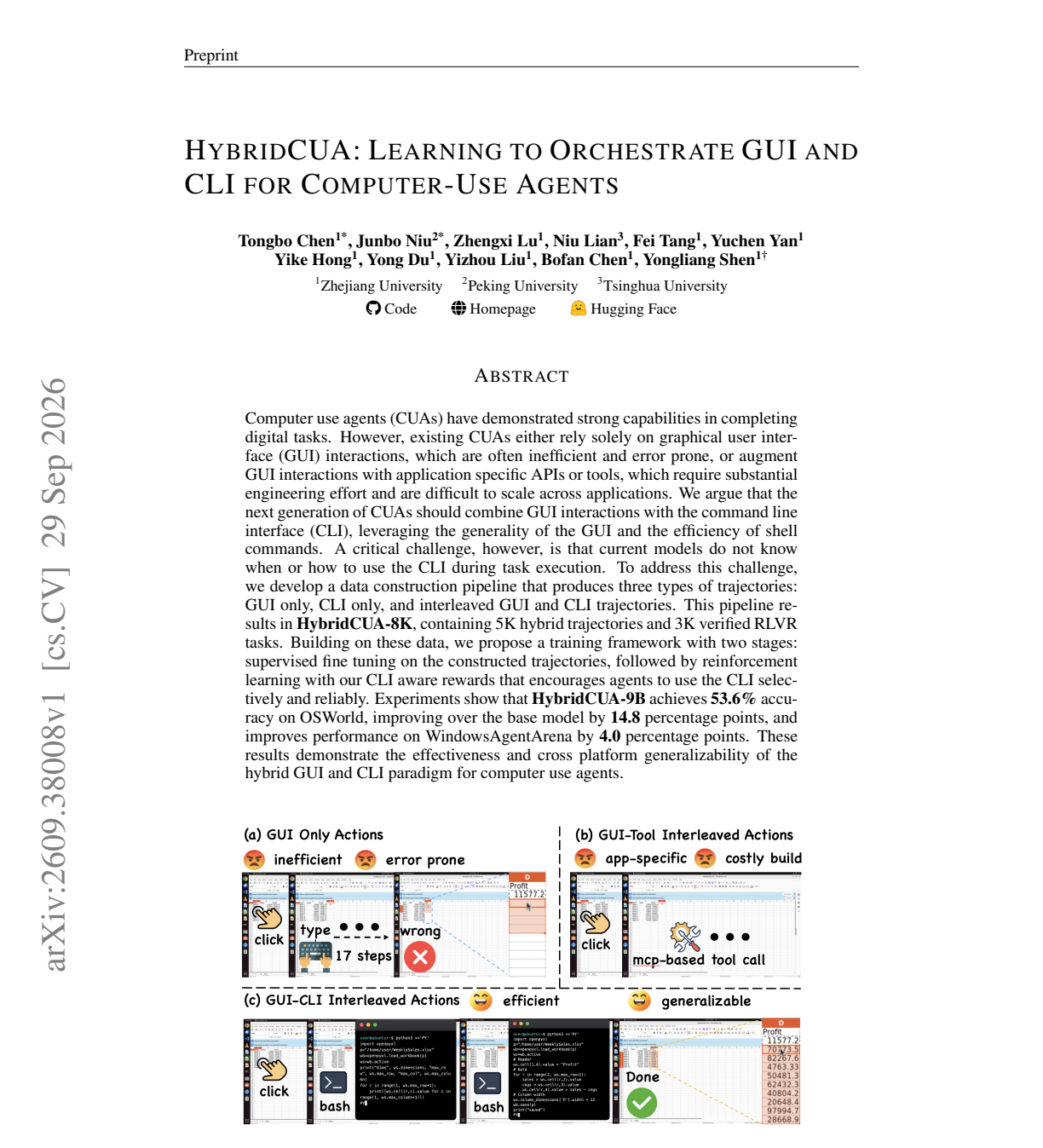
However, existing CUAs either rely solely on graphical user interface (GUI) interactions, which are often inefficient and error prone, or augment GUI interactions with application specific APIs or tools, which require substantial engineering effort and are difficult to scale across applications. We argue that the next generation of CUAs should combine GUI interactions with the command line interface (CLI), leveraging the generality of the GUI and the efficiency of shell commands. A critical challenge, however, is that current models do not know when or how to use the CLI during task execution. To address this challenge, we develop a data construction pipeline that produces three types of trajectories: GUI only, CLI only, and interleaved GUI and CLI trajectories. This pipeline results in HybridCUA-8K, containing 5K hybrid trajectories and 3K verified RLVR tasks. Building on these data, we propose a training framework with two stages: supervised fine tuning on the constructed trajectories, followed by reinforcement learning with our CLI aware rewards that encourages agents to use the CLI selectively and reliably. Experiments show that HybridCUA-9B achieves 53.6% accuracy on OSWorld, improving over the base model by 14.8 percentage points, and improves performance on WindowsAgentArena by 4.0 percentage points. These results demonstrate the effectiveness and cross platform generalizability of the hybrid GUI and CLI paradigm for computer use agents.
from the abstract
Pith says
Machine review · deepseek-v4-flash · 30 Sep 2026 · what was read was not recorded · not checked by a person
It can be wrong. Challenge this review or reply to it.
Holds up, with conditions. Genuinely new training signal and an unusually honest empirical writeup, but the headline deltas are single-run point estimates within about a standard error of zero, so the claims are promising, not yet established. This line is wrong
3 major objections · 4 minor
How often objections from reviews like this one are right: not yet measured
Not checked: figures, code, what the 33 references say.
The paper says, at Appendix E; Tables 1 and 3
The review did not quote this passage.
Pith says: Objection 1 of 3 · major
Appendix E states that 'each reported number comes from a single evaluation run per model and benchmark,' and the magnitude of the load-bearing deltas shows why this is unresolved rather than merely unpolished. With N=361 on OSWorld and success rates near 0.5, the standard error of a binary rate is about 2.6 percentage points; the isolation carrying the headline, HybridCUA-9B …
more of objection 1
… at 53.6% vs the GUI-only RL branch at 50.4% (Table 1), a +3.2pp delta, is within roughly 1.2 standard errors of zero, and the SFT contrast 46.0% vs 44.2% is about 0.7 SE. On WindowsAgentArena (Table 3), the +4.0pp transfer (36.0 vs 32.0, N=154, SE≈3.8pp) is within about one standard error of zero. Because the two isolations that support the central claims, 'the added interface improves accuracy' and 'cross-OS transfer of routing,' are not statistically separated from zero under a single run, the authors should report multiple seeds or per-task bootstrap confidence intervals for at least the head-to-head comparisons in Tables 1 and 3; the current evidence is directionally consistent but not decisive.
The paper says, at Section 4.2 and Appendix E, Eq. (9)
The review did not quote this passage.
Pith says: Objection 2 of 3 · major
Eq. (9) defines the reported Acc. as a mean evaluator score, which the paper itself (Appendix E, b283) recognizes as an upper bound on the strict all-or-nothing success rate. This caveat matters for the headline contrasts in Table 1 and Section 4.2: the GUI-only and GUI-API baselines (EvoCUA 56.7, ToolCUA 46.8, AutoGLM-OS 48.9) are quoted from other papers whose published …
more of objection 2
… numbers may be aggregated as strict success rates, and the text does not verify that every compared number uses the same aggregation. If the baselines are strict rates while HybridCUA is a mean evaluator score, the 'best among comparably sized models' claim and the GUI-CLI vs GUI-API deltas are inflated by construction. The authors should report HybridCUA's strict all-or-nothing success rate alongside the mean evaluator score, or explicitly document that all numbers in Table 1 and Table 3 use the identical aggregation.
The paper says, at Sections 3.2, 3.3 and Appendix G.3
The review did not quote this passage.
Pith says: Objection 3 of 3 · major
The CLI-advantage labels b* (Appendix C.2) are computed from rollouts of Qwen3.8-27B equipped with hand-authored per-application CLI skills (Appendix G.3) that encode interface-routing decisions and task-solving recipes, and R_CLI in Eq. (4)/(6) rewards the student for matching b*. Consequently the student's learned routing is partly imitation of skill-author interface choices, which weakens the mechanism claim (b27) that 'the improvement comes …
more of objection 3
… from knowing when and how to use the shell rather than from using it more' and, to a lesser degree, the cross-platform generalizability claim. To be clear, this is not a circularity objection to the accuracy numbers: b* is empirically measured from 16 teacher rollouts per mode rather than hand-assigned, and Appendix G.3 discloses that the skills are absent from the student's training and evaluation context. But the transferability interpretation would be substantially strengthened by a concrete test, for example labeling a held-out task subset with a teacher that does not receive the CLI skills and comparing the student's routing and accuracy on it.
4 minor objections
The paper says, at Section 4.3 and Figure 4
Pith says: minor objection 1 of 4
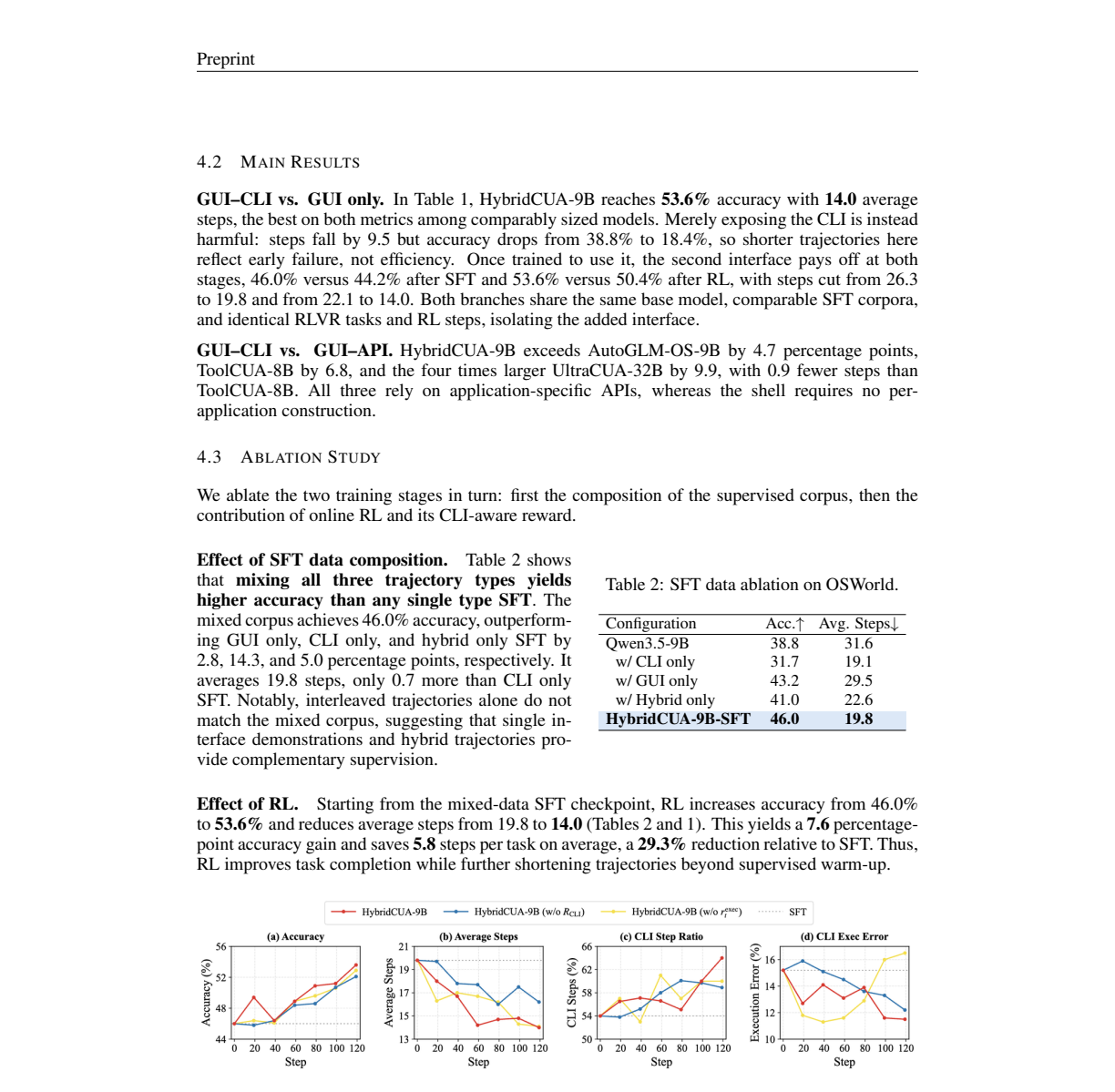
The text reports CLI execution error rates 'by step 120,' but Table 8 lists the training environment step limit as 30; please reconcile the x-axis scale of Figure 4 with the stated training horizon and clarify whether the curves are plotted over cumulative environment steps across rollouts.
The paper says, at Section 4.3
Pith says: minor objection 2 of 4
The effect of removing R_CLI on accuracy is described only qualitatively ('costs little accuracy'); the three RL variants should be given numeric accuracy values in the text or a table, since the Figure 4 panels are currently the sole quantitative record of that ablation.
show 2 more
The paper says, at Section 3.1, Eq. (2) and Appendix B
Pith says: minor objection 3 of 4
The subscripts in C_CLI and C_GUI are collapsed in the rendered text, and the status of PyAutoGUI heredocs as GUI actions despite their shared bash wrapper should be restated at the first mention in Section 3.1 rather than deferred to Appendix B, so the interface classification is unambiguous for the reader.
The paper says, at Section 4.2
Pith says: minor objection 4 of 4
The phrase 'the best on both metrics among comparably sized models' is scale-scoped by definition, but a one-sentence note that 32B-class baselines such as EvoCUA-32B (56.7) still exceed HybridCUA-9B would prevent misreading of the comparison.
What would settle it
Run three to five independent evaluation runs (fresh rollouts, same checkpoints) of the configurations that carry the central deltas — HybridCUA-9B, the GUI-only-RL variant (50.4% row of Table 1), and the mixed-SFT variant (46.0%) on OSWorld, plus HybridCUA-9B and Qwen3.5-9B on WindowsAgentArena — and report per-task paired scores and mean±std. Accept the magnitude claims if the hybrid-vs-GUI-RL OSWorld gap and the +4.0pp Windows gap each stay above roughly 2× the observed run-to-run std; otherwise the differences are within noise and the 'best among comparably sized models' and cross-platform claims should be softened to point estimates pending more runs.
from the skeptic's reading
How the review went
4 readings by deepseek-v4-flash · 30 Sep 2026
- Reader holds up, with conditions
- Skeptic partly agrees
- Editor wrote the verdict above
- Referee major revision: 3 major objections, 4 minor
Not run on this paper: the simulated authors' defence.
Pith did not check this review's objections against the paper.
The review in full
The review in brief, machine-written
The actual contribution here is making interface choice an explicit training signal: the unified bash action space, the task-level R_CLI preference reward, and the step-level r_exec execution reward, wrapped in a three-mode (GUI-only, CLI-only, interleaved) data pipeline. That is a real step beyond CUA-Universe and RecreationWorld, which supervise outcomes rather than routing. The student never sees the per-application CLI skills and is rewarded on genuinely novel rollouts, so the gains are not recycled from training data.
The paper is honest where it counts. Appendix E discloses that every number is a single evaluation run per model per benchmark. It states plainly that the reported accuracy is a mean evaluator score, an upper bound on strict success rate (b283), and warns readers to compare only against numbers aggregated the same way. The limitations section owns the CLI-availability and application-coverage issues. The RL ablations are internally consistent: removing R_CLI stalls the efficiency gain, removing r_exec raises the execution error rate back above SFT level, and the mixed supervised corpus beats each single-type corpus. That coherence is the strongest evidence in the paper.
Now the soft spots, in proportion. The single-run issue is not cosmetic. The stress-test arithmetic is roughly right: on OSWorld (N=361), the standard error of a binary rate near 0.5 is about 2.6pp, putting the +3.2pp hybrid-RL-over-GUI-RL isolation that carries the central claim at about 1.2 SE, and the Windows transfer +4.0pp on N=154 at about 1.05 SE. I'd add one nuance: the two runs share the same task set, and with paired outcomes the comparison could be tighter than independent-binomial SE suggests. But the paper gives no per-task data, so we can't check. Either way, deltas and plausible noise are the same order of magnitude, and a few seeds would settle it.
Second, the routing-learning interpretation is partly imitation. The teacher is handed eight hand-authored per-application CLI skills (Appendix G.3), and the b* labels are fitted from that same teacher's rollouts. That does not touch the accuracy numbers, but it weakens the claim that what transfers is a learned "when to delegate" capability rather than choices baked into the skill sheets. The WindowsAgentArena +4.0pp is supposed to be the evidence for transfer, and it is exactly the figure most exposed to the single-run problem.
Third, artifacts are promised, not shipped.
Recommendation: send this to a serious referee. The idea is new, the execution is careful, and the paper is unusually candid about its own limits. The referee's job is to push for seeds and error bars, artifact release, and a cleaner isolation of routing from skill imitation, ideally via a held-out application set. This is a revise-and-resubmit, not an accept and not a reject.
The strongest objection
Appendix E discloses that 'each reported number comes from a single evaluation run per model and benchmark.' That is acknowledged, but the magnitude calculation shows why it is unresolved rather than merely unpolished. On OSWorld (N=361) with a success rate near 0.5, the standard error of a binary rate is about sqrt(0.25/361) ≈ 2.6pp. The isolation that carries the central claim — HybridCUA-9B at 53.6% vs the same-trained GUI-only RL branch at 50.4% (Table 1), a +3.2pp delta, roughly 11–12 task-level differences — is only ≈1.2 SE from zero. The SFT contrast 46.0% vs 44.2% is ≈0.7 SE, and the WindowsAgentArena transfer of +4.0pp (36.0 vs 32.0, N=154, SE ≈ 3.8pp) is ≈1.05 SE. So the two load-bearing isolations — 'the added interface improves accuracy' and 'cross-OS transfer of routing' — are each within about one standard error of zero under a single run, and a different seed could shrink or invert them. The 'best among comparably sized models' claim (b26) also stacks single point estimates from other papers with a possibly different aggregation; the paper itself notes (b283) its mean-evaluator-score metric is an upper bound on strict success rate. This is an evidence-strength problem, not a construction problem: the ablations are honest and the pipeline is carefully described. The reader's skill-injection concern (G.3) is real but secondary: b* is empirically measured from 16 teacher rollouts per mode, so routing is not purely hand-labeled; it primarily weakens the transferability interpretation, whereas the single-run fragility directly threatens the observed differences that the headline claims rest on.
The paper is a careful, honest empirical study: the ablations are internally consistent, the limitations section is candid, the action-schema and reward-ablation controls (Tables 2–4, Figure 4) are well designed, and the own-reported ablation that removing R_CLI 'costs little accuracy' (b103) is disclosed rather than hidden. The reader's CONDITIONAL verdict is the right call, and reason (1) — single runs with no error bars — is, in my view, the single most load-bearing concern, more so than the skill-injection mechanism concern that the reader designated as the weakest assumption. The reason is quantitative: the decisive contrasts are all near one standard error from zero given N=361 and N=154. If re-runs show ±2–3pp variability, then the +3.2pp hybrid-over-GUI-RL isolation and the +4.0pp Windows transfer are not established, and the central claims about the added interface and its cross-platform generalizability weaken materially. This is a testable, concrete evidential gap, not a defect in the method. The skill-injection concern is genuine but softer: the b* labels are empirically measured from teacher success rates, and the CLI skills primarily determine which commands work (the 'how'), not the per-task routing decision (the 'when'), so the routing signal is at least partly grounded in execution outcomes rather than pure authoring. Its main casualty would be the interpretation of routing as a freshly learned, transferable capability, not the observed comparison itself. I therefore agree with the reader's verdict (CONDITIONAL, unchanged) but partially agree on which assumption is weakest: I would require multi-seed variance estimates as the gate before the magnitude and transfer claims are relied upon, and treat skill-injection as a secondary interpretive caveat for the mechanism framing.
The referee's report
If the reported numbers hold, HybridCUA is a solid contribution: it is a clean demonstration that a 9B-parameter CUA can beat comparably sized GUI-only and GUI+API agents by combining the GUI with the OS shell through a shared action grammar. The ablation design is careful and internally consistent: mixed SFT data beats any single trajectory type, RL adds 7.6pp, removing R_CLI stalls the efficiency gain, removing r_exec raises execution errors, and the unified schema beats separate tools. The paper ships unusually complete disclosures: Appendix E states explicitly that every number comes from a single evaluation run, Eq. (9) is honestly flagged as an upper bound on the strict success rate, and Appendix G.3 reproduces the full skill sheets used during data collection so the reader can audit what the teacher was given. The main deficit is statistical: the load-bearing deltas, hybrid-vs-GUI-only RL (+3.2pp) and the Windows transfer (+4.0pp), are each within roughly one standard error of zero under a single run (OSWorld N=361, SE≈2.6pp; WindowsAgentArena N=154, SE≈3.8pp), so the evidence is directionally consistent but not decisive.
Pith's reading of the paper (a machine's summary, not the authors')
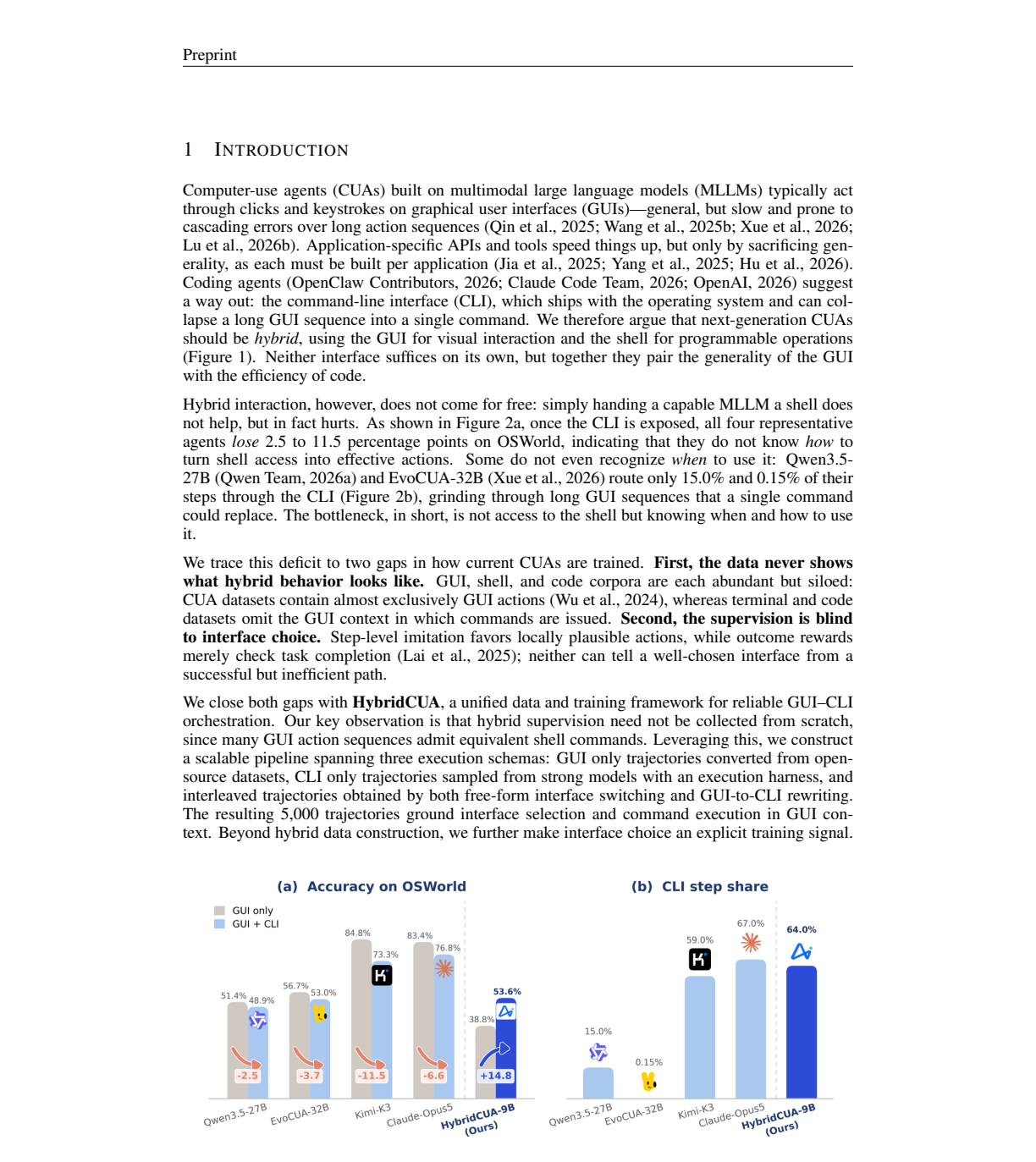
Computer-use agents mostly act through GUI clicks or per-application APIs, and this paper claims that both miss a third option: the operating system's command-line shell. It argues the real bottleneck is not access to the shell but knowing when and how to use it, since naively exposing a CLI costs every tested model points on OSWorld. To close that gap it builds a data pipeline producing GUI-only, CLI-only, and interleaved trajectories, and trains with two rewards that supervise interface choice and command reliability separately. The resulting 9-billion-parameter model reaches 53.6% on OSWorld, 14.8 points above its base, uses the shell for 64% of its steps, and transfers the gain to Windows. If correct, this turns interface selection into a learnable capability instead of an engineering decision.
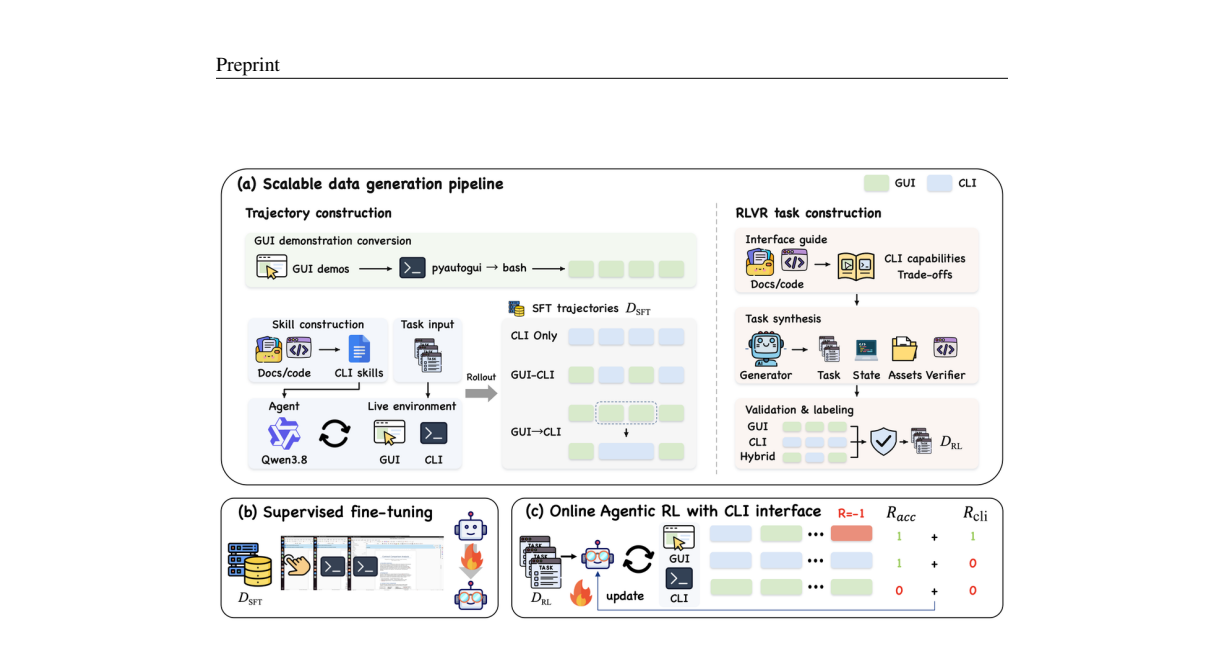
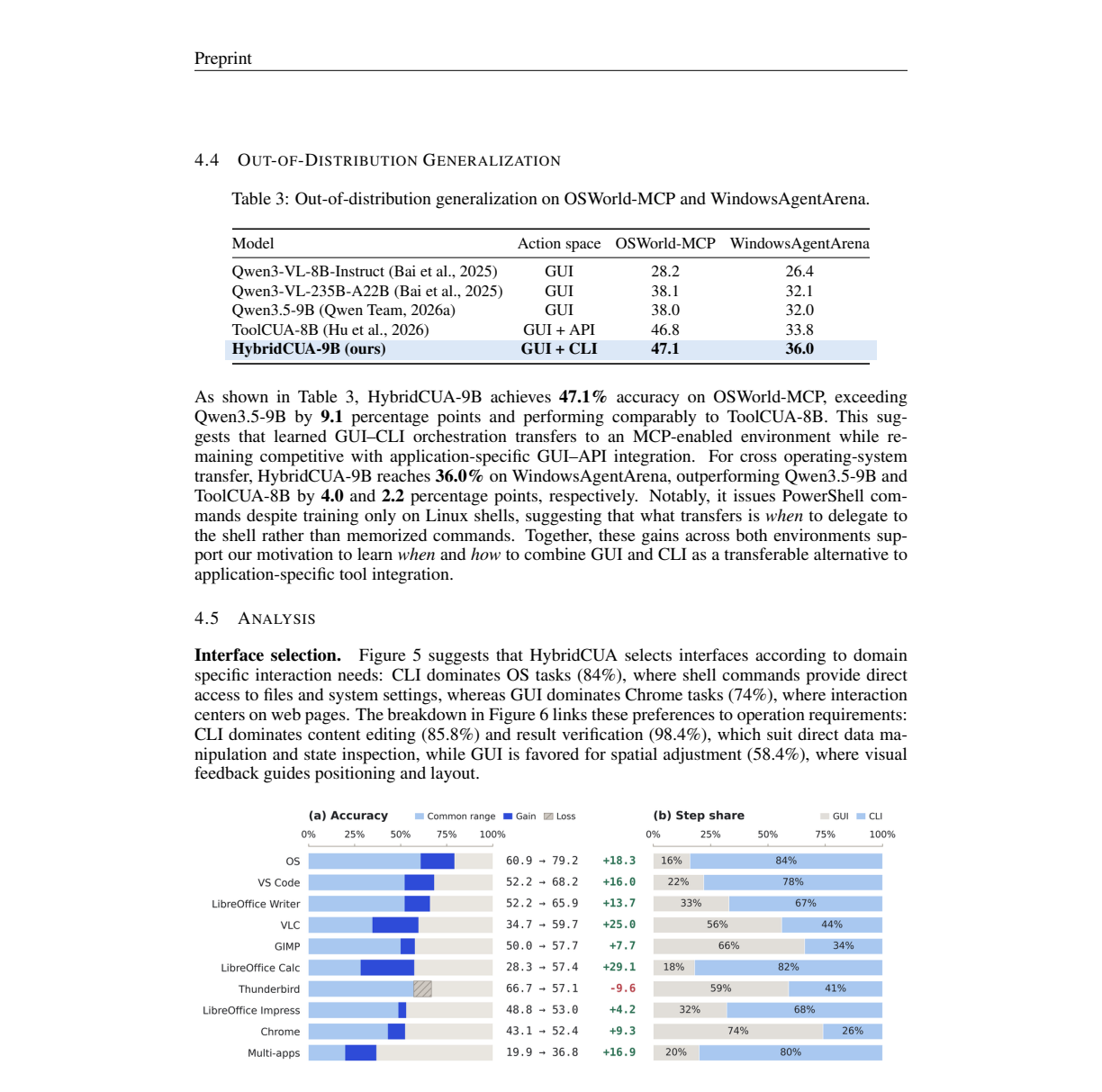
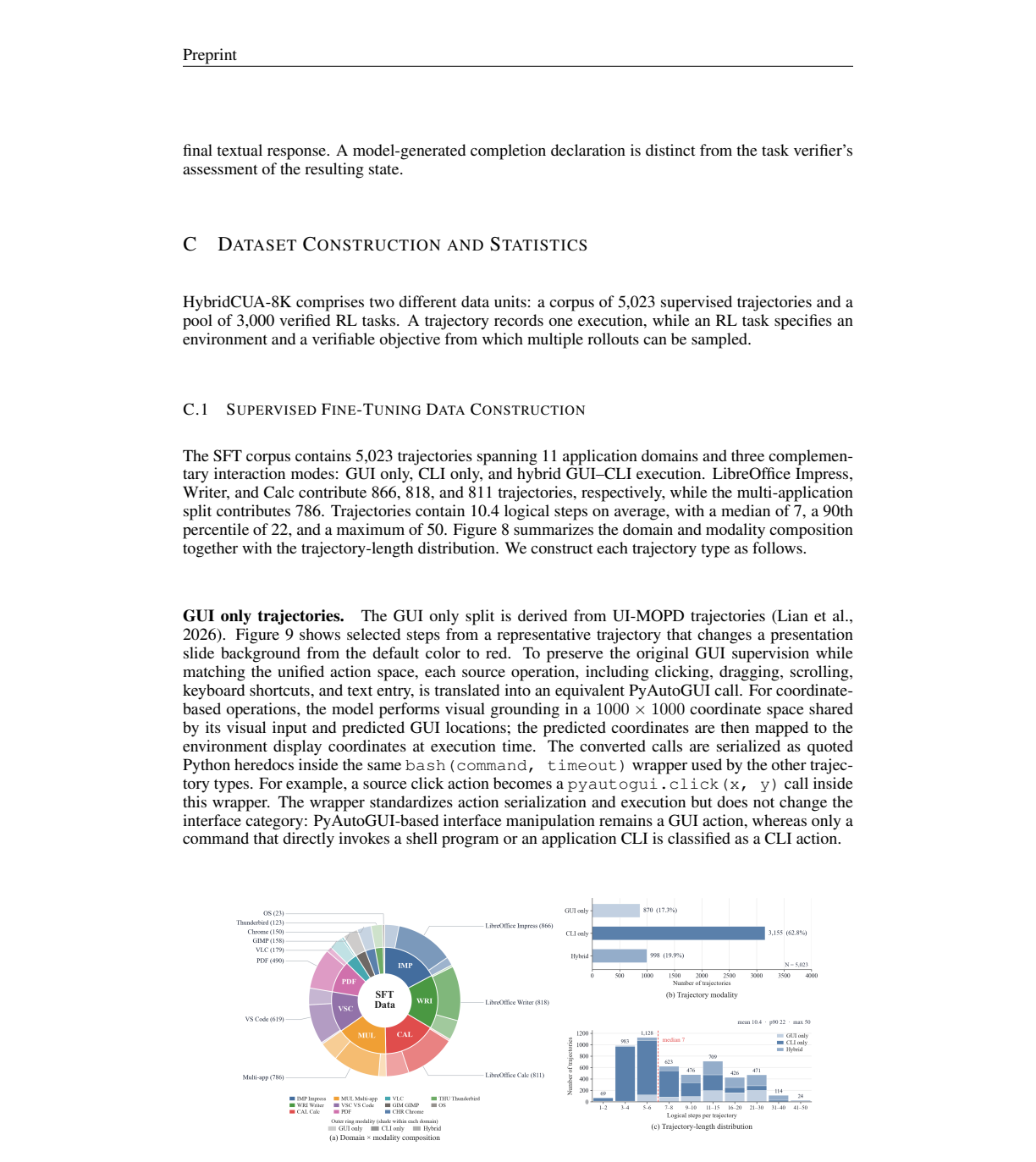
What carries the argument. The load-bearing machinery is a two-stage training pipeline. Stage one is supervised fine-tuning on HybridCUA-8K, a corpus of 5,023 GUI-only, CLI-only, and interleaved GUI-CLI trajectories plus 3,000 verified RLVR tasks, each carrying a binary label $b^star$ for whether CLI use offers a clear execution advantage. Stage two is online reinforcement learning with a CLI-aware reward: a task-level term rewards rollouts whose CLI usage matches the task's label, while a step-level term penalises a shell-level command failure. The third piece is the unified action space: both GUI actions, expressed as PyAutoGUI heredocs, and direct shell commands issue through a single bash command wrapper, an abstraction the action-schema ablation shows is worth 7.2 points over a separate GUI-tool and CLI-tool schema.
Core claim. The central claim is that a computer-use agent can be taught when and how to combine the GUI with the command line, and that doing so beats both GUI-only and GUI-API agents of comparable size. The evidence is a training pipeline in which interface choice becomes an explicit learning signal: supervised fine-tuning on 5,023 trajectories of all three modes, followed by reinforcement learning on 3,000 verified tasks, each labelled with whether CLI use carries a clear execution advantage. A task-level reward $R_{CLI} = I[Success(tau)] * I[b(tau)=b*]$ rewards rollouts whose CLI usage matches the label, teaching when to invoke the shell, while a step-level reward r_exec = -1 on shell failure teaches command reliability. The result is 53.6% on OSWorld against a 38.8% base, with CLI usage at 64.0% - on par with the most shell-heavy baseline that nevertheless loses points - which the authors take to show the gain comes from knowing when and how to use the shell, not from using it more. The ablation isolating the two rewards confirms the separation: dropping the CLI routing reward stalls the efficiency gain while dropping the execution reward lets CLI errors climb from 11.5% to 16.5%.
The premise it rests on. The claim that the gain reflects a learned, transferable ability to route between GUI and CLI depends on the teacher model being handed per-application CLI skill sheets - distilling each app's documentation and reference code into usage recipes - so the student's interface choices partly imitate those skill authors' decisions rather than arising purely from the reward signal.
If the paper is right (Pith's inferences, not the authors')
Interface choice becomes a supervised capability: with the right data and rewards, a 9B model learns when the shell beats the GUI and acts on it, matching the routing of a far larger model.
Cross-platform transfer is plausible: the model issues PowerShell commands on Windows despite training only on Linux shells, suggesting what transfers is routing judgment rather than memorized commands.
Per-application API engineering may be replaceable: without constructing any application-specific tool, the shell approach stays competitive with GUI+API agents and beats some that are four times larger.
The two reward terms split cleanly: the task-level routing reward drives efficiency, the step-level execution reward drives reliability, and both are needed for the full gain.
CLI-advantage labelling is a reusable method: any task pool can be annotated by ranking GUI-only, CLI-only, and hybrid rollouts, turning interface selection into a supervised signal for future agents.
The mechanism claim - that the gain reflects learned routing rather than CLI frequency - rests on CLI-only trajectories being sampled by a teacher handed per-application skill sheets describing when the CLI is efficient; so the student's routing is partly imitation of skill-author choices, and a cleaner test would strip the skills and see whether the advantage label still predicts gains.
A held-out application never present in the 11 training domains is the sharpest falsifier: routing that truly transfers should show a CLI-share shift on that application's tasks without any skill sheet for it.
The Windows result is the strongest evidence for transferable routing; extending it to macOS (zsh) and to restricted-shell environments named in the paper's own limitations would distinguish routing judgment from command-pattern memory.
The step accounting averages over all tasks including budget-exhausted ones, so the reported efficiency gain could partly reflect earlier, cleaner termination; a per-task step-budget analysis would separate genuine efficiency from truncation.
Check this review
Pith stored no record of this review's passes and took no fingerprint of it. Reviews made by code from 13 Nov 2026 on carry both.
How often reviews like this one are right
Reviews like this one: written by deepseek-v4-flash, where what was read was not recorded.
How often objections from reviews like this one are right: not yet measured
Reviews by people
This review was written by a machine. No person has reviewed this paper on Pith yet. A scientist listed on Pith can review it for a fee, and their review is published here whatever it concludes.
The paper
Abstract
Computer use agents (CUAs) have demonstrated strong capabilities in completing digital tasks. However, existing CUAs either rely solely on graphical user interface (GUI) interactions, which are often inefficient and error prone, or augment GUI interactions with application specific APIs or tools, which require substantial engineering effort and are difficult to scale across applications. We argue that the next generation of CUAs should combine GUI interactions with the command line interface (CLI), leveraging the generality of the GUI and the efficiency of shell commands. A critical challenge, however, is that current models do not know when or how to use the CLI during task execution. To address this challenge, we develop a data construction pipeline that produces three types of trajectories: GUI only, CLI only, and interleaved GUI and CLI trajectories. This pipeline results in HybridCUA-8K, containing 5K hybrid trajectories and 3K verified RLVR tasks. Building on these data, we propose a training framework with two stages: supervised fine tuning on the constructed trajectories, followed by reinforcement learning with our CLI aware rewards that encourages agents to use the CLI selectively and reliably. Experiments show that HybridCUA-9B achieves 53.6% accuracy on OSWorld, improving over the base model by 14.8 percentage points, and improves performance on WindowsAgentArena by 4.0 percentage points. These results demonstrate the effectiveness and cross platform generalizability of the hybrid GUI and CLI paradigm for computer use agents.
The paper's own sentences, arranged, kept beside the review and separate from it. Each label is drawn from a closed vocabulary; the number beside it is the probability the classifier gave that label. No sentence in this record was written by a model.
abstract compiled · 2026-09-30
The authors' main claim, as the classifier picked it out 1.00
“These results demonstrate the effectiveness and cross platform generalizability of the hybrid GUI and CLI paradigm for computer use agents.”
How the main claim is stated: asserted 1.00
What the abstract itself states, as probabilities: claims first 0.08 · states limitation 0.16 · human participants 0.04 · controlled comparison 0.82 · randomized assignment 0.01 · states quantitative result 0.99 · compares with prior results 0.89 · mentions code or data availability 0.05
The abstract, sentence by sentence
This table labels the abstract only (arXiv listing abstract v1). The number is the probability the classifier gave the label.
| Sentence | Role | The authors' own work | States the main conclusion | Strength |
|---|---|---|---|---|
| Computer use agents (CUAs) have demonstrated strong capabilities in completing digital tasks. | background 1.00 | 0.06 | 0.02 | asserted 1.00 |
| However, existing CUAs either rely solely on graphical user interface (GUI) interactions, which are often inefficient and error prone, or augment GUI interactions with application specific APIs or tools, which require substantial engineering effort and are difficult to scale across applications. | background 0.81 | 0.06 | 0.03 | asserted 1.00 |
| We argue that the next generation of CUAs should combine GUI interactions with the command line interface (CLI), leveraging the generality of the GUI and the efficiency of shell commands. | future work 0.35 | 0.09 | 0.28 | asserted 0.65 |
| A critical challenge, however, is that current models do not know when or how to use the CLI during task execution. | gap 0.99 | 0.08 | 0.03 | asserted 1.00 |
| To address this challenge, we develop a data construction pipeline that produces three types of trajectories: GUI only, CLI only, and interleaved GUI and CLI trajectories. | method 0.95 | 0.96 | 0.03 | asserted 1.00 |
| This pipeline results in HybridCUA-8K, containing 5K hybrid trajectories and 3K verified RLVR tasks. | method 0.80 | 0.96 | 0.04 | asserted 1.00 |
| Building on these data, we propose a training framework with two stages: supervised fine tuning on the constructed trajectories, followed by reinforcement learning with our CLI aware rewards that encourages agents to use the CLI selectively and reliably. | method 0.99 | 0.95 | 0.06 | asserted 0.94 |
| Experiments show that HybridCUA-9B achieves 53.6% accuracy on OSWorld, improving over the base model by 14.8 percentage points, and improves performance on WindowsAgentArena by 4.0 percentage points. | result 1.00 | 0.97 | 0.17 | asserted 1.00 |
| These results demonstrate the effectiveness and cross platform generalizability of the hybrid GUI and CLI paradigm for computer use agents. | interpretation 1.00 | 0.82 | 0.86 | asserted 1.00 |
What kind of paper the classifier reports this is: method or tool 0.99 · evidence from observation or experiment 1.00
What was examined, and what was not
Sources read
- arXiv listing abstract v1
Not examined
- full text
- figures and tables
- references and citing sentences
- relations to other papers
Levels run
- P abstract
Not run
- S sections
- T body sentences
- C citations
- R cross-paper relations
How the labels were made
Compiled by classifier-1.13.0 via TypeSafe API, question bank abstract-p1-20260923, 2026-09-30: 1 request, 7,030 input tokens.
Every quoted sentence on this record is the authors'. Every label is from Pith's closed vocabulary, with the probability shown beside it. This record as JSON
Figures (11)
Figures are the authors', reproduced from the paper.
References (33)
- [1] Shuai Bai, Yuxuan Cai, Ruizhe Chen, et al. Qwen3-VL technical report. arXiv preprint arXiv:2511.21631, 2025 on PithPith's reviewarXiv
- [2] Shuai Bai, Jiayong Deng, Sicheng Fan, et al. RecreationWorld : Scalable and verifiable environments for hybrid computer-use agents. arXiv preprint arXiv:2609.22000, 2026 on PithPith's reviewarXiv
- [3] Rogerio Bonatti, Dan Zhao, Francesco Bonacci, et al. Windows agent arena: Evaluating multi-modal os agents at scale. arXiv preprint arXiv:2409.08264, 2024 on PithPith's reviewarXiv
- [4] Claude Code Team . Claude Code . GitHub repository, 2026. URL https://github.com/anthropics/claude-code on Pith
- [5] Xuhao Hu, Xi Zhang, Haiyang Xu, et al. ToolCUA : Towards optimal gui-tool path orchestration for computer use agents. arXiv preprint arXiv:2605.12481, 2026 on PithPith's reviewarXiv
- [6] Hongrui Jia, Jitong Liao, Xi Zhang, Haiyang Xu, Tianbao Xie, Chaoya Jiang, Ming Yan, Si Liu, Wei Ye, and Fei Huang. OSWorld-MCP : Benchmarking mcp tool invocation in computer-use agents. arXiv preprint arXiv:2510.24563, 2025 on PitharXiv
- [7] Hanyu Lai, Xiao Liu, Yanxiao Zhao, et al. ComputerRL : Scaling end-to-end online reinforcement learning for computer use agents. arXiv preprint arXiv:2508.14040, 2025 on PitharXiv
- [8] Wanli Li, Bowen Zhou, Yunyao Yu, Zhou Xu, Yifan Yang, Dongsheng Li, and Caihua Shan. WeaveBench : A long-horizon, real-world benchmark for computer-use agents with hybrid interfaces. arXiv preprint arXiv:2606.09426, 2026 on PithPith's reviewarXiv
- [9] Niu Lian, Tongbo Chen, Zhehao Yu, Chengzhen Duan, Fazhan Liu, Hui Liu, Pei Fu, Jian Luan, Heng Qu, Shu-Tao Xia, and Jinpeng Wang. UI-MOPD : Multi-platform on-policy distillation for unified gui agents. arXiv preprint arXiv:2607.04425, 2026 on PithPith's reviewarXiv
- [10] Zhengxi Lu, Jiabo Ye, Fei Tang, Yongliang Shen, Haiyang Xu, Ziwei Zheng, Weiming Lu, Ming Yan, Fei Huang, Jun Xiao, et al. Ui-s1: Advancing gui automation via semi-online reinforcement learning. arXiv preprint arXiv:2509.11543, 2025 on PitharXiv
- [11] Zhengxi Lu, Yuxiang Chai, Yaxuan Guo, Xi Yin, Liang Liu, Hao Wang, Han Xiao, Shuai Ren, Pengxiang Zhao, Guangyi Liu, et al. Ui-r1: Enhancing efficient action prediction of gui agents by reinforcement learning. In Proceedings of the AAAI Conference on Artificial Intelligence, v... on Pith
- [12] Zhengxi Lu, Fei Tang, Guangyi Liu, Jin Ma, Kaitao Song, Xu Tan, Wenqi Zhang, Weiming Lu, Jun Xiao, Yueting Zhuang, et al. Ui-copilot: Advancing long-horizon gui automation via tool-integrated policy optimization. In Proceedings of the 64th Annual Meeting of the Association for... on Pith
- [13] Bowen Lv, Xiao Liu, Yanyu Ren, Hanyu Lai, Bohao Jing, Hanchen Zhang, Yanxiao Zhao, Shuntian Yao, Jie Tang, and Yuxiao Dong. SCALECUA : Scaling computer use agents with verifiable task synthesis and efficient online rl. arXiv preprint arXiv:2607.11185, 2026 on PithPith's reviewarXiv
- [14] OpenAI . Codex for (almost) everything . OpenAI, April 2026. URL https://openai.com/index/codex-for-almost-everything/. Published April 16, 2026 on Pith
- [15] OpenClaw Contributors . Peekaboo : Mac automation that sees the screen and does the clicks. GitHub repository, 2026. URL https://github.com/openclaw/Peekaboo on Pith
- [16] Yujia Qin, Yining Ye, Junjie Fang, et al. UI-TARS : Pioneering automated gui interaction with native agents. arXiv preprint arXiv:2501.12326, 2025 on PithPith's reviewarXiv
- [17] Qwen Team . Qwen3.5 : Towards native multimodal agents. Qwen Blog, 2026 a . URL https://qwen.ai/blog?id=qwen3.5. Published February 15, 2026 on Pith
- [18] Qwen Team . Qwen3.8 . Qwen Blog, 2026 b . URL https://qwen.ai/blog?id=qwen3.8. Qwen3.8-27B open-weight release, August 14, 2026 on Pith
- [19] Guangming Sheng, Chi Zhang, Zilingfeng Ye, Xibin Wu, Wang Zhang, Ru Zhang, Yanghua Peng, Haibin Lin, and Chuan Wu. HybridFlow : A flexible and efficient RLHF framework. In Proceedings of the Twentieth European Conference on Computer Systems (EuroSys), 2025 on Pith
- [20] Haoting Shi, Wenhao Wang, Weicheng Fang, Yaozhong Liang, Tian Jin, Pengxiang Zhao, Guangyi Liu, Siheng Chen, and Yanfeng Wang. CUA-Universe : A scalable and dynamic environment for hybrid GUI+CLI agents. arXiv preprint arXiv:2609.05374, 2026 on PithPith's reviewarXiv
show 13 more
- [21] Mohammad Shoeybi, Mostofa Patwary, Raul Puri, Patrick LeGresley, Jared Casper, and Bryan Catanzaro. Megatron-LM : Training multi-billion parameter language models using model parallelism. arXiv preprint arXiv:1909.08053, 2019 on PithPith's reviewarXiv
- [22] THUDM . slime: An LLM post-training framework for RL scaling. https://github.com/THUDM/slime, 2025 on Pith
- [23] Bowen Wang, Dunjie Lu, Junli Wang, Tianyi Bai, Shixuan Liu, Zhipeng Zhang, Haiquan Wang, Hao Hu, Tianbao Xie, Shuai Bai, Dayiheng Liu, Que Shen, Junyang Lin, and Tao Yu. CUA-Gym : Scaling verifiable training environments and tasks for computer-use agents. arXiv preprint arXiv:... on PithPith's reviewarXiv
- [24] Haoming Wang, Haoyang Zou, Huatong Song, et al. UI-TARS-2 technical report: Advancing gui agent with multi-turn reinforcement learning. arXiv preprint arXiv:2509.02544, 2025 a on PithPith's reviewarXiv
- [25] Xinyuan Wang, Bowen Wang, Dunjie Lu, et al. OpenCUA : Open foundations for computer-use agents. arXiv preprint arXiv:2508.09123, 2025 b on PitharXiv
- [26] Zhiyong Wu, Zhenyu Wu, Fangzhi Xu, et al. OS-ATLAS : A foundation action model for generalist gui agents. arXiv preprint arXiv:2410.23218, 2024 on PithPith's reviewarXiv
- [27] Tianbao Xie, Danyang Zhang, Jixuan Chen, et al. OSWorld : Benchmarking multimodal agents for open-ended tasks in real computer environments. arXiv preprint arXiv:2404.07972, 2024 on PithPith's reviewarXiv
- [28] Taofeng Xue, Chong Peng, Mianqiu Huang, Linsen Guo, Tiancheng Han, Haozhe Wang, Jianing Wang, Xiaocheng Zhang, Xin Yang, Dengchang Zhao, Jinrui Ding, Xiandi Ma, Yuchen Xie, Peng Pei, Xunliang Cai, and Xipeng Qiu. EvoCUA : Evolving computer use agents via learning from scalable... on PitharXiv
- [29] Yunhe Yan, Shihe Wang, Jiajun Du, et al. MCPWorld : A unified benchmarking testbed for api, gui, and hybrid computer use agents. arXiv preprint arXiv:2506.07672, 2025 on PithPith's reviewarXiv
- [30] Yuhao Yang, Zhen Yang, Zi-Yi Dou, et al. UltraCUA : A foundation model for computer use agents with hybrid action. arXiv preprint arXiv:2510.17790, 2025 on PithPith's reviewarXiv
- [31] Yuhao Yang, Tianyu Fan, and Chao Huang. CLI-Anything : Towards agent-native computer use. arXiv preprint arXiv:2606.03854, 2026 on PithPith's reviewarXiv
- [32] Lianmin Zheng, Liangsheng Yin, Zhiqiang Xie, Chuyue Sun, Jeff Huang, Cody Hao Yu, Shiyi Cao, Christos Kozyrakis, Ion Stoica, Joseph E. Gonzalez, Clark Barrett, and Ying Sheng. SGLang : Efficient execution of structured language model programs. In Advances in Neural Information... on Pith
- [33] Hanzhang Zhou, Panrong Tong, Xu Zhang, Quyu Kong, Chenglin Cai, Tianyu Xia, Gongjie Zhang, Jianan Zhang, Long Li, Long Chen, Lei Wang, Gaole Dai, Pengxiang Li, Liangyu Chen, Yue Wang, and Steven Hoi. Qwen-UI-Agent technical report: Toward next-generation real-world centric fou... on PithPith's reviewarXiv
Cited by 1 Pith paper
Reviewed papers on Pith that cite this one. The full citation record
Challenges and discussion
Disagree with the review, or know something it missed? Leave a comment, or challenge this review formally: a challenge becomes a permanent entry in this paper's record, and its decision is published here.
Come back by email
A short list of the week's newly reviewed papers. Nothing is sent until you confirm from your inbox, and every email has a link that stops it. No account.
No comments yet.
Sign in to comment