Machine Learning · arXiv:2609.40284 v1 · submitted 30 Sep 2026 · 22 references
cua-speedrun: Standardized Benchmarking of the Speed of Computer-Use Agents
The paper says
“Computer use agents (CUAs), which use graphical user interfaces (GUIs) to complete tasks on a computer, have recently surpassed human performance on many standard benchmarks, including difficult long-horizon tasks.”
more of the abstract
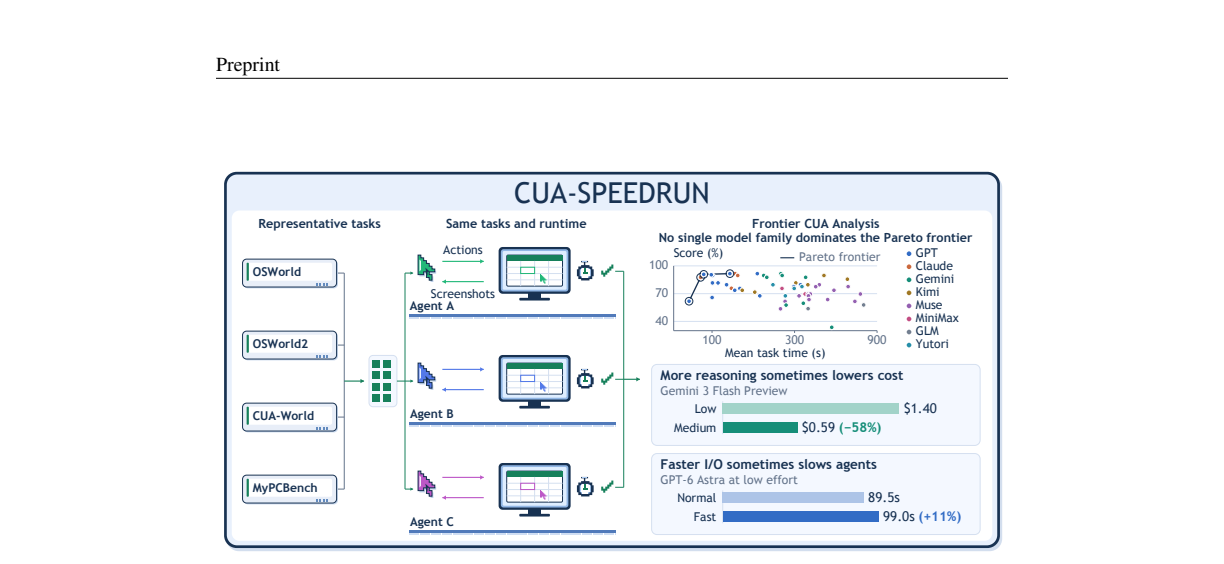
Their capabilities are undoubtedly impressive, however, a key barrier to the widespread adoption and deployment of CUAs remains their speed and cost. Progress towards faster yet capable CUAs requires reliable evaluation of their speed, but many CUA benchmarks currently face a reproducibility crisis. Benchmarks are based on complex infrastructure with varying machine and container configurations that confound the evaluation of the execution speed of CUAs. Towards addressing this gap, we propose cua-speedrun, which introduces standardized infrastructure and task sets, with a focus on evaluating the speed and efficiency of CUAs. cua-speedrun uses a uniform virtual machine setup and execution pipeline, along with a common agent interface that enables single-agent implementations to operate seamlessly across different benchmarks. Across four different CUA benchmarks, we evaluate how reasoning effort, agent harnesses, and environment latency affect performance, speed, and cost. We find no single model family is optimal for all three; none of the open-weight models are on the frontier, and also, unintuitively, for some models increasing the reasoning effort can speed up task completion, while faster environment input-output can slow down overall task completion time. We also demonstrate that we can effectively reduce the evaluation task set of most CUA benchmarks without degrading overall statistical power, allowing for more efficient benchmarking and comparison. We believe cua-speedrun will enable structured progress towards fast, efficient CUAs, unlocking new real-world use cases and applications. All code, infrastructure, and analysis are available at https://cuaspeedrun.com.
from the abstract
Pith says
Machine review · deepseek-v4-flash · 1 Oct 2026 · what was read was not recorded · not checked by a person
It can be wrong. Challenge this review or reply to it.
Holds up, with conditions. Worth a serious referee: solid engineering, a genuinely new leave-one-agent-out-validated subset-selection method, and honest reporting; the qualitative findings hold, but the exact frontier among fast closed models is fragile given single seeds and 66.7% subset frontier recall. This line is wrong
3 major objections · 4 minor
How often objections from reviews like this one are right: not yet measured
Not checked: figures, code, what the 22 references say.
The paper says, at Sec. 3.2 and Appendix G.4
The review did not quote this passage.
Pith says: Objection 1 of 3 · major
The abstract and Sec. 3.2 claims ('no single model family dominates', 'none of the open-weight models are on the frontier') are computed on the 50-task OSWorld and 52-task OSWorld2 subsets, not the full benchmarks, and the frontier-preservation validation in Appendix G.4 is done only on the nine calibration models listed in G.1 (Sonnet 5, Gemini 3.6 Flash, Gemini 3 Flash Preview, GLM-5V Turbo, Luna, Kimi K3, Muse Spark, MiniMax M3, Qwen3.5-9B).
more of objection 1
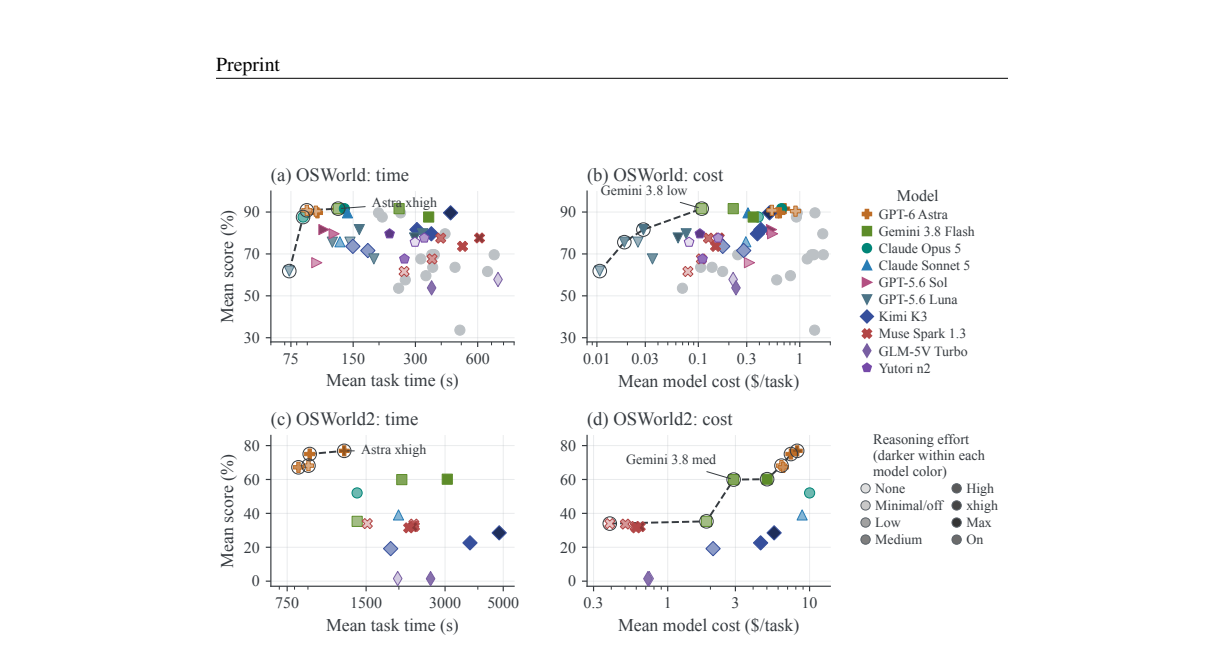
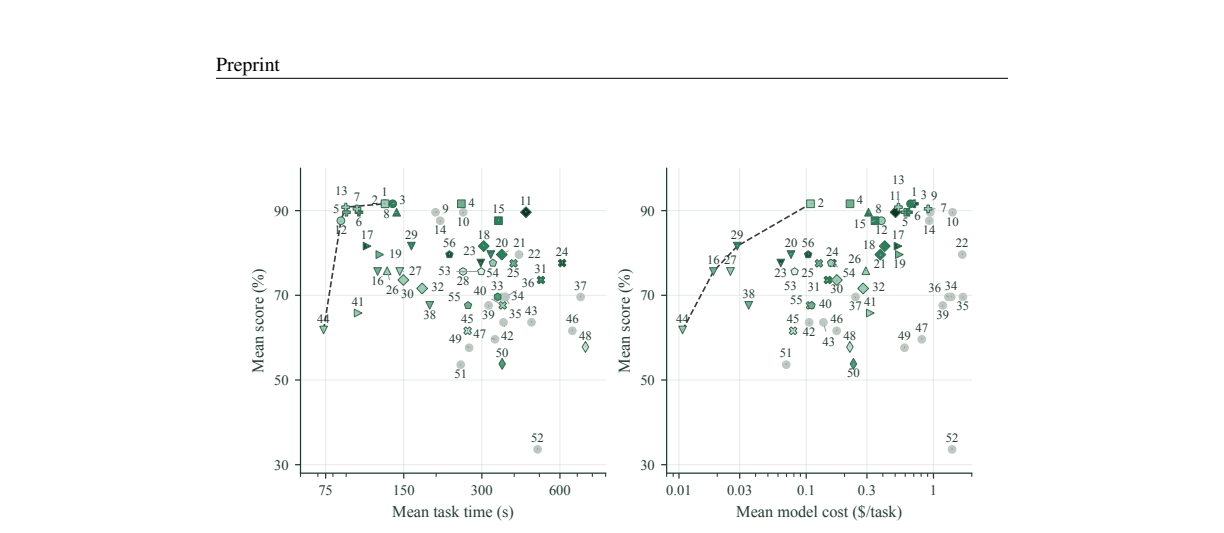
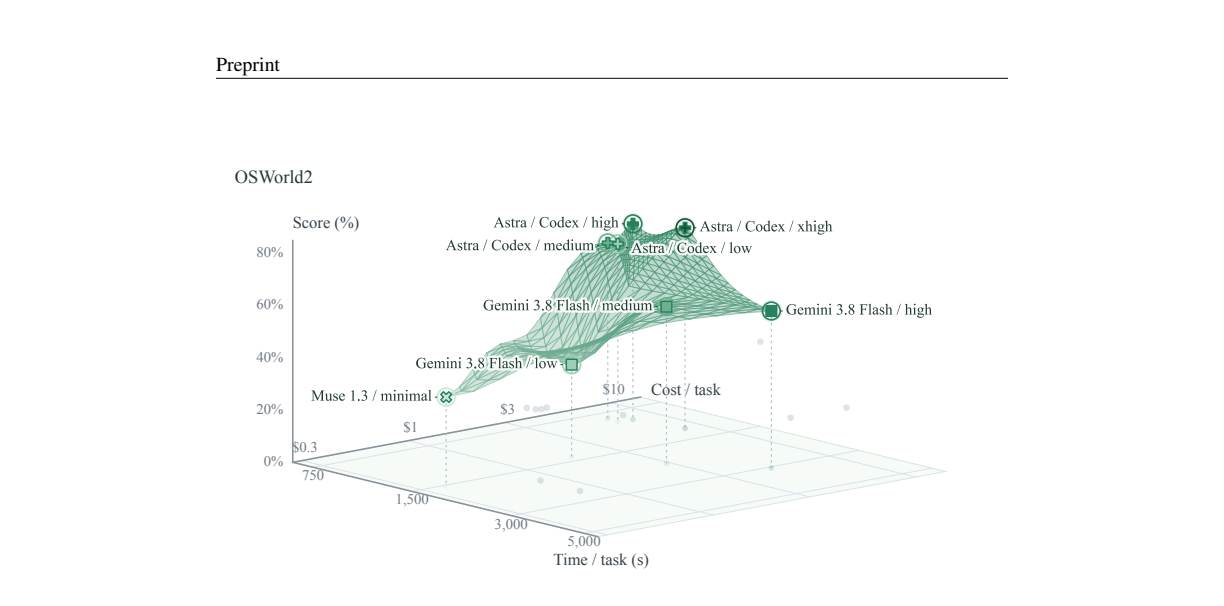
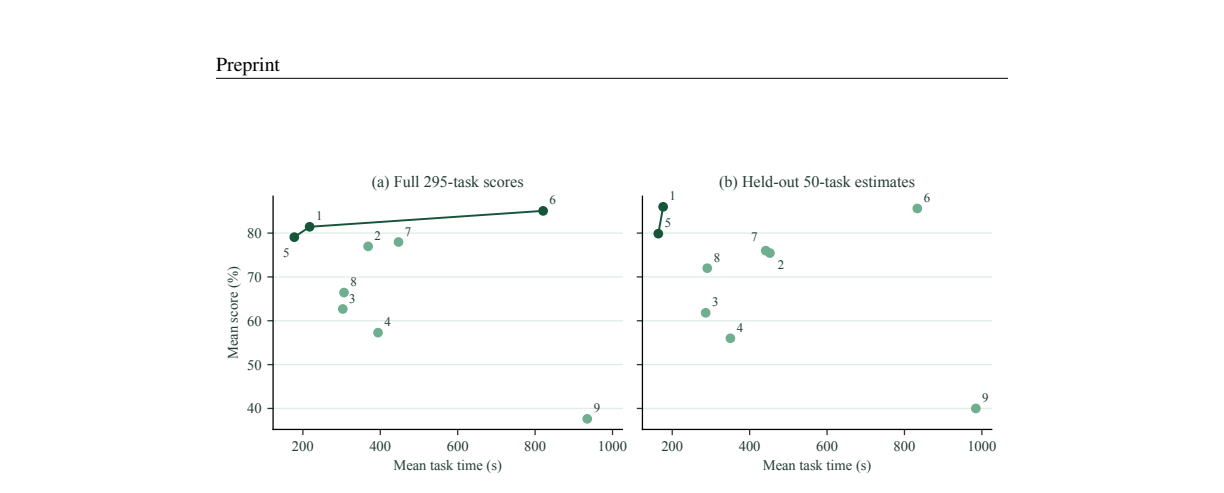
That validation reports 100% precision but only 66.7% recall for the full-set frontier, with 91.7% pairwise-dominance agreement. The configurations that anchor the abstract's frontier — GPT-6 Astra, Gemini 3.8 Flash, Claude Opus 5, Kimi K3, Muse Spark 1.3, GLM-5V Turbo — are entirely outside that pool, so subset frontier preservation for the models actually used in the headline comparisons is unverified. Because ranking preservation (which is solid) does not imply frontier preservation (a local property), the paper should either (a) run the near-frontier configurations on the full 295/63 task sets and report whether subset frontier membership is preserved, or (b) provide a margin/sensitivity analysis showing which subset-frontier memberships would survive full-set re-evaluation, or (c) explicitly qualify all Sec. 3.2 frontier statements as subset-frontier claims. The authors' own G.4 numbers show one of three true frontier points can be dropped, so this is not a remote risk.
The paper says, at Sec. 3.1 and Appendix F
The review did not quote this passage.
Pith says: Objection 2 of 3 · major
Of the 56 OSWorld configurations, only GPT-6 Astra (low) — and the paired Fast I/O comparison — are run with five seeds (Table 11, Appendix F); the remaining configurations are single-seed runs, and the same holds for almost all OSWorld2 configurations.
more of objection 2
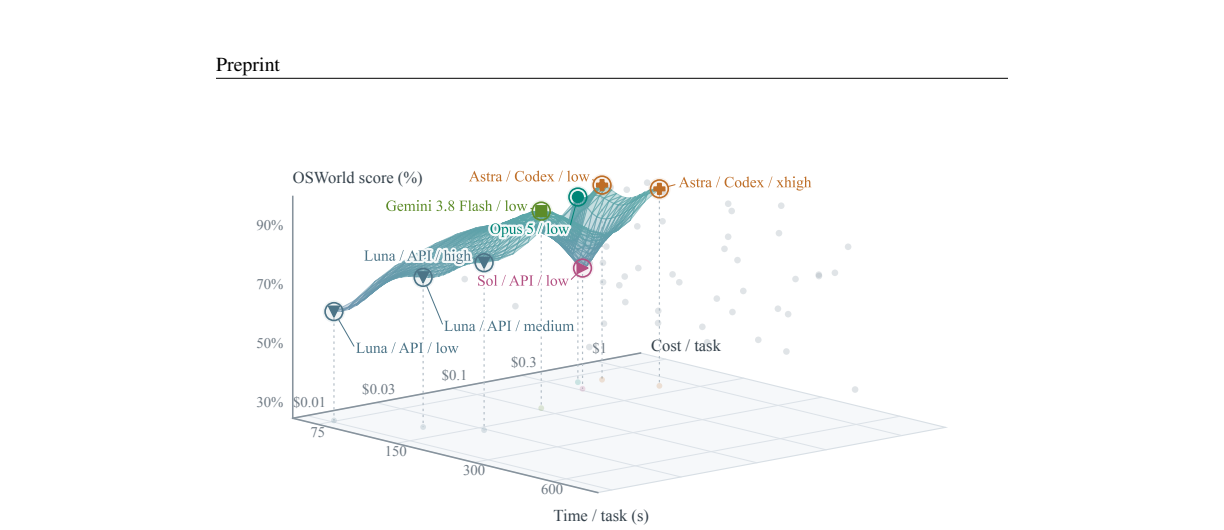
The frontier points in Fig. 2 sit close together (Claude Opus 5 low at 87.6%/85.9 s vs. Astra low at 90.8%/89.5 s vs. Gemini 3.8 Flash low at 91.6%/127.1 s), and the documented five-seed variation for Astra low (score SD 1.79 pp, task-time SD 2.16 s) is of the same order as several of these gaps. The paper should quantify the effect of single-seed noise on frontier membership — for example by reporting per-configuration standard errors, or by identifying which pairs of configurations are within a plausible noise band and treating their frontier ordering as uncertain. Without this, the strength of the 'no open-weight model on the frontier' claim exceeds what the measurement uncertainty supports.
The paper says, at Sec. 3.2, Fig. 2, and Appendix J.5
The review did not quote this passage.
Pith says: Objection 3 of 3 · major
Frontier membership on the cost axis for the open-weight models depends on the cost accounting for self-hosted vLLM inference, which is described in J.5 as provider charges or token usage at applicable API prices but which, for the self-hosted open-weight models on fixed L40S GPUs, must be an estimate (the paper itself gives Muse Spark 1.3 (minimal) an 'estimated $0.39' in Sec. 3.2).
more of objection 3
The headline claim that no open-weight model lies on the cost frontier is sensitive to the assumed GPU rental or inference-pricing rate, which is a free parameter of the analysis. A brief sensitivity analysis (e.g., frontier membership as the assumed per-hour L40S rate varies over a plausible range) would establish that this conclusion is not an artifact of one pricing assumption, or would identify the rate at which an open-weight configuration enters the frontier.
4 minor objections
The paper says, at Sec. 3.2 and Appendix E.2 (Fig. 10)
Pith says: minor objection 1 of 4
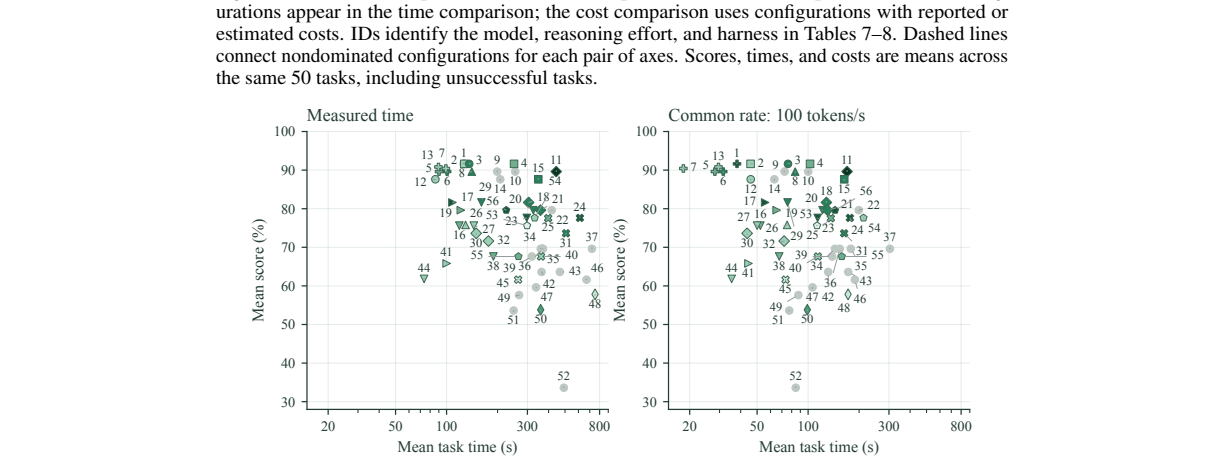
The 'fast agents generate fewer tokens, not tokens faster' claim relies on the common-token-rate comparison of Fig. 10, which assigns every model a rate of 100 tokens/s. The rate is an arbitrary constant rather than a measured quantity; the text should state explicitly that the conclusion holds only under this assumed rate and indicate how the comparison changes at other rates.
The paper says, at Sec. 3.2 and Table 7/8
Pith says: minor objection 2 of 4
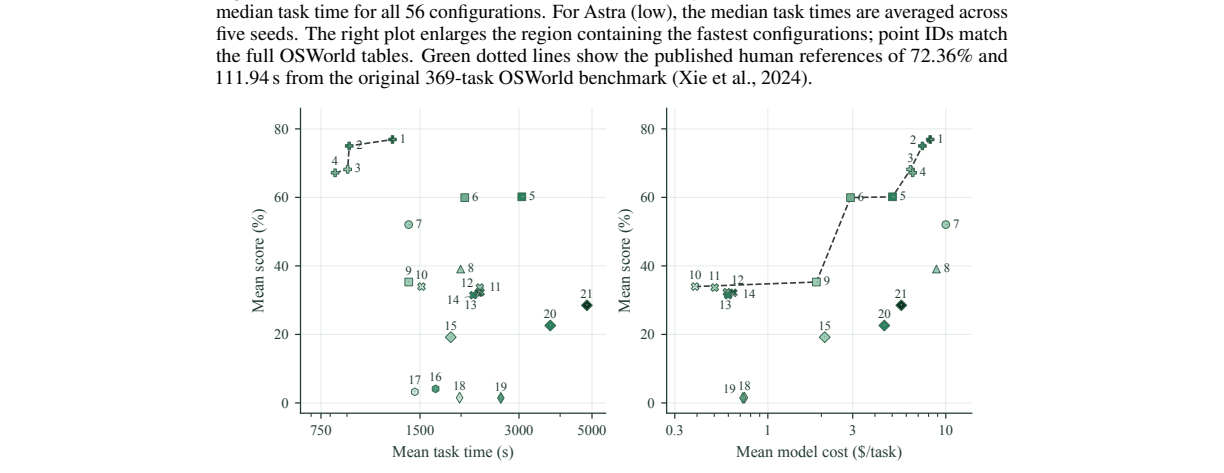
The joint performance-time-cost frontier in Fig. 6 marks bolded IDs in Tables 7–8, but the caption and text do not explain the exclusion of MiniMax M3 (no cost data) from the cost frontier while it appears in the time-frontier figures. A sentence reconciling the time-only versus joint-frontier treatment of the no-cost configurations would remove ambiguity.
show 2 more
The paper says, at Sec. 2.2
Pith says: minor objection 3 of 4
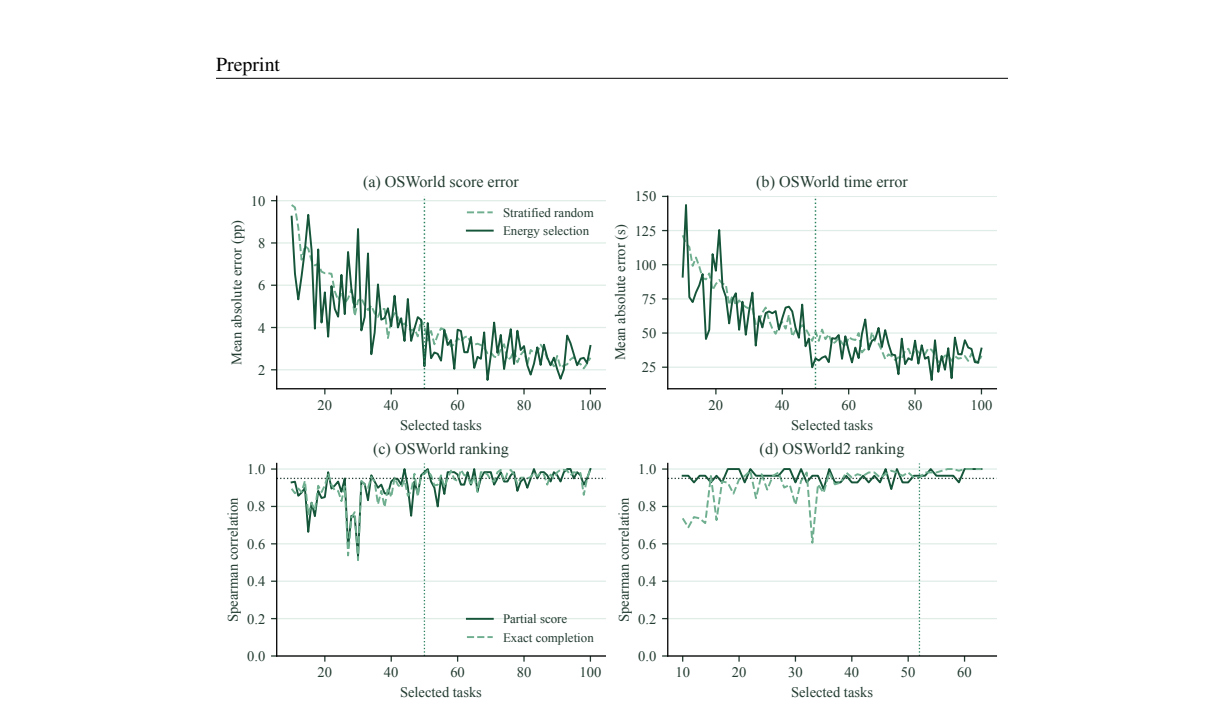
The K* selection criterion in Eq. (3) requires Spearman >= 0.95 at K-1, K, and K+1, which is a sensible stability check; however, the threshold 0.95 is itself a free parameter, and the paper does not report how sensitive the chosen subset sizes (50, 52, 26, 38) are to this threshold. Reporting the correlation curves of Fig. 15 for a range of thresholds would strengthen the choice.
The paper says, at Appendix G.6
Pith says: minor objection 4 of 4
The selected-task identity lists appear complete, but the CUA-World list in Table 17 and the MyPCBench list are not machine-readable; it would improve reproducibility to provide the full task UUIDs/IDs as a downloadable file rather than only in tables.
What would settle it
Run the configurations that define or bracket the OSWorld subset frontier on the full 295-task OSWorld set: Claude Opus 5 (low), GPT-6 Astra (low and xhigh), Gemini 3.8 Flash (low), plus the strongest open-weight candidates Kimi K3 (max/batched), Muse Spark 1.3 (high), and GLM-5V Turbo (thinking on). Recompute the performance–time and performance–cost frontiers from full-set scores and times and compare membership against the 50-task subset frontier in Fig. 2. If any open-weight configuration becomes nondominated on the full set, or if any claimed frontier point (e.g., Claude Opus 5 low) becomes dominated, the headline claims 'none of the open-weight models are on the frontier' and the Fig. 2 frontier decomposition fail. If membership is unchanged, the concern is resolved.
from the skeptic's reading
How the review went
4 readings by deepseek-v4-flash · 1 Oct 2026
- Reader holds up, with conditions
- Skeptic agrees
- Editor wrote the verdict above
- Referee major revision: 3 major objections, 4 minor
Not run on this paper: the simulated authors' defence.
Pith did not check this review's objections against the paper.
The review in full
The review in brief, machine-written
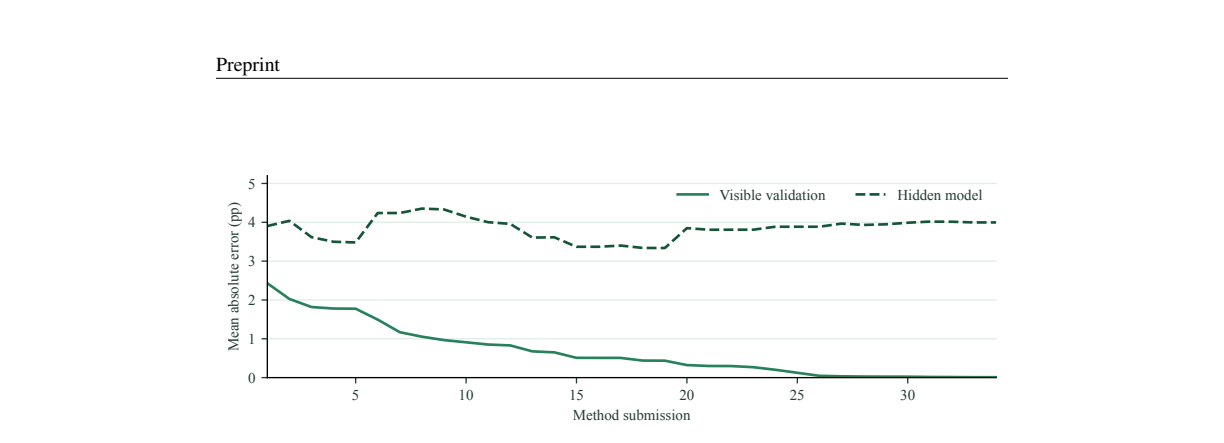
Worth a real referee slot. The genuinely new piece is the energy-distance task-subset selection applied to CUA benchmarks, validated leave-one-agent-out, with direct comparison against tinyBenchmarks/IRT, SparseEval, and PACE. Ranking preservation is solid: held-out Spearman 0.983/0.975 at K=50/52, and the 84.9% trajectory-time reduction is real. The infrastructure work is better than typical for this genre: CUA-AutoDebug caught genuine input bugs in existing runtimes (Tables 19-20), the latency breakdown is careful (Tables 1-3), and the honest reporting of the Appendix L search-overfitting result — validation error driven to 0.01 while held-out error stayed at 4.00 — is exactly the kind of thing that makes me trust the rest.
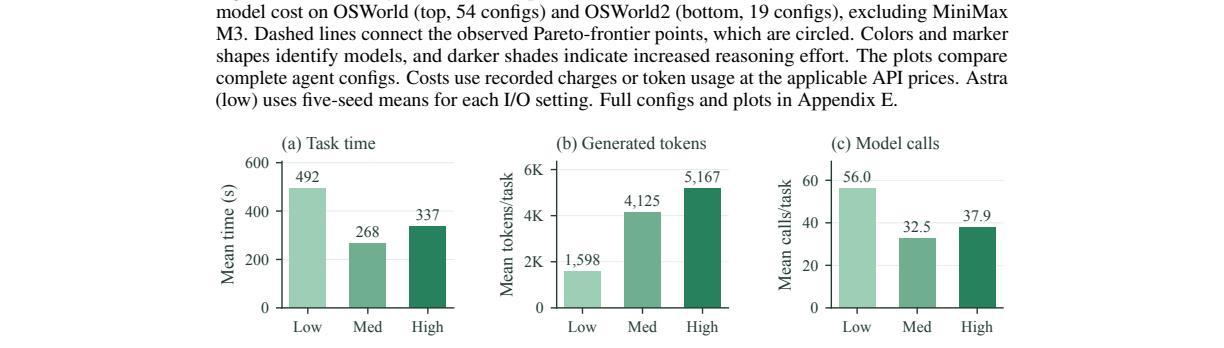
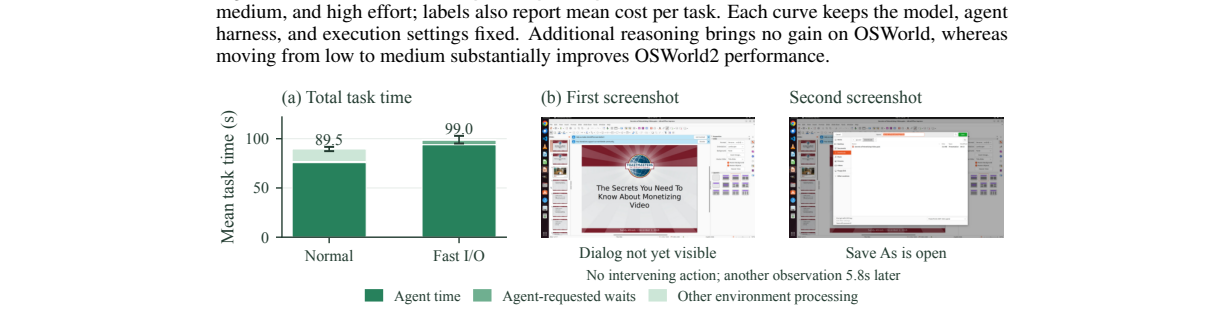
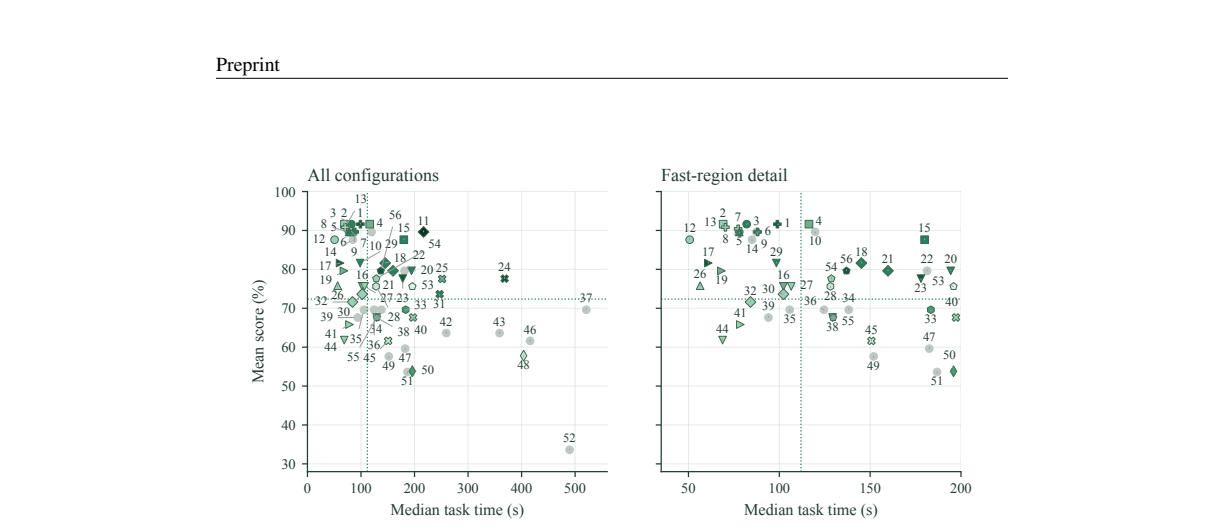
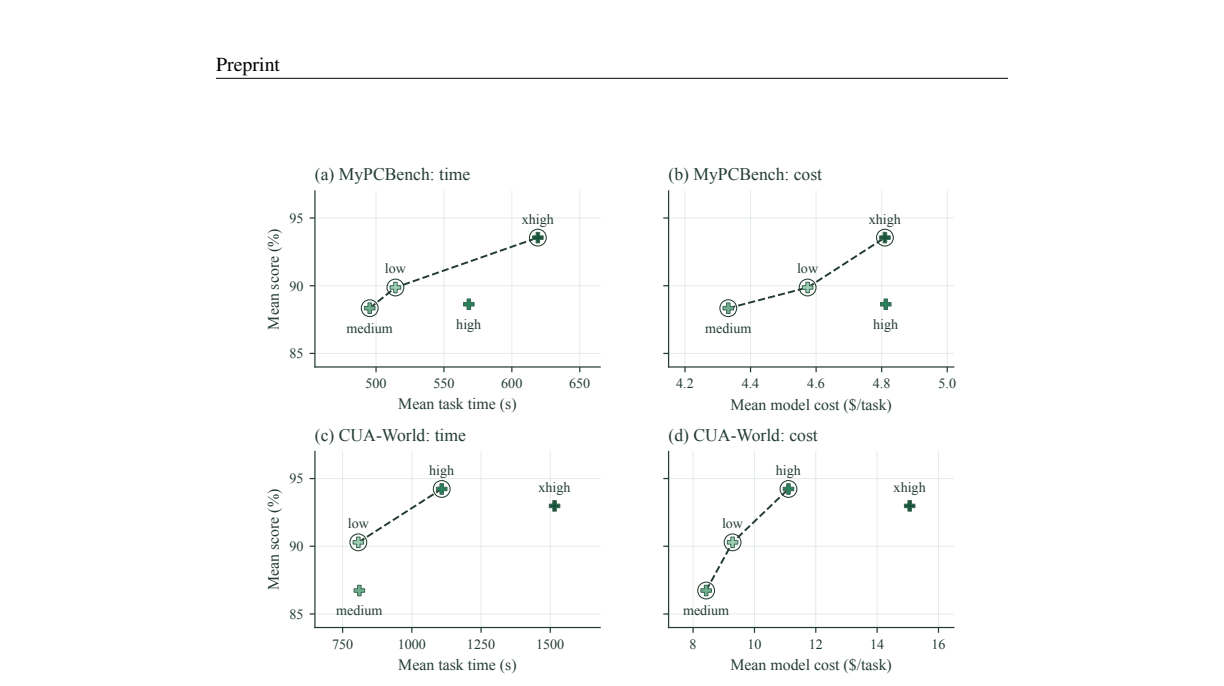
The counterintuitive findings survive a close read. More reasoning reducing task time (Gemini 3 Flash Preview: 492 to 268 s, Fig. 3) is a large effect with a concrete mechanism. Fast I/O slowing the agent (89.5 to 99.0 s) is smaller, roughly two standard deviations across two five-seed runs, but the mechanism — screenshots arriving before the dialog renders, extra requested waits — is directly demonstrated in Fig. 5b. I would want a paired evaluation before leaning hard on the magnitude, but the direction reads true.
Soft spots, in proportion. Most of the 56 OSWorld configurations are single-seed runs; only Astra low has five. The frontier points among the fast closed models sit within the documented ±2.2 s / ±1.8 pp noise, so the exact frontier shape there is fragile. Sharper: frontier preservation on the 50-task subsets is weaker than ranking preservation — the paper's own Appendix G.4 puts frontier recall at 66.7%, measured on calibration-pool models, not on the actual anchors (Astra, Gemini 3.8 Flash, Opus 5, which sit outside that pool). So the precise composition of the frontier is a claim about subsets not validated on the models that define it. That said, the stress-test overreaches if it thinks the no-open-weight-model finding collapses: Kimi K3 max scores 89.6% in 444 s versus Astra low at 90.8% in 89.5 s. That gap is fivefold in time; no 50-task subset is going to flip it. The 84.9% figure is trajectory-time only, stated in the appendix but not the abstract — a clarifying sentence, not a substantive flaw.
Verdict: engage. Send it out. A good referee will ask for more seeds on the frontier configurations and a full-set frontier check on the specific models that anchor the abstract's claims; both are addressable.
The strongest objection
The paper's central frontier conclusions — 'no single model family dominates', 'none of the open-weight models are on the frontier', and the performance–time–cost trade-off curves of Fig. 2/Fig. 6 — are all computed on the 50-task OSWorld (52-task OSWorld2) representative subsets of Sec. 2.2, not the full benchmarks. The ranking guarantee for those subsets is solid (held-out Spearman 0.983/0.975 at K=50, Table 14; Fig. 15). But ranking preservation does not imply frontier preservation, and the paper's own Appendix G.4 shows the subset frontier recovers only 66.7% of true full-set frontier configurations on held-out models in the calibration pool, with 91.7% pairwise-dominance agreement. Two gaps follow. First, the G.4 validation uses the calibration models themselves (Claude Sonnet 5, Gemini 3.6 Flash, Luna, Qwen3.5-9B, etc., Sec G.1). The configurations that actually anchor the abstract's frontier conclusions — GPT-6 Astra, Gemini 3.8 Flash, Claude Opus 5, plus the open-weight contenders Kimi K3, Muse Spark 1.3, GLM-5V Turbo — are entirely outside that pool, so subset frontier preservation for them is unverified. A frontier configuration could be silently dropped (recall < 100%) or a dominated configuration could appear nondominated (precision < 100%) when moved to the subset. Second, subset frontier membership is fragile against the single-seed noise the paper itself documents: the frontier points in Fig. 2 sit close together (Claude Opus 5 low at 87.6%/85.9 s vs. Astra low at 90.8%/89.5 s), and most Table 8 entries are single runs, so the dominance relations defining 'none of the open-weight models are on the frontier' are determined by margins comparable to run-to-run variation (±1.8 pp score, ±2.2 s, Table 11). The claim is load-bearing because it is the abstract's headline finding, and it is only as strong as the unshown full-set frontier for these specific models.
The reader's weakest_assumption is exactly the representative-task-selection premise, with the 66.7% frontier recall in G.4 flagged as the soft point. I agree, and I add specificity: the frontier claims in Sec. 3.2 and the abstract are not just 'weaker than the ranking guarantee' — they are asserted for model configurations (GPT-6 Astra, Gemini 3.8 Flash, Claude Opus 5, Kimi K3, Muse Spark, GLM-5V Turbo) that are entirely absent from the calibration pool whose held-out frontier behavior was validated. Appendix G.4 validated frontier preservation only against the nine calibration models (Sec. G.1), and even for those it achieved 66.7% recall. So for the models that matter to the conclusions, there is no direct evidence that subset frontier membership equals full-set frontier membership; the claim is supported only by extrapolation. This is compounded by the single-seed measurements (Table 8) and the close spacing of frontier points in Fig. 2, which make dominance relations sensitive to noise of the magnitude the paper reports (±1.8 pp, ±2.2 s, Table 11). An 'open-weight model not on the frontier' is a claim about dominance relative to that noise; on a subset with known 33% frontier recall on held-out models, the risk that a true frontier member is missing (or a false one appears) is real. I do not treat this as fatal: the ranking-preservation backbone (0.98 held-out Spearman, leave-one-agent-out, honest Appendix L overfitting report) is well supported, and the 'more reasoning speeds up' and 'fast I/O slows agents' findings are either five-seed controlled (Fig. 5, Table 4) or far beyond selection noise (224 s gap, Fig. 3 vs. 31.4 s time MAE at K=50). The concern is narrowly scoped to the frontier-preservation premise for out-of-pool agents, and it is addressable with one full-set evaluation set of runs. Hence CONDITIONAL remains the right verdict: the infrastructure and ranking platform claims are credible, but the headline frontier conclusions should not be accepted as established until subset vs. full-set frontier membership is checked for the specific evaluated configurations. My recommendation therefore does not change the reader's verdict; it specifies the experiment that would move it to ACCEPT.
The referee's report
If the claims hold, this is a valuable infrastructure contribution to a benchmarking area — CUA speed and cost — that the paper correctly notes has lagged capability measurement. The strengths are real and worth naming: the leave-one-agent-out validation of subset selection is well designed; the energy-selection method is validated against stratified-random and IRT baselines (Table 15); the honest reporting of the Appendix L search-overfitting result (validation error falls from 2.43 to 0.01 pp while held-out error remains ~4 pp) is exemplary and increases credibility; and the infrastructure (code release, CUA-AutoDebug input-error catalog, FastCUA latency tables) is reproducible and clearly specified. The ranking-preservation claim is solidly supported. The principal weakness is that the headline frontier conclusions are computed on representative subsets whose frontier preservation is validated only on a calibration pool of nine models with 66.7% recall (Appendix G.4), while the configurations that actually anchor the abstract's frontier claims lie outside that pool; the near-tied single-seed frontier points add further unquantified risk.
Pith's reading of the paper (a machine's summary, not the authors')
The paper claims that computer-use agents (CUAs), which operate graphical user interfaces to complete tasks, cannot be judged on success rate alone because speed and cost vary so widely that the ordering of models changes when those axes are added. It proposes cua-speedrun, a standardized evaluation platform that runs all agents on the same cloud-hosted virtual machines with a common agent interface, and an energy-based task-selection method that prunes each benchmark to a small representative subset. On OSWorld the subset of 50 tasks cuts evaluation time by 84.9 percent while preserving agent rankings at high correlation with the full 295-task set. The paper's empirical claims are that no single model family lies on the performance–time–cost frontier, that raising reasoning effort can shorten total task time by avoiding repeated failed actions, and that faster infrastructure I/O can make agents slower.
What carries the argument. Two mechanisms carry the argument. The first is energy-based representative-task selection: each task is represented as a vector of all calibration agents' partial and exact-completion scores, and a subset of $K$ tasks is chosen by minimizing the energy distance between the full benchmark's score distribution and the subset's; leave-one-agent-out validation selects the smallest $K$ whose partial-score and exact-completion rank correlations clear 0.95 at $K-1$, $K$, and $K+1$. The second is the standardized infrastructure itself: a common agent interface plus cloud-hosted sandboxes that time task execution consistently, separate agent time from environment time and agent-requested waits, and are validated end-to-end by the CUA-AutoDebug action test suite and the FastCUA low-latency I/O mode.
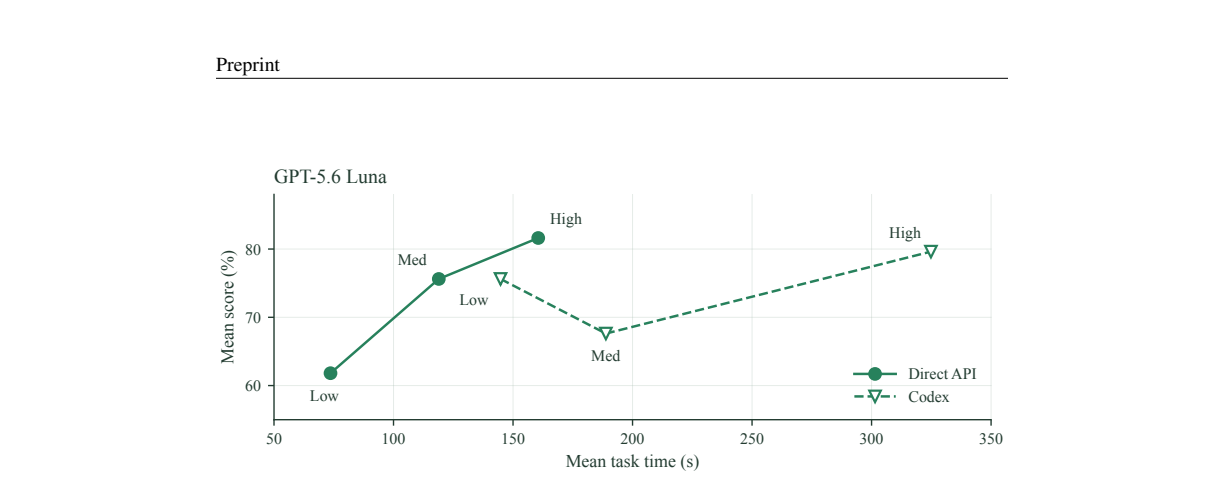
Core claim. The central claim is that wall-time behavior of computer-use agents is governed by interaction dynamics rather than by raw model output speed, and that these dynamics only become visible under standardized infrastructure. The paper reports that reasoning more can reduce task time: Gemini 3 Flash Preview improves from 33.6 to 57.6 percent score while mean task time drops from 492 to 268 seconds because higher effort cuts model calls from 56.0 to 32.5 per task. It also reports the opposite surprise of infrastructure speed: under its FastCUA mode, action-to-observation latency falls by an order of magnitude, yet total task time for GPT-6 Astra rises from 89.5 to 99.0 seconds because screenshots arrive before the application updates its interface. No evaluated configuration is best on all of performance, time, and cost simultaneously, and none of the open-weight models tested lie on the performance–time or performance–cost frontier of OSWorld or OSWorld2.
The premise it rests on. A subset of roughly 50 tasks, fit by energy minimization to a specific set of nine OSWorld and seven OSWorld2 calibration agents, is assumed to preserve full-benchmark rankings and the Pareto frontier for any future agent and task distribution, with the frontier-preservation side of that guarantee being weaker than the ranking side.
If the paper is right (Pith's inferences, not the authors')
A roughly 50-task representative set can replace the full 295-task OSWorld evaluation at 15.1 percent of the recorded task time while keeping left-out agents' rankings above 0.95 Spearman correlation, making speed comparisons affordable enough to run repeatedly.
Because performance, time, and cost do not move together, a single leaderboard number is insufficient; the correct agent choice becomes a frontier preference problem that depends on a workload's score, time, and cost budgets.
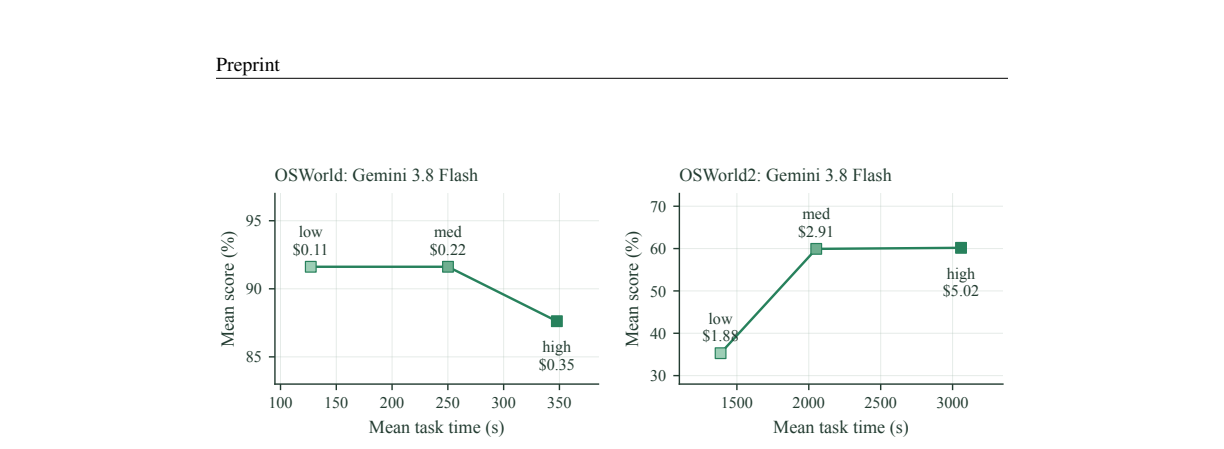
Reasoning-effort tuning is a deployment lever with benchmark-dependent returns: on OSWorld low and medium effort both score 91.6 percent but medium roughly doubles time and cost, while on OSWorld2 medium adds about 24 points over low.
The agent harness is part of the frontier: the same model and reasoning setting can land at different points depending on whether it runs through the direct API or the Codex harness.
The energy-based subset recipe — score profiles across a small calibration population, energy-distance minimization, leave-one-out ranking validation — is a generic benchmark-compression tool that could prune web-agent, coding, or long-horizon benchmarks whose per-task cost is high.
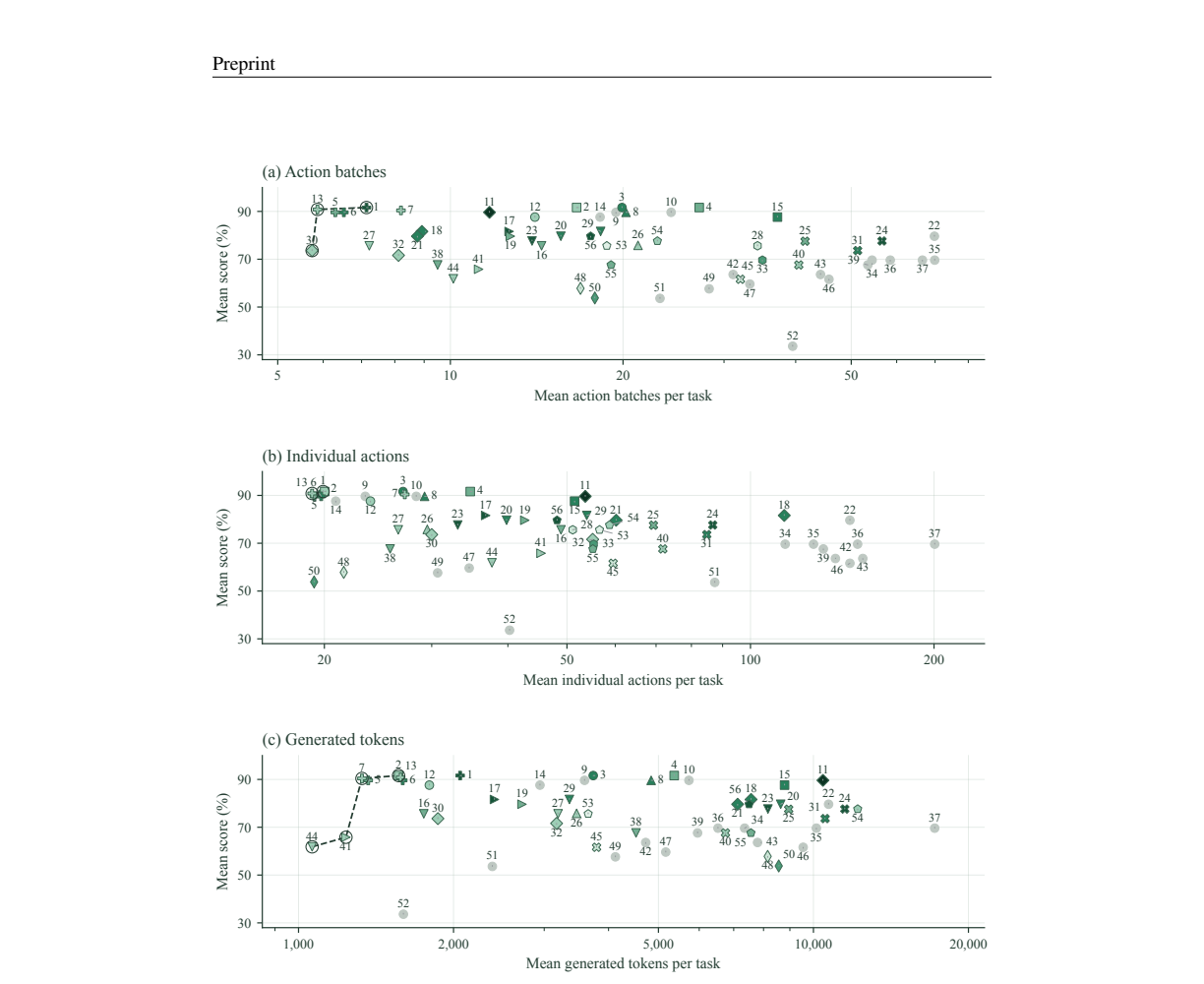
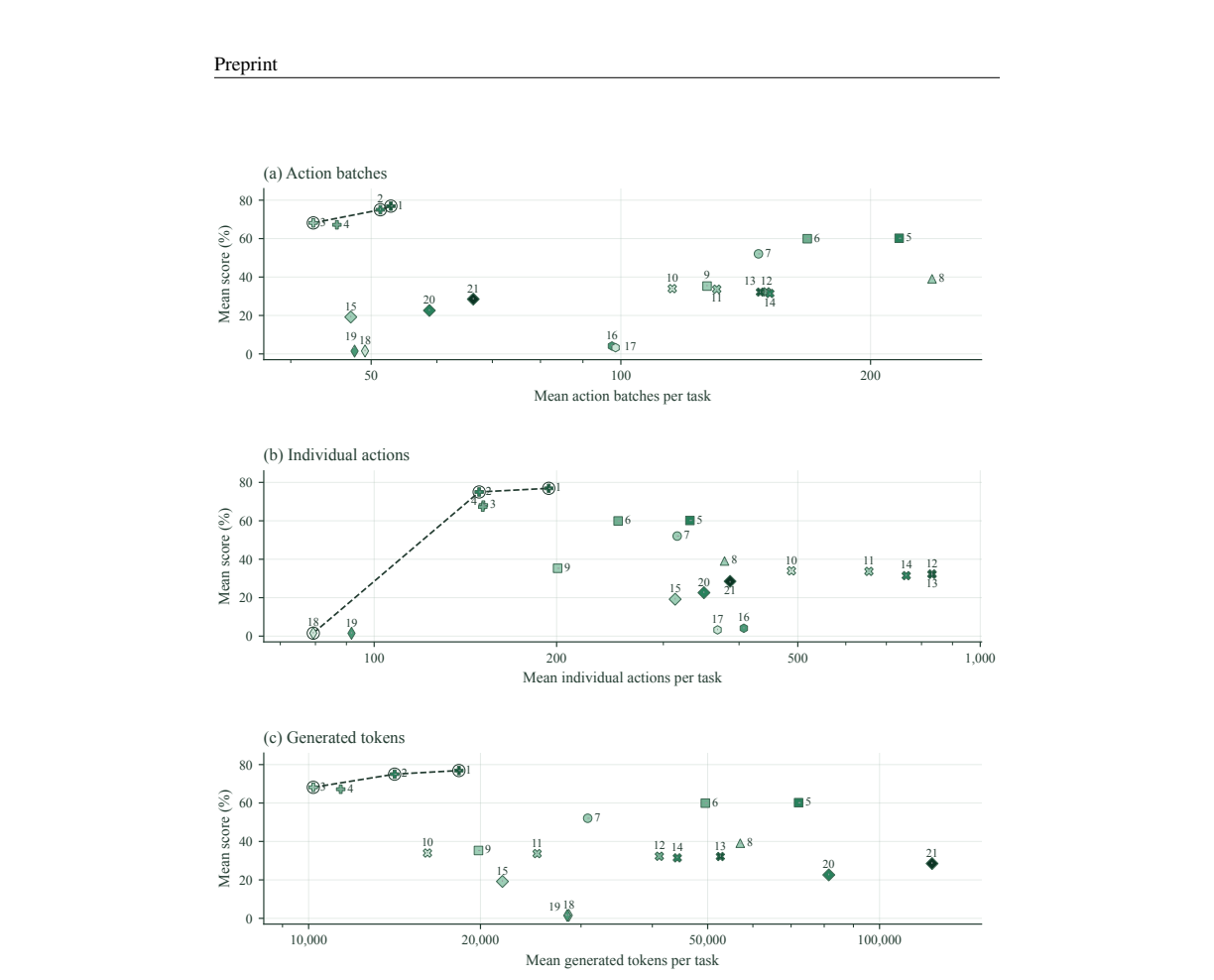
The result that reasoning can reduce wall-clock time implies that interaction-level statistics such as action batches and failed-action retries predict task time better than token counts for long-horizon tasks, so latency-optimizing deployers should treat reasoning effort as a budget knob rather than a quality knob.
The FastCUA slowdown suggests models tuned under standard 2–3 second I/O latency absorb that latency as an implicit wait signal; agents trained with varied I/O latencies or given explicit state-ready signals could plausibly reverse the result, a testable extension the paper leaves implicit.
Check this review
Pith stored no record of this review's passes and took no fingerprint of it. Reviews made by code from 13 Nov 2026 on carry both.
How often reviews like this one are right
Reviews like this one: written by deepseek-v4-flash, where what was read was not recorded.
How often objections from reviews like this one are right: not yet measured
Reviews by people
This review was written by a machine. No person has reviewed this paper on Pith yet. A scientist listed on Pith can review it for a fee, and their review is published here whatever it concludes.
The paper
Abstract
Computer use agents (CUAs), which use graphical user interfaces (GUIs) to complete tasks on a computer, have recently surpassed human performance on many standard benchmarks, including difficult long-horizon tasks. Their capabilities are undoubtedly impressive, however, a key barrier to the widespread adoption and deployment of CUAs remains their speed and cost. Progress towards faster yet capable CUAs requires reliable evaluation of their speed, but many CUA benchmarks currently face a reproducibility crisis. Benchmarks are based on complex infrastructure with varying machine and container configurations that confound the evaluation of the execution speed of CUAs. Towards addressing this gap, we propose cua-speedrun, which introduces standardized infrastructure and task sets, with a focus on evaluating the speed and efficiency of CUAs. cua-speedrun uses a uniform virtual machine setup and execution pipeline, along with a common agent interface that enables single-agent implementations to operate seamlessly across different benchmarks. Across four different CUA benchmarks, we evaluate how reasoning effort, agent harnesses, and environment latency affect performance, speed, and cost. We find no single model family is optimal for all three; none of the open-weight models are on the frontier, and also, unintuitively, for some models increasing the reasoning effort can speed up task completion, while faster environment input-output can slow down overall task completion time. We also demonstrate that we can effectively reduce the evaluation task set of most CUA benchmarks without degrading overall statistical power, allowing for more efficient benchmarking and comparison. We believe cua-speedrun will enable structured progress towards fast, efficient CUAs, unlocking new real-world use cases and applications. All code, infrastructure, and analysis are available at https://cuaspeedrun.com.
The paper's own sentences, arranged, kept beside the review and separate from it. Each label is drawn from a closed vocabulary; the number beside it is the probability the classifier gave that label. No sentence in this record was written by a model.
abstract compiled · 2026-10-01
The authors' main claim, as the classifier picked it out 0.70
“We find no single model family is optimal for all three; none of the open-weight models are on the frontier, and also, unintuitively, for some models increasing the reasoning effort can speed up task completion, while faster environment input-output can slow down overall task completion time.”
How the main claim is stated: asserted 1.00
What the abstract itself states, as probabilities: claims first 0.08 · states limitation 0.39 · human participants 0.04 · controlled comparison 0.15 · randomized assignment 0.02 · states quantitative result 0.20 · compares with prior results 0.59 · mentions code or data availability 0.99
The abstract, sentence by sentence
This table labels the abstract only (arXiv listing abstract v1). The number is the probability the classifier gave the label.
| Sentence | Role | The authors' own work | States the main conclusion | Strength |
|---|---|---|---|---|
| Computer use agents (CUAs), which use graphical user interfaces (GUIs) to complete tasks on a computer, have recently surpassed human performance on many standard benchmarks, including difficult long-horizon tasks. | background 1.00 | 0.08 | 0.04 | asserted 1.00 |
| Their capabilities are undoubtedly impressive, however, a key barrier to the widespread adoption and deployment of CUAs remains their speed and cost. | background 0.73 | 0.05 | 0.03 | asserted 1.00 |
| Progress towards faster yet capable CUAs requires reliable evaluation of their speed, but many CUA benchmarks currently face a reproducibility crisis. | gap 0.85 | 0.07 | 0.03 | asserted 1.00 |
| Benchmarks are based on complex infrastructure with varying machine and container configurations that confound the evaluation of the execution speed of CUAs. | gap 0.52 | 0.06 | 0.02 | asserted 1.00 |
| Towards addressing this gap, we propose cua-speedrun, which introduces standardized infrastructure and task sets, with a focus on evaluating the speed and efficiency of CUAs. cua-speedrun uses a uniform virtual machine setup and execution pipeline, along with a common agent interface that enables single-agent implementations to operate seamlessly across different benchmarks. | contribution 0.80 | 0.85 | 0.07 | asserted 0.97 |
| Across four different CUA benchmarks, we evaluate how reasoning effort, agent harnesses, and environment latency affect performance, speed, and cost. | method 0.54 | 0.96 | 0.05 | asserted 0.95 |
| We find no single model family is optimal for all three; none of the open-weight models are on the frontier, and also, unintuitively, for some models increasing the reasoning effort can speed up task completion, while faster environment input-output can slow down overall task completion time. | result 1.00 | 0.97 | 0.50 | asserted 1.00 |
| We also demonstrate that we can effectively reduce the evaluation task set of most CUA benchmarks without degrading overall statistical power, allowing for more efficient benchmarking and comparison. | result 0.94 | 0.96 | 0.13 | asserted 1.00 |
| We believe cua-speedrun will enable structured progress towards fast, efficient CUAs, unlocking new real-world use cases and applications. | interpretation 0.72 | 0.11 | 0.18 | hedged possibility 0.66 |
| All code, infrastructure, and analysis are available at https://cuaspeedrun.com. | contribution 0.79 | 0.38 | 0.03 | asserted 0.98 |
What kind of paper the classifier reports this is: dataset or benchmark 0.94 · evidence from observation or experiment 0.99
What was examined, and what was not
Sources read
- arXiv listing abstract v1
Not examined
- full text
- figures and tables
- references and citing sentences
- relations to other papers
Levels run
- P abstract
Not run
- S sections
- T body sentences
- C citations
- R cross-paper relations
How the labels were made
Compiled by classifier-1.13.0 via TypeSafe API, question bank abstract-p1-20260923, 2026-10-01: 1 request, 7,716 input tokens.
Every quoted sentence on this record is the authors'. Every label is from Pith's closed vocabulary, with the probability shown beside it. This record as JSON
Figures (18)
Figures are the authors', reproduced from the paper.
References (22)
- [1] Reyna Abhyankar, Qi Qi, and Yiying Zhang. OSWorld-Human: Benchmarking the efficiency of computer-use agents.arXiv preprint arXiv:2506.16042, on PithPith's reviewarXiv
- [6] 10 Preprint Tanmay Gupta, Piper Wolters, Zixian Ma, Peter Sushko, Rock Yuren Pang, Diego Llanes, Yue Yang, Taira Anderson, Boyuan Zheng, Zhongzheng Ren, Harsh Trivedi, Taylor Blanton, Caleb Ouellette, Winson Han, Ali Farhadi, and Ranjay Krishna. MolmoWeb: Open visual web agent... on PithPith's reviewarXiv
- [7] Lawrence Keunho Jang, Andrew Keunwoo Jang, Jing Yu Koh, and Ruslan Salakhutdinov. MyPCBench: A benchmark for personally intelligent computer-use agents.arXiv preprint arXiv:2606.16748, 2026a. Lawrence Keunho Jang, Jing Yu Koh, Daniel Fried, and Ruslan Salakhutdinov. Odysseys: ... on PitharXiv
- [8] URLhttps://arxiv.org/abs/2407.01502. Sayash Kapoor, Benedikt Stroebl, Peter Kirgis, Nitya Nadgir, Zachary S Siegel, Boyi Wei, Tianci Xue, Ziru Chen, Felix Chen, Saiteja Utpala, Franck Ndzomga, Dheeraj Oruganty, Sophie Luskin, Kangheng Liu, Botao Yu, Amit Arora, Dongyoon Hahm, ... on PithPith's reviewarXiv
- [9] URLhttps://arxiv.org/pdf/2510.11977. Kimi Team. Kimi K3: Open frontier intelligence.arXiv preprint arXiv:2607.24653, on PitharXiv
- [11] Bowen Lv, Xiao Liu, Yanyu Ren, Hanyu Lai, Bohao Jing, Hanchen Zhang, Yanxiao Zhao, Shuntian Yao, Jie Tang, and Yuxiao Dong. ScaleCUA: Scaling computer use agents with verifiable task synthesis and efficient online RL.arXiv preprint arXiv:2607.11185, on PithPith's reviewarXiv
- [12] Cristina Menghini, Peter Ney, Hamza Kwisaba, Zifan Wang, Miles Turpin, et al. Muse Spark safety & preparedness report.arXiv preprint arXiv:2606.12429, on PithPith's reviewarXiv
- [13] 11 Preprint Yujia Qin, Yining Ye, Junjie Fang, Haoming Wang, Shihao Liang, Shizuo Tian, Junda Zhang, Jiahao Li, Yunxin Li, Shijue Huang, Wanjun Zhong, Kuanye Li, Jiale Yang, Yu Miao, Woyu Lin, Longxiang Liu, Xu Jiang, Qianli Ma, Jingyu Li, Xiaojun Xiao, Kai Cai, Chuang Li, Yao... on PithPith's reviewarXiv
- [14] Barada Sahu and Shivesh Pandey. Teach it to stop, not just to click.arXiv preprint arXiv:2607.17136, on PithPith's reviewarXiv
- [15] Yueqi Song, Lintang Sutawika, Jiarui Liu, Lindia Tjuatja, Jiayi Geng, Yunze Xiao, Daniel Lee, Aditya Bharat Soni, Vincent Lo, Xiang Yue, and Graham Neubig. PACE: A proxy for agentic capability evaluation.arXiv preprint arXiv:2607.02032, on PithPith's reviewarXiv
- [18] Taolin Zhang, Hang Guo, Wang Lu, Tao Dai, Shu-Tao Xia, and Jindong Wang. SparseEval: Efficient evaluation of large language models by sparse optimization. InICLR, 2026a. Yuxuan Zhang, Yubo Wang, Yipeng Zhu, Penghui Du, Junwen Miao, Xuan Lu, Zhuofeng Li, Xingwei Qu, Zhengkang G... on PithPith's reviewarXiv
- [19] 13 Preprint APPENDIXTABLE OFCONTENTS A Limitations . . . . . . . . . . . . . . . . . . . . . . . . . . . . . . . . . . . . . . . . . . . . 16 B Infrastructure: Technical Details . . . . . . . . . . . . . . . . . . . . . . . . . . . . . . . 16 B.1 Agent and Environment Sandboxe... on Pith
- [20] for mouse clicks, key presses, and text entry. Fast I/O takes 2.4–27.6 ms per call, compared to 2.5–3.5 s for the existing implementations. For example, a click takes 27.6 ms compared with 2.8 s with Gym-Anything, while typing 100 characters takes 15.0 ms compared with 3.5 s. ... on Pith
- [21] 24 Preprint E FULLEVALUATIONRESULTS E.1 MODEL, HARNESS,ANDREASONING-EFFORTCONFIGURATIONS Tables 7–9 report mean score, time, cost, and token use for each model, harness, and reasoning setting. Astra (low) uses five-seed means for each I/O setting. The configuration IDs identif... on Pith
- [22] 143 26 MyPCBench (Jang et al., 2026a) 184 38 Table 13: Task counts for the representative subsets selected forcua-speedrun. G.1 MODELS ANDTASKSUSED FORSELECTION OSWorld.We use nine configurations evaluated on the same 295 tasks: Claude Sonnet 5 xhigh, Gemini 3.6 Flash, Gemini ... on Pith
- [2013] Bowen Wang, Dunjie Lu, Junli Wang, Tianyi Bai, Shixuan Liu, Zhipeng Zhang, Haiquan Wang, Hao Hu, Tianbao Xie, Shuai Bai, Dayiheng Liu, Que Shen, Junyang Lin, and Tao Yu. CUA- Gym: Scaling verifiable training environments and tasks for computer-use agents.arXiv preprint arXiv:2... on PithPith's reviewarXiv
- [2018] Dunjie Lu, Shuai Bai, Tianyi Bai, et al. Qwen-CUA: Native computer use for (almost) everything. arXiv preprint arXiv:2608.02352, on PitharXiv
- [2022] Mengqi Yuan, Zilong Zhou, Xinzhuang Xiong, Weiming Wu, Jiayang Sun, Jiamin Song, Kaiqian Cui, Bowen Wang, Haoyuan Wu, Yitong Li, Dunjie Lu, Haikong Lu, Qi Zhen, Xinyuan Wang, Jiaqi Deng, Yuhao Yang, Cheng Chen, Boyuan Zheng, Alex Su, Xiao Yu, Hao Zou, Saaket Agashe, Xing Han L... on PithPith's reviewarXiv
- [2023] Shuangrui Ding, Xuanlang Dai, Long Xing, Shengyuan Ding, Ziyu Liu, Yang JingYi, Penghui Yang, Zhixiong Zhang, Xilin Wei, Xinyu Fang, Yubo Ma, Haodong Duan, Jing Shao, Jiaqi Wang, Dahua Lin, Kai Chen, and Yuhang Zang. WildClawBench: A benchmark for real-world, long-horizon agen... on PithPith's reviewarXiv
- [2024] GLM-5 Team. GLM-5: from vibe coding to agentic engineering.arXiv preprint arXiv:2602.15763, on PithPith's reviewarXiv
show 2 more
- [2025] Pranjal Aggarwal, Graham Neubig, and Sean Welleck. Gym-Anything: Turn any software into an agent environment.arXiv preprint arXiv:2604.06126, on PithPith's reviewarXiv
- [2026] Ahmed Awadallah, Sahil Gupta, Yash Lara, Yadong Lu, Hussein Mozannar, Akshay Nambi, Zach Nussbaum, Yash Pandya, Aravind Rajeswaran, Corby Rosset, Alexey Taymanov, Luiz do Valle, Vibhav Vineet, Spencer Whitehead, and Andrew Zhao. Fara-1.5: Scalable learning environments for com... on PithPith's reviewarXiv
Cited by 2 Pith papers
Reviewed papers on Pith that cite this one. The full citation record
- Visual Token Routing: Learning to keep tokens that matter cs.CV · Nov 2026
- CUA-Master: Scaling Computer-use Agents through Open-World Recursive Improvements cs.AI · Nov 2026
Challenges and discussion
Disagree with the review, or know something it missed? Leave a comment, or challenge this review formally: a challenge becomes a permanent entry in this paper's record, and its decision is published here.
Come back by email
A short list of the week's newly reviewed papers. Nothing is sent until you confirm from your inbox, and every email has a link that stops it. No account.
No comments yet.
Sign in to comment