Computation and Language · arXiv:2609.17857 v1 · submitted 15 Sep 2026 · 25 references
Who Judges Matters: Measuring Family-Conditioned Preference in LLM-as-Judge Panels
The paper says
“Who the judge is can affect an LLM-as-judge result, but measuring that effect without confusing it with candidate quality is difficult.”
more of the abstract
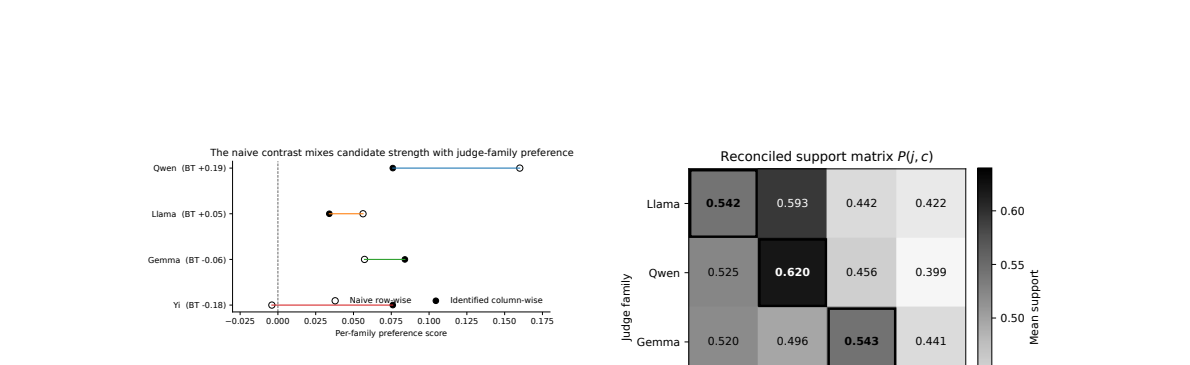
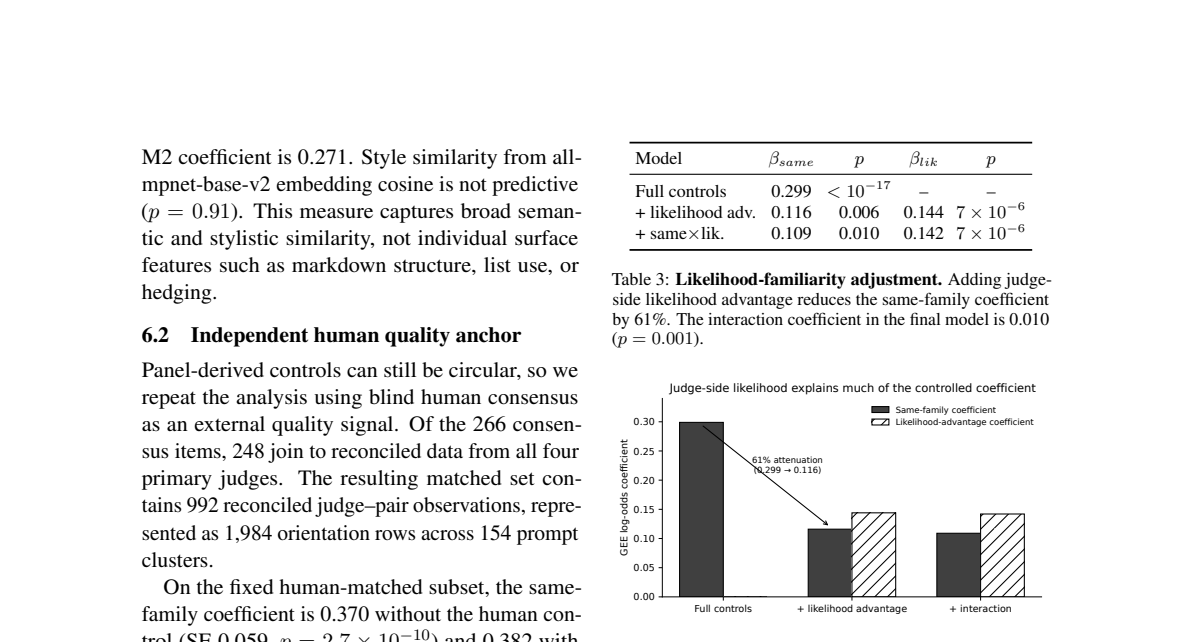
We study four open-weight families (Llama 3.1, Qwen 2.5, Gemma 2, and Yi 1.5) in a fully crossed pairwise design with 9,312 judgments. A common per-family statistic is strongly confounded with candidate quality and correlates with Bradley-Terry ability at r = 0.95. We derive a corrected estimator that holds the candidate family fixed and compares judges. All four families then show a positive same-family lift (3.4-8.4 percentage points), with global FPS 0.067 (95% CI [0.053, 0.084], permutation p = 0.0002). The effect remains under panel-based quality controls, an independent human-consensus anchor, and a float16 judging replication. Judge-side likelihood is closely related to the effect: adding likelihood advantage reduces the controlled coefficient by 61%, which we treat as descriptive attenuation rather than causal mediation. Position is a separate failure mode. Across the panel, 55.4% of AB/BA pairs reverse, and reversal above 50% is incompatible with a simple independent content-noise model. Relative to a family-balanced reference, panel composition changes 18.5% of pairwise outcomes. A complete reproducibility archive has been prepared for public release.
from the abstract
Pith says
Machine review · deepseek-v4-flash · 17 Sep 2026 · what was read was not recorded · not checked by a person
It can be wrong. Challenge this review or reply to it.
Holds up. A cleanly executed measurement paper that fixes a confound in LLM-as-judge family-preference studies, with strong empirical support and transparent limitations. This line is wrong
4 minor
How often objections from reviews like this one are right: not yet measured
Not checked: figures, code, what the 25 references say.
4 minor objections
The paper says, at References
Pith says: minor objection 1 of 4
The reference for Shi et al. (2025) typesets the last author as 'Soroush V osoughi' with an unintended space; please restore the name, presumably as 'Soroush Vosoughi'.
The paper says, at Section 9 / Appendix D
Pith says: minor objection 2 of 4
The full-precision replication reports 3,168 trials, while Appendix D calls this the pre-filter set and says Section 9 uses the 62 prompts remaining after the response-health filter; please state explicitly whether the reported global FPS of 0.066 is computed on the 66-prompt or the 62-prompt sample.
show 2 more
The paper says, at Section 4
Pith says: minor objection 3 of 4
The sentence that each judge row in P sums to 2.00 depends on P being a mean over the three opponent families rather than raw total support; please state that normalization in the main text so readers do not infer a row sum of 6.
The paper says, at Table 4
Pith says: minor objection 4 of 4
The row 'LOO judge (other removals) 0.071-0.091' should name which judges are removed in those cells (Llama, Gemma, and Yi separately) so the leave-one-out pattern is fully transparent.
What would settle it
Even though no concern was identified, a useful verification step would be to independently re-derive the column-wise estimator from the raw 9,312 trial-level data (without using the reconciled support matrix) to confirm that the sample-level analysis reproduces the headline FPS of 0.067 and the per-family values in Table 1. This is a standard reproducibility check.
from the skeptic's reading
How the review went
4 readings by deepseek-v4-flash · 17 Sep 2026
- Reader holds up
- Skeptic agrees
- Editor wrote the verdict above
- Referee accept: 4 minor
Not run on this paper: the simulated authors' defence.
Pith did not check this review's objections against the paper.
The review in full
The review in brief, machine-written
This paper does something simple and correct that should have been obvious but wasn't: it shows that the usual row-wise per-family preference contrast is r=0.95 correlated with candidate quality, then replaces it with a column-wise estimator that isolates the judge×candidate interaction. The headline result—all four families show a positive same-family lift, global FPS 0.067—is well-supported by the fully crossed design, 9,312 judgments, a clear mathematical derivation, and an unusually thorough robustness suite (human anchor, float16 replication, multiverse, leave-one-out, permutation tests). The likelihood-familiarity analysis is a nice mechanistic hint, and the paper is careful to call it descriptive rather than causal.
Weaknesses are minor and mostly acknowledged. The column-wise estimator assumes an additive model with double-centered constraints; the authors test it with permutation and the decomposition holds up, but it remains a modeling assumption. The 61% attenuation figure is correctly described as not causal, but some readers will mentally treat it as a mediation proportion anyway—the paper could be more aggressive about warning against that. The position-consistent FPS of 0.211 is clearly sensitivity evidence but could be mistaken by a less careful reader. No reproducibility archive is available at this writing (only 'prepared for release'), but the level of detail in the paper makes the claims checkable in principle.
Who this is for: anyone doing LLM-as-judge evaluation, especially if they use multi-model panels. The paper will change how people measure family bias and should be cited by future work in this space.
Recommendation: accept. The central claim is solid, the methodology is transparent, and the paper earns its space in the literature.
The strongest objection
I read the paper carefully. The central claim is well-supported by the column-wise estimator, extensive robustness checks, human anchor, likelihood analysis, float16 replication, confirmatory holdout, and multiverse analysis. The reader identified the additive model assumption as the weakest point, but this assumption is standard and the paper provides permutation evidence that supports the decomposition. The derivation of FPScol from the additive model with double-centered constraints is mathematically sound and yields an estimator that isolates the judge-candidate interaction. The permutation test (p=0.0002) and bootstrap CIs provide strong inferential support. No load-bearing concern that would undermine the central claim was found. The paper is thorough and transparent about limitations.
The paper presents a solid methodology for measuring family-conditioned preference. The reader correctly identifies the additive model as the weakest assumption, but this assumption is well-justified by the balanced design and supported by permutation tests and robustness checks. I found no additional load-bearing concerns that would justify changing the verdict. The central claim that all four families show positive same-family lifts is supported by multiple converging lines of evidence.
The referee's report
If the result holds, this is a useful methodological contribution: it corrects a common per-family measurement error in LLM-as-judge evaluation and demonstrates that evaluator provenance can change pairwise decisions at a scale comparable to many leaderboard gaps. The main strengths are the pre-specified confirmatory split, the transparent derivation of the confound in Equations (3)-(6), the non-circular column-wise estimator that compares judges on the same candidate, the independent human-consensus anchor in Section 6.2, and the prepared reproducibility archive containing judgments, likelihoods, and analysis artifacts. The additive-model assumption behind the interaction interpretation is the weakest point, but the permutation and residualization checks in Section 4.2 make it an acceptable modeling assumption rather than a load-bearing defect. I find no internal inconsistency or unsupported central claim in the manuscript.
Pith's reading of the paper (a machine's summary, not the authors')
This paper argues that LLM judges systematically favor candidate responses from their own model family, and that measuring this effect requires an estimator that separates judge-candidate interaction from candidate quality. In a fully crossed pairwise panel with 9,312 judgments across four open-weight families (Llama, Qwen, Gemma, Yi), the naive row-wise per-family statistic is strongly confounded with candidate ability (r=0.95). The paper derives a column-wise estimator that holds the candidate family fixed and compares judges, which isolates the interaction. With this corrected estimator, every tested family shows a positive same-family lift between 3.4 and 8.4 percentage points, yielding a global Family Preference Score (FPS) of 0.067 (95% CI [0.053, 0.084], permutation p=0.0002). The effect persists under panel-internal quality controls, an independent human-consensus anchor, and a float16 judging replication. Judge-side likelihood advantage accounts for 61% of the controlled coefficient, suggesting familiarity as a channel, though the paper treats this as descriptive attenuation rather than causal mediation. The paper also documents that 55.4% of AB/BA pairs reverse, which is incompatible with a simple content-noise model and indicates that position bias is a separate failure mode.
What carries the argument. The column-wise Family Preference Score (FPScol) is the central identifying device. It is defined for each family f as FPScol_f = P(f,f) - (1/3) * sum_{j != f} P(j,f), where P(j,c) is the mean reconciled support judge family j gives candidate family c. Under an additive model P(j,c)=μ+a_j+b_c+γ_jc with double-centered identification constraints, FPScol equals (4/3)γ_{ff}, isolating the judge-candidate interaction from the candidate main effect b_f that contaminates the row-wise contrast. This estimator asks the question: does candidate family f receive more support from its same-family judge than from the other judges?
Core claim. The paper establishes that LLM judges exhibit a measurable and robust family-conditioned preference: candidate responses receive systematically higher support when evaluated by a judge from the same model family, after correcting for candidate quality. The central discovery is methodological: the conventional row-wise per-family contrast (comparing a judge's support for its own family versus its support for other families) conflates candidate main effects with judge-candidate interactions and correlates near-perfectly with Bradley-Terry ability (r=0.95). By contrast, the column-wise Family Preference Score (FPScol)—which fixes the candidate family and compares the same-family judge against other judges—yields positive point estimates for all four families (Llama 0.034, Qwen 0.076, Gemma 0.084, Yi 0.076; all BH-corrected p<0.05). The paper further shows that the effect is not explained by measured quality differences, style similarity, or response length; survives an independent human-consensus anchor; and replicates in a float16 judging run. The association with judge-side likelihood advantage (61% coefficient attenuation) provides a plausible familiarity mechanism while leaving a significant residual family effect.
The premise it rests on. The column-wise estimator identifies the judge-candidate interaction under an additive model P(j,c)=μ+a_j+b_c+γ_jc with double-centered constraints, which assumes that candidate main effects and judge main effects are separable and that higher-order interactions are negligible; if the true data-generating process involves structural asymmetries (e.g., differential judge behavior on different candidate pairs beyond a simple interaction), the estimator may not isolate the intended preference.
If the paper is right (Pith's inferences, not the authors')
Panel-based LLM evaluation should use provenance-aware estimators, not naive row-wise per-family statistics, to avoid conflating candidate quality with bias.
Practitioners should record judge-side likelihoods for candidate responses; a large same-family likelihood gap is a warning signal for potential preference contamination.
AB/BA reversal rates above 50% are diagnostic of systematic position bias, which must be treated separately from family-conditioned preference; counterbalancing removes position-following but attenuates genuine preference signal on reversed pairs.
Panel composition matters: a family-unbalanced panel can change 18.5% of pairwise outcomes relative to a balanced reference, meaning leaderboard rankings can depend on who the judges are.
The observed 6.7 pp global lift exceeds the median adjacent gap in AlpacaEval 2.0 (1.09 pp), suggesting that family-conditioned preference is large relative to typical margins used to separate competing systems.
The column-wise estimator could be applied to other demographic or provenance attributes (e.g., training data overlap, geographic origin, or fine-tuning domain) to detect analogous interaction effects in LLM judge panels.
The result implies that multi-judge panels should be designed to maximize cross-family diversity, and that leave-one-family-out sensitivity analysis should become a standard robustness check in LLM-as-judge audits.
Because the residual family effect after controlling likelihood remains significant, familiarity alone does not fully explain the preference; unexplored mechanisms such as shared tokenization, instruction-following style, or response structure may contribute.
The paper's descriptive attenuation (61%) is not a causal proportion; a randomized experiment that manipulates response predictability while holding quality fixed would be needed to establish whether likelihood is a mediator or a confound.
Check this review
Pith stored no record of this review's passes and took no fingerprint of it. Reviews made by code from 13 Nov 2026 on carry both.
How often reviews like this one are right
Reviews like this one: written by deepseek-v4-flash, where what was read was not recorded.
How often objections from reviews like this one are right: not yet measured
Reviews by people
This review was written by a machine. No person has reviewed this paper on Pith yet. A scientist listed on Pith can review it for a fee, and their review is published here whatever it concludes.
How Pith checks papers · The full audit of this paper · Review history (20 versions)
The paper
Abstract
Who the judge is can affect an LLM-as-judge result, but measuring that effect without confusing it with candidate quality is difficult. We study four open-weight families (Llama 3.1, Qwen 2.5, Gemma 2, and Yi 1.5) in a fully crossed pairwise design with 9,312 judgments. A common per-family statistic is strongly confounded with candidate quality and correlates with Bradley-Terry ability at r = 0.95. We derive a corrected estimator that holds the candidate family fixed and compares judges. All four families then show a positive same-family lift (3.4-8.4 percentage points), with global FPS 0.067 (95% CI [0.053, 0.084], permutation p = 0.0002). The effect remains under panel-based quality controls, an independent human-consensus anchor, and a float16 judging replication. Judge-side likelihood is closely related to the effect: adding likelihood advantage reduces the controlled coefficient by 61%, which we treat as descriptive attenuation rather than causal mediation. Position is a separate failure mode. Across the panel, 55.4% of AB/BA pairs reverse, and reversal above 50% is incompatible with a simple independent content-noise model. Relative to a family-balanced reference, panel composition changes 18.5% of pairwise outcomes. A complete reproducibility archive has been prepared for public release.
The paper's own sentences, arranged, kept beside the review and separate from it. Each label is drawn from a closed vocabulary; the number beside it is the probability the classifier gave that label. No sentence in this record was written by a model.
abstract compiled · 2026-09-23
The authors' main claim, as the classifier picked it out 0.98
“All four families then show a positive same-family lift (3.4-8.4 percentage points), with global FPS 0.067 (95% CI [0.053, 0.084], permutation p = 0.0002).”
How the main claim is stated: asserted 1.00
What the abstract itself states, as probabilities: claims first 0.04 · states limitation 0.84 · human participants 0.29 · controlled comparison 0.86 · randomized assignment 0.11 · states quantitative result 0.99 · compares with prior results 0.73 · mentions code or data availability 0.89
The abstract, sentence by sentence
This table labels the abstract only (arXiv listing abstract v1). The number is the probability the classifier gave the label.
| Sentence | Role | The authors' own work | States the main conclusion | Strength |
|---|---|---|---|---|
| Who the judge is can affect an LLM-as-judge result, but measuring that effect without confusing it with candidate quality is difficult. | background 0.61 | 0.06 | 0.06 | asserted 0.79 |
| We study four open-weight families (Llama 3.1, Qwen 2.5, Gemma 2, and Yi 1.5) in a fully crossed pairwise design with 9,312 judgments. | method 0.84 | 0.96 | 0.03 | asserted 0.97 |
| A common per-family statistic is strongly confounded with candidate quality and correlates with Bradley-Terry ability at r = 0.95. | result 0.93 | 0.86 | 0.07 | asserted 1.00 |
| We derive a corrected estimator that holds the candidate family fixed and compares judges. | method 0.81 | 0.95 | 0.07 | asserted 1.00 |
| All four families then show a positive same-family lift (3.4-8.4 percentage points), with global FPS 0.067 (95% CI [0.053, 0.084], permutation p = 0.0002). | result 1.00 | 0.96 | 0.66 | asserted 1.00 |
| The effect remains under panel-based quality controls, an independent human-consensus anchor, and a float16 judging replication. | result 0.97 | 0.93 | 0.09 | asserted 1.00 |
| Judge-side likelihood is closely related to the effect: adding likelihood advantage reduces the controlled coefficient by 61%, which we treat as descriptive attenuation rather than causal mediation. | result 0.54 | 0.95 | 0.06 | asserted 0.98 |
| Position is a separate failure mode. | result 0.65 | 0.38 | 0.03 | asserted 0.99 |
| Across the panel, 55.4% of AB/BA pairs reverse, and reversal above 50% is incompatible with a simple independent content-noise model. | result 0.91 | 0.94 | 0.07 | asserted 1.00 |
| Relative to a family-balanced reference, panel composition changes 18.5% of pairwise outcomes. | result 1.00 | 0.92 | 0.12 | asserted 1.00 |
| A complete reproducibility archive has been prepared for public release. | contribution 0.83 | 0.80 | 0.02 | asserted 1.00 |
What kind of paper the classifier reports this is: empirical study 0.99 · evidence from observation or experiment 0.99
What was examined, and what was not
Sources read
- arXiv listing abstract v1
Not examined
- full text
- figures and tables
- references and citing sentences
- relations to other papers
Levels run
- P abstract
Not run
- S sections
- T body sentences
- C citations
- R cross-paper relations
How the labels were made
Compiled by classifier-1.13.0 via TypeSafe API, question bank abstract-p1-20260923, 2026-09-23: 1 request, 8,218 input tokens.
Every quoted sentence on this record is the authors'. Every label is from Pith's closed vocabulary, with the probability shown beside it. This record as JSON
Figures (3)
Showing 2 of the paper's 3 figures. Figures are the authors', reproduced from the paper.
References (25)
- [1] Wei-Lin Chen, Zhepei Wei, Xinyu Zhu, Shi Feng, and Yu Meng. 2025a. Do LLM evaluators prefer themselves for a reason? arXiv preprint arXiv:2504.03846 on PitharXiv
- [2] Zhi-Yuan Chen, Hao Wang, Xinyu Zhang, Enrui Hu, and Yankai Lin. 2025b. Beyond the Surface: Measuring Self-Preference in LLM Judgments. In Proceedings of EMNLP 2025, pages 1653--1672 on Pith
- [3] Yann Dubois, Balazs Galambosi, Percy Liang, and Tatsunori B. Hashimoto. 2024. Length-controlled AlpacaEval: A simple way to debias automatic evaluators. arXiv preprint arXiv:2404.04475 on PithPith's reviewarXiv
- [4] Shashwat Goel, Joschka Struber, Ilze Amanda Auzina, Karuna K. Chandra, Ponnurangam Kumaraguru, Douwe Kiela, Ameya Prabhu, Matthias Bethge, and Jonas Geiping. 2025. Great Models Think Alike and this Undermines AI Oversight. In Proceedings of the 42nd International Conference on... on Pith
- [5] Santiago Gonzalez et al. 2026. QEDBENCH: Quantifying the alignment gap in automated evaluation of university-level mathematical proofs. arXiv preprint arXiv:2602.20629 on PithPith's reviewarXiv
- [6] Guneet Kohli. 2026. Nine judges, two effective votes: Correlated errors undermine LLM evaluation panels. arXiv preprint arXiv:2605.29800 on PithPith's reviewarXiv
- [7] J. Richard Landis and Gary G. Koch. 1977. The measurement of observer agreement for categorical data. Biometrics, 33(1):159--174 on Pith
- [8] Dawei Li, Renliang Sun, Yue Huang, Ming Zhong, Bohan Jiang, Jiawei Han, Xiangliang Zhang, Wei Wang, and Huan Liu. 2026. Preference Leakage: A Contamination Problem in LLM-as-a-Judge. In International Conference on Learning Representations on Pith
- [9] Bill Yuchen Lin, Yuntian Deng, Khyathi Chandu, Faeze Brahman, Abhilasha Ravichander, Valentina Pyatkin, Nouha Dziri, Ronan Le Bras, and Yejin Choi. 2025. WildBench: Benchmarking LLMs with challenging tasks from real users in the wild. In International Conference on Learning Re... on Pith
- [10] Yiqi Liu, Nafise Moosavi, and Chenghua Lin. 2024. LLMs as narcissistic evaluators: When ego inflates evaluation scores. In Findings of ACL 2024, pages 12688--12701 on Pith
- [11] Erlis Lushtaku, Bora Kargi, Ali Elganzory, Fabio Ferreira, Alejandro R. Salamanca, Julia Kreutzer, and David Salinas. 2026. JudgeArena: A Unified Framework for Reproducible LLM-Judge Evaluation. arXiv preprint arXiv:2608.02620 on PithPith's reviewarXiv
- [12] Masanari Oi, Masahiro Kaneko, Ryuto Koike, Mengsay Loem, and Naoaki Okazaki. 2024. Likelihood-based Mitigation of Evaluation Bias in Large Language Models. In Findings of ACL 2024, pages 3237--3245 on Pith
- [13] Arjun Panickssery, Samuel R. Bowman, and Shi Feng. 2024. LLM evaluators recognize and favor their own generations. In Advances in Neural Information Processing Systems, volume 37 on Pith
- [14] Jose Pombal, Ricardo Rei, and Andre F. T. Martins. 2026. Self-preference bias in rubric-based evaluation of large language models. arXiv preprint arXiv:2604.06996 on PithPith's reviewarXiv
- [15] Lin Shi, Chiyu Ma, Wenhua Liang, Xingjian Diao, Weicheng Ma, and Soroush Vosoughi. 2025. Judging the Judges: A Systematic Study of Position Bias in LLM-as-a-Judge. In Proceedings of IJCNLP-AACL, pages 292--314 on Pith
- [16] Sadman Kabir Soumik. 2026. Judging the Judges: A Systematic Evaluation of Bias Mitigation Strategies in LLM-as-a-Judge Pipelines. Transactions on Machine Learning Research on Pith
- [17] Evangelia Spiliopoulou, Riccardo Fogliato, Hanna Burnsky, Tamer Soliman, Jie Ma, Graham Horwood, and Miguel Ballesteros. 2025. Play Favorites: A Statistical Method to Measure Self-Bias in LLM-as-a-Judge. arXiv preprint arXiv:2508.06709 on PithPith's reviewarXiv
- [18] Rickard Stureborg, Dimitris Alikaniotis, and Yoshi Suhara. 2024. Large language models are inconsistent and biased evaluators. arXiv preprint arXiv:2405.01724 on PithPith's reviewarXiv
- [19] Hiroyasu Usami, Keisuke Hara, Ayato Tsuboi, and Naohiko Matsuda. 2026. LLM Judges Have Dark Current: A Psychometric Datasheet for LLM-as-a-Judge Evaluation. arXiv preprint arXiv:2606.15610 on PithPith's reviewarXiv
- [20] Pat Verga, Sebastian Hofstatter, Sophia Althammer, Yixuan Su, Aleksandra Piktus, Arkady Arkhangorodsky, Minjie Xu, Naomi White, and Patrick Lewis. 2024. Replacing Judges with Juries: Evaluating LLM Generations with a Panel of Diverse Models. arXiv preprint arXiv:2404.18796 on PithPith's reviewarXiv
show 5 more
- [21] Peiyi Wang, Lei Li, Liang Chen, Zefan Cai, Dawei Zhu, Binghuai Lin, Yunbo Cao, Lingpeng Kong, Qi Liu, Tianyu Liu, and Zhifang Sui. 2024. Large language models are not fair evaluators. In Proceedings of ACL 2024, pages 9440--9450 on Pith
- [22] Koki Wataoka, Tsubasa Takahashi, and Ryokan Ri. 2024. Self-preference bias in LLM-as-a-Judge. arXiv preprint arXiv:2410.21819 on PithPith's reviewarXiv
- [23] Jinming Yang, Zheng Hu, Chuxian Qiu, Zhenyu Deng, Xinshan Jiao, and Tao Zhou. 2026a. Quantifying and mitigating self-preference bias of LLM judges. arXiv preprint arXiv:2604.22891 on PithPith's reviewarXiv
- [24] Zongyou Yang, Yinghan Hou, and Xiaokun Yang. 2026b. When the Judge Changes, So Does the Measurement: Auditing LLM-as-Judge Reliability. arXiv preprint arXiv:2607.08535 on PithPith's reviewarXiv
- [25] Lianmin Zheng, Wei-Lin Chiang, Ying Sheng, Siyuan Zhuang, Zhanghao Wu, Yonghao Zhuang, Zi Lin, Zhuohan Li, Dacheng Li, Eric P. Xing, Hao Zhang, Joseph E. Gonzalez, and Ion Stoica. 2023. Judging LLM-as-a-Judge with MT-Bench and Chatbot Arena. In Advances in Neural Information P... on Pith
Cited by 2 Pith papers
Reviewed papers on Pith that cite this one. The full citation record
Challenges and discussion
Disagree with the review, or know something it missed? Leave a comment, or challenge this review formally: a challenge becomes a permanent entry in this paper's record, and its decision is published here.
Come back by email
A short list of the week's newly reviewed papers. Nothing is sent until you confirm from your inbox, and every email has a link that stops it. No account.
No comments yet.
Sign in to comment