Computation and Language · arXiv:2609.30652 v1 · submitted 25 Sep 2026 · 40 references
Recursive Self-Improvement via On-Policy Distillation for Reasoning
The paper says
“On-policy distillation (OPD) trains a student model by having it generate trajectories, then matching its next-token predictions with an external teacher's next-token predictions. This provides dense, token-level supervision to the student.”
more of the abstract
On-policy self-distillation (OPSD) eliminates the need for the external teacher. Specifically, a second frozen copy of the student model, now given the ground truth in its context, serves as the teacher. The student model only receives the problem and learns to mimic the privileged teacher model, while the teacher remains frozen throughout training. Previous work showed that freezing the teacher is useful for training stability, but we argue that this can prevent the teacher from incorporating the improvements learned by the student during training. Our primary contribution is to address this limitation with a recursive framework built around two complementary components. First, we let the privileged teacher co-evolve with the student so that revision learned in one round can guide the next, a process we refer to as Dynamic Co-Evolution (DCE). Second, because stronger revision can also make responses too verbose and self-critical, we additionally train on shorter, verified rewrites of the model's own on-policy responses. We call this complementary objective Self-Refined Concise Learning (SRCL). Overall, our comprehensive evaluations show that DCE+SRCL outperforms OPSD across multiple model scales and four competition-level mathematics benchmarks. Specifically, on Qwen3-8B, DCE+SRCL reaches 65.97% Average@12, outperforming OPSD by 35.62 percentage points while reducing mean output length by 7.80% relative to DCE alone.
from the abstract
Pith says
Machine review · deepseek-v4-flash · 28 Sep 2026 · what was read was not recorded · not checked by a person
It can be wrong. Challenge this review or reply to it.
Holds up, with conditions. A genuinely useful extension of OPSD (co-evolving teacher plus concision objective) whose headline gain is mostly token length; the real residual signal is a thin single-seed 6.6 pp at 8K, but the 16K matched budget reads stronger. This line is wrong
5 major objections · 5 minor
How often objections from reviews like this one are right: not yet measured
Not checked: figures, code, what the 40 references say.
The paper says, at §5.8, Table 6
The review did not quote this passage.
Pith says: Objection 1 of 5 · major
The matched-budget comparison couples the training effect with a continuation-protocol asymmetry. DCE+SRCL under budget is evaluated with the 'Cue' continuation instruction, while the OPSD control is extended with the 'Wait'-based TTS procedure. Because Cue and Wait differ in prompt content and likely in effectiveness, the residual (+6.6 pp at 8K, +26.9 pp at 16K) could be partly a protocol effect rather than a training effect.
more of objection 1
Please run OPSD under the identical Cue protocol at the same budgets, and also report DCE+SRCL under the identical TTS/Wait protocol, so that training and continuation mechanism are not confounded.
The paper says, at §5.1, §5.8, Table 24
The review did not quote this passage.
Pith says: Objection 2 of 5 · major
Every core number — the table 1 headline, the table 6 matched-budget residuals, and the table 13 teacher-refresh comparison — comes from a single seed (seed 42) with no error bars, on 30-problem benchmarks with 12 samples each (n=360 per benchmark).
more of objection 2
A 6.6 pp residual at 8K is within plausible sampling noise for this sample size. Report at least 3 seeds with mean and standard error for (a) the 8B OPSD vs DCE+SRCL comparison, (b) the 8K/16K matched-budget residuals, and (c) the frozen-vs-dynamic teacher comparison; otherwise the load-bearing residual claim is not statistically grounded.
The paper says, at §5.6, Table 13
The review did not quote this passage.
Pith says: Objection 3 of 5 · major
The frozen-vs-dynamic teacher comparison is length-confounded, and the claim that 'updating the teacher every round outperforms frozen' is not established at matched budget. The frozen 8B run peaks at 41.04% with 8,723 mean tokens under 32K decoding, whereas DCE+SRCL under the 8K budget reaches 35.07% with 7,500 tokens; at approximately matched output budgets the frozen-teacher model is not worse.
more of objection 3
The 24.9 pp gap in table 13 may therefore be largely a length effect. Apply the same 8K/16K budget controls to the frozen-teacher checkpoints (and to the EMA/periodic variants) before concluding that co-evolution itself is the driver.
The paper says, at §5.3, Eq. (3), Fig. 4
The review did not quote this passage.
Pith says: Objection 4 of 5 · major
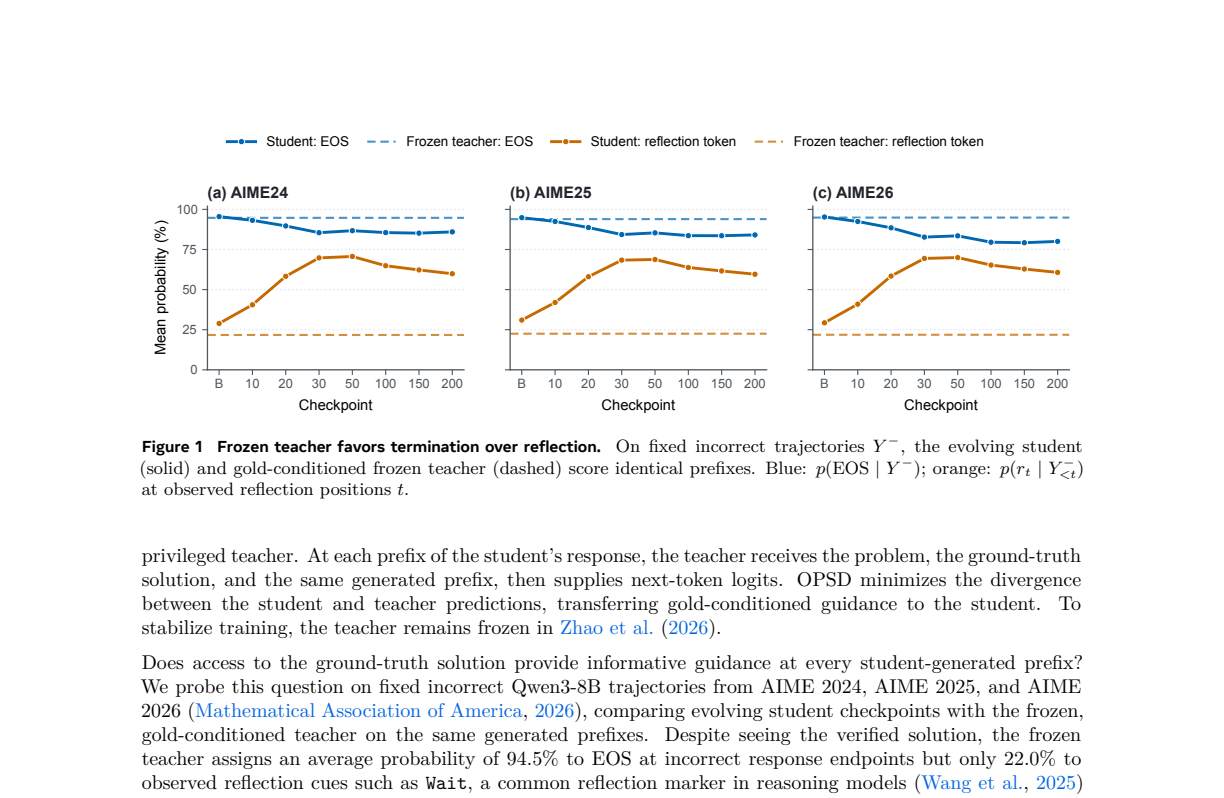
The mechanism attribution is weaker than the prose ('the privileged teacher learns to provide stronger revision guidance') because the teacher and student share the same parameters θk with a stop-gradient (eq. 3): the teacher's falling p(EOS) and rising p(rt) in fig. 4 can simply mirror the student's own improvement on the same weights, conditioned differently.
more of objection 4
The table 18 KL/ΔNLL diagnostics are the right direction but are measured on the paper's own stored trajectories and are correlational. Provide a discriminator that separates gold-conditioning from shared-weight improvement — for example, measure whether gold-conditioning adds likelihood beyond what the student's own evolving distribution already assigns, and test causal accuracy impact by ablating the gold-conditioned teacher branch (e.g., a frozen-gold teacher at later checkpoints) in a matched-budget setting.
The paper says, at Abstract, Conclusion, §5.1
The review did not quote this passage.
Pith says: Objection 5 of 5 · major
The headline '+35.62 pp' (b11) is dominated by the roughly three-fold output-length gap between DCE+SRCL (17,561 tokens) and OPSD (6,009 tokens); leading with it misrepresents the result, since the honest matched-budget residual is +6.6 pp at 8K and +26.9 pp at 16K.
more of objection 5
Reframe the abstract and conclusion around the matched-budget residuals, and explain the strong nonlinearity of the residual in budget — it is surprising that doubling the budget from 8K to 16K multiplies the residual by roughly four — since that nonlinearity is itself part of the evidence about what training induces.
5 minor objections
The paper says, at Abstract
Pith says: minor objection 1 of 5
Grammar slip: 'we let the privileged teacher to co-evolve with the student' should read 'we let the privileged teacher co-evolve with the student'.
The paper says, at §5.1, Tables 11–12, Table 19
Pith says: minor objection 2 of 5
Each method reports its best checkpoint (e.g., OPSD at step 100, frozen at step 50, DCE+SRCL at step 100/200), and checkpoint selection is done on the test benchmarks with a single seed. State the selection rule explicitly and, ideally, report a curve-average or a fixed early-stopping rule; best-of-checkpoint selection with one seed risks overfitting the selection itself.
show 3 more
The paper says, at §F, Table 19
Pith says: minor objection 3 of 5
The 1.7B DCE+SRCL trajectory collapses to 1.53% at step 200 after peaking at 26.88%; the main text should state the early-stopping criterion used and note that this instability is part of the reported result rather than only a footnote in an appendix.
The paper says, at §D, after Table 15
Pith says: minor objection 4 of 5
The sentence 'Because each schedule is represented by one training trajectory, small differences should not be overinterpreted' (b376) is an important caveat; it should appear in the main text near table 13, not buried in the appendix, and it reinforces major comment 2.
The paper says, at Fig. 1 caption
Pith says: minor objection 5 of 5
The figure claims the student and frozen teacher 'score identical prefixes'; clarify in the caption that the two branches receive different conditioning (with versus without the gold solution) even though the generated prefix is identical.
What would settle it
Run a matched-budget frozen-teacher ablation at the 8K target with identical Cue decoding: freeze θ0, train OPSD-style with SRCL, truncate/cue to 8K, and compare Average@12 against DCE+SRCL Cue (35.07%, table 6). If frozen+SRCL Cue at 8K lands within ~2 pp of 35.07%, co-evolution is not the driver. Independently, repeat the DCE+SRCL Cue vs OPSD-TTS 8K comparison across 5 seeds and report the seed-to-seed spread of the 6.6 pp lead; if the lead is not consistently positive, the mechanism attribution fails within noise.
from the skeptic's reading
How the review went
4 readings by deepseek-v4-flash · 28 Sep 2026
- Reader holds up, with conditions
- Skeptic partly agrees
- Editor wrote the verdict above
- Referee major revision: 5 major objections, 5 minor
Not run on this paper: the simulated authors' defence.
Pith did not check this review's objections against the paper.
The review in full
The review in brief, machine-written
Worth your time, and worth a serious referee. The core idea — refresh the privileged teacher from the current student each round instead of freezing it at the base checkpoint — is a genuine extension of OPSD, and the SRCL concision objective is a sensible complement. The reviewer's framing is right that the +35.62 pp headline is largely a token-length artifact: at 32K, DCE+SRCL emits roughly three times the tokens of OPSD. But the paper is not hiding this. The matched-budget controls are in table 6, and the abstract's own contribution bullet reports the honest 6.6 pp at 8K. The 16K matched comparison actually reads stronger than the stress test suggests: DCE+SRCL with the Cue condition is 57.64 vs 30.76 for OPSD-TTS, a ~27 pp gap at matched budget. So the mechanism signal is not just the 6.6 pp; it is mixed, and the paper reports both numbers plainly. What it does well: careful ablation structure (teacher-update schedules, placement, divergence direction, loss weights), matched-budget controls, transfer to Gemma, and unusually honest about its own limits — it flags that schedule differences are single-trajectory (b376) and that the KL/ΔNLL probes are correlational and per-trajectory (b400, b408). The SRCL-alone ablation collapsing to ~2% is informative and reassuring. Token counts are reported everywhere, which makes the length confound auditable. Where it is genuinely soft. First, a single seed (42), zero error bars, 30-problem benchmarks at 12 samples each. Fine for a first pass, thin for the load-bearing residual claim. Second, the evaluation problems are public and the training shard's disjointness from AIME/HMMT is never shown; the large AIME26 gains make this a real leakage risk that should be addressed directly. Third, the mechanism attribution is weaker than the prose suggests. In eq 3, teacher and student share parameters θk and differ only by gold conditioning, so the teacher's rising p(rt) (32.8% to 77.4%) and falling p(EOS) largely mirror the student's own improvement through shared weights. The discriminator that would establish the mechanism — whether gold conditioning adds information beyond the student's own evolving distribution — is table 18's ΔNLL, which the authors themselves call training-dynamics evidence rather than causal (b408). The frozen-teacher ablation (table 16) is also budget-mismatched (8,723 vs 17,561 tokens), so it cannot cleanly separate refresh from length. None of this is disqualifying. The direction of the result is probably right — co-evolution likely does help — but the magnitude and the attribution are not yet nailed down. The fixes are cheap: more seeds, CIs, a data-split disclosure, and a cleaner test of whether gold conditioning beats the shared-weight baseline. I'd send it to review and push for those in revision.
The strongest objection
The paper's central mechanistic claim (b142: 'the primary accuracy gains come from dynamic co-evolution') is the load-bearing assertion. The evidence for it decomposes into two layers. First, the headline DCE-vs-OPSD comparison at 32K is heavily length-confounded: DCE+SRCL emits 17,561 tokens vs 6,009 for OPSD (table 1). The paper's own matched-budget control (table 6) is the honest corrective, and there the lead over OPSD-TTS at 8K collapses to 35.07% vs 28.47% (+6.6 pp). That residual is the entire empirical skeleton of the mechanism claim, but it is reported without error bars, from a single seed (seed 42, table 24), on 30-problem benchmarks with 12 samples each (n=1,440 total). Second, the structural evidence that the teacher actually learns better revision (fixed-trace probes, eq 8, fig 4) is weaker than it appears: in eq 3, qk,t := stopgrad[p_θk(·|C)], so the teacher and student are the same parameters θk, differing only by gold-in-context conditioning. The observed rise in teacher p(rt) (32.8% to 77.4%) and fall in teacher p(EOS) (90.4% to 41.3%) is therefore largely a mirror of the student's own improvement on shared weights, not independent evidence of a distinct 'teacher learns to revise better' mechanism. The discriminator that would establish the mechanism is whether gold-conditioning adds information beyond the student's own evolving distribution (the KL/ΔNLL in table 18), and whether that added information causally improves accuracy. Table 18 is measured on the paper's own stored correct trajectories and is explicitly correlational (b400, b408). The consequence: the co-evolution attribute rests on a 6.6 pp single-seed matched-budget residual, while the frozen-teacher ablation (table 13) is again budget-mismatched (8,723 vs 17,561 tokens), so it cannot separate teacher refresh from length.
The reader's weakest_assumption (token-length artifact behind the headline gain) is well-supported and I agree it is the correct locus, but I push it one step further. The reader treats the matched-budget controls as 'narrowing but not closing' the gap; I argue the load-bearing fragility is that the entire mechanistic attribution to dynamic co-evolution rests on (i) a 6.6 pp single-seed residual at 8K and (ii) fixed-trace probes that are weakened by the fact that teacher and student share weights in eq 3, so the teacher's improved p(rt)/p(EOS) largely mirrors the student's own change. This makes the claim 'the privileged teacher learns to provide stronger revision guidance' (b47) under-determined even though the raw empirical win may be real. The paper is otherwise strong: careful ablations (placement table 16, refresh schedules table 13, objective comparison table 4), honest matched-budget reporting (table 6, 23), length-cost acknowledgments (b40-b41), and single-trajectory caveats (b376). I find no disqualifying flaw; the concern is about the strength of the mechanism attribution, which argues for keeping CONDITIONAL rather than moving to ACCEPT or REJECT. I partially agree with the reader because I converge on the length-attribution issue but locate the decisive weakness in the probe's shared-weight construction and the unmatched frozen-teacher ablation, which the reader's list mentions only in passing.
The referee's report
If the matched-budget residuals are reproducible, the recipe — refresh the privileged teacher each round, distill gold-conditioned guidance along the student's own rollouts, and add concise verified rewrites — is a cheap, scalable post-training alternative to RLVR for verifiable reasoning. The paper's strengths are real: it ships honest matched-budget controls, a careful teacher-refresh-schedule ablation (tables 13–15), a placement ablation separating refresh from prompt serialization (table 16), a self-audited SRCL acceptance filter (table 27), and detailed reproducibility settings (table 24). These are the right experiments, and several of the paper's own cautions (single-trajectory schedule comparisons, KL not being a correctness measure, table 18 being non-causal) show methodological self-awareness. The weakness is statistical and attributive: all headline numbers come from one seed with no error bars on 30-problem benchmarks, and the claim that the teacher 'learns better revision guidance' is compromised by the fact that teacher and student share the same weights (eq. 3, stopgrad).
Pith's reading of the paper (a machine's summary, not the authors')
On-policy self-distillation trains a student to match the next-token predictions of a privileged teacher that is given the ground-truth solution. The paper's central claim is that freezing that teacher caps what the student can learn, because the teacher cannot acquire the very behaviors student improves at. The authors therefore co-evolve the teacher with the student each round and add a companion objective that trains on shorter, verified self-rewrites. Across four competition-level math benchmarks and several model sizes, the combination beats the frozen-teacher baseline by a wide margin, with the bulk of the gain attributed to the co-evolving teacher rather than to longer generation.
What carries the argument. The central object is a recursive two-role loop in which one checkpoint fills both the student, conditioning only on the problem, and the detached gold-conditioned privileged teacher, conditioning additionally on the verified solution, with gradients stopped through the teacher branch. Each round the student samples an on-policy rollout, Forward KL pushes its next-token distribution toward the teacher's on those same prefixes, SRCL cross-entropy trains the same checkpoint on accepted concise rewrites, and the updated checkpoint re-initializes both roles. The detach-plus-refresh step is what carries the recursive self-improvement, and assistant-side placement of the verified solution in the assistant turn is the authors' preferred representation of privileged context.
Core claim. The paper claims that a frozen, gold-conditioned privileged teacher assigns high probability to stopping at incorrect endpoints but low probability to reflection cues, so its guidance grows misaligned with the evolving student. Its framework, Dynamic Co-Evolution (DCE), refreshes the detached privileged teacher from each updated checkpoint, so that revision learned in one round shapes the next round's supervision, in a recursive loop. Self-Refined Concise Learning (SRCL) complements DCE by training on accepted rewrites of the model's own on-policy responses that are shorter, reflection-free, and answer-correct, countering the verbosity that stronger revision brings. On Qwen3-8B the authors report DCE+SRCL reaching 65.97% Average@12, compared with 30.35% for OPSD, with similar margins at other scales, and matched-budget controls indicating that longer generation alone does not explain the gains.
The premise it rests on. The load-bearing premise is that the accuracy gains come from co-evolving the teacher rather than from the much longer outputs that co-evolution induces, since at the headline setting DCE emits roughly three times the tokens of OPSD and the gap narrows sharply under an 8K budget.
If the paper is right (Pith's inferences, not the authors')
If correct, the result makes a refreshed privileged teacher a practical post-training recipe for verifiable reasoning without step-level labels or a separate verifier.
The fixed-trace probes suggest that co-evolution changes the teacher itself, lowering its endpoint EOS probability and raising its probability on observed reflection tokens, which would transfer revision capability across rounds.
The tight-budget results imply learned revision behavior is useful at modest inference budgets, where simply forcing longer generation helps little.
The EOS-penalty ablation indicates that learning from concise verified rewrites preserves accuracy better than directly pressuring the model to stop early.
An unstated consequence is that the method's gains may depend on the answer verifier being nearly perfect: the SRCL acceptance filter and the teacher's gold conditioning are only as reliable as the math_verify judge, and the comparative advantage could shrink on tasks with noisy or absent verification.
A natural testable extension is measuring how the recursive loop behaves on non-verifiable or open-ended tasks, since the ground-truth conditioning that motivates DCE is unavailable there.
A second extension is checking whether the co-evolution gains come from the teacher becoming better at revision or simply from the student's policy drift being tracked more closely; the fixed-trace probes are measured on stored trajectories and do not fully distinguish these.
Check this review
Pith stored no record of this review's passes and took no fingerprint of it. Reviews made by code from 13 Nov 2026 on carry both.
How often reviews like this one are right
Reviews like this one: written by deepseek-v4-flash, where what was read was not recorded.
How often objections from reviews like this one are right: not yet measured
Reviews by people
This review was written by a machine. No person has reviewed this paper on Pith yet. A scientist listed on Pith can review it for a fee, and their review is published here whatever it concludes.
The paper
Abstract
On-policy distillation (OPD) trains a student model by having it generate trajectories, then matching its next-token predictions with an external teacher's next-token predictions. This provides dense, token-level supervision to the student. On-policy self-distillation (OPSD) eliminates the need for the external teacher. Specifically, a second frozen copy of the student model, now given the ground truth in its context, serves as the teacher. The student model only receives the problem and learns to mimic the privileged teacher model, while the teacher remains frozen throughout training. Previous work showed that freezing the teacher is useful for training stability, but we argue that this can prevent the teacher from incorporating the improvements learned by the student during training. Our primary contribution is to address this limitation with a recursive framework built around two complementary components. First, we let the privileged teacher co-evolve with the student so that revision learned in one round can guide the next, a process we refer to as Dynamic Co-Evolution (DCE). Second, because stronger revision can also make responses too verbose and self-critical, we additionally train on shorter, verified rewrites of the model's own on-policy responses. We call this complementary objective Self-Refined Concise Learning (SRCL). Overall, our comprehensive evaluations show that DCE+SRCL outperforms OPSD across multiple model scales and four competition-level mathematics benchmarks. Specifically, on Qwen3-8B, DCE+SRCL reaches 65.97% Average@12, outperforming OPSD by 35.62 percentage points while reducing mean output length by 7.80% relative to DCE alone.
The paper's own sentences, arranged, kept beside the review and separate from it. Each label is drawn from a closed vocabulary; the number beside it is the probability the classifier gave that label. No sentence in this record was written by a model.
abstract compiled · 2026-09-28
The authors' main claim, as the classifier picked it out 1.00
“Overall, our comprehensive evaluations show that DCE+SRCL outperforms OPSD across multiple model scales and four competition-level mathematics benchmarks.”
How the main claim is stated: asserted 1.00
What the abstract itself states, as probabilities: claims first 0.07 · states limitation 0.40 · human participants 0.03 · controlled comparison 0.95 · randomized assignment 0.01 · states quantitative result 0.99 · compares with prior results 0.98 · mentions code or data availability 0.02
The abstract, sentence by sentence
This table labels the abstract only (arXiv listing abstract v1). The number is the probability the classifier gave the label.
| Sentence | Role | The authors' own work | States the main conclusion | Strength |
|---|---|---|---|---|
| On-policy distillation (OPD) trains a student model by having it generate trajectories, then matching its next-token predictions with an external teacher's next-token predictions. | background 0.96 | 0.10 | 0.02 | asserted 1.00 |
| This provides dense, token-level supervision to the student. | background 0.52 | 0.14 | 0.01 | asserted 1.00 |
| On-policy self-distillation (OPSD) eliminates the need for the external teacher. | background 0.59 | 0.16 | 0.03 | asserted 1.00 |
| Specifically, a second frozen copy of the student model, now given the ground truth in its context, serves as the teacher. | method 0.89 | 0.33 | 0.02 | asserted 1.00 |
| The student model only receives the problem and learns to mimic the privileged teacher model, while the teacher remains frozen throughout training. | method 0.78 | 0.22 | 0.02 | asserted 1.00 |
| Previous work showed that freezing the teacher is useful for training stability, but we argue that this can prevent the teacher from incorporating the improvements learned by the student during training. | gap 0.79 | 0.17 | 0.04 | asserted 0.62 |
| Our primary contribution is to address this limitation with a recursive framework built around two complementary components. | contribution 1.00 | 0.51 | 0.07 | asserted 0.93 |
| First, we let the privileged teacher co-evolve with the student so that revision learned in one round can guide the next, a process we refer to as Dynamic Co-Evolution (DCE). | contribution 0.76 | 0.90 | 0.07 | asserted 0.99 |
| Second, because stronger revision can also make responses too verbose and self-critical, we additionally train on shorter, verified rewrites of the model's own on-policy responses. | method 0.58 | 0.77 | 0.03 | asserted 0.60 |
| We call this complementary objective Self-Refined Concise Learning (SRCL). | contribution 0.52 | 0.82 | 0.03 | asserted 0.77 |
| Overall, our comprehensive evaluations show that DCE+SRCL outperforms OPSD across multiple model scales and four competition-level mathematics benchmarks. | result 0.99 | 0.96 | 0.80 | asserted 1.00 |
| Specifically, on Qwen3-8B, DCE+SRCL reaches 65.97% Average@12, outperforming OPSD by 35.62 percentage points while reducing mean output length by 7.80% relative to DCE alone. | result 1.00 | 0.96 | 0.25 | asserted 1.00 |
What kind of paper the classifier reports this is: method or tool 1.00 · evidence from observation or experiment 0.92
What was examined, and what was not
Sources read
- arXiv listing abstract v1
Not examined
- full text
- figures and tables
- references and citing sentences
- relations to other papers
Levels run
- P abstract
Not run
- S sections
- T body sentences
- C citations
- R cross-paper relations
How the labels were made
Compiled by classifier-1.13.0 via TypeSafe API, question bank abstract-p1-20260923, 2026-09-28: 1 request, 8,880 input tokens.
Every quoted sentence on this record is the authors'. Every label is from Pith's closed vocabulary, with the probability shown beside it. This record as JSON
Figures (7)


Figures are the authors', reproduced from the paper.
References (40)
- [1] Rishabh Agarwal, Nino Vieillard, Yongchao Zhou, Piotr Stanczyk, Sabela Ramos Garea, Matthieu Geist, and Olivier Bachem. On-policy distillation of language models: Learning from self-generated mistakes. In The Twelfth International Conference on Learning Representations, ICLR 2... on Pith
- [2] Bradley C. A. Brown, Jordan Juravsky, Ryan Ehrlich, Ronald Clark, Quoc V. Le, Christopher R \' e , and Azalia Mirhoseini. Large language monkeys: Scaling inference compute with repeated sampling. CoRR, abs/2407.21787, 2024. doi:10.48550/ARXIV.2407.21787. https://doi.org/10.485... on PithPith's reviewarXivdoi:10.48550/arxiv.2407.21787
- [3] Mehul Damani, Idan Shenfeld, Andi Peng, Andreea Bobu, and Jacob Andreas. Learning how hard to think: Input-adaptive allocation of LM computation. In The Thirteenth International Conference on Learning Representations, ICLR 2025, Singapore, April 24-28, 2025 . OpenReview.net, 2... on Pith
- [4] Hamed Firooz, Rui Liu, Yuchen Lu, Zhenyu Hou, Fangzhou Xiong, Xiaoyang Zhang, Changshu Jian, Zhicheng Zhu, Jiayuan Ma, Jacob Tao, et al. Scaling reinforcement learning for content moderation with large language models. CoRR, abs/2512.20061, 2025. doi:10.48550/ARXIV.2512.20061.... on Pithdoi:10.48550/arxiv.2512.20061
- [5] Kanishk Gandhi, Ayush Chakravarthy, Anikait Singh, Nathan Lile, and Noah D. Goodman. Cognitive behaviors that enable self-improving reasoners, or, four habits of highly effective stars. CoRR, abs/2503.01307, 2025. doi:10.48550/ARXIV.2503.01307. https://doi.org/10.48550/arXiv.2... on PithPith's reviewarXivdoi:10.48550/arxiv.2503.01307
- [6] Soumya Suvra Ghosal, Souradip Chakraborty, Avinash Reddy, Yifu Lu, Mengdi Wang, Dinesh Manocha, Furong Huang, Mohammad Ghavamzadeh, and Amrit Singh Bedi. Does thinking more always help? mirage of test-time scaling in reasoning models. In Danielle Belgrave, Cheng Zhang, Laura N... on Pith
- [7] Etash Kumar Guha, Ryan Marten, Sedrick Keh, Negin Raoof, Georgios Smyrnis, Hritik Bansal, Marianna Nezhurina, Jean Mercat, Trung Vu, Zayne Sprague, et al. Openthoughts: Data recipes for reasoning models. CoRR, abs/2506.04178, 2025. doi:10.48550/ARXIV.2506.04178. https://doi.or... on PithPith's reviewarXivdoi:10.48550/arxiv.2506.04178
- [8] C aglar G \" u l c ehre, Tom Le Paine, Srivatsan Srinivasan, Ksenia Konyushkova, Lotte Weerts, Abhishek Sharma, Aditya Siddhant, Alex Ahern, Miaosen Wang, Chenjie Gu, et al. Reinforced self-training (rest) for language modeling. CoRR, abs/2308.08998, 2023. doi:10.48550/ARXIV.2... on PithPith's reviewarXivdoi:10.48550/arxiv.2308.08998
- [9] Daya Guo, Dejian Yang, Haowei Zhang, Junxiao Song, Peiyi Wang, Qihao Zhu, Runxin Xu, Ruoyu Zhang, Shirong Ma, Xiao Bi, et al. Deepseek-r1 incentivizes reasoning in llms through reinforcement learning. Nat., 645 0 (8081): 0 633--638, 2025. doi:10.1038/S41586-025-09422-Z. https:... on Pithdoi:10.1038/s41586-025-09422-z
- [10] Harvard--MIT Mathematics Tournament . Past tournaments, 2026. https://www.hmmt.org/www/archive/problems. Accessed August 26, 2026 on Pith
- [11] Dan Hendrycks, Collin Burns, Saurav Kadavath, Akul Arora, Steven Basart, Eric Tang, Dawn Song, and Jacob Steinhardt. Measuring mathematical problem solving with the MATH dataset. In Joaquin Vanschoren and Sai - Kit Yeung, editors, Proceedings of the Neural Information Processi... on Pith
- [12] Edward J. Hu, Yelong Shen, Phillip Wallis, Zeyuan Allen - Zhu, Yuanzhi Li, Shean Wang, Lu Wang, and Weizhu Chen. Lora: Low-rank adaptation of large language models. In The Tenth International Conference on Learning Representations, ICLR 2022, Virtual Event, April 25-29, 2022 .... on Pith
- [13] Jie Huang, Xinyun Chen, Swaroop Mishra, Huaixiu Steven Zheng, Adams Wei Yu, Xinying Song, and Denny Zhou. Large language models cannot self-correct reasoning yet. In The Twelfth International Conference on Learning Representations, ICLR 2024, Vienna, Austria, May 7-11, 2024 . ... on Pith
- [14] Andrew Lee, Lihao Sun, Chris Wendler, Fernanda B. Vi \' e gas, and Martin Wattenberg. The geometry of self-verification in a task-specific reasoning model. CoRR, abs/2504.14379, 2025. doi:10.48550/ARXIV.2504.14379. https://doi.org/10.48550/arXiv.2504.14379 on PithPith's reviewarXivdoi:10.48550/arxiv.2504.14379
- [15] Hunter Lightman, Vineet Kosaraju, Yuri Burda, Harrison Edwards, Bowen Baker, Teddy Lee, Jan Leike, John Schulman, Ilya Sutskever, and Karl Cobbe. Let's verify step by step. In The Twelfth International Conference on Learning Representations, ICLR 2024, Vienna, Austria, May 7-1... on Pith
- [16] Zichen Liu, Changyu Chen, Wenjun Li, Penghui Qi, Tianyu Pang, Chao Du, Wee Sun Lee, and Min Lin. Understanding r1-zero-like training: A critical perspective. CoRR, abs/2503.20783, 2025. doi:10.48550/ARXIV.2503.20783. https://doi.org/10.48550/arXiv.2503.20783 on PithPith's reviewarXivdoi:10.48550/arxiv.2503.20783
- [17] Ilya Loshchilov and Frank Hutter. Decoupled weight decay regularization. In 7th International Conference on Learning Representations, ICLR 2019, New Orleans, LA, USA, May 6-9, 2019 . OpenReview.net, 2019. https://openreview.net/forum?id=Bkg6RiCqY7 on Pith
- [18] Kevin Lu and Thinking Machines Lab. On-policy distillation. Thinking Machines Lab: Connectionism, 2025. doi:10.64434/tml.20251026. https://thinkingmachines.ai/blog/on-policy-distillation on Pithdoi:10.64434/tml.20251026
- [19] Mathematical Association of America . MAA invitational competitions, 2026. https://maa.org/maa-invitational-competitions/. Accessed August 26, 2026 on Pith
- [20] Niklas Muennighoff, Zitong Yang, Weijia Shi, Xiang Lisa Li, Li Fei - Fei, Hannaneh Hajishirzi, Luke Zettlemoyer, Percy Liang, Emmanuel J. Cand \` e s, and Tatsunori Hashimoto. s1: Simple test-time scaling. In Christos Christodoulopoulos, Tanmoy Chakraborty, Carolyn Rose, and V... on Pith
show 20 more
- [21] Leyi Pan, Shuchang Tao, Yunpeng Zhai, Lingzhe Zhang, Zhaoyang Liu, Bolin Ding, Aiwei Liu, and Lijie Wen. RLCSD: reinforcement learning with contrastive on-policy self-distillation. CoRR, abs/2606.11709, 2026. doi:10.48550/ARXIV.2606.11709. https://doi.org/10.48550/arXiv.2606.11709 on PithPith's reviewarXivdoi:10.48550/arxiv.2606.11709
- [22] Qwen Team . Qwen3 technical report. CoRR, abs/2505.09388, 2025. doi:10.48550/ARXIV.2505.09388. https://doi.org/10.48550/arXiv.2505.09388 on PithPith's reviewarXivdoi:10.48550/arxiv.2505.09388
- [23] David Rein, Betty Li Hou, Asa Cooper Stickland, Jackson Petty, Richard Yuanzhe Pang, Julien Dirani, Julian Michael, and Samuel R. Bowman. GPQA: A graduate-level google-proof q & a benchmark. CoRR, abs/2311.12022, 2023. doi:10.48550/ARXIV.2311.12022. https://doi.org/10.48550/ar... on PithPith's reviewarXivdoi:10.48550/arxiv.2311.12022
- [24] Zhihong Shao, Peiyi Wang, Qihao Zhu, Runxin Xu, Junxiao Song, Xiao Bi, Haowei Zhang, Mingchuan Zhang, Y. K. Li, Y. Wu, et al. Deepseekmath: Pushing the limits of mathematical reasoning in open language models. CoRR, abs/2402.03300, 2024. doi:10.48550/ARXIV.2402.03300. https://... on PithPith's reviewarXivdoi:10.48550/arxiv.2402.03300
- [25] Noah Shinn, Federico Cassano, Ashwin Gopinath, Karthik Narasimhan, and Shunyu Yao. Reflexion: language agents with verbal reinforcement learning. In Alice Oh, Tristan Naumann, Amir Globerson, Kate Saenko, Moritz Hardt, and Sergey Levine, editors, Advances in Neural Information... on Pith
- [26] Charlie Victor Snell, Jaehoon Lee, Kelvin Xu, and Aviral Kumar. Scaling LLM test-time compute optimally can be more effective than scaling parameters for reasoning. In The Thirteenth International Conference on Learning Representations, ICLR 2025, Singapore, April 24-28, 2025 ... on Pith
- [27] Chenlong Wang, Yuanning Feng, Dongping Chen, Zhaoyang Chu, Ranjay Krishna, and Tianyi Zhou. Wait, we don't need to "wait"! removing thinking tokens improves reasoning efficiency. In Christos Christodoulopoulos, Tanmoy Chakraborty, Carolyn Rose, and Violet Peng, editors, Findin... on Pithdoi:10.18653/v1/2025.findings-emnlp.394
- [28] Yangzhen Wu, Zhiqing Sun, Shanda Li, Sean Welleck, and Yiming Yang. Inference scaling laws: An empirical analysis of compute-optimal inference for LLM problem-solving. In The Thirteenth International Conference on Learning Representations, ICLR 2025, Singapore, April 24-28, 20... on Pith
- [29] Chenxu Yang, Chuanyu Qin, Qingyi Si, Minghui Chen, Naibin Gu, Dingyu Yao, Zheng Lin, Weiping Wang, Jiaqi Wang, and Nan Duan. Self-distilled RLVR . CoRR, abs/2604.03128, 2026. doi:10.48550/ARXIV.2604.03128. https://doi.org/10.48550/arXiv.2604.03128 on PithPith's reviewarXivdoi:10.48550/arxiv.2604.03128
- [30] Shangjian Yin and Zhouxing Shi. From individual to common: An early exploration of consensus in non-verifiable data for balanced preference optimization. In Proceedings of the 64th Annual Meeting of the Association for Computational Linguistics (Volume 1: Long Papers), pages 3... on Pithdoi:10.18653/v1/2026.acl-long.1598
- [31] Shangjian Yin, Shining Liang, Wenbiao Ding, Yuli Qian, Zhouxing Shi, Hongzhi Li, and Yutao Xie. PIKA : Expert-level synthetic datasets for post-training alignment from scratch. CoRR, abs/2510.06670, 2025. doi:10.48550/ARXIV.2510.06670. https://arxiv.org/abs/2510.06670 on PithPith's reviewarXivdoi:10.48550/arxiv.2510.06670
- [32] Shangjian Yin, Yu Fu, Yue Dong, and Zhouxing Shi. GRLO : Towards generalizable reinforcement learning in open-ended environments from zero. CoRR, abs/2605.15464, 2026 a . doi:10.48550/ARXIV.2605.15464. https://arxiv.org/abs/2605.15464 on PithPith's reviewarXivdoi:10.48550/arxiv.2605.15464
- [33] Shangjian Yin, Zhepei Wei, Xinyu Zhu, Wei - Lin Chen, and Yu Meng. Aligning large language models via fully self-synthetic data. In Proceedings of the 64th Annual Meeting of the Association for Computational Linguistics (Volume 1: Long Papers), pages 34553--34568. Association ... on Pithdoi:10.18653/v1/2026.acl-long.1595
- [34] Qiying Yu, Zheng Zhang, Ruofei Zhu, Yufeng Yuan, Xiaochen Zuo, Yu Yue, Weinan Dai, Tiantian Fan, Gaohong Liu, Juncai Liu, et al. DAPO: an open-source LLM reinforcement learning system at scale. In Danielle Belgrave, Cheng Zhang, Laura N. Montoya, Hsuan - Tien Lin, Razvan Pasca... on Pith
- [35] Eric Zelikman, Yuhuai Wu, Jesse Mu, and Noah D. Goodman. Star: Bootstrapping reasoning with reasoning. In Sanmi Koyejo, S. Mohamed, A. Agarwal, Danielle Belgrave, K. Cho, and A. Oh, editors, Advances in Neural Information Processing Systems 35: Annual Conference on Neural Info... on Pith
- [36] Weihao Zeng, Yuzhen Huang, Qian Liu, Wei Liu, Keqing He, Zejun Ma, and Junxian He. Simplerl-zoo: Investigating and taming zero reinforcement learning for open base models in the wild. CoRR, abs/2503.18892, 2025. doi:10.48550/ARXIV.2503.18892. https://doi.org/10.48550/arXiv.2503.18892 on PithPith's reviewarXivdoi:10.48550/arxiv.2503.18892
- [37] Anqi Zhang, Yulin Chen, Jane Pan, Chen Zhao, Aurojit Panda, Jinyang Li, and He He. Reasoning models know when they're right: Probing hidden states for self-verification. CoRR, abs/2504.05419, 2025 a . doi:10.48550/ARXIV.2504.05419. https://doi.org/10.48550/arXiv.2504.05419 on PithPith's reviewarXivdoi:10.48550/arxiv.2504.05419
- [38] Zhenru Zhang, Chujie Zheng, Yangzhen Wu, Beichen Zhang, Runji Lin, Bowen Yu, Dayiheng Liu, Jingren Zhou, and Junyang Lin. The lessons of developing process reward models in mathematical reasoning. In Wanxiang Che, Joyce Nabende, Ekaterina Shutova, and Mohammad Taher Pilehvar, ... on Pith
- [39] Siyan Zhao, Zhihui Xie, Mengchen Liu, Jing Huang, Guan Pang, Feiyu Chen, and Aditya Grover. Self-distilled reasoner: On-policy self-distillation for large language models. CoRR, abs/2601.18734, 2026. doi:10.48550/ARXIV.2601.18734. https://doi.org/10.48550/arXiv.2601.18734 on PithPith's reviewarXivdoi:10.48550/arxiv.2601.18734
- [40] Xudong Zhu, Jiachen Jiang, Mohammad Mahdi Khalili, and Zhihui Zhu. From emergence to control: Probing and modulating self-reflection in language models. CoRR, abs/2506.12217, 2025. doi:10.48550/ARXIV.2506.12217. https://doi.org/10.48550/arXiv.2506.12217 on PithPith's reviewarXivdoi:10.48550/arxiv.2506.12217
Cited by 4 Pith papers
Reviewed papers on Pith that cite this one. OpenAlex reports about 6 citations worldwide. The full citation record
- Auditing the Product, Not the Recursion: The Evaluation Evidence Behind Recursive Self-Improvement Claims cs.LG · Oct 2026
- ECG-RSI: Recursive Self-Improvement through Targeted Electrocardiogram Waveform Evolution cs.AI · Oct 2026
- ART-MPG: Autoregressive R/T Manifold Path Guiding cs.LG · Oct 2026
- MMLA-RSI: Recursive Self-Improvement through RTT and RTMA cs.CL · Oct 2026
Challenges and discussion
Disagree with the review, or know something it missed? Leave a comment, or challenge this review formally: a challenge becomes a permanent entry in this paper's record, and its decision is published here.
Come back by email
A short list of the week's newly reviewed papers. Nothing is sent until you confirm from your inbox, and every email has a link that stops it. No account.
No comments yet.
Sign in to comment