Artificial Intelligence · arXiv:2609.30861 v1 · submitted 25 Sep 2026 · 14 references
SkillEvoReg: Regularizing Agent Skill Evolution Against Overfitting
The paper says
“Language-model agents increasingly improve by converting execution experience into reusable external skills.”
more of the abstract
Yet repeated skill updates form a learning process of their own: locally useful edits can accumulate into redundant or task-specific instructions, while new updates can disrupt behavior that previously worked. We study this problem as skill-evolution overfitting and introduce SkillEvoReg, a general regularization framework for skill evolution inspired by anti-overfitting techniques in neural-network training. SkillEvoReg combines training-time skill dropout, which perturbs update generation, and complexity-aware local regularization, which controls unnecessary structural growth, with causal counterexample validation (CCV), which provides targeted behavioral validation of candidate-specific regressions. We instantiate the framework across heterogeneous skill-evolution systems while retaining each system's native skill evolver and task evaluator. Across SkillOpt, SkillEvolBench, and ContinualSkillBench, SkillEvoReg consistently controls skill-state growth while preserving competitive downstream capability, improves several transfer and later-stage evolution outcomes, and identifies update-level regressions that structural metrics alone cannot reveal. These results suggest that explicit regularization is a useful complement to increasingly capable skill updaters.
from the abstract
Pith says
Machine review · deepseek-v4-flash · 28 Sep 2026 · what was read was not recorded · not checked by a person
It can be wrong. Challenge this review or reply to it.
Holds up, with conditions. The framework is a sensible idea and the paper is honest, but the comparative evidence does not clear the noise floor the paper itself documents. This line is wrong
4 major objections · 5 minor
How often objections from reviews like this one are right: not yet measured
Not checked: figures, code, what the 14 references say.
The paper says, at §5 / A.3 / E.3
The review did not quote this passage.
Pith says: Objection 1 of 4 · major
The single-trajectory statistical premise does not support the improvement claims. The paper honestly states in A.3 that 'Main comparisons use one evolved state per condition,' but the severity of this limitation relative to its own evidence is not acknowledged. The shared-prefix continuation (E.3, Table 17) shows two SkillEvoReg branches sharing a byte-identical state through step 30 and diverging to 59.25% …
more of objection 1
… versus 50.00% terminal test accuracy on the same 200 tasks: a 9.25pp spread, implying a per-run sampling SD of roughly 6.5pp under n=2. The headline deltas (Table 1: +3.75pp SpreadsheetBench delivery, +0.68pp SearchQA; Table 3: Overall +1.60 to +5.27pp) are within about one such SD, and the Table 3 Office deficit of 1.44pp is likewise within noise. I recommend running 3–5 independent seed trajectories per condition (the E.3 setup shows this is feasible) or explicitly relabeling all improvement claims as single-trajectory observations that may not survive seed variation.
The paper says, at §4.3 / A.3 Tables 1–3, 8
The review did not quote this passage.
Pith says: Objection 2 of 4 · major
The complexity measure C(S) of Equation 13 is used both as the training-time regularization signal (through f_comp, Section 4.3) and as the reported evaluation metric for the 'controls skill-state growth' claims, so those claims are partly circular. The hand-chosen weights in Equation 13 define the objective the regularizer minimizes, and the reported reductions (0.49x, 0.32x, 0.33x in Table 8) therefore partly reflect the regularizer minimizing its own target.
more of objection 2
The token-count reductions (Table 1: 6,060 to 2,341 tokens on SpreadsheetBench) provide a partially independent check, so the compactness claim is not wholly circular, but the complexity reductions specifically should be framed as partially self-referential. The Remark in Section 4.3 addresses intent (complexity as means, not objective), not the measurement circularity.
The paper says, at §5.5.2 / E.2
The review did not quote this passage.
Pith says: Objection 3 of 4 · major
The CCV claim that regressions can be detected 'beyond structural signals' is supported only by anecdotal evidence. The 12 regression signals and 9 repairs are drawn from single trajectories, and the only detailed instance is one representative SkillEvolBench trace. No quantitative comparison is made against a structural-only detector (for example, whether C(S) or token-change would flag these 12 events), and no precision/recall against a labeled set of regressions is reported.
more of objection 3
Either provide a systematic multi-trajectory comparison of CCV signals against structural signals, or temper the corresponding abstract claim.
The paper says, at §4.2–4.4 / Table 10
The review did not quote this passage.
Pith says: Objection 4 of 4 · major
The key free parameters have no reported sensitivity analysis. The complexity weights in Equation 13, the CCV regression thresholds (0.8, 0.05, 0.1 in Table 10), the dropout mask sampling distribution, and the growth budgets are all hand-chosen. Since several results are within noise (Table 3 Office) or are explicit trade-offs (LiveMath, C.1), the robustness of the conclusions to these settings is unexamined.
more of objection 4
At minimum, a sensitivity sweep of the CCV thresholds and of the SkillEvolBench second-pass growth budget should be reported, since these directly determine the CCV-confirmed regression count and the reported growth reductions.
5 minor objections
The paper says, at §3.1 / A.1
Pith says: minor objection 1 of 5
The structural-transfer set is hand-constructed (12/40 versus 5/40 multi-sheet workbooks in Table 5), so the widening IID–transfer gap may partly reflect the choice of stress-set construction; the paper scopes this honestly in A.1, but a sentence noting that the gap magnitudes are not directly comparable to naturally occurring distribution shift would help.
The paper says, at §5.3 / C.2
Pith says: minor objection 2 of 5
The 2-pass SkillEvolBench protocol is a novel extension of that benchmark, so its numbers are not directly comparable to published SkillEvolBench results; this is stated in C.2 but should appear in the main text near Table 2 to avoid reader confusion.
show 3 more
The paper says, at §4.4
Pith says: minor objection 3 of 5
The term 'causal' in CCV is explicitly operational (Section 4.4 Remark and b111), which is good; consider adding a footnote at first use to preempt reader confusion, since the term appears in the framework's name and in the contribution list.
The paper says, at §5.4 / Table 13
Pith says: minor objection 4 of 5
The evaluator-level breakdown shows the baseline winning on some categories (Healthcare EM 66.67 versus 62.50, Office Structured 78.57 versus 76.19); the phrase 'maintains comparable or better' in the Section 5.4 text should be checked against these category-level differences, which look like noise given the single-trajectory protocol.
The paper says, at General
Pith says: minor objection 5 of 5
No code or artifact release is described; given the framework's modular design, releasing the three integration adapters (dropout reconciliation, complexity-local editor, CCV probe generators) would materially improve reproducibility.
What would settle it
Run K=5 independent training seeds (fresh randomness for candidate-update sampling and acceptance) of native SkillOpt vs SkillEvoReg on SpreadsheetBench, identical frozen 200-task test set and identical validation-based delivery selection. Report the mean and 95% bootstrap CI of the delivery-test delta (SkillEvoReg minus baseline) over seeds; declare the 'improves' claim supported only if the CI excludes zero. Before running, calibrate the expected noise from the paper's E.3 fork: two SkillEvoReg branches sharing a byte-identical step-30 prefix dispersed 9.25pp on 200 tasks at the terminal checkpoint, implying per-condition SD roughly 5–7pp.
from the skeptic's reading
How the review went
4 readings by deepseek-v4-flash · 28 Sep 2026
- Reader holds up, with conditions
- Skeptic agrees
- Editor wrote the verdict above
- Referee major revision: 4 major objections, 5 minor
Not run on this paper: the simulated authors' defence.
Pith did not check this review's objections against the paper.
The review in full
The review in brief, machine-written
The contribution is real: a general regularization layer that combines training-time skill dropout, complexity-aware local regularization, and causal counterexample validation, instantiated across three genuinely heterogeneous skill-evolution systems while preserving each native updater. That framing is new relative to the cited concurrent work, which tackles individual reliability aspects. The paper is also unusually candid about its limits—single-trajectory evaluation is acknowledged in A.3, the LiveMath decline is localized and explained, and the E.3 continued-experiment confounds are flagged. That honesty should be credited.
The soft spot is the statistical basis. Every condition is one evolved skill state, and the paper's own E.3 shared-prefix continuation shows two SkillEvoReg branches sharing a byte-identical prefix diverging to 59.25% vs 50.00% on the same 200 tasks. With n=2 that implies a per-run SD around 6.5pp, so the reported deltas of 3.75pp on SpreadsheetBench or 1.6–5.3pp on ContinualSkillBench are within one such standard deviation. The authors mention 'residual stochasticity' but never use it to calibrate the main improvement claims. As written, the comparative evidence does not clear the noise floor the paper itself documents. No amount of honest limitation-stating fixes that.
The complexity measure C(S) is used both as a training-time regularizer and as the reported evaluation metric, so the complexity reductions partly reflect the regularizer minimizing its own objective. The token-count reductions are less circular, and the structural control claim is plausible, but the circularity should be acknowledged more directly. The CCV results are qualitative—12 signals, 9 repairs, one trace—interesting but not a quantitative performance claim.
The framing is sound: explicit regularization is a plausible complement to better updaters, and the paper does not oversell. But the empirical headline is not supported by the evidence as it stands. This is fixable: run a few independent seeds per condition and report mean ± SD, or at least show that the between-condition deltas exceed the within-condition spread from E.3.
This deserves a serious referee—the idea is worth engaging, the writing is competent, and the area is active. But my recommendation is major revision, not acceptance, unless multi-seed evidence arrives. I would want at least 3–5 independent trajectories per condition across the main tables before trusting the improvement claims.
The strongest objection
The most load-bearing concern is the statistical basis of the empirical headline (Tables 1–3): every condition is a single evolved skill state, and the claimed improvements (delivery +3.75pp on SpreadsheetBench, +0.68pp SearchQA, +0.23pp LiveMath in Table 1; +1.60 to +5.27pp Overall in Table 3) sit within the method's own measured sampling noise. The paper states the premise honestly in A.3 ('Main comparisons use one evolved state per condition; repeated frozen evaluations measure execution-time variation of that state rather than variation across independently trained trajectories') and C.3, and flags confounders in b521 and b243. What is not acknowledged is the severity. The paper's own shared-prefix continuation (E.3) has two SkillEvoReg branches sharing a byte-identical state through step 30, then accepting independently sampled updates on the same remaining batch sequence; the terminal test accuracies diverge to 59.25% vs 50.00% on the same 200 tasks — a 9.25pp spread. With only two observed values the implied per-run sampling SD is roughly 6.5pp, so a between-condition delta of 3.75pp (SpreadsheetBench delivery) or 1.6–5.3pp (ContinualSkillBench Overall) is within about one such standard deviation, and the terminal +12.25pp SpreadsheetBench delta is only ~1.3–1.9 SDs under a crude n=2 calibration. The single-trajectory premise therefore fails to distinguish 'SkillEvoReg improves outcomes' from run-to-run sampling variation, which is the principal basis of the abstract's and conclusion's improvement claims. The framing claim — general regularization instantiated around heterogeneous native updaters while retaining native evolver and evaluator — is structurally sound, the three integrations are genuinely heterogeneous, and the paper is candid about single-trajectory, non-causal CCV, and LiveMath decline limitations (b111, b288); the weakness is specifically that the comparative evidence does not clear the noise floor the paper itself documents.
The reader's weakest_assumption — single evolved state per condition, with 2–3pp deltas potentially within run-to-run noise (A.3) — is exactly the load-bearing concern, and I agree with it. The framing claim (a general regularization layer instantiable around heterogeneous updaters/evaluators) is structurally sound: the three integrations retain native updaters, the paper provides algorithmic detail (Appendix D) and programmatic scope enforcement (F.4), and the motivating pilot (Section 3.1, A.1) is honestly scoped as a single-seed stress test with mean-of-replays evaluation of one trajectory (b243). The weakness is concentrated entirely in the comparative evidence for 'improves... outcomes' in the abstract and conclusion (b5, b25). I strengthen the reader's point with a quantitative anchor the paper itself supplies: the E.3 shared-prefix fork, in which two SkillEvoReg branches with a byte-identical 30-step prefix diverge 9.25pp on the terminal checkpoint. This is direct, within-method evidence that the one-state-per-condition protocol carries sampling variation of the same order as (or larger than) the claimed effect sizes, which the paper does not acknowledge as undermining its own headline. This is not an accusation of dishonest reporting; the authors disclose the single-trajectory premise and confounders in A.3, C.3, b243, and b521. It is nevertheless the most load-bearing weakness because every comparative improvement claim in Section 5 inherits it, and no independent-seed variance is supplied. The recommendation stays CONDITIONAL (hence UNCHANGED relative to the reader): the framing and mechanism contributions are real and honestly scoped, but the empirical headline should be treated as conditional on a seed-robustness check. The concrete test — K=5 independent seeds on at least the SpreadsheetBench SkillOpt setting, with a bootstrap CI on the delivery-test delta and calibration against the E.3 noise estimate — would settle whether the improvement claims clear run-to-run variance.
The referee's report
If the empirical claims held at the stated strength, SkillEvoReg would be a valuable model-agnostic regularization layer for the growing family of skill-evolution agents. The conceptual translation of dropout, capacity control, and augmentation to discrete, language-generated skill state is thoughtful and clearly specified in Appendices D–F, and the three mechanisms are cleanly separated so their roles can be studied independently. The paper also ships unusually honest failure analyses (E.1 whole-skill rewriting case, E.3 shared-prefix fork) and detailed algorithmic pseudocode that would let others reimplement the framework. However, the statistical foundation of the headline improvement claims is the central weakness: with one evolved state per condition and the paper's own E.3 fork showing a 9.25pp terminal spread between byte-identical prefixes, the reported improvements (1.6–5.3pp) sit within the method's documented sampling noise. In addition, the complexity measure C(S) functions simultaneously as the training-time objective and the reported evaluation metric, which partially circularizes the growth-control claims.
Pith's reading of the paper (a machine's summary, not the authors')
Language-model agents improve by converting execution experience into reusable external skills, but each skill update is inferred from narrow recent experience and then persists into future behavior; the authors argue this repeated revision is a learning process that overfits in three ways that need not coincide — structure accumulates without benefit, instructions specialize to incidental properties of recent tasks, and new edits break behavior the previous skill already supported. They propose SkillEvoReg, a regularization layer that wraps any native skill updater rather than replacing it: training-time skill dropout perturbs which skill content the updater sees when generating a change, complexity-aware local regularization triggers bounded, candidate-local consolidation when a structural-complexity signal says so, and causal counterexample validation (CCV) confirms an update-level regression only when the incumbent handles a targeted attacked case while the candidate deteriorates. Across SkillOpt, SkillEvolBench, and ContinualSkillBench, the paper reports consistently smaller skill states at competitive downstream capability, several improved transfer and later-stage outcomes, and regression signals that structural metrics alone cannot reveal. If the paper is right, explicit regularization is a useful complement to increasingly capable skill updaters.
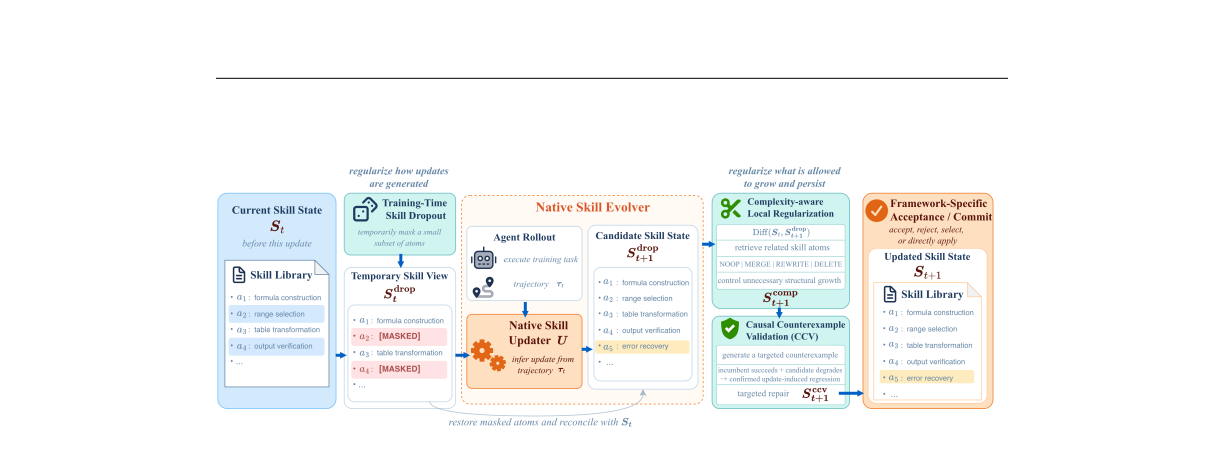
What carries the argument. The load-bearing object is the skill atom — a self-contained directive, list item, procedural block, or other semantically coherent unit of the external skill state — because every regularizer operates on atoms. Training-time skill dropout samples a mask $M_t \subseteq \mathcal{A}(S_t)$ over atoms, generates the update from the masked view, and reconciles the learned delta $\Delta^{\text{drop}}_t$ onto the full incumbent; complexity regularization computes a signal $c_t = f^{\text{comp}}(\phi(S_t), \phi(S^{\text{drop}}_{t+1}), \phi(\Delta^{\text{comp}}_t))$ from observable structural properties and, when triggered, confines editing to the candidate's atoms plus bounded related context $\Omega_t = D_t \cup \text{Related}(S_t, D_t)$; CCV builds an attacked case $x^{\text{ccv}}_t$ from the candidate-specific delta and applies the four-way comparison in which a confirmed regression requires the incumbent to succeed on the attacked case while the candidate deteriorates, both having qualified on the original source. The framework-specific complexity measure $C(S)$ sums per-atom lexical-unit, code-line, control-flow, and external-dependency contributions, and the discrete operations NOOP, MERGE, REWRITE, and DELETE structure how candidate content is consolidated.
Core claim. The central claim is that skill-evolution overfitting is a real, diagnosable failure mode with three distinct manifestations — structural accumulation, semantic specialization, and update-induced regression — and that all three can be controlled by adapting anti-overfitting principles from neural-network training to discrete, language-generated skill transitions. SkillEvoReg instantiates the adaptation at three points: training-time skill dropout masks a sample of skill atoms from the update-generation context (the perturbation affects only how the update is learned and is reconciled back onto the complete incumbent, never treated as a deletion), complexity-aware local regularization uses an observable complexity signal to trigger bounded editing over the candidate's own atoms plus a small related set, with operations NOOP, MERGE, REWRITE, or DELETE, and causal counterexample validation (CCV) performs a four-way paired behavioral comparison — incumbent and candidate both qualified on an original source, then both evaluated on an attack constructed from the candidate's own delta — confirming a regression only when the incumbent succeeds on the attacked case while the candidate deteriorates; the paper is explicit that this is CCV-confirmed regression in an operational sense, not formal causal identification. Across SkillOpt, SkillEvolBench, and ContinualSkillBench, the paper claims the framework consistently controls skill-state growth while preserving competitive downstream capability, improves several transfer and later-stage outcomes, and detects update-level regressions that structural metrics alone cannot reveal.
The premise it rests on. Every comparative result in Section 5 rests on a single evolved skill state per condition — repeated frozen evaluations measure execution-time variation of that one state, not variation across independently sampled training trajectories — so the reported improvements of 2 to 3 percentage points could in principle fall within run-to-run noise.
If the paper is right (Pith's inferences, not the authors')
With identical evolution budgets, regularizing candidate transitions yields substantially smaller persistent skill states at competitive or better frozen-test accuracy — on SpreadsheetBench the final skill drops from 6,060 to 2,341 tokens while final test accuracy rises from 47.00% to 59.25%.
Repeated unregularized evolution can actively hurt deployment transfer — a second SkillEvolBench pass drops deployment success from 31.67% to 29.44% — whereas regularizing that same additional experience reaches 33.33% and cuts second-pass token growth by 34.0% relative to the unregularized second pass, showing the layer changes which repeated experience persists, not merely how much.
The three components are complementary: complexity regularization alone limits growth (13.1K chars, 55.50%), dropout alone gives higher accuracy with a larger skill (19.5K chars, 57.50%), and the combination gives the smallest skill and strongest score in the ablation (11.7K chars, 59.25%).
CCV provides behavioral evidence that structural metrics miss: across the evaluated trajectories it found 12 candidate-specific regression signals and performed 9 state-changing repairs, including a dependency-resolution case where a package-boundary attack scored the incumbent 1.0 and the candidate 0.8.
Compact persistent skills reduce a stable component of inference context, yielding 29.5% to 56.1% mean token savings on the controlled-path tasks (SpreadsheetBench, LiveMath, SearchQA); the paper explicitly frames this as a deployment-side by-product of regularization, not its objective.
The three roles — perturb generation context, cap structural growth locally, and validate behavior by candidate-conditioned attack — do not depend on any particular skill representation, so the natural next targets are other persistent externalized instruction state such as agent memory networks, workflow libraries, and prompt repositories; the machinery only needs state that segments into locally
Because Section 5 compares one evolved state per condition and reports only frozen-evaluation repeats of that state, the decisive follow-up experiment the paper does not run is multi-seed evolution with per-seed checkpoint selection; the Appendix E.3 shared-prefix fork already indicates the residual risk is late-stage trajectory divergence (9.25 points at the final checkpoint) rather than early-tr
CCV's value depends almost entirely on its attack generator and source selector, which the paper leaves framework-specific; a testable extension is to sweep SelectSource and GenerateAttack choices (number of perturbed atoms, attack strength, source recency) and measure how many of the 12 regression signals and 9 repairs survive, giving practitioners a handle on where engineering effort should go.
The token-usage numbers suggest a deployment cost model the authors do not construct: regularization buys capability stability plus per-task inference savings on control-limited tasks, but the price is the CCV validation and repair calls themselves; quantifying that compute overhead per saved token would tell operators whether the by-product is worth the added latency.
Check this review
Pith stored no record of this review's passes and took no fingerprint of it. Reviews made by code from 13 Nov 2026 on carry both.
How often reviews like this one are right
Reviews like this one: written by deepseek-v4-flash, where what was read was not recorded.
How often objections from reviews like this one are right: not yet measured
Reviews by people
This review was written by a machine. No person has reviewed this paper on Pith yet. A scientist listed on Pith can review it for a fee, and their review is published here whatever it concludes.
The paper
Abstract
Language-model agents increasingly improve by converting execution experience into reusable external skills. Yet repeated skill updates form a learning process of their own: locally useful edits can accumulate into redundant or task-specific instructions, while new updates can disrupt behavior that previously worked. We study this problem as skill-evolution overfitting and introduce SkillEvoReg, a general regularization framework for skill evolution inspired by anti-overfitting techniques in neural-network training. SkillEvoReg combines training-time skill dropout, which perturbs update generation, and complexity-aware local regularization, which controls unnecessary structural growth, with causal counterexample validation (CCV), which provides targeted behavioral validation of candidate-specific regressions. We instantiate the framework across heterogeneous skill-evolution systems while retaining each system's native skill evolver and task evaluator. Across SkillOpt, SkillEvolBench, and ContinualSkillBench, SkillEvoReg consistently controls skill-state growth while preserving competitive downstream capability, improves several transfer and later-stage evolution outcomes, and identifies update-level regressions that structural metrics alone cannot reveal. These results suggest that explicit regularization is a useful complement to increasingly capable skill updaters.
The paper's own sentences, arranged, kept beside the review and separate from it. Each label is drawn from a closed vocabulary; the number beside it is the probability the classifier gave that label. No sentence in this record was written by a model.
abstract compiled · 2026-09-28
The authors' main claim, as the classifier picked it out 0.98
“These results suggest that explicit regularization is a useful complement to increasingly capable skill updaters.”
How the main claim is stated: hedged possibility 1.00
What the abstract itself states, as probabilities: claims first 0.06 · states limitation 0.16 · human participants 0.04 · controlled comparison 0.48 · randomized assignment 0.02 · states quantitative result 0.04 · compares with prior results 0.65 · mentions code or data availability 0.03
The abstract, sentence by sentence
This table labels the abstract only (arXiv listing abstract v1). The number is the probability the classifier gave the label.
| Sentence | Role | The authors' own work | States the main conclusion | Strength |
|---|---|---|---|---|
| Language-model agents increasingly improve by converting execution experience into reusable external skills. | background 1.00 | 0.05 | 0.02 | asserted 0.99 |
| Yet repeated skill updates form a learning process of their own: locally useful edits can accumulate into redundant or task-specific instructions, while new updates can disrupt behavior that previously worked. | background 0.72 | 0.08 | 0.03 | asserted 0.87 |
| We study this problem as skill-evolution overfitting and introduce SkillEvoReg, a general regularization framework for skill evolution inspired by anti-overfitting techniques in neural-network training. | contribution 1.00 | 0.90 | 0.10 | asserted 0.99 |
| SkillEvoReg combines training-time skill dropout, which perturbs update generation, and complexity-aware local regularization, which controls unnecessary structural growth, with causal counterexample validation (CCV), which provides targeted behavioral validation of candidate-specific regressions. | method 0.98 | 0.86 | 0.05 | asserted 0.99 |
| We instantiate the framework across heterogeneous skill-evolution systems while retaining each system's native skill evolver and task evaluator. | method 0.93 | 0.91 | 0.03 | asserted 0.99 |
| Across SkillOpt, SkillEvolBench, and ContinualSkillBench, SkillEvoReg consistently controls skill-state growth while preserving competitive downstream capability, improves several transfer and later-stage evolution outcomes, and identifies update-level regressions that structural metrics alone cannot reveal. | result 1.00 | 0.96 | 0.35 | asserted 1.00 |
| These results suggest that explicit regularization is a useful complement to increasingly capable skill updaters. | interpretation 1.00 | 0.51 | 0.83 | hedged possibility 1.00 |
What kind of paper the classifier reports this is: method or tool 1.00 · evidence from observation or experiment 0.92
What was examined, and what was not
Sources read
- arXiv listing abstract v1
Not examined
- full text
- figures and tables
- references and citing sentences
- relations to other papers
Levels run
- P abstract
Not run
- S sections
- T body sentences
- C citations
- R cross-paper relations
How the labels were made
Compiled by classifier-1.13.0 via TypeSafe API, question bank abstract-p1-20260923, 2026-09-28: 1 request, 5,716 input tokens.
Every quoted sentence on this record is the authors'. Every label is from Pith's closed vocabulary, with the probability shown beside it. This record as JSON
Figures (2)

Figures are the authors', reproduced from the paper.
References (14)
- [1] Task block 1-pass 2-pass SKILLEVOREG T1–T3, Replay 0.85570.8588 0.8558 T1, Canonical replay 0.8604 0.8625 0.8807 T2, Enriched replay0.84840.8439 0.8381 T3, Variant replay 0.85840.8699 0.8487 T4–T6, Deployment0.82990.8263 0.8269 T4, Context shift 0.83340.8447 0.8227 T5, Adversa... on PitharXiv
- [2] URLhttps://arxiv.org/abs/2608.15165. Omar Khattab, Arnav Singhvi, Paridhi Maheshwari, Zhiyuan Zhang, Keshav Santhanam, Sri Vard- hamanan A, Saiful Haq, Ashutosh Sharma, Thomas T. Joshi, Hanna Moazam, Heather Miller, Matei Zaharia, and Christopher Potts. DSPy: Compiling declara... on PithPith's reviewarXiv
- [3] URLhttps://arxiv.org/abs/2609.08944. Jingwei Ni, Yihao Liu, Xinpeng Liu, Yutao Sun, Mengyu Zhou, Pengyu Cheng, Dexin Wang, Er- chao Zhao, Xiaoxi Jiang, and Guanjun Jiang. Trace2skill: Distill trajectory-local lessons into transferable agent skills, on PithPith's reviewarXiv
- [4] URLhttps://arxiv.org/abs/2603.25158. Pedro Orvalho, Mikol ´aˇs Janota, and Vasco M. Manquinho. Counterexample guided program re- pair using zero-shot learning and MaxSAT-based fault localization. InProceedings of the AAAI Conference on Artificial Intelligence, volume 39, pp. 649–657, on PithPith's reviewarXiv
- [9] URL https://arxiv.org/abs/2604.01687. Hongyi Zhang, Moustapha Ciss´e, Yann N. Dauphin, and David Lopez-Paz. mixup: Beyond empiri- cal risk minimization. InInternational Conference on Learning Representations, on PithPith's reviewarXiv
- [12] The correspondingf comp compares incumbent and candidate complexity and supplies the complexity term used by regularized candidate evaluation. Complexity can therefore influence whether a candidate transition is retained. SkillEvolBench.For SkillEvolBench,f comp is used primar... on Pith
- [13] We sumCover individual files and report growth relative to the one-pass library. The original benchmark-specific atom counts are 991, 1,113, and 1,070 for the one-pass, two-pass, and regu- larized libraries; the common structural counts are 1,422, 1,551, and 1,515, respectivel... on PitharXiv
- [14] A CCV-confirmed regression requires the incumbent to remain sufficiently successful onx ccv t while 22 Algorithm 3Causal Counterexample Validation Input:Incumbent skill stateS t, complexity-regularized candidateS comp t+1 , training historyH t, CCV configurationθ ccv Output:CC... on PitharXiv
- [39] The degrading branch accumulates broader instructions for preserving blank/nonmatching slots, clearing a prefilled destination block, blanking non-terminal rows, and clearing unused spill cells. The main branch is not free of blanking language, but combines it with explicit fu... on Pith
- [1998] Reid Pryzant, Dan Iter, Jerry Li, Yin Lee, Chenguang Zhu, and Michael Zeng. Automatic prompt optimization with “gradient descent” and beam search. InProceedings of the 2023 Conference on Empirical Methods in Natural Language Processing, pp. 7957–7968. Association for Compu- ta... on Pith
- [2023] 10 Nitish Srivastava, Geoffrey Hinton, Alex Krizhevsky, Ilya Sutskever, and Ruslan Salakhutdinov. Dropout: A simple way to prevent neural networks from overfitting.Journal of Machine Learning Research, 15(56):1929–1958, on Pith
- [2024] Yifan Yang, Ziyang Gong, Weiquan Huang, Qihao Yang, Ziwei Zhou, Zisu Huang, Yan Li, Xuemei Gao, Qi Dai, Bei Liu, Kai Qiu, Yuqing Yang, Dongdong Chen, Xue Yang, and Chong Luo. Skillopt: Executive strategy for self-evolving agent skills, 2026b. URLhttps://arxiv. org/abs/2605.239... on PithPith's reviewarXiv
- [2025] Chen Yang, Jiashuo Tian, Ziqi Wang, Xinyin Liu, Meiru Ye, and Junjie Chen. Learning globally reusable skills for coding agents, 2026a. URLhttps://arxiv.org/abs/2608.06153. Chengrun Yang, Xuezhi Wang, Yifeng Lu, Hanxiao Liu, Quoc V . Le, Denny Zhou, and Xinyun Chen. Large langu... on PithPith's reviewarXiv
- [2026] URLhttps: //arxiv.org/abs/2608.03874. Qingyan Guo, Rui Wang, Junliang Guo, Bei Li, Kaitao Song, Xu Tan, Guoqing Liu, Jiang Bian, and Yujia Yang. Connecting large language models with evolutionary algorithms yields powerful prompt optimizers. InInternational Conference on Learn... on PithPith's reviewarXiv
Cited by 1 Pith paper
Reviewed papers on Pith that cite this one. The full citation record
Challenges and discussion
Disagree with the review, or know something it missed? Leave a comment, or challenge this review formally: a challenge becomes a permanent entry in this paper's record, and its decision is published here.
Come back by email
A short list of the week's newly reviewed papers. Nothing is sent until you confirm from your inbox, and every email has a link that stops it. No account.
No comments yet.
Sign in to comment