Artificial Intelligence · arXiv:2609.08944 v1 · submitted 8 Sep 2026 · 63 references
SkillAdam: Stable and Efficient Skill Evolution for Agents
The paper says
“Agent skills provide a lightweight way to equip frozen language-model agents with domain knowledge and procedural guidance, yet obtaining high-quality skills remains costly and difficult to scale. Expert-written skills require substantial human effort.”
more of the abstract
Recent skill self-evolution methods automate an iterative loop that uses execution feedback to revise skills, but their heuristic update strategies often yield unstable optimization and low iteration efficiency. We identify two challenges in realizing stable and efficient skill self-evolution. Direction Stability requires effective corrections to accumulate rather than be overwritten by iteration-local feedback. Update Adaptivity requires the scope of each revision to reflect the consistency of recent case-level improvements. We introduce SkillAdam, an Adam-inspired framework for optimizing discrete and non-differentiable skill documents. As a functional analogue of Adam's first moment, an optimization memory records identified problems and the outcomes of prior solution attempts to stabilize the update direction. As a functional analogue of Adam's second moment, a volatility-driven edit budget tracks the history-weighted variation of recent case-level improvements and adaptively controls the update magnitude. Across seven benchmarks that span short- and long-horizon tasks, SkillAdam achieves state-of-the-art performance with more stable optimization dynamics. It also obtains stronger skills with substantially fewer optimization iterations and lower cost than prior methods. Code repository: https://github.com/ruc-datalab/SkillAdam
from the abstract
Pith says
Machine review · deepseek-v4-flash · 9 Sep 2026 · what was read was not recorded · not checked by a person
It can be wrong. Challenge this review or reply to it.
The passes disagreed. Reader: holds up. Skeptic: holds up only with conditions. Referee: major revision.
SkillAdam offers a genuinely novel adaptation of Adam to discrete skill optimization, with solid empirical grounding, though the headline SOTA claims rest on thin margins against SkillOpt that are not yet variance-bounded. This line is wrong
5 major objections · 6 minor
How often objections from reviews like this one are right: not yet measured
Not checked: figures, code, what the 63 references say.
The paper says, at §5.4, Table 2
The review did not quote this passage.
Pith says: Objection 1 of 5 · major
The headline improvements over SkillOpt on short-horizon benchmarks are very small (SearchQA +0.2, Spreadsheet +0.4, OfficeQA tie, DocVQA +1.1, LiveMath +0.8 percentage points). Section 5.3 states that evaluations use temperature 1.0 and each test case is evaluated once. No confidence intervals, standard deviations, or multiple runs are reported.
more of objection 1
Given the high temperature and single evaluation, these differences are within plausible random noise. The paper must report variance (e.g., across seeds or bootstrap) or provide a statistical test to substantiate that SkillAdam outperforms SkillOpt on these tasks.
The paper says, at §5.2, Baselines
The review did not quote this passage.
Pith says: Objection 2 of 5 · major
For the five short-horizon benchmarks, baseline results (including SkillOpt) are taken from the GPT-5.5 no-harness setting reported by SkillOpt (Yang et al., 2026). They are not independently re-run in the same environment as SkillAdam. This introduces possible configuration drift (e.g., different system prompts, exact model version, evaluator implementation).
more of objection 2
For a fair comparison, the authors should either re-run the baselines in their own pipeline or explicitly discuss the risk of uncontrolled differences. Without this, comparisons to baselines on short-horizon tasks are unreliable.
The paper says, at §6, Stability and Efficiency (Figure 4)
The review did not quote this passage.
Pith says: Objection 3 of 5 · major
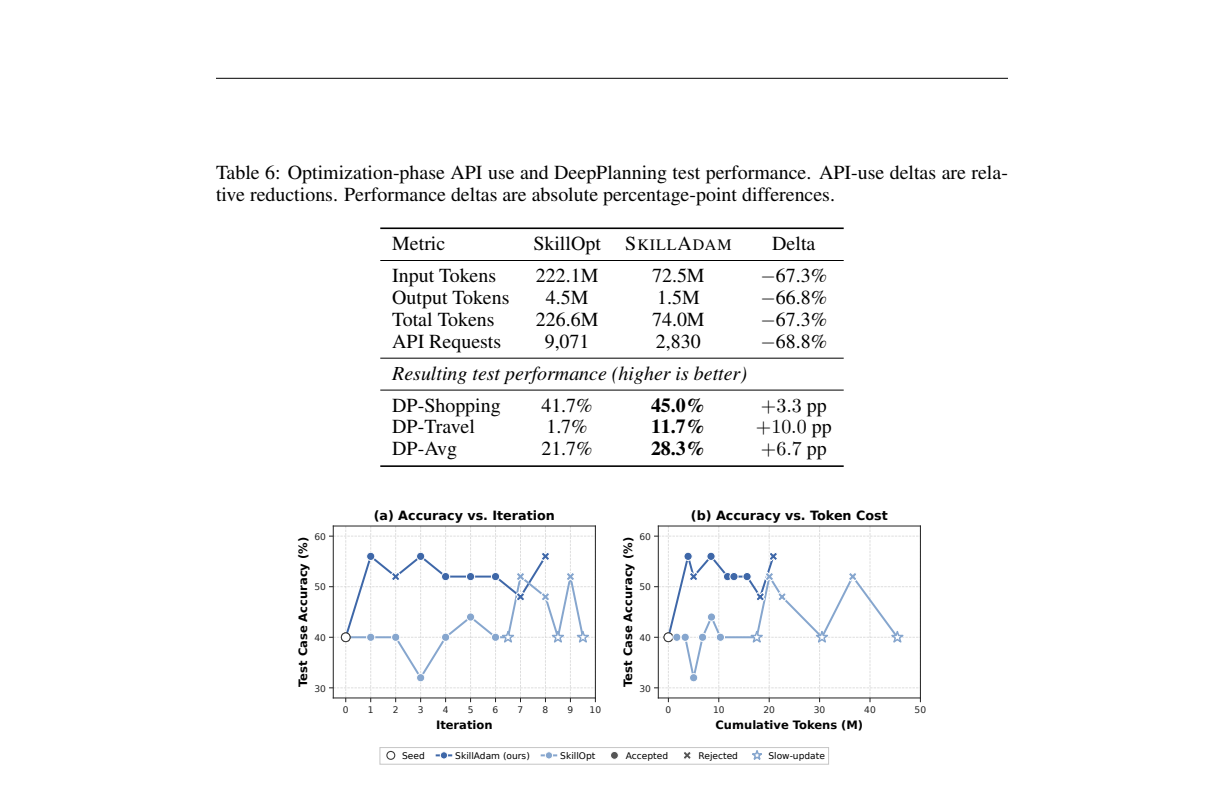
The stability and efficiency analysis is based on a single run on DeepPlanning Shopping Level 1. One run cannot demonstrate 'more stable optimization dynamics' in a statistical sense. The authors should present multiple runs (e.g., with different random seeds) to show that the pattern is reproducible, or at minimum acknowledge this limitation prominently. The current text and Figure 4 give an impression of robustness that is not supported.
The paper says, at §5.3, Protocol Asymmetry
The review did not quote this passage.
Pith says: Objection 4 of 5 · major
SkillAdam merges the train and selection partitions into one optimization pool, while SkillOpt retains the original train/selection split. This is a protocol asymmetry that could favor SkillAdam by providing more training data per iteration. The paper should either assess the effect of this change (e.g., by running SkillAdam with the original split) or justify why the asymmetry is negligible. Without it, the comparison on short-horizon benchmarks is not apples-to-apples.
The paper says, at §5.3, Acceptance Gate
The review did not quote this passage.
Pith says: Objection 5 of 5 · major
The acceptance gate uses the same mini-batch for both the current skill rollout and the candidate evaluation (lines 7-14, Algorithm 1). This risks overfitting to the sampled batch, as improvements may be based on noise in that specific batch. SkillOpt uses a separate selection set.
more of objection 5
The paper should discuss this risk and ideally test whether acceptance decisions generalize to held-out batches. In its current form, the gate does not provide the same level of selection signal as a held-out validation set.
6 minor objections
The paper says, at §4.1, Eq. (18)
Pith says: minor objection 1 of 6
The clip operation in Eq. (18) is written as 'clip(V_t / V_max, 0, 1)' but it should be 'clip(V_t / V_max, 0.0, 1.0)' for clarity. Also, the floor operation symbols are non-standard; consider using 'floor' notation.
The paper says, at Algorithm 1
Pith says: minor objection 2 of 6
The algorithm is presented in the main text but the notation for functions like U_EIT, G_LLM, etc. is not defined. Consider adding a brief description in the caption or in a separate table.
show 4 more
The paper says, at Table 1
Pith says: minor objection 3 of 6
The functional correspondence is helpful but the 'Apply' row for SkillAdam is unclear: it says 'Apply and gate g_t' but the gate is separate. Clarify that Apply + gate is analogous to the parameter update step.
The paper says, at §5.5, Ablation
Pith says: minor objection 4 of 6
The ablation is cumulative, so the effect of Memory alone when Budget is present is not measured. The text acknowledges this, but still draws conclusions about memory's benefit. Consider adding an ablation that removes Memory only while keeping Budget.
The paper says, at §5.7, Skill Quality
Pith says: minor objection 5 of 6
Figure 3 shows SkillAdam outperforming SkillOpt on all slices, but the six dimensions are averaged into one score. Reporting per-dimension scores would help understand which aspects improve most. Also, the judge is GPT-5.5, which may have a preference for longer/more specific skills (a potential confounding factor). A brief discussion of this limitation would strengthen the analysis.
The paper says, at §5.8, Training Cost
Pith says: minor objection 6 of 6
Table 6 reports token counts and API requests. The cost reduction is impressive, but the two methods differ in total iterations (SkillOpt runs 4 epochs, SkillAdam runs until a stopping rule). Explicitly comparing number of iterations or skill updates would make the efficiency claim more transparent.
What would settle it
Run at least five independent repetitions of SkillAdam and SkillOpt on all seven benchmarks with identical optimization pools, identical pre-registered acceptance rules, and re-run SkillOpt baselines rather than copying Table 2 numbers. Report mean plus 95% confidence intervals or paired bootstrap intervals over test cases for every metric. If the SearchQA, Spreadsheet, OfficeQA, and DP-Travel differences are not distinguishable from zero, the SOTA and cost-efficiency claims should be restricted to DocVQA, LiveMath, and the single DeepPlanning cost analysis; if the differences persist across seeds, the concern is resolved.
from the skeptic's reading
How the review went
4 readings by deepseek-v4-flash · 9 Sep 2026
- Reader holds up
- Skeptic disagrees: says it holds up only with conditions The SOTA and efficiency claims are not yet supported by variance-aware evidence: most short-horizon gaps vs SkillOpt are within plausible noise, baselines are partly copied, and the stability analysis is a single run.
- Editor wrote the verdict above
- Referee major revision: 5 major objections, 6 minor
Not run on this paper: the simulated authors' defence.
Pith did not check this review's objections against the paper.
The review in full
The review in brief, machine-written
The paper does something genuinely new: it adapts Adam's momentum and adaptive step-size ideas to the discrete, non-differentiable space of LLM agent skill documents. The Evolving Issue Tracker as a first-moment analogue and the volatility-driven edit budget as a second-moment analogue are well-motivated and clearly explained. The engineering is thorough—seven benchmarks, ablation studies, cross-model transfer, cost analysis. The quality analysis with a judged skill score is a nice addition.
The main weakness is empirical, not conceptual. The short-horizon gains over SkillOpt—the strongest baseline—are 0.2 to 1.1 percentage points on five benchmarks, with one tie. The paper reports no variance estimates (single evaluation at temperature 1.0) and baselines are copied from the SkillOpt paper, introducing potential configuration drift. The long-horizon DP-Travel gain (11.7 vs 1.7) is larger but on a 60-case test set, so the absolute gap of roughly 6 successes vs 1 success is impressive but still noisy. The stability and efficiency analysis in Section 6 is a single run.
The acceptance gate using the same mini-batch for both evaluation and decision risks overfitting to the sampled cases, though the paper's use of protected metrics mitigates this somewhat. The reliance on proprietary LLMs (GPT-5.5, Claude) means results may not reproduce with different model versions.
That said, the central claim—that SkillAdam enables more stable and efficient skill evolution—is defensible. The ablations support the design, and the cross-model transfer results are credible. The paper is clearly written and makes a real contribution to the agent skill optimization subfield.
For whom is this paper? Researchers building automated skill construction pipelines or working on prompt/self-evolution methods. They will find the method directly applicable and the design choices well-articulated.
Recommendation: Deserves a serious peer review. I would encourage the authors to add error bars, rerun baselines in their own environment, and show variance across multiple seeds. The core idea is strong enough that these requests are constructive, not fatal.
The strongest objection
The load-bearing part of the central claim is that SkillAdam achieves state-of-the-art performance with more stable optimization dynamics and substantially fewer iterations at lower cost. The weakest support is empirical, not conceptual. In Table 2, the differences against SkillOpt are SearchQA +0.2, Spreadsheet +0.4, OfficeQA tie, DocVQA +1.1, and LiveMath +0.8 percentage points, while Section 5.3 states that each test case is evaluated once and the short-horizon runs use temperature 1.0, so there is no estimate of run-to-run or evaluation noise. The five short-horizon baselines are not independently rerun; Section 5.2 says they are taken from the GPT-5.5 no-harness setting reported by SkillOpt, which introduces possible cross-paper configuration drift. The long-horizon flagship gain, DP-Travel 11.7 versus 1.7, is about 7 versus 1 successes on a 60-case test set. Section 6 explicitly notes that its stability and efficiency analysis reports one run, and Table 6 measures cost only on DeepPlanning. Section 5.3 also says SkillAdam merges the train and selection partitions while SkillOpt retains the original split, an uncontrolled protocol asymmetry. These observations do not disprove the method, but they mean the headline comparison is not yet established beyond plausible noise.
A good-faith reading shows that the Adam analogy is functional rather than numerical, the ablations are cumulative but honestly labeled, and the cross-model transfer experiment is a useful robustness signal. The reader's weakest assumption, LLM patch quality, is real, but it is not the place where the central claim is most exposed: even if the LLM-based tracker and patch generator work perfectly, the evidence for state-of-the-art performance and substantially fewer iterations still rests on small per-benchmark gaps, a partly copied baseline set, and a single-run stability plot. The paper explicitly flags the one-run nature of Section 6, which is honest but does not remove the need for repeated trials. A CONDITIONAL verdict is appropriate: the mechanism and ablations are promising, but the SOTA and efficiency headline should require variance-aware re-evaluation or a rescoped claim.
The referee's report
If the empirical claims hold, the work contributes a principled transfer of Adam's optimization principles to the discrete, non-differentiable space of skill documents. The conceptual framing (direction stability and update adaptivity) is clear and well-motivated. The two mechanisms are plausible and backed by an ablation. The cross-model transfer and skill quality analyses provide additional evidence. However, the core empirical support for the SOTA claim is weaker than the text suggests (see major comments). The paper opens a promising direction but requires stronger evidence to be fully convincing.
Pith's reading of the paper (a machine's summary, not the authors')
The paper introduces SkillAdam, a framework that adapts Adam's optimization principles to the discrete space of natural-language agent skills. It identifies two challenges in skill self-evolution: direction stability (previous corrections being overwritten) and update adaptivity (revision scope not reflecting evidence consistency). SkillAdam addresses these with an Evolving Issue Tracker that accumulates issue histories like Adam's first moment, and a volatility-driven edit budget that adjusts revision scope like Adam's second moment. Experiments on seven benchmarks show SkillAdam achieves state-of-the-art performance with substantially fewer iterations and lower cost than prior methods, and its skills transfer better across models.
What carries the argument. The key machinery comprises two components: (1) an Evolving Issue Tracker, a structured repository of past issues, their current status, and attempted solutions, which serves as the optimization memory to stabilize the update direction; and (2) a volatility-driven edit budget, computed from the history-weighted variance of case-level improvements across the latest iteration, which controls how extensively the skill may be modified in the next update.
Core claim. The core discovery is that the two mechanisms from Adam—momentum-based direction stabilization and adaptive step-size scaling—can be functionally replicated in discrete skill space to produce stable and efficient skill self-evolution. Specifically, the Evolving Issue Tracker (analogous to first moment) consolidates problem histories and solution outcomes across iterations to prevent useful corrections from being overwritten, while the volatility-driven edit budget (analogous to second moment) measures the consistency of case-level improvements and correspondingly limits or expands the allowable scope of the next revision. This design yields more coherent optimization trajectories, higher final skill quality, 67% lower token consumption, and better cross-model transfer compared to existing skill-evolution methods like SkillOpt.
The premise it rests on. The core assumption is that the LLM-based patch generator and Evolving Issue Tracker can reliably identify problems, propose effective modifications, and track issue status across iterations, which depends on the underlying LLM's ability to produce high-quality patches and summaries.
If the paper is right (Pith's inferences, not the authors')
If SkillAdam is correct, skill optimization becomes as reliable and efficient as parameter optimization with Adam, enabling rapid iteration toward high-quality agent skills.
The 67% reduction in token cost and 69% fewer API requests make large-scale skill evolution practically affordable, lowering the barrier for deploying specialized agents.
Cross-model retention improves by 5.1 percentage points on average, meaning skills optimized with one LLM can be reused with weaker models without substantial performance loss.
The approach generalizes to long-horizon planning tasks like DeepPlanning, where prior methods nearly failed, suggesting it can handle tasks requiring many interdependent steps.
The Evolving Issue Tracker could be applied beyond skill documents to any iterative refinement of discrete natural-language artifacts, such as prompts, instruction templates, or even code comments.
If volatility-driven budgets prove general, they might replace heuristic early-stopping or manual review in agent-feedback loops, automating quality control.
The functional analogy to Adam suggests that other adaptive optimizers (e.g., RMSprop, AdaGrad) could inspire further improvements in discrete optimization of agent skills.
Check this review
Pith stored no record of this review's passes and took no fingerprint of it. Reviews made by code from 13 Nov 2026 on carry both.
How often reviews like this one are right
Reviews like this one: written by deepseek-v4-flash, where what was read was not recorded.
How often objections from reviews like this one are right: not yet measured
Reviews by people
This review was written by a machine. No person has reviewed this paper on Pith yet. A scientist listed on Pith can review it for a fee, and their review is published here whatever it concludes.
The paper
Abstract
Agent skills provide a lightweight way to equip frozen language-model agents with domain knowledge and procedural guidance, yet obtaining high-quality skills remains costly and difficult to scale. Expert-written skills require substantial human effort. Recent skill self-evolution methods automate an iterative loop that uses execution feedback to revise skills, but their heuristic update strategies often yield unstable optimization and low iteration efficiency. We identify two challenges in realizing stable and efficient skill self-evolution. Direction Stability requires effective corrections to accumulate rather than be overwritten by iteration-local feedback. Update Adaptivity requires the scope of each revision to reflect the consistency of recent case-level improvements. We introduce SkillAdam, an Adam-inspired framework for optimizing discrete and non-differentiable skill documents. As a functional analogue of Adam's first moment, an optimization memory records identified problems and the outcomes of prior solution attempts to stabilize the update direction. As a functional analogue of Adam's second moment, a volatility-driven edit budget tracks the history-weighted variation of recent case-level improvements and adaptively controls the update magnitude. Across seven benchmarks that span short- and long-horizon tasks, SkillAdam achieves state-of-the-art performance with more stable optimization dynamics. It also obtains stronger skills with substantially fewer optimization iterations and lower cost than prior methods. Code repository: https://github.com/ruc-datalab/SkillAdam
The paper's own sentences, arranged, kept beside the review and separate from it. Each label is drawn from a closed vocabulary; the number beside it is the probability the classifier gave that label. No sentence in this record was written by a model.
abstract compiled · 2026-09-23
The authors' main claim, as the classifier picked it out 0.90
“Across seven benchmarks that span short- and long-horizon tasks, SkillAdam achieves state-of-the-art performance with more stable optimization dynamics.”
How the main claim is stated: asserted 1.00
What the abstract itself states, as probabilities: claims first 0.06 · states limitation 0.08 · human participants 0.11 · controlled comparison 0.53 · randomized assignment 0.01 · states quantitative result 0.39 · compares with prior results 0.96 · mentions code or data availability 0.98
The abstract, sentence by sentence
This table labels the abstract only (arXiv listing abstract v1). The number is the probability the classifier gave the label.
| Sentence | Role | The authors' own work | States the main conclusion | Strength |
|---|---|---|---|---|
| Agent skills provide a lightweight way to equip frozen language-model agents with domain knowledge and procedural guidance, yet obtaining high-quality skills remains costly and difficult to scale. | background 0.93 | 0.07 | 0.04 | asserted 1.00 |
| Expert-written skills require substantial human effort. | background 0.98 | 0.06 | 0.02 | asserted 1.00 |
| Recent skill self-evolution methods automate an iterative loop that uses execution feedback to revise skills, but their heuristic update strategies often yield unstable optimization and low iteration efficiency. | background 0.59 | 0.12 | 0.03 | asserted 0.94 |
| We identify two challenges in realizing stable and efficient skill self-evolution. | gap 0.78 | 0.73 | 0.03 | asserted 0.99 |
| Direction Stability requires effective corrections to accumulate rather than be overwritten by iteration-local feedback. | gap 0.81 | 0.49 | 0.04 | asserted 0.98 |
| Update Adaptivity requires the scope of each revision to reflect the consistency of recent case-level improvements. | gap 0.80 | 0.36 | 0.03 | asserted 0.99 |
| We introduce SkillAdam, an Adam-inspired framework for optimizing discrete and non-differentiable skill documents. | contribution 0.86 | 0.89 | 0.10 | asserted 1.00 |
| As a functional analogue of Adam's first moment, an optimization memory records identified problems and the outcomes of prior solution attempts to stabilize the update direction. | method 0.97 | 0.86 | 0.04 | asserted 1.00 |
| As a functional analogue of Adam's second moment, a volatility-driven edit budget tracks the history-weighted variation of recent case-level improvements and adaptively controls the update magnitude. | method 0.96 | 0.87 | 0.05 | asserted 1.00 |
| Across seven benchmarks that span short- and long-horizon tasks, SkillAdam achieves state-of-the-art performance with more stable optimization dynamics. | result 1.00 | 0.96 | 0.49 | asserted 1.00 |
| It also obtains stronger skills with substantially fewer optimization iterations and lower cost than prior methods. | result 1.00 | 0.94 | 0.36 | asserted 1.00 |
| Code repository: https://github.com/ruc-datalab/SkillAdam | result 0.39 | 0.70 | 0.07 | asserted 0.77 |
What kind of paper the classifier reports this is: method or tool 1.00 · evidence from observation or experiment 0.88
What was examined, and what was not
Sources read
- arXiv listing abstract v1
Not examined
- full text
- figures and tables
- references and citing sentences
- relations to other papers
Levels run
- P abstract
Not run
- S sections
- T body sentences
- C citations
- R cross-paper relations
How the labels were made
Compiled by classifier-1.13.0 via TypeSafe API, question bank abstract-p1-20260923, 2026-09-23: 1 request, 8,643 input tokens.
Every quoted sentence on this record is the authors'. Every label is from Pith's closed vocabulary, with the probability shown beside it. This record as JSON
Figures (4)


Figures are the authors', reproduced from the paper.
References (63)
- [1] ReAct: Synergizing Reasoning and Acting in Language Models , author=. International Conference on Learning Representations , year= on Pith
- [2] Toolformer: Language Models Can Teach Themselves to Use Tools , author=. Advances in Neural Information Processing Systems , volume= on Pith
- [3] Zhang, Yinger and Jiang, Shutong and Li, Renhao and Tu, Jianhong and Su, Yang and Deng, Lianghao and Guo, Xudong and Lv, Chenxu and Lin, Junyang , journal=. 2026 , url= on Pith
- [4] Introducing. 2025 , month=oct, url= on Pith
- [5] Adam: A Method for Stochastic Optimization , author=. International Conference on Learning Representations (ICLR) , year= on Pith
- [6] Yang, Yifan and Gong, Ziyang and Huang, Weiquan and Yang, Qihao and Zhou, Ziwei and Huang, Zisu and Li, Yan and Gao, Xuemei and Dai, Qi and Liu, Bei and Qiu, Kai and Yang, Yuqing and Chen, Dongdong and Yang, Xue and Luo, Chong , journal=. 2026 , url= on Pith
- [7] Ni, Jingwei and Liu, Yihao and Liu, Xinpeng and Sun, Yutao and Zhou, Mengyu and Cheng, Pengyu and Wang, Dexin and Zhao, Erchao and Jiang, Xiaoxi and Jiang, Guanjun , journal=. 2026 , url= on Pith
- [8] Yuksekgonul, Mert and Bianchi, Federico and Boen, Joseph and Liu, Sheng and Huang, Zhi and Guestrin, Carlos and Zou, James , journal=. 2024 , url= on Pith
- [9] Agrawal, Lakshya A. and Tan, Shangyin and Soylu, Dilara and Ziems, Noah and Khare, Rishi and Opsahl-Ong, Krista and Singhvi, Arnav and Shandilya, Herumb and Ryan, Michael J. and Jiang, Meng and Potts, Christopher and Sen, Koushik and Dimakis, Alexandros G. and Stoica, Ion and ... on Pith
- [10] Dunn, Matthew and Sagun, Levent and Higgins, Mike and Guney, V. Ugur and Cirik, Volkan and Cho, Kyunghyun , journal=. 2017 , url= on Pith
- [11] Ma, Zeyao and Zhang, Bohan and Zhang, Jing and Yu, Jifan and Zhang, Xiaokang and Zhang, Xiaohan and Luo, Sijia and Wang, Xi and Tang, Jie , booktitle=. 2024 , note= on Pith
- [12] Opsahl-Ong, Krista and Singhvi, Arnav and Collins, Jasmine and Zhou, Ivan and Wang, Cindy and Baheti, Ashutosh and Oertell, Owen and Portes, Jacob and Havens, Sam and Elsen, Erich and Bendersky, Michael and Zaharia, Matei and Chen, Xing , journal=. 2026 , url= on Pith
- [13] Mathew, Minesh and Karatzas, Dimosthenis and Jawahar, C.V. , booktitle=. 2021 , url= on Pith
- [14] He, Linyang and Yu, Qiyao and Dong, Hanze and Liao, Baohao and Xu, Xinxing and Goldblum, Micah and Bian, Jiang and Mesgarani, Nima , journal=. 2026 , url= on Pith
- [15] Shridhar, Mohit and Yuan, Xingdi and C. International Conference on Learning Representations (ICLR) , year= on Pith
- [17] Zhao, Andrew and Huang, Daniel and Xu, Quentin and Lin, Matthieu and Liu, Yong-Jin and Huang, Gao , journal =. 2023 , url = on Pith
- [18] Agent Workflow Memory , author =. Proceedings of the 42nd International Conference on Machine Learning , series =. 2025 , publisher = on Pith
- [19] Self-Refine: Iterative Refinement with Self-Feedback , author =. arXiv preprint arXiv:2303.17651 , year = on PithPith's reviewarXiv
- [20] Reflexion: Language Agents with Verbal Reinforcement Learning , author =. arXiv preprint arXiv:2303.11366 , year = on PithPith's reviewarXiv
- [21] Large Language Models as Optimizers , author =. International Conference on Learning Representations , year = on Pith
show 43 more
- [24] Zhang, Hanrong and Fan, Shicheng and Zou, Henry Peng and Chen, Yankai and Wang, Zhenting and Zhou, Jiayu and Li, Chengze and Huang, Wei-Chieh and Yao, Yifei and Zheng, Kening and Liu, Xue and Li, Xiaoxiao and Yu, Philip S. , journal =. 2026 , url = on Pith
- [25] Ouyang, Siru and Yan, Jun and Chen, Yanfei and Han, Rujun and Wang, Zifeng and Mishra, Bhavana Dalvi and Meng, Rui and Li, Chun-Liang and Jiao, Yizhu and Zha, Kaiwen and Shen, Maohao and Tirumalashetty, Vishy and Lee, George and Han, Jiawei and Pfister, Tomas and Lee, Chen-Yu ... on Pith
- [26] Chen, Minghao and Li, Yihang and Yang, Yanting and Yu, Shiyu and Lin, Binbin and He, Xiaofei , booktitle =. 2024 , url = on Pith
- [27] Inducing Programmatic Skills for Agentic Tasks , author =. Conference on Language Modeling , year = on Pith
- [28] Li, Xiangyi and others , journal =. 2026 , url = on Pith
- [29] Gautam, Srishti and Radhakrishna, Arjun and Gulwani, Sumit , journal =. 2026 , url = on Pith
- [30] Alzubi, Salaheddin and Provenzano, Noah and Bingham, Jaydon and Chen, Weiyuan and Vu, Tu , journal =. 2026 , url = on Pith
- [31] Zhang, Shaolei and Fan, Ju and Fan, Meihao and Li, Guoliang and Du, Xiaoyong , journal=. 2025 , url= on Pith
- [32] Fan, Meihao and Fan, Ju and Zhang, Yuxin and Zhang, Shaolei and Du, Xiaoyong and Song, Jie and Li, Peng and Jiang, Fuxin and Zhang, Tieying and Chen, Jianjun , journal=. 2026 , doi= on Pith
- [33] Zhang, Yuxin and Fan, Ju and Fan, Meihao and Zhang, Shaolei and Du, Xiaoyong , booktitle=. 2026 , url= on Pith
- [34] Deng, Chao and Zhang, Shaolei and Fan, Ju and Du, Xiaoyong , journal=. 2026 , url= on Pith
- [35] Liu, Yizhe and Zhang, Shaolei and Fan, Ju , journal=. 2026 , doi= on Pith
- [36] Lakshya A. Agrawal, Shangyin Tan, Dilara Soylu, Noah Ziems, Rishi Khare, Krista Opsahl-Ong, Arnav Singhvi, Herumb Shandilya, Michael J. Ryan, Meng Jiang, Christopher Potts, Koushik Sen, Alexandros G. Dimakis, Ion Stoica, Dan Klein, Matei Zaharia, and Omar Khattab. GEPA : Refle... on PithPith's reviewarXiv
- [37] Salaheddin Alzubi, Noah Provenzano, Jaydon Bingham, Weiyuan Chen, and Tu Vu. EvoSkill : Automated skill discovery for multi-agent systems. arXiv preprint arXiv:2603.02766, 2026. URL https://arxiv.org/abs/2603.02766 on PithPith's reviewarXiv
- [38] Anthropic . Introducing Agent Skills , October 2025. URL https://claude.com/blog/skills on Pith
- [39] Minghao Chen, Yihang Li, Yanting Yang, Shiyu Yu, Binbin Lin, and Xiaofei He. AutoManual : Constructing instruction manuals by LLM agents via interactive environmental learning. In Advances in Neural Information Processing Systems, volume 37, 2024. URL https://papers.nips.cc/pa... on PitharXiv
- [40] Chao Deng, Shaolei Zhang, Ju Fan, and Xiaoyong Du. DataEvolver : Automatic data preparation for large language models through multi-level self-evolving. arXiv preprint arXiv:2606.07001, 2026. URL https://arxiv.org/abs/2606.07001 on PithPith's reviewarXiv
- [41] Matthew Dunn, Levent Sagun, Mike Higgins, V. Ugur Guney, Volkan Cirik, and Kyunghyun Cho. SearchQA : A new Q&A dataset augmented with context from a search engine. arXiv preprint arXiv:1704.05179, 2017. URL https://arxiv.org/abs/1704.05179 on PithPith's reviewarXiv
- [42] Meihao Fan, Ju Fan, Yuxin Zhang, Shaolei Zhang, Xiaoyong Du, Jie Song, Peng Li, Fuxin Jiang, Tieying Zhang, and Jianjun Chen. DeepPrep : An LLM -powered agentic system for autonomous data preparation. Proceedings of the VLDB Endowment, 19 0 (11): 0 3371--3384, 2026. doi:10.147... on PitharXiv
- [43] Srishti Gautam, Arjun Radhakrishna, and Sumit Gulwani. SkillAxe : Sharpening LLM -authored agent skills through evaluation-guided self-refinement. arXiv preprint arXiv:2606.10546, 2026. URL https://arxiv.org/abs/2606.10546 on PithPith's reviewarXiv
- [44] Linyang He, Qiyao Yu, Hanze Dong, Baohao Liao, Xinxing Xu, Micah Goldblum, Jiang Bian, and Nima Mesgarani. LiveMathematicianBench : A live benchmark for mathematician-level reasoning with proof sketches. arXiv preprint arXiv:2604.01754, 2026. URL https://arxiv.org/abs/2604.01754 on PithPith's reviewarXiv
- [45] Diederik P. Kingma and Jimmy Ba. Adam: A method for stochastic optimization. In International Conference on Learning Representations (ICLR), 2015. URL https://arxiv.org/abs/1412.6980 on PithPith's reviewarXiv
- [46] Xiangyi Li et al. SkillsBench : Benchmarking how well agent skills work across diverse tasks. arXiv preprint arXiv:2602.12670, 2026. URL https://arxiv.org/abs/2602.12670 on PithPith's reviewarXiv
- [47] Yizhe Liu, Shaolei Zhang, and Ju Fan. DA-Studio : An agentic system for end-to-end data analysis. Proceedings of the VLDB Endowment, 19 0 (12): 0 4766--4769, 2026. doi:10.14778/3827998.3828117. URL https://www.vldb.org/pvldb/vol19/p4766-liu.pdf on PitharXiv
- [48] Zeyao Ma, Bohan Zhang, Jing Zhang, Jifan Yu, Xiaokang Zhang, Xiaohan Zhang, Sijia Luo, Xi Wang, and Jie Tang. SpreadsheetBench : Towards challenging real world spreadsheet manipulation. In Advances in Neural Information Processing Systems (NeurIPS), 2024. URL https://arxiv.org... on PithPith's reviewarXiv
- [49] Minesh Mathew, Dimosthenis Karatzas, and C.V. Jawahar. DocVQA : A dataset for VQA on document images. In IEEE/CVF Winter Conference on Applications of Computer Vision (WACV), 2021. URL https://arxiv.org/abs/2007.00398 on PithPith's reviewarXiv
- [50] Jingwei Ni, Yihao Liu, Xinpeng Liu, Yutao Sun, Mengyu Zhou, Pengyu Cheng, Dexin Wang, Erchao Zhao, Xiaoxi Jiang, and Guanjun Jiang. Trace2Skill : Distill trajectory-local lessons into transferable agent skills. arXiv preprint arXiv:2603.25158, 2026. URL https://arxiv.org/abs/2... on PithPith's reviewarXiv
- [51] Krista Opsahl-Ong, Arnav Singhvi, Jasmine Collins, Ivan Zhou, Cindy Wang, Ashutosh Baheti, Owen Oertell, Jacob Portes, Sam Havens, Erich Elsen, Michael Bendersky, Matei Zaharia, and Xing Chen. OfficeQA Pro : An enterprise benchmark for end-to-end grounded reasoning. arXiv prep... on PitharXiv
- [52] Siru Ouyang, Jun Yan, Yanfei Chen, Rujun Han, Zifeng Wang, Bhavana Dalvi Mishra, Rui Meng, Chun-Liang Li, Yizhu Jiao, Kaiwen Zha, Maohao Shen, Vishy Tirumalashetty, George Lee, Jiawei Han, Tomas Pfister, and Chen-Yu Lee. SkillOS : Learning skill curation for self-evolving agen... on PithPith's reviewarXiv
- [53] Reid Pryzant, Dan Iter, Jerry Li, Yin Lee, Chenguang Zhu, and Michael Zeng. Automatic prompt optimization with ``gradient descent'' and beam search. In Proceedings of the 2023 Conference on Empirical Methods in Natural Language Processing, pp.\ 7957--7968. Association for Comp... on Pithdoi:10.18653/v1/2023.emnlp-main.494
- [54] Mohit Shridhar, Xingdi Yuan, Marc-Alexandre C \^o t \'e , Yonatan Bisk, Adam Trischler, and Matthew Hausknecht. ALFWorld : Aligning text and embodied environments for interactive learning. In International Conference on Learning Representations (ICLR), 2021. URL https://arxiv.... on PithPith's reviewarXiv
- [55] Guanzhi Wang, Yuqi Xie, Yunfan Jiang, Ajay Mandlekar, Chaowei Xiao, Yuke Zhu, Linxi Fan, and Anima Anandkumar. Voyager: An open-ended embodied agent with large language models. arXiv preprint arXiv:2305.16291, 2023. URL https://arxiv.org/abs/2305.16291 on PithPith's reviewarXiv
- [56] Zora Zhiruo Wang, Apurva Gandhi, Graham Neubig, and Daniel Fried. Inducing programmatic skills for agentic tasks. In Conference on Language Modeling, 2025 a . URL https://openreview.net/forum?id=lsAY6fWsog on Pith
- [57] Zora Zhiruo Wang, Jiayuan Mao, Daniel Fried, and Graham Neubig. Agent workflow memory. In Proceedings of the 42nd International Conference on Machine Learning, volume 267 of Proceedings of Machine Learning Research, pp.\ 63897--63911. PMLR, 2025 b . URL https://proceedings.mlr... on Pith
- [58] Cilin Yan, Jingyun Wang, Lin Zhang, Ruihui Zhao, Xiaopu Wu, Kai Xiong, Qingsong Liu, Guoliang Kang, and Yangyang Kang. Efficient and accurate prompt optimization: The benefit of memory in exemplar-guided reflection. In Proceedings of the 63rd Annual Meeting of the Association ... on Pithdoi:10.18653/v1/2025.acl-long.37
- [59] Chengrun Yang, Xuezhi Wang, Yifeng Lu, Hanxiao Liu, Quoc V. Le, Denny Zhou, and Xinyun Chen. Large language models as optimizers. In International Conference on Learning Representations, 2024. URL https://arxiv.org/abs/2309.03409 on PithPith's reviewarXiv
- [60] Yifan Yang, Ziyang Gong, Weiquan Huang, Qihao Yang, Ziwei Zhou, Zisu Huang, Yan Li, Xuemei Gao, Qi Dai, Bei Liu, Kai Qiu, Yuqing Yang, Dongdong Chen, Xue Yang, and Chong Luo. SkillOpt : Executive strategy for self-evolving agent skills. arXiv preprint arXiv:2605.23904, 2026. U... on PithPith's reviewarXiv
- [61] Mert Yuksekgonul, Federico Bianchi, Joseph Boen, Sheng Liu, Zhi Huang, Carlos Guestrin, and James Zou. TextGrad : Automatic ``differentiation'' via text. arXiv preprint arXiv:2406.07496, 2024. URL https://arxiv.org/abs/2406.07496 on PithPith's reviewarXiv
- [62] Hanrong Zhang, Shicheng Fan, Henry Peng Zou, Yankai Chen, Zhenting Wang, Jiayu Zhou, Chengze Li, Wei-Chieh Huang, Yifei Yao, Kening Zheng, Xue Liu, Xiaoxiao Li, and Philip S. Yu. CoEvoSkills : Self-evolving agent skills via co-evolutionary verification. arXiv preprint arXiv:26... on PithPith's reviewarXiv
- [63] Shaolei Zhang, Ju Fan, Meihao Fan, Guoliang Li, and Xiaoyong Du. DeepAnalyze : Agentic large language models for autonomous data science. arXiv preprint arXiv:2510.16872, 2025. URL https://arxiv.org/abs/2510.16872 on PitharXiv
- [64] Yinger Zhang, Shutong Jiang, Renhao Li, Jianhong Tu, Yang Su, Lianghao Deng, Xudong Guo, Chenxu Lv, and Junyang Lin. DeepPlanning : Benchmarking long-horizon agentic planning with verifiable constraints. arXiv preprint arXiv:2601.18137, 2026 b . URL https://arxiv.org/abs/2601.18137 on PitharXiv
- [65] Yuxin Zhang, Ju Fan, Meihao Fan, Shaolei Zhang, and Xiaoyong Du. CoDA-Bench : Can code agents handle data-intensive tasks? In Proceedings of the 43rd International Conference on Machine Learning, 2026 c . URL https://arxiv.org/abs/2606.15300 on PitharXiv
- [66] Andrew Zhao, Daniel Huang, Quentin Xu, Matthieu Lin, Yong-Jin Liu, and Gao Huang. ExpeL : LLM agents are experiential learners. arXiv preprint arXiv:2308.10144, 2023. URL https://arxiv.org/abs/2308.10144 on PithPith's reviewarXiv
Cited by 3 Pith papers
Reviewed papers on Pith that cite this one. The full citation record
- Trajectory-Guided Fault Localization for Agent Skill Evolution cs.SE · Oct 2026
- SkillSpec: Consensus-Gated Agent Skill Evolution via Representation Specialization cs.LG · Sep 2026
- SkillEvoReg: Regularizing Agent Skill Evolution Against Overfitting cs.AI · Sep 2026
Challenges and discussion
Disagree with the review, or know something it missed? Leave a comment, or challenge this review formally: a challenge becomes a permanent entry in this paper's record, and its decision is published here.
Come back by email
A short list of the week's newly reviewed papers. Nothing is sent until you confirm from your inbox, and every email has a link that stops it. No account.
No comments yet.
Sign in to comment