Artificial Intelligence · arXiv:2609.38850 v2 · submitted 30 Sep 2026
Beyond Outcome Rewards: Post-Rationale Distribution Optimization for Selective Prediction in Reasoning Models
The paper says
“Reasoning models are trained to produce correct answers, yet selective deployment requires ranking which answers to accept or defer, and outcome-reward training does not directly optimize the post-rationale distribution used for that decision.”
more of the abstract
We identify two mismatches: expected correctness is mode-seeking rather than distribution-eliciting, and scoring an average across rationales rewards disagreement unavailable to a single-rationale decision. We introduce Post-Rationale Distribution Optimization (PRDO), which applies a proper score to the answer distribution after each sampled rationale, without target rationales or separate confidence labels. Across four 0.6–3.8-billion-parameter models on MMLU-Pro, PRDO improves Brier score, error ranking and secondary accuracy relative to budget-matched, temperature-scaled GRPO. At 20% realized error, oracle coverage rises by \npjQ3a_vs_grpo.qwen3-0.6b.mp.oracle_cov@0.2.ppabs–\npjQ3a_vs_grpo.phi-4-mini.mp.oracle_cov@0.2.ppabs percentage points, and ranking gains transfer to unseen tasks. Matched controls identify proper, per-rationale scoring as the active design choices, while verification tasks show the boundary: better selective ranking can coexist with lower full-coverage accuracy. Code is available at https://github.com/ZimmyGao/openjev-rlcd
from the abstract
Pith says
Machine review · deepseek-v4-flash · 1 Oct 2026 · of version 1 of the paper; version 2 is newer · what was read was not recorded · not checked by a person
It can be wrong. Challenge this review or reply to it.
Holds up, with conditions. Clean, honest, practically useful paper: the RLVR-as-mixture-minus-Gini framing and the two-stage calibrate-then-reinforce recipe are real contributions, with the single-query calibration claim the one load-bearing spot that needs a per-rationale check. This line is wrong
2 major objections · 5 minor
How often objections from reviews like this one are right: not yet measured
Not checked: figures, code, what the references say.
The paper says, at §5.1, Table 1; Appendix B; Appendix C
The review did not quote this passage.
Pith says: Objection 1 of 2 · major
The headline claim that 'a single query decides 81% of the items at ≤5% error' rests entirely on the protocol 'single query = the first' of the M=4 rationales, which is defined only in Appendix B. The gap between the reported single-query and 4-rationale-mixture results on GSM8K-Verify (AURC 0.034 vs 0.014, accuracy 92.2 vs 94.5, in Table 1 vs Appendix …
more of objection 1
… C) shows that the readout is not rationale-independent at the test distribution, so the 81% Cov@5% figure could depend on which draw position is used. To substantiate the single-query claim, please report AURC and Cov@5% for each draw position (or averaged over random single draws), together with a per-rationale calibration measure, on both tasks.
The paper says, at §3.1, Proposition 2; Figure 1; Table 1
The review did not quote this passage.
Pith says: Objection 2 of 2 · major
Proposition 2 identifies u(x,r)=q(x) as the unique maximizer over unrestricted readouts, but the implementation uses a finite-capacity softmax readout over option-token logits of a 1.7B model after a long reasoning trace. The only evidence that the learned readout realizes the per-rationale hedge is the training-time Varr(u) diagnostic in Figure 1 for MMLU-Pro; no test-set per-rationale statistic is reported on either task.
more of objection 2
Since the single-query calibration claim is exactly the claim that the hedge transfers to a lone draw, please report a test-set quantity such as the variance of u across the M rationales per item, or ECE stratified by draw position or rationale length, to connect the empirical result to the theoretical optimum.
5 minor objections
The paper says, at Appendix B
Pith says: minor objection 1 of 5
The single-query protocol should be stated in the main text (§4 or §5.1), since it is central to the headline coverage numbers.
The paper says, at Table 1
Pith says: minor objection 2 of 5
With only 3 seeds, the reported standard deviations understate uncertainty; consider also reporting 95% bootstrap intervals for Cov@5% and Cov@20%, as is done for the AURC comparisons.
show 3 more
The paper says, at §5.3
Pith says: minor objection 3 of 5
The statement that RLCD 'provably cannot beat' cross-entropy on aleatoric tasks is supported by a one-sentence gradient-equality argument; a formal statement or a more detailed derivation would make the claim precise.
The paper says, at §3.2
Pith says: minor objection 4 of 5
The observation that 'the readout-based reward is blind to the format of the rationale' is only clear if the reader remembers that u is defined as the next-token distribution over option tokens; consider restating this in the no-anchor ablation discussion.
The paper says, at §5.1
Pith says: minor objection 5 of 5
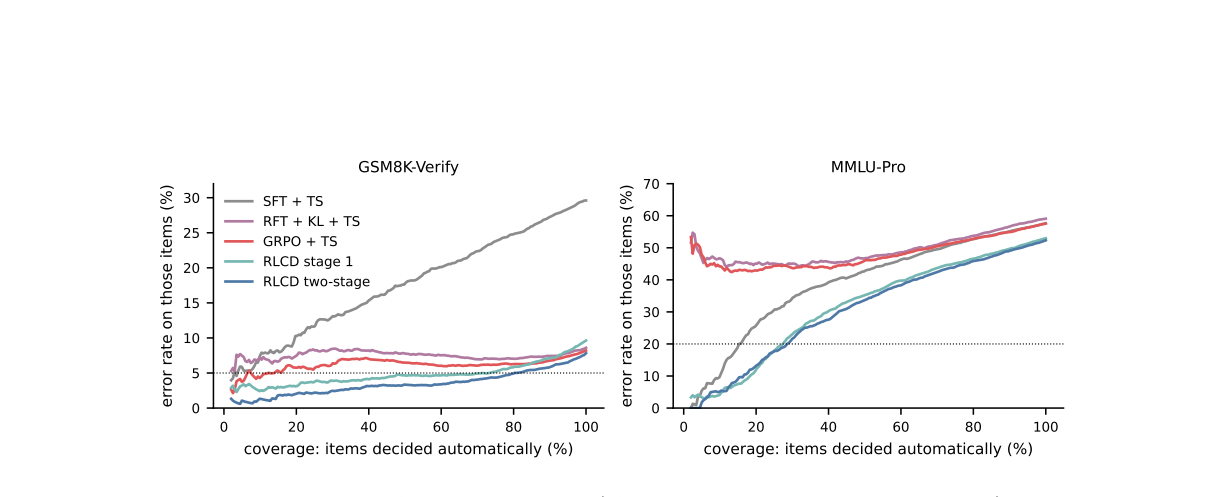
The rendered text has a formatting artifact in §5.1 (the Figure 2 caption appears inline as '5 0 20 40 ...'); ensure all figures are placed correctly in the final version.
What would settle it
On the released checkpoints, re-run evaluation with each of the M=4 sampled rationales used alone as the single query (indices 1-4 separately), reporting per-index single-query ECE, Brier, AURC and Cov@5% on GSM8K-Verify and MMLU-Pro, plus test-set Varr(u) across the four rationales. The check: (i) if Cov@5% moves by more than roughly 10 relative points depending on the rationale index, or per-index ECE exceeds the reported value beyond seed noise, the per-rationale hedge does not transfer and single-query numbers are draw-dependent; (ii) determine whether test-set Varr(u) accounts for the single-query-versus-mixture AURC gap (0.034 vs 0.014 on GSM8K-Verify, Appendix C); (iii) test whether low-confidence draws are systematically wrong at matched confidence, which would make the 5%-error coverage frontier hostage to a subset of draws.
from the skeptic's reading
How the review went
4 readings by deepseek-v4-flash · 1 Oct 2026
- Reader holds up, with conditions
- Skeptic partly agrees
- Editor wrote the verdict above
- Referee major revision: 2 major objections, 5 minor
Not run on this paper: the simulated authors' defence.
Pith did not check this review's objections against the paper.
The review in full
The review in brief, machine-written
This is the first working RLCD implementation for reasoning models I've seen, and it earns its title. The variance identity is textbook Brier/Jensen decomposition, but the corollary that RLVR is exactly the mixture objective minus a Gini-diversity bonus, and the two-stage recipe that falls out of the two failure modes (System-One collapse, policy-gradient drowning), are genuinely new and useful. The fork experiments are the strongest part: same checkpoint, four continuations, showing the outcome reward—not the anchor—does the work, and that a correctness reward undoes calibration while the proper score preserves it. Estimator checks against exact enumeration to 1e-15, paired tests over items, code released, limitations stated plainly. This is careful, self-aware work.
Soft spots, in proportion. The scale limit is real and acknowledged (1.7B model, 3 seeds, 400-800 steps); the headline Cov@5% gap (81 vs 19) rests on a narrow base that needs replication. The sharper concern is the single-query claim. "Single query" is operationalized as the first of M=4 rationales, and the mixture-vs-single-query gap on GSM8K (AURC 0.014 vs 0.034, accuracy 94.5 vs 92.2) is large enough that calibration transfer to a lone draw deserves direct evidence—a per-rationale test-set analysis on the saved checkpoints would settle it, and the paper doesn't provide one. The Y-perp-r|x premise is satisfied in both main tasks (deterministic labels), so the active assumption is that the finite-capacity readout realizes the hedge per rationale rather than only on the policy's mixture. That's a fair, testable question, not a fatal one. Also, the unexpanded LaTeX macros in the abstract are a formatting embarrassment.
For anyone working on confidence ranking, selective prediction, or calibration for reasoning models, this is a solid, reproducible data point. The recipe is clean, the controlled comparison is fair, and the failure-mode analysis is instructive. I'd take it if I were editing—it deserves a serious referee—with the single-query claim flagged for the authors to address with per-rationale evidence.
The strongest objection
The central claim is that a single RLCD query is calibrated, evidenced by Cov@5% of 81% on GSM8K-Verify and AURC 0.034 versus 0.061 for GRPO. Proposition 2's optimum u(x,r)=q(x) is per-rationale, so the claim needs the finite readout (softmax over option tokens of a 1.7B model) to realize the hedge for every sampled rationale, not merely on average over the policy's rationale mixture. Note that the reader's primary flag, Y independent of r given x, is actually satisfied in both main tasks—Y is a deterministic property of x for GSM8K-Verify and MMLU-Pro—so the active risk is the implicit second premise: transfer of the hedge to a lone draw. Evidence on this is thin. Varr(u) is shown only as a training-phase diagnostic on MMLU-Pro (Figure 1), never as a test-set quantity on the two headline tasks; and the single-query-vs-mixture gap is large where reported: on GSM8K-Verify mixture AURC is 0.014 against 0.034 single-query, and mixture accuracy 94.5 against 92.2 (Appendix C). A readout calibrated over the mixture but overconfident on low-support rationales would pass aggregate checks while inflating single-query Cov@5%: at a 5% error budget even a small share of confident-but-wrong rationales near the coverage frontier changes how many items can be decided. The protocol takes 'single query = the first of M=4 rationales', so the headline number is one draw from the per-rationale distribution; if the first draw is calibrated differently from later draws, or off-support rationales are systematically overconfident, the 81% figure is a property of the draw protocol, not of 'a single query'. This is a mechanism-level concern distinct from the acknowledged scale limit, and it is testable on already-saved checkpoints.
I read the paper in good faith: the mathematics is clean and self-contained, Proposition 1's variance identity and Corollary 1 are exact, the estimator checks to 1e-15 on tabular models are credible evidence, and the forked-checkpoint controls (anchor-only vs reward, GRPO-reward vs proper-score reward) are well designed and convincingly attribute the stage-2 effect to the proper-score reward. Within its stated scope the empirical core holds up. My stress test targets the one place where the central claim could fail without violating anything the paper verifies. The reader's weakest-assumption centers on the independence premise Y_perp_r|x; I find that premise is actually satisfied in both headline tasks since the outcome is a deterministic property of the question, so the real residual risk is the readout's ability to realize the per-rationale hedge—the reader's second, implicit premise. I elevate that premise to the primary concern because the paper never reports a test-set per-rationale analysis: Varr(u) appears only as a training diagnostic, and the one place where single-query and mixture results are both reported (Appendix C, GSM8K-Verify) shows a 2.4x AURC gap, leaving open the possibility that a lone draw's confidence ranking is materially worse than the mixture's, which would directly bear on Cov@5%. The concern does not overturn the verdict: the reader is already CONDITIONAL on scale, stage-2 unpredictability, and independent reimplementation, and my concern adds a fourth, separately testable check without changing the disposition. I recommend UNCHANGED because the conditional verdict already accommodates this risk; if the per-index test shows draw dependence, the verdict should move no further than the conditional stance already adopted. Agreement is partial because the reader bundled the capacity/transfer issue under the independence premise, whereas I hold that the independence premise is satisfied here and the transfer issue is the operative one.
The referee's report
The central claim, that confidence ranking rather than only accuracy can be trained by reinforcement on a model's own rationales via per-rationale proper scoring, is valuable and, if correct, has direct practical implications for selective prediction and delegation in LLM-based decision systems. The theoretical identities are clean and correct, and the estimators are verified against exact enumeration on tabular models to below 1e-15. The empirical methodology is careful: three seeds, paired tests, temperature scaling applied to all baselines, and a negative result on ChaosNLI that strengthens the credibility of the positive results. The code and run logs are released. The main unresolved point is the evidence connecting Proposition 2's per-rationale optimum to the realized single-query behavior of a finite-capacity readout.
Pith's reading of the paper (a machine's summary, not the authors')
The paper sets out to make a reasoning model's reported confidence trustworthy, not just its answers: a calibrated decision model can automate the choices it is sure about and escalate the rest, using only its own confidence. Its proposal, RLCD (reinforcement learning for calibrated decisions), scores the answer distribution the model commits to after sampling its own rationale with a strictly proper scoring rule, in two stages — first calibrate that readout, then reinforce the reasoning that feeds it. A variance identity explains why the common alternative, scoring the mixture of several sampled rationales (the form behind RLVR-style training such as GRPO), pays a bonus for disagreement and is the source of overconfidence. On GSM8K answer verification and MMLU-Pro with a 1.7B model, RLCD matches or beats temperature-scaled SFT, RFT/STaR and GRPO in accuracy and beats all of them in selective prediction: a single RLCD query decides 81% of GSM8K-Verify items at ≤5% error versus 19% for GRPO. When the uncertainty is annotator disagreement, the same objective provably cannot beat cross-entropy and correctly stops reasoning.
What carries the argument. Two objects carry the argument. First, the readout $u_\theta(x,r)$: after the model samples a rationale $r$ ending in the answer marker, the paper reads the next-token distribution over the $K$ option tokens rather than sampling an answer, and scores it with the shifted, negated Brier score $J(u,y)=2u_y-\|u\|^2$, whose expectation is uniquely maximized at $u=q(x)$. Second, the variance identity $J(p,q)=E_r J(u(r),q)+E_r\|u(r)-p\|^2$ (Proposition 1), which decomposes the mixture objective into the average per-rationale score plus a disagreement bonus; Corollary 1 reads RLVR as that mixture objective without its Gini-diversity term, and Proposition 2 shows the per-rationale objective has the unique per-rationale maximizer $u(x,r)=q(x)$ when $Y\perp r\mid x$. Around these sits the recipe 'calibrate, then reinforce' (Algorithm 1): stage 1 trains only the pathwise readout part of the gradient, and stage 2 adds the score-function term that reinforces the reasoning, down-weighted ($c=0.3$) and KL-anchored ($\beta=0.04$) to the stage-1 model.
Core claim. Reinforcement can train the confidence a reasoning model reports as well as its accuracy. The central claim is that if, after the model samples a rationale $r$, you read the distribution $u_\theta(x,r)=\mathrm{softmax}(\text{option-token logits})$ it commits to and score that distribution with a strictly proper score (the shifted, negated Brier score $J(u,y)=2u_y-\|u\|^2$), then a single query is calibrated at the optimum, and this can be made to work in practice with a two-stage recipe. The engine is the variance identity $J(p,q)=E_r J(u(r),q)+E_r\|u(r)-p\|^2$ (Proposition 1): the mixture objective equals the average per-rationale score plus a bonus for rationales that disagree, so rewarding mixtures pays for ungrounded disagreement — and Corollary 1 shows RLVR is exactly that mixture objective with its diversity (Gini) term removed, which is why correctness-reward training makes models overconfident. The per-rationale objective instead has the unique maximizer $u(x,r)=q(x)$ for every rationale under the premise $Y\perp r\mid x$ (Proposition 2), so a single query is calibrated at the optimum. Because end-to-end optimization either collapses the model into a direct scorer (the System-One collapse, prevented by a KL anchor) or is drowned by policy-gradient noise, the recipe separates the roles: stage 1 trains the readout on the model's own rationales with a proper score, and stage 2 reinforces the reasoning with the same proper score, anchored at the calibrated model. The payoff is confidence ranking, not just accuracy: at equal accuracy with GRPO (92.2% vs 91.8%) on GSM8K-Verify, RLCD's risk-coverage curve lets one query decide 81% of items at ≤5% error, versus 19% for GRPO, and on MMLU-Pro it decides 28% of items at a 20% error budget where reasoning baselines decide none.
The premise it rests on. The calibration claim rests on the premise that the outcome is independent of the model's own rationale given the question ($Y\perp r\mid x$, which the paper says holds whenever the outcome is produced by the world), plus the implicit premise that the finite readout can represent and learn the hedge $q(x)$ after a long reasoning trace; if a rationale changes the conditional answer distribution in a way the readout cannot hedge, the unique per-rationale optimum $u(x,r)=q(x)$ is no longer guaranteed and a single query's calibration can weaken.
If the paper is right (Pith's inferences, not the authors')
If a single query is calibrated, a downstream agent can decide, from the model's own confidence and without labels, which items to automate at any chosen error budget; the reported Cov@ε numbers show how large that budget-bought coverage is.
Reward identity matters for confidence: a correctness reward (RLVR/GRPO) re-inflates the confidence of a calibrated readout (temperature from $T=1.4$ to $T=3.8$ on MMLU-Pro), while the same proper score used as the reward preserves calibration.
Reinforcing the reasoning with a proper score helps exactly where reasoning is computation: on GSM8K-Verify the stage-2 continuation gains +3.5 accuracy and $-0.057$ Brier over the readout-only fork, while on MMLU-Pro it is neutral.
Where uncertainty is aleatoric (annotator disagreement), the per-rationale proper-score objective provably cannot beat cross-entropy and, left alone, switches reasoning off; the paper treats this as the correct behaviour of a decision objective.
Scoring any mixture of sampled rationales pays for disagreement, so diversity bonuses in group-reward methods are unsafe unless they are grounded; a policy can collect the bonus simply by randomizing its conclusions.
The identity implies a diagnostic for existing RLVR runs: accuracy gains that arrive with worsening AURC or a growing fitted temperature are the signature of the missing diversity term, so tracking the Gini impurity of sampled answers during training would reveal mode-seeking drift before deployment.
The boundary is the independence premise $Y\perp r\mid x$: on tasks where the chain of thought carries information the question alone does not supply, the per-rationale optimum need not be $q(x)$, and single-query calibration would have to come from hedging over rationales instead; a test would pair one question with deliberately correct and deliberately wrong rationales and check whether the read
The 'calibrate, then reinforce' split is a template for any setting where a cheap pathwise signal is drowned by a noisy score-function term; the paper's own result that explicit-probability RLCD never beats cross-entropy suggests proper-score RL buys nothing when there is no reasoning to reinforce.
A natural scaling test: on problems with longer effective reasoning chains, stage 2's benefit should grow if reasoning is computation and stay flat on knowledge-heavy tasks, the two regimes the paper's own tasks bracket.
Check this review
Pith stored no record of this review's passes and took no fingerprint of it. Reviews made by code from 13 Nov 2026 on carry both.
How often reviews like this one are right
Reviews like this one: written by deepseek-v4-flash, where what was read was not recorded.
How often objections from reviews like this one are right: not yet measured
Reviews by people
This review was written by a machine. No person has reviewed this paper on Pith yet. A scientist listed on Pith can review it for a fee, and their review is published here whatever it concludes.
The paper
Abstract
Reasoning models are trained to produce correct answers, yet selective deployment requires ranking which answers to accept or defer, and outcome-reward training does not directly optimize the post-rationale distribution used for that decision. We identify two mismatches: expected correctness is mode-seeking rather than distribution-eliciting, and scoring an average across rationales rewards disagreement unavailable to a single-rationale decision. We introduce Post-Rationale Distribution Optimization (PRDO), which applies a proper score to the answer distribution after each sampled rationale, without target rationales or separate confidence labels. Across four 0.6–3.8-billion-parameter models on MMLU-Pro, PRDO improves Brier score, error ranking and secondary accuracy relative to budget-matched, temperature-scaled GRPO. At 20% realized error, oracle coverage rises by \npjQ3a_vs_grpo.qwen3-0.6b.mp.oracle_cov@0.2.ppabs–\npjQ3a_vs_grpo.phi-4-mini.mp.oracle_cov@0.2.ppabs percentage points, and ranking gains transfer to unseen tasks. Matched controls identify proper, per-rationale scoring as the active design choices, while verification tasks show the boundary: better selective ranking can coexist with lower full-coverage accuracy. Code is available at https://github.com/ZimmyGao/openjev-rlcd
The paper's own sentences, arranged, kept beside the review and separate from it. Each label is drawn from a closed vocabulary; the number beside it is the probability the classifier gave that label. No sentence in this record was written by a model.
abstract compiled · 2026-10-01
The authors' main claim, as the classifier picked it out 0.91
“With Qwen3-1.7B on two reasoning tasks (3 seeds, paired tests), RLCD matches or beats SFT, RFT/STaR and GRPO (each temperature-scaled) in accuracy and beats all of them in selective prediction; on GSM8K answer verification a single query decides \gvTwoCovFive\% of the items at $\le$5\% error, versus \gvGrpoCovFive\% for GRPO.”
How the main claim is stated: asserted 1.00
What the abstract itself states, as probabilities: claims first 0.14 · states limitation 0.96 · human participants 0.05 · controlled comparison 0.92 · randomized assignment 0.06 · states quantitative result 0.94 · compares with prior results 0.98 · mentions code or data availability 0.98
The abstract, sentence by sentence
This table labels the abstract only (arXiv listing abstract v1). The number is the probability the classifier gave the label.
| Sentence | Role | The authors' own work | States the main conclusion | Strength |
|---|---|---|---|---|
| Decision models such as Jev answer questions with probabilities, which are only useful if they are calibrated. | background 1.00 | 0.06 | 0.03 | asserted 1.00 |
| Open-source reproductions rely on supervised fine-tuning plus temperature scaling, while reinforcement learning from verifiable rewards (RLVR) makes reasoning models overconfident. | background 0.82 | 0.11 | 0.06 | asserted 1.00 |
| We present a working implementation of reinforcement learning for calibrated decisions (RLCD) for reasoning models: the model samples a rationale, and we score the answer distribution it commits to afterwards with a strictly proper scoring rule. | contribution 0.81 | 0.93 | 0.32 | asserted 1.00 |
| A variance identity shows that scoring the mixture of several samples rewards disagreeing rationales, and that RLVR is exactly this mixture objective without its diversity term. | interpretation 0.45 | 0.80 | 0.09 | asserted 1.00 |
| Optimized naively, the per-rationale objective either switches reasoning off or is drowned out by policy-gradient noise, which leads to a two-stage recipe: calibrate, then reinforce. | method 0.89 | 0.83 | 0.10 | asserted 1.00 |
| With Qwen3-1.7B on two reasoning tasks (3 seeds, paired tests), RLCD matches or beats SFT, RFT/STaR and GRPO (each temperature-scaled) in accuracy and beats all of them in selective prediction; on GSM8K answer verification a single query decides \gvTwoCovFive\% of the items at $\le$5\% error, versus \gvGrpoCovFive\% for GRPO. | result 1.00 | 0.96 | 0.51 | asserted 1.00 |
| When uncertainty comes from annotator disagreement, RLCD provably cannot beat cross-entropy. | limitation 0.97 | 0.77 | 0.06 | asserted 1.00 |
| Code and results: https://github.com/ZimmyGao/openjev-rlcd. | contribution 0.87 | 0.43 | 0.02 | unclear 0.79 |
What kind of paper the classifier reports this is: method or tool 1.00 · evidence from observation or experiment 0.91
What was examined, and what was not
Sources read
- arXiv listing abstract v1
Not examined
- full text
- figures and tables
- references and citing sentences
- relations to other papers
Levels run
- P abstract
Not run
- S sections
- T body sentences
- C citations
- R cross-paper relations
How the labels were made
Compiled by classifier-1.13.0 via TypeSafe API, question bank abstract-p1-20260923, 2026-10-01: 1 request, 6,415 input tokens.
Every quoted sentence on this record is the authors'. Every label is from Pith's closed vocabulary, with the probability shown beside it. This record as JSON
Figures (3)


Figures are the authors', reproduced from the paper.
Cited by 8 Pith papers
Reviewed papers on Pith that cite this one. The full citation record
- Needwise: Generation-Free Conversational Recommendation from Need-Level Typed Decisions cs.AI · Nov 2026
- UEmo-D1: An Efficient and Calibrated Decision Model for Unified Multimodal Emotion Recognition cs.MM · Nov 2026
- Learning a calibrated decision head from logged bandit feedback cs.LG · Nov 2026
- Understanding Jev-Style System One Models: Does Structure Reduce Selection Bias? cs.CL · Oct 2026
- Commit or Abstain? System One Decision Models, LLMs, and Missing Legal Authority cs.AI · Oct 2026
- StartLux-Decision: AutoThink Decision Models with Reinforcement Learning for Calibrated Deliberative Decisions cs.CL · Oct 2026
- PsyJev: Psychological Analysis via System-1 Judgment cs.AI · Oct 2026
- The Hitchhiker's Guide to System 1 Models: Fast Decision-Making Beyond LLMS cs.AI · Oct 2026
Challenges and discussion
Disagree with the review, or know something it missed? Leave a comment, or challenge this review formally: a challenge becomes a permanent entry in this paper's record, and its decision is published here.
Come back by email
A short list of the week's newly reviewed papers. Nothing is sent until you confirm from your inbox, and every email has a link that stops it. No account.
No comments yet.
Sign in to comment