Artificial Intelligence · arXiv:2611.31175 v1 · submitted 23 Nov 2026 · 93 references
Needwise: Generation-Free Conversational Recommendation from Need-Level Typed Decisions
The paper says
“Conversational recommenders must rank items against needs that catalogs record only in part, while users add, withdraw and reverse needs and switch between requests.”
more of the abstract
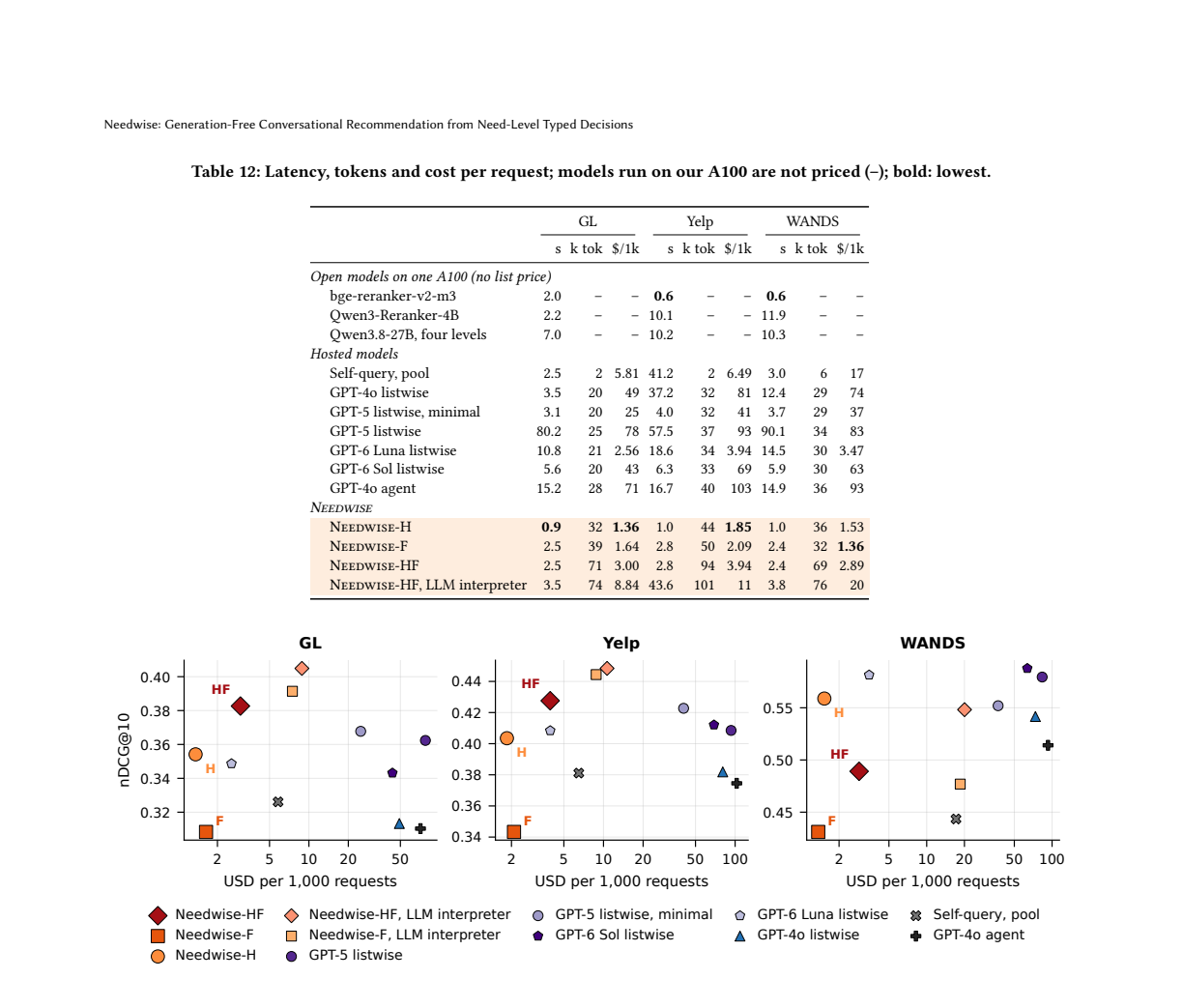
LLM rankers re-read the dialogue at every turn: they are slow, and their ordering does not show which needs an item meets. We show that a conversational recommender can be built from typed decisions instead: named questions over fixed options, answered with option probabilities rather than generated text. On each turn, one typed request maps the message onto the catalog's fields, keeps what no field expresses in the user's words, and decides how the turn changes each earlier need. Needwise then ranks candidates must-first: the needs on the kind of item, its place and its price form a tier, and within it one holistic decision and need-level verdicts (supported, contradicted or unknown) are combined with equal weight (Needwise-HF). With the graded attributes withheld from the records, so that needs must be inferred from names, descriptions and reviews, Needwise-HF ranks Google Local requests significantly better than GPT-6 Sol (0.383 against 0.343 nDCG@10) and is not significantly different from the strongest LLM ranker on Google Local and Yelp; these comparisons keep their sign under every treatment of unrecorded attributes we test. It costs a fraction of GPT-6 Sol's API price and answers in 2.5 s at the median on Google Local, against 5.6 s for GPT-6 Sol. In conversations, the typed state keeps the ranking across switches and returns, but it recognizes only 19-27% of withdrawn needs.
from the abstract
Pith says
Machine review · deepseek-v4-flash · 24 Nov 2026 · read the full text (158,457 characters) · not checked by a person
It can be wrong. Challenge this review or reply to it.
Holds up, with conditions. A generation-free conversational recommender built from typed decisions matches the strongest LLM rankers on local-business requests at a fraction of the cost, and the paper's own stated limits — missed withdrawals and weaker product search — are the ones that matter. This line is wrong
6 minor · 2 open questions
How often objections from reviews like this one are right: not yet measured
The paper, first character to last
The reviewer was given the whole text, 158,457 characters. Not checked: figures, code, what the 93 references say.
6 minor objections
The paper says, at 5.1
Pith says: minor objection 1 of 6
Section 5.1, Table 2 and Appendix F show that on WANDS (product search), Needwise-HF scores 0.489 nDCG@10, significantly worse than GPT-6 Sol (0.588) and even below the holistic-only variant (0.559). The paper attributes this to wrong hard predicates from typed interpretation.
more of objection 1
This is a domain where the method clearly fails. The abstract and conclusion emphasize the positive results on Google Local and Yelp, but the product search failure is relegated to an appendix. The authors should discuss this limitation more prominently in the main text, as it shows that the method is not universally applicable and that the tier can be harmful when interpretation is unreliable.
The paper says, at 3.2
Pith says: minor objection 2 of 6
Section 3.2, Eq. (3): The evidence e = p_s - p_c is the expected value of y under the distribution. It would be helpful to state this explicitly for readers unfamiliar with the formulation.
show 4 more
The paper says, at 5.1
Pith says: minor objection 3 of 6
Table 2: The row 'Self-query, pool' has a footnote marker (the superscript dagger) but no corresponding footnote in the table. The footnote appears only in Table 5. Please add a note or remove the marker.
The paper says, at A.1
Pith says: minor objection 4 of 6
Appendix A.1: The description of clause splitting ('A message is split at sentence ends, commas, dashes, conjunctions and relative pronouns') could be clearer. For example, what counts as a 'content word' for the rule that joins short pieces? A brief definition or example would help reproducibility.
The paper says, at 4.1
Pith says: minor objection 5 of 6
The paper uses many acronyms (GL, HF, P1–P4, etc.). A glossary in the appendix would aid readers who skip sections.
The paper says, at 1
Pith says: minor objection 6 of 6
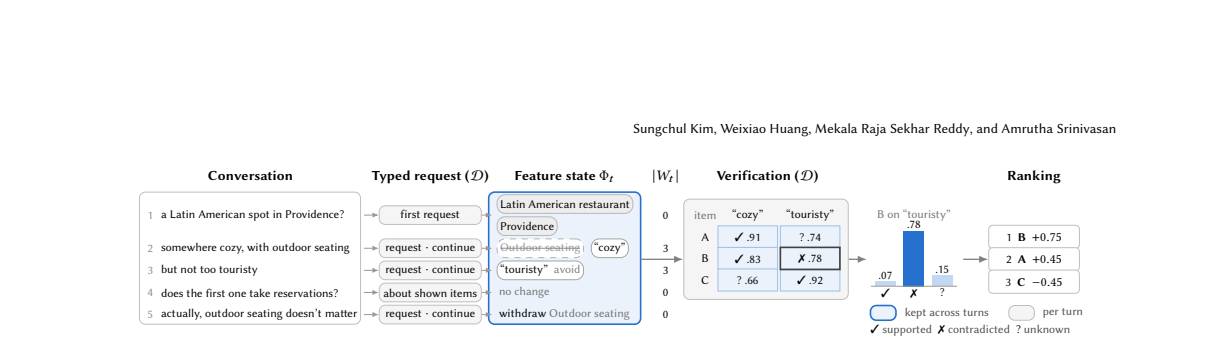
Figure 1 is not visible in the supplied text. The caption is informative, but the figure is essential for understanding the architecture. Since we cannot see it, we cannot assess its clarity. The authors should ensure the figure is self-contained and clearly labeled.
Open questions (2)
Pith raised these and could not confirm them against the text of the paper it read. They are questions for the authors, not findings.
- 5.2 What is the impact of missed withdrawals on nDCG@10 at checkpoints P2-P4, as measured by an ablation that uses oracle withdrawal recognition?
- 4.1 Pith raised a concern here that it could not check against the text of the paper it was given, so it is not published as an objection.
What would settle it
A controlled experiment that compares Needwise-HF's ranking against an oracle that recognizes all withdrawals (e.g., using gold transition labels) would quantify the impact of missed withdrawals on nDCG@10 at each conversation checkpoint; if the gap is small, the withdrawal problem is less critical than the paper suggests.
from Pith's summary of the paper
How the review went
5 passes by deepseek-v4-flash · 24 Nov 2026
- Reader holds up, with conditions
- Skeptic concern not confirmed: listed as an open question
- Referee 6 minor
- Check against the paper kept 0 of 5 objections
- Editor wrote the verdict above
Not run on this paper: the simulated authors' defence.
Pith's passes raised 5 objections. A check against the paper's text kept 0, withdrew 1 (1 the paper already says), left 3 as questions and moved 1 to the minor objections.
The review in full
The review in brief, machine-written
The paper's claim is specific and it survives: build a conversational recommender from typed decisions — a named question with a fixed option set, answered with option probabilities, no generated text — and rank candidates must-first, combining one holistic judgment with per-need verdicts that include a genuinely three-valued relation (supported, contradicted, insufficient evidence). On Google Local it beats GPT-6 Sol by 0.040 nDCG@10 with a Holm-corrected 95% interval from +0.020 to +0.063, is statistically indistinguishable from the strongest LLM ranker on both local datasets, and does it at a fraction of the token cost with a lower median latency. The comparisons keep their sign under every treatment of unrecorded attributes. That is a real result, and the evaluation supports it: identical pools for every method, paired bootstrap with Holm correction rechecked by a randomization test, and careful accounting of what the closed-world grade assumptions can and cannot show.
The genuinely new piece is combining typed interpretation, transition-routed state tracking and need-level verification into one generation-free pipeline, with an explicit insufficient-evidence option so a silent record is not counted as a contradiction. The ablations are honest about where the value sits: the holistic question carries the ranking, the tier and verdicts add +0.029 and +0.024 on top, and need-level verdicts alone rank low.
The soft spots are the ones the paper prints itself, and they bound the claim rather than refute it. Withdrawal recognition at 19-27% leaves dropped needs scoring in conversation; the paper reports this and traces it in examples. On WANDS product search the hard tier costs more than it adds (drhf trails the holistic-only version by 0.070 and GPT-6 Sol by 0.099). Both datasets are synthetic local business, grades are closed-world, and the LLM-interpreter ablation — which lifts drhf to 0.405 and 0.448 — shows typed interpretation, not scoring, is the binding constraint. The open question I would like answered is what an oracle withdrawal recognizer would buy in conversational nDCG; the current numbers cannot say.
This paper deserves a serious referee. The central claim is supported and the scope is stated with unusual precision about its limits.
The stress test's concern
Not confirmed. Pith could not check this concern against the text of the paper it was given; it is listed as an open question, not a finding.
The referee's report
Not published. Pith's referee wrote this assessment before its objections were checked against the paper, and 3 of its 4 major objections did not survive that check.
Pith's reading of the paper (a machine's summary, not the authors')
The paper argues that a conversational recommender can be built entirely from typed decisions—named questions over fixed options answered with probabilities—without generating any text at query time. The system, Needwise, interprets each user turn with one typed request, tracks needs as typed features, and ranks candidates using a must-first hybrid score that combines a holistic decision with per-need verdicts (supported, contradicted, unknown). On Google Local and Yelp, with graded attributes withheld so needs must be inferred from text, Needwise-HF ranks requests significantly better than GPT-6 Sol on Google Local and not significantly differently from the strongest LLM ranker on both datasets, while costing a fraction of the API price and answering in 2.5 seconds median. The typed state maintains rankings across request switches and returns, but the typed request recognizes only 19–27% of withdrawn needs, a key limitation.
What carries the argument. The core mechanism is the hybrid scoring function Needwise-HF, which orders candidates first by a hard tier (evidence for the kind of item, place, and price) and then by an equal-weight combination of a holistic decision (four-level relevance) and the mean signed evidence across soft needs. The evidence for each need is the difference between the probability that the record supports it and the probability that it contradicts it, with a third option for insufficient evidence. This scoring is driven entirely by typed decision models that answer named questions over fixed options without generating text.
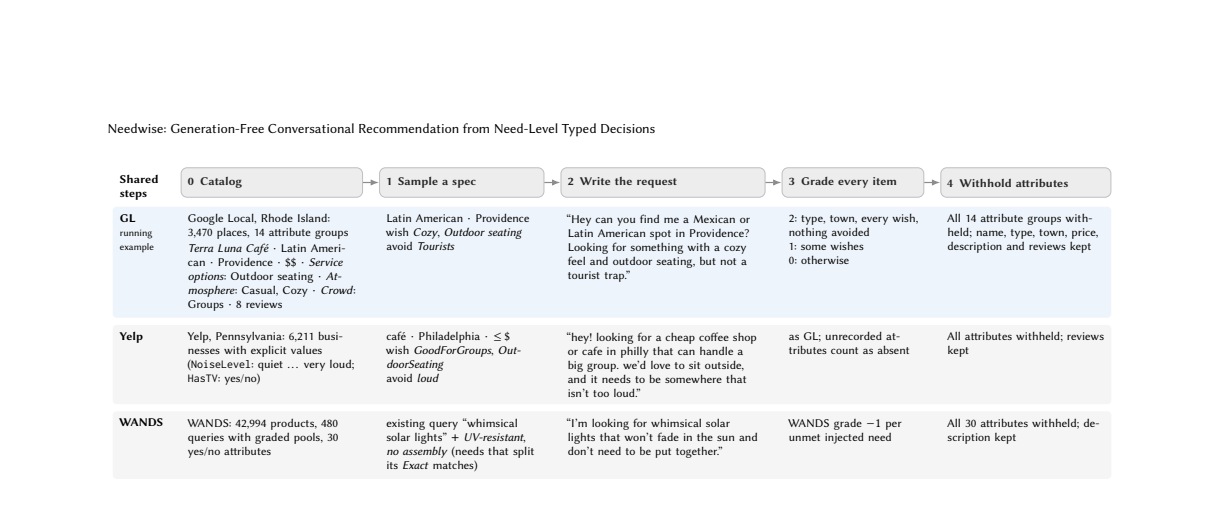
Core claim. The central claim is that typed decision models can replace generative LLMs for every query-time judgment in conversational recommendation—reading the message, tracking the state, and verifying candidates—and that combining a holistic decision with need-level evidence in a must-first tier yields ranking quality comparable to the strongest LLM rankers on local-business requests, at substantially lower latency and cost. The paper demonstrates this on two datasets with withheld graded attributes, using a hosted decision model without any weight adaptation.
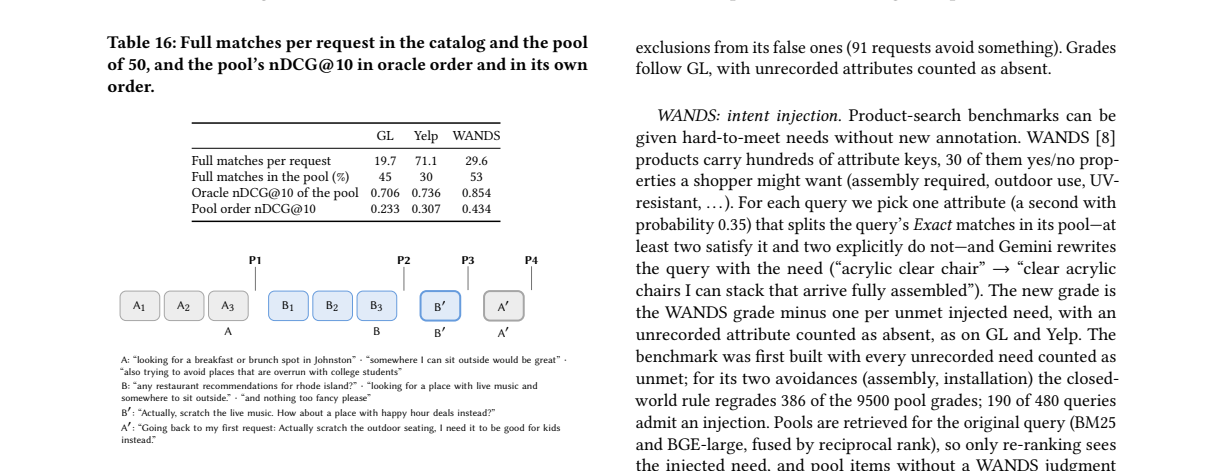
The premise it rests on. The typed request must correctly identify when a user withdraws a need, reverses a need, or switches to a new request; the paper reports that only 19–27% of withdrawals are recognized, which directly degrades conversational ranking because outdated needs remain in the scoring.
If the paper is right (Pith's inferences, not the authors')
If correct, conversational recommenders can achieve strong ranking without the latency and cost of re-reading the dialogue at every turn with a generative LLM.
The typed state enables efficient handling of request switches, revisions, and returns, as stored verdicts are reused.
The need-level evidence provides interpretable per-candidate justifications (which needs are met or contradicted), unlike black-box LLM rankings.
The approach is model-agnostic: any typed decision model (hosted or open-weight) can serve as the backend, and the scoring rules have no tuned parameters.
The low withdrawal recognition rate (19–27%) suggests that improving turn-level interpretation—perhaps by training the decision model on dialogue state transitions—could yield significant gains in conversational ranking.
The approach's reliance on a fixed vocabulary for field values limits its applicability to domains where the catalog schema is rich and stable; open-ended requests with novel attributes would require the fallback to user-word features, which underperform LLM-generated definitions.
The equal-weight combination of holistic and need-level scores is a design choice; a learned weighting or adaptive tier could further improve ranking, especially on product search where the hard tier currently hurts.
Check this review
What was read
The passes were given all 158,457 characters of the paper's LaTeX source.
Fingerprint of that text (SHA-256): 9d545e12397ed01ca00b926f83cfe85ec03cb8d5409694d1ac278982cc4b634d
Pith does not keep that text. Rebuilt from the paper's source or PDF by the same code, it has this fingerprint if it is the same text. From a copy of Pith's code:
PYTHONPATH=. python scripts/review_input_check.py 2611.31175
The passes, in the order they ran
- Reader deepseek-v4-flash · medium effort · $0.0053 · instructions of the Reader, fingerprint f9ead7300382…
- Skeptic deepseek-v4-flash · medium effort · $0.0046 · instructions of the Skeptic, fingerprint 8f88c0f61488…
- Referee deepseek-v4-flash · medium effort · $0.0047 · instructions of the Referee, fingerprint a852d99aea0d…
- Check against the paper deepseek-v4-flash · medium effort · $0.0069 · instructions of the Check against the paper, fingerprint 6c7a6883d551…
- Editor deepseek-v4-flash · medium effort · $0.0080 · instructions of the Editor, fingerprint e7211f6a3d27…
- Circularity check deepseek-v4-flash · medium effort · $0.0044 · instructions of the Circularity check, fingerprint e9946e39d67b…
- Summary for the page deepseek-v4-flash · medium effort · temperature 0.2 · $0.0048 · instructions of the Summary for the page, fingerprint e4f56bf568e7…
The passes cost $0.039 in model calls together.
Version stamped on this review: pith-pipeline@v1.4.1-daily-deepseek-or-medium+deepseek/deepseek-v4-flash+p.d60f54226f00
Each link opens a pass's instructions as plain text, the exact bytes its fingerprint was taken over. Every stored set of instructions.
curl -s https://pith.science/methodology/prompts/f9ead730038216984cfb56d7cb34332bdf691828296a1de4245f3d6667d4bf56 | sha256sum
prints the fingerprint of the reader's instructions. The same works for every pass.
The receipt
The review's fingerprint was taken on 24 Nov 2026. The review you are reading still matches it.
Fingerprint of the review (SHA-256): e5b8ef48932574ae880b3d157db986fc87a80e769eef7afeab66306d26ffccd1
curl -s 'https://pith.science/api/v1/verdicts/2611.31175?form=canonical' | sha256sum
prints the fingerprint of the review as it stands now. The rule, in four steps.
A matching fingerprint shows the review has not changed since that date. It does not show that the review is right.
How often reviews like this one are right
Reviews like this one: written by deepseek-v4-flash, from the paper's LaTeX source.
How often objections from reviews like this one are right: not yet measured
Reviews by people
This review was written by a machine. No person has reviewed this paper on Pith yet. A scientist listed on Pith can review it for a fee, and their review is published here whatever it concludes.
The paper
Abstract
Conversational recommenders must rank items against needs that catalogs record only in part, while users add, withdraw and reverse needs and switch between requests. LLM rankers re-read the dialogue at every turn: they are slow, and their ordering does not show which needs an item meets. We show that a conversational recommender can be built from typed decisions instead: named questions over fixed options, answered with option probabilities rather than generated text. On each turn, one typed request maps the message onto the catalog's fields, keeps what no field expresses in the user's words, and decides how the turn changes each earlier need. Needwise then ranks candidates must-first: the needs on the kind of item, its place and its price form a tier, and within it one holistic decision and need-level verdicts (supported, contradicted or unknown) are combined with equal weight (Needwise-HF). With the graded attributes withheld from the records, so that needs must be inferred from names, descriptions and reviews, Needwise-HF ranks Google Local requests significantly better than GPT-6 Sol (0.383 against 0.343 nDCG@10) and is not significantly different from the strongest LLM ranker on Google Local and Yelp; these comparisons keep their sign under every treatment of unrecorded attributes we test. It costs a fraction of GPT-6 Sol's API price and answers in 2.5 s at the median on Google Local, against 5.6 s for GPT-6 Sol. In conversations, the typed state keeps the ranking across switches and returns, but it recognizes only 19-27% of withdrawn needs.
The paper's own sentences, arranged, kept beside the review and separate from it. Each label is drawn from a closed vocabulary; the number beside it is the probability the classifier gave that label. No sentence in this record was written by a model.
abstract compiled · 2026-11-24
The authors' main claim, as the classifier picked it out 0.62
“With the graded attributes withheld from the records, so that needs must be inferred from names, descriptions and reviews, Needwise-HF ranks Google Local requests significantly better than GPT-6 Sol (0.383 against 0.343 nDCG@10) and is not significantly different from the strongest LLM ranker on Google Local and Yelp; these comparisons keep their sign under every treatment of unrecorded attributes we test.”
How the main claim is stated: asserted 1.00
What the abstract itself states, as probabilities: claims first 0.07 · states limitation 0.97 · human participants 0.17 · controlled comparison 0.91 · randomized assignment 0.02 · states quantitative result 0.99 · compares with prior results 0.98 · mentions code or data availability 0.04
The abstract, sentence by sentence
This table labels the abstract only (arXiv listing abstract v1). The number is the probability the classifier gave the label.
| Sentence | Role | The authors' own work | States the main conclusion | Strength |
|---|---|---|---|---|
| Conversational recommenders must rank items against needs that catalogs record only in part, while users add, withdraw and reverse needs and switch between requests. | background 0.99 | 0.07 | 0.03 | asserted 1.00 |
| LLM rankers re-read the dialogue at every turn: they are slow, and their ordering does not show which needs an item meets. | background 0.71 | 0.14 | 0.03 | asserted 1.00 |
| We show that a conversational recommender can be built from typed decisions instead: named questions over fixed options, answered with option probabilities rather than generated text. | contribution 0.52 | 0.72 | 0.28 | asserted 0.58 |
| On each turn, one typed request maps the message onto the catalog's fields, keeps what no field expresses in the user's words, and decides how the turn changes each earlier need. | method 1.00 | 0.72 | 0.07 | asserted 0.99 |
| Needwise then ranks candidates must-first: the needs on the kind of item, its place and its price form a tier, and within it one holistic decision and need-level verdicts (supported, contradicted or unknown) are combined with equal weight (Needwise-HF). | method 1.00 | 0.85 | 0.12 | asserted 1.00 |
| With the graded attributes withheld from the records, so that needs must be inferred from names, descriptions and reviews, Needwise-HF ranks Google Local requests significantly better than GPT-6 Sol (0.383 against 0.343 nDCG@10) and is not significantly different from the strongest LLM ranker on Google Local and Yelp; these comparisons keep their sign under every treatment of unrecorded attributes we test. | result 1.00 | 0.95 | 0.52 | asserted 1.00 |
| It costs a fraction of GPT-6 Sol's API price and answers in 2.5 s at the median on Google Local, against 5.6 s for GPT-6 Sol. | result 1.00 | 0.94 | 0.08 | asserted 1.00 |
| In conversations, the typed state keeps the ranking across switches and returns, but it recognizes only 19-27% of withdrawn needs. | limitation 0.84 | 0.93 | 0.06 | asserted 1.00 |
What kind of paper the classifier reports this is: method or tool 1.00 · evidence from observation or experiment 0.93
What was examined, and what was not
Sources read
- arXiv listing abstract v1
Not examined
- full text
- figures and tables
- references and citing sentences
- relations to other papers
Levels run
- P abstract
Not run
- S sections
- T body sentences
- C citations
- R cross-paper relations
How the labels were made
Compiled by classifier-1.13.0 via TypeSafe API, question bank abstract-p1-20260923, 2026-11-24: 1 request, 6,537 input tokens.
Every quoted sentence on this record is the authors'. Every label is from Pith's closed vocabulary, with the probability shown beside it. This record as JSON
Figures (4)
Figures are the authors', reproduced from the paper.
References (93)
- [1] Mohammed Ali, Abdelrahman Abdallah, and Adam Jatowt. 2026. MemRevise: A Self-Revising Memory for Conversational Search. arXiv:2610.24672 [cs.IR] https://arxiv.org/abs/2610.24672 on PithPith's reviewarXiv
- [2] Anastasios N. Angelopoulos, Stephen Bates, Adam Fisch, Lihua Lei, and Tal Schuster. 2024. Conformal Risk Control. InThe Twelfth International Conference on Learning Representations (ICLR 2024). arXiv:2208.02814 [stat.ME] https: //openreview.net/forum?id=33XGfHLtZg on PithPith's reviewarXiv
- [3] Artificial Analysis. 2026. GPT-5 (medium): Intelligence, Performance & Price Analysis. https://artificialanalysis.ai/models/gpt-5-medium. Output speed on OpenAI’s API. Accessed 2026-10-21 on Pith
- [4] Seyedarmin Azizi, Erfan Baghaei Potraghloo, and Massoud Pedram on Pith
- [5] BAAI. 2024. BAAI/bge-reranker-v2-m3 Model Card. https://huggingface.co/ BAAI/bge-reranker-v2-m3 Hugging Face model card; accessed 2026-10-19 on Pith
- [6] Taylor Berg-Kirkpatrick, David Burkett, and Dan Klein. 2012. An Empirical Investigation of Statistical Significance in NLP. InProceedings of the 2012 Joint Conference on Empirical Methods in Natural Language Processing and Computa- tional Natural Language Learning. 995–1005. h... on Pith
- [7] David Berghaus, Arber Zela, Behzad Shomali, Markus Frey, Mehdi Ali, Rafet Sifa, and Volkan Cevher. 2026. Extending Reasoning in Typed Decision Models via Looping. arXiv:2611.07736 [cs.CL] https://arxiv.org/abs/2611.07736 on PithPith's reviewarXiv
- [8] Yan Chen, Shujian Liu, Zheng Liu, Weiyi Sun, Linas Baltrunas, and Benjamin Schroeder. 2022. WANDS: Dataset for Product Search Relevance Assessment. InAdvances in Information Retrieval: 44th European Conference on IR Research. 128–141. doi:10.1007/978-3-030-99736-6_9 on Pithdoi:10.1007/978-3-030-99736-6_9
- [9] Konstantina Christakopoulou, Filip Radlinski, and Katja Hofmann. 2016. Towards Conversational Recommender Systems. InProceedings of the 22nd ACM SIGKDD International Conference on Knowledge Discovery and Data Mining. 815–824. doi:10.1145/2939672.2939746 on Pithdoi:10.1145/2939672.2939746
- [10] Cloudflare. 2026. Clef. https://developers.cloudflare.com/workers-ai/models/ clef/ on Pith
- [11] Convai Innovations. 2026. Laya: System 1 Decision Engine. https://laya. convaiinnovations.com/ on Pith
- [12] Jonathan Cook, Tim Rocktäschel, Jakob Nicolaus Foerster, Dennis Aumiller, and Alex Wang. 2024. TICKing All the Boxes: Generated Checklists Improve LLM Evaluation and Generation. arXiv:2410.03608 [cs.AI] doi:10.48550/arXiv.2410. 03608 NeurIPS 2024 Workshop on Language Gamification on PithPith's reviewarXivdoi:10.48550/arxiv.2410
- [13] Gordon V. Cormack, Charles L. A. Clarke, and Stefan Büttcher. 2009. Reciprocal Rank Fusion Outperforms Condorcet and Individual Rank Learning Methods. InProceedings of the 32nd International ACM SIGIR Conference on Research and Development in Information Retrieval. 758–759. do... on Pithdoi:10.1145/1571941.1572114
- [14] Pritam Deka. 2026. From Retrieval to Typed Decisions: Calibrated System One Models from Biomedical Sentence Encoders. arXiv:2610.02486 [cs.CL] https: //arxiv.org/abs/2610.02486 on PithPith's reviewarXiv
- [15] Nischay Dhankhar, Alisher Amantay, Zhanibek Datbayev, Darkhan Akhme- tov, Yash Shah, Nurmukhamed Ubaidullayev, Raman Saparkhan, Dos Baha, and Abulhair Saparov. 2026. Towards Foundation Decision Models: Drex. arXiv:2611.07854 [cs.CL] https://arxiv.org/abs/2611.07854 on PithPith's reviewarXiv
- [16] Michael Dinzinger, Kanishka Ghosh Dastidar, and Michael Granitzer. 2026. Sys- tem One Models Are Not Better Rerankers. arXiv:2610.32318 [cs.CL] https: //arxiv.org/abs/2610.32318 on PithPith's reviewarXiv
- [17] Ahmed Elgohary, Denis Peskov, and Jordan Boyd-Graber. 2019. Can You Unpack That? Learning to Rewrite Questions-in-Context. InProceedings of the 2019 Conference on Empirical Methods in Natural Language Processing and the 9th International Joint Conference on Natural Language Pr... on Pithdoi:10.18653/v1/d19-1605
- [18] Zhimin Gao and Pichao Wang. 2026. OpenJev-RLCD: A Working RLCD Imple- mentation. arXiv:2609.38850 [cs.AI] https://arxiv.org/abs/2609.38850 on PithPith's reviewarXiv
- [19] Shirley Anugrah Hayati, Dongyeop Kang, Qingxiaoyang Zhu, Weiyan Shi, and Zhou Yu. 2020. INSPIRED: Toward Sociable Recommendation Dialog Systems. InProceedings of the 2020 Conference on Empirical Methods in Natural Language Processing (EMNLP). 8142–8152. arXiv:2009.14306 [cs.CL... on PithPith's reviewarXiv
- [20] Zhankui He, Zhouhang Xie, Rahul Jha, Harald Steck, Dawen Liang, Yesu Feng, Bodhisattwa Prasad Majumder, Nathan Kallus, and Julian McAuley. 2023. Large Language Models as Zero-Shot Conversational Recommenders. InProceedings of the 32nd ACM International Conference on Informatio... on Pithdoi:10.1145/3583780.3614949
show 73 more
- [21] Sture Holm. 1979. A Simple Sequentially Rejective Multiple Test Procedure. Scandinavian Journal of Statistics6, 2 (1979), 65–70. https://www.jstor.org/ stable/4615733 on Pith
- [22] Yupeng Hou, Junjie Zhang, Zihan Lin, Hongyu Lu, Ruobing Xie, Julian McAuley, and Wayne Xin Zhao. 2024. Large Language Models are Zero-Shot Rankers for Recommender Systems. InAdvances in Information Retrieval: 46th European Conference on Information Retrieval. 364–381. doi:10.1... on Pithdoi:10.1007/978-3-031-56060-6_24
- [23] Xu Huang, Jianxun Lian, Yuxuan Lei, Jing Yao, Defu Lian, and Xing Xie. 2025. Recommender AI Agent: Integrating Large Language Models for Interactive Recommendations.ACM Transactions on Information Systems43, 5, Article 152 (2025), 33 pages. arXiv:2308.16505 doi:10.1145/3731446 on PithPith's reviewarXiv
- [24] Ilaria Imperatrice, Taisia Kameneva, Adam Eric Greenberg, and Alessan- dro Romano. 2026. Are AI Decision Models Biased? A Case Study of Jev. arXiv:2610.19619 [cs.AI] https://arxiv.org/abs/2610.19619 on PithPith's reviewarXiv
- [25] Dietmar Jannach, Ahtsham Manzoor, Wanling Cai, and Li Chen. 2021. A Survey on Conversational Recommender Systems.Comput. Surveys54, 5, Article 105 (2021), 36 pages. doi:10.1145/3453154 on Pithdoi:10.1145/3453154
- [26] Walid Krichene and Steffen Rendle. 2020. On Sampled Metrics for Item Recom- mendation. InProceedings of the 26th ACM SIGKDD International Conference on Knowledge Discovery and Data Mining. 1748–1757. doi:10.1145/3394486.3403226 on Pithdoi:10.1145/3394486.3403226
- [27] LangChain. 2026. SelfQueryRetriever (LangChain API reference). https://reference.langchain.com/python/langchain-classic/retrievers/self_ query/base/SelfQueryRetriever on Pith
- [28] Jiacheng Li, Jingbo Shang, and Julian McAuley. 2022. UCTopic: Unsupervised Contrastive Learning for Phrase Representations and Topic Mining. InProceed- ings of the 60th Annual Meeting of the Association for Computational Linguistics (Volume 1: Long Papers). 6159–6169. doi:10.1... on Pithdoi:10.18653/v1/2022.acl-long.426
- [29] Raymond Li, Samira Ebrahimi Kahou, Hannes Schulz, Vincent Michalski, Lau- rent Charlin, and Chris Pal. 2018. Towards Deep Conversational Recom- mendations. InAdvances in Neural Information Processing Systems, Vol. 31. arXiv:1812.07617 [cs.LG] https://proceedings.neurips.cc/pap... on PithPith's reviewarXiv
- [30] Yuliang Li, Aaron Feng, Jinfeng Li, Saran Mumick, Alon Halevy, Vivian Li, and Wang-Chiew Tan. 2019. Subjective Databases.Proceedings of the VLDB Endow- ment12, 11 (2019), 1330–1343. doi:10.14778/3342263.3342271 on Pithdoi:10.14778/3342263.3342271
- [31] Jiacheng Lin, Tian Wang, and Kun Qian. 2025. Rec-R1: Bridging Generative Large Language Models and User-Centric Recommendation Systems via Reinforcement Learning. arXiv:2503.24289 [cs.IR] https://arxiv.org/abs/2503.24289 on PitharXiv
- [32] Xuan Lu, Sifan Liu, Bochao Yin, Yongqi Li, Xinghao Chen, Hui Su, Yaohui Jin, Wenjun Zeng, and Xiaoyu Shen. 2025. MultiConIR: Towards multi-condition Information Retrieval.arXiv preprint arXiv:2503.08046(2025). arXiv:2503.08046 doi:10.48550/arXiv.2503.08046 on PithPith's reviewarXivdoi:10.48550/arxiv.2503.08046
- [33] Hanjia Lyu and Yinglong Xia. 2026. Decision-Oriented Recommen- dation Reranking: An Empirical Study of Its Promise and Limitations. arXiv:2609.40241v2 [cs.IR] https://arxiv.org/abs/2609.40241v2 Version 2, 12 Oct 2026 on PithPith's reviewarXiv
- [34] Kelong Mao, Zhicheng Dou, Fengran Mo, Jiewen Hou, Haonan Chen, and Hongjin Qian. 2023. Large Language Models Know Your Contextual Search Intent: A Prompting Framework for Conversational Search. InFindings of the Association for Computational Linguistics: EMNLP 2023. 1211–1225.... on Pithdoi:10.18653/v1/2023
- [35] Mark Marosi. 2026. decider: one-pass typed decisions with calibrated probabili- ties. https://github.com/Mapika/decider on Pith
- [36] Julian McAuley and Jure Leskovec. 2013. Hidden Factors and Hidden Topics: Understanding Rating Dimensions with Review Text. InProceedings of the 7th ACM Conference on Recommender Systems. 165–172. doi:10.1145/2507157.2507163 on Pithdoi:10.1145/2507157.2507163
- [37] Microsoft. 2026. Deploy and use Microsoft-Decision-1 in Microsoft Foundry. https://learn.microsoft.com/en-us/azure/foundry/foundry-models/ how-to/use-foundry-models-microsoft-decision on Pith
- [38] Microsoft. 2026. Microsoft-Decision-1: Our model for fast decision-making. https://commandline.microsoft.com/microsoft-decision-1-model-foundry/ on Pith
- [39] OpenAI. 2024. GPT-4o System Card.arXiv preprint arXiv:2410.21276(2024). arXiv:2410.21276 doi:10.48550/arXiv.2410.21276 on PithPith's reviewarXivdoi:10.48550/arxiv.2410.21276
- [40] OpenAI. 2025. GPT-5 System Card. https://cdn.openai.com/gpt-5-system- card.pdf Official system card PDF; accessed 2026-10-19. Needwise: Generation-Free Conversational Recommendation from Need-Level Typed Decisions on Pith
- [41] OpenAI. 2026. API Pricing. https://platform.openai.com/docs/pricing. Accessed 2026-10-20 on Pith
- [42] OpenAI. 2026. Decisions API. https://developers.openai.com/api/docs/guides/ decisions on Pith
- [43] OpenAI. 2026. GPT-6 Luna – Model Documentation. https://developers.openai. com/api/docs/models/gpt-6-luna. Released 2026-09-22; accessed 2026-10-21 on Pith
- [44] OpenAI. 2026. GPT-6 Sol – Model Documentation. https://developers.openai. com/api/docs/models/gpt-6-sol. Released 2026-09-22; accessed 2026-10-21 on Pith
- [45] Dheeraj Mohandas Pai and Lu Xian. 2026. JevBench: An Open Evaluation Frame- work for Typed Decision Models. Preprints.org. doi:10.20944/preprints202610. 0181.v1 on Pithdoi:10.20944/preprints202610
- [46] Pouya Pezeshkpour and Estevam Hruschka. 2025. Multi-Conditional Ranking with Large Language Models. InProceedings of the 2025 Conference of the Nations of the Americas Chapter of the Association for Computational Linguistics: Human Language Technologies (Volume 1: Long Papers)... on PithPith's reviewarXiv
- [47] Ronak Pradeep, Sahel Sharifymoghaddam, and Jimmy Lin. 2023. RankZephyr: Effective and Robust Zero-Shot Listwise Reranking is a Breeze! arXiv:2312.02724 [cs.IR] doi:10.48550/arXiv.2312.02724 on PithPith's reviewarXivdoi:10.48550/arxiv.2312.02724
- [48] Yiwei Qin, Kaiqiang Song, Yebowen Hu, Wenlin Yao, Sangwoo Cho, Xiaoyang Wang, Xuansheng Wu, Fei Liu, Pengfei Liu, and Dong Yu. 2024. InFoBench: Evaluating Instruction Following Ability in Large Language Models. InFind- ings of the Association for Computational Linguistics: ACL... on PithPith's reviewarXiv
- [49] Zhen Qin, Rolf Jagerman, Kai Hui, Honglei Zhuang, Junru Wu, Le Yan, Jiaming Shen, Tianqi Liu, Jialu Liu, Donald Metzler, Xuanhui Wang, and Michael Ben- dersky. 2024. Large Language Models are Effective Text Rankers with Pairwise Ranking Prompting. InFindings of the Association... on Pithdoi:10.18653/v1/2024.findings-naacl.97
- [50] Dushyant Rajput, Nirdesh Chauhan, and Siddharth Kosaraju. 2026. Does a Hosted Decision Model Respect Irrelevant Alternatives? A Pre-Registered Test of Option- Set Dependence in Jev. arXiv:2610.16655 [cs.AI] https://arxiv.org/abs/2610.16655 on PithPith's reviewarXiv
- [51] Abhinav Rastogi, Xiaoxue Zang, Srinivas Sunkara, Raghav Gupta, and Pranav Khaitan. 2020. Towards Scalable Multi-Domain Conversational Agents: The Schema-Guided Dialogue Dataset. InProceedings of the AAAI Conference on Artificial Intelligence, Vol. 34. 8689–8696. doi:10.1609/aa... on Pithdoi:10.1609/aaai.v34i05.6394
- [52] Stephen Robertson and Hugo Zaragoza. 2009. The Probabilistic Relevance Frame- work: BM25 and Beyond.Foundations and Trends in Information Retrieval3, 4 (2009), 333–389. doi:10.1561/1500000019 on Pithdoi:10.1561/1500000019
- [53] Tetsuya Sakai. 2007. Alternatives to Bpref. InProceedings of the 30th Annual International ACM SIGIR Conference on Research and Development in Information Retrieval. 71–78. doi:10.1145/1277741.1277756 on Pithdoi:10.1145/1277741.1277756
- [54] Kevin Schott, Jan Lattenkamp, Daniel Hienert, and Dagmar Kern. 2026. Cleo: A Transparent and Controllable Chatbot for Conversational Commerce. InPro- ceedings of the 2026 Conference on Human Information Interaction and Retrieval (CHIIR ’26). 326–330. arXiv:2608.06068 [cs.HC] d... on PithPith's reviewarXiv
- [55] Rahul Sharma, Andrew B. Duncan, Gaétan Marceau Caron, and Sebastian J. Vollmer. 2026. TypedBench: A Benchmark for Calibration, Framing Sensitivity, and Cost in System One Decision Models. arXiv:2610.11392 [cs.AI] https: //arxiv.org/abs/2610.11392 on PithPith's reviewarXiv
- [56] Mark D. Smucker, James Allan, and Ben Carterette. 2007. A Comparison of Statistical Significance Tests for Information Retrieval Evaluation. InProceedings of the Sixteenth ACM Conference on Conference on Information and Knowledge Management. 623–632. doi:10.1145/1321440.1321528 on Pithdoi:10.1145/1321440.1321528
- [57] Shreyas Subramanian. 2026. To Jev or Not to Jev: When Can System-1 Decision Models Replace LLM Judges? arXiv:2611.00505 [cs.AI] https://arxiv.org/abs/ 2611.00505 on PithPith's reviewarXiv
- [58] Weiwei Sun, Lingyong Yan, Xinyu Ma, Shuaiqiang Wang, Pengjie Ren, Zhumin Chen, Dawei Yin, and Zhaochun Ren. 2023. Is ChatGPT Good at Search? Investi- gating Large Language Models as Re-Ranking Agents. InProceedings of the 2023 Conference on Empirical Methods in Natural Languag... on Pithdoi:10.18653/v1/2023.emnlp-main.923
- [59] Yu Sun, Junhao Xu, Jiajia Shi, and Zijin Yang. 2026. Type-Safe Is Not Error-Free: Typed Decision Models Follow the Option Name, Not the Definition Bound to It. arXiv:2609.26758 [cs.AI] https://arxiv.org/abs/2609.26758 on PithPith's reviewarXiv
- [60] Yueming Sun and Yi Zhang. 2018. Conversational Recommender System. In The 41st International ACM SIGIR Conference on Research & Development in Information Retrieval. 235–244. doi:10.1145/3209978.3210002 on Pithdoi:10.1145/3209978.3210002
- [61] Supersonic Labs. 2026. Julia 1. https://systemonemodels.ai/supersonic-labs/julia- 1 on Pith
- [62] Lijuan Tang and Yuemeng Zheng. 2026. Typed Decision Models: An Early Evidence Audit and Evaluation Checklist. arXiv:2609.32160 https://arxiv.org/ abs/2609.32160 on PithPith's reviewarXiv
- [63] James Thorne, Andreas Vlachos, Christos Christodoulopoulos, and Arpit Mittal on Pith
- [64] Katherine Tian, Eric Mitchell, Allan Zhou, Archit Sharma, Rafael Rafailov, Huaxiu Yao, Chelsea Finn, and Christopher Manning. 2023. Just Ask for Calibration: Strategies for Eliciting Calibrated Confidence Scores from Language Models Fine- Tuned with Human Feedback. InProceedin... on Pithdoi:10.18653/v1/2023.emnlp-
- [65] Dat Tran, Yongce Li, Hannah Clay, Negin Golrezaei, Sajjad Beygi, and Amin Saberi. 2026. Entropy Guided Diversification and Preference Elicitation in Agentic Recommendation Systems. InProceedings of the AAAI Symposium Series, Vol. 8. 197–205. arXiv:2603.11399 [cs.AI] doi:10.160... on PitharXiv
- [66] TypeSafe AI. 2026. Jev and the TypeSafe System One API Documentation. https://docs.typesafe.ai/models on Pith
- [67] TypeSafe AI. 2026. System One Models. https://docs.typesafe.ai/concepts/ system-one on Pith
- [68] Julián Urbano, Harlley Lima, and Alan Hanjalic. 2019. Statistical Significance Testing in Information Retrieval: An Empirical Analysis of Type I, Type II and Type III Errors. InProceedings of the 42nd International ACM SIGIR Conference on Research and Development in Informatio... on Pithdoi:10.1145/3331184
- [69] Xiaolei Wang, Xinyu Tang, Wayne Xin Zhao, Jingyuan Wang, and Ji-Rong Wen on Pith
- [70] Xiaoyue Wang, Jianyou Wang, Weili Cao, Kaicheng Wang, Ramamohan Paturi, and Leon Bergen. 2024. BIRCO: A Benchmark of Information Retrieval Tasks with Complex Objectives. arXiv:2402.14151 [cs.IR] on PithPith's reviewarXiv
- [71] Orion Weller, Benjamin Chang, Sean MacAvaney, Kyle Lo, Arman Cohan, Ben- jamin Van Durme, Dawn Lawrie, and Luca Soldaini. 2025. FollowIR: Evaluating and Teaching Information Retrieval Models to Follow Instructions. InProceedings of the 2025 Conference of the Nations of the Ame... on Pithdoi:10.18653/v1/2025.naacl-long.597
- [72] Orion Weller, Dawn Lawrie, and Benjamin Van Durme. 2024. NevIR: Negation in Neural Information Retrieval. InProceedings of the 18th Conference of the European Chapter of the Association for Computational Linguistics (Volume 1: Long Papers). 2274–2287. doi:10.18653/v1/2024.eacl... on Pithdoi:10.18653/v1/2024.eacl-long.139
- [73] Orion Weller, Kathryn Ricci, Eugene Yang, Andrew Yates, Dawn Lawrie, and Benjamin Van Durme. 2025. Rank1: Test-Time Compute for Reranking in In- formation Retrieval.arXiv preprint arXiv:2502.18418(2025). arXiv:2502.18418 doi:10.48550/arXiv.2502.18418 on PithPith's reviewarXivdoi:10.48550/arxiv.2502.18418
- [74] Ga Wu, Kai Luo, Scott Sanner, and Harold Soh. 2019. Deep Language-based Critiquing for Recommender Systems. InProceedings of the 13th ACM Conference on Recommender Systems. 137–145. doi:10.1145/3298689.3347009 on Pithdoi:10.1145/3298689.3347009
- [75] Yanran Wu, Dian Yu, Chongyang Bai, Jieyi Zhang, Rui Liu, Tianyi Chen, Shike Mei, Hang Cui, Frank Shyu, Sandeep Pandey, Luke Simon, Chunwei Liu, and Xi Liu. 2026. DecisionRank: On-Policy Distillation for Decision-Model Rerankers. arXiv:2610.42128 [cs.CL] https://arxiv.org/abs/2... on PithPith's reviewarXiv
- [76] An Yan, Zhankui He, Jiacheng Li, Tianyang Zhang, and Julian McAuley. 2023. Personalized Showcases: Generating Multi-Modal Explanations for Recommen- dations. InProceedings of the 46th International ACM SIGIR Conference on Re- search and Development in Information Retrieval. 22... on Pithdoi:10.1145/3539618
- [77] Yelp Inc. 2026. Yelp Open Dataset. https://business.yelp.com/data/resources/ open-dataset/ Intended for educational use; accessed 2026-10-19 on Pith
- [78] Xiaoxue Zang, Abhinav Rastogi, Srinivas Sunkara, Raghav Gupta, Jianguo Zhang, and Jindong Chen. 2020. MultiWOZ 2.2: A Dialogue Dataset with Additional Annotation Corrections and State Tracking Baselines. InProceedings of the 2nd Workshop on Natural Language Processing for Conv... on Pith
- [79] Jiamu Zhang, Tianze Yang, Yucheng Shi, Evan Chen, Zixiang Nie, Kelly Wan, Liangjie Hong, Ninghao Liu, and Liang Wu. 2026. AnyJev. https://github.com/ nokia-applied-research/AnyJev on Pith
- [80] Yongfeng Zhang, Xu Chen, Qingyao Ai, Liu Yang, and W. Bruce Croft. 2018. Towards Conversational Search and Recommendation. InProceedings of the 27th ACM International Conference on Information and Knowledge Management. 177–186. doi:10.1145/3269206.3271776 on Pithdoi:10.1145/3269206.3271776
- [81] Yanzhao Zhang, Mingxin Li, Dingkun Long, Xin Zhang, Huan Lin, Baosong Yang, Pengjun Xie, An Yang, Dayiheng Liu, Junyang Lin, Fei Huang, and Jingren Zhou on Pith
- [82] Yuyue Zhao, Jiancan Wu, Xiang Wang, Wei Tang, Dingxian Wang, and Maarten de Rijke. 2024. Let Me Do It For You: Towards LLM Empowered Recommen- dation via Tool Learning. InProceedings of the 47th International ACM SIGIR Sungchul Kim, Weixiao Huang, Mekala Raja Sekhar Reddy, and... on PithPith's reviewarXiv
- [83] Jike Zhong, Ming Li, and Yuxiang Lai. 2026. When the Right Answer Is Missing: An Arithmetic-Dependent Rejection Bottleneck in Jev. arXiv:2609.39496 [cs.LG] https://arxiv.org/abs/2609.39496 on PithPith's reviewarXiv
- [84] Changtai Zhu, Siyin Wang, Ruijun Feng, Kai Song, and Xipeng Qiu. 2025. ConvSearch-R1: Enhancing Query Reformulation for Conversational Search with Reasoning via Reinforcement Learning. arXiv:2505.15776 [cs.CL] https: //arxiv.org/abs/2505.15776 on PitharXiv
- [85] Yaochen Zhu, Harald Steck, Dawen Liang, Yinhan He, Vito Ostuni, Jundong Li, and Nathan Kallus. 2025. Rank-GRPO: Training LLM-based Conversational Recommender Systems with Reinforcement Learning. arXiv:2510.20150 [cs.IR] https://arxiv.org/abs/2510.20150 on PitharXiv
- [86] Honglei Zhuang, Zhen Qin, Kai Hui, Junru Wu, Le Yan, Xuanhui Wang, and Michael Bendersky. 2024. Beyond Yes and No: Improving Zero-Shot LLM Rankers via Scoring Fine-Grained Relevance Labels. InProceedings of the 2024 Conference of the North American Chapter of the Association f... on Pith
- [87] Shengyao Zhuang, Honglei Zhuang, Bevan Koopman, and Guido Zuccon. 2024. A Setwise Approach for Effective and Highly Efficient Zero-shot Ranking with Large Language Models. InProceedings of the 47th International ACM SIGIR Conference on Research and Development in Information R... on PithPith's reviewarXiv
- [88] Henry Peng Zou, Vinay Samuel, Yue Zhou, Weizhi Zhang, Liancheng Fang, Zihe Song, Philip S. Yu, and Cornelia Caragea. 2024. ImplicitAVE: An Open-Source Dataset and Multimodal LLMs Benchmark for Implicit Attribute Value Extraction. InFindings of the Association for Computational... on PithPith's reviewarXiv
- [93] if it has the right type and town, lists every wish and no avoided attribute, and a partial match (grade 1) if it lists some wishes. Labels are positive-only: an unlisted attribute is not proof of absence. Yelp.The 6,211 open food and nightlife businesses in Pennsyl- vania (Ph... on Pith
- [2018] FEVER: a Large-scale Dataset for Fact Extraction and VERification. In Proceedings of the 2018 Conference of the North American Chapter of the Association for Computational Linguistics: Human Language Technologies, Volume 1 (Long Papers). 809–819. doi:10.18653/v1/N18-1074 on PithPith's reviewdoi:10.18653/v1/n18-1074
- [2023] Rethinking the Evaluation for Conversational Recommendation in the Era of Large Language Models. InProceedings of the 2023 Conference on Em- pirical Methods in Natural Language Processing. Association for Computational Linguistics, Singapore, 10052–10065. doi:10.18653/v1/2023.... on Pithdoi:10.18653/v1/2023.emnlp-main.621
- [2025] Qwen3 Embedding: Advancing Text Embedding and Reranking Through Foundation Models.arXiv preprint arXiv:2506.05176(2025). arXiv:2506.05176 doi:10.48550/arXiv.2506.05176 on PithPith's reviewarXivdoi:10.48550/arxiv.2506.05176
- [2026] Labels Override Definitions in Jev-Style Typed Decision Models. arXiv:2610.02586 [cs.AI] https://arxiv.org/abs/2610.02586 on PithPith's reviewarXiv
Challenges and discussion
Disagree with the review, or know something it missed? Leave a comment, or challenge this review formally: a challenge becomes a permanent entry in this paper's record, and its decision is published here.
Come back by email
A short list of the week's newly reviewed papers. Nothing is sent until you confirm from your inbox, and every email has a link that stops it. No account.
No comments yet.
Sign in to comment