Artificial Intelligence · arXiv:2609.26758 v3 · submitted 22 Sep 2026
Type-Safe Is Not Error-Free: Typed Decision Models Follow the Option Name, Not the Definition Bound to It
The paper says
“Typed decision models return structured results, but output-type correctness alone does not ensure that decisions follow explicit option definitions.”
more of the abstract
Each option pairs a name with a definition that defines its intended meaning; the name, however, can provide a competing semantic cue. We study this conflict in Jev and two open-weight models by changing only the name-definition mapping, leaving the question, state, and the names and definition texts themselves unchanged. We measure decision flips at the level of the selected definition, rather than the returned name. On 1200 decision tasks with task-specific definitions, decision-flip rates are up to 70.4 pp higher with yes/no names than with the 0/1 control. This gap holds across all 4 binary decision rules. With yes/no names, reassignment also lowers their mean AUC from 93.8% to a below-chance 23.2%. In the binary evaluations, random strings used as option names yield mean flip rates close to those of neutral controls across all three models, with comparable balanced accuracy before reassignment. Together, these results support option-name polarity as a contributor to decision instability beyond reassignment alone. The type-error rate remains 0% throughout, showing that type-correct outputs can still fail to follow explicit option definitions.
from the abstract
Pith says
Machine review · deepseek-v4-flash · 25 Sep 2026 · of version 2 of the paper; version 3 is newer · what was read was not recorded · not checked by a person
It can be wrong. Challenge this review or reply to it.
Holds up, with conditions. Core finding is solid — below-chance AUC makes name-following over definitions clean — but the abstract's 'semantic polarity' attribution outruns the data; engage, with that claim fixed. This line is wrong
3 major objections · 4 minor
How often objections from reviews like this one are right: not yet measured
Not checked: figures, code, what the references say.
The paper says, at Abstract; Section 4.3; Table 2
The review did not quote this passage.
Pith says: Objection 1 of 3 · major
The causal attribution to 'semantic polarity' is not isolated from lexical content. The random-string control (Table 4) establishes that the option names must be meaningful words, but it does not separate polarity (the conventional semantic opposition of the two names) from wordness, word frequency, or lexical overlap with the decision domain.
more of objection 1
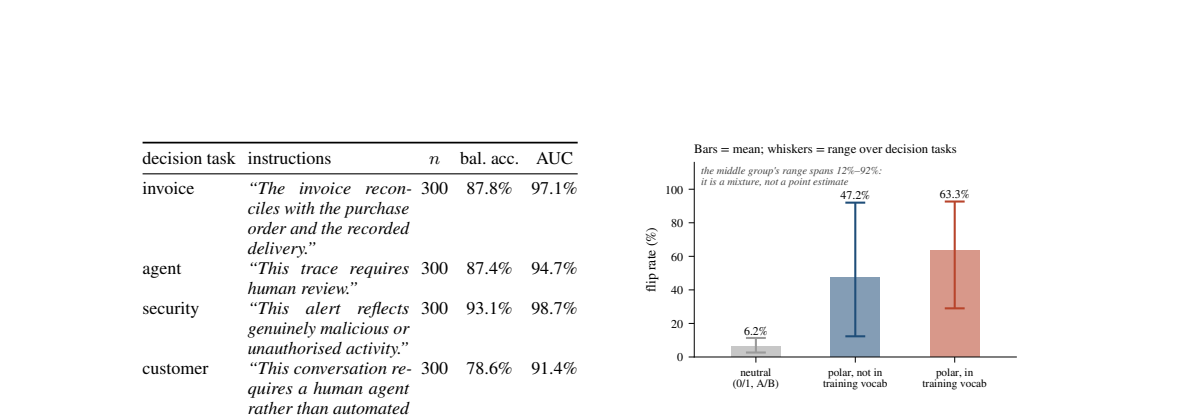
Table 2 is directly relevant: negative/positive flips 90.3% of invoice decisions but only 13.0% of security decisions, a 77pp spread. If polarity drove the failure, the effect should be roughly task-invariant, because polarity is a property of the name pair rather than of the task text; the observed task-level spread indicates that the names' lexical content matching the task text contributes substantially. The abstract's unconditional statement that 'the failure therefore depends on the semantic polarity of the option names' overstates what the controls establish. The authors should either reframe the claim to 'semantic content of the names' or add a control that varies polarity while holding content and lexical overlap fixed.
The paper says, at Table 6; Section 4.5
The review did not quote this passage.
Pith says: Objection 2 of 3 · major
For Open-Jev the neutral A/B pair flips 26.0% of decisions while the 0/1 pair flips 3.6%, a 22.4pp spread within the control class. The aggregated 'neutral' mean of 14.8% for Open-Jev therefore conflates a stable 0/1 control with a substantially noisier alphabetic control.
more of objection 2
The claim that the name-class ordering (neutral < unseen-polar < in-voc-polar) holds in all three models should be verified for Open-Jev against 0/1 alone; as presented, the ordering partly rests on averaging two controls with very different behaviors for that model.
The paper says, at Section 4.5; Section 7 [b135, b136]
The review did not quote this passage.
A classifier read this sentence of the paper as acknowledging the concern (probability 0.90):
“Open-Jev also answers less accurately before the re- assignment: its balanced accuracy is 59.8%–63.9% across name classes, against 79.4%–89.6% for Laya (Table 4), so its lower flip rate may also re- flect a preference for one definition regardless of the state.”
Pith says: Objection 3 of 3 · major
The 'read-out geometry' explanation — that Open-Jev flips less often because it mean-pools over the full option span — is plausible but unverified; the paper itself states this explanation is untested for other architectures. Additionally, Open-Jev's aligned balanced accuracy (59.8–63.9%, Table 4) is near chance, so its lower flip rate may reflect a decision-insensitive model rather than a more definition-robust one.
more of objection 3
The authors acknowledge this confound in Section 7, but it limits the cross-model generalization of the effect magnitudes and should be stated more prominently wherever Table 6 is interpreted.
4 minor objections
The paper says, at Section 4.3; Table 4
Pith says: minor objection 1 of 4
The sample sizes are inconsistent across tables and the text does not resolve the discrepancy: Table 1 reports Laya on 1200 questions, while Table 4 and Figure 2 report 1800, and the Table 4 caption says the non-random columns are 'means over the pairs of Table 1' without stating whether those means are recomputed on the 1800-question subset. State explicitly on which question set each column is computed.
The paper says, at Section 4.3; Table 3
Pith says: minor objection 2 of 4
The 'training-vocabulary familiarity' contrast (in-voc vs unseen polar pairs, +16.04 pp) is confounded with word frequency and word length: yes/no and false/true are among the highest-frequency English words, whereas absent/present, negative/positive, and rejected/accepted are longer and far less frequent. The familiarity claim should be flagged as preliminary rather than presented as a clean separation.
show 2 more
The paper says, at Section 4.4; Section 7 [b139]
Pith says: minor objection 3 of 4
The non-binary results are acknowledged as directional because original-name accuracy is only 56.4%, but Section 4.4's placement in the main text gives them more weight than that caveat allows; consider moving Table 5 to an appendix or explicitly labeling the subsection as exploratory.
The paper says, at Section 3; Appendix C
Pith says: minor objection 4 of 4
The exclusion of the 600 generic-definition questions is correct and the upper-bound treatment in Appendix C is appropriate, but the reader first meets the 1200-vs-1800 sample distinction in Section 4.3; a one-line reference to the exclusion at the end of Section 3 would prevent confusion across tables.
What would settle it
On the 300-question security-alert task (where negative/positive flips only 13.0%, Table 2), rerun the identical reassignment protocol with polarity-equivalent names that share no morphemes with any state or definition token, e.g. 'pro/con' or 'upper/lower', keeping definitions, gold labels, and scoring exactly as in the paper. Under a pure-polarity mechanism the flip rate should match the high polarity baseline seen elsewhere for Laya (roughly 45-80%); if it instead stays near the 13.0% negative/positive floor or near the 6% 0/1 control, the effect is lexical content matching between names and the task domain, not polarity, and the abstract's attribution sentence should be weakened.
from the skeptic's reading
How the review went
4 readings by deepseek-v4-flash · 25 Sep 2026
- Reader holds up, with conditions
- Skeptic partly agrees
- Editor wrote the verdict above
- Referee major revision: 3 major objections, 4 minor
Not run on this paper: the simulated authors' defence.
Pith did not check this review's objections against the paper.
The review in full
The review in brief, machine-written
Core finding holds, and the stress-test note is right about why: the below-chance AUC (23.2%) is the load-bearing result, not the flip rate. It rules out confusion (would sit near 50% flips and ~50% AUC), rules out order or position bias (the 0/1 control flips only 6.5%), and cannot be explained by a consistency-seeking reader, since under reassignment both options are internally contradictory. Name-following is the only mechanism that produces a clean inversion, and 76.9% flips with AUC 23.2% is consistent with it. I'd even go a bit further than the reader on credit: fixed question, state, and definitions across arms, bootstrap CIs, and a test-retest floor for the nondeterministic hosted model is good measurement hygiene.
Where I agree with the soft spot: the abstract's claim that the failure "depends on the semantic polarity" is the one sentence that outruns the evidence. The random-string control shows names must be meaningful, but it does not separate polarity from wordness or lexical overlap with the task vocabulary. Their own Table 2 cuts against a pure-polarity mechanism: negative/positive flips 90.3% on invoices but 13.0% on security, a 77-point spread for a pair whose polarity is state-independent. A pure polarity mechanism should give roughly flat flip rates across tasks. What is demonstrated is that the semantic content of names overrides the definitions; polarity is the parsimonious reading for yes/no specifically, not an isolated mechanism. The authors do flag the meaning-preservation confound in their limitations ([b138]), which is honest, but that is exactly the claim the abstract should not overstate.
Secondary gaps, minor in proportion: Jev's 0% type-error rests on documentation and a single API snapshot ([b137]) — acknowledged in the text; and there is no code or commit hash, so the numbers are not independently replayable. Neither weakens the open-weight demonstration. The literature is honestly engaged (Krishna Kumar, Sclar, Zheng, Liusie, Wei all cited and positioned correctly), and nothing is fitted to obtain the headline numbers.
Verdict: this deserves a serious referee. It is a measurement paper, not a field-reshaping one, but it delivers a clean, threshold-independent demonstration that a loudly advertised structural guarantee (0% type error) carries no decision-quality information, and it offers a cheap name-invariance metric. Accept conditional on softening the polarity attribution in the abstract or adding a control that isolates polarity from lexical overlap. I would cite it and bring it to reading group.
The strongest objection
The central claim, that type-safe models can follow option names rather than the definitions bound to them, is well supported on Laya: with definitions and question/state text held fixed across arms and only the name-binding changed, the yes/no reassignment flips 76.9% of decisions and AUC drops to 23.2%, below chance [b81]. That below-chance reversal is the key diagnostic: it requires a systematic inversion mechanism, ruling out confusion (about 50% AUC and 50% flip), positional/order bias (the 0/1 control flips only 6.5%), and a consistency-seeking reading of '<name>: <definition>' because under reassignment both options are internally contradictory, so no consistent option exists. Name-following is the only mechanism that cleanly produces a consistent inversion, and the observed 76.9% flip with AUC 23.2% is quantitatively consistent with it. The core finding therefore withstands the strongest alternative mechanisms I could construct. The load-bearing weakness is the further attribution in the abstract ('the failure therefore depends on the semantic polarity of the option names, rather than on the renaming operation itself') and in Section 4.3. The random-string control (Table 4) shows that names must be meaningful, but it does not isolate polarity specifically from wordness, case, length, or lexical overlap with the decision domain. The paper's own Table 2 is hard for a polarity-only mechanism to explain: negative/positive flips 90.3% on invoice but 13.0% on security, a 77 pp spread for a supposedly polarity-driven pair, whereas yes/no spans 56.7-92.7%. Since a name's polarity is state-independent, a pure polarity mechanism predicts roughly constant flip rates across tasks; the large task spread indicates task-dependent lexical matching between the specific names and the state/definition vocabulary.
This pass asked what would have to be true for the central claim, that type-safe models follow the option name rather than the rubric bound to it, and where it is least secure. The design is unusually clean: definitions and question/state text are fixed across arms, only the name-to-definition binding changes, so flips cannot originate in the definition texts themselves. The 0/1 and A/B controls (6.5%, 6.0%) bound the operational/order effect, and the random-string condition (about 6.9%) shows meaningless names behave like neutral ones. I checked the below-chance AUC (23.2%) against plausible alternatives: confusion gives about 50% AUC and 50% flip; positional bias is ruled out by the control; a consistency-seeking reading of '<name>: <definition>' is impossible because under reassignment both pairings are internally contradictory. Name-following is the only mechanism producing a consistent inversion, and 76.9% flip with AUC 23.2% is quantitatively consistent with it. So the central finding is robust; no internal inconsistency was found, and REJECT is not warranted. The genuine soft spot is the causal attribution to 'semantic polarity of the option names' in the abstract and Section 4.3. The controls establish that meaningfulness matters (random strings behave like neutral names), not that polarity specifically matters. Table 2's 77 pp task spread for negative/positive (90.3% invoice vs 13.0% security), against yes/no's narrower 56.7-92.7% spread, is not predicted by a pure polarity mechanism, since a name's polarity is state-independent; it indicates task-dependent lexical matching between names and state/definition vocabulary. The authors acknowledge meaning-preservation differences across name pairs [b138] but do not weigh the task spread against the polarity attribution, and the paper reports no code or commit hash to enable direct rechecking. This is a limitation of the causal story, not of the central name-vs-definition result, and it reinforces rather than alters the reader's CONDITIONAL verdict. Jev documentation trust [b137] is a real caveat but not load-bearing for the central claim, which rests on Laya's open-weight measurements; Jev only supports the secondary 'recurs across model families' generalization. Net recommendation: UNCHANGED, because the reader's CONDITIONAL already captures the attribution, generalization, and reproducibility caveats, and the strongest alternative mechanisms I could construct leave the core finding intact.
The referee's report
The core empirical result is strong and load-bearing: the below-chance AUC of 23.2% for Laya's yes/no reassignment requires a systematic inversion mechanism, which rules out confusion (roughly 50% AUC), positional/order bias (the 0/1 control flips only 6.5%), and a consistency-seeking reading of the option text (both reassigned options are internally contradictory). The measurement is clean and well annotated: neutral (0/1, A/B) and random-string controls, bootstrap confidence intervals, a definition-level flip metric that needs no gold labels, and a test-retest floor for the nondeterministic hosted model. The Section 7 limitations are candid: the read-out-geometry explanation is untested for other architectures, Open-Jev's low aligned accuracy confounds its flip-rate magnitudes, and Jev's type-safety premise rests on a single API snapshot. The central claim — that type-safe models can follow option names rather than the definitions bound to them — is well supported on Laya.
Pith's reading of the paper (a machine's summary, not the authors')
Typed decision models guarantee that every returned answer is one of the declared options — a 0 percent type-error rate — but this paper shows that guarantee is silent about whether the model follows the definition attached to each option. By swapping which name is bound to which definition while holding the question, state, definition texts, and name set fixed, the authors find that polar names such as yes/no override the definitions: Laya flips 76.9 percent of its decisions under a yes/no swap versus 6.5 percent for a neutral 0/1 control, and its AUC falls from 93.8 percent to 23.2 percent, below chance, meaning the ranking is reversed rather than merely uncertain. Random strings as option names return the model to the neutral regime without accuracy loss, so the failure depends on the semantic polarity of the names, not on the renaming operation itself. The type-error rate stays 0 percent in every condition, so a type check cannot detect the failure.
What carries the argument. The reassignment design carries the argument: keep the question, state, option names, and definition texts fixed, and change only which name binds to which definition; because the gold answer follows the definition, a model that reads the definitions preserves its definition-level choice and returns a different name, while a model that reads the names returns the same name and thus selects a different definition. The flip rate measures the chosen definition, not the returned name, so it needs no gold labels. Contrasting name classes — polar pairs inside and outside the training vocabulary, neutral 0/1 and A/B controls, and random five-character strings — isolates semantic polarity from the reassignment operation itself, and AUC, being threshold-independent, separates a reversed ranking from a mere loss of confidence.
Core claim. Type safety constrains where a decision can land, not what the options mean to the model. The paper establishes that typed decision models can select an option by its name rather than by the definition bound to it: reassigning yes/no to the definitions flips 76.9 percent of Laya's decisions (70.4 pp above the 0/1 control, 95% CI [67.6, 73.1]), and AUC drops from 93.8 percent to a below-chance 23.2 percent, so the scores separate the classes in the wrong direction, an error that threshold adjustment cannot fix. The effect holds across all four decision predicates at at least 7.4 times the control, grows with the number of options, and recurs in Jev (32.5 percent flip, AUC 81.5 to 58.1 percent, 24 times its test-retest floor) and Open-Jev (19.5 percent), with magnitudes differing across read-out geometries. Random character-string names behave like neutral controls with comparable accuracy, pointing to option-name polarity rather than the reassignment operation as the driver. Because the type-error rate remains 0 percent throughout, structurally valid outputs can still fail to follow the explicit option definitions.
The premise it rests on. The measured flips are attributed to the semantic polarity of the names, which assumes the definition texts are unconfounded with the names and the polarity-versus-content reading correct; the authors themselves note that name pairs differ in how far they preserve meaning, and the wide task spread (negative/positive flips 90.3 percent on invoices but 13.0 percent on security) suggests lexical content matching may drive part of the effect.
If the paper is right (Pith's inferences, not the authors')
A 0 percent type-error rate should be reported together with a name-invariance number; the flip rate under reassignment against neutral names needs no gold labels and costs two extra forward passes per question.
Practitioners can carry the meaning in neutral option names rather than in polar ones, which on Laya cuts the flip rate from 76.9 percent to 6.5 percent.
Training-time randomization of option names is proposed as a cheap mitigation for a model of Laya's size, though the authors do not evaluate it.
An AUC below chance means the model ranks instances in the wrong direction, an error a decision-threshold adjustment cannot correct.
Name sensitivity grows with the number of options: on three-to-sixteen-option questions even neutral letter names change 52.4 percent of decisions.
A sharper test than the paper runs would check whether flip rate tracks lexical content matching between names and task text: for negative/positive, the 90.3 percent flip on invoices versus 13.0 percent on security suggests a substantial content-driven component that the polarity reading may be folding in.
The same failure likely extends to any schema-constrained system that emits label words with conventional semantics, such as structured classifiers or safety judges returning yes/no verdicts, since the mechanism is name semantics overriding definitions.
The proposed mitigation — finetuning with randomized option names — is directly testable, and if it collapses flip rates to the neutral-control level it would confirm polarity, not content, as the driver.
The claimed modulation by read-out geometry (marker-token versus mean-pooling scoring) is untested across architectures; a controlled comparison holding the base model fixed would separate scoring effects from pretraining differences.
Check this review
Pith stored no record of this review's passes and took no fingerprint of it. Reviews made by code from 13 Nov 2026 on carry both.
How often reviews like this one are right
Reviews like this one: written by deepseek-v4-flash, where what was read was not recorded.
How often objections from reviews like this one are right: not yet measured
Reviews by people
This review was written by a machine. No person has reviewed this paper on Pith yet. A scientist listed on Pith can review it for a fee, and their review is published here whatever it concludes.
How Pith checks papers · The full audit of this paper · Review history (2 versions)
The paper
Abstract
Typed decision models return structured results, but output-type correctness alone does not ensure that decisions follow explicit option definitions. Each option pairs a name with a definition that defines its intended meaning; the name, however, can provide a competing semantic cue. We study this conflict in Jev and two open-weight models by changing only the name-definition mapping, leaving the question, state, and the names and definition texts themselves unchanged. We measure decision flips at the level of the selected definition, rather than the returned name. On 1200 decision tasks with task-specific definitions, decision-flip rates are up to 70.4 pp higher with yes/no names than with the 0/1 control. This gap holds across all 4 binary decision rules. With yes/no names, reassignment also lowers their mean AUC from 93.8% to a below-chance 23.2%. In the binary evaluations, random strings used as option names yield mean flip rates close to those of neutral controls across all three models, with comparable balanced accuracy before reassignment. Together, these results support option-name polarity as a contributor to decision instability beyond reassignment alone. The type-error rate remains 0% throughout, showing that type-correct outputs can still fail to follow explicit option definitions.
The paper's own sentences, arranged, kept beside the review and separate from it. Each label is drawn from a closed vocabulary; the number beside it is the probability the classifier gave that label. No sentence in this record was written by a model.
abstract compiled · 2026-09-24
The authors' main claim, as the classifier picked it out 0.83
“The failure therefore depends on the semantic polarity of the option names rather than on the renaming operation itself.”
How the main claim is stated: asserted 1.00
What the abstract itself states, as probabilities: claims first 0.04 · states limitation 0.44 · human participants 0.09 · controlled comparison 0.97 · randomized assignment 0.06 · states quantitative result 0.99 · compares with prior results 0.88 · mentions code or data availability 0.07
The abstract, sentence by sentence
This table labels the abstract only (arXiv listing abstract v1). The number is the probability the classifier gave the label.
| Sentence | Role | The authors' own work | States the main conclusion | Strength |
|---|---|---|---|---|
| Typed decision models are built for settings where model outputs are consumed directly by software. | background 1.00 | 0.05 | 0.02 | asserted 1.00 |
| Instead of generating free-form text, they return a decision over a predefined set of options. | background 1.00 | 0.06 | 0.02 | asserted 1.00 |
| By construction, every output conforms to the required schema. | background 1.00 | 0.07 | 0.03 | asserted 1.00 |
| Yet this guarantee does not tell us whether the model interprets the options as intended. | gap 0.97 | 0.06 | 0.18 | asserted 0.98 |
| We study Jev and two Jev-like models with open weights by changing how option names are assigned to rubrics. | contribution 0.68 | 0.93 | 0.04 | asserted 0.93 |
| Each option consists of an option name and a textual rubric that defines what the option means. | method 0.79 | 0.27 | 0.03 | asserted 1.00 |
| We change only which option name is assigned to each rubric; the question, state, rubric wording, and set of option names remain exactly the same. | method 0.97 | 0.92 | 0.03 | asserted 0.99 |
| On 1200 workflow decisions with task-specific rubrics, renaming the two options from 0/1 to no/yes changes 70.4 more answers per hundred (95% CI: [67.6, 73.1]) and shifts AUC from .94 to .23, revealing a systematic reversal in the decision ranking rather than simple uncertainty. | result 1.00 | 0.96 | 0.38 | asserted 1.00 |
| The same operation has little effect with neutral option names. | result 1.00 | 0.93 | 0.05 | asserted 1.00 |
| This pattern holds across all 4 predicates, where the effect is at least 7.4x larger than under the neutral control, and becomes stronger as the number of options increases. | result 1.00 | 0.94 | 0.09 | asserted 1.00 |
| The effect also depends on the read-out geometry: a second model family that mean-pools over the full option span flips 4.1x less often. | result 0.99 | 0.92 | 0.05 | asserted 1.00 |
| The hosted model exhibits the same behavior: the swap changes AUC from .8146 to .5806 and produces 24x as many answer flips as its test-retest floor. | result 1.00 | 0.90 | 0.07 | asserted 1.00 |
| In contrast, replacing the option names with random character strings returns all model families to the neutral-control regime without reducing accuracy. | result 0.98 | 0.92 | 0.11 | asserted 1.00 |
| The failure therefore depends on the semantic polarity of the option names rather than on the renaming operation itself. | interpretation 0.99 | 0.89 | 0.70 | asserted 1.00 |
| Across all conditions, the type-error rate remains 0%, even when decision accuracy degrades substantially. | result 0.98 | 0.92 | 0.26 | asserted 1.00 |
What kind of paper the classifier reports this is: empirical study 1.00 · evidence from observation or experiment 0.99
What was examined, and what was not
Sources read
- arXiv listing abstract v1
Not examined
- full text
- figures and tables
- references and citing sentences
- relations to other papers
Levels run
- P abstract
Not run
- S sections
- T body sentences
- C citations
- R cross-paper relations
How the labels were made
Compiled by classifier-1.13.0 via TypeSafe API, question bank abstract-p1-20260923, 2026-09-24: 1 request, 10,808 input tokens.
Every quoted sentence on this record is the authors'. Every label is from Pith's closed vocabulary, with the probability shown beside it. This record as JSON
Figures (4)


Figures are the authors', reproduced from the paper.
Cited by 28 Pith papers
Reviewed papers on Pith that cite this one. OpenAlex reports about 39 citations worldwide. The full citation record
- Thinking Fast, Anywhere: One System-1 for the Decision Points of Any Agent Workflow cs.AI · Nov 2026
- Track or Follow? A Jev-Compatible Multi-Agent Trading System When Web News Lags the Market cs.CL · Nov 2026
- Entity Matching using Decision Models cs.CL · Oct 2026
- NIOCIS: Typed-Decision Next-Hop Routing with Node-Conditioned Option Spaces for Tool-Use Agents cs.CR · Oct 2026
- Sharp and Stable Label-Free Calibration Certificates from Logical Coherence cs.LG · Oct 2026
- Lost in the Fallback: How Reliably Do Typed Decision Models Use Fallback Options? cs.CR · Oct 2026
- Suggested Is Not Superseded: A Pre-Registered Evaluation of a System-One Model as a Memory-Retirement Gate cs.AI · Oct 2026
- JevAdvBench: A Benchmark and Black-Box Attacks for Reinforcement Learning for Calibrated Decisions Models cs.CR · Sep 2026
- Jev-as-a-Reward: Validating Probabilistic Safety Judges for Reinforcement Learning cs.AI · Nov 2026
- Is Jev a Good Multilingual Judge? cs.CL · Nov 2026
- JevBreak: Your Model, Their Decision cs.CR · Nov 2026
- FlipJev: Fast Black-Box Red Teaming Finds Universal Adversarial Suffixes for Typed Decision Models cs.CR · Oct 2026
- Claim Laundering: When Agent Decision Models Trust Records Over Reality cs.AI · Oct 2026
- Jev-LiteMAS: Separating Decisions from Generation in Multi-Agent Workflows cs.AI · Oct 2026
- Jev-ToM: Evaluating Theory of Mind in Typed Decision Models cs.CL · Oct 2026
- Consider, Then Choose: Order-Invariant Decisions in System One Models cs.AI · Oct 2026
- Same Attack, Different Judge: A First Controlled Adversarial Comparison of Jev, LLM Judges, and Purpose-Built Safety Classifiers cs.CR · Oct 2026
- Poisoned into Action: Context Attacks on Typed Decision Workflows cs.CR · Oct 2026
- Can Jev be Your Q or Policy in Reinforcement Learning? cs.LG · Oct 2026
- Same-Number Citation Swaps: Stress-Testing Jev as a Financial Evidence Judge cs.CL · Oct 2026
- OmniMed-Jev: Calibrating LVLM Confidence for Trustworthy Medical Multimodal Decisions via System One cs.LG · Sep 2026
- MM-SystemOneBias: Evaluating Bias in Multimodal Jev-Style System One Decision Models cs.AI · Nov 2026
- How Reliable Are System-One Decisions in Medicine? A Comparative Study of Jev, Jev-like Models, and LLMs cs.CL · Oct 2026
- Specialized Decision Models vs. General-Purpose LLMs: Benchmarking Jev Across Knowledge, Reasoning, and Multilingual Tasks cs.CL · Oct 2026
- AnyJev Technical Report cs.LG · Sep 2026
- When the Right Answer Is Missing: An Arithmetic-Dependent Rejection Bottleneck in Jev cs.LG · Sep 2026
- Benchmarking candidate coverage and rejection policy transfer in typed decision models cs.AI · Oct 2026
- Typed Decision Models: An Early Evidence Audit and Evaluation Checklist cs.CL · Sep 2026
Challenges and discussion
Disagree with the review, or know something it missed? Leave a comment, or challenge this review formally: a challenge becomes a permanent entry in this paper's record, and its decision is published here.
Come back by email
A short list of the week's newly reviewed papers. Nothing is sent until you confirm from your inbox, and every email has a link that stops it. No account.
No comments yet.
Sign in to comment