Computation and Language · arXiv:2611.10414 v1 · submitted 7 Nov 2026 · 50 references
Track or Follow? A Jev-Compatible Multi-Agent Trading System When Web News Lags the Market
The paper says
“LLM agents increasingly trade on the Web news they read, yet much Web news about listed firms is published after, and about, the price move it reports, so a reader can agree with the market by following it instead of reading the event.”
more of the abstract
We ask whether LLM judgments of Web news track the market's reaction to the reported event or follow it. To answer, we built a multi-agent trading system whose agents share only point-in-time stores and answer typed questions through the interface of Jev, a hosted typed decision model; code sets every position under a proved bound on how far text can move it. In a hash-committed test of a Jev-compatible reader built from a pinned LLM's option probabilities, item judgments track announcement-window abnormal returns (weekly Spearman 0.119), also after the LLM's release, and event types agree with the issuers' 8-K filings (AUC 0.833); Jev's judgments of news published after its own release track the reaction as well (descriptive). Exploratory analyses show where the association comes from: 72% of earnings news items appear after the issuer's filing, contributor-written items often report the price move, and from the first trade after publication the association falls to 0.023. At a weekly horizon, the confirmatory test detects no rank information over code-only features. Under attack, decision cards traced 88% of successful attacks to the planted item. We propose that market-graded tests of Web-text readers report the criterion from publication, not only from the event.
from the abstract
Pith says
Machine review · deepseek-v4-flash · 10 Nov 2026 · what was read was not recorded · not checked by a person
It can be wrong. Challenge this review or reply to it.
Holds up, with conditions. Rigorous, honest, and important for evaluation methodology, but the headline correlation (0.119) is mostly driven by news that follows the market, and the paper's own exploratory results show the publication-aligned association is near zero (0.023) and no trading usefulness at the weekly horizon. This line is wrong
2 major objections · 7 minor
How often objections from reviews like this one are right: not yet measured
Not checked: figures, code, what the 50 references say.
The paper says, at §3.5, Assumption A.1 (Trust partition), and Appendix A
The review did not quote this passage.
Pith says: Objection 1 of 2 · major
The influence bound (Proposition A.2) rests on Assumption A.1, which states that the trusted logit, trusted ranks, bound parameters, reference-path quantities, and exclusion anchors are functions of trusted inputs only. The paper argues that single-writer immutable stores enforce this, and it provides property tests and worst-case checks (0 violations in 8,912 checks).
more of objection 1
However, the assumption implicitly relies on the modeler's choice of which features are designated as 'trusted' versus 'untrusted'. A future attacker who can influence price data (e.g., via market manipulation) could indirectly affect the trusted logit, which would violate the assumption. The paper notes this limitation in the bound's tightness discussion but does not discuss the possibility of attacks on the trusted inputs themselves. Given that the bound is not central to the main validity claim (H2, H3), this is a minor limitation. Still, the paper should acknowledge this boundary condition explicitly.
The paper says, at §4.3, Registered probe D1 (Figure A1)
The review did not quote this passage.
Pith says: Objection 2 of 2 · major
The date-only probe D1 tests whether the model's re-identification of the date exceeds chance. The registered test uses a start rule that reads the window centred on July 2024, and the paper reports that the AUC over the evaluation window is 0.488 (p=0.896).
more of objection 2
However, in an exploratory monthly view, 13 of 14 pre-release windows lie above 0.5, and two windows between the cutoff and the release (2024-11 to 2025-02) show p<0.05 before Holm correction. The paper attributes this to 'training data past the cutoff, a name prior, or chance'. While this does not undermine the post-release estimate (0.115), the evidence of potential look-ahead in the pre-release period is suggestive. The paper should discuss whether the buffer period of four decisions is sufficient given that some windows before the release differ from chance. The current treatment—acknowledging the pre-release deviations but not examining their impact on the confirmatory window—seems slightly dismissive.
7 minor objections
The paper says, at Abstract, line 9
Pith says: minor objection 1 of 7
The phrase 'code sets every position under a proved bound on how far text can move it' could be misinterpreted as a bound on any trading system. Clarify that the bound holds for this system's decomposition and relies on Assumption A.1 (trust partition).
The paper says, at Table 1
Pith says: minor objection 2 of 7
The abbreviation 'NG' appears without explanation in the table (defined later in §3.1 as 'this-that-model-1.0'). Consider adding a brief footnote or parenthetical in the table caption.
show 5 more
The paper says, at §3.3, paragraph on screening
Pith says: minor objection 3 of 7
The sentence 'Screening removes the opinion, promotion and instructions that Web text mixes with reports before any judgment is asked' is slightly unclear. The word 'before' might be read as a time ordering; consider rephrasing to 'before any judgment is elicited' or similar.
The paper says, at Table 3, row 'All frame items'
Pith says: minor objection 4 of 7
The column 'Reports move (%)' is 7.1 for all items, but the exploratory audit suggests the true share is near 10.6%. The paper already notes this undercount in Appendix C. Consider adding a parenthetical note in the table or footnote to avoid confusion.
The paper says, at §4.5, Table 5B, row 'Per-item reader'
Pith says: minor objection 5 of 7
The entry 'ASR (%) 10.5' and the subsequent Δ column are presented with a reference to 'the 7 secondary contrasts'. The reader might benefit from a brief reminder of which contrasts these are (A1–A7 pooled and the three reader variants).
The paper says, at Appendix D, Reporting Checklists
Pith says: minor objection 6 of 7
The paper references the typed-model checklist [40] and LLM trading reporting items [43, 47]. It might also mention the broader crypto/AI evaluation guidelines from [8] if applicable, but this is not required.
The paper says, at Figure 2 caption
Pith says: minor objection 7 of 7
The panel labels (a), (b), (c) are in the caption but not on the figure itself. Please add panel letters directly to the figure for clarity.
What would settle it
Replicate the confirmatory H2 statistic (weekly Spearman correlation of E[effect] with AR[0,+1], Newey–West standard errors with 4 lags) on an independent sample: either a later time period (e.g., weeks 116–200) or a different universe (e.g., S&P 400 mid-caps) using the same pinned LLM and question bank. If the correlation is not significantly positive, the generalizability of the central claim would be limited. If it is positive and of comparable magnitude, the central claim is strengthened.
from the skeptic's reading
How the review went
4 readings by deepseek-v4-flash · 10 Nov 2026
- Reader holds up, with conditions
- Skeptic partly agrees
- Editor wrote the verdict above
- Referee minor revision: 2 major objections, 7 minor
Not run on this paper: the simulated authors' defence.
Pith did not check this review's objections against the paper.
The review in full
The review in brief, machine-written
This is a well-executed paper that makes a real methodological contribution, but its central empirical claim is more subtle than the headline suggests. The paper asks whether LLM judgments of web news 'track' the market's reaction to the reported event or 'follow' it (i.e., merely report a price move that already happened). The confirmatory test finds a Spearman correlation of 0.119 with announcement-window returns, and this is robust to many controls. But the exploratory analysis shows that the publication-aligned association—measured from the first trade after the news item appears—is only 0.023, and the confirmatory test of trading usefulness finds nothing (−0.016 IC). So the interpretation is: LLM judgments do correlate with the market's reaction, but almost entirely because the news items themselves report that reaction. The judgments don't add predictive power beyond code-only features at a weekly horizon.
What the paper does well is considerable. The system design—point-in-time stores, typed questions, a proved influence bound—is careful and transparent. The pre-registration is thorough, with many controls for look-ahead (post-release estimates, blinding probes, placebo windows). The exploratory content analysis of news timing and authorship cleanly explains where the association comes from. The paper is honest about its limits and proposes a sensible reporting standard (publication-aligned criterion).
The soft spots are mostly those the paper acknowledges. The main empirical finding, while real, is not practically useful for trading (and the paper says so). Generalizability is limited to one LLM, one news feed, 100 large caps, and a weekly horizon. The trust-partition assumption for the bound is plausible but not empirically verified under adversarial pressure; the bound itself is a design feature but its practical tightness depends on chosen parameters (mu, K, J). The H1 result (attack comparison) went the wrong way, which the paper handles honestly.
This paper should go to peer review. It is a serious piece of work. The revisions needed are minor: make the publication-aligned criterion and the null usefulness result more prominent in the abstract and conclusion, so readers don't take the headline correlation at face value. The real contribution is in the evaluation methodology and the proposed standard, not in the specific correlation number.
The strongest objection
The paper is methodologically rigorous and transparent. The central claim—that LLM judgments of Web news track the market's reaction to the reported event—is supported by the confirmatory test (weekly Spearman 0.119, 95% CI [0.098, 0.140], Holm-adjusted p<10⁻⁶), and the association holds after the model's release (0.115) and under multiple sensitivity checks. The exploratory analyses honestly reveal that the association comes from returns realized before the item appears: the publication-aligned correlation is only 0.023 [0.005, 0.041]. The confirmatory test of usefulness (H3) detects no rank information at the weekly horizon (−0.016 [−0.029, −0.002]). The paper's own proposed reporting standard (publication-aligned criterion) addresses this. The trust partition assumption (A.1) is load-bearing for the influence bound but is implemented with single-writer immutable stores, tested with property tests and worst-case checks (0 violations in 8,912 checks), and the bound is not central to the main validity claim. All acknowledged limitations are clearly stated. No significant unresolved objection remains.
The paper's central claim (that LLM item judgments track announcement-window abnormal returns) is well-supported by a pre-registered confirmatory test, post-release estimates, blinding probes, and agreement with 8-K filings. The reader identified the trust partition (Assumption A.1) as the weakest assumption. While that assumption is important for the influence bound, it is not load-bearing for the core validity claim; the bound is a separate contribution. The trust partition is backed by single-writer stores, immutable records, taint tracking, property tests, and worst-case checks. The main qualification—that the publication-aligned correlation is very small (0.023)—is already prominently reported as an exploratory finding, and the paper explicitly recommends reporting both criteria. The reader's CONDITIONAL verdict is appropriate, and no additional concern warrants moving to REJECT or ACCEPT without revision. The agreement is 'partial' because the reader's weakest assumption (trust partition) is not the most critical limitation for the central claim; rather, the interpretation of the tracking result given the small publication-aligned association is more central, and the paper already addresses this honestly.
The referee's report
If the findings hold, the paper makes several important contributions. First, it provides a rigorous, pre-registered evaluation framework that separates event-level criterion validity from publication-aligned usefulness—a distinction that many prior studies conflate. Second, it delivers concrete empirical evidence that the apparent 'tracking' ability of LLMs on headline news is largely an artifact of the announcement window including returns that precede the item; the true publication-aligned signal is small and economically insignificant at a weekly horizon. Third, the multi-agent system design—with its typed question interface, single-writer stores, trust-partitioned learning, and formal influence bound—is a methodological contribution that others can adopt or extend. Fourth, the paper is unusually transparent: it reports all limitations, exploratory results (including negative ones), and checks for look-ahead, price-reporting items, and re-identification. The proposed reporting standard (publication-aligned criterion) is actionable and well-motivated. The paper does not overclaim; it honestly labels its confirmatory, registered, exploratory, and descriptive estimates.
Pith's reading of the paper (a machine's summary, not the authors')
The paper asks whether LLM judgments of Web news items about listed firms track the market's reaction to the reported event or simply follow a price move that has already occurred. To answer, the authors built a multi-agent trading system with point-in-time stores, typed decision interfaces, and a proved bound on how far text can influence positions. In a pre-registered test, LLM option-probability judgments correlated with announcement-window abnormal returns at a weekly Spearman of 0.119, even after the model's release. However, exploratory analysis showed that 72% of earnings news appears after the issuer's filing and that the correlation fell to 0.023 when measured from the first trade after publication. The paper concludes that standard market-graded tests should report the criterion from publication, not just from the event, because Web news largely reports what has already happened.
What carries the argument. The central mechanism is a trust-partitioned learning system with a proved influence bound (Proposition A.2) that limits how far any text can move a position, combined with a publication-aligned evaluation criterion that separates returns realized before an item appears from those that follow its publication. The band-guarded decision layer (Lemma A.3) admits text to adjust ranks only among names the trusted data already rates near the cut, and the pre-registered protocol (hash-committed tests H1–H3) fixes the evaluation in advance.
Core claim. The confirmatory test detects that LLM item judgments rank announcement-window abnormal returns (weekly Spearman 0.119, 95% CI [0.098, 0.140]), and the association holds after the LLM's release (0.115). Event-type judgments agree with issuers' 8-K filings (AUC 0.833 for earnings). Yet the association is mostly realized before the item appears: 72% of earnings news items follow the issuer's filing, contributor-written items frequently report the price move, and from the first trade after publication the correlation drops to 0.023 [0.005, 0.041]. At a weekly decision horizon, the test detects no rank information over code-only features (ΔIC −0.016). All attacks stayed within the proved influence bound, and decision cards traced 88% of successful attacks to the planted item. The paper proposes that market-graded tests of Web-text readers should report the criterion from publication, not only from the event.
The premise it rests on. The trust partition (Assumption A.1) assumes that the trusted logit, trusted ranks, the bound parameter kappa, and all reference-path quantities depend only on trusted inputs and are unaffected by any attack on text. If a later attack could indirectly affect trusted features (e.g., through correlated price movements or contamination of blackboard stores by earlier text outputs), the influence bound would not hold. The paper argues that single-writer stores and immutable records enforce this separation, but the assumption also depends on the modeler's choice of which features are trusted versus untrusted.
If the paper is right (Pith's inferences, not the authors')
Future tests of LLM readers on Web financial news should report a publication-aligned criterion alongside the announcement-window criterion, as the paper's results show the two can diverge sharply.
A trading system's exposure to adversarial text is bounded by a code-level cap, not by the reader's vigilance, so security guarantees can be made reader-agnostic.
Planted content that stays inside the band (e.g., fabricated facts or press releases) can still move positions, meaning defense must address both the reader and the decision-layer bound.
The association between LLM judgments and returns is mostly pre-publication, so claims of predictive insight from Web news readers should be tempered by a timing analysis.
The multi-agent architecture with per-item clearances and write-once stores is a replicable testbed for any typed reader, enabling paired re-evaluation without look-ahead bias.
The same point-in-time evaluation methodology could be applied to other domains where Web text reports time-stamped outcomes, such as clinical trial results graded against registry data or product announcements graded against subsequent sales figures.
If the finding generalizes beyond the single news feed and LLM tested, much of the touted market-prediction ability of LLM readers may be an artifact of reporting the price move rather than anticipating it, reducing their practical trading value.
The band-guarded decision layer is a promising pattern for deploying any untrusted content (not just text) in safety-critical systems: a tight bound on influence from untrusted sources, enforced by code, independent of the content's quality.
The paper's failure to detect rank information at a weekly horizon (H3) suggests that fast assimilation of news by the market leaves little for a learner to extract, consistent with the efficient-market view at weekly scales.
Check this review
Pith stored no record of this review's passes and took no fingerprint of it. Reviews made by code from 13 Nov 2026 on carry both.
How often reviews like this one are right
Reviews like this one: written by deepseek-v4-flash, where what was read was not recorded.
How often objections from reviews like this one are right: not yet measured
Reviews by people
This review was written by a machine. No person has reviewed this paper on Pith yet. A scientist listed on Pith can review it for a fee, and their review is published here whatever it concludes.
The paper
Abstract
LLM agents increasingly trade on the Web news they read, yet much Web news about listed firms is published after, and about, the price move it reports, so a reader can agree with the market by following it instead of reading the event. We ask whether LLM judgments of Web news track the market's reaction to the reported event or follow it. To answer, we built a multi-agent trading system whose agents share only point-in-time stores and answer typed questions through the interface of Jev, a hosted typed decision model; code sets every position under a proved bound on how far text can move it. In a hash-committed test of a Jev-compatible reader built from a pinned LLM's option probabilities, item judgments track announcement-window abnormal returns (weekly Spearman 0.119), also after the LLM's release, and event types agree with the issuers' 8-K filings (AUC 0.833); Jev's judgments of news published after its own release track the reaction as well (descriptive). Exploratory analyses show where the association comes from: 72% of earnings news items appear after the issuer's filing, contributor-written items often report the price move, and from the first trade after publication the association falls to 0.023. At a weekly horizon, the confirmatory test detects no rank information over code-only features. Under attack, decision cards traced 88% of successful attacks to the planted item. We propose that market-graded tests of Web-text readers report the criterion from publication, not only from the event.
The paper's own sentences, arranged, kept beside the review and separate from it. Each label is drawn from a closed vocabulary; the number beside it is the probability the classifier gave that label. No sentence in this record was written by a model.
abstract compiled · 2026-11-10
The authors' main claim, as the classifier picked it out 0.67
“We propose that market-graded tests of Web-text readers report the criterion from publication, not only from the event.”
How the main claim is stated: hedged possibility 0.41
What the abstract itself states, as probabilities: claims first 0.05 · states limitation 0.89 · human participants 0.06 · controlled comparison 0.62 · randomized assignment 0.03 · states quantitative result 0.99 · compares with prior results 0.69 · mentions code or data availability 0.13
The abstract, sentence by sentence
This table labels the abstract only (arXiv listing abstract v1). The number is the probability the classifier gave the label.
| Sentence | Role | The authors' own work | States the main conclusion | Strength |
|---|---|---|---|---|
| LLM agents increasingly trade on the Web news they read, yet much Web news about listed firms is published after, and about, the price move it reports, so a reader can agree with the market by following it instead of reading the event. | background 0.98 | 0.07 | 0.05 | asserted 0.97 |
| We ask whether LLM judgments of Web news track the market's reaction to the reported event or follow it. | gap 0.70 | 0.16 | 0.03 | unclear 0.81 |
| To answer, we built a multi-agent trading system whose agents share only point-in-time stores and answer typed questions through the interface of Jev, a hosted typed decision model; code sets every position under a proved bound on how far text can move it. | method 0.98 | 0.93 | 0.04 | asserted 0.97 |
| In a hash-committed test of a Jev-compatible reader built from a pinned LLM's option probabilities, item judgments track announcement-window abnormal returns (weekly Spearman 0.119), also after the LLM's release, and event types agree with the issuers' 8-K filings (AUC 0.833); Jev's judgments of news published after its own release track the reaction as well (descriptive). | result 0.98 | 0.96 | 0.43 | asserted 1.00 |
| Exploratory analyses show where the association comes from: 72% of earnings news items appear after the issuer's filing, contributor-written items often report the price move, and from the first trade after publication the association falls to 0.023. | result 0.84 | 0.89 | 0.08 | asserted 0.98 |
| At a weekly horizon, the confirmatory test detects no rank information over code-only features. | result 0.98 | 0.93 | 0.16 | asserted 1.00 |
| Under attack, decision cards traced 88% of successful attacks to the planted item. | result 0.99 | 0.90 | 0.03 | asserted 1.00 |
| We propose that market-graded tests of Web-text readers report the criterion from publication, not only from the event. | future work 0.85 | 0.24 | 0.70 | hedged possibility 0.41 |
What kind of paper the classifier reports this is: empirical study 0.84 · evidence from observation or experiment 0.83
What was examined, and what was not
Sources read
- arXiv listing abstract v1
Not examined
- full text
- figures and tables
- references and citing sentences
- relations to other papers
Levels run
- P abstract
Not run
- S sections
- T body sentences
- C citations
- R cross-paper relations
How the labels were made
Compiled by classifier-1.13.0 via TypeSafe API, question bank abstract-p1-20260923, 2026-11-10: 1 request, 6,485 input tokens.
Every quoted sentence on this record is the authors'. Every label is from Pith's closed vocabulary, with the probability shown beside it. This record as JSON
Figures (3)

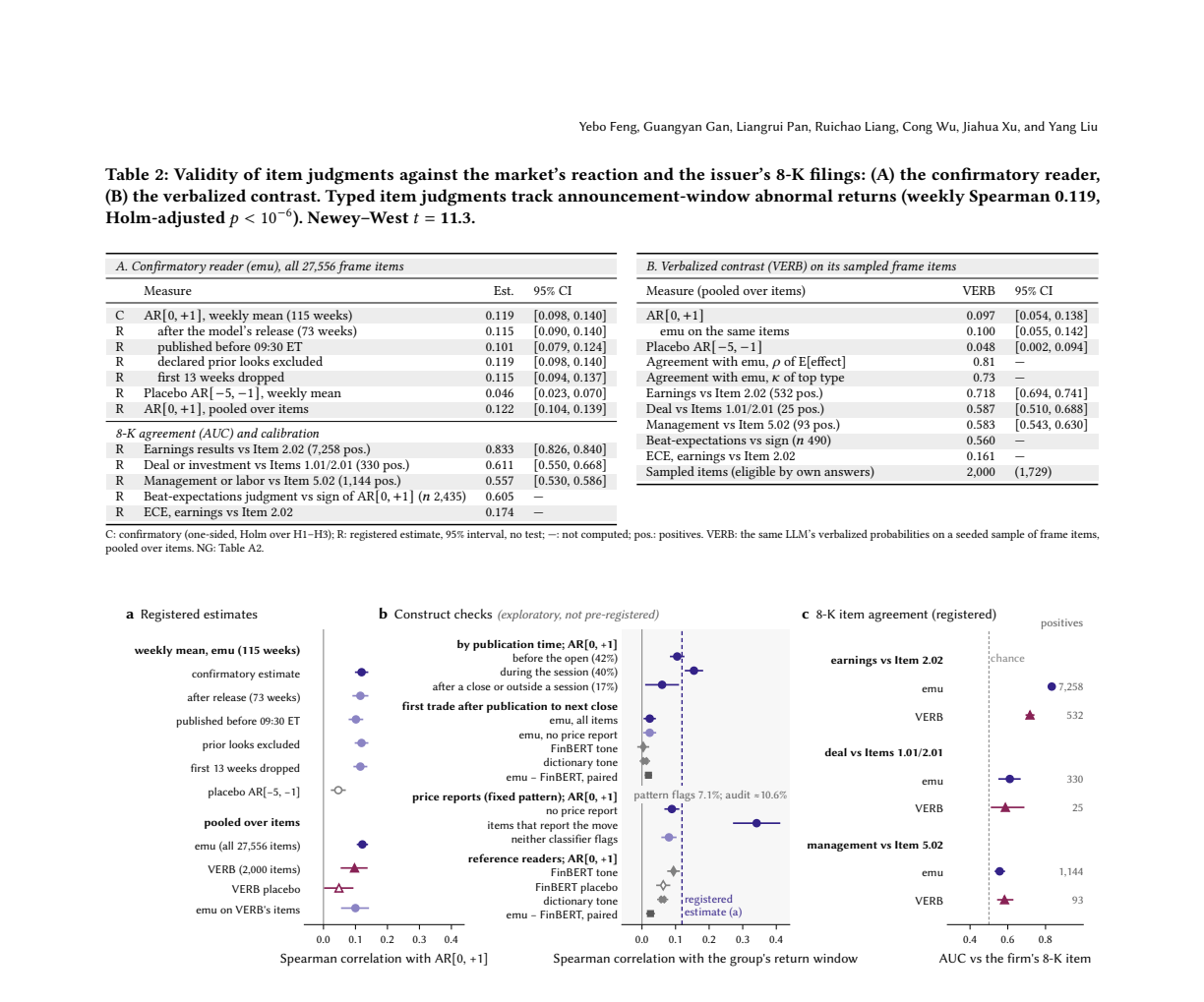

Figures are the authors', reproduced from the paper.
References (50)
- [1] AS Aravinthakshan, Laven Srivastava, and Harsh Nandwani. 2026. Human Agreement and Return Association Are Not Interchangeable Criteria. Preprint. arXiv:2609.11144 on PithPith's reviewarXiv
- [2] David H. Bailey and Marcos López de Prado. 2014. The Deflated Sharpe Ratio: Correcting for Selection Bias, Backtest Overfitting, and Non-Normality.JPM (The Journal of Portfolio Management)40, 5 (2014), 94–107 on Pith
- [3] Arslan Bisharat and Oudom Hean. 2026. Evaluating Financial Sentiment in the Age of AI. Preprint. arXiv:2609.20198 on PithPith's reviewarXiv
- [4] Jeffrey A. Busse and T. Clifton Green. 2002. Market efficiency in real time.J. Financ. Econ.65, 3 (2002), 415–437 on Pith
- [5] Xinying Cai, Minghao Guo, Jiahe Liu, Jiaojiao Han, Bangwei Guo, Yitao Long, Yuxuan Chen, Bohan Wu, Dimitris N. Metaxas, and Raymond Li. 2026. OpenPM: Auditable Point-in-Time Evaluation for LLM Portfolio-Management Agents. Preprint. arXiv:2608.09988 on PithPith's reviewarXiv
- [6] Zefeng Chen and Darcy Pu. 2026. Autonomous Market Intelligence: Agentic AI Nowcasting Predicts Stock Returns. Preprint. arXiv:2601.11958 on PitharXiv
- [7] Zehua Cheng, Wei Dai, and Jiahao Sun. 2026. this-that-model-1.0: A typed decision model that decides in 30 ms, for a millionth of a cent. Preprint. arXiv:2609.23886 on PithPith's reviewarXiv
- [8] Xiang Deng, Vasilisa Bashlovkina, Feng Han, Simon Baumgartner, and Michael Bendersky. 2023. What do LLMs Know about Financial Markets? A Case Study on Reddit Market Sentiment Analysis. InWWW Companion. 107–110 on Pith
- [9] Xiao Ding, Yue Zhang, Ting Liu, and Junwen Duan. 2015. Deep Learning for Event-Driven Stock Prediction. InIJCAI. 2327–2333 on Pith
- [10] Rian Dolphin, Joe Dursun, Jarrett Blankenship, Katie Adams, and Quinton Pike on Pith
- [11] George Fatouros and Kostas Metaxas. 2026. Signal or Noise in Multi-Agent LLM-based Stock Recommendations? Preprint. arXiv:2604.17327 [q-fin.PM] on PithPith's reviewarXiv
- [12] Anastassia Fedyk and James Hodson. 2023. When can the market identify old news?J. Financ. Econ.149, 1 (2023), 92–113 on Pith
- [13] Fabrizio Gilardi, Meysam Alizadeh, and Maël Kubli. 2023. ChatGPT outperforms crowd workers for text-annotation tasks.PNAS120, 30 (2023), e2305016120 on Pith
- [14] Paul Glasserman and Caden Lin. 2023. Assessing Look-Ahead Bias in Stock Return Predictions Generated by GPT Sentiment Analysis.JFDS (The Journal of Financial Data Science)6, 1 (2023), 25–42 on Pith
- [15] Kai Greshake, Sahar Abdelnabi, Shailesh Mishra, Christoph Endres, Thorsten Holz, and Mario Fritz. 2023. Not What You’ve Signed Up For: Compromising Real-World LLM-Integrated Applications with Indirect Prompt Injection. InAISec (ACM Workshop on Artificial Intelligence and Secur... on Pith
- [16] Barbara Hayes-Roth. 1985. A blackboard architecture for control.Artif. Intell.26, 3 (1985), 251–321 on Pith
- [17] Songrun He, Linying Lv, Asaf Manela, and Jimmy Wu. 2025. Chronologically Consistent Large Language Models. Preprint. arXiv:2502.21206 on PithPith's reviewarXiv
- [18] Jianyi Hu, Hangtao Zhang, Yi Liu, Yeqi Zeng, Li Zeng, Xianlong Wang, Rui Wang, and Leo Yu Zhang. 2026. JevAdvBench: A Benchmark and Black-Box Attacks for Reinforcement Learning for Calibrated Decisions Models. Preprint. arXiv:2609.31142 on PithPith's reviewarXiv
- [19] Ziniu Hu, Weiqing Liu, Jiang Bian, Xuanzhe Liu, and Tie-Yan Liu. 2018. Listening to Chaotic Whispers: A Deep Learning Framework for News-oriented Stock Trend Prediction. InWSDM. 261–269 on Pith
- [20] Allen H. Huang, Hui Wang, and Yi Yang. 2023. FinBERT: A Large Language Model for Extracting Information from Financial Text.CAR (Contemporary Accounting Research)40, 2 (2023), 806–841 on Pith
show 30 more
- [21] Hazem Ibrahim and Yasir Zaki. 2026. Evaluating Decision Models for Text Annotation in Computational Social Science. Preprint. arXiv:2609.24574 [cs.CL] on PithPith's reviewarXiv
- [22] Haozhe Jia. 2026. HindsightBench: A Black-Box Behavioral Audit Protocol for Parametric Hindsight in Time-Indexed LLM Decision Tasks. Preprint. arXiv:2607.18867 on PithPith's reviewarXiv
- [23] Arjun Kathiravelu. 2026. Jev earnings-call pre-registration. OSF Registries. https://osf.io/pck9g/ Pre-registration, registered 2026-09-27 on Pith
- [24] Daisuke Kawai, Alejandro Cuevas, Bryan Routledge, Kyle Soska, Ariel Zetlin- Jones, and Nicolas Christin. 2023. Is your digital neighbor a reliable investment advisor?. InWWW. 3581–3591 on Pith
- [25] Zheng Tracy Ke, Bryan Kelly, and Dacheng Xiu. 2019.Predicting Returns With Text Data. NBER Working Paper 26186. National Bureau of Economic Research on Pith
- [26] Kemal Kirtac. 2026. Financial Language Models as Applied Artificial Intel- ligence Systems for News-Based Trading under Market Frictions. Preprint. arXiv:2609.23703 on PithPith's reviewarXiv
- [27] Kelvin J.L. Koa, Yunshan Ma, Ritchie Ng, and Tat-Seng Chua. 2024. Learning to Generate Explainable Stock Predictions using Self-Reflective Large Language Models. InWWW. 4304–4315 on Pith
- [28] Changlun Li, Yao Shi, Chen Wang, Qiqi Duan, Runke Ruan, Weijie Huang, Hao- nan Long, Lijun Huang, Nan Tang, and Yuyu Luo. 2025. Time Travel is Cheating: Going Live with DeepFund for Real-Time Fund Investment Benchmarking. In NeurIPS. 184676–184704 on Pith
- [29] Xiangyu Li, Yawen Zeng, Xiaofen Xing, Jin Xu, and Xiangmin Xu. 2025. Profit Mirage: Revisiting Information Leakage in LLM-based Financial Agents. Preprint. arXiv:2510.07920 on PitharXiv
- [30] Yubo Li, Yidi Miao, Ramayya Krishnan, and Rema Padman. 2026. JEV- as-a-Judge: Accept When Confident, Escalate When Unsure. Preprint. arXiv:2609.26550 [cs.AI] on PithPith's reviewarXiv
- [31] Guoming Ling, Muen Xue, and Zijian Ye. 2026. Jev in the Wild: A Data-Driven Analysis of the Jev Model’s Functionality, Applications and Ecosystem. Preprint. arXiv:2609.30216 on PithPith's reviewarXiv
- [32] Alejandro Lopez-Lira and Yuehua Tang. 2026. Can ChatGPT forecast stock price movements? Return predictability and large language models.J. Financ. Econ. 184 (Oct. 2026), 104335 on Pith
- [33] Alejandro Lopez-Lira, Yuehua Tang, and Mingyin Zhu. 2025. The Memorization Problem: Can We Trust LLMs’ Economic Forecasts? Preprint. arXiv:2504.14765 on PitharXiv
- [34] Tim Loughran and Bill McDonald. 2011. When Is a Liability Not a Liability? Textual Analysis, Dictionaries, and 10-Ks.J. Finance66, 1 (2011), 35–65 on Pith
- [35] Fredrik Nestaas, Edoardo Debenedetti, and Florian Tramèr. 2025. Adversarial Search Engine Optimization for Large Language Models. InICLR. 4857–4888 on Pith
- [36] Daniel Paleka, Shashwat Goel, Jonas Geiping, and Florian Tramèr. 2026. Pitfalls in Evaluating Language Model Forecasters. InICLR on Pith
- [37] Yakov Pyotr Shkolnikov. 2026. Composable Trust for Language Models: A proven boundary and a measured defense. Preprint. arXiv:2607.13149 on PithPith's reviewarXiv
- [38] Qi Rong Sua, Junhao Dong, Nguyen Duc Thai, Yuqing Wen, Cheston Tan, and Yew-Soon Ong. 2026. Contagion on the Trading Floor: How Adversarial Signals Spread in Multi-Agent Trading Systems. InECML PKDD (European Conference on Machine Learning and Principles and Practice of Knowle... on Pith
- [39] Yu Sun, Junhao Xu, Jiajia Shi, and Zijin Yang. 2026. Type-Safe Is Not Error-Free: Typed Decision Models Follow the Option Name, Not the Definition Bound to It. Preprint. arXiv:2609.26758 [cs.AI] on PithPith's reviewarXiv
- [40] Lijuan Tang and Yuemeng Zheng. 2026. Typed Decision Models: An Early Evidence Audit and Evaluation Checklist. Preprint. arXiv:2609.32160 on PithPith's reviewarXiv
- [41] Katherine Tian, Eric Mitchell, Allan Zhou, Archit Sharma, Rafael Rafailov, Huaxiu Yao, Chelsea Finn, and Christopher Manning. 2023. Just Ask for Calibration: Strategies for Eliciting Calibrated Confidence Scores from Language Models Fine-Tuned with Human Feedback. InEMNLP. 5433–5442 on Pith
- [42] Tiantong Wu and Wei Yang Bryan Lim. 2026. Decision Hijacking: Prompt Injection Attacks on Jev’s Typed Probabilistic Decisions. Preprint. arXiv:2609.28613 [cs.CR] on PithPith's reviewarXiv
- [43] Yihan Xia, Panpan You, Taotao Wang, Fang Liu, Han Qi, Xiaoxiao Wu, and Shengli Zhang. 2026. Agentic Trading: When LLM Agents Meet Financial Markets. Preprint. arXiv:2605.19337 [cs.AI] on PithPith's reviewarXiv
- [44] Yijia Xiao, Edward Sun, Di Luo, and Wei Wang. 2024. TradingAgents: Multi- Agents LLM Financial Trading Framework. Preprint. arXiv:2412.20138 on PithPith's reviewarXiv
- [45] Miao Xiong, Zhiyuan Hu, Xinyang Lu, Yifei Li, Jie Fu, Junxian He, and Bryan Hooi. 2024. Can LLMs Express Their Uncertainty? An Empirical Evaluation of Confidence Elicitation in LLMs. InICLR on Pith
- [46] Yumo Xu and Shay B. Cohen. 2018. Stock Movement Prediction from Tweets and Historical Prices. InACL. 1970–1979 on Pith
- [47] Yuxuan Ye, Jun Han, Ao Hu, Juncheng Bu, Yiyi Chen, Liangjian Wen, Danilo Mandic, Danny Dongning Sun, Xu Yinghui, and Zenglin Xu. 2026. The Alpha Illusion: Reported Alpha from LLM Trading Agents Should Not Be Treated as Deployment Evidence. Preprint. arXiv:2605.16895 Yebo Feng,... on PithPith's reviewarXiv
- [48] Zhe Yu, Wenpeng Xing, Gaolei Li, Shuguang Xiong, Hongzhi Wang, Xuyang Teng, and Meng Han. 2026. Cordon-MAS: Defending RAG against Knowledge Poisoning via Information-Flow Control. Preprint. arXiv:2605.26754 on PithPith's reviewarXiv
- [49] Zeyu Zhang and Bradly C. Stadie. 2026. Temporal Leakage in LLM Backtesting: Measurement, Validation, and Adjusted Scores. Preprint. arXiv:2608.02985 A The Influence Bound Setup.We drop the decision index 𝑡. Code standardizes each judgment into features; the trusted learner giv... on PithPith's reviewarXiv
- [2026] Grounded Event Extraction from SEC 8-K Filings with a Fine-Grained Taxonomy. Preprint. arXiv:2607.08346 on PithPith's reviewarXiv
Challenges and discussion
Disagree with the review, or know something it missed? Leave a comment, or challenge this review formally: a challenge becomes a permanent entry in this paper's record, and its decision is published here.
Come back by email
A short list of the week's newly reviewed papers. Nothing is sent until you confirm from your inbox, and every email has a link that stops it. No account.
No comments yet.
Sign in to comment