Cryptography and Security · arXiv:2610.25985 v1 · submitted 19 Oct 2026 · 113 references
NIOCIS: Typed-Decision Next-Hop Routing with Node-Conditioned Option Spaces for Tool-Use Agents
The paper says
“Tool-use agents pay per decision: at each hop a language model re-reads the state and thinks for seconds, though its actions are finite and decisions recur.”
more of the abstract
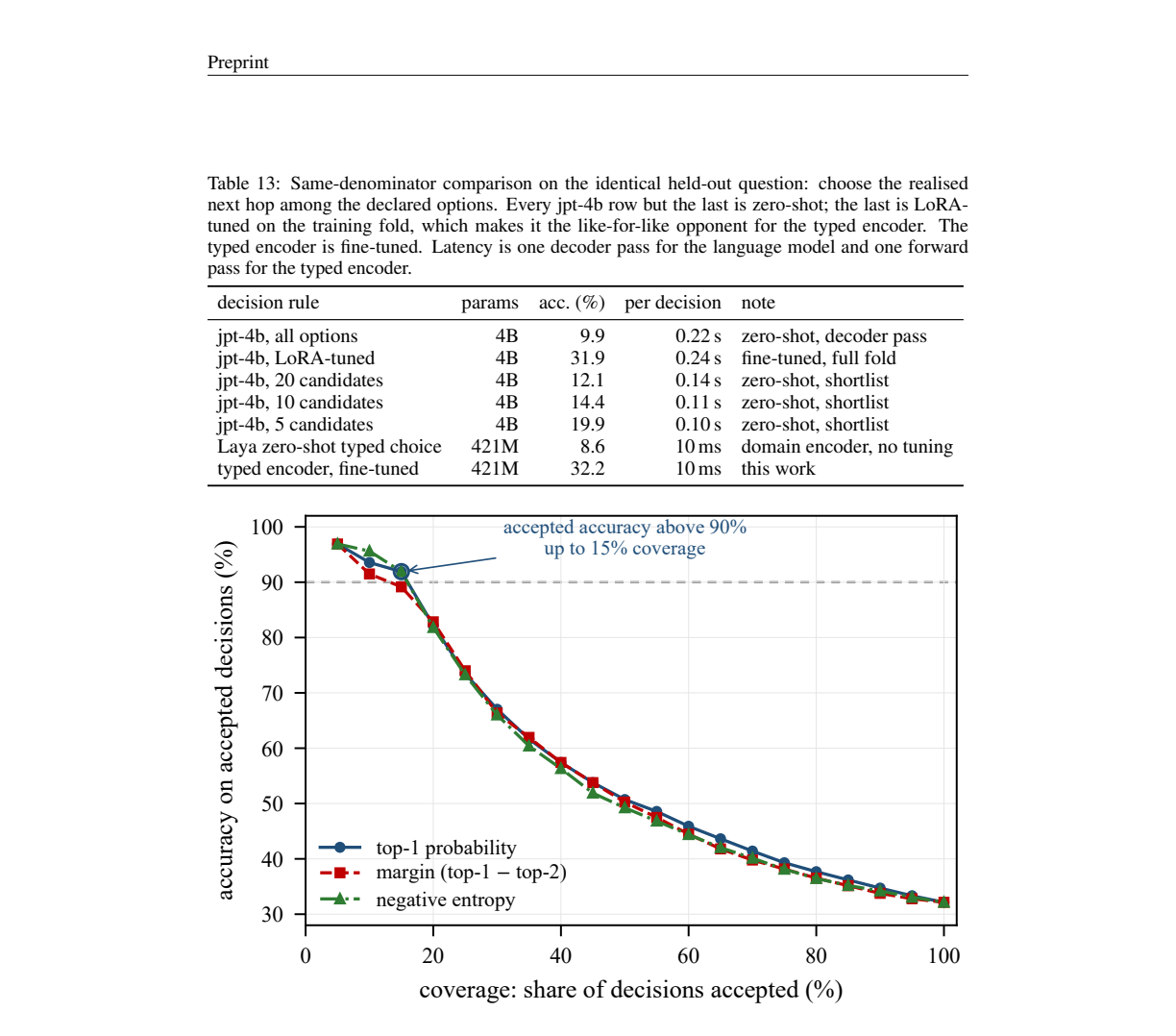
We present NIOCIS, a routing layer that folds execution logs into a loop-collapsed action graph (forward transitions plus recovery back-edges) answering one typed question: which declared option at a state, plus stop, does the fleet take next? A small model reads a calibrated distribution over them in one pass, emitting no text. On 1,615 production security-operations episodes we measure what the layer replaces, returns and is bounded by. Replaces: the typed encoder matches the logged next hop on 32.2% of the 3,875 held-out decisions (34.9% within the declared options) in 10 ms of encoder time (19.5 ms for the typed-choice form), against 2.2 s per LLM hop; two feature readouts reach 32.8% and 32.3%, an ordering the paired test does not resolve, so the typed layer is chosen for cost, not a separated lead. Tuning: jpt-4b reaches 9.9% zero-shot and 31.9% fine-tuned, a gap an exact paired test does not resolve (p=0.68), at 244 ms. Returns little: the realised hop falls outside the declared options for 7.9% of decisions and outside the model's top twenty for 9.3%; the most confident 15% holds 91.9% accuracy. Bounded: a cross-trace leave-one-out test puts the released state's ceiling at 25.6–44.9% as the state key grows more specific, i.e. repeated states disagree more often than they agree; the option-space ablation attributes the gain to per-node candidate restriction (+3.5 points over a flat catalog) rather than graph traversal (zero within its interval); a gated self-evolution loop lifts every arm above its anchor yet ends below full supervision; a confidence-gated cascade loses agreement when the escalation arm is the zero-shot stand-in; and agreement past a third of the fleet needs a state carrying the plan and the observation.
from the abstract
Pith says
Machine review · deepseek-v4-flash · 20 Oct 2026 · what was read was not recorded · not checked by a person
It can be wrong. Challenge this review or reply to it.
Holds up. NIOCIS is a solid, well-executed engineering paper that honestly measures what a cheap typed router can and cannot do for agent next-hop routing. The narrow claim holds, the negative results are transparent, and the documentation of limitations is a model for this kind of work. This line is wrong
3 minor
How often objections from reviews like this one are right: not yet measured
Not checked: figures, code, what the 113 references say.
3 minor objections
The paper says, at §5, zero-shot arm (Laya)
Pith says: minor objection 1 of 3
The zero-shot temperature fit is stated to be unbounded (validation NLL falls monotonically to the uniform-prediction limit). This should be flagged more prominently in the main text, not only in the appendix, because it means the reported calibration (ECE-15 = 0.031) and the fitted temperature (T=3.0) are grid-dependent and not interpretable as calibrated confidence for this arm.
The paper says, at General
Pith says: minor objection 2 of 3
The paper introduces many acronyms (NIOCIS, AURC, ECE, RSI, MLP, CLIP, SOC, etc.). A dedicated table of acronyms would improve readability, especially for readers not intimately familiar with every subfield.
show 1 more
The paper says, at Figures 3 and 7 captions
Pith says: minor objection 3 of 3
The captions are detailed, but it would help the reader if the subsample sizes and the median lines were explicitly labelled in the caption text rather than only in the main text, so that the figures are more self-contained.
What would settle it
Re-run the E3 cascade sweep (Table 5) with the escalation arm replaced by the LoRA-tuned jpt-4b (from E23c) instead of the zero-shot MIMO Pro V2.6, on the same 345 held-out episodes. If the hybrid's decision-level match exceeds the pure hidden-state probe's 30.7% at any escalation rate below 40%, the cascade gap is closed; if it remains below 30.7% at all rates, the confidence-gated cascade's failure is structural rather than an artifact of the escalation arm's capability gap.
from the skeptic's reading
How the review went
4 readings by deepseek-v4-flash · 20 Oct 2026
- Reader holds up
- Skeptic disagrees
- Editor wrote the verdict above
- Referee accept: 3 minor
Not run on this paper: the simulated authors' defence.
Pith did not check this review's objections against the paper.
The review in full
The review in brief, machine-written
The core idea — induce a loop-collapsed action graph from logs, then use a typed-decision router whose option set is the current node's outgoing edges — is cleanly novel. The paper doesn't oversell. It says plainly that the router matches the fleet on ~32% of decisions at 10 ms, and that the most confident 15% of decisions hit 91.9% accuracy. Everything else is bounded or fails in a documented way.
What I admire: the honesty. They run ablations for what the graph is worth (E9: per-node restriction buys 3.5 points over a flat catalog; graph traversal adds nothing), measure the information ceiling of the stripped state (E23e: 44.9% agreement with repeated-state modal, still below a coin flip), and explicitly report that the confidence-gated cascade "loses agreement when the escalation arm is the zero-shot stand-in" (E3). They also replicate on five public process logs and ToolBench, showing the same pattern. The code and derived data are released.
Soft spots, in proportion:
1. The high-precision band is demonstrated only for the static fine-tuned encoder, not in a practical cascade with a tuned escalation arm. The stress-test note is right: the only tested cascade (Table 5) loses agreement at every threshold. The paper acknowledges this and identifies the fix (a tuned escalation arm), but doesn't run it. That's the paper's weakest operational link, but it's a missing experiment, not a flaw in the static measurement.
2. The teacher-forced evaluation means you can't show improvement over the fleet. This is acknowledged and is appropriate for the narrow claim.
3. The gated self-evolution loop (E25) shows real but limited gains: the band compresses to 6.8% coverage, and the gate's advantage over random selection is within seed noise. The paper presents this clearly.
4. The derived outcome labels (completed/blocked/abandoned) are convention-based, not independently annotated. They flag this.
None of these are fatal. The paper is self-aware, methodical, and its narrow claim — containment and a small high-precision band at millisecond cost — is supported.
Who this is for: practitioners deploying agent systems who need to decide how much router cost they can cut without breaking the loop, and researchers working on lightweight agent control layers.
Yes, this deserves a serious referee. It should be published with a request to test the cascade with a tuned escalation arm (they have the LoRA-tuned jpt-4b weights), but even as-is it makes a solid, honest contribution.
The strongest objection
The paper's operational recommendation is a small high-precision band (15% coverage at 91.9% agreement) with the remainder escalated, implying a cascade. But the only confidence-gated cascade tested (Table 5, E3) uses MIMO Pro V2.6 zero-shot as the escalation arm and loses agreement at every threshold (pure probe: 30.7%; hybrids at τ=0.55/0.75/0.9: 20.9%/19.1%/16.5%, with 74–85% escalation). The paper acknowledges that this requires a stronger escalation arm, noting the stand-in is 'zero-shot' and 'tool-result-stripped,' and does not test a tuned escalation arm. However, the E23c comparison (jpt-4b LoRA-tuned reaches 31.9% vs the typed encoder's 32.2%) shows that a tuned LLM on the same stripped state reaches near-parity with the typed encoder, so on the escalated fraction a tuned escalation arm might match or exceed the pure readout—but this is not tested in the cascade configuration. The gap between the claimed band (static, single-model) and the deployable cascade (where the band interacts with the escalation arm's errors) is the paper's weakest operational link. The E25 self-evolution results further compress the band to 6.8% coverage, confirming the fragility. The paper's central cost-accuracy claim still holds (10 ms vs 2.2 s per hop), but the practical deployability of the 'small high-precision band' beyond a static analysis is unresolved.
The reader's verdict ACCEPT and strongest_claim focus on the narrow cost-accuracy numbers. The reader's weakest_assumption (state information ceiling) is orthogonal to my concern. I identify a different load-bearing point: the practical cascade that would deploy the claimed high-precision band is not shown to work. The paper acknowledges this ('it assumes an escalation arm stronger than the zero-shot stand-in') but leaves the gap untested. Nevertheless, the paper's central claim—that a typed encoder matches 32.2% of the fleet's decisions at millisecond cost and provides containment statistics—remains supported. My concern does not change the verdict because the paper is honest about the negative cascade result and does not overclaim beyond the static analysis. The concrete test would either strengthen the operational claim or confirm the limitation, but the paper as written already accurately reports what it measures.
The referee's report
The paper delivers a well-measured, narrow claim: a small encoder can contain a fraction of next-hop decisions at millisecond cost, with a small high-precision band. The results are reproducible (code and derived data released), the experiments are thorough (multiple ablations, trace-clustered bootstrap paired tests, honest reporting of ceilings and negative results), and the limitations are clearly stated. The negative cascade result is particularly valuable as it cautions against naïve confidence-based escalation. The work is of practical relevance for cost- and latency-sensitive deployments of LLM agents. The contributions are modest but well-supported, and the paper sets realistic expectations for what structural state alone can achieve.
Pith's reading of the paper (a machine's summary, not the authors')
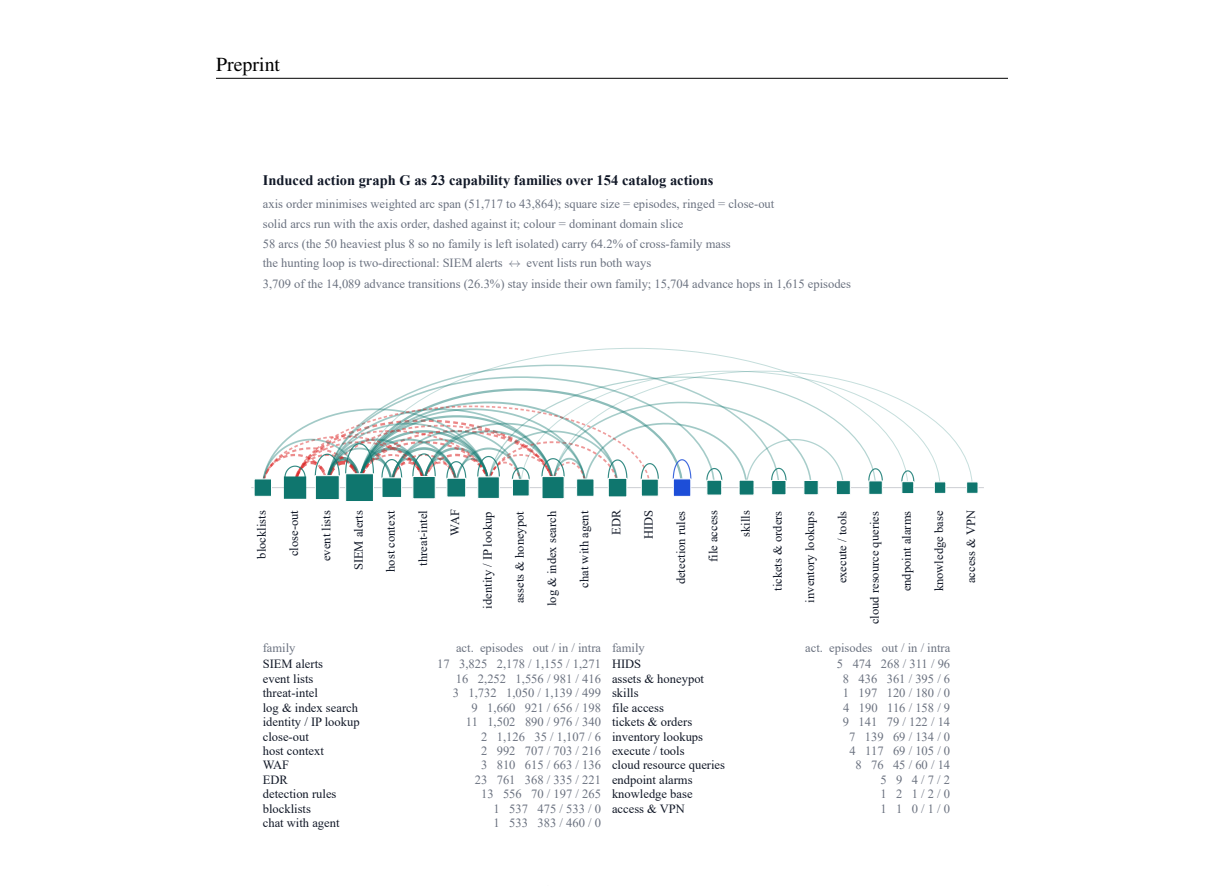
The paper tries to establish that a small typed-decision model, trained on execution logs, can replace the per-hop language model deliberation in tool-use agents for a substantial fraction of decisions. It introduces NIOCIS, a routing layer that induces a loop-collapsed action graph from logs and then answers, in one forward pass, which declared next action the fleet would take at each state. The central claim is that this typed router matches the logged next hop on about one third of decisions at millisecond cost, providing a containment and high-precision band, but that accuracy is fundamentally bounded by the information content of the released state—specifically, the absence of tool results and the plan context. The paper therefore advocates for a tiered architecture where the cheap typed router handles routine decisions and escalates uncertain cases to the LLM, while acknowledging that the confidence-gated cascade tested here lost agreement due to the escalation arm's low accuracy.
What carries the argument. The central object is the loop-collapsed action graph $G = (V, E^+ \cup E^-)$, which folds retry runs and recovery back-edges from episode logs into a directed graph of semantic actions. Its outgoing edges at a node $v$ define the declared option set $A(v) = \text{succ}(v) \cup \{\text{stop}\}$. The typed-decision router $\pi(a|v,g,c)$ is a small model (either a feature MLP or a hidden-state probe on a frozen encoder) that reads a calibrated distribution over $A(v)$ in a single forward pass, with no text generation. The gate mechanism accepts the decision when $\max_a \pi(a|\cdot) \geq \tau$ and otherwise escalates to an LLM. The self-evolution loop accumulates executed walks as training data and commits updates only if validation performance does not regress beyond a tolerance $\delta$.
Core claim. NIOCIS demonstrates that a loop-collapsed action graph induced from production agent logs, combined with a typed-decision readout over node-conditioned option spaces, can predict the fleet's next hop on 32.2% of held-out decisions (34.9% within the declared options) in 10–20 ms per decision, compared to 2.2 s per LLM hop. The method does not require the induced graph's traversal structure to achieve this gain—the per-node candidate restriction provides the lift—and its accuracy is bounded by an information ceiling of 25.6–44.9% as measured by cross-trace leave-one-out agreement on the released state. The self-evolution loop lifts every arm but ends below full supervision, and the confidence-gated cascade loses agreement when the escalation arm is a zero-shot language model.
The premise it rests on. The paper assumes that the released state—structural features derived from action labels and ordering, without tool results or plan context—contains enough information to predict the next hop usefully, but it explicitly measures this ceiling at 25.6–44.9% and acknowledges that agreement past a third of the fleet would require a state carrying the plan and the observation.
If the paper is right (Pith's inferences, not the authors')
If the paper is right, many routine tool-use decisions can be handled by a cheap typed router, reserving expensive LLM calls for uncertain or out-of-space states, reducing per-hop latency from seconds to milliseconds.
The node-conditioned option space is the key enabler: restricting candidates per state adds 3.5 accuracy points over a flat catalog, while graph traversal adds no measurable benefit beyond node identity.
The information ceiling of the released state (25.6–44.9%) implies that accuracy gains beyond about one third of decisions require a richer state representation that includes tool results and the plan context.
The gated self-evolution loop can absorb moderate label corruption (12%) but does not close the gap to full supervision, and its rollback gate is coarse (~0.5 accuracy point threshold).
The paper's finding that graph traversal contributes nothing beyond node identity suggests that the induced graph's main value is as a supplier of per-node option sets, not as a path-planning device; future work could explore whether incorporating distance-to-goal or goal-conditioned walk costs lifts accuracy.
The negative result on confidence-gated cascades (hybrids scoring below the pure readout) implies that effective escalation requires per-state competence assessment, not just confidence; a router that predicts which arm is likely to be correct on a given state might outperform both pure readout and pure escalation.
The method could be generalized to any domain with recurrent decisions and logged traces, such as IT operations, customer service, or robotic task planning, where the state information bottleneck (lack of observations) is a known limitation that future richer exports could address.
Check this review
Pith stored no record of this review's passes and took no fingerprint of it. Reviews made by code from 13 Nov 2026 on carry both.
How often reviews like this one are right
Reviews like this one: written by deepseek-v4-flash, where what was read was not recorded.
How often objections from reviews like this one are right: not yet measured
Reviews by people
This review was written by a machine. No person has reviewed this paper on Pith yet. A scientist listed on Pith can review it for a fee, and their review is published here whatever it concludes.
The paper
Abstract
Tool-use agents pay per decision: at each hop a language model re-reads the state and thinks for seconds, though its actions are finite and decisions recur. We present NIOCIS, a routing layer that folds execution logs into a loop-collapsed action graph (forward transitions plus recovery back-edges) answering one typed question: which declared option at a state, plus stop, does the fleet take next? A small model reads a calibrated distribution over them in one pass, emitting no text. On 1,615 production security-operations episodes we measure what the layer replaces, returns and is bounded by. Replaces: the typed encoder matches the logged next hop on 32.2% of the 3,875 held-out decisions (34.9% within the declared options) in 10 ms of encoder time (19.5 ms for the typed-choice form), against 2.2 s per LLM hop; two feature readouts reach 32.8% and 32.3%, an ordering the paired test does not resolve, so the typed layer is chosen for cost, not a separated lead. Tuning: jpt-4b reaches 9.9% zero-shot and 31.9% fine-tuned, a gap an exact paired test does not resolve (p=0.68), at 244 ms. Returns little: the realised hop falls outside the declared options for 7.9% of decisions and outside the model's top twenty for 9.3%; the most confident 15% holds 91.9% accuracy. Bounded: a cross-trace leave-one-out test puts the released state's ceiling at 25.6–44.9% as the state key grows more specific, i.e. repeated states disagree more often than they agree; the option-space ablation attributes the gain to per-node candidate restriction (+3.5 points over a flat catalog) rather than graph traversal (zero within its interval); a gated self-evolution loop lifts every arm above its anchor yet ends below full supervision; a confidence-gated cascade loses agreement when the escalation arm is the zero-shot stand-in; and agreement past a third of the fleet needs a state carrying the plan and the observation.
The paper's own sentences, arranged, kept beside the review and separate from it. Each label is drawn from a closed vocabulary; the number beside it is the probability the classifier gave that label. No sentence in this record was written by a model.
abstract compiled · 2026-10-20
The authors' main claim, as the classifier picked it out 0.58
“Bounded: a cross-trace leave-one-out test puts the released state's ceiling at 25.6--44.9% as the state key grows more specific, i.e. repeated states disagree more often than they agree; the option-space ablation attributes the gain to per-node candidate restriction (+3.5 points over a flat catalog) rather than graph traversal (zero within its interval); a gated self-evolution loop lifts every arm above its anchor yet ends below full supervision; a confidence-gated cascade loses agreement when the escalation arm is the zero-shot stand-in; and agreement past a third of the fleet needs a state carrying the plan and the observation.”
How the main claim is stated: asserted 1.00
What the abstract itself states, as probabilities: claims first 0.05 · states limitation 0.98 · human participants 0.06 · controlled comparison 0.92 · randomized assignment 0.03 · states quantitative result 0.99 · compares with prior results 0.87 · mentions code or data availability 0.07
The abstract, sentence by sentence
This table labels the abstract only (arXiv listing abstract v1). The number is the probability the classifier gave the label.
| Sentence | Role | The authors' own work | States the main conclusion | Strength |
|---|---|---|---|---|
| Tool-use agents pay per decision: at each hop a language model re-reads the state and thinks for seconds, though its actions are finite and decisions recur. | background 0.99 | 0.09 | 0.02 | asserted 1.00 |
| We present NIOCIS, a routing layer that folds execution logs into a loop-collapsed action graph (forward transitions plus recovery back-edges) answering one typed question: which declared option at a state, plus stop, does the fleet take next? | contribution 0.85 | 0.89 | 0.10 | asserted 1.00 |
| A small model reads a calibrated distribution over them in one pass, emitting no text. | method 0.99 | 0.70 | 0.04 | asserted 0.99 |
| On 1,615 production security-operations episodes we measure what the layer replaces, returns and is bounded by. | method 0.76 | 0.95 | 0.03 | asserted 0.99 |
| Replaces: the typed encoder matches the logged next hop on 32.2% of the 3,875 held-out decisions (34.9% within the declared options) in 10 ms of encoder time (19.5 ms for the typed-choice form), against 2.2 s per LLM hop; two feature readouts reach 32.8% and 32.3%, an ordering the paired test does not resolve, so the typed layer is chosen for cost, not a separated lead. | result 1.00 | 0.96 | 0.23 | asserted 1.00 |
| Tuning: jpt-4b reaches 9.9% zero-shot and 31.9% fine-tuned, a gap an exact paired test does not resolve (p=0.68), at 244 ms. | result 0.99 | 0.94 | 0.05 | asserted 1.00 |
| Returns little: the realised hop falls outside the declared options for 7.9% of decisions and outside the model's top twenty for 9.3%; the most confident 15% holds 91.9% accuracy. | result 0.97 | 0.96 | 0.09 | asserted 1.00 |
| Bounded: a cross-trace leave-one-out test puts the released state's ceiling at 25.6--44.9% as the state key grows more specific, i.e. repeated states disagree more often than they agree; the option-space ablation attributes the gain to per-node candidate restriction (+3.5 points over a flat catalog) rather than graph traversal (zero within its interval); a gated self-evolution loop lifts every arm above its anchor yet ends below full supervision; a confidence-gated cascade loses agreement when the escalation arm is the zero-shot stand-in; and agreement past a third of the fleet needs a state carrying the plan and the observation. | result 0.85 | 0.95 | 0.27 | asserted 1.00 |
What kind of paper the classifier reports this is: method or tool 0.98 · evidence from observation or experiment 0.86
What was examined, and what was not
Sources read
- arXiv listing abstract v1
Not examined
- full text
- figures and tables
- references and citing sentences
- relations to other papers
Levels run
- P abstract
Not run
- S sections
- T body sentences
- C citations
- R cross-paper relations
How the labels were made
Compiled by classifier-1.13.0 via TypeSafe API, question bank abstract-p1-20260923, 2026-10-20: 1 request, 6,802 input tokens.
Every quoted sentence on this record is the authors'. Every label is from Pith's closed vocabulary, with the probability shown beside it. This record as JSON
Figures (10)





Figures are the authors', reproduced from the paper.
References (113)
- [1] Arya Adriansyah, Boudewijn F. van Dongen, and Wil M. P. van der Aalst. Conformance checking using cost-based fitness analysis. In IEEE International Enterprise Distributed Object Computing Conference (EDOC), 2011. doi:10.1109/EDOC.2011.12 on Pithdoi:10.1109/edoc.2011.12
- [2] Ananto Nayan Bala and Faisal Muhammad Shah. Multi-agent routing as set-valued prediction: A WildChat benchmark and cost-aware evaluation. arXiv preprint arXiv:2606.28925, 2026 on PithPith's reviewarXiv
- [3] Alessandro Berti, Sebastiaan van Zelst, and Daniel Schuster. PM4Py : A process mining library for Python . Software Impacts, 17: 0 100556, 2023. DOI: 10.1016/j.simpa.2023.100556 on Pithdoi:10.1016/j.simpa.2023.100556
- [4] Joos Buijs. Receipt phase of an environmental permit application process ('WABO'), CoSeLoG project . Eindhoven University of Technology (4TU.ResearchData), dataset, 2014. DOI: 10.4121/uuid:a07386a5-7be3-4367-9535-70bc9e77dbe6 on Pithdoi:10.4121/uuid:a07386a5-7be3-4367-9535-70bc9e77dbe6
- [5] Josep Carmona, Boudewijn van Dongen, Andreas Solti, and Matthias Weidlich. Conformance Checking: Relating Processes and Models. Springer, 2018. doi:10.1007/978-3-319-99414-7 on Pithdoi:10.1007/978-3-319-99414-7
- [6] Abhijit Chakraborty, Ni Trieu, and Vivek Gupta. Typed federated artifacts for the Agentic Web : Sharing tool-routing knowledge across frozen, heterogeneous LLM agents. arXiv preprint arXiv:2609.06815, 2026 on PithPith's reviewarXiv
- [7] Lingjiao Chen, Matei Zaharia, and James Zou. FrugalGPT : How to use large language models while reducing cost and improving performance. arXiv preprint arXiv:2305.05176, 2023 on PithPith's reviewarXiv
- [10] Massimiliano de Leoni and Felix Mannhardt. Road Traffic Fine Management Process . Eindhoven University of Technology (4TU.ResearchData), dataset, 2015. DOI: 10.4121/uuid:270fd440-1057-4fb9-89a9-b699b47990f5 on Pithdoi:10.4121/uuid:270fd440-1057-4fb9-89a9-b699b47990f5
- [11] Liang Ding. AgentHER : Hindsight experience replay for LLM agent trajectory relabeling. arXiv preprint arXiv:2603.21357, 2026 on PithPith's reviewarXiv
- [12] Tao Feng, Fangxu Yu, Haozhen Zhang, Zhongjie Dai, Liangqi Yuan, Zijie Lei, Weizhi Zhang, Kunlun Zhu, Haodong Yue, Keyang Xuan, Ge Liu, and Jiaxuan You. LLMRouter : Unified infrastructure for developing, evaluating, and deploying LLM routers. arXiv preprint arXiv:2608.06867, 2026 on PithPith's reviewarXiv
- [13] Dawei Fu, Cheng Jiang, Sitian Qian, Huainan Wang, and Zhongkai Hao. SE-GoS : Self-evolving graph-of-skills for skill library at scale. arXiv preprint arXiv:2609.08228, 2026 on PithPith's reviewarXiv
- [14] Yonatan Geifman and Ran El-Yaniv. Selective classification for deep neural networks. In Advances in Neural Information Processing Systems (NeurIPS), 2017. arXiv:1705.08500 on PithPith's reviewarXiv
- [15] Saibo Geng, Martin Josifoski, Maxime Peyrard, and Robert West. Grammar-constrained decoding for structured NLP tasks without finetuning. In Proceedings of the 2023 Conference on Empirical Methods in Natural Language Processing (EMNLP), 2023. DOI: 10.18653/v1/2023.emnlp-main.674 on Pithdoi:10.18653/v1/2023.emnlp-main.674
- [16] Chuan Guo, Geoff Pleiss, Yu Sun, and Kilian Q. Weinberger. On calibration of modern neural networks. In International Conference on Machine Learning (ICML), 2017. arXiv:1706.04599 on PithPith's reviewarXiv
- [17] Yu Hao, Jinxuan Cai, Qi Zhang, Yawen Li, Zhiqiang Zhang, Chuan Shi, and Cheng Yang. HiSkill : Empowering LLM agents with hierarchical skill graphs. arXiv preprint arXiv:2607.25853, 2026 on PithPith's reviewarXiv
- [19] Diederik P. Kingma and Jimmy Ba. Adam: A method for stochastic optimization. In International Conference on Learning Representations (ICLR), 2015. arXiv:1412.6980 on PithPith's reviewarXiv
- [21] Woosuk Kwon, Zhuohan Li, Siyuan Zhuang, Ying Sheng, Lianmin Zheng, Cody Hao Yu, Joseph E. Gonzalez, Hao Zhang, and Ion Stoica. Efficient memory management for large language model serving with pagedattention. In ACM Symposium on Operating Systems Principles (SOSP), 2023. DOI: ... on Pithdoi:10.1145/3600006.3613165
- [22] Maikel Leemans. Statechart Workbench and Alignments Software Event Log . Eindhoven University of Technology (4TU.ResearchData), dataset, 2018. DOI: 10.4121/uuid:7f787965-da13-4bb8-a3fd-242f08aef9c4 on Pithdoi:10.4121/uuid:7f787965-da13-4bb8-a3fd-242f08aef9c4
- [23] Sander J. J. Leemans, Dirk Fahland, and Wil M. P. van der Aalst. Discovering block-structured process models from event logs -- a constructive approach. In Application and Theory of Petri Nets and Concurrency (ICATPN), 2013. DOI: 10.1007/978-3-642-38697-8\_17 on Pithdoi:10.1007/978-3-642-38697-8
- [24] Delong Li, Xu Wang, Haochen Gong, Rui Lang, and Guangsheng Yu. Replacing large language models with Jev decision models for low-latency edge service orchestration. arXiv preprint arXiv:2609.22753, 2026 a on PithPith's reviewarXiv
show 80 more
- [27] Minghao Li, Yingxiu Zhao, Bowen Yu, Feifan Song, Hangyu Li, Haiyang Yu, Zhoujun Li, Fei Huang, and Yongbin Li. API-Bank : A comprehensive benchmark for tool-augmented LLMs . In Proceedings of the 2023 Conference on Empirical Methods in Natural Language Processing (EMNLP), 2023... on PithPith's reviewarXiv
- [28] Yubo Li, Yidi Miao, Ramayya Krishnan, and Rema Padman. JEV -as-a-judge: Accept when confident, escalate when unsure. arXiv preprint arXiv:2609.26550, 2026 c on PithPith's reviewarXiv
- [29] Zhiyuan Li, Linyuan Gao, Xuechun Ding, Hongwei Chen, Yuan Wu, and Yi Chang. CaSKG : Counterfactual-causal skill graphs for scalable agent skill retrieval. arXiv preprint arXiv:2608.25500, 2026 d on PithPith's reviewarXiv
- [32] Yifan Lu, Qiyue Zhang, Shenrun Zhang, Zhibo Yu, Zhuang Wang, Hanjie Chen, and Jiarong Xing. The routing plateau: Understanding and breaking the accuracy limits of LLM routers. arXiv preprint arXiv:2606.07587, 2026 on PithPith's reviewarXiv
- [33] Weiyu Ma, Liangbing Zhao, Yongcheng Zeng, and Jian Zhao. JEV-Star : Fast, low-cost StarCraft II control with language-model planning. arXiv preprint arXiv:2609.27331, 2026 on PithPith's reviewarXiv
- [34] Felix Mannhardt. Sepsis Cases - Event Log . Eindhoven University of Technology (4TU.ResearchData), dataset, 2016. DOI: 10.4121/uuid:915d2bfb-7e84-49ad-a286-dc35f063a460 on Pithdoi:10.4121/uuid:915d2bfb-7e84-49ad-a286-dc35f063a460
- [38] Isaac Ong, Amjad Almahairi, Vincent Wu, Wei-Lin Chiang, Tianhao Wu, Joseph E. Gonzalez, M Waleed Kadous, and Ion Stoica. RouteLLM : Learning to route LLMs with preference data. arXiv preprint arXiv:2406.18665, 2024 on PithPith's reviewarXiv
- [40] Rudrendu Kumar Paul and Sourav Nandy. AgentRouter : Heterogeneous model routing for cost-optimal multi-step agentic workflows. arXiv preprint arXiv:2609.22951, 2026 on PithPith's reviewarXiv
- [41] Mirko Polato. Dataset belonging to the help desk log of an Italian Company . University of Padova (4TU.ResearchData), dataset, 2017. DOI: 10.4121/uuid:0c60edf1-6f83-4e75-9367-4c63b3e9d5bb on Pithdoi:10.4121/uuid:0c60edf1-6f83-4e75-9367-4c63b3e9d5bb
- [42] Dean A. Pomerleau. Efficient training of artificial neural networks for autonomous navigation. Neural Computation, 3 0 (1), 1991. DOI: 10.1162/neco.1991.3.1.88 on Pithdoi:10.1162/neco.1991.3.1.88
- [43] Yiyu Qian, Liyuan Zhao, and Tim Miller. M2-PALE : A framework for explaining multi-agent MCTS--Minimax hybrids via process mining and LLMs . arXiv preprint arXiv:2604.14687, 2026 on PithPith's reviewarXiv
- [44] Yujia Qin, Shihao Liang, Yining Ye, Kunlun Zhu, Lan Yan, Yaxi Lu, Yankai Lin, Xin Cong, Xiangru Tang, Bill Qian, Sihan Zhao, Lauren Hong, Runchu Tian, Ruobing Xie, Jie Zhou, Mark Gerstein, Dahai Li, Zhiyuan Liu, and Maosong Sun. ToolLLM : Facilitating large language models to ... on PithPith's reviewarXiv
- [45] Simiao Ren, Kidus Zewde, Xingyu Shen, Yuchen Zhou, Dennis Ng, Ankit Raj, Tommy Duong, Yuxin Zhang, and Neo Tiangratanakul. Open- Jev judgments on CallScreenBench : Calibrated one-pass scam screening with a small language model. arXiv preprint arXiv:2609.23959, 2026 on PithPith's reviewarXiv
- [46] Ziqiao Shang, Ling-Yue Ge, and Lan-Zhe Guo. GraphSkillAA : Attribution-guided skill-graph updating with targeted validation and rollback. arXiv preprint arXiv:2609.20455, 2026 on PithPith's reviewarXiv
- [47] Noah Shinn, Federico Cassano, Ashwin Gopinath, Karthik Narasimhan, and Shunyu Yao. Reflexion : Language agents with verbal reinforcement learning. In Advances in Neural Information Processing Systems (NeurIPS), 2023. doi:10.48550/arXiv.2303.11366 on PithPith's reviewarXivdoi:10.48550/arxiv.2303.11366
- [48] Rui Sun, Zhi Zheng, Zhenkun Wang, and Zhichao Lu. GraphSkillEvo : Evolutionary optimization of graph-structured agent skills. arXiv preprint arXiv:2609.21749, 2026 a on PithPith's reviewarXiv
- [50] Richard S. Sutton, Doina Precup, and Satinder Singh. Between MDP s and semi- MDP s: A framework for temporal abstraction in reinforcement learning. Artificial Intelligence, 112, 1999. DOI: 10.1016/S0004-3702(99)00052-1 on Pithdoi:10.1016/s0004-3702(99)00052-1
- [51] Leah Tacke genannt Unterberg, Lisa L. Mannel, and Wil M. P. van der Aalst. Monotonicity-guided bottom-up Petri net discovery: The SPECpp framework. arXiv preprint arXiv:2608.09398, 2026 on PithPith's reviewarXiv
- [52] Niek Tax, Ilya Verenich, Marcello La Rosa, and Marlon Dumas. Predictive business process monitoring with LSTM neural networks. In Advanced Information Systems Engineering (CAiSE), 2017. DOI: 10.1007/978-3-319-59536-8\_30 on Pithdoi:10.1007/978-3-319-59536-8
- [53] Wil M. P. van der Aalst. Process Mining: Data Science in Action. Springer, 2016. DOI: 10.1007/978-3-662-49851-4 on Pithdoi:10.1007/978-3-662-49851-4
- [54] Boudewijn van Dongen. Real-life event logs - Hospital log . Eindhoven University of Technology (4TU.ResearchData), dataset, 2011. DOI: 10.4121/uuid:d9769f3d-0ab0-4fb8-803b-0d1120ffcf54 on Pithdoi:10.4121/uuid:d9769f3d-0ab0-4fb8-803b-0d1120ffcf54
- [55] Boudewijn van Dongen. BPI Challenge 2012 . Eindhoven University of Technology (4TU.ResearchData), dataset, 2012. DOI: 10.4121/uuid:3926db30-f712-4394-aebc-75976070e91f on Pithdoi:10.4121/uuid:3926db30-f712-4394-aebc-75976070e91f
- [56] Boudewijn van Dongen. BPI Challenge 2017 . Eindhoven University of Technology (4TU.ResearchData), dataset, 2017. DOI: 10.4121/uuid:5f3067df-f10b-45da-b98b-86ae4c7a310b on Pithdoi:10.4121/uuid:5f3067df-f10b-45da-b98b-86ae4c7a310b
- [57] Guanzhi Wang, Yuqi Xie, Yunfan Jiang, Ajay Mandlekar, Chaowei Xiao, Yuke Zhu, Linxi Fan, and Anima Anandkumar. Voyager : An open-ended embodied agent with large language models. arXiv preprint arXiv:2305.16291, 2023 on PithPith's reviewarXiv
- [59] Benjamin Warner, Antoine Chaffin, Benjamin Clavi \'e , Orion Weller, Oskar Hallstr \"o m, Said Taghadouini, Alexis Gallagher, Raja Biswas, Faisal Ladhak, Tom Aarsen, Griffin Thomas Adams, Jeremy Howard, and Iacopo Poli. Smarter, better, faster, longer: A modern bidirectional e... on Pithdoi:10.18653/v1/2025.acl-long.127
- [60] Tiantong Wu and Wei Yang Bryan Lim. REFLEX with Jev for efficient selective control in LLM agents. arXiv preprint arXiv:2609.26532, 2026 on PithPith's reviewarXiv
- [61] Shuhan Xue, Jianyuan Zhong, Ziyuan Nan, Wenbin Li, Zhaochen Yu, Jinchao Ding, Qiang Gao, Pengyu Zhan, Yuntong Zhang, Tian Cheng, Zhenfei Yin, Yingcheng Wu, and Ling Yang. ScienceBuddy : Recursive-in-recursive self-improvement for interactive scientific agents. arXiv preprint a... on PithPith's reviewarXiv
- [63] Shunyu Yao, Jeffrey Zhao, Dian Yu, Nan Du, Izhak Shafran, Karthik Narasimhan, and Yuan Cao. ReAct : Synergizing reasoning and acting in language models. In International Conference on Learning Representations (ICLR), 2023. doi:10.48550/arXiv.2210.03629 on PithPith's reviewarXivdoi:10.48550/arxiv.2210.03629
- [64] Tong Zheng, Xidong Wu, Zheng Zhang, Zhankui He, Chaoyi Zhang, Benjamin Coleman, Ruoqiao Wei, Di Bai, Haolin Liu, Rui Liu, Xue Wang, Yue Zhuan, Wang-Cheng Kang, Renkai Xiang, Heng Huang, Xinwu Cheng, and Yunsong Guo. Dream-RSI : Recursive self-improvement through evolving world... on PithPith's reviewarXiv
- [65] Process Mining: Data Science in Action , author=. 2016 , note= on Pith
- [66] Discovering Block-Structured Process Models from Event Logs -- A Constructive Approach , author=. Application and Theory of Petri Nets and Concurrency (ICATPN) , year= on Pith
- [67] Sutton, Richard S. and Precup, Doina and Singh, Satinder , journal=. Between. 1999 , note= on Pith
- [68] Revealing Inherent Concurrency in Event Data: A Partial Order Approach to Process Discovery , author=. arXiv preprint arXiv:2509.15346 , year= on PithPith's reviewarXiv
- [69] Tacke genannt Unterberg, Leah and Mannel, Lisa L. and van der Aalst, Wil M. P. , journal=. Monotonicity-Guided Bottom-Up on Pith
- [70] Efficient Memory Management for Large Language Model Serving with PagedAttention , author=. ACM Symposium on Operating Systems Principles (SOSP) , year= on Pith
- [71] Adam: A Method for Stochastic Optimization , author=. International Conference on Learning Representations (ICLR) , year= on Pith
- [72] Agent Workflow Memory , author=. arXiv preprint arXiv:2409.07429 , year= on PithPith's reviewarXiv
- [73] Inducing Task Models from Computer-Use Traces , author=. arXiv preprint arXiv:2608.20319 , year= on PithPith's reviewarXiv
- [74] Automata from Agent Traces: Failure and Next-Step Prediction , author=. arXiv preprint arXiv:2608.23670 , year= on PithPith's reviewarXiv
- [75] Multi-Turn Agentic Scientific Literature Search via Workflow Induction , author=. arXiv preprint arXiv:2607.00597 , year= on PithPith's reviewarXiv
- [76] Hao, Yu and Cai, Jinxuan and Zhang, Qi and Li, Yawen and Zhang, Zhiqiang and Shi, Chuan and Yang, Cheng , journal= on Pith
- [77] Fu, Dawei and Jiang, Cheng and Qian, Sitian and Wang, Huainan and Hao, Zhongkai , journal= on Pith
- [78] Li, Zhiyuan and Gao, Linyuan and Ding, Xuechun and Chen, Hongwei and Wu, Yuan and Chang, Yi , journal= on Pith
- [79] Shang, Ziqiao and Ge, Ling-Yue and Guo, Lan-Zhe , journal= on Pith
- [80] Sun, Rui and Zheng, Zhi and Wang, Zhenkun and Lu, Zhichao , journal= on Pith
- [81] Scalable Behaviour Cloning on Browser Using via Skill Distillation , author=. arXiv preprint arXiv:2606.32014 , year= on PithPith's reviewarXiv
- [82] Qian, Yiyu and Zhao, Liyuan and Miller, Tim , journal= on Pith
- [83] Ding, Liang , journal= on Pith
- [84] Smarter, Better, Faster, Longer: A Modern Bidirectional Encoder for Fast, Memory Efficient, and Long Context Finetuning and Inference , author=. Proceedings of the 63rd Annual Meeting of the Association for Computational Linguistics (ACL) , year= on Pith
- [85] this-that-model-1.0: A Typed Decision Model That Decides in 30 ms, for a Millionth of a Cent , author=. arXiv preprint arXiv:2609.23886 , year= on PithPith's reviewarXiv
- [86] Ren, Simiao and Zewde, Kidus and Shen, Xingyu and Zhou, Yuchen and Ng, Dennis and Raj, Ankit and Duong, Tommy and Zhang, Yuxin and Tiangratanakul, Neo , journal=. Open- on Pith
- [87] Li, Yubo and Miao, Yidi and Krishnan, Ramayya and Padman, Rema , journal= on Pith
- [88] Wu, Tiantong and Lim, Wei Yang Bryan , journal= on Pith
- [89] Type-Safe Is Not Error-Free: A Constrained Decision Head Follows the Option Name, Not the Rubric Bound to It , author=. arXiv preprint arXiv:2609.26758 , year= on PithPith's reviewarXiv
- [90] Ma, Weiyu and Zhao, Liangbing and Zeng, Yongcheng and Zhao, Jian , journal= on Pith
- [91] Li, Delong and Wang, Xu and Gong, Haochen and Lang, Rui and Yu, Guangsheng , journal=. Replacing Large Language Models with on Pith
- [92] Paul, Rudrendu Kumar and Nandy, Sourav , journal= on Pith
- [93] Agentic Routing: The Harness-Native Data Flywheel , author=. arXiv preprint arXiv:2607.11399 , year= on PithPith's reviewarXiv
- [94] Bala, Ananto Nayan and Shah, Faisal Muhammad , journal=. Multi-Agent Routing as Set-Valued Prediction: A on Pith
- [95] Chakraborty, Abhijit and Trieu, Ni and Gupta, Vivek , journal=. Typed Federated Artifacts for the on Pith
- [96] Feng, Tao and Yu, Fangxu and Zhang, Haozhen and Dai, Zhongjie and Yuan, Liangqi and Lei, Zijie and Zhang, Weizhi and Zhu, Kunlun and Yue, Haodong and Xuan, Keyang and Liu, Ge and You, Jiaxuan , journal= on Pith
- [97] Lu, Yifan and Zhang, Qiyue and Zhang, Shenrun and Yu, Zhibo and Wang, Zhuang and Chen, Hanjie and Xing, Jiarong , journal=. The Routing Plateau: Understanding and Breaking the Accuracy Limits of on Pith
- [98] Latent Geometry Beyond Search: Amortizing Planning in World Models , author=. arXiv preprint arXiv:2605.08732 , year= on PithPith's reviewarXiv
- [99] Natural Language Query to Configuration for Retrieval Agents , author=. arXiv preprint arXiv:2605.27361 , year= on PithPith's reviewarXiv
- [100] Chen, Lingjiao and Zaharia, Matei and Zou, James , journal= on Pith
- [101] Ong, Isaac and Almahairi, Amjad and Wu, Vincent and Chiang, Wei-Lin and Wu, Tianhao and Gonzalez, Joseph E. and Kadous, M Waleed and Stoica, Ion , journal= on Pith
- [102] Recursive Self-Evolving Agents via Held-Out Selection , author=. arXiv preprint arXiv:2606.28374 , year= on PithPith's reviewarXiv
- [103] Zheng, Tong and Wu, Xidong and Zhang, Zheng and He, Zhankui and Zhang, Chaoyi and Coleman, Benjamin and Wei, Ruoqiao and Bai, Di and Liu, Haolin and Liu, Rui and Wang, Xue and Zhuan, Yue and Kang, Wang-Cheng and Xiang, Renkai and Huang, Heng and Cheng, Xinwu and Guo, Yunsong ,... on Pith
- [104] Xue, Shuhan and Zhong, Jianyuan and Nan, Ziyuan and Li, Wenbin and Yu, Zhaochen and Ding, Jinchao and Gao, Qiang and Zhan, Pengyu and Zhang, Yuntong and Cheng, Tian and Yin, Zhenfei and Wu, Yingcheng and Yang, Ling , journal= on Pith
- [105] arXiv preprint arXiv:2609.08183 , year= on PithPith's reviewarXiv
- [106] Auditing Self-Evolution in Financial Agents: Capability Gains, Security Drift, and Execution-Interface Mismatch , author=. arXiv preprint arXiv:2608.17684 , year= on PithPith's reviewarXiv
- [107] APIGen: Automated Pipeline for Generating Verifiable and Diverse Function-Calling Datasets , author=. arXiv preprint arXiv:2406.18518 , year= on PithPith's reviewarXiv
- [108] Qin, Yujia and Liang, Shihao and Ye, Yining and Zhu, Kunlun and Yan, Lan and Lu, Yaxi and Lin, Yankai and Cong, Xin and Tang, Xiangru and Qian, Bill and Zhao, Sihan and Hong, Lauren and Tian, Runchu and Xie, Ruobing and Zhou, Jie and Gerstein, Mark and Li, Dahai and Liu, Zhiyu... on Pith
- [109] Li, Minghao and Zhao, Yingxiu and Yu, Bowen and Song, Feifan and Li, Hangyu and Yu, Haiyang and Li, Zhoujun and Huang, Fei and Li, Yongbin , booktitle=. 2023 , note= on Pith
- [110] Berti, Alessandro and van Zelst, Sebastiaan and Schuster, Daniel , journal=. 2023 , note= on Pith
- [111] Tax, Niek and Verenich, Ilya and La Rosa, Marcello and Dumas, Marlon , booktitle=. Predictive Business Process Monitoring with. 2017 , note= on Pith
- [112] Geng, Saibo and Josifoski, Martin and Peyrard, Maxime and West, Robert , booktitle=. Grammar-Constrained Decoding for Structured. 2023 , note= on Pith
- [113] Efficient Training of Artificial Neural Networks for Autonomous Navigation , author=. Neural Computation , volume=. 1991 , note= on Pith
- [114] On Calibration of Modern Neural Networks , author=. International Conference on Machine Learning (ICML) , year= on Pith
- [115] Selective Classification for Deep Neural Networks , author=. Advances in Neural Information Processing Systems (NeurIPS) , year= on Pith
The first 100 of 113 references are listed here. All of them are in this paper's citation record.
Challenges and discussion
Disagree with the review, or know something it missed? Leave a comment, or challenge this review formally: a challenge becomes a permanent entry in this paper's record, and its decision is published here.
Come back by email
A short list of the week's newly reviewed papers. Nothing is sent until you confirm from your inbox, and every email has a link that stops it. No account.
No comments yet.
Sign in to comment