Artificial Intelligence · arXiv:2610.15710 v1 · submitted 11 Oct 2026 · 18 references
Suggested Is Not Superseded: A Pre-Registered Evaluation of a System-One Model as a Memory-Retirement Gate
The paper says
“Long-term memory for assistants needs a gate that decides when a new utterance retires an old stored claim.”
more of the abstract
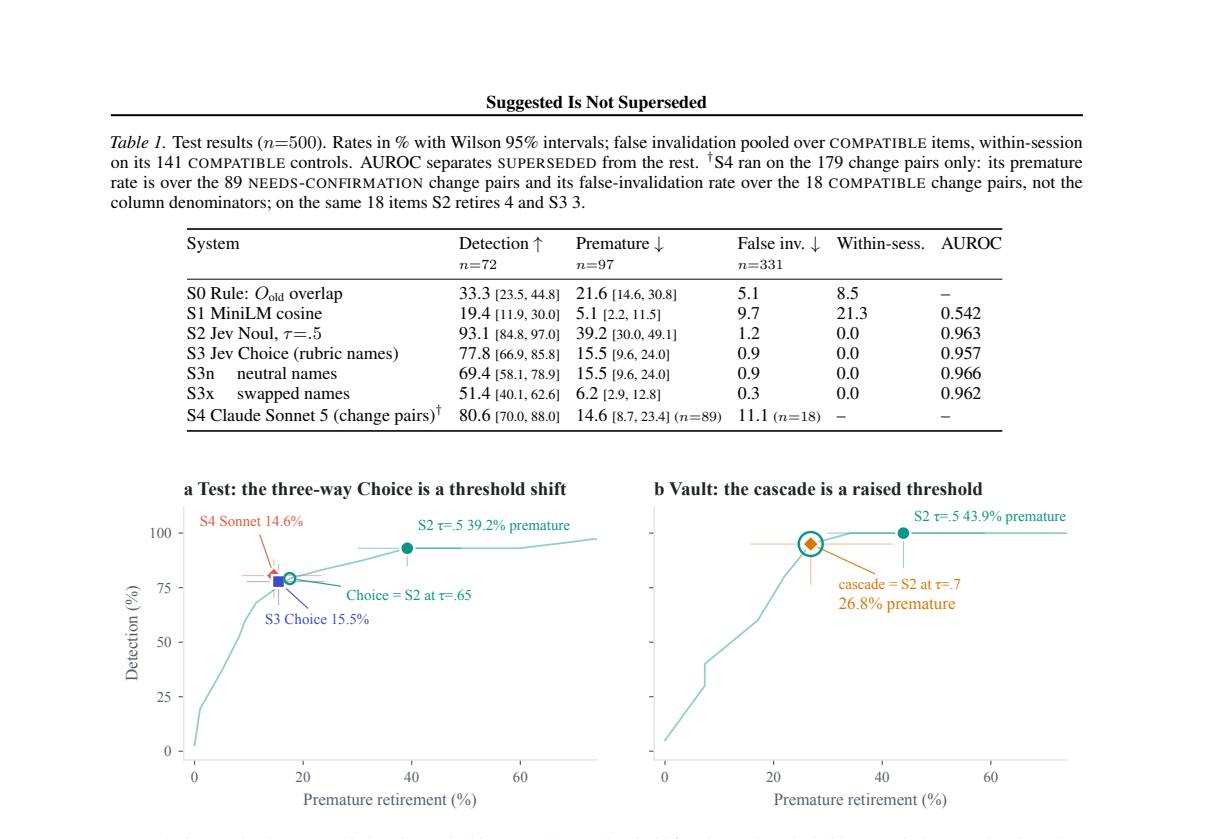
Benchmark labels for this step mark a pair as changed or not, so they cannot tell a gate that acts on established change from one that acts on a hint. We write a task contract that separates the two (SUPERSEDED vs. NEEDS-CONFIRMATION vs. COMPATIBLE), label 500 test pairs built from STALE (change pairs plus same-user controls) with three LLM annotators and two human adjudicators (one author and a second annotator; provenance reported), and evaluate Jev, a typed "System One" decision model, under pre-registered hypotheses. Of the 179 test pairs STALE marks as changed, 72 meet the contract's bar for an established change. Jev never retired a claim on 141 same-conversation non-changes. Its failure is premature retirement: the binary gate retires 39.2% of claims whose change is only suggested. A three-way decision cuts this to 15.5% at a 15.3-point detection cost, which misses our pre-registered 10-point budget, and it lands on the binary gate's own threshold frontier; these verdicts hold under three readings of the gold labels. On a held-out vault scored against a second annotator's labels, a cascade that escalated uncertain cases to a reasoning model and looked best on development data was indistinguishable from simply raising the threshold (premature retirement 26.8% vs. 6.5% on dev). Part of the gap comes from the gold labels: relative to that annotator's reading, LLM-majority gold shares most of its errors with a same-family escalation model, and an identity for binary labels says how much such shared errors hide. The rest is small-sample selection on development data. For builders this means a binary score should not be wired to delete: route suggested changes to pending evidence, and do not trust a cascade selected on development data of this size.
from the abstract
Pith says
Machine review · deepseek-v4-flash · 14 Oct 2026 · what was read was not recorded · not checked by a person
It can be wrong. Challenge this review or reply to it.
Holds up. A careful, pre-registered evaluation of a concrete failure mode in memory retirement: fast gates retire on hints, not just on established change, but the gold-label boundary is the soft spot and the authors acknowledge it. This line is wrong
3 major objections · 5 minor
How often objections from reviews like this one are right: not yet measured
Not checked: figures, code, what the 18 references say.
The paper says, at Section 5, Table 3
The review did not quote this passage.
A classifier read this sentence of the paper as acknowledging the concern (probability 0.61):
“Limitations Each human-labelled item has one adjudicator (one author for the first batch, the second annotator for the other 68), so the human labels are one reading, not a consensus; their provenance is given in Section 3.”
Pith says: Objection 1 of 3 · major
Gold label reliability on the SUPERSEDED/NEEDS-CONFIRMATION boundary is low (κ 0.22–0.60). The paper's sensitivity analyses (three readings) vary the gold but all derive from the same three LLM annotators. A stricter test would restrict to items where all three annotators agree on the label. The authors should report premature retirement rates on this unanimous subset. If the 39.2% rate holds there, the claim is robust; if not, it weakens. This directly addresses the weakest assumption acknowledged in the paper.
The paper says, at Section 6, Proposition 1
The review did not quote this passage.
A classifier read this sentence of the paper as acknowledging the concern (probability 0.91):
“On the vault every hu- man label is the second annotator’s, so the direction of the shared-error finding in Section 6 is conditional on that reading, and we label it exploratory; an annotator indepen- dent of both model families would settle it.”
Pith says: Objection 2 of 3 · major
The vault analysis uses second-annotator labels with provenance issues (agent pre-fill, short annotation time, agreement with model fill). The paper labels this exploratory, which is appropriate. However, the Proposition 1 analysis on shared errors depends heavily on these labels. The paper should clarify how much the conclusion about gold hiding error depends on the specific reading of H. Since the second-annotator labels may not be independent, the interpretation of shared errors remains uncertain.
The paper says, at Section 5 (H2)
The review did not quote this passage.
Pith says: Objection 3 of 3 · major
H2 is not testable due to small sample (n=11). The paper acknowledges this, but the descriptive reversal (S2 90.9% vs S4 63.6%) suggests the opposite of the pre-registered direction. While the stratum is too small for inference, the reversal undermines the assumed gap for implicit/numeric changes and should be noted more explicitly as a potential sign that the hypothesis may be mis-specified.
5 minor objections
The paper says, at Figure 1 caption
Pith says: minor objection 1 of 5
The caption is very long and includes procedural details that could be moved to the main text or a note. Consider shortening to the key visual takeaway and referring readers to the relevant sections for details.
The paper says, at Section 3 (Provenance)
Pith says: minor objection 2 of 5
The term 'second annotator' is used both for the human annotator and for annotator A2. Clarify by consistently calling the human annotator 'Human H' or 'second human annotator' to avoid confusion with A2.
show 3 more
The paper says, at Section 3, paragraph starting 'Provenance of the 68...'
Pith says: minor objection 3 of 5
The sentence 'the second annotator agrees with the agent on 65/68 items' uses 'agent' without earlier definition; specify that 'agent' refers to the coding agent that pre-filled the pages (GPT-6 Astra).
The paper says, at References
Pith says: minor objection 4 of 5
Some references list all authors (e.g., Chhikara et al. 2025) while others use 'et al.' inconsistently. Also, several URLs are incomplete or missing access dates; standardize format.
The paper says, at Appendix B
Pith says: minor objection 5 of 5
The proof of Proposition 1 is correct but could be explained more intuitively: the identity shows that the measured error equals true error minus twice the shared errors, making the understatement condition clear.
What would settle it
Using the per-item labels that will be released, compute S2's premature retirement rate P = Pr(retire | gold = NEEDS-CONFIRMATION) restricted to the subset of test change pairs where all three LLM annotators (A1, A2, A3) assign the same label (unanimous NEEDS-CONFIRMATION). Compare to the full-set rate of 39.2%. If the unanimous rate is below 30%, the central finding weakens; if it remains above 35%, the concern is mitigated.
from the skeptic's reading
How the review went
4 readings by deepseek-v4-flash · 14 Oct 2026
- Reader holds up
- Skeptic partly agrees
- Editor wrote the verdict above
- Referee minor revision: 3 major objections, 5 minor
Not run on this paper: the simulated authors' defence.
Pith did not check this review's objections against the paper.
The review in full
The review in brief, machine-written
This is a good paper. It does something simple and useful: it writes a contract that splits 'changed' into established (SUPERSEDED) vs. suggested (NEEDS-CONFIRMATION), then tests a fast decision model against that contract. The main finding is that a binary gate retires 39.2% of suggested changes, and the three-way variant that cuts this to 15.5% acts as a threshold shift, not as extra information. That’s a clean negative result with a clear message for memory-system builders.
The paper is transparent about its limitations—gold labels from LLM majority, low inter-annotator agreement on the SUPERSEDED/NEEDS-CONFIRMATION boundary, small sample sizes, a single model version. The sensitivity analyses show the verdicts hold under three readings of gold labels, which is reassuring. The pre-registration, the dated amendments, the detailed provenance of the second-annotator labels, and the released code all signal honest work.
The central vulnerability is exactly what the stress-test note flags: the gold label reliability on the boundary that decides retirement. The inter-annotator kappas of 0.22–0.60 on change pairs are low, most disagreement is on that boundary, and human labels come from one or two people, not a consensus. The authors acknowledge this in the limitations section. The sensitivity analyses show the main numbers are stable under alternative label readings, but those readings still depend on the same LLM annotators. A stricter test—restricting to items where all three annotators agree on the label—would be more convincing. That test is not in the paper, and it should be. Without it, the 39.2% premature retirement rate is plausible but not fully pinned down.
Even so, the paper makes its case. The threshold-shift finding is robust: the three-way Choice sits on the binary gate’s own threshold frontier, and the AUROCs are nearly identical. The held-out vault analysis, though exploratory because it uses the second annotator’s labels, shows that a cascade selected on development data does not beat a raised threshold. The Proposition 1 identity is a nice theoretical touch that quantifies how much a correlated gold hides.
Who is this for? Researchers building memory systems that use fast decision models as gates, and people designing benchmarks for memory update. They will get practical value from the recommendations: route suggested changes to pending evidence, do not wire binary scores to delete, and do not trust a cascade selected on small development data.
Recommendation: this paper deserves a serious referee. It is not a desk reject. But the referee should ask for an additional analysis on the subset of change pairs where all three annotators agree on the label, or at least a clearer discussion of how label noise might affect the central estimate. The authors already have the data to do this (the agreement matrices in Table 3). If that analysis confirms the finding, the paper is stronger. If it weakens it, that is also informative.
In short: accept with a request for a tighter sensitivity on the unanimous subset.
The strongest objection
The paper's central claim (binary gate retires 39.2% of suggested changes) depends on the gold label contract distinguishing SUPERSEDED from NEEDS-CONFIRMATION. Inter-annotator agreement on this boundary is low (κ 0.22–0.60, Section 5). The sensitivity analysis varies the reading by including/excluding human labels and the second annotator's labels, but all readings are derived from the same three LLM annotators. A stricter test: restrict to items where all three annotators agree on the label. The agreement matrices (Table 3) suggest that at most about 96/179 change pairs may be unanimous for NEEDS-CONFIRMATION (since A2–A3 agree on 96 NC items, but A1 may disagree). If the premature retirement rate on this unanimous subset is substantially lower, the headline 39.2% would be an artifact of label noise. If it remains high, the claim is robust. This test directly addresses the weakest assumption.
The reader correctly identified gold label reliability as the weakest assumption. The paper's sensitivity analyses address partially but do not isolate the most stringent check: unanimous annotator agreement. The proposed test is concrete, feasible with released data, and would either strengthen the headline claim or qualify it. The paper is otherwise well-conducted and transparent; the verdict does not need adjusting unless this test reveals a large drop in the premature retirement rate.
The referee's report
The paper makes an important contribution by highlighting the distinction between established and suggested change, providing a concrete task contract and labeled data, and conducting a thorough pre-registered evaluation. The findings challenge common practice of using binary gates for memory retirement and suggest routing suggested changes to pending evidence rather than deletion. The transparency (pre-registration, sensitivity analyses, full data release) is commendable.
Pith's reading of the paper (a machine's summary, not the authors')
The paper establishes that a fast decision model (Jev, a 'System-One' model) cannot be trusted to permanently delete stored claims from an AI assistant's long-term memory when used with a binary score. The authors create a task contract that separates 'established change' (SUPERSEDED) from 'suggested change' (NEEDS-CONFIRMATION) and relabel 500 test pairs from the STALE benchmark. The binary gate retires 39.2% of claims whose change is only suggested, and a three-way decision cuts this to 15.5% at a detection cost of 15.3 points, exceeding the pre-registered budget. On a held-out vault, a reasoning-model cascade selected on development data does not beat a simple threshold adjustment, partly because the gold labels share errors with the system. The core message for builders is to route suggested changes to pending evidence rather than deleting on a positive binary score.
What carries the argument. The central machinery is the three-way task contract that labels each claim-utterance pair as SUPERSEDED (established change, safe to retire), NEEDS-CONFIRMATION (suggested change, should not retire without more evidence), or COMPATIBLE (no change). This contract drives the measurement of detection, premature retirement, and false invalidation. Additionally, the threshold-sweep comparison of the binary gate's scores shows that the three-way Choice acts as a threshold shift rather than providing new information, and Proposition 1 provides an exact decomposition of the error hidden when a gold label is correlated with the system.
Core claim. A System-One gate (Jev) acting on a binary score is unsafe on hints: it retires 39.2% of claims whose change is only suggested (NEEDS-CONFIRMATION), even though it never retires same-conversation non-changes. A three-way decision that only retires on the contract's SUPERSEDED label cuts premature retirement to 15.5% but loses 15.3 points of detection, missing the pre-registered 10-point budget, and this improvement is indistinguishable from simply raising the binary gate's threshold. The held-out vault reveals that a cascade that looked best on development data fails to outperform a re-thresholded binary gate, and part of the apparent advantage comes from gold labels that share errors with the system—quantified by an identity (Proposition 1) showing how much of the system's error the gold cannot see.
The premise it rests on. The gold labels correctly distinguish established (SUPERSEDED) from suggested (NEEDS-CONFIRMATION) change, but inter-annotator agreement on that boundary is low (kappa 0.22–0.60) and human labels come from one or two people, not a consensus; if the contract cannot be applied reliably, the measured premature retirement rate is uninterpretable.
If the paper is right (Pith's inferences, not the authors')
Memory systems should treat a positive binary gate decision as evidence to attach, not as permission to delete, unless the decision model has been scored on suggested changes.
Benchmarks of memory update should label established and suggested change separately; STALE's 'changed' label conflates both, rewarding gates that retire on hints.
Evaluations using LLM-majority gold should report, via Proposition 1, how many of the system's errors the gold can see, to avoid overestimating safe performance.
A three-way decision that uses the contract's labels offers no advantage over a well-tuned binary threshold for the Jev model on this data, indicating that fast models do not extract extra information from the label structure.
The finding that the three-way Choice is a threshold shift suggests that for other typed decision models with similar architecture, the same pattern may hold: the three-way output is a monotonic transformation of the binary score, so the ranking is unchanged and the option names only affect the argmax, not the underlying assessment.
The low inter-annotator agreement on the SUPERSEDED/NEEDS-CONFIRMATION boundary (kappa 0.22–0.60) implies that deploying such a contract in a production memory system would require a consensus-building step or a probabilistic treatment of the label, because the human baseline is itself noisy.
If the gold labels used for evaluation are drawn from models of the same family as the decision model under test, the shared-error effect quantified by Proposition 1 will systematically understate the system's true error rate, making a gate appear safer than it is.
The failure of the cascaded model to beat threshold adjustment on a small development sample (31 NEEDS-CONFIRMATION items) implies that future developer evaluations of memory gates should require a minimum sample size for the relevant label stratum before certifying any method that combines multiple models.
Check this review
Pith stored no record of this review's passes and took no fingerprint of it. Reviews made by code from 13 Nov 2026 on carry both.
How often reviews like this one are right
Reviews like this one: written by deepseek-v4-flash, where what was read was not recorded.
How often objections from reviews like this one are right: not yet measured
Reviews by people
This review was written by a machine. No person has reviewed this paper on Pith yet. A scientist listed on Pith can review it for a fee, and their review is published here whatever it concludes.
The paper
Abstract
Long-term memory for assistants needs a gate that decides when a new utterance retires an old stored claim. Benchmark labels for this step mark a pair as changed or not, so they cannot tell a gate that acts on established change from one that acts on a hint. We write a task contract that separates the two (SUPERSEDED vs. NEEDS-CONFIRMATION vs. COMPATIBLE), label 500 test pairs built from STALE (change pairs plus same-user controls) with three LLM annotators and two human adjudicators (one author and a second annotator; provenance reported), and evaluate Jev, a typed "System One" decision model, under pre-registered hypotheses. Of the 179 test pairs STALE marks as changed, 72 meet the contract's bar for an established change. Jev never retired a claim on 141 same-conversation non-changes. Its failure is premature retirement: the binary gate retires 39.2% of claims whose change is only suggested. A three-way decision cuts this to 15.5% at a 15.3-point detection cost, which misses our pre-registered 10-point budget, and it lands on the binary gate's own threshold frontier; these verdicts hold under three readings of the gold labels. On a held-out vault scored against a second annotator's labels, a cascade that escalated uncertain cases to a reasoning model and looked best on development data was indistinguishable from simply raising the threshold (premature retirement 26.8% vs. 6.5% on dev). Part of the gap comes from the gold labels: relative to that annotator's reading, LLM-majority gold shares most of its errors with a same-family escalation model, and an identity for binary labels says how much such shared errors hide. The rest is small-sample selection on development data. For builders this means a binary score should not be wired to delete: route suggested changes to pending evidence, and do not trust a cascade selected on development data of this size.
The paper's own sentences, arranged, kept beside the review and separate from it. Each label is drawn from a closed vocabulary; the number beside it is the probability the classifier gave that label. No sentence in this record was written by a model.
abstract compiled · 2026-10-14
The authors' main claim, as the classifier picked it out 0.99
“For builders this means a binary score should not be wired to delete: route suggested changes to pending evidence, and do not trust a cascade selected on development data of this size.”
How the main claim is stated: asserted 0.97
What the abstract itself states, as probabilities: claims first 0.07 · states limitation 0.95 · human participants 0.65 · controlled comparison 0.86 · randomized assignment 0.04 · states quantitative result 0.99 · compares with prior results 0.91 · mentions code or data availability 0.06
The abstract, sentence by sentence
This table labels the abstract only (arXiv listing abstract v1). The number is the probability the classifier gave the label.
| Sentence | Role | The authors' own work | States the main conclusion | Strength |
|---|---|---|---|---|
| Long-term memory for assistants needs a gate that decides when a new utterance retires an old stored claim. | background 1.00 | 0.07 | 0.04 | asserted 1.00 |
| Benchmark labels for this step mark a pair as changed or not, so they cannot tell a gate that acts on established change from one that acts on a hint. | gap 0.89 | 0.11 | 0.04 | asserted 1.00 |
| We write a task contract that separates the two (SUPERSEDED vs. NEEDS-CONFIRMATION vs. COMPATIBLE), label 500 test pairs built from STALE (change pairs plus same-user controls) with three LLM annotators and two human adjudicators (one author and a second annotator; provenance reported), and evaluate Jev, a typed "System One" decision model, under pre-registered hypotheses. | method 0.77 | 0.96 | 0.05 | asserted 0.99 |
| Of the 179 test pairs STALE marks as changed, 72 meet the contract's bar for an established change. | result 0.99 | 0.93 | 0.06 | asserted 1.00 |
| Jev never retired a claim on 141 same-conversation non-changes. | result 1.00 | 0.88 | 0.07 | asserted 1.00 |
| Its failure is premature retirement: the binary gate retires 39.2% of claims whose change is only suggested. | result 0.98 | 0.90 | 0.19 | asserted 1.00 |
| A three-way decision cuts this to 15.5% at a 15.3-point detection cost, which misses our pre-registered 10-point budget, and it lands on the binary gate's own threshold frontier; these verdicts hold under three readings of the gold labels. | result 0.98 | 0.95 | 0.23 | asserted 1.00 |
| On a held-out vault scored against a second annotator's labels, a cascade that escalated uncertain cases to a reasoning model and looked best on development data was indistinguishable from simply raising the threshold (premature retirement 26.8% vs. 6.5% on dev). | result 1.00 | 0.92 | 0.08 | asserted 0.99 |
| Part of the gap comes from the gold labels: relative to that annotator's reading, LLM-majority gold shares most of its errors with a same-family escalation model, and an identity for binary labels says how much such shared errors hide. | interpretation 0.51 | 0.86 | 0.05 | asserted 0.82 |
| The rest is small-sample selection on development data. | interpretation 0.48 | 0.73 | 0.04 | asserted 0.95 |
| For builders this means a binary score should not be wired to delete: route suggested changes to pending evidence, and do not trust a cascade selected on development data of this size. | interpretation 0.90 | 0.58 | 0.82 | asserted 0.97 |
What kind of paper the classifier reports this is: empirical study 0.99 · evidence from observation or experiment 0.99
What was examined, and what was not
Sources read
- arXiv listing abstract v1
Not examined
- full text
- figures and tables
- references and citing sentences
- relations to other papers
Levels run
- P abstract
Not run
- S sections
- T body sentences
- C citations
- R cross-paper relations
How the labels were made
Compiled by classifier-1.13.0 via TypeSafe API, question bank abstract-p1-20260923, 2026-10-14: 1 request, 8,569 input tokens.
Every quoted sentence on this record is the authors'. Every label is from Pith's closed vocabulary, with the probability shown beside it. This record as JSON
Figures (3)


Figures are the authors', reproduced from the paper.
References (18)
- [2] Chhikara, P., Khant, D., Aryan, S., Singh, T., and Yadav, D. Mem0: Building production-ready AI 7 Suggested Is Not Superseded agents with scalable long-term memory.arXiv preprint arXiv:2504.19413, on PithPith's reviewarXiv
- [3] on retire vs. keep, vault items with anySUPERSEDED vote. Top three rows: annotators on all 37 items; bottom row: S4 on the 27 of them in M4’s band. Wilson 95% intervals. Drawn from the per-item system outputs and gold files described in the Reproducibility Statement (Section A... on Pith
- [7] Ibrahim, H. and Zaki, Y . Evaluating Decision Models for Text Annotation in Computational Social Science. arXiv:2609.24574, on PithPith's reviewarXiv
- [8] Jiang, D., Li, Y ., and Li, B. Jev-Mem: System-One- Controlled Agentic Memory for Efficient AI Agents. arXiv:2609.23986, 2026a. Jiang, D., Li, Y ., Li, G., Li, Q., and Li, B. HAGE: Har- nessing agentic memory via RL-driven weighted graph evolution.arXiv preprint arXiv:2605.099... on PithPith's reviewarXiv
- [9] Li, Y ., Miao, Y ., Krishnan, R., and Padman, R. JEV-as- a-judge: Accept when confident, escalate when unsure. arXiv preprint arXiv:2609.26550, on PithPith's reviewarXiv
- [12] Reimers, N. and Gurevych, I. Sentence-BERT: Sentence embeddings using siamese BERT-networks. InPro- ceedings of the 2019 Conference on Empirical Meth- ods in Natural Language Processing and the 9th In- ternational Joint Conference on Natural Language Pro- cessing (EMNLP-IJCNLP... on Pith
- [14] Accessed 2026-10-04. Wang, W., Wei, F., Dong, L., Bao, H., Yang, N., and Zhou, M. MiniLM: Deep self-attention distillation for task-agnostic compression of pre-trained transformers. InAdvances in Neural Information Processing Systems (NeurIPS), on Pith
- [16] Wu, T. and Lim, W. Y . B. REFLEX with Jev for effi- cient selective control in LLM agents.arXiv preprint arXiv:2609.26532, on PithPith's reviewarXiv
- [17] Zhang, J., Yang, T., Shi, Y ., Chen, E., Nie, Z., Wan, K., Hong, L., Liu, N., and Wu, L. AnyJev technical report. arXiv preprint arXiv:2610.00831, 2026a. Zhang, J., Yang, T., Shi, Y ., and Wu, L. AnyJev: Turn any LLM into a Jev-style decision model.https://gith 8 Suggested Is ... on PithPith's reviewarXiv
- [1927] doi: 10.1080/01621459.1927.10502953. Wu, D., Wang, H., Yu, W., Zhang, Y ., Chang, K.-W., and Yu, D. LongMemEval: Benchmarking chat assistants on long-term interactive memory. InInternational Confer- ence on Learning Representations (ICLR), on Pithdoi:10.1080/01621459.1927.10502953
- [1934] doi: 10.1093/biomet /26.4.404. Cohen, J. A coefficient of agreement for nominal scales. Educational and Psychological Measurement, 20(1):37– 46, on Pithdoi:10.1093/biomet
- [1947] doi: 10.1007/BF02 295996. Panickssery, A., Bowman, S. R., and Feng, S. LLM evaluators recognize and favor their own generations. InAdvances in Neural Information Processing Systems (NeurIPS), on Pithdoi:10.1007/bf02
- [1960] doi: 10.1177/001316446002000104. Dorner, F. E., Nastl, V . Y ., and Hardt, M. Limits to scal- able evaluation at the frontier: LLM as judge won’t beat twice the data. InInternational Conference on Learning Representations (ICLR), on Pithdoi:10.1177/001316446002000104
- [2019] doi: 10.18653/v1/D19-1410. Sun, Y ., Xu, J., Shi, J., and Yang, Z. Type-Safe Is Not Error- Free: A Constrained Decision Head Follows the Option Name, Not the Rubric Bound to It. arXiv:2609.26758, on PithPith's reviewarXiv
- [2023] doi: 10.1073/pnas.2305016120. Hu, Y ., Wang, Y ., and McAuley, J. Evaluating memory in LLM agents via incremental multi-turn interactions. In International Conference on Learning Representations (ICLR), on Pithdoi:10.1073/pnas.2305016120
- [2024] doi: 10.18653/v1/2024.acl-long.747. McNemar, Q. Note on the sampling error of the differ- ence between correlated proportions or percentages.Psy- chometrika, 12(2):153–157, on Pithdoi:10.18653/v1/2024.acl-long.747
- [2025] Fan, X., Liu, M., Yang, R., Ouyang, S., and Han, J. Can agent memory systems track evolving state?arXiv preprint arXiv:2608.19652, on PithPith's reviewarXiv
- [2026] Chao, H., Bai, Y ., Sheng, R., Li, T., and Sun, Y . STALE: Can LLM agents know when their memories are no longer valid?arXiv preprint arXiv:2605.06527, on PithPith's reviewarXiv
Challenges and discussion
Disagree with the review, or know something it missed? Leave a comment, or challenge this review formally: a challenge becomes a permanent entry in this paper's record, and its decision is published here.
Come back by email
A short list of the week's newly reviewed papers. Nothing is sent until you confirm from your inbox, and every email has a link that stops it. No account.
No comments yet.
Sign in to comment