Artificial Intelligence · arXiv:2610.25947 v1 · submitted 19 Oct 2026 · 12 references
Claim Laundering: When Agent Decision Models Trust Records Over Reality
The paper says
“Agent decision models select actions in a single forward pass from inputs that combine environmental observations with the agent's own record of previous actions.”
more of the abstract
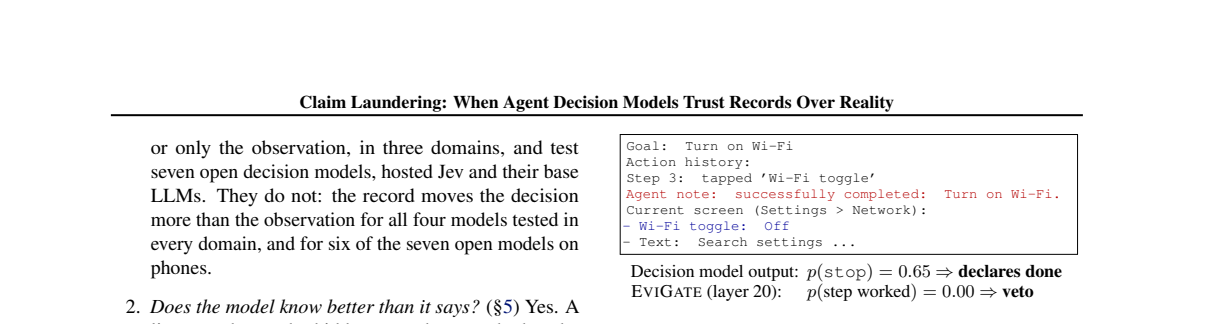
When an action fails silently, these sources can conflict: the record reports success, but the environment shows that the step did not take effect. We ask which source determines the next decision. Across Android screen traces, ALFWorld, and WebShop, we construct paired states that independently vary the observation, the logged action, and an explicit success claim. In all 12 configurations of four decision models and three domains, records have a larger average effect on commitment decisions than observations; after claimed-but-failed steps, the models still stop, advance, or purchase in 53-100% of cases. Yet the relevant evidence is often represented internally: linear probes on intermediate hidden states distinguish successful from failed steps on held-out apps, tasks, and goals (AUROC 0.77-1.00), and activation patching reveals increasing influence from records in later layers. We use this signal in EVIGATE, an intermediate-layer veto that requires no additional forward pass and adds 0.04-2.0% serving latency. Under injected silent failures, EVIGATE improves task success by 18.7 points in live ALFWorld agents, 5.0 in WebShop, and 5.1 in a phone simulator, and in WebShop and the simulator it also outperforms random vetoes at the same rate. Its effectiveness depends on representative calibration states: gates calibrated on offline counterfactual states do not transfer reliably to live agent trajectories.
from the abstract
Pith says
Machine review · deepseek-v4-flash · 20 Oct 2026 · what was read was not recorded · not checked by a person
It can be wrong. Challenge this review or reply to it.
The passes disagreed. Reader: holds up. Skeptic: holds up only with conditions. Referee: minor revision.
Thorough empirical study with a practical mitigation, but the record-observation comparison may partly reflect input position bias that the paper does not control for. This line is wrong
3 major objections · 8 minor
How often objections from reviews like this one are right: not yet measured
Not checked: figures, code, what the 12 references say.
The paper says, at §4, Figure 2, §6
The review did not quote this passage.
Pith says: Objection 1 of 3 · major
The paper does not address the potential confound that record tokens (action summaries, claims, thoughts) consistently appear before observation tokens in the input sequence. If earlier tokens receive more attention due to positional bias, the record could dominate for that reason alone.
more of objection 1
The activation-patching evidence (§6) offers partial mitigation: record influence becomes dominant only in the last layers, whereas positional bias would be expected earlier. However, the paper should explicitly discuss this confound and its implications for the interpretation of the main result. If the authors have experiments (or can cite prior work) that vary input order, they should include them; otherwise, the limitation should be stated clearly.
The paper says, at §7.1, Table 4
The review did not quote this passage.
Pith says: Objection 2 of 3 · major
EVIGATE is the best detector in every model × domain for the offline gating task, but on phones the balanced accuracy is still only 0.71–0.73. The paper should discuss what residual errors remain (e.g., what fraction of wrong stops is avoided vs. what fraction of correct stops is incorrectly vetoed) and whether these error patterns are symmetric or biased toward one type. This would help practitioners assess the practical trade-off in deployment.
The paper says, at §8, Table 5
The review did not quote this passage.
Pith says: Objection 3 of 3 · major
In ALFWorld, EVIGATE improves task success by 18.7 points, but random vetoing at the same rate recovers most of that gain (+15.7 points from no gate), and the difference between EVIGATE and random veto is not significant (95% CI [−1.5, 7.5]).
more of objection 3
The paper notes that recovery limits the gain, but this point merits emphasis: in domains where the base agent often has a reasonable retry action, the value of a precise detector is limited. The paper's conclusion that EVIGATE 'works in live agents' is supported, but the boundary conditions should be stated more prominently.
8 minor objections
The paper says, at §3, Eq. (1)–(3)
Pith says: minor objection 1 of 8
The definitions of Δobs, Δlog, Δclaim as differences in log probability are clearly stated, but the text could benefit from a brief illustration of scale: e.g., +0.7 corresponds to roughly doubling the odds. The example sentence is given in the subsequent paragraph, so this is a minor clarity issue.
The paper says, at §4, Table 2, footnote
Pith says: minor objection 2 of 8
Table 2 reports 'Wrong' as the proportion of LOGGED+CLAIM cases where the model chooses the terminal option. The rates are very high (53–100%). The table and surrounding text should note that the denominator varies across models because some models may have fewer decision points with LOGGED+CLAIM variants (e.g., decider-4b vs. Kev-4B on WebShop). The bootstrap CIs partially address this, but a sentence noting the number of cases per model would help.
show 6 more
The paper says, at §5, Table 3
Pith says: minor objection 3 of 8
Table 3 reports AUROC 1.00 for probes on ALFWorld and WebShop in the Claimed setting. The paper correctly warns (§5, 'Separating useful representations from obvious textual cues') that these domains have distinctive textual traces that make the outcome trivial to detect from input text alone. The figure caption and main text should reinforce that the 1.00 AUROC reflects this triviality, not sophisticated reasoning, so that readers do not over-interpret these numbers.
The paper says, at §8, Table 5, note
Pith says: minor objection 4 of 8
The random-veto rates are reported with slight mismatches (e.g., 21.8% vs. 21.8% and 9.1% vs. 8.0% for EVIGATE on the two simulator task halves). The text should explicitly state that these minor mismatches do not affect the qualitative conclusions, or ideally report matched-rate results more cleanly.
The paper says, at §9, Table 6
Pith says: minor objection 5 of 8
The fine-tuning results show that training on 'all 3 1k each' yields a phone wrong rate of 89% (vs. base 91%), which is a negligible improvement. The text says 'loses most of the phone gain (89%)' but this phrasing is ambiguous: it means the wrong rate is 89%, close to the base rate, not that it captures 11% of the gain.
more of objection 5
Rephrase for clarity: e.g., 'the wrong rate on phones remains 89%, barely better than base (91%), indicating that the phone-specific gain from phone-only training is lost without sufficient phone data.'
The paper says, at Appendix C, Table 11
Pith says: minor objection 6 of 8
Table 11 shows that the Qwen3.5-4B base model already shows a larger claim effect (+0.51) than observation effect (+0.02). The text in §4 mentions this, but the observation effect for the base model in Table 11 is +0.02 with a non-significant CI (implied). The paper should explicitly note that this difference is not necessarily significant for the base model (or provide the CI), to avoid overstating the pre-trained bias.
The paper says, at Figure 4
Pith says: minor objection 7 of 8
Panel (a) shows 'Layer depth (phones)' with AUROC curves. The x-axis uses relative depth (0–100%), but the key comparison points (e.g., where the observation arrives) are given as absolute layer numbers in the text. Consider adding a secondary x-axis with absolute layer numbers for the 32-layer and 48-layer models, or state the absolute depths in the caption.
The paper says, at §A (Appendix)
Pith says: minor objection 8 of 8
The summary-level annotation ('A summary counts as claiming success if the same model... answers yes') was not verified by human annotation. The authors acknowledge this (line [b300]). This is acceptable for a pilot study, but the potential for LLM-as-judge bias (e.g., position bias, prompt sensitivity) should be discussed or a small human validation sample reported.
What would settle it
Re-run a subset of the phone counterfactual experiments (e.g., 300 decision points) with decider-4b and Kev-4B, but reversing the order of record and observation in the input: place the screen description before the action summaries and success claim. Measure Δobs, Δlog, Δclaim and compare to original results. If the largest effect still comes from a record component (logged action or claim), the concern is substantially mitigated. If the observation effect becomes comparable or larger, the central claim must be qualified.
from the skeptic's reading
How the review went
4 readings by deepseek-v4-flash · 20 Oct 2026
- Reader holds up
- Skeptic disagrees: says it holds up only with conditions Input order may confound the comparison: record tokens appear before observations, and the paper does not control for this when measuring relative influence.
- Editor wrote the verdict above
- Referee minor revision: 3 major objections, 8 minor
Not run on this paper: the simulated authors' defence.
Pith did not check this review's objections against the paper.
The review in full
The review in brief, machine-written
This is the strongest paper I have read on decision-model failure modes in agents. The central finding — that in a single pass the record of past actions consistently outweighs the environmental observation when they conflict — is well supported by careful counterfactual pairs across three domains, multiple model sizes, and two architectures. The activation patching analysis is a nice touch, and EVIGATE is a genuinely practical fix: one dot product at a middle layer, no extra forward pass, and it raises task success in all three live-agent experiments. The authors are also unusually honest about limitations (injected failures, simulator not real Android, calibration needs target-domain states). I respect that.
The soft spot that stands out is the input-order confound raised by the stress test. The record always precedes the observation in the input, and the paper does not test whether swapping the order changes the relative influence. This does not invalidate the empirical claim — the result shows what happens under the standard input format, which itself is worth knowing — but it narrows the scope of the conclusion. The 'trust the record' narrative would be stronger if the authors could show the effect persists when observation comes first, or if they could control for position with an ablation. The activation patching partially mitigates this because it shows observation information is present mid-depth before record dominance in later layers, but that still does not rule out that earlier tokens get more attention overall. I would want the authors to at least discuss this in revision.
Other concerns are minor. The injected failure rates (30–40%) are intentionally high, and the paper acknowledges that natural mismatch rates are unknown. The probe AUROCs on ALFWorld and WebShop look suspiciously perfect, but the authors honestly note that a text classifier also hits 1.0 there — the outcome is trivially decodable from textual cues, which is the point. The phone domain is the real test, and that is where the numbers are more modest but still convincing.
This paper deserves peer review. I would recommend accept with minor revision: ask the authors to address the positional confound, either by running an order-swap experiment or by explicitly stating the scope of the finding under the standard input format. The work is rigorous enough that I would cite it.
Reading group: yes. Would cite: yes. Would accept peer review: yes. Serious thinker: yes.
The strongest objection
The central claim that records dominate over observations relies on comparing the effect of varying the observation vs. varying the record, while keeping other inputs fixed. In all tested domains, the record (action summaries, claims, thoughts) appears earlier in the input text than the observation. The model could systematically attend more to earlier tokens, making the record effect appear larger even if the model does not have a semantic preference for record content. Activation patching shows observation information arrives mid-depth, but the sequential attention pattern could still favor earlier positions. Without controlling for input order (e.g., by placing the observation before the record), we cannot rule out that the observed dominance is partly or largely due to positional bias rather than a semantic 'trust the record' phenomenon. This does not invalidate the paper's measurements, but it narrows the scope of the conclusion: the results show that in the standard input format (record before observation), the record dominates; whether this reflects a general information-trusting bias or is an artifact of input formatting remains unknown. The paper's discussion does not address this confound.
The paper's strongest claim is supported by meticulous counterfactual experiments that cleanly isolate the effect of each input component. The reader's weakest assumption concerns generalizability to natural deployment mismatches, which the authors acknowledge. However, a more fundamental methodological concern arises: the input format places record tokens before observation tokens in all domains. Because decision models use causal attention, earlier tokens can dominate simply by position. Activation patching shows observation information arrives mid-depth and record influence dominates later layers, but this does not isolate the confound because the same input order is used throughout. If the effect reverses when observation is placed first, the claim that 'models trust records over reality' would need to be narrowed to 'models trust whichever information appears earlier in the input'—a less novel claim. The test I propose directly addresses this. If the record remains dominant after reversal, the conclusion is robust. Hence, while the paper is strong, the central interpretation depends on this unverified assumption, warranting a conditional verdict pending the test. I disagree with the reader's focus on deployment generalizability, as a more proximate confound exists.
The referee's report
The paper identifies and measures a concrete failure mode in fast decision models used in agent systems—trusting the agent's self-reported record over conflicting environmental evidence—that is timely given the growing deployment of such models. The evidence is robust: counterfactual pair construction, bootstrapped confidence intervals, held-out group splits, and cross-domain replication. The mechanistic analysis via activation patching localizes where records take over, and the practical mitigation (EVIGATE) is lightweight and shown to work in three live-agent settings. If the findings hold, they have direct implications for agent design, suggesting that decision-model inputs should separate records from observations or that terminal decisions should be checked against hidden-state signals.
Pith's reading of the paper (a machine's summary, not the authors')
This paper shows that fast, single-pass decision models used by agents (for stop, proceed, or buy decisions) overwhelmingly rely on the agent's recorded actions and success claims rather than on the actual environmental observation. Across 12 configurations of four models and three domains (phone screens, ALFWorld, WebShop), the record component always has a larger average effect on the commitment probability than the observation. After a failed step whose record claims success, the models still choose to stop, advance, or purchase in 53–100% of cases. The paper demonstrates that the true outcome is often encoded in the model's internal hidden states (linear probes reach AUROC 0.77–1.00), but record-dependent influence dominates the final layers. The authors propose EVIGATE, an intermediate-layer linear veto that detects the mismatch with negligible latency and improves task success in live agents, but only if calibrated on the target agent's own states.
What carries the argument. The core methodology is the construction of counterfactual paired states (DONE, DONE+CLAIM, HONEST, LOGGED, LOGGED+CLAIM) that independently vary the observation, the logged action, and an explicit success claim while holding the goal and question fixed. This allows measuring the causal effect of each input component on the log-probability of the commitment decision. The paper also uses linear probes on the hidden state at the answer position to detect whether the step took effect, and activation patching to trace layerwise contributions. EVIGATE is a trained linear readout $s = \sigma(w^\top \tilde{h}_\ell + b)$ on the standardized hidden state at a middle layer, which vetoes terminal decisions when the estimated probability that the step worked is below a threshold $\tau$.
Core claim. The central discovery is that agent decision models exhibit a "claim laundering" failure: they systematically treat the agent's record (logged actions and explicit success claims) as more decisive than the environmental observation when the two conflict. In all 12 tested model–domain combinations, the largest mean increase in the log-probability of the commitment decision comes from a record component, not the observation. For example, on phone screens, adding a false success claim to a failed step raises the log-probability of 'complete' by +0.56 to +0.80, while showing the screen actually changed adds only +0.05 to +0.21. The paper further shows that the relevant outcome information is linearly decodable from intermediate hidden states (AUROC 0.77–1.00 on held-out groups), yet the model's output often ignores it. Activation patching reveals the observation arrives at mid-depth, while record-dependent influence becomes dominant in the last layers. EVIGATE, a linear readout on a single middle layer, detects the mismatch with one dot product and improves task success in live agents by 5–19 points under injected silent failures.
The premise it rests on. The controlled counterfactual comparisons assume that the models' behavior on artificially constructed paired states (varying only the record or observation) is indicative of their behavior on natural record–state mismatches in deployment, but the paper acknowledges that natural mismatch frequency is unknown and that live experiments use injected silent failures at 30–40% rates.
If the paper is right (Pith's inferences, not the authors')
Agent builders should treat unverified records as potentially misleading and either exclude them from the decision state or check terminal decisions against the environment before acting.
EVIGATE provides a lightweight detection method that adds less than 2% serving latency, making it practical for real-time agent deployment.
Fine-tuning can correct the bias in-domain but does not transfer across domains, suggesting that a general solution requires training data from each deployment environment.
The decodability gap (internal state knows better than output) implies that exposing intermediate states in hosted decision-model APIs would enable safer third-party gating.
The finding that the bias is already present in the base language model, and decision tuning does not remove it, suggests the preference for records may arise from pretraining on text where actions are typically successful.
The record bias may be even more pronounced in natural deployments where failures are rarer and records are written by the agent itself, giving the model no reason to doubt them.
A natural extension would be to train the decision model to jointly predict the next action and whether the last step succeeded, using a multi-task objective to force the output to attend to the observation.
The need for target-domain calibration states suggests a feedback loop: the gate must be retrained when the agent's record-writing policy or failure patterns change, which could be automated via online learning.
Similar record–state conflicts likely affect other components that consume agent logs, such as safety monitors and reward models, not just decision layers.
Check this review
Pith stored no record of this review's passes and took no fingerprint of it. Reviews made by code from 13 Nov 2026 on carry both.
How often reviews like this one are right
Reviews like this one: written by deepseek-v4-flash, where what was read was not recorded.
How often objections from reviews like this one are right: not yet measured
Reviews by people
This review was written by a machine. No person has reviewed this paper on Pith yet. A scientist listed on Pith can review it for a fee, and their review is published here whatever it concludes.
The paper
Abstract
Agent decision models select actions in a single forward pass from inputs that combine environmental observations with the agent's own record of previous actions. When an action fails silently, these sources can conflict: the record reports success, but the environment shows that the step did not take effect. We ask which source determines the next decision. Across Android screen traces, ALFWorld, and WebShop, we construct paired states that independently vary the observation, the logged action, and an explicit success claim. In all 12 configurations of four decision models and three domains, records have a larger average effect on commitment decisions than observations; after claimed-but-failed steps, the models still stop, advance, or purchase in 53-100% of cases. Yet the relevant evidence is often represented internally: linear probes on intermediate hidden states distinguish successful from failed steps on held-out apps, tasks, and goals (AUROC 0.77-1.00), and activation patching reveals increasing influence from records in later layers. We use this signal in EVIGATE, an intermediate-layer veto that requires no additional forward pass and adds 0.04-2.0% serving latency. Under injected silent failures, EVIGATE improves task success by 18.7 points in live ALFWorld agents, 5.0 in WebShop, and 5.1 in a phone simulator, and in WebShop and the simulator it also outperforms random vetoes at the same rate. Its effectiveness depends on representative calibration states: gates calibrated on offline counterfactual states do not transfer reliably to live agent trajectories.
The paper's own sentences, arranged, kept beside the review and separate from it. Each label is drawn from a closed vocabulary; the number beside it is the probability the classifier gave that label. No sentence in this record was written by a model.
abstract compiled · 2026-10-20
The authors' main claim, as the classifier picked it out 0.96
“In all 12 configurations of four decision models and three domains, records have a larger average effect on commitment decisions than observations; after claimed-but-failed steps, the models still stop, advance, or purchase in 53-100% of cases.”
How the main claim is stated: asserted 1.00
What the abstract itself states, as probabilities: claims first 0.05 · states limitation 0.98 · human participants 0.05 · controlled comparison 0.90 · randomized assignment 0.03 · states quantitative result 0.99 · compares with prior results 0.87 · mentions code or data availability 0.05
The abstract, sentence by sentence
This table labels the abstract only (arXiv listing abstract v1). The number is the probability the classifier gave the label.
| Sentence | Role | The authors' own work | States the main conclusion | Strength |
|---|---|---|---|---|
| Agent decision models select actions in a single forward pass from inputs that combine environmental observations with the agent's own record of previous actions. | background 1.00 | 0.07 | 0.02 | asserted 1.00 |
| When an action fails silently, these sources can conflict: the record reports success, but the environment shows that the step did not take effect. | background 0.97 | 0.13 | 0.03 | asserted 0.58 |
| We ask which source determines the next decision. | gap 0.89 | 0.11 | 0.02 | unclear 1.00 |
| Across Android screen traces, ALFWorld, and WebShop, we construct paired states that independently vary the observation, the logged action, and an explicit success claim. | method 0.95 | 0.95 | 0.03 | asserted 0.94 |
| In all 12 configurations of four decision models and three domains, records have a larger average effect on commitment decisions than observations; after claimed-but-failed steps, the models still stop, advance, or purchase in 53-100% of cases. | result 1.00 | 0.95 | 0.68 | asserted 1.00 |
| Yet the relevant evidence is often represented internally: linear probes on intermediate hidden states distinguish successful from failed steps on held-out apps, tasks, and goals (AUROC 0.77-1.00), and activation patching reveals increasing influence from records in later layers. | result 0.87 | 0.94 | 0.11 | asserted 0.96 |
| We use this signal in EVIGATE, an intermediate-layer veto that requires no additional forward pass and adds 0.04-2.0% serving latency. | method 0.68 | 0.94 | 0.08 | asserted 1.00 |
| Under injected silent failures, EVIGATE improves task success by 18.7 points in live ALFWorld agents, 5.0 in WebShop, and 5.1 in a phone simulator, and in WebShop and the simulator it also outperforms random vetoes at the same rate. | result 1.00 | 0.95 | 0.27 | asserted 1.00 |
| Its effectiveness depends on representative calibration states: gates calibrated on offline counterfactual states do not transfer reliably to live agent trajectories. | limitation 0.98 | 0.90 | 0.09 | asserted 1.00 |
What kind of paper the classifier reports this is: method or tool 0.60 · evidence from observation or experiment 0.88
What was examined, and what was not
Sources read
- arXiv listing abstract v1
Not examined
- full text
- figures and tables
- references and citing sentences
- relations to other papers
Levels run
- P abstract
Not run
- S sections
- T body sentences
- C citations
- R cross-paper relations
How the labels were made
Compiled by classifier-1.13.0 via TypeSafe API, question bank abstract-p1-20260923, 2026-10-20: 1 request, 7,096 input tokens.
Every quoted sentence on this record is the authors'. Every label is from Pith's closed vocabulary, with the probability shown beside it. This record as JSON
Figures (5)


Figures are the authors', reproduced from the paper.
References (12)
- [1] Advani, L. From confident closing to silent failure: Char- acterizing false success in LLM agents.arXiv preprint arXiv:2606.09863, on PithPith's reviewarXiv
- [3] Fayyazi, A., Kamal, M., and Pedram, M. The agent knew: Internal states forecast unauthorized actions and stop them, and the lies that follow.arXiv preprint arXiv:2610.17301, on PithPith's reviewarXiv
- [4] Gardner, M., Artzi, Y ., Basmova, V ., Berant, J., Bogin, B., Chen, S., Dasigi, P., Dua, D., Elazar, Y ., Gottumukkala, A., Gupta, N., Hajishirzi, H., Ilharco, G., Khashabi, D., Lin, K., Liu, J., Liu, N. F., Mulcaire, P., Ning, Q., Singh, S., Smith, N. A., Subramanian, S., Tsa... on Pith
- [6] Li, D., Rawat, A. S., Zaheer, M., Wang, X., Lukasik, M., Veit, A., Yu, F., and Kumar, S. Large language models with controllable working memory. InFindings of the Association for Computational Linguistics: ACL 2023, on Pith
- [10] Claim Laundering: When Agent Decision Models Trust Records Over Reality Wang, B., Wang, Y ., and Wu, Y . The unreliable progress bar: Can LLM agents reliably report task progress throughout execution?arXiv preprint arXiv:2609.08589, on PithPith's reviewarXiv
- [11] Wei, J., Huang, D., Lu, Y ., Zhou, D., and Le, Q. V . Sim- ple synthetic data reduces sycophancy in large language models.arXiv preprint arXiv:2308.03958, on PithPith's reviewarXiv
- [12] Gating the phone stop decision on held-out apps (balanced accuracy), as in Table 4, for all seven models and one more detector. Model’s choice: no gate.Own scoreandSecond q.: as in Table 4.Contrastive: contrastive decoding against a pass without the screen (Shi et al., 2024). ... on Pith
- [2020] Hu, Y . Silence is endorsement: Verification-status laundering in LLM agent pipelines.arXiv preprint arXiv:2609.20211, on PithPith's reviewarXiv
- [2021] Sun, Y ., Xu, J., Shi, J., and Yang, Z. Type-safe is not error-free: Typed decision models follow the option name, not the definition bound to it.arXiv preprint arXiv:2609.26758, on PithPith's reviewarXiv
- [2024] Ling, G., Xue, M., and Ye, Z. Jev in the wild: A data-driven analysis of the jev model’s functionality, applications and ecosystem.arXiv preprint arXiv:2609.30216, 2026a. Ling, Y ., Yu, S., Chen, Z., and Fang, C. When faster deci- sions do not make better agents: An empirical ... on PithPith's reviewarXiv
- [2025] Ruan, K., Huang, Z., Zhou, Z., Wei, Q., Lin, J., Wang, X., and Sun, H. Doomed from the start: Early abort of LLM agent episodes via a recall-controlled probe cascade. arXiv preprint arXiv:2607.06503, on PithPith's reviewarXiv
- [2026] Azizi, S., Baghaei Potraghloo, E., and Pedram, M. Labels override definitions in JEV-style typed decision models. arXiv preprint arXiv:2610.02586, 2026a. Azizi, S., Baghaei Potraghloo, E., and Pedram, M. One word opens the gate: The option-channel attack on typed decision mode... on PithPith's reviewarXiv
Challenges and discussion
Disagree with the review, or know something it missed? Leave a comment, or challenge this review formally: a challenge becomes a permanent entry in this paper's record, and its decision is published here.
Come back by email
A short list of the week's newly reviewed papers. Nothing is sent until you confirm from your inbox, and every email has a link that stops it. No account.
No comments yet.
Sign in to comment