Information Retrieval · arXiv:2610.24672 v1 · submitted 17 Oct 2026 · 40 references
MemRevise: A Self-Revising Memory for Conversational Search
The paper says
“In conversational search, users correct misun-derstandings, revise their requests and return to earlier topics, so part of the history no longer reflects what they want. Existing benchmarks do not isolate such turns.”
more of the abstract
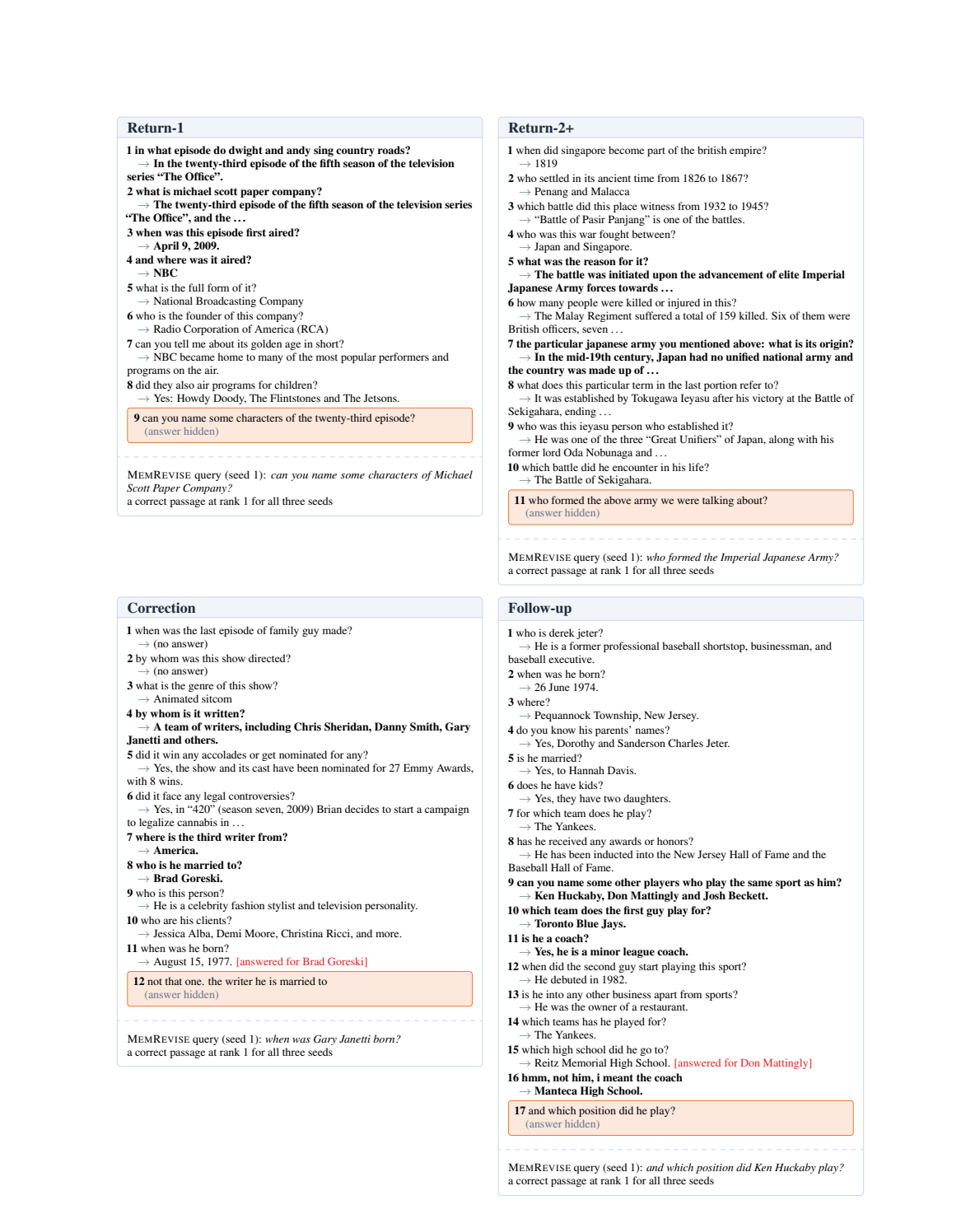
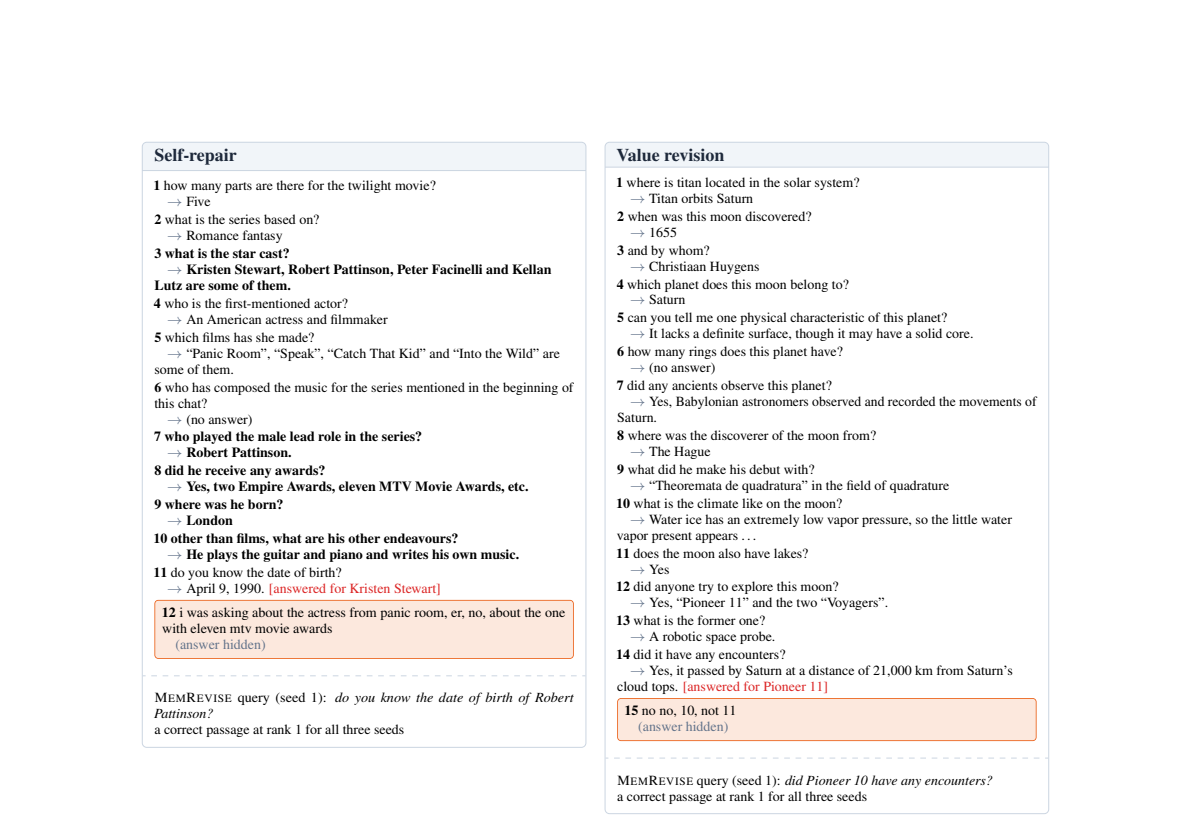
Current search methods either re-read the history or keep a record of every turn, and none of them marks earlier content as dropped. We introduce CONVREVISE, a benchmark of 4,429 test questions in six tiers of returns and revisions over TopiOCQA, CORAL and OR-QuAC. We also propose MEMREVISE, which combines a revisable memory graph, a 3B writer distilled from teacher memories, and a search guided by the memory. The writer reads each turn once and adds a node that records its topic, its facts and the operations it performs, such as adding, abandoning or reactivating a topic. Topic status follows from these operations, so a dropped topic keeps its facts and can be restored. With a frozen retriever, MEMREVISE reaches a mean MRR@10 of 0.701, against 0.589 for the best competitor, ConvSearch-R1-FT, and 0.617 for a writer distilled the same way without the memory, so the memory and the steps built on it add 0.084. MEMREVISE is significantly better on Topi- OCQA and OR-QuAC, statistically tied with prompted 32B rewriters on CORAL, and never significantly behind the strongest competitor of any tier.
from the abstract
Pith says
Machine review · deepseek-v4-flash · 20 Oct 2026 · what was read was not recorded · not checked by a person
It can be wrong. Challenge this review or reply to it.
Holds up, with conditions. Solid empirical paper on conversational search with a new benchmark and a well-ablated memory architecture; the main claims hold up under scrutiny. This line is wrong
1 major objection · 7 minor
How often objections from reviews like this one are right: not yet measured
Not checked: figures, code, what the 40 references say.
The paper says, at §3, §4.3, Limitations
The review did not quote this passage.
Pith says: Objection 1 of 1 · major
The benchmark CONVREVISE uses GPT-5.4-mini and Claude Fable 5.1 to generate revision turns, while the teacher memories for training MEMREVISE are generated by GPT-5.4-mini and Claude Opus 5.5. This means the writer is trained on targets from the same model family used to create the test data.
more of objection 1
While this does not invalidate the relative comparisons (since all methods are evaluated on the same benchmark), it limits generalizability to human-generated corrections and revisions. The authors should add an explicit discussion of this circularity as a limitation and, if possible, provide evidence (beyond the 100-turn human evaluation) that the benchmark captures realistic revision patterns not specific to these model families.
7 minor objections
The paper says, at Abstract
Pith says: minor objection 1 of 7
Hyphenation artifact: 'misun-derstandings' should be a single word without a line-break hyphen (appears in the abstract as reproduced).
The paper says, at Table 3, CORAL Return-2+
Pith says: minor objection 2 of 7
MEMREVISE is 0.471 vs CHIQ-AD 0.504 (-0.033). The paper states this is a statistical tie. Please confirm the paired bootstrap interval and report it explicitly, as the negative difference might otherwise appear to contradict the claim of being 'never significantly behind'.
show 5 more
The paper says, at §4.5, Eq. (2)
Pith says: minor objection 3 of 7
The normalization function z(·) is described as standardising scores over the collection. Clarify whether this is a z-score normalisation computed per query or globally on the collection, and whether it uses the same statistics during training and inference.
The paper says, at Table 5, No topic repair
Pith says: minor objection 4 of 7
The ablation for 'No topic repair' reports a mean drop of -0.003 but the per-group breakdown shows -0.004 for corrections and -0.008 for follow-ups. The follow-up drop is not statistically significant (interval contains zero) but is the largest in magnitude among listed groups. A brief comment on why follow-ups benefit more would be helpful.
The paper says, at Table 8 (Competitors)
Pith says: minor objection 5 of 7
ConvSearch-R1-FT stopped at step 39/78 due to flat reward. Please report whether convergence was checked and whether an earlier checkpoint might have performed differently; the development-set choice mitigates this concern but it is worth noting.
The paper says, at Appendix F, Table 14
Pith says: minor objection 6 of 7
The error analysis is useful. Consider adding a brief discussion of how often the 'wrong topic in memory' cause is due to the writer vs the topic-repair step, to guide future improvements.
The paper says, at Throughout
Pith says: minor objection 7 of 7
The paper uses 'statistically tied' when the 95% confidence interval of the difference contains zero. This is a non-standard phrasing; consider 'the difference is not statistically significant' or 'the 95% interval does not rule out zero' for clarity.
What would settle it
Independently replicate Table 12 by training the memory-free writer from the same LoRA seed and verifying that its MRR@10 on the CONVREVISE test set falls within the reported 95% interval of [0.607, 0.627] (across seeds). This would confirm that the distillation baseline is stable and that the 0.084 gain is not driven by an unusually weak memory-free writer.
from the skeptic's reading
How the review went
4 readings by deepseek-v4-flash · 20 Oct 2026
- Reader holds up, with conditions
- Skeptic partly agrees
- Editor wrote the verdict above
- Referee minor revision: 1 major objection, 7 minor
Not run on this paper: the simulated authors' defence.
Pith did not check this review's objections against the paper.
The review in full
The review in brief, machine-written
This paper tackles a real gap in conversational search: handling user corrections, revisions, and returns that make part of the dialogue history stale. The authors contribute both a new benchmark (CONVREVISE, 4,429 questions across six revision/return tiers) and a new architecture (MEMREVISE, a revisable memory graph written turn-by-turn by a distilled 3B model). The benchmark is carefully constructed and validated with human judges. The architecture is well motivated and the experimental design is thorough: three datasets, multiple baselines (including fine-tuned versions), ablations, statistical significance tests, and an ablation with a memory-free writer that isolates the contribution of the memory (+0.084 MRR@10). The results are consistent and the central claim—that the revisable memory improves retrieval on corrective turns—is convincingly supported.
Soft spots: The teacher memories used for distillation and parts of the benchmark were generated by the same model family (GPT-5.4-mini, Claude), which could inflate absolute scores slightly. The authors acknowledge this, and it does not undermine the internal comparison since the memory-free writer and competitors also trained on this data also benefit from any patterns. More important: 81% of TopiOCQA test questions come from conversations in its training split, which could advantage methods trained on TopiOCQA. Again, the authors flag this, and the memory-free writer shares that advantage, so the relative gain is robust. The paper is up-front about both limitations.
Overall, this is a careful, reproducible piece of work. It will be of value to anyone working on conversational search, especially those interested in non-additive context handling or memory-based retrieval. The code and trained models are promised upon publication.
Recommendation: Should be sent to peer review. The experiments are comprehensive, the claims are well-supported, and the limitations are honestly stated. I would like to see the released code to verify the main results independently, but the paper as presented deserves a serious referee.
The strongest objection
No significant objection identified. The paper's central claim that the revisable memory adds 0.084 MRR@10 over a memory-free writer is supported by careful ablations, statistical tests, and comparisons with multiple baselines. The reader's concerns about circularity (same model family for teacher and benchmark) and training-test overlap are acknowledged by the authors; they affect external generalizability but do not undermine the internal validity of the comparison on CONVREVISE, because all fine-tuned methods share exposure to the same generated data. The memory-free writer, trained on the same teacher queries, also benefits from any such patterns, so the relative gain is robust within the benchmark. The paper's statistical methodology is sound and the results are reproducible across seeds.
The reader identified circularity and training-test overlap as the weakest assumptions. These are valid concerns about external generalization, but within the CONVREVISE benchmark the internal comparisons are fair: all fine-tuned methods are trained on the same teacher-generated data, and the memory-free writer isolates the effect of the memory. The ablation studies and statistical significance tests provide strong evidence for the core claim. No internal inconsistency or methodological flaw was found. Therefore the CONDITIONAL verdict remains appropriate, but no adjustment is needed based on this stress-test.
The referee's report
If the results hold, this work makes two contributions. First, it identifies a gap in existing conversational search benchmarks—turns where user intent changes non-additively—and fills it with CONVREVISE, which is carefully constructed and validated with human annotation (4.65/5 naturalness, 95% gold-passage agreement). Second, MEMREVISE demonstrates that a small (3B) model with a structured, revisable memory can match or exceed prompted 32B rewriters on this benchmark across three corpora. The ablation isolating the memory component from distillation is clean and shows that the memory contributes 0.084 MRR@10 beyond a strong memory-free baseline. The evaluation is thorough: three datasets, multiple competitors, ablation studies, statistical significance testing, and a human evaluation of the benchmark.
Pith's reading of the paper (a machine's summary, not the authors')
Conversational search methods typically treat history as additive, but users often correct misunderstandings, revise requests, or return to earlier topics. Existing benchmarks do not isolate such dynamic turns, and current systems either reread the whole history or store an append-only record with no way to mark dropped context. This paper introduces CONVREVISE, a benchmark of 4,429 test questions across six tiers of returns and revisions, and proposes MEMREVISE, a method that maintains a revisable memory graph. At each turn a 3B writer (distilled from teacher memories) adds a node recording the operations (add, abandon, reactivate, etc.), the topic, and relevant facts; topic status is derived by replaying the operations rather than predicted directly. With a frozen retriever, MEMREVISE achieves a mean MRR@10 of 0.701, outperforming the best competitor (ConvSearch-R1-FT at 0.589) by a wide margin, and the memory and its search steps provide a gain of +0.084 over a distillation-only baseline of the same 3B model.
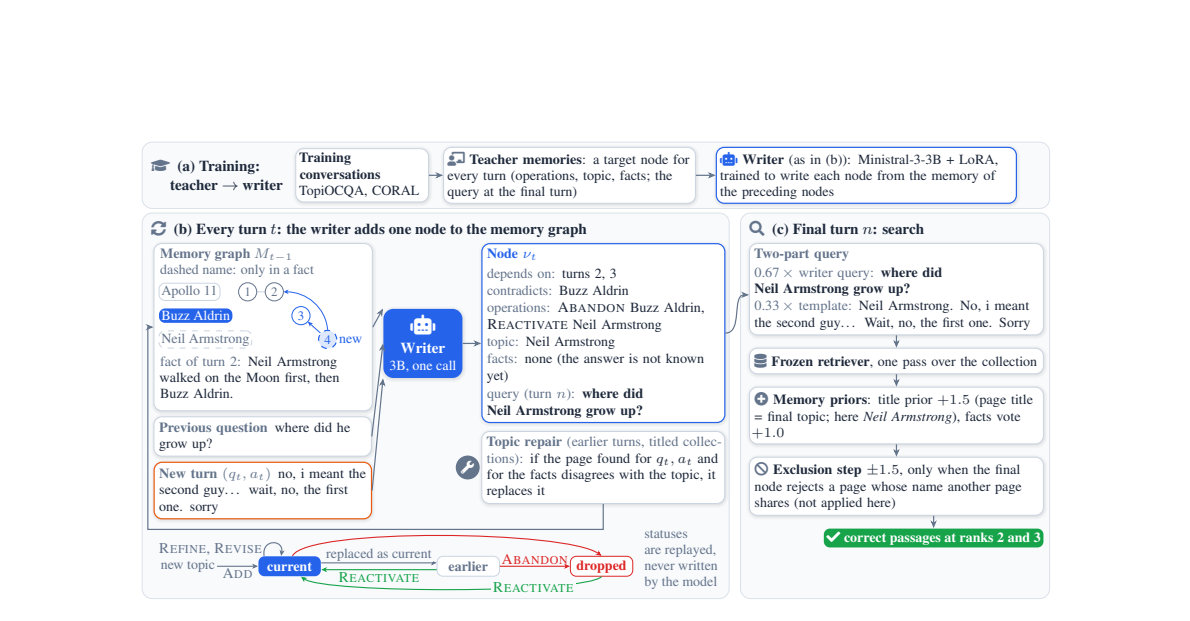
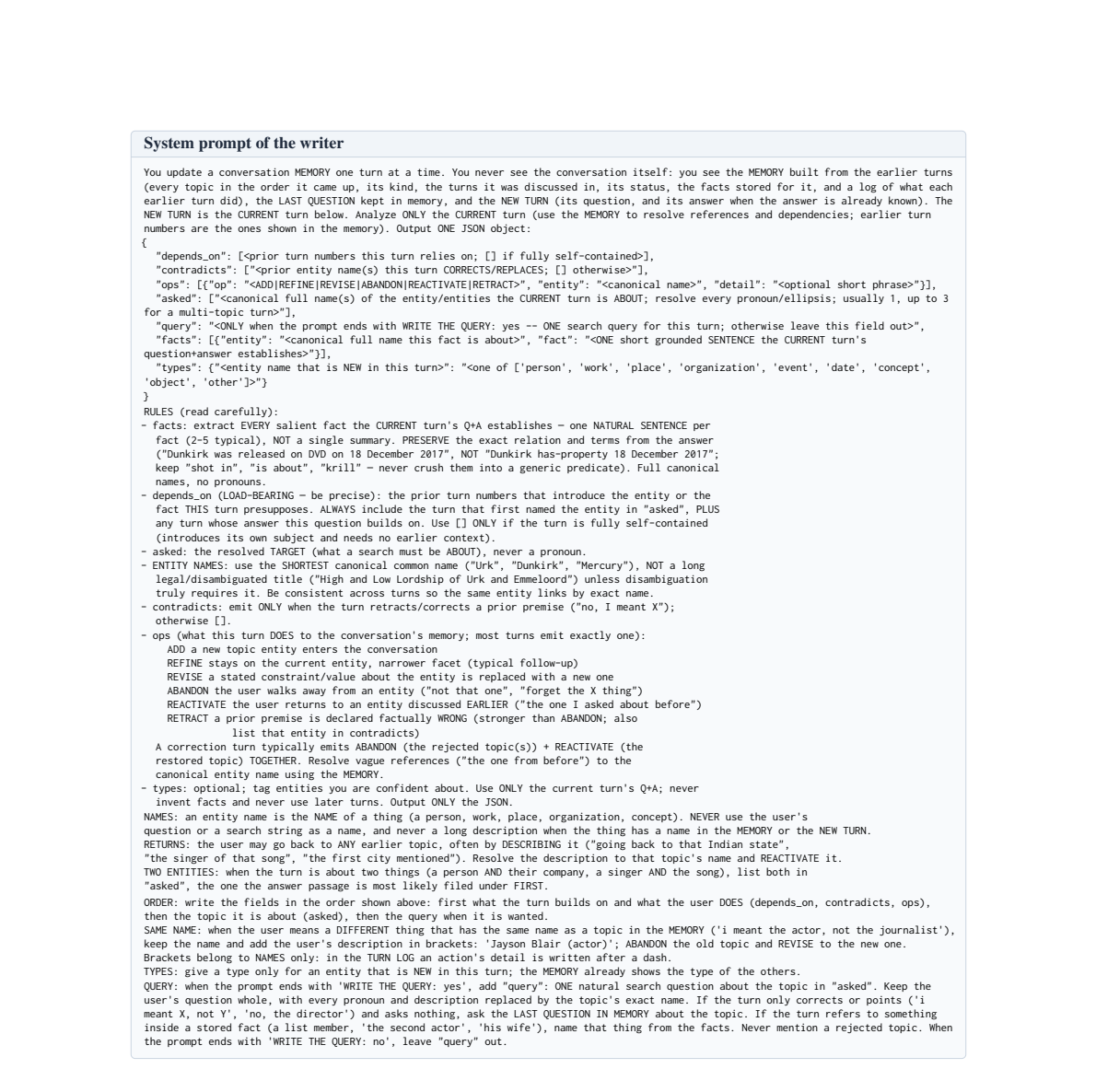
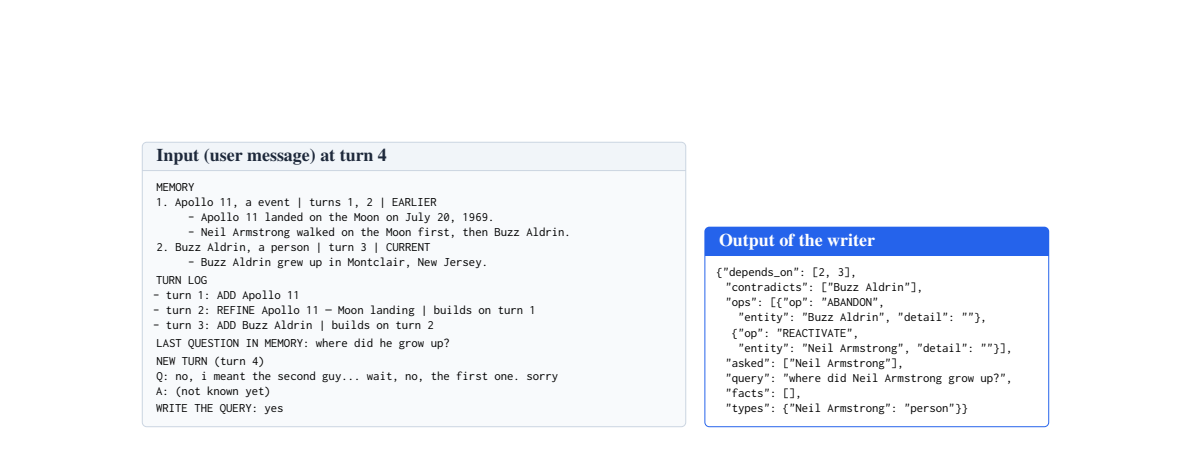
What carries the argument. The revisable memory graph is the central object. Each turn adds one node that stores the operations performed (ADD, REFINE, REVISE, ABANDON, REACTIVATE), the topic entity, and extracted facts. Topic status (CURRENT, EARLIER, DROPPED) is derived by replaying the operations in turn order, so dropped topics retain their facts and can be restored without rereading. The memory writer is Ministral-3-3B fine-tuned with LoRA on teacher-generated target nodes (produced by GPT-5.4-mini and Claude Opus 5.5). At inference, search combines a resolved writer query (0.67 weight) with a template query (0.33 weight) that foregrounds the current topic, adds a title prior and facts vote, and optionally applies an exclusion step for pages with the same surface name.
Core claim. The paper establishes that explicit representation of topic dynamics—through a graph that stores per-turn operations (ADD, REFINE, REVISE, ABANDON, REACTIVATE) and derives topic status by replaying them—enables a 3B language model to match or exceed prompted 32B methods on conversational search, especially when user intent changes. The memory is written once per turn without rereading history, and the final search query fuses a writer-generated resolved query with a template query, plus memory-derived priors (title match, fact support) and an optional exclusion step for same-name pages. On CONVREVISE, MEMREVISE scores 0.686 on TopiOCQA, 0.634 on CORAL, and 0.783 on OR-QuAC, leading on 10 of the 12 tier-level comparisons and never falling significantly behind any competitor. The gain from the memory framework over a distilled writer without memory is +0.084 MRR@10, confirming that the structured memory, not just the strong distillation, drives the improvement.
The premise it rests on. The training targets for the memory writer and part of the CONVREVISE benchmark were generated by the same language model family (GPT-5.4-mini, Claude Opus, Claude Fable); if these models share systematic biases in how they interpret corrections and returns, the writer may perform well on benchmark examples that align with those biases while failing on genuinely different human conversational patterns.
If the paper is right (Pith's inferences, not the authors')
Conversational search systems can drop the requirement to reread the full dialogue history at each turn, reducing latency and input length while retaining relevant context across corrections and topic returns.
A small distilled model (3B) with an explicit memory graph can rival or beat much larger prompted models (32B) on tasks involving dynamic user intent, suggesting that structure can compensate for raw parameter count.
The CONVREVISE benchmark provides a standardised testbed for evaluating retrieval systems on corrections, self-repairs, returns, and value revisions, enabling more targeted progress on these challenging interaction patterns.
The framework generalises to corpora not seen during training (OR-QuAC), indicating the memory graph and the distillation recipe capture transferable behaviour rather than dataset-specific patterns.
Because 81% of TopiOCQA test questions come from training conversations, the reported advantage on that set may partly reflect memorized dialogue structures. The strong performance on OR-QuAC (zero training overlap) partially mitigates this concern.
The training targets and benchmark data were generated by the same language model family (GPT-5.4-mini, Claude), creating a potential circularity: the writer may learn to match patterns the teacher produces rather than general conversational repair. Human evaluation of 100 samples (95% gold correctness) suggests the benchmark is reliable, but broader validation on fully human-annotated data would
The explicit memory operations (ABANDON, REACTIVATE, etc.) could be integrated into an end-to-end learned system rather than relying on distillation, potentially improving correctness on list-reference and ambiguous pronoun cases where the current writer sometimes picks the wrong entity.
Check this review
Pith stored no record of this review's passes and took no fingerprint of it. Reviews made by code from 13 Nov 2026 on carry both.
How often reviews like this one are right
Reviews like this one: written by deepseek-v4-flash, where what was read was not recorded.
How often objections from reviews like this one are right: not yet measured
Reviews by people
This review was written by a machine. No person has reviewed this paper on Pith yet. A scientist listed on Pith can review it for a fee, and their review is published here whatever it concludes.
The paper
Abstract
In conversational search, users correct misun-derstandings, revise their requests and return to earlier topics, so part of the history no longer reflects what they want. Existing benchmarks do not isolate such turns. Current search methods either re-read the history or keep a record of every turn, and none of them marks earlier content as dropped. We introduce CONVREVISE, a benchmark of 4,429 test questions in six tiers of returns and revisions over TopiOCQA, CORAL and OR-QuAC. We also propose MEMREVISE, which combines a revisable memory graph, a 3B writer distilled from teacher memories, and a search guided by the memory. The writer reads each turn once and adds a node that records its topic, its facts and the operations it performs, such as adding, abandoning or reactivating a topic. Topic status follows from these operations, so a dropped topic keeps its facts and can be restored. With a frozen retriever, MEMREVISE reaches a mean MRR@10 of 0.701, against 0.589 for the best competitor, ConvSearch-R1-FT, and 0.617 for a writer distilled the same way without the memory, so the memory and the steps built on it add 0.084. MEMREVISE is significantly better on Topi- OCQA and OR-QuAC, statistically tied with prompted 32B rewriters on CORAL, and never significantly behind the strongest competitor of any tier.
The paper's own sentences, arranged, kept beside the review and separate from it. Each label is drawn from a closed vocabulary; the number beside it is the probability the classifier gave that label. No sentence in this record was written by a model.
abstract compiled · 2026-10-20
The authors' main claim, as the classifier picked it out 0.89
“MEMREVISE is significantly better on Topi- OCQA and OR-QuAC, statistically tied with prompted 32B rewriters on CORAL, and never significantly behind the strongest competitor of any tier.”
How the main claim is stated: asserted 1.00
What the abstract itself states, as probabilities: claims first 0.27 · states limitation 0.16 · human participants 0.13 · controlled comparison 0.93 · randomized assignment 0.02 · states quantitative result 0.99 · compares with prior results 0.98 · mentions code or data availability 0.04
The abstract, sentence by sentence
This table labels the abstract only (arXiv listing abstract v1). The number is the probability the classifier gave the label.
| Sentence | Role | The authors' own work | States the main conclusion | Strength |
|---|---|---|---|---|
| In conversational search, users correct misun-derstandings, revise their requests and return to earlier topics, so part of the history no longer reflects what they want. | background 1.00 | 0.07 | 0.03 | asserted 1.00 |
| Existing benchmarks do not isolate such turns. | gap 0.99 | 0.08 | 0.02 | asserted 1.00 |
| Current search methods either re-read the history or keep a record of every turn, and none of them marks earlier content as dropped. | gap 0.83 | 0.05 | 0.03 | asserted 1.00 |
| We introduce CONVREVISE, a benchmark of 4,429 test questions in six tiers of returns and revisions over TopiOCQA, CORAL and OR-QuAC. | contribution 0.84 | 0.95 | 0.05 | asserted 1.00 |
| We also propose MEMREVISE, which combines a revisable memory graph, a 3B writer distilled from teacher memories, and a search guided by the memory. | contribution 0.70 | 0.93 | 0.08 | asserted 1.00 |
| The writer reads each turn once and adds a node that records its topic, its facts and the operations it performs, such as adding, abandoning or reactivating a topic. | method 1.00 | 0.82 | 0.03 | asserted 1.00 |
| Topic status follows from these operations, so a dropped topic keeps its facts and can be restored. | method 0.99 | 0.70 | 0.05 | asserted 1.00 |
| With a frozen retriever, MEMREVISE reaches a mean MRR@10 of 0.701, against 0.589 for the best competitor, ConvSearch-R1-FT, and 0.617 for a writer distilled the same way without the memory, so the memory and the steps built on it add 0.084. | result 1.00 | 0.96 | 0.43 | asserted 1.00 |
| MEMREVISE is significantly better on Topi- OCQA and OR-QuAC, statistically tied with prompted 32B rewriters on CORAL, and never significantly behind the strongest competitor of any tier. | result 0.99 | 0.95 | 0.53 | asserted 1.00 |
What kind of paper the classifier reports this is: method or tool 0.69 · evidence from observation or experiment 0.96
What was examined, and what was not
Sources read
- arXiv listing abstract v1
Not examined
- full text
- figures and tables
- references and citing sentences
- relations to other papers
Levels run
- P abstract
Not run
- S sections
- T body sentences
- C citations
- R cross-paper relations
How the labels were made
Compiled by classifier-1.13.0 via TypeSafe API, question bank abstract-p1-20260923, 2026-10-20: 1 request, 7,078 input tokens.
Every quoted sentence on this record is the authors'. Every label is from Pith's closed vocabulary, with the probability shown beside it. This record as JSON
Figures (6)

Figures are the authors', reproduced from the paper.
References (40)
- [1] CHIQ: Contextual history enhancement for improving query rewriting in conversational search , author=. Proceedings of the 2024 Conference on Empirical Methods in Natural Language Processing , pages= on Pith
- [2] Convgqr: Generative query reformulation for conversational search , author=. Proceedings of the 61st Annual Meeting of the Association for Computational Linguistics (Volume 1: Long Papers) , pages= on Pith
- [3] Chatretriever: Adapting large language models for generalized and robust conversational dense retrieval , author=. Proceedings of the 2024 Conference on Empirical Methods in Natural Language Processing , pages= on Pith
- [4] Convsearch-r1: Enhancing query reformulation for conversational search with reasoning via reinforcement learning , author=. Proceedings of the 2025 Conference on Empirical Methods in Natural Language Processing , pages= on Pith
- [5] Can you unpack that? learning to rewrite questions-in-context , author=. Proceedings of the 2019 Conference on Empirical Methods in Natural Language Processing and the 9th International Joint Conference on Natural Language Processing (EMNLP-IJCNLP) , pages= on Pith
- [6] Topiocqa: Open-domain conversational question answering with topic switching , author=. Transactions of the Association for Computational Linguistics , volume=. 2022 , publisher= on Pith
- [7] CORAL: Benchmarking multi-turn conversational retrieval-augmented generation , author=. Findings of the Association for Computational Linguistics: NAACL 2025 , pages= on Pith
- [8] Open-retrieval conversational question answering , author=. Proceedings of the 43rd International ACM SIGIR conference on research and development in Information Retrieval , pages= on Pith
- [9] Few-shot conversational dense retrieval , author=. Proceedings of the 44th International ACM SIGIR Conference on research and development in information retrieval , pages= on Pith
- [10] Conversational question reformulation via sequence-to-sequence architectures and pretrained language models , author=. arXiv preprint arXiv:2004.01909 , year= on PithPith's reviewarXiv
- [11] CMT-RAG: Complementary Memory Traces for Multi-turn Multi-hop RAG , author=. arXiv preprint arXiv:2607.26470 , year= on PithPith's reviewarXiv
- [12] EXCISE: Query-Side Exclusion for Late-Interaction Retrieval , author=. arXiv preprint arXiv:2608.05497 , year= on PithPith's reviewarXiv
- [13] Zhang, Wenhao and Zhang, Mengqi and Wu, Shiguang and Pei, Jiahuan and Ren, Zhaochun and de Rijke, Maarten and Chen, Zhumin and Ren, Pengjie , booktitle = on Pith
- [14] Colbert: Efficient and effective passage search via contextualized late interaction over bert , author=. Proceedings of the 43rd International ACM SIGIR conference on research and development in Information Retrieval , pages= on Pith
- [15] Chaffin, Antoine , year = on Pith
- [16] Lora: Low-rank adaptation of large language models , author=. arXiv preprint arXiv:2106.09685 , year= on PithPith's reviewarXiv
- [17] Ministral 3 , author =. arXiv preprint arXiv:2601.08584 , year = on PithPith's reviewarXiv
- [18] Qwen2.5 Technical Report , author =. arXiv preprint arXiv:2412.15115 , year = on PithPith's reviewarXiv
- [19] Deepseekmath: Pushing the limits of mathematical reasoning in open language models , author=. arXiv preprint arXiv:2402.03300 , year= on PithPith's reviewarXiv
- [20] Approximate nearest neighbor negative contrastive learning for dense text retrieval , author=. arXiv preprint arXiv:2007.00808 , year= on PithPith's reviewarXiv
show 20 more
- [21] Recor: Reasoning-focused multi-turn conversational retrieval benchmark , author=. Findings of the Association for Computational Linguistics: ACL 2026 , pages= on Pith
- [22] Mem0: Building production-ready ai agents with scalable long-term memory , author=. arXiv preprint arXiv:2504.19413 , year= on PithPith's reviewarXiv
- [23] Zep: a temporal knowledge graph architecture for agent memory , author=. arXiv preprint arXiv:2501.13956 , year= on PithPith's reviewarXiv
- [24] Context-agent: Dynamic discourse trees for non-linear dialogue , author=. Findings of the Association for Computational Linguistics: ACL 2026 , pages= on Pith
- [25] The preference for self-correction in the organization of repair in conversation , author=. Language , volume=. 1977 , publisher= on Pith
- [26] History-aware conversational dense retrieval , author=. Findings of the Association for Computational Linguistics: ACL 2024 , pages= on Pith
- [27] Longmemeval: Benchmarking chat assistants on long-term interactive memory , author=. arXiv preprint arXiv:2410.10813 , year= on PithPith's reviewarXiv
- [28] Beyond a million tokens: Benchmarking and enhancing long-term memory in LLMs , author=. International Conference on Learning Representations , volume= on Pith
- [29] Evaluating very long-term conversational memory of llm agents , author=. Proceedings of the 62nd Annual Meeting of the Association for Computational Linguistics (Volume 1: Long Papers) , pages= on Pith
- [30] Memgpt: Towards llms as operating systems , author=. arXiv preprint arXiv:2310.08560 , year= on PithPith's reviewarXiv
- [31] Beyond Continuity: Challenges of Context Switching in Multi-Turn Dialogue with LLMs , author=. arXiv preprint arXiv:2605.09268 , year= on PithPith's reviewarXiv
- [32] Multiwoz-a large-scale multi-domain wizard-of-oz dataset for task-oriented dialogue modelling , author=. Proceedings of the 2018 conference on empirical methods in natural language processing , pages= on Pith
- [33] Transferable multi-domain state generator for task-oriented dialogue systems , author=. Proceedings of the 57th annual meeting of the association for computational linguistics , pages= on Pith
- [34] Zhong, Wanjun and Guo, Lianghong and Gao, Qiqi and Ye, He and Wang, Yanlin , booktitle= on Pith
- [35] A-mem: Agentic memory for llm agents , author=. Advances in Neural Information Processing Systems , volume= on Pith
- [36] QuAC: Question answering in context , author=. Proceedings of the 2018 conference on empirical methods in natural language processing , pages= on Pith
- [37] Beyond goldfish memory: Long-term open-domain conversation , author=. Proceedings of the 60th annual meeting of the association for computational linguistics (volume 1: long papers) , pages= on Pith
- [38] Bright: A realistic and challenging benchmark for reasoning-intensive retrieval , author=. International Conference on Learning Representations , volume= on Pith
- [39] Identifying user corrections automatically in spoken dialogue systems , author=. Second Meeting of the North American Chapter of the Association for Computational Linguistics , year= on Pith
- [40] Characterizing and predicting corrections in spoken dialogue systems , author=. Computational linguistics , volume=. 2006 , publisher= on Pith
Cited by 1 Pith paper
Reviewed papers on Pith that cite this one. The full citation record
Challenges and discussion
Disagree with the review, or know something it missed? Leave a comment, or challenge this review formally: a challenge becomes a permanent entry in this paper's record, and its decision is published here.
Come back by email
A short list of the week's newly reviewed papers. Nothing is sent until you confirm from your inbox, and every email has a link that stops it. No account.
No comments yet.
Sign in to comment