Artificial Intelligence · arXiv:2610.16655 v1 · submitted 12 Oct 2026 · 26 references
Does a Hosted Decision Model Respect Irrelevant Alternatives? A Pre-Registered Test of Option-Set Dependence in Jev
The paper says
“Decision APIs that return a probability for each option are routinely used as if those probabilities were properties of the options themselves.”
more of the abstract
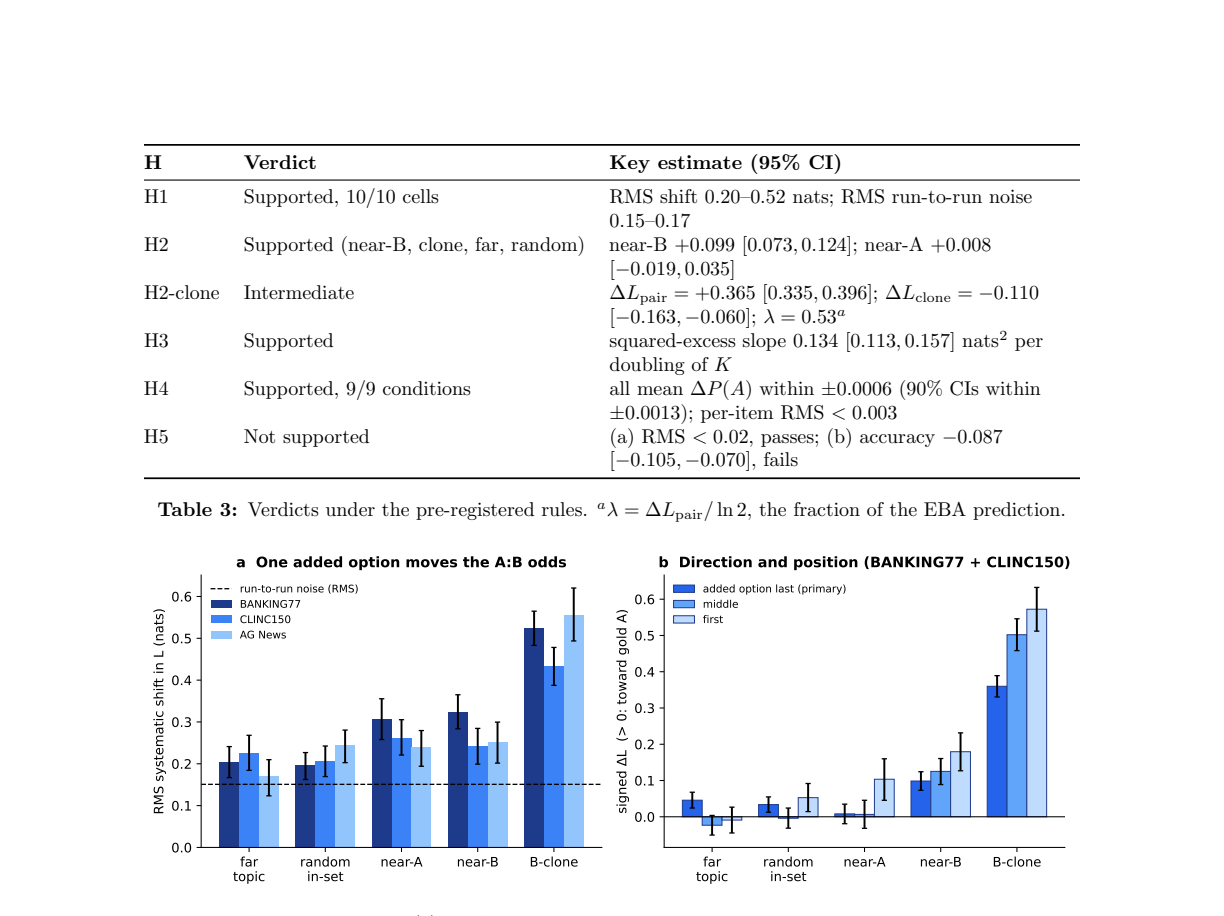
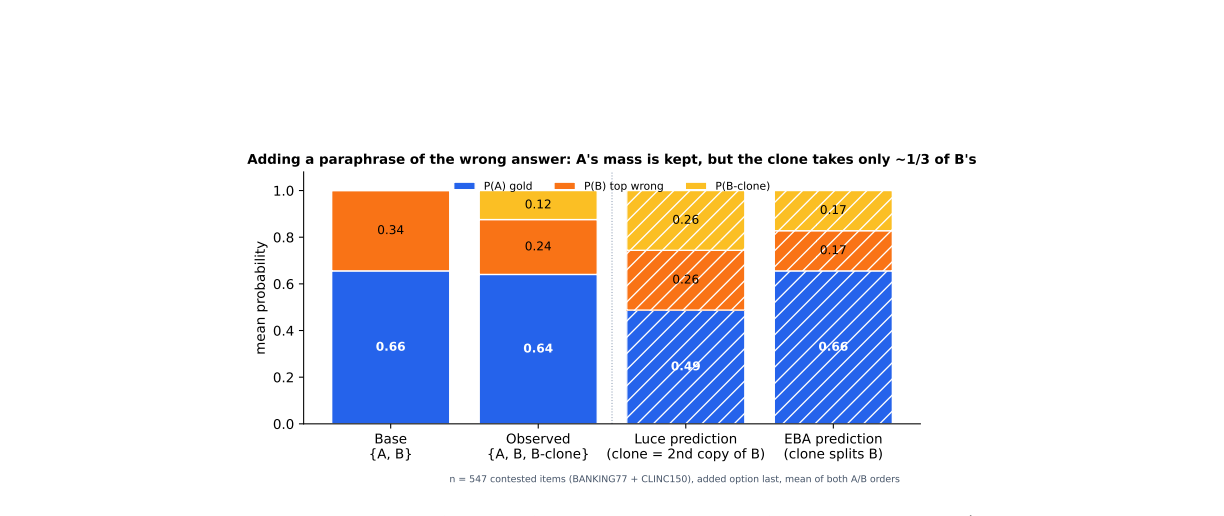
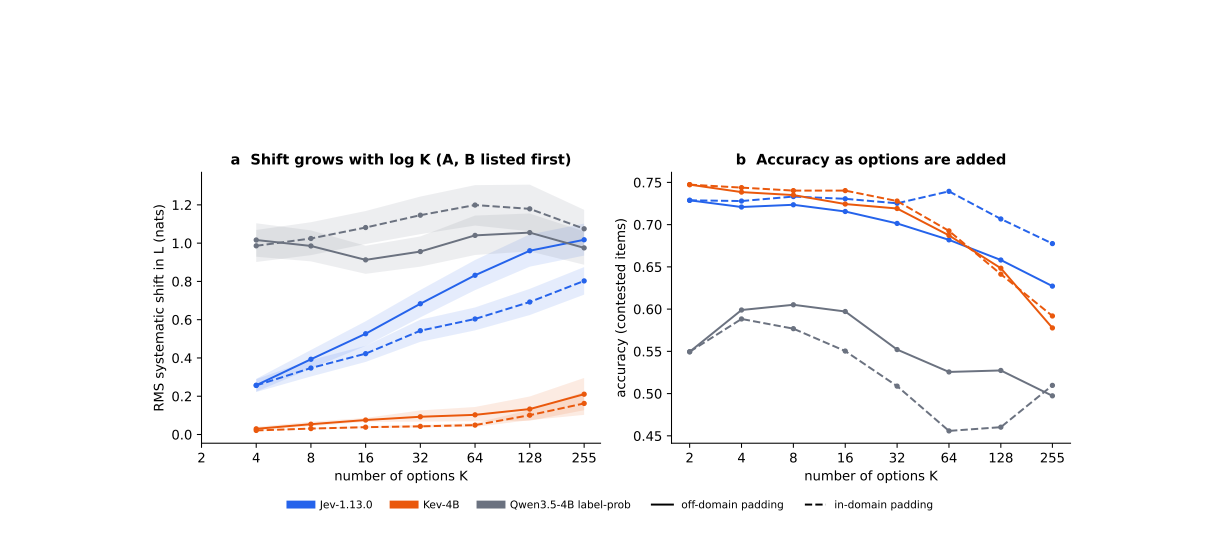
That reading is valid only if the model satisfies independence of irrelevant alternatives (IIA): adding an option that is neither the right answer nor its strongest rival should leave the odds between those two unchanged. We test this in a pre-registered study of jev-1.13.0, a hosted decision model, using 299,463 calls on intent classification (BANKING77, CLINC150) and topic classification (AG News). Every added option moves the log-odds between the gold label and the strongest wrong label: the root-mean-square systematic shift is 0.20-0.52 nats, 1.2 to 3 times the run-to-run variation, even when the added option takes at most 0.1% of the probability mass. The shifts are directional. An option similar to the wrong answer draws probability from it (+0.10 nats toward the gold label). A paraphrase of the wrong answer produces an intermediate pattern: the gold label's probability is almost conserved, but the paraphrase receives only about a third of the wrong answer's share rather than the half that strict substitution implies. The distortion grows steadily with the logarithm of the number of options, reaching about 1 nat at 255 options, and off-domain padding pushes the odds against the gold label. In contrast, questions packed into one call do not interact (bias < 0.001). Scoring each option with an independent yes/no question removes the option-set dependence but picks the right answer 8.7 points less often. Jev sits between two local baselines, an option-independent scorer and a prompt readout. Its probabilities are best read as relative to the option list they were computed over.
from the abstract
Pith says
Machine review · deepseek-v4-flash · 14 Oct 2026 · what was read was not recorded · not checked by a person
It can be wrong. Challenge this review or reply to it.
Holds up. Solid empirical measurement of IIA violation in a commercial decision API; the core result is convincing and the paper is well-executed, though the directional claims rely on partially unchecked LLM-filtered decoys. This line is wrong
4 minor
How often objections from reviews like this one are right: not yet measured
Not checked: figures, code, what the 26 references say.
4 minor objections
The paper says, at §4.2
Pith says: minor objection 1 of 4
The clone test verdict is 'intermediate' because neither Luce nor EBA equivalence passes. The text could more explicitly state that both equivalence criteria failed (not just that the pre-registered verdict is intermediate), to prevent any ambiguity about whether one model was a better fit.
The paper says, at Fig. 5 caption
Pith says: minor objection 2 of 4
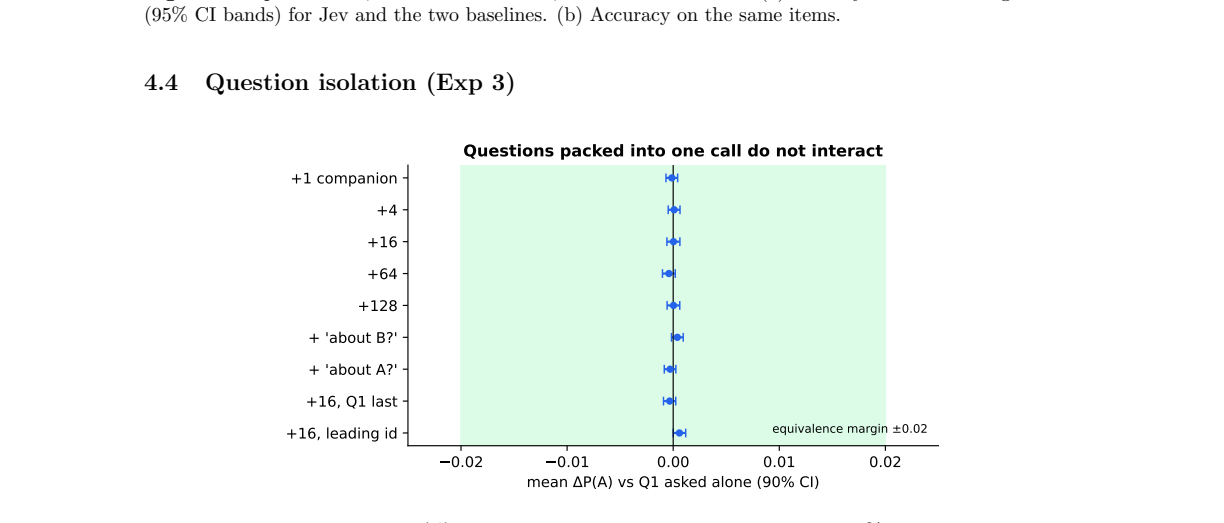
The figure caption reads 'Mean change in P(A) when other questions share the call, with 90% CIs, against the pre-registered ±0.02 equivalence margin.' Please also state that the data come from Exp 3 and that all nine conditions pass H4. The caption currently implies the conclusion but does not name the hypothesis explicitly.
show 2 more
The paper says, at §4.1
Pith says: minor objection 3 of 4
When reporting that the near-A shift (+0.008) is not detectable, the text says 'this is a null not rejected, not an equivalence'. It would be helpful to note that the 95% CI spans zero and that the pre-registered rule for H2 only requires the near-B CI to exclude zero, which it does; the near-A result is simply not significant.
The paper says, at p. 5, Table 2
Pith says: minor objection 4 of 4
The decision rule for H2-clone uses a 90% CI for ΔL_pair and a 95% CI for ΔL_clone. This asymmetry is justified in the pre-registration, but a one-sentence explanation in the main text (e.g., 'following the pre-registered thresholds') would help a reader who does not consult the registration.
What would settle it
Manually review all near-decoy items across BANKING77 and CLINC150 that were not human-reviewed but were flagged as potentially plausible correct by the LLM (approximately 15 items). For each, determine if an alternative correct label exists. Exclude and re-run the near-B signed shift analysis (C-last, pooled main sets) on the cleaned set. If the 95% CI remains above zero and the point estimate is >0.05, the claim withstands; otherwise it is weakened.
from the skeptic's reading
How the review went
4 readings by deepseek-v4-flash · 14 Oct 2026
- Reader holds up
- Skeptic agrees
- Editor wrote the verdict above
- Referee minor revision: 4 minor
Not run on this paper: the simulated authors' defence.
Pith did not check this review's objections against the paper.
The review in full
The review in brief, machine-written
This paper does what it says: it tests whether adding an irrelevant option to a choice set changes the pairwise log-odds in Jev-1.13.0, and it finds a clear yes. The pre-registered design is thoughtful—the squared-excess statistic that separates systematic shift from noise is a nice touch, and the full permutation control for position is the right way to handle ordering effects. The clone test and the log-K growth are both informative. The isolation of question-level independence (Exp 3) is a helpful negative result: the coupling is contained within a single Choice question, not across the API call.
I think the core claim (H1) is solid. Every added option shifts the odds beyond noise, and the effect survives sensitivity checks. The magnitude (0.2–0.5 nats for one option, 1 nat at 255 options) is large enough to matter for anyone who compares probabilities across different option sets. The paper states its practical implications clearly and gives concrete guidance.
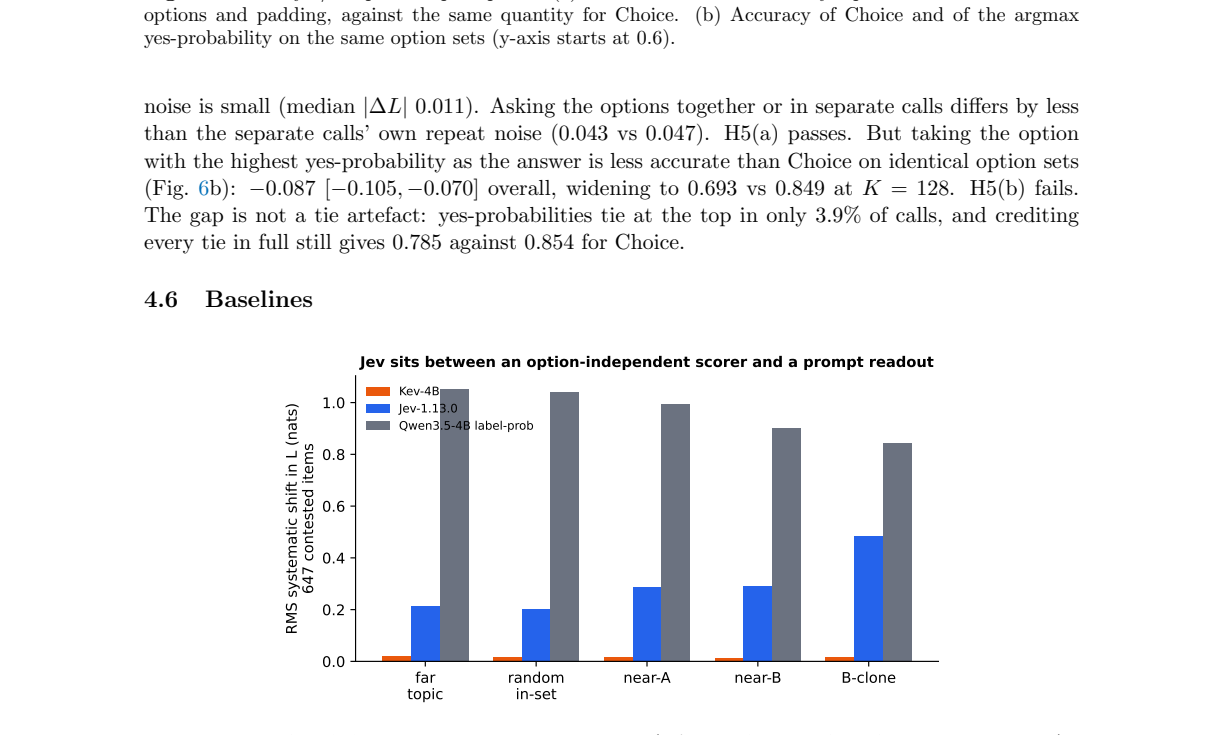
The soft spots are real but bounded. The near-decoy check was done by an LLM with no human verification; the authors note ~15 unreviewed plausible-correct near-decoys may remain. That could inflate the directional shift in H2 by maybe 0.02 nats, which is within the reported CIs but is a genuine uncertainty. The baselines (Kev-4B, Qwen label-prob) are exploratory and only run on contested items, so the positioning of Jev relative to them is suggestive rather than definitive. The one-model, one-task-family scope is acknowledged. The paused run sounds messy but the drift check is null, so I don't worry.
Who should read this? Researchers building or evaluating probability-returning APIs, and practitioners who use them. It's a clean empirical contribution, not a theoretical one, and the limitations are honestly stated. I'd send this to peer review without hesitation.
The strongest objection
The paper's directional results (H2) depend on the near-decoy conditions being valid—i.e., the added option is not itself a plausible correct answer. The authors rely on an LLM (Claude) to flag such cases, but note that about 15 unreviewed plausible-correct near-decoys may remain among contested items (Sec. 6). If these near-decoys are actually correct, then the shift toward the gold label (near-B +0.099 nats) could be inflated: the model may be correctly distributing probability to a second valid answer, not necessarily violating IIA in the intended sense. This affects only the directional claim (H2), not the primary systematic-shift claim (H1), which is supported by all decoys including far and random. The acknowledged ~2.3% contamination rate could shift the estimate by up to ~0.02 nats if the per-item effect is ~1 nat, which is within the reported confidence intervals, so the concern is real but modest.
The reader's weakest assumption correctly identifies the LLM-based near-decoy check as a potential risk to the directional H2 results. I agree that this is the single most load-bearing concern in the sense that it is the weakest link in the chain supporting the secondary claim, but the primary claim (H1, systematic shift for all decoys) is robust to it. The paper acknowledges the limitation, and even a small contamination would not overturn the main conclusion that IIA is violated. Therefore the verdict remains ACCEPT with MOBERATE confidence, unchanged.
The referee's report
If the results hold—and the pre-registered design, bootstrap CIs, sensitivity checks, and independent review suggest they do—this work provides the first direct, quantified estimate of IIA violation in a production decision API. The finding that even a near-zero-mass option changes the odds is non-trivial and has practical import for any deployment that compares or thresholds probabilities across different option sets. The paper also cleanly separates option-set dependence from question-set isolation, and evaluates a mitigation (per-option yes/no). The study is unusually transparent (frozen code, raw data available, independent review) and its main estimates are precise enough to guide engineering decisions. The scope is limited to one model version and text classification, but the measurement framework is transferable.
Pith's reading of the paper (a machine's summary, not the authors')
This paper asks whether a hosted decision model (Jev-1.13.0) respects independence of irrelevant alternatives (IIA), a property required for option probabilities to be treated as fixed properties of the options themselves. Through a pre-registered study involving 299,463 API calls on intent and topic classification datasets, the authors demonstrate that Jev systematically violates IIA: every added option shifts the log-odds between the correct label and its strongest competitor beyond the level of run-to-run noise. The shift is directional, grows with the logarithm of the number of options, and is larger for options similar to the rival or for cloned (paraphrased) options. The paper concludes that Jev's probabilities are relative to the specific option list and should not be compared across different option sets.
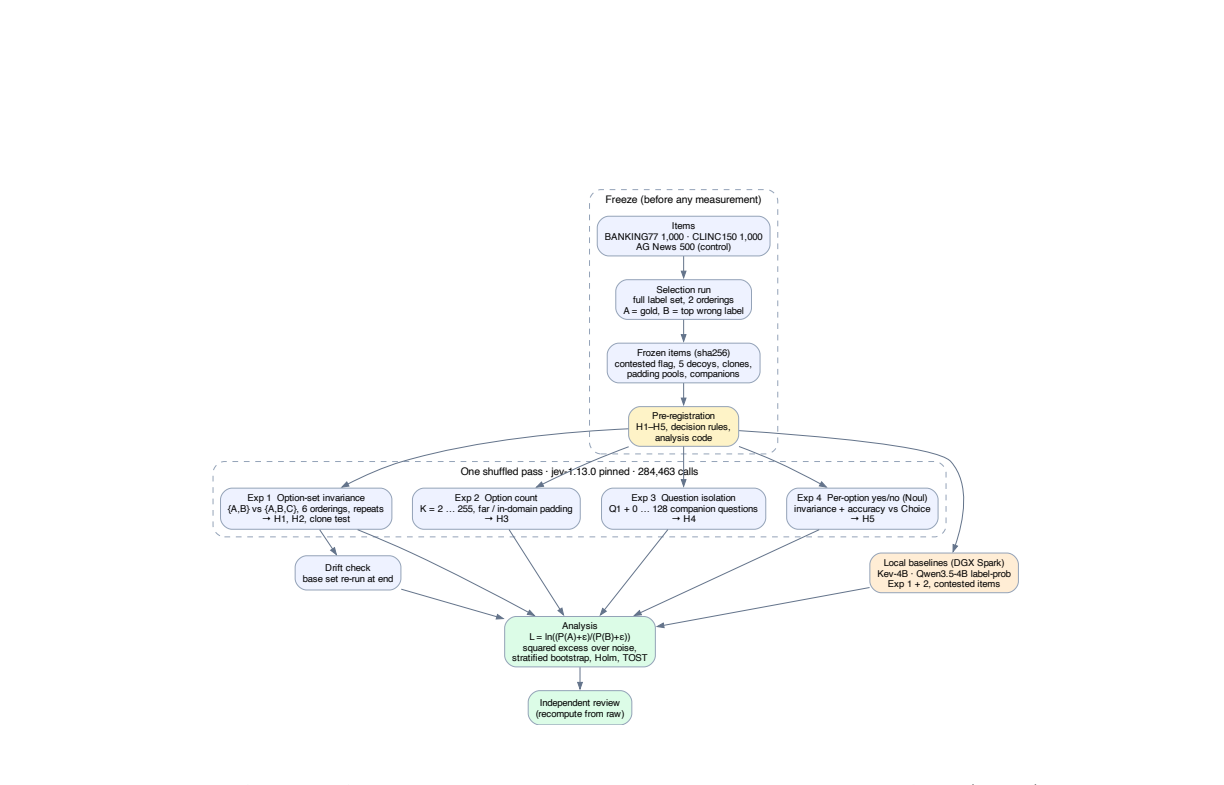
What carries the argument. The gold-vs-rival log-odds L = ln((P(A)+ε)/(P(B)+ε)) and the unbiased squared-excess statistic y = ΔL² - (n_c² + n_₂²)/2, which isolates the systematic shift from run-to-run noise. These metrics are applied across four pre-registered experiments that vary the added option type (including near-decoy and clone), the number of options (2 to 255), and the question structure (single Choice vs. per-option yes/no questions).
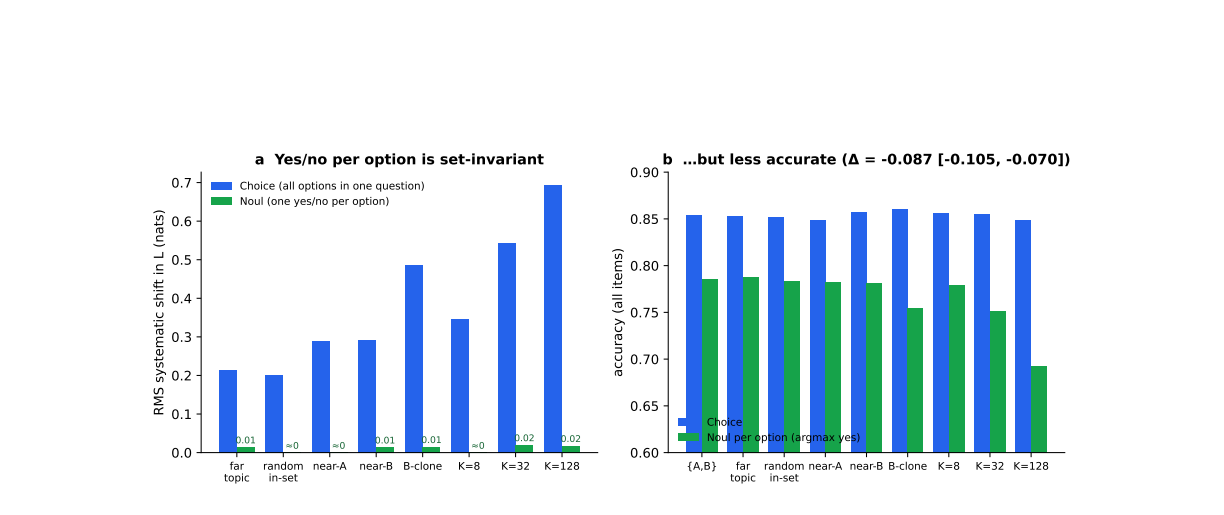
Core claim. The paper establishes that Jev-1.13.0, a hosted decision model, systematically violates Luce's choice axiom (independence of irrelevant alternatives) in a controlled, pre-registered experiment. Adding any option to a Choice question changes the log-odds between the gold label and its strongest wrong label by a root-mean-square of 0.20–0.52 nats, which is 1.2 to 3 times the run-to-run noise. The shifts are structured: a decoy similar to the wrong answer draws probability from it, moving odds toward the gold label (+0.10 nats); a paraphrase of the wrong answer preserves the gold label's mass but takes only about a third of the rival's share, falling between Luce's and elimination-by-aspects predictions. The distortion increases steadily with the logarithm of the number of options, reaching about 1 nat at 255 options, and off-domain padding pushes odds against the gold label. In contrast, multiple questions packed into one API call do not interact (mean bias < 0.001). Scoring each option with an independent yes/no question removes the option-set dependence but reduces accuracy by about 9 points.
The premise it rests on. The near-decoy definitions rely on an LLM (Claude) to flag plausible-correct near-decoys; about 15 unreviewed plausible-correct near-decoys may remain among contested items, which could slightly inflate the measured near-decoy shifts.
If the paper is right (Pith's inferences, not the authors')
Practitioners should not treat Jev's probabilities as fixed properties of options; they are relative to the option list they were computed over.
Near-duplicate options (paraphrases) should be removed because they split their original's probability mass without diluting the gold label, distorting odds.
Off-domain padding must be avoided: it shifts odds against the gold label and reduces accuracy, with effects growing with the number of padding options.
Multiple independent questions can be safely packed into one API call without measurable interaction (bias < 0.001).
Per-option yes/no questions (Noul) restore IIA invariance but at a cost of about 9 accuracy points relative to the Choice method.
The log-linear growth of distortion with option count suggests that for large option sets (e.g., >100), the systematic shift will be practically significant, potentially affecting any application that compares probabilities across calls with different list lengths.
The intermediate clone result (neither pure Luce nor pure EBA) implies that Jev's mechanism may be modeled as a softmax over embeddings that are not perfectly orthogonal; a nested logit model could capture the partial substitution pattern.
The position effect (larger shift when the added option is listed first) indicates order dependence beyond content effects, suggesting that callers should randomize option order and average over permutations when accurate pairwise odds are needed.
Check this review
Pith stored no record of this review's passes and took no fingerprint of it. Reviews made by code from 13 Nov 2026 on carry both.
How often reviews like this one are right
Reviews like this one: written by deepseek-v4-flash, where what was read was not recorded.
How often objections from reviews like this one are right: not yet measured
Reviews by people
This review was written by a machine. No person has reviewed this paper on Pith yet. A scientist listed on Pith can review it for a fee, and their review is published here whatever it concludes.
The paper
Abstract
Decision APIs that return a probability for each option are routinely used as if those probabilities were properties of the options themselves. That reading is valid only if the model satisfies independence of irrelevant alternatives (IIA): adding an option that is neither the right answer nor its strongest rival should leave the odds between those two unchanged. We test this in a pre-registered study of jev-1.13.0, a hosted decision model, using 299,463 calls on intent classification (BANKING77, CLINC150) and topic classification (AG News). Every added option moves the log-odds between the gold label and the strongest wrong label: the root-mean-square systematic shift is 0.20-0.52 nats, 1.2 to 3 times the run-to-run variation, even when the added option takes at most 0.1% of the probability mass. The shifts are directional. An option similar to the wrong answer draws probability from it (+0.10 nats toward the gold label). A paraphrase of the wrong answer produces an intermediate pattern: the gold label's probability is almost conserved, but the paraphrase receives only about a third of the wrong answer's share rather than the half that strict substitution implies. The distortion grows steadily with the logarithm of the number of options, reaching about 1 nat at 255 options, and off-domain padding pushes the odds against the gold label. In contrast, questions packed into one call do not interact (bias < 0.001). Scoring each option with an independent yes/no question removes the option-set dependence but picks the right answer 8.7 points less often. Jev sits between two local baselines, an option-independent scorer and a prompt readout. Its probabilities are best read as relative to the option list they were computed over.
The paper's own sentences, arranged, kept beside the review and separate from it. Each label is drawn from a closed vocabulary; the number beside it is the probability the classifier gave that label. No sentence in this record was written by a model.
abstract compiled · 2026-10-14
The authors' main claim, as the classifier picked it out 0.91
“Its probabilities are best read as relative to the option list they were computed over.”
How the main claim is stated: asserted 0.94
What the abstract itself states, as probabilities: claims first 0.05 · states limitation 0.78 · human participants 0.09 · controlled comparison 0.91 · randomized assignment 0.05 · states quantitative result 0.99 · compares with prior results 0.95 · mentions code or data availability 0.04
The abstract, sentence by sentence
This table labels the abstract only (arXiv listing abstract v1). The number is the probability the classifier gave the label.
| Sentence | Role | The authors' own work | States the main conclusion | Strength |
|---|---|---|---|---|
| Decision APIs that return a probability for each option are routinely used as if those probabilities were properties of the options themselves. | background 1.00 | 0.05 | 0.03 | asserted 1.00 |
| That reading is valid only if the model satisfies independence of irrelevant alternatives (IIA): adding an option that is neither the right answer nor its strongest rival should leave the odds between those two unchanged. | background 0.99 | 0.06 | 0.06 | asserted 0.98 |
| We test this in a pre-registered study of jev-1.13.0, a hosted decision model, using 299,463 calls on intent classification (BANKING77, CLINC150) and topic classification (AG News). | method 0.81 | 0.94 | 0.03 | asserted 0.98 |
| Every added option moves the log-odds between the gold label and the strongest wrong label: the root-mean-square systematic shift is 0.20-0.52 nats, 1.2 to 3 times the run-to-run variation, even when the added option takes at most 0.1% of the probability mass. | result 1.00 | 0.96 | 0.59 | asserted 1.00 |
| The shifts are directional. | result 1.00 | 0.87 | 0.08 | asserted 1.00 |
| An option similar to the wrong answer draws probability from it (+0.10 nats toward the gold label). | result 1.00 | 0.94 | 0.05 | asserted 1.00 |
| A paraphrase of the wrong answer produces an intermediate pattern: the gold label's probability is almost conserved, but the paraphrase receives only about a third of the wrong answer's share rather than the half that strict substitution implies. | result 1.00 | 0.94 | 0.05 | asserted 1.00 |
| The distortion grows steadily with the logarithm of the number of options, reaching about 1 nat at 255 options, and off-domain padding pushes the odds against the gold label. | result 1.00 | 0.94 | 0.15 | asserted 1.00 |
| In contrast, questions packed into one call do not interact (bias < 0.001). | result 1.00 | 0.92 | 0.06 | asserted 1.00 |
| Scoring each option with an independent yes/no question removes the option-set dependence but picks the right answer 8.7 points less often. | result 0.96 | 0.87 | 0.10 | asserted 1.00 |
| Jev sits between two local baselines, an option-independent scorer and a prompt readout. | result 0.58 | 0.62 | 0.07 | asserted 1.00 |
| Its probabilities are best read as relative to the option list they were computed over. | interpretation 1.00 | 0.72 | 0.79 | asserted 0.94 |
What kind of paper the classifier reports this is: empirical study 1.00 · evidence from observation or experiment 0.98
What was examined, and what was not
Sources read
- arXiv listing abstract v1
Not examined
- full text
- figures and tables
- references and citing sentences
- relations to other papers
Levels run
- P abstract
Not run
- S sections
- T body sentences
- C citations
- R cross-paper relations
How the labels were made
Compiled by classifier-1.13.0 via TypeSafe API, question bank abstract-p1-20260923, 2026-10-14: 1 request, 9,027 input tokens.
Every quoted sentence on this record is the authors'. Every label is from Pith's closed vocabulary, with the probability shown beside it. This record as JSON
Figures (7)
Figures are the authors', reproduced from the paper.
References (26)
- [1] R. Duncan Luce.Individual Choice Behavior: A Theoretical Analysis. Wiley, New York, 1959 on Pith
- [2] Gerard Debreu. Review of R. D. Luce, individual choice behavior: A theoretical analysis. American Economic Review, 50(1):186–188, 1960 on Pith
- [3] Amos Tversky. Elimination by aspects: A theory of choice.Psychological Review, 79(4):281– 299, 1972 on Pith
- [4] Joel Huber, John W. Payne, and Christopher Puto. Adding asymmetrically dominated alter- natives: Violations of regularity and the similarity hypothesis.Journal of Consumer Research, 9(1):90–98, 1982 on Pith
- [5] Itamar Simonson. Choice based on reasons: The case of attraction and compromise effects. Journal of Consumer Research, 16(2):158–174, 1989. 12 on Pith
- [6] Zihao Zhao, Eric Wallace, Shi Feng, Dan Klein, and Sameer Singh. Calibrate before use: Improving few-shot performance of language models. InProceedings of the 38th International Conference on Machine Learning (ICML), 2021 on Pith
- [7] Ari Holtzman, Peter West, Vered Shwartz, Yejin Choi, and Luke Zettlemoyer. Surface form competition: Why the highest probability answer isn’t always right. InProceedings of EMNLP, 2021 on Pith
- [8] Pouya Pezeshkpour and Estevam Hruschka. Large language models sensitivity to the order of options in multiple-choice questions. InFindings of the Association for Computational Linguistics: NAACL 2024, 2024 on Pith
- [9] Chujie Zheng, Hao Zhou, Fandong Meng, Jie Zhou, and Minlie Huang. Large language models are not robust multiple choice selectors. InInternational Conference on Learning Representa- tions (ICLR), 2024 on Pith
- [10] TypeSafe. TypeSafe API documentation: Jev decision model (SystemOne endpoint).https: //docs.typesafe.ai, 2026. Accessed 2026-10-11 on Pith
- [11] Daniel McFadden. Conditional logit analysis of qualitative choice behavior. In Paul Zarembka, editor,Frontiers in Econometrics, pages 105–142. Academic Press, 1974 on Pith
- [12] J¨ org Rieskamp, Jerome R. Busemeyer, and Barbara A. Mellers. Extending the bounds of rationality: Evidence and theories of preferential choice.Journal of Economic Literature, 44(3):631–661, 2006 on Pith
- [13] Joshua Robinson, Christopher Michael Rytting, and David Wingate. Leveraging large lan- guage models for multiple choice question answering. InInternational Conference on Learning Representations (ICLR), 2023 on Pith
- [14] I˜ nigo Casanueva, Tadas Temˇ cinas, Daniela Gerz, Matthew Henderson, and Ivan Vuli´ c. Efficient intent detection with dual sentence encoders. InProceedings of the 2nd Workshop on Natural Language Processing for Conversational AI, 2020 on Pith
- [15] Stefan Larson, Anish Mahendran, Joseph J. Peper, Christopher Clarke, Andrew Lee, Parker Hill, Jonathan K. Kummerfeld, Kevin Leach, Michael A. Laurenzano, Lingjia Tang, and Jason Mars. An evaluation dataset for intent classification and out-of-scope prediction. InProceedings of... on Pith
- [16] Xiang Zhang, Junbo Zhao, and Yann LeCun. Character-level convolutional networks for text classification. InAdvances in Neural Information Processing Systems (NeurIPS), 2015 on Pith
- [17] Nils Reimers and Iryna Gurevych. Sentence-BERT: Sentence embeddings using Siamese BERT-networks. InProceedings of EMNLP-IJCNLP, 2019 on Pith
- [18] Wenhui Wang, Furu Wei, Li Dong, Hangbo Bao, Nan Yang, and Ming Zhou. MiniLM: Deep self-attention distillation for task-agnostic compression of pre-trained transformers. InAd- vances in Neural Information Processing Systems (NeurIPS), 2020 on Pith
- [19] Jens Lehmann, Robert Isele, Max Jakob, Anja Jentzsch, Dimitris Kontokostas, Pablo N. Mendes, Sebastian Hellmann, Mohamed Morsey, Patrick van Kleef, S¨ oren Auer, and Chris- tian Bizer. DBpedia – a large-scale, multilingual knowledge base extracted from Wikipedia. Semantic Web,... on Pith
- [20] Dorottya Demszky, Dana Movshovitz-Attias, Jeongwoo Ko, Alan Cowen, Gaurav Nemade, and Sujith Ravi. GoEmotions: A dataset of fine-grained emotions. InProceedings of ACL, 2020 on Pith
show 6 more
- [21] Sture Holm. A simple sequentially rejective multiple test procedure.Scandinavian Journal of Statistics, 6(2):65–70, 1979 on Pith
- [22] Donald J. Schuirmann. A comparison of the two one-sided tests procedure and the power approach for assessing the equivalence of average bioavailability.Journal of Pharmacokinetics and Biopharmaceutics, 15(6):657–680, 1987 on Pith
- [23] Bradley Efron. Bootstrap methods: Another look at the jackknife.The Annals of Statistics, 7(1):1–26, 1979 on Pith
- [24] Jared Palmer. Kev-4b. Hugging Face modeljaredpalmer/kev-4b, snapshot 139fdd94, 2026 on Pith
- [25] Qwen Team. Qwen3.5-4B-Base. Hugging Face modelQwen/Qwen3.5-4B-Base, 2026 on Pith
- [26] Daniel McFadden. Modelling the choice of residential location. In A. Karlqvist, L. Lundqvist, F. Snickars, and J. W. Weibull, editors,Spatial Interaction Theory and Planning Models, pages 75–96. North-Holland, Amsterdam, 1978. 14 A Exp 1 per-condition detail Added option RMS s... on Pith
Cited by 4 Pith papers
Reviewed papers on Pith that cite this one. The full citation record
- Needwise: Generation-Free Conversational Recommendation from Need-Level Typed Decisions cs.AI · Nov 2026
- Entity Matching using Decision Models cs.CL · Oct 2026
- Rigel-Ladon: An Option-Count Law for a One-Pass Decision Encoder, Tested on Held-Out Option Counts and Held-Out Schemas cs.AI · Nov 2026
- Understanding Jev-Style System One Models: Does Structure Reduce Selection Bias? cs.CL · Oct 2026
Challenges and discussion
Disagree with the review, or know something it missed? Leave a comment, or challenge this review formally: a challenge becomes a permanent entry in this paper's record, and its decision is published here.
Come back by email
A short list of the week's newly reviewed papers. Nothing is sent until you confirm from your inbox, and every email has a link that stops it. No account.
No comments yet.
Sign in to comment